




Abstract
While previous research has shown that organizational social capital benefits organizations and creates performance gains, most of this work examined this relationship at the macro level based on organizational aggregates. In this article, we study organizational social capital effects at the micro level, that is, its impact on important work-related attitudes of employees within organizations. We argue that individual perceptions of organization-wide social capital matter in determining employee attitudes such as engagement and commitment. We also point to the critical role of team cognition in shaping individual perceptions of social capital in organizations. Using an organizationally representative sample of nearly 1,200 individuals from two local government organizations in North Carolina, we find support for the indirect effect of team cognition on employee work attitudes. The findings suggest that a promising way to increase the social capital of organizations is through interventions at the team level.
Keywords
Introduction
Social capital is a collective resource made up of collaboration, trust, and a sense of mission among members within organizations (Inkpen & Tsang, 2005; Nahapiet & Ghoshal, 1998). Private sector research has shown that firms with more social capital develop favorable organizational attributes that help create an advantage over other firms (Chow & Chan, 2008; de Clercq, Dimov, & Thongpapanl, 2013; Sherif, Hoffman, & Thomas, 2006; Tsai & Ghoshal, 1998). Similarly, public sector research has shown that the social capital of public organizations is positively related to organizational performance, although such an effect can be nonlinear, mediated, and disproportionally beneficial to certain client groups (Andrews, 2010; Compton & Meier, 2016; Holme & Rangel, 2012; Leana & Pil, 2006).
Despite clear evidence regarding performance effects at the macro level, little is known about the specific mechanisms through which the benefits of social capital materialize within organizations. In particular, relatively little research examines the internal organizational variables that subtract or add social capital, or how organizational social capital (OSC) affects individual outcomes that potentially improve performance. This article’s first contribution is that it sheds light on the mechanisms 1 at the micro level that may help further explain the connection between social capital and organizational performance: how OSC is linked to the work engagement and organizational commitment of members within public organizations. The article’s second contribution is that it examines the importance of teams in the process of translating social capital into positive employee-level outcomes. Work groups often constitute prisms through which employees view the entire organization, and social interactions with team members shape individual perceptions of the work environment.
Our theory is concerned with the perceptions of organization-wide social capital by individual employees who constitute our unit of analysis. Drawing on organizational behavior theories of teams and learning (e.g., Mohammed, Ferzandi, & Hamilton, 2010; Rentsch & Klimoski, 2001; Wong, 2004), we argue that team cognition with regard to OSC shapes team members’ social capital perceptions. That is, employees’ understanding of the social capital in the organization they work for is a function of the social interactions within their work groups. In a second theoretical step, we argue that individuals’ perception of the presence of OSC fosters positive work-related attitudes such as engagement and organizational commitment. In particular, we propose that social capital increases engagement and commitment because it creates intraorganizational networks that allow members to become more effective, reduces transaction costs of interactions by building trust, and creates a sense of joint purpose and organizational cohesion (e.g., Chughtai & Buckley, 2013; Kim & Rhee, 2010; Kristof-Brown, Zimmerman, & Johnson, 2005; Kroll & Tantardini, 2017).
Overall, we find empirical support for the indirect effect we propose: Team mental models of social capital are expected to magnify individual capital perceptions, which, in turn, affect individual-level attitudes such as engagement and commitment. Given the role of team cognition in forging employee attitudes, our results suggest that public managers should focus on developing collaboration, trust, and a mission focus within teams.
In what follows, we offer a definition of the OSC concept and lay out our theoretical argument in greater detail. To test our hypotheses, we use an organizationally representative sample of nearly 1,200 individuals from two local government organizations in North Carolina. After explaining our data and methods, we display the statistical findings, discuss them, and distill our major conclusions at the end.
Defining OSC
While definitions of social capital vary in breadth and depth, one common conceptual thread is the structure and quality of relationships between organizational members (Adler & Kwon, 2002; Leana & van Buren, 1999). Along these lines, social capital has been described as the goodwill that comprises sympathy, trust, and forgiveness (Adler & Kwon, 2002); networks, norms, and social trust (Putnam, 1995); and structural elements of organizations that affect relationships between people (Schiff, 1992). The quality of these relationships comprises social capital, which is construed as an attribute of organizations (Coleman, 1990; Putnam, 1995; Schiff, 1992).
Social capital serves three theoretical functions within organizations: It facilitates cooperation among organizational members (Coleman, 1990; Portes & Sensenbrenner, 1993; Putnam, 1995), it reduces the need and costs to monitor behavior (Leana & van Buren, 1999), and it speeds the transfer of knowledge (Nahapiet & Ghoshal, 1998). Given this range of functions, it is not surprising that scholars have cast OSC as an asset to organizations, joining the ranks of physical and human capital (Leana & van Buren, 1999).
Since the introduction of the social capital concept in the mid-1990s, scholars have identified three types of social capital: structural, relational, and cognitive. The structural dimension of social capital pertains to the configuration of relationships within organizations, either between individuals or groups. Nahapiet and Ghoshal (1998) originally cast structural social capital as an impersonal characteristic of networks within organizations. Andrews (2010, 2011) subsequently focused on the extent of collaborative relationships in the organization. Drawing on literature related to networks and learning, he argued that collaborative structures increase contact between individual and work units, which, in turn, expedite the flow of organizational information (Kogut & Zander, 1996), hasten organizational learning and knowledge accumulation (Nahapiet & Ghoshal, 1998), and increase cooperation between organizational members (Miller, 1992).
The relational dimension of OSC focuses on the quality of relationships between actors. These relationships are built over time through interactions between individual organizational members (Nahapiet & Ghoshal, 1998). Relationships high in trust, loyalty, obligation, and identity are expected to create solidarity in the workplace (Adler & Kwon, 2002). That solidarity, in turn, is expected to loosen the flow of information, enhance cooperation, and reduce the need for monitoring (Nahapiet & Ghoshal, 1998). Ultimately, organizations high in relational capital are expected to have greater organizational commitment (Andrews, 2011), lower employee turnover (Dess & Shaw, 2001), and ultimately higher performance (Andrews, 2010).
The cognitive dimension of OSC relates to collective understandings that emerge from organizational membership. These understandings create representations on organizational phenomena that are shared by organization members, that allow for common interpretations of events and behavior, and that create systems of meaning (Nahapiet & Ghoshal, 1998). A number of organizational mechanisms are thought to inform these understandings, including mission and values (Andrews, 2010, 2011), goal clarity (Holme & Rangel, 2012), and leadership turnover (Dess & Shaw, 2001; Holme & Rangel, 2012). Cognitive social capital is theorized to reap a host of benefits for organizations, including organizational identification, a shared language for diffusing knowledge across diverse units (Nahapiet & Ghoshal, 1998), organizational stability (Holme & Rangel, 2012), and motivation for collective action (Andrews, 2010, 2011; Leana & van Buren, 1999).
The dimensions of OSC are conceptualized as distinct, but it is easy to foresee interdependencies. For example, structural capital inevitably will logically affect knowledge and learning, as certain group configurations can impede information flow and collaboration (Andrews, 2010). Structural capital has also been linked with facets of relational capital (Nahapiet & Ghoshal, 1998). While the exact linkages have not been fully mapped out, we recognize the potential interdependencies. We therefore conceptualize OSC as a hierarchical latent construct that at the first level consists of three subdimensions, which, however, share enough similarities to make up a joint social capital factor at a higher level.
A Micro Perspective of Social Capital in Organizations
Conceptual Clarifications
A micro perspective on OSC is concerned with its impact on members of the organization. If social capital benefits organizations at the macro level, then we should be able to see parallel causal mechanisms at the micro level that would help explain the macro effect (Kozlowski & Klein, 2000). In particular, we assume that there should be an effect of OSC on important work-related employee attitudes and behaviors.
In this study, we examine specific effects on employees’ work engagement and organizational commitment, and we selected these outcomes variables for three reasons: Both variables are important antecedents of organizational performance; they both tap into positive attitudes toward one’s work, yet are conceptually and empirically distinct from each other; and they can be measured using tested and validated scales (Balfour & Wechsler, 1996; Halbesleben, 2010; Hallberg & Schaufeli, 2006; Meyer, Stanley, Herscovitch, & Topolnytsky, 2002). Cumulatively then, both variables constitute promising proxies to examine the behavioral (micro-level) impact of OSC. That is, while social capital effects may not be limited to the two variables we study here, we think that social capital—if influential—should display a positive impact on employees’ engagement and commitment, and we explain the logic behind this reasoning in the section below.
At the same time, both engagement and commitment are different enough from the social capital construct, so that our hypotheses about a potential link are falsifiable. First, OSC is a collective resource that occurs at the group and organizational level, whereas commitment and engagement characterize the relationship of the employee to his or her organization, thus occurring at the individual level. Second, high levels of social capital may not always be aligned with high levels of engagement and commitment. For example, social capital can display negative organizational effects if it leads to the creation of in- and out-groups, suppresses the benefits of group diversity, or makes it more difficult for new organization members to join existing networks (e.g., Kroll & Tantardini, 2017; Morrow, 1999).
Here, we define both of our outcomes variables in more detail. Work engagement is a “persistent, positive affective-motivational state of fulfilment” (Maslach, Schaufeli, & Leiter, 2001, p. 417). Engagement is about feeling good at work and feeling charged with energy, as opposed to being burned out. Organizational commitment is the sum of affective-emotional attachment to the organizations, the awareness of the costs of leaving the organization, and the normative obligation to continue employment (Meyer & Allen, 1991). Although both concepts at least partially overlap (feeling good at work may increase commitment and vice versa), they are still conceptually and empirically distinguishable from each other, as illustrated by the fact that one can feel committed to an organization without being energized and vice versa (Hallberg & Schaufeli, 2006).
Theoretical Model
When theorizing about the impact of OSC on individuals, we need to keep in mind that there is no one, entirely agreed upon, account of the quantity or quality of social capital in an organization. Rather, the extent to which collaboration, trust, and shared values are perceived to be present may vary across teams and ultimately individuals. Hence, it is the individual perception of OSC that may explain differences in employee-level attitudes and behaviors. This is consistent with assumptions made in research about organizational climate or culture, where the perceptions by individuals, which are likely to vary within organizations, are often the unit of analysis (James, 1982; Moynihan & Pandey, 2006).
We argue that individual perceptions of OSC are a function of the perceptions of the people surrounding the individual. To make this point, we draw on the extant literatures on team mental models (Rentsch & Klimoski, 2001), transactive memory (Lewis, 2003), group learning (Wong, 2004), and strategic consensus (Knight et al., 1999). What these literatures have in common is the assumption that members of the same team tend to develop shared cognition about work tasks, teamwork processes, the environment the team operates in, as well as priorities and beliefs. While the observation that members of the same team are likely to share the same mental models seems to hold across contexts, there is variation in the development of team cognitions, which—if widely shared and mostly accurate—can yield positive performance effects (Mohammed et al., 2010).
Team members are likely to share mental models if teams are small, members had similar life experiences, and they were actively recruited to be on the team (Rentsch & Klimoski, 2001). Other factors that foster the development of team mental models include autonomy, functional communication, and members’ agreement about each other’s expertise (Lewis, 2003) as well as cross-training (Marks, Sabella, Burke, & Zaccaro, 2002). We know that stress diminishes teams’ ability to collectively encode, store, and retrieve information, which in turn may negatively affect team performance (Ellis, 2006). Group diversity makes the creation of shared cognition and understanding less likely (Knight et al., 1999). At the same time, in very cohesive groups, members’ views and experiences may be so similar that actual learning is more likely to occur outside of the group (Wong, 2004). Group think theory (Janis, 1982) makes a similar point in that groups sharing the same mental models, decision heuristics, and biases are also more prone to ignoring group-external cues and insights, often due to pressure for consensus and conformity.
Overall, we find a great deal of support for Rentsch’s (1990) seminal observation that the more employees interact with each other in groups, the more likely it becomes that they attach the same meaning to organizational events. Similarly, Willems (2016) finds that the quality of the exchanges among leadership teams in nonprofit organizations determines the convergence of their mental models. We adapt these observations to the case of OSC and argue that individual perceptions of social capital are not developed in isolation. Rather, such perceptions are likely to be influenced by the perceptions of peers surrounding the individual. That is, the degree to which an employee perceives social capital to be present is a function of not only her own experiences but also the experiences shared by her immediate peers. In a group setting, individual perceptions of social capital will be adjusted according to average team perceptions. For example, after learning of negative team perceptions about organization-wide collaboration, trust, or value congruence, an individual’s sense of OSC could be diminished. Conversely, team perceptions of high OSC may positively influence individual perceptions of collaboration, trust, and value congruence across the entire organization.
The second part of our argument is that individual perceptions of OSC explain differences in work-related attitudes such as engagement and commitment. We argue that OSC has an impact on employees through three pathways—the creation of collaborative relationships, trust, and the collective understanding of mission. This is in line with previous work showing that increases in OSC over time in a panel of federal government agencies have a positive effect on employees’ intrinsic motivation and a negative effect on turnover intention (Kroll & Tantardini, 2017).
Structural social capital, found in the collaborative relationships between employees, is expected to foster positive attachment to the job by facilitating communication and creating opportunities to get to know similar others. Structural social capital allows individuals to tap into collective resources, making it easier for the member to succeed in their organizational role (Andrews, 2010, 2011; Nahapiet & Ghoshal, 1998). Kim and Rhee (2010) find that social networks foster organizational commitment, particularly if such networks are sizable and diverse, and network partners powerful. Research also shows that proactive employees who exploit the benefits of social networks are more engaged and successful (Bakker, Tims, & Derks, 2012; Thompson, 2005).
The relational dimension of social capital is also expected to foster an employee’s positive attachment to their job. Conceptualized in previous literature as trust, relational social capital reduces the transaction costs of social interactions, fostering information sharing and horizontal learning in the process (Adler & Kwon, 2002; Nahapiet & Ghoshal, 1998). Trust is also a condition for building a sense of togetherness. Work by Chughtai and Buckley (2013) suggests that trust in managers and team members affects work engagement through the creation of identification and psychological safety. Similarly, a study set up in the public sector finds that interpersonal trust fosters affective organizational commitment, pointing to the importance of bottom-up trust building initiatives (Nyhan, 1999).
The cognitive dimension of social capital, in the collective understandings of mission, is expected to strengthen an employee’s attachment to their job (Holme & Rangel, 2012; Leana & van Buren, 1999). Employees are expected to be more engaged if they can link their tasks to the overall purpose of the organization and its higher order objectives (Erikson, 1986; Hummel, 1994). Along these lines, Shteynberg and Galinsky (2011) find that “sharing goals with similar others intensifies goal pursuit” (p. 1291), and in a meta-analysis, Kristof-Brown et al. (2005) show that person–organization fit is strongly correlated with organizational commitment.
Data and Method
Sample
The data we use to test our hypotheses were collected in 2016 by a survey questionnaire administered to the employees of (a) a city in a metropolitan area and (b) an urban city’s Department of Social Services in North Carolina. The organizations were the 10th and 11th participants in the Local Government Workplaces Initiative, a cross-organizational data collection started in 2004 to study organizational dynamics in cities and counties. We only use data from those two organizations for which the survey instrument included all questions that were relevant for our research project.
The city and the county social services department participating in this study self-selected into data collection to better understand the perspectives of their employees on a range of workplace issues. In the United States, cities provide basic functions to residents within its jurisdiction: public safety, including fire and police services; public works, which encompasses street maintenance, water delivery, and trash collection; parks and recreation; and libraries. From a workforce perspective, local governments hire both blue- and white-collar workers, with employees diverse in education (from General Educational Development [GED] to PhD) and skill sets (accountants, lawyers, engineers, trades, law enforcement, and public administrators). Departments of social services, which reside within county organizations, assist in the delivery of financial assistance and programs in support of vulnerable community members, including families, the elderly, and disabled adults. Social service professionals tend to have associate’s, bachelor’s, or master’s degrees in social work.
The research team sought the perspectives of employees throughout each organization’s hierarchy, representing an “echelon” approach of multiple informants with different organizational perspectives (Walker & Brewer, 2008). Accordingly, questionnaires were distributed to all full-time regular employees of both organizations, totaling 1,710 employees. Individuals are nested within departments and teams. Departments are the first grouping level, and teams constitute the next hierarchical grouping level within each department.
The survey process was implemented using the principles of the Tailored Design Method, featuring multiple contacts and consistent messaging with prospective research participants (Dillman, Smyth, & Christian, 2014). Each survey process began with an email from the top organizational leader to employees’ work emails expressing support for the study, encouraging voluntary participation, guaranteeing confidentiality, and allowing the survey to be completed during work hours. Within 2 weeks of the alert email, survey invitations were emailed to employee work emails with a personalized Qualtrics link. Survey invitations stressed the voluntary and confidential nature of survey participation. In the city studied, employees without ready access to a computer were given access to conveniently located computer labs, with research team members available to assist employees in navigating Qualtrics. This process yielded 1,452 usable responses, representing a sample-weighted response rate of 82% (85% for the town and 73% for the social service department). Both samples represent the population of employees in the distribution of departments, age, gender, race and ethnicity, and managerial status. 2
Measures
The exact wording of all our measures and their reliability scores can be found in the appendix. The first dependent variable—work engagement—is operationalized by four items adapted from the Utrecht Work Engagement Scale (Schaufeli & Bakker, 2003; for example, “When I get up in the morning, I look forward to going to work”). The items have been slightly adjusted to reflect the specific nature of the local government work context. Organizational commitment—the second dependent variable—was measured using four items (e.g., “I would feel guilty if I left this organization now”) developed by Meyer, Allen, and Smith (1993). Two of the commitment items reflect affective commitment and two reflect normative commitment.
We operationalized OSC as a second-order factor consisting of three first-order factors. These first-order factors reflect the three dimensions, namely, structural, relational, and cognitive OSC. Each dimension is measured using two to three items. For example, participants scored items such as “employees in my department function as a team” (structural OSC) or “employees trust supervisors to do the right thing on their behalf” (relational OSC). The item formulation followed a referent-shift consensus model (Chan, 1998), which means that the items are formulated in a way addressing respondents’ perception of their organization as a whole instead of their individual social capital. Hence, reference points for the items are not the individual level (“I trust my supervisor”) but the group level (“Employees trust their supervisor”; van Mierlo, Vermunt, & Rutte, 2008). The confirmatory factor analysis reveals a good fit of the second-order factor structure—χ²(17) = 86.2, p < .001; comparative fit index (CFI) = .97; Tucker–Lewis index (TLI) = .95; root mean square error of approximation (RMSEA) = .056; standardized root mean square residual (SRMR) = .036—and all paths in the model are significant (p < .01), with factor loadings ranging between .66 and .89 (see Figure 1). 3 This second-order model with three first-order factors fits the data considerably better than a single-factor model, χ²(20) = 748.6, p < .001, CFI = .68, TLI = 0.56, RMSEA = .167, and SRMR = .128.
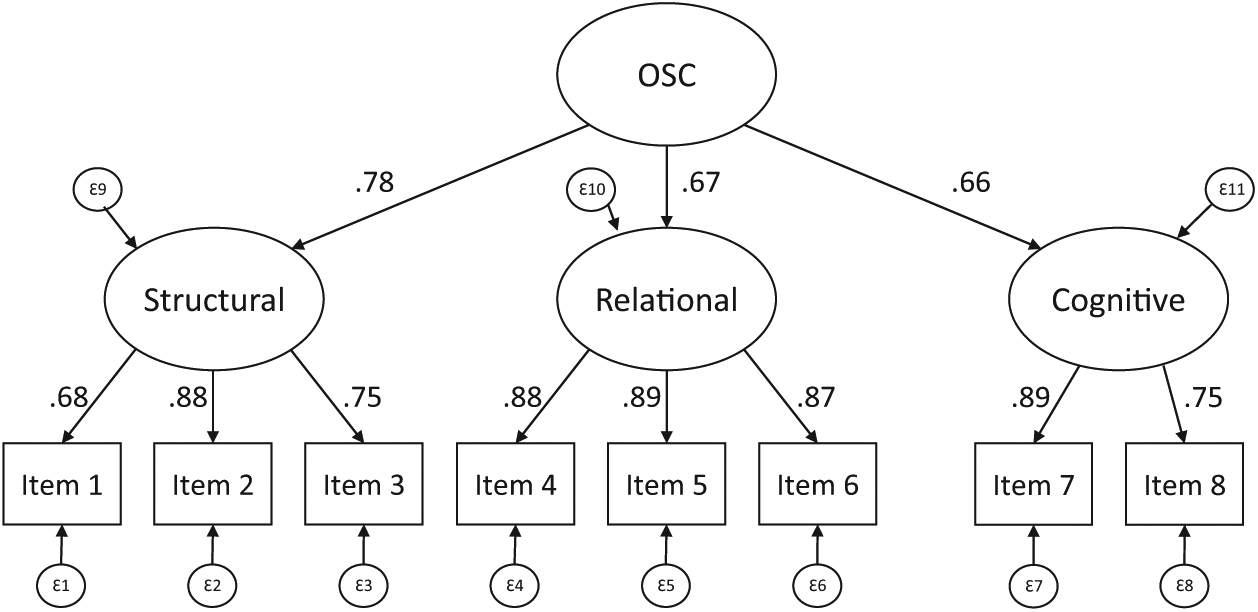
Confirmatory factor analysis of OSC.
We construct individual and team perceptions of OSC using Kenny, Mannetti, Pierro, Livi, and Kashy’s (2002) actor–partner interdependence model (APIM). APIM was developed in research on couples, which was interested in how the attitudes or behaviors of one partner affect those of the other partner. Hence, effects on outcome variables such as life satisfaction are a function of the variance between couples, within couples, or both (Kashy & Snyder, 1995). Kenny et al. (2002) adopted this approach to the research on small groups and similarly argued that statistical effects can result from team members’ individual attitudes and behaviors, other team members’ attitudes and behaviors, or a combination of both.
While individual OSC and team OSC are created at different levels (individual vs. team) based on data from different informants, they both draw on the responses to the same set of OSC items listed in the appendix. However, both measures are distinct in that individual OSC perceptions are based on one employee’s responses, whereas team OSC perceptions are based on the averaged responses by that employee’s colleagues. For example, consider Team Members A, B, C, and D. For Employee A, this person’s OSC responses make up her individual OSC score, whereas the average of the responses by Employees B, C, and D constitute the team OSC score. For Employee B, this person’s OSC responses make up his individual OSC score, whereas the average of the responses by Employees A, C, and D constitute the team OSC score, and so forth. 4
To minimize omitted variable bias, we included control variables at the individual and organizational levels, which are all listed in the appendix. Like previous research on engagement and commitment, we include demographic variables (education, gender, age, race, and tenure) as well as some contextual factors (team size, organization) in our models (Loi, Hang-Yue, & Foley, 2006; Raub & Blunschi, 2014). At the same time, we want to account for organizational and job-related variables that could serve as alternative predictors of engagement and commitment. We think that—relatively independent of an organizations’ social capital—employees tend to be more engaged and committed when they experience procedural fairness in the workplace (Loi et al., 2006; Strom, Sears, & Kelly, 2014). We further want to disentangle social capital effects from just a general feeling of satisfaction with the work environment, which is why we also control for the latter variable (Caykoylu, Egri, Havlovic, & Bradley, 2011). In line with job demands–resources theory, we expect employees to show more positive work attitudes if they are being given autonomy (Crawford, LePine, & Rich, 2010). Finally, purpose, or more specifically job significance, is another important positive driver of engagement and commitment, which we will account for in our models (Raub & Blunschi, 2014).
All constructs measured by more than two items have been operationalized as standardized factors using principal component analyses with PROMAX rotation. Table 1 gives an overview of the descriptives of the variables. The sample is 43% female and 28% employees of color. The average respondent is 44 years of age and has been employed by the organization for 9 years. The average team size is 21 members. Table 2 shows all intervariable correlations.
Descriptive Statistics.
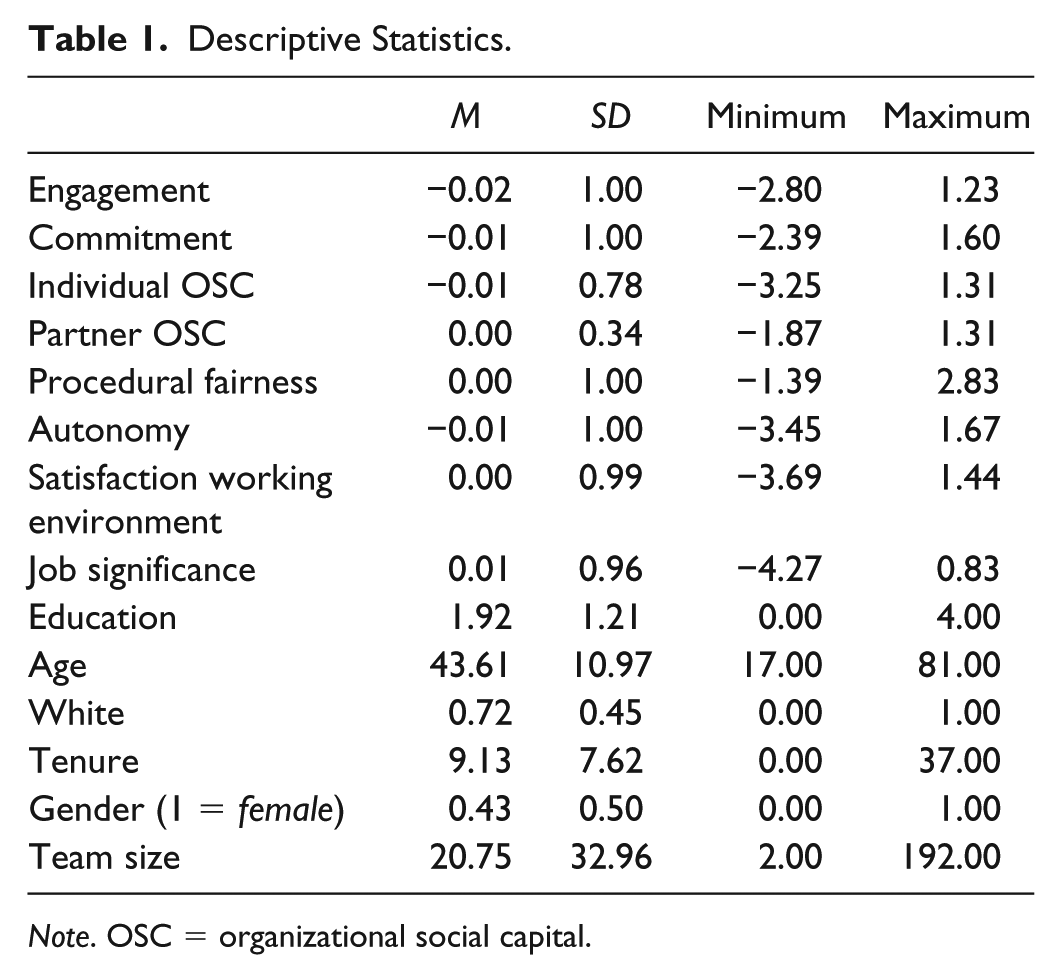
Note. OSC = organizational social capital.
Correlations.
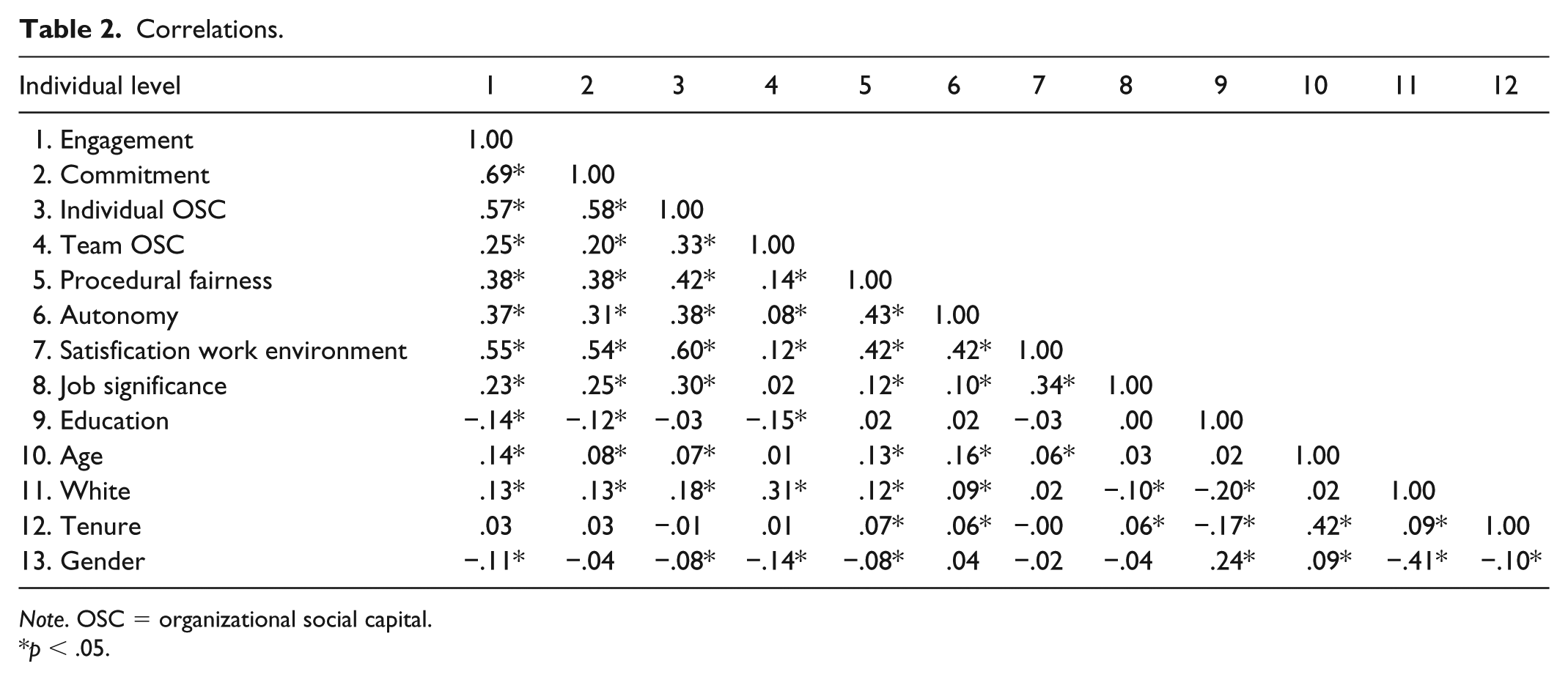
Note. OSC = organizational social capital.
p < .05.
The dependent variables are correlated with r = .69 (they share 48% of variation), indicating that they are related but not identical and that it is worth studying them separately. The dependent variables are correlated with Individual OSC at levels of r = .57/.58 and with team OSC at r = .25/.20. All correlations are modest (the highest correlation being .60), suggesting that none of the independent or control variables are correlated too highly to distort the regression models.
Analytical Procedure
To test our hypotheses, we used a hierarchical linear model for each of the two dependent variables. The models allow for varying intercepts for each team (random intercept model) and account for the clustered structure of the data. We also tested whether varying slopes could improve the models but did not find any improvement. Therefore, we decided to use the most parsimonious model by fixing the slopes at team level and estimating a random intercepts model only. The model can be formalized the following way:
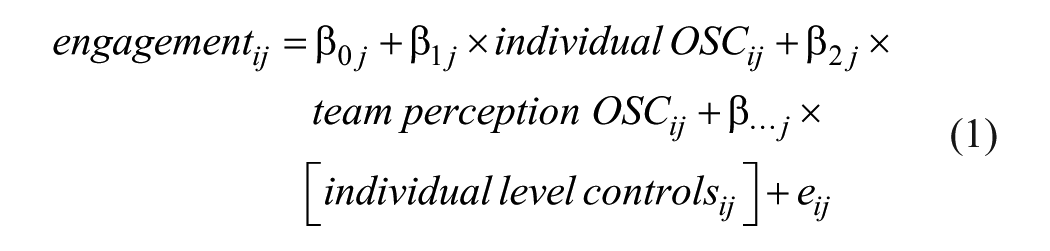
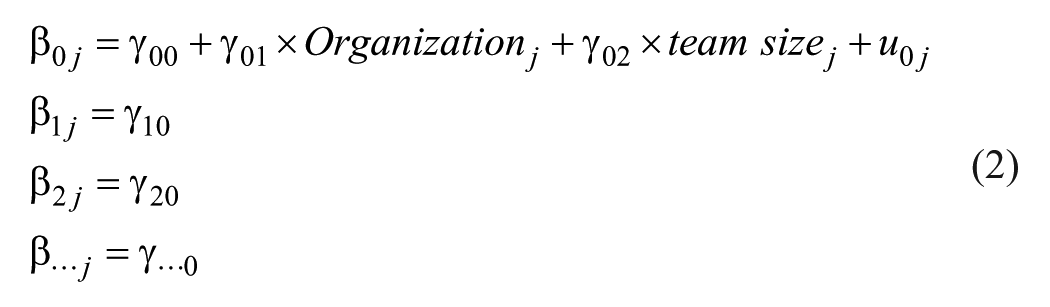
To test the proposed indirect effect, we employ a set of regressions rather than structural equation modeling. Although the latter has its advantage in providing several global fit indices, it is badly suited to handle larger numbers of control variables. As our focus is on exploiting the multilevel structure of the data and accounting for a good number of relevant confounding factors at the individual and team level, we opt for the use of several hierarchical linear regression models rather than one structural equation model.
To examine the indirect effect of X on Y through the intervening variable IV, we run two regressions: First, IV is regressed on X to establish the link between the independent variable and the intervening variable. Second, Y is regressed on X and IV to separate the effect of the independent variable from that of the intervening variable on the dependent variable. As we examine two dependent variables, we offer two tests of each regression equation. We expect that (a) X is related to IV, (b) IV is related to Y, and (c) there is no significant direct effect of X on Y once the impact of IV is accounted for. We make no assumptions about the existence of a total effect between X and Y, which is why our modeling approach is in line with the recommendations by Hayes (2009) and Zhao, Lynch, and Chen (2010) and slightly different from Baron and Kenny (1986).
Results
Figure 2 shows a summary of our results for the proposed indirect effect, separated by the dependent variable. For the sake of brevity, the figure only incorporates the variables we theorized about in our hypotheses, whereas the findings for the 11 control variables are omitted (but they are reported in Table 3). Figure 2 shows that team perceptions of OSC have a significant impact on employees’ engagement and commitment because they shape the individual’s experience of social capital in a first step. The path coefficients are substantive and significant, and we find it noteworthy that the indirect effects are significant (b = 0.14, p < .01; b = .17, p < .01; p values are bootstrapped), whereas the direct effect is not. This is evidence in favor of our two hypotheses.
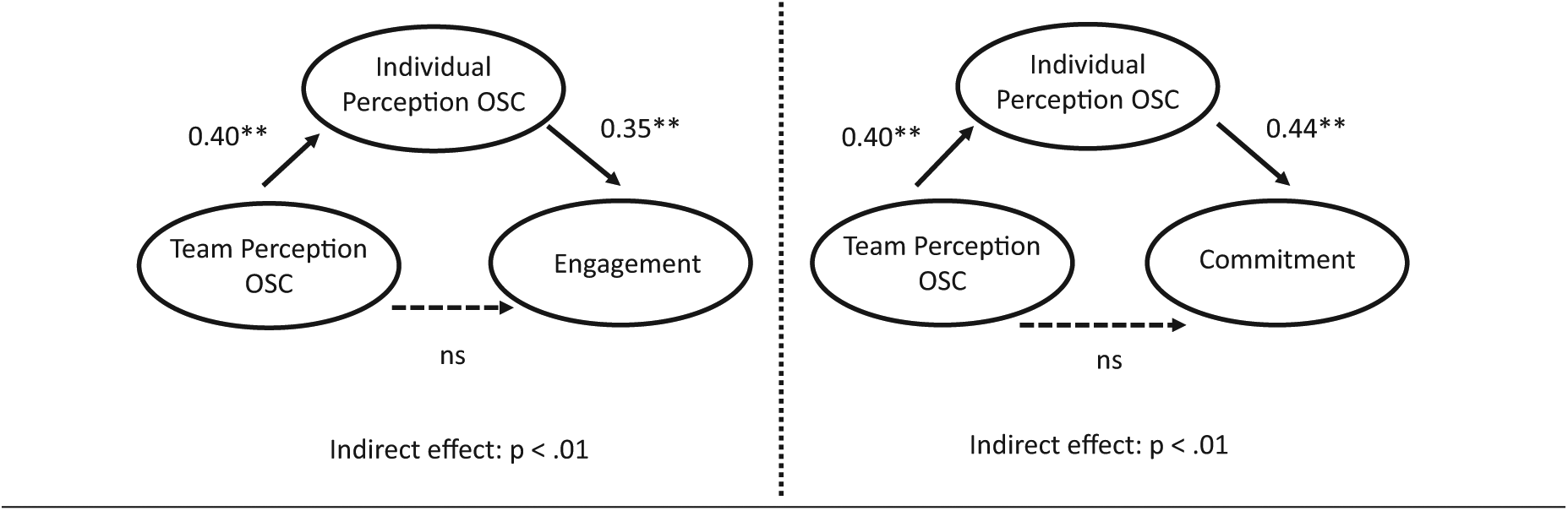
Summary of findings for proposed indirect effect.
Full Set of Hierarchical Linear Models.

Note. Hierarchical linear models. Estimator: Maximum likelihood; t values in parentheses. OSC = organizational social capital; AIC = Akaike information criterion; BIC = Bayesian information criterion; S&B = Snijders and Bosker.
p < .05. **p < .01.
In addition to the presentation of our main findings, we now review the findings for our control variables, the appropriateness of the use of hierarchal linear modeling, and the performance of our models.
Focusing on the control variables, we can see a few significant effects. Three of them have an impact on work engagement as well as organizational commitment. The fairer employees perceive the procedures in their department, the more work engagement and organizational commitment they report. This is line with the findings from other research showing that procedural justice is an important antecedent of work engagement (Saks, 2006; Strom et al., 2014) and organizational commitment (Loi et al., 2006; Lowe & Vodanovich, 1995). In addition, satisfaction with the work environment also increases engagement and commitment. A bit surprisingly, the more educated respondents are, the lower are their levels of work engagement and organizational commitment. As previous research concludes, this might be the result of higher expectations by those with more education with respect to their organizations (Mathieu & Zajac, 1990; Mowday, Koberg, & McArthur, 1984).
Some additional control variables show an effect only on one of the dependent variables. The more autonomous and the older an employee, the more he or she is engaged. In contrast, many years of employment in a single organization reduces respondents’ work engagement, a finding that is consistent with previous results on demotivational tendencies that long-time employees in the public sector display (e.g., Vogel & Kroll, 2016). With respect to organizational commitment, female employees and those who see the significance of their daily work show higher values.
For our analysis, we use multilevel modeling, which is the most appropriate estimation strategy given the structure of our data. The ICC(1) of the dependent variables is .09 (work engagement) and .07 (organizational commitment), indicating that 9% of an individual’s work engagement can be explained by team membership (Bliese, 2000). The ICC(2) for the two variables is .67 and .54, indicating a modest reliability of the group mean (Woehr, Loignon, Schmidt, Loughry, & Ohland, 2015). Although the ICC(1) is relatively low, neglecting the clustering of the data could result in severely biased estimators. We also tested the interrater agreement for the OSC measures following Bliese’s (2016) suggestions. The results show that the three factors of OSC, structural (rwg(j) = .71; AD = 1.00), relational (rwg(j) = .64; AD = 1.22), and cognitive (rwg(j) = .71; AD = 1.21), show good agreement and are all—as advised—above (rwg(j)) or below (AD) simulated significance thresholds. 5 Based on this information, it is appropriate to use hierarchical linear models to test our hypotheses and to aggregate team members’ perception of OSC to the team level.
In addition to conducting our main analysis, we use Table 3 to examine how our fully fitted regressions perform and compare them against the null model (Models 2 vs. 3 and Models 4 vs. 5). First, we turn to the model fit of the full models (Models 3 and 5). We used Snijders and Bosker’s (1994) R²(S&B) to address the explained variance of the models. R²(S&B) indicates how much variance a model explains in comparison with the respected null model that uses group membership as the only predictor (LaHuis, Hartman, Hakoyama, & Clark, 2014). The values indicate that our models reduce the amount of unexplained variance by 56% (work engagement) and 58% (organizational commitment). The Akaike information criterion (AIC) and the Bayesian information criterion (BIC) also indicate a good model fit. All four values of the final models are lower than the values of the corresponding null model. For work engagement, AIC declines from 3,329 to 2,722 and BIC from 3,344 to 2,803. For organizational commitment, the AIC drops from 3,357 to 2,756 and the BIC from 3,373 to 2,837. Finally, the log likelihood test is significant for both models. Overall, we can conclude that our models perform well.
Discussion
Our findings add to the literature on social capital of firms (Chow & Chan, 2008; de Clercq et al., 2013; Sherif et al., 2006) and public organizations (Andrews, 2010; Compton & Meier, 2016; Holme & Rangel, 2012). Although previous work has established the link between social capital and organizational performance by examining organization-wide aggregate scores, little was known about the mechanisms at the micro level of the organization, which link the two variables. We show evidence for such a link through the impact on employees’ engagement and commitment and provide evidence for the important role of teams in shaping individual perceptions of OSC.
We find evidence for the relationship between individually perceived social capital with organizational commitment and work engagement. Put simply, when employees perceive collaboration, trust, and an understood and achieved mission, they are more likely to be engaged and committed to the organization. Given that work engagement and organizational commitment have been linked with various measures of organizational performance, this finding provides some new theoretical routes from social capital to performance.
Our second finding is an important qualification of the first one. While individual perceptions of social capital are crucial, they are not formed in isolation. Rather, individual perceptions are largely shaped by the peers surrounding the individual (Mohammed et al., 2010; Rentsch, 1990). Our findings imply the importance of the team in fostering a collective sense of OSC that translates to individual outcomes. This suggests that those organizations seeking to strengthen their psychological assets should focus specifically on building collaboration, trust, and a sense of mission among teams as well as individual employees. This recommendation is particularly instructive for organizational development efforts that target employees writ large, but leave team development up to team leaders. In these circumstances, public organizations are missing an important opportunity to harness team perceptions of organizational capital in service of motivating individual employees.
We see ample opportunities for future research. We consider the support for the indirect effect of team perceptions of social capital on positive individual-level work attitudes largely robust (particularly because our findings hold for commitment and engagement). At the same time, we also acknowledge the need to identify important contingency factors. For example, team cognition may be less influential in cases in which individuals have as much or even more exposure to members from other teams. Alternatively, the role of the team may decrease as the number of out-group members increases. That is, if team members feel less a sense of belonging to their teams, they will be less likely to listen to the views, narratives, and experiences of team members. Finally, team homogeneity may enhance team effects because individuals may be more likely to buy into team cognition, the more similar they are to other team members. This idea is informed by work showing that social capital has a complicated relationship with diversity. Along these lines, we also recognize that OSC is a positive normative concept only in settings that seek to preserve democracy and achieve the realization of public values, whereas in other settings OSC could easily produce administrative evil.
We acknowledge limitations of our research that readers should keep in mind when drawing inferences from our findings. We draw all our data from two local government organizations, which may raise the issue of generalizability, but it also makes the test of our theory conservative. If perceptions of social capital vary and are influential, despite the fact that all of them were collected from the same two organizations, we can expect more variation and even stronger effects if our theory is tested using a much more diverse sample of organizations. However, to increase potential variation in perceptions, our OSC questions refer to the level of departments within each organization. Another factor strengthening the generalizability of our results is that local governments are functionally diverse entities, providing services that range from public safety to arts and culture to streets and sanitation. Similarly, local government employees are diverse, not only demographically (survey respondents in this sample were 42.9% female and 28.4% people of color) but also educationally: Our respondents hold graduate (17.6%) and undergraduate degrees (42.5%), as well as GEDs (9.74%). The remaining employees have had some college or some graduate school.
Common source bias may be a second concern, although we see four reasons why this should not jeopardize the validity of our study. First, our variables of interest are personal attitudes and, to the best of our knowledge, there is no better way to capture such attitudes than using self-reports. Second, we tap into different data sources to measure our main independent variable and the two dependent variables. Whereas the latter were captured through individual self-reports, the former was constructed as a team-level variable, drawing the data from the individual’s peers. Third, previous research found that measures mostly prone to bias were related to organizations’ performance ratings. Hence, variables that carry less social desirability bias—such as social capital—may also be less susceptible to common method variance. Fourth, and in line with what George and Pandey (2017) argue, the threat that a common method poses may have been overstated in recent public administration scholarship. Although such bias can affect the statistical results, it is often unclear whether this favors the null or research hypothesis, and whether bias ever reaches a substantive impact.
Conclusion
In this article, we have examined the micro-level mechanisms of social capital in organizations. In particular, we have studied how perceptions of organization-wide capital at different levels affect employee-level work attitudes. We have looked at effects on two such attitudes (engagement and commitment), thereby providing two tests for each hypothesis. Drawing on an organizationally representative sample of nearly 1,200 individuals from two local government organizations in North Carolina, we found the following: Individual perceptions of social capital are important determinants of both work engagement and organizational commitment. However, individual perceptions of social capital are shaped through social interactions with team members, suggesting that work groups constitute prisms through which employees view the entire organization, and that the effect on engagement and commitment is indirect.
Overall, the study points to the importance of teams in facilitating positive perceptions of organization-wide social capital, which have not received much attention in previous work. Teams diffuse mental models among members, and they are the primary experiential pathway between the employee and the organization. Hence, interventions at the team level can be a promising route to facilitate organization-wide social capital and related positive effects. In particular, our results suggest that public managers should focus on developing collaboration, trust, and a mission focus within teams. The literature on team effectiveness is instructive on this point (see Salas, Goodwin, & Burke, 2008): Team leaders can foster collaboration by encouraging team members to speak up and listen to each other (Edmondson & Roloff, 2008); leaders can use transformational tactics (Özaralli, 2003), such as repeatedly talking about the meaningfulness of the work in team meetings; and leaders can facilitate team meetings by which members develop a shared vision of how group goals connect with organizational mission (Sundstrom, De Meuse, & Futrell, 1990).
Although we know a great deal about social capital effects at the macro level (organizations that own social capital tend to outperform others), little is known about how such gains are created and how this capital positively affects individuals. This article offers such a micro-level perspective. It incorporates literature on teams and work groups and examines how teams and individuals interact, thereby adding to public administration scholarship that rarely looks at multiple organizational levels and potential interdependencies simultaneously. It also promises public managers—in an era of fiscal constraint and heightened service expectations—a more holistic framework for understanding workplace climate and language for articulating the emotional assets they can build in public organizations.
Footnotes
Appendix
Measures.

| Variable | Operationalization |
|---|---|
| Engagement (adapted from Schaufeli & Bakker, 2003) (α = .88) |
In thinking about your job, where do you fall in between the following statements? • 0 = When I get up in the morning, I dread going to work. 8 = When I get up in the morning, I look forward to going to work. • 0 = As soon as I find a better job, I’ll leave. 8 = I have no plans to look for another job. • 0 = I often think of quitting my job. 8 = I never think of quitting my job. • 0 = Each workday seems like it will never end. 8 = Time flies by on the job. |
| Organizational commitment (adapted from Meyer, Allen, & Smith, 1993) (α = .82) | Thinking about how you feel about working for the City of [. . .], how much do you agree or disagree . . . (0 = strongly disagree, 6 = strongly agree) • I would feel guilty if I left this organization now. • I wouldn’t leave this organization right now because I have a sense of obligation to the people in it. • I would be very happy to spend the rest of my career with this organization. • In thinking about your job, where do you fall in between the following statements? (0 = I do not feel emotionally attached to this organization; 8 = I am emotionally attached to this organization.) |
| Organizational social capital | Structural OSC (α =,82): How much do you agree or disagree with the following statements about teamwork in your department? (0 = strongly disagree, 6 = strongly agree) • Employees in my department function as a team. (Item 1) • My department works well with other departments. (Item 2) • Other departments work well with our department. (Item 3) Relational OSC (α = .79): Thinking about trust in your department, how much do you agree or disagree with the following statements? (0 = strongly disagree, 6 = strongly agree) • Employees trust supervisors to do the right thing on their behalf. (Item 4) • Employees here trust supervisors. (Item 5) • When supervisors here say something, you can believe it’s true. (Item 6) Cognitive OSC (α = .72): Where does your opinion lie between the following opposite statements about the City of [. . .] mission? • 0 = My department does not achieve the city’s mission 8 = My department achieves the city’s mission. (Item 7) • 0 = No one understands the city’s mission 8 = Everyone understands the city’s mission (Item 8) |
| Procedural fairness (adapted from Alexander & Ruderman, 1987) (α = .81) | In thinking about your input into department decisions, how much do you agree or disagree with the following statements (0 = strongly disagree; 6 = strongly agree) • I have a lot of say in rules that affect my job. • I have a lot of say in the city’s rules. • I am given the chance to contribute to important decisions made about my department. |
| Satisfaction with working environment (α = .78) | How satisfied or dissatisfied are you with the following parts of your job? (0 = strongly disagree, 6 = strongly agree) • The extent to which my work environment embraces new ideas • The opportunities I have for professional development (training, learning opportunities) • The access I have to technology • The feeling that I have accomplished worthwhile work |
| Autonomy (α = .76) | In thinking about your job, how much do you agree or disagree with the following statements? (0 = strongly disagree; 6 = strongly agree) • I feel that I am my own boss in most matters. • Generally, I’m allowed to work independently in my job. • I have the right amount of independence for my job. |
| Job significance (Morgeson & Humphrey, 2006) (α = .87) | How much do you agree or disagree with these statements about your job? (0 = strongly disagree; 6 = strongly agree) • The results of my work significantly affect the lives of other people. • My job has a large impact on citizens. • My job itself is very important in the broader scheme of things. • The work I do on this job is meaningful to the citizens of the City of [. . .]. |
| Education | Which of the following represents your highest level of education? • 0 = high school or GED • 1 = some college • 2 = bachelor’s degree • 3 = some graduate school • 4 = graduate degree |
| Gender | Are you . . . 0 = male; 1 = female |
| Age | How old are you? |
| Race | 0 = non-Caucasian
1 = Caucasian |
| Tenure | For how many years have you been working for the city of [. . .]? |
Note. OSC = organizational social capital; GED = General Educational Development.
Declaration of Conflicting Interests
The author(s) declared no potential conflicts of interest with respect to the research, authorship, and/or publication of this article.
Funding
The author(s) received no financial support for the research, authorship, and/or publication of this article.
