




Abstract
The billions of dollars in assets seized by law enforcement each year represent a crucial source of revenue for these organizations, but also raise important constitutional questions and can create significant tensions within the jurisdictions they administer. Research on asset forfeiture to date has focused heavily on municipal police, largely neglecting forfeiture activities by sheriffs. Thus, it has missed an important opportunity to build theory about the differences between appointed and elected administrators and neglected an important source of institutional variation that may help to explain this particular administrative activity. To develop expectations about the relative levels of asset forfeiture and the response to intergovernmental incentives related to forfeiture, we draw on and extend scholarship comparing the behavior of elected versus appointed administrators in other settings. We test those expectations in analyses of more than 1,200 sheriff’s offices and over 2,200 municipal police departments between 1993 and 2007. Results suggest that sheriffs receive less forfeiture revenue than municipal police and are less responsive to state-level policies that change the financial rewards of asset forfeiture for agencies. These results hold whether we examine forfeitures made through the federal Equitable Sharing Program, where civil and criminal forfeiture cases can be distinguished, or jurisdictional level data on forfeiture, where civil and criminal forfeitures are combined. We conclude with a discussion of implications for both the research on asset forfeiture and on elected versus appointed public administrators more generally.
Introduction
Under forfeiture laws, law enforcement organizations seize billions of dollars a year from U.S. citizens. Some of this revenue is connected to a criminal conviction, but a majority accrues from civil forfeiture proceedings, 1 which do not require a conviction or even charges be filed. The issue of civil asset forfeiture has gained salience of late because of concerns about the tension that such activities create between law enforcement and citizens and the consequences when those tensions boil over in places like Ferguson, MO. While most of the media attention has focused on civil asset forfeiture (see, for example, Sallah et al., 2014; Stillman, 2013), a recent supreme court case (Timbs v. Indiana) has also refocused public attention on the possibility that assets forfeited after criminal convictions may violate constitutional prohibitions against the levying of excessive fines.
Not surprisingly, given its controversial nature, asset forfeiture has been a subject of significant interest among legal and criminal justice scholars, but we argue that the practice raises important questions about equity and fairness in the administration of public programs and laws and should be of interest to scholars of public administration as well. In this article, we are particularly interested in the degree to which asset forfeiture offers opportunities to refine theory about differences between elected and appointed officials who deliver comparable public services. We make this assertion because work to date has not sufficiently explored seizures by more than 3,000 sheriff’s departments across the country. Based on jurisdictional data on total forfeiture revenue, sheriffs account for one third of forfeiture dollars and, thus, have a meaningful impact on the effect of seizure activity on citizens. 2 Furthermore, the vast majority of sheriffs are elected, rather than appointed like municipal police chiefs, which means that work to date has neglected whether the electoral motivations of the former lead to differences in the behavior of these two sets of public administrators. Finally, the presence of state and federal policies meant to increase asset forfeiture among local agencies, mean that this is a great place to examine hitherto unexplored questions about the impact of intergovernmental incentives on elected versus appointed administrators.
To develop expectations about the relative levels of asset forfeiture, as well as the response to intergovernmental incentives, we draw on the literature comparing elected versus appointed administrators in other settings. This work suggests that the relative need to satisfy voters creates differences in the behaviors of these actors (see, for example, Besley & Coate, 2003). In this context, theory suggests that sheriffs face potential electoral costs from seizing voter property that they must weigh against the monetary benefits, whereas municipal police do not face such costs, at least not directly. Because of this calculation, we expect that sheriffs receive less forfeiture revenue than municipal police, all else being equal. We also extend existing work by considering how the electoral motivation affects the impact of intergovernmental incentives on the behavior of administrators. Specifically, we develop the expectation that the electoral costs for sheriffs should offset, and therefore reduce, the effect of state-level policies that increase the monetary benefit of forfeiture for local law enforcement.
We test these expectations in an analysis of 1,247 sheriff offices and 2,278 municipal police departments between 1993 and 2007. We examine civil forfeiture and criminal forfeiture revenue from the federal Equitable Sharing Program, as well as total forfeiture revenue reported by the agencies. Results suggest that sheriffs consistently report significantly less revenue from asset forfeiture than do police departments. They also suggest that sheriffs are less responsive to state policies that allow local law enforcement agencies to keep a larger portion of seized revenue. We conclude with a discussion of the implications of these results for our understanding of civil asset forfeiture and the behavior of elected versus appointed administrators more generally.
Asset Forfeiture
Civil asset forfeiture is a two-step process. First, law enforcement seizes private property believed to be connected to criminal activity. Afterward, the seized assets are forfeited (i.e., kept) by the government, with the proceeds typically reverting to the seizing agency. Modern policies date back to The Comprehensive Drug Abuse Prevention and Control Act of 1970 which included a civil forfeiture provision, allowing law enforcement to seize and forfeit “. . . drugs, drug manufacturing and storage equipment, and conveyances used to transport drugs” (Blumenson & Nilsen, 1998, p. 44). 3 The intent was twofold, to mitigate the financial gains from participating in the drug trade and to incentivize law enforcement to do more anti-drug policing by allowing the agency to retain a portion, if not the entirety, of the proceeds from forfeited property. Over time, the list of seizable assets has expanded to include almost any type of property including, but not limited to, cash and real property, and every state has adopted civil asset forfeiture laws of their own.
Civil asset forfeiture has proven to be highly controversial. For starters, it is a civil and not criminal proceeding, meaning a criminal conviction (or even criminal charges) are not required; property may be seized and forfeited on suspicion of connection to criminal activity. 4 Scholarship suggests that the majority of civil forfeitures occur without a charge, or even an arrest (see, for example, Burnett, 2008; Sallah et al., 2014). Moreover, because it is a civil case, the property owner is entitled to fewer legal protections, making it easier for the government to ultimately forfeit the seized property. 5
Also, contentious are the financial incentives created by allowing law enforcement agencies access to seizure revenues. Given the important source of revenue that forfeitures represent for many jurisdictions, a number of authors have argued that they create questionable incentives for police behavior and distract law enforcement from their primary mandate of protecting public safety (Benson et al., 1995; Blumenson & Nilsen, 1998). 6 Actual empirical evidence on whether police departments strategically focus on certain types of arrests to maximize forfeiture revenue is mixed, although studies of individual jurisdictions have suggested a relationship between police behavior and forfeiture (see, for example, D’Alessio et al., 2015; Kelly & Kole, 2016; Miller & Selva, 1994). Regardless of their effect on incentives, researchers and law enforcement officials both emphasize the importance of forfeiture revenue (Cassella, 1997, 2004; Coe & Wiesel, 2001; Williams, 2002), with one author finding that 40% of police executives reported forfeiture proceeds as essential to their operational budgets (Worrall, 2001).
The extent to which state and local agencies are able to profit off of civil asset forfeiture is governed by state law; only seven states and the District of Columbia prohibit law enforcement agencies from profiting at all from seizures, whereas 25 states allow law enforcement to keep 100% of forfeited revenue. However, the authority of state laws is compromised by the federal Equitable Sharing Program, created by the 1984 Comprehensive Crime Control Act. Under the Equitable Sharing Program, state and local agencies seize property under federal law, the federal government then processes the seized assets, and shares the proceeds with the state or local law enforcement agency once the asset is forfeited (U.S. Department of Justice, 2009). 7
Somewhat surprisingly, researchers have failed to demonstrate a relationship between the generosity of state incentives and the amount of revenue seized (Worrall & Kovandzic, 2008). Worrall and Kovandzik (2008) suggest, however, that the null relationship between state monetary incentives and seizure behavior is due to the fact that departments in restrictive states circumvent state laws through greater participation in the Equitable Sharing Program. In other words, agencies in states with restrictive laws regarding civil forfeiture are able to circumvent those laws by allowing the federal government to dispose of seized property and return a portion of the proceeds to the agency. Several empirical studies have confirmed the negative relationship between the ease and incentives for seizure and the receipt of equitable sharing payments by local law enforcement (Carpenter et al., 2015; Holcomb et al., 2011, 2018).
Election Versus Appointment and the Incentives for Forfeiture
Our primary research question is whether the electoral incentives faced by sheriffs change their asset forfeiture behavior relative to police departments led by appointed chiefs. Not surprisingly, the existing literature comparing elected and appointed administrators offers some insight into this question, and this section applies those insights to develop expectations about the seizure behavior of sheriffs and municipal police. Unfortunately, existing work on elected versus appointed administrators has largely neglected differences in the response of these actors to intergovernmental incentives. This section also addresses this shortcoming to develop a more comprehensive theory of asset forfeiture and of the behavior of elected versus appointed administrators more generally.
Although the findings are not always consistent (see, for example, Campbell & Turnbull, 2003), the literature on elected versus appointed administrators generally expects that these actors will behave differently, primarily due to the electoral incentives faced by the former. A relatively intuitive insight from this literature is that elected administrators are able to maintain and exercise significantly greater independence from political bodies (see, for example, Marando, 1973; Miller, 2017). In addition, scholars have hypothesized that appointed and elected officials will perform better or worse in different task environments because of their independence and unique characteristics. Relying on the assumption that bureaucrats aim to signal competence for career advancement, while politicians strive for reelection, Alesina and Tabellini (2007, 2008) suggest that bureaucrats are preferable in those tasks that require technical skills, such as monetary policy and public debt management, whereas elected officials are preferable when policies have redistributive implications, when uncertainty about social preferences is high, and when greater flexibility is required. 8
The largest body of work in this area, and the one that is most germane to our inquiry, focuses on the degree to which elected administrators are expected to be more democratically responsive because of the electoral motivation. Taking a positive perspective, Miller (2017) argues that diffusing power to numerous elected executives leads to administrative decisions that more closely match citizen preferences. Alternatively, Maskin and Tirole (2004) caution that the reelection motivation may lead elected officials to pander to majority opinion and overlook minority welfare.
Whatever the normative perspective, scholars have found differences between elected and appointed officials across a range of public institutions. For example, research suggests that elected judges sentence more harshly relative to their appointed counterparts, particularly as elections approach (Gordon & Huber, 2007) and have a higher number of discrimination charges (Besley & Payne, 2013). Not surprisingly, differences resulting from method of selection are highly correlated with the political orientation of voters in the judge’s jurisdiction, as judges with more conservative constituents are more likely to impose harsher sentences (Lim, 2008, 2013).
A fairly large literature has also examined the impact of electoral pressures on the decision-making of regulators. Although some early work in this area found few differences between the elected and appointed administrators (see, for example, Hagerman & Ratchford, 1978), most work suggests that elected regulators keep rates lower than their appointed counterparts to appease constituents (see, for example, Boyes & McDowell, 1989; Smart, 1994). Recent work in this area confirms that electoral considerations motivate elected utilities regulators to adopt more pro-consumer policies than appointed commissioners (Besley & Coate, 2003). 9
Work comparing elected mayors and appointed city managers has arrived at similar conclusions regarding differences driven by the electoral motivation. Researchers find that mayor-council cities are less likely to privatize services, because the mayor is politically motivated to claim credit for service provision rather than any cost savings accruing from privatization (Levin & Tadelis, 2010). Studies have also found that elected mayors increase targeted redistribution in election years (Enikolopov, 2014) and that mayors respond to voters’ public safety concerns by hiring more police in election years relative to their appointed counterparts (Vlaicu, 2008).
Although evidence regarding the impact of the electoral motivation on administrative behavior is varied and compelling, there are a number of elements that the literature has yet to address. We believe that asset forfeiture can provide insight on two of these. The first of these deals with blame avoidance. We have significant evidence that elected legislators and executives adopt numerous strategies to avoid retribution from voters for unpopular decisions (Weaver, 1986), but we do not know whether elected administrators do as well or do so to a greater degree than appointed counterparts. Second, although there is a large literature exploring the responsiveness of traditional elected officials to intergovernmental incentives (e.g., grants-in-aid, loan programs), no work to date has investigated the degree to which elected and appointed administrators may respond to these types of incentives differently. The following section will develop expectations related to both of these gaps in the context of asset forfeiture.
Sheriffs Compared With Municipal Police
Before moving on, it is important to take a moment to discuss important differences and similarities between the two types of organizations that we will be comparing. Of course, the key difference that we exploit in this article is the fact that sheriffs in all but two states are elected directly, rather than appointed by a political principal. However, there are other significant differences that must be accounted for in any comparison. First, because of differences in the historical development of county and local law enforcement agencies in this country, sheriffs are typically responsible for a broader range of activities than are municipal police, including providing support services for district (county) courts, maintaining the county-level correctional facilities, and, in rare cases, collecting taxes and fees. Another important distinction is organizational. After controlling for size, sheriff’s offices tend to be less bureaucratized than municipal police departments having fewer hierarchical divisions and larger spans of control (Falcone & Wells, 1995; Mastrofski et al., 1987).
While there are differences between sheriffs and police that must be accounted for, these organizations also share important similarities. Most obviously, the core function in both is law enforcement, with the majority of resources being dedicated to investigation, patrolling, and other law enforcement activities. 10 Furthermore, the distribution and characteristics of officers across organizations are similar and, while expenditures for both sheriffs and municipal police increased dramatically from 1980 to 2007, both types of agency have faced declining budgets and significant resource scarcity since the Great Recession (U.S. Bureau of Justice Statistics, 2011). 11
Expectations Regarding Forfeiture Revenue Among Sheriffs and Police
The literature reviewed above identifies the relative incentives facing elected versus appointed administrators and provides a useful way to begin generating expectations about asset forfeiture by sheriffs and police departments. To do so, we begin with a set of assumptions. First, we assume that both benefit economically from asset forfeiture. In addition, we assume that the economic benefit of forfeiture is greater for both types of organizations in states that allow law enforcement to keep a greater proportion of seized assets. Finally, in states with more restrictive forfeiture laws, we assume that sheriffs and police have the same option to hand off appropriate cases to federal officials to take advantage of equitable sharing.
Because the financial incentives are constant across agency type, we argue it is the electoral costs of seizure activities that will cause any differences in the seizure behavior of police and sheriffs. This is due to the fact that sheriffs are elected and are therefore . . . less insulated from the public than the police chief, lacking the administrative buffer from the general public that most municipal departments have in the mayor, police commission, or city board who oversee them and appoint their chief executive. The ostensible effect of direct election will be that the sheriff’s office is more overtly political in a popular sense (i.e. based in popular appeal and voter approval) . . . (Falcone & Wells, 1995, p. 127)
Of course, this lack of insulation and need for voter approval would likely have little bearing on sheriff’s decisions if asset forfeiture was popular among citizens. Indeed, if it is seen as part of a “law and order” strategy (which research shows more the majority of American voters’ support), 12 we might expect sheriffs to make more seizures to appeal to these voters. However, available evidence overwhelming suggests that citizens do not support civil asset forfeiture. Indeed, one recent poll found that only 16% of Americans believe that police should be able to seize property before a person was convicted of a crime (Ekins, 2016). Another poll found only 7% of respondents thought that “permanently seizing people’s property . . . even if no charges have been filed” was legitimate (Huffington Post/YouGov, 2015). Questions explicitly eliciting attitudes on criminal forfeiture are less common, but data from the 2010 Cooperative Congressional Election study suggest that Americans are not supportive of police using forfeitures, regardless of type, as a source of revenue. When asked if law enforcement agencies should “be allowed to keep property they take for their own use,” 70% of respondents preferred that it “be placed in a state general fund or some other neutral account.”
These data suggest that voters do not prefer a high level of forfeiture activity by law enforcement, at least not for their own enrichment. For sheriffs, who have to answer directly to these voters, this implies that asset forfeiture may come with significant electoral penalties that are not borne by appointed police chiefs. Sheriff’s elections garner very little media attention or exit polling; so, it is difficult to find direct evidence of voters suggesting they voted against the incumbent sheriff because of asset forfeiture activity. However, it is possible to find evidence that sheriffs and police have different political calculi when it comes to forfeiture. Wisconsin is currently considering civil asset forfeiture reform that would dramatically limit, and make it much more difficult for law enforcement to profit from the practice within that state. The Wisconsin Chiefs of Police Association have publicly opposed the Bill, but the Wisconsin Sheriff’s Association has announced that they will remain neutral in the debate (Kittle, 2018). While anecdotal, this is at least consistent with our assertion that sheriffs may perceive an electoral cost to civil asset forfeiture that countervails the economic benefits of the practice.
Obviously, elected officials at the municipal level may bear these same costs if voters are unhappy about asset seizures by municipal police and, as a result, put pressure on police to seize less. However, the impact of such pressure is likely diluted by the principal agent problems inherent in policing; city elected officials can claim that while they do not support asset forfeiture, it is difficult to stop police making seizures given current state law and their lack of knowledge of the circumstances surrounding individual seizures (Rector, 2018). 13 The differences in the costs associated with asset forfeiture lead us to three hypotheses, first,
It is also important to remember that the potential for electoral blame often does not completely prevent politicians from engaging in an activity. Instead, the literature suggests that the electoral motivation leads to a host of blame avoidance behaviors when elected officials want to do something that may be unpopular with voters (Weaver, 1986). There are a host of these strategies including the crafting of ambiguous statutes and the delegation of authority for implementation to another actor (Fiorina, 1982). Such delegation helps to ensure that the legislature can claim credit if the policy is a success, but has someone to blame if things go wrong. Most importantly, for our purposes, authors have demonstrated that elected officials use the intergovernmental system as a blame avoidance technique, delegating authority to different levels of government when potential electoral costs are high (Volden, 1999).
The blame avoidance literature suggests that sheriffs, who obviously desire the additional revenue from forfeitures, will look for ways to secure that revenue without incurring the electoral costs. The ability to use the Equitable Sharing Program, where federal authorities process seized property and then redistribute the proceeds to the seizing agency, may provide such a mechanism. As such, we expect that
As noted above, the literature on asset forfeiture has often focused on the degree to which state governments can incentivize agencies to seize more by increasing the proportion of forfeited revenue flowing to agencies. These policies are very similar in nature to most intergovernmental monetary incentives, which are designed to induce greater subnational or substate spending on a particular public good by reducing the price of that good (Oates, 1968). We know from decades of research, however, that jurisdictions’ response to these policy tools is not uniform (Chubb, 1985). Recent work in this area has demonstrated that the response to intergovernmental incentives is heavily influenced by the degree to which they help, or hinder, the electoral goals of political actors within the jurisdiction (Nicholson-Crotty, 2004, 2015). That work suggests that jurisdictions will choose not to incur the cost of alienating the median voter by treating intergovernmental incentives, like grants, as fungible or eschewing them all together.
We expect that sheriffs, as elected administrators, will react to financial incentives to increase asset forfeiture in the same way. To understand why, it is convenient to think of forfeiture as a simple benefit–cost calculation by agencies. For municipal police in a given state, the utility of taking property is wholly a function of the amount they are able to retain under state law. For sheriffs in that same state, however, total utility is a function of that amount minus the additional electoral cost associated with each additional dollar taken from potential voters. Thus, the utility of more generous state forfeiture laws is necessarily lower for sheriffs than for police. More intuitively, we expect that
Data, Variables, and Estimator
The Law Enforcement Management and Administration Statistics (LEMAS) survey provides a measure of total forfeiture revenue, one of our dependent variables, as well as the primary independent variables and many of the controls. LEMAS is collected by Bureau of Justice Statistics (BJS) at irregular intervals via surveys administered to all state and local law enforcement agencies throughout the United States. It covers a wide range of operational and administrative activities and characteristics of law enforcement agencies, including agency responsibilities, operating expenditures, seizure revenues, officer salaries and demographics, officer recruitment and training requirements, special units, and a variety of organizational policies.
Our panel consists of data from the 5 years the LEMAS survey was conducted: 1993, 1997, 2000, 2003, and 2007. 15 Due to the irregular sampling interval and the sampling scheme adopted by LEMAS, our analytic sample has an unbalanced panel data structure. Specifically, each survey contains the universe of large police agencies, operationalized by BJS as the law enforcement agencies with more than 100 full-time sworn officers, and a nationally representative random sample of smaller agencies. However, the unbalanced nature of the data does not pose a threat to estimation because it does not result from attrition. As a matter of fact, survey response rates are very high due to the mandatory nature of the data collection, ranging from 91.7% in 2007 to 95.2% in 1987 (Garner et al., 2018). In our sample, 15.35% of the agencies appear in each survey wave, 10.27% are surveyed 4 times and 23.63% are included 3 times. The total sample size is 10,230 observations on 3,525 law enforcement organizations, including 3,626 observations on 1,247 sheriff’s offices, and 6,604 observations on 2,278 police departments.
The LEMAS data are combined with data from the Department of Justice’s Equitable Sharing Program, which provides three additional dependent variables. 16 These data are reported by the federal government annually at the agency level and include every state and local agency that participated in the Program in a given year. Also included are indicators that clarify whether the seized asset undergoes a criminal or civil forfeiture process. Not every agency in LEMAS makes seizures under the Equitable Sharing Program, as such when our DV is drawn from the Equitable Sharing data our sample consists of agencies in LEMAS that also participated in the federal program.
Demographic and financial data drawn from the American Community Survey (ACS) and the Annual Survey of State and Local Government Finances, both published annually by the U.S. Census Bureau, supplement our primary data. These variables are described in further detail below.
Dependent Variables
We use four dependent variables in subsequent analyses to test different hypotheses. For two of these, we model the equitable sharing funds returned to each jurisdiction. A real advantage of the equitable sharing data, from an analytic standpoint, is that forfeitures can be identified as either civil or criminal. Thus, we measure funds associated with a criminal conviction and those forfeited in the absence of a conviction; both are logged and normalized by jurisdictional population. We expect the difference between sheriffs and municipal police to be greater in the case of civil forfeiture because the electoral costs of taking property from persons found guilty of a crime are likely to be lower. The third dependent variable, sourced from LEMAS, is the total value of forfeiture revenue in a given agency, again scaled by the population of the agency’s jurisdiction. This variable includes both criminal and civil forfeitures and revenue from all forfeiture activities. See Figure 1 below for the distribution of these three dependent variables, by organizational types.
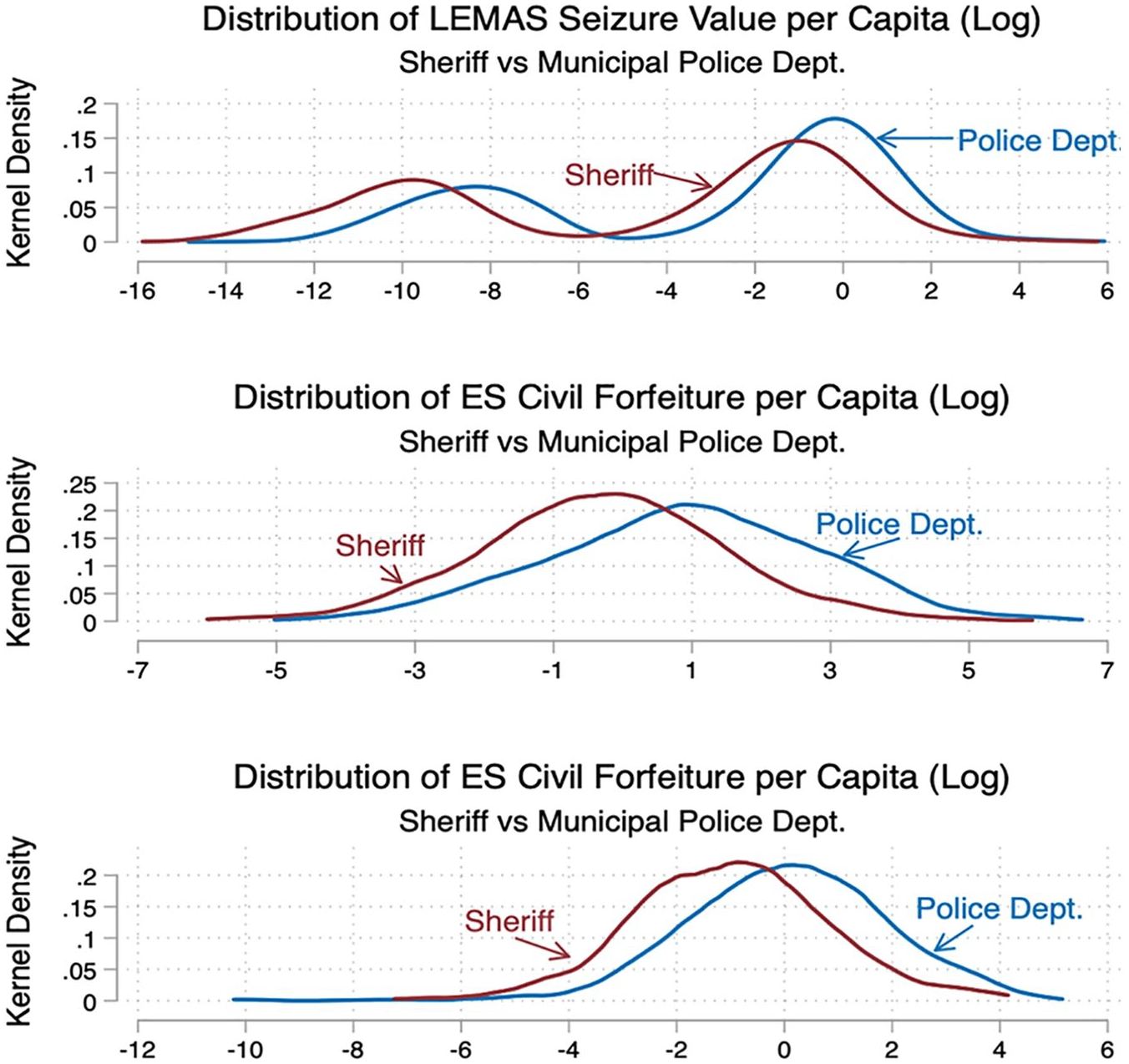
Distribution of dependent variables (total seizure value, civil and criminal forfeiture) in sheriffs and police departments.
Our final dependent variable is the proportion of total forfeiture revenue received from the Equitable Sharing Program and is used to test the blame avoidance hypothesis. The following density plot (Figure 2) displays the distribution of this variable by agency type.
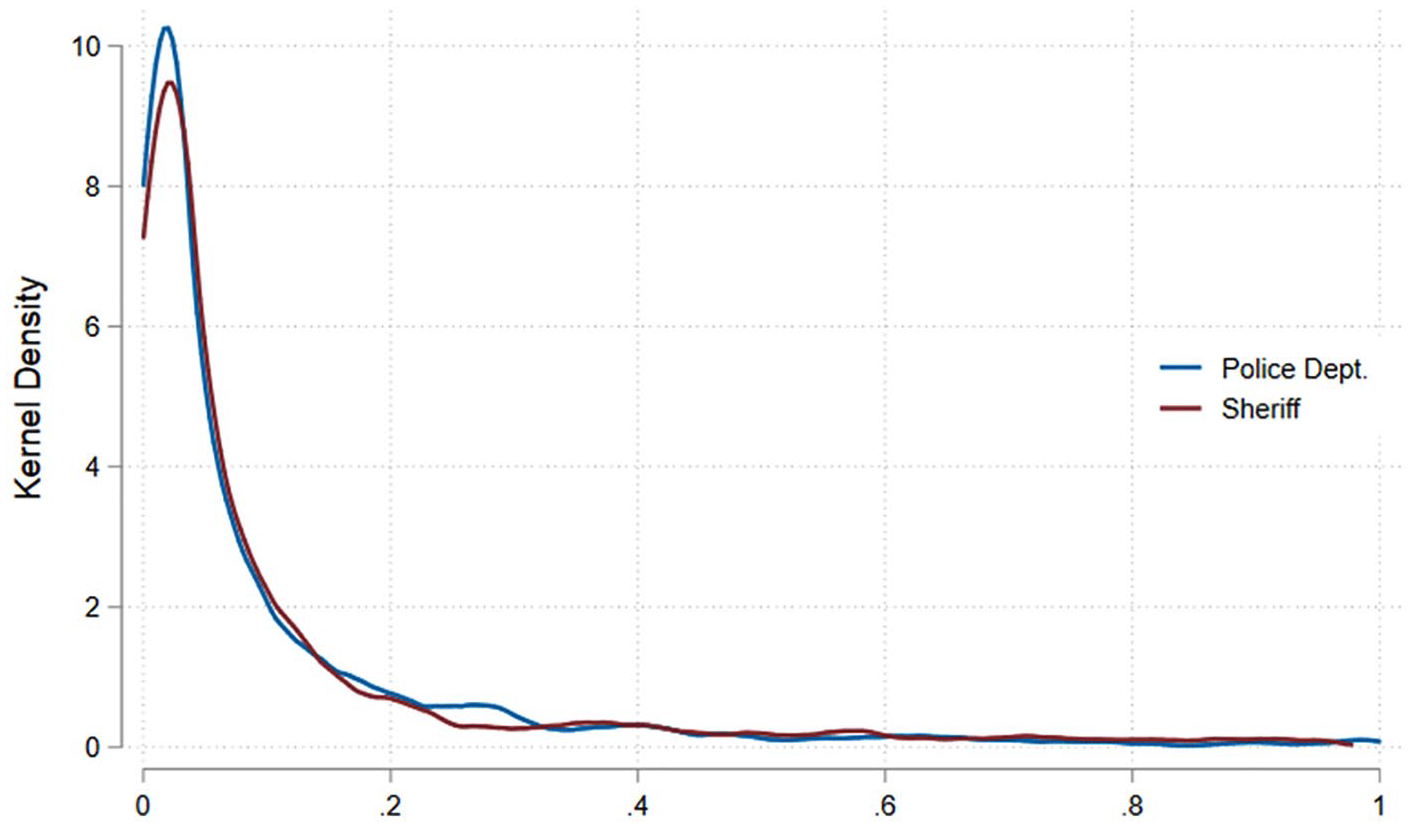
Distribution of proportion of seizure revenue from equitable sharing program in sheriffs and police departments.
Independent Variables
Our primary independent variable is a binary measure indicating agency type. It is equal to one for sheriff’s offices and zero for municipal police departments. As noted above, we expect sheriffs to receive less forfeiture revenue, regardless of the source, than municipal police. We also expect that sheriffs will have a stronger preference that federal authorities be responsible for forfeitures and thus will make greater use of the Equitable Sharing Program, relative to municipal police.
The second independent variable captures financial incentives which may encourage agencies to seize and forfeit property. We construct this variable by coding state forfeiture laws that govern the distribution of profits from forfeited assets. Forty-three states allow agencies to retain some or all of the seized funds, whereas seven states and the District of Columbia direct the entirety of the funds elsewhere. 17 The coefficient of interest for hypothesis testing is an interaction between the state fiscal incentive measure and the agency type indicator. We expect that potential monetary gain from forfeiture positively moderates total forfeiture revenue among municipal police departments to a greater degree than among sheriff offices. In this specification (testing H3), the measure is a continuous, allowing us to test how forfeiture behavior in the two types of law enforcement organizations varies as the financial return to forfeiture increases. In models testing H1 and H2 where the financial incentive measure is included as a control, we follow previous literature (see, for example, Worrall and Kovandzic (2008)) and use a binary indicator (0 for states that do not allow agencies to profit from forfeiture and 1 for other states where at least a portion of proceeds are diverted back to agencies) to ease interpretation.
Control Variables
Models also include a vector of control variables that previous research suggests are correlated with police seizure. These controls are lumped into three general categories; the first includes variables capturing basic departmental characteristics sourced from LEMAS. Arguably, the most important characteristic to account for is agency size, as it is related to the services the agency provides and unobserved differences (for example agency culture) between police departments and sheriff offices (Falcone & Wells, 1995). As such, we include the number of full-time sworn officers as a measure of organizational size and capacity.
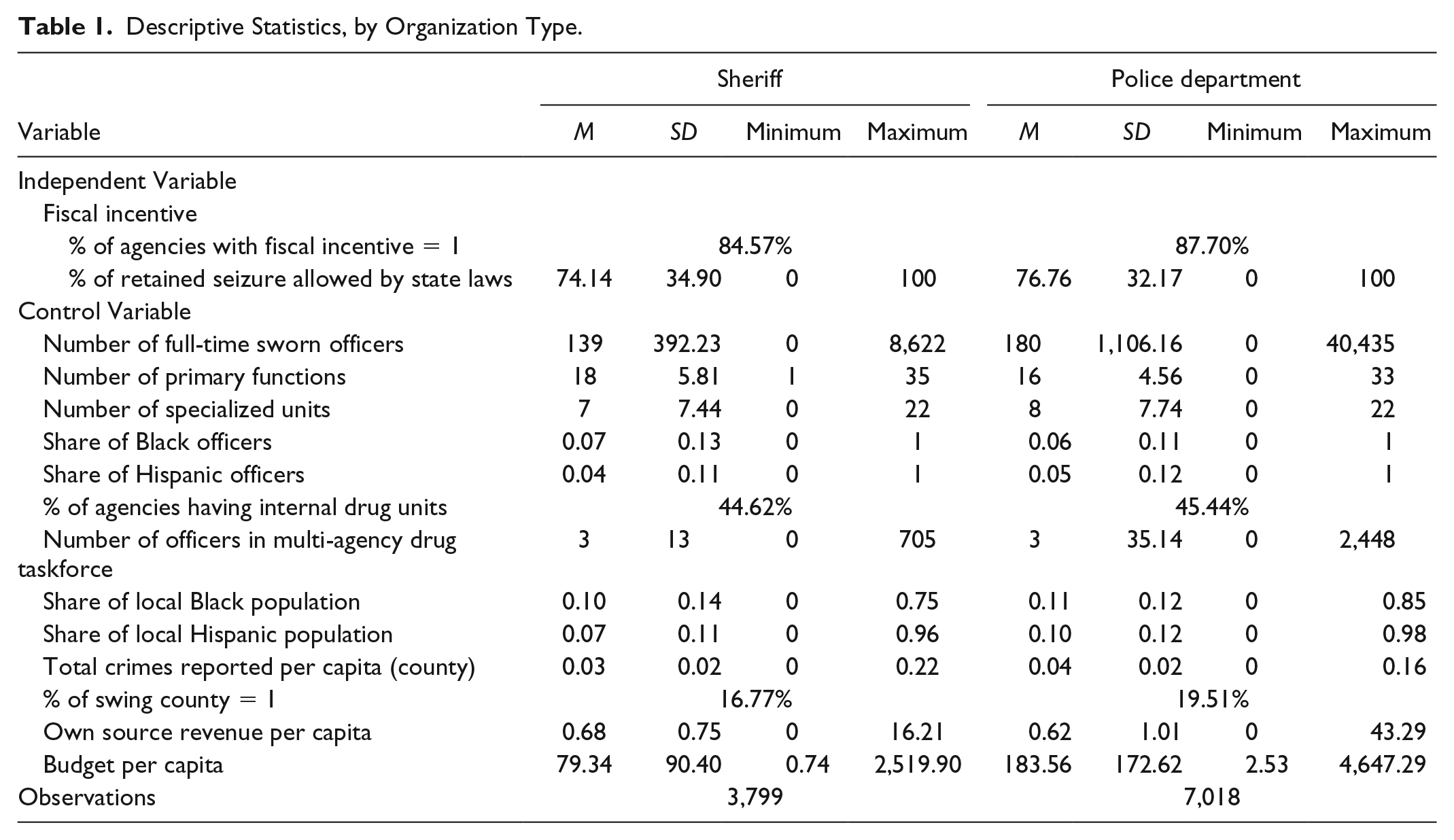
To further account for the institutional and functional differences between two types of organizations, we include two proxy measures that capture functional complexities, which may further impact our dependent variable, either through influencing the resources readily dedicated to seizure or changing the desire to in(de)crease the use of forfeiture. The first measure is a count of the number of functions an agency claims primary responsibility for, which is a proxy to the agency’s workload. The second measures the number of specialized units within an agency, such as a domestic violence unit and a hate crime unit. It accounts for the level of division of work within an agency. In our sample, as shown later in Table 1, at the end of this section, Sheriffs on average take on 18 duties, whereas police departments are responsible for 16. 18 Besides, they appear to be equally sophisticated in terms of work division—Sheriffs set up seven specialized units on average, whereas police departments have eight. Although the two types of police organizations do not differ dramatically on these functional measures, we include them in analyses to reassure the readers that possible differences between the two have been accounted for, and thus, the effects of electoral costs on asset forfeiture should be isolated in our empirical models.
Descriptive Statistics, by Organization Type.
Finally, we measure the minority representation in the police force as the proportion of Black and Hispanic officers. Work on representative bureaucracy and policing suggests that more representative police departments engage in less proactive policing (see, for example, Close & Mason, 2006, 2007).
As asset forfeiture was initially designed as a part of the war against drug-related activities (U.S. Department of Justice, 1994) and the need to curtail drug trafficking is one of the most common justifications of asset forfeiture offered by law enforcement, we need to capture the degree to which seizures are a function of drug-related activity. To do so, we construct two proxy measures. The first is a dummy variable set to one if the agency sets up an internal special drug task unit, and the second measures the number of officers assigned to a multiagency joint drug task force.
The second category of controls captures jurisdictional characteristics that may influence police seizure behavior. Specifically, we use the ACS estimates on the proportion of African Americans and Hispanics living in a given county. 19 Suggested by racial threat and social control theories from the field of sociology, a large and growing minority population increases the perceived level of minority threat in the general population, and in turn increases the likelihood that majority-controlled institutions engage in social control activities (see, for example, Blalock, 1967). Aggressive policing tactics, such as forfeiture, is one example of punitive mechanisms available to law enforcement to sanction citizens of color (Chambliss, 2001; Liska, 1992; Smith & Holmes, 2014). In addition, we include a county-level variable that measures the total crimes reported per capita (including both violent and property crimes), to control for the differences in the public safety environment across jurisdictions as this may affect seizure revenues. Moreover, we aim to account for the intensity of electoral pressure that sheriffs may face when making seizure decisions. To this end, we construct a measure of accountability using the difference in partisan presidential vote share for all counties in our sample. 20 It is included in our estimations as a binary indicator: Localities are coded as competitive (equal to one) if the absolute partisan difference in county level vote share is less than 5% with the remaining localities treated as noncompetitive (equal to zero).
The last category of controls includes financial variables. Per capita own source revenue, obtained from the Survey of State and Local Government Finances, accounts for the government’s ability to increase revenues through taxation. We suspect that agencies with greater power to affect tax revenues have more secure funding and are thus less likely to resort to forfeiture to pad budgets. A measure of operating expenditures controls for the amount of resources available to agencies. The percentage of seizures made under the Equitable Sharing Program is included, accounting for differences in the use of that program and the possibility that agencies in states with less generous seizure laws are more likely to take advantage of the Equitable Sharing Program. The following table displays summary statistics on the variables that we use in the analysis.
Estimator
The baseline model to test the first hypothesis takes the following form:

where
Before moving on, we would like to justify our use of ordinary least squares (OLS) estimation. Although the analytic sample has a panel structure, commonly used panel methods such as fixed effects (FE) that control for time invariant unobserved heterogeneity do not serve our research purpose well. The key predictors of interest, most notably agency type and fiscal incentive, do not vary over time within agency. Therefore, an FE model is unable to estimate the effect of these key variables. In OLS estimations, we include year fixed-effects to account for conditions in a given year, such as widespread economic downturns, that may affect most jurisdictions and their forfeiture activities, as well as a rich set of control variables shown in previous section that are corrected with police seizure activity.
To examine H2, we again use OLS estimation to fit a model that has the same structure of Equation 1, but uses the proportion of seizure coming from the partnership with the federal agency in Equitable Sharing Program as the dependent variable. To test the last hypothesis (H3), we again utilize OLS, adding a multiplicative interaction term between the agency indicator and the measure of percent of forfeiture revenue retained by the local jurisdiction (i.e., state fiscal incentive).
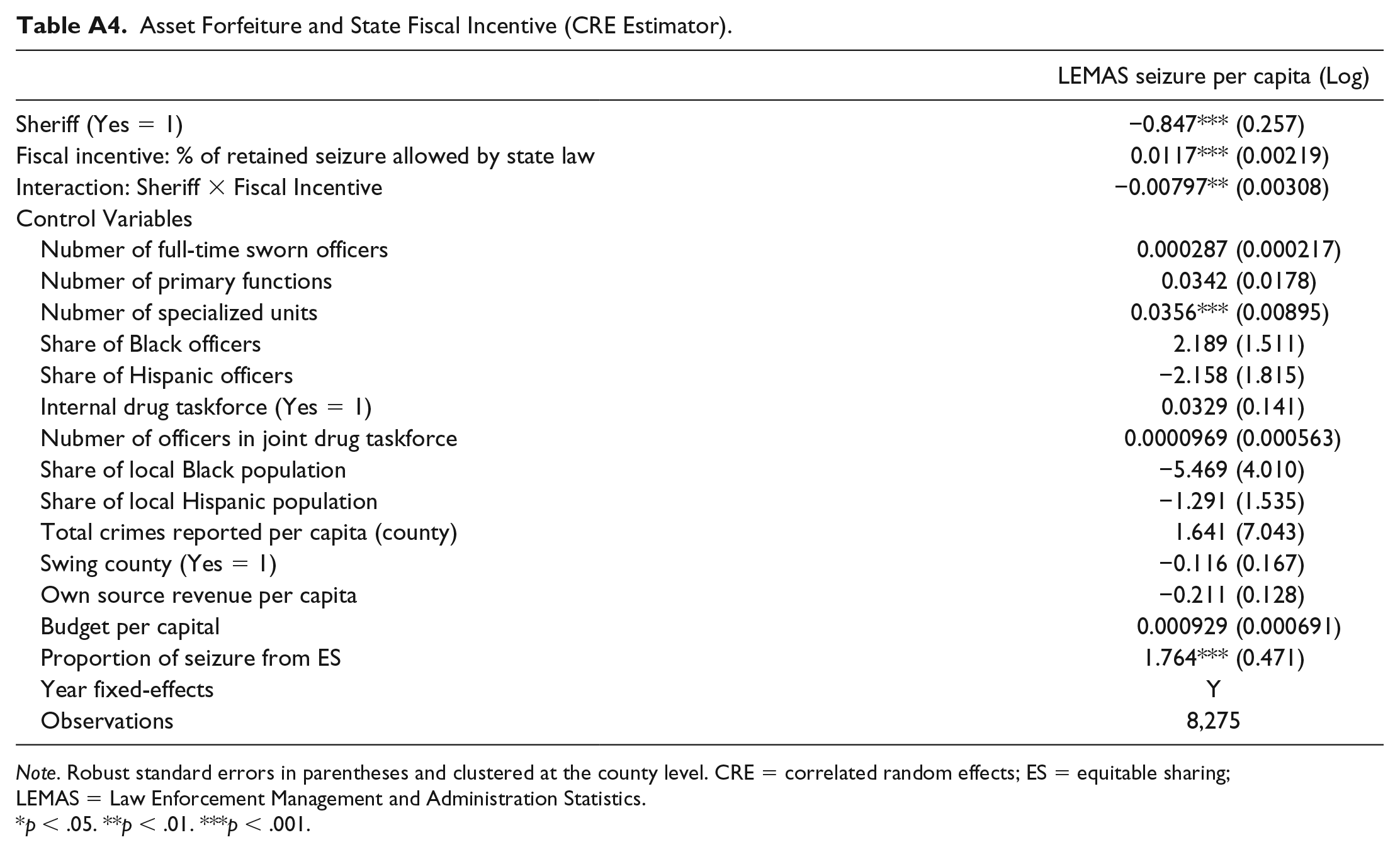
As a robustness check, we perform several sets of ancillary analyses, these results of which are provided in Appendix to this article. To begin with, we run an FE model at the county level to fit Equation 1. In doing so, we lose point estimates on the swing county and fiscal incentive variables; however, we are able to examine variation in police and sheriff behavior within a given county, accounting for unmeasured, time invariant factors that may produce variation in seizures across counties. This approach helps to confirm that any observed effect of agency type on seizure activity (H1) is not due to these factors. Second, we use correlated random effects (CRE) estimation to confirm our primary results. The CRE model represents an improvement on fixed-effects estimation as it allows for within estimates on time-varying variables while at the same time allows for the inclusion of time-constant variables (Mundlak, 1978; Wooldridge, 2010). 22 In these robustness checks, we are able to obtain within-estimations on time-varying variables while evaluating the effects of time-constant factors, such as fiscal incentive and the extent to which election is competitive.
Findings and Discussion
Baseline Results
We begin by examining the relationship between agency type and forfeiture revenue in Table 2. The coefficient estimations on the sheriff’s office indicator are negative and statistically significant across all three models (p < .001), civil forfeitures in the equitable sharing data (Column 1), forfeitures associated with a criminal conviction also in the equitable sharing data (Column 2), and total forfeiture revenue reported (Column 3). This is consistent with H1, that agencies headed by elected officials (sheriff offices) seize less than those headed by appointed officials (municipal police departments), all else being equal. In terms of magnitude, the results confirm our expectation that differences in forfeiture revenues received by sheriffs and municipal police is smaller in criminal seizures, providing further support for the notion that these differences are driven by the potential electoral costs of seizure. Similar results are found using county fixed-effects and CRE estimators. 23
Asset Forfeiture: Sheriff’s Office Versus Municipal Police Department.

Note. Analytic samples in three models come from civil forfeiture, criminal forfeiture in equitable sharing data and LEMAS separately. The sample size is smaller in Columns 1 and 2 due to the fact that not all agencies seize property through the Equitable Sharing Program. Robust standard errors in parentheses and clustered at the county level. ES = equitable sharing; LEMAS = Law Enforcement Management and Administration Statistics.
p < .05. **p < .01. ***p < .001.
Descriptively, the average law enforcement agency in our sample obtains $10.6 per capita from civil forfeiture. The point estimate of −0.839 in Column 1 suggests that switching from police departments to sheriff’s office results in a 56.79% decrease in seizure revenue per capita. 24 The equivalent result for criminal forfeiture (Column 2) is a 52.48% decline. Applying the same calculation to the point estimate on agency type in the LEMAS data (column 3) results in an even larger decrease of 76.33%, a finding that is consistent with the estimates on criminal and civil forfeiture. 25
Before moving on, we would like to note the impact of the control variables across three models. The number of full-time sworn officers is negatively associated with all measures of seizure revenue (though not significant). The two proxies that measure functional complexities—number of primary functions and number of specialize units—are positively and significantly correlated with LEMAS seizure (p < .001), but negatively associated with the dependent variables in Equitable Sharing Program. Variables that capture the extent to which police organizations engage in anti-drug activities are consistent with expectations. For instance, the number of officers belonging to a joint drug taskforce is positively correlated with all three dependent variables but is statistically significant in cases of criminal forfeitures only (p < .001). Setting up an internal drug taskforce is also positively associated with seizure values of all kinds (Column 3) but is negatively correlated with civil forfeiture. Estimations on local minority populations align with previous work on racial threat and social control theories. Specifically, the share of Black population in a county is a positive, statistically significant predictor of civil and total (but not criminal) asset seizure. Hispanic population share, however, is a significant predictor of asset forfeiture in the LEMAS data set but is not significant in specifications using the Equitable Sharing outcome variables. Total crimes per capita (reported at the county level) is a significant predictor as well, but it is positively related to the LEMAS measure while presenting an opposite pattern when using dependent variables drawn from the Equitable Sharing Program data. Alternatively, budget and own source revenue per capita are positively associated with each type of forfeiture revenue, however the latter is only statistically significant in cases of criminal forfeiture. This suggests that, contrary to the argument that cash strapped agencies make use of asset forfeiture in response to budgetary shortfalls, it is wealthier organizations that take most advantage of the practice.
We now turn to Table 3, where we probe the expectation that to avoid electoral blame for forfeiture activity sheriffs will make greater use of the Equitable Sharing Program relative to municipal police departments. The dependent variable in this case is the proportion of total forfeiture revenue from the Equitable Sharing Program. The indicator of sheriff office is expectedly positive, suggesting sheriffs are more likely to partner with federal authorities to seize and forfeit property than are municipal police. However, the coefficient failed to reach traditional levels of statistical significance, meaning we cannot conclusively confirm the hypothesis that sheriffs are more likely to partner with federal authorities. 26
Asset Forfeiture and Blame Avoidance.
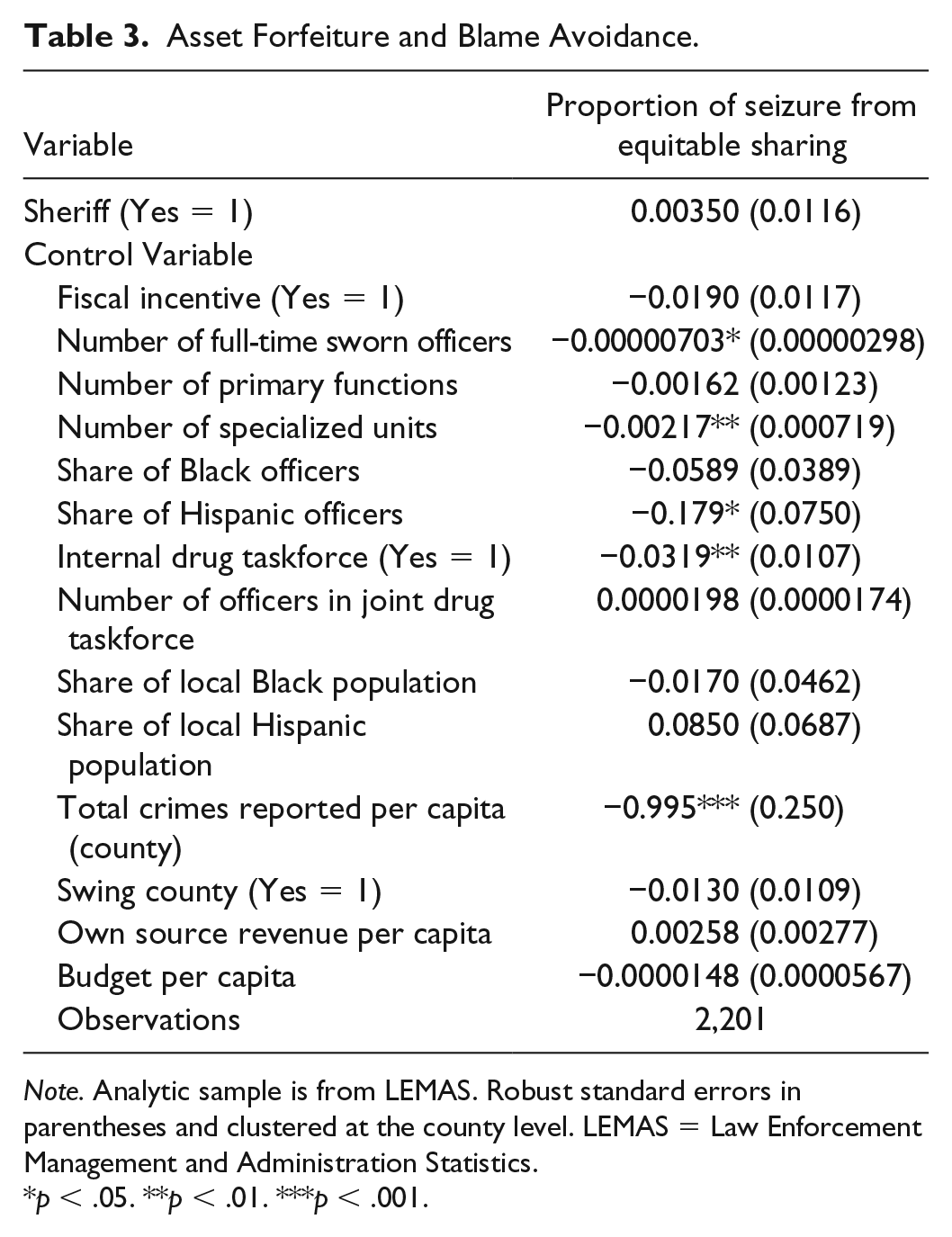
Note. Analytic sample is from LEMAS. Robust standard errors in parentheses and clustered at the county level. LEMAS = Law Enforcement Management and Administration Statistics.
p < .05. **p < .01. ***p < .001.
Finally, the model in Table 4 tests our third hypothesis that sheriffs are less responsive to state policies that allow jurisdictions to keep a larger share of forfeited assets. The interaction between the sheriff’s office indicator and the financial incentive measure is negative and significant (p < .05), providing support for that assertion. This finding is easiest to interpret via a graph, which we present in Figure 3. As the figure shows, seizures by municipal police are responsive to state incentives, increasing predicted forfeiture across the range of the measure. Alternatively, and consistent with our expectations, seizures by sheriffs are only slightly responsive to financial incentives. 27 Specifically, the results suggest that a municipal police department in a state that allows agencies to keep 100% of forfeiture revenue will seize 23% more than a department in a state that allows law enforcement to retain only one fifth of seizure revenue. Alternatively, the difference between two sheriff’s offices in these hypothetical states is 3%.
Asset Forfeiture and State Fiscal Incentive.
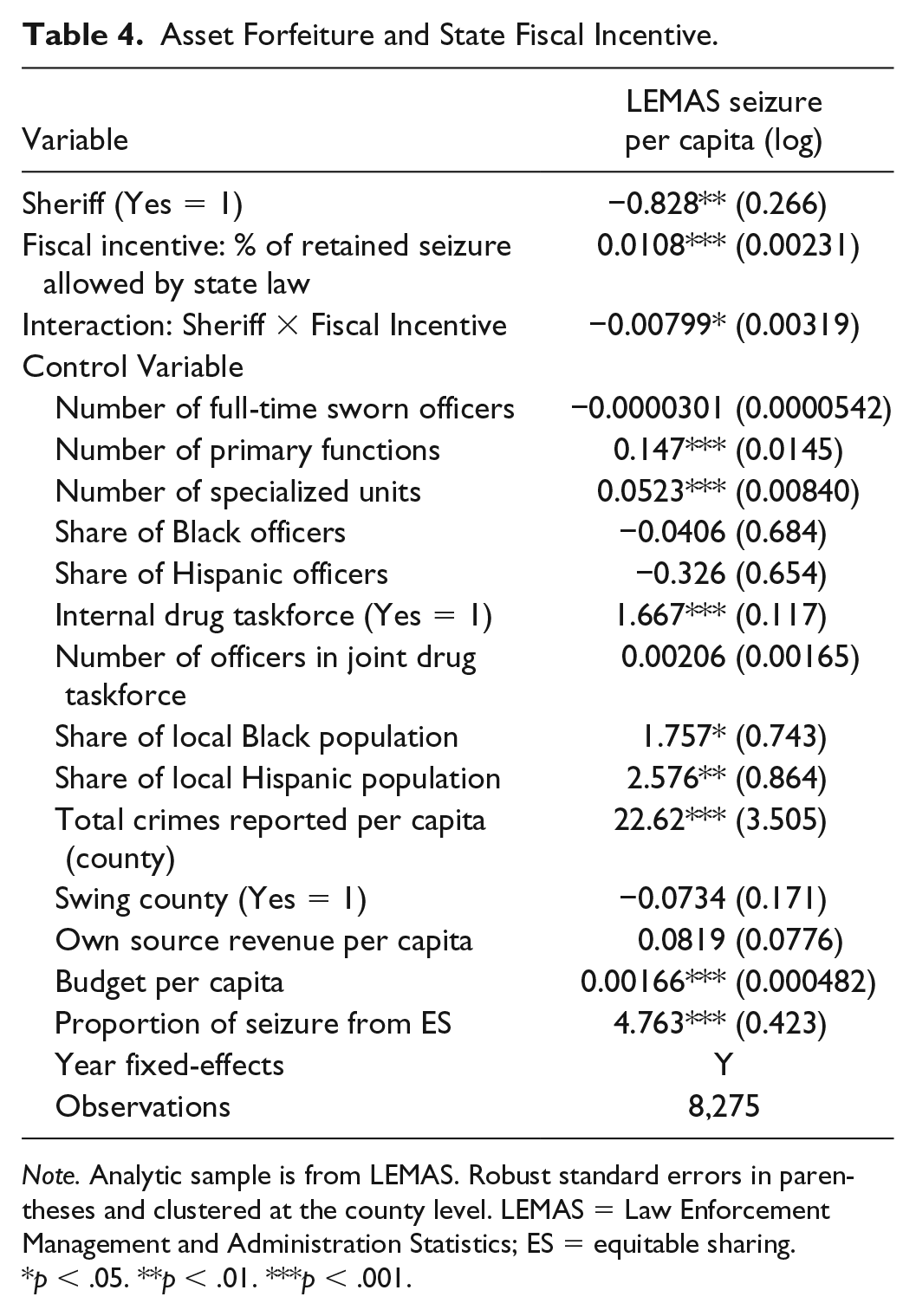
Note. Analytic sample is from LEMAS. Robust standard errors in parentheses and clustered at the county level. LEMAS = Law Enforcement Management and Administration Statistics; ES = equitable sharing.
p < .05. **p < .01. ***p < .001.
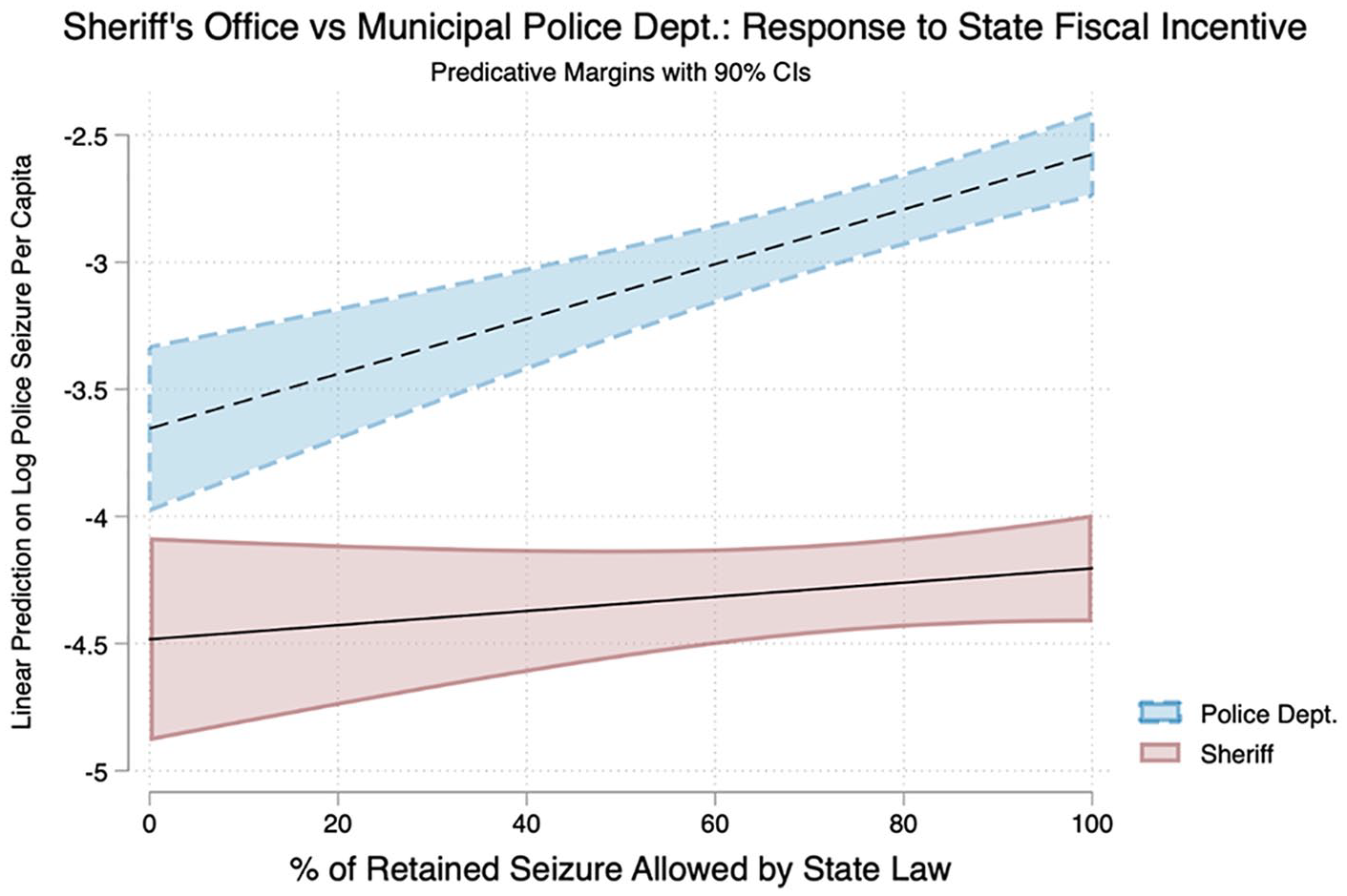
Sheriffs versus police departments: police seizure and fiscal incentive.
Conclusion
We began with the assertion that, although existing work has developed many meaningful insights, there is more to learn about asset forfeiture and about the ways in which organizational characteristics and intergovernmental incentives influence that behavior. We also suggested that existing research has missed an opportunity to refine theory regarding differences in the delivery of public services by elected versus appointed public administrators. Drawing on and expanding that literature, we develop the expectations that sheriffs should seize less than police due to the potential electoral costs associated with that activity, that they would engage in blame avoidance strategies to avoid those costs, and that they should be less responsive to state laws that attempt to incentivize asset forfeiture.
Analyses of more than 3,500 law enforcement organizations over a period of 14 years provide considerable support for these assertions. Sheriff’s offices, which we suggest face a potential electoral cost for seizure activities that municipal police departments do not, report less total forfeiture revenue and more revenue from civil forfeitures under the Equitable Sharing Program. Our argument that these differences are driven by the electoral motivation is bolstered by the findings that the difference between sheriffs and police is greater in civil versus criminal cases. Finally, consistent with expectations, we find that state-level policies allowing agencies to keep a larger percent of forfeited assets influence the behavior of police departments, but not of sheriffs. This result is consistent with our argument that for sheriffs, the financial benefits given by state laws are offset by the electoral costs of additional forfeiture dollars. This is not the case for police, meaning that the strength of the incentive is necessarily greater for the latter.
Our study has significant implications for the study of appointed versus elected public administrators. The finding that sheriffs seize less because they fear electoral reprisal for a politically unpopular activity is consistent with the expectations from that literature, but until now, that expectation not been confirmed in the context of policing. Given that far more citizens interact directly with police and sheriffs than with judges or city managers/mayors, confirming that the electoral motivation matters in this context has significant implications for the consequences of administrator selection methods.
The study also contributes to scholarship in this area by explicitly examining the blame avoidance techniques that elected administrators might adopt when engaging in activities that voters oppose. Although we do not find statistically significant evidence that sheriffs are more likely to “pass the buck” (Weaver, 1986) to federal authorities when it comes to unpopular forfeiture activity, the results of our analyses are in the expected direction and suggest that this may be a fruitful line of inquiry moving forward.
The largest contribution of this study to work on appointed versus elected administrators comes from its examination of the ways in which the differing motivations of these actors may influence their responsiveness to intergovernmental incentives. Many studies of elected versus appointed administrator behavior have occurred in contexts where there exists a significant set of intergovernmental incentives designed to influence administrator behavior. This is particularly true in areas such as redistribution (Enikolopov, 2014) and the hiring of police (Vlaicu, 2008). Our study directly examines the impact of electoral motivations on the responsiveness to such incentives, demonstrating that state policies increasing the proportion of forfeited assets retained by the agency only have an impact when increased revenue is not offset by potential electoral costs.
There are numerous areas where we might expect this relationship between selection mechanisms for administrators and the influence of other levels of government on local policy to be consequential. As just one example, research on grants-in-aid has demonstrated that jurisdictions are more likely to seek and receive federal grants when those awards can help them provide public goods desired by core constituents (see, for example, Nicholson-Crotty, 2015). This represents an important vehicle for the transmission of federal resources and influence into these jurisdictions. This relationship may be more complicated, however, if the core constituency of an elected administrator is different than for that of other elected officials in a jurisdiction. Similarly, grants may have different impacts on targeted subnational activities when administered by an appointed, rather than an elected administrator. Although more research is obviously needed, we think that the results from this study suggest that the selection mechanism for public administrators may have implications for intergovernmental relations that have not been explored to date.
Finally, the results from this study can meaningfully inform work on the motivations for forfeiture behavior by law enforcement organizations. As noted above, research has suggested that state-level incentives do not necessarily influence that behavior, but we find that they do once you have accounted for important differences across agencies. Furthermore, although previous work has examined use of the Equitable Sharing Program for forfeiture activity by local law enforcement, it has often treated the program as monolithic. Our results suggest, however, that important differences emerge when you examine civil and criminal forfeitures under that program individually, suggesting the need for more nuanced analysis moving forward. Contrary to the dominant narrative among forfeiture supporters, our results suggest that it is not resource poor agencies who engage in the most forfeiture activity, but rather those with the largest budgets and, presumably, the highest capacity to seize and dispose of property. Finally, our analyses suggest that forfeiture revenue is highly correlated with a larger share of minority residents. At worst, this correlation may suggest that forfeiture is being used a method of social control by law enforcement. More likely, it simply indicates that police are more likely to seize property from populations that do not have the political resources to effectively object. Obviously, the finding needs to be confirmed in analyses more explicitly designed to uncover the relationship between race and forfeiture, but it begins to confirm one of the primary concerns raised by critics of asset forfeiture.
Footnotes
Appendix
Asset Forfeiture and State Fiscal Incentive (CRE Estimator).
| LEMAS seizure per capita (Log) | |
|---|---|
| Sheriff (Yes = 1) | −0.847*** (0.257) |
| Fiscal incentive: % of retained seizure allowed by state law | 0.0117*** (0.00219) |
| Interaction: Sheriff × Fiscal Incentive | −0.00797** (0.00308) |
| Control Variables | |
| Nubmer of full-time sworn officers | 0.000287 (0.000217) |
| Nubmer of primary functions | 0.0342 (0.0178) |
| Nubmer of specialized units | 0.0356*** (0.00895) |
| Share of Black officers | 2.189 (1.511) |
| Share of Hispanic officers | −2.158 (1.815) |
| Internal drug taskforce (Yes = 1) | 0.0329 (0.141) |
| Nubmer of officers in joint drug taskforce | 0.0000969 (0.000563) |
| Share of local Black population | −5.469 (4.010) |
| Share of local Hispanic population | −1.291 (1.535) |
| Total crimes reported per capita (county) | 1.641 (7.043) |
| Swing county (Yes = 1) | −0.116 (0.167) |
| Own source revenue per capita | −0.211 (0.128) |
| Budget per capital | 0.000929 (0.000691) |
| Proportion of seizure from ES | 1.764*** (0.471) |
| Year fixed-effects | Y |
| Observations | 8,275 |
Note. Robust standard errors in parentheses and clustered at the county level. CRE = correlated random effects; ES = equitable sharing; LEMAS = Law Enforcement Management and Administration Statistics.
p < .05. **p < .01. ***p < .001.
Authors’ Note
Siân Mughan is now affiliated with Arizona State University, Phoenix, USA.
Declaration of Conflicting Interests
The author(s) declared no potential conflicts of interest with respect to the research, authorship, and/or publication of this article.
Funding
The author(s) received no financial support for the research, authorship, and/or publication of this article.
