



Abstract
Over the course of this decade, Florida has emerged as one of America’s fastest growing and most visited states. As many of the state’s municipalities compete for opportunities to expand their tax base and achieve other municipally centered goals, they are faced with the challenge of needing to strategically differentiate themselves from their peers to attract opportunities. One way to accomplish this is through using marketing as a tool of strategic management. While literature shows that marketing engagement is happening in cities throughout the world, we lack a clear understanding of what American municipalities are doing about marketing and why they are increasingly choosing to participate in the activity. This work provides a glimpse into how a sample of Florida cities are strategically using marketing and what city managers and communication officials are specifically hoping to accomplish with marketing activity. The purpose of this research is to answer the following three questions: Why do city governments engage in marketing? Do city government officials engage in marketing from a strategic management perspective? How do city governments engage in marketing? Utilizing surveys and interviews from city managers and communication officials at the municipal level from across the state, this exploratory study sheds a light onto how several cities using marketing as a strategic management tool to achieve articulated goals. We provide recommendations for practitioners exploring strategic use of marketing and practitioners seeking to expand marketing engagement within their municipalities.
Introduction
On an average day, citizens encounter numerous branding images ranging from golden arches to green umbrellas. Story (2007) reported that individuals encounter as many as 5,000 images daily. This does not even consider the recent emergence of social media and the ease of advertising across all mobile platforms that have developed in the past decade. The way that citizens view the world and the images that they connect with those perceptions are influenced by marketing and branding. At its core, marketing is a humanly intrinsic activity. Organizations communicate by projecting messages to achieve various goals, including, but not limited to, building group comradery, earning trust, and increasing customer engagement.
Most often, the private sector comes to mind when we think of marketing: Nike’s “just do it,” BMW’s “the ultimate driving machine,” and Maxwell House’s “good to the last drop” highlight marketing campaigns that stand out over the past few decades. Each of these messages is designed to identify the uniqueness of the brand and to reinforce the positive relationship the customer has with the firm. As private sector practices have increasingly entered the public sphere, several outlined goals of marketing have followed suit. City managers and other public administrators seek to develop meaningful relationships between citizens and the jurisdiction they represent. Despite the ubiquity of these activities in citizen engagement in practice, scholarly exploration of these activities remains nascent in the United States. With the idea of marketing infiltrating local governance lexicon, exploring the use of marketing among public officials carries values today and into the future for both theory and practice.
The purpose of this research is to answer the following three questions: Why do city governments engage in marketing? Do city governments engage in marketing from a strategic management perspective? How do city governments engage in marketing? While literature illustrates that marketing engagement is happening in cities throughout the world, we lack a clear understanding of which marketing activities American municipalities are using and why they increasingly devote time and monetary resources to the activity. Studying these questions is timely, because contrary to their global counterparts, American cities have only recently begun to explore and engage in the practice of marketing, with public administration theory slowly following suit. Public sector strategic management theory rarely addresses marketing and branding. In this regard, the use of marketing research by cities is still in its infancy and requires a broader examination into its use. This article provides a literature review and exploratory empirical data work serving as a baseline for further research on marketing in local governments. We hope that our research will help public administrators understand how to better market their cities more effectively and also inform scholars why practitioners engage in this behavior.
This exploratory study provides information on how a sample of cities in Florida are using marketing and what they hope to accomplish with the activity. We also tie this activity to the strategic management literature, because marketing and branding are two tools that public managers are using to purposefully engage internal and external stakeholders with their city. Since the emergence of New Public Management (NPM) literature within public administration around 1990, there has been an increase in the adoption of private sector management tools in cities and states (Berry, 1994, 2007; Poister & Streib, 1999). The subject matter within this study is another illustration that shows how cities adopt management functions from the private sector.
The remainder of this article is organized as follows: We first outline relevant definitions of key terms used in this article and explore prior related work. Next, we describe our research methodology and present the findings of our analyses. To conclude, we briefly provide recommendations for practitioners based on insights gained from the study and provide guidance to the public marketing community coupled with avenues for future exploration in this field.
Defining Concepts
Many of the terms used in this study have applications in both the public and private sectors. Given that scholars utilize marketing, branding, and strategic management in different contexts and forms, there is often confusion about the basic terminology associated with marketing as many public marketing studies have not linked these practices together. 1 Marketing and branding are not synonymous and are often misused by practitioners and scholars.
The American Marketing Association (AMA, 1985) defined marketing as “the process of planning and executing the conception, pricing, promotion, and distribution of ideas, goods, and services to create exchanges that satisfy individual and organizational objectives” (p. 11). Despite operating in an environment that is less profit driven than the private sector, cities do provide services and goods to constituencies and therefore have the opportunity to market those goods and services similar to private firms. The International City/County Management Association (ICMA, 2006) found that there is no single approach to how cities decide to engage in marketing. The organization profiled four cities that used marketing in a public context, dating back to the turn of the 21st century. They argued that marketing is not confined to one area of the country or one particular type of town (i.e., rural town, suburb, large city). In Fay and Zavattaro’s (2016) work on branding and isomorphism, the authors delineated marketing in the context of branding by echoing Karents et al. (2016, pp. 486–487): “Public branding is a deliberate governance strategy to influence citizens’ perceptions. [Branding] is a strategy for communication and image building among target groups.” Marketing is the effort to communicate that image to the target groups, whereas branding involves every decision that can influence the relationship between the group and branded entity (e.g., constituent and government). 2
For the current study, we define the terms strategic management, marketing, and branding in the following ways: Consistent with Bryson (2011, n.p.) strategic management is “the appropriate and reasonable integration of strategic planning and implementation across an organization (or other entity) in an ongoing way to enhance the fulfillment of its mission, meeting of mandates, continuous learning, and sustained creation of public value.” Marketing is a purposeful strategy to influence stakeholder perceptions. A city’s brand is the relationship that the city has with various stakeholders including citizens, visitors, employees, and other organizations. The practice of branding is a conscious effort made by city officials and employees to portray and stamp that brand through consistent use of the brand on published materials, the organizational website, and other documents. Brand equity is best characterized as the success of a brand given the associations made with it and a perceived loyalty to the brand (Anholt, 2007; Fay & Zavattaro, 2016; Keller, 1993).
Public marketing is generally understood by practitioners and scholars alike as government communication activities articulating a message to current or future constituents. 3 The standard definition of private marketing developed by the AMA discussed above parallels strategic management rather than basic communication practices. Municipal decisions regarding which services to offer, how to deliver services, how to pay for services (i.e., fees or general appropriations), how to promote services to encourage citizen participation, and use of services could all be considered marketing activities if examined through a private management lens. In the interest of parsimony and based on the discussions in the public management literature and from public managers themselves, we limit our conceptualization of public marketing to the promotion or communication of ideas and services to current or future constituents to accomplish municipal goals. This definition accounts for both short-term and long-term goals put forth by a public entity. Each of these ideas and past research are covered in a brief literature review in the following subsections.
Strategic Management
Bryson’s definition is consistent with Moore’s (1995, 2013) work in which he posited that strategic management is used for the purpose of defining and creating public value. Kellough and Selden (2003) described Berry’s (1994) ideas of what strategic planning should achieve, notably that the practice should communicate an organization’s mission, acknowledge its relevant constituencies, articulate strategic goals, and develop and implement strategies to achieve those goals. As a result, we assert that marketing should be utilized by city managers and other city officials to communicate their respective municipality’s mission, acknowledge citizens and employees, articulate its strategic (and sometimes short term) goals, and develop strategies designed to achieve those goals. This definition of marketing strategy would be consistent both with strategic management and a general marketing framework.
With three decades of public application, engagement in strategic management is still growing among practitioners and demonstrated to often be successful when adapted correctly (Bryson, 2018). Yet, few studies have linked strategic management and planning to the utilization of marketing as a tool to communicate the plan and encourage stakeholder buy-in. The development of a marketing campaign provides a city with an opportunity to examine the values of their constituency as well as the opportunity to espouse the city’s value to a wider audience, both inside and outside of the jurisdiction.
In Kentucky, state officials affiliated with Governor Steve Beshear worked with a private marketing firm to develop a marketing plan for the state health insurance exchange that would promote state-based public values and encourage potential health insurance purchasers to enroll in the state’s health insurance exchange (M. Thomas, 2017). 4 Using imagery that resonated with what Kentuckians might view as local (i.e., barns in rural areas, diverse populations in urban areas), the state worked with the marketing firm to appeal to the values of their constituency within the context of the marketing of the Medicaid expansion program called “Kynect” to achieve the state’s goal of improved health outcomes for Kentucky residents through insurance purchases.
Public Marketing
Academic interest in public marketing and branding has grown in the past five decades since its introduction into mainstream public administration literature with Kotler and Zaltman’s (1971) seminal work on social marketing. Shama (1976) argued that marketing has played significant roles in political campaigns for six decades now. Political marketing has been applied to an array of related forums including leaders, parties, coalitions, and policies (Eshuis & Klijn, 2012). Marketing and branding have also surfaced in other types of academic literature including public administration and policy, notably higher education (Fay & Zavattaro, 2016; Woodhouse, 2016), public health (Basu & Wang, 2009), and tourism via place branding (Tschirhart, 2008). In recent years, public agencies have utilized different methods to communicate their message, with social media emerging as ubiquitous (Bertot et al., 2012; Picazo-Vela, et al., 2012; Ranerup et al., 2016; Zavattaro & Bryer, 2016; Zavattaro & Sementelli, 2014).
Despite this growth, the literature surrounding public marketing still pales in comparison to research in the private sector. Walsh (1994) described that public marketing and branding are less common because less is known about how citizens act, and the “psychology of citizens” is underexplored as opposed to the “psychology of consumers.” Yet this argument ignores the similarities between public and private sector marketing. Citizens consume government goods and services similar to private goods by exchanging tax dollars or user fees with municipalities. Governments compete externally with others, such as city-versus-city or state-versus-state trying to attract potential businesses, visitors or future residents, which Tiebout (1956) outlined in his work. This illustrates that cities and states use various mixtures of expenditures, taxes, and policies to attract citizens, visitors, and business, all consistent with a general understanding of marketing. Boehmke and Witmer (2004) noted that by looking at governments with similar needs and characteristics, states can propose reforms that might be better suited to a constituency and its particular circumstances. Furthermore, marketing efforts can provide additional information regarding citizen policy preferences (Boehmke, 2000), thereby reducing the adoption risk to elected officials or managers before a policy is implemented (C. Bennett, 1991).
The increasing use and incentives on collaborative governance at all levels of government has made the critical shift from top-down commands to involving and empowering a variety of stakeholders and their networks (Castells, 2008; Linders, 2012). Public officials view citizens as having value in the community through citizen engagement activities. Participants may believe that their contributions make a meaningful difference and therefore strengthen their relationship to the city brand. From a public employee perspective, by seeing citizens as agents to work with as opposed to barriers to overcome, cities can access resources such as expertise, effort, and time. Citizen engagement is viewed as a method of gaining access to stakeholder opinions, especially those of the constituents that a city serves.
At least in terms of branding, the development of the brand allows for the synthesis of voices through different mechanisms. In the case of citizens, discussion panels serve as a possible vehicle to gain access to opinion (Eshuis et al., 2014). Eshuis and Edwards (2013) argued that the way citizens feel about a brand and their emotions connected to it can be captured within a brand, if there is a participatory process. Eshuis et al. (2014) argue that this type of interaction is lauded in governance literatures in addition to place marketing literatures. 5 A European example of where citizen engagement occurs was provided by Eshuis et al. (2014), in which a town south of Rotterdam, Netherlands (Katendrecht) sought to engage in revitalization. One aspect of this was to initiate a branding campaign.
A strong residents’ association in Katendrecht held a significant influence in municipal affairs due to their ability to mobilize citizens. As a result, a combination of 20 individuals, half of which were residents, took part in the initial development of the branding process. This input helped developers and local officials understand the emotions tied to the city and to identify the best direction that a branding and marketing campaign should go. Once again, it is worth echoing that a brand is more than just an image. It is what people feel or the words that he or she associate with the particular company or organization. Branding is also “an active strategy” where stakeholders are involved in the entirety of its production (Dinnie, 2015; Fay & Zavattaro, 2016). Although the case of Katendrecht is an international example, it illustrates the potential that citizen engagement can have on a municipal branding. While there is not a similar example that exists within our sample, discussing the success of citizen engagement in another Western context shows how citizen engagement looks and serves as an example for American cities to emulate. Citizen input enables public administrators and possible marketing companies to establish how citizens feel about the city, which government services they associate with their community, and how that should change or maintain consistent in the future to be responsive to citizens. It is not unreasonable to believe that marketing can function in much the same way. By engaging in this activity, cities are able to react to public concern and tailor communication efforts to address citizen demand. Public administrators can also develop a better understanding of how people are tied to the city emotionally (brand equity) and how the managers should integrate that information in their duties. The resulting interactions between constituents and public officials working to achieve a common goal provide the opportunity for citizens to become more invested long term in the governance of the areas where they live. Considering that public marketing is an attempt to improve citizens’ perceptions and inform them of government activities, marketing is a way to build stronger citizen–government bonds.
Methods
The data for this article were collected from two sources: an administered survey of and follow-up interviews with city managers and related officials in charge of public communications in the state of Florida. The survey examined public activity that covered branding, marketing, social marketing, and strategic management. Second, information was obtained from follow-up interviews conducted with seven survey participants opting to engage in interviews. The open-ended interview questions shed more insight into how public agencies are using these activities within their cities today, how their successes or failures are captured, and what scholars and practitioners should better understand about these concepts today. This research focuses on the questions pertaining to marketing and strategic management of its use.
Survey Data & Sampling
The sample for the online questionnaire and interviews included Florida city managers and local municipal officials across the state in charge of public communication for their city. Survey questions were written for consistency with Qualtrics software formatting. The email was distributed by the Florida League of Cities (“FLC” hereafter), which is an organization based in Tallahassee, Florida whose goals “are to serve the needs of Florida’s cities and promote local self-government.” Formed in 1922 by several municipal governments, FLC goals are to “shape policy, share the advantages of cooperative action, and exchange ideas and experiences (Florida League of Cities, 2016).” The survey was accessed through email with an embedded link to an online survey that potential respondents had the opportunity to complete. The survey respondents included city managers, city clerks, and individuals with municipal communication offices that had firsthand knowledge of marketing and branding practices used by the city in which they were employed. The sample identified for this study was consistent with a 2015 FLC published survey which examined the views of local tourism in which 178 out of 411 municipalities contacted responded from October 27 to November 23, 2015. As a result, a similar questionnaire (consisting of agree–disagree statements, multiple choice/multiple-choice-plus-response questions and follow-up open-ended questions) was sent electronically to 412 Florida city managers and local municipal officials across the state whose cities are affiliated with the FLC from May 1, 2017 through June 21, 2017. The significant difference between the 2015 and 2017 surveys is that the 2015 version was seven questions in length and consisted of only tourism-related questions, whereas the survey utilized for this study was more extensive (59 questions) and examined broader concepts outside the scope of tourism.
To maximize survey respondent results, the FLC distributed emails on three separate days. On May 15, 2017, the organization sent a follow-up email to further turnout. Both emails provided a survey deadline of May 24, 2017. The FLC sent out an email once more on June 13, 2017, with a response deadline of June 21, 2017. In total, 42 responses out of 660 emails were acquired from this survey with a final response rate of 6.3%. 6
Information was gleaned from public administrators working for 42 different cities in Florida. Job titles of survey participants include City Manager, Assistant City Manager, City Clerk, Communications Director, Human Resource Manager, Chief Operating Officer, and Risk Manager among others. Only one elected official responded, serving in the position of Mayor. Based on 2016 population data, our sample includes responses from individuals representing towns ranging from approximately 500 people to more than 250,000. Individual towns represent coastal, rural, suburban, and urban cities all across Florida.
As the response rate was very low, we decided that interviews would help provide more in-depth discussion and offer a more in-depth feel for how city managers view these practices for their cities. We also made the decision not to generalize to all Florida cities based on the survey results but use the data as suggestive of city marketing activities that are occurring.
Interviews
Interviewees were selected for this research based on their willingness to participate, as indicated on a question at the end of the administered survey. Seven individuals from cities with varying demographic considerations from across the state participated in the phone interviews. Each interview was recorded and subsequently transcribed to help ensure accuracy, a practice considered a good standard to use in qualitative research (Yin, 2013). To ensure anonymity, responses were numbered based on their appearance in this study. We also identify each interviewee based on the city’s location in Florida (northern, central, and southern) and urbanization (rural, suburban, and urban). The interviews utilized a semi-structured method, consisting of a standard set of questions. When necessary, interviewee responses that needed additional clarification were followed up with applicable questions. A total of seven interviews were conducted via telephone during July and August 2017. Each interview took an average of 40 min and 51 s.
Results
The surveys and interviews for this research questioned city managers and related officials about their city’s engagement in strategic management, specifically who was involved, what process was used, and the formalness of the plan. Questions were also asked about a city’s marketing practices, beginning with how marketing has been utilized, followed by marketing plan execution and finally, how the town defines whether a campaign was successful or not. The “Results” section is organized by discussing the degree of municipal strategic management by survey respondents. We then discuss how cities engaged in marketing, which is outlined fully in Table 1. In Table 2, the process used by cities to execute marketing activities is outlined. Table 3 identifies how cities determined whether a marketing campaign is successful (through branding initiatives).
Job Titles Survey Participants Hold (By Descending Order).

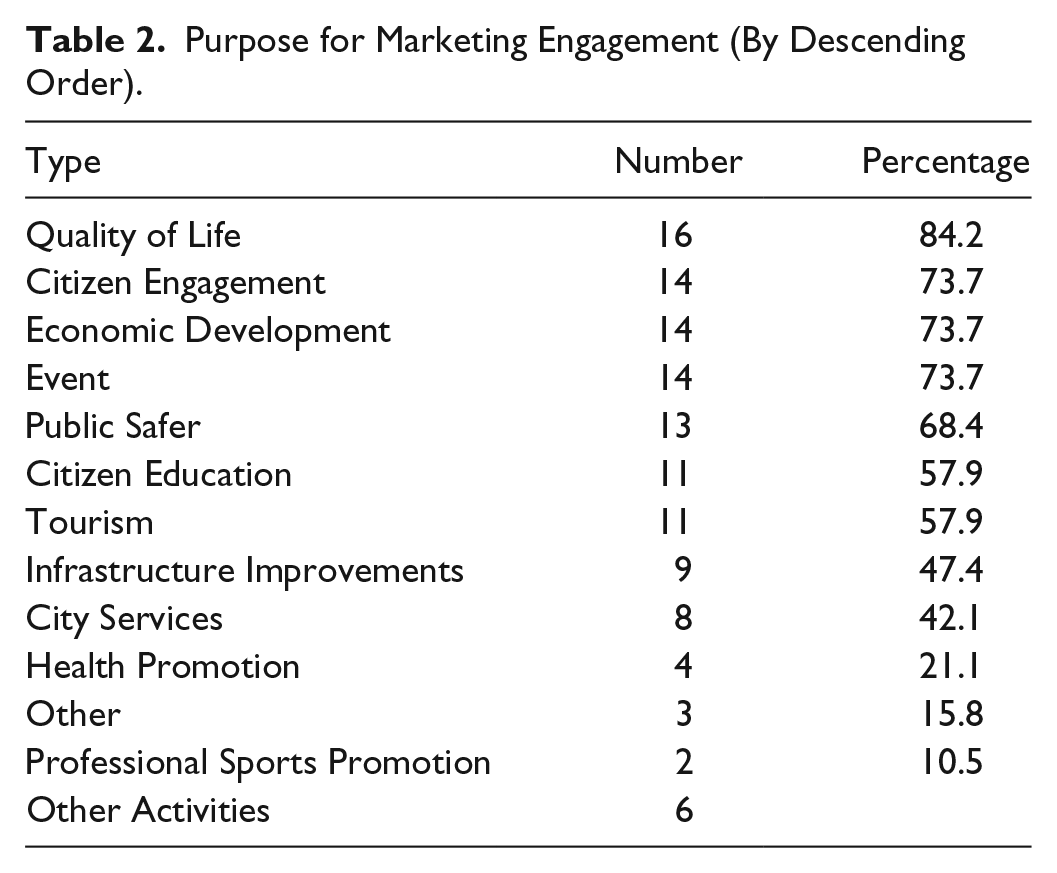
Purpose for Marketing Engagement (By Descending Order).
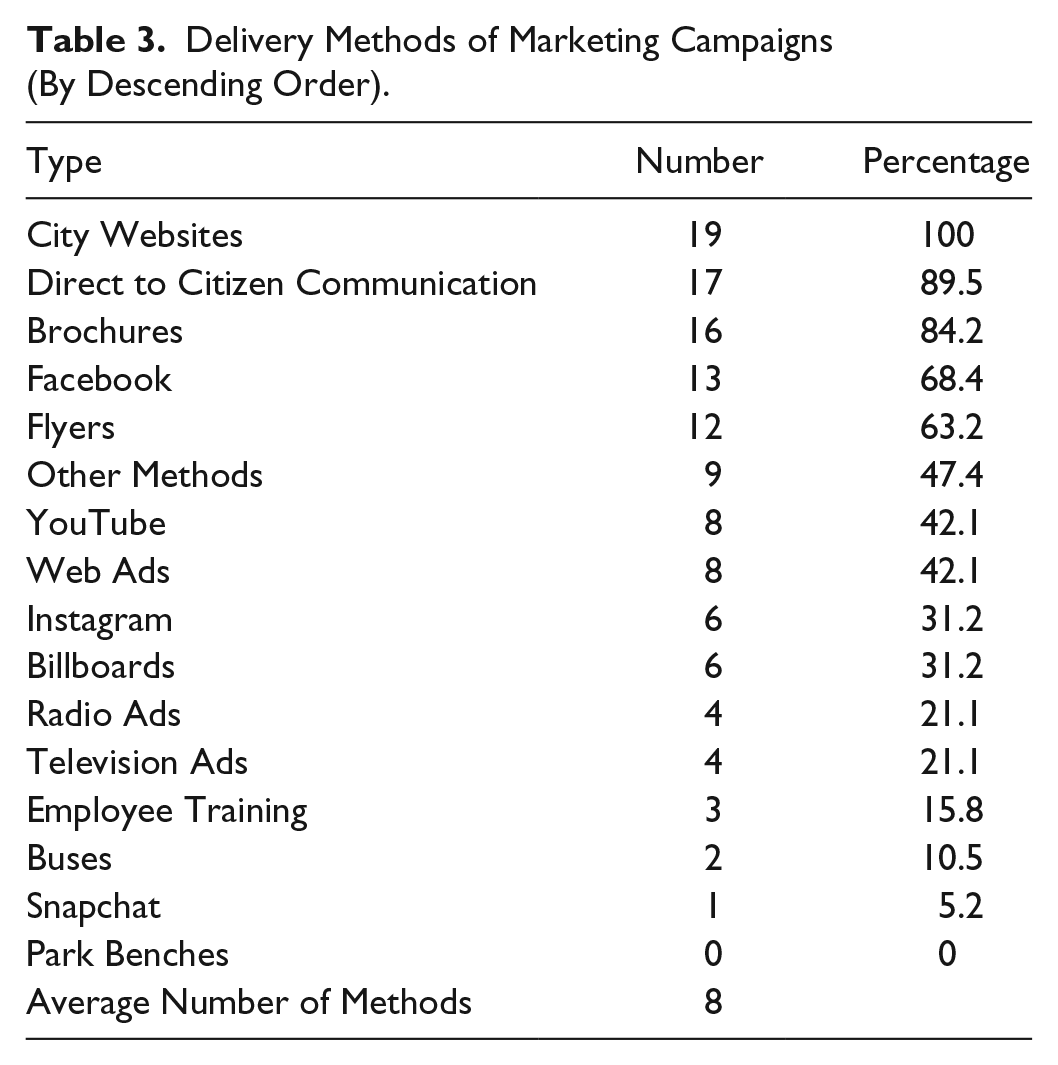
Delivery Methods of Marketing Campaigns (By Descending Order).
How Cities Evaluate Marketing Success Through Branding Initiatives (By Descending Order).

We find that the majority of cities that participated in the survey have strategic plans (57.1%) with almost half (47.4%) including marketing as one element of the plan. What this illustrates is that at least among this sample, marketing is becoming acknowledged as important enough by public officials to formally address the activity in long-term municipal goals. Given the relatively recent emergence of the activity in the public sector, one would expect this number to grow over the time, especially when strategic plans are revisited or renewed.
Of the cities that returned surveys, 36.8% engage in marketing, with an average of 6.1 services and programs marketed such as quality of life, economic development, and citizen engagement. The two most common ways that cities engage in marketing is through direct-to-citizen communication (89.5%) and through the issuance of brochures (84.3%).
On average, cities use eight different methods to engage in marketing, none of which allow for interactive citizen interaction. The way cities determine success and failure has been through word-of-mouth citizen comments and whether local media provides coverage of a marketed element (68.4%, each). In addition, what we see in the city examples is that the goals are largely about spreading a message and do not directly allow much citizen engagement in message development. Governments also evaluate marketing campaigns based on social media reach (63.2%). Interestingly, 15.8% of participants do not evaluate whether a marketing campaign is successful, which suggests a lack of capacity or interest in trying to get evidence of the marketing program’s effects.
Strategic Management and Planning Engagement
This section illustrates that cities are utilizing marketing as one of their strategic management tools, according to the survey. Of the cities that have a strategic plan, 89.5% involve the Office of the City Manager and 68.4% involve the Office of the Mayor in the creation of their city’s plans.
Stakeholder participation is a hallmark of strategic management and is part of what separates strategic from traditional management. Respondents were asked to identify stakeholder groups that contributed to their plans, including Office of the City Manager, Office of Communications, Office of the Mayor, Office of Planning, business leaders, citizen advisory board, Other, and “I don’t know.” On average, 3.1 stakeholder groups were consulted by the cities that are represented in this survey. In the “Other” category, answers included “department heads,” city councils, certified municipal planners, and an outside consultant (which was not identified), which indicate that in terms of strategic planning, city officials are listening to stakeholders within their government and the community, to a degree. Still, these low figures show there is room for more voices in the marketing planning process.
Marketing Engagement
There are a plethora of purposes for why cities utilize marketing. In our survey, respondents were given a list of 12 purposes and/or programs that their city potentially marketed. The marketed elements included citizen education, community engagement, economic development/growth (nontourism), health promotion, tourism, prominent attraction(s), advertising municipal services (e.g., local transit), quality of life, professional sports, infrastructural improvements, event (e.g., marathon, concert), public safety, and other. Respondents were asked to note all that were marketed in and by their city.
On average, city respondents marked 6.1 elements of the list as currently being marketed. The most marketed municipal element that participants highlighted was quality of life (84.2%). This is interesting, given that cities are not pushing forward a particular program, service, or institution (such as using a public library, trash pickup, or taking advantage of a crime prevention program), but appear to be marketing itself as a whole. It appears that cities are looking at a “big picture” and pursuing brand equity here, choosing instead to build its general brand as opposed to promoting individual items. Quality of life speaks to both visitors and residents alike and allows for people to make their own assumptions on what is best in the community. It also lends itself to building brand equity given that people want to visit and live in a high-quality area.
Marketed elements that cities used included citizen education (“CitizenEdu”) and citizen engagement (“CitizenEngage”), both at 73.7%. Both of these are linked to strategic management, given that each is about getting citizens more invested in the community by increasing their knowledge of the municipality and their direct interaction with public officials. Citizen education and citizen engagement directly contribute to the goals and missions of city governments, which also relate directly to strategic management. Citizen engagement also leads to creating emotional ties to a city, which is an indicator of brand equity of the city. A list of these elements is listed on Table 1.
Taking advantage of Florida’s diverse natural environments, eco-tourism was also listed as an element that cities market as well, while one rural city manager outside of Orlando whose city lacked budgetary funds to contribute to the activity added, hypothetically: “If we were going to do anything, we would probably go on a more historical, [. . . ] eco-tourism type of direction.” In addition to variation in what was marketed, there was variation in how cities marketed different aspects of their cities.
Marketing Execution
In our survey, respondents had a list of the types of medium that cities could use to engage in marketing, including billboards, brochures, buses, direct-to-citizen communication, employee training, flyers, park benches, radio ads, television ads, city websites, Facebook, Instagram, YouTube, web advertisements, and other. Respondents were asked to note all mediums that were used by the city in marketing. On average, cities utilized eight different mediums of communication to deliver their marketing, with their city’s websites leading the way in every municipality surveyed that engaged in the practice, followed by direct-to-citizen communication (89.5%) and brochures (84.2%). Among the options listed in “other” including social media sites Twitter, LinkedIn, and Next Door as well as printed ads and newspapers. What this suggests is that cities are utilizing technology through their webpages to reach citizens but are less likely to use social media as a platform to deliver messages. The most preferred methods are also those that are delivered by the city and require citizen effort to seek out the marketing materials. Citizens usually do not peruse municipal websites regularly, but only when they are looking for specific information.
Determining Marketing Successes
The type of stakeholders that public and private organizations serve influences the complexity of marketing evaluation in each sector. With shareholders as their primary stakeholders, a private sector organization can use profit as the key evaluator of the marketing campaign performance by comparing units sold pre- and post-campaign, as profits are the main goal of private sector organizations and their shareholders. Meanwhile, public marketing evaluation is more complex given that profit is not the sole driving force. Public organizations are much more complex and must account for diverse motivations from different departments that serve citizens as customers of the public value the organization produces. As a result, it is easy to understand why measuring public marketing would be difficult. This could serve as an explanation for why there is a lack of consistency among practitioners evaluating marketing efforts.
Participants were questioned about the ways their governments evaluate successes and failures of their marketing initiatives (via branding). Survey options included number of constituents reached, visitors to the city, job creation, increased social media attention, coverage in local media, word of mouth (of campaign), awards from a professional organization, “other,” and the absence of campaign evaluation. Respondents were asked to note all the mechanisms that were marketed in their city.
As Table 4 illustrates, local media coverage and word of mouth of whether an initiative is successful were deemed to be the most used determinant of success with our city respondents using 68.4% of each of them.
Media can play a significant role in how success is viewed, albeit more in terms of brand equity, instead of program promotion as one Central Florida city manager illustrates, We measure reach, and the number of people that follow or hide our posts, and the feedback that we receive and our shared posts. These articles from other publications from credible sources (CNN was identified) that are saying how great our city is are the posts that are the most shared over our social media cites to express the same pride that they feel about our city.
Another official in central-suburban Florida alludes using local media as an indirect strategy for “free” marketing and branding: Because we are so conscious of our taxpayer’s dollars and because we have developed such a great relationship with the media outlets here, we rely on a lot of editorial coverage or partnerships that doesn’t require funding.
In the above passage, media does not necessarily act as a stakeholder, but rather serves as another mechanism that cities can use to their advantage. However, not all cities have this resource available to them due to a strained relationship or the inability to access media. In some cases, media may be an additional challenge for communication departments and city managers trying to reshape their local and national identities as the communications director of a Central Florida coastal town laments, People and the news media are only reporting on the bad things that happen and they don’t ever say the good things. We’ve been working really hard on re-branding our community, to show the good things that have been happening. It’s not just a place that has crime and its away from [City withheld], we have other things here. So that has been our focus and why it was so important for us to have a marketing and public relations type of position for this community.
The use of social media is an emergent trend for local governments attempting to reach their constituency. Survey responses indicate that the incorporation of social media sites into a larger strategic plan is a trend that has not caught on quite as fast. One of the reasons for this is that while cities can quantify how messages spread, it is harder to tell what impact social media actually has on the overall marketing effectiveness, though at least one Central Florida city manager sees it as nothing but positive: The easy thing with social media is that they have the built-in ability to look at the insights of your posts or of what you share. I look at Facebook and Twitter, almost daily to see what level of engagement that each post has, and if it is liked. So far as measuring success on social media are the insights of the tool itself that I look at.
Social media behaviors are activities that several public administrators discuss as indicators of whether their marketing activity is working. Some cities look to the number of “shares” on their Facebook profiles as an indicator of how well a message is spreading throughout a constituency. As one Central Florida coastal town’s Communication Director illustrates, defining success can be difficult: It’s hard because we are a city government, [. . . ] we are promoting our services, it depends on the type of marketing that we are doing as to the implementation, we change it up a lot because we try to see what works and what doesn’t, especially when it comes to development marketing, you have to pick the right media to use.
Thus, participants revealed that while marketing as a concept is considered worthwhile, the devil is in the details. An example could be that marketing a city to a potential manufacturer or large employer that wants to locate in town is different than marketing recycling services to citizens. In this scenario, educating citizens on what and how to recycle coupled with providing details pickup schedules would need one type of approach. Marketing the city as a tourist destination or a place to move to for work and quality of life requires a different marketing approach and targeting a very different audience from the first two target groups. Contrary to the private sector, where the “bottom line” is always about product sold or service acquired, the “bottom line” in the public sector is less clear when it comes to educating citizens about the various city services or influencing the outside world to consider the intangible “quality of life” in the city. As a result, although cities may develop expertise in marketing, this expertise may not address all the city’s marketing needs and may require partners to work with the city. These entities could include contracted companies or institutions of higher education that are better equipped to reach the desired target populations and evaluate marketing campaign success.
Participants agreed that marketing is a function that cities should cover in their strategic management, but how to do it and what goals to cover are not as clear-cut. Marketing a city is not as simple as marketing a toothpaste or a restaurant. It appears that participants measure the success of the communication tool rather than how that communication effort has helped achieve a strategic goal of the city.
An inability of public officials to capture how marketing is achieving strategic management goals is one of many hurdles that exist in public marketing engagement. Despite the obstacles, there are ways to address these issues. We next discuss recommendations that we have developed for practitioners to use beyond this piece that will enable them to take advantage of marketing as a tool to achieve articulated goals in their communities.
Recommendations for Practitioners
Based on our findings, there are three pieces of practical advice we can offer to individuals in charge of municipal marketing to contemplate: First, public officials need to consider clarifying what they would like to accomplish through marketing and whether marketing is the best avenue to achieve outlined goals. Second, administrators need to establish quantifiable mechanisms to evaluate marketing successes and failures within their respective city. Finally, government officials need to identify ways to increase communication among various stakeholders, including citizens, to establish strategic goals consistent with the brand of the city.
In this research, we observe that while cities put forth many parts of their cities in marketing efforts, the most important aspects were based on big picture views and qualities that were associated with brand equity. Our sample suggests that the cities in this study prioritize the overall “brand” of the city rather than a focus on individual programs or services. In choosing this path, cities would be best served by outlining formal goals and developing outcomes that accurately assess whether these goals are being achieved by marketing initiatives. As prior works indicate, there is not one best element for cities to market; however, literature does provide evidence that strategic efforts are more effective when there are outcomes that effectively measure what cities want to accomplish. What is troubling within this sample is that only 15% of survey respondents claimed that their city does not use a formal mechanism to determine whether marketing achieves the goals it was set forth to do.
In her work on strategic planning, Berry (2007, pp. 331–332) argued that strategic planning was helpful in managing organization change by developing a more lucid idea of organizational mission and desired service outcome(s), providing the organization or department a better understanding of the views of its stakeholders and clients, promoting a flexible and innovative organizational culture of innovation and bridging together public agency strategies with identifiable performance measures. Poister (2010) echoed Berry’s sentiments, asserting that it was necessary for public managers to bridge the gap between strategic planning and performance management processes for the sake of addressing calls for accountability and managing results.
By utilizing marketing as a tool of strategic management and planning, one of the first practices cities should engage in is articulating what they want marketing to accomplish. As a tool, one purpose of marketing is to identify and communicate strategic goals of the city. A majority of cities in this survey stated their city has strategic goals. Aligning marketing programs with identifiable objectives outlined in a city’s plan would provide direction for officials in charge of marketing in how to utilize marketing and how to judge whether a particular initiative is working. Identifying goals does not have to be a lonely organizational endeavor. There is a plethora of internal and external stakeholders that may be willing to help provide expertise and other perspectives that would enable a city to have a well-rounded perspective of what the constituents hope the city accomplishes in the future. Scholars identify citizen input as a key component of good strategic planning (Brody et al., 2003; Bryson et al., 2013; Poister & Streib, 1999;). Citizen input could determine whether not only the cities are offering a desired mix of services and taxes for citizens but also the way to promote those services to encourage citizen participation.
Administrators have the ability to engage citizens through a variety of processes and activities, such as citizen advisory boards, public–private partnerships, or relationships with colleges/universities or other organizations where resources are pooled (e.g., such as nonprofits or business incubators). Each of these processes can serve as potential assets to provide ideas and initiatives from citizens that serve public and constituent goals. A recent example of this is between business developers, local government, and state higher education systems in Florida. In 2016, Orlando Mayor Buddy Dyer lent his city’s support for a public partnership with the University of Central Florida (UCF) and Valencia College to open a shared 68-acre campus called Downtown Orlando’s Creative Village, calling the project one, “that will be of equal benefit to our region.” Mayor Dyer identified several benefits of the project, noting that the new project anticipated the creation of 2,000 new direct and indirect jobs and an annual economic impact of more than US$200 million (City of Orlando, 2016). The partnership “brings new housing, educational and career opportunities for our residents” (City of Orlando, 2016). The project’s marketing materials communicate a clear vision with measurable outputs in terms of economic development, education, and infrastructure investment. The project also provided detailed information about how citizens can provide their opinion and get involved in the project itself. Upon its completion in Summer 2019, the Creative Village will serve as an enormous marketing campaign espousing Orlando as an economic, education, and employment innovator. The success of the project rests on citizen and stakeholder engagement.
Sticking with the engagement theme, cities have ample opportunities to engage citizens in a financially efficient way. Social media has low startup and maintenance costs. It is rare that municipalities stumble upon tools that are low cost with high-reward potential, yet social media engagement falls into this category. Developing a web presence other than a government website via social media (on sites such as Facebook, Instagram, YouTube, and others) is necessary regardless of a city’s financial resources, because it offers the opportunity to directly target communication efforts toward a city’s intended market. A city can push out relevant and tailored information to all citizens, not just those visiting a website to report a problem. Social media provides the city with agency about what is transmitted to individuals to control the narratives pushed to potential visitors, residents, and businesses in a low-cost manner. Government officials should use this platform to promote the city’s brand and communicate the strategic goals of the city and understand the needs and wants of the citizens. These communications should be meaningful in substance and evaluated based on their effectiveness in achieving those goals, not in the reach of the communication itself.
Conclusion
Marketing is on the leading edge of what is happening in local governance and is a tool that public officials are increasingly using to achieve municipal goals. This article has discussed the ways that several cities in Florida utilize marketing as a strategic management and planning tool. We aimed to identify why city governments engage in marketing, how do they do it, and whether marketing engagement is from a strategic management perspective.
There are three major points this research underscores. First, cities are increasingly engaging in strategic management, with close to half of cities surveyed including marketing as a formal mechanism in their plans. Second, while cities claim to engage in marketing, what they really appear to be doing is attempting to build brand equity through communication efforts. Evidence of this is highlighted by the finding that cities engage in marketing to promote their area’s quality of life, which is not program-specific, but all-encompassing. From a strategic management perspective, cities want to improve citizen education and citizen engagement of local programs but may not be marketing these activities strategically. Third, in larger cities, many of these marketing activities occur within offices of communication with the city manager having knowledge of the activities. In smaller communities, city manager offices are the places most likely to control marketing activities, given that a smaller city likely does not have the ability to support a separate communications arm due to funding. Our findings suggest cities are still evolving in their use of marketing and not yet in a sophisticated management process using social media for marketing.
While many messages are being marketed through a variety of mechanisms, there does not appear to be a consistent message across the board, nor is there any consistency in how success is measured, as only 15% of the city strategic plans contain formal mechanisms to measure success. This research underscores the need for practitioners to re-emphasize performance measures for marketing strategy and execution and encourage cooperation with stakeholders to find best practices.
Given that this study is exploratory and based on preliminary survey data, the table is set to pursue related research questions in the future. For instance, we can investigate how cities will embed marketing, and subsequently branding, into their strategic plans, especially as more of them adapt the activities in practice. If we extend this idea, there is an opportunity to examine the degree that marketing will become a necessary function of governments.
A number of city managers that spoke to us described using marketing as taking the opportunity to control their town’s narrative or having the ability to write the story for their city, which may be a strategic move to draw attention to their respective areas. This study demonstrates, however, that it remains unclear just how strategic this move to take control of one’s own narrative may be. In Florida, perhaps what cities are seeking to accomplish is entrenched in the idea that echoes Nike Football’s 2010 World Cup campaign developed by Portland, Oregon-based firm Wieden+Kennedy, when they encouraged Nike athletes and fans alike to “Write the Future.” By using marketing techniques combined with a strategic plan to help guide the message, many of the cities surveyed are indeed exhibiting a strong desire to “write their future” by changing the narrative (or enhancing it) associated with their cities and working to illustrate that their respective communities have a depth of meaning and services. While there is no “cookie-cutter” way to accomplish this task, the recommendations that we offer in this piece are a good start that even the savviest of strategically managed and well-marketed cities can utilize moving forward.
Supplemental Material
Appendix – Supplemental material for Strategically Marketing Florida’s Cities: An Exploratory Study Into How Cities Engage in Public Marketing
Supplemental material, Appendix for Strategically Marketing Florida’s Cities: An Exploratory Study Into How Cities Engage in Public Marketing by M. Blair Thomas, Daniel L. Fay and Frances S. Berry in The American Review of Public Administration
Footnotes
Declaration of Conflicting Interests
The author(s) declared no potential conflicts of interest with respect to the research, authorship, and/or publication of this article.
Funding
The author(s) received no financial support for the research, authorship, and/or publication of this article.

Supplemental Material
Supplemental material for this article is available online.
Notes
Author Biographies
References
Supplementary Material
Please find the following supplemental material available below.
For Open Access articles published under a Creative Commons License, all supplemental material carries the same license as the article it is associated with.
For non-Open Access articles published, all supplemental material carries a non-exclusive license, and permission requests for re-use of supplemental material or any part of supplemental material shall be sent directly to the copyright owner as specified in the copyright notice associated with the article.
