




Abstract
Advertising proves to be a particularly useful source of images, stories, and vocabulary, to study the globalization of the Indian economy and the construction of Indian identity. The authors analyze how advertising executives and other cultural producers, such as magazine editors, try to answer the question “Indian consumer kaun hai?” (Who is the Indian consumer?) while trying to develop narratives that can represent Indian ways of living. In a country as diverse as India, this is an extremely difficult task. Drawing from a content analysis of the Hindi and English versions of India Today as well as interviews with Indian advertising executives, the authors detail how cultural producers imagine Indian consumers. This work illuminates the striking differences, between the imagined cultural world of the English speaking elite, and their vernacular counterparts. By showing the importance of the English language, and Western cultural references in indexing the “modern Indian,” this work contributes to macromarketing efforts to study globalization and its effects.
Introduction
Indian consumer kaun hai? Who is the Indian consumer? It is a question that pervades the hallways and meeting rooms of Indian advertising agencies. And yet, given the staggering abundance of languages, communities, religions, and social distinctions in the Indian context (Venkatesh and Swamy 1994), finding a suitable answer is a complex endeavor. Consequently, trying to elaborate national campaigns or a national publication requires dexterous semiotic work, navigation of a vast and perilous vocabulary in seeking to articulate ways of being and living that can resonate with such a diverse nation. Our study looks specifically at the ways Indian advertising executives and other cultural producers such as magazine editors try to solve this riddle.
At the center of our study is a content analysis of the English- and Hindi-language editions of India Today, a national news magazine which, following a structure much like that of Time magazine, presents and discusses events of national significance. Through an analysis of the editorial content and a comparison of translation choices and advertisements in both editions, we provide an original perspective on the way magazine editors and marketing executives imagine English-speaking readers and the readership of the Hindi edition. Interviews with several Indian advertising executives offer an additional key to understanding the distinction between elite and vernacular Indians, and the problematic alternatives advertising agencies must consider in reaching out to them.
We use our insights into cultural production and class distinctions in India to question some prevalent assumptions about the impact of globalization on so-called emerging markets. The increasing attention paid by the Western media to an exclusive group of Indians working in call centers and software companies has given the impression that Indian consumers are embracing Western lifestyles en masse, and the rise of the cosmopolitan Indian as a popular representation of Indian consumers has only reinforced that assumption. Despite all the talk about the changing lifestyles of the “great Indian middle class” (see Varma 1998) and the supposed desire of that middle class to emulate Western lifestyles (see Batra et al. 2000), these analyses remain problematic in that they tend to group highly heterogeneous modes of being and living under the label of “middle class.” Others have already suggested that the Indian middle classes are more divided by language and social position than any other in the world (Beteille 2001). Any attempt to answer the question “Indian consumer kaun hai?” will show that Indian cultural producers are engaged in a semiotic and linguistic pursuit that reveals, reflects, and reproduces a cultural divide within the middle class between an English-speaking cultural elite that is at ease with Western cultural references, and a vernacular, more locally oriented class of Indian consumers.
Macromarketing scholars have shown that the process of cultural globalization is one of indigenization, with consumers adopting a variety of strategies to localize foreign, and especially Western, cultural references (Askegaard and Kjeldgaard 2007; Eckhardt and Humaira 2004; Yazicioglu 2010). However, once this process of “indigenization” is recognized in any environment, scholars must still ask not only how heterogeneous subgroups within a society differentially indigenize radically different types of foreign objects, people, ideas, and institutions but also how these different processes of indigenization transform the very sociocultural conditions that structured them in the first place. By showing that the work of advertisers and other cultural brokers reinforces the cultural divide that exists between the transnationally connected elite and vernacular Indians, we contribute to a better understanding of the effects of globalization on India’s sociocultural dynamics.
Research Approach
The Politics of Advertising Production
Our research approach in this article is to study advertising production rather than the reception of advertising images by consumers. Mass media producers such as film studios or advertisers are actively engaged in representing the world not only on screen or on paper, but also when conceiving of their audiences to begin with. The writer imagines a potential reader (Ong 1975), the television producer envisions home viewers (Ang 1991), and the marketer thinks about his customers. Talking about writing, Ong (1975) describes the process of imagining a reader: “The writer’s audience is always a fiction. The writer must set up a role in which absent and often unknown readers can cast themselves” (p. 9). In a business context, because of the separation between production and consumption as well as the increasing institutionalization of markets, producers, and consumers now rarely encounter each other. Advertisers and marketers are thus obliged to constantly imagine their target customers, relying on constructed images of consumers and audiences in designing their strategies. In this light, cultural production can be seen as the creation of imagined worlds of receivers (Dornfeld 1998).
Our research approach is therefore to study the politics of cultural production (Mahon 2000). We are especially interested in uncovering the way Indian audiences are imagined. As Ang (1991) explains in the case of television programming: “[T]he television audience is not an ontological given, but a socially-constituted and institutionally-produced category” (p. 3). Like television producers, advertising agencies, magazine editors, and other cultural brokers must rely on “invisible fictions” (Hartley 1987) of consumers to whom they hope to appeal. This process of constructing audiences and consumers has been studied to detail how creative staff imagines consumers in the American context (Kover 1995). We will try to show the relevance of this approach to analyzing how Indian cultural brokers mediate the influence of the West and the globalization of the Indian economy. More specifically, we will show that the process of construction that goes into answering the question “Indian consumer kaun hai?” involves all kinds of small but important decisions about Indians and how best to address them.
Fieldwork and Data Collection
The data we present here come from different periods of fieldwork in the world of Indian advertising. In 2001 and 2002, both researchers spent the better part of a year interviewing advertising and marketing executives in Mumbai, with the first author spending nine months as participant observer in an Indian advertising agency and the second author doing extensive ethnographic fieldwork on the Indian insurance industry. We were both interested in studying the impact of India’s liberalized market on the Indian public sphere, and the evolving representations of Indian consumers in this context. Since then, we have returned to Mumbai for shorter periods of fieldwork and conducted additional interviews with advertising and marketing executives. Our data collection has involved interviews, participant observation in an Indian advertising agency, and accumulation of archival material, including popular magazines such as India Today.
Our first window into the evolving representations of Indian consumers is the publication India Today. Our objective was to compare the English- and Hindi-language versions of this national weekly magazine. We collected all issues of India Today from September 1996 to December 1997 and systematically compared the two editions for each week of that period. Ultimately, we analyzed the two editions of the magazine along three dimensions: (1) translation issues, paying specific attention to the small differences in articles appearing in both language editions which cannot be attributed to linguistic difficulties of translation; (2) editorial choices, such as the types of articles consistently run in one of the editions but not the other; and (3) advertisements, and particularly the broadly different types of advertisements appearing in the two editions.
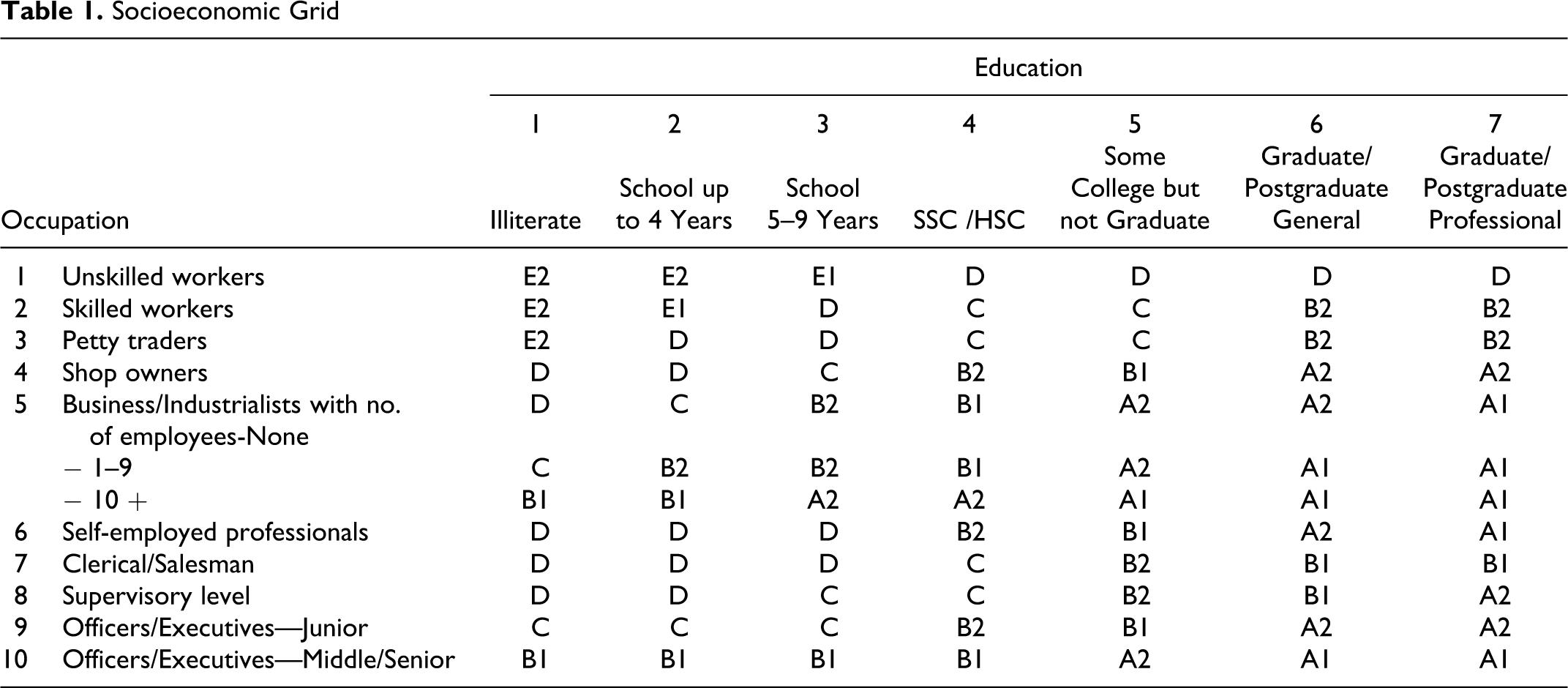
In addition, we went back to the interviews we had done with various advertising and marketing executives in Mumbai at different periods of fieldwork between 2001 and 2008 (the number of interviews we did is not particularly relevant here, since our sample was originally constructed to answer other questions). We reanalyzed our data, looking more specifically at patterns in the way these executives talked about and represented Indian consumers in the course of their work. We paid specific attention to the distinctions Indian advertising executives make between what they call “SEC A consumers” and “SEC B consumers,” referring to the Socio-Economic Classification (SEC) grid that permeates the world of Indian marketing, and which classifies the chief wage earner of a family along the axes of education (from illiterate to postgraduate) and occupation (from unskilled worker to senior executive). The classification grid is made of eighty different slots, collapsed into eight different segments (SEC A1, A2, B1, B2, C, D, E1, E2). Not surprisingly, the grid is highly skewed toward the Indian consuming class since over half of India’s population would probably fit in the six E squares of lower occupation and education, while less than half would be in the remaining seventy-eight squares (we have reproduced this grid in Table 1 ). Overall, our approach is consistent with other types of discovery-oriented inquires (Wells 1993), which have used a purposive sample of empirical material to generate theoretical insights.
Socioeconomic Grid
India Today: Between the Elite and the Vernacular
In a highly influential monograph, Anderson (1983) developed the idea that print capitalism is a crucial medium through which many people in the twentieth century have come to perceive themselves as belonging to social and political communities—what Anderson calls “imagined communities.” Yet, as we will show, while the popular Indian weekly India Today peppers articles and advertisements with the pronoun “we” to evoke a national destiny and a national consciousness, the politics of print capitalism reveal a more nuanced and complex picture in India.
To help convey the general style and content of India Today, we will briefly draw some comparisons between India Today and Time magazine, a magazine that has been emulated in a high percentage of the world’s national media markets. To begin with, the cover pages of India Today use photographic images and computer graphics, presumably to frame “national issues” in a manner reminiscent of Time’s covers. At the most basic level of comparison, the cover of India Today always has a red border, as does that of Time. In both magazines, the table of contents groups articles under headings such as “Nation,” “Society,” “Business,” or “The Arts.” Generally, the feature articles in each issue are spread through these categories (though India Today tends to have a proportionally higher number of cover articles on explicitly political national developments and issues). Both magazines have a one- or two-page section at the back of the magazine—titled “People” in Time, “Eyecatchers” in India Today (English edition), and “charchit chehare,” or “Discussed Faces” in the Hindi edition—which contains five or six short pieces on notable individuals, often embellished with tamely titillating photographs. In their first pages, either before or after the letters to the editor in both magazines, a page features a hodgepodge of biting and ludicrous quotations recorded by the national media over the previous week or two. Perhaps most importantly for the purpose of this comparison, both scatter what seems to be a national “we” through their pages of standardized realistic reportage. Yet behind this homogenizing “we” hides a very clear cultural divide, reinforced by the editors of India Today, between the English-speaking prototypical readers of the English edition and their vernacular counterparts. More specifically, a comparative analysis of the English and Hindi editions of India Today reveals striking differences in (1) the translation choices of the editors for key articles; (2) the content of both magazines; and (3) the advertisements that appears in the two editions.
Before we proceed with our comparison, however, a brief introduction to the language used in the Hindi edition is in order. Linguistically, Hindi emerged as a unique language in the first half of the twentieth century when it officially split with Urdu—they had previously been known as Hindustani (cf. Lelyveld 1993)—though today, on the street, they often merge and intersect to the point of being indistinguishable. However, Hindi, written in modernized Devanagari orthography, draws its lexicon more heavily from Sanskrit than does Urdu, and Urdu, written in a modified Perso-Arabic script, draws more from the Perso-Arabic languages, though both contain innumerable elements from both language families. To a certain extent, Hindustani resembles what Ferguson (1959) has termed diglossia, a language split into two broad varieties varying in “distance” from a classical language. Thus, we observe a “high” Hindi code which is extremely Sanskritized, contains few Urdu or English lexical items, and is seldom spoken outside particular formal and ritualized circumstances, and a “low,” less Sanskritized, and more common Urdu- and English-influenced speech.
The form of standard Hindi used in the Hindi edition of India Today is more of an official register of the “low” variety. It loosely approximates the standardized discourse of the increasingly powerful vernacular (including some Delhi and Mumbai) elites, which the editors of India Today take as their stereotypical Hindi readers (who partly overlap with their stereotypical English readers). But the situation is even more complex, for the Hindi edition is closely translated from the English. As we will show in our analysis, the indexical particulars which mark the audience of the English edition as cosmopolitan, Westernized elite are significantly filtered out of the Hindi edition without generally being replaced with explicit sociocultural regionalisms (regionalisms which might potentially threaten the perception of the Hindi text as being standard by overly indexing a particular region or caste group). This results in a very “bare” form of standard Hindi which, from within its referential frame, is readily able to be positioned to readers as a nation-indexing standard; it is a paradoxically national “voice from nowhere.”
Translation
Consider this example of translation, taken from the 1997 January edition of India Today. Both the English and Hindi editions of India Today contain the same extensive article analyzing the “high points” and “low points” of 1996 and, as one might expect, the frame of reference of this retrospective seems unambiguously national. The editors repeatedly use the national “we” throughout the article in both editions in a manner which, not unlike the rhetoric of politicians and nationalists of all stripes, seeks to produce the perception that the conceptual distance between the “speakers,” addressees and even subjects of the text is essentially nonexistent insofar as they are all Indian.
Glancing at the first page of the article, one cannot miss the boldfaced quotation of the politician K. Karunakaran commenting on the political misfortunes of the one-time Prime Minister and Congress Party leader Narashima Rao: “Rao’s Machiavellian methods helped him survive for five years, but he lost his credibility to rule” (IT 1/25/97, p. 44). This quotation is also prominently displayed in the corresponding Hindi version. However, rather than simply transcribing “Machiavellian” into the Devanagari script, as is easily and commonly done in Hindi with loan words from a variety of other languages, the editors chose to convey “Machiavellian” through a common expression for “cunning” in the Hindi translation. Not only does this decision cause one to pause and consider the editors' conceptions of the educational background of their Hindi and English audiences, but it also raises the complexly related issues of translation and journalistic integrity as the Hindi readers are shielded from the knowledge that the public figure K. Karunakaran is positioning himself within an “elite” but discursive world that they may not share, a world linguistically indexed by English usage peppered with Western historical, social, and pop-cultural references. A transcription of “Machiavellian” in the Hindi translation would seem to logically mitigate this problem by partially revealing K. Karunakaran’s indexical self-figuration. Notably, the vast majority of the divergences between the English and Hindi editions tend to occur in contexts in which the editors of India Today have to make choices about recognizably “Western” or “global-capitalist” utterances, images, or dispositions. The editors do not generally seem to find it easy or even desirable to translate specific Western cultural references by replacing them with specific Indian cultural references. Rather, they either render the highly particular Western word or phrase into standard, “no frills” Hindi, as in the Machiavellian/“cunning” example, or simply omit the sentence or phrase containing the Western reference from the Hindi translation. An example of the first of these two strategies of selective translation occurs in the opening lines of the editorial “comment” page, where the editors attempt to evoke the politicosartorial atmosphere since the late 1980s reign of Prime Minister Rajiv Gandhi: “During the Gucci years of Rajiv Gandhi, when homespun acquired designer status, the dustbins were full of Gandhi caps. Now it is khadi-time again, and Congressmen are turning back to scrap, rummaging for abandoned headgear” (IT 1/15/97, p. 6). In an interesting twist, the Hindi translation replaces “Gucci years” with “modernist era,” and “acquired designer status” with “colored with modernity” (see Appendix A for some examples of translation between the English and Hindi versions of the magazine). Also moving from a highly specific Western reference to a general phrase in Hindi, the Hindi “translation” of the title discussed above (p. 13), “T. N. Sheshan: Shaken, Not Stirred,” reads: “T. N. Sheshan: Stumbled, but not fallen” (IT 1/20/97, p. 30) and the title “Waiting to Inhale” is translated as “Impatiently clutching at the reins of power” (IT 2/5/97, p. 24). Turning to the strategy of selective omission, the following sentence was omitted from the Hindi edition in an article of political commentary virtually translated phrase by phrase: “A thoroughbred like Jaswant Singh should press flesh with the types of Naidu; Manmohan must come down a few steps from the Olympian Heights of intellectual aristocracy, fenced off by the spires of British universities” (IT 2/15/97, p. 19). “Thoroughbred” and “press flesh” are both idiomatic English expressions; the second section of the quotation packs two West-indexing references into a single, albeit mixed, metaphor. A similarly selective omission occurs in a brief segment discussing well-known party-girl Pamela Singh’s settling down as a serious photographer. The following sentence was left out of the Hindi version: “Sort of a case of a girl finding a new calling!” (IT 1/31/97, p. 144, italics added). It is important to note that there is absolutely no linguistic reason why these words, phrases, and sentences are not simply transliterated into Devanagari, the Hindi script, in the Hindi edition; there is a strong precedent of transliterating English words in Hindi texts, especially proper nouns, and words being assimilated into Hindi more generally. That said, the pattern of editorial decisions observed here demonstrates that broad semantic equivalence is not the only goal of translation. Rather, the translation process seems to be strongly influenced by the editors' and writers' orientation toward two differently stereotyped audiences. The recurrent manipulations in translating West-indexing references indicate that the editors assume that the prototypical readers of the English edition are drawn from the upper and upper-middle classes, whose members are perceived as: (a) having attended the “Western” English-medium schools and universities in which one learns to recognize references from the European canon; and (b) having the means and desire to insert themselves into the flow of contemporary Euro-American cultural signs.
Content and Editorial Choices
As mentioned above, it appears the editors of India Today assume that the prototypical readers of their English edition, unlike those of the Hindi edition, have attended the “Western” English-medium schools and universities in which one learns to recognize classical references from European history. Not surprisingly, such an education is virtually a minimum requirement to enter the urban professional upper and upper-middle classes in India and has been so (at least for men) since before India achieved independence from the British in 1947. If anything, this requirement has intensified in the 1990s with the increasing liberalization of the Indian economy and the related “global” perspective of the professional metropolitan elites who remain in India.
The English edition of India Today clearly senses and reproduces for these classes the language and content of Indian English discourse, presenting classical and pop-cultural Western references, and increasingly sprinkling its articles with discussion and images relating to the global capitalist economy and India’s position within it. At the same time, a vast quantity of this global capitalist “noise” is expunged as the magazine is translated into Hindi. For example, business articles appearing in the English edition are consistently left out of the Hindi edition. The February 15, 1997, English issue and the corresponding Hindi issue (IT 2/20/97) contain virtually all the same articles except on the subjects of business and the economy. The English issue contains articles detailing the successes of privatized Indian banks and a high-ranking German banker’s advice for the Indian economy, in addition to a weekly section entitled “Trade Winds.” None of these articles were run in the Hindi issue; in fact, not a single article devoted to the economy appeared anywhere in the Hindi issue. This distribution of articles on the economy is commonplace. In the early months of 1997, the highly esteemed pro-liberalization Finance Minister made the front page of the English edition twice; the March 31 cover displayed his bespectacled head atop Superman’s body, cape and all, with the caption, “Super Budget, is it for real?” This cover article ran fifteen pages, while the corresponding article in the Hindi issue was reduced to one page (IT 4/5/97, p. 42). In the Finance Minister’s place on the cover of this and an earlier issue, the Hindi edition displayed two different politicians, both heavily involved in regional politics in Uttar Pradesh, the most populous Hindi-speaking state. It is as if the two editions talked about two different economies: one that is global and central to people’s lives in the English edition, but one much more local and peripheral in the Hindi edition. The economy as it is understood in India Today in fact comprises two different sociocultural and economic spaces, a fact that, not surprisingly, bears heavily on the choice of advertisements run in the two editions.
Advertisements
Having fictionalized two very different types of Indian readerships, it follows that the two editions of India Today feature radically different advertisements, further emphasizing the divide between Indians who potentially have the cultural, social, and economic capital to connect with an increasingly globally connected world, and those who do not. The English edition of the national magazine clearly targets Indians aspiring to be cosmopolitan consumers. Ads in the Hindi edition do not, indicating once again the editors' cultural and socioeconomic stereotypes of the magazine’s English and Hindi audiences.
The advertisements in the glossy pages of the English edition target the Westernized upper and upper-middle classes by evoking a sense of the global gaze of cosmopolitan Indians and capturing their desire to see themselves as successful global citizens. Actual and aspiring elites generally attend the English-medium schools and universities established during British rule, and they have the means and desire to insert themselves into the flow of contemporary global cultural signs and economic networks. Catering to this desire, the caption of an advertisement for Global Connect cellular phones reads: “Global Connect… speaking a million languages, understanding a million nuances and spreading a million greetings. Have you got a mobile phone service that’s part of the Global Connect? Are you a global Indian?” (IT 2/15/97). To be a true “global Indian” is a goal the advertisers manipulate again and again. In another example, an advertisement for a private health care group depicts an assemblage of attractive Indian men and women, many holding briefcases and all professionally dressed in “modern” clothing, smiling at the camera. The caption reads: “Vision 2000. One World, a unified global vision. The Zydus group and Cadia Health Care invite you to share an exciting global vision… Drawing research and resource from every corner of the globe we bring you advanced medical care” (IT 1/31/97). An emerging image of the cosmopolitan “global Indian” in these advertisements is that he or she has global standards, so even domestic products must hold up to international standards if they are to be desired commodities.
In another example, Zodiac’s Classic Business Statements neckties are advertised with the line, “Flawlessly manufactured to the highest international standards, these ties are held in high esteem worldwide” (Ibid.). Titan Watches writes of their Insignia model: “Connoisseurs yield to its distinctive looks. Not only in Europe but in knowledgeable circles across Asia and Australia” (Ibid.). Intertwining the stereotypes of the cosmopolitan consumer and the metropolitan upper-middle-class professional, the caption for Reynolds, “the Pen the world prefers,” reads: “It [our pen] is how lasting impressions are made. It’s not what people think of you. It’s what you make them think of you. Even at something as routine as a [business] presentation” (IT 3/31/97). An ad for V.I.P. Luggage reads: “It takes a lot to be a V.I.P. Tour luggage should do you proud. Anywhere in the world” (Ibid.).
An important political undercurrent of these advertisements is the projected sense that the good standing of Indians and Indian companies in the global marketplace is a boon to the Indian economy and a victory for the nation. In this guilt-free capitalist vision of nationalism, the cosmopolitan consumer is a contemporary incarnation of the patriot consumer, as his or her consumption and display of the pen, suit, and travel luggage the world prefers—all taken to be signs of an international culture of success—are rationalized as acts which cast the face of a modernizing nation in its best light.
This image is more difficult to maintain when the self-indulgent pleasures of cosmopolitan consumption are foregrounded. Judging by several advertisements run exclusively in the English edition, the global Indian cosmopolitan consumer has the desire and “freedom” to travel in and outside of India and the freedom to transcend national and cultural boundaries. In an advertisement for Singapore Airlines, a smiling Indian family strolls through a huge indoor mall in Singapore. The caption reads: “Such a cool place to shop, even the streets are air conditioned. Enjoy variety galore in surroundings unmatched. Join the trendy in chic boutiques and themed cafes. Discover a city where shopping is a joy and dining an art” (IT 3/31/97). In a new twist, Singapore markets itself to wealthy cosmopolitan Indians through draping itself in carefully crafted, “hip” pseudo-American English describing air-conditioned mall streets far from the sweaty bustle of Delhi or Mumbai.
In contrast, the ads in the Hindi edition of India Today from the late 1990s had a much less global orientation. To begin with, this edition contained a much smaller number of advertisements by multinational corporations (of both foreign and domestic origin) than the English issues. For example, the January 15, 1997, issue of the English edition contained seventeen such advertisements, while the corresponding Hindi issue contained zero. In this same issue, twelve of the advertisements in the English version incorporated photographs of foreigners, especially Europeans, into their visual images; the Hindi issue contained one such advertisement. Many of the advertisements unique to the Hindi edition were primarily in black and white, and advertised domestically produced, inexpensive goods such as underwear, Ayurvedic lotions, knitting yarn, and water heaters—objects marketed more as practical necessities than being driven by fashion. The 1997 Hindi fiction issue, for instance, contains a black-and-white ad for a rehydration solution (meant for kids) for treating diarrhea, and another for United brand cookware (whose slogan translates as: “Be consumed! Let the quality of United be sung!”). There are also often ads for domestic and government savings and insurance companies, like one for the General Insurance Corporation of India, with the Hindi caption: “Now there’s just one thing remaining…Insurance,” and text that reads like an insurance salesman’s pitch. Finally, as seen in this same fiction issue, the higher-end products tend to be advertised for special occasions or gifts, downplaying conspicuous consumption. Domestically produced gold-plated watches for women are advertised as “Special watches for special occasions,” and “Presently the captivating adornment watches of India” (note the difference from the watches advertised in the English edition, which “connoisseurs” from around the world prefer). Elsewhere, an ad for a set of nice dinnerware boasts it will double the dining pleasure of one’s guests so they won’t stop giving praise.
Overall, through the advertisements they run, the editors of India Today give their prototypical English-language readers a sense that they share their “global Indian” outlook, only to carefully dilute this position in the Hindi edition into a more conventional national frame. In the process, they subtly reinforce the existence of an elite–vernacular divide in contemporary India. This divide is largely articulated in the manner and extent to which these two highly stereotyped groups are perceived to differently assimilate various waves of outside influence into Indian contexts, from the language and classical “culture” of the colonizers to today’s signs of global capitalism.
The Vernacular and the Elite in the World of Indian Advertising
The divide that is reflected in the pages of India Today has significant currency in the world of Indian advertising, in the distinction that executives make between the elite English-speaking Indians and what ad executives describe as the vernacular class of Indians. Our interviews with ad executives in Mumbai reveal that, while our archive of India Today issues may be a bit dated, the social distinctions it helped us illuminate have remained relevant in the last decade. For example, one of the advertising executives we interviewed was working on the new campaign for a famous brand of Scotch whisky. He was debating, with other executives working on the brand, whether they should target the segment of elite, English-speaking Indians (SEC A consumers) or what they called the “vernacular new rich” consumers (wealthy but lacking an understanding of Western cultural references), whom they classified as SEC B: SEC A will be a very frequent flier, CEO, senior management, the Sr. officers sees a lot of plays, very well read, very well travelled kind of persons. SEC B in Indian terms let’s say Gujarati business-man, easily making around Rs two lakhs a month. He has an import export kind of business but the psychological profile is very different. The type of programs he watches will be Hindi channels, will be watching a lot of Hindi movies as compared to English movies like SEC A guy. He will be watching channels like “Zee TV” “Sony TV” etc. rather than BBC, National Geographic, which a SEC A guy watches. Both these people are extremely relevant first and as and now there is no real quantitative basis as to say what percent of our market is SEC B—this business-man guy and what percentage of SEC A we don’t know.
For our brand, I think it still makes sense to target the SEC A guy because at least you keep your imagery focused on SEC A guy. The SEC B guy drinks Glendy because it is an aspirational of Scotch for him because he thinks by drinking this scotch he is projecting himself as very sophisticated, highly educated, up-market kind of person. He drinks it to show he is an upmarket kind of person. The SEC A guy is a guy that the SEC B guy is trying to imitate. In terms of imitation I think it is still important for us to maintain a focus on the SEC A class, but somehow you need to find a way to reach these people who may not be cosmopolitan in their outlook but definitely have the money to buy our brand. So maybe you start sponsoring more film parties, places where you may expose this SEC B guy.
Yet as Indian advertising executives and their clients recognized the market potential of the so-called vernacular middle class, they also feared that in doing so they would dilute their appeal, by emphasizing less glamorous languages and references. For example, in a campaign for a brand of cell phones we call Starck, the account director handling the account talked about the way the client, a young Indian executive, eventually decided to refuse a campaign that specifically targeted the “typical Gujarati businessman”: See we identified the profile of the vernacular businessman. The man we thought about is the typical Gujarati businessman, dealing in textile, an entrepreneur. There are plenty of these guys in Mumbai. They are not the corporate type. More like self-made men. So we created this whole campaign for prepaid cards targeted at this profile. The campaign was to run in Hindi, Gujarati and Marathi. But eventually, the client kind of got scared that it would hurt the brand, that we would lose the international appeal.
Advertising agencies often come to us and they say “we really want to tap into the middle class this time.” So we say “fine” and we show a middle-class guy, riding a scooter, to his middle-class home, with a small kitchen and, overall, a small apartment. But the agency usually frowns and says “that’s too down market” so eventually we end up showing what we call the “advertising middle-class,” a guy who rides a nice motorcycle, with a house that has a huge kitchen, the type of kitchen that may exist in the West but doesn’t exist in India.
Apart from these decisions about whether such indigenization would hurt the appeal of a brand by diluting its Western flavor, the Indian creative team also wondered which kinds of symbols, language, and characters they should use when trying to appeal to what they called vernacular India: If you are talking to the man from the higher socioeconomic classes, he is a man who has Western references, so you can talk to him using these references, from films or from music. But the minute you start going into what I would call vernacular India, it’s a different game altogether. There, you will have to rely on typical Indian situations. And then begin your difficulties. Because defining what a typical situation is, is difficult when you have such regional differences. For example, if you dress him in white, that’s going to be too South Indian. And you can’t show weddings, because they are so different from one region to another. And then, when you try to be really Indian, to find what cuts across, there it becomes difficult.
We often take Maharastrian actors. There are several reasons for that. One is that there are so many Maharastrians in Mumbai, which is in the state of Maharastra. That’s the practical reason. But what is important is that Maharastrians usually look like they could be from anywhere, South or North. So they are more difficult to associate with any specific region than say a Bengali. Also they are usually relatively fair and again that’s a physical trait that is aspirational all across India. But anyway, the advantage is that they look Indian and at the same time they are not controversial.
See, take the Surf campaign for example and the character of Lalitaji. She is clearly Hindu, because she is wearing a sari and a mangalsutra.
1
But the medallion of the mangalsutra is hidden under the blouse so you can’t really tell from which region she is. It’s very clever. It’s a way to select what cuts across, the mangalsutra, and take out what could identify her geographically.
The urban upper-middle class has pretty much the same type of global lifestyle all over the world. But when you want to reach the middle-class, then you have to go into Indian culture. That is when you need to come up with Indian symbols. Indian creatives are very good at that. See for example all the ads that use the character of the tapuri. The tapuri is a man from the street, a kind of Romeo from the neighborhood, he adds comedy to situations but he also adds an Indian feel, a typical Indian character.
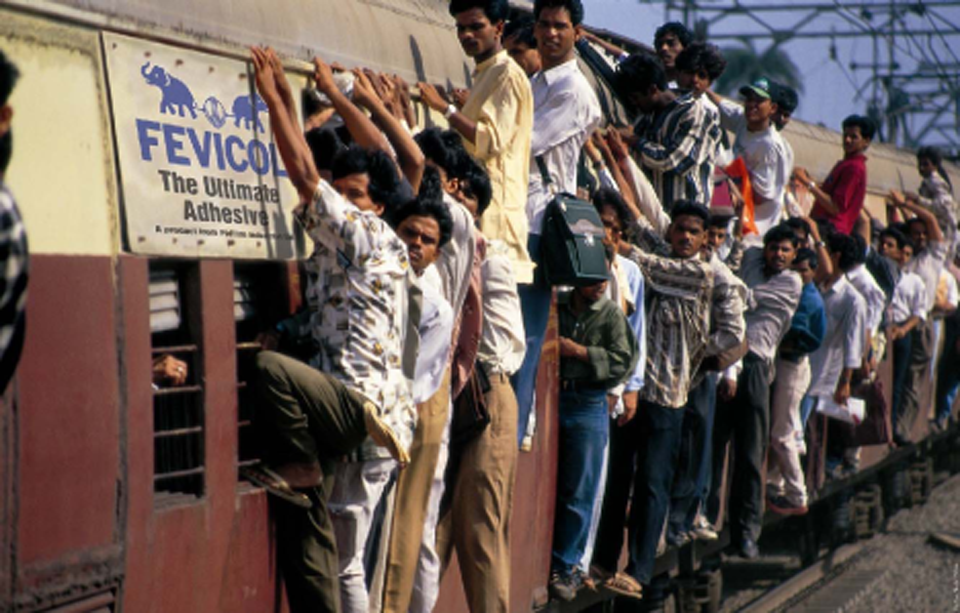
Fevicol Print Campaign 2001. Courtesy of Ogilvy & Mather India.
In the boardrooms of advertising agencies, ad executives claiming to speak the language of the “real middle class” often deploy these forms of cultural capital. For example, an ad producer we interviewed compared his middle-class childhood “playing cricket barefoot in Calcutta” with agency executives “who mostly come from an upper-middle-class background” to suggest that he was more in touch with the common man. In a meeting we attended, agency creative staff made playful fun of the client, an upper-class Indian raised in Mumbai and educated in the best schools in the country, for her lack of skills in Hindi, as agency creatives and brand managers were trying to devise a new campaign for the North of the country. Overall, while these discussions of symbolic mastery and linguistic fluency illuminate new forms of cultural capital at play in Indian advertising, they are also emblematic of the cultural distance of the English-speaking middle class, increasingly connected to other global elites, from the vernacular realm they are trying to reach with their ads, products, and brands.
Discussion
To answer the question “Indian consumer kaun hai?” Indian cultural intermediaries formulate a class-based grammar—a symbolic repertoire that assumes and perpetuates two very different cultural horizons. On one hand, advertising creates a world of Western references and access to global networks of labor and commodities. On the other hand, the world of the vernacular is projected as speaking a different language, both linguistically and symbolically—a world where explicit Western evocations are avoided and where advertisers try to create what they see as typical Indian situations and characters.
To better understand this disjuncture between a cosmopolitan and vernacular world, one must first appreciate its historical underpinnings. In particular, it is important to understand the rise of the “cosmopolitan Indian” in the context of the evolution of Indian advertising. After India’s independence and the Nehruvian project of economic modernization, Indian advertising celebrated independence from foreign rule and placed economic achievements in a nationalist frame. For example, the dairy brand Amul was advertised with the corporate slogan “The Taste of India” (see Figures 2 and 3 ).
Amul Taste of India 1995 Television Campaign. Courtesy of FCB Ulka.

Amul Taste of India 1995 Television Campaign. Courtesy of FCB Ulka.
Flourishing Indian companies like the industrial conglomerate Tata advertised by emphasizing their Indian engineering and management vision. Air India, with the creation of its Maharajah advertising character, signified Indian hospitality and technological advances. Camlin, an Indian manufacturer of art materials, ran an advertisement in newspapers in 1969 with the line, “India can make it without foreign collaboration. India can sell it without the foreign name” (Doctor and Alikhan 1997). Advertisements like this one were common in a socialist-leaning India that privileged swadeshi [local; of our country] production over imports in government economic policy.
This edifice began to crumble in the late 1980s. No longer in undisputed control of the lion’s share of political power, the cosmopolitan ruling classes became stereotyped in the national imaginary as the professional classes, less involved in politics and more involved in the global economy. The perception of an increasing gap has strained the connection between the English-speaking, Western-oriented elites and the rest of the nation, threatening the neutral national-standard status of English in the process. Although the ideal life histories and structures of desire promoted by global advertising reach into the Indian hinterlands, one cannot help feeling that the successes of the elites in appearing to fulfill these capitalist dreams separate them from the masses more than ever before as their own distance (in every sense of the word) from other global elites continues to shrink (Appadurai 1996, p. 9). And while the prototypical figure of the Westernized cosmopolitan producer/consumer leaping off the pages of the English edition of India Today has emerged as emblematic of this shift, many Indians have found leaders closer to home.
Of course, this does not mean that these worlds of the elite and the vernacular never meet, mix, or collide. For example, as Bijapurkar (2007) notes, many young people from the elite English-speaking class declare that they prefer to watch television programs in the vernacular languages. The success of MTV India, which mixes Hindi and English, is a reflection of that phenomenon. In fact, circumstances that appear thoroughly Westernized often tend to be interpreted as having an unseen Indian core, as illustrated by the words of Aishwarya Rai, a former Miss World, now a famous actress and Indian advertising’s favorite model: “If an Indian girl wears western clothes, it does not mean that she ceases to have Indian values” (quoted in Munshi 2001, p. 90). These postcolonial claims to hybridity are at least a century old, with a genealogy going back to Indian nationalists' construction of an unconquerable Indian “inside” and “spirit” in response to colonial rule (Chatterjee 1993, p. 120-121). Indian advertising is full of hybrid representations that mix the traditional and the modern, the Western and the vernacular. In commercials, movies and television programs, hybridity is held up as an idealized attribute of elite, modern Indians who comfortably embrace progress without losing their sense of “Indianness” or their feel for “tradition” (Butcher 1999; Mazzarella 2003).
Yet celebrations of the successful indigenization of Western influences must not hide the cultural divide we have highlighted, nor indulge in what Abu-Lughod (1990) has called the “romance of resistance” by automatically equating indigenization with strategies that somehow resist the cultural hegemony of the West. At the very least, our analysis demonstrates that the world of Indian advertising and Indian media at large only works to reproduce a Western-centric form of cultural hierarchy. If there is power in this equation, it lies in the representations of Indian consumers. In other words, the representations of elite and vernacular Indians have a discursive dimension. They are what Foucault (1980) terms discourses, in that they are more than just an assemblage of everyday talk and narratives about consumers. As Burke (1996) explains: a discourse is talk that works through particular institutional arrangements of power and knowledge, that circulates and organizes conversations between specific producers and audiences, that relies on specific conventions for establishing its authority. And in so doing, a discourse produces the effect of power within the self as a form of discipline. (p. 31)
Consider the following 2002 advertisement for American Express (see Figure 4 for the advertisement’s storyboard). In the ad, a fair young Indian woman, smartly dressed in a blouse and pants, is staying at a hotel in England. Her friend, a young Indian man who presumably lives in England, arrives to show her around the city. They roam the cobblestone streets together, hand in hand, and stumble upon a group of Indians celebrating the Indian festival Holi, covered in color from the powdered dye they are throwing on each other. The group sees them, recognizes them as “their own,” and merrily closes in on them. In spite of the man’s protests, he gets daubed in color. The woman bursts out in laughter, and she succumbs to the festive spirit as well. With their faces smeared with bright colors, they leave the group and approach a hotel. The man gestures to the distinguished-looking, tuxedoed English doorman behind the glass door, who ignores this apparently grubby couple while pretending to wipe a speck off the gleaming glass door. The woman, exasperated, begins to turn away, when the man waves his American Express card in front of the doorman. The doorman’s manner changes immediately, and he opens the door with a smile to usher them inside. The voiceover says, “Respected the world over, the American Express Card.”

American Express Television Ad (2002). Courtesy of afaqs.com.
The couple in this ad moves swiftly between “Western” and “Indian” contexts, between an Indian ritual and the plush comfort of a global hotel chain—two contexts which in the age of globalization rub shoulders in unexpected and surprising ways. What this ad also signals, beyond hybridity, is a world of access and lack of access, where the ability to consume foreign brands indexes a certain kind of hybrid, cosmopolitan Indian capable of traversing opposing cultural worlds. It also foregrounds the inaccessibility of that world of Western references and English doormen for the Indian who cannot afford to belong to that elite club and is destined to remain in the shadows. Hybridity, in this ad and other forms of representation, is first and foremost the domain of the privileged rather than the dispossessed, the ones who can move between cultural worlds, feeling confident both in a sari and in Western dress, with National Geographic and Hindi movies. Rather than bridging the gap between the elite and the vernacular, the hybridity of consumer representations in Indian advertising only seem to accentuate the cultural distance between them.
Contributions
The foremost contribution of this article is to show the importance of language as a marker of social distinction in the globalization of the marketplace. Üstüner and Holt (2010) have recently shown the importance of Western cultural references in animating class hierarchies in the Turkish context. Their work extends Bourdieu’s (1984) analysis of cultural capital by showing how, in less-industrialized contexts, social distinctions have to be understood in a global context, where the West still indexes access to wealth, social mobility, and access to transnational networks of labor and commodities. What we add here is a specific attention to the politics of language.
We have shown that English remains, long after India’s independence, a palpable indicator of the distance between the English-speaking middle-class and its vernacular counterpart. The globalization of the Indian economy seems to have only augmented that distance. The popularity of accent training, of training in public speaking and the rush among the vernacular middle class to enroll their children in English-medium schools signal the desire to access new forms of labor, such as work in call centers and in multinational companies. This high demand for English education also takes its roots in the social and cultural hierarchies of the Indian system, where speaking and being able to work in English are the deployment of a certain kind of cultural capital. As Fernandes (2006) pertinently argues in her book about the Indian middle class, the rising importance of English and the mastery of Western cultural references shows that globalization has contributed to the reproduction of social distinctions. The work of cultural brokers such as magazine editors and ad executives only works to reproduce and augment this symbolic distance.
Our findings on the importance of social class in analyses of globalization dynamics adds to the growing body of research on the topic in various scholarly fields (e.g., Üstüner and Holt 2010; Derné 2008; Fernandes 2006). Within this stream of research, our distinctive contribution is to detail the process through which the globalization of the Indian economy has reinforced the role of English and Western cultural references as markers of identity. Given the popular talk about a “flat world” where globalization levels the playing field between competing nations (Friedman 2005), our work is a reminder that globalization does not erase social, cultural, and racial hierarchies. On the contrary, the work of advertising and marketing in India and other places (e.g., Burke 1996; Kemper 2001) bolsters these hierarchies. By detailing the process through which globalization reinforces distinctions between consumers who can navigate the world of Western references and those who cannot, our work answers the call among macromarketing theorists for description of globalization processes and their consequences as a way to better understand global marketing systems (Fisk 2006).
Our analysis of cultural production in India, and of the cultural divide it reinforces, nicely complements Derné’s (2008) distinction between a transnational Indian middle class that positions itself transnationally, in relation to the Western middle class, and a locally oriented middle class which has not benefited as much from these new transnational connections. Drawing from ethnographic fieldwork in Dehra Dun, a mid-size town located in North India, Derné argues that for most of the Indian men he met in 1991 and then 2001, life has not changed dramatically. Some of these men may have access to better jobs, but by and large their conceptions of love marriages as fantasies and women’s commitment to family duties as essential to preserving an Indian way of life, as well as most other notions about family, gender, and modernity, have remained very similar. For the locally oriented middle class, Derné argues, Hollywood films and other forms of transnational media have even intensified notions of male dominance and the objectification of women through images of male strength and female weakness. In contrast, for the Westernized, English-speaking elite, the globalization of the Indian market has meant access to well-paid jobs and cosmopolitan lifestyles that are not completely at odds with the types of lives described in Western films and an increasing number of Hindi films. Derné’s argument is that we have overstated the cultural change happening in India—that because structural and institutional arrangements have not changed much for most ordinary middle-class Indians, their social imaginary is bound to remain very similar to what it was a decade ago.
Globalization is often portrayed as the arrival of what is new, as reflected in the influx of new companies, commodities, and brands that now flood the Indian market. But behind the change, there is also more of the same. For Indian colonial elites in the nineteenth century, speaking English became a new form of socioeconomic competition, facilitating access to certain administrative jobs and, generally, signaling a new kind of colonial modernity (Joshi 2001). Over a century later, the English language remains an important form of cultural capital in the Indian public sphere. The rise of shoddy business schools offering MBAs and of more nursery schools offering English language education are part of a larger craze for English that has only increased since the liberalization of the Indian economy. Yet these changes mostly work to reproduce a cultural hierarchy where Western norms and access to the global are indexed as superior.
Our second contribution is to show the role of cultural producers, such as ad executives and magazine editors, in creating different imagined communities within the Indian nation. Here we are grounding our work in Benedict Anderson’s influential book Imagined Communities: Reflections on the Origin and Spread of Nationalism, where the author makes the case that the development of print capitalism proved crucial to the emergence of nationalist movements everywhere as the “we-ness” of the nation became “imagined” through the collective consumption of media such as newspapers and realist novels. This consumptive regime establishes what Anderson characterizes as a single spatiotemporal and ideological frame of reference isomorphic to the homogenous, primordial “groupness” of modern nationalisms. Anderson’s analysis of nationalism, though it perceptively focuses on the contributions of print capitalism, the educated “creole” middle classes, and modern conceptualizations of space to nationalist movements, nevertheless failed to recognize the crucial role played by the economy and economic ideologies in the collective imagining and practical creation of India as nation.
More recent work in different fields such as marketing, anthropology, cultural studies, and political science have started to fill that void by detailing the role of other cultural forms in creating collective identities (Cayla and Eckhardt 2008; Kemper 2001; Mattern 2008). In our work, we show that the Indian context features different kinds of imagined communities, with different linguistic and cultural conventions. So while many ads try to create a national “we” by referring to Bollywood celebrities or cricket stars, the “we” that is imagined in the English edition of India Today is quite different from its Hindi counterpart. As we have shown, even nationalist icons such as India Today directly and indirectly contribute to the increasingly hollow ring of contemporary voicings of the Indian national “we.” Advertising may contribute to the construction of a national identity, but the process of imagination we have documented here is a fragmented one.
Limitations and Future Research
While our analysis of India Today focuses on a critical period during which multinational companies started expanding into the Indian market in earnest, future research should study the magazine longitudinally by examining more recent issues. Analyses of India Today and other cultural forms with ambitions of national representation are important for macromarketing scholars to consider, as they probe not only the construction of national ideologies but the role that advertising narratives, commodities, and other cultural forms play in that construction.
In addition, while our insights are very specific to the Indian context as a postcolonial country with a history of British rule, we believe our insights about English as a marker of social identity could foster new research in macromarketing on the politics of language and consumption. The rising influence of English words in ads and other marketplace transactions has at times been interpreted as a rising wave of Western influence (cf. Cutler, Javalgi, and White 1995). Our analysis, however, offers a more nuanced understanding of language as an important factor in social differentiation in India. While we have limited our analysis to advertising here, there is no doubt that the use of English as a means of distinction plays out in a variety of market areas. Future research on service interactions in India might build upon our insights to analyze the language conventions of such interactions. This research could help us better understand how companies try to cross the invisible yet genuine and perceptible boundaries between social classes in India as they seek to reach lower-middle-class consumers in various parts of the country.
Finally, while we have focused our analysis on English and Hindi, there is a great dearth of research on Indian advertising in other Indian languages (exceptions include Daechsel 2006; Haynes 2010; Krishnasamy 2007; Nag 1991). Future research should look at the way cultural forms in vernacular languages develop their own versions of the modern Indian consumer. Ultimately, such analyses would help us develop critical insights into the reconfigurations of group allegiances available to Indians in the context of a globalizing, liberalizing economy.
Footnotes
Appendix A
Declaration of Conflicting Interests
The author(s) declared no potential conflicts of interest with respect to the research, authorship, and/or publication of this article.
Funding
The author(s) disclosed receipt of the following financial support for the research, authorship and/or publication of this article: Julien Cayla acknowledges the financial support of the Marketing Science Institute, the Sheth Foundation, and the University of New South Wales who helped fund part of this research. Mark Koops Elson acknowledges the support of the University of Chicago where work on this project started.