



Abstract
Anti-consumption studies are gaining in popularity, but doubt remains as to whether they can add anything unique to consumer research and marketing that other similar topics cannot. This article attempts to explain the distinctive nature of anti-consumption and how it can contribute to the understanding of marketing beyond other related phenomena, such as ethical consumption, environmental consumption, consumer resistance, and symbolic consumption. Drawing upon reasons theory, the article contends that the “reasons against” consumption are not always the logical opposite of the “reasons for” consumption and there are important differences between phenomena of negation and affirmation. By focusing on the reasons against consumption, anti-consumption research acts as a lens that scholars and practitioners may use to view similar phenomena in a new light. The article illustrates this point by offering anti-consumption as an overarching perspective that spans a range of behavioral and thematic contexts, thereby revealing its unique contribution to marketing.
Keywords
Introduction
Anti-consumption is a nascent yet burgeoning field of research, evident in the recent proliferation of related conferences and special issues (visit www.icar.auckland.ac.nz for a summary). Most existing work on anti-consumption is built upon one premise, that the phenomena against consumption warrant special treatment, since they can provide scholars and practitioners with knowledge that is not sufficiently captured in conventional studies of consumption (Lee, Fernandez, and Hyman 2009). The general argument is that knowledge of anti-consumption increases our understanding of consumption overall.
However, despite the robust arguments put forward by some proponents of anti-consumption research, several interconnected problems afflict anti-consumption as an area of inquiry. First, because the consequences of anti-consumption are less observable in the marketplace, and harder to measure than positive consumer decisions, there are fewer phenomena to study on the whole (Wilk 1997). This is evident, for instance, in the case of boycotting research. Although consumer demand for a specific branded product (e.g., Starbucks coffee) can be easily measured in the form of actual sales, the conscious avoidance of a purchase constitutes a nonevent (Friedman 1985) that can only be indirectly observable through estimates such as boycott calls, consumer forums, interviews, and news media reports, none of which provide a concrete measure of the impact of anti-consumption activity. Further convolution arises when the target of consumer boycotts is indirect (e.g., America as a country of origin) rather than the producer of a product or service itself (e.g., Starbucks as an American brand).
Second, owing to the relative scarcity of acts against consumption, when data are available, researchers may be strongly motivated to theorize about or interpret data in a way which compels evidence to fit into an anti-consumption frame, even when other explanations may be more suitable. In other words, given that acts against consumption have been scant, it is not surprising to see a tendency by some scholars to attribute various behaviors to anti-consumption even when they may not be driven by motivations and attitudes that are really against consumption. In line with this criticism, Shaw and Newholm (2002) caution that the practice of voluntary simplicity cannot be viewed only in terms of anti-consumption. Similarly, in their study of users of toy sharing libraries, Ozanne and Ballantine (2010) found that nearly half of their sample consisted of people that engaged in sharing practices for reasons other than anti-consumption, such as opportunities for socialization and monetary benefits. Thus, many acts studied under the guise of anti-consumption are actually driven by motivations that are not necessarily against consumption. Of course, further confusion arises from the observation that many acts studied by anti-consumption scholars can be simultaneously driven by both anti-consumption and non anti-consumption reasons. As Ozanne and Ballantine’s study implies, one may engage in sharing practices because of anti-consumerist motivations that coincide with additional motivations such as socialization and financial savings.
Clearly, these problems undermine the distinctive contribution of anti-consumption and raise questions as to whether it is superfluous when held alongside related and established terms such as ethical consumption, environmental consumption, consumer resistance, and symbolic consumption.
Previous work has drawn a comparison between anti-consumption and health care, suggesting that many of the advances in medicine have come through studying unhealthy (fringe) rather than healthy (mainstream) people (consumers; Lee, Fernandez, and Hyman 2009). Other special issues have linked anti-consumption to sustainability (Black 2010), highlighted the importance of ideology (Kozinets, Handelman, and Lee 2010), and contrasted anti-consumption with consumer resistance (Lee et al. 2011). All of these works proclaim the importance of focusing on acts against consumption, arguing that it is only through appreciating all aspects of consumer behavior (including its contrary) that we can fully understand consumption as a phenomena, at both micro individual and macro sociocultural levels. However, with the exception of Lee et al. (2011) who attempt to delineate anti-consumption with consumer resistance, no other work attempts to explain what the unique contribution of anti-consumption is, above and beyond other similar phenomena.
Lee et al. (2011) contend that anti-consumption is distinct from consumer resistance because the latter requires consumers to oppose a force of domination, while anti-consumption focuses on “phenomena that are against the acquisition, use, and dispossession of certaingoods” (p. 1681). Thus, resistance is not always a necessary condition; for example, when anti-consumption is motivated by symbolic incongruity, negative experiences, or value inadequacy (Lee, Motion, and Conroy 2009). Furthermore, Lee et al. (2011) suggest that consumer resistance can sometimes be expressed through consumption rather than against consumption. For example, in the case of anti-brand loyalty, selective consumption of a competing brand (Saab vs. Volvo, Mac vs. PC) demonstrates consumers’ allegiance to one brand and the simultaneous (and intentional) resistance of another (Muniz and O'Guinn 2001). Similarly, consumer cooperatives and other consumer resistance movements such as open source software communities may actually result in more consumption of goods through economies of scale, and/or increased consumption of products to oppose the “enemy,” rather than an increase in anti-consumption behavior. In such cases of consumer resistance, it is obvious that consumption also helps to express resistance against some power imbalance within the market place (Cromie and Ewing 2009; Herrmann 1993).
While Lee et al.’s (2011) position on the differences between anti-consumption and consumer resistance seem legitimate, their paper stops short of highlighting any attribute unique to anti-consumption that makes it, as a topic, distinct and therefore valuable; especially when held alongside a plethora of similar areas, such as nonconsumption; symbolic, ethical, environmental, and alternative consumption; or even consumer resistance. Therefore, in this article, we attempt to clarify the domain of anti-consumption by drawing upon, and applying the analytical distinction between “reasons for” and “reasons against” (Westaby 2002, 2005a, 2005b; Westaby and Fishbein 1996; Westaby, Fishbein, and Aherin 1997; Westaby, Probst, and Lee 2010) to the four main clusters of theoretical and empirical interest that scholars often convolute with anti-consumption: environmental consumption, ethical consumption, consumer resistance, and symbolic consumption. Concurrently, following emerging developments in these fields (cf. Barnett et al. 2011; Prothero, McDonagh, and Dobscha 2010) we attempt to move away from the micro-psychological focus that has so far predominated those streams of research. Paralleling Prothero and Fitchett’s (2000) notion of a green commodity discourse and Barnett et al.’s (2011) genealogical approach to ethical consumerism, we argue that reasons against can be viewed as part of emerging discourses and narratives that stretch beyond the micro realm of individual decision making and action. Subsequently, the article poses some research questions and suggestions as to how new directions for anti-consumption research might develop.
Reasons for versus Reasons Against
Extant consumer research mainly focuses on cognitions and reasons that explain performing a given behavior, despite the fact that the reasons concerning not performing that same behavior may be qualitatively different. For example, a decision to buy Fair Trade products may be consistently explained by specific, positive attitudes toward Fair Trade (e.g., Chatzidakis et al. 2004), but a decision not to buy Fair Trade products, may or may not coincide with scoring negatively on an evaluation scale used to assess these attitudes. Likewise, an anticonsumer of meat (vegetarian) may avoid meat owing to concerns about animal welfare, but it is unlikely that those who consume meat do so because they want animals to be killed (Richetin, Conner, and Perugini 2011). In line with this idea, social psychological research draws a distinction between “reasons for” and “reasons against” performing a behavior (e.g., Westaby 2002, 2005a, 2005b; Westaby and Fisbein 1996; Westaby, Fishbein, and Aherin 1997; Westaby, Probst, and Lee 2010). This dichotomous differentiation of motivational forces (Roe, Busemeyer, and Townsend 2001) is assumed with slight variations (such as pros versus cons, costs versus benefits) in various models of social cognition (see Westaby 2005b) and related dimensions have been supported in several empirical settings (e.g., Janis and Mann 1977; Marcus, Rakowski, and Rossi 1992; Novick and Cheng 2004).
Reasons for and against capture the “specific subjective factors people use to explain their anticipated behavior” (Westaby 2005b, 100) and in this sense comprise the underlying cognitions that explain global attitudes or motives in favor of, or against, performing a behavior. In other words, an individual or society’s overall attitudinal disposition toward a particular behavior (e.g., positive about buying Fair Trade products) can be explained on the basis of underlying reasons such as helping Third World producers, making a difference, enjoying products of a higher quality and so on. Focusing on reasons as opposed to related constructs such as beliefs (Ajzen and Fishbein 1980; Ajzen 1985) or goals (e.g., Clary et al. 1998) offers advantages because they can be measured at a more context-specific level and they can also capture self-justification and defense mechanisms that are otherwise left unaccounted for, in models of buyer behavior (Westaby 2002, 2005a). For instance, research by Eckhardt, Belk, and Devinney (2010) implies that some individuals may reinterpret certain behaviors as instances of anti-consumption (e.g., anti-SUVs) even though it may not be anti-consumption attitudes that truly motivate such behavior in the first place (increasing petrol prices). Unlike traditional measures of attitudes, reasons for and against incorporate postbehavioral accounts and rationalizations in addition to prebehavioral, presumably causal explanations, in so far as they satisfy individuals’ needs for self-consistency and sense making (e.g., Westaby 2005b). In turn, the capacity of reason constructs to capture such processes may help explain why, in various studies, reasons for and against are found to explain variance in intentions and/or behavior over and above conventional measures of global attitudes and their underlying beliefs or goals (Westaby, Probst, and Lee 2010).
The implication that reasons against are more than, or at least different from, the logical opposites of reasons for performing a behavior carries important implications for the development of anti-consumption research. Indeed, most research to date has focused on measuring cognitions with respect to performing a behavior rather than notperforming, assuming that the latter will simply be the exact opposite of the former. This “complementarity assumption” (Sutton 2004) is plausible in the case of intentions or global attitudinal measures but is highly questionable in the case of underlying cognitions (reasons). That is, asking people whether they have a favorable attitude toward Nike or whether they intend to buy Nike products is the logical opposite of asking whether they do not have a favorable attitude toward Nike or whether they do not intend to buy Nike products, but this is not the case with underlying reasons. The reasons for buying Nike, such as perceptions of good quality, or preference for an aggressive and athletic brand image (see Figure 1) could certainly be the logical opposite of reasons against buying Nike; for example, perceptions of poor quality, or disdain toward the brand’s overly aggressive athletic image (these reasons fulfill the complementarity assumption). But reasons against buying Nike could also include additional considerations, such as issues around sweatshop labor and multinational companies (see Figure 2). These reasons against are unlikely to be the logical opposite of the “reasons for” purchasing Nike (i.e., people are unlikely to purchase Nike because they want to support sweatshop clothing).

Nike’s provocative branding motivates both reasons for and reasons against consuming the brand. Source: http://www.designyourway.net/blog/inspiration/35-nike-print-advertisements-that-boosted-the-companys-income/.

Reasons against consuming Nike may not always be the logical opposite of reasons for consuming Nike. Source: http://anongallery.org/146/nike-just-do-it.
Furthermore, research by Richetin and colleagues (Richetin, Conner, and Perugini 2011; Richetin et al. 2012) has illustrated across various domains that intentions to not perform certain actions increase the variance explained in behavior over and above intentions to perform those same actions. Thus, asking people both whether they intend to reduce consumption and whether they do not, increases the variance explained in actual behavior despite the fact the two statements should be logical opposites. The authors concluded that this is because even negative statements that seem tautological to positive ones (e.g., intent to perform vs. not perform a pro-environmental behavior) may correspond to underlying goals (or reasons) that are psychologically distinct rather than opposite. Richetin et al. (2012) found that intentions to reduce consumption were driven by reasons such as “saving the planet” whereas intentions not to reduce consumption were motivated by reasons such as “maintaining current lifestyles” (p. 115). Their findings resonate with emerging evidence across several streams of research, from studies on stereotype activation (Gawronski et al. 2008) to neuroscience (Brass and Haggard 2007), all concluding that “negation of a construct is not the conceptual opposite of the affirmation of a construct” (p. 41), thereby reinforcing the value of studying both reasons for and against consumption.
Although the extant research on reasons theory has remained within the micro context of individual decision making and cognition, the analytical focus on reasons and the for/against distinction can be incorporated into several alternative theoretical traditions and corresponding levels of aggregation. Within sociological and more macro-oriented perspectives, for example, the study of reasons includes self-justifications, accounts, and related cognitions that are “extensions of patterns of thought prevalent in society rather than something created de novo’’ (Sykes and Matza 1957, 669). In this sense, when accounting for their decisions, individuals choose from a repertoire of available social, public, and cultural narratives or discourses that are ultimately limited. Reasons for and against can be viewed as vocabularies of motive (Mills 1940), socially learned and legitimized accounts (Scott and Lyma 1968), or broader narratives (e.g., Maruna and Copes 2005) that say more about a given culture and society rather than the individual.
The study of reasons for and against is therefore not only possible at the micro level of individual choice but also in the variety of meso-, macro-, and supra-national levels through which various actors (e.g., businesses, governments, nongovernmental organizations [NGOs]) mobilize anti- (and pro-) consumption discourses. Prothero, McDonagh, and Dobscha (2010) discuss how the apparent mainstreaming of the “green commodity discourse” in contemporary societies has been possible not only through the adoption of various micro practices by green consumers but also because of media activities such as Al Gore’s Inconvenient Truth, business interest in triple bottom line (social, environmental, financial) reporting, mobilization by institutions such as World Watch Institute, and various national and transnational policy initiatives such as the United Nations Millennium Goals. Likewise, Barnett et al. (2011) point to the need to relocate the consumer from the position of main agent of change and to give credit to various organizations that have played a key role in politicizing and moralizing consumption logics and practices. The authors illustrate how data from the Ethical Purchasing Index (EPI), a survey produced by UK’s Co-Operative Bank and New Economics Foundation, were deployed by various campaign organizations not only with a view to provide reasons for purchasing Fair Trade products to individual consumers, but also to use evidence of broad-based support as a means to exert influence on governments and businesses and legitimize their standing to members/supporters and the wider public realm.
In line with these developments, reasons against consumption can be viewed as part of “institutional logics” (Thornton and Ocasio 2008) or narratives that are employed by a variety of actors at differing levels of aggregation. For example, Chatzidakis, Maclaran, and Bradshaw (2012) show how reasons against consumer culture, along with logic of voluntary simplicity, can be cultivated in activist groups and areas (e.g., guerilla parks) that share an explicit anticapitalist ethos. Here, alternative marketing systems (Layton 2007), such as gifting bazaars and collective cooking events, form part of broader political arguments and mobilization against market capitalism. Similarly, Izberk-Bilgin (2010) shows how reasons against can be employed in the case of specific brands or products not only at a community level but also at a country-level (e.g., reactionary nationalism) and by alternative communities based on interests such as religion (e.g., antimaterialistic attitudes). Izberk-Bilgin also notes how it is not only consumers who engage with reasons against but also other actors such as marketers who attempt to counter resistance toward their products or services, and who may operate both within and out of conventionally defined markets (see Layton and Grossbart 2006). Adding to this observation, a recent study on Chinese grassroots nationalism illustrates how reasons against foreign brands are manifest in various fronts—from consumer boycotts of individual companies to antimonopoly laws that coincide with nationalistic interests—and they are rooted in a confluence of nationalistic motives and agendas by agents such as the consumer, the government, the media and local companies (Gao 2012).
Finally, more macro-oriented reasons against and reasons for consumption, such as those concerned with the global effects of consumption rather than more personal, micro concerns (cf. Prothero, McDonagh, and Dobscha 2010) can be located within broader ideological and normative appeals that underpin market capitalism (e.g., Latouche 2009) and neoliberalism (Harvey 2010). Consumers are often provided with reasons for buying local goods such as helping local economies and improving their carbon footprint. There is less public policy and media discourse around the limits of global economic growth and the possibility of helping the planet through buying less rather than more (even when the latter includes green products). From this perspective, it is not specific services or products, but consumer society per se that is fundamentally intertwined with all that is pro-consumption including notions that quality of life and well-being can be actualized via consumerist lifestyles (Kilbourne, McDonagh, and Prothero 1997). In turn, counterconsumerist critiques and related reasons against consumption, such as arguments in favor of environmental–social justice and more sensual, less materialistic lifestyles (Soper, Ryle, and Thomas 2009), can be viewed as countervailing logics (Thornton and Ocasio 2008) or emerging shifts in the Dominant Social Paradigm (DSP; Kilbourne et al. 2009).
Anti-Consumption and the Study of Reasons Against
The foregoing discussion highlights that anti-consumption is a worthy field of investigation because it pertains to a particular set of reasons against consumption, which are more than and different from their conceptual opposites—reasons for consumption—and which can be applied at differing levels of aggregation. However, in this article, we do not aim to develop a full account of how insights from reasons theory may add to the existing consumer research literature despite the potential benefits from such an endeavor. Instead, we draw on the substantive distinction between reasons for and reasons against to elucidate issues of conflict, confusion, and convergence between anti-consumption and other similar streams of empirical research, such as ethical consumption, environmental consumption, consumer resistance, and symbolic consumption. In other words, our purpose is not to delineate anti-consumption with all consumption activities that have a positive and negative frame, but only those areas (as mentioned) that are more commonly confused with anti-consumption.
It is also important to note that anti-consumption should not be conflated with nonconsumption or alternative consumption. Nonconsumption due to proscription or other contextual influences, for instance, where preference toward one brand leads to incidental nonconsumption of another (Cherrier, Black, and Lee 2011), is not anti-consumption as there is no intentional choice to avoid the nonconsumed brand (Cherrier 2009). Similarly, alternative consumption or mere choice is also not anti-consumption, since some behaviors are avoided not because of their unattractiveness or explicit reasons against them, but because of the greater appeal of alternative options, such as preference for private versus public transport (Gardner and Abraham 2008). Instead, anti-consumption is only concerned with those reasons against consumption that are expressive and consciously articulated (through either internal or external dialogue), that may be used as accounts, explanations or narratives of why people “go against” (Kozinets, Handelman, and Lee 2010) and express “resistance to, distaste of, or even resentment or rejection” (Zavestoski 2002, 121) of specific brands (e.g., anti-Starbucks; Thompson and Arsel 2004), behavioral and product categories (e.g., antialcohol; Piacentini and Banister 2009); and/or consumer culture altogether (e.g., through voluntary simplicity; see Leonard-Barton 1981; Shaw and Newholm 2002).
The Nature and Scope of Anti-Consumption Research
Figure 3 summarizes the scope of anti-consumption research from a reasons for and reasons against perspective. We identify four nonmutually exclusive clusters of theoretical and empirical interest, relating to ethical, environmental, resistance, and symbolic concerns. Figure 3 does not propose that anti-consumption is a higher-order construct than the four areas of concern, rather, the main purpose of Figure 3 is to position anti-consumption as a distinct perspective by which other, seemingly similar topics may be viewed. We select those four areas in particular, because they are the streams of research most commonly confused with anti-consumption, with such confusion detracting from the incremental value of anti-consumption research. Thus, Figure 3, and this article, aims to redress the confusion by offering anti-consumption, and the reasons against consumption, as a legitimate lens that provides additional value to the four areas of concern discussed below.
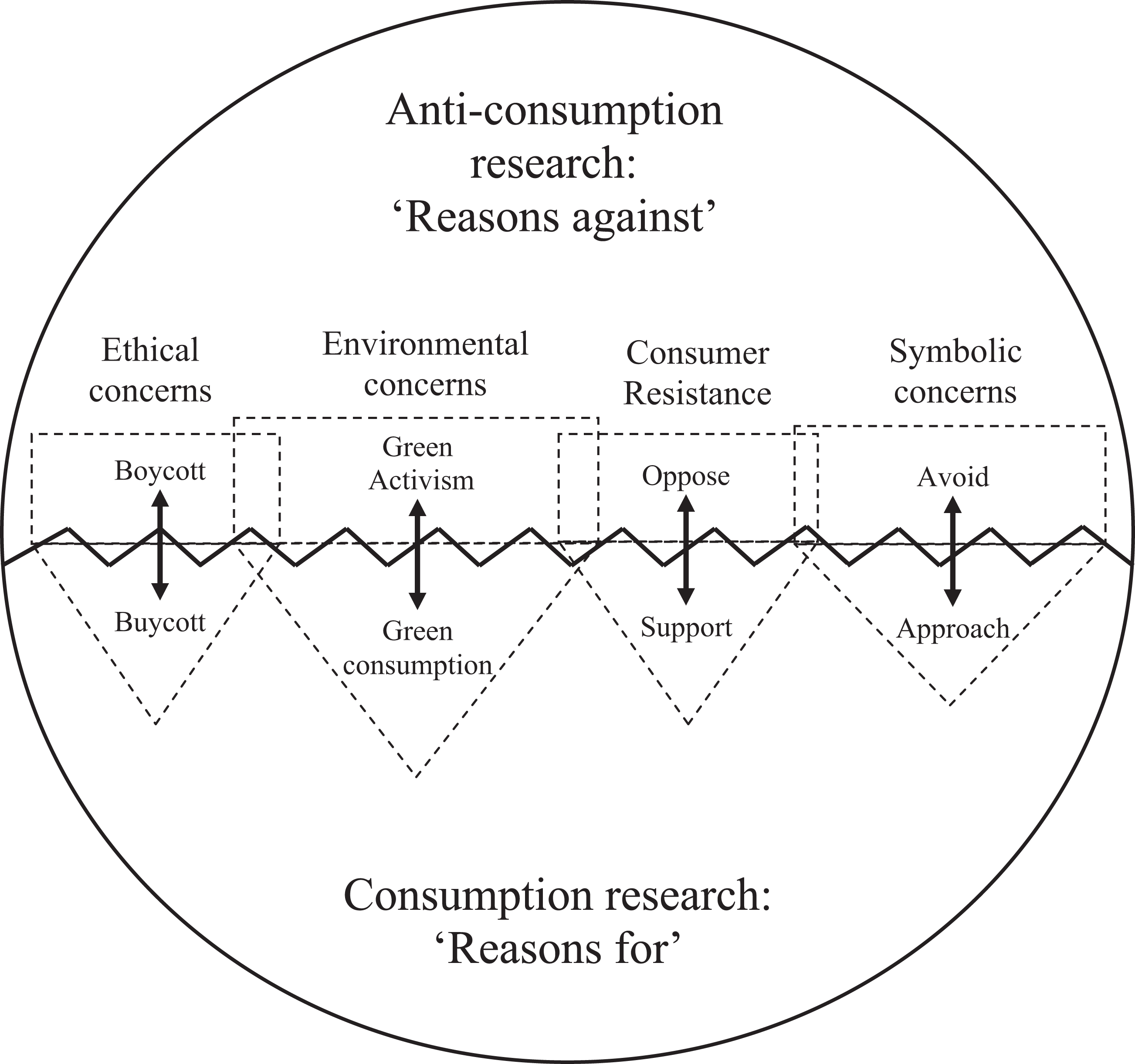
The focus of anti-consumption research from a reasons theory perspective.
Ethical Concerns
Ethical consumption has been broadly defined as “the conscious and deliberate decision to make certain consumption choices due to personal moral beliefs and values” (Crane and Matten 2004, 290). It has been often treated as an evolution of green consumerism to incorporate concerns such as trading relationships with the Third World (e.g., Carrigan and Attalla 2001; DePelsmacker, Driesen, and Rayp 2005; Shaw and Clarke 1999) and Corporate Social Responsibility (CSR; Sen and Bhattacharya 2001; Sen, Bhattacharya, and Korschun 2006). As Figure 3 illustrates, although ethical concerns may translate into both reasons for (buycotting) and reasons against (boycotting) specific consumption practices, in following a similar path with most consumer research, the field has focused mostly on positive consumer decisions centered on ethical purchases. More fundamentally still, the assumption that the reasons against are always the logical opposite of the reasons for has also been adopted without scrutiny, when in fact the reasons for consumption may not be the logical opposite of the reasons against consumption. For instance, a group boycotting Shell, owing to accusations of unethical government corruption, may not necessarily buycott (i.e., select) Mobil for a lack of corruption or being ethical. In fact, situational convenience may be the main reason for the group’s choice of any petrol supplier, rather than loyalty or the desire to reward specific companies for ethical behavior/policies. Consequently, any conscious decision they make is driven more by anti-consumption (the main motivation is to boycott Shell), rather than consumption. In other words, the group is not really loyal to particular brands, but rather, is simply settling for any brands apart from Shell. In this sense, a reasons against perspective has far more to offer in terms of understanding ethical concerns and market intentions than traditional consumption perspectives, such as those emphasizing brand loyalty (Lee, Motion, and Conroy 2009).
Applying an anti-consumption perspective also allows researchers to analyze the market place activity surrounding ethical concerns from three other perspectives. First, it encourages researchers to consider the reasons against unethical companies as legitimate drivers of the reasons for purchasing products from more ethical companies. Understanding the flip side to ethical consumption choices is of obvious importance. For the target companies of boycotting such knowledge may be used to address their negative brand image, and for their competitors, similar information is useful in terms of their respective positioning strategies. Second, the anti-consumption lens may also include consideration of the reasons preventing anti-consumption. Here the focus would be on explaining why consumers, and consumer groups, do not reject or boycott unethical companies, despite their negative assessment of such companies. People’s reasons for not boycotting a brand may not be the logical opposites of the reasons for boycotting a brand. A consumer may wish to boycott KFC for unethical treatment of animals, but the reasons preventing him or her from boycotting KFC may be related to broader group influences or peer pressure, whereby his or her peers do not share a similar inclination to boycott KFC and therefore the consumer is unable to action his or her “reasons against” consumption. This viewpoint is important, given that many prosocial movements depend on mass action. Thus, understanding the reasons why people do not boycott unethical companies, even though they believe it is the ethical thing to do, is sometimes even more important than understanding their original motivations. Third, adopting an anti-consumption perspective may also include looking at the reasons against the buycott of so-called ethical products. For example, reasons for not buying Fair Trade products may not include relative indifference about the welfare of Third World Consumers, or even perceived difficulties in purchasing such products, but additional concerns such as the extent to which systemic, macro problems of global injustice are posited onto micro consumer decision-making contexts and seek a solution there (cf. Dolan 2002). This may in turn make more radicalized “ethical consumers” cynical about marketplace exchanges of Fair Trade goods (Chatzidakis, Maclaran, and Bradshaw 2012). Therefore, interrelated ethical concerns about world trade justice may translate into different forms and rationales for buycotting and boycotting action. This anti-consumption perspective challenges the so-called observation of attitude–behavior gaps in ethical consumerism (e.g., Bird and Hughes 1997; Carrigan and Attalla 2001; DePelsmacker, Driesen, and Rayp 2005; Nicholls and Lee 2006; Uusitalo and Oksanen 2004) as it implies that reasons against otherwise positively perceived (ethical) products or reasons for negatively perceived (unethical) ones, may moderate the extent to which actual behavior is in line with general attitudes.
Environmental Concerns
Following the rise of the environmental movement in the late 1960s, early academic research on socially conscious, green, or ecologically conscious consumers (e.g., Anderson and Cunningham 1972; Webster 1975; Roberts 1996; Straughan and Roberts 1999) attempted to understand them in terms of gender, income, occupation, and other personal characteristics. Despite the potential benefits of segmentation studies however, such attempts soon proved elusive (Oates et al. 2008; Straughan and Roberts 1999) and later research shifted away from demographic variables to consider the role of psychological and attitudinal constructs (see Bamberg and Moser 2007 for a review) and broader sociocultural processes (e.g., Belz and Peattie 2009). Such studies provided valuable insights from the perspective of anti-consumption, as many of the behaviors of interest concerned the translation of pro-environmental concerns into reasons against consumption, from milder and fragmented forms of green activism to energy conservation (Wilson and Dowlatabadi 2007) and reduction of private transport (Gardner and Abraham 2008) to more committed and radical lifestyles of voluntary simplicity (e.g., Oates et al. 2008). Nonetheless, to provide useful information to marketers of sustainable products (Straughan and Roberts 1999), most consumer research focuses on buying eco-friendly products (green consumption) rather than not-buying environmentally polluting ones, and only few studies consider the more radical idea of practicing anti-consumption for environmental concerns by reducing consumption altogether (aka green activism).
At a more fundamental level, however, research into sustainable consumption has not explicitly considered issues of complementarity between reasons for and reasons against pro-environmental activism. For instance, although it is highly likely that a reason for buying eco-friendly products is pro-environmental concern, it is highly unlikely that a reason against buying eco-friendly products is intention to harm the environment. All things equal (e.g., price, quality, and convenience) most consumers would not have a reason to opt for an environmentally harmful product (McDonald and Oates 2006), but (non environmentally related) reasons against arise when green buying and other forms of pro-environmental activism entail a degree of compromise (Peattie 2001). When consumers decide to go against specific consumption practices due to pro-environmental concerns, they do so because of a concurrent commitment and ability to translate their concerns into action, but it does not follow that those who do not buy eco-friendly products are not environmentally concerned. This is evident in more extreme forms of sustainable living, such as hard core voluntary simplicity and ecofeminism, which are often underpinned by radical political-environmental motives and explicitly articulated anticonsumerist agendas (Oates et al. 2008). Such consumers often have further reasons against the conventional forms of pro-environmental action, such as green consumption, as these are perceived to be in line with consumer culture and hence inefficient for far-reaching ecological change (e.g., Dobscha and Ozanne 2001).
Thus, Figure 3 shows that the scope of anti-consumption focuses on the nexus where environmental concerns and the reasons against consumption meet. The resultant behaviors may then manifest as green activism against specific brands and companies as well as more general and radicalized forms of anti-consumption, which result in a rejection of consumerism and the adoption of more frugal lifestyles. The alternative perspective here is that eco-friendly products are “green washed” by companies as a means of increasing market share and profitability. Therefore, a better choice to buying more green products (green consumption) is actually the decision to practice anti-consumption of such products (green activism; Black and Cherrier 2010; Dobscha and Ozanne 2001).
Resistance Concerns
Consumer resistance is an area that has been traditionally confused with anti-consumption, that is, until the two domains were explicitly disentangled by Lee et al. (2011). As mentioned earlier, not all acts of consumer resistance need to be driven by anti-consumption motives. The true motivation behind any consumer resistance movement is, obviously, resistance to some domineering force (Foucault 1982; Peñazola and Price 1993). Sometimes this resistance is expressed by acts of opposition and anti-consumption, while at other times resistance is expressed by acts of support and consumption. In cases of consumer cooperatives and open-source software communities, support of those activities predominately occurs via consumption, rather than anti-consumption (Cromie and Ewing 2009; Herrmann 1993). Whereas, in other cases of consumer resistance, it is evident that anti-consumption in the form of opposition is the main driver. Consumer resistance to multinational corporations such as Starbucks (Thompson and Arsel 2004) does indeed support local cafes. However, the real driver of the consumer resistance activity is opposition to Starbucks. As Figure 3 shows, anti-consumption is mainly interested in the opposition part of consumer resistance, and since this is the most salient aspect of consumer resistance, it comes as no wonder, that the two domains have been easily confused with one another.
Symbolic Concerns
Another key theme in anti-consumption research concerns the reasons against consumption for symbolic communication and the construction of meaning. Much research has established the role of consumption in the formation of identity and self-concept (Belk 1988; Aaker 1999; Dolich 1969; Grubb and Grathwohl 1967; Heath and Scott 1998; Hogg, Cox, and Keeling 2000; Levy 1959; McCracken 1986; Sirgy 1982; Solomon 1983). The role of anti-consumption in such activity is also well studied, albeit to a lesser extent (Banister and Hogg 2004; English and Soloman 1997; Hogg and Michell 1997; Levy 1959; Thompson and Arsel 2004). This balance of approach and avoidance (Elliot 1999; Markus and Nurius 1986) has been applied to understanding consumer behavior for many years.
However, the authors believe that with overconsumption gradually becoming the norm over the last four decades (at least in Western societies), acts of consumption, à la the approach aspect of the equation, and the reasons driving these acts, may no longer possess the same unique level of symbolism, as they did in the post–World War II era. Consequently, acts against consumption, and the reasons driving those avoidance behaviors, are now equally potent symbolic acts through which consumers may express themselves (Kozinets, Handelman, and Lee 2010; English and Solomon 1997). As Figure 3 shows, the focus of anti-consumption is on the avoidance aspect of these symbolic behaviors. This might include an obvious interest in what consumers deliberately avoid in order to prevent themselves from drawing closer to their undesired self-concepts. For example, some may reject Walmart despite financial hardship, so that they do not have to perceive themselves as bargain hunters or cheap (see www.peopleofwalmart.com for examples illustrating with what people practicing anti-consumption of Walmart wish to avoid association). However, the focus of anti-consumption may also be in the less obvious exploration of what consumers may avoid in order to maintain or enhance their desired self-concepts. Some continue to avoid Walmart despite financial hardship in a patriotic effort to support local/neighborhood stores (see Figure 4). Superficially, both examples appear interchangeable in terms of their influence on self-concept. Certainly, both may well operate simultaneously within the same individual and among anti-Walmart group members. Yet, previous literature on the undesired self suggests that, in a similar vein to reasons theory, the undesired self is not the mere opposite of the desired self, with the former being a more concrete concept (Ogilvie 1987).

Bumper sticker displaying a symbolic reason against consumption, which assists in positive identity construction. Source: http://carryabigsticker.com/btn_patriots_dont.htm.
Another key point to remember is that while the complementarity argument applies to some cases of symbolic consumption, numerous occasions occur when the symbolic reasons for approaching brands may not be the logical opposite for avoiding brands. In cases where the complementarity argument holds, some consumers may avoid Dell because of poor symbolic match and approach Apple because of a good symbolic match. On the other hand, in cases where the complementarity argument does not hold, consumers may prefer Apple for its symbolic value, but avoid Dell for issues related to functionality. These scenarios can also occur within the same brand. The market may choose VW beetles for its nostalgic value but may also avoid the same brand if a new marketing campaign is considered too edgy in symbolism. And in cases where the complementarity argument does not hold, consumers may avoid VW beetles for the company’s opposition to CO2 emission legislation. Thus, it is important to look at both the reasons for and against consumption to gain greater insights into market place motivations, with anti-consumption providing a lens by which scholars are encouraged to focus on the avoidance aspect of the equation.
Overall, Figure 3 relates anti-consumption to the four aforementioned areas, which have been used in most cases interchangeably with anti-consumption. Indeed, the dashed lines of the four clusters suggest fluidity and overlaps between the related domains of anti-consumption research. In other words, none of the four clusters are mutually exclusive. More importantly, Figure 3 illustrates how the reasons for are not the logical/mirror opposites of the reasons against. Hence, each cluster of concern is visually divided by a solid jagged line rather than reflected in what we term the broken mirror metaphor. Furthermore, each cluster is represented not only by differing terms, such as boycott versus buycott (under the cluster of ethical concerns), but also nonequivalent shapes (i.e., triangles and rectangles) to depict the difference between the reasons for consumption versus the reasons against consumption. Consequently, this article’s main argument is that anti-consumption research focuses on the reasons against consumption and, therefore, provides scholars with an alternative perspective on phenomena in those four areas. Black (2010) suggests that one way to promote sustainability is to consider that, in some cases, anti-consumption and buying less (reasons against mass consumption) can provide citizens with more opportunities for symbolic self-expression than environmental consumption alone (reasons for buying green products). Similarly, other scholars suggest that avoidance choices are just as important to the formation of self-concept as approach behaviors (Banister and Hogg 2004; English and Solomon 1997). It is clear then that both reasons for and reasons against motivate and influence individual consumers and the market. The underlying explanations or reasons that people give to themselves and others may be employed in a synergistic rather than antagonistic fashion to increase understanding of consumer behavior and marketing.
Discussion and Implications for Future Research
Anti-consumption is primarily concerned with those reasons against that are expressive, consciously articulated and may reflect “resistance to, distaste of, or even resentment or rejection” (Zavestoski 2002, 121) of specific brands, products, services, and/or consumer culture altogether. This article borrows from reasons theory in an attempt to delineate the boundaries between anti-consumption and various streams of research concerned with ethics, environment, resistance, and symbolism. The predominant focus of previous studies on descriptive accounts and outward behaviors, rather than upon underlying motivations, has failed to successfully demarcate these similar research traditions. Accordingly, clear boundaries of convergence and divergence should be based on the basic premise that anti-consumption is predominantly concerned with reasons against rather than reasons for consumption.
However, a further question is what anti-consumption, as an independent field of study, can add to our understanding of such phenomena that is not already accounted for in those aforementioned streams of research (albeit in a fragmented way). Apart from the obvious explanation that the universe of reasons against stretches beyond ethical, environmental, symbolic, and resistant concerns, more research on anti-consumption is pertinent on a variety of conceptual and empirical grounds. First, in line with advancements in social psychological research and reasons theory, reasons against may include more than the logical opposites of reasons for. Conventional measurement and conceptualizations of attitudes, reasons, and related cognitions may therefore fail to capture phenomena relating to negation rather than affirmation. Indeed, even when the reasons for performing a certain behavior is the main topic of interest to researchers, considering the reasons against performing that same behavior promises to increase the explanatory and predictive ability of the adopted theoretical models (e.g., Richetin, Conner, and Perugini 2011), and thus enhance understanding of that phenomenon. Overall, consumer research here has a unique opportunity to gain ground in an emerging stream of cross-disciplinary research that acknowledges that not doing is much more than, or at least different than, the conceptual opposite of doing.
Second, as noted in the introduction, anti-consumption is a worthy stream of research because it redresses the tendency of both lay people and academics to focus on the phenomena that are made tangible in the conventional marketplace rather than acts that are not. Yet, dislikes, distastes and undesired selves, usually reflected in nonpurchases may be more telling of individual identities, and societies, than likes, tastes, and desires that translate into reasons for purchases (Hogg and Banister 2001; Wilk 1997). In other words, what is conspicuous by its absence may be of equal importance to understanding consumer lifestyles and consumer culture overall. It has been well documented, for instance, that many consumer boycotts are symbolic and serve an important expressive function, regardless of whether or not they are effective in terms of reducing sales (Kozinets and Handelman 2004; Smith 1990).
Third, the independent study of reasons against across more specific streams of research—such as ethical/green consumption and resistance—allows for further examination of the commonalities that may characterize anti-consumption phenomena. On one hand, despite the potential diversity of underlying motivations, negation of a specific brand or product category may often be less financially demanding and time consuming than affirmation. Yet, both positions (e.g., anti-Coca-Cola vs. pro-Coca-Cola) may leave equal space for symbolic expression. On the other hand, another related research question is how people cope with the fact that manifestations of anti-consumption attitudes and motivations tend to be less tangible and observable than acts of consumption (Wilk 1997). Consequently, individuals or groups may use anti-brand bumper stickers (Figures 2 and 4) or engage in other forms of online culture jamming (see Figure 5 or simply enter ‘BP’ as a search term in Google Images) to redress the intangibility of their negative position toward brands. Thus, ironically, expressing anti-consumption may, in such cases, prove more effortful and require more investment, than expressing consumption.

Acts of anti-consumption may sometimes involve more effort from individuals and organizations (such as Greenpeace) than acts of consumption. Source: http://www.listoid.com/list/103/page2.
More broadly, anti-consumption phenomena may also be usefully observed at the level of consumption constellations (Solomon and Assael 1987) and anti-constellations (Hogg and Mitchell 1997). As consumers’ negation of symbolically interconnected products, brands, and activities tends to be more intangible than affirmation, they may choose to redress this through alternative activities that are invested with related meaning. For instance, resistance to the overcommercialization of Christmas or Valentine’s Day can be expressed through symbolic celebrations (e.g., anti-Christmas parties), and alternative exchanges such as handmade gifts and cards (Close and Zinkhan 2009).
In terms of future research, the purpose of this article was to provide clarity by showing how focus on the reasons against can help delineate anti-consumption from four commonly confused streams of research. However, the for and against dichotomy provided by reasons theory can likely be applied to other topics, such as love versus hate brand relationships (Fournier 1998), consumer reactance versus compliance (Brehm 1966), and conformity versus anti-conformity (Willis 1965), to name a few. In other words, the reasons for love, compliance, and conformity (respectively) are probably also not the logical opposites of the reasons for hate, reactance, and anti-conformity (respectively). However, given the focus herein and indeed the macro focus of this Journal, these more micro-psychological issues should be explored further by future research.
Additional future research directions and implications should also continue to look beyond the micro level of individual decision making to meso and macro levels where reasons against, as well as reasons for, are mobilized by a variety of actors other than the consumer. For instance, businesses may engage with anti-consumption discourses through their marketing communications, and the media, to counter reasons against their brands (Figure 6 provides one such example of a business cleverly using anti-consumption discourse to their advantage).
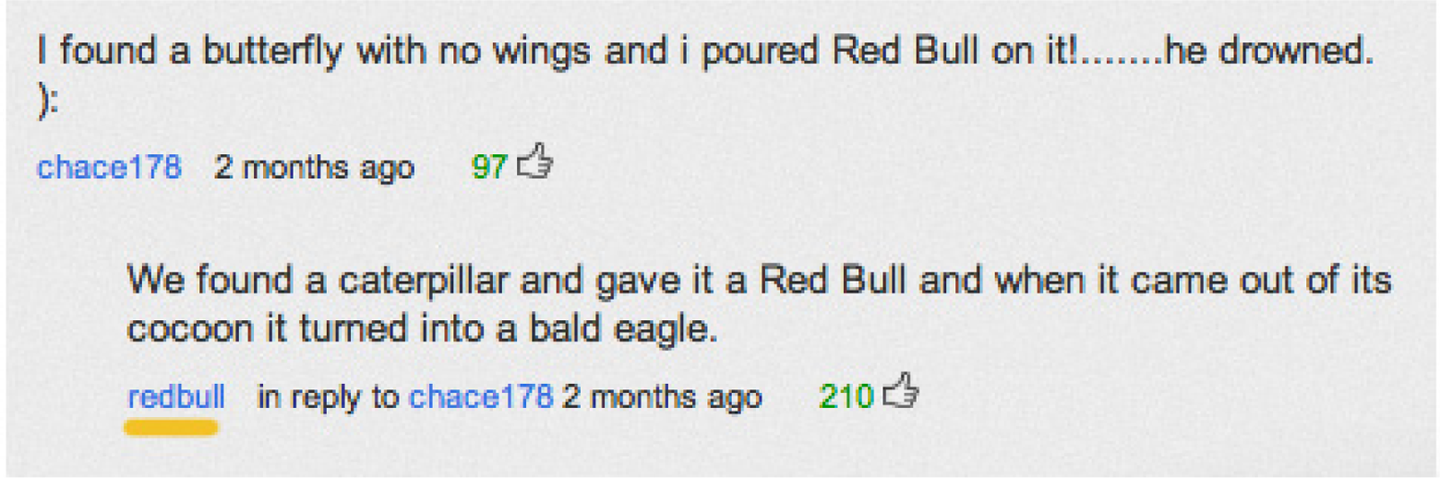
Businesses and organizations can also benefit from focusing on anti-consumption discourse (note the number of “likes” in the second message). Source: http://www.twylah.com/redbull/tweets/192462460282867713.
Alternatively, companies may implement strategies that prevent or discourage the market from being able to enact their reasons against the brand, such as by furtive subbranding or increasing exiting fees (Lee, Motion, and Conroy 2009). The rhetoric and types of strategies employed in all these settings could be analyzed through a variety of interpretive methodologies and this could provide valuable insights as to how businesses interact with both their consumers and their anti-consumers (Thompson, Rindfleisch, and Arsel 2006). Indeed, although applications of reasons theory mostly remain within a sociocognitive, logicodeductive paradigm, interpretive approaches may prove better suited to address issues around self-presentation and the dynamics of sense making and account giving. In addition, known methodological problems such as social desirability bias (e.g., Crane 1999) can be more effectively addressed through prolonged engagement, building trust and rapport, and triangulating with different data collection methods. Likewise, interpretive studies could explore how other actors such as bottom-up, grassroots movements but also top-down institutional actors also engage with anticonsumerist attitudes and motivations. Opposition to genetic modification (GM) forms part of an agenda that is negotiated not only at the level of individual choice but also in policy-making settings where various stakeholders engage with the rhetoric for and against GM.
Furthermore, the types of reasons for and against consumption that consumers employ in their everyday purchasing (and nonpurchasing) contexts are fundamentally intertwined with taken-for-granted notions of desirable lifestyles and the ideological nexus of market capitalism. Contemporary markets legitimize consumer choice based on the functional, use value of products rather than their potential environmental and social externalities. Consumers may criticize Chevron (or Ryanair) for their exploitation of the environment (or workers), but they may still carry on buying petrol (or using the low cost airline) if those brands fulfill a function and the consumer makes no connection between the concepts of exploitation and functionality (Salzer-Morling and Strannegård 2007). Potentially useful perspectives here include institutional theory (Thornton and Ocasio 2008) and Kilbourne, McDonagh, and Prothero’s (1997) approach to understanding the institutional foundations of the DSP. Reasons against could be treated as counterconsumerist critiques or “countervailing logics” (e.g., Seo and Creed 2002) that reflect paradigmatic shifts in the dominant socioeconomic order. A parallel stream of research could distinguish between macro- versus micro-oriented reasons against consumption and the extent to which they are in rooted in different institutional forces and stakeholder actions. In the context of green consumerism, Prothero, McDonagh, and Dobscha (2010) differentiate between micro-level (e.g., helping one’s family or local economy) versus macro-level motivations (e.g., concerns about the global effects of consumer culture). Likewise, micro- and macro-level reasons against are expected to have distinct ideological and motivational underpinnings.
Conclusion
In sum, this article argues that anti-consumption is a distinct area of research interested in the reasons against consumption. By drawing on reasons theory, the article offers anti-consumption as an overarching perspective that spans a range of behavioral and thematic contexts, and acts as a lens that encourages scholars to consider the other side of the consumption continuum. In doing so anti-consumption research attempts to increase understanding of consumption overall, as well as contribute to an emerging cross-disciplinary tradition that acknowledges the ways in which phenomena of negation differ from those of affirmation.
Footnotes
Author’s Note
Both the authors have contributed equally.
Declaration of Conflicting Interests
The author(s) declared no potential conflicts of interest with respect to the research, authorship, and/or publication of this article.
Funding
The author(s) received no financial support for the research, authorship, and/or publication of this article.