




Abstract
This article examines deviant marketplace behaviors that appear in marketing systems involving subsistence consumer merchants, and their beneficial and detrimental implications. Deviant marketplace behaviors are violations of social norms that often arise among subsistence consumer merchants facing conflicting normative goals and incompatible means for meeting such goals. Social and environmental factors that exacerbate such conflicts, common in bottom-of-the-pyramid marketplaces, are explored within a deviant behavior typology. The research uses ethnographic data gathered from subsistence consumer-merchants to illustrate ways in which deviant behavior can be beneficial or detrimental and the unique challenges that partnering with subsistence consumer merchants may entail. It also provides insights into what conflicting norms and deviance engender in marketing systems.
Keywords
This research seeks a better understanding of deviant marketplace behaviors among subsistence consumer-merchants and some of the factors that lead to such behaviors. Subsistence consumer-merchants are market actors who provide for self and family by managing microenterprises that often serve as final links in the supply chain for major companies (Viswanathan, Rosa, and Ruth 2010). Deviant marketplace behaviors are actions and activities that violate social norms (Merton 1949), be the outcomes from such behaviors beneficial (e.g., reaching new customers by bending rules innovatively to reach a new location) or detrimental (e.g., misrepresenting product quality to tourist customers unlikely to be seen again). In marketing systems, deviant behavior arises when market actors, such as subsistence consumer-merchants, violate the explicit or implicit norms held by other market actors (Warren 2003). The research also seeks to shed light on the implications of deviant marketplace behavior for marketing systems. Given that deviant behavior by subsistence consumer merchants can lead to beneficial and detrimental outcomes, implications from such behaviors for marketing systems can be complex.
Recent research in the subsistence consumer domain has touched on how relationships within social and kinship communities affect consumer behavior (Viswanathan, Gajendiran, and Venkatesan 2008); on the influence of consumer culture on marketing systems (Eckhardt and Mahi 2012) and business practices (Viswanathan et al. 2009); on the influence of economic liberalization in subsistence economies on strategic and organizational change (Carman and Dominguez 2001); and on the role of social marketing in improving economic wellbeing (Kotler, Roberto, and Leisner 2006). Less attention has been devoted to delayering the complexities of marketing systems at the bottom of the pyramid (Prahalad 2005). In this domain, the conversation has focused primarily on institutions and aggregated forces that give structure and continuity to subsistence marketing systems, but has largely ignored the final link in an exchange process that “creates, assembles, transforms, and makes available assortments of products” (Layton 2007, p. 230). In subsistence markets, this final link most often consists of millions of subsistence consumer-merchants (SCMs) who close the gap between producers or intermediaries, and billions of poor consumers who would otherwise not have access to goods and services.
Subsistence consumer-merchants can be found running small neighborhood stores, selling from homes and on street corners, offering goods door-to-door, and in thousands of bazaars throughout the developing world. They typically operate in rural villages or hard-to-access subsistence urban districts (e.g., slums, favelas, shanty towns). The market environments in which they operate are socially complex and unpredictable; and when responding to such environments, SCM marketing methods do not always align with what producers and intermediaries desire. Milk vendors in India, for example, may sell on credit even when ordered not to by milk suppliers, or they may violate producer or government imposed prices with some customers to preserve the relationship (e.g., Viswanathan, Rosa, and Ruth 2010). When norms are violated, producers and intermediaries see the SCMs as deviant, and both the act and its judgment shape relationships for SCMs and other market actors.
Not always recognized by market actors is the fact that deviant behavior by SCMs often arises as they pursue compliance with coexisting norms within the broader social milieu in which the marketing system is embedded (Layton 2009; Varman and Costa 2008). Factors such as low literacy, violence-forced displacement, material deprivation, and day-to-day uncertainty contribute to subsistence districts being different from social environments in developed markets (Boo 2012). In general, bottom-of-the-pyramid (BoP) social systems are marked by a level of group membership fragility that complicates SCM-marketing system interactions. Competing and often irreconcilable social norms (from government, families, neighbors, etc.) coupled with extreme resource constraints, lead to deviant behaviors being commonplace in subsistence social systems. Not surprisingly, deviance is accepted as necessary even if undesirable, and is hence a factor with which market actors wanting to participate in subsistence marketplaces must contend.
Given the multilayered and interdependent nature of social and marketing systems, deviant marketplace behaviors have implications that reach beyond affecting those who exchange with SCMs directly. Marketing systems serving the BoP need to incorporate SCMs in order to reach consumers who otherwise lack access to provisioning structures and institutions found in developed marketing systems (Layton 2011). As a result, understanding SCMs and the role of deviance in BoP exchange helps marketing system scholars and participants to: 1) better develop processes and exchange logics that can handle SCM-focused exchange, 2) make use of the beneficial outcomes (e.g., innovativeness) that deviance unleashes, and 3) avert or minimize the effect of detrimental outcomes that arise from SCM deviance.
This research seeks to better understand the nature and antecedents of deviant marketplace behaviors among SCMs, in order to help improve marketing system performance at the bottom of the pyramid. The following section presents a brief overview of marketing systems in the context of subsistence. Subsequently, a typology of deviant behavior is presented that extends the field’s understanding of deviance and highlights its potential contributions in reaching BoP consumers. Sections that follow discuss antecedents of SCM deviant behavior, and informant narratives that exemplify deviance types and their antecedents. Finally, theoretical and practical implications and opportunities for future research are discussed.
Marketing Systems and Subsistence Consumer-Merchants
Layton (2009, p. 354) defines marketing systems as “a network of individuals, groups and/or entities embedded in a social matrix linked directly or indirectly through sequential or shared participation in voluntary exchange of value which jointly creates, assembles, transforms, and makes available assortments of products, services, experience, and ideas provided in response to customer demand.”
In developed economies, marketing systems include goods and packaging producers, transportation providers, wholesalers, retailers, credit card companies, shopping mall operators, and other entities that directly or indirectly contribute to exchange. In subsistence markets, many of these entities do not exist, and SCMs fulfill a diverse collection of market functions, albeit incompletely and imperfectly. Within subsistence marketing systems, market exchanges are facilitated when SCMs enter voluntary partnerships with producers and their intermediaries. These partnerships engage the SCM in the delivery of an assortment of goods and services to final consumers. Breaking this down further, each SCM performs a small part of the provisioning function of a marketing system by bringing together upstream producers or aggregators, fellow SCMs, and downstream consumers (Layton 2009; Viswanathan, Rosa, and Ruth 2010). Together, as a network of SCMs, they provide marketing functions for the market actors they serve. Subsistence marketing systems in different regions of the world will vary based on the cultures and societies involved, but they all involve SCMs, and as such, the systems are affected by the behaviors, deviant or otherwise, of those SCMs as they balance the tasks of facilitating exchange with the need to survive.
Although subsistence marketing systems lack some of the elements of formal marketing systems, they are not absolved from their flows of ownership, possession, information, finance, and risk (Layton 2007). All marketing systems arise in form and structure from relationships of exchange and partnerships rooted in economic, social, and cultural contexts (Mittelstaedt, Kilbourne, and Mittelstaedt 2006). As a result, they are bound by formal, informal, and philosophical antecedents that impinge on SCM behavior and must be understood.
Formal antecedents are legal and institutional structures that regulate and organize social and marketing systems. Policies, regulations, and ordinances that contractually and normatively bind would reflect a formal structural relationship between SCMs and other market actors, and help ensure that localized business norms are adequately adhered to and comply with broader social norms. In a subsistence marketplace, however, formal antecedents are often either missing or unreliable (Boo 2012; Viswanathan and Rosa 2007; Viswanathan, Rosa, and Ruth 2010). Law enforcement is non-existent or corrupt, and government institutions may not reach the slums and rural villages where SCMs conduct business. Informal antecedents are cultural, ethnic, and religious factors that shape, regulate, and transform marketing systems. Informal antecedents are reflected in the many imperfect and fragile relations that SCMs hold with different social groups (e.g. customers, vendors, families, neighbors), and which present their own set of norms.
Finally, philosophical antecedents are the underpinnings of the social paradigm, and they shape at the most basic level how people view the world (Kilbourne, McDonagh, and Prothero 1997; Mittelstaedt, Kilbourne, and Mittelstaedt 2006). They are beliefs and expectations that transcend the relational underpinnings of informal antecedents. Within healthcare marketing systems in developed countries, for example, informal antecedents include a patient’s expectations that doctors will treat him or her with respect, while philosophic antecedents include the patient viewing healthcare as a normative right. Neither antecedent is formal as defined earlier, but they operate at different levels.
In BoP marketplaces, relationships between SCMs and customers or suppliers are primarily anchored on informal antecedents that are shaped by philosophical ones. In the absence of effective formal antecedents, the subsistence marketing system served by SCMs relies on informal, group-oriented antecedents to set norms that govern the actions of SCMs and other market actors. Informal antecedents and their norms, however, come into conflict when market actors who are informed by differing philosophical ones (e.g. culture, religion, social class, gender) “interpret” and act on informal group norms. Important to our analysis of SCM deviance is the realization that the tri-partite nature of marketing system antecedents – formal, informal, and philosophical – virtually guarantees that SCMs will operate in environments where conflicts abound and adherence with one set of norms will lead to violation of other norms.
While conflicting antecedents and norms affect all marketing systems, the subsistence marketing environment is unique in several ways. First, the subsistence marketing environment differs sharply from marketing contexts that rely on formal antecedents such as policies, laws, and ordinances to avoid or resolve norm conflicts. Secondly, many actors in subsistence marketing systems have transitioned from their place of birth (e.g. villages and small towns) where the norms based on informal antecedents were held in common. This creates social milieus where multiple sets of informal antecedents will be present and guiding behavior. In addition, variability in the religious, ethnic, and other philosophical antecedents that are often forced to coexist by poverty in subsistence environments further complicates issues. Even when SCM market participants appear to be abiding by shared informal market antecedents, it is risky to assume that compliance reflects shared philosophical perspectives. Such unique aspects of the subsistence marketing system present challenges to market execution.
Viswanathan, Rosa, and Ruth (2010) show that SCMs address norm conflicts by managing relationship sub-systems with family, vendors, and customers in seemingly endless cycles of violating expectations in one relationship system to affirm and sustain other relationship systems. Their focus was not deviance as such, but they provide examples of detrimental deviant behaviors against different system members, from lying to customers, to betraying the trust of vendors, to forcing children to go hungry. Their data shows that deviant marketplace behaviors are part and parcel of how SCMs do business, and they further suggest that companies doing business with SCMs must be ready to witness and experience some deviant behaviors. The complexities and cross-forces present suggest it is important for actors in marketing systems and marketing systems scholars to understand the factors that drive SCMs to deviance, en route to developing processes that reduce the incidence and severity of deviant behaviors, manage deviance in constructive ways, and mitigate the unintended and harmful consequences of such behaviors when they arise.
Deviance as Violation of Social Norms
Deviance exists when social norms are violated. The foundations for this view can be found in Merton’s (1949) work on anomie. Merton defines anomie as any state in which societally determined goals and the means to achieve such goals are violated. He portrays society as the ultimate determiner of goals and means, and suggests that all individuals owe their strongest allegiance and compliance to society. For individuals, there can be either 1) acceptance or rejection of societal goals, and 2) acceptance or rejection of societal means. The crossing of these decision points creates a four-quadrant deviance typology: conformity, innovation deviance, ritualist deviance, and retreatist deviance. A fifth type emerges when goals and means that are contrary to those of mainstream society are actively pursued and imposed (see Figure 1). This fifth type is labeled rebellious deviance. Merton (1949) further argues that members of societies can be characterized as fitting into one of these classifications based on an aggregated assessment of their behaviors, even if violations of the overarching pattern exist.

Societal goals and means based deviance types.
Conformity exists when individuals accept societal goals and means of achieving those goals. When SCMs comply with societal norms, deviance is minimal and exchange takes place predictably and consistently. For example, if an SCM is able to repay a micro-finance loan on-time (socially-acceptable goal) because she achieved a return on investing in the business (socially-acceptable means), the SCM has complied with explicit and implicit expectations of the micro-finance lender. Because no deviance is involved, however, market actors in conformity are outside the scope of our research. In this research, attention is directed at innovative deviance, ritualist deviance, retreatist deviance, and rebellious deviance. The emphasis is on SCMs who digress from social goals, means, or both to achieve their purposes.
Innovative Deviance
Innovative deviance occurs when market actors accept societal goals but reject the means of achieving those goals (see Figure 1). Examples of such deviant marketplace behaviors among SCMs can be found in how ration card programs function in India (National Portal of India 2005; Walk Through India 2010). In Bangalore slum areas, ration cards for commodities such as rice, wheat, sugar, and kerosene are issued to residents. In this case, the social goal is a base level of wellbeing among the poor and ration cards are distributed to families as the means. This aligns with an implicit social norm that ration cards will be used by families to secure the commodities associated with each specific ration card. SCMs, however, often reject the “proper” use of the ration cards. Vendor SCMs might allow the purchase of other goods with ration cards, for example. Similarly, consumers and SCMs trade ration cards for other commodities, which facilitates SCM hoarding or reselling of the accumulated staple items. In spite of such means violations, the goal of providing a base level of wellbeing is achieved, because consumers and SCMs are able to feed their families, improve disposable income, and gain access to needed products not covered by ration cards (e.g. health and beauty products, batteries). Much of the product flow in Bangalore slums involves innovatively deviant use of the ration cards (means) to achieve improved material wellbeing for consumers and the SCMs who serve them.
Ritualist Deviance
Ritualist deviance is present when individuals reject or give up societal goals but comply with the means of achieving such goals. They go through the motions, but are deviant in their commitment to the social goal. A man who ostensibly goes to work (means) to make money to support his family would seemingly be in line with social norms. However, if he stops at the bar on the way home and gambles away his earnings, he is demonstrating ritual deviance by giving up on the goal of supporting his family. He is complying with the socially-dictated means of going to work, but has given up on the socially-dictated goal of family wellbeing. Similarly, market actors who engage in normative behaviors but lack the discipline to pursue goals shared with system partners are not likely to care about customer needs and satisfaction, and possibly endanger the reputation of companies they represent. In subsistence markets, where formal antecedents such as the rule of law are capricious or nonexistent, ritualistically deviant SCMs may hinder marketing system performance. It is hence important that ritualist SCMs be understood and managed. Inattentive companies who partner with ritualistically deviant SCMs will have difficulty detecting the deviance until partnership outcomes have visibly suffered.
Retreatist Deviance and Rebellious Deviance
The rejection of both goal and means-related norms are involved in both retreatist and rebellious deviance (Merton 1949). The difference is in the degree to which individuals or groups organize to actively overthrow dominant social norms. Retreatist deviance is present when individuals reject both societal goals and means of obtaining those goals in favor of other norms, and primarily seek to create an environment in which those alternative norms can be enforced. Religious cults living in isolated compounds serve as examples of retreatist deviance. They seek new recruits, but once converted those recruits are brought into the compounds’ social systems and separated from mainstream society.
When people organize and act collectively to impose their alternative goals and means on the mainstream social matrix, they transition into rebellious deviance. If the aforementioned religious cult engages in terrorism intent on undermining the existing legal and social structure, it is no longer retreatist – it is rebellious. Although it may be counterintuitive to think of such SCMs as potential partners, it is important to recognize that the incidence of retreatist and rebellious deviance in some parts of the world can affect large groups of otherwise attractive consumers, and that if the retreatist or rebellious deviance are against an oppressive and unjust society, seeking ways of serving the marketing system through retreatist and rebellious SCMs may serve a greater good.
Criminal gangs in slums and favelas can exemplify retreatist deviance. In general, attaining and maintaining gang membership involves secrecy and adhering to goals and means that do not align with those of mainstream society. Indoctrination is commonplace, and not surprisingly, gang members tend to hold unique worldviews and have difficulty relating to people outside the gang (Howell, Egley, Jr., and O’Donnell 2012). In effect, gangs tend to create closed societies not much different from religious cults, espousing atypical goals and means, known only to members and recruits, and resistant to outside influence. In subsistence social contexts gangs seem to exist to fill control-and-authority voids created by disregard from government institutions, but they do not seek to undermine society at large.
In subsistence marketplaces, gangs can control access to large consumer segments. As an example, the favelas in Brazilian cities such as Rio de Janeiro and Sao Paulo include millions of consumers isolated from mainstream society. The state’s rule of law does not reach most favela residents, and gangs act as the government within their “turf” (Hagedorn 2008). Business in favelas is conducted differently from marketing systems where private property rights and the rule of law prevail. Informal and sometimes philosophical antecedents take precedence over formal ones, and the enforcement of goals and means norms is often dependent of the quality and stability of relationships between SCMs and gang members. Gang-administered marketing systems have existed in favelas for years, and in effect created an economy that is only indirectly affected by that of the mainstream society from which the favela is isolated; companies that want to reach favela consumers must develop marketing systems that include gangs as partners.
While gangs and other retreatists isolate themselves from mainstream society, rebels seek to disrupt it. Extremist organizations such as the Taliban in Afghanistan and the FARC in Colombia are examples of rebelliously deviant groups that in some cases have become SCMs within their marketing systems. The Taliban, for example, is dedicated to the imposition of strict Islamic law in central Asia. In contrast to gangs, its members are not satisfied with creating isolated pockets where alternative norms prevail, and they seek instead to overthrow societies whose norms differ from their own. The Taliban controls commercial access to areas under its control, and it has a long tradition of opium trade and smuggling activities (alternative means) to fund its political agenda (alternative goals) (Rubin 2000). Similarly, FARC forces in Colombia employed the drug trade, smuggling, and kidnapping for ransom in their fight against the government, inspired by a revolutionary economic and social agenda (Richani 2008). Although documented examples of marketing system partnerships with the Taliban, FARC, and other rebellious deviants are difficult to uncover, the presence of global brands such as Coca-Cola and Nescafé in markets they control suggests that marketing systems can adjust to rebellious deviance to serve consumers. For market actors serving consumer segments influenced or controlled by rebellious deviants, the implications for conducting business are not all that different from what applies to retreatist enclaves such as gang-controlled favelas. However, such actors and their marketing partners must negotiate the norm conflicts that arise from rebellious attempts to undermine the broader social system in which they otherwise reside and operate.
Implicit in these examples are factors further explored in the next section, stemming from deviance often arising when individuals violate one set of norms in order to comply with an alternative set. Such conflicts become likely when formal, informal, and philosophical antecedents trace their origins to different market actors. On a case-by-case basis, the norms most likely to dominate SCM behavior in a particular exchange will be those of the social system group that is most important to the individual in that context. In the case of favela gangs, for example, members may reject societal goals and means because they seem foreign, hard-to-decipher, and out of reach. They retreat instead to gang-controlled micro-societies where goals and means make intuitive sense and are achievable. Similarly, SCMs in India are known to alternate between affirming goals and means dictated by Hindu and Muslim society, the local community, or those of family and their ancestral villages (Viswanathan, Rosa, and Ruth 2010).
Group Membership Fragility and Conflicting Norms
As discussed previously, SCMs face significant everyday challenges. Many live at the margins of society, both physically and emotionally. Faced with underdeveloped systems that lack or inconsistently apply formal antecedents (e.g. property rights, rule of law), SCMs encounter a marketplace distinct from that of partner producers and distributors. Even shared informal antecedents are lacking in subsistence marketing system, as SCMs and the consumers they serve are often displaced from their birthplace and its associated norms. For SCMs in a slum Indian community, for example, mixed cultural and religious backgrounds (e.g. Hindu and Muslim) imply differing philosophical perspectives that influence how SCMs interpret and trade-off between competing social norms. Adding to the complexity, the turmoil and tragedies that market actors face in subsistence contexts (e.g. war, ethnic conflict, deprivation) amplify existing differences in philosophical viewpoints and the interpretation of informal market norms. Living in communities that are poorly served by government institutions, where conflicting religious and cultural values strive for dominance, and where the rule of law does not apply, SCMs’ deviation from formal, informal, and philosophical market assumptions reflects their different worldview origins. Unmoored from the stability of home and shared beliefs, their worldview is characterized by fragile and shifting group memberships.
Many subsistence consumer-merchants, like the informants in Viswanathan, Rosa, and Ruth (2010), moved from rural villages where their extended families continue to worship at local temples that serve as spiritual anchors for the refugees (Boo 2012). They still belong to that family and village, but can no longer uphold its norms. At the same time, they are imperfect members of social groups within their neighborhoods – imperfect because of rapid turnover in slum populations and their otherwise unstable nature. Further, they contend with norms that shift with context. When it comes to selling cooked food, for example, Viswanathan, Rosa, and Ruth (2010) show that the marketing norms-relevant social group is most likely the people living on the same city block and regular pedestrians. When the task is marketing flowers for temple worship, however, the norm-relevant group involves temple worshippers, other vendors, temple priests, and possibly the market landlord. Further, within these groups sub-groups exist based on ancestry and religion; and SCM members of ethnic and religious minorities have to deal with social groups defined by caste and theological distinctions prevalent in mainstream society. In most instances, marketing system membership is made fragile by uncertainty and change, with possibly only family, ethnic, and religious social systems achieving some level of permanence. Sellin (1938) labeled such situations conflicts of conduct norms, which arise when individuals identify with multiple social groups that have alternative norms for given situations, but he did not address fragility in group membership as a factor.
Although being involved in multiple social groups with conflicting norms is not uncommon, SCMs’ group membership fragility distinguishes them. Around the world, SCMs are affected by religious persecution, sectarian violence, capricious law enforcement, extortion, and unpredictable earnings and purchasing power, all of which contribute to high uncertainty (Viswanathan and Rosa 2007). Further, SCMs are seldom considered full members in new communities, giving them a limited voice in the shaping of goals and means with which they are expected to comply (Boo 2012). Fragile membership, high environmental uncertainty, and other factors combine to produce the fluid commitment to different sets of norms that characterizes subsistence consumers in general. It is a phenomenon that companies and marketing systems seeking to partner with SCMs must address.
A pertinent question to consider is, “how do SCMs choose which set of norms to follow?” Building on social identity theory (Tajfel and Turner 1985), it has been argued that group norms mediate the relationship between identity and behavior (Terry, Hogg, and White 1999). In situations where individuals belong to more than one social group, it is the highest identification group norms that the individual will observe. The implications for SCMs who hold fragile group membership and transitory group identification are straight forward. In situations where more than one social group is relevant, context is likely to determine which group identification will dominate. On a particular day in a Brazilian favela, it may be gang membership that is most salient, and a truck driver for a company that has secured protection from gang leaders as recognized actors in the marketing system will be allowed to do business. If family or ancestral ties become dominant, however, as would be the case if a younger brother needed to pull off a heist to attain gang membership, individual gang members may allow the protected driver to be robbed, violating marketing system norms to uphold family ones. Similarly, a Hindu SCM selling temple flowers may have a relationship with a Muslim flower supplier and do business according to Islamic norms (e.g., no interest on loans), until a Hindu flower supplier enters the market and imposes Hindu norms. If ethnic and religious group memberships are less tenuous than local market memberships, Hindu norms will prevail. Due to the shifting and fragile group membership endemic to the subsistence marketing system, SCMs consistently face conflicting norms and engage in deviance toward one group to comply with the norms of other contextually-important groups.
Field Evidence: Deviance Types and Conflicting Norms
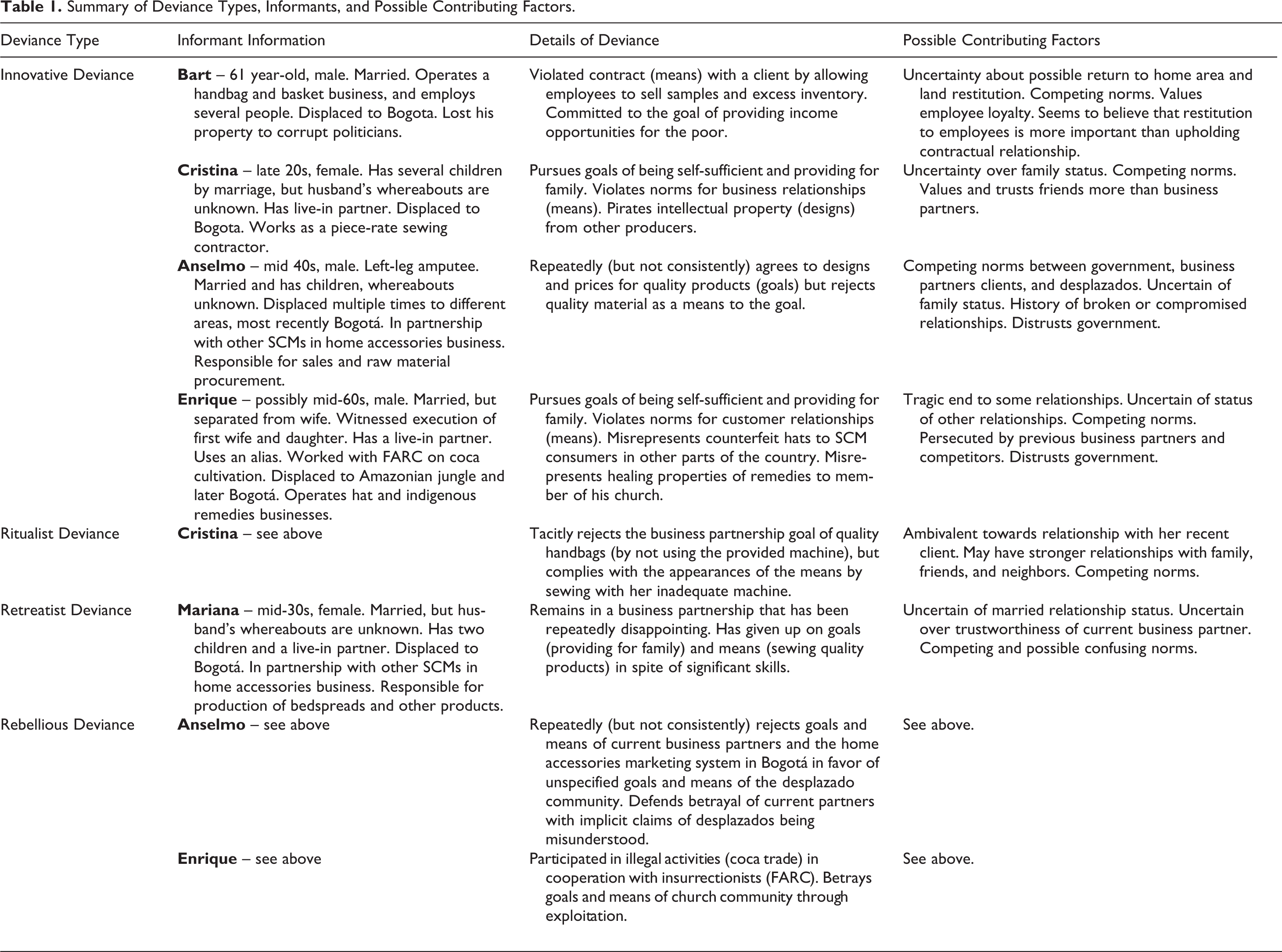
Evidence of deviance arising from norm conflicts can be found in the narratives of SCMs. Five disguised-name primary informants, two women and three men, are used to illustrate deviance and the antecedents described. They were drawn from a group of twenty-one informants, among whom instances of deviance and antecedents similar to those described below are pervasive. Some instances involve product design and intellectual property piracy; some involve deceiving customers and business partners; and some involve participating in illegal activities such as coca cultivation. Informants also reported being victims of deviance, from being misled by other SCMs to seeing loved ones murdered. The data were gathered in an ethnographic study of SCMs conducted in 2010 in Bogotá, Colombia. Informants were interviewed in their homes or places of business by a three-person team using an unstructured approach in which informants described their business or businesses and how they operate, along with as much information about their families and background as they were willing to share. Demonstrations of their products were integral to all interviews, along with references to family members and friends who are involved in the business. All interviews were at least 90 minutes long, and many extended to 120 minutes. The interviews were conducted in Spanish, transcribed in the native language, and later translated. The team involved a US-scholar fluent in Spanish and a Colombian scholar (listed authors), and a Bogotá government consultant. Findings from interview data are summarized in Table 1. Details are discussed below.
Summary of Deviance Types, Informants, and Possible Contributing Factors.
The Research Context
Bogotá has a population of eight million, of which it is estimated that almost 40% lived below the poverty line at the time of the study (PNUD 2010). National poverty stood at 45.5% in the same time period. Many of Bogotá’s poor are squatters – people who build shelters, homes, and workshops on land they do not own, and improve those structures over time. These settlements tend to occur in unincorporated areas of the city – areas where social services and the rule of law reach imperfectly or not at all. In spite of its poor control, many of the poor register with the government, often using false addresses, to get work permits and access to some social services. Compliance with government/societal and squatter community norms is therefore expected.
Further enriching the norms’ tapestry is the desplazado status of many of Bogotá’s poor. Desplazados are individuals and families who are forced to relocate from homes in other parts of the country by violence linked to the drug trade. They are the equivalent of refugees fleeing armed conflict in war-torn countries. Approximately 280,000 of Bogotá’s poor were classified as desplazados at the time of the study, and it is argued that the numbers are understated (PNUD 2010). Many desplazados hide their status to avoid stigma; others adopt false identities because of still-active violence and death threats. It is estimated that between 2002 and 2009 over 2.4 million persons became desplazados in Colombia (CODHES 2010). Desplazados in a city like Bogotá come from other regions of the country and may retain relationships with people in those areas. They are members of fragmented but still functioning social systems. Because many retain family and social connections to their home regions, and establish exchange relationships with people from those regions within their squatter communities, regional norms tend to inform their behaviors. Eleven of the twenty-one informants in the study self-identified as desplazados, and the others were suspected desplazados who refused to speak about their status.
Bogotá reflects the ethnic and cultural plurality of Colombia. The country’s population is roughly 45 million with a median age of 28 years (all descriptive information drawn from the 2012 CIA World Factbook). Almost 60% of the population is officially classified as mestizo, but even many in the officially classified white population (20%) are likely to have some indigenous ancestry. Approximately 75% of the population lives in urban areas, but only 40% live in the five largest cities, which range in size from eight million in Bogotá to one million in Bucaramanga. The country’s history includes violent conflict dating back to pre-colonial times. It is a country rich in natural resources with a diverse topography. The Andean range crosses the country from south to north and divides into three ranges in its traverse. Large sections of fertile land divided by impassable mountain ranges and massive river systems have created a society abundant in cultural microcosms, all of which are represented in the population of Bogotá because of its draw as the economic and cultural center of the country. Colombians are loyal to their cultural ancestry, quite often evident at fiercely competitive futbol (soccer) matches. At the same time, they are strongly nationalistic and proud of their Hispanic heritage. They argue with one another, and fight to the death among themselves, but unite against common enemies, such as the US earlier in the 20th century and more recently against leftist regimes in Venezuela and Ecuador.
Until recently, the country was affected by an ideologically communist insurrectionist movement – Fuerzas Armadas Revolucionarias de Colombia (FARC) – that as late as 2005 controlled almost one-third of the country’s land mass. Following the typical insurrectionist model, FARC expropriated property and goods from local citizens to support its troops. In addition, FARC participated in the drug trade because of its prevalence and high returns in Colombia. Government failure to curtail FARC activities gave rise to counterforces in many parts of the country, typically labeled paramilitares. Paramilitares are not ideologically informed, but they defend against violence with violence, and also became involved in expropriation and the drug trade as a source of income. In the opinion of many Colombians, conflicts between FARC, paramilitares, and government forces were more often over money than other factors. The Colombian military has been undermined by numerous abuse and corruption scandals, and may have contributed to the desplazado problem.
Bart and the Baskets – Innovative Deviance
Bart is 61 years old. With his wife, he operates a small business that manufactures baskets and ladies handbags from polypropylene woven monofilament webbing, the same material used for vintage aluminum-frame patio chairs. The handbags are often sold on street corners, and the baskets have recently started to sell at Home Center, a Latin American version of Home Depot. Bart’s business is stable and prosperous enough to have several employees, and Bart and his wife earn approximately $2.50 per day. They arrived in Bogotá in 2000 after losing the family farm to corrupt politicians who worked for guerillas (FARC or paramilitares, Bart would not say) involved in the drug trade. Bart hopes to return to his land someday, and was optimistic the day we met him because of progress made by the Colombian military in curtailing guerilla activity. As with many other SCMs, Bart is victimized by deviance but also engages in it, and does not seem to recognize the contradictions.
There are people who have copied our products. There was a guy who posed as being affiliated with Politécnico Gran Colombiano (a post-secondary trade school), and claimed he was going to get us publicity in the newspapers, but needed to interview us. He promised it would benefit us, but that he needed to know everything: where we bought materials, where we sold, the names of the companies that supplied us, the colors that customers wanted. We were not supposed to tell others about the colors that customers (e.g., Home Center) wanted, but this guy told us we needed to tell him everything. And we told him. He took photos of us and our work; and then started producing exact copies of our products. The guy was from Bogotá and supposedly from a good family (not really true) and he copied all our products.
A member of the interview team had learned from government officials that the person who tricked Bart lived in another part of the city, and after copying Bart’s products tried to sell them to retailers who compete with Bart’s clients. He accepted a large contract for 6-month delivery at an unsustainable price per unit, however, and went out of business, but not without first unsuccessfully suing the client for breach of contract.
At the interview, the team member shared the competitor’s anecdote with Bart, who quickly confessed to making a similar mistake when Home Center first approached him – a mistake that almost cost him the business. His employees worked without pay to save it. They sacrificed family well-being for the sake of their employer’s survival, and Bart appreciates it.
Well you know… (emotional pause) … I created this (the business) because of physical and moral necessity, but these people … without them I am worthless. And it makes me glad to have them with me, and to help them overcome their poverty.
Interestingly, Bart has never paid his employees for the lost wages directly, perhaps because his accounting systems and financial management were not sufficiently sophisticated to track the liabilities. Instead, he allowed employees to engage in deviant behaviors (described below) to make extra money.
Upon learning what happened to his competitor, Bart moralized for a few minutes on the importance of being honest and truthful. Once the conversation returned to the business, however, he revealed the following:
Well anyway, we don’t have an exclusivity contract with anyone (not true), and some of the same baskets that we sell them (Home Center), well there are always some left over and samples and such. We (the employees) sell those (on the street) for a little more than we charge Home Center, but less than what Home Center charges. They sell the baskets for around 49,999 pesos ($27 US) and we sell (on the street) for around 45,000 pesos (slightly less than $25 US). And we sell to Home Center for 38,000-39,000 pesos (around $21 US). But you know, Home Center does not care that much about making money. They are trying to help us poor people and they can raise the price on other products.
In selling the same baskets on the street, Bart and his employees violated an existing contract with Home Center, and when probed on the contradiction between his moralizing and behaviors, he shifted the conversation to “we are family in this business, and even when things are tough everyone gets to earn something. In good times we laugh, and in bad times we laugh but not as much.” Bart never stated outright that abiding by the norms of the subsistence community (his employees) was more important than abiding by the retailer/supplier norms imposed by the marketing system, but the norm conflict and innovative approach to making good on his employees’ sacrifices seem clear. Subsistence community and Home Center goals were relatively compatible (earning enough to survive and provide for others), but the means were incompatible (fulfilling contractual obligations long term versus opportunistically selling excess inventory short term). In effect, Bart engaged in innovative deviance as illustrated in Figure 1.
Cristina and the Handbags – Ritualist and Innovative Deviance
Cristina is in her late 20s and has several children (she would not say how many). She has a live-in partner in Bogotá, but is not legally married, and implied she had a husband in her hometown but does not remain in touch. She did not claim desplazada status, but aspects of her life suggested she was. She claimed to not remember how many years she had lived in Bogotá. Cristina works in the garment trade broadly defined, sewing blouses, pajamas, and Halloween costumes, and more recently handbags made from faux leather materials. All of her work is on contract. She sells to a more successful SCM who aggregates products from several SCMs like Cristina and sells to small independent retailers.
The day we visited, Cristina was very agitated. A disagreement with her buyer had left her unemployed and unable to pay bills. She complained openly and bitterly about her buyer:
What happened (you ask)? Well this man asked me to make ladies handbags, and I thought it was very good deal because he offered work for the whole year, and I was happy. He even brought me a machine (sewing) because mine was pretty much worn out, but he said “you be calm, I will bring the machine and you work for me.” And that’s how it went and we started to work and all was well; and then he started to find fault with my product (damaged stitching, etc.) and he would pay me half of what he owed me. He had another lady working for him, and was always coming up with the same story, and so I returned his machine and quit.
Did he bring the design for you to make?
Yeah. He brought the pieces precut.
And you assembled them (handbags)?
Yeah, I assembled them, and he was supposed to pay me 1,800 pesos per bag (almost $1 US). And I was supposed to line the purses and all that work for 1800 pesos; and then he paid only 1000 pesos.
Cristina considered the buyer deviant and not to be trusted, and herself as a victim. As the interview unfolded, however, several deviant behaviors by Cristina came to light. One was the inadequacy of her machine to work with the faux leather materials for the handbags.
Well, this handbag is kind of complex because this machine does not lend itself to this material. It is too thick. Here, I’ll show you a little, because look how this is very difficult to handle, and it made my hands hurt.
Cristina did not use the machine that was provided by her client because she did not know how to operate it, a fact she did not reveal when agreeing to the work, and relied instead on a standard home-grade machine unsuitable for working on synthetic leather. As a result, handbag quality and her production rate suffered. She was repeatedly late on deliveries. It was taking her 2-3 times as long to produce one handbag as she initially envisioned, and stitch quality was poor. When sewing is seen as the means, and sellable handbag quality as the goal, Cristina can be recognized as a ritualist. She agreed to sew handbags, but tacitly rejected the quality goal implicit in the client providing her with a suitable sewing machine. Unfortunately her deviance did not become obvious until several handbags had been poorly assembled, and the potentially fruitful marketing system relationship had been irreversibly damaged.
Another deviant behavior in which Cristina engaged was stealing her buyer’s designs and selling copycat bags on her own.
And the design of this bag, did you do it?
I used the materials (precut pieces) he brought me to develop a sewing pattern, and then I told my friend “we don’t have any money, so let’s you and I work and go to the retail stores, because this is not all that hard to do.” But then the man… but look at all the hard work that goes into assembling these handbags.
We learned that Cristina and her friend approached some of the same stores where Cristina’s client was selling handbags, and the store owners had informed him of the piracy. Copying designs and labels from magazines, retail stores, and clients is something that Cristina does often, and she typically sells the products to her friends. This is innovative deviance, in that Cristina is trying to make a living through her labor (a social goal), but a violation of implicit norms about intellectual property to do it (the means). Design piracy is a violation of apparel industry norms in the Colombian marketing system even among subsistence SCMs in the apparel trade, but it appears that to Cristina, family and community (e.g., friends) norms trump apparel marketing system norms.
Other informant narratives suggests that retreatist and innovative deviance as displayed by Cristina are common among apparel industry SCMs in the Bogota marketing systems, and likely replicated in other areas of the country. Similar deviance seems possible in industries where SCMs are part of the production process. Being alert to such possibilities upon entering into business partnerships with SCMs seems advisable.
Anselmo, Mariana, and the Bedspreads – Retreatist, Innovative, and Rebellious Deviance
Anselmo is a rail-thin black man in his forties. His left leg ends a few inches below the groin. He is evasive when asked about how he lost the leg, but happy to show off how well he moves on crutches. He reports having a wife and children he has not seen in 5-6 years. He admits to being a desplazado and waxes eloquent about his experiences as a desplazado and having to lie repeatedly so landlords would rent to him and other desplazados. He reports being on the run from more than one city (e.g., Medellin, Pacho). He also shared freely his opinions of national and regional policies and programs to aid desplazados. At the time of the interview he was involved in a partnership with two other SCMs who were producing bedspreads. Mariana, one of his partners, was present at the interview. She appeared to be in her 30’s, but was hesitant to share her age. She and her two children are desplazados, and had been in Bogotá for four years at the time of the interview. She has a live-in partner, and does not know her husband’s whereabouts. In contrast to Anselmo, she was reticent to share details about her story other than difficulties with the cost of raising a family on her own.
Mariana’s responsibilities in the partnership were to produce bedspreads to client specifications as communicated by Anselmo, while his responsibilities were to solicit orders throughout the Bogotá retail marketing system and to purchase raw materials. It was in executing these tasks that a pattern of deviant behaviors arose:
They placed an order for 100 bedspreads. The guy came and gave me half the money, and I was supposed to buy the material (specified by the customer). … So I went all over to find the material, but it was too expensive. I went to Restrepo (a wholesale market) … No wait! First I went to San Victorino (another wholesale market) and I walked and walked, and all the prices were the same. And from there I went to Restrepo, walking, looking for a price that would leave us a profit margin, and I spent hours and hours, and then I went to Policarpa (a third wholesale market) and I found the same material. And where other places wanted 40 pesos per (square) meter, there they wanted 29 pesos, and so I bought the material and I made money on the cloth and on the sewing.
And what happened?
I lost the customer, and he says to me “you are a miserable son-of-a-bitch” … and the guy still owes me money! He accepted the bedspreads and sold them forward and when I called him and said “what’s up with the rest of my money that you have not finished paying, and if you are not going to finish paying me you should tell me” the guy says “I am waiting until I visit Bogotá to tell you a few truths about being a lying crook.”
The quality of the material…
What do you mean a lying crook? I delivered the goods. I delivered what he requested, and told him how much it was, and even suggested he go compare prices, and he says “no, the moment those bedspreads went into the washing machine the colors ran, and … where did you purchase that material? …” And he kept my money. … I am not going to find that guy to collect the rest of the money because he might beat me up. Of course I lost the rest of the money. I know where he lives, but I don’t dare go see him, and he does not know where I live. I got away from the customer.
The interview revealed that this was not the only time Anselmo replaced the specified material for something less expensive and of lower quality. In a separate incident, he replaced the material for towels that also failed when washed. Anselmo has been repeatedly deviant toward Mariana and other business partners and customers. He agrees to prices based on customer specifications (quality goals), and then changes the material (means to the quality goal) to increase his own margins. He sees nothing wrong with such actions. His dominant norms, possibly informed by years on the run, allow for maximizing short-term gains whenever the opportunity arises. In general, Anselmo believes it is fine to forego agreed-to fabric standards if material can be had for less money, and to not share his margins with his business partners. In such cases he violates retail marketing system norms and subsistence social system norms, in support of what he claims are desplazado norms.
That is how I get along, doing whatever. And this girl asked me if I would like to work and I said “as long as it comes for free, I welcome whatever comes.”
In Anselmo’s case we see innovative deviance and rebellious deviance caused by conflicting norms. Innovative deviance is illustrated in his repeated rejection of accepted means (e.g., purchasing good quality material at a fair price). Rebellious deviance is manifest in his covert rejection of the goals and means implicit in his business partnership with Mariana (e.g., sustainable business, consistent product quality and on-time delivery) in favor of a maximize-self-gain approach that he defends as required for desplazados. Anselmo’s ambivalence towards most relationships (e.g., government, family, business partners) makes him risky as an SCM marketing system partner.
Mariana, on the other hand, is best classified as a retreatist. In spite of Anselmo’s multiple deviant episodes, she has not abandoned the relationship, possibly because of fear of retaliation. Instead, she seems to have put aside goals and means important to her family’s well-being. She has for the moment given up on worthy goals (e.g., earning sufficient income) and means (e.g., producing quality bedspreads). This is possibly a worse type of deviance than Anselmo’s because of the resulting negative effect on her children. But it must be noted that in spite of current business troubles, the work samples that Anselmo and Mariana brought to the interview suggest they are capable of producing beautiful high-quality bedspreads. With adequate safeguards and monitoring processes in place, ones that take into account the social group conflicts that may be driving Anselmo’s and Mariana’s current behaviors, they could be fruitful SCM partners.
Enrique and his Businesses – Rebellious and Innovative Deviance
Enrique is a man of mystery. He appears to be in his 60s, but will not disclose his age. In addition, he initially gave us the name that is here disguised as Enrique, but admitted late in the interview it is not his real name. He has a live-in female partner (Natalia) who is in her late 30s. She claims to have a husband and children somewhere else in Colombia, and to have been forced to flee by paramilitares, but her story cannot be verified. Similarly, Enrique claims to have a wife living somewhere in the Amazonian jungle, daughter to a medicine man. His declared first love, however, is the wife he saw executed by paramilitares, along with a daughter. Among his many vocations, Enrique actively grew coca on a farm before fleeing for his life, first to the jungle and later to Bogotá. He sings about it in his home region’s equivalent of folk ballads. After fleeing to the jungle, I came up with a rhyme titled The Coquero’s (i.e., coca grower) Delirium, and one of the parts goes like this (he starts singing): I planted some coca plants. It was a beautiful field. A quarter of a hectare infested with crickets. In winter three bushels it produced. And from it came 21 grams, a perfect seven. And do the accounts, gentlemen, because I am right.
The lyrics go on to tell about a buyer showing up in an expensive suit, carrying a 9 mm automatic handgun, and paying good money for the cocaine powder. How much is true and how much embellishment is hard to discern, but Enrique’s knowledge of FARC and the drug trade was impressive. To the extent that Enrique was knowingly active in the drug trade and linked to FARC’s insurrectionist ideals, he was rebelliously deviant.
At the time of the interview, Enrique was involved in multiple businesses, all of which involve deviant behavior. Two of the businesses are described here. One business (with his live-in partner) is the production of hats that he transports to the southern regions of the country for resale. Deviance arises in how Enrique markets the hats.
For example, I sell this poncho to go along with the Wendy Jimenez’s hat, which is over there. See how the colors match?
Who is Wendy Jimenez?
She is the one from the soap operas (a singer-performer who wears hats).
Enrique alters hats purchased in bulk from Bogotá suppliers through the use of ribbons and other decorations, and sells them among subsistence consumers in rural areas as if they are the same hats sold in Bogotá high-end stores and used by famous TV personalities like Wendy Jimenez. He also reshapes hats as needed using spray-on starch, but the reshaping cannot withstand getting wet and does not last in Colombia’s rainy weather. He regularly deceives subsistence consumers outside his immediate community, and flees when the deceptions become known. As in earlier cases, Enrique and Natalia comply with the social goal of earning a living through their own work, but violate norms pertaining to selling legitimate products (means).
Similar in its deception to the hat business, and also aimed at SCM consumers, is Enrique’s spiritualist remedies business.
I am a naturist. I lived 14 years in the jungle, and I have a wife who is Indian, and her father was a medicine man. And there I learned about plants and animal grease because there are no doctors there. And if something bites you there… I have been bit three times by the four-nose serpent. … I had someone pray (indigenous prayers) over all my molars, and my molars fall apart piece by piece but they never hurt because in the jungle there are no doctors. … And if you get bit by a snake, we find some tarrago (a plant) and scrape a little of the bark and grind it good and apply to the wound and say the prayer … I learned to make potions and ointments, and now I work on contract. I will make you a potion, for example, that purifies the blood, and ointments that heal the skin, and injections to cure cancer and all kinds of illnesses. … There is a woman at church (protestant charismatic) who has scales around her eyes, and it is herpes, and the doctors cannot help her. And I told her to stop wasting her time because she needs to have her blood purified so she can heal from the inside out. Later today I will take her a small potion that costs only 20,000 pesos ($11 US). I take her the potion, and she gives me 20,000 pesos for food, and it’s all good because I cured her of cancer.
The above quote is excerpted from a long monologue in which Enrique portrayed himself as a healer, a shaman in the city. Some of the monologue seemed well-rehearsed, and the collection of potion and ointment jars he showed us confirmed that this is a business. Enrique never openly admitted to seeing this as a scam (he admitted the counterfeit hats are a scam, and the coca growing illegal), but the playfulness in his delivery left the interview team wondering where the true healing power of Enrique’s potions, prayers, and ointments ends and his harnessing of positive illusions (Taylor 1988) begins. Enrique did not try to sell interview team members any of his remedies, but spoke repeatedly of selling them to church members and neighbors in Bogotá, subsistence consumers not unlike those to whom he sells hats. In betraying the implicit goals and means of the evangelical church community to which he belongs, Enrique gives further evidence of being rebelliously deviant.
Enrique gave evidence of living prosperously, and showed a bank statement that suggests he has over $3000 US in a savings account. He is clearly resourceful, hard-working, innovative, and currently successful. In many ways, he and Natalia represent ideal SCM partners. Market actors wishing a business relationship with people like Enrique and Natalia, however, must be prepared for systemic and repeated violations of marketing system norms based on context, unspoken needs, and the shifting demands for survival that a checkered past like Enrique’s may entail. People like Enrique and Natalia may well be the types of SCMs that market actors will encounter in countries such as Pakistan, Afghanistan, Iraq, Somalia, Sudan, and other areas where rebellious deviance characterizes the people who control society.
Summary Comments on Informant Narratives
As mentioned earlier, the five informants featured in this section are not unique, being selected mostly because their narrative styles made it possible to extract quotations that capture the theoretically-based distinctions in deviance discussed earlier. We find that SCM’s selective application of one set of norms over another is not consistently conscious or unconscious. Sometimes they seem to recognize and rationalize the violations in one domain for the sake of goals in a different one. Other times they seem unaware of the contradictions. Regardless, evidence of these factors being instrumental in SCM deviance was pervasive throughout the informant narratives used for this study, and seemingly equally pervasive in other settings and contexts from the examples cited earlier. Conflicting norms are not the only causes of SCMs’ deviant marketplace behavior, but they are common enough to suggest that market actors and researchers who want to understand subsistence marketing systems should take note of their influence and what leads to them being present. Moreover, marketing system actors must be prepared for the types of deviance likely to arise when doing business with SCMs and possibly seek ways of neutralizing its effects, given the virtual impossibility of controlling the factors in SCM lives that lead to deviant behaviors.
Discussion and Implications
This research was motivated by two interrelated objectives: achieving a better understanding of deviant marketplace behavior among subsistence consumer-merchants, as well as some of the social factors that lead to such behavior, and to shed some light on the implications of such deviant marketplace behavior for marketing systems. The theoretical arguments and empirical evidence suggest that marketplace deviance is common, even possibly pervasive among SCMs, given the array of factors that influence their behaviors. Compromised or absent formal market antecedents such as rule of law, competing informal and philosophical antecedents as a result of diverse community and family affiliations, and fragility in group membership caused by uncertainty all contribute to SCMs violating social norms for goals, means, or both. SCMs often violate the norms of one social group for the sake of complying with those of another group, and appear to be caught in frequent and repeating cycles of deviance that become part of normal life.
While formal, informal, and philosophic factors shape the marketplace, those excluded from the mainstream of society must find ways to operate at the margins of these systems, often in violation of the accepted norms of more established market participants. Because SCMs are faced with conflicting sets of social norms, deviation from market norms manifests itself as deviant marketplace behavior. Such deviance is not always deliberate, and it should not be seen as optional. The best intentioned and otherwise sincere SCM is likely to violate explicit and implicit norms in business relationships as a customer and as a partner in marketing systems. This suggests that marketing system actors seeking to do business in BoP markets should be aware of the marketing implications of deviance, and possibly finds ways of transforming such deviance into opportunities. The findings discussed here help highlight some of these implications.
Practice Implications
One major implication from this research is that companies wanting to serve subsistence markets successfully need to make allowances for deviance to be ever present, and when possible to channel such deviance. Instead of being surprised by deviance, marketers in subsistence markets should learn to anticipate it, and whenever possible turn it into a competitive advantage. An example of such tactics can be gleaned from Brazilian retailer Casas Bahía (Wheatley 2008). Casas Bahía sells furniture and electronics to BoP consumers in favelas around major urban centers such as Rio de Janeiro, Sao Paulo, and Belo Horizonte. The company targets favela residents by providing easy credit and home delivery, sources of value for consumers who typically do not have permanent employment, own cars, or have reliable access to public transportation. And whereas law enforcement and other organizations fear entering favelas, many of which are gang-controlled, Casas Bahía delivery trucks and personnel enter such areas with minimal threats to personnel, vehicles, or products. To achieve such access, Casas Bahía store managers get to know local gang leaders, and instruct drivers and other employees to comply with gang norms. In effect, Casas Bahía employees behave like favela community members. Being able to do business in favelas, out of reach to other retailers, gives Casas Bahía a significant competitive advantage. In addition, Casas Bahía improves the quality of life of thousands, if not millions, of consumers by becoming a partner to groups that provide governance in favelas and by providing products and services no other company can provide. Casas Bahía manages deviance-grounded partnerships that deliver wellbeing to communities within the marketing system.
Companies can also benefit by adjusting business practices to some of the unique characteristics of SCMs. As market actors within complex social matrices, SCMs face conflicting norms regularly, and tenuous relationships make their loyalty to any set of norms fragile. Marketing system members doing business with SCMs would be well served to create physical, cognitive, and emotional environments where SCMs feel secure, and to understand the other market actors with which particular SCMs have relationships. At a more practical level, it seems important that close attention be given to changing environmental factors such as shifts in the ethnic and religious composition of neighborhoods where SCMs do business, changes in local government officials that may signal new priorities in law enforcement, increased or reduced threats of relocation brought about by economic and political developments, and the changing needs of SCM families. In line with Layton’s (2007) arguments, alliances with SCMs cannot be strictly transactional. They must take into account the physiological and emotional factors that impinge on SCMs and affect their sense of belonging, and do whatever is possible to maximize the influence of those norms that are most advantageous to the partnership, and not allow norm violations that arise to jeopardize the partnership.
Macromarketing Implications
Deviant marketplace behavior offers several valuable insights into our understanding of macromarketing theory. First, deviant behavior is a standard part of the marketing activities in subsistence markets. Deviance adds to the dynamism of markets by disrupting the sorting and assorting function of a system (Alderson 1965). For example, Anselmo replaced specified materials with lower quality ones. Such actions present possible adverse economic and social implications to both Anselmo and his business partners. Similarly, Enrique’s deviant alterations to assortments within exchange systems present economic implications to both the supplier of the assortments and end consumers. Any research dealing with subsistence markets should seek to understand the drivers and implications of marketplace deviance.
Second, when norms conflict, the resulting deviant marketplace behavior may not follow any one set of norms. Bart, for example, was forced to make compromises that reflected neither the dominant culture, nor his historic norms. This is true in non-subsistence circumstances, as well. Redmond (2012) finds that formal and philosophic forces in the mortgage facilitation market led to rational, but deviant, behaviors among many actors, contributing to the collapse of the US housing market. In the case of BoP markets, however, it seems plausible the incidence will be higher, even if the economic impact of single episodes is lower.
Third, deviant marketplace behavior exposes weaknesses in the functions of a marketing system. As a result, the level of deviant marketplace behavior can serve as a proxy to measure the effectiveness of a marketing system. Often, the field uses trade efficiency (Mullen et al. 2009) or corruption (De Soto 2000) measures to understand the health of a marketing system, but deviance may offer a better approach, in that it offers a richer reflection of the daily lives of market participants. Future research should seek to examine marketplace deviance as a measure of marketplace effectiveness.
Finally, if deviant marketplace behavior is systemic, then the field should consider marketing system designs (McMillian 2002) that further shape the trajectory of marketplace deviance. Casas Bahía is an example of a company already doing this, but it should not stand alone. As marketing systems transition from emergent to structured, formal influences can account for and curb negative deviant behavior, while encouraging positive deviance. This involves serious conversation about how to reward innovation, while holding in check the cultural influences that tend to marginalize some market participants.
One final set of implications pertains to future research opportunities. Implicit in the deviance typology but not analyzed in these data are potential differences in the psychological distance at which goals and means from diverse social groups are held by individuals, and the manner in which such distance may affect their decisions. In the case of gang-involved youths, for example, mainstream social goals and means may argue for a long-term focus on education in pursuit of wellbeing, a perspective that may in turn demand delayed gratification and distancing from friends and family members focused on more immediate outcomes (e.g., a new TV). Delayed gratification norms are implicit in admonitions to work hard and obey authority. Gangs, however, often display short-term orientation and adopt means that lead to quicker surrogate goals (e.g., getting high, money to spend). Similarly, one may find motivational and behavioral differences between Taliban leaders who work for the goal of an Islamic world order in the distant future, and insurgent recruits who agree to fight today in exchange for a few dollars, but may not fight tomorrow because the livestock need tending. Such leaders create psychological distance from the here-and-know, and are willing to sacrifice livestock and wealth in the present, while their recruits remain closely attached to family well-being, and can hence easily disengage from other demands. We believe that differences in psychological distance are an additional set of factors in deviant SCM marketplace behavior that should be considered as strategies for marketing systems in BoP marketplaces are developed and implemented.
Footnotes
Acknowledgements
This article was developed as a joint effort by students and professors in a Consumer Behavior Seminar at the University of Wyoming. The data were collected as part of a Fulbright Fellowship project at Universidad de los Andes by the last-listed author and the third-listed author. All contributors are grateful for support from the Fulbright Commission, the University of Wyoming, Universidad de los Andes, and the City of Bogotá. They are also grateful to informants and the editors and reviewers at the Journal of Macromarketing.
Declaration of Conflicting Interests
The author(s) declared no potential conflicts of interest with respect to the research, authorship, and/or publication of this article.
Funding
The author(s) received no financial support for the research, authorship, and/or publication of this article.