



Abstract
Subsistence consumers are disadvantaged and marginalized on many levels, including financial deprivation, poor health, lack of access to resources, and social stigmatization. The disadvantages experienced by subsistence consumers are interconnected and co-constitutive; being disadvantaged in one domain often intersects with other disadvantages, contributing to an overall vulnerability within the market system. Drawing from the intersectionality paradigm, the authors examine an overlooked low-income community that shares elements of subsistence contexts. The findings reveal multiple ways in which a trailer park community residents experience and manage intertwined disadvantages. Several overlapping identity categories (i.e., socio-economic status, health status, and type of housing) vis-à-vis structural and relational dynamics are fleshed out. Implications for research on subsistence marketplaces and the usefulness of the intersectionality approach for macromarketing research are discussed.
Macromarketing is focused on market problems and solutions to those problems that would improve the wellbeing of various stakeholders within the marketing system (Ferrell and Ferrell 2008; Layton 2007). Even though macromarketers have explored constraints facing subsistence consumers, such as social and political disempowerment (Corus and Ozanne 2012) and lack of access to basic resources (Weidner, Rosa, and Viswanathan 2010), studies that analyze multiple levels of marginalization are not commonly published in the Journal of Macromarketing (for an exception, see Baker, Gentry, and Rittenburg 2005).
Often referred to as the “bottom-of-the-pyramid,” subsistence marketplaces are home to social groups that lack financial and material resources but are rich in emotional, social, and cognitive abilities (Prahalad and Hammond 2002; Viswanathan and Rosa 2010). Close-knit social networks, both among the consumers and between the consumers and marketers, operate in subsistence settings; consumers’ entrepreneurial initiatives help improve their personal and communal well-being (Viswanathan et al., 2009; Viswanathan, Rosa, and Ruth 2010). Subsistence research often focuses on less-developed economies with large poor populations, such as India and Bangladesh (Viswanathan et al. 2009; Viswanathan, Sridharan, and Ritchie 2010). Despite extended interest in some other contexts including South Africa (Ruth and Hsiung 2007), attention to subsistence consumers in developed countries is scant (for exceptions, see Hill 1991; Hill and Stephens 1997). We investigate how poverty is experienced in a low-income, rural mobile home park community in the United States, pointing out the differences and similarities of this setting vis-à-vis more traditional subsistence settings. Deriving from the intersectionality paradigm, we explicate how intersecting disadvantages play out within macro structures such as welfare and healthcare. Our research is inspired by calls to encourage businesses to contribute to just marketing systems (Hill 2005; Kotler, Roberto, and Leisner 2006). We call for broadened conceptions of struggles for fair exchange and suggest that looking closely at overlapping disadvantages can help design fair marketing systems.
Next, we review the basic tenets of the intersectionality paradigm and distinguish it from previous research that highlights multiple disadvantages experienced by the poor.
Theoretical Framework
Intersectionality: A Paradigm for Exploring Intersecting Disadvantages
With roots in critical feminist thought, intersectionality is a theoretical paradigm that examines multiple overlapping marginalizations at the individual and institutional levels (Crenshaw 1991; McCall 2005). An intersectional approach facilitates contextualized understanding of the experiences of the marginalized. Fundamentally, intersectionality argues that members of marginalized groups are hardly homogenous. For example, while some African American women are faced with degrading cultural representations related to their race, others are victims of gender-related domestic and sexual violence (Crenshaw 1991). Intersectionality offers various strategies to explore the similarities and differences across and within social groups that experience intersecting marginalizations (Crocket et al. 2011; Ozanne and Fischer 2012).
Originally focused on categories of race, gender, and class, this research stream has expanded to consider other social categories such as sexual orientation, occupation, health, and age (Gopaldas 2013). Increasingly, consumer researchers who study marginalization call for intersectional work that not only analyzes overlapping social categories (Crockett et al. 2011; Gopaldas 2013; Ozanne and Fischer 2012) but also provides a deeper analysis of structural processes that create and exacerbate consumer vulnerability (Baker, Gentry, and Rittenburg 2005).
Poverty and Subsistence Marketplaces through an Intersectional Lens
Approximately 46 million Americans live in poverty, which represents almost 15% of the population (U.S. Census Bureau 2013). Various forms of American poverty (e.g., urban/rural poor, working poor) exemplify subsistence contexts where individuals barely have sufficient resources to get by (Hill 2001). Despite nuances across different poverty subpopulations, many poor Americans suffer from similar intertwined structural disadvantages such as lack of affordable housing, inadequate healthcare, racial discrimination and segregation (Mishel, Bernstein, and Schmitt 1999).
Recent research recognizes poverty as marked not only by economic disadvantage but also by multiple other disadvantages including psychological, social and political deprivations (Hill 2001; Shultz and Holbrook 2009). Poverty as multiple disadvantages approach derives from an understanding of vulnerability as a multidimensional state which consumers try to manage either through individual means (Baker, Gentry, and Rittenburg 2005; Hill 2001), as a community (Baker, Hunt, and Rittenburg 2007), or through marketplace stakeholders such as organizations considering entry into recovering economies (Manfredo and Shultz 2007). Even though this perspective recognizes the concurrent role of individual and structural dynamics in causing vulnerability (Baker 2009), the intersectionality paradigm is distinct in several ways (see Table 1 for a detailed comparison of the two paradigms).
Comparison of Poverty as Multiple Deprivations and Poverty through Intersectionality Approaches.
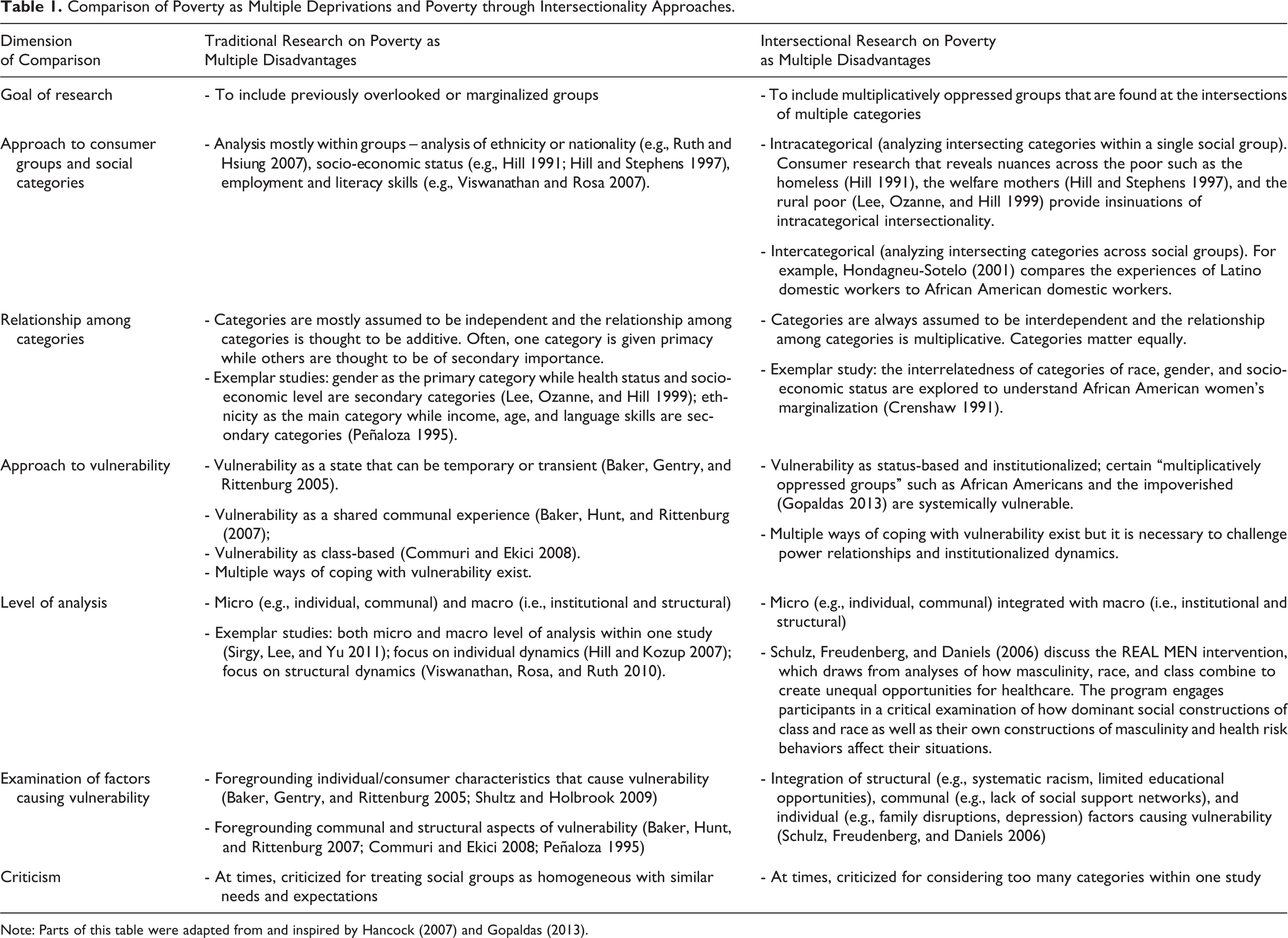
Note: Parts of this table were adapted from and inspired by Hancock (2007) and Gopaldas (2013).
A comprehensive approach to multiple intertwined dynamics affecting consumers’ lives is in line with Baker, Gentry, and Rittenburg’s (2005), Hill’s (2001), and Peñaloza’s (1995) work. In this research stream, vulnerability is viewed as a complex process arising from the interaction of individual characteristics/states and external conditions. Shultz and Holbrook (2009) highlight the relevance of an approach that recognizes the systemic nature of vulnerability, yet their model foregrounds individual factors. In an intersectionality approach, analysis of consumer vulnerability goes beyond consumers’ idiographic experiences and the temporary or state-based nature of vulnerability (Baker, Gentry, and Rittenburg 2005). As such, a more systemic and group-based vulnerability is emphasized (Commuri and Ekici 2008). Moreover, intersectionality takes a broader approach and considers the intertwined economic, social, cultural, and political contexts in which individual and external conditions interact. For example, in a health intervention program (REAL MEN) designed to help young men leaving jail to adapt to community life, researchers and healthcare professionals explored how social constructions of masculinity, race, and class intersect to create unequal life opportunities (Schulz, Freudenberg, and Daniels 2006). As a result, the interventions designed effectively addressed the life situations of the participants at multiple levels. The participants were linked to high school, GED, literacy, and job readiness programs, as well as local substance abuse and physical and mental health programs in their communities.
Methodology
Context of the Study
We explore the intersection of multiple identity categories of the poor (e.g., employment, health status, housing) in a mobile home park in the Southeast U.S. Mobile homes emerged as low-cost opportunities for transient blue-collar workers and veteran families to realize the American Dream of home ownership. However, since the 1960s, this form of housing has largely been at the center of social stigmatization (Wallis 1991). As a housing form, mobile homes sometimes refer to vacation homes preferred by the retirees and trailers used by seasonal workers (Wallis 1991). The trailer park for this study exemplifies the typical low-income marginalized mobile home park community inhabited by people who struggle to make ends meet.
Even though distinct in many ways, our trailer park community bears some resemblance to traditional subsistence contexts. For example, all of our informants struggle to secure their most basic needs such as food, healthcare, transportation, and education (Viswanathan, Rosa, and Ruth 2010), some have limited literacy skills (Viswanathan and Rosa 2007), and many of them are physically and psychologically vulnerable.
The trailer park community is a particularly informative context for exploring the overlapping disadvantages that marginalize the American working poor. In addition to economic deprivation and poor health, most of our trailer park residents face multiple degrading categorizations. For example, while most people have sympathy for the poor, conservative and even some liberal (meaning left-leaning in the U.S.) political agendas are guided by negative stereotypes of the poor as lazy, deviant, and irresponsible individuals. Additionally, low-income mobile home communities are generally socially and spatially segregated due to prevalent negative stereotypes (“trailer trash”) and zoning regulations to preserve the neighboring land value (MacTavish 2007).
Data Collection
We conducted 40 in-depth interviews with 24 mobile home park residents (see Table 2). Interviews took place at the informants’ homes and lasted between 1 to 1.5 hours. The informants were offered $20 per interview for their participation. All interviews were recorded using a digital tape recorder and transcribed by a professional transcriber. The interview data were analyzed through a hermeneutical approach, which allows for analytical categories and themes to emerge, evolve, and expand (Thompson 1997). This evolving interpretation proceeded through moving back and forth between the data and the literature to identify themes, categories, and patterns within and across informants’ narratives.
Informant Characteristics.

Findings
We present our findings in two sections. The first section is macro oriented; it highlights the structural inequalities and their converging effects on our informants. The second section is an analysis of more micro level processes, focusing on social interactions and resulting vulnerabilities.
Intersecting Structural Disadvantages
Structural inequalities are linked to institutional, systemic factors that sustain marginalization of disadvantaged groups. These inequalities often contribute to the perpetuation of various disadvantages such as lack of employment, inadequate healthcare, lack of affordable housing, and political disempowerment (Newman and Chen 2007; Shipler 2004).
Our informants cite several intersecting structural dynamics that contribute to their marginalization. Here, the lived experiences of poverty are invested with ideological meanings and the resulting deprivations are perceived as the outcome of structural failings (Newman and Chen 2007). We examine the overlapping systemic inequalities within the healthcare, financial, and welfare systems.
Healthcare system
The systemic disparities between the health care received by the wealthy versus by the poor in the United States have been documented in previous studies (Sirgy, Lee, and Yu 2011). The poor are disadvantaged in the healthcare system for many reasons, including lack of literacy skills and social class standing (Newman and Chen 2007).
Poor health and lack of access to adequate healthcare is perhaps one of the most significant disadvantages experienced by the informants. Our findings highlight that the healthcare inequality is even evident within the same social class of working poor. Furthermore, based on our informant’s account below, the patterns of practice in the healthcare system can perpetuate vulnerabilities, especially in the cases of patients with deep financial constrains: People without insurance are treated different…Let’s say I went in for cancer. Had to get a lump removed, that’s what I went in for. I have insurance; I pay all my co-pay’s and stuff, they take care of me. Let’s say my neighbor across the road here, he don’t have insurance. If he went to the doctor for the same lump that I have, the doctor would say that it’s fine until it gets bigger…So he wouldn’t get the surgery whereas I did. I’ve seen people die sitting there waiting for the treatment because they can’t afford it. (Matt)
Health-related disadvantages are perpetuated by other disadvantages such as economic deprivation, lack of employment, and unjust treatment in the workplace. Irene discusses her experience of a work-related physical injury. At her workplace, she fell, passed out, and broke her shoulder. However, she was denied worker’s compensation because she could not prove whether her injury was related to her falling and passing out or passing out first and then falling. Thus, she became disabled and dependent on her daughter. Irene attributes her economic and social vulnerability to the dynamics of the healthcare and legal system and feels her hard work has not been reciprocated: “I’ve been working public work since I was 14 and get turned down for every program out there.” Her vulnerability in one domain becomes contingent upon and at times exacerbates her vulnerability in another domain. She talks about her vicious circle of unemployment, resulting financial deprivation, and dependency: she has injured her arm and lost her job as well as her insurance. Hence, she cannot seek treatment [and therefore get a job], which concurrently leaves her out of the labor market, health system, as well as the financial system. I'd be working now. I mean I've had three people that would hire me if I can get my arm fixed, but I can't get my arm fixed. Until I get the arm fixed I can't work…I have no job, I have no income, I have no insurance, I have nothing of value to sell. I live with my daughter to have a place to stay and food to eat, you know, her and her husband are giving me that until I can get my shoulder fixed. (Irene)
The interconnected nature of structural vulnerabilities also resonates in John’s struggle with poor health and material deprivation. He describes how multiple stakeholders within the healthcare system (i.e., social security services, the insurance company, his healthcare provider) started a dispute, while his disability was advancing: “They are just arguing now over who is going to pay me and who is not. So, no one is focusing on my problem to get it taken care of. ”
Financial system
The financial system also plays a substantial role in the marginalization of underprivileged individuals and already disadvantaged communities. Predatory lending practices target vulnerable groups such as the elderly, impoverished, and minorities (Hill and Kozup 2007). The lack of access to financial services (e.g., credit and checking accounts) highlights the restricted choices available to the poor. Below, an informant offers an account of how his lack of access to resources perpetuates his financial deprivation. We don't have the luxury of accountants that write our bills for us or our lawyers that take care of things when they don't go right. So, we have to suffer with whatever the credit companies deliver upon us. (John)
Welfare system
Welfare programs operate based on demonstrable level of need, often with stringent eligibility criteria and close monitoring of “cheats” in the system (Hill and Stephens 1997). Beneficiaries of the welfare system are often frustrated with service providers and delays in receiving resources and some exit social services prematurely (Shipler 2004). As a case in point, Sharon explains how her family was denied government assistance in the form of food stamps because her husband’s income was $1/hour above the qualification cutoff: “They make up their mind and they send you your letter and you can appeal, but what are you going to appeal? A dollar an hour? I mean are you going to appeal a dollar?”
Hancock (2004) examines the public identities of welfare beneficiaries from an intersectionality viewpoint and highlights the categorization of social groups around large entities such as class and ethnicity as well as unfair moral judgments ascribed to groups that are the beneficiaries of welfare programs (e.g., “welfare queens”). These multiple identities and associated stigmas serve as ideological justification for specific policy agendas (e.g., Personal Responsibility and Work Opportunities Act of 1996; Hancock 2004). The welfare regulation trend toward “the criminalization of poverty” (Gustafson 2009) entangles welfare dependence with criminality and these converging labels are reflected in the interwoven welfare and criminal justice systems. Our informants voice their perceptions of the welfare system as degrading and dehumanizing: They look at you like you're asking for their blood.…Like you're a bum off the street regardless of whether you're a working person…You know, you can tell when somebody looks at you with disgust. (Irene)
In addition, the park residents complain about the difficulty of navigating the welfare domain due to the perceived irrationality and complexity of the process that varies from state to state. The stringent welfare criteria make one informant feel like she is facing an irrational system that seems extremely difficult to navigate. It's like, you've got a sheet of paper and you open it up and there are questions on here. It would cover this table, questions, questions…In Colorado, when you went to try and get food stamps, you didn't go to welfare. You went to the agriculture department. They determined your eligibility and they didn't ask all these stupid questions. What you owned outside of there, they didn't care about…you know, you can't eat a car. (Deborah)
Coping with Structural Disadvantages
An intersectional perspective also helps explore multiple ways of coping with inequalities. One common coping tactic found in other traditional subsistence settings is to form and rely on social networks (Weidner, Rosa, and Viswanathan 2010) and microenterprises (Viswanathan, Rosa, and Ruth 2010). The strong social ties in subsistence marketplaces in less-developed countries provide a way of coping with structural disadvantages. However, our informants resort to more micro-level and unorganized coping tactics. For instance, Anita chooses to “work the system” by sending her friends to different food banks in the town to get around the rule that limits such visits to once a month. Likewise, Emma engages in “false compliance” (Scott 1985) to manage her child support payments. After being forced to give the custody of her children to her mother due to her past drug addiction, Emma explains how she “keeps them [the welfare staff] quiet” by acting like a compliant citizen. I signed away my rights because I couldn't take care of my kids and I don't feel I should have to pay to take care of kids that I signed away my rights to. Plus, I give them money all the time and mom, it's not mom that wants the child support, it’s where she gets the check from the state on the kids called TANF, so it's the state that issued me to pay child support, it’s not her, but I think that’s not fair…So, I paid like $20 a week [in child support]. But that equals out to $100 a month when I'm supposed to be paying $249. But it keeps them quiet. (Emma)
Emma also attends community picnics organized by a volunteer organization at the park to secure food for herself, boyfriend, and her dog. Other informants who have not yet engaged in similar acts of defiance think that “cheating” and “lying” might be the only feasible ways to get their needs met. As she expresses her anger towards the welfare system that denied her compensation after a job-related injury, Irene wishes she had lied. I couldn't lie. I could have went in and lied to them, you know, lied to the people at workman's comp hearing and said this is what happened, and I could have gotten disability, but I didn't know to lie. I was telling the truth. I thought if you told the truth, you know, good things are supposed to happen. It's better to lie…this country evidently runs on lies. Four dollars a gallon for a gallon of gas? How is a regular person going to live in this country without lying about everything? (Irene)
Irene’s excerpt above nicely articulates the interconnected nature of disadvantages (i.e., financial deprivation, poor health, unjust treatment within the welfare system). At a more ideological level, the desire for fairer and more comprehensive public policies is expressed by Matt who criticizes the government for “rebuilding other countries at the expense of taking care of American people.” Offering macro level solutions, Matt articulates: We’re not responsible for every life on this earth, but we are responsible for the lives in this country and feed the children. We've got kids in this country that are under nourished, that are misfed, and you go to apply for assistance, and you make too much money because you make $6.00 an hour and you've got seven people in your family. You don't qualify for anything. It should be a program in this country to help every person here before we go somewhere else and help somebody else…(Matt)
Our informants rely on what we term as “linguistic tricks” (e.g., sarcasm, irony, cynicism). These individual tactics act as “everyday forms of resistance” or “weapons of the weak” (Scott 1985) that help subsistence consumers preserve their dignity within a system perceived as “messed up.” For example, Irene becomes sarcastic when she interacts with the bill collector. So, the bill collector called today and wanted to know, well, didn't I have somewhere else I could get money from? You know, will you loan me the money to pay my bills? That's what I asked him. I don't have money, my friends are not rich people…I ain't borrowing no money. I just say, look, we can handle it one of two ways. You can either quit harassing me until I get back to work and get you paid or you can call my other bill collectors and you all can start calling each other and start paying each other. (Irene)
Although these linguistic tricks do not have the impact of organized forms of resistance (e.g., protests, strikes), they have a therapeutic function when the informants feel hopeless. This is in line with the notion that while subsistence consumers lack economic and material resources, they rely on a rich repertoire of emotional coping strategies (Viswanathan and Rosa 2007).
Intersecting Relational Disadvantages
Here, we examine the vulnerabilities of our informants at a micro level, focusing on the dynamics of social interactions. Our informants experience social stigmatization within multiple domains and some cope with it through drinking and substance abuse. As a case in point, one informant explains how her addiction was fueled by the stigma of being poor, while poignantly, becoming her primary mechanism for coping with poverty. It’s hard to be poor and it's [referring to her drug abuse] just a way of dealing with it, you know, so you don't have to think about it and think about what other people think and, you know, how people perceive you because if you're high you really don't care. (Velma)
Another common social stigma experienced by our informants is related to their substandard housing. Spatially segregated to the outskirts of towns, trailer homes are generally perceived as challenge to the American housing standards and aesthetics norms (Wallis 1991). As Emily states: “people look down upon you because it’s a trailer. Lots of people they are ashamed to say that they live in this park because people, you know, they look down upon you when you do.” Our informants discuss degrading labels used to refer to people who live in trailer parks, as Anita says, “They call us trailer trash, didn’t you know?” However, most of our informants do not seem to be bothered with this degrading portrayal of trailer homes; they cite affordability as the main reason for living in the park. Here, the intersecting nature of poverty related disadvantages is once again highlighted by our informants who point to the lack of affordable housing as a structural problem while they also experience the social stigma of living in a trailer park: “you can’t afford to live in this country if you don’t have something like this [referring to her trailer home]” (Irene).
Other intersecting social stigmas include negative social stereotyping such as disparaging the poor’s intellectual capabilities, suspecting their morality, and discounting possibilities of upward mobility: “Automatically when you talk about a trailer park, people think about poor people, trashy people, drugs, crime, this and that,” says Tim.
Stigmatization of the trailer park community interacts with other forms of marginalization. For instance, racial and social class stigmatizations intersect in shaping teacher-student interactions. Morris (2005) demonstrates the ways in which teachers connect parents' reliance on public assistance and living condition (i.e., cheaper forms of living such as trailer park or low income housing projects) to students' lack of motivation. Similarly, our informant Samantha explains how her children are treated differently by teachers and school representatives: “some of the kids who don't come from a wealthy family get treated a lot different than the kids who do come from money.” Likewise, Sharon describes the discriminatory treatment her son receives at school. They had one professor's child…and he would act up all day long in the class. Now when James [her son] gets in trouble in school, the minute he does something they call home. James is not doing this; he's not doing that, whatever. This little boy [referring to the professor’s child], they took him downtown and bought him ice cream because he would not behave in school. (Sharon)
The social disadvantages experienced within the educational domain also affect some of our adult informants and perpetuate other disadvantages. For instance, Wanda, who is now in her 50s, started school at a relatively older age yet quit at third grade when she was 17 years-old because she was “picked on by the kids at the school…and the principal told [her] to go buy me a bunch of books and read and quit school.” Here, the negative social stigmatization exacerbates other deprivations such as lack of education, low literacy, and lack of a steady employment that might have been achieved through schooling.
Coping with Relational Disadvantages
Our informants exercise critical thinking and offer an integrated account of how social spheres are indeed interrelated. The perceived lack of accountability and responsibility in many social domains is emphasized by Irene who tries to make sense of the disadvantaged treatment her grandchildren receive at school: Instead of correcting that child [referring to the professor’s child mentioned above], they took him downtown and bought him ice cream so he would behave. You don't reward one and correct the others. If you're going to make a rule, it's got to apply to everybody or nobody…Nobody accepts responsibility, nobody is accountable for what they do or don’t do. And then you wonder why there are trailer parks. (Irene)
A few informants are trying to get out of the park to secure more desirable housing. Engaging in home-based entrepreneurial activities is a way to gain fiscal agency in order to achieve this goal. For instance, Sharon makes photo albums and recipe cookbooks to sell to her friends and acquaintances. Emily makes and sells pocketbooks and helps people with their paperwork on their taxes and small businesses. However, these entrepreneurial activities do not turn into the communal micro-enterprises as in traditional subsistence contexts such as India (Viswanathan, Sridharan, Ritchie 2010), Latin America, and China (Weidner, Rosa, and Viswanathan 2010). Structural and cultural reasons might help explain this dissimilarity. In traditional subsistence markets, small business entrepreneurship often emerges out of necessity to earn the income for dire needs of sustenance and shelter. Local traditions put women at a disadvantage securing jobs in factories or finding other job opportunities. As a result, the majority of these entrepreneurs are women who are burdened with the responsibility to maintain their families while possibly getting minimal to no support from their husbands (Viswanathan 2011; Viswanathan, Gajendiran and Venkatesan 2008). Lack of coordinated communal participation in the marketing system could be a discouraging factor for trailer park residents. The trailer park community is very heterogeneous in nature. Even though all of our informants are low-income, they have different conceptions of poverty and distinct needs. While their disadvantages are interconnected, the perceived importance of these disadvantages differ. Some informants prioritize their financial and material needs, yet others are more concerned about the social stigmatization they experience in the marketplace. Finally, there are clear moral boundaries among the community members. With the exception of a few informants, these individuals do not socialize with their neighbors and look down upon them because they believe they are morally superior than those “noisy, gossipy people,” “drug dealers,” and “junkies.” As such, park residents do not share a communal spirit that might help them form social networks and turn their home-based businesses into organized communal endeavors.
As they perceive their chances of getting out of the park is not very high, most of our informants feel like they are “stuck” and manage the social stigma of living in a trailer park through upward social comparison (Miller and Kaiser 2001). A lot of people that are living in $200,000 homes are starting to look at places like this to live because they are losing their home. I watch the news everyday. I watch it at two thirty in the morning, I watch it at seven o'clock at night, and it's the same thing, people are losing their homes everyday. (Velma)
Other times, upward social comparison is used to cope with the stigma attached to trailer parks as social zones used for illegal activities. While acknowledging the community problems, our informants highlight the similarities between the park and “rich neighborhoods.” …it does draw people that are troubled…they steal things, but as you read in the paper everyday you've got movie stars that didn't pay their taxes so what's the difference? You know, crime is a crime…There's drug dealers all throughout the town. They are in every apartment complex…They want to identify the trailer park as trailer park trash, that we keep nothing but drug dealers and lowlifes in here. That's not necessarily so. You can go right across through all of these fancy apartments over here. They are just more sophisticated, that's all. (John)
Discussion
Consumer researchers have long investigated multiple disadvantages that affect poor consumers, including low literacy (Viswanathan and Rosa 2007), ethnicity (Peñaloza 1995), gender and health status (Lee, Ozanne, and Hill 1999), and race (Crockett and Wallendorf 2004). Even though much evidence exists on the multiplicative disadvantages facing the poor, research that particularly focuses on the interplay of identity categories and communal/structural forces is still scant. Marketing researchers increasingly call for work designed to analyze multiple categories of difference and to shed light unto how oppression on one dimension is shaped by oppression on other dimensions (Crockett et al. 2011; Gopaldas 2013; Ozanne and Fischer 2012).
Our research contributes to this discussion by adopting an intersectionality perspective within a low-income neighborhood that shares some similarities with subsistence settings. We investigate the intersection of various identity categories such as socio-economic status, education level, health, employment, and geographical setting in a rural mobile home park in the U.S. In addition, we explore the intersection of these categories vis-à-vis relational and structural mechanisms (e.g., welfare system, healthcare, educational field, and workplace).
Implications for Research on Poverty and Subsistence Marketplaces
On one hand, the trailer park community is similar to traditional subsistence contexts: both types of settings are marked by extreme financial deprivation, psycho-social vulnerabilities, and social stigmatization. Yet, our findings reveal the heterogeneous nature of this neighborhood: distinct perceptions of poverty along with moral and social boundaries that exist among the residents present barriers to a shared communal spirit. As such, this community is different from the “densely networked social communities” (Viswanathan, Rosa, and Ruth 2010) where subsistence consumers turn their small-scale, home-based businesses into communal microenterprises and participate in the marketing system (Layton 2007).
The macro context in which the trailer park is located clearly diverges from traditional subsistence contexts as “1-to-1 interactional marketplaces” (Viswanathan, Sridharan, and Ritchie 2010). Unlike consumers in traditional subsistence marketplaces where many consumers are indeed “microenterprise operators” (Viswanathan, Rosa, and Ruth 2010), our trailer park residents do not live in the context of an informal microenterprise economy. Moreover, the financial and healthcare systems are becoming ever more demanding in terms of consumer knowledge, skills and involvement in an advanced economy like the U.S. (Viswanathan 2011). Accordingly, we show that it becomes particularly challenging for the marginalized to navigate these systems that are based on the assumption that it is the consumers’ responsibility to take care of their own medical and financial well-being.
Lastly, we find multiple perceptions of vulnerability even within a geographically bounded community of a trailer park. Lakeside community has preexisting characteristics and conditions (e.g., substandard housing, social stigmatization, poor health, low income) that affect the type and level of vulnerability experienced as a social group. Like Baker, Hunt, and Rittenburg’s (2007) work within a community after a natural disaster, our study reveals multiple collective forms of vulnerability. We propose an expansion of this collective understanding of vulnerability by investigating communal characteristics vis-à-vis structural mechanisms.
Future research might benefit from further investigation of the subjective and local nuances within subsistence markets (Weidner, Rosa, and Viswanathan 2010). Intersectionality can offer valuable guidance into the nuances across subgroups (e.g., different groups within the same social class or ethnicity).
Implications of Intersectionality for Macromarketing and Public Policy
Macromarketers call for contributions that help guide the creation of an environment that nurtures fair exchanges for all (Kotler, Roberto, and Leisner 2006). A fundamental obstacle in the way of a fair system is the inequitable distribution of resources and lack of access to fundamental needs such as healthcare and housing. In order to evaluate justice (or lack thereof), it is necessary to investigate multiple structural dimensions and social relational patterns that shape power and resource distribution.
Exploring multiple experiences of marginalization through an intersectional lens is particularly helpful from a macromarketing perspective as this approach is relevant to quality-of-life and distributive justice issues (Hill 2005; Layton and Grossbart 2006). We point at the need for just and fair public policies and intervention programs in order to alleviate the burden of intersecting structural vulnerabilities. Many social policy oriented practices overlook the intersecting nature of marginalization. For instance, within the United Nations system, discrete mechanisms are developed for addressing gender and race discrimination separately, such as the Conventions on the Elimination of all Forms of Racial Discrimination and all Forms of Discrimination Against Women (UNTC, 2013).
At the policy level, categorical boundaries are often rigid and consistently enforced in the larger systems (e.g., welfare, financial), reinforcing an “Oppression Olympics” (Gopaldas 2013). This results in social groups competing for the title of the “most oppressed” and the accompanying support and benefits. Researchers as well as policy makers should recognize that the traditionally used categorizations of social groups (e.g., class, income, health) are hardly separate entities operating independently of one another. Instead of assuming clear-cut boundaries of oppression and supporting one single group (e.g., marginally poor, women), policy makers and advocacy groups should identify their common target groups and collaborate for their well-being (e.g., identifying the needs of marginally poor women).
Footnotes
Declaration of Conflicting Interests
The author(s) declared no potential conflicts of interest with respect to the research, authorship, and/or publication of this article.
Funding
The author(s) disclosed receipt of the following financial support for the research, authorship, and/or publication of this article: ACR/Sheth Foundation Dissertation Grant Award (winner in the second place in public purpose category), 2008; AMA Marketing and Society Dissertation Award, 2009.