



Abstract
Two recent books, both by journalists, expose major weaknesses in marketing because of what is ignored in the standard treatment. The marketing story tends to end with the purchase of a good or service. But what is bought is eventually discarded and what happens when goods are thrown away is part of the marketing system, too. This part of the system is largely ignored. How much we actually throw away is alarming, mostly because we are unaware of it. Some of it enters the global recycling industry, but the vast majority goes into the trash sector. It may or may not actually get land filled. It may just float around in the oceans. We did not get to where we are by accident. Marketing and marketers helped in a big way. Macromarketers must help us understand the predicament we are in, and then help get us out of it.
“The American dream is to turn goods into trash as fast as possible.”
Introduction
I recently read two disturbing books: Adam Minter’s Junkyard Planet (2013) 1 and Edward Humes’ Garbology (2012). As books they join the likes of Strasser (2000), Royte (2005), Zimring (2005), and Rogers (2006). Both Junkyard Planet and Garbology are about what we buy and, eventually, throw away. The emphasis is on where it goes when we throw it away: into the global recycling industry (Minter) or into landfills or freely floating in our oceans (Humes). Both books are also about sustainability. Alone, each tells half the story; together they get close to the whole story, a story ignored by our 600+ page marketing textbooks. We should be ashamed of our textbook writers! Adopting either or both of these books in our principals of marketing or marketing management courses would serve our students well by telling them, as the late American newscaster Paul Harvey used to say, “the rest of the story.”
How Much Do We Throw Away and Where Do We Throw It?
Let’s get a grip on how much trash America generates and how much gets recycled? Minter provides the following data (some of the extensions are mine). 2 In 1960 Americans diverted 5.6 million tons of household and workplace waste away from landfills. By 2010 that number had increased to 65 million tons. That is a huge increase—about 1000 percent. There was also a sizable population increase in the United States during that period, something Minter does not mention. The population of the U.S. grew between 1960 and 2010 from 180.7 million to 309.3 million, a 71.2 percent increase. It stands to reason that more people will recycle more stuff, so the per capita figures are important. On a per capita basis we diverted 62 pounds per person away from landfills in 1960 and 420.3 pounds per person in 2010. That is a 578 percent increase in per capita recycling, still a significant increase. As we all know, however, any increase represents a large percentage gain when you begin with a small base.
In 1960 I was a high school student in Denver, Colorado. I don't remember using or hearing the word “recycle”. The container in our house, into which we put our trash, was, in fact, referred to as a waste-paper basket! Paper was not recycled; it was burned or put in the trash. We did not do much recycling of anything. In fact, I only recall two instances.
First, our elementary school held an annual paper drive, and everybody understood that a paper-drive was for newspapers (which people actually read back then). Each homeroom had a designated space by the schoolyard fence. On the day of the paper drive parents would help their children bring bundles of newspapers (appropriately tied to protect them from the wind) and pile them up by the fence. It was a contest to see which homeroom would collect the most. I have no memory as to what was at stake, other than bragging rights.
The second memory I have is of occasions when we filled up the back of our father's pickup truck with the accumulation of grass clippings, ash from the incinerator (which most houses had and where waste paper was burned), and discarded steel cans and glass containers like mayonnaise jars (but these, too, were often reused as canning jars). We would then drive the pickup truck to the county dump. We used rakes and shovels to simply push the trash over the edge of the truck bed. We would then drive home with the tailgate open so the wind could blow away what remained. People without access to a truck would empty their incinerator into a steel can (something like a 25 gallon galvanized can) and put it out, along side the steel (we called them tin) cans, for pick up by the trash truck that drove either down the alley or down the street each week.
I remember on at least one occasion dad dropped off an old car battery at the entrance to the dump. He told me that old car batteries were full of lead and that the guy manning the entrance to the dump could sell it for the lead it contained. He was, in other words, recycling an old car battery.
Those are my two memories: paper drives and car batteries.
We reused some things. By “we” I mean everybody. Every household produced a certain amount of organic kitchen waste. That came with making coffee in the morning, peeling apples in the afternoon, and peeling carrots and potatoes at night. We called it garbage. As a boy one of my chores was to take the kitchen waste to the garbage pail in the back yard. The garbage pail was a five-gallon bucket, with a lid, that sat on top of a platform affixed to the top of the fence that surrounded the backyard. As I recall, two or three times a week a garbage truck would drive the alley and collect the garbage. The truck was a flatbed truck with short fences, or skirts, around it. And it stank; there was no mistaking when it came by. This, of course, went to the pig farms as slop for the pigs. Eventually piggeries went away. This was about the same time that garbage disposals began showing up in America’s kitchens, but the demise of piggeries had more to do with health issues than with new technologies. (Humes discusses the rise and fall of piggeries as a form of waste disposal in his book.) I still remember when dad bought an electric disposal for mom. It must have been around 1958.
Glass bottles were mostly reused rather than recycled or discarded. Soda bottles went back to the grocery store, which, in turn, sent them back to the bottlers who washed them, refilled them, and resold them as soda pop. The soda bottles had deposits on them. My sister recalls it was two cents for each bottle. A neighbor at the time (with whom I am still in contact) tells me he remembers it was a nickel or a dime. Which ever it was, the deposit was paid when the soda was bought and refunded when the bottles were returned. Whether two, five or ten cents, it was enough to keep most of them out of the trash. (In the mid-1950s candy bars were five cents.)
Milk bottles were also returned and reused. We would put the empty milk bottles in a milk box. Many families—and maybe most—got their milk by home delivery a couple of times a week. (There were bread delivery trucks, too, but they are not part of this story.) Houses built in the 1940s and 1950s included pass-through milk doors about a foot square. Today these would be open invitations for burglary! I know because when my sister and I locked ourselves out of the house I would crawl through the milk shoot to get inside and unlock the door. Other homes had a box with a lid on the porch. The milkman would collect the bottles when he left the nice cold, cream-topped milk. (By the way, this is the origin of the expression “skim-the-cream pricing.” Most students today are clueless as to where the expression comes from because they have never seen a bottle of milk with cream floating on top.) The milkman would take the bottles back to the dairy for washing and refilling. They would then be redelivered, another day to perhaps another family, full of milk.
My point is that there was not much household recycling going on at the time. Consequently, any increase in recycling between 1960 and 2010 would be a significant, even huge, percentage increase. The 578 percent increase is huge.
For the volume of non-recycling waste generated (the trash) in 1960 and 2010, Minter’s data do not indicate anything like the increases for recycling. That is because they begin with a higher base. Even with that, the amount of waste generated tripled between 1960 and 2010. As Minter says, “Americans were doing a better job of recycling their waste, but they were also doing an equally fine job of generating it” (pp. 6-7).
Humes, like Minter, discusses the quantity of material we throw away. “Americans make more trash than anyone else on the planet, throwing away about 7.1 pounds per person per day, 365 days a year” (p. 4). Humes converts this into something we can grasp. “Across a lifetime,” he writes, “we are each on track to generate 102 tons of trash” (p. 4). How much is 102 tons of trash? “Each of our bodies may occupy only one cemetery plot when we’re done with this world, but a single person’s 102-ton trash legacy will require the equivalent of 1,100 graves” (p. 4). Wrap your brain around that!
Another way to visualize the amount of trash we generate is to consider all the big trucks we see on our highways and by ways. You know, the trucks that haul and deliver mail, haul and deliver furniture, haul and deliver packages, and, of course, those that pick up the trash. Now imagine this: “One out of every six big trucks in the U.S. is a garbage truck” (p. 6). Seventeen percent of the U.S. truck fleet is devoted to hauling away our trash (see Figure 1)! The yearly loads of these trucks would “fill a line of trucks stretching halfway to the moon” (pp. 6-7). And to bring it home to a contemporary concern, “The creation of products and packaging that end up in those trucks contributes 44 percent of the greenhouse gas emissions that drive global warming, more than any other carbon-spewing category” (p. 7).
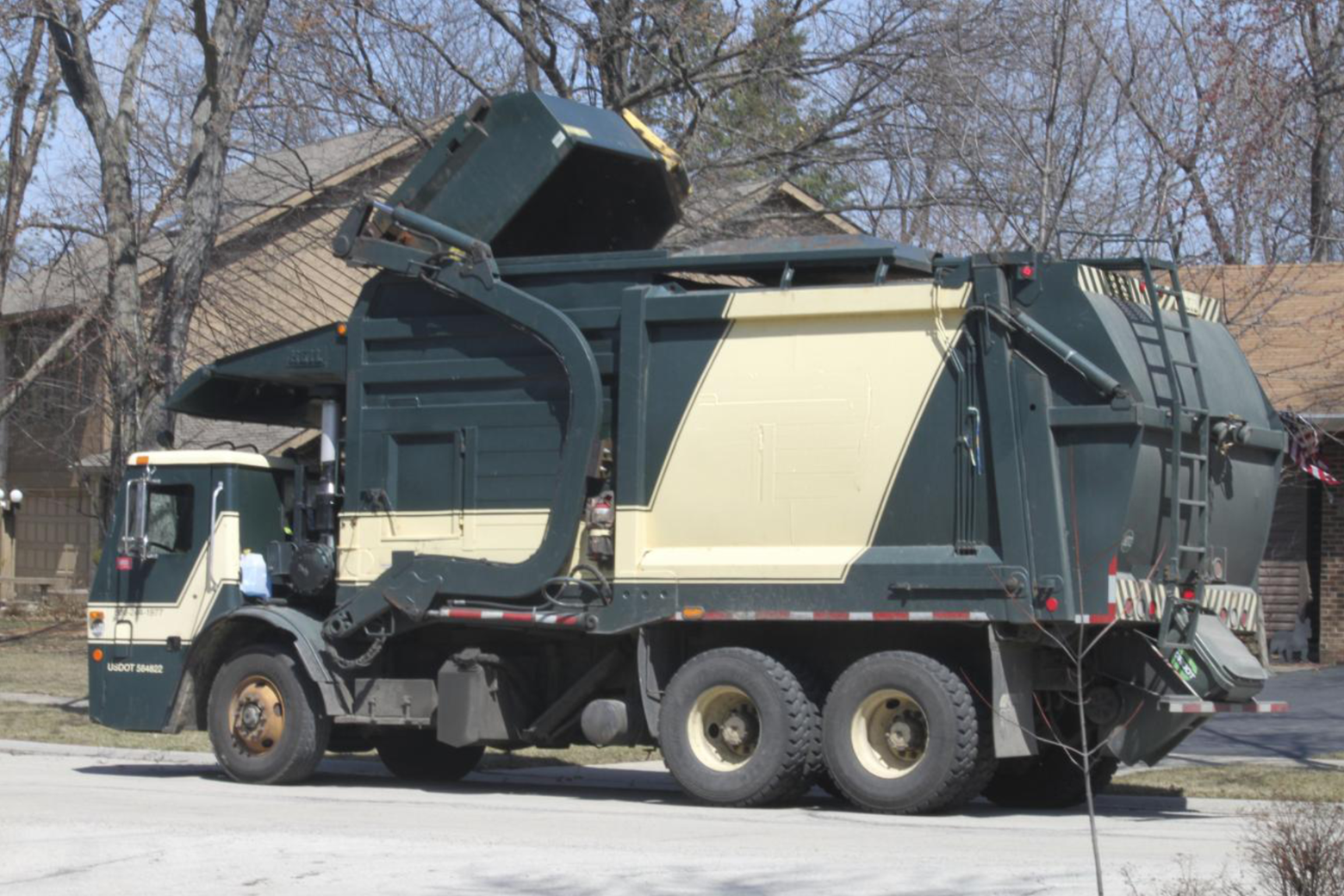
One out of every six big trucks in the U.S. is a garbage truck.
Still another way to visualize trash is financially. In 2011 New York City spent more than $300 million “just transporting its citizens’ trash by train and truck—12,000 tons a day—to out-of-state landfills” (p. 7). How much is 12,000 tons? It is equivalent to “sixty-two Boeing 747 jumbo jets,” or “8,730 new Honda Civics” (p. 7). And that is per day. Annually the haul equates to 22,000 Boeing 747s and more than three million Honda Civics. That is more Hondas then households in New York City that own cars (NYCEDC 2012), and fifteen times more 747s than have ever been built (Boeing 2014).
Humes provides more data than does Minter. He has charts indicating where the trash goes (landfills, recycling/composting, waste-to-energy) regionally in the U.S. and internationally by country. He has charts indicating trash content by product category and by type of material—both before and after recycling and composting in taken into account. He has a chart illustrating the evolution of waste in the U.S. from 1900 to 2000.
Even with all this data it is hard to visualize how much American’s consume and, eventually, throw away. A documentary produced by National Geographic (2008), “Human Footprint,” helps. It is an hour and a half long visual assault on the senses, a truly amazing experience by itself. And best of all, it can we watched, online, for free.
Junkyard Planet
Minter tells the story of his own life. In a way, Junkyard Planet is as much a travelogue (as suggested by the subtitle itself: Travels in the Billion-Dollar Trash Trade) and a memoir (it is about his travels in the trash trade) as it is an account of the global recycling and reuse industry—what we properly call reverse channels of distribution. Minter also tells the life stories of many of the scrap dealers he knows in China and the Chinese scrap buyers with whom he traveled the highways and byways of the U.S. looking for scrap to buy. He tells how scrappers buy scrap and how these traveling buyers buy it from the scrap yards. The story is clear: the scrap industry is a large industry and one that works more or less backwards. Scrap is easy to sell because there is such a demand for it. It is hard to buy. In fact, Minter says, there is an axiom in the industry: “it’s hard to buy scrap, and easy to sell it” (p. 59). He also points out that scrappers make their money buying it rather than selling it. This reminded me of a 1973 Kotler and Levy article in the Journal of Marketing: “Buying is Marketing, Too!”
Junkyard Planet is a detailed account of an unseen marketing system, the kind of detailed study that the likes of Louis D.H. Weld and other early marketing scholars produced. As Tadajewski put it, early marketing scholars followed “products from their point of production and manufacture, all the way through to their distribution to the ultimate consumer” (2009, p. 17; see, also, Jones and Monieson 1990). In the present case, however, we are moving from the ultimate consumer backwards to the creation of raw materials. We need more studies like this, and not just of the scrap business, but of all businesses. As a discipline, we have become so focused on consumer behavior and selling/marketing to the ultimate consumer that we often lack a full understanding of the entire marketing system, including the reverse channels of distribution.
Minter focuses on scrap metal because he is the son and grandson of American scrap yard owners. The family scrap yard, which his grandfather began, still operates in Minneapolis. Both the family scrap yard, for which he holds fond childhood memories, and the industry inform his outlook on life “in fundamental ways” (p. 10). While he did not pursue the junk business, neither did he fall far from the tree. As a journalist he covers the Asian scrap trade for two important periodicals in the global scrap business, Scrap and Recycling International. (Junkyard Planet is Minter’s first book.) This and his decision a decade ago to move to China give him unprecedented access to what he admits, in several places, is a rather shadowy business.
Minter is open about his love for what his grandmother called “the junk business.” He tells the family history, a history of which he is proud. It is also a history that gives a great deal of insight as to how the scrap business is run. Is it all rosy? No, of course not. “Believe me,” he writes, “I’m aware of the industry’s faults…But for all of its problems—and they are rife—the world would be a dirtier and less interesting place without junkyards” (p. 11).
Since Junkyard Planet is largely a travelogue, understanding the structure of the book is difficult. Eventually I realized that he took, as he says, “the well-known pyramid that every American schoolchild learns: reduce, reuse, recycle” (p. 6) and treated each element in reverse order. He spends most of his time discussing the global recycling industry, and there primarily metal recycling although he does devote a chapter to plastics, a chapter to e-waste, and mentions paper. From recycling he moves on to reuse—the reuse of electric motors, circuit boards, computer chips, and peripherals like monitor and printers. He eventually touches on reduce; he says it is the only real solution to the problem of waste before dismissing it as a solution. “Alas,” he writes, “most people have very little interest in reducing their consumption or reusing their goods” (p. 6). That is why recycling is the “worst best solution” (p. 6).
Minter contextualizes his argument as part of the economic development process. He also contextualizes it as an alternative to dumping our trash in landfills. Hence, he presents the global trade in recyclables as a sustainable business, one driven by entrepreneurs who have “a talent for spotting value in what others throw away” (p. 5). As far as Minter is concerned, the global trade in recyclables will continue, even if it is, as he writes, “the third-best option” available (p. 6).
Minter takes on the issue of dumping. Ever since Packet and Smith (2003) there has been a general presumption that the West dumps its trash on less developed countries—mostly unsuspecting Asians and, today, mostly on the Chinese. They then work in horrid conditions at low wages to process it. Make no mistake, he is clear that the working conditions are horrid (but not as bad as the alternative), and the wages are low (but not as low as the alternative). For these reasons we are not dumping our waste on anybody. Instead, Minter argues, the Chinese see value in what we throw away and not only do they want it, but they need it (especially the metal). By the way, the alternative is always presented as one of returning to rural villages, and he does not present that as much of an alternative. He writes, “rather than spending days sorting scrap for wages, villagers spend days in fields, picking crops for subsistence” (p. 75), adding, in villages “the best economic opportunity remains a life stuffing seeds into the ground for little more than subsistence wages” (p. 137). He is forthright: “Is one better than the other? I’ve never lived in either circumstance, so I’m not about to guess” (p. 75). He will not guess, but he certainly has an opinion.
Minter argues that the global trade in recyclables is absolutely necessary; it is a fundamental part of the globalized world economy. It is, in fact, part of the process of economic development, itself. He makes his case by suggesting that trade in recyclables is not a new phenomenon, but a very old one. He illustrates his point by telling the story of how the U.S. developed by importing some of England’s waste.
Any country striving to develop economically, he writes, uses, to some degree, other peoples’ trash to do so. America did it and China does it. To make his point, Minter presents two short historical vignettes of the U.S. developmental path—one about rags and the other about rails. They are both interesting stories and, frankly, ones I never encountered before reading them here.
In the early 1800s, mechanized papermaking arrived in the U.S. There was a big market for paper, too. Americans were increasingly educated and were reading more newspapers and books, and writing more letters. At the time the primary raw material from which paper was made was old rags—mostly linen. They provided high-quality and low-cost pulp. But Americans could not save enough rags to meet the demand for printed material. So, as Minter puts it, “America’s enterprising papermakers—and entrepreneurial rag traders—made a very contemporary choice: they…looked abroad to the more wasteful economies of Europe for their raw materials” (p. 79). In 1850 Americans imported 98 million pounds of scrap rags from Europe. By 1875 we imported 123 million pounds, mostly from England. And sticking with one of his themes, “nobody in nineteenth- or early twentieth-century North America railed against the Victorians for ‘dumping’ their ‘waste’ on the still-developing economies of the former colonies” (p. 80).
We have all heard about the expansion of the railroad system and the opening of the West but have we ever stopped to think where all the steel for those rails came from? “The U.S. … looked abroad to Europe…for raw materials. … U.S. imports of scrap iron and steel grew from 38,580 tons in 1884 to 380,744 tons in 1887” (p. 80). That was a ten-fold increase! It was not until the years leading up to World War I that we began to export steel scrap, initially to Europe and now mostly to China.
China, today, has a voracious appetite for all sorts of metal. Throughout Junkyard Planet Minter draws our attention to how much of our trash China really wants and uses. Just under a half of China’s copper supply is imported as scrap metal (p. 67) and, he points out elsewhere, as of 2012 China accounted for 43 percent of total global demand for copper. All the manufacturing going on in China, “whether of cars or reinforced steel for new shopping malls—is fed to a considerable degree by imported scrap metal” (p. 110). Most of the buildings Minter sees rising in the cities he visits, one of his hosts reminds him, “were wired with metal imported as scrap, and processed locally” (p. 140). It is not just metal: “China needs recycled plastics to make everything from cell phones to coffee cups” (p. 155). If we want to buy Chinese manufactured goods (and we do), then we have to sell them what we produce, and we produce trash like no other country in the world.
So it seems one of Minter’s main objectives is to convince us that, contrary to common opinion, we are not dumping our trash on other countries. They want it; they demand it; they use it. And they buy it! We shouldn’t feel bad about it. If we stopped exporting the tons of recyclable material we do, we would have to send it to landfills. The Chinese would still go after the resources they need for their own development. They would mine the metals they need and cut down the world’s remaining forests to get it. Now they mine America’s trash for it. Hence, the global junk business is a sustainable business. As Minter states in the introduction, and repeats at every opportunity, the thousands of factories in China today “need copper [to cite but one example] to make things like wires, power cords, and smart phones” (p. 2). Chinese factories “have a choice; they can use copper mined in far off, environmentally sensitive places like the Brazilian Amazon” or they can use copper “mined from imported Christmas tree lights” (p. 2).
There are many interesting histories spread throughout Junkyard Planet. Take the automobile as another example. In the U.S., junked automobiles were a big problem in the 1950s, 1960s, and into the 1970s. The problem was with those that we wrecked but especially, with those that we abandoned on the streets. You can drive the countryside today and look behind most any shed or barn and frequently find abandoned cars, trucks, and tractors. Why did we abandon them? Because most people did not know of any other way to get rid of them once they stopped running.
“In 1969,” Minter writes, “seventy thousand automobiles and trucks were abandoned by their owners on the streets of New York City. Some of them leaked gas and oil; some of them provided habitat for rats and mosquitoes; most were unsightly” (p. 162). The problem was not exclusive to New York City. It was a problem, he suggests, because “the American automobile industry (much less its customers) had never taken much responsibility for the afterlife of the products that it placed on the road” (p. 162). That comment, of course, could be said of virtually every industry and product category, a point Minter does not make but we should appreciate. Perhaps business leaders do not give much thought to the afterlife of the products they manufacture and distribute because we, as marketing educators, shamefully ignore it, too.
I grew up in Denver, Colorado. I remember that the urban landscape was full of wrecking yards (see Figure 2). They were everywhere. I also remember, in the late 1960s and early 1970s, that people were protesting and demanding these wrecking yards build huge fences around them so the wrecks could not be seen from the roadways. On February 10, 1970, according to Minter, President Nixon declared before Congress, “Few of America’s eyesores are so unsightly as its millions of junked automobiles” (p. 164). They were, indeed, an urban blight!
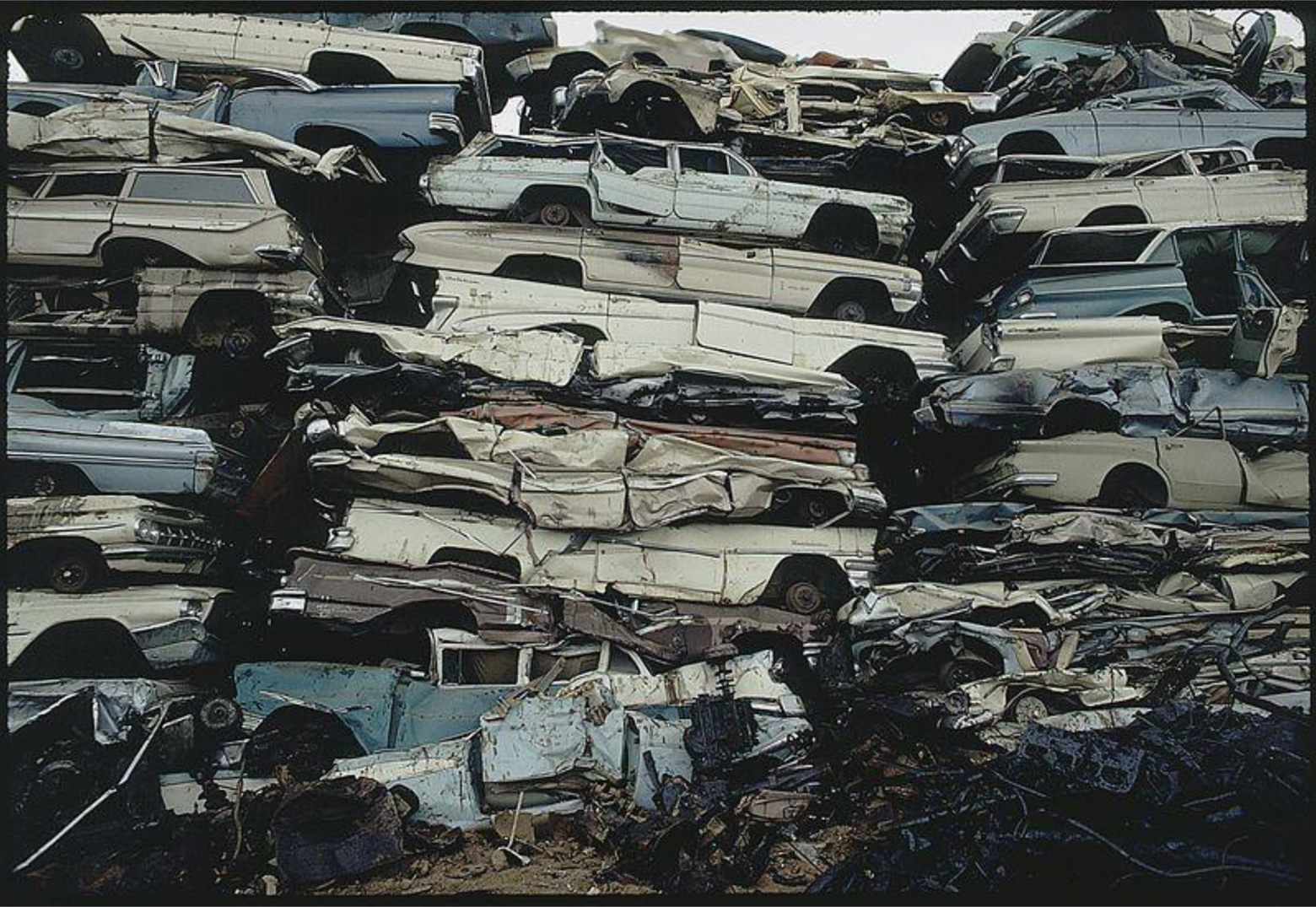
Pile of wrecked autos at Klean Steel Co., May 1972.
I have not thought about these automobile junkyards for a long time, mainly, I suppose, because I do not see them anymore. Where did they go? Those cars now provide the structural support for shopping malls and apartment houses—mostly in China. Somewhere around 2007 or 2008 the backlog had been cleared out. That is when, Minter writes, the “last scrap cars came out of the woods” (p. 176).
In the context of discussing junked automobiles, Minter tells the story of the invention of the metal shredder. Today, there are 300 of these beasts in North America (and from his description they are beasts) and another five hundred in the rest of the world. “The shredder,” he writes, “is…the best and really only solution to managing the biggest source of consumer waste in the world today: the roughly 14 million American automobiles that are junked annually” (p. 161). It was the crusher and the shredder, and the backhaul to China, that quietly and stealthily eliminated the auto junkyards.
Here is something Minter does not discuss and few of us have probably thought much. What do we do with retired, no longer serviceable airplanes? Several online videos describe the process (see, for example, National Geographic n.d.). What we do with old airplanes is not unlike what we do with old cars and lots of other metal (Science Discovery 2013).
The recycling industry is a sustainable industry, even if it is not about sustainability. Minter writes, “not every recycler is an environmentalist, and not every recycling facility is the sort of place you’d want to take kindergartners for a field trip” (p. 5). Recyclers are in the business because they want to make money, and they have a knack for spotting value in what others throw away. Minter has some reservations about it. It is a dirty industry, one full of health and safety issues for those working in it. This is especially the case in plastics recycling. Recycling businesses process the worst of what they import out of sight and mind of regulators. “Qingyuan,” a center for scrap recycling established in the mid-1980s, “was remote enough to avoid scrutiny from environmental authorities” (p. 133). He says that in Wen’an, a center for plastics recycling, he frequently saw “black spots” on the ground where, he was told, “unrecyclable plastics were burned in the night” (p. 145). Of Wen’an he notes the most striking feature is that “there is nothing green. It’s a dead zone” (p. 145). Twenty-five years ago it was “bucolic—an agricultural region renowned for its streams, peach trees, and simple, rolling landscape” (p. 146). So much for sustainability.
He discusses how environmental and safety equipment “is neither required nor available at the local equipment and chemical dealers (we checked)” (p. 148), and how the quality of some of the plastic made from some recycled trash is inferior and does not meet U.S. and European quality standards. “Only the Chinese, often manufacturers of last resort, will use that stuff,” he writes, which, when used to make plastic bags and the like, “are then passed off as safe for food packaging” (p. 149). After describing a processing facility that bathed shredded plastic in caustic cleaning fluid before rinsing and drying it, Minter notes: the excess trash and cleaning fluid is gathered up, and is either resold or tossed into a waste pit on the edge of town. Unless I’m missing something, or visiting on the wrong day, there is no safety equipment, no respirators, hard hats, or steel-toed boots, here; in fact, most of the workers—including Mr. Hu—wear sandals…this is bad (p. 150).
The recycling of plastics is a shadowy business. Unlike the multibillion-dollar trade in recyclable metals, plastics are traded in small lots. The American, European, and Japanese scrap-plastics exporters have no idea who recycles the material they export. [They] sell to brokers and other middlemen who sell to Chinese importers, often near ports, who then resell the scrap plastics to small traders of the sort that transport the plastics to Wen’an. Once they arrive at Wen’an, they’re sold again [to family enterprises] that will actually separate and recycle it (Minter 2013, p. 147 ).
Minter celebrates the entrepreneurial spirit that drives the junk business. “If my travels in global recycling have taught me anything,” he writes, “its that somebody in the developing world can usually find a use for what Americans can’t recycle profitably” (pp. 144-145). The business, itself, is “a profession for outsiders” such as immigrants (pp. 31-32). The immigrants can be from other countries (as was the case in the U.S.) or immigrants from rural areas (as is the case for China). Minter’s comment that his outlook on life reflects the family business and the industry is certainly tied up with the entrepreneurialism he sees in the junk business—an entrepreneurialism, as he discusses it, that is as much a product of circumstances as it is of opportunity—and the fact that his grandfather was an immigrant to the U.S. Minter would make Milton Friedman proud by the way he waxes over how the undirected market coordinates the global movement of trash, moving it from those that produce it (and see no value in it) to those that consume it (because they do see the value in it).
But most of all, Junkyard Planet is a book about how the scrap industry functions, told from an insiders point of view, from scavenging to buying, shipping, disassembling, refurbishing, reselling, and recycling. It is about channels of distribution; more precisely, it is about reverse channels of distribution, the most neglected—indeed, ignored—of all channels. Scrap is a $500 billion industry that employs more people than any industry in the world except agriculture. It is time we paid attention to it.
Garbology
If we add refuse to the well-known pyramid of reduce, reuse, and recycle we have Humes’ book. Humes, also a journalist, writes for the New York Times, the Los Angeles Times, Los Angeles Magazine, and Sierra. He has written several books on a variety of topics, all having something to do with social issues. Two of his most recent books touch on environmental topics: Eco Barons: The New Heroes of Environmental Activism (2010) and Force of Nature: The Unlikely Story of Wal-Mart’s Green Revolution (2011). To these add Garbology (2012).
Garbology’s theme is clear from its subtitle: Our Dirty Love Affair with Trash. His focus is on the amount of junk and trash we generate and on how much of it is not recycled. Each week we dutifully put our trash out for collection (see Figure 3). The trash truck then picks it up and takes it away. Actually, the trash truck comes by after the scavengers, who look for—and take—large pieces of metal. To most of us that is the end of the issue. The problem is solved—the trash went away. Humes suggests, as did Kirkpartrick Sale (1980, p. 243) so many years ago, “There’s one fundamental thing wrong with [a ‘throwaway’ society],…There is no ‘away’.” Our trash goes somewhere; most of us just don’t know where. “Away” is someplace and that someplace is the concern of Garbology.

Trash bins lined up for collection.
Humes does mention recycling. “Somehow,” he writes, “without ballot or poll or any explicit decision by presidents or legislators or voters to do so, America, a country that once built things for the rest of the world, has transformed itself into China’s trash compactor” (p. 11). And he provides corroborating data to Minter’s. However, the vast bulk of what we throw away does not go into recycling and, therefore, recycling is not his primary concern. His concern is refuse, not recycling.
Humes contextualizes his presentation differently than does Minter. Rather than discussing our waste in terms of economic development or trade and markets, he casts his discussion in terms of hoarders and hoarding. He opens with the story of Jesse and Thelma Gaston, a chemist and a retired teacher. Living on the south side of Chicago, they became a news sensation because they were “trapped by trash” inside their own home. They were hoarders. “They hoarded until goods and trash consumed their home and almost their lives” (p. 2). Extreme hoarding like this is often viewed as an aberration, but it is surprisingly common. Somewhere between 3 to 6 million Americans are thought to be compulsive hoarders. Two popular television programs follow them: A&E’s Hoarders and TLC’s Hoarding: Buried Alive.
The condition, some argue, should be a distinct mental illness. One proposed name for it is disposophobia. At the time Humes was writing it was just one of the many forms of obsessive-compulsive disorder. To Humes the thing to notice about it is our tone-deaf response to the phenomenon (other than freak show fascination). Those that do pay attention to it—therapists, organization coaches, family, friends and TV show hosts—always focus on persuading disposophobics to do what “normal” people do, which is to take the trash to the curb so it can be hauled away. “Little if any thought is given to the refuse itself, or to the rather scarier question of how any person, hoarder or not, can possibly generate so much trash so quickly” (pp. 3-4).
Humes begins with these hoarding stories (there is another one) to make a point: “the amount of junk, trash and waste that hoarders generate is perfectly, horrifyingly normal” (p. 4). It’s just that most of us hoard it in landfills, he says, rather than in our living rooms. Consequently we never see the truly epic quantities of stuff we discard. Humes could have added, though he did not, that we also hoard it in the many self-storage units that dot the country (Mooallem 2009). That, I presume, is a chapter he will write for the second edition of Garbology.
Humes’ book is a play in three-acts: identify the problem, investigate the causes, and wrestle with the solutions. Part I ascertains the quantity of refuse we produce, but more importantly what we do with it. It includes an interesting history of what we have done with our waste since the days when, as he writes, sailors six miles out at sea would have smelled New York City. 3 Part II, the analysis, consists of two chapters. One accounts for the fact that we really do not know a lot about where the trash that does not find its way to landfills goes (and there is a lot of it, too) and gives an account of how some are trying to find out. The other chapter wrestles with the fact that we know far too little about what is really in the trash that does find its way to landfills. Both themes are ripe for participation by macromarketing researchers. Part III is devoted to the reduce piece of the familiar triumvirate. Humes takes it more seriously than does Minter, but it is probably, even at that, the weakest part of the book.
Part I concentrates on New York City and Los Angeles. It is a history of what we have done with our waste from the time that we simply dumped it in the streets and in the East River. All cities built on rivers, did the same thing—they used their rivers as open sewers. We then dumped it at sea, used it to fill in swamps and mudflats, took organic waste to piggeries, and burned the inedible organic. We even attempted, believe it or not, recycling programs (which involved attempts to get the citizenry to sort their trash, much as we do today, and building of the prototype of a mechanical sorting facility when they would not). We rendered it, put it in open dumps (a vast improvement, he notes, to river dumping even if they leaked the toxic soup that is leachate), and eventually deposited it in modern hermetically sealed “sanitary” landfills. In his description and discussion of this last stage, Hume focuses on Los Angeles’ Puente Hills and its history. In short, it is a story of how we got to where we are.
Like Minter’s Junkyard Planet, Garbology is also a story of the individuals who work in the industry, from Big Mike, who drives one of the huge machines that shape and form the trash into garbage mountains, to David Steiner, CEO of Waste Management, Inc. Mike’s story is interesting because he, too, is proud of what he does. While a lot of weird and strange things show up in the landfills, like human bodies, Big Mike talks about the common “everyday stuff” that fills the place, items that are not really trash at all: the boxes of perfectly new plastic bags, still on the roll, tossed because the logo on them was out-dated. Or the cases of food that turn up from time to time, perfectly usable and brand-new, yet discarded as if they had no use. Cloths of all types, some worn and torn but others seemingly pristine, are common. There are whole cans of paint (a forbidden, toxic item in landfills, though they arrive mixed in the household trash, difficult to detect), trashed because someone didn’t like the custom color that, once mixed, could not be returned to the paint store. And there is the furniture—tons of it, much of it ratty and too far gone, but a surprising amount of it perfectly serviceable, at least until those chairs and couches and coffee tables meet Big Mike’s BOMAG, the great democratizer of trash (p. 56). (see Figure 4) Shaping a trash mountain in Perth, Australia.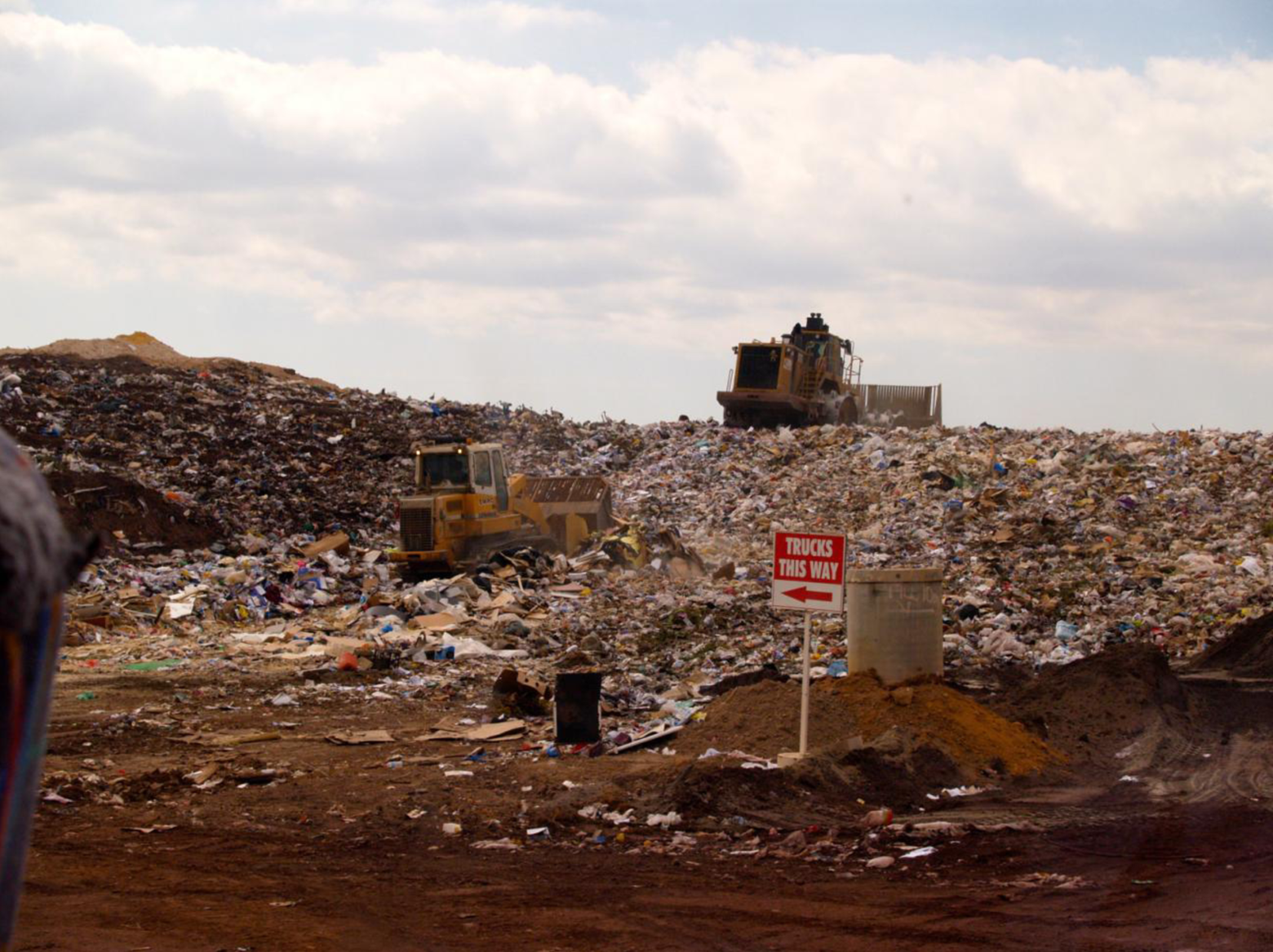
In fact, Humes notes, the sanitary landfill (as with all the previous attempts to deal with our waste) contributes to the huge volume of waste that we generate because it empowers even more wasting: “The landfill solution to garbage took away the slimy stench of the old throw-it-in-the-streets disposal, the smoking pall of the old incinerators, the noisome piggeries, the noxious reduction plants spewing out garbage grease, the ugly, seeping open dumps” (p. 57). It took away, in short, “the obvious consequences of waste and eliminated the best incentives to be less wasteful” (p. 57). In a similar way, the black plastic trash bag on the curb (which was originally green when introduced in New York) made it all but impossible for scavengers to go through peoples’ trash and pick out things that, to the scavenger, had value. In short, the sort of gleaning that Guillard and Roux (2014) write about largely came to an end. The net result was more stuff going to the landfill.
That is not, in itself, sufficient to push the whole country away from earlier eras’ acceptance of hard work, diligent saving, and the conservation of resources as the road to the good life. We went from thrifty, frugal, conservation and unwasteful attitudes to one that held that “the highest expression and measure of the American Dream lay in…the acquisition of stuff” (Humes, p. 59). How did it happen?
It is a complex story, one that has been told many times (Jones 1965; Horowitz 1979; McKendrick 1982; Marchand 1985; Sulkunen, Holmwood, Radner and Schulze 1997; Blaszczyk 2008; Berger and Goldberg 2011). One thing is for sure: it involved overcoming the forces of custom and tradition that were in the way of a mass consumption society (Witkowski 2010). The current textbook approach, in as much as it relies on the fabled concept of the production era, “presupposes…people…to have been engines of aggressive consumption whose demand rose automatically with the supply of affordable products” (Fullerton 1988, p. 112). But as Fullerton points out, “Making more products available would have had no effect on people who did not want them” (p. 112). What we fail to adequately appreciate today is something, to quote Fullerton again, “American marketing teachers in the early 1900s” understood, namely, that ‘demand creation’ was one of the fundamental business tasks” (p. 112). That is, business had the responsibility, and has the responsibility, of not only making the products but of making the demand for them as well.
Humes draws attention to the role of mid-century marketers such as J. Gordon Lippincott. Humes (p. 59) quotes Lippincott as having said, in 1947: Our willingness to part with something before it is completely worn out is a phenomenon noticeable in no other society in history…It is soundly based on our economy of abundance. It must be further nurtured even though it runs contrary to one of the oldest inbred laws of humanity, the law of thrift. has been alternately celebrated and condemned for the last half a century for its unprecedented impact on society and culture. Yet one of its most enduring effects—helping bring about an American trash tsunami—is rarely put on the list of mass media [and marketing] goods and evils (pp. 57-58). that all members of a typical family, even young children, would someday have their own phones, and that Americans could pay several hundred dollars a month for this ‘necessity’—for cell phones that would become high-tech trash in two years or less. It was the labor of marketers that transformed yesterday’s waste and excess into today’s normal and necessary (p. 64).
Part II of Garbology consists of two chapters. The first discusses what happens to the trash, mainly plastics, that go into the oceans. 4 This is a subject more thoroughly discussed by Tadajewski and Hamilton (2014) in their recent discussion of waste, art and social change. Humes’ treatment of it begins with the story of MIT’s trash trackers, a program in which “smart trash” is created by attaching electronic sensors to pieces of trash. These are then set free, as if released into the wild. The object is to see where they actually go. The creators of smart trash “wanted to expose how waste gets where its going—the meandering, mysterious and, it turns out, occasionally disturbing path it takes after it is thrown away” (pp. 132-133). One thing they are learning is that “our waste doesn’t go where we think it goes” and the idea that there is a waste-management “system” “is more illusion than reality.” At best there is a hodgepodge of potential trash destinations that eludes both control and detection” (p. 140).
The second chapter in Part II considers what, actually, is in the trash that ends up in our landfills. It is the story of Bill Rathje, the archaeologist at the University of Arizona that founded the Garbage Project and has spent decades exploring the inner space of landfills. Rathje’s story has been told many times (Rathje and Murphy 2001; Zimring and Rathje 2012). This is a nice introduction to the Garbage Project for those not already familiar with it.
One of the key insights from the Garbage Project has been that “people had no idea what was really in their garbage (or, for that matter, in their closets, refrigerators, cupboards and shopping carts)” (p. 155). Rathje exposed our trash mythology: “what we know versus what we think we know about garbage” (p. 155), and in the process he began tackling a problem that stands in the way of our ability to ever shrink “the 102-ton legacy” that is our trash. Namely, “why we are…so…clueless about the true size and nature of our waste” (p. 155). This discussion will be familiar territory to any marketer, especially consumer researchers, because it deals with what we already know: there is a huge gap between what people say they do and what they, in fact, do—from how much healthy food we say we eat and how much we actually eat to how much we say we throw away and how much we actually throw away.
The Real Solution: Reduce
Humes’ Part III focuses on the most important element in the Reduce, Reuse, Recycle triumvirate: Reduce. This was also touched upon at the end of Junkyard Planet. “No doubt,” Minter wrote, “the environment would be better off if everyone [in the affluent countries] stopped consuming so much.” He then added, “the likelihood of that is essentially nil, maybe less” (p. 252). That is why he gives up on it, even if he probes his own behavior: “Even those of us who should know better about consuming in excess simply can’t help ourselves” (p. 253).
Minter discusses an interesting article that appeared in the Journal of Consumer Psychology (Catlin and Wang 2013). The article reports on a set of experiments involving paper recycling. In both experiments either a trash bin alone or a trash bin and a recycling bin were available to those participating in the experiment. In both experiments the results were troubling: “those who performed the task in the presence of a recycling bin used twice as much paper as those who could only throw their excess paper in a trash bin.” In other words, “the addition of a recycling option can lead to increased resource usage” (p. 251).
“Isn’t recycling,” Minter asks, “supposed to promote conservation and preserve the environment?” (p. 252). Why do people use more paper if a recycling bin is present than if one is absent? And does the availability of recycling options have anything to do, as he puts it, with his own willingness to buy an iPhone that he does not need to replace his current one that is perfectly functional? It may be possible that a recycling option gives us a “get out of jail free” card. The signal is that it is acceptable to consume as long as the used product is recycled. Here Minter throws down a challenge for macromarketers: “I leave it to others,” he says, “to write about how and why convenience—and not sustainability—motivates consumers around the world” (p. 253).
This is of concern to Minter for a couple of reasons. First, there are hidden costs associated with recycling—and there are costs associated with the water and energy used. Second, everything cannot be infinitely recycled. Cardboard and paper fibers can survive six or seven trips. Metals are different. Theoretically some metals, like copper, can be recycled indefinitely. Practically, however, some copper is lost on each cycle. The same is true for aluminum cans. “Nothing—nothing—is 100 percent recyclable, and many things, including things we think are recyclable, like iPhone touch screens, are unrecyclable” (p. 255). Rather than being the best course of action, recycling is, he repeats, “the third best course of action, after reducing consumption and reusing what has been bought already” (pp. 252-253).
Minter is not hopeful about reducing consumption. Humes, on the other hand, provides anecdotal examples of reduced consumption at work. They involve artists reusing “found objects” from municipal solid waste facilities, and programs aimed at weaning us from plastic bags (programs based on initiatives developed first in Ireland). Humes is persuaded that banning plastic bags is important because “incremental changes add up” and the way to start the snowball rolling “is with the plastic bag” (p. 218). Plastic bags “are kind of like the gateway drug.” If we can kick that habit, “all the rest of our single-use habits will start to fall like dominoes” (p. 219). Or so he hopes.
The most important route to a reduced level of consumption is to just say no to consuming so much. This, he writes, is “the home run of waste reduction” (p. 260). Here he discusses the experience of Bea Johnson, her husband and two children. They lived in a suburb of the San Francisco Bay Area. When they moved to a new town they ended up in a much smaller apartment than their San Francisco home. A lot of family possessions had to go into storage—furniture, extra cloths, and just lots and lots of stuff. And that is when it happened; she soon realized she did not miss any of it.
“That’s how it started,” Humes writes. The “it” to which he refers is their experiment to live a less cluttered life. It did not begin “with a conscious effort to be greener or more sustainable or less wasteful,” as was the case with No Impact Man (Beavan 2009). They just stumbled on the fact that they were “happier in a simpler, less cluttered home, and agreed that they’d see where that idea would take them” (p. 241). The lesson to be learned is not the lesson Minter relates—that it ain’t gonna happen—but that it is actually possible. In a way their story illustrates something economist Kenneth Boulding once remarked (1969, p. 15): “What exists, is possible.” Since a simpler, less consumptive life style exists, it is therefore possible. It can happen pace Minter.
Conclusions
These books contain macromarketing implications, especially for those of us concerned about the environment. One implication is that we have to come to terms with the fact that we did not get into this mess by ourselves. The “we” in that sentence is “we, the people.” We had a lot of help from marketers. We will need the help of marketers to get out of the mess. We (as in “macromarketers” this time) need to drop the pretense that all marketing does is satisfy consumer needs and wants as consumers, themselves, define and express them. If the tasks of marketing management was in the 1970s and 1980s, to manage demand (Kotler 1973), it is probably the same today. We need to begin managing demand not with the profitability of giant global corporations as the sole criteria in mind, but with the global ecosystem in mind as well—or instead. As I have expressed before, that will be a daunting task involving a massive shift in our root metaphor (Benton 2012).
It also means accepting a critical stance toward understanding the role and function of marketing in society. It is not an all or nothing, either/or, situation, however (Mittelstaedt et al. 2014). You don’t have to be in love with markets or appreciate a critical perspective. You can be in love with markets and be critical of marketing. Macromarketers, even those with a critical bent, must accept that markets have a role to play. 5 Minter is clear about this in terms of the global recycling industry. About the role of markets in the global refuse industry Humes is less clear. On the role of marketing, Minter is silent; not so Humes.
In both cases, macromarketers need to begin looking into how we can promote the reduction of consumption, and the reuse of what we do buy, and spend less time getting more people to buy more stuff, even if some of that stuff can be recycled. We need to do this if we hold out hope for a sustainable future.
Footnotes
Declaration of Conflicting Interests
The author(s) declared no potential conflicts of interest with respect to the research, authorship, and/or publication of this article.
Funding
The author(s) received no financial support for the research, authorship, and/or publication of this article.