



Abstract
This study provides a review of religion-related research published in the Journal of Macromarketing (JMK) from 1981 to 2014. A systematic review of the journal identifies 19 key articles at the intersection of religion and macromarketing. Both quantitative and qualitative approaches are utilized to review this body of work in terms of frequency, content, methodology, and authorship. Results reveal four categories of religion-related research in JMK: 1) the impact of religion on macromarketing issues, 2) the impact of macromarketing issues on religion, 3) religion as a theoretical perspective, and 4) religious groups/individuals as a research context. Opportunities for future research on macromarketing and religion are discussed.
Introduction
The Journal of Macromarketing (JMK) has a long, rich tradition of publishing research that “examines important social issues, how they are affected by marketing, and how society influences the conduct of marketing,” according to its website http://jmk.sagepub.com. Religion constitutes one of the world’s most important social issues, unique in its cognitive, emotional, motivational, and behavioral aspects. Since its inception in 1981, JMK has supported the inclusion and consideration of religion in understanding the macromarketing landscape. The purpose of this article is twofold. First, we aim to gain insight into and appreciation of how the Journal of Macromarketing has shaped our understanding of macromarketing and religion. Second, the review reveals areas in which scholarship is lacking at the intersection of macromarketing and religion. Following in the path of Jones and Shaw (2006), this literature review focuses specifically on JMK, examining 34 years of religion-related research in the Journal in an effort to contextualize the contributions made in this current special issue on Religion and Macromarketing.
Religion provides a unique theoretical and substantive perspective in the field of macromarketing. Religion and the market have been indelibly linked throughout history from the agoras of Plato’s Republic and the quest for the “good life,” to the Holy Bible’s pro-trade commandment of “thou shall not steal,” to the modern debate regarding “religious freedom” for 21st century corporations. As Mittelstaedt (2002) states, “religion affects (1) what we trade, (2) how we trade, and (3) when and where trade occurs” (p. 7). Around the world, market systems are reciprocally shaped by religion. Religion-related holidays can promote consumption (e.g., shopping for Christmas gifts) or restrict consumption (e.g., fasting during Ramadan and Yom Kippur). Religion-related values can drive advertising imagery and market regulations (e.g., banning alcohol advertisements in Saudi Arabia). Religion-related norms can predict product viability in a market (e.g., not offering beef and pork at McDonald’s in India). Religions themselves have become increasingly commercialized in the modern marketplace with the increasing popularity of religion-related spokespersons (e.g., Christian televangelist Joel Osteen) and the marketing of religion-related goods (e.g., Kabbalah red string, candles and Kabbalah Water; see Einstein 2008).
In his 1981 Journal of Macromarketing article, “What Constitutes Usable Knowledge in Macromarketing,” Monieson paves the way for religion to have a home in macromarketing thought. Monieson suggests religion is a “philosophically laden” barrier to rationally constructed scientific systems, but to deliver research of value, “macromarketing has to develop into an open study able to incorporate these so-called enemies” (pp. 18-19). Religion is indeed one of many historical antecedents providing structure to market systems (Mittelstaedt, Kilbourne, and Mittelstaedt 2006). However, in a postmodern culture, scholars suggest religion is of decreasing importance in consumers’ market-driven lives (Arvidsson 2008; Brennan, Eagle, and Rice 2010; Firat and Vicdan 2008). Despite the decentralization and deconstruction of religious institutions, religion remains an important part of global consumer culture. The Pew Research Center’s Forum on Religion & Public Life estimates that there are 5.8 billion religiously affiliated adults and children around the globe, representing 84% of the 2010 world population of 6.9 billion (Hackett and Grim 2012).
A key challenge in studying religion is identifying and agreeing upon a conceptual definition of the term religion. The Oxford Dictionary alone presents three definitions. Indeed, theologians, philosophers, business ethicists, among others have argued the meaning of religion for centuries (Comstock 1972; Guthrie 1993; Smith 1962). Emile Durkheim (1915/1965) describes religion as “a unified system of beliefs and practices relative to sacred things” (p. 62). Clifford Geertz (1966) calls religion a “system of symbols, which acts to establish powerful, pervasive, and long-lasting moods and motivations in men by formulating conceptions of a general order of existence and clothing these conceptions with such an aura of factuality that the moods and motivations seem uniquely realistic” (p. 4). Many definitions use catchphrases like “sacred” and “supernatural,” but these terms fail to account for the complexity of religion as a lived experience within a cultural system (Idinopulos 1998). Moreover, the proliferation of definitions and misuse of the term conceptually obscures religion from other distinct constructs such as ideology and moral philosophy (Fitzgerald 2000). Therefore, for the purpose of this review, we borrow Hill and Hood’s (1999) definition of religion as “phenomena that include some relevance to traditional institutionalized searches to acknowledge and maintain some relationship with the transcendent” (p. 5). This definition is applicable to the macromarketing context, acknowledging the interactive and systemic nature of religion and inclusive of world religions, indigenous religions, and emerging religious movements.
The purpose of this review is to gain a better understanding of the past, present, and future of religion-related research in the Journal of Macromarketing. Some of the questions we address include the following: How has the frequency of religion-related research published in JMK changed over time? What is the contextual nature of article published on macromarketing and religion in JMK? Which methodological approaches are used to study macromarketing and religion in JMK? What is the nature of authorship (e.g., career stage, university affiliation) among religion-related publications in JMK? Through answering these questions, we aim to provide a foundation for future research at the intersection of religion and macromarketing.
First, we outline the methodology for this review. To that end, we identify the inclusion criteria for selecting articles analyzed in the review and measures by which the articles are analyzed. Next, we discuss the frequency of religion-related research publication in JMK over the entire 34-year time period – identifying 19 key articles. More detailed analysis follows organized by the three categories of measures: content, methodology, and authorship. Lastly, we close by identifying three primary areas in which future research is warranted.
Methodology
Inclusion Criteria
To assess the significance of religion-related research in the Journal of Macromarketing, we searched all issues of the journal for religion-related keywords including the following: religion, religious, spiritual, spirituality, faith, God, and gods. To ensure an exhaustive review of the journal, a follow-up search was conducted utilizing terminology from the five widely recognized world religions – Buddhism, Christianity, Hinduism, Islam and Judaism – as well as other religious categories including religiously unaffiliated (e.g., agnostic, atheist), folk and tribal religions (e.g., African traditional religions, Chinese folk religions, Native American religions, Australian aboriginal religions), and other religions (e.g., Baha’i faith, Taoism, Sikhism, Wicca), according to classifications from Pew Research Center’s Forum on Religion & Public Life (Hackett and Grim 2012). Book and media reviews, editorials, conference proceedings, and calls for papers were excluded. Special issues and invited commentaries were included in the analysis. The result yielded 104 articles after eliminating overlapping articles.
In line with previous literature reviews on macromarketing topics (e.g., historical research in Jones and Shaw 2006; marketing ethics in Nill and Schibrowsky 2007), each of the articles was evaluated to determine whether it was fundamentally related to religion. Given religion’s role as an influential factor in market systems, it is not surprising that many macromarketing articles mention religion as a contextual consideration. However, for the purpose of this study, only articles that explicitly used religion-related constructs or concepts within the primary text were included. Articles in which religion was discussed only briefly to provide historical context were eliminated from the dataset. To illustrate, Ferrell and Ferrell (2008) suggest the roots of distributive justice can be traced back to Judeo-Christian, Catholic, and Eastern religions. However, this is not central to the development of their framework for macromarketing ethics. Rather, in this case, religion provides historical context for the evolution of marketing ethics (Hunt and Vitell 2006; Laczniak and Murphy 2006; Mittelstaedt 2002). Each author independently coded each of the articles for relevance with regard to religion (i.e., 1 = religion-related relevance, 0 = no religion-related relevance). An article was considered relevant based on the extent to which religion was central in the core content of the article, including its theoretical approach (e.g., theological perspective as theoretical framework), methodological approach (e.g., sacred text as data source, religious group as sample of interest), and macromarketing contribution (e.g., addressing religion as a central element in the market system). Following procedures outlined by Nill and Schibrowsky (2007), two people coded the data at the article level. To estimate inter-rater reliability, we calculated a consensus estimate for the percent of agreement resulting in a reliability measure of 85.2% consensus between the independent coders, placing reliability above the recommended 70% threshold (Stemler 2004). Intercoder disagreements were resolved through discussion. Articles deemed highly religion-related in one or more of these categories remained in the final sample. This procedure resulted in a final total of 19 articles published in the Journal of Macromarketing between 1981 and 2014.
Measures
Each of the 19 articles was individually analyzed and independently coded based on four categories of measures: frequency, content, methodology, and authorship. Frequency identifies each article’s order of chronological appearance. Article content indicates its scope of religion-related research in terms of JMK’s stated mission to examine “important social issues, how they are affected by marketing, and how society influences the conduct of marketing.” Methodology captures the breadth of empirical approaches used to examine religion and macromarketing. Lastly, given the beneficial role of global author diversity in marketing scholarship (Stremersch and Verhoef 2005), article authorship assesses the institutional background and geographical representation of authors. These measures were selected to systematically capture the nature of religion-related research in JMK.
Frequency
Exploring the frequency of which religion-related articles appear in JMK is insightful from an evolutionary perspective, in line with Jones and Shaw’s (2006) review of historical research in the Journal of Macromarketing. Frequency analysis provides a snapshot of how religion-related scholarship in JMK has progressed since the Journal’s introduction in 1981. To identify each article’s order of appearance, we used its original printed publication date.
Content
To measure content diversity, we developed a three-pronged classification scheme including 1) macromarketing topic, 2) relevance of religion, and 3) religious perspective. First, to assess the macromarketing topic, we adapted the list of important subcategories in macromarketing literature set forth by Shapiro, Tadajewski, and Shultz (2009). Their list of categories was condensed and reconfigured to ten final subcategories of macromarketing scholarship (see Table 2). Second, to specifically evaluate the relevance and role of religion in each article, we developed an emergent classification scheme following an iterative hermeneutic analysis method to discover common underlying themes among the articles (Spiggle 1994; Thompson 1997). The advantage of this iterative process is that “it permits the development of provisional categories, constructs, and conceptual connections for subsequent exploration” (Spiggle 1994, p. 495). That is, the content of the articles was not analyzed with a predetermined structure or schema; rather meaningful categories emerged from the data. A succinct but comprehensive categorization scheme for the relevance of religion in each article emerged from the data, including 1) the impact of religion on macromarketing issues, 2) the impact of macromarketing issues on religion, 3) religion as a theoretical perspective, and 4) religious groups/individuals as a research context. Third, to examine the religion or religious perspective of interest, we coded each article for focal religion (e.g., Catholicism, Islam, Judaism). Again, the religious categories emerged from the sample of articles rather than a predetermined set of categories.
Methodologies
To assess the variety of methodological approaches used within the studies, we first classified articles as empirical, conceptual, and other (e.g., invited commentary). We further categorized the empirical category into three subcategories – quantitative, qualitative, and mixed method – adopted from DeBerry-Spence, et al. (2013). Lastly, we closely examined the data collection and analysis methods of each article.
Authorship
To examine the diversity of authors who contribute religion-related macromarketing research, we adapted DeBerry-Spence, et al.’s (2013) coding scheme for authorship. We examined the institutional background of the authors (e.g., academic, nonacademic), the rank of each author (e.g., doctoral student, full professor), the country of institutional employment for each author, and if applicable, the religious affiliation of each institution. All authorship data were collected based on each author’s position at the time of publication.
Findings and Discussion
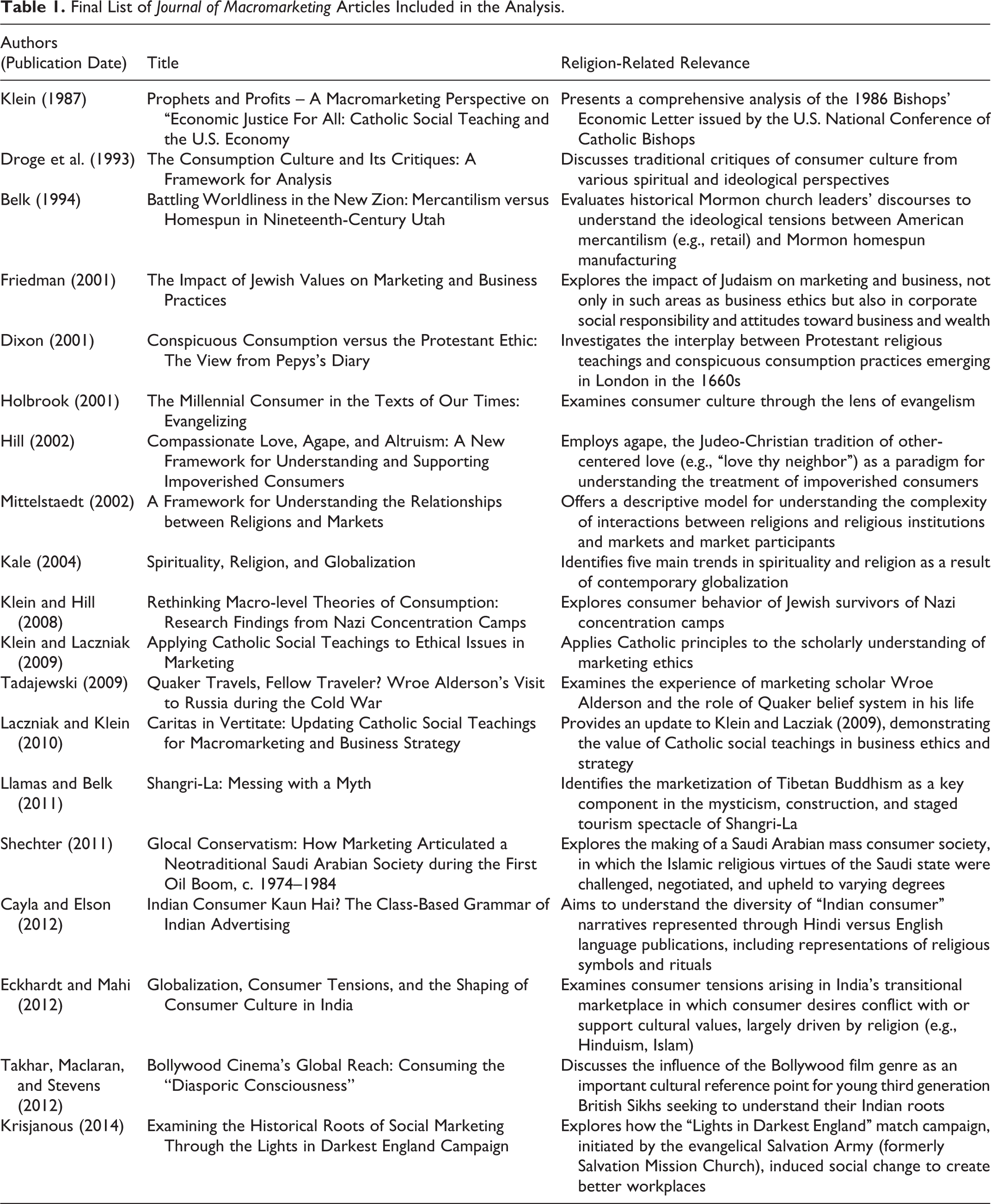
The procedure outlined above resulted in 19 articles published in the Journal of Macromarketing between 1981 and 2014 with religion-related foundation, focus, or findings (see Table 1). These articles serve as the data used for this review. Here, we present results from our content analysis of these 19 key JMK religion-related papers. Tables and figures are provided throughout the findings and discussion section, which is organized by four categories:
Frequency: How has the frequency of religion-related research published in JMK changed over time?
Content: What is the topical nature and scope of articles published on macromarketing and religion?
Methodology: What methodological approaches are utilized to study macromarketing and religion?
Authorship: Who publishes research on macromarketing and religion?
Final List of Journal of Macromarketing Articles Included in the Analysis.
Frequency
Despite the importance of religion emphasized by early macromarketing scholars (Carman 1982; Monieson 1981), the presence of religion-related research in JMK was almost nonexistent in the first two decades of the journal’s publication (see Figure 1). The early 2000s appear to be a turning point for religion-related research in the Journal of Macromarketing, as only three religion-related articles were published prior to the turn of the 21st century. Religion research in JMK after the year 2000 saw a 433% increase relative to the previous two decades. This is particularly of interest given the timing of Mittelstaedt’s (2002) seminal paper providing a framework for understanding the influence of religion in macromarketing. Still, the increases are incremental. Within the 34-year span considered here (1981-2014), the maximum number of religion-related articles published in JMK in any given year is three (2001 and 2012).

Frequency of Journal of Macromarketing religion publications (1981-2014).
Content
Macromarketing Topic
We classified each article using an adapted classification scheme of important subcategories in macromarketing literature set forth by Shapiro, Tadajewski, and Shultz (2009) (see Table 2). Over half of the religion-related articles in JMK relate to consumer culture and behavior. This is not surprising given religion’s historical influence in shaping culture and guiding human behavior (Dawson 2013). Market system dynamics and globalization represent the second and third most related research areas, respectively, in terms of religion and macromarketing. In particular, recent articles (Cayla and Elson 2012; Eckhardt and Mahi 2012; Shechter 2011; Takhar, Maclaran, and Stevens 2012) examine the reciprocal and interactive role of religion in shaping consumer behaviors and market systems in response to an increasingly globalized marketplace. Recent research aims to understand how, when, why, and to what extent consumers must navigate tensions between long-standing, institutionalized religious beliefs (e.g., food selections, clothing choices, family dynamics) and the modern, global marketplace (e.g., new technology, foreign foods, cross-cultural entertainment). With one exception, all articles published on religion as it relates to classic macromarketing topics including marketing ethics, quality of life marketing, and distributive justice were published prior to Mittelstaedt’s 2002 seminal paper on religion and macromarketing. Apparently, the tenor of religion and macromarketing research shifted in the early 2000s toward market system dynamics, globalization, and consumer culture. Three of the 19 religion-related articles in JMK explore topics central to marketing history. For example, Krisjanous (2014) examines the history of social marketing by providing a case analysis of evangelist General William Booth and his religiously driven mission to improve quality of life in England’s 19th century match factories. It should be noted some articles in the initial sample studied marketing during religiously significant eras (e.g., “Biblical times” in Hull 2008). However, such papers were deemed historically significant but not religiously significant. Surprisingly, only one article to date evaluates the connection between religion and sustainability or environmental issues, despite current macromarketing interest surrounding sustainability (McDonagh and Prothero 2014; Prothero and McDonagh 2015). Although Friedman (2001) briefly comments on how Jewish culture, values, and ideas influence environmental responsibility and wasteful consumption in particular, no article uses sustainability as a primary macromarketing perspective from which to explore or apply the role of the religion.
Content Analysis by Research Topic.
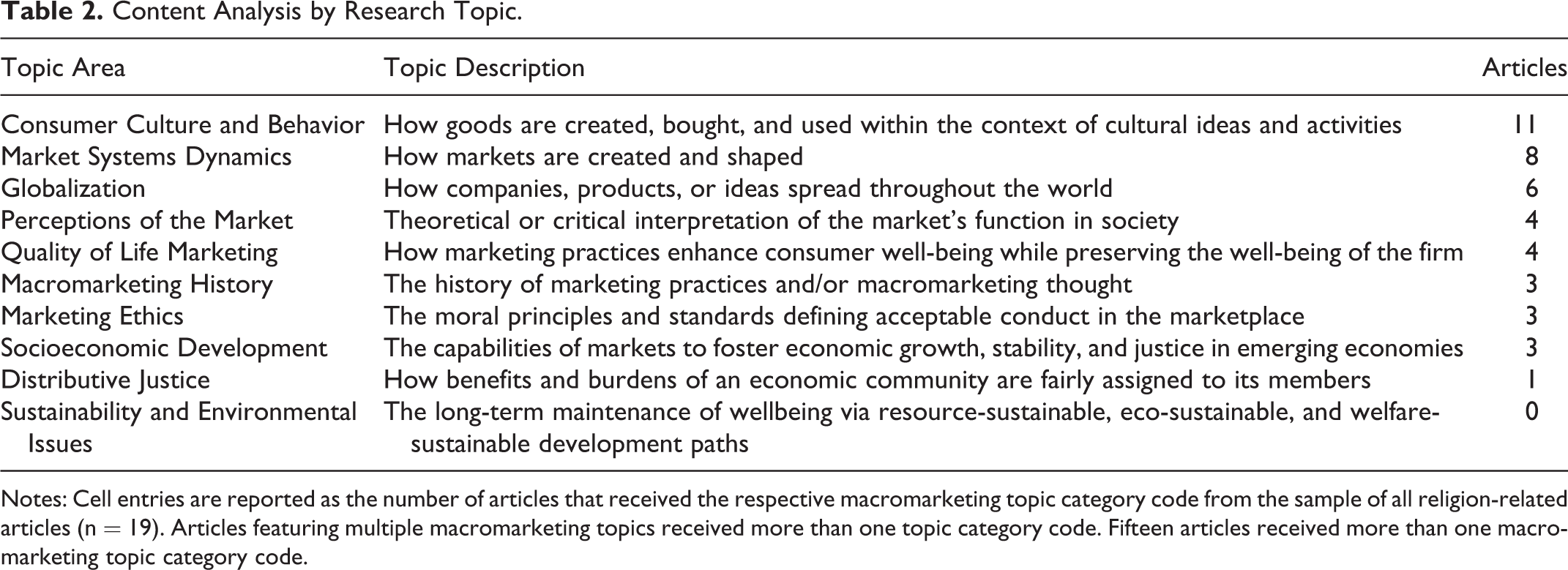
Notes: Cell entries are reported as the number of articles that received the respective macromarketing topic category code from the sample of all religion-related articles (n = 19). Articles featuring multiple macromarketing topics received more than one topic category code. Fifteen articles received more than one macromarketing topic category code.
Relevance of religion
The relevance and role of religion in each article was characterized by four emergent themes: 1) the impact of religion on macromarketing issues, 2) the impact of macromarketing issues on religion, 3) the theoretical perspective of religion, and 4) religious groups/individuals as a research context (see Table 3). Six articles examine the role of religion in macromarketing by seeking to understand how religion shapes macromarketing. For example, Friedman (2001) outlines the role of Judaism on marketing and business practices, including sustainability, marketing ethics, and corporate social responsibility. This directional relationship from religion to marketing is represented in six of the 19 religion-related articles in JMK. Two articles examine the opposite directional relationship: the impact of macromarketing on religion. These articles aim to understand how macromarketing issues such as globalization (Kale 2004) and tourism marketing (Llamas and Belk 2011) influence religion. For instance, Llamas and Belk (2011) examine the marketization of Tibetan Buddhism as part of an overarching remaking of the Chinese county Zhongdian into the fictional idyllic location of Shangri-La. The authors explore how marketing practices are applied to Buddhism in order to enhance the location’s perceived authenticity, sacredness, and mysticism among tourists. Kale (2004) examines how globalization has influenced trends in modern spirituality and religion. Six articles demonstrate the common theme of using religion from a theoretical perspective. These articles do not necessarily study religion itself; however, they pointedly examine macromarketing through the lens of religion. For example, in his review essay, Holbrook (2001) uses evangelism as a metaphor for the modern marketplace – marketers preach and consumers worship. Such articles lean on teachings and perspectives from religions from a theoretical framework through which to examine macromarketing issues. Hill (2002) uses agape love, the concept of other-centered love derived from the Judeo-Christian tradition, as a foundational perspective for developing a new love-as-resource framework addressing support for impoverished consumers. Lastly, five of the 19 religion-related articles in JMK primarily use religious groups or individuals as a research context. These articles aim to understand the lived experiences of religious consumer groups or individuals. For example, Tadajewski (2009) identifies marketing scholar Wroe Alderson’s Quaker belief system as a key impetus in his trip to Russia during the Cold War and the role Quakerism played in his individual life. Other articles examine particular religious groups. For example, Takhar, Maclaran, and Stevens (2012) discuss the influence of the Bollywood film genre as an important cultural reference point for young third generation British Sikhs seeking to understand more about their Indian roots.
Content Analysis by Relevance of Religion.
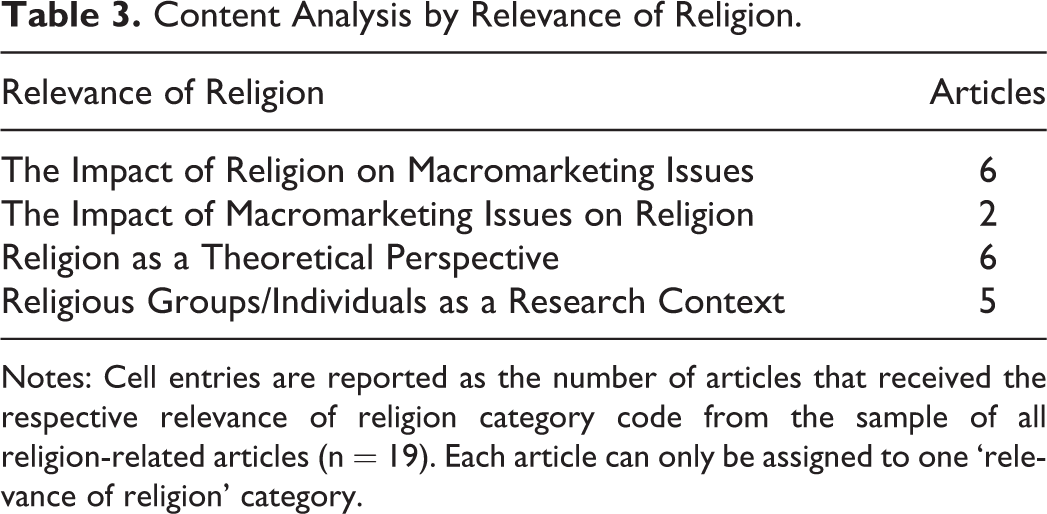
Notes: Cell entries are reported as the number of articles that received the respective relevance of religion category code from the sample of all religion-related articles (n = 19). Each article can only be assigned to one ‘relevance of religion’ category.
Religions of interest
An examination of the focal religion or religious perspective of interest (e.g., Catholicism, Islam, Judaism) in each article uncovered 12 religions discussed in the 19 religion-related papers published in JMK (see Table 4). Christian faiths dominate the discussion of religion and macromarketing. Protestant, Evangelical, Catholic, Mormon, Quaker, and Puritan faith traditions account for more than half of the articles. Three articles discuss more than one religion. However, only one article approached multiple religions from a comparative perspective. Two articles, Mittelstaedt (2002) and Kale (2004), discuss religion and spirituality in a general sense, but Mittelstaedt (2002) does note that examples in his framework are “limited to monotheistic, Abrahamic religions” (p. 14).
Primary Religion of Interest.
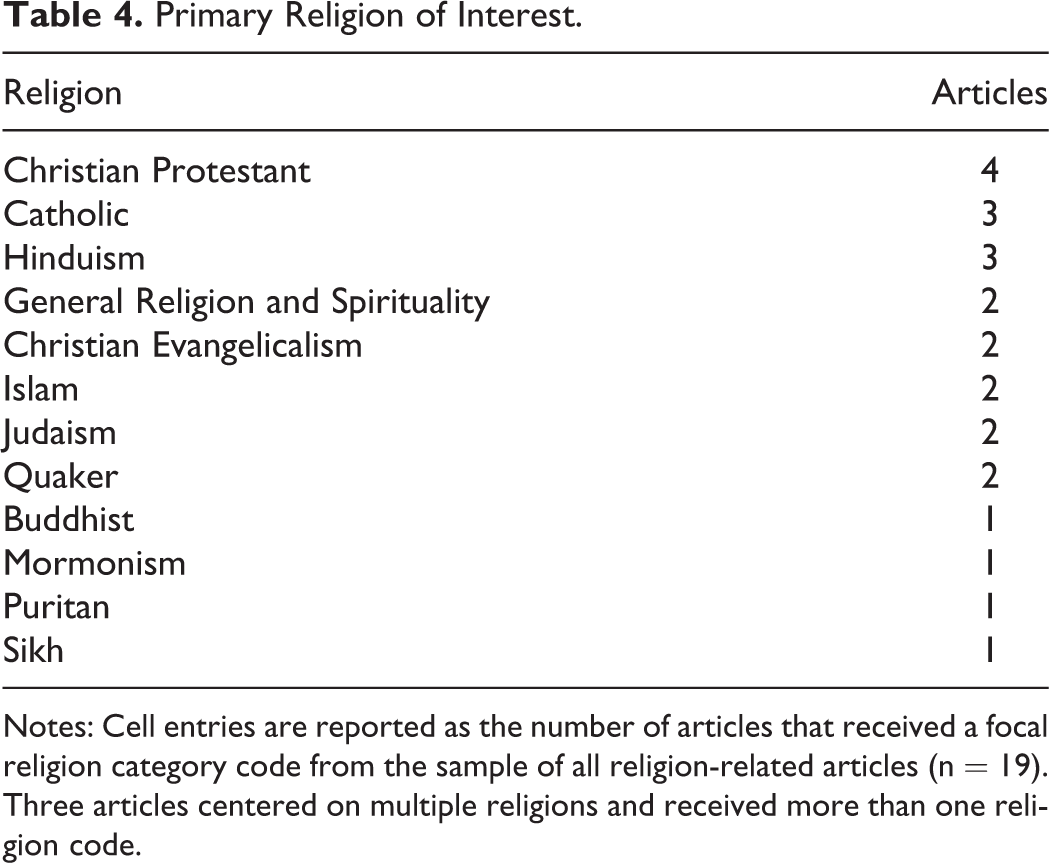
Notes: Cell entries are reported as the number of articles that received a focal religion category code from the sample of all religion-related articles (n = 19). Three articles centered on multiple religions and received more than one religion code.
Methodologies
Of the 19 religion-related articles published in JMK, over three-fourths are empirical (see Figure 2). Three articles are conceptual, and one is a review essay. All conceptual articles were published prior to 2003. Further investigation of the methodological approaches used to explore macromarketing and religion reveals a dearth of quantitative papers pertaining to religion. All empirical papers use qualitative approaches (see Table 5). That is, none of the religion-related papers in JMK use quantitative methods. Text analysis is the most widely used qualitative approach, representing 11 of the 19 religion-related articles in JMK. Most commonly, articles utilizing a text analysis approach use religious texts, such as the Talmud, Midrash, and Torah (Friedman 2001) or written diaries and journals from religious persons, such as written memoirs from Jewish Holocaust survivors (Klein and Hill 2008). After text analysis, interviews and ethnography represent the preferred empirical methods used to study religion and macromarketing. Six of the 15 empirical articles employ multiple qualitative methods; however, none of the papers use a mixed methods approach (i.e., qualitative and quantitative).

Methodological approach by type. Note: ‘Other’ includes a review essay: Holbrook (2001).
Types of Empirical Research Methods.
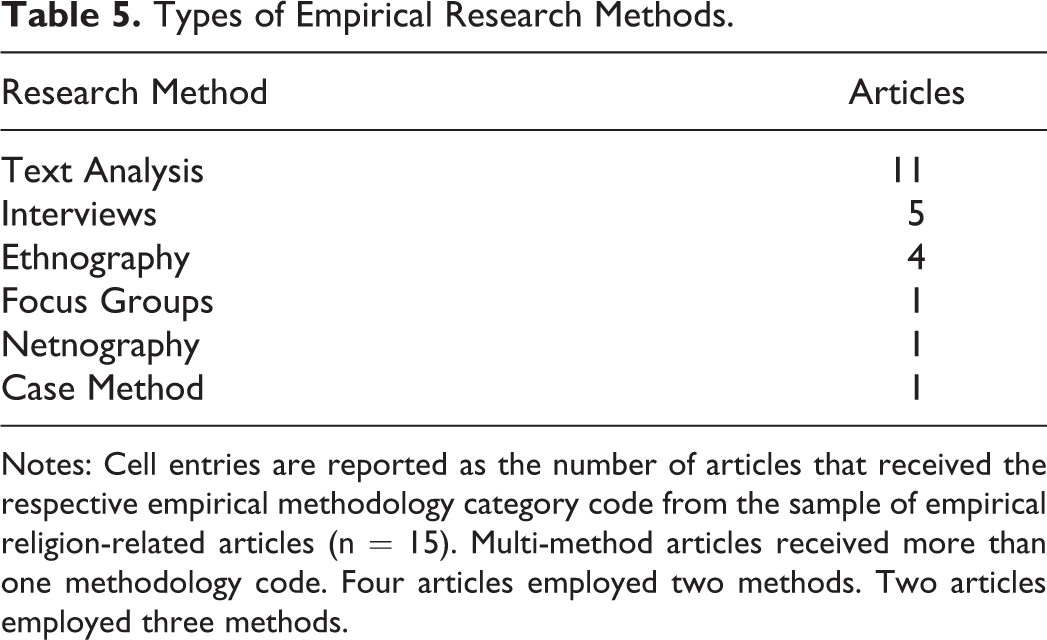
Notes: Cell entries are reported as the number of articles that received the respective empirical methodology category code from the sample of empirical religion-related articles (n = 15). Multi-method articles received more than one methodology code. Four articles employed two methods. Two articles employed three methods.
Authorship
The majority of the authors are academics in the field of marketing. Only two of the authors were in industry at the time of publication, but both hold doctorates and previously worked in academia prior to their publication. Four of the authors published multiple works that were analyzed in our study, yet authorship was considered distinct for each publication, as rank and university affiliation did change for some of the authors between publications.
When examining ranks, approximately half of the authors were full professors or emeritus at the time of publication (see Table 6). All doctoral students co-authored with full professors at their own university. Only two of the papers were single authored by an Assistant Professor (Mittelstaedt 2002; Tadajewski 2009). These numbers indicate a trend towards authors tackling these types of religion-focused publications later in their academic careers. Dixon (2001) published his paper as an independent scholar, after a 45-year academic career as a professor of marketing at several universities.
Author Representation by Rank at Time of Publication.
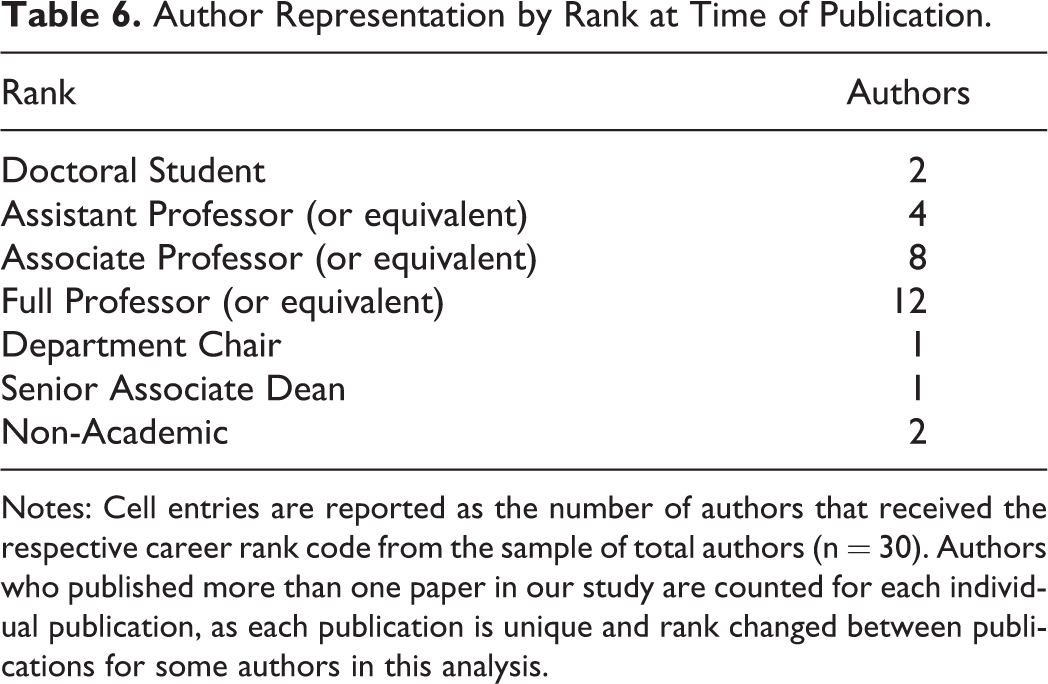
Notes: Cell entries are reported as the number of authors that received the respective career rank code from the sample of total authors (n = 30). Authors who published more than one paper in our study are counted for each individual publication, as each publication is unique and rank changed between publications for some authors in this analysis.
Interestingly, of the papers analyzed in this study, only three faith-based universities were represented in the publications: Marquette University, University of Portland, and Villanova University – all in the United States of America and all Roman Catholic universities (see Table 7). While some connections may exist between an author’s institutional religious affiliation and his or her publication topic, the data do not support statements of direct correlation between the two. For instance, as a professor at Marquette University, Gene R. Lacznaik published two papers (Klein and Lacznaik 2009; Laczniak and Klein 2010) investigating Catholic Social Teaching. At first consideration, it may appear that Marquette University’s Catholic affiliation may have influenced Lacznaik in these works, but it should be noted that Thomas A. Klein, the co-author on both of the works, was not publishing from a religious based university. In fact, Klein published three of the papers analyzed in our study, the highest number of the papers from any of the authors, yet he was not affiliated with a religious university for any of these works. Furthermore, Ron Paul Hill published two different works (Hill 2002; Klein and Hill 2008) from two different Catholic Universities, and neither of these works center specifically on Catholicism. Based on these findings, we do not see a high correlation between religious university affiliation and publications reflecting these specific affiliations.
Author Representation by Religious University Affiliation.

Notes: Gene R. Lacznaik (Marquette University) published two papers (2009, 2010).
The majority of authors, 18 of 30 analyzed in this study, published their works while representing American universities or businesses. The other authors came from a variety of universities throughout the world. The various countries outside of the U.S. include the United Kingdom, Australia, New Zealand, Canada, Israel, Singapore, and Spain (see Table 8). Again, in this analysis, individual authors that published multiple papers were considered for each individual publication, as some authors published at different universities in different countries. One author, Donald F. Dixon, was retired at the time of publication and considered an “independent scholar” in his publication. Dixon worked as a professor at a variety of universities throughout the world during his career.
Author Representation by Country of University or Firm Affiliation.
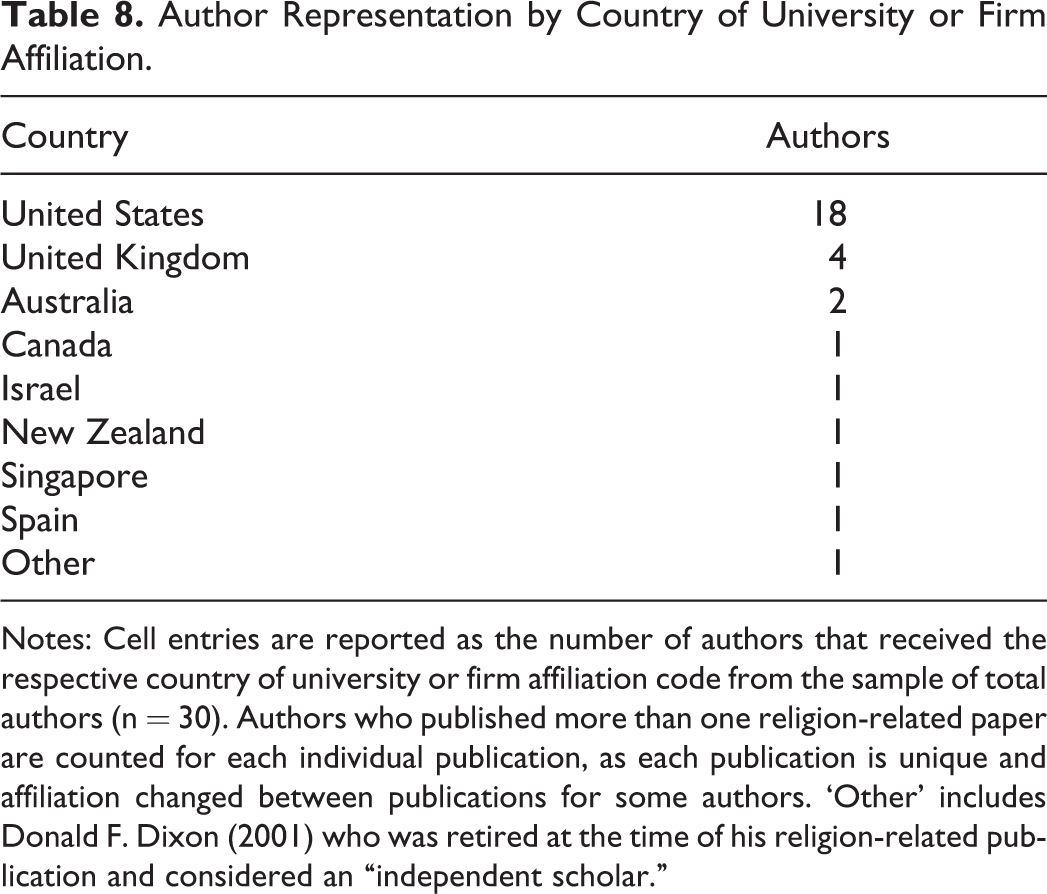
Notes: Cell entries are reported as the number of authors that received the respective country of university or firm affiliation code from the sample of total authors (n = 30). Authors who published more than one religion-related paper are counted for each individual publication, as each publication is unique and affiliation changed between publications for some authors. ‘Other’ includes Donald F. Dixon (2001) who was retired at the time of his religion-related publication and considered an “independent scholar.”
The data do not provide evidence to support any correlational or causal relationship between geographic location and religion-related research. That is, religion-related research is not necessarily driven by an author’s geographic location. For example, Shechter (2011) published from Israel, which is declared to be a Jewish State, yet his publication addresses Saudi Arabian consumer society with regard to Islamic religious influences. It should be noted that the majority of countries from which these articles originated offer basic religious freedoms, which may more easily advance these types of religion-related studies.
Current State of the Literature and Future Directions
This review of religion-related research in the Journal of Macromarketing offers insight into its past, present, and future. Although religion was initially recognized as an important factor in macromarketing scholarship (Monieson 1981), religion-related research has only recently begun to develop in JMK with over half of the religion-related papers in JMK published within the past decade. One conclusion that can be drawn from our review is the existing research on macromarketing and religion in JMK can be considered sluggish, at best. Nonetheless, in practice, religion has been and continues to be a major factor in worldwide marketplace transformations. At its core, macromarketing research acknowledges the role of broad cultural and environmental factors in shaping the marketplace. However, as macromarketers, we must not disregard the reciprocal nature of this relationship. In this case, religion influences marketing, which in turn influences religion.
Findings from this review suggest religion is of interest to macromarketing scholars, but to date, much of the current research focuses on how religion shapes marketing and markets, rather than providing a well-rounded, all-encompassing perspective of the interactivity between religion and the market. Our review shows the majority of religion-related research in JMK is centered on monotheistic, mainstream religions and primarily approaches the study of religion from a qualitative or conceptual perspective.
This review of religion-related research reveals three areas in which more research is needed to better understand the relationship between religion and macromarketing: 1) the influence of marketing on religion, 2) the representation of religious groups in the literature, and 3) the diversification of methodological (e.g., quantitative) and substantive (e.g., sustainability) perspectives from which to explore religion.
First, despite Mittelstaedt’s (2002) framework identifying how marketing influences religion as a key area of interest for religion and macromarketing research, few scholars explore this. The question remains: how do such marketplace transformations reciprocally influence religion? More research examining how marketing erodes, advances, or sustains religious structures and consumers’ religious practices is needed. Kale’s (2004) article is exemplary in its attempt to capture how globalization has influenced religious practices worldwide. Particularly in postmodern cultures in which religious institutions are increasingly decentralized (Granger et al. 2014) scholars are primed to explore how markets and marketing reciprocally influences religion. In today’s market, the lines between religious institutions and for-profit corporations are becoming increasingly blurred. For example, in America for-profit companies such as Hobby Lobby and Chick-fil-A have distinguished their corporate identities and positioning through religious practices (Oppenheimer 2013). Such organizations have stirred controversy for mixing marketing and religion (Kuzma, Kuzma, and Kuzma 2009). However, little academic research investigates how faith-based marketing practices influence religious structures and consumer culture.
Second, a greater diversity of representation in types of religion is warranted in future macromarketing research. Previous religion-related macromarketing research largely ignores the religiously unaffiliated (agnostic, atheist), folk and tribal religions (African traditional religions, Native American religions, Australian aboriginal religions), and other religions (Wicca). These religious groups warrant examination through the lens of macromarketing. For instance, although about 16% of the worldwide population identifies as religiously unaffiliated, a recent study found religiously unaffiliated Americans continue to partake in religious communities for a variety of social, moral, and cultural motives (Ecklund and Lee 2011). Grierson (2012) points out that this phenomenon is most prevalent in faith-based countries, where failure to visibly support a religious institution (church, synagogue, mosque, temple) could negatively impact an individual’s economic or social standing in the community. In an effort to advance macromarketing knowledge, future research should challenge and refine the conceptual underpinnings of religion and aim to better understand what constitutes a religious group in the postmodern marketplace. Sociologists and religious scholars have tried to establish clear markers (leadership, size, organization, membership) differentiating mainstream religious groups from alternative or emerging religious movements (Miller 1995). Understanding a more extensive range of traditional, nontraditional, and emerging past, present, and future religions from a macromarketing perspective will allow for greater insights in macromarketing scholarship from comparative ethical codes across religions and comparative perceptions of quality of life based on religious practices.
Third, a key takeaway from our analysis lies in identifying methodological and substantive areas in which religion research in JMK is lacking. None of the religion-related research published in JMK to date examines religion from a quantifiable perspective. The Journal of Macromarketing aims to deliver research from diverse theoretical and empirical perspectives. Therefore, the dearth of quantitative research and empirically testable theoretical contributions is surprising. Future macromarketing research can build upon the rich history of qualitative religious research in JMK to measure the impact of religion in the marketplace. Sustainability and environmental issues are a substantive area in which religion and macromarketing research is lacking. While some research has touched upon sustainability briefly (Friedman 2001), no research to date examines environmental issues through the lens of religion. Research has only begun to emerge tying religion to sustainable consumption (Minton, Kahle, and Kim 2015). Future research should build upon the growing foundation of JMK sustainability literature (Shapiro 2006) to incorporate religion into the discussion.
This review of 34 years of religious research in the Journal of Macromarketing provides a barometer for understanding the state of current macromarketing scholarship and the potential for future contributions. While interpretations are presented from the perspective of the authors, readers are encouraged to review the religion-related research highlighted in this article in order to distill insights of their own for future research. The contribution of this article lies in tracing the evolution of religion research in the Journal of Macromarketing to reveal gaps in the literature, and more importantly, to prompt a meaningful dialogue among macromarketing scholars.
Footnotes
Declaration of Conflicting Interests
The author(s) declared no potential conflicts of interest with respect to the research, authorship, and/or publication of this article.
Funding
The author(s) received no financial support for the research, authorship, and/or publication of this article.