



Abstract
Fragmented marketing debates concerning the role of alternative economies are attributable to the lack of a meaningful macromarketing dimension to which alternative economic practices can be anchored. This research frames an evaluation of existing macromarketing developments aimed at reformulating the mindless pursuit of economic growth. Raising concerns with the treadmill dynamics of marketing systems, three different approaches - green growth, a-growth and degrowth - are critically evaluated to: (a) introduce degrowth as a widely overlooked concept in the macromarketing literature; (b) expose how each perspective entails a specific organization of provisioning activities; and (c) foreground the role of alternative economic practices beyond the growth paradigm. We conclude that socially sustainable degrowth is the missing voice within macromarketing debates that lie central to elucidating the future direction of alternative economic practices.
Our research is sensitive to the fact that complex civilizations should never be characterized as anything but fragile and impermanent. We therefore open with a powerful reminder that human history is littered with examples of highly complex and prosperous socio-economic systems that once flourished but eventually faltered and failed (e.g. Diamond 2005; Glubb 1978; Olson 1982; Orlov 2008; Tainter 1988). While the cited causes for collapse are diverse, we are frequently reminded that environmental degradation lies behind some of the greatest downfalls (Chew 2006; Fagan 2008; Hughes 1996; Ponting 2007). Furthermore, there is every reason to believe that a systemic collapse could be happening again (Orlov 2013), although this time on a scale without historical precedent (e.g. Gilding 2011; Greer 2008; Heinberg 2011; Hertsgaard 2011; Parker 2013). In this regard, scientific evidence continues to expose an alarming fragility in the health of ecosystems upon which the global economy, and ultimately humankind, depends (e.g. Gilding 2011; Greer 2008; Wijkman and Rockstrom 2012).
The implausible scale of economic growth, which lies at the heart of such an apocalyptic warning, is palpably overwhelming. Unprecedented economic expansion during the Twentieth Century has been sustained on the equally unprecedented consumption of raw materials and fossil fuels - most notably coal and oil (Krausmann et al. 2009). The world economy consumes more fossil fuels today that at any other point in human history (IEA 2014a); global energy demand is set to grow by 37% by 2040, with China expected to surpass the US as the largest oil-consuming country by the year 2030 (IEA 2014b); and the planetary carrying capacity of natural ecosystems has been exceeded in key areas, ranging from climate change to biodiversity loss (WWF 2014).
Within this context, the quest for alternative economies is receiving increased attention within the marketing discipline. To date, however, it is also apparent that current marketing debates concerning the role of alternative economies ‘remain fragmented leaving larger scale questions…largely underexplored and undertheorized’ (Campana, Chatzidakis, and Laamanen 2015, p. 151). While we concur with Gibson-Graham (2014) that alternative economies engender great potential to enable more sustainable ways of living, we contend that this potential cannot be evaluated until it is critically theorized in relation to the relentless pursuit of economic growth. This becomes a worthwhile project within the field of macromarketing where any scholarly engagement with the growth conundrum is long overdue (Kilbourne 2010). Consequently, our work provides a twofold contribution. First, we identify and critically evaluate the most prominent competing discourses which are gathering pace in response to the dominant growth paradigm. Second, we draw upon these discourses to frame and theorize the transformative role of alternative economies in more critical terms. Our work charts an unexplored macromarketing territory - one which is currently characterized by dispersed, fragmented debates - as we pave the way for a more productive engagement with alternative economic practices.
Our article is structured as follows. First, we introduce the notion of growthmania to frame the obsessive and mindless pursuit of economic growth. Second, we critically discuss the three primary criticisms of growthmania to expose a core set of humanistic, environmental and inequality concerns. Third, our argument draws attention to the institutional forces driving economic growth. We establish a categorization of competing positions which seek to reform these institutional forces, namely: green growth, a-growth, and degrowth. A subsequent critique and evaluation focuses upon the macromarketing implications demanded by each perspective. In recognizing degrowth as a meaningful overarching framework within which to anchor progress towards socially sustainable alternative economies, our article closes with remarks concerning the challenges and opportunities ahead.
Growthmania
When Daly (1992) used the term ‘growthmania’ he did so to denote a set of assumptions about human progress deeply embedded in orthodox economic theories. Such chrematistic assumptions lead to the tireless utilitarian advocacy of economic growth as the ultimate foundation for wellbeing and a panacea to many kinds of societal problems. Growthmania is epitomized by the centrality of the Gross Domestic Product (GDP) indicator in contemporary public discourse (Schmelder 2016). Indeed, GDP growth has been constituted as an overarching policy objective with such pervasiveness and undisputed authority, that ‘even minor reductions of GDP are received with almost religious disappointment’ (Schmelder 2016, p. 1).
Historically, policy-makers did not have a consistent set of national accounting indicators until the 1930s. It was in the years following the Great Depression of 1929 that the United States’ Treasury commissioned economist Simon Kuznets to develop a national accounting system which became a precursor to the GDP indicator (Schmelder 2016). Following World War II, experts from the US Treasury informed discussions leading to the Bretton Woods agreements (Costanza et al. 2009). Subsequently, the newly created economic institutions (e.g. the IMF and the World Bank) established the GDP indicator as the primary measure of national progress, thereby facilitating the widespread acceptance of GDP in an increasingly interdependent global economy (Costanza et al. 2009).
While originally intended to serve as a proxy for national income, not welfare, contemporary visions of social prosperity have gradually relinquished to a one-dimensional race for GDP growth. This process has occurred despite a wealth of opposition over several decades (e.g. Douthwaite 1992; Galbraith 1958; Hirsch 1976; Meadows et al. 1972; Mishan 1967; Schumacher 1973; Scitovsky 1976; Stiglitz, Sen, and Fitoussi 2010). Recognizing the negative consequences of economic growth is therefore essential for the purposes of our discussion.
Critiques of Economic Growth
Critics have consistently argued that the GDP indicator fails to acknowledge the diverse social, ecological and human costs of running an economy. The sheer volume of discontent towards growthmania can be categorized into three broad areas, which we frame as the environmental critique, the humanistic critique, and the social critique.
The environmental impacts of economic growth can be identified as receiving the most attention in marketing debates (see: Leonidou and Leonidou 2011; McDonagh and Prothero 2014). Notably, within the environmental critique, material wealth generated by marketing activities has come at a great cost for the environment (e.g. Fisk 1973, 1974; Campbell, O’Driscoll, and Saren 2013; Scott, Martin, and Schouten 2014; Shapiro 1978; van Dam and Apeldoorn 1996), not least because the global ecological footprint already exceeds the earth’s carrying capacity (WWF 2014). Ecological damage inflicted by the mindless pursuit of economic growth is extensive and well recognized (e.g. climate change, biodiversity loss, pollution, etc.). This already delicate situation is expected to worsen substantially under an on-going business as usual scenario, thus further undermining the natural ecosystems upon which life depends (Wijkman and Rockstrom 2012).
Placing concerns with environmental sustainability to one side, the discrepancy between economic growth and wellbeing indicators is also acknowledged as a fundamental concern (Layton 2009). Embracing a humanist position, which begins with a recognition that once basic human needs are satisfied, materialistic aspirations should tend to decline in importance, it is apparent that macromarketing efforts geared towards increasing national GDP typically work in the opposite direction, namely by promoting a way of life based upon long-working weeks and wasteful consumption (Schor 1998). For the sake of maintaining the effect of a treadmill in motion (Galbraith 1958), growth-oriented economies operate by seeking new ways to expand the so-called work-and-spend cycle rather than using gains in labour productivity to attain a better work/life balance (Jackson and Victor 2011). Legitimation for this work-spend cycle has been buttressed by a culturally specific ideology, namely consumerism, which subordinates identity construction to a playful acquisition of sign-values agglomerated as the result of an ever-expanding flurry of commodities (Assadourian 2010; Burns 2006; Burns and Fawcett 2012). In this context, Shankar, Whittaker, and Fitchett (2006, p. 500) argue that marketing technologies play a central role in constructing people as ‘potential agents of unhappiness or misery’ (see also Bailey and Porter 2008) rather than promoting simpler lifestyles built upon sufficiency (Gorge et al. 2015) or mindful consumption (Sheth, Sethia, and Srinivas 2011).
While the implications of consumerism are contested (e.g. O’Shaughnessy and O’Shaughnessy 2002), it is apparent that overconsumption can negatively affect wellbeing by drowning consumers in an ocean of choice (Markus and Schwartz 2010). The emergence of ‘desiring people’, for whom wanting becomes more pleasurable than having (Richins 2013), only serves to echo Fromm’s (1976) concern that materialistic values in modern societies lead people to prefer ‘having’ to ‘being’. Within this context, the humanistic critique stresses that pressure to sustain growth hinders progress towards humanistic values, most notably those related to increasing the availability of free-time, people’s autonomy from waged labour, the encouragement of self-reflection, work-life balance, good citizenship, generosity, conviviality and a sense of community (Nierling 2012).
The third main criticism of economic growth addresses issues of poverty and inequality. During the last century, global GDP growth has made the world appear substantially more affluent than at any other point in history. Admittedly, this has meant a dramatic increase in material standards of living for many, with the quest for economic growth symbolizing the possibility of consumerist lifestyles becoming available to the masses in the affluent world (Wilkie and Moore 1999). Nevertheless, the benefits of economic expansion have arisen at a great cost in terms of inequality (Piketty 2014). Indeed, the gap between the global rich and poor has widened considerably during this period. Despite substantial increases in global household wealth in the past decade (Credit Suisse 2014), progress towards the Millennium Development Goals has been slow and insufficient (UN 2014). While the global number of billionaires is flourishing, particularly in Asia (Credit Suisse 2014), the totality of global wealth is increasingly concentrated among small numbers of a wealthy elite. Currently, the richest eighty-five individuals in the world accumulate the same wealth as the bottom fifty per cent of the global population (Oxfam 2015: our emphasis).
The Growth Dilemma
Beyond a certain point, it is apparent that the pursuit of further economic growth becomes inherently ‘uneconomic’, as Daly (2013, p. 24) puts it. However, doubts remain as to whether any planned economic contraction offers a feasible macroeconomic policy (Alexander 2012). In this regard, low rates of GDP growth typically lead capitalist economies into a spiral of unemployment, reduced disposable income, diminishing consumer confidence, budgetary constraints, and underinvestment (Jackson 2009).
For Harvey (2015), the cause of the problem is that capital can only exist as a continuous flow of value. Thus, the circulation of capital chasing more capital constitutes the essence of capitalism. On a global scale, the reproduction of a ‘healthy’ capitalist economy requires an annual compound rate of growth of three per cent (Harvey 2015). Therefore, to avoid the problems associated with a ‘sluggish’ performance, capitalist economies require a cyclical renewal of the production and consumption process on an expanded scale. Drivers to grow on the supply side can be constrained by limits, or bottlenecks, on the demand-side. This means that the expansion of effective demand is a necessary condition to avoid a crisis of supply-side overcapacity. The role of marketing is central to this process, not least because it enables capitalist firms to circumvent demand-side bottlenecks emerging under competitive market conditions. In this vein, marketing scholars recognize these treadmill dynamics of capitalism noting that ‘while market economies are moving, they are not moving towards some final state, such as a Pareto-optimal, general equilibrium’ (Hunt 2011, p. 11).
These arguments transcend the neoclassical model to conceptualize the capitalist system in a constant state of disequilibrium. The only way to sustain its viability is to keep it in motion. Indeed, as Rosa (2010) so poignantly reminds us, the accelerated processes involved in the pursuit of capitalist growth are no longer simply experienced as constituting a forward motion: When politicians and economists remind us of making every effort to overcome the economic slowdown, to increase the rates of innovation, to speed up our efforts, they no longer appeal to the idea of a better life or a better society: they scare us with images of a bleak future and decay instead. Society can only reproduce itself and remain stable by increasing its intrinsic tempo: we have to dance faster and faster not to get anywhere, but to stay in place (Rosa 2010, no pagination).
Green Growth: Concept and Implications for Marketing Systems
While acknowledging the criticisms levelled at the pursuit of conventional GDP growth, green growth typically depicts the choice between ‘green’ and ‘growth’ as a false choice (Ekins 2011; Jänicke 2012). In one instance, it is argued that solutions to the most pressing sustainability concerns cannot afford to forsake growth given that governments and consumers are more likely to turn their money away from sustainability concerns in times of economic hardship. However, in the other instance, green growth advocates acknowledge that ‘growth as usual’ has become uneconomic, not least because its pursuit is accelerating climate change and other ecological problems that threaten the prosperity of present and future generations (Stern 2007). From a green growth perspective, the solution to this conundrum lies in continuing the pursuit of GDP growth by means that are substantially less wasteful and reliant on fossil fuels and scarce natural resources. Advocates of green growth argue that technological development could enable faster rates of resource efficiency than industrial economies have so far succeeded in achieving (Ekins 2011). It is assumed that negative environmental and social impacts will be gradually decoupled from GDP units, or even reversed in some cases, as capitalist enterprises shift their productive capacities towards activities and technologies which better contribute to resolving ecological (Porter and van der Linde 1995) and social problems (Porter and Kramer 2011).
As far as the implications for marketing systems are concerned, green growth assumes that sustainability challenges can be effectively addressed within the boundaries established by a capitalist political economy (Prothero and Fitchett 2000; Prothero, McDonagh, and Dobscha 2010). Hence, the transition towards green growth is framed as an opportunity for turning sustainability into a thriving source of investment, jobs, profits, or technological innovations (Fletcher 2009), paving the way towards a green industrial revolution. This transformation requires the coordinated action of all capitalist actors, including businesses, governments and consumers.
Commencing with the role of the state, marketing scholars have long acknowledged that governments are key enablers in the process of greening marketing systems’ activities and actions (e.g. Sheth and Parvatiyar 1995; van Dam and Apeldoorn 1996). Emphasis is placed on the two prevalent environmental policy strategies identified in contemporary debates, namely the neoliberal and the neo-Keynesian approaches towards green growth (Bina and La Camera 2011). Central to the neoliberal perspective is the implementation of market-friendly policy instruments, with the role of government being limited to the tasks of regulating and allocating property rights to scarce natural resources, valuing ecosystem services and pricing externalities, or enabling trading permits of ‘environmental bads’, to name a few (Arsel and Büscher 2012). To clarify, therefore, neoliberal approaches to green growth give government the responsibility of levelling the playing field for green industries without undermining the competitive dynamics of capitalism (Porter and van der Linde 1995). In addition to the former approach, neo-Keynesian perspectives involve the use of green stimulus policies, typically by drawing upon a combination of green fiscal advantages and public spending on greener infrastructures, through which governments seek to achieve a beneficial impetus to the green economy (Tienhaara 2014).
While the role of policy-makers is key, the centrality of capitalist markets remains unchallenged by the green growth agenda (Mitchell, Wooliscroft, and Higham 2010). Thus, the green entrepreneur emerges as a crucial actor whose purpose is to channel environmental concerns through the market in more innovative, customer oriented, strategic, and transparent ways (Menon and Menon 1997). Moreover, as consumer choice becomes a fundamental driver for the emergence of green markets, the green consumer emerges as a necessary counterpart in the creation of win-win green marketing strategies (Moisander, Markkula, and Eräranta 2010). Hence, green growth ultimately depends on the choices of environmentally responsible consumers, whose purchase decisions are necessary to reward greener business practices with significant market advantages.
Such arguments suggest that the boundaries of environmental action are fundamentally confined to the realm of businesses and consumers, with governments and civil society playing the role of enablers (Prothero et al. 2011). Consequently, ‘the sanctity of the market’ and a belief in the purported superiority of market-based solutions to sustainability is embraced as a ‘key article of faith’ (Peattie 2007, p. 199), whereas ‘distrust of markets is often dismissed as simply the expression of outdated left-wing, centralist tendencies’ (Peattie 2007, p. 200). Given that most of the provisioning activities for green growth are carried out within capitalist marketing systems, any consideration of the contribution of alternative economies is of minimal significance.
A-Growth: Concept and Implications for Marketing Systems
In presenting a justification for a-growth, van den Bergh (2011, p. 885) states: ‘GDP growth might be good in some periods or for some countries, but unconditional growth is not a wise aim.’ In fact, the assumption that higher GDPs lead to higher societal benefits contradicts a wealth of statistical evidence suggesting that the positive correlation between income and wellbeing indicators does not hold once a certain threshold has been surpassed. Layard (2005), for example, observes that despite the steady pace of GDP growth in most affluent countries, measures of subjective well-being started to stagnate, or even reverse, somewhere in between 1950 and 1970. Similarly, a substantial increase in the numbers of people seeking fulfilment by embracing new forms of sufficiency and voluntary simplicity (Alexander and Ussher 2012), suggests that the inflexion point might have already been reached by many consumers within the affluent world (Ahuvia and Friedman 1998). These changes are embedded in a broader shift towards what Varey (2010, p. 121) calls ‘transindustrialism’, an emergent value-system whose consolidation entails ‘fundamentally different values to the industrial society—for example, nonmaterialism and spiritualism.’
The a-growth perspective recognizes that a primary focus on profit-making currently obstructs what otherwise would be the natural emergence of new marketing practices which do not pursue economic ‘ends’, but meaningful enhancements of social and environmental wellbeing (Varey 2010). It follows, therefore, that macromarketing debates must effectively distance themselves from the prevalent fixation on economic growth in order to focus on the pursuit of meaningful improvements in pressing areas related to the environment, labour, healthcare or education (e.g. van den Bergh 2011; van den Bergh and Kallis 2012). This position of ‘agnosticism’ towards GDP is supported with a parallel development of alternative indicators for evaluating the contribution of marketing systems to both society and the natural environment in more holistic terms. For example, macromarketing scholars have previously focused on quality of life (Kilbourne, McDonagh, and Prothero 1997; Lee and Sirgy 2004), subjective wellbeing (Pan, Zinkhan, and Sheng 2007), or environmental sustainability (Simkins and Peterson 2016), to name a few. Even outside of the marketing field a number of alternative metrics aligned to the a-growth position have been explored. Examples here include The Genuine Progress and Well-being Indicator, the Gross National Happiness, Human Development Index, or the Sustainable Welfare Index (cf: Kubiszewski et al. 2013; Thompson 2005).
As a corollary of these arguments, it becomes apparent that a-growth’s core proposition lies in decentering the pursuit of economic growth from its prevalent position within macromarketing policy and practice. In doing so, two key differences between green growth and a-growth can be identified with regard to the institutional reorientation of marketing systems. First, as the pursuit of welfare displaces the traditional focus on economic growth, it is argued that addressing issues of redistribution is of critical importance due to the pernicious impacts of inequality, environmental sustainability and subjective wellbeing (Wilkinson and Picket 2009). In this regard, the pivotal role of government in the a-growth transition is not only different, but also substantially more significant than is the case with its green growth counterpart (van den Bergh 2011). Simultaneously, a-growth most likely requires a substantial curtailing of the centrality of capitalist firms, as agents of social provisioning, in favor of organizations working within the so-called third sector, also referred to as the voluntary or not-for-profit sector.
In enabling the scope and role of the third sector, it is argued that organizations operating between spheres of the state and the market (Moulaert and Ailenei 2005), most fundamentally social enterprises (Ridley-Duff 2008), are less dependent on the growth imperative than their for-profit counterparts (Johanisova, Crabtree, and Fraňková 2013), while retaining their dynamism and flexibility. Moreover, reduced pressures to enhance their economic performance beyond a sufficiency threshold ultimately means that social enterprises have more scope than conventional, or rather, only-for-profit, enterprises to focus on the production of products, services and activities which generate high ecological and social value (Ridley-Duff 2008). In these circumstances, social marketing has an increasingly important role to play in enabling the transition towards a-growth (Hastings 2013). Environmentally and socially harmful products will have to be de-marketed through social marketing campaigns (Peattie and Peattie 2009), encouraging businesses and consumers to distance themselves from those products and organizations which cannot demonstrate significant social and environmental value (Hastings 2013). Therefore, while green marketing is observed as the micromarketing expression of green growth, social marketing emerges as a micromarketing contribution towards the welfare agenda advanced by a-growth.
Nevertheless, the rise of a post-materialistic culture and a thriving third sector could hardly sustain the transition towards a-growth without decisive institutional support at multiple levels. In terms of national policies, a-growth requires increasing the amount of public investment in natural capital and resources conservation, the implementation of more stringent environmental regulations, and a shift in taxation from labour towards financial capital, fossil fuels, or scarce natural resources (van den Bergh 2011; van den Bergh and Kallis 2012). Moreover, the welfare agenda advanced by a-growth combines work-sharing policies with the parallel expansion of social coverage as a means to safeguard citizens’ wellbeing against a subsequent decline in income-per-capita. This can be achieved through a compulsory reduction of the working week, alongside a strengthening of the social-security system, particularly in areas such as healthcare, housing and education (van den Bergh and Kallis 2012).
Degrowth: Concept and Implications for Marketing Systems
Latouche (2009, p. 9) describes degrowth as ‘a political slogan with theoretical implications’, operating at the crossroads of critical theory and radical praxis (Sekulova et al. 2013). Notions of degrowth involve a conceptual critique of the dominant social paradigm of growth, as well as the multifarious praxis of grassroots movements operating within the realms of social and environmental justice (Martinez-Alier, Pascual, and Vivien 2010). Aries (in Fournier 2008), presents degrowth as a symbolic weapon, or ‘missile word’, to wage a conceptual war on the taken-for-granted naturalness of economic thinking and systems that see growth as an unquestionable necessity. Although a-growth and degrowth both share a critical oppositional stance towards growthmania, a key difference emerges in how each perspective conceives the transition towards a post-growth economy. Whereas a-growth opts for shifting the focus of provisioning systems towards a welfare agenda, as a strategy to ‘ignore’ (van den Bergh 2011, p. 885) or ‘de-emphasize’ (Varey 2010, p. 124) the growth imperative, the strategy advanced by degrowth subverts the causality. That is, to stay within safe environmental limits, any proposed welfare agenda will have to be preceded by ‘a socially sustainable and equitable reduction (and eventually stabilisation) of society’s throughput’ (Kallis 2011, p. 874). In other words, degrowth recognizes that, for the time being, humankind cannot afford to simply ‘ignore’ or ‘de-emphasize’ economic growth.
Moreover, while arguments put forward by a-growth proponents endorse a shift away from growth within affluent economies, resulting from generalized levels of material saturation, Martinez-Alier (2002) criticizes such a post-materialist position for having nothing to say about the poor. Degrowth therefore contends that any preoccupation with economic growth must be contextualized within the history of power and domination shaping the relationships between the Global North and South (Muradian and Martinez-Alier 2001). As Patel (2007) depicts, growth-driven capitalism has given rise to a world inhabited by ‘the starved’ and ‘the stuffed’, a world in which overconsumption and underconsumption have become mutually constitutive phenomena. For example, it is known that the size of ecological footprints vary greatly across international economies, with consumers in the Global North consuming overwhelmingly greater amounts of natural resources than their counterparts in the Global South (Assadourian 2012). In light of this uneven access to resources, the imperative downscaling of the world economy has to be undertaken in combination with parallel efforts geared towards enabling a convergence between low-income and high-income countries (Martinez-Alier, Pascual, and Vivien 2010). A double path of planned contraction and convergence means that only if overdeveloped economies embrace degrowth - contraction - will their underdeveloped counterparts be able to converge without exceeding biophysical planetary boundaries (Alexander 2012).
The issue of global convergence and redistributive justice highlights another important difference between a- and degrowth approaches. While a-growth typically justifies the convergence of consumption levels between high- and low-income countries on the basis of a rather standardized understanding of human development - one which is enshrined in Western-centric concepts such as quality of life, welfare, or subjective-wellbeing - degrowth, on the contrary, solicits skepticism towards the imposition of universal concepts which seek to define ‘the good life’ without any sensitivity towards culturally-specific variations of the construct (Escobar 2015). This concern, raised by Dolan (2002) within the realm of sustainable consumption, reflects the strong affinity between post-development studies and the literature on degrowth (Escobar 2015). Consequently, degrowth thinking embraces locally defined ways of defining ‘the good life’, most notably evident in the concepts of Ubuntu in Africa, Sumak Kawsay/Buen Vivir in Latin-America, or Ghandianism and Confucianism in Asia (cf. D’Alisa, Demaria, and Kallis 2015).
Moreover, it is important to recognize that terms such as recession or depression are not applicable to the degrowth vision, as Latouche explains: Just as there is nothing worse than a work-based society in which there is no work, there is nothing worse than a growth-based society in which growth does not materialize. And that social and civilizational regression is precisely what is in store for us if we do not change direction. For all these reasons, de-growth is conceivable only in a de-growth society, or in other words within the framework of a system that is based upon a different logic (Latouche 2009, p. 8).
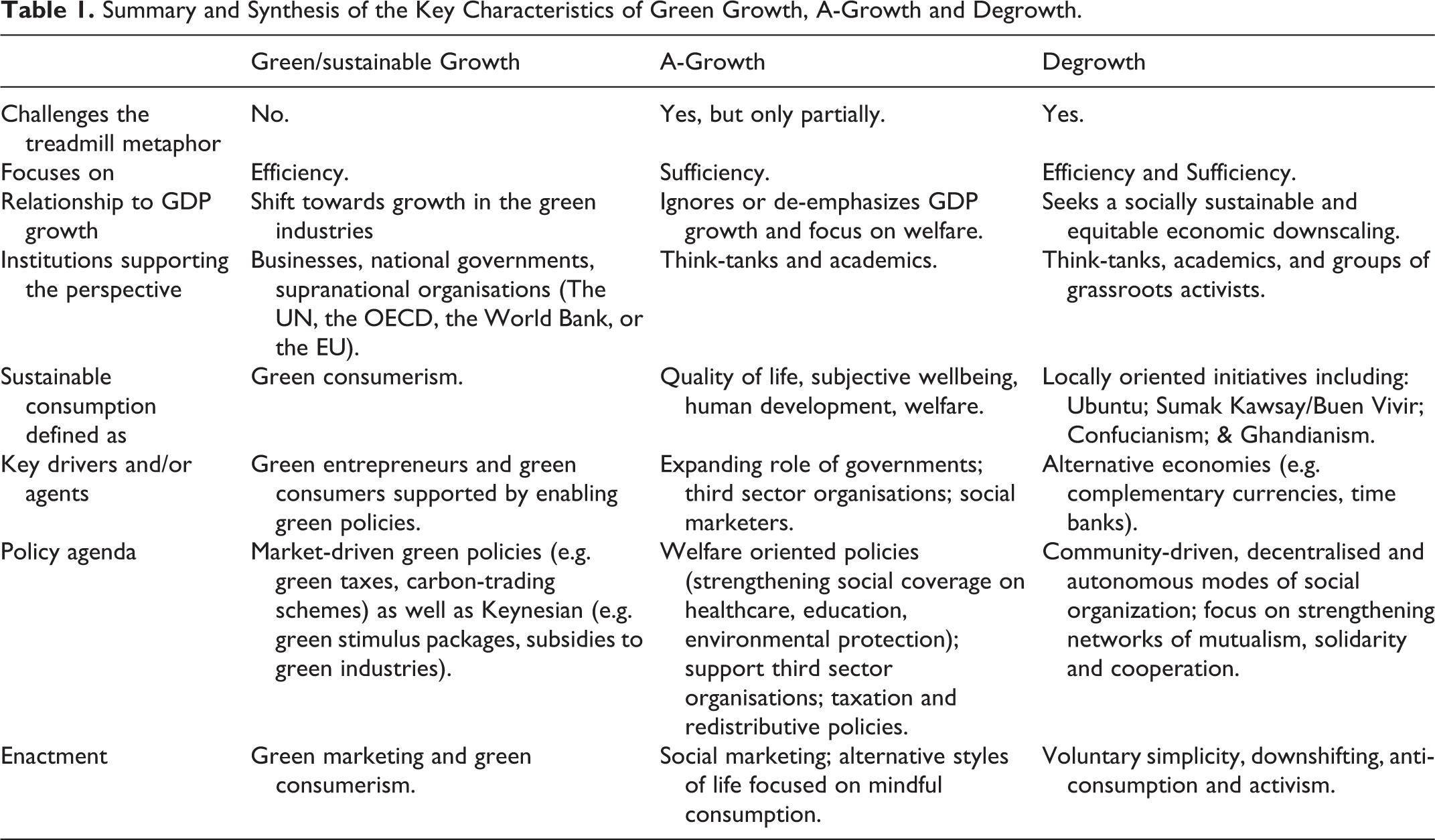
Summary and Synthesis of the Key Characteristics of Green Growth, A-Growth and Degrowth.
A Critical Evaluation of Green Growth, A-Growth and Degrowth: Locating the Role of Alternative Economies within the Degrowth Paradigm
In the preceding section, we identify green-growth, a-growth and degrowth as emergent responses to the growth dilemma. In the discussion that ensues, we undertake a critical evaluation of each approach and foreground the implications for alternative economies. In doing so, we conclude that any meaningful theorization of alternative economies from a macromarketing perspective must be located within the emergent paradigm of degrowth.
Each alternative possibility outlined rests upon a different arrangement of the provisioning system. For example, the advocacy of green growth is consistent with developmental macromarketing approaches to sustainability that seek to reform, rather than transform, capitalist institutions (Mittlestaedt et al. 2014). Critical approaches, on the contrary, remain cautious about macromarketing perspectives which fail to subvert the dominant social paradigm, as these are likely to bring about superficial changes rather than a meaningful transformation of society (Kilbourne 1998). This criticism is particularly apparent in relation to green growth, not least because the institutional arrangements underpinning this approach fail to challenge the treadmill dynamics of the capitalist system. Consequently, the greatest promises of green growth are paradoxical. They resurface to expose its greatest shortcomings. For example, due to the rebound effect, also known as Jevons’ paradox, the more efficient an economy becomes the more resources it uses rather than vice versa. In this regard, research evidences that savings resulting from a more efficient use of energy or natural resources are typically re-appropriated through additional consumption activities, thereby offsetting their previous environmental gains (Druckman et al. 2011; Murray 2013).
Further criticisms highlight that the quest for green growth is largely unconcerned with redistributive justice. For instance, by modelling the different scenarios set by the UN’s Green Economy strategy, Victor and Jackson (2012) argue that the gap between rich and poor is a likely to widen as a result of green growth policies. It is entirely plausible to suggest that these negative implications for global inequality might even be exacerbated within other green growth strategies, such as the ones formulated by the OECD or the EU, which place even less emphasis on redistribution (Bina and La Camera 2011). Similarly, green consumerism has been theorized as a medium/upper class phenomenon, not least because the premium price label of most environmentally friendly products renders sustainable living as a luxury, a display of elitism which remains largely unaffordable to many (Martinez-Alier 2002). Other commentators highlight green growth as a technocratic project which relocates questions of governance among large corporations, particularly those in technological sectors (Viitanen and Kingston 2014). In summary, therefore, green growth is characterized as the subterfuge of ‘polluting less to pollute longer’ (Daly 1992), a forward-moving escape option for a capitalist system ‘running out of steam’ (Bina and La Camera 2011; Harvey 2015).
Contrary to green growth, advocates of a-growth acknowledge that the mindless pursuit of GDP growth must be abandoned if economies are to make meaningful progress towards a genuinely sustainable future (e.g. Skidelsky and Skidelsky 2012; Stiglitz, Sen, and Fitoussi 2010). This is a well-established position within the macromarketing debates aligned to what Mittlestaedt et al. (2014) label as ‘critical’ perspectives on sustainability. Varey’s (2010) notion of welfare marketing epitomizes a-growth. To this effect, Varey (2010, p. 124) affirms that ‘the marketing system can produce collective well-being, if the growth imperative is de-emphasized and well-being is defined collectively.’ However, while not denying that this is an important step in the right direction, critics suggest that a-growth crucially fails to acknowledge that a period of socially sustainable degrowth will be necessary before affluent economies can learn to manage without growth (Alexander 2012; Kallis 2011). Therefore, as we have argued, advocates of degrowth recognize that the a-growth proposal of ‘de-emphasizing’ or ‘decentering’ the pursuit of economic growth in the name of well-being falls short of the task at hand, at least for the time being.
Consequently, it is apparent that disconnecting the plug of the growth treadmill poses a challenge that exceeds the framework of a-growth, compelling macromarketing scholars to, first and foremost, ‘provide a critique of the economy and its colonising effect…[before] pointing to escape routes’ (Fournier 2008, p. 541). For degrowth, what is needed is to conceptualize and engage with existing practices of social provisioning that do not rely on an economic vocabulary (Gibson-Graham 2006, 2008). This strategy will contribute to the performance of social organizations and modes of exchange that break-up the hold of economic rationality, creating new spaces in which citizens can experiment with non-economic relationships and identities (Fournier 2008). As Fournier further argues (ibid.), highlighting the constructed nature of the ‘economy’ and recognizing the openness of economic possibilities does not negate the importance of the various material practices which contribute towards meeting people’s needs. However, for proponents of degrowth, it is of critical importance to ‘re-embed such practices within the social and the political rather than be seen as belonging to an autonomous, reified field of ‘the economy’ (Fournier 2008, p. 534).
Degrowth, therefore, translates into a vision of social change from below, largely consistent with the diverse economies framework elaborated by Gibson-Graham (2006, 2008) in that it seeks to denaturalize the myth of a totalizing capitalist economy by rendering visible a myriad of provisioning activities that undermine the purported prevalence of economic rationality and profit-maximization. Likewise, degrowth insists that the economy is open to choices and multiple possibilities so that it can contribute towards freeing the macromarketing imagination and conceptualization of material practices from the grip of capitalism (Fournier 2008). Degrowth thus supports an emphasis on performing alternative provisioning systems, alongside modes of social organizations and consumption based on solidarity and mutual support. Without being too prescriptive, degrowth proponents maintain pressure to subvert the relationships that sustain the treadmill dynamics, most notably including: debt and financial power (Dholakia 2012); economic calculation and cut-throat competition (Latouche 2009); the endless quest for productivity and efficiency (Jackson and Victor 2011); the subordination of human autonomy to their participation in waged-labour (e.g. Nørgård 2013); or the sacred value of property ownership. Commodity-relations underpinning market exchange within formal capitalist economies must be challenged with a new social logic. This needs to be a logic that is built upon sufficiency (e.g. Gorge et al. 2015), cooperation and mutual support (Johanisova, Crabtree, and Franková 2013). It should be a logic which emphasizes a growing culture of sharing and open access (e.g. Belk 2010) and a logic which underpins a recuperation and expansion of the commons (e.g. Patsiaouras, Saren, and Fitchett 2015).
Consequently, to supplant the void left by the subsequent withdrawal of capitalist markets and the capitalist state in a purported degrowth society, the practices of social provisioning must increasingly rely upon new arrangements and social innovations currently encompassed by the umbrella term alternative economies. In fact, the list of alternative economic practices that can contribute to degrowth is intentionally broad and open-ended, most likely including: the proliferation of complementary currency schemes (North 2007), LETS and time banks (Ozanne and Ozanne 2016); co-housing projects (Lietaert 2010), eco-villages or rurban squats (Cattaneo and Gavalda 2010); initiatives aimed at creating and recuperating the urban commons, such as community gardens (Ghose and Pettygrove 2014), alternative water infrastructures (Domenech, March, and Saurí 2013) and community-owned electricity production (Kunze and Becker 2015); the promotion of counter-hegemonic forms of urban mobility (Dalpian, Silveira, and Rossi 2015); and consumption practices which challenge the hegemony of consumerism (Assadourian 2010), such as; voluntary simplicity (Alexander and Ussher 2012; Gorge et al. 2015); freeganism (Pentina and Amos 2011); sharing and freecycling (Ozanne and Ballantine 2010); or anti-consumption (Chatzidakis and Lee 2013).
Concluding Commentary
A wealth of evidence suggests that the mindless pursuit of economic growth places humankind on the brink of a systemic collapse, threatening to undermine the prosperity of present and future generations. Indeed, as Garcia (2012) observes, most current visions and theories of social and environmental change are deeply perturbed as the limits to growth become more apparent. As such, those visions of prosperity formulated on the presumption that growth should continue, or indeed can continue, are likely to share the same perilous destiny. Such powerful reminders of our civilization’s fragility and impermanence compels business leaders, government leaders, and policy makers to seriously consider the long-term viability of a growth-obsessed capitalist world. Hence, paradoxical though it may seem for a discipline that has thrived during an apparently golden period of capitalist-driven growth, we argue that the current situation provides marketing with an opportunity to enhance its social and political relevance.
In this vein, our categorization and evaluation of the debates presented provides a number of contributions. It charts the territory for a more productive approach to the study of alternative economies. It reconnects debates dispersed across disciplinary boundaries to expose neglected tensions between consumption, sustainability, development, inequality and growth. It reveals degrowth as an overlooked opportunity from which marketing scholars can meaningfully theorize and critically evaluate the role of alternative economies. In particular, it exposes why researchers should remain hesitant to celebrate the rise of alternative economic practices unless they provide a self-conscious alternative to the continuation of growth-driven capitalism. These are important considerations, particularly in terms of positioning future macromarketing inquiries which seek to challenge the growth paradigm.
In the evaluation and critique of economic possibilities outlined, we conclude that the transition towards degrowth cannot be realized while social provisioning remains dependent upon growth-driven institutions (Latouche 2009). While the pursuit of profit by capitalist firms is typically argued to be the most important driver of economic growth (Varey 2010), it is necessary to not overlook the fact that government provisioning is no less dependent on economic growth than that of capitalist firms (Hunt 2012). This outcome leads Gorz (1980) to observe that growth-oriented socialism reflects ‘the distorted image of our past, not our future’, assuring that ‘socialism is no better than capitalism if it makes use of the same tools’ (p. 20). This observation pitches degrowth in opposition to both the expansion of capitalist markets (Fournier 2008) and the capitalist state (Gorz 1980). Therefore, degrowth sidesteps the false market/state dichotomy to support alternative forms of social organization and provisioning whose development subverts, even if only precariously and temporarily, the language and values of capitalist institutions (Latouche 2009). In this sense, as Fournier (2008) suggests, the most important contribution of degrowth to environmental debates lies precisely in its emphasis on ‘escaping from the economy’ and the colonizing elements of economic thinking - most notably, but not exclusively, the GDP indicator. In doing this, degrowth invites us to rethink economic practices in terms of democratic choices and acts of citizenship rather than logical imperatives dictated by purportedly uncontestable treadmill dynamics.
Such a formulation of degrowth also renders the approach open to the same criticism and charges as any other strategy seeking social transformation from below: the question of power. This emerges as a critical concern which requires urgent attention from macromarketing scholars interested in advancing the possibilities of degrowth. In fact, as Kallis (2011) acknowledges, big social changes such as those entailed by degrowth will never appeal to the ‘kings’ and ‘priests’ of the time. In this respect, and despite knowing that the pursuit of economic growth is no longer delivering increasing levels of prosperity within the affluent world, perhaps one cannot help feeling intimidated, if not pessimistic, by the scale of the challenge ahead. And yet, as Kallis (2011, p. 878) also suggests, in the gap and loss of meaning created by what increasingly appears as a systemic crisis, a window of opportunity is likely to open for ‘a new cultural story and the alternative, liberated social spaces and practices that embody it.’
Footnotes
Declaration of Conflicting Interests
The author(s) declared no potential conflicts of interest with respect to the research, authorship, and/or publication of this article.
Funding
The author(s) received no financial support for the research, authorship, and/or publication of this article.