



Abstract
Building on work on social and macro-social marketing, we provide an empirical account of ways in which American gun violence prevention groups (GVPGs) act as macro-social marketers as they address the wicked problem of gun violence, which they define as deaths and injuries with firearms. We find that, as a collective, GVPGs attempt to change the culture related to guns by targeting up-, mid-, and downstream agents. We contribute to theory by (1) expanding the concept of macro-social marketing beyond government entities to include consumer interest groups and collectives; (2) introducing internal marketing as a macro-social marketing tool critical for macro-social marketers dependent largely on volunteers; (3) elucidating ways that macro-social marketers can accomplish upstream changes indirectly, by encouraging consumers and citizens to influence policy makers; and (4) revealing marketing tactics that can be leveraged across up-, mid-, downstream, and internal efforts.
Scholars have conceptualized macro-social marketing as marketing efforts aimed at creating systemic or macro-level change (Kennedy 2015; Lefebvre 2013) and as the type of marketing required to ameliorate multi-faceted, “wicked” social problems (Kennedy and Parsons 2012; Rittel and Webber 1973). Government entities are well suited to facilitate macro-level change, and extant macro-social marketing research has examined government agencies’ efforts to address social problems such as cigarette smoking (e.g., Kennedy and Parsons 2012). To date, researchers have neglected the study of non-governmental organizations (NGOs) as macro-social marketers, and some definitions of macro-social marketing limit it to government entities (Wymer 2011). Other definitions allow for the possibility of work by NGOs (Domegan 2008; Kennedy 2015), raising questions about whether and how NGOs may engage in macro-social marketing as they attempt to address wicked problems.
In this research, our objective is to improve understanding of the diverse agents that engage in, and efforts which constitute, macro-social marketing. We investigate consumer interest groups working to address the wicked problem of American gun violence, which these organizations define as death or injury by firearm. Such NGOs present an interesting context in which to examine macro-social marketing because they face four unique challenges in creating societal change: 1) they lack the formal authority of a government agency, 2) are funded through donations rather than public funds, 3) largely depend on the efforts of unpaid volunteers, and 4) are typically smaller than government entities, and thus possess less reach and capacity.
In investigating groups which identify as gun violence prevention groups (GVPGs), we adopt a systems theory perspective, which positions markets and the cultural systems with which they are intertwined as heterogeneous complex systems in which actors can have broad impacts on cultural and market norms that contribute to the problem (Domegan 2008; Mittelstaedt, Kilbourne, and Mittelstaedt 2006). Our research question is: In what ways do GVPGs use marketing tools in their attempts to create macro-level change? Specifically, we seek to understand whom they target, the strategies they use to reach these targets, and the outcomes they hope to achieve. Because a relative lack of paid staff and capacity differentiate GVPGs from the government entities that have been the focus of previous macro-social marketing research, we give special attention to the groups’ efforts aimed at motivating volunteers and the ways the groups’ efforts complement one another.
As theoretical contributions, we expand the field’s conceptualization of macro-social marketers to include NGOs and collectives by demonstrating how a collective of consumer interest groups targets marketing efforts to agents throughout a system in an attempt to change institutionalized norms; add internal marketing to the set of macro-social marketing tools previously conceptualized, illuminating its importance for organizations dependent on volunteers; elucidate ways that macro-social marketers accomplish upstream changes indirectly by encouraging consumers and citizens to influence policy makers; and reveal tactics that can be leveraged across up-, mid-, downstream, and internal efforts.
Social Marketing and Macro-social Marketing
Social marketing involves the use of conventional marketing tools to change individual behaviors in ways that improve individuals’ well-being and address a social problem (Andreasen 1994). Ascribing agency and causation of the social problem to individuals (Wymer 2011), social marketing seeks to change behavior of any who engage in the focal, problematic act (Andreasen 2006). Social marketing efforts can be classified as up-, mid-, or downstream, depending on the proximity of the agent to the problematic behavior (see Gordon 2013). Downstream targets are individuals who engage in the behavior, and downstream marketing has historically been favored by agents seeking to influence individual behaviors in pro-social ways (Hoek and Jones 2011; Wymer 2011). Examples include anti-smoking campaigns directed at smokers and drunk-driving prevention campaigns directed at drivers (Andreasen 2006). Midstream targets are agents proximal to individuals engaging in the behavior, including family members, colleagues, and neighbors (Gordon 2013). These agents can motivate downstream individuals to change their behavior by setting standards and expectations, incentivizing behavioral change, and/or facilitating the work of social marketers (Andreasen 2006). Upstream targets are “individuals and groups in legislative bodies, government departments, corporations and non-profit organizations, who have the power to make policy, regulatory and legislative changes” that improve well-being (Donovan and Henley 2011, p. xv) and reduce the social problem (Andreasen 2006; Hoek and Jones 2011).
Social marketing aimed at changing individual behavior is often insufficient to address wicked social problems (Kennedy 2015), which require changes throughout a complex system. Macro-social marketing scholars have built on research into system-wide efforts to facilitate positive social change (Andreasen 2006; Kennedy and Parsons 2012) to conceptualize how social marketing might be applied at a societal level (Domegan 2008; Donovan and Henley 2011; Kennedy 2016). Adopting a macro perspective which foregrounds social, cultural, and/or political phenomena within the broad marketplace system (Mittelstaedt, Kilbourne, and Mittelstaedt 2006), Kennedy (2015) defines macro-social marketing as marketing efforts aimed at creating holistic, system-wide change by promoting change in institutionalized norms.
Such conceptual work has explored the variety of efforts that may constitute macro-social marketing. Dibb (2014) proposes that societal change requires a synergistic combination of upstream, midstream, and downstream efforts. Kennedy (2016) adds community participation, de-marketing, and systems social marketing to the list of macro-social marketing tools. Empirical investigations of the ways that organizations use marketing efforts to change institutionalized norms while navigating practical challenges are scant (see Kennedy and Parsons 2012 for an exception), and their absence motivates our research.
Government entities with broad reach seem well equipped to target diverse agents with the marketing efforts necessary to create macro level change. However, NGOs may also desire and work toward such change. Relative to government entities, these organizations typically lack reach, authority, public funding, paid staff, size, and capacity, making it difficult for a single NGO to implement the combination of up-, mid-, and downstream marketing efforts that Dibb (2014) proposes is necessary for societal level change. Researchers have thus far neglected the ways that NGOs facing such challenges attempt to achieve macro-level change, or how multiple NGOs with a shared societal goal but limited individual capacity and reach may engage in complementary up-, mid-, downstream, or other efforts.
Our research fills these gaps. We conduct an empirical study of the ways in which multiple consumer interest groups use a variety of marketing tools to address a wicked problem at a societal level. We investigate the ways in which the up-, mid-, and downstream efforts of multiple organizations work synergistically in the groups’ collective efforts to change cultural norms, thus answering calls for additional research on the ways in which upstream social marketing complements (micro)social marketing (Goldberg 1995; Gordon 2013) and how macro-social marketers can effectively integrate upstream and downstream approaches (e.g., French et al. 2009). We aim to increase understanding of the diversity of organizations that may be conceptualized as macro-social marketers, the variety of efforts which constitute macro-social marketing, and the ways that marketing tools can be efficiently and effectively deployed across a system. Further, we seek to provide insight into macro-social marketing in a context that includes a powerful opposing lobby, which can impede the effectiveness of social marketing efforts (Wymer 2011).
Gun Violence within the American Cultural Context
Constitutional Protection and the Gun Lobby
America’s relationship with guns is unique among developed nations in that the right to possess firearms is protected in the U.S. Constitution (adopted in 1791). The most recent U.S. Supreme Court interpretation of the Second Amendment (District of Columbia v. Heller 2008) establishes the individual right to possess firearms, including handguns, for self-defense.
Several agents within the cultural system of firearms oppose any regulation they deem as restricting this right, including gun manufacturers and marketers, consumer groups which support “gun rights,” lobbyists, and politicians. The National Rifle Association (NRA), which some have argued constitutes the gun lobby (Carroll 2016), currently has approximately five million dues-paying members, including many who support only legislators favored by the NRA (Agger and Luke 2015; Rodengen 2002). The group exerts significant influence on municipal, state, and federal gun legislation, as well as business policies and individual consumer practices (Carter 1997; Hardy 2016). Employing a variety of effective marketing tools to promote gun rights, purchase, ownership, and training (Blair and Hyatt 1995; Witkowski 2013), the NRA often thwarts attempts to impose new regulation (e.g., Cagle and Martinez 2004) or change other aspects of the cultural system. In as much as the NRA aims to benefit society by protecting a civil right, one could argue that it has been an effective macro-social marketer in influencing cultural and market institutions over the last century.
Gun Ownership and Regulation
U.S. Congressional reports estimate that Americans own approximately 310 million civilian firearms, or approximately one firearm for every person in the country (Krouse 2014). Purchases tend to spike after high-profile shootings or media coverage of issues related to more restrictive gun legislation (Santos 2015), a response seemingly stoked by public fear and concerns for personal safety (Jones and Stone 2015). Nearly half of gun owners arm themselves for purposes of self-defense (Fingerhut 2016), despite research showing that carrying a firearm on one’s person (Branas et al. 2009) or keeping a firearm in one’s home (Kellermann et al. 1998) puts the gun owner and family members at increased risk of being shot (Wintemute 2008).
Presently, the majority of Americans support both the right to possess firearms and some regulations, such as requiring “universal” background checks to prevent certain groups (e.g., convicted domestic abusers) from legally purchasing guns (Fingerhut 2016). (Universal background check legislation requires a potential buyer of a firearm to pass a criminal background check for most types of purchase, including from a firearm retailer, private sale, and online sale.) This support is consistent with research indicating that background checks help to reduce gun violence (Webster, Vernick, and Bulzacchelli 2009). However, current federal legislation does not require universal background checks, and only eighteen (of fifty) states require them (see smartgunlaws.org). Further, state-level legislation and normative behaviors related to firearms vary widely. Thus, firearms occupy a unique position in American politics; the public largely supports the right to own firearms with some restrictions, but federal and state legislatures are reluctant to pass even well-supported regulations (Eakins and Gatch 2016).
American Gun Violence as a Wicked Problem
In this research, we adopt the definition of gun violence used by the self-identified gun violence prevention groups we investigate. These groups define gun violence as any injury or death by gunshot, regardless of intent. Across the past 5 years for which the U.S. Centers for Disease Control and Prevention has published data (2010-2014), averages of 32,964 Americans were killed and 78,815 were injured with firearms each year (Centers for Disease Control and Prevention). In 2014, the firearm death rate (10.54 per 100,000 people) was similar to that of motor vehicle deaths (11.18 per 100,000). However, unlike motor vehicle deaths, firearm deaths have increased in recent years. Number of firearm deaths increased 6.08% from 2009 to 2014, with the death rate increasing by 2.73%. Over the same period, number of firearm injuries increased by 10.24%, with a 6.72% increase in the injury rate. (The U.S. C.D.C. data for the most recent 10-year period, 2005-2014, indicates an average of 32,058 firearm deaths and 75,057 non-fatal firearms injuries per year. In this 10-year period, the crude rate of firearm deaths per 100,000 people increased 1.44% to 10.54, and the crude rate of non-fatal firearm injuries per 100,000 people increased 7.53% to 25.41.)
American rates of injury and death by gunshot far surpass those of other developed countries (Wintemute 2015), prompting the American Medical Association and other public health organizations to call for gun violence to be addressed as a public health issue (Mozaffarian, Hemenway, and Ludwig 2013) deserving of unrestricted access to research funding and data by public health professionals (Weinberger et al. 2015).
We conceptualize America’s large number of injuries and death by firearms as a wicked problem. Wicked problems (Rittel and Webber 1973) are inherently difficult to characterize due to a multiplicity of potential contributors and can never be completely or indisputably solved. They involve numerous stakeholder groups with various perspectives on the nature of the problem and appropriateness and effectiveness of potential solutions. These characteristics prohibit the generation of an exhaustive set of possible solutions, and provide no means of testing if a solution has been ultimately effective. In addition, wicked problems are “influenced by a constellation of complex social and political factors” (Kreuter et al. 2004, p. 442), including society’s values, beliefs, and behavioral norms (Kennedy 2015).
Gun violence meets all of these criteria (Santaella-Tenorio et al. 2016; Weinberger et al. 2015). As with other wicked problems, the various stakeholders in gun violence interpret the problem and its causes differently, and propose solutions consistent with their respective interpretations. For instance, some believe that gun violence should be addressed through research, more restrictive regulation of firearms, and consumer education about the dangers of gun ownership (Kennedy 2016; Mozaffarian, Hemenway, and Ludwig 2013). Meanwhile, others argue that the problem should be addressed by focusing on related social issues, such as mental health, national security, and violent crime (see Agger and Luke 2015; Lott 2010), and still others maintain that gun violence will decrease if gun ownership increases (Kates and Mauser 2007).
Disparate interpretations of solutions to gun violence are facilitated by the multiplicity of its manifestations. While mass shootings garner national attention, they account for only a small proportion of gun violence (Lankford 2016). Suicides account for 63% of firearms-related deaths, (Centers for Disease Control and Prevention), and the remainder of deaths and injuries occur in ways that vary in both intentionality and criminality. For example, approximately 18,000 children and teens are killed or injured with firearms each year (Centers for Disease Control and Prevention), and many of these occur when children gain access to unsecured firearms. Other manifestations include gang violence, acts of self or home defense, hunting accidents, domestic violence, pre-meditated murder, impulsive shootings following verbal disputes, and others. Gun violence is intertwined with other, equally complex social problems, including mental illness (Metzl and MacLeish 2015), racism (Reeves and Holmes 2015), and domestic abuse (Vigdor and Mercy 2006). Moreover, many argue that the problem is perpetuated by entrenched cultural norms and a market system that makes guns easily available (Aneja, Donohue, and Zhang 2014; Miller, Azrael, and Hemenway 2001). For those who adopt this view, identifying and implementing solutions require a systemic approach.
Gun Violence Prevention Groups
GVPGs are consumer interest groups comprised of individuals who view the current levels of firearm-related injury and death as intolerable, and link these to inadequate regulation and irresponsible consumer practices (Carroll 2016). GVPGs share an understanding that the problem of gun violence is complex and multi-faceted, and that cultural change will occur through a combination of regulatory changes, shifts in cultural perspectives, and behavioral change on an individual level (Goss 2006). These groups began to emerge and mobilize in the 1970s. With a collective membership currently estimated at less than 10% of NRA membership, GVPGs have had some successes with legislative change at the state level, but on the whole the groups lack the visibility, resources, and influence of the NRA (Carroll 2016). Our research seeks to understand how these groups employ marketing tools in their attempts to reduce gun violence through societal change.
Method
Our research goals encompass emergent phenomena and relationships. Therefore, we employed an inductive, interpretive approach. Qualitative methods are appropriate for studying macromarketing topics which entail complex stakeholder relationships and the need to simultaneously consider multiple, interrelated concepts (Samuel and Peattie 2016).
Data Collection
Data collection was prefaced by emerging ourselves in the cultural context to develop an understanding of the social problem, including identification of stakeholders (e.g. GVPGs, the NRA) and data related to the nature and scope of the problem (e.g. C.D.C. reports on deaths and injuries). Beginning in February 2015, and throughout the project’s duration, each author engaged in regular, systematic media scanning of America’s three largest news outlets (i.e., Wall Street Journal, New York Times, USA Today) for articles related to guns, gun rights, gun violence, gun control, etc. Additionally, we used social media to “follow” prominent GVPGs and similar organizations “recommended” by social media algorithms. We discussed the media scanning at weekly research meetings, where we also identified, gathered, and read additional background material, including: articles in other mainstream media (e.g. The Economist), summaries and opinions related to high profile legal decisions (e.g. D.C. v. Heller), books on the subject, and public opinion polls (e.g. PEW reports).
Our sampling of GVPGs began by purposively sampling one nation-wide group with a local chapter (Safe And Sound), and one regional group formed after a high-profile mass shooting (Protect The Children). In April 2015, the first author contacted group leaders and arranged formal interviews with professional staff. Sampling continued using a snowball method. We selected additional groups which were mentioned or present at meetings or interviews, or whose social media messaging was similar to the first two groups’. We collected data from nine GVPGs. Five work on a national or regional level, and four work on a local level. Table 1 provides more detail on the groups. To protect the identity of these groups and individual informants, we use pseudonyms, and identifying details have been disguised.
Profiles of Gun Violence Prevention Groups.

We collected multiple forms of data, including interviews with GVPG organizers and legislators, participant observations at in-person events (e.g. rallies, member training sessions, local chapter meetings), informal field interviews with organizers and volunteers, and content from GVPGs’ social media activity and websites. Each author was involved in data collection. Table 2 provides more detail on data sources.
Types of Data Sources and Informant Profiles.
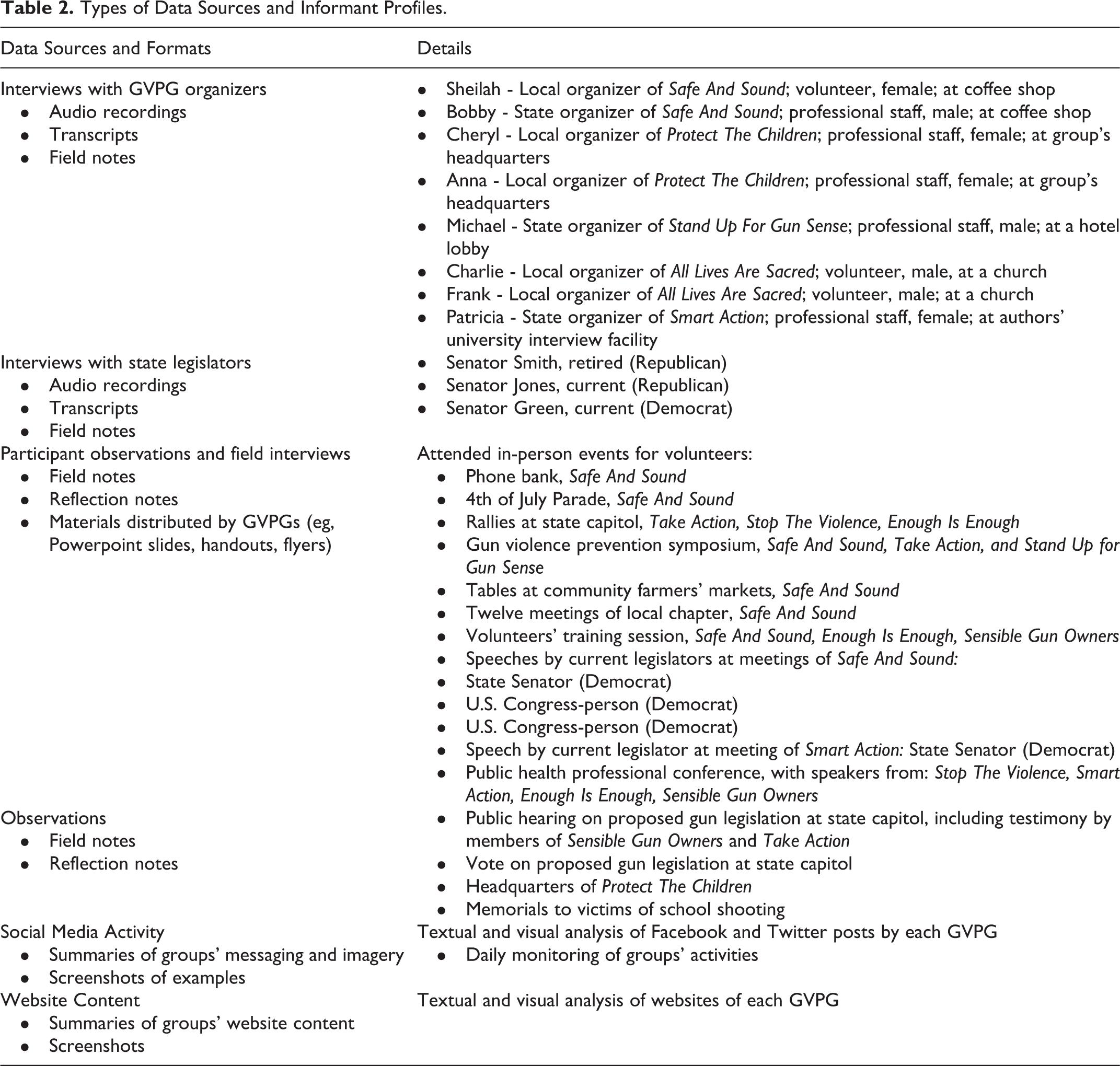
We conducted formal interviews with eight organizers at five GVPGs. The interview guide included questions about group history, formation, and structure; group strategies and tactics, including how they have evolved over time; successes, failures, and challenges; and how volunteers are recruited and retained.
State legislators were sampled purposively to include Democrat and Republican perspectives. Interviews enabled us to gain an understanding of how GVPGs attempt to influence law makers and policy. Interviews included questions about the climate for gun policy in the legislature and in the state; nature and frequency of interactions with GVPGs and “gun rights” groups; and the nature and significance of communication from citizens.
We requested permission to attend GVPGs’ meetings and community events, and receive email correspondence. Several events, such as a state-wide symposium on gun violence prevention and rallies at a state capitol, featured multiple GVPGs, providing support for our conceptualization of these groups as an informal collective. Participant observations and field interview data from these events were captured in fieldnotes. Field interviews involved informal conversations with group members, and included follow-up and clarification questions (e.g. why did you target that legislator?).
Transcripts and fieldnotes formed a data set of 307 single-spaced pages. This was supplemented with materials provided by groups to volunteers (e.g. scripts to use when telephoning voters, PowerPoint slides outlining preferred terminology) and the public (e.g. pamphlets about safe gun storage practices). With the help of research assistants, the authors monitored groups’ Facebook and Twitter posts daily from April 2015 through October 2016. The data set included screen shots of groups’ websites and social media messaging, and typed summaries and observations of the website and social media content.
Data Analysis
Data collection and analysis occurred iteratively throughout this study. Each author reviewed data independently. At weekly authors meetings, we collaboratively analyzed and coded data, advanced our interpretation, and articulated our emerging data collection plan. Starting with open coding, we identified broad categories and themes, discussed their properties, and identified examples in the data (Glaser 1998) to identify agents, targets, and strategies. As we moved iteratively between the data and our emerging theorization, we employed focused coding (Charmaz 2006) to select and focus on codes and categories informed by theory; specifically, we assigned codes related to up-, mid-, and downstream marketing. The category “internal marketing” emerged as we analyzed ways the groups attempt to motivate volunteers. We then used axial coding to reveal the properties of the different categories, refine our initial codes and categories, and identify relationships between categories (Corbin and Strauss 1990). These codes focused on the nature and properties of cultural changes sought by GVPGs and led to our emergent interpretation of how GVPGs engage in macro-social marketing.
GVPGs as Macro-social Marketers
Collective Seeking Cultural Change
As a wicked problem, gun violence presents the possibility of multiple interpretations of the nature and causes of the problem. We find that GVPGs identify the root of gun violence as irresponsible, dangerous behaviors and practices – many of which are legal – that contribute to an unacceptably large number of preventable deaths and injuries. Unlike the contexts of smoking (Kennedy and Parsons 2012) and alcohol consumption (Gordon 2013), gun violence comprises a wide range of individual behaviors. Thus, social marketing approaches aimed at changing a specific individual behavior are inadequate for addressing gun violence. GVPGs instead attempt to influence the cultural system within which gun violence occurs. Some groups explicitly identify “changing culture” as a goal on their websites (e.g., Stop The Violence), others express their desire to “change the country and the culture” and “influence cultural change” at leadership events (fieldnotes, Safe And Sound, Enough Is Enough), and some informants expressed it in interviews. When asked what constitutes success for their organization, Anna replied, “I think it’s going to be a huge cultural shift…Just keeping people safer in all aspects. To keep women safer from their abusive husbands and boyfriends, to keep kids safe at school, reduce the rate of suicide by a gun…It’s hard to say where you start because it’s everywhere.” (Anna, Protect The Children)
We conceptualize the groups as a collective in that they share a broad marketing strategy and the goal of reducing gun violence by changing cultural norms, often publicly support one another’s efforts, and occasionally coordinate activities: “we all are definitely looking for the same thing. The end goal for all of us is the same—reduce gun violence…but our avenues are different to get there” (Cheryl, Protect The Children). The collective attempts to intervene at multiple levels of the cultural system, with some groups focused exclusively on upstream efforts, one (Protect The Children) primarily on down- and midstream efforts, but most targeting agents at multiple levels (see Table 1). For example, Marco, a leader of Sensible Gun Owners, explains that his group focuses on passage of “safe [gun] storage laws, [which] will change behaviors of gun owners and reduce gun deaths and injuries that happen as a result of negligence,” emphasizing his group’s formal affiliation with Enough Is Enough and the ways his group both formally and informally combines forces with other GVPGs to push for legislative changes: “we all [gesturing to leaders of Smart Action, Stop The Violence] work together. We absolutely do. We have to.” Indeed, a member of Stop The Violence notes that a political action committee (PAC) has recently formed, comprised of Safe And Sound, Enough Is Enough, Take Action, and Stop The Violence, to formally align these GVPGs’ efforts in supporting political candidates. In other instances, the collaboration is more informal and ad hoc. Patricia, the leader of Smart Action, describes how groups get involved “from every angle.” “Each group has something to offer. Smart Action has the experience. We’ve been in this game a long time. Marco’s organization [Sensible Gun Owners]: they know guns, inside and out. They’re all gun owners. Safe And Sound: they’ve got the numbers. We need 80,000 people at a rally? They get involved, and they also have the resources to do [safe gun storage] training at the local level, to change how people are actually being safer with their guns. If we need data, research, that comes from Take Action. They have the people on that. It’s all a big team. We all know what the other [GVPGs] are up to, and then we can bring it all together when we need to.” (Patricia, the leader of Smart Action)
Shared Marketing Strategy
The overarching marketing strategy shared by all GVPGs in the collective includes specific positioning, targeting, and communication. The GVPGs position themselves as supporters of the Second Amendment; none indicate a desire to repeal it, or even challenge its current interpretation, and the issue arose rarely in our data. Instead, groups focus on reducing gun violence while upholding the Constitution. Members from multiple groups explicitly state that the groups’ support of the Second Amendment establishes credibility and “prevents a conversation [with a neighbor, legislator, etc.] from being shut down” (field interview, Take Action), highlighting the importance of this positioning to their efforts to influence those necessary to achieve their objectives.
The GVPGs target the “middle-ground majority” (Sheilah, Safe And Sound) of the public in their attempts to ultimately change societal norms, business practices, and regulation. Specifically, the GVPGs attempt to raise awareness among this target audience of the prevalence of gun violence in America and the various legislative and behavioral changes that could reduce it. They define the middle-ground majority as those who do not currently espouse extreme views on gun rights and may therefore be receptive to their message. Cheryl (Protect the Children) explains, “you have these seven percent yelling on the left, and these seven percent yelling on the right, but there’s a whole lot of people that just don’t want children killed…so that’s the path.”
Finally, the groups strategically focus their communications on everyday gun violence rather than mass shootings, continuously highlighting statistics in their marketing communications such as “eight children are killed each day” (Facebook, Protect The Children) and “52 women are shot and killed by their intimate partners every month” (Facebook, Safe And Sound). Informants explain that their groups focus on everyday shootings not only because they account for so many more deaths, but because everyday violence, unlike mass shootings, provides less opportunity for gun rights advocates to redirect the discussion: [after a mass shooting, gun rights advocates ask] “‘Why did the mental health system fail us?’…[The public] believes the gun lobby when [it] says, ‘There’s nothing you could have done about that case so just shut up and move on.’…It’s a lot tougher for people to try to deal with when you’re talking about the everyday shootings” (Michael, Stand Up For Gun Sense).
The collective’s marketing strategy – positioning themselves as supportive of the Second Amendment, targeting the “middle-ground” majority, and focusing communications on the everyday toll of gun violence while utilizing non-polarizing language – guides a wide variety of upstream, midstream, downstream, and internally focused marketing efforts aimed at changing institutionalized norms at multiple levels of the system. In combination, these efforts constitute macro-social marketing.
Marketing Efforts, Targets, and Desired Changes
We depict the collective’s various macro-social marketing efforts in Figure 1, with marketing efforts depicted as solid arrows. We now provide an overview of the model before describing the groups’ tactics in more detail.

Theoretical model of consumer interest groups as macro-social marketers.
As shown in the upper portion of Figure 1, GVPGs in the collective engage in upstream marketing as they work toward changing formal institutional norms, including legislation and business practice (Kennedy 2015) related to guns. GVPGs target some upstream marketing efforts directly to legislators in hopes of (1) passing laws that increase restrictions on, and accountability for, firearm purchase and possession; and (2) preventing passage of laws that would decrease such restrictions and accountability. The groups also directly target business leaders, in hopes that they will implement policies to prevent those likely to perpetrate gun violence from purchasing a gun, such as requiring receipt of a conclusive background check before selling a firearm, or which the groups believe will create barriers for potential perpetrators, such as prohibiting the open or concealed carry of firearms in places of business.
GVPGs also seek these upstream changes indirectly, by targeting citizens and consumers. GVPGs aim to encourage citizens to directly affect law through voter initiatives or to exert political influence on elected lawmakers through their vote, voice, or political contributions. GVPGs encourage consumers to exert pressure on businesses to implement desired policies through boycotts or demonstrations. This influence and pressure are depicted as dashed arrows.
As shown in the central portion of the figure, GVPGs engage in midstream marketing as they attempt to influence informal, social norms by increasing the normativity of behaviors which GVPGs believe decrease risk of, or provide early intervention in, gun violence. GVPGs target these midstream marketing efforts to members of the public in their capacity as members of the immediate social environment of someone who may intentionally or unintentionally commit acts of gun violence. For example, GVPGs provide education about potential suicide risks, and encourage parents to ask about the presence and security of firearms in homes their children visit. In addition, they target midstream efforts to influential service providers, such as physicians, and community leaders.
GVPGs engage in downstream marketing, shown in the lower portion of the figure, in their attempts to influence the individual behaviors of current and potential gun owners, and ultimately normalize behaviors the groups deem safe. For example, GVPGs implement campaigns to promote storing guns and ammunition in ways that prevent child access. Finally, within the bubble depicting the collective of GVPGs, we highlight the internal marketing efforts intended to motivate members. We next describe the groups’ externally targeted tactics in more detail.
Upstream, Midstream, and Downstream Tactics
GVPGs employ a variety of marketing tactics in their upstream, midstream, and downstream efforts as they target external agents. Some are specific to one stream, some are used across multiple streams, and some also target group followers, those who follow GVPGs’ webpages and/or participate in events, whom we conceptualize as inside the collective. In presenting the ways in which these tactics overlap and diverge across streams, we answer calls from previous scholars to further investigate the ways in which macro-social marketers integrate their various efforts (Luca, Hibbert, and Mcdonald 2016). Table 3 shows GVPG marketing tactics targeted to more than one type of agent (up-, mid-, downstream, and internal). In the following sections, we unpack these tactics and how they are deployed.
Tactics Targeted to Multiple Types of Agents.

Across their up-, mid-, and downstream marketing efforts, GVPGs utilize both rational and emotional appeals. Michael, an informant at Stand Up For Gun Sense, referred to this as attempting to “win the minds, not just the hearts” of agents the groups wish to influence. GVPGs are aware that the nature of gun violence may entice them to rely too heavily on emotional appeals, and that such appeals may be dismissed by targets who are more influenced by objective arguments. Therefore, groups intentionally use both rational appeals, including research data and statistics from credible sources, and emotion evoking stories of those personally impacted by gun violence, thus increasing the salience of the social problem and demonstrating the need for legislative and cultural change (Berkhout 2013). Michael, who became involved in gun violence prevention after his child was killed in a school shooting, explains how he tries to combine emotion and facts in his attempts to persuade others: “I try to mix, ‘here’s a little bit of my personal experience and this is why I got involved, but once I got involved, I learned these things. I want to share these things with you. This is why I want you to support me, not because I want you to feel sorry for me.’” (Michael, Stand Up For Gun Sense) “statistics and the reality of how dangerous unsecured guns can be, with my experience as a responsible gun owner, and my experience losing [my sister] because her shooter was easily able to steal an unsecured gun.…This is something that gun owners can relate to, and elected officials [too]. (Marco, Sensible Gun Owners)
In their upstream attempts to directly and indirectly influence legislators to support or oppose gun-related legislation, GVPGs use two additional tactics simultaneously with both rational and emotional appeals: working toward state rather than federal legislation, and “providing cover” (Patricia, Smart Action) for legislators supporting the groups’ agenda. Examples of desired legislation include imposing and enforcing “universal” background checks; requiring firearms be stored safely; imposing personal liability if one’s firearm is used in a crime; expanding the legal definition of domestic abuse(rs) and de-possessing abusers and other criminals of firearms; preventing the passage of open carry and “stand your ground” laws, and preventing repeals of existing restrictions on purchase and possession. (“Stand your ground” laws remove an individual’s duty to retreat from an imminent threat of personal harm, and permit the individual to use deadly force in self-defense.)
Groups focus their efforts at the state level because they deem passing desired laws at the federal level exceedingly difficult. An informant from Protect The Children expresses a lack of faith in federal progress common to many of our informants, recounting her reaction following the failure of a federal bill that would have limited magazine sizes in the wake of the 2012 mass shooting at Sandy Hook Elementary. She says, “[after that] we said, ‘Alright, this is going to have to be a state-by-state thing. If Congress isn’t going to do it, then the states are going to have to do it themselves’” (Anna, Protect The Children). We find that even nationally-organized GVPGs target their legislative efforts to the state level in states where progress seems possible.
Our informants express that it is essential to provide legislators with “cover” and “ammunition” (Patricia, Smart Action), in the form of compelling, objective data and demonstrations of voter backing, to counter the passionate and vocal gun lobby (State Senator Green; Michael, Stand Up for Gun Sense). We note the irony of our informants’ use of gun-related metaphors as we identify multiple forms of “cover,” including: research data; letters, calls, and emails from constituents in favor of increased restrictions; organizational policy statements representing the views of a large number of voters; presence of supporters at hearings and votes; analogies to regulation of other consumer products such as automobiles; and testimony by relevant stakeholders, including those personally impacted by gun violence. In order to generate cover in the form of voter support, GVPGs target persuasive messaging to group followers and other citizens.
At the midstream and downstream levels, the GVPGs develop and promote a wide variety of programs aimed at changing behavioral norms in ways that they believe will reduce gun violence. An informant explains why her group uses mid- and downstream efforts rather than focusing only on upstream changes, saying, “Totally grass roots [is] the way the country has always changed. The country has changed for seatbelt laws and marriage equality, and all of these things have come up from the bottom. You don’t start at the top” (Anna, Protect The Children). Such comments allude to the ways in which individual behaviors may change societal structures over time, even as they are constrained by existing structures (Giddens 1994). Examples of midstream efforts include: campaigns to promote reporting suspicious activity or discussing access to firearms with parents of children’s playmates; programs to reduce bullying among schoolchildren, provide early interventions in gang violence, or help individuals identify indicators of mental illness and suicide risk and intervene; and, in states where it is not prohibited by law, programs to encourage pediatricians to discuss gun safety with parents. Downstream programs identified in the data target gun owners at risk of unintentional shootings and encourage storing firearms in ways that prevent child access.
GVPGs implement two tactics that bridge their mid- and downstream marketing efforts: (1) establishing local groups that can tailor programs to the community and potentially serve as test markets for broader implementation, and (2) recruiting opinion leaders in the community to implement these programs. For example, when Protect The Children initiates a new grassroots group in a community, group leaders work with locals to identify “grass-tops” – existing, successful leaders of formal and informal community institutions – with the motivation and ability to start a Protect The Children group. In addition, groups implement a tactic across midstream targets and internal followers: providing individuals with training and tools to influence others’ behavior, such as suggested wording and a checklist for discussions with other parents about firearm access, and checklists physicians can use in discussions with patients and their family members.
Internal Marketing Strategies
GVPG leaders are acutely aware of the systemic nature of gun violence and the severity of the challenges they face as they attempt to change entrenched cultural systems. In discussing the “uphill battle” of addressing this social problem, informants noted many obstacles, including: the sanctity of the second amendment; a lack of awareness among the general public about existing gun laws, in part due to wide variation in state laws; the desire of consumers in the “broad middle” to avoid a controversial and polarized issue; issue fatigue due to the prevalence of high-profile shootings; the multiple manifestations of gun violence; and lack of reliable data, in part due to the current ban on federal funding for CDC research on gun violence. Further, many informants note the magnitude of the gun lobby’s influence, which manifests as significant lobbying budgets and impactful marketing campaigns offering consumers appealing, simple clichés (e.g., “guns don’t kill people, people kill people”), or stressing the sanctity of a constitutionally-protected right regardless of its social impact (State Senator Green; fieldnotes, Smart Action), in ways that can encourage individual consumers to identify and align themselves with gun rights advocates (Bhattacharya and Elsbach 2002; Witkowski 2013).
In the face of these challenges, consistently motivating followers to voluntarily work towards cultural change represents an internal priority. Extant literature on volunteer workers has examined the managerial practices that influence volunteers’ motivation and commitment, such as quality and clarity of communications, information, and planning (Farrell, Johnston, and Twynam 1998). We build on this by focusing on the marketing efforts targeted to groups’ followers and volunteers. We designate these efforts as a form of internal marketing, which has traditionally been conceptualized as marketing to employees to motivate them to provide satisfying customer experiences (George 1990). In the context of non-governmental macro-social marketers, we find that internal marketing aimed at motivating followers to work toward cultural change represents a substantial and vital portion of their marketing efforts. “There is no shortage of passionate, capable volunteers. The challenge is to prevent burnout, to broaden the perspective beyond one particular bill” (Bobby, staff member Safe And Sound).
Inciting Outrage
Consistent with their strategy of focusing on everyday gun violence in America, GVPG leaders incite outrage among followers by regularly communicating the relentless nature of gun violence and its impact on everyday Americans. While high-profile mass shootings capture national attention, the dialogue and concern quickly wane, frustrating GVPG leaders, who would like to continuously channel followers’ anger into upstream marketing efforts (fieldnotes, Safe And Sound). Leaders seek to fuel continued anger by reminding followers of the “slow-motion massacre” of everyday gun violence (Patricia, Smart Action).
Groups somberly profile incidents several times a day on social media, often highlighting how victims and survivors are “everyday” people rather than criminals. For instance, Safe And Sound posted a link to a news report of a child’s death with the comment, “AGAIN. After finding a loaded handgun on a desk in his grandparents’ Mississippi home, a 3-year-old unintentionally fatally shot his 8-year-old sister in the head. Safe, responsible gun storage can prevent these tragic shootings.” Other GVPGs make frequent use of hashtags that evoke anger, including #ENOUGH and #notonemore. As they like and share posts, followers engage in externally targeted marketing aimed at normalizing behaviors the groups deem safe and garnering public support for upstream changes.
Some GVPG emails and social media actively stoke and direct anger toward legislators who are reluctant or refuse to institute laws that leaders believe would reduce gun violence. A Facebook post by Smart Action reads, “Rather than passing stronger laws to keep guns out of the hands of madmen, we put our kids at risk and make them hide in closets of locked schoolrooms.” Such content fuels outrage while the social media platform provides followers a means of engaging in upstream marketing by sharing the posts with other voters. Calls to action reveal group leaders’ intent that followers channel their outrage into efforts to influence other voters and legislators: “Don’t stop urging your lawmakers to act to keep guns out of the hands of dangerous people, so that this [Orlando shooting, June, 2016] might be the last time our country comes together to mourn lost brothers and sisters. Click the link below to find your representatives’ phone numbers!” (Facebook post by Safe And Sound).
Stoking Optimism
As a second internal strategy, GVPG leaders stoke optimism that progress is possible through the use of two tactics. First, they emphasize the long time horizon for upstream changes to occur, reminding followers that the broad cultural changes necessary to reduce gun violence cannot be realized quickly, thus establishing realistic expectations. At a meeting intended to motivate followers to continue working for upstream change, a leader at Safe And Sound stressed that “getting laws passed, even small laws, takes years of ground work…the dominoes don’t fall overnight” (fieldnotes). Similarly, communications from Take Action stress that “this is a long game,” and the group needs to maintain its momentum and “be relentless” in order to bring about changes (fieldnotes). In emphasizing the “long game,” group leaders often use analogies to previous social and legislative movements. Leaders from Safe And Sound, Take Action, Stand Up For Gun Sense, All Lives Are Sacred, and Smart Action frequently refer to the years of work and eventual successes in other domains, such as drunk driving or cigarette smoking (Sheilah, Safe And Sound).
Second, group leaders continually redefine success in ways that allow followers to regularly experience a sense of achievement. Given the varied nature of factors contributing to gun violence, it is difficult, if not impossible, for groups to maintain exclusive focus on a specific goal for long periods of time; desired outcomes are constantly in flux as the broad political and cultural context shape the GVPGs’ efforts. For groups focused on upstream change, the collective understanding of success varies with the political tenor of the legislature. When the legislature is leaning left (i.e., Democratic), groups typically define success as progress toward more restrictive laws. When the legislature is leaning right (i.e., Republican), they often construe success as preventing “bad bills” (i.e., repeals of restrictions). Leaders of Safe And Sound and Take Action refer to this as “playing offense or defense” (fieldnotes, local chapter meetings). Success is possible in either instance, and can entail something as seemingly inconsequential as the legislature merely discussing a proposed bill (fieldnotes, state-wide symposium of GVPGs), or a legislator reversing his stance. After a U.S. senator reversed position on gun legislation by cosponsoring a bill that would repeal legislation protecting the firearms industry, Stop The Violence issued an email with the message, “[senator’s] turnaround is proof of what can happen when the public holds politicians accountable. The power of [our group’s] advocates works and we are winning!”
Other definitions of group success include: widespread adoption of desired practices or behaviors (e.g., inclusion of gun access questions on pediatricians’ wellness checklists) (Stop The Violence, All Lives are Sacred, Protect The Children), mainstream celebrities or organizations publicly endorsing the group (Enough is Enough and Take Action), high attendance at group rallies or marches (Stop The Violence, Safe And Sound, Take Action, and All Lives are Sacred), and affirmations from credible research that gun safety laws or initiatives result in fewer incidents of violence (all GVPGs). The fluid nature of success promotes optimism by making success achievable in spite of climbing gun violence rates, the dauntingly systemic nature of the problem, and unfavorable political climates.
Fostering Community
GVPG leaders promote internal cohesion and a sense of community in order to keep followers engaged. For groups with local chapters, the importance of personal connections frequently arose in our data; leaders repeatedly stress the importance of face-to-face and telephone interactions to maintaining a strong sense of community, and explicitly describe email and social media as inferior to direct, real-time communications (Bobby, Safe And Sound; Patricia, Smart Action; fieldnotes). Accordingly, organizers in Safe And Sound regularly host “home parties” where followers can interact in person, develop friendships, and conduct group work, such as telephoning voters or writing letters to legislators. Leaders recognize the value of parties in keeping followers motivated by building community and combatting the tedium (field interviews).
In contrast, leaders in nation-wide GVPGs without a network of local chapters promote a sense of shared purpose by organizing large gatherings such as rallies and marches. For instance, Stop The Violence and Take Action periodically host marches that are well attended, highly publicized, and often include speeches from prominent gun violence survivors or legislators. These events simultaneously serve as external marketing efforts in that they may influence legislators by demonstrating the number of voters who support a group’s agenda, and raising awareness among consumers, voters, and business people.
Unlike the government entities that have been the subjects of previous research in macro-social marketing, GVPGs lack public funding and employ few, if any, paid staff. For these non-governmental macro-social marketers, implementation of the vast majority of their up-, mid-, and downstream marketing efforts occurs only if group leaders are effective in motivating volunteers with their internal marketing efforts. If group leaders are unable to do so, few of the other marketing efforts necessary for creating societal level change will be implemented. Thus, internal marketing represents a vital component of macro-social marketing for such non-governmental organizations.
Theoretical Contributions
Our findings provide the basis for advancing macro-social marketing theory in four ways. First, we expand conceptualizations of macro-social marketers to include NGOs and collectives, in addition to singular government entities (Domegan 2008). Aiming to create cultural change, the collective of GVPGs in this study directs marketing efforts to all levels of the stream, as targeting only one level is insufficient for systemic change to take hold (Dibb 2014). In showing the ways in which the collective engages in complementary up-, mid- and downstream efforts, we answer calls for additional research on upstream social marketing as a complement to (micro)social marketing (Goldberg 1995; Gordon 2013).
Second, we add internal marketing, a critical type of marketing for organizations that depend largely on volunteers, to previously conceptualized macro-social marketing tools, such as community participation; upstream, midstream, and downstream marketing; systems marketing; and de-marketing (Kennedy 2016). The internal marketing strategies implemented by the GVPGs in this study go beyond helping followers to identify a problem and inspiring desire for a solution that would create a more ideal state (Bruner and Pomazal 1988). Because the problem is wicked in nature and thus requires sustained effort to address, GVPGs also repeatedly incite outrage from followers at the seeming lack of effort on the part of legislators, business leaders, and consumers to address it, and then continually channel this outrage into the groups’ work by stoking optimism in ways that provide followers a needed sense of accomplishment, and fostering community to keep followers engaged with one another and the work.
Third, we develop a richer understanding of how macro-social marketers can attempt to achieve changes in formal institutionalized norms, such as laws and business policy. Government entities acting as macro-social marketers may have the power to mandate changes in policy, but NGOs typically do not, and must therefore engage in upstream marketing to do so. Previous research has highlighted upstream marketing efforts targeted directly at regulators, policy makers, or educators (Gordon 2013). We extend previous work on upstream marketing to include indirect paths to policy change. Specifically, we demonstrate how those with the power to change policy can also be influenced indirectly through upstream efforts targeted at consumers or citizens with the power to influence their legislators and business leaders.
Finally, we contribute to theory by showing that marketing tactics may be simultaneously targeted to a combination of up-, mid-, downstream, and/or internal agents. To date, upstream, midstream, and downstream marketing have been conceptualized as discrete marketing efforts, with strategies and tactics specific to each (e.g., Gordon 2013). Our empirical findings support the appropriateness of conceptualizing agents and associated desired outcomes as situated along a particular location in a river. However, our demonstration of the ways that some macro-social marketers target a single tactic to a combination of different types of agents prohibits a similar categorization of these tactics. We suggest that scholars should instead conceptualize tactics within a separate dimension which overlays up-, mid-, downstream, and internal locations.
Our first three theoretical contributions are represented in Figure 1, which graphically depicts the complex nature of macro-social marketing, including the ways that the collective engages in up-, mid-, downstream, and internal marketing efforts to promote cultural changes. Table 3 highlights our fourth contribution by underscoring the ways that marketing tactics are deployed across these four different types of marketing.
Discussion
In this research, we uncover the ways in which gun violence prevention groups use marketing tools to address a wicked social problem, answering calls for additional research on the social marketing efforts of NGO’s (Dann 2010). We find that GVPGs, working as a collective, act as macro-social marketers in that they aim to change the American cultural system related to firearms by changing both formal, institutional norms, such as laws and business practices, and informal social norms (Donovan and Henley 2011; Kennedy 2015).
In our findings, we elucidate the groups’ overall marketing strategy, including positioning themselves as supporters of the Second Amendment, targeting the middle-ground majority, and communicating the everyday toll of gun violence using non-polarizing language. We describe the groups’ up-, mid-, and downstream efforts, and we illuminate strategies and tactics used in a fourth type of marketing, internal marketing, aimed at motivating group volunteers. In addition, we show the ways in which some tactics are leveraged across these various efforts, and direct and indirect ways to achieve upstream change. Further, in demonstrating how NGO’s and collectives can engage in macro-social marketing, we reveal the critical nature of internal marketing for macro-social marketers who rely on volunteers.
We note that because consumer interest groups lack the formal authority to implement policy change or influence the necessary upstream agents in the ways that governmental agencies do, these groups must be particularly effective in their upstream marketing efforts. Messaging must be persuasive and well executed in order to have impact on the public, law makers, and businesses. Additionally, the groups must amass power and credibility by establishing a collective of like-minded groups in order to assemble a critical mass of followers and adequate funding, which are necessary for groups to have sufficient reach at all levels of the stream.
Our sustained engagement in the context has enabled us to recognize some evidence of cultural change related to firearms. Policy changes include an increase in the number of states requiring universal background checks from 12 in 2012 to 18 in 2016, and prominent companies instituting restrictive firearms policies (e.g. Target, Starbucks banning open carry). Other cultural changes are indicated by mainstream social institutions declaring support for more legislation and consumer attention to the social problem. For example, editorial boards of major newspapers (e.g., New York Times, USA Today), A-list celebrities (e.g., Beyonce, Jennifer Anniston), comedians (e.g., Conan O’Brien, Amy Schumer), and professional sports and entertainment associations (e.g., N.B.A.) have recently supported the same cultural changes championed by GVPGs through open letters, advertisements, and content. Additionally, the public response to a June, 2016 mass shooting prompted an unusual level of pressure on the U.S. Congress – from some of its own members in the form of a sit-in and from the public – to pass federal legislation (Herszenhorn and Huetteman 2016). Further, a Gallup poll indicates that the percentage of respondents who want the nation’s laws or policies on guns to be more strict rose from 25% in 2012 to 38% in 2016 (Gallup 2016), providing further evidence that a cultural shift is in progress. It is neither possible nor necessary to precisely identify the impact of GVPGs in these changes, but we assert it is reasonable to assume that they play an important role.
Based on our interactions with GVPG leaders and followers, we conclude that they are motivated by a desire to prevent Americans from experiencing unnecessary physical and emotional trauma by reducing firearms-related death and injury. Further, we acknowledge their apparent willingness to compromise with gun rights advocates. Rather than calling for abolishing or reinterpreting the Second Amendment, GVPGs express support for the right to bear arms with some restrictions, in accordance with the Supreme Court’s current interpretation, which holds that Like most rights, the Second Amendment right is not unlimited. It is not a right to keep and carry any weapon whatsoever in any manner whatsoever and for whatever purpose…The Court’s opinion should not be taken to cast doubt on longstanding prohibitions on the possession of firearms by felons and the mentally ill, or laws forbidding the carrying of firearms in sensitive places such as schools and government buildings, or laws imposing conditions and qualifications on the commercial sale of arms. (Distict of Columbia v. Heller 2008)
Implications
Our demonstration of ways that tactics can be leveraged across internal, up-, mid-, and downstream marketing provides insight for other social and macro-social marketers seeking to synergize their efforts. We note that some tactics are useful both for influencing external entities and motivating group members. For example, rallies can simultaneously motivate followers and contribute to strategic work at multiple levels of the stream. We encourage the use of similar tactics that make particularly efficient use of group resources.
In addition, we contend that the groups’ marketing strategy is palatable to many gun owners in its explicit support for the Second Amendment. This moderate positioning lessens the risk of casting average consumers as the enemy (Kozinets and Handelman 2004) and increases the likelihood of making cultural change broadly appealing. We assert that consumer interest groups are likely to be more impactful if they can strike an optimal balance between rights and responsibilities, although this balance may be difficult to identify.
Further, we suggest that groups will be more effective in their marketing efforts when they share resources and employ consistent messaging, particularly at times when specific behavioral responses are required. For example, following a high profile mass shooting in Florida (June, 2016), many GVPGs loudly and publically broadcast the importance of contacting legislators in order to support a federal background check bill, using text messaging, emails, and social media to provide the public with easy access to legislators’ phone numbers. The communications were consistent across groups. Given the aggregation algorithms of social media platforms, it is likely that the followers of one group also follow a second or third similar group. For those following multiple GVPGs, receiving a consistent message from all groups emphasized the significance of the situation, and repeated exposure likely increased their chance of acting.
Finally, we note that in the age of social media, individual consumers do not need to be formal members in order to consider themselves – and be considered – followers of a group. Prior work on consumer interest groups has stressed groups’ reliance on formal members who can devote time, effort, and resources to the group (Berry and Wilcox 2009). However, loosely-affiliated followers who are positioned to receive groups’ internal marketing messages (e.g., by “liking” a GVPG on Facebook, or requesting to receive emails) can be motivated to explicitly and implicitly become part of a cultural shift, and to disseminate messaging with others who are not followers. These individuals can enable the interest group to form a critical mass and facilitate cultural change, in spite of their lack of formal membership. Thus, we suggest that groups aimed at cultural change leverage the power of large numbers of loosely-connected followers in addition to relying on formal members and volunteers.
Limitations and Future Research
This research has some limitations. While we attempted to build rapport with our informants, in part by ensuring confidentiality, it is possible that some informants were not entirely forthcoming. This is especially likely for informants who hold public office or are professional strategists for GVPGs. Additionally, our research is based on less than eighteen months of data collection, which may not be sufficient to thoroughly understand GVPGs’ efforts to affect cultural change. Although we offer insight into how consumer interest groups work as macro-social marketers to tackle wicked social problems, many related questions arise.
We note the existence of tensions in GVPGs’ strategic work, and call for additional research into how groups navigate these tensions. For example, when a group celebrates a victory as a step towards larger progress, expressions of confidence meant to motivate GVPG members may simultaneously provide gun rights advocates the opportunity to reassert that any change in gun regulation is a step on the “slippery slope” toward repealing the Second Amendment. We further note the tension between inciting outrage by regularly communicating the toll of everyday gun violence and the risk of tempering optimism by provoking member fatigue, desensitization, and hopelessness. Additional research into how and under what circumstances tensions arise and the ways groups successfully navigate them could provide valuable insight for social interest groups.
Other avenues for future research include focused investigations into whether, how, and why specific macro-social marketing strategies are effective at enabling cultural change, as well as examinations of other agents in the system to understand how their actions can contribute to (or inhibit) cultural change. The conflict between macro-social marketing efforts of the NRA and GVPGs could be studied more closely, as could the roles of gun manufacturers and retailers in the market system. Future work could explore how mainstream media influences and is influenced by macro-social marketers, or examine how U.S. Supreme Court decisions and other contextual indicators of cultural values and norms influence the marketing strategies of consumer interest groups. Macro-social marketing research is emerging as a research domain that is well suited to investigate pressing social problems, including gun violence, and identify effective ways to address these problems.
Footnotes
Acknowledgments
The first two authors contributed equally to this research.
Declaration of Conflicting Interests
The author(s) declared no potential conflicts of interest with respect to the research, authorship, and/or publication of this article.
Funding
The author(s) disclosed receipt of the following financial support for the research, authorship, and/or publication of this article: This research was supported by the 2015 spring term research funding at the College of Business, Oregon State University.