




Abstract
This article provides a discussion on the use of an alternative paradigm towards a cross-fertilization of CCT and macromarketing. Researchers at the intersection of CCT and macromarketing can benefit from both research traditions’ relative strength: the deep sociocultural focus of CCT and the structural lens of Macromarketing. To facilitate this dialogue, the authors propose an innovative and inclusive approach to research design and data collection. More specifically, the action research paradigm that is driven by an agenda for an egalitarian participation into the social sphere, a multidimensional wellbeing, and a reflexive social change is introduced. The discussion on an action research-driven research design and methodology also builds upon the key insights of Macromarketing and CCT traditions and offers a detailed framework for researchers who wish to bring an alternative and fresh look into a CCT/Macromarketing alliance.
Introduction
This article investigates the potential for collaboration between macromarketing and Consumer Culture Theory (CCT) traditions by exploring the contribution of action research. Even though they are rarely emphasized in the same research study, the core tenets of the CCT and macromarketing research (consumer culture and consumer wellbeing, respectively) are far from being mutually exclusive. Several recent studies highlight that consumer culture and consumer wellbeing can, and at times, should be simultaneously considered in a single inquiry (see, for example, Askegaard and Kjeldgaard 2007; Gurrieri, Previte, and Brace-Govan 2013; Gurrieri, Brace-Govan, and Previte 2014). In addition to an extended theoretical thinking (Holt 2017; Arnould and Thompson 2018), a CCT and macromarketing cross-pollination can benefit from a creative, open-minded, and perhaps more daring look at data collection.
As a change-driven, multivocal, equitable, and self-reflective inquiry, action research offers an alternative to traditional social science research, both epistemologically and methodologically (Fals Borda 2001; MacDonald 2012). It combines scientific knowledge with local, everyday knowledge of those being researched and highlights the need to generate practical outcomes as a key research goal. In this paper, we explore how an action research-driven framework could enrich the depth of cultural understandings while illuminating underlying social, structural, historical, and institutional forces. More specifically, we advocate for the use of the two types of action research approaches (i.e., participatory action research and deliberative democracy). These approaches offer methods that are sensitive to research population’s cultural formation, socio-historically grounded, and reflective as they ensure that the community/group being studied is the primary beneficiary of the research (Kindon, Pain, and Kesby 2007; McIntyre 2008). Action research methods allow for a thorough investigation of a group or a community’s reality with the goal of consciousness-raising to help them discover their strengths and needs in order to foster capacity, explore the underlying dynamics of social practices, and improve wellbeing.
This article is organized as follows. First, we provide a summary overview of CCT and macromarketing traditions, and highlight points of convergence. Then, we briefly discuss two well-known action research types: participatory action research (PAR) and deliberative democracy. We then elaborate on specific methods that could be inspirational for a CCT-macromarketing collaboration; we discuss underlying principles of various methods along with real-life applications. Next, we outline how participatory and deliberative methods can be useful when further exploring two areas that we believe constitute convergence points between macromarketing and CCT streams: the notion of market inequities and multistakeholder involvement in the phenomenon of interest. With the help of PAR and deliberative methodologies, we argue that opportunities for bridging CCT and macromarketing streams become more visible and feasible. We conclude with a discussion on action research challenges along with suggested solutions as well as a roadmap for scholars who seek to follow an action research orientation.
Consumer Culture Theory and Macromarketing: A Tale of Two Rebels
The beginning of the CCT research stream dates back to the 1980s when some consumer researchers started questioning the dominant econometrical and psychological approaches to the study of behavior (Askegaard and Linnet 2011; Thompson, Arnould, and Giesler 2013). Positioning CCT as a ‘disciplinary brand’, Arnould and Thompson’s (2005) seminal piece explores the symbolic, socio-cultural, ideological, and experiential aspects of consumption and organizes CCT-oriented work around four research streams: consumer identity projects, marketplace cultures, socio-historic patterning of consumption, and mass-mediated marketplace ideologies and consumers’ interpretive strategies. Although each of these four research domains investigates different aspects of consumption, they are united by the goal of arriving at a deep cultural understanding of consumer lifeworlds.
While CCT researchers have traditionally focused on the individual and explored symbolic aspects of consumption (Moisander, Valtonen, and Hirsto 2009; Askegaard and Linnet 2011), the current CCT-oriented work increasingly investigates “the heterogeneous distribution of meanings and the multiplicity of overlapping cultural groupings that exist within the broader sociohistoric frame of globalization and market capitalism” (Arnould and Thompson 2005, p. 869). As such, there is a growing tendency to rely on macro-scoped social theories, such as institutional theory (Ertimur and Coskuner-Balli 2015; Dolbec and Fischer 2015), actor-network theory (Martin and Schouten 2014), and assemblage work (Epp and Velagaleti 2014). In parallel, the methodological orientation has extended beyond the dominant phenomenological interviewing and encompassed a variety of data collection tools (e.g., textual analysis, historical and archival methods, netnography) to generate more inclusive insights that cannot be driven through in-depth interviews alone (Moisander, Penaloza, and Valtonen 2009; Askegaard and Linnet 2011). Both conceptually and methodologically, this renewed direction aligns CCT with the macromarketing approach in which social practices are explored in relation to macro forces.
Macromarketing is essentially an inquiry into market and societal phenomena; as such, it deals with the interactions across firms and consumers, governments, regulatory bodies, pressure groups and citizens (Wooliscroft 2016). Questions that macromarketing researchers ask often involve the roles of marketers and consumers in co-creating relationships, flows, activities, and meanings in the marketplace (Layton and Grossbart 2006). Macromarketing-oriented scholars highlight that all marketing and consumption related activities at the individual or at the firm level occur within and derive meaning from some larger marketing system (Shultz 2007). Topics such as the quality of life, ethical marketing practices, sustainable development, and distributive justice constitute a large portion of macromarketing research agenda (Kilbourne, McDonagh, and Prothero 1997; Lee and Sirgy 2004; Nill and Schibrowsky 2007; Laczniak and Santos 2011). As a more recent scholarly movement, TCR (Transformative Consumer Research) bears some resemblance to the macromarketing tradition with its focus on consumer welfare and mission to “encourage, support, and publicize research that benefits quality of life for all beings engaged in or affected by consumption trends and practices across the world” (Mick et al. 2012, p. 6). However, there exist some differences between these two research traditions; while TCR particularly highlights the sociocultural and situational nature of consumer wellbeing, macromarketing research gives primacy to the intersecting and systemic interactions between markets, market actors, and societal forces. Hence, the macromarketing research stream is driven by a theoretical orientation that focuses on markets as units of analysis while the TCR agenda takes a more micro-level consumer-centered approach in exploring wellbeing (Figueiredo et al. 2015).
CCT and macromarketing traditions have several points of convergence. Both research streams have evolved through critiques of prominent, yet ostensibly reductionist and narrow, research orientations within the field of marketing. CCT arose in reaction to econometrically or psychologically based approaches to consumer behavior (Askegaard and Linnet 2011; Thompson, Arnould, and Giesler 2013). CCT researchers critique the psychological tradition for confining consumer experience to structured surveys and scales or to the controlled environment of experimental design. Similarly, macromarketing has evolved as a reaction to the prevalence of a micro orientation in marketing field, where the focus of the discipline was on the study of individual organizations and/or individual consumers (Hunt 1976; Lusch 2007; Layton 2007). Owing to their counter-main stream beginnings, CCT and macromarketing are infused by a spirit of innovation (Arnould and Thompson 2005, 2018; Fisk 2006; Figueiredo et al. 2015; Blanchet and Depeyre 2016). Discussions in both research streams have addressed the need to not only generate theories, but also to embrace a wider range of methods that would allow for a more contextualized understanding of consumption and markets (Arnould and Thompson 2005, 2018; Blanchet and Depeyre 2016; Holt 2017).
Given their shared understandings, as well as the many calls for the use of innovative methods, CCT and macromarketing collaboration is a promising opportunity for methodological expansion. Towards this end, we propose the use of participatory and deliberative methods that extend beyond idiographic analyses overlooking broader dynamics or purely macro level investigations bypassing microcultural accounts. These methods take into account diverse, and often times, conflicting consumer meanings and stakeholder values, and help bridge consumers’ daily experiences with local and global dynamics.
Participatory and Deliberative Approaches
Participatory and deliberative approaches derive from action research. Defined as “a participatory, democratic process concerned with developing practical knowing in the pursuit of worthwhile human purposes” (Reason and Bradbury 2001, p. 1), action research has a long history in social sciences. Since its inception in management (Lewin 1946), action research has gained an interdisciplinary ground (for a historical overview, see Chambers 2003; Fals Borda 2001; Ozanne and Saatcioglu 2008; Ozanne, Corus, and Saatcioglu 2009).
In this section, we briefly review the key tenets of the two prevalent types of action research. Specific methods and their exemplar applications will be discussed in the next section.
Participatory Action Research (PAR) Overview
With its roots in neo-Marxist approaches to community development, PAR provides a bridge between “action and reflection, theory and practice, in participation with others, in the pursuit of practical solutions to issues of pressing concern to people” (Reason and Bradbury 2001, p. 1). At the root of PAR is the notion that research should seek to bring together theory and practice, that is, all research activity should be geared towards both theory development/extension and social change. PAR researchers tend to study issues of pressing concern that have societal implications. As a case in point, in their action research study on community health, Ozanne and Anderson (2010) explore the issue of diabetes that affects a southwestern community’s well-being in the United States. The intended outcome of an action research project is twofold: consciousness raising about the issue at hand at both the community and policy levels and the implementation of positive changes. Towards this end, PAR researchers gather multiple stakeholders (e.g., community members, outreach groups and non-profit organizations, businesses, local government representatives) throughout all phases of the research process and treat them as collaborators. This is similar to the “relational engagement approach” suggested by Ozanne et al. (2017) whereby knowledge is cocreated and shared with diverse stakeholders both within and outside of academia.
PAR researchers share the vision of providing the study participants with a democratic platform to share experiences and seek ways to improve the community’s material and social well-being. In a PAR project conducted in a maximum-security prison in the U.S., Hill et al. (2015) involved inmates in all phases of the research process, from study design to data collection and the dissemination of the findings. The incarcerated men were even listed as co-authors – “the Gramercy Gentlemen”- along with the three researchers. Consistent with PAR’s nature, the findings were presented to state government representatives and a team of commissary suppliers to raise consciousness about the realities of prison life.
Deliberative Democracy Overview
The philosophical roots of deliberative democracy date back to ancient Greece where citizens used to gather in public spaces to discuss issues of collective interest. Inspired by Habermas’ (1984) theory of communicative action, contemporary forms of deliberative democracy emerged (for a review, see Chambers 2003; Lukensmeyer and Torres 2006; Ozanne, Corus, and Saatcioglu 2009). All deliberative democracy approaches are driven by the notion of citizenship; consumers are first citizens who have the right to contribute to public discourse over social issues (McGregor 2001; Mintrom 2003). Yet, an efficient and democratic dialogue is possible when all relevant stakeholders (e.g., corporations, policy makers, citizens, experts) are involved. Recently, deliberative democratic approaches have gained popularity with the burgeoning of new methods applied particularly in controversial areas such as biomedicine, urban development, community education, and policymaking (Russell and Parry 2015).
PAR and Deliberative Democracy Methods
Like CCT and macromarketing researchers, action researchers perceive social reality as co-created, context-bound, and situated (Fals Borda 2001; Kemmis and McTaggart 2005). The methods used in PAR and deliberative democracy traditions are diverse and mostly interpretivist in nature (see, for example, Wakeford 2001; Ozanne and Saatcioglu 2008; Ozanne and Anderson 2012). We organize these methods around four groups, namely visually based artistic methods, performative methods, deliberative methods, and digital/web-based methods (see Table 1 for an overview of methods).
Participatory and Deliberative Methodology.
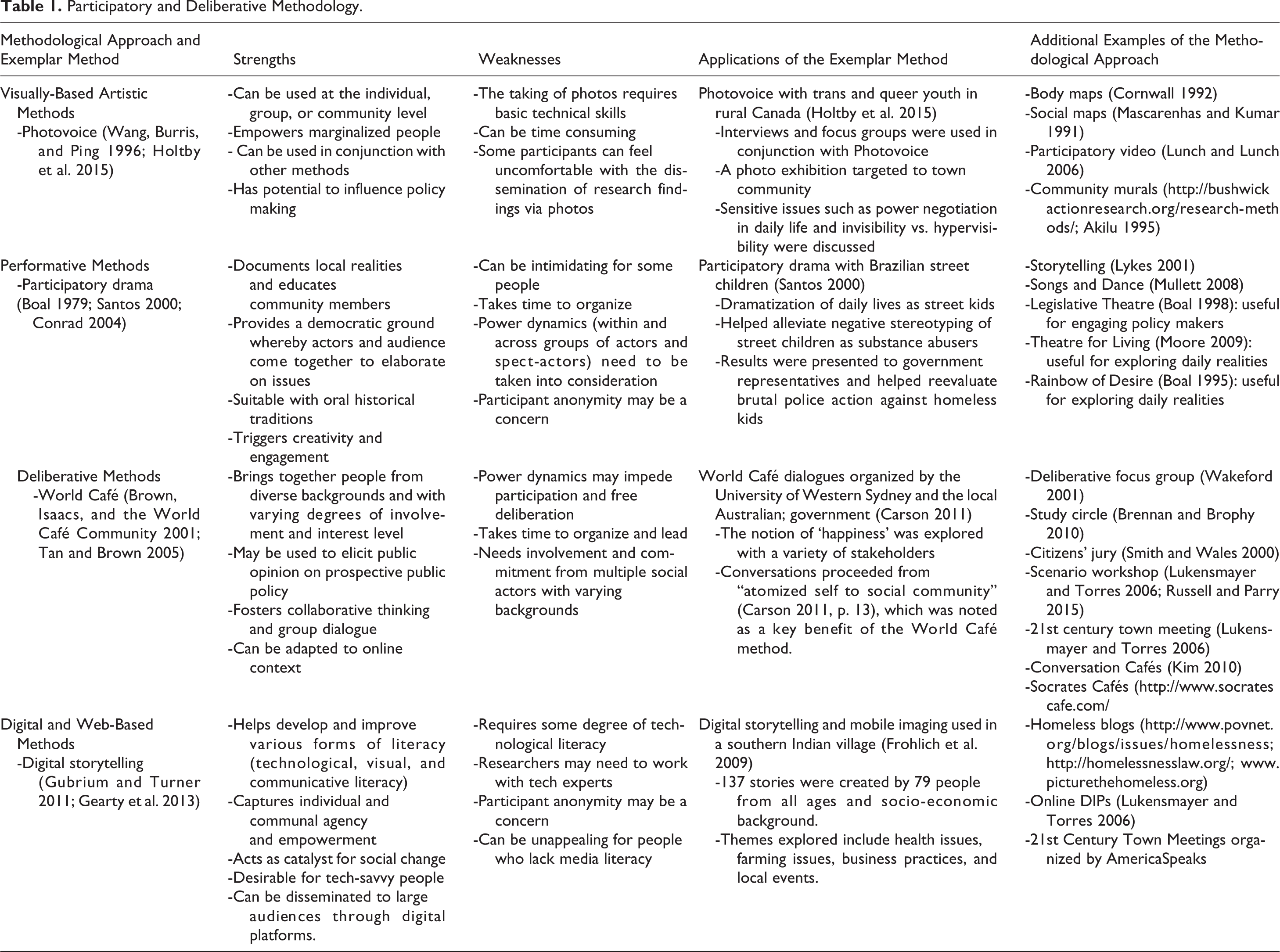
Visually-Based Artistic Methods
“As the reflection of culture and as something that contributes to the production, reproduction, and transformation of culture” (Moisander and Valtonen 2006, p. 85), visuality can be a very powerful tool to explore the many different ways people construct and negotiate the social world.
There are two types of visually based art forms researchers can rely on in their data collection. First, researchers can analyze art forms that have been created prior to the research at hand. Analyzing street graffiti (Visconti et al. 2010), historical miniatures and engravings (Karababa and Ger 2010), and various types of artwork at Burning Man site (Kozinets 2002a) are examples of such data collection. Other times, researchers ask study participants to use their creativity through cartoons, collages, drawings, photographs, and films/videos (Belk 2011; Belk and Kozinets 2011).
Although art-based visual methods have gained popularity in consumer research, they are still underutilized compared to in-depth interviewing and textual analysis. On the other hand, action researchers, particularly PAR scholars, are more inclined to employ visual techniques since visuality allows for uncovering hidden practices and giving voice to marginalized groups who might feel uncomfortable with written or verbal forms of communication (Lykes 2001; Ozanne, Muscato, and Kunkel 2013). Diverse art-driven visual techniques such as collages, mapping (social/community maps and body maps), participatory video, and Photovoice are commonly used in action research. These methods are particularly helpful when the research topic is sensitive, as in the case with women living with HIV in South Africa who were asked to describe their experiences through body mapping (http://www.catie.ca/en/bodymaps-temp).
Next, we discuss Photovoice as an exemplar method. Photovoice is unique in the sense that it can be applied on an individual, group, or community level; empowers marginalized people; can be used in conjunction with other methods; and helps uncover not only collective problems but also strengths and capabilities within a community (Wang, Burris, and Ping 1996; Wang 1999; Ozanne, Moscato, and Kunkel 2013).
Exemplar method: Photovoice
Photographs are used in many different ways in social science research. Photovoice can best be defined as “transformative photography” (Ozanne, Moscato, and Kunkel 2013) where researchers treat participants as collaborators to raise awareness about an issue that is relevant in their lives and motivate social change via photos.
Originally intended to reach policy makers via photographs and inspire social change, Photovoice was developed by Wang, Burris, and Ping (1996) as an inspiration from documentary photography, feminist theory, and Freire’s (1970) critical education theory. Wang, Burris, and Ping (1996) gave cameras to poor Chinese women to document their daily realities about healthcare needs. Individually taken photos were used to stimulate group discussion and brainstorm about the community’s health problems and possible action plans. Exhibitions that contain photos taken by the women were presented to the general public, policy makers, and the media to raise awareness of existing health needs in rural China. The project resulted in the implementation of significant policy changes and social improvements such as the foundation of a birth assistance program, providing educational scholarship for young girls, and establishing a day care program for women in need.
Performative Methods
We refer to performative methods as those that rely on performance-based expression to highlight multiple opinions on specific topics and to raise consciousness. Here, researchers ask study participants to engage in some sort of artistic performance such as role-playing, singing, storytelling, and dancing (Conrad 2004; Fletcher 2016). Compared to well-known oral and written methods, this type of data collection technique is sparsely used in consumer research (Sherry and Schouten 2002; Kozinets 2002b). In contrast, participatory action researchers often utilize creative forms of engagement and performance in their data collection and dissemination of research findings (Mayoux 2012). Usually, these performative tools are used in conjunction with oral methods such as interviewing, story telling, and focus groups to reflect on the themes that arise and to further motivate group dialogue.
Exemplar method: Participatory drama
Also referred to as forum theatre, interactive theatre (Fletcher 2016) or critical performance ethnography (Conrad 2004), participatory drama is based on Brazilian educator and activist Augusto Boal’s (1979) Theatre of the Oppressed and Paolo Freire’s (1974) work on dialogue, conscientization, and praxis. Participatory drama provides a fertile ground for community dialogue and empowerment through the exploration of different opinions, experiences with disempowerment, and alternative approaches to shared struggles. Study participants perform a play in a theatre-like atmosphere. Performers, most often drawn from the community affected by the given problem, enact scripts on stage and invite the audience – which is also drawn from the community- to participate into the play. Different participation forms exist, such as the audience making suggestions to actors about the performance and the story or becoming full ‘spect-actors’ (Mayoux 2012) through role-playing. To help the audience relate closely with the performance and elicit further participation, the use of other performative folk tools (e.g., songs, dancing) is encouraged.
Participatory drama has been utilized to explore a variety of social, cultural, and political issues across diverse marginalized and overlooked communities such as school children, homeless people, inmates, and politically oppressed groups (Moore 2009). This method is especially an effective way of engaging youth. For instance, Conrad (2004) employed this technique with a group of high school drama students in a rural Alberta community. Organized around the theme “Life in the Sticks,” the study evolved through a series of data generating activities (e.g., games for trust building and skill development, storytelling, and informal interviews). Students were asked to reflect on the notion of “at-risk” and discuss topics such as substance abuse, rule breaking at school, addiction, and interpersonal conflicts. As such, they were given the opportunity to reflect on their lives and possibly re-evaluate their risky behaviors. The research progressed further as workshops, and plays were organized for other students at the school and at another school in a nearby town. Like Conrad (2004, p. 18) suggests, researchers might consider writing “a series of scripted descriptions or “ethnodramatic vignettes” based on the audio, videotapes, and field notes to disseminate research findings to larger audiences.
Deliberative Methods
Usually referred to as “deliberative inclusive processes” (DIPs), these methods are predominantly oral methods that have become popular for eliciting public opinion to inform policy decisions (for a detailed overview of DIPs, see Lukensmeyer and Torres 2006, Ozanne, Corus, and Saatcioglu 2009, and Corus and Ozanne 2014). Used in a variety of public policy arenas such as healthcare, urban design, and public budgeting, DIPs are particularly effective in bringing together social actors from diverse backgrounds and with varying levels of expertise on a subject matter. DIPs can range from informal and small-scale techniques such as deliberative focus groups and study circles to more large-scale methods such as 21st century meetings and World Cafés (see Table 1). We discuss The World Café as exemplar method since it is widely used by action researchers and practitioners alike and can be tailored to research needs.
Exemplar method: The world café
Developed in the late 1990s, The World Café technique is based on the principles of dialogical inquiry and collaborative thinking. The technique provides flexibility as it can be used with as few as a dozen people or as many as hundreds or thousands of participants.
In a relaxed café-like atmosphere, participants gather around small tables of four to five. Organizers of a World Café session are encouraged to make the environment as hospitable as possible with quiet background music, soft lighting, and refreshments. This is reminiscent of Oldenburg’s (1999) “third place” – “a home away from home that affords comfort and engagement.” At each table, people have a round of conversation, usually lasting from 20 to 45 minutes, and brainstorm on specific topics. Participants are provided with coloring writing supplies and paper so that they can create a shared space on each table to draw and take notes (Jones 2010). At the end of each round, one person remains at each table as a host while others move to other tables; table hosts welcome newcomers and share the key points of that table’s conversation so far. The newcomers in return share their table’s conversational threads and the dialogue continues around similar and different themes that have been emerging across tables. Every new round is built upon the previous one but also adds in further questions and more themes to explore so that the dialogue leads in deeper and more meaningful insights that are connected.
There are a plethora of successful applications of the World Café method; a quick glance at The World Café Foundation’s website (http://www.theworldcafe.com/global-impact) reveals numerous global cases in which the method was utilized by governments, corporations, academic researchers and non-profit organizations.
Digital and Web Based Methods
The power of social media and online communities has been well documented, especially in the co-creation of products and services (Ozanne and Anderson 2012). Consumers discuss market offerings online (Scaraboto and Fischer 2013), organizations and consumers come together in community blogs, and netnography is becoming an increasingly effective tool for digging into various consumption practices (Kozinets 2002c, 2006). In addition, many existing offline data collection techniques such as focus groups and the diary method have been adapted to the online platform.
Within the action research tradition, there has been some reservation about the use of web-based methods; researchers express concerns regarding privacy and anonymity as well as the possible exclusion of disadvantaged consumers residing in tech-poor areas (Ozanne and Anderson 2012). Surprisingly, some traditional data collection tools such as blogs and diaries have proven to be very helpful even with disadvantaged populations. An inspiring and notable example is the case of homeless blogs where homeless people share their experiences online and outreach groups become involved to help homeless get their voice heard (see Table 1).
Action researchers have also adapted other offline data collection techniques (e.g., diaries, storytelling) to the online context. Furthermore, the potential of traditional deliberative democracy methods (e.g., scenario workshops, consensus conferences, deliberative focus groups, World Cafés) applied to the online context is noteworthy when the research topic is driven by large-scale dynamics and relevant social actors are geographically dispersed. Political elections, environmental pollution, urban planning, and economic revitalization plans are among such topics that have been successfully explored via online deliberation. We discuss digital storytelling as a promising method that blends digital, web-based, and more traditional techniques in generating insights.
Exemplar method: Digital storytelling
Deriving from oral history and cultural anthropology, digital storytelling was inspired by Paulo Freire’s participatory and community-based approach to education and consciousness-raising. Originated by The Center for Digital Storytelling (www.storycenter.org) in the mid 1990s, it has since been prevalently used in education (Ohler (2006) [2005]; Ming et al. 2014), public health research and practice (Gubrium, Hill, and Flicker 2014), environmental sustainability (Gearty et al. 2013), and subsistence economies (Frohlich et al. 2009).
Digital storytelling combines personal oral narratives with multimedia technologies (e.g., still images, text, first-person audio narration, and sometimes music). Similar to written and oral storytelling, it requires participants to use their imagination and narrative skills. Participants create a short movie (usually around 3-5 minutes but can be longer) based on their own lived experiences. The intention is to construct a personalized multimedia story to draw attention to a particular issue and cultivate feelings of empathy and/or advocacy. Like Photovoice, digital storytelling gives primacy to “participant subjectivities” (Gubrium, Hill, and Flicker 2014); by creating their own multimedia story, participants feel a sense of empowerment and agency. Moreover, stories act as “catalysts for change” and often times lead to a “cascaded advocacy” among the storytellers and various audiences who are exposed to studies (Gearty et al. 2013). For example, in a study exploring environmental sustainability, academics from the University of Bath collaborated with Storyworks, an independent company in the U.K. The research team worked with people over the age of 50 to help them produce short movies (see https://vimeo.com/album/1469229 for a sample of movies produced) depicting their everyday pro-environmental behaviors and exploring the notion of sustainability (Gearty et al. 2013). Select films were compiled into an online storybank and shared with stakeholders. Results revealed that the stories acted as bridge between everyday, micro practices and macro issues concerning the environment; some people felt encouraged to explore new sustainable consumption practices.
Bridging Macromarketing and CCT Through Participatory and Deliberative Approaches
We identify two key areas that deserve further attention towards an impactful CCT-macromarketing cross-fertilization: an in-depth understanding of market inequities and a closer focus on multistakeholder involvement within the research process. The notion of market inequities and the consideration of all relevant social actors in the phenomenon of interest are perhaps two significant domains that constitute points of convergence between CCT and macromarketing. Our discussion here demonstrates how CCT and macromarketing research streams approach these two domains and underline the potential contribution of participatory and deliberative techniques.
A Better Understanding of Market Inequities
CCT’s early focus on agentic identity projects and symbolic consumption has shifted toward an interest in socio-historical and institutional structures shaping consumption (Thompson, Arnould, and Geisler 2013). This shift gave way to a broader perspective on market inequities, propelling a better understanding of “power, social stratification, gender hierarchies, ideological interpellations, and other structuring forces”(Thompson, Arnould, and Geisler 2013, p. 159). CCT researchers have delved into many frameworks that analyze societal and institutional structures, such as Bourdieu’s theory of practice (Holt 1998; Saatcioglu and Ozanne 2013), Gidden’s structuration theory (Phipps and Ozanne 2017), and Foucault’s notion of governmentality and power (Thompson 2004). For instance, CCT researchers who draw from Bourdieu’s concept of capital and fields primarily focused on class distinctions, the unfair distribution of resources, and resulting inequities across social groups (Crockett and Wallendorf 2004; Saatcioglu and Ozanne 2013).
On the macromarketing front, researchers are particularly interested in issues of social justice and wellbeing in connection to the societal impact of marketing (e.g., Kilbourne 2004; Layton 2007; Figueiredo et al. 2015), also reflected in studies that often encompass market constraints and unintended effects of marketing (Layton and Grossbart 2006). This parallels CCT’s investigation of the historical, ideological, and institutional forces (Ertimur and Coskuner-Balli 2015; Dolbec and Fischer 2015). Specifically, macromarketing researchers have focused on consumers’ lack of access to various forms of resources in studies of developing markets and subsistence economies (Viswanathan and Gau 2005; Saatcioglu and Corus 2014) and on the impact of such inequitable distribution on consumers, in, for instance, quality of life studies (Lee and Sirgy 2004; Sirgy, Lee, and Rahtz 2007). More fundamentally, macromarketing researchers are vested in understanding market systems and their impact on societies, including power inequalities between market actors and ways to countervail these inequalities (e.g., Ferrell and Ferrell 2008; Laczniak and Santos 2011).
Given these parallel orientations, we highlight that CCT and macromarketing have common interest in and possess distinct, if not complementary, tools for tackling questions of market inequities. The macromarketing approach permits to “observe the ideologies, obfuscations, manipulations and mystifications playing out in markets” (Dholakia 2012, p. 3). Specifically for CCT researchers who are well versed in sociological and cultural theories of structure and power, macromarketing perspectives provide fertile ground to examine the terrains of marketing systems, market-society relationships, and ideologies that are of central significance to understanding marginalization and inequity in the marketplace.
A CCT- macromarketing collaboration can, for instance, help a more refined understanding of the moralizing effects of certain market actions often intended for societal benefits. A case in point is the moralization of health behaviors such as weight management and breastfeeding through social marketing campaigns, and the consequent stigmatization of women who do not comply with the promoted behavioral norms (Gurrieri, Previte, and Brace-Govan 2013). While macromarketing’s concerns with equity, justice, and power help accounting for viewpoints of multiple stakeholders (Ferrell and Ferrell 2008; Laczniak and Santos 2011), such effects have often been framed as unintended consequences in macromarketing studies (Layton and Grossbart 2006; Gould and Seeman 2014). Yet, fueled by elaborate social theories of CCT, researchers can look into the processes of moralization and marginalization as systemic and persistent. For instance, Gurrieri, Previte, and Brace-Govan’s (2013) study draws from a Foucauldian perspective to highlight the moralization of certain behaviors (e.g., breastfeeding, weight management) as a governmentality technique where non-conforming individuals are systemically marginalized (also see Gurrieri, Brace-Govan, and Previte 2014).
Other researchers have conducted similar analyses of moralizing effects of dominant discourses related to food and dieting where those who do not comply are constructed as engaging in problem behaviors or as ‘at risk’ (Askegaard et al. 2014; Yngfalk and Yngfalk 2015). These inquiries have started laying the groundwork for a CCT-macromarketing alliance by drawing from social theories to extend the understanding of power in market systems. They leverage macromarketing’s extensive analysis of complex, systemic interdependencies between markets, marketing, and society. In addition, this research stream provides a useful foundation for contextualizing and situationally embedding market inequities and experiences of marginalization.
For CCT and macromarketing researchers, an important step toward aligning their efforts in tackling market inequities would be to particularly consider less fortunate and stigmatized consumers. Yet, delving into such contexts with the objective of addressing power struggles is not without challenges. Traditional methods that work well in typical contexts might not work in such marginalized settings (Ozanne and Fischer 2012; Ozanne and Anderson 2012). Consider the case of low literate consumers who lack sufficient reading and writing skills. Visually-based artistic techniques that make use of photographs, drawings, or mapping can work well in this case. Likewise, marginalized people who might feel shy to participate in a typical one-on-one interview can feel more at ease in a group setting where they engage in a dialogue with like-minded people, as in the case of Photovoice group discussions and participatory dramas. Participatory and deliberative methods are especially suitable for mapping the societal and historical context in settings of marginalization, such as developing markets where complex networks of social connections and resulting power imbalances are common (Viswanathan and Gau 2005).
A Focus on Multistakeholder Involvement
A multistakeholder approach has long been prominent in macromarketing and public policy-oriented marketing. For instance, distributive justice studies often examine the fair resource allocation among diverse stakeholders. Giving voice to multiple social actors is important for ensuring equity for those who may not always be heard (Ferrell and Ferrell 2008). From a CCT perspective, hearing multiple voices is also fundamental for a deeper understanding of cultural meanings (Crockett and Wallendorf 2004; Sandikci and Ger 2010; Scaraboto and Fischer 2013; Giesler and Veresiu 2014). The inclusive consideration of multiple market actors (e.g., consumer organizations, suppliers, regulatory bodies) can help contribute to the renewed CCT direction that extends cultural understandings beyond individual consumers’ life world and into the investigation of markets as systems with their own cultures (Laczniak and Murphy 2006; Ferrell and Ferrell 2008). Furthermore, a “relational engagement” perspective that strives to extend to all shareholders both within and outside of academia offers a complementary and powerful angle to traditional approaches to research impact (Ozanne et al. 2017).
PAR and deliberative democracy approaches are particularly relevant when exploring complex problems that necessitate the inclusion of diverse viewpoints (Ozanne and Anderson 2010; Corus and Ozanne 2014). These methods are based on the notion of equitable, sincere forms of engagement, which corresponds with macromarketing’s recent conceptualization of markets as democratic forums (Mittelstaedt, Kilbourne, and Mittelstaedt 2006). Issues concerning marketing and society (e.g., sustainability, climate management, public health) often involve jointly held objectives by market actors and therefore, their solutions require the involvement of many different stakeholders. For instance, scenario workshops, citizen juries, study circles, and World Cafés are specifically designed to include a broad range of stakeholders (e.g., consumers, corporations, policy makers, experts, non-profit organizations). Participatory and deliberative methods are also useful tools to ensure a fair ground before any deliberation takes place. Extensive pre-deliberation contacts to build rapport, trust, and group spirit [see, for example, Ozanne and Anderson’s (2010) project on diabetes with Native American tribes] and skill development to help study participants learn about research processes and engage in data collection [see Hill et al.’s (2015) prison study] are common techniques in action-oriented studies (Ozanne and Fischer 2012; Ozanne and Anderson 2012).
In including a diverse set of social actors with differing backgrounds and levels of expertise, PAR and deliberative methodologies seek to approach consumer as a citizen first. These methods, particularly DIPs, provide platforms where consumers can voice issues not only about their consumption preferences but also about “their concerns as citizens, such as concerns about the environment and social justice” (Smith, Drumwright, and Gentile 2010, p. 8). Consumers are construed as citizens and community members whose lives are affected by marketing systems (McGregor 2001; Smith, Drumwright, and Gentile 2010; Korschun and Du 2013).
Guidance for an Action Research-Oriented Approach
In this section, we provide guidance and suggestions for researchers willing to follow action research principles in their work. Towards this end, we first discuss four key challenging issues that specifically concern action research along with some suggested solutions. We then present a more general roadmap for scholars at the intersection of macromarketing and CCT who wish to apply the action research paradigm towards a more comprehensive understanding of the interaction between cultural dynamics and structural/institutional forces. Our roadmap touches upon several topics such as research goals, theory development, sampling, and method selection as well as more specific issues to consider under these topics.
Action Research Challenges and Suggested Solutions
Despite the many contributions of action research methodology, there are some challenges. Some of these derive from the nature of action research while others are more closely related to the application of specific methods (see Table 1). Perhaps the most common challenge is logistical; methods are unusual, can be time-consuming and costly, and necessitate the active collaboration of study participants. However, the flexibility and adaptability of these methods help overcome many of these issues. For example, Photovoice can be used either on an individual, group, or communal level (Ozanne, Moscato, and Kunkel 2013) and the World Café can be adapted to smaller groups in the form of study circles (Brennan and Brophy 2010) or can take the form of scenario workshops and citizens’ juries (Smith and Wales 2000) if the aim is more policy-oriented. Likewise, participatory drama allows for different levels of participation depending on the group and research goals (Conrad 2004) and digital storytelling can be tailored to fit various levels of media literacy (Frohlich et al. 2009; Gubrium and Turner 2011).
Another logistical challenge is related to time; many action research projects are driven by the need to act urgently as pressing problems necessitate fast and effective solutions. Yet, fundamental steps in action research (e.g., building community; including all relevant stakeholders in the research process; uncovering local knowledge, strengths, and shared struggles) take time and require a prolonged commitment on the part of the research team and study participants. Furthermore, there may be a divergence of opinions, capacities, and values among community/group members, which may lead researchers spend more time on building consensus on what shared problems require urgent action and what issues can wait (MacDonald 2012). Thus, the preferences of participants, research goals, and available resources need to be taken into account when determining which action research method is more suitable for the issue at hand.
Theory Building/Extension vs. Practical/Policy-Related Outcomes
From the beginnings of action research dating back to the work of Lewin (1946), it has focused on generating practical outcomes, hence the term ‘action’ research. Traditionally, the production of scientific knowledge without motivating practical outcomes is perceived contradictory to the very nature of action research. Yet, some critiques have underlined the imbalance between scientific contributions and pragmatist outcomes derived from action-oriented studies (Cooke and Kothari 2001; Hickey and Mohan 2004). Likewise, DIPs have been criticized for foregrounding political outcomes at the expense of instrumental goals. Similar to the conflict between scientific vs. practical outcomes, the tension between the use of everyday local knowledge of the people being studied and scientific/academic knowledge throughout the research process is evident in much of action research criticism (Grant, Nelson, and Mitchell 2008). Action methodologies have been accused of generating “an obsession with the ‘local’ as opposed to wider structures of injustice and oppression” (Hickey and Mohan 2004, p. 11). Nevertheless, there is considerable action research that has advanced scientific knowledge in addition to generating practical or policy-related outcomes (Reason and Bradbury 2001; Hill et al. 2015). For instance, Ozanne and Anderson’s (2010) work on diabetes in a Mexican and Native American rural community led to the development of a “local health worker program at the local community college” (p. 133) while also advancing marketing/public policy literature through a meticulous conceptualization of community action research. Hence, we believe such tension between theory and practice is unnecessary as it generates a “falsity of a supposed research-activism dualism, which research seen as dispassionate, informed, and rational and with activism seen as passionate, intuitive, and weakly theorized” (Kemmis and McTaggart 2005, p. 569).
Effective solutions
Research and action can perfectly converge when researchers are fully equipped with rich theoretical frameworks and methodological toolboxes. Holt (2017) emphasizes that applied research very often lacks refined theoretical abilities to apply theory in an elaborate fashion, which is fundamental to solving real problems. Action researchers can benefit from the rigorous theoretical orientation of CCT and macromarketing scholars in approaching unique local problems and social issues with a more scientific perspective.
At times, researchers might need to trade off between theory building/extension and the generation of pragmatist outcomes. This requires moving from theory building into a problem solving approach and seeing issues as important social problems rather than case studies (Holt 2017). Moreover, hybrid forms of action/theory combination exist in socially relevant research; while there is research that seeks to give equal weight to theory and action, theory-driven action constitutes the core of other work (Ozanne et al. 2017). Nevertheless, the crucial role of a rich, innovative methodological portfolio is undeniable here; when seeking insights that should be meaningful and useful for a diverse group of stakeholders such as civil society, academics, or governmental bodies, not only the theoretical lenses but also research methods need to change.
Reflexivity and Positionality
In action research, the term reflexivity refers to both researchers and study participants becoming aware of how their own subject positions, assumptions, and social locations influence the research process and outcomes (Ozanne and Fischer 2012). The application of participatory and deliberative methodology requires researchers and community/group members joining in solidarity to delve into social problems, uncover shared strengths and struggles, and improve wellbeing. Therefore, at the root of an action research inquiry lies an agenda for social change that is “value laden and morally committed” (MacDonald 2012, p. 36), meaning that knowledge production is also a consciousness raising effort and an educational process that change both researcher(s) and those being researched. Hill’s et al.’s (2015) study at a maximum security prison provides a perfect exemplar; inmates took the lead researcher’s “Marketing and Society” course and researchers and inmates explored the possibility of starting a marketing research firm run by the inmates.
Consequently, the role of the researcher in action research is generally that of a facilitator, a guide, or even a “copreneur, cocreator, and provocateur” (Ozanne et al. 2017, p. 12) who works closely with stakeholders in every phase of the research. Study participants are viewed as collaborators whose local knowledge, capabilities, and subjectivities are of paramount importance for the success of research. However, in a typical consumer research study, researcher is viewed as an engaged but expert person equipped with much needed scientific knowledge. This may naturally result in an invisible yet powerful divide between the researcher and participant, which then may mislead researchers on the use of suitable methodologies and even determining the right research question(s).
Effective solutions
The collaboration with research participants in the research process does not need to fit a standard format; the level of researcher and participant engagement can be determined based on research goals and the characteristics of the group. For instance, in Hill’s et al. (2015) study, the role of the researcher evolved from that of a teacher, to a facilitator, and a consultant throughout all three phases of the research. Macromarketers and consumer culture theorists have much to gain from an action research design where participants are consulted on the use of specific methods based on their preferences and comfort level. Developing partnerships with key community members (Ozanne and Anderson 2010) to identify important issues and explore individual and communal capabilities can certainly help with asking the right theoretical and practical questions. And, fully engaging participants within the data collection process can provide researchers with deep and meaningful access to community dynamics especially when the research setting involves highly stigmatized and marginalized groups (Hill et al. 2015).
The Notion of Representation
In action research projects, the notion of representation is of paramount importance since the untangling of individual/communal capacities and struggles can only be possible when multiple voices are heard. Questions such as the following need to be carefully considered in an action oriented study: Who constitutes the community and who will represent the community? Whose voices are included and excluded? Whose interests are best served with the research? Does the research adequately reflect the experiences and opinions of all stakeholders?
The question of who represents or should represent the community is always a challenge in any research project as no community is homogeneous or static. But “the conceptualization of community” (Ozanne and Saatcioglu 2008) becomes more important in action research due to the participatory and collaborative nature of this paradigm. In their review of the myths and misinterpretations of PAR, Kemmis and McTaggart (2005, p. 596) define a collective as “not a closed group with fixed membership – a coherent, unified, autonomous, independent, and self-regulating whole – but rather as internally diverse, differentiated, and sometimes inconsistent and contradictory.” Macromarketing and CCT researchers wanting to adopt an action research perspective should be particularly attentive to community dynamics in order to adequately define the parameters of the community being researched.
Effective solutions
Similar to the notion of ‘key informant’ in interpretivist research, developing collaborations with some community members is a common way to manage the challenge of representation. For example, Ozanne and Anderson (2010) formed collaborative partnerships with select community members (e.g., a local physician, community college teachers and staff, students, healthcare workers, local advocacy groups) in their study on diabetes. This ensured a fair communal representation and collaboration as the community members took ownership of the project. Likewise, Hill et al. (2015) worked with key prison inmates in all phases of the data collection in their PAR study at a maximum-security prison. The inmates were trained on the PAR techniques, practiced in-depth interviewing skills, interviewed other inmates, and presented the study findings to the research team, the prison management, and state government representatives.
Surely, a full representation of all relevant social actors might not be possible due to logistical constraints. Moreover, different projects have varying goals in regards to level of representation. For example, while PAR-driven work is more focused on exploring group-based dynamics, deliberative democratic approaches aim to gather as many stakeholders as possible from the community being studied and even the larger public. Hence, researchers should consider their research aims and available resources when considering issues related to representation.
Power Dynamics and the Politics of Participation
Related to the notion of representation is the issue of participation. Even when a proper representation of relevant social actors is ensured, a full participation might not be possible (Cooke and Kothari 2001; Mendelberg 2002; Grant, Nelson, and Mitchell 2008). Compared with traditional methods, action research methods are likely to increase participation but researchers are still advised to pay close attention to power dynamics both within communities/groups and across different stakeholders that take part in the study.
Effective solutions
To encourage participation, researchers might engage in “capacity building” [see, for example, the Regenerated Freirean Literacy Through Empowering Community Techniques (REFLECT) program, Archer and Cottingham 1996]. This capacity building does not always need to be as comprehensively developed as in the REFLECT program; the inherent flexibility of DIPs and PAR methodologies allows for accounting for group dynamics with only little planning and creative thinking. For example, Fishbowl is a methodology developed by feminist action researchers to take into account gender dynamics within groups (Gordon 2004; Gordon and Cornwall 2004). In Fishbowl, the traditional deliberative focus group method is adjusted in a way to prevent traditional gender roles hindering participation. By simply changing the way women and men sat and alternating the sitting positions, researchers were able to generate a more democratic and egalitarian group dialogue in their studies on sexuality in Zambia.
Roadmap for Scholars at the Intersection of Macromarketing and CCT
Our roadmap presents an action research oriented approach towards a macromarketing and CCT alliance. We review several broad areas such as research goals, research questions, literature review, theory development, sampling, methodology, and implications to help scholars determine if/how an action research perspective would help (please see Table 2).
An Action Research-Oriented Roadmap for Macromarketing and CCT Scholars.
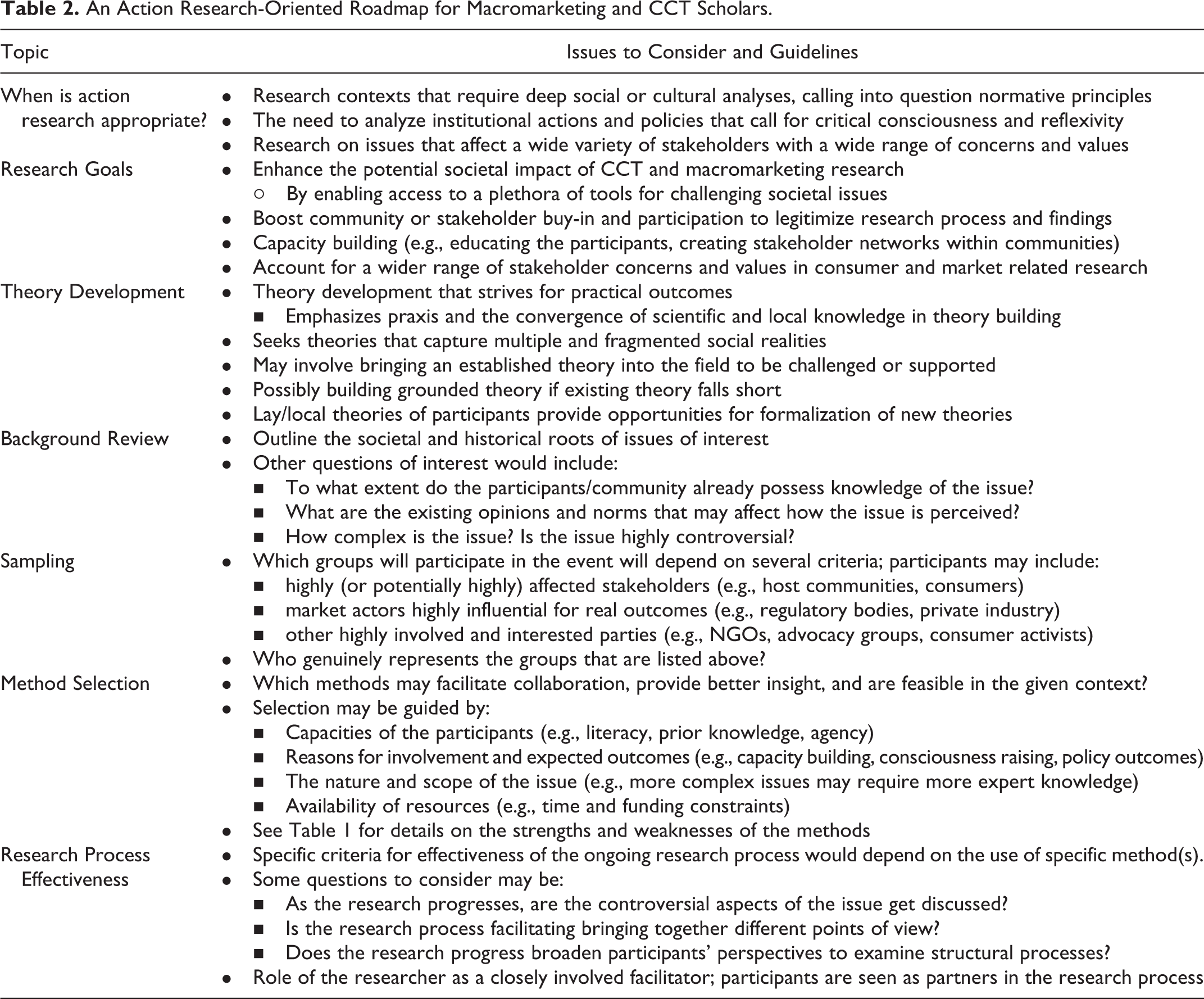
Research phenomena that require a deep historical and social understanding of the context, as well as involving structural processes that affect multiple groups, are prime opportunities for the implementation of participatory and deliberative methods. Researchers who are interested in boosting the societal impact of their research and enhancing the legitimacy of their findings and/or interventions may consider engaging with these methods. This mindset should guide the formulation of research goals and questions, as well as the theoretical framework, as the researchers attempt to obtain a comprehensive analysis of the institutional forces and power dynamics at play.
Theory development that parallels analysis of pressing societal issues is highly valued in action research. Seeking historical depth is important to any study that bears critical aspirations. Mapping the societal and historical roots of issues of interest by looking at the origins of the present social reality helps understand the ‘how’s and ‘why’s of its current construction. The extent of knowledge participants already possess, the complexity of the issue at hand, as well as the deep set of opinions that might affect discussions should be fleshed out early on in the research process (see the section titled “Theory Building/Extension vs. Practical/Policy-Related Outcomes).
Decisions related to method selection should involve identifying which consumers and other market actors are most central to and most affected by the pressing issue at hand. As such, the relevant groups will vary drastically with the issue, as well as budget and timing constraints that are specific to each method (see Table 1 for more detail).
Importantly, who is included or excluded from the study will depend on who is affected by the issue at hand, who is influential for any targeted policy, regulatory, or market outcomes, and who may be interested in or involved enough to contribute to the development of practical outcomes. The issue of representation is fundamental for methods with diverse participants and merits substantial consideration (see the section titled “The Notion of Representation”).
Conclusion
CCT and macromarketing have much to gain from each other. The current CCT ‘heteroglossia’ reflects multilayered cultural analyses that draw from complex cultural systems, social structures and power relations (Thompson, Arnould, and Giesler 2013). Given its macro, societal orientation that spans decades, macromarketing is an ideal ally in collaborating with this renewed orientation of CCT. As researchers expand their interests to the intersection of these two research streams, they will need methods that are culturally sensitive, adaptable to consumers in diverse contexts, and sensitive to structural processes that connect consumption and marketing to societal outcomes. We present action research methods as effective and inspirational tools to this end.
Participatory and deliberative approaches offer a plethora of methods that emphasize structural dynamics as well as methods that put a relatively greater emphasis on local knowledge and culture. For instance, while the World Café method is effective for studying macro dynamics and large networks, methods such as digital storytelling and participatory drama usually give credence to local culture. Multiple layers and forms of cultural agency (e.g., individual, group, and communal agency) can be explored via Photovoice and participatory videos while reflecting on the status quo and systemic inequities (Ozanne, Muscato, and Kunkel 2013). The potential of participatory and deliberative methodologies in bridging the micro level, human-centered perspective with a more systemic and structural angle is also evident in recent TCR work (Ozanne and Anderson 2012; Ozanne and Fischer 2012; Hill et al. 2015).
We propose participatory and deliberative approaches as alternatives to traditional consumer research, as these approaches move social inquiry from a purely cultural/theoretical (as in CCT) or structural/policy-oriented (as in macromarketing) perspective to a collective, inclusive, and reflexive framework that motivates capacity building and social change. As put by Holt (2017), “those who think that their theory-building work will naturally “trickle out” into the world and become useful in solving social problems are deceiving themselves” (p. 7).
Footnotes
Declaration of Conflicting Interests
The author(s) declared no potential conflicts of interest with respect to the research, authorship, and/or publication of this article.
Funding
The author(s) received no financial support for the research, authorship, and/or publication of this article.