



Abstract
Though most acculturation research investigates movement across national boundaries, many other types of boundaries may exist (e.g. rural to urban migration). Rural migrant workers focus on their adaptive and exploratory consumption practices to assemble a liquid identity in China. In essence, this research examines the nature of the transitions that the vast group of Chinese (over 280 million) endures as migrant workers seek to assemble new identities through consumption activities in a liminal space. We find that family relations and government policy hinder migrants’ adjustments to urban life. Thus, we contribute to macromarketing by enriching the theories of liquid identity, boundary work, and acculturation.
Migrant Workers as an Emerging Segment in the Chinese Political Economy
Macromarketing has a focus on market issues and solutions that would improve the wellbeing of various stakeholders within the market system (Layton 2007), and research needs to generate more understanding of the well-being of individuals and societies (Shultz 2007). Analysis of subsistence markets focuses upon vulnerable consumers; the understanding of such markets is vital to improve the quality of life of those individuals who struggle to survive in difficult living conditions (Viswanathan, Shultz, and Sridharan 2014). Subsistence marketplace studies provide unique insights for macromarketing, as they share the concern of developing a sustainable marketing system in which prosperity and quality of life are enhanced for those in the marketplace. Shultz and Holbrook (2009) propose the relevance of an approach that recognizes the systematic nature of consumer vulnerability. Public policy and marketing practice can be employed to create positive influences to enhance the well-being of the people whose lives have inextricable links with the marketing system (Shultz 2012). Despite marketers having explored various constraints that vulnerable consumers may face (e.g., Corus and Ozanne 2012; Weidner, Rosa, and Viswanathan 2010), many issues of marginalization -- mass migration by human populations in transitioning economies, for example -- present opportunities for fresh and meaningful examination.
China currently experiences a migration transition in the context of economic and social development. Individuals have regained the freedom to move to destinations abroad and within China after decades of migration controls (Pieke and Mallee 1999). However, rural migrants to urban China live predominantly in subsistence conditions (The Economist 2018; Wang and Tian 2014). Not only do Chinese migrants face the barrier of extremely limited social acceptance in their new environment (which is certainly not unique to this context), but they also face structural barriers that limit most opportunities to adjust to urban life. For example, the household registration system (Hukou) continues to be powerful policy that directly and indirectly influences the population transfer. The emphasis placed on family/kinship in China also has significant impact on Chinese perceptions of migration. Therefore, the current population mobility in China is more than a variation on a universal theme, as Chinese migrant workers have their own characteristics (Pieke and Mallee 1999).
As Viswanathan, Shultz, and Sridharan (2014) note, macromarketing perspectives are particularly germane to environments in which people find themselves in subsistence living conditions. The special issue editors (Polsa and Zheng 2015) of the issue on China in the Journal of Macromarketing explicitly called for more research on migrant well-being and services in migrant communities. Thus, our contribution to the literature is one of adding to the understanding of the migrant segment in urban China beyond what has been presented previously (Wang and Tian 2014; Wang, Zhou, and Zhang 2015). We will note many differences between our study and the Wang and Tian (2014) one (the most similar marketing study to ours). At the same time, we will contrast the Chinese migrants’ status with those documented in a study of Turkish rural to urban migrants (Ustuner and Holt 2007) in order to note cultural differences in how migrants adjust to their new environments. We will begin by discussing the general status of Chinese migrants in urban life.
Subsistence Consumers and Chinese Migrant Workers
In the subsistence marketplace literature, the market is defined as both physical marketplaces found in most communities and as a negotiated social milieu (Viswanatha et al. 2009). The stream of research on subsistence marketplaces examines underlying variables that affect the interaction of the poor with the marketplace, primarily focusing upon thinking styles, emotional bondings, and social relations (Viswanathan, Gajendiran, and Venkatesan 2008). Further, subsistence consumers are seldom considered full members of the community in which they reside, giving them a limited voice in the shaping of goals and means with which they are expected to comply (Boo 2012). Thus, they face structural barriers that hinder the adjustment process.
Migrant workers have recently been recognized as an important market segment with unique characteristics in many transitional economies (e.g., Huang, Guo, and Cheng 2018). Previous research on the migrant segment has mostly examined workers’ adaptation processes in their new cultural milieus (Luedicke 2011; Peñaloza 1994) and has focused on how immigrants are assimilated to a new environment (Askegaard and Bengtsson 2005; Berry 1997; Luedicke 2011, 2015; Oswald 1999; Peñaloza 1994). Such research isoften conducted within the unique context of the U.S. marketplace and has little emphasis on the larger population of migrant workers in transitional economies. For instance, it is estimated that more than 280 million rural laborers in China have left their villages to find work in cities with the hope of making a better living (The Economist 2018). This biggest within-country migration in human history has provided an unprecedented context to examine this particular market segment and to contemplate how marketing systems can improve the quality of life of the migrants.
At this point, we would like to briefly define some of our terms. We use the term ‘migration’ to deal with the movement of groups of peoples to new geographic areas (in this case from rural to urban China). Although most ‘acculturation’ research has dealt with the adjustment that immigrants make in a new country, we use the term as did Wang and Tian (2014) to cover the adjustment process of the domestic migrants to their new environment.
China’s 280 million migrant workers would constitute the fourth largest country in the world in terms of population size. This number of migrant workers continues to rise despite recent policies that intend to prevent the growth of China’s urban population. However, this particular market segment has been ignored and much research on Chinese consumers has focused on urban elites, missing an opportunity to problematize existing theories of acculturation and its marketing implications (Davis 2000; Yusuf and Brooks 2010; Zhang 2012; Zhou et al. 2010).
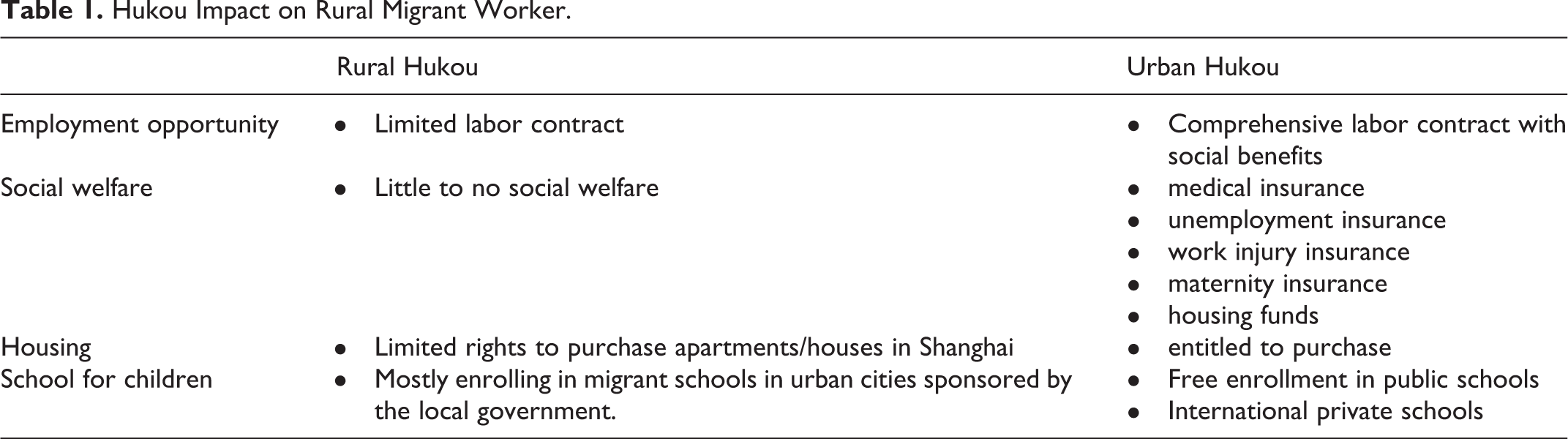
Although Chinese laborers can move to cities to search for jobs, government restrictions limit their ability to become permanent urban residents. The Chinese Hukou system has produced an unavoidable division among urban areas and rural spaces. An urban Hukou ensures the privileges of employment, health insurance, housing, access to loans, and children’s education (Liang 2016). The “migrant workers” (nong min gong in Chinese) are those who hold rural Hukou even though they have moved to cities and work there. These migrants are characterized by a lack of access to public services such as education, the acquisition of bank loans, and healthcare (Wang and Tian 2014; Zhang, Wu, and Sanders 2007). Table 1 provides a comparison of urban and rural Hukous. Migrants are socially discriminated by urban residents (Zhang, Wu, and Sanders 2007) and are represented as “uncivilized,” “invasive,” “unpredictable,” “defiling,” “dirty,” “dangerous,” and “polluting” (Pow 2007). In the meantime, they have to leave family behind in the village and are estranged from loved ones. However, migrant workers are considered to be well-off in their hometowns and are often the role models for their rural peers to emulate (see Figure 1).
Hukou Impact on Rural Migrant Worker.
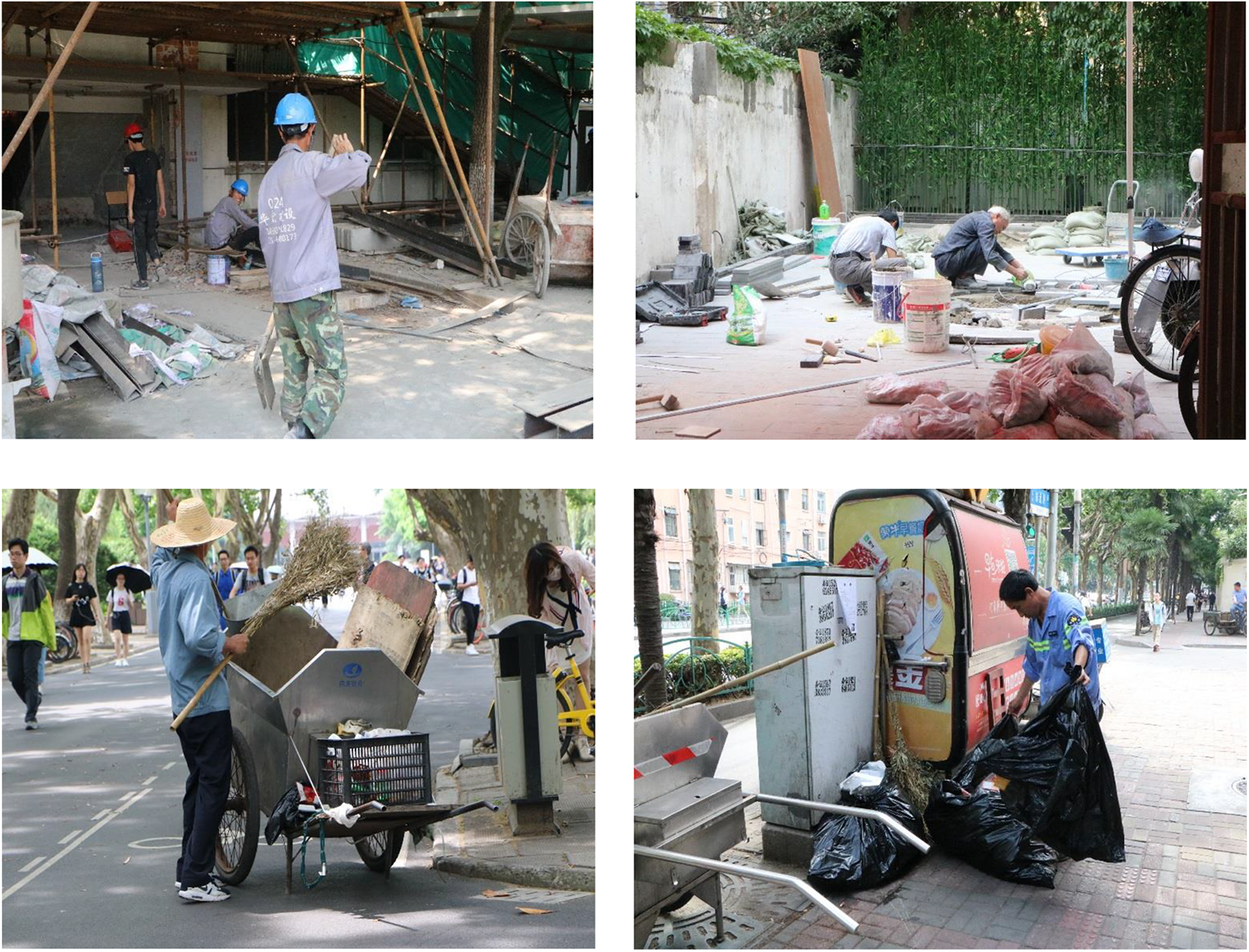
Urban scenes of rural migrants working on the streets of Shanghai.
We have chosen to re-examine existing understandings of this market segment of within-country migrant workers, which was also the context of the Wang and Tian (2014), Wang, Zhou, and Zhang (2015), and Ustuner and Holt (2007) studies. Our study differs from those studies in important ways. Both the studies in China investigated financial issues. Wang, Zhou, and Zhang (2015) investigated how different forms of social capital (bonding vs. bridging) affect migrant wages, whereas Wang and Tian (2014) investigated the issues that migrant cab drivers in Shenzhen faced in getting loans to pay the 200,000 RMB to lease their taxi. The Ustuner and Holt (2007) study investigated females’ lived experience in households that had migrated from Eastern Turkey to Ankara.
Unlike in other transitional economies such as Turkey and India, governmental barriers (the Hukou residency system) are in place, which limit the migrants’ access to health, loans, and educational benefits in urban China. This raises important issues regarding assimilation. Second, the strong tradition of filial piety in China makes ties to the past (and family back home) much harder to break. While these ties play roles in all three of the Chinese studies, there was no mention of such ties in Ustuner and Holt (2007). Specifically, this latter difference between the Chinese and Turkish studies is made stronger by the fact that many Chinese migrants have children left behind as well as parents, grandparents, and siblings, whereas the Turkish migrants in Ustuner and Holt’s (2007) study had their children with them when they migrated to the capital city of Ankara. Thus, this study extends previous research by including social-cultural and political structure barriers to examine migrant workers’ quality of life, identity transition, and marketplace interactions.
Consumer Acculturation
Consumer acculturation is the process of adaptation to a new consumer culture (Peñaloza 1994). It is believed that given sufficient time, acculturation results in certain positive end-states, depending on the path taken by individuals (Berry 1997; Luedicke 2015; Mathur 2012). Moving from a focus on why consumption patterns of immigrants differ from the locals and how the differences influence assimilation processes, acculturation studies have now emphasized how immigrants adapt skills and knowledge relevant to consumer culture in a foreign context (e.g., Luedicke 2011). From a more macromarketing perspective, cultural adoption is seen to derive from a wide variety of factors, including language differences, education levels, availability of other migrants from one’s background, and government policies. During the acculturation process, boundaries and identities are formed, and identity outcomes are contingent upon context and perspectives (Luedicke 2015).
Acculturation was once portrayed as having been an ethnocentrically linear one-dimensional process. However, it has been re-conceptualized as a bi-directional process in which the acculturation of the minority subculture can be measured along two dimensions: the degree of adoption of the majority culture and the degree of retention of the culture of origin (Gentry, Jun, and Tansuhaj 1995). In this process, some individuals may fully integrate into the new culture and give up their past identity (assimilation), which once was the expected nature for the acculturation process. But Berry (1997) also noted alternative outcomes (integration, separation, and marginalization).
Many migrants have become social neophytes on the border of China’s urban-rural divides, rather than acculturated migrants as had been predicted in previous studies of the acculturation process. Instead, they dwell in a space of betwixt and between social categories (Cody and Lawlor 2011), which can be better conceptualized through the theoretical lens of liminality (Turner 1969).
Liquid Identity and Boundary Work in Liminal Space
In contrast to a relative solid social space, social theorists argue that the affordability of instantaneous communication, global travel, and the labor movement have produced a flexible and fluid social condition (Bauman 2000). Bauman (2000) extends the “liquid” metaphor to characterize the change of a solid base to a less determinant but more variable form of identity. Liquid modernity was used to describe migrants, refugees, or asylum seekers who are on the move without permanent abode (Bauman 2013). The concept of liquid modernity emphasizes the flow of capital and labor which reshapes society (Bauman 1989). The social change being wrought by the increase of liquid modernity produces a tendency towards accepting new consumption patterns and values among individuals. Migrant workers are detached from their previous social identities that were tied to farming and village life, as they move from their homespace to urbanspace to form a new identity. During the intervening and transitional period, the individuals face ambiguity and uncertainty, and they pass through a new cultural realm in the urban space that has few if any of the attributes of the past. As such, Turner’s (1969) concept of social liminality provides a theoretical lens to understand the migrant workers’ transitional experiences from rural to urban areas.
In Turner’s (1969) original theorization, the phase of the liminal is transient, and the reintegration signals a more permanent change in identity. Liminal space exists between two identified states and is often experienced as a suspension of identities that are constituted by previously used consumption strategies. The liminal stage of transformation can be marked by three phases: separation, transition, and reintegration. The first phase comprises symbolic behaviors signifying the detachment of the individuals from an earlier social structure. During the second period of liminality, new components of urban consumption practices are introduced into migrant workers’ daily lives. Migrants may face symbolic connection with the past while struggling within the current urban consumer culture. In the third phase, the individual is expected to behave by certain customary norms binding on their current social position. However, for migrant workers in our study, the liminal stage of identity shift seems quite prolonged and does not appear to have the potential to result in the urban life equilibrium being sought. This prolonged liminal state is due in part to the lack of a clearly defined end-state (Barrios, Piacentini, and Salciuviene 2012). In Bauman’s (2000, 2007) terms, society today has reached a “liquid” era of postmodernity, in which social norms are changing rapidly. Thus, the social disembedding from previous institutions, such as farms and villages, does not lead (at least not smoothly) to re-embedment into urban life. Rural migrants to urban environments globally generally are not met with social acceptance, as they usually have less education, literacy issues, and are poorer in addition to possible policy barriers limiting their agency to try to fit in. In other words, they face discrimination from local residents. Many are often treated as illegal laborers, which places the workers in a highly vulnerable position (Chan 2012). That being said, the rural migrant labor may face high levels of unemployment, further marginalization and impoverishment if a financial crisis occurs in urban China (Chan 2012).
The prolonged liminal space creates a boundary for the migrants. The concept of boundaries has been developed in the marketing literature to understand the ways in which people construct boundaries through consumption and production (Weinberger 2015). At its core, this type of research is rooted in the Durkheim and Mauss ((1963) [1903]) notion of in-group/out-group categorization. Further, Lamont and Molnar (2002) state that the boundaries are conceptual distinctions made by social actors to categorize objects, people, practices, and even time and space. Thus, the boundaries influence which people acquire status and monopolize resources. This is consistent with Bourdieu (1986)’s framework in which social groups create subtle distinction boundaries between in-groups and out-groups through the exchange of cultural, social, and economic capital (Weinberger 2015). One aspect of boundary work focuses upon assimilation and acculturation to understand how ethnic groups crossing physical boundaries face a new set of social, cultural, and economic norms and consumption practices (Luedicke 2011). The boundary-crossing process is somewhat complicated, as people engage in a complicated and politicized identity (e.g. Askegaard, Arnould, and Kjeldgaard 2005). In China, given the complexity of the political economy, it is essential to understand how the within-country migrant workers construct liquid identities within the boundary work.
Methods
According to Wong, Fu, and Song (2008), most migrant workers are from Western and Central China and travel to Eastern coastal locations such as Beijing and Shanghai. The driving force behind the migration is income disparity (Zhang and Song 2003). Migrant workers, who are described as a “floating population,” account for about 40 percent of the population in Shanghai, one of the largest cities in China with a total population of 23 million (Eades 2014). Amid Shanghai’s wealth and modernity, however, is a growing underclass of poor migrant workers from the Chinese countryside. That being said, Shanghai is a most attractive location for researchers to access the large population of migrant workers with diverse backgrounds. A total of 36 migrants between the ages of 24 and 51 participated in the study from 2013-2015 in Shanghai (see Table 2).
Informants’ Demographics.
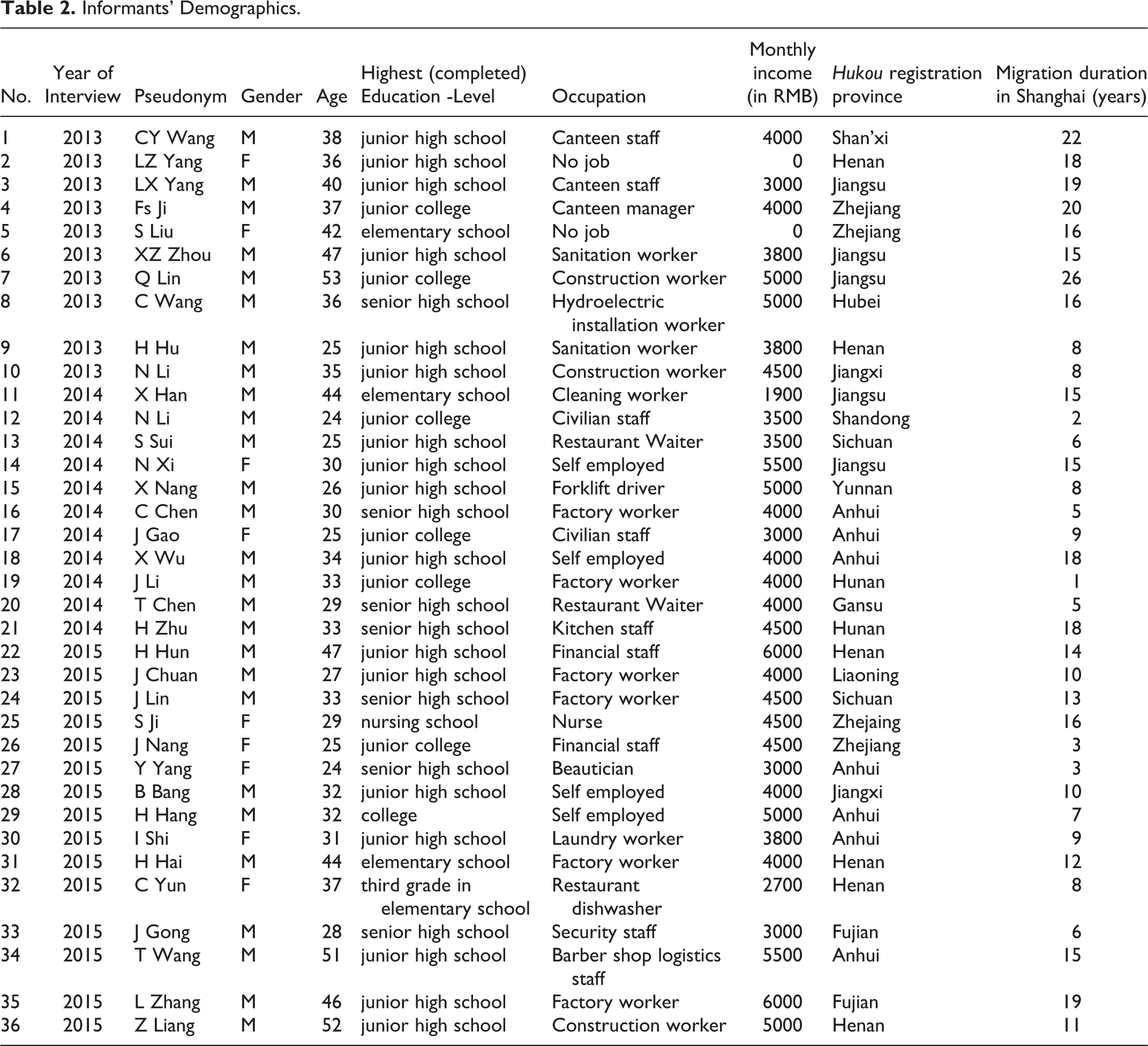
We took an ethnographic approach (Arnould and Wallendorf 1994) to understand the life domains of rural migrants in urban settings. A sample size of 36 obviously cannot generalize to 280 million migrants, but the purpose of ethnographic research is to increase the depth of understanding rather than generalization. Wang and Tian (2014) used a sample size of 19 migrants to investigate a much more specific context. All informants are Chinese nationals, and most had resided in the urban area for more than five years. We used our personal ties with the local government and companies to recruit informants. We did not adopt the common snowballing methods to find our informants because of the fear of reaching very similar participants.
This contrasts with Wang and Tian (2014), who used snowball sampling among migrants from the same geographical area in Shenzhen. As a result, our informants have much more diverse backgrounds regarding place of origin, occupation, gender, and migration history than theirs. Long depth interviews (McCracken 1988) were conducted in the informant’s residences, workplaces, and other “hangout” locations. Each interview lasted between one to two hours. The use of depth interviews allowed us to consider more possible determinants of the migrants’ quality of life to provide a more macro perspective of the problems encountered. The conversation was video recorded and later transcribed in Mandarin or Putonghua. The interviews started with general questions regarding demographics such as migration history, age, and marital status, and were then followed with questions on consumption habits and practices before and after migration. Questions on identity formation emerged from the conversation and were further probed for elaboration. For example, the researchers asked what “home” means to the migrant workers, and what bundles of attitudes, interests, and activities in urban areas the migrant worker have enjoyed. In addition, photographs, field notes, and archive documents comprise part of the qualitative data for this research.
Each interview generated between 15 to 40 pages of transcripts in Mandarin Chinese. Since not all authors are Chinese nationals, the original texts were read by the authors and then translated into English. All the researchers independently analyzed the English transcripts and compared the relevant and important details. Then, the researchers discussed their data analysis process/findings, and a consensus was reached within the research team. The transcripts were scrutinized for common themes and categories and compared for consistency across the entire data set (Arnould and Wallendorf 1994; Belk, Fischer, and Kozinets 2013; Spiggle 1994). In essence, the key patterns were categorized and summarized to draw comparisons and contrasts in the dataset (Thompson 1997).
All of the authors have been rigorously trained in marketing and have conducted extensive work in qualitative research. Much analysis occurred simultaneously with data collection (between 2013 and 2015) and helped to determine the direction of the study. As new data were collected, they were analyzed for points of similarity and contrast. The initial coding was analyzed using NVivo software. For instance, codes such as “outsiders,” “locals,” “shopping,” “home,” “lifestyle,” “family,” “support,” and “friends” were used in the software to attempt to seek patterns.
Analysis was an iterative process of coding, categorizing, and abstracting the data (McCracken 1988). Data of thematic similarity were identified throughout based on keywords or phrases. Coded data were compared and contrasted to yield a few broad categories which, through sorting and clustering, were reduced to the more fundamental patterns that constitute the emergent themes. The final analysis integrated the themes into a unified discussion of the identity reconstruction process (Schouten 1991). This approach is consistent with grounded theory procedures (Strauss and Corbin 1990), which are iterative in nature and require continually collecting data, comparing categories, and revising interpretation until the process is understood (Creswell 2013; Sayre 2001). In essence, the data analysis process and our interpretations follow the guidance prescribed in Belk, Fischer, and Kozinets (2013). In addition to interview data, media news, as well as government policy documents, were included to help us understand the economic and sociocultural background. These observations facilitated our understanding of the vibrant lives of migrants in China.
Findings
Three major themes emerged from our analysis: 1) difficulties breaking with the past; 2) partial urban adjustment; and 3) migrant aspirations. The migrants’ adjustment is marked by a wide variety of coping strategies such as finding friends to help with online shopping (surrogate shoppers) and purchasing used electronic appliances to make it easier for migrant workers to adjust to urban consumption patterns. The liminal space entails culturally constructed rituals (e.g., going back to the hometown for Chinese New Year), cultural narratives (e.g. luoyeguigen - the falling leaves return to the ground; youfangcaiyoujia – house makes home possible), institutional arrangements (e.g., the Hukou system, urbanization, and social benefits), technology (e.g., TV, Internet, cell phones), as well as modified consumption activities (e.g., finding surrogate shoppers, choosing designated/ preselected shops, avoiding fashion items). Public policies play a critical role in hindering the transition for migrant workers. From a macromarketing perspective, the lives of the migrants are affected by many people and institutions, yet they have been a much-overlooked set of stakeholders to date.
Failure to break with the past
A person’s social status transition is often comprised of symbolic behaviors signifying their detachment from an earlier social structure (Turner 2009). Our informants believe that their lives have separated from their materially deprived pasts: “I feel my living condition now is better than in the past. Shanghai is much better than my hometown. There are people out there who still do not have enough food and clothes. By thinking about that, I feel much better for myself.” (Liu) “Also, when I was a kid, I walked six miles every day to go to school. Now in the city, you can actually buy a bike, and it only takes a few minutes to go to the places you need to go.” (Zhang)
Many participants acknowledged the improvement in living conditions in cities, although their severance from the rural consumption habits often are never complete. Despite the continuous incorporation of new components from urban consumer culture, there is a strong sense of attachment to their kinship ties. As research has indicated, family is important enterprise central to consumption, and family life interacts with symbolic marketplace resources (Epp and Price 2008). The quotes below show such strong ties with families left at home, which make it difficult for migrant workers to completely separate from their past. Rather than completely assimilating to an urban consumer culture (Mathur 2012), many regard the rural area as a safer social space to which they can always return. Lin elaborated his feelings about the past: “Every end of the year, I give money to my parents. I pretty much leave every dime I have to my parents and hope they can take care themselves. During the Chinese New Year, they calculated their living costs and wanted to return the money left to us. I refused to take it and honestly, they can keep it for themselves. This is sad. When I first left my parents, I did not even have a cell phone. I used the public phone to call them for a while. For the first seven or eight years, I really did not have anything left to give to them. Now, my financial situation is slightly better and I really want to take care of them. My Mom and Dad cried when I said I will take care of them. They told me that it is not easy for me to make a living. I do not have much money for myself. I should keep it.” (Lin) “My brother is nice as well. When I left my family, my brother told me that I should go. I was told if it is not good out there, I still can come back. He even told me that he will be responsible for my parents’ living and asked me not to worry about them. Then I left. The first time I went back to see him, he held me and cried.” (Chen)
Although urban migrants have strong emotional bonds with their families in the rural areas, the separation between family members creates a “marginalized” past. Although rites of passage highlight the one-way transition from previous status to the next, here we see the obligation for return to the rural social sphere created by the long-cherished value of filial piety to one’s parents. Such forward and backward struggling haunts the lives of migrant workers. In addition to the “left–behind Chinese elderly” (i.e. Xiang 2007), there are also the left behind children, strengthening ties to the past and leading to emotional struggle for both the children and the parents. Many married informants expressed concerns for their children left behind with their grandparents or relatives in rural China. For example, Zhou told us, “My daughter is with her grandparents. We live in a small place in Shanghai. If I ask my parents to bring her here, they will not have a place to stay. So, we had to leave them behind and often my wife purchases stuff here and mails it back to them.” “I work 12 hours a day. There is no way I can take care of my child here” (Li).
“You know, they are labeled as ‘left-behind children,’ and their life is miserable. The TV news talks about them all the time,” (Hun).
Due to connections with families, the village, and the past, the transition becomes blurry and confusing for the workers. Liang expressed, “For these years, my kids have never been to Shanghai…. Originally, they were going to come here. But later, we decided not to take them. My daughter who just finished middle school had to take care of my younger son back home. This year, my wife finally went back. I feel very guilty about this. When I call them once in a while, I can hear my kid crying in the background. I feel so sad…The only time I go back is during Chinese New Year. Well, unless some relatives passed away, I would have to go back. For birthdays, we find a time during the New Year holiday to celebrate it early…Also, we spend quite a bit during the holidays back home, which causes me headaches too. The relationship thing is complicated. If I give people less (red hong bao envelopes with cash), I feel ashamed.”
Given their long work hours, migrants had little time to return home to see loved ones. In most cases, contacts were limited to Chinese New Year festivities. “Most of us always go back for holidays. We have friends here. But they also gather with family during holidays. If you do not go back, you will feel very lonely. Now, my parents are still there. I need to go back to see them.” [Ji] “I cannot break the ties with them. They raised me. I go back during Chinese New Year. I do not know if I will move back or not. It seems it is too far to even think about it.” (Nang) “My parents passed away. We had a very old house back to the hometown then. It is pretty old and shoddy, so we finally sold it. A while back, my brother bought a newer house/apartment in a better area. He lets us to stay when we go back. My other brother also left the town for work in another city. But anyway, the house is empty most of time, since no one is permanently living there. I am thinking since my brother bought it, I could decorate it a little. We can all contribute something and maybe get together once in a while. My wife does not go back often though unless it is Chinese New Year.” (Hang)
The ties to family and hometown that were discussed in much depth in our interviews were not mentioned in Ustuner and Holt’s (2007) interpretations of their Turkish migrants’ experiences, though they played major roles in the other Chinese studies (Wang and Tian 2014; Wang, Zhou, and Zhang 2015). It may be likely that the greater amount of time spent in the urban area by the Turkish migrants facilitated the separation from their families in Eastern Turkey. Additionally, their informants had their children with them in Ankara, whereas many Chinese migrants had “left behind children.” Thus, the Chinese migrants found leaving their pasts behind to be more challenging. Yet, the nature of the bonding ties varied between the Wang and Tian (2014) study and ours. The cab drivers got needed funding from family back home while money would flow in the opposite direction for our informants, providing them with financial challenges.
Acculturation is an ongoing process which, along with movement of material and non-material components, may reconfigure the workers’ consumption practices in the urban area. Thus, in the next section, we will describe the current consumption activities that surfaced during the interviews.
Partial urban adjustment
Many workers suffer from low literacy levels, low cultural capital (Bourdieu 1986), and low economic status. In order to cope with the disadvantages, migrants deploy strategies such as using electronics as a means of coping with limited socialization experience, finding friends to help with online shopping (surrogate shoppers), avoiding bargaining and making purchases in a “known” store, and building identities through avoiding certain product categories such as makeup. The emergent urban consumption is hence composed of a heterogeneity of imagined and actualized practices.
Previous researchers have identified a number of cognitive and social vulnerabilities that arise from low consumer literacy in both developed economies such as the United States (Adkins and Ozanne 2005; Viswanathan, Rosa, and Harris 2005) and developing economies such as India (Viswanathan, Gajendiran, and Venkatesan 2008). Low literacy is responsible for the present living conditions for many. Li said, “I have six siblings, I went to elementary school for two years. That is it. Now, I try to learn something on the radio and finally reach a point that I can read some of the Chinese characters. But my mind is so slow; it is not enough.” “My education is elementary level. My family is very poor and could not support me to go to school. I do not understand Shanghai-nese accent. They always see us as outsiders. There is nothing wrong with us. Just some locals wear colored lens to see us. We are not one of them.” (Hu) “I do not have hobbies; I watch many TV shows.” (Yang) “I want a computer, I [would] use the computer to watch TV. In terms of phone, I would buy it as far as it looks pretty to me. But I want a computer to watch my favorite shows, though I do not know how to use it still. Lately, I save so hard for a computer [laughing].” (Liu) “I have not been to any parks yet. My kid wants to go and I told him to wait till the school takes them there. For us, it is more important to buy a TV and a bike. They are the necessities.” (Xi) “My wife likes watching TV, but I like movies. She does not want me to go to the movie theater, as the ticket would cost us money. TV is cheaper here (we only have basic channels). Well, just like we do not go to the parks, we do not want to pay the tickets to get in.” “The only products or brands I trust are those I watched on TV. If a new brand comes out, I have never seen it on TV before, I would not even think of buying it at all. I would go to the store to try it but definitely won’t take it home.” (Hu) “At times, my friends introduce me to some brands. But still I do not like them, unless I see them on TV before.” (Li)
Mobile telecommunication enables low-income households to leapfrog prior forms of economic inequality and to connect to resources and information that are becoming an integral part of the social system (Horst and Miller 2006). As such, cell phones have become central to establish and maintain relationships. Even in certain parts of rural China, technology allows people to extend or transform their social relationships and/or to create new ones through online platforms (McDonald 2016). Consequently, electronic products such as computers and cell phones are important components of migrant workers’ urban consumption. These products have become the “must-haves” for many migrant workers. This tendency of prioritizing electronics may be due to their lack of other forms of socialization in the cities (Bourdieu 1986).
In essence, electronic products have become the connection between the self and the outside world. The Internet has created a channel of information flows, word-of-mouth, and technical advice from user communities and websites in various consumption classes (Achrol and Kotler 2012). Many workers have relied on technology to cope with their low literacy and low social capital. Some informants use cell phones to listen to music or watch TV shows in the urban environment. The actants of televisions, cell phones, and the Internet have provided great opportunities for these “alienated consumers” to avoid the stigma of low literacy and to develop adaptive skills so that they can manage their social situations. Here technologies are not passive tools but ones that act to stabilize urban consumption activities. TVs, cell phones, and the Internet all help to bridge and transform the rural consumption patterns in which migrant workers used to be embedded. “I use a Huawei cell phone. I heard the brand is good. I can actually watch news on the phone.” (Zhang) “I spend 268 Yuan per month on cell phone. That’s a lot for me but I like to talk on the phone.” (Chen) “Many of us use cell phones to surf the Internet. I play games and read short stories on the phone. Many people on our construction site do this. You know some even bought iPhone to surf Internet [even with low income] because we do not hang out in the evening. This helps us to kill time.” (Gong)
In addition to technological products, other important components of migrant workers’ urban consumption include friends or family members who may provide a surrogate shopping service. Buying clothing can be a stressful experience for low literate individuals. A trusted friend might serve as a surrogate shopper (Adkins and Ozanne 2005). Needing to find surrogate shoppers results from a lack of skill in using technology. Though many workers can use cell phones and certain types of social media (i.e. WeChat, QQ) to communicate with others, making online purchases requires more sophisticated knowledge (i.e. having and using credit cards, setting up emails to place order/receive receipts, and navigating unfamiliar shopping websites.) “I love online shopping, it is convenient. However, I do not know how. Sometimes, I ask for help from a friend. She pays it for me ahead of time. Later I pay her back.”(Yang) “I love to buy stuff online. However, my son is the one who operates the computer system. I do not really know how to use it.” (Sui)
Migrant workers also prefer going to the “known” store that they can trust so that they can purchase without bargaining. “I also like to shop in the store I know of. You know, most of us do not like to bargain. So, if you know the store, you would feel more comfortable to go. Plus, I do not think shopping is leisure. I go to the store I know and bring the stuff back. I do not like to wander around in the mall.” (Shi) “I do not buy makeup. I feel makeup is expensive. Plus, my employers would not like me to wear it anyway, I think. They want to hire the down-to-earth person. I am glad that I do not buy or use makeup.” (Xi) “I do not wear makeup; you know that you cannot look like the boss. They may not like us to look in certain ways. For clothes, my boss may be less concerned. If it fits, and the fabric is good, I am good. I do not need anything stylish.” (Ji)
Fashion avoidance was also found among the Turkish adult female informants in Ustuner and Holt (2007), though not among their daughters. A bigger difference between the two studies is that the female Chinese migrants were in the workplace, while the first-generation Turkish female migrants were not.
Additionally, as Holt (1998) noted, certain social class norms involve specific patterns of consumption. In other words, each status group develops a unique lifestyle and pursues unique consumption activities. Low cultural capital consumers (LCCs) are acculturated in a social milieu in which they engage the material rigors of everyday life (Holt 1998). From our interviews, it seems that female migrant workers perceived aesthetic appearance to widen the gap between them and the “locals” further. Consequently, many have developed their self-identity through the lens of others. This may reflect the “looking-glass self” metaphor which posits that self-concepts are passively formed as reflections of the responses of others (Cooley 1902, p. 77). However, the difference may be in the degree to which it is an active process of adjustment among the migrant workers versus a passive process of acceptance as suggested by Cooley (1902). Meeting the expectations of others was key for consumption decisions. However, the finding conflicts with the previous research finding that those with low cultural capital (LCC) indigenized consumption to narrow the social class gaps and consistently consumed goods that served as conspicuous signals (Ustuner and Holt 2010).
As expected, migrant workers preferred items that are durable, functional, branded but low priced. As literature has shown, the LCCs’ ability to manage material constraints becomes a primary value (Holt 1998). However, our interviews uncovered that the workers have deployed subtle strategies such as finding surrogate shoppers with online skills and using electronics (TV, internet) as a means of changing the self, and avoiding certain product categories such as makeup for constructing a self-identity through the eyes of others. Surrogate shoppers and technological tools, on one hand, help to build their confidence and self-esteem; on the other hand, they may create a deeper liminal space in which the migrant worker may dwell. The non-self-reliance situation may extend the liminal period, which may result in an equilibrium of sorts forming in the transition stage.
The evidence revealed that the workers found multiple strategies to avoid the “darkness” in the transition (Turner 2009). Migrant workers learned to leverage resources despite their limited capacities. Their capacity for using the Internet to shop or going shopping in designated stores is contingent upon the development of social capital. Not wearing makeup is contingent upon the “old” identity and creates possible exclusion from the new culture. The importance of owning/watching TV can be a result of lacking social capital and literacy. By leveraging these resources, the migrants created a comfort zone for themselves but also limited their access to new cultural positions and reduced their desires or abilities to obtain cultural capital in the urban setting.
Migrant aspiration
Migrants transition to urban areas with hopes for generating a higher quality of life for themselves and their families. There is a possibility for that to happen and, as MacInnis and DeMello (2005) note, only possibility and not probability is needed for one to hope. Beyond possibility, though, is the notion of potentiality, as self-efficacy may lead some migrants to plan for acquiring full urban status actively. As some quotations below indicate, many migrants question the likelihood of their reaching their goals.
Many workers tend to take the path of double marginalization (from both the rural and urban cultures), due to cultural differences and public policies. Various cultural resources are embraced to attempt to build a future self. Understandings of urban consumption (and consumption processes themselves) are also shifting over time, making individual migrant workers’ plans for the future more dynamic. Here we found that the experiences of living in the city is a progressive process (Arsel 2016). The initial excitement of moving to urban China is gradually transformed by the continuing links to the rural, which reinforces the liminal phase the workers experience and lead to an ambiguous self-identity. “When I first got here, I felt that I moved from hell to the heaven. I finally could afford pork for dinner. But, I miss my family.” (Gao) “I do not feel we can be urban people. They look at us differently. They feel we are dirty anyway. You know we work in the factory. In the future, if it is possible to save some money, I would like to go back to the hometown to buy a place to live in the countryside. That is my dream.” (Lin)
Home is a complex concept that embraces a place, a set of feelings, and cultural meanings (Blunt and Dowling 2006; Fowler and Lipscomb 2010). One’s sense of home is shaped by childhood memories, along with the present experience and the dreams for the future (Blunt and Dowling 2006). The feeling of having a home is more than just an expression, but also a deep-seated human desire to have, use, and enjoy one’s space (Allen 2015). Migrant parents expressed concern about future living arrangements and desired a home in Shanghai or one in rural China. Buying a home is the ultimate goal. Those who have this dream of buying a home in an urban area have been influenced by observing urban consumers. Those who wish to obtain a home in rural areas may have failed to actualize a desired and potentially attainable self, which may be due to the inability to convert will to action (Schouten 1991). Over time, home ownership becomes an important means of territorialization to stabilize the urban identity formation. Owning a permanent home in the urban area helps to fixate the established urban status. The hope, imagination, and desire for urban living are abstracted through a home in the city (DeLanda 2006). For example, “I save some money for my kid. I also think it would nice to buy a home. I know, I know, it is not even possible, I could only dream about it. It is awfully expensive in Shanghai.” (Hun) “My life goal is to get a larger apartment.” (Bang) “My goal of living in the city is to buy a place to live. Stability is the key for us. We save money but do not have a clear plan.” (Li) “If you want to settle down, first thing you want to do is to buy a house. Everything else is secondary. I have the expectation, but it does not mean it will become true.” (Nang)
Our findings suggest that the unlikely ownership of a home along with missing family ties have become factors in destabilizing identity construction in urban China. Some migrant workers have built or purchased houses in their hometowns even though nobody is living there. Such a strategy, on the other hand, stabilizes their rural identity, as the cultural narrative youfangcaiyoujia argues that house makes home possible.
Discussion
Due to the high demand in large cities for cheaper labor on construction sites, at restaurants, and in other industries, migrants are grudgingly allowed to stay in urban areas (Eades 2014). Chinese migrant workers are going through (partially at least) three major phases, and their liminal consumption patterns are associated with new norms and identities. Culturally speaking, the findings suggest that the workers are unlikely to separate from previous rural ties due to cultural norms and government policies, which result in a prolonged liminal stage and a lack of societal acceptance. We found that migrants are perceived as being vulnerable, in part, due to the external factors such as public policies and discrimination. As Hill (1995) states, stigmatization and discrimination contribute to consumer vulnerability. External factors such as structural and social problems are beyond the control of the individual (Hill and Stamey 1990). Though past marketing literature focuses on the vulnerability of the migrant in general, many of the informants perceive their quality of life has been improved in the urban areas, which indicates that vulnerability is a perceived concept based upon the individuals’ experiences.
In essence, this research takes a bottom up approach (e.g. Viswanathan, Shultz, and Sridharan 2014) to provide micro-level insights for macromarkeitng, emphazing the transition from a subsistence rural living condition to an isolated urban vulnerable position. It expands macromarketing knowledge by including economic and social structure in the marketing system (Layton 2007). The study also indicates that vulnerability tends to create its own self-reinforcing cycle (Shultz and Holbrook 2009) (e.g., migrant workers seem to willingly isoldate themselves in the urban eviroment.) As Baker, Gentry, and Rittenburge (2005, p. 134) note, vulnerability arises from the interaction of individuals states, individual characteristics, and external conditions to hinder consumption goals.
Specifically, this research contributes to macromarketing literature from three major theoretical perspectives. First, it enriches the literature on the liquid identity of migrant workers in urban China and extends the theory of liminality. Second, we found migrant workers face or recreate boundaries, which contributes to the conventional Western notion of acculturation theory that emphasizes assimilation. As Wang and Tian (2014) note, migrant workers consistently face structural barriers in a political economy like China. Finally, we believe Hukou is a political barrier which hinders the adaptation process for the migrants. We propose that public policymakers need to pay further attention to enhance the quality of life for the rural migrants. Otherwise, there may be unanticipated consequences such as higher rates of crime and unemployment. As Eades (2014) notes, migrant workers have been relegated to the worst, lowest paid jobs and are treated by native urbanites as second-class citizens. Inequality and conditions of migrants in urban areas need to be understood by public policymakers as barriers to economic development and a threat to social and political stability, China’s “Growth at all costs” policies have thus failed to address such issues.
Liquid identity in liminal space
As noted earlier, Bauman (2000, 2007) criticizes the Weberian notion of a modernization process that regards development in modernity as a process of removing social agents from previous institutions such as farms and family villages and re-embedding them into new social structures of factories and urban space. Instead, Bauman offers the notion of liquid modernity, focusing on the liquidating process of dis-embedding without re-embedding in late modernity. Whereas institutional powers are consolidated by resistance in the modernization process, their stability is seen by Bauman (2000) as an illusion. He argued for a more amorphous form of modernity or liquid modernity, in which social bonds are weakened, social relationships become more transient, and transience replaces durability as an enduring value in today’s society. Such notions of liquid modernity are embedded within Western societies in which the flow of people between the rural and the urban is more fluid. China is marked by a Hukou system as a structural barrier for the workers, and it has fixed the social status of most migrants to their home villages even if they have been attempting to adapt to urban consumption practices. Our findings resonate with Bauman’s (2000, 2007) notion of liquid modernity, but the uniqueness of the Hukou system renders interpretations of Turner’s notion of the liminal and liminality questionable as reaching the final stage may face insurmountable barriers.
During the transitional/liminal stage, workers have deployed many strategies to cope with the stress associated with transition (e.g., technology adaptation, surrogate shopping, fashion avoidance). Migrant workers may take various paths to envision a post-assimilation identity. As Mathur (2012) proposed, post-assimilation may be viewed as a multi-dimensional stage. Some migrants may fully integrate into the new culture and give up their past identity (assimilation), while others maintain their old rituals or identity (separation). However, our findings suggest that many may dwell in the marginalized liminal state for a prolonged period (marginalization), as it is extremely challenging for migrant workers to integrate into urban China. The desire for urban homeownership is similar to the “imaginative capacities” that Epp, Schau, and Price (2014) noted. Consumers may use imaginative capacity to compensate for the absence of the resources that are reflective of urban residents (Epp, Schau, and Price 2014).
This research also reveals that the liminality of Chinese workers is affected by the uniqueness of Chinese social norms (e.g., family values, urban housing arrangements) and, more importantly, public policies (education and industrial development policies). Migrant workers’ rural Hukou restricts their children’s access to education in urban areas and leaves them not sufficiently protected (Li 2002). Social welfare in China is also tied to residence status within the Hukou system. Therefore, migrant workers are largely excluded from social security, access to bank loans, and medical benefits in urban areas. These structural issues were not discussed in the context of the Turkish migrants in Ustuner and Holt (2007), but they were central to the challenges faced by the Shenzhen cab drivers in Wang and Tian (2014). For many Chinese migrants, the completion of the acculturation process, or the liminal transition, is often outside the realm of possibility. Liminal consumption rituals and practices are shaped and reshaped by individual resources, literacy, institutional arrangement, capitalism discourse, and Chinese filial piety norms. The interface between the cultural factors and policies impedes progress toward reaching a final equilibrium phase, thus forming a liquid identity that shifts between the rural and the urban.
Boundary work and acculturation
Prior acculturation literature has highlighted an intricate process of cultural adaption to unfamiliar economic, biological (e.g., health), physical (e.g., urbanization), social (e.g., discrimination), and cultural (clothing, religion, language) conditions that often create psychological stress (Berry and Sam 1997). Typically, the acculturation literature emphasizes border crossings (e.g., legal, or illegal, immigrants in the U.S.) and how migrants adapt to Western consumer cultures (Cross 2000). As Regany, Visconti, and Fosse-Gomez (2012) posited, migrants confront multiple cultural references as they navigate the market structure. As a result, some migrants might creatively reset the boundaries, which are theoretically defined as “a distinction that established categories of objects, people and activities” (Askegaard and Bengtsson 2005).
Consistent with previous research, Chinese migrant workers moved towards establishing coordination across boundaries (i.e., going home to see family, co-paying for a house in the hometown). However, unlike previous work which emphasized “border crossing consumers” (Peñaloza 1994; Regany, Visconti, and Fosse-Gomez 2012), this study positions boundary work by emphasizing “within-country” migration with the focus on a national-level cultural boundary. We provide insight on migrants’ lived experiences within a national level, which differs from international migration studies that have more focus on language/cultural/religion/ethnicity differences (Regany, Visconti, and Fosse-Gomez 2012) using the theoretical framework of the rites of passage (Van Gennep (1960) [1909]). Liminal boundaries seem vague, as the migrant workers are free to move back and forth between the urban and rural areas. Consequently, the acculturation process may be dissimilar to the international phenomenon, which has traditionally focused upon adaptation as the likely outcome. To that end, we extend cultural assimilation research that has emphasized national, ethnic, and religious boundaries (Regany, Visconti, and Fosse-Gomez 2012).
Public policy implications
We hold the view that governments should bear primary responsibility for developing public policies to address the needs of individuals living in subsistence (Viswanathan et al. 2012). As such, the key question revolves around what government policymakers can do to empower migrants. However, China’s Hukou policy limits many aspects of migrants’ lives in the urban setting. Under such a policy, rural migrants have limited opportunities to become permanent urban residents (Wang and Tian 2014). As a result, many face barriers in accessing public resources/services, such as low-cost healthcare, retirement funds, and social security. We agree with Wang and Tian (2014) that a social system may need to include rural migrants in urban planning. The local government may need to provide low-cost housing and public education to the migrants’ children. In rural areas, the local government may need to take initiative to help with “left behind” elderly or children, which may include investment in low-cost nursing homes/home nursing programs and low-cost public education in rural China.
Previous research suggests that consumer skills such as literacy and numeracuare needed to make sense of the marketplace, e.g. reading advertising, calculating discounts, and identifying the value of goods (Wallendorf 2001). Our findings show that migrants lack formal education, which hinders further acculturation. To illustrate, many migrant workers utilize social capital/connections to navigate online shopping, due to illiteracy. However, very little attention has been made to cultivate marketplace skills for rural migrants in China. As such, it may be helpful to develop low-cost or free literacy education to help these individuals to overcome shortcomings and increase their capacity to find economic welfare and independence.
Conclusion and Future Research
Urbanization is a global phenomenon; yet the movement of poor, less educated rural peoples to somewhat hostile urban environments has received relatively little attention in marketing. Adjustment to the new environments requires an interface with a far different market structure with many offerings of new and highly desirable products. At the same time, the movement requires separation from family (and not only parents and grandparents, but increasingly from children as well), which is a far more painful process in collective cultures than in Western ones. While migrant workers are needed for manufacturing and service jobs in urban areas, government policies in some countries (such as Hukou in China) reflect perspectives that seemingly restrict the movements from being permanent.
Theoretically, this study re-examined extant acculturation literature by analyzing within-border migration. More work is needed to address the explicit roles of the market in identity formation and revision in migrant workers’ urban transitions. Future research may focus on how different markets (i.e. fashion, leisure) influence migrant workers’ identity transition and consumption. Some migrants may return to their rural homes at some point of their life, which would seem to be the implicit intent of the Hukou policy. As such, more work needs to investigate how the workers re-adapt to the rural home environment after they have lived in the urban area for years. Family dynamics among the workers may be another area that needs to be explored. A better understanding of how relations among migrants’ parents, children, and grandparents impact family identity in the current marketplace would directly contribute to cultural understanding.
Throughout the paper we have compared our findings in China with those from Wang and Tian (2014), also in a Chinese context, and from Ustuner and Holt (2007) in a Turkish rural-to-urban context. There were major differences in the studies, even within the two Chinese ones. Using a macromarketing perspective, we find that one large difference in the contexts of the Chinese studies and the Turkish study is the role of government policy in China. It is somewhat unfathomable to consider how a country with more than 1.3 billion people, approximately half of them living in rural areas, can be directed so as to provide a good quality of life for its people. The Hukou system had served to prevent China’s cities from becoming so large that they might become ungovernable. Allowing rural-to-urban migration in order to provide labor during its industrial revolution helped the economy grow rapidly, but maintaining the Hukou system in terms of not providing medical and education benefits to the migrants is having a severe impact on the country’s family system. This family structure has been a major factor in Chinese culture, but it is facing unprecedented challenges that desperately need handling.
Even the two Chinese contexts faced major differences. The Wang and Tian (2014) study had a much tighter focus than did our study. Their financial focus led them to discuss the barriers faced by migrants to Shenzhen in terms of acquiring capital, and their findings lead to the conclusion that money flows from rural to urban settings. In the broader context of our study, money was seen to flow from urban to rural. Another difference seems to be due to how the samples of informants were generated. The migrants to Shenzhen apparently came from the same area of China and apparently used the same language dialect. Shanghai has attracted migrants from many regions of China, and many migrants had problems dealing with the Shanghainese dialect. Further, Wang and Tian’s informants all came from one particular area of Shenzhen, composed of migrants from the same area of China. Nearly 50% of their informants indicated that friends originally from their home area were helpful in their finding employment. The informants in our study did not report such local ties. The point is that there are many different factors affecting how migrants adjust to their new environment, and much more research needs to be conducted before generalizable processes can be identified.
Rural migrants are at the center of China’s urbanization process. Their social welfare, economic status, and consumer rights have yet to be improved (Wang and Tian 2014). This study has focused upon a limited number of migrant workers in Eastern China; thus, future research should continue to study the life transition of migrant workers with a larger sample size in various geographic areas. Additionally, our study emphasizes public policy, identity transition, and consumption scale in the urban setting. Research may further examine the well-being of the left behind elderly’s and children’s living condition in rural China. Researchers may investigate various forms of boundaries that migrants may have created/faced which impact the quality of life among the workers. Longitudinal analysis will be better suited to understand the long-term implications of public policy impact on the workers.
Footnotes
Acknowledgments
The authors thank Russ Belk and Ron Hill for their comments on the manuscript.
Author Contribution
Jie G. Fowler and James W. Gentry contributed this paper equally.
Declaration of Conflicting Interests
The author(s) declared no potential conflicts of interest with respect to the research, authorship, and/or publication of this article.
Funding
The author(s) disclosed receipt of the following financial support for the research, authorship, and/or publication of this article: The authors acknowledge the financial support from the National Social Science Foundation of China (13CSH071).
