



Abstract
The present paper assesses the usage of relational ontologies in the realm of macromarketing made available by consumer culture theorists. Our paper advances this movement by exploring the potential of relational ontologies to propel a more thorough methodological discussion and operationalization of relationality in macromarketing. To fulfill this task, the paper first identifies and discusses four perspectives that have provided stimuli for relational thought: the new mobilities paradigm, non-representational theories, practice theories and assemblage theories. Subsequently, the paper offers an organizing framework made of four steps (i.e., approaching, setting up, emplacing, and staging) in which the role of different relational perspectives is examined. Lastly, the paper sketches a hypothetical relational-inspired macromarketing study on the reputational capital of places as a way to encourage an applied discussion of this relational framework. By so doing, the paper seeks to better clarify the expected contribution of the different relational perspectives brought forward by CCT scholars to the realm of macromarketing, with a particular focus on methodological aspects.
Keywords
Introduction
Relationality and its conceptual embodiment in “relational ontologies” has become a very controversial and widespread topic in several fields, from the natural sciences to the social sciences and humanities such as theology, philosophy and sociology (Wildman 2010). In this respect, relational ontologies (note the plural) can be seen as a worldview in which relations are considered central and have primacy over entities; this is in contrast to objectivist and substantivist ontologies in which entities have primacy. However, relational ontologies are being appropriated in different forms, resulting in different theories, approaches and methodologies. Even though a complete survey of the differences in every field of the academy is beyond the scope of this paper, one can recognize that relational ontologies have gradually trickled down from different areas of the social sciences (e.g., Donati 2010; Haraway 1999; Latour 2005; Ticineto Clough 2010; Whatmore 2006; Wight 2006) into business administration (e.g., Missonier and Loufrani-Fedida 2014; Orlikowski and Scott 2008; Özbilgin 2006; Vosselman 2014), and in particular into marketing and research on market(ing) practices (e.g., Finch and Geiger 2010; Hill, Canniford, and Mol 2014; Kjällberg and Helgesson 2006; Mason and Spring 2001). More broadly, this trickling down could be considered as a response to a conceptually driven “quest for complexity”, which has gone hand in hand with an increasing awareness of the fact that companies, products, and consumers are embedded in an increasingly dynamic, performative (Hagberg and Kjällberg 2010; Kjällberg and Helgesson 2006), fast-paced, and “wired” society (Bajde 2013). More specifically, as suggested by the popular adoption of different relational ontologies by researchers of Consumer Culture Theory (CCT) (see, for example, Bettany and Kerrane 2011; Bajde 2013; Canniford and Bajde 2015; Hill, Canniford, and Mol 2014), this interest in relational ontologies could also be considered as an attempt to investigate the complexities of marketing and consumption not only analytically but also, more crucially, methodologically and to contextualize these within a dynamic perspective that considers societies as contingent and constantly in the process of becoming (see Castells 2000).
It is possible to argue, surprisingly, that the interest of macromarketing researchers in relational ontologies has so far resulted in occasional accounts (e.g., Lindeman 2014; Layton 2015; Blanchet and Depreyre 2016). In these few instances, relational ontologies have been merely used as enabling or explicatory theory and not as sources of methodological inspiration capable of informing certain epistemologies. This seems to be a missed opportunity for macromarketing for two main reasons. First, researching relationality implies an onto-epistemological view that collapses the division between “way of being” and “way of knowing” so that theories and methodologies should be informed and follow each other (see also for a critique Barad 2003). Second, since macromarketing is defined as (a) the study of systems in their constitution with the environment (Layton and Grossbard 2006) in which the actions of market participants have consequences far beyond the boundaries of firms (Mittelstaedt, Kilbourne, and Mittelstaedt 2006), relational ontologies might be useful to serve as a proxy for an investigation of the relationality that seems, perhaps implicitly, to underpin the foundations of the discipline. In other words, as suggested by the few pioneering relational investigations cited above, macromarketing could be an appropriate research laboratory in which relational ontologies could be appreciated and implemented.
To explore this nexus, the present paper seeks to unpack the potential of relational sensitivity within the area of macromarketing research by focusing in particular on an epistemological-methodological dimension. More specifically, this paper offers a critical, reflexive, and politically sensitive research approach that intends to pave the way for a relational research agenda in macromarketing. First, we critically explore the manner in which interest in relational ontologies generated by consumer culture theorists has trickled down into the Journal of Macromarketing, which is understood as an eclectic publication in which different forms of study merge. In the following section, this paper presents and discusses an organizing framework by drawing from research on relationality (Crossley 2015; Desmond 2014) in order to set the foundations for a relational approach that works with the dynamic and processual nature of society and, particularly, contemporary markets and marketing systems. Lastly, we propose a relational-inspired macromarketing study on the reputational capital of places as a way to encourage an applied discussion of this relational framework. By so doing, this paper seeks to better clarify the expected contribution of the different relational perspectives brought forward by CCT scholars into the realm of macromarketing, with a particular focus on methodology.
Methodological Reflection in Macromarketing
The literature on macromarketing has been vigilant in refining its theoretical foundations, and these refinements have incited considerable debates over the years (see Layton and Grossbard 2006). Methodological advancements, however, have not progressed at the same speed. Three decades have passed since Venkatesh and Dholakia’s (1986) pioneering article on methodological issues in macromarketing, wherein the authors stimulated a discussion about methodological peculiarities of the macromarketing research field and discussed the ways in which macromarketing research can help capture aspects of society that macromarketing research cannot. Despite the development of subsequent studies on methods and empirical work in macromarketing (see Finn and McQuitty 1994; Zinkhan et al. 1990), limited reflections on the ways in which research is done and knowledge is acquired characterize the macromarketing realm.
A recently published special issue on methods (see Wooliscroft 2016) has attempted to fill the vacuum. And yet, the majority of articles included in that publication have mainly focused on procedural tools (i.e., methods and their practical application); this focus actually marginalizes many relevant methodological dimensions such as epistemology, which is understood here as way of reflecting on the production of scientific knowledge. In fact, whereas the recent revamp in methodology has followed one of the two main ways of understanding methods-related issues within social sciences – namely methodology understood as techniques of data collections (e.g., interviews) and/or procedures to perform analyses – the treatment of methodology in this paper follows instead another path, namely that which emphasizes the philosophy of methods and thus has to do with the reflection on the views, rationales and assumptions that underpin certain methodological choices.
Given the nature of macromarketing as a complex and systemic theoretical approach (see Meade and Nason 1991) that is able to capture “the interactions between the system and its environment” (Layton 2007, p. 235), and given its emphasis on understanding marketing systems through their reciprocal interactions with society as a form of agorology (Mittelstaedt, Kilbourne, and Mittelstaedt 2006), the task of developing methodological reflections that capture such complexity is particularly crucial. In other words, researching intricate macromarketing phenomena necessitates a methodology that is capable of capturing the complexity of macromarketing as a wide spectrum of interactions and systemic connections.
As a field that is by definition continuously arguing its centrality in exploring the connections, relations and entanglements implied by marketing phenomena, macromarketing has provided, perhaps implicitly, a vibrant laboratory of empirical relationality since its very foundation (see Layton and Grossbard 2006; Layton 2015). Going a step further, we believe that the relational sensitivity recently made available by CCT researchers and studies have great potential to enrich the discussion of complexity that can be fruitful for macromarketing in further nurturing its methodological awareness, of which epistemology constitutes a privileged dimension. A more epistemological exploration of relational ontologies, in fact, may have far-reaching implications for self-reflexive observers who wish to observe and account for complex and multilayered macromarketing scenarios.
In other words, on the one hand, we argue that the debate over relational ontologies started by CCT scholarship can offer macromarketing the opportunity to engage more thoroughly with the language, tools, and procedures of relational ontologies. At the same time, on the other hand, the present paper, by departing from macromarketing peculiarities, advances the idea that macromarketing by definition (as done by macromarketing scholars) is a germane field of research for building a relational methodology. All of this is an effort to emphasize that macromarketing is worth the attention of CCT researchers seeking an ideal testing ground for their relational inquiries but also more crucially, to possibly refine some of their critical and political aspirations in pursuing a relational research agenda. This is because macromarketing traditionally has opened up the possibilities of suggesting a relational deconstruction, and thus a critique, of concepts such as marketing systems, consumers and markets (see Schwarzkopf 2011, 2014). We hope that building this bridge is a helpful contribution to both fields.
Thus, in line with Blalock’s (1984 in Parkhe 1993, p. 245) recommendation to offer formulations that are able to translate complexity into more specific forms, it is suggested here that the more established and yet still recent epistemological sensitivity in adopting relational ontologies promoted by CCT scholarship can, if adapted, facilitate the elaboration of a methodological approach that is able to operationalize macromarketing’s complexity into more comprehensive and analyzable forms which can thus be approached more critically and fruitfully. In addition, this task simultaneously translates into the necessity to critically examine the possible obstacles and perils that are implied by the attempt to bring specific relational ontologies into macromarketing research.
As in Venkatesh and Dholakia’s work (1986), this present paper bridges the two fields by outlining a flexible research approach that can be used to think about macromarketing research critically, reflexively, and politically. Rather than defining a detailed or schematic suggestion for methods and sets of techniques, as Saatcioglu and Corus (2018) recently did in relation to action research, this paper promotes an onto-epistemological exploration of the buffer zone where CCT meets (and tries to exert an influence on) macromarketing. This implies an endeavor that is able to account for “the rationale and the philosophical assumptions that underlie any natural, social or human science study” (McGregor and Murnane 2010, p. 2) and ultimately offers a way to capture the relationality of macromarketing with more critical awareness.
Relational Horizons in Macromarketing
Relational ontologies have been “translated” into very different shapes and forms in social science. In the cognate field of CCT scholarship, one can witness how this trend has recently gained momentum and produced a series of more eclectic research accounts (see for example Bettany and Kerrane 2011; Bajde 2013; Canniford and Bajde 2015; Hill, Canniford, and Mol 2014). This tendency emerged as a result of integrating different theoretical and methodological approaches inspired by relational ontology rather than applying traditional functionalist or pure cognitivist models and tools of marketing and consumer behavior research.
Nevertheless, as in other fields, the relational emphasis (or fashion) has created some patterns of selective appropriation and remodulation of relationality in the form of different relational ontologies; these have in turn been translated into different theoretical perspectives, which, despite a certain common ground, are characterized by a series of substantial differences. Among these, one can recognize four interrelated theoretical perspectives that are adopted from the elaboration of relational ontologies within the human and social sciences and have informed the relational inquires developed by CCT researchers. These are the “new mobilities paradigm”, “non-representational theories”, “practice theories”, and “assemblage theories”. Following Cohen and Cohen (2012) and other recent summative conceptual accounts (Alberti et al. 2011; Powell and Dépeltau 2013; Wight 2006), these four perspectives reflect a broader meta-theoretical reorientation in contemporary sociology and philosophy that emphasizes a shift from permanence to flux, from structure to agency, from scripted social activities to the processes leading to their emergence. In other words, these four perspectives share a diachronic ontology that considers marketing activities processually and understands them as being reproduced across different social domains, thus overcoming binary concepts, such as the dichotomy between reality and virtuality.
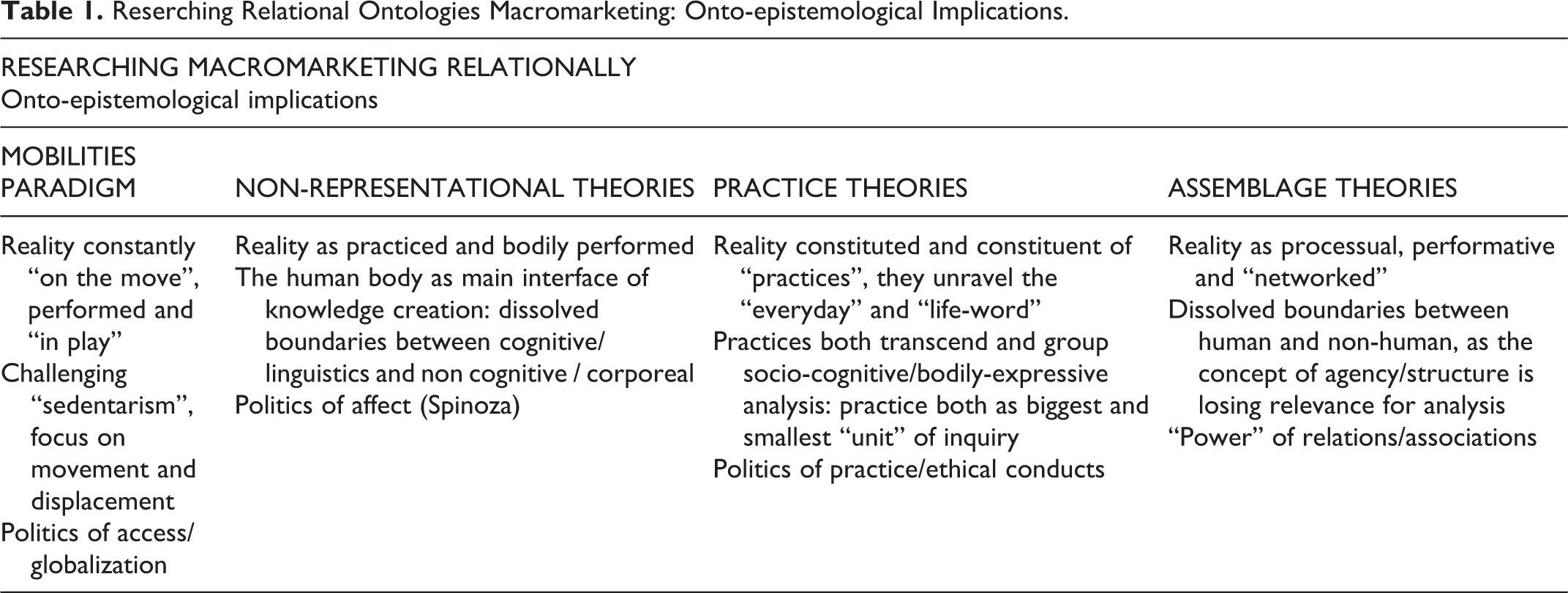
While the pure conceptual treatment of these perspectives is beyond the scope of the present paper and can be found elsewhere (see Cohen and Cohen 2012), there is a necessity, following the argument put forward by Barad (2003), that these perspectives should be considered onto-epistemologically when sketching their similarities (e.g., a common relational onto-epistemological approach) and differences. This for two reasons: first, the paucity of applications of these perspective in macromarketing leaves an empty space to fill before moving to a more concrete methodological consideration; second, the differences have not only to do with dissimilar philosophical roots (e.g., the time geography of Härgestrand; the semiotics of Serres and Greimas) but also, and more crucially, with divergent methodological conceptualizations. In the next section, in order to show the presence, albeit limited, of these four perspectives in macromarketing, we offer a critical assessment of the studies endorsing the four methodological approaches (see Table 1).
Reserching Relational Ontologies Macromarketing: Onto-epistemological Implications.
New Mobilities Paradigm
The rise of the concept of “mobilities” within the social sciences has inspired novel ways of thinking and researching (Hannam, Sheller, and Urry 2006; Urry 2007). As defined by Sheller and Urry (2006), the “new mobilities paradigm” entails an understanding of society and the lived experiences of people as inherently mobile, given the fact that mobility underlies a plethora of everyday phenomena (e.g., commuting, tourism, sport, etc.). This paradigm also highlights the significance of materiality, bodily experiences, and emotions that determine the way in which people are linked to and make sense of their environments through their movements. Additionally, the new mobilities paradigm implies a critical understanding of (a) the interconnections between people and places, emphasizing that all social processes are spatial, and (b) the interconnections between place, space, time, and movement. Such a view has the merit of challenging “sedentarism”, the tendency to stick to static conceptualizations of social, natural, technological, and human phenomena that often hinders research in the human and social sciences (Sheller and Urry 2006, p. 208).
So far, except for one specific case (see Scaraboto and Figueredo 2017), this relational perspective has trickled down into macromarketing research as a foundational paradigm only occasionally and implicitly. This is surprising, given that some pioneers have managed to capture aspects of the mobility paradigm, as did Korzeniewicz (1994), who sought to track the organizational and geographical dimensions of the manufacturing and distribution processes of goods in global commodity chains. Furthermore, the systemic conceptualization of macromarketing, as put forth by Layton (2007), the postmodern conceptualization by Venkatesh (1999), and the empirical study of reterritorialization of rock music in Turkey (Yazicioglu 2010) have all dealt with some of the elements evoked by the “new mobilities” paradigm, such as the fluidity of sociocultural phenomena and the connectivity of the contemporary world. These studies focus on the complexity of globalization and the general movement of ideas, images, and consumption practices.
Non-representational Theories
Non-representational theories are considered as a heterogeneous set of theoretical perspectives, largely developed by human geographers. These focus on how social actors express themselves in shared everyday experiences, with due recognition to the embodied, affective, and pre-cognitive aspects of their movements and dispositions (see Cadman 2009; Dewsbury 2000; Lorimer 2005; Nash 2000; Thrift 2000). The main contribution of this perspective is that it complements the widespread, predominant research focus on representational modes of knowledge based on words, images, and graphic elements. Accordingly, the tendency to account for social phenomena by describing them through purely cognitive and linguistic procedures is tenuous since it may form what Beyes and Steyaert (2011, p. 46) critically define as “representational distance”.
Through the articulation of their main tenets, non-representational theories provide a perspective that social phenomena is constituted as embodied, performative, and affective practices occurring in people’s everyday lives. These practices are regarded as ways of doing and being within the flow of everyday life that may transcend the cognitive awareness of what this particular doing and being means to the social actors. In other words, the assumption is that practicing may elude explanation given the unintentional and unpredictable character of these practices, but they can be understood with due recognition of their performative nature.
The perspective of non-representational theories has not warranted much attention within macromarketing research. We can argue that a non-representational perspective in macromarketing can pose challenges and limitations in terms of accounting for forms of individuals’ precognitive dispositions that supersede self-reported behavior and verbal accounts. However, because macromarketing has been historically less influenced by the linguistic turn brought about by postmodernism (see Venkatesh and Dholakia 1986) and has retained a certain critical realist outlook, a critical exploration of non-representational theories, especially in regard to their methodological materialization, cannot be excluded a priori. Similarly, as has happened in other fields such as management (Lorino, Tricard, and Clot 2011), the growing interest in the main tenets of non-representational theories such as affect, performativity, and corporality evident in recent macromarketing studies (see Zwick 2013) can be noted, although very few studies have facilitated a sound methodological application of non-representational theories. Despite that, elements of non-representational theories, such as the importance of materiality (Scott, Martin, and Schouten 2014) and performativity (Onyas and Ryan 2015) have been addressed.
Practice Theories
Practice theories or theories of (social) practices are another composite perspective which includes different, sometimes complementing and sometimes contrasting, underpinnings. As applied to social sciences in the work of Schatzki (1996) and the cultural work of Reckwitz (2002), this body of theory emerges as a counter-movement against the purely interpretative turn in socio-cultural studies. Emerging from the work of Bourdieu, Giddens, Wittgenstein, Foucault, Garfinkel, and Taylor, among others, and similar to the above-mentioned non-representational theories that are more geographically developed, practice theory has its backbone in the “everyday” and “life-world”. The peculiarity of this perspective is its onto-epistemological focus only and exclusively on practices understood as encompassing elements. In other words, as pointed out by Schatzki (1996) and Reckwitz (2002), what practice theories imply is that practices are simultaneously the biggest and smallest “unit” of inquiry that should be researched and analyzed, and that they are the unit in which everything happening should be conceptualized. It follows, therefore, that analyzing “practices” via “practices” is the key to unravel ideas and main social, human, animal and technological core concepts such as body, mind, things, knowledge, discourse, structure/process, and agency, as well as marketing, consumers, market, system, relation, co-creation, brands and exchange (e.g., Echeverri and Skålen 2011; Schau, Muñiz, and Arnould 2009; Shove and Pantzar 2005; Warde 2005).
Perspectives focused on theories of practices has been applied in macromarketing research in a recent analysis of community empowerment in underdeveloped areas (Lindeman 2014), in the analysis of gambling practices centered on the interplay between family identity goals at the meso-level and wider socio-cultural institutions at the macro-level (Westberg, Beverland, and Thomas 2017), and in the analysis of citizen practices in the case of the slow food movement (Chaudhury and Albinsson 2015). Nevertheless, these accounts use practice theories as a theoretical lens to analyze data and much less as an epistemological or methodological tool for generate data. Instead, in practice theories, privileging practices offers, as pointed out by Reckwitz (2002), a way to transcend different dimensions of the human and social by implying that practices could been seen as praxis, as “the whole of human action”.
Here, practices have both micro and macro properties; not only do they unfold as the nexus of occurrences in in society and the actions of people over time, but they also include “practitioners” in the form of actors that develop and draw upon practices to enact the social praxis and final practices which emerge as routine practices that are combined, coordinated, and adopted to construct practice. On the one hand, practice theories encourage a shifted self-understanding of the role of researchers. They are not merely analyzing, detached “practitioners”, but they are also practicing macromarketing research in itself as carriers of sustainable practices imbued with certain ethical outlooks that might have effects on the type of agrology that is produced above its “idealization” (see a critique on the idealized agora by Schwarzkopf 2014). However, on the other hand, this perspective invites the researcher and researched to consider all agents as carriers of routinized, over-subjective complexes of bodily movements, of forms of interpreting, knowing, wanting, and using things.
Assemblage Theories
Assemblage theories, as exemplified by the heterogeneous contributions presented by Canniford and Bajde (2015), are a set of relational theories that have been widely adopted in the social sciences. Regardless of their philosophical (e.g., De Landa 2006; Deleuze and Guttari 1987), sociological (Callon 1987; Latour 1987; Phillips 2006), technological (Law 1987), and cultural (Entwistle and Slater 2013; Slater 2002) variations, these theoretical perspectives challenge the notion of an independent and stable domain of reality. Indeed, they suggest that traditional observers “have confused what they should explain with the explanation” (Latour 2005, p. 8). Social phenomena, based on assemblage theories, are not glue that holds society together but rather are “what is glued together by many other types of connectors” (ibid, p. 5). Society, then, is not a “specific realm…but only…a very peculiar movement of reassociation and reassembling…a trail of associations between heterogeneous elements” (ibid, p. 5). In particular, this theoretical perspective stresses the emergence of networks, such as systems (see Layton 2015) that are continuously assembled and reassembled as entities “in becoming”. This means that both the study and existence of macromarketing systems, understood as the study of agorology, depend entirely on the continuous performance of relations that are analyzed as a device, whereby the multidimensional relations between products and/or services are articulated in the process of relational emergence. This has already been shown, for example, in the research on brands (Lucarelli and Hallin 2015; Onyas and Ryan 2015; Parmentier and Fischer 2014).
The application of assemblage theories in the area of macromarketing, especially in its ANT version, is the most established perspective in this journal. These efforts have shown that implementing assemblage theories can be a way to explore potentially new research avenues (see Firat and Vicdan 2008) or even to rethink the concept of a market system (Layton 2015). However, even if assemblage theories and their variations have been primarily exploited conceptually, a thorough methodological operationalization remains limited. In fact, even though we can witness empirical studies – primarily brought about by CCT scholarship, in different macromarketing contexts (Eckhardt and Mahi 2012), such as consumer labor in the technological world (Bonsu and Darmondy 2008), self-branding (Bandinelli and Arvidsson 2012), and global market spaces (Bjerrisgaard and Kjeldgaard 2013), as well as critical works on the central concept of the way resources are used in marketing (Campbell, O Driscoll, and Saren 2013) and ideology (see Eckhardt, Dholakia, and Varman 2012) – their methodological implementation has been only partially operationalized. Apart from the singular methodological reflections on the way to analyze market formation (see Blanchet and Depreyre 2016), other examples of data collection and data analysis are of paramount importance. Such examples are deemed essential both for rendering a more substantive corpus of studies from which to learn and draw insights for further studies. They could also suggest different ways of analyzing “translation” as the core assumption behind the view of an assembled and networked nature of macromarketing phenomena. For example, in their study on macromarketing shaping, Blanchet and Depreyre (2016) suggest that market controversies could be analyzed through an ANT perspective in order to offer intelligible narratives that do not overwrite the debate but preserve the wealth of connections that entangle markets and society, as well as the uncertainties that surround them.
Toward Relational Macromarketing Research: An Organizing Framework
We have shown appreciation for the wide array of resemblances to relational approaches brought by CCT researchers into macromarketing. However, in order to provide a more systematic discussion of the methodological implications raised by a relational philosophy of methods in macromarketing, it appears appropriate to elaborate an organizing framework by which the suffix -ing suggests its processual, emerging and tentative character. As shown in section no. 2, the growing broader debate on relationality within the social sciences suggests that social phenomena should be approached in terms of interactions, ties, and networks (see Crossley 2015). Accordingly, macromarketing topics or megatrends, such as marketing systems or sustainability, could be very difficult to disentangle since they have continuously co-evolved in combination with other topics or megatrends, such as poverty, or justice. This suggests that any macromarketing object of research cannot be understood either atomically (as individual single topics/trend) or as a pure combination of some of these. However, questions remain regarding extent to which these relations of macromarketing can be captured in a methodological apparatus that is suitable to account for its dynamic, complex and processual nature. Drawing from, among others, the work of Desmond (2014), can serve as a proxy for the development of methodological sensitivity imbued with relationality. The present section introduces a framework that focuses on the dynamics emerging between different research steps which are qualitatively different from each other yet oriented toward and enmeshed with one another.
Figure 1 summarizes a relational research process in an attempt to systematize the relational undertakings of macromarketing researchers and, in the next section, examine the role that each relational perspective presented above can play as complementary building blocks of relational thinking in macromarketing. Step 1 (“Approaching”) focuses on a more general level and proposes an onto-epistemological understanding of macromarketing’s object of study as being in a continuous process of reshaping. In line with an anti-substantialist perspective, research is seen as an attempt to identify appropriate “networked” fields (see Burrell 2009) in order to understand the configuration of relations whereby marketing systems emerge, rather than considering marketing systems as given. Notably, instead of following Layton (2015) and placing emphasis on dynamics within a marketing system (or multiple actors/nodes/forms of organization selected for some theoretical purpose), one should instead expand the scope of the research object in order to focus and document social relations across a marketing system field, thus without pre-selecting actors/nodes/forms of organization.
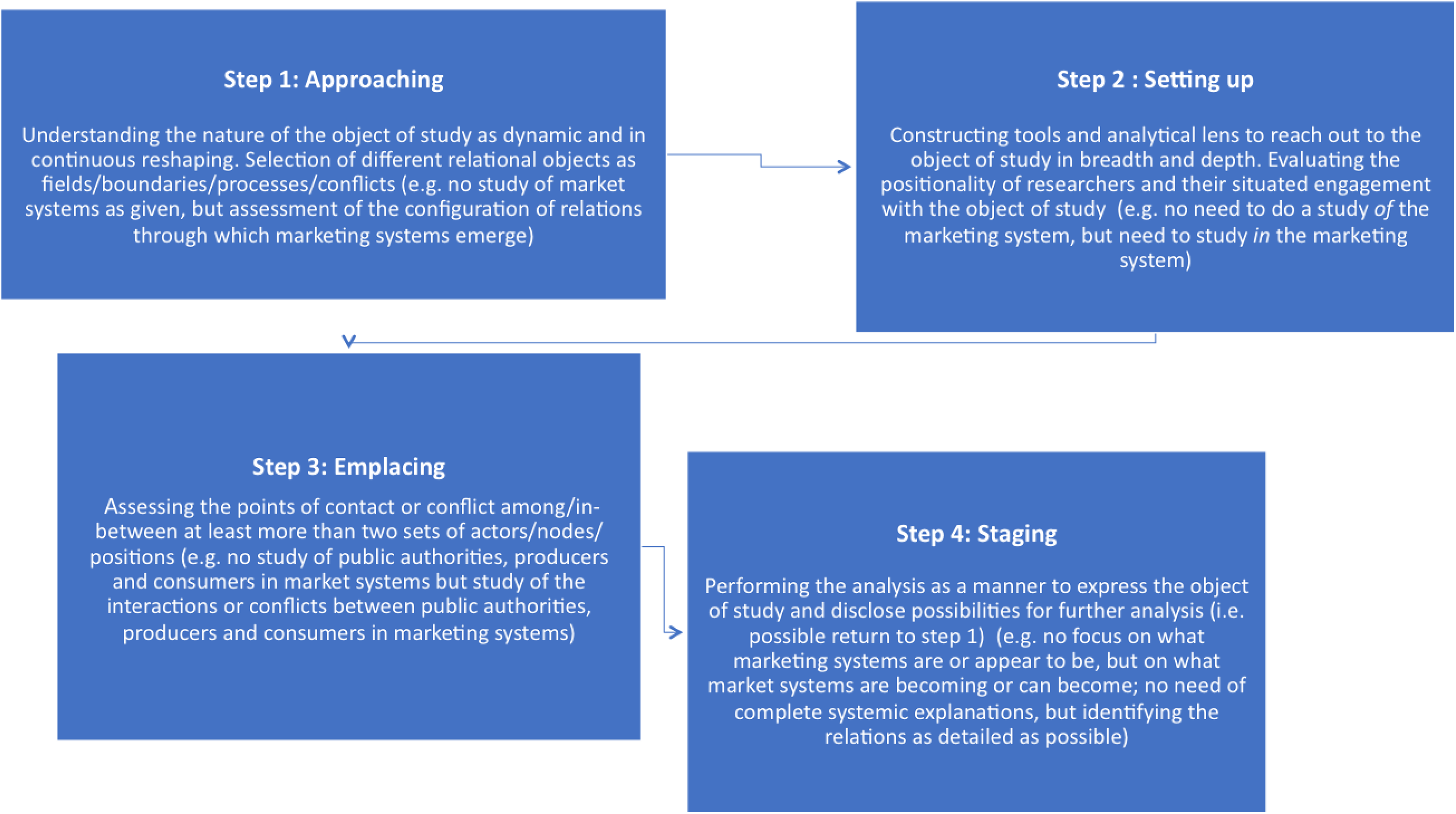
Four steps in the relational undertakings of macromarketing researchers.
In line with an idea that challenges substantialism and process-reduction, Step 2 (“Setting up”) has to do with the construction of strategies and an analytical lens that further expands the object of study in breadth and depth. This comprises, among others, two main challenges: accounting for the positionality of the researchers and dealing with the problem of having access to fieldwork and materials (gaining entrée). Regarding the former this implies stimulating the reflexivity of researchers by conceiving them in an active process of data creation and fieldwork. This includes acknowledging the different positions of the researchers, their socialization within different scientific communities of practice (see Yanow 2009), and their dispositions toward the object of study including their possible vested interests. In other words, this would entail appreciating the research team and its characteristics in relation to both the object of study and the different researching procedures that are undertaken. In this respect, the issue of entrée refers to problems of access and selectivity in identifying sources of data which researchers are called to be coping with warily and proactively. For example, access to (or contact with) some participants may compromise the possibility to approach other (antagonist) groups of participants (see Desmond 2014, p. 569). Connected to this is the issue of time, since resources allocated to a certain task (e.g., an interview, a transcription, a piece of visual analysis, etc.) cannot be allocated to other tasks (ibid). The awareness for these limitations should then inform a relational inquiry.
Step 3 (“Emplacing”) further advances this sensitivity to suggest how to take on the traditional steps of data collection and analysis. Accordingly, this implies selecting and assessing the relations (i.e., points of contact/conflict) among/in-between at least more than two sets of actors/nodes/positions. This does not merely entail a breaking away from the tendency to encourage a more critical-emancipatory take on macromarketing scholarship in general (see Kravets 2017) or analytical focus in particular (see Figueredo et al. 2015). This would rather endorse an approach that implies documenting sequences of connected events that are spatially and temporally contingent, instead of striving for complete systemic explanations of marketing systems (see Kadirov 2018; Layton and Duffy 2018). In other words, this means moving away from studies of different public authorities, producers and consumers in marketing systems, toward an investigation of the position, action, and conflicts between public authorities, producers, and consumers in marketing systems. This would mean an analysis of not marketing harmony, but relational collision, competition in-between at least more than two sets of actors/nodes/positions.
Step 4 (“Staging”) refers to the traditional phases of research dissemination and is the final step suggested in the framework, but it is not necessarily the end of the research process. Here, the account of the analysis is seen as a manner to express the object of study and disclose possibilities for further inquiries, thus suggesting the need to return to Step 1 and eventually re-open or keep open the research effort. In this regard, instead of producing representations of research which highlight specific semi-essentialist features of macromarketing, the approach here suggests that this could only be seen as a partial or transitory representation, as an attempt to appreciate areas of macromarketing that might be interrelated rather than incommensurable.
To develop a contextualized and applied discussion of how this framework could inspire and propel macromarketing research, the next section envisions a relational-inspired macromarketing study on the reputational capital of places, clarifying which relational perspective(s), in particular, may facilitate which step(s), and the reasons for this.
A Relational-inspired Macromarketing Study on the Reputational Capital of Places
For the sake of illustration, we imagine here the development of a macromarketing study that aims at investigating the dynamics through which places create and manage their reputational capital, a popular subject that has become the center of expanding streams of literature not only in macromarketing (e.g., Askegaard and Kjeldgaard 2007; Brown and Campelo 2014; Kerrigan, Shivanandan, and Hede 2012; Kravets 2012; Rodner and Preece 2016) but also within other influential outlets of marketing literature (e.g., Giovanardi, Lucarelli, Pasquinelli 2013; Charters and Spielmann 2014; Dinnie 2018).
Step 1: Approaching
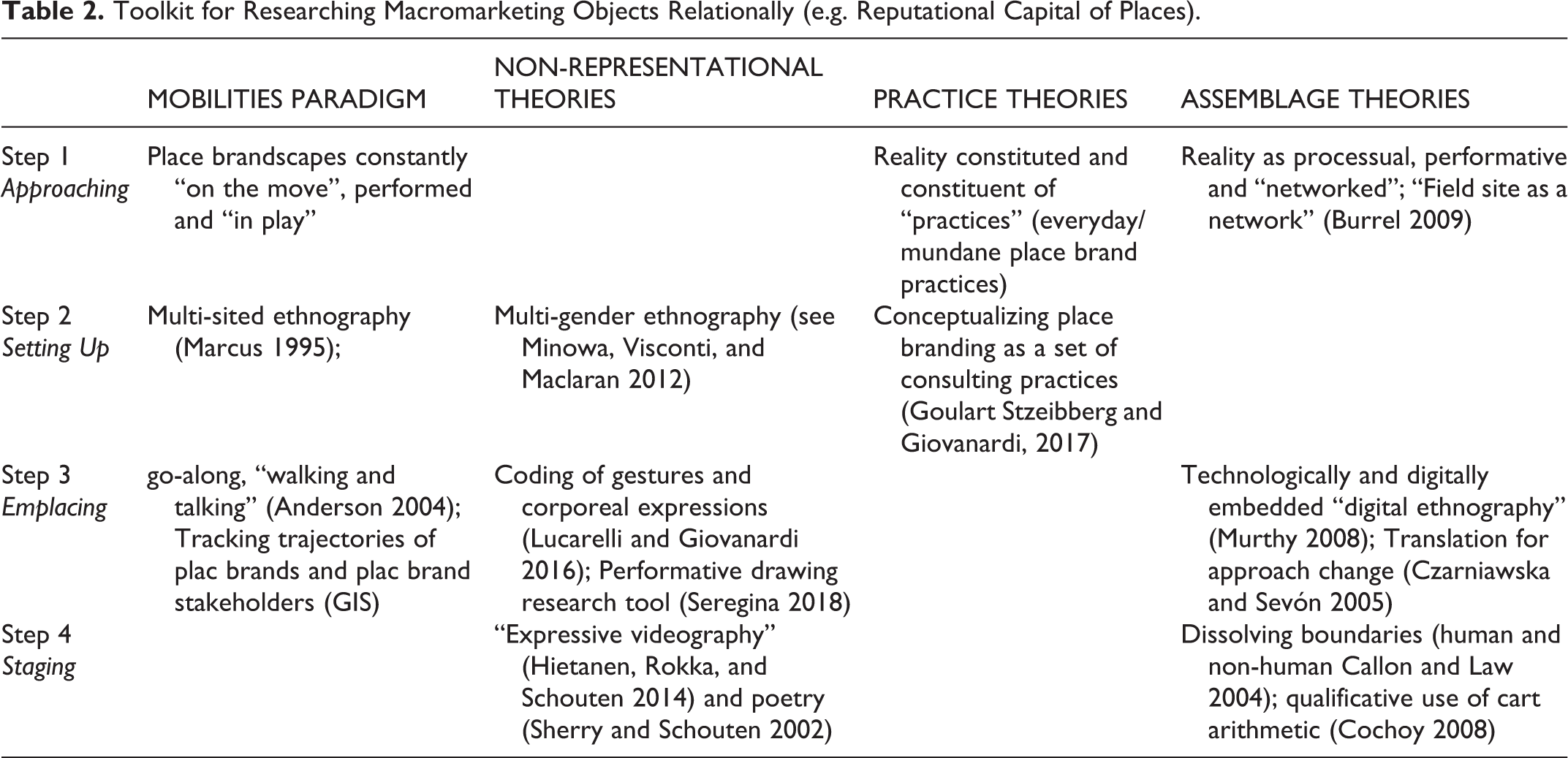
With some degree of oversimplification, established marketing research on the reputational capital of places often tends to focus on and legitimate two ways of defining the “contour” of the research object, namely the place brand. The first consists of singling out groups of place brand stakeholders, such as residents or business consultants (e.g., Merrilees, Miller, and Herington 2012). The second consists of selecting a set of one or more places, such as destinations, cities or regions intended as delimited portions of space. Going against this tendency of producing “bins” into which most of the work is usually “slotted” (Desmond 2014, p. 550), researchers should start by viewing place branding as the field in which reputational capital is unfolding and processualy played out. This is very different from taking for granted that a city brand exists in itself as a set of properties owned by a specific DMO (Destination Management Organization) and then examining this DMO within a context. Researchers should be ready to envision that they will not be observing a place brand as given, but rather some probably scattered configuration of relations through which place brands are negotiated by different stakeholders and, maybe, across multiple locations.
In this respect, Actor Network Theory and Practice Theory can be seen as the relational perspectives that are more appropriate in order to approach research by overcoming “dominant categories of common thought” (Desmond 2014, p. 551), such as a rigidly defined place brand that excludes other concurring representations of territoriality. Actor Network Theory would help clarify that place brands that are not merely at the mercy of actors and their agency whose intervention(s) can produce modifications, defections, and appropriation. More crucially, it would redirect attention toward the way the displacement of assembled activities (i.e., policy documents, marketing campaigns, social media attention) is not caused by an initial impetus but rather by different forces in the process that are of equal importance (in the sense of having pouvoir as pointed out by Spinoza) in the creation of associations through an expressed desire or belief in order to arrive at the same result (Callon 1986). This implies that the translation process is more important than the “essence” of the place brand, as it suggests an analysis that tries to follow and reconstruct the possible displacement of power-associations, such as the study of disturbances in policy creation during the drafting of public mandates in the production of tending for consultant project bids.
Additionally, an adoption of Practice Theory would help appreciate that the analysis at hand has little to do with the actual place brand per se, but has more to do with the actions taken and with the actions of the actors that import, change, and embed the possibility of branding places via different contexts, locations, and times. An emphasis on practices at this stage of the research process would support researchers in breaking free from the tendency to focus on groups only and, rather, to examine relations via a lens (i.e. practices) that allows an alternating analysis of common-sense objects without overlooking spillovers, deviations, and the unexpected.
Step 2: Setting Up
Getting ready to follow the networks that unfold around a place branding exercise has implications on the choice of the unit of analysis, which might well exceed the level of the firm. In fact, private companies (both small and large), local administrations, community associations and parts of civil society, public-private consortia (such as DMO or territorial entities that are in charge of creating and controlling PDOs and PGIs) collaborate or cooperate in order to position places of various kinds within an international scenario of global competition. Universities and place-branding researchers themselves could end up becoming part of this array of stakeholders by bringing their assumptions, vested interests, and managerial philosophy into the public management mechanisms, thus influencing local politicians through the act of scientific consulting (see Goulart, Sztejnberg, and Giovanardi 2017). Self-reflection on the relations between the object of study and the research team itself would be useful to disclose the existence of different research (or consultancy) “codes of conduct” in opposition with each other. One attitude would be closer to the needs of local communities and the least powerful; another attitude would be closer to the “establishment” and the mainstream managerial consulting praxis.
The relational perspectives that appear to be most illuminating at this stage of the research process would be the mobility paradigm but also non-representational theories, as their adoption would help move the attention away from both territorial-based research and a cognitivist and linguistic understanding of knowledge creation. Setting up multi-sited (Marcus 1995) and multi-gender (Minowa, Visconti, and Maclaran 2012) ethnographic teams can be regarded as a relevant strategy to combine the contribution of more than one individual researcher and try to acquire more than one locational perspective more easily, but also to use their diverse bodily presence in the research as way to stage the research process. Accessing the unfolding of a place brand from multiple spatial entry points would also be a way to address the problem of access and a way to examine a research object as constantly “on the move”, performed, and “in play”. The process of place brand creation and negotiation would be researched as a dynamic phenomenon that is played out across (not within) fixed boundaries of any sorts, such as legal (e.g., visa applications), institutional (e.g., ethics applications), economic (e.g., leading to an extended capacity to attract funding), or cultural (e.g., improved research outreach and engagement). The adoption of a mobility and non-representational mindset would also help researchers in selecting appropriate case study fields (e.g., a city hall corridor rather than a meeting room, gestures rather than talks) that are not “contained” somewhere, since political dynamics enable different hubs and nodal points rather than equivalent transit points. Both onto-epistemologies, in fact, reinforce and mirror power that is performed by different urban or regional elites (or groups of interest) in the attempt to promote a certain dimension of place at the expense of others. In addition, the reference to relationships between local and global power-geometries suggests that the new mobilities paradigm articulates the relevance of power through the concept of political access.
Step 3: Emplacing
Several perspectives coincide to facilitate this crucial step that has to do with data collection and analysis. We have seen that mobilities would make available a focus on “diffusion”, seen here as the geographical dispersion of a place brand which necessitates a mobile researcher and a mobile collection of data, because traces of the brand (e.g., hashtags on social media; e-word-of-mouth, and physical traditional brand ambassadors) are dispersed within an international physical space (e.g., the reputation of a spatial unit may vary remarkably if investigated and followed “round the world”, with Switzerland being, for example, the most romantic honeymoon destination in the eyes of Indian consumers and incentive travel companies (see Gyimóthy 2018)). Online reception analysis (Knudsen and Kjeldgaard 2014), for example, would offer a method that focuses on discursive developments in consumer debates on places and brands, based on the open-access social media platform, YouTube, as opposed to the closed communities investigated by netnography. Multi-sited ethnography (Marcus 1995) can be regarded as a relevant strategy to capture the phenomenon in multiple locations where it is spreading and tracking trajectories of brand artifacts. Manifestations and ambassadors’ opinions can be operationalized by drawing on geographical information systems (GIS) techniques.
However, the spirit of research promoted by mobilities can also suggest that a careful examination of immobilities can be done with the adoption of a focus on the “practices” of branding. This could help better understand the locations where place brands cannot go (i.e. which consumers or markets cannot be reached and how place brands contribute to define forbidden areas for some market actors), but it could also help focus on the politically connoted exchange zones in which some groups of place-brand stakeholders have no possibility to participate/interact, such as inside closed rooms and consulting offices, where a non-representational outlook on bodily gestures and different moments of “silence” can be as informative as vocal deliberations of conflicts or agreement. Hence, identifying the oppositions and frictions between stakeholder groups could be more promising and insightful than describing the best practices or abstracting models of efficacy.
Perhaps operationalizing Actor Network Theory’s concept of translation can be more easily adopted to integrate the study of “diffusion” and understand it as a deeply power-related research focus. In fact, our hypothetical study would not take for granted that a brand remains unaltered as it travels across social and geographical thresholds; rather, when seen as a form of agora, both understood as real and ideal, the brand would not only appear in different shapes in different contexts but also have enabling characteristics in both its “travelling” on its path and in the creation of context.
In fact, a relational consideration of the management of the reputational capital of places would also necessitate examining this place-branding exercise in terms of socio-technological practices that are carried out by the involvement of a plethora of macromarketing practice bearers. The perspective enabled by practice theory might turn out to be useful to fine-tune, for example, the unit of analysis in temporal terms. Instead of limiting the inquiry to the usually short-term mandate of local politicians, examining macromarketing practices as extending beyond the fracture point of elections or a government hand-over might inspire more longitudinal research projects that emphasize which aspects of the practice under examination remain stable, even though the actors (e.g., local governments, consultants) are replaced.
The operationalization of the non-representational concept of performance could assist in illuminating one of the key characteristics of the practice, namely its expressivity or its representationalism. Following Hastrup (1995, p. 81), “agency is not merely located in the mind and the expression of inner experiences are not reserved for words”. This implies a shift from an “informative” ethnography to a “performative” ethnography in which the place brand as well as human (e.g., residents) and non-human (e.g., Twitter) actors are also evaluated in terms of their material and embodied practices.
This ensures a more attentive treatment of materiality and embodiment, since it addresses that which is spoken through the mouth and also via the body. The revamped interest in multisensoriality in consumer culture theory (Canniford, Riach, and Hill 2018) and areas of place-branding theory that are very proximate to consumer culture theory (see for example Henshaw et al. 2016) constitute an interesting benchmark for macromarketing researchers who wish to challenge the traditional semiotics that characterize the agora of inter-place competition. It is therefore essential to acknowledge the research process as both representational (i.e. about meaning) and non-representational (i.e. about the expressive and performative character of experience). This is in line with attempts to capture brands’ material and non-cognitive aspects by drawing on performative research (Bode, Chauvin, and Mace 2015; Seregina 2018) and efforts to perform coding of gestures and non-verbal practices (Lucarelli and Giovanardi 2016).
Step 4: Staging
The time comes during endeavors of research when it is necessity to represent the networks that unfold around a place-brand exercise in an attempt to craft a coherent and unifying narration of the research object. This unifying and coherent narration is a mise en scene of the complex and assembling process which different methods and theories have been used in a modular way. For example, our hypothetical study on the reputational capital of places would be presented as a complex process of co-creation in which, to various degrees, local officials, marketing consultants and corporations, citizens but also non-citizen members of the population, shape the geographical position occupied by a place within a networked space of other places. In such a way, this could be understood as via traditional concepts of the production and consumption of place brands. However, this staging according to our relational approach would imply a reopening of not only these concepts but also the relationship nodes and networks which originally started in Step 1. This can be done by performing either non-orthodox ways of staging research to capture place brands’ material and non-cognitive (more-than-representational) aspects through videography (Hietanen 2012; Rokka, Hietanen, and Brownlie 2018; Hietanen, Rokka, and Schouten 2014) or poetry (Sherry and Schouten 2002). Alternatively, this can be done by reassessing the configuration of relations through which place branding happens. If power “across the field”, for example, were the object to be reopened, an Assemblage Theory view could be helpful to recognize the dispersive relational quality of information ethnology and open it up for big data analyses. This, ultimately, would inspire a study which considers a “calculative distributed agency” (Callon and Muniesa 2005, p. 1229) so that charts, global index and rankings become the renewed focus in the research, thereby emphasizing capital (understood as mathematical “qualculation”) (see Callon and Law 2004; Cochoy 2008).
Even the act of dissemination itself, such as a paper presentation, a poem, or a poster at an international conference, would be a “act of speech” in itself, with implications for the notoriety of a destination among an elite audience of academics. Conversely, an open access report available on an online platform or a general press-release would communicate the piece of place-brand research very differently, suggesting a different type of engagement of researchers within a local community. Such awareness has implications for the reflexivity of not only CCT and TCR researchers (see Ozanne et al. 2017), but also for macromarketing researchers. This is because a relational methodological approach can, to paraphrase Whatmore, act as a form of “relational ethics” which emphasizes “the situatedness of ethical agency and the extralinguistic connectivities of the ethical community” (Whatmore 1997 in Murdoch 2001, p. 128).
Continuing the Loop: The Future of Research on the Reputational Capital of Places
Research concerning the reputational capital of places has begun to examine the relationality inherent in spatial mechanisms (e.g., planning, place development, infrastructure development), governance processes and, specifically, marketplace dynamics (Castilhos, Dolbec, and Veresiu 2017). Similar to the developments within CCT with respect to market dynamics (see Siebert and Giesler 2012; Giesler and Fischer 2017), macromarketing would have an opportunity here to examine the complex nexus between the production, consumption, and reproduction of reputational capital by embracing an approach that allows one to overcome dichotomies (such as producers vs. consumers, or firms vs. territorial district) and advance an understanding of the links between markets, marketing, and society (Blanchet and Depreyre 2016). This would be an opportunity for macromarketing scholarship to enable a more organic understanding of the connections beyond the mere “exchange relationships” underpinning the contemporary more-than-commercial “agora” (Mittelstaedt, Kilbourne, and Mittelstaedt 2006, p. 131) as is commonly practiced among macromarketing researchers’ “vocation to complexity”, which distinguishes macromarketing from other sectorial marketing research efforts. In this respect, the proposal of the present paper can be seen as the following: (1) a forma mentis, a way to think of, enact, perform, and produce research and (2) a methodological approach that, grounded in a relational onto-epistemological perspective, can provide researchers with a toolbox that includes new mobilities, non-representational theories, practice theories and assemblage theories. Table 2 illustrates a toolkit for researching the reputational capital of places relationally by emphasizing the main role of the relational perspective for each of the steps.
Toolkit for Researching Macromarketing Objects Relationally (e.g. Reputational Capital of Places).
Conclusion
In investigating the explicit or more latent contribution of relationality to macromarketing research, the present paper has sought to reveal “the implicit” that is associated with the adoption of specific types of methodological awareness and, in other words, acknowledge what Savage (2013) calls the “social life of methods”. We have sought to grasp the marketing debate on relational ontologies originating within the area of CCT and weigh their implications for macromarketing, thereby proposing an organizing framework in which the role of different relational perspectives is examined. In this way, macromarketing can be researched and assessed through a relational angle in a manner that critically considers the problem of “straightforward” adoptions of different relational ontologies. This implies that approaches to macromarketing phenomena should be open-ended and should consider the embedded, productive, and performative aspects of a given context, since the research phenomena and the agents of change do not exist per se; they rather co-emerge. This view implies a specific approach to conducting research, one that attempts to challenge the artificial bins constructed by traditional research (e.g., production and consumption, producers and consumers, participant observation and in-depth interviews, etc.).
Researching macromarketing based on a relational onto-epistemology implies a critical, reflexive, and political attitude toward the research process that is similar to the suggestions from established (Venkatesh and Dholakia 1986) and more recent (Saatcioglu and Corus 2018) contributions that have built synergies between CCT and macromarketing. The elaboration of this approach is only a first step toward the creation of a relational sensitivity that may contribute to corroborate the attempt of CCT researchers to challenge the dominant functional, prescriptive, and managerialistic Weltanschaaung of much macromarketing scholarship. Further work is thus necessary to refine the relational approach defined in this paper, especially by adapting the suggested organizing framework to other macromarketing megatrends or objects of research, thus testing the flexibility and adaptability of different relational perspectives. The macromarketing community is invited to adopt the proposed approach not as a set of normative prescriptions, but rather as a sort of “open source” methodological apparatus that can and should be improved, adapted, and enriched for the sake of specific research aims and the pursuit of the common goal of unveiling the reciprocal relationship between marketing and society at large.
Footnotes
Authors' Note
Massimo Giovanardi is also affiliated with University of Bologna, Rimini Campus, Rimini, Italy.
Declaration of Conflicting Interests
The author(s) declared no potential conflicts of interest with respect to the research, authorship, and/or publication of this article.
Funding
The author(s) received no financial support for the research, authorship, and/or publication of this article.