




Abstract
War and other violent conflicts greatly degrade a country’s economic, social, and marketing systems. In the aftermath of conflict, national and international organizations develop different strategies, such as business development, aimed at the reconstruction of these systems. This article draws on boundary theory to frame the way in which entrepreneurship can help ex-militants to discard war-activities and to reintegrate peacefully and productively into a peace-time economy. An interpretive study examining the life-narratives of former militants of illegal groups involved in Colombia’s armed conflict – the world’s longest, lasting 52 years – regarding their business start-ups was designed and administered. Findings extend current Macromarketing and Entrepreneurship literature by showing how policies and entrepreneurial business practices in recovering marketing systems can help ex-militants to overcome discrimination, to transform their identities and to reintegrate peacefully into civil society, which in turn may portend a more inclusive and equitable marketing system and robust national economy.
Keywords
Introduction
War and other violent social conflicts are profoundly devastating (Institute for Economics and Peace 2017; Roser 2016). The consequences are enormous and transcend war itself; they remain as challenges for people and institutions long after peace agreements are reached by various parties engaged in the fighting (De Rivera and Paéz 2007; Stiglitz and Bilmes 2008). War and its accordant destruction cripple marketing systems by disrupting production capabilities, distribution channels, and the manufacture, flow, pricing, communications about and assortment of goods and services -- all of which adversely affect the well-being of producers, distributors, retailers and consumers (e.g., Barrios et al. 2016; Shultz et al. 2005; Sredl, Shultz, and Brečić 2017). Indeed, those outcomes are often viewed by warring adversaries as requisite mechanisms to force policy changes, capitulation or, in the most extreme warfare, to annihilate. Such violent conflict fractures the fabric of society, resulting in ideological divisions that foment distrust, exclusion and discrimination (De Dreu and Knippenberg 2005), which can retard investment, development and recovery (Manfredo and Shultz 2007). Violent conflict then often re-emerges, perpetuating a cycle of destruction and misery.
The challenges for recovering countries and societies trapped in this cycle are enormous; the human costs are tragic and have haunted humanity for millennia (Sophocles 2015/5th CBC), yet the path to recovery and sustainable peace and prosperity has not been clear or easy. Conflict resurgence, and the systemic distress and failure it causes, is obviously problematic, as seen for example in Congo (Themnér 2011), Afghanistan (Zyck 2009), and Cambodia, East Timor, Iraq, Kosovo and Lebanon (e.g., Suhrke and Berdal 2012; Shultz 2016). Some of the motivations for resurgence are ex-combatants’ poverty, unemployment, and lack of community-affinity (Suhrke and Berdal 2012; Hill, Taylor, and Temin 2008). An important mechanism to promote sustainable peace, implemented from Colombia to Afghanistan has been the United Nations’ Disarmament, Demobilization, and Reintegration program (UNDDR 2014). DDR is a process whereby former militants/combatants transition into civil society through three phases: “removing weapons from the hands of combatants, taking the combatants out of military structures, and reintegrating combatants socially and economically” (Desai 2016, p. 241). During this process, ex-combatants acquire legal status, and the rights and protections afforded to all citizens.
The economic reintegration of ex-combatants has been identified as key to reduce the risk of conflict reversion (Collier 1994). Successful economic reintegration requires coordination among social, political and commercial organizations (e.g., Oetzel et al. 2009). Evidence in war-ravaged countries reveals policies and systemic coordination of marketing-based solutions, including entrepreneurship, can help to end the cycle of violence by creating civic institutions and employment opportunities, building businesses, and rebuilding peaceful and prosperous communities and societies. A far-reaching success-story would be the “Marshall Plan” following World War II (Foreign Assistance Act of 1948). More recent macromarketing examples include endeavors to enhance food marketing and agribusiness in the countries of former Yugoslavia (Shultz et al. 2005); international tourism in Vietnam (Nguyen, Rahtz, and Shultz 2014); coffee production in Rwanda (Tobias, Mair, and Barbosa-Leiker 2013) and Colombia (Barrios et al. 2016); and retailing and distribution in Bosnia (Sredl, Shultz, and Brečić 2017).
Despite important and useful findings from those studies, concerns remain regarding the ways in which the process individually materializes, and which market solutions are most efficacious. This study explores how business development could be a prosocial market-based solution, which facilitates ex-combatants’ reintegration to society. Entrepreneurship requires individuals to engage in occupational, social, and personal development (Zahra and Wright 2016), with the potential to affect positive outcomes such as: (a) pull people from poverty and render them “legitimate” (cf. Tobias, Mair, and Barbosa-Leiker 2013; World Bank 2011), (b) emancipate discriminated individuals (Rindova, Barry, and Ketchen 2009), and (c) instill confidence, shape beliefs and redefine social roles of the previously marginalized (Abdelnour and Branzei 2010).
To develop this research agenda the authors apply Boundary Theory to frame how a Colombian DDR government-program, which promotes and builds on entrepreneurship to reintegrate demobilized paramilitary and guerrilla ex-militants into civil society, has functioned as a boundary object to cross social and economic boundaries and thus to engage prosocially Colombia’s evolving marketing system. The legitimate business-venturing practices promoted by the program constructively engaged by ex-militants in a successful learning process is intended to liberate former militants from their roles in a war market and help them to transition to new, prosocial endeavors in a peace market. The experiences faced by these individuals in their journeys from militants engaged in businesses supporting war efforts, to responsible citizens engaged in legitimate commercial, entrepreneurial activities are studied (Galtung 1969; see also Shultz 2016; Barrios et al. 2016).
Our results are intended to shape macromarketing thought by sharing insights about factors that can facilitate the adaptive recovery of dysfunctional marketing systems rendered unable to provide requisite goods and services to sustain civil society and to ensure the well-being of its consumer-citizens (e.g., Layton 2015a; Shultz 1997). We draw attention to the importance of linking and coordinating micromarketing skills, behaviors and processes of entrepreneurs to societal needs and institutional policies; for the macromarketing purpose of enhancing individual life-quality and societal well-being (e.g., Layton 2007; Shultz 2012; Wooliscroft and Wooliscroft-Ganglmair 2018). Indeed, if entrepreneurs – through the production, exchange and consumption of their goods and services – cause marketing systems to change (Eggers et al. 2018), and entrepreneurship helps to create jobs and enhances performance among small firms in competitive environments (Covin and Slevin 1989), then they surely have an important, catalytic role – perhaps an indispensable role – to play in devastated and recovering economies ravaged by war and other forms of violent conflict. We conclude with some discussion of implications for Macromarketing and Entrepreneurship theory, future research opportunities, and practical considerations for policy makers to facilitate sustainable peace and prosperity in Colombia and potentially other countries engaged in or recovering from violent conflicts.
Conceptual Background
Entrepreneurship and Marketing Systems
Entrepreneurship may be viewed simply as the pursuit of unexploited business opportunities (Acs 2006). However, the outcomes of entrepreneurship are varied and impactful, including for example wealth creation (Hitt et al. 2011), competitive advantage (Zahra and George 2002), and social change (Mair and Marti 2006). In particular to social change, entrepreneurship can contribute to the solution of problems when/where governments or extant private initiatives have fallen short (Miles, Crispin, and Kasouf 2011). For example, macromarketing research has shown that entrepreneurial activity in subsistence marketplaces can positively influence both individuals and their surrounding communities; entrepreneurship provides individuals with economic capabilities and a source of income (Sridharan et al. 2014). Moreover, entrepreneurs’ social interaction, bedrock of the local marketing system, promotes the community and enhances social capital and resilience (Viswanathan et al. 2014).
Entrepreneurship is important to the development of marketing systems disrupted by ineffectual policy and/or violent conflict (e.g., Arikan 2010; Paswan and Tran 2012; Shultz 2012). In post-conflict settings, entrepreneurial business venturing may be an effective alternative to introduce demobilized militants to civil society as they provide models for economic survival (Tobias, Mair, and Barbosa-Leiker 2013), cooperation (Abdelnour and Branzei 2010), and coordinated business and policy initatives to stimulate marketing-system recovery (Shultz et al. 2005). While these studies are promising, they beg important theoretical and practical questions regarding how these benefits manifest.
In this article, the authors feature Social Boundary Theory as lens to analyze ways in which entrepreneurship has helped former guerillas and paramilitary militants to cross the boundaries between war- and peace-time economy. Building upon the long history of macromarketing scholars who administered field studies in, for example, the USSR (Alderson et al. 1956); Latin America (Slater 1968), Africa (Lindeman 2014) and various war-ravaged countries in Europe, Southeast Asia and the Middle East (Shultz 2016), we aim to facilitate better understanding about ex-militants’ transformational experiences as entrepreneurs developing their business ventures and in turn contributing to Colombia’s evolving marketing system and civil society.
Social Boundary Theory
The analysis of boundaries is often traced to Marx and Engels (1848), Durkheim (1965), and Weber ((1978) [1922]), who identified social boundaries people face across different categories, beliefs, or strata, such as social class, religion, and status. These seminal works were the impetus for boundary theory, which grew from sociological research on individuals’ cognitive organization of roles. Further to that organization, people in their social reality develop a classification system that helps them to differentiate various social spaces in which one is immersed – objects, practices, and people included (Zerubavel 1996). This classification system could become a barrier with both intrasubjective and intersubjective consequences.
An intrasubjective consequence of boundaries is self-fragmentation (Hermans and Hermans-Konopka 2010). Every day, individuals mobilize across social and cultural practices, while performing different roles. For example, individuals develop boundaries about family and work roles, sometimes these roles overlap, and individuals develop strategies to manage or align them (Nippert-Eng 1996). Self-fragmentation occurs when there is a perceived inconsistency across performed roles, which individuals cannot align, thus creating dissonance or anxiety (Diehl and Hay 2007).
An intersubjective consequence of boundaries is the limitation of people’s social interactions (Akkerman and Bakker 2011). Individuals create groups according to similarity for membership, by guiding people to associate primarily with members of their in-group, while disassociating from members outside the group (Epstein 1992). Disassociation can occur both at the individual and structural level; it provokes unequal access to resources across group categories (Lamont and Molnár 2002). For example, at the individual level, employees’ different professional backgrounds (e.g., finance, anthropology, engineering) might become boundaries that limit collaboration towards a single objective (Edgell, Gerteis, and Hartmann 2006). At the structural level, different legal arrangements within a marketing system can be the source of boundaries between formal and informal businesses (Barrios and Blocker 2015).
Social Boundary Theory is used in this article as lens to frame how violent conflict creates ideological division, boundaries, and tensions among former guerrillas and paramilitary militants, and with civil society.
Boundary Objects and Boundary Work
Boundaries more recently have been interpreted not only as sources of discontinuities, but also as junctures; that is, there are relevant shared elements in the spaces separated by boundaries (Quick and Feldman 2014). Hence, individuals can play a more active role not only categorizing the separating elements, but also identifying and developing strategic negotiations of the shared elements (Nippert-Eng 1996). This is a process of boundary work – the process of managing the differences and commonalities between the social spaces separated by boundaries (Gieryn 1983).
Certain artifacts can play an essential role in individuals’ boundary-work process (Star and Griesemer 1989). These artifacts, defined as “boundary objects,” inhabit the intersecting worlds and …[are] both plastic enough to adapt to local needs and the constraints of the several parties employing them, yet robust enough to maintain a common identity across sites. They are weakly structured in common use and become strongly structured in individual site use (Star and Griesemer 1989, p. 393).
The way in which boundary objects promote people boundary work can be summarized in four mechanisms: identification, coordination, reflection, and transformation (Akkerman and Bakker 2011). Identification pertains to the recognition of the core characteristics of each domain. This recognition can occur by defining and differentiating the practices in each domain or by accepting the legitimating coexistence of practices. Coordination pertains to how the boundary object allows people across domains to dialogue, to pursue a particular goal, even in the absence of consensus (Star 2010). Reflection pertains to how the boundary object allows people to realize and to formulate the different perspectives between/among the role-practices in each domain. Finally, transformation pertains to the development of profound identity changes via the successful development of practices in the new domain, or the creation of new practices in-between domains.
A successful consequence of boundary work occurs when a person understands the context-specific characteristics of each role and develops a legitimate interaction and participation in the new role (Lave and Wenger 1991). However, risks also emerge, such as a person staying at the periphery, never fully belonging to or being acknowledged as a participant in the new domain (Akkerman and Bakker 2011). Boundary object theory is used in this article to frame the way in which entrepreneurship can help these ex-militants to transform their practices from war to a peace-time economy, while boundary work is used to frame the effect of such transformation for ex-militants’ lives.
Boundary Theory Application to Marketing Systems and Entrepreneurship
Readers will recall that marketing systems generally are regarded to be: a network of individuals [including entrepreneurs], groups and/or entities, embedded in a social matrix, linked directly or indirectly through sequential or shared participation in economic exchange, which jointly and/or collectively creates economic value with and for customers, through the offer of assortments of goods, services, experiences and ideas, that emerge in response to or anticipation of customer demand (Layton 2007, p. 230; cf. Layton 2015a, p. 5).
However, important questions also emerge. Consider, for example, how boundary work occurs; what factors help or hinder this process; what ultimately is the impact of entrepreneurship on reintegration of ex-combatants, reconciliation, marketing-system recovery and transition, and sustainable peace? These and related questions present compelling research opportunities.
Below, we describe the Colombian conflict, the challenges faced by the government for promoting and implementing policies to demobilize and reintegrate ex militants of former guerrillas (on the political left) and former paramilitary (on the political right) groups. We share and interpret findings emerging from life-narratives articulated by ex-militants; with focus on comments pertaining to their business venturing, to illuminate plausible answers to the preceding questions, and to provide valuable insights about how entrepreneurship can help ex-militants to engage, contribute to and sustain peace-time marketing systems.
The Colombian Conflict
Colombia has endured the longest internal armed-conflict in the world, which lasted more than 50 years. The conflict involved more than 50,000 members of illegal militant-groups/militants (Guerrillas and Paramilitary), who directly victimized 8,792,781 people (22% of the country population): 1,525,529 were killed or disappeared; 7,090,493 were forcibly displaced (Registro Único de Víctimas 2017). This section provides a brief historical description of this armed conflict, with some emphasis on the number of different conflicting actors (e.g., guerrillas, paramilitary, victims, and army) and the social boundaries that emerged between/among them.
Colombia’s Violent Conflict
The Colombian conflict began in the early 1960s, and in many respects mirrored the global political and socioeconomic differences between capitalist (right wing) and communist (left wing) ideologies during the Cold War. The intersections of these political elements with income inequalities prompted the emergence of two communist-oriented guerrilla movements: Fuerzas Armadas Revolucionarias de Colombia (Revolutionary Armed Forces of Colombia, aka FARC) and Ejercito de Liberación Nacional (National Liberation Army, aka ELN). These movements initially were small groups--less than 100 participants--seeking social justice and changes to Colombia’s class structure (Ning 2005).
During the 1980s the conflict took a drastic turn, as violence escalated, and illegal groups recruited more heavily and forcibly. These changes were fueled by the development of a war-time economy supported by the markets of illegal drug-production and trafficking (Ballentine and Nitzschke 2003). Guerrillas entered this illicit market, firstly by “taxing” drug producers and then becoming producers and traders themselves. These groups grew to 20,000 members (RCN 2014). The reasons to join the guerillas were diverse. Some people voluntarily joined, attracted to ideology or job-opportunity; others (especially, children) were forced to enter, as a family payment to the war-cause (see for example Florez-Morris 2007, for a detailed discussion of this topic). Subsequently, a right-wing paramilitary group -- Autodefensas Unidas de Colombia (United Self-defenders of Colombia, aka AUC) -- entered the conflict. This group, initially envisioned as an alliance of legal landowners with private security forces to deter or combat the guerrillas, morphed into a group of 11,000 mercenaries, hired by drug dealers to protect their illegal businesses (ACNUR 2002).
During the 1990s, a ‘war economy market’ emerged (Duffield 2000). This market included trade activities that directly funded the war-effort, such as drug trafficking, weapons trade, money-laundering. The illegal groups develop entrepreneurial activities within/for the war economy market. The consequences were heinous and devastating, as revenues from their businesses enabled guerrillas and paramilitary groups to obtain resources to terrorize every stratum of Colombian society. The casualties spiked upward: the war resulted in 486,232 victims before 1990; the number of victims reached 6,902,398 (81.5% civilians and 18.5% militants) between 1990 and 2010 (Registro Único de Víctimas 2017).
At the start of the new millennium, the conflict transitioned, as the Colombian government developed and implemented US $10 billion anti-drug program, “Plan Colombia”, intended to cut the financial resources of guerrillas and paramilitary groups. The program provided military and social aid to regions where drug trafficking was strong. This program so significantly interrupted and diminished economic strength and fighting capabilities of the guerillas and paramilitary – and the illicit marketing system that sustained them – they agreed to enter a peace-agreement with the Colombian government. In 2008, a peace-accord was brokered with the right-wing paramilitary, which resulted in the demobilization of approximately 31,000 members (Colombian Presidency 2008). A subsequent peace-agreement was entered with FARC, in 2016, which has facilitated the demobilization of 17,500 members, as we enter these keystrokes, with further high hopes and eventual plans to reintegrate them into civil society (El Espectador 2016). The complexity of issues, dark memories of atrocities, ongoing tensions and sheer numbers of participants reveals the societal challenges Colombia faces to implement successfully a Disarmament, Demobilization and Reintegration (DDR) program for former militants of the illegal groups.
The DDR and Colombian Reintegration Agency
The de-escalation of war motivated guerrilla and paramilitary militants to abandon their allegiances and return to civil society. Between 2001 and 2010, 53,653 of them demobilized (ACN 2019). Given this high number, the government created in 2011 the Colombian Agency for Reintegration – ACR – to design and implement a long-term DDR program for militants who voluntarily chose to leave the violent groups (ACR 2016).
The ACR designed a six-year customized DDR plan, which former militants must follow to pass successfully between illicit war-time activities and legitimate peace-time endeavors. The plan begins with interventions to assess and improve physical and psychological well-being; it involves educational and labor training according to the participants’ interests (e.g., agriculture, construction, etc.), and culminates when they feel and demonstrate ability to develop an autonomous life-project in accordance with Colombian laws. A total of 52,004 demobilized militants has entered this program. Among them: 24,208 have completed the program; 6,927 are still in the process; 20,869 quit (ACN 2019).
A major challenge for demobilized militants to complete the plan is to engage in a productive life (ACR 2016). Even though demobilized militants have legal approval to work, discrimination has emerged as a social boundary limiting necessary interactions for completion of the reintegration process. Many demobilized militants in fact have suffered discrimination due to their violent past, hurting their employment opportunities (Moloney 2016). From the 52,000 demobilized militants that have entered the program, only 8,939 have a formal job. This situation is jeopardizing the sustainability of the peace accord and forces Colombian policymakers, citizens and global stakeholders to ponder an otherwise unthinkable scenario of more war, death and destruction.
In response to the aforementioned poor results, the government and NGOs have begun to offer demobilized militants an alternative: business venturing as a viable alternative to re-engage civil society via productive work, driven by legitimate entrepreneurial businesses. At the time of this writing, 20,356 demobilized militants have attempted to develop their own business. The current study focuses on these entrepreneurial, demobilized militants. Particularly, if their experience of business venturing has helped them to cross social boundaries, to follow compelling reintegration processes and to reconciliate with society.
Methods
Methods were qualitative, guided by a phenomenological approach aiming to develop a rich, nuanced and dynamic understanding of demobilized combatants’ experiences during their business-venturing activities, including the perceived barriers and their efforts to transcend them.
Data Collection
To access the population of illegal former militants, we were required to pass several filters ranging from the University’s ethics committee, to government agencies, and to the ex-militants themselves. A flexible but rigorous protocol was performed to contact former militants, and to obtain the narratives about business-venturing experiences.
Firstly, we used purposive sampling (Patton 2002) to select a group of ex-militants that chose to develop businesses as part of their efforts to reintegrate productively into civil society. The Colombian Agency for Reintegration (ACR) provided information regarding 100 ex-militants, from guerrilla and paramilitary groups, who: (a) developed or were developing businesses, as part of their reintegration process; (b) were willing to participate in the study (most ex-militants prefer to avoid any activity that reveals their past). Business success was not a selection criterion.
Secondly, we contacted all the ex-militants in the list, individually; firstly, by phone, to explain the purpose of the study and to ask if the person would participate in an interview. Twenty-one people, all ex-militants from different regions across Colombia, agreed to participate.
Thirdly, we visited the different regions where participants were located. In each of the regions visited, the researchers sought and received permission from the local authorities regarding the proposed engagement with ex-militants and were accompanied by the ACR psychologist who administers the ex-militants’ reintegration process.
Fourthly, we conducted two interviews with each informant – an interview in person and then a follow-up interview via phone. Each interview was conducted in Spanish and each interview lasted approximately 60 minutes. This relative brevity is partly explained by the ex-militants’ low motivation to discuss their lives. Some ex-militants spent most of their lives fighting, evading and living in isolation, which has affected their willingness to communicate or to participate in an academic study. To ensure trustworthiness during data collection, at least two researchers were present during the interviews: one to ask questions; one to take notes. The in-person interviews were conducted at ex-militants’ business establishments, during a time and at specific location in the business facility favored by the informant. The interview protocol applied a life-stories approach (McAdams 2008). Following introductions and further assurances of confidentiality, informants were asked to describe their biographical narratives, dividing their life-story in three stages: their time and experiences during/before they left the armed group, the process of demobilization, and their time and experiences after demobilization. This approach, with some concentration on ‘turning point’ or cathartic moments in people’s lives, is useful to obtain rich descriptions about processes and changes (Kvale 2008; see also Miles, Huberman, and Saldaña 2014), especially in the context of countries emerging or recovering from war (Shultz et al. 2005). When informants’ narratives tapped into some business-related boundary elements, we probed more purposefully, developing further questions about those elements and experiences related thereto.
The second interview (administered via phone) focused on the business-venturing process and the relation to the three moments mentioned during the first interview. This approach, thoughtfully and unobtrusively directing the interview toward the biography of an object, is useful to link entrepreneurship and the business-venturing process to informants’ life trajectories (Hoskins 1998). After each interview the participant-researchers discussed and recorded the impressions about information obtained and whether, or the extent to which, the new information obtained during the telephone interview corroborated, complemented or conflicted with other information obtained in the study.
Fifthly, 17 relevant actors – people engaged in or connected to the businesses of the ex-combatant entrepreneurs who are familiar with the business development, including suppliers, customers, and government supervisors – were interviewed. At the completion of the first personal interview, we asked if the informant could/would give us the contacts of said relevant actors. These actor-interviews were conducted at a location preferred by the actors (typically their workplace) and revolved around the evolution of participants’ relationships with the ex-militants, and boundaries identified during ex-militants’ life narratives. This information allowed us to triangulate the information provided by the ex-militants, to assess and re-assess our interpretations, and to confirm the veracity and trustworthiness of findings (Belk, Fischer, and Kozinets 2013; Miles and Huberman 1994).
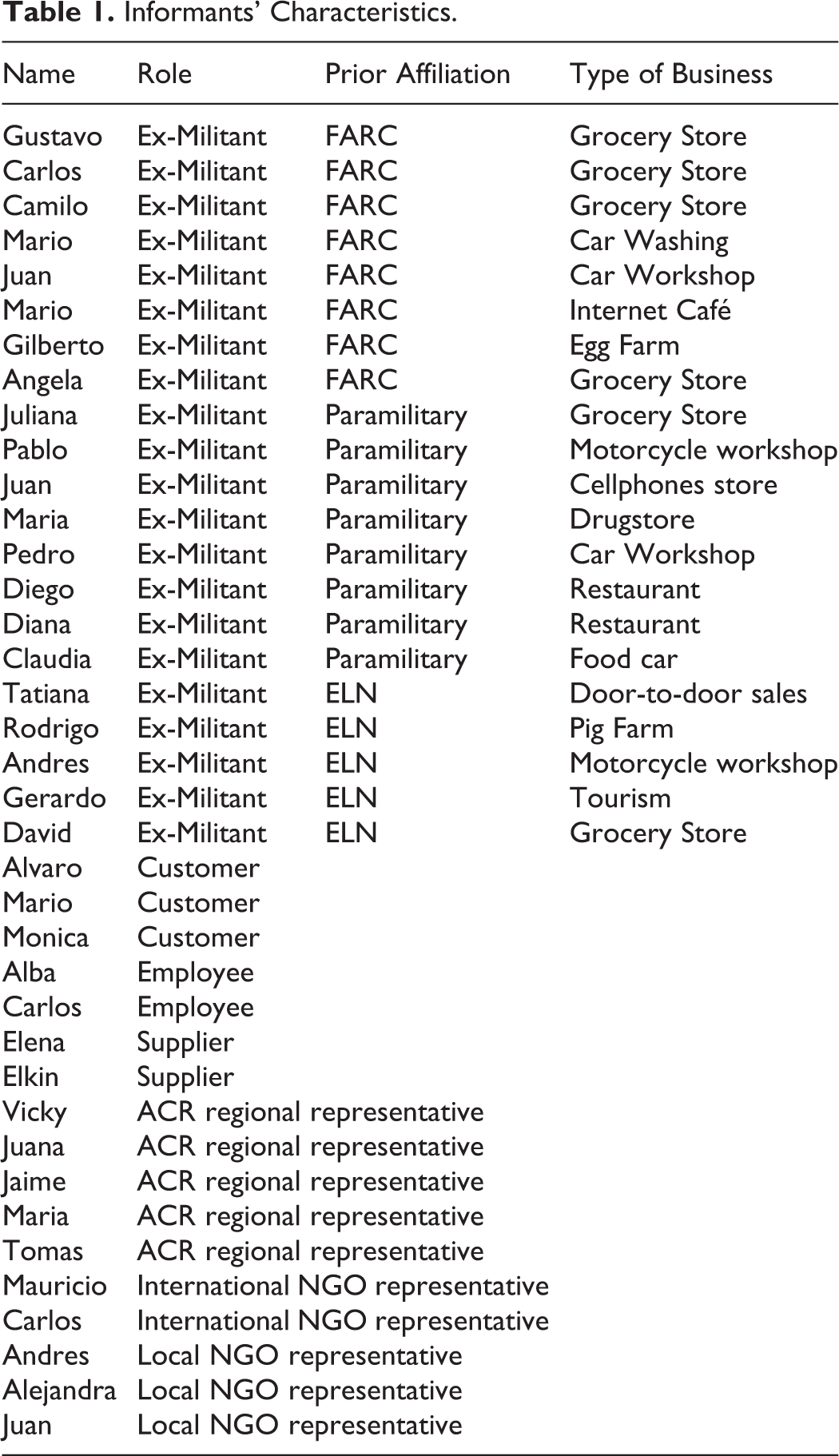
Collectively, 38 semi-structured depth interviews were conducted; interviewees were comprised of 21 ex-militants and 17 participants engaged in or connected to the ex-militant’s business and who are familiar with the business development. Table 1 indicates informants’ characteristics, such as role (combatant, or related actor), former violent group to which they belonged, region in Colombia, and type of business developed. Names assigned to all informants are fictitious and fabricated to ensure anonymity. All informants were thanked for their participation; findings, final reports and publications have been and will be made available to all participants.
Informants’ Characteristics.
Data Analysis
All informants’ interviews were transcribed, evaluated, translated and again evaluated. This process was administered by one of the authors who is fluent in Spanish and English, and familiar with nuances of various Colombian dialects. The transcripts were reviewed and analyzed using a thematic approach (Guest 2012). For developing the themes, a coding process was systematically developed using NVIVO software. The coding process followed a deductive approach (Crabtree and Miller 1999), shaped by the “Social Boundary Theory” elements experienced by participants during their business venturing experiences. We started by identifying and coding any boundary-related elements mentioned by informants. Then we analyzed the different nuances of the information in each code, and classified them in the three main themes: boundaries identification, boundary object, and boundary work. Finally, an interpretation of the information within each theme, in relation to the project aim and available literature, was performed. Three main themes were identified: (1) challenges that affected ex-militants’ reintegration process (boundaries identification), (2) motivations to pick entrepreneurship as economic alternative (boundary object), and (3) the effect of business-venturing activities in reintegration process (boundary work). To prevent bias during coding, researchers developed a bracketing process by listing and discarding any possible presumption about the ex-militants and their business venturing (Fischer 2009). The emergent themes are presented below.
Findings and Emergent Themes
We present findings as they pertain to Social Boundary Theory and some subthemes relevant to it, in the context of people who are ex-militants that participated in illegal guerilla or paramilitary activities during the Colombian internal conflict. For each theme, a description of informants’ experiences is shared, as well as related theory identification. Findings are illuminated by representative narratives iterated by informants.
Social Boundaries for Ex -militants’ Transition and Entry into a Peace Economy
Not unlike military organizations, Colombia’s guerrillas and paramilitary groups had rigorous, institutionalized norms and socialization-practices to develop esprit de corps, resulting in militants’ shared-values, beliefs and work view (cf. Haynie and Sheperd 2011). These practices included strict control over militants’ daily lives, such as roles, social interactions, and economic activity linked to the group’s ideology. Most informants in our study entered these violent groups at a relatively young age (16-25 years). They were impressionable and internalized the groups’ norms, including the legitimacy of control, which helped to define ex-militants’ sense of self and community; a phenomenon that has been observed among other individuals in groups developing and engaged in illegal/illegitimate activities (e.g., Hamilton and Sherman 1996). Ex-militants’ internalization of the group norms became the social boundaries to transition into a peace economy with intra and inter subjective consequences for behaviors that respected or disrespected those norms.
The following examples show the intrasubjective consequences of social boundaries. Ex-militants experienced internal struggles when entering the reintegration program and had to reject some identifiers of their lives as militants. Gilberto’s narratives indicate the importance of his rifle and role as sniper to his identity, and the difficulty of rejecting that identity and forming a new one: …I felt empty the day I deliver my rifle to the army. For me was like the end of life as I knew it. I quit my future that day. In war, the armory is power, and it is the only thing that gives you freedom, so losing your guns is losing your freedom. (Gilberto-FARC) For me, it was already very difficult to adapt to Bogotá, because I was not used to living surrounded by so many strange people. I did not know anyone here, and everyone was different. I was not giving orders, and no one was giving me orders. I felt powerless. Imagine how you would feel losing your protection for the last five years. I felt lonely and empty. (Maria - Paramilitary) I wanted to start with this business, so I went to [Bank A] and opened a savings account. For one year, I saved money until I gathered the necessary [money] to rent a store. Once I got the place, I asked the same bank for a loan, but it was rejected. The bank asked for personal and commercial references, which I did not have. I explained my situation to the bank, even ACR contact them, but all of that was useless: the loan was rejected. Six month later, I made the loan request under my girlfriend’s name and was accepted. Ever since, the business is under her name. (David-ELN) We had to keep the secrecy of our past with our clients. When people start to know, you hear some of them dodge you, and whisper about you, even some said bad things out loud expecting a response, but we had to learn to face such situations with respect. (Pablo-Paramilitary)
The enduring set of values of a nation, a region, or an organization influences both the marketing system social matrix where business exchange occurs (e.g., Layton 2015a, 2015b), and individuals’ entrepreneurship-motivation in that market (George and Zahra 2002). Those assertions appear to hold for the illegal organizations we studied, based on the informants interviewed. More specifically, the preceding findings reveal different values of the illegal organizations for navigating the war-oriented marketing system; these values create intra and inter subject boundaries that affect informants’ confidence, relationships building, and trust to develop a business in the peace-oriented marketing system. These findings offer a glimpse of entrepreneurship as boundary object, which we consider in more detail, below.
Entrepreneurship as Boundary Object
All the informants opted for business-venturing, during the uncertainties and challenges following demobilization. All informants acknowledged their decision was motivated by their previous experiences – legally or otherwise – and in response to an unattended need in the region where they were located.
Regarding previous experiences and related productivity or “achievements,” the Colombian war market was “a mixture of international drug trafficking, weapons, money-laundering, criminality and terrorism with international political and economic elements involved” (Firchow 2005, p. 46). Developing these activities necessitated an entrepreneurial spirit. According to ACR representatives, most ex-militants have developed strong “leadership and resilience” while in the war market. These elements gave them the strength to face difficulties and to find opportunities in the peace market.
Informants describe the challenges endemic to moving from a transactional approach with business stakeholders to a more relational approach. Although the different social boundaries present challenges to developing business relationships with customers and suppliers, over time, informants have learned to adapt. Cooperation, empathy, complementary goals and win-win outcomes with civil society are now recognized as desirable – perhaps obligatory – for positive business outcomes, and customer and personal benefits. Some ex-militants develop very strong relationships with clients. In some instances, clients have cooperated/intervened well beyond the typical expectation of business-client relations, as was the case when one ex-militant was going to be evicted from his grocery store, so that the space could become a facility for a local university. This business [restaurant] has taught me how to interact with people, and to serve [society]. People usually come here not only to eat, but also to talk. Sometimes, customers do not have the money that day, so you give them credit, and they keep coming. Now, I know many people in the neighborhood and some of them can be considered as friends. Last month, I was hired to do the catering of a party nearby. Once I finished my work, they invited me to stay. (Gustavo-FARC) [Recently] the institution administrator wanted to move-out our business. A group of students made a petition to stop the process [and] four thousand signatures were collected among professors, students, and administrative staff. The letter expressed that I was providing great service, and that I was part of the institution’s “family”. During that time, many people started to attend the business as a way of support. That day, I realized the difference between arriving at a place and seeing people being polite with you because you have a gun and arriving at a place and seeing people being polite because they appreciate you. (Gustavo-FARC)
Responding to unattended needs in one’s region also drives entrepreneurship among informants. The business dynamics developed in the war market were greatly driven by the unattended needs of the surrounding community – and access to resources discerned to be most expedient toward meeting those needs. Thus, the illegal group, whether guerillas or paramilitaries, often purchased illicit, high value products – e.g., cocaine – from the closest harvester or laboratory, which subsequently could be exchanged for cash or other resources. These commercial exchanges developed in a system based on a remarkable level of trust among exchange-participants, as most transactions required multiple players – some of whom were notoriously ruthless – engaging at various stages, over time and space, until all parties to the exchange were satisfied based on previously established agreements. According to ACR representatives, although ex-militants had the possibility to select any location to start a new life, 90% prefer small towns because their resourcefulness and entrepreneurial spirt are more useful and valued. Consider the following narrative. I wanted to be nearby the coast, because here [in contrast to Bogotá] you are known and respected. The AUC here were respected, because when we were not in combat, we helped the farmers with their projects. Now, even though I am not part of the group, my aim is to help people with my business. I know all about the best routes for food transportation. I know that my work will help small farmers to commercialize their products (Pedro-Paramilitary).
Boundary Crossing during Business Venturing Practices
Informants’ narratives draw attention to several challenges during the business-venturing process – the experiences of being entrepreneurs and business venturing – in Colombia’s evolving peace-time marketing system. The process evoked reflections on past experiences in the war market, and to consider the extent to which they have crossed the boundary towards a peace market. This section presents how informants’ responses to the business venturing challenges reflect the four mechanisms of boundary crossing previously described in the literature review.
Identification
Informants’ narratives show identification occurred during initial encounters with the different business stakeholders (e.g., suppliers, customers, employees). While engaged in business encounters, informants ascertained the common practices and behaviors in a learning-by-doing approach. Learning these common practices enabled them to identify themselves in a new domain, and to differentiate the practices and behaviors from previous activities, especially criminal activities associated with the war economy. The following narratives offer insights into the identification mechanism. When I started selling these [apparel accessories] products, people were afraid of me. I visit almost twenty clients around the neighborhood, but no one gave me more than one minute. My manager at ACR told me that I was too rough with clients, and that I should change my attitude. I told him that being a tough girl was necessary in the group. Finally, I tried out a new look, and immediately felt people’s positive reaction. I am still a tough girl, but now I know when to show that. (Tatiana-ELN)
Coordination
Coordination pertains to individual communications across domains to pursue a particular goal, even in the absence of consensus. Business venturing enables ex-militants to leverage old skills and/or to develop new skills in socially acceptable ways that add economic value to their business. …given that I learnt about fixing motorcycles in the ELN, I decided to open a workshop once I escaped. The business was not going well. However, one day, a man who knew about my past asked me if I knew how to “poison” a motorcycle [enhance the acceleration speed]. He assumed that I did that [as a] guerrilla, which I did not. I said “yes”, I learnt about how to do this and now that is my most profitable service in the workshop (Andres-ELN).
Reflection
Reflection is the process of realization, formulation and understanding of different perspectives between/among the role-practices in each domain. According to informants, while developing business-related activities, they constantly reflect on the differences between their actions in a war market and peace market. Two business-related activities emerged as seminal sources of reflection: budget management and business interactions.
Budget management is a difficult task for guerilla ex-militants whose necessities were provided by the organizations. Reflecting upon this past situation, former guerrillas initially were insecure about being responsible for managing financial planning and obligations, without group control. However, with time, they demonstrated skill in managing personal and business expenses. The following narrative from Carlos sheds light on his anxiety about managing a monthly budget, and how the responsibility to provide for his partner motivates him to learn how to do this task. I was really worried when seed [funding] arrived, because I was really bad managing a budget. In the group you get everything you need: clothing, food, or health appliances -- everything is provided. The only business is drug dealing and it is managed by the group leader. But then, I had the responsibility to provide not only for myself, but also for my partner and associates. That [his partner] was the main motivation to learn. I want to show her that we could be in charge of our own lives. (Carlos-FARC) In the group, you either give or receive orders…Clients are all different, although some take a tomato to check it and leave it on the shelf a thousand times, you need to be patient. Instead of being rude with people, you identify their needs and try to solve them. However, sometimes you need to be firm. There are very difficult people that want to impose their [authority], so you need to stop them as soon as you feel they crossed the line. (Carlos-FARC) My school of working relationships was from “El Mono” [a FARC leader killed in 2010 by the military]. He had an amazing management capacity. He was able to manage in his mind the information of almost 1000 militants, including their territorial location, supply needs, and war plan. He was able to motivate you to work without yelling, or punishing. That is what I try to do for the people I work with now (Camilo-FARC).
Transformation
Transformation manifests in profound changes to the practices of the new domain or the creation of new practices, and ultimately to the people engaged in them. During the genesis, development, and management of entrepreneurial businesses, ex-militants have learned context-specific characteristics of the peace market, and the legitimate, systemic interactions required to thrive in it. This learning has transformed their livelihoods and life-perspectives. An interesting common-narrative across informants is gratitude; that is, ex-militants are grateful to be alive and are grateful for various forms of support, their business-successes, and perhaps most importantly, a “different life”. Consider Carlos and Angela: After seven months, I started to manage the situation better, the sadness was gone, and I started a different life. I had the money to provide for my wife and even to send some [money] to my mother. So, I was a different person. My business provided me with the foundation for being where I am now. (Carlos - FARC) My major fear when I demobilized [as a militant] was how I was going to sustain my family and myself. I have not worked before in my life [other than illegalities associated with being a militant]. But developing this business [grocery store] helped to develop my work-skills, [to create] my vocation and leadership. (Angela-FARC) I am producing free range eggs, and you can see people’s satisfaction with the product quality. That is good not only for me but also for other ex-[militants]. I knew they were suspicious about my business and for that reason they came to see how I feed the hens. Now, they (government distributors) could (see) that I am being fair. Now, they signed an agreement with two other members of the program…(Gilberto-FARC)
Discussion
In this study, the authors embraced and extended a tradition of macromarketing scholars who have studied distressed, underperforming, or war-ravaged economies, with hopes to improve marketing systems, where or if they existed, and societal well-being. Colombia, a country that has been affected by more than 50 years of protracted war and still suffers from conflicted ideological divisions between (ex-) militants of illegal groups and civil society, fractured institutions, and disrupted marketing systems, is the country of focus. We used Social Boundary Theory to frame the experiences of a group of ex-militants of illegal groups, immersed into a DDR program, who selected entrepreneurship as part of their social and economic reintegration into civil society.
The study resulted in four overarching findings. Firstly, despite demobilization from illegal groups, ex-militants’ internalization of the groups’ previous, ideological differences, and experience of stigma for belonging to such groups, create social boundaries that impede their reintegration into civil society. Secondly, entrepreneurship is capable of being a “boundary object” helping ex-militants to cross the social boundaries previously described. Entrepreneurship allows ex-militants to leverage experiences they obtained while involved in an illegal marketing system, in ways to create a safe space to interact with unfamiliar people and institutions in a legal marketing system. These entrepreneurships also create opportunities for citizens who were not militants, to understand and to engage with ex-militants as fellow citizens rather than threatening objects. Thirdly, crossing such social boundaries allows ex-militants to develop a boundary crossing process and to have a new understanding of their humanity that includes a reflection into their past lives, and a self transformation towards a newly envisioned future (See Figure 1 for a summary of findings).
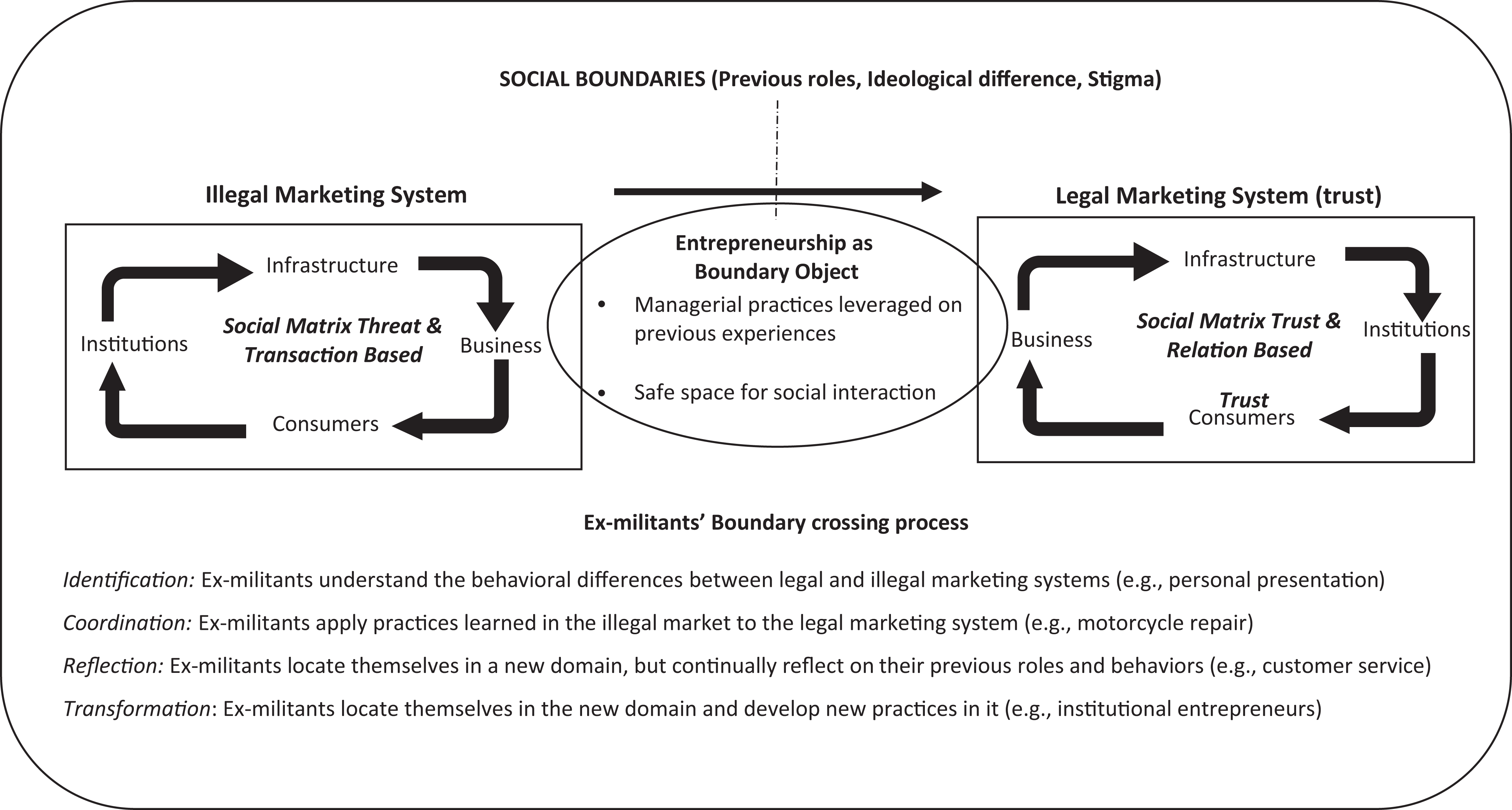
The role of entrepreneurship as boundary object for illegal ex-militant’s reintegration.
Below, we discuss how these findings contribute to the macromarketing / marketing-systems and entrepreneurship literature, at macro, meso and micro levels, with implications for practice, policy, and further research.
At a macro level, this study complements and expands views about the economic and social benefits of developing marketing-systems in general (e.g., Hunt 2010; Layton 2007; Slater 1968; Wooliscroft and Ganglmair-Wooliscroft 2018), and the important role entrepreneurship can play in marketing-systems development, including its potential for positive effects on post-conflict settings in particular (Tobias, Mair, and Barbosa-Leiker 2013; Barrios et al. 2016; Sredl, Shultz, and Brečić). Ex-militants’ business-venturing initiatives tend to enhance larger marketing systems where they are embedded, as these businesses provide ex-militants, suppliers, employers, and customers business-opportunities, helping to overcome the economic consequences of violent conflict. These marketing systems have a distinctive and adaptive social matrix in which exchange occurs (e.g., Layton 2015a), where entrepreneurship creates spaces and opportunities for ex-militants’ social interaction, dialogue, understanding and compassion, thus helping to overcome the social consequences that limit societal reconciliation. This process of reconciliation within the marketing system social matrix is integral; it is paramount to entrepreneurial businesses that engage ex-militants. Moreover, constructively engaging ex-militants with legitimate business is requisite for sustainable peace and prosperity of the marketing system(s) in which the businesses are found and with which they interact. These findings have practical implications regarding the way business development is promoted and evaluated, which traditionally involves a focus on the marketing-system participants’ financial performance (Chrisman, McMullan, and Hall 2005). While this performance is necessary for the economic viability of the business, there are particular cases in countries transitioning from war to peace in which the social benefit of the businesses – additional value added for the marketing system and its stakeholders – is an extremely important variable to consider and indeed to assess when reintegrating ex-militants into the business landscape.
Building upon the preceding paragraph, the study complements meso-views about the positive community effects of business in war-recovering economies, especially when the mission of those businesses is inclusive and intended to expedite recovery (e.g., Shultz et al. 2005). Findings show how social boundaries can promote or exacerbate individual and structural discrimination (Lamont and Molnár 2002), limiting the interaction between ex-militants and established members of civil society. However, consistent with Diamond and McDonald (1996), findings show that business venturing gives ex-militants opportunities for legitimate participation in a new social world allowing the broader marketing system to see their humanity. Specifically, business practices create safe spaces, opportunities for interactions with fellow citizens, crossing institutional barriers, to build formal and informal bridges promoting the dialogue and constructive engagement between formerly conflicted parties – e.g., victim and victimizer – to sustain a peaceful and prosperous marketing system (Shultz 2016). During the interviews it was evident that informants were empowered to lead independent, productive and prosocial lives, commensurate with values espoused by civil society. This in turn helps to deter the resurgence of violence (cf. Hill, Taylor, and Temin 2008), by shaping and redefining the beliefs and social roles of the previously marginalized. Stating the case, bluntly: employed and prosperous ex-militants with stakes in their new socioeconomic milieu and marketing system, are not inclined to re-engage efforts to destroy that milieu and system – and the human beings that comprise it.
These results have implications for policy and business practice, as governments’ post-conflict strategies need to focus on former militants, but strategies also must attend to society’s relationships with the ex-militants. Entrepreneurship and the businesses that emerge from it are important facilitators of this process, not only in Colombia, but in other war-recovering countries as well. Traditionally, UN DDR and other support organizations’ protocols to manage post-conflict transition to sustainable peace are represented as foundations for civil society. A society recovering from war however cannot be truly and sustainably civil if it does not reintegrate ex-militants. This process requires new perspectives of self and society, governance and business venturing, and entrepreneurship in transitioning societal contexts (cf. Sredl, Shultz, and Brečić 2017). Our findings suggest catalytic institutions in the forms of integrative policies, businesses and entrepreneurship are indispensable to this process. Indeed, to date, this has been evident in the Colombian peace process, whereby FARC guerrillas and the Colombian government reached an agreement much of Colombian society did not initially accept, but ultimately most Colombians seem to have embraced, due to persistent negotiations and revisited policies to achieve peace (e.g., McKirdy and Romo 2016).
At a micro level, the research extends previous studies about the different and difficult challenges faced by ex-militants for returning to civil society (Branzei and Abdelnour 2010; Tobias, Mair, and Barbosa-Leiker 2013). These challenges are greatly underappreciated, rarely are factored into the costs of war or are greatly underestimated (Stiglitz and Bilmes 2008), and are as old as war itself (Sophocles 2015 / 5th CBC). Findings reveal how the war-time lives of ex-militants often are a symbolic boundary that limits entrance into a brave new world of social relationships and expectations. However, both market-transactions and relation-based interactions during ex-militants’ business venturing help ex-militants to identify and cross such social ‘symbolic boundaries’ (cf. Epstein 1992), and in turn invoke a self-transformation process (cf. Akkerman and Bakker 2011). Boundary Theory illuminates a process through which ex-militants disengaged from previous war-related ideologies and violent pasts (cf. Chandra 2017), can create social roles and develop new, emancipating identities from the previous self-images (cf. Abdelnour and Branzei 2010).
These findings have implications for policy and further research. Coordinated policy, business venturing and entrepreneurship facilitate socioeconomic conditions and opportunities to enable ex-militants to cross the social and symbolic boundaries that remain after violent conflict has ended. Colombia’s FARC reintegration program is estimated to cost US$ 30 Billion in the first 10 years (Muñoz 2016) – a huge sum by any measure – and given rekindled violence by remnants of ELN and FARC (e.g., González and Casey 2019) even that amount may not be sufficient. Initiatives and resources from afar – similar to the Marshall Plan, perhaps – may be required. More than 50 years of war, millions of dead and disenfranchised, countless suffering, a 10 year peace process and numerous uncalculated costs to war however suggest that price tag may be a bargain (cf. Stiglitz and Bilmes 2008), especially when one considers that it is an investment intended to stimulate prosocial businesses, to enhance economic prosperity, to sustain peace, and to ensure personal and community well-being (Shultz 2016). Our research therefore provides insights for policy makers about the business-related opportunities and alternatives for ex-militants reintegration and society reconciliation. Such practices can be seen as key identity-developers and tools to counter discrimination (Reed 2002). In this case – and by logical extension other cases in which countries struggle to recover from war, transition to peace and reintegrate ex-militants – findings indicate constructive engagement and reintegration through prosocial business practices and entrepreneurial initiatives facilitate the process of developing new identities (Shultz 2007). This process can be a vehicle to cross the social boundaries of discrmination; in some cases, former militants leveraged the stigma of being an ex-combatant to their favor, to develop their businesses. These findings extend the applications of entrepreneurship literature (e.g., Navis and Glynn 2011) about the contours of an entrepreneurial identity and its individual and social effects – beyond the traditional business paradigm, in much needed ways – into the realm of integrative policy and business to heal marketing systems, to advance civil society and to sustain peace.
While our research offers fresh and useful insights, it also has limitations. Perhaps foremost is the extent to which findings can be generalized, given the sample and the process for its selection. Following the approval for this study by the University and its ethics board, identification and access to ex-militants was permitted only via the official Colombian agency, ACR, which provided the initial list of 100 ex-militants. Thus, sample-participants were not randomly selected from the entire population of ex-militants engaged in business venturing. The process may have favored the inclusion of ex-militants who are, or appear to be, successfully transitioning into Colombia’s peace economy. However, during the interviews we discovered that informants knew other ex-militants having similar experiences; these informants also mentioned various aspects of business failure (socially and economically) with their current or previous businesses. We did not interview people who quit their entrepreneurial activity. Future research should include a more representative sample. Nevertheless, even if the sample of ex-militants that participated in the study included a disproportionate number of “success cases” – which we were informed was not the case and appeared not to be the case during our depth interviews – the findings offer insights into some factors that predict success, which can be useful to the DDR program, its participants and Colombia more broadly; indeed, we believe they can be useful to other recovering economies/societies. We should also add that, despite conscientious efforts to follow rigorous, standardized procedures and thus to ensure veracity and trustworthiness of findings, some misinterpretation or interpretive bias by the researchers is possible.
Future research can enhance confidence in the extant findings and expand them. Particularly beneficial would be to study the effect of business outcomes on ex-militants’ reintegration and societal reconciliation. Longitudinal tracking and measurement of attitudes and trends would be especially useful, so would performance measures of the businesses established/managed by ex-militant entrepreneurs. Such initiatives would require the collection of quantitative data via surveys, and reports filed with tax authorities and other agencies, respectively. The establishment of data-bases would permit year-on-year comparisons and, depending upon the amount and quality of data, modelling and other analyses to ascertain trends in attitudes and perceptions of life-quality/satisfaction among ex-militants and other DDR stakeholders; business performance (and factors that predict/deter it); policy efficacy and ultimately societal well-being. These data could be compared to similarly collected data in other recovering economies suffering from disrupted or fractured marketing systems, unable to deliver the requisite assortment and quality of goods and services needed to build and sustain civil society. We also believe it would be useful to study why ex-militants leave the program, and thus plausible ways to persuade them to remain or return; the potential problems of administering such a study have been noted above.
We conclude by reminding readers war remains one of the most existentially threatening problems confronting humanity, infecting many countries and shunting resources from just about all others. It devastates individuals, communities, and nation-states; it ravages a society’s wealth; it cripples future generations. Thoughtful, inclusive and prosocial business initiatives – designed to actualize important macromarketing outcomes such as individual quality-of-life and societal well-being, in addition to micromarketing and financial indicators – have the capacity to overcome the economic and social consequences of war and to sustain peace. This article intersects current macromarketing views of marketing systems and entrepreneurship with views posited by sociology vis-à-vis boundaries and boundary crossing, to show how business venturing also can be a vehicle to help former militants cross social boundaries created by violent conflict. Evidence from field research in Colombia indicates ex-militants’ prosocial business engagement is instrumental to reintegrate socially and economically and contribute to sustainable marketing systems where they are embedded. While this study offers a glimpse into the importance of business and policy initiatives to reintegrate ex-militants into civil society, future research in other post-war countries – which explores various elements in a marketing system, including ex-militants’ entrepreneurial business and other catalytic forces in the system – will shed further light on the importance of entrepreneurship and other prosocial business and marketing applications of theory, to affect individual welfare, societal well-being and sustainable peace and prosperity.
Footnotes
Acknowledgments
The authors thank the Senior Editor, Guest Editors and three reviewers for helpful comments on earlier versions of the manuscript published as this article.
Declaration of Conflicting Interests
The author(s) declared no potential conflicts of interest with respect to the research, authorship, and/or publication of this article.
Funding
The author(s) disclosed receipt of the following financial support for the research, authorship, and/or publication of this article: The author(s) received financial support from Colciencias and RCUK for developing the fieldwork of this research.
