




Abstract
Robert F. (Bob) Lusch has made many contributions to scholarly research on macromarketing, especially on how business —and especially marketing– can and should contribute to society. His insights are important in understanding how business practices are evolving over time. In addition, they are prescient in identifying new ways for scholarly research in business and marketing to be useful to society. This tribute briefly describes how Bob Lusch’s ideas are reflected in management and marketing practices today. I also discuss how they are related to three key principles of responsible research advocated by Responsible Research in Business and Management (RRBM). (See: https://rrbm.network/). This conceptual paper calls for research on topics relevant to business performance and value networks, marketing and societal well-being, sustainability and the bioenvironment, service systems and stakeholders, and human and labor rights.
Keywords
Although Robert F. (Bob) Lusch has made many contributions to scholarly research on macromarketing, I am especially struck by his insights on how business —and especially marketing–
What is Responsible Research?
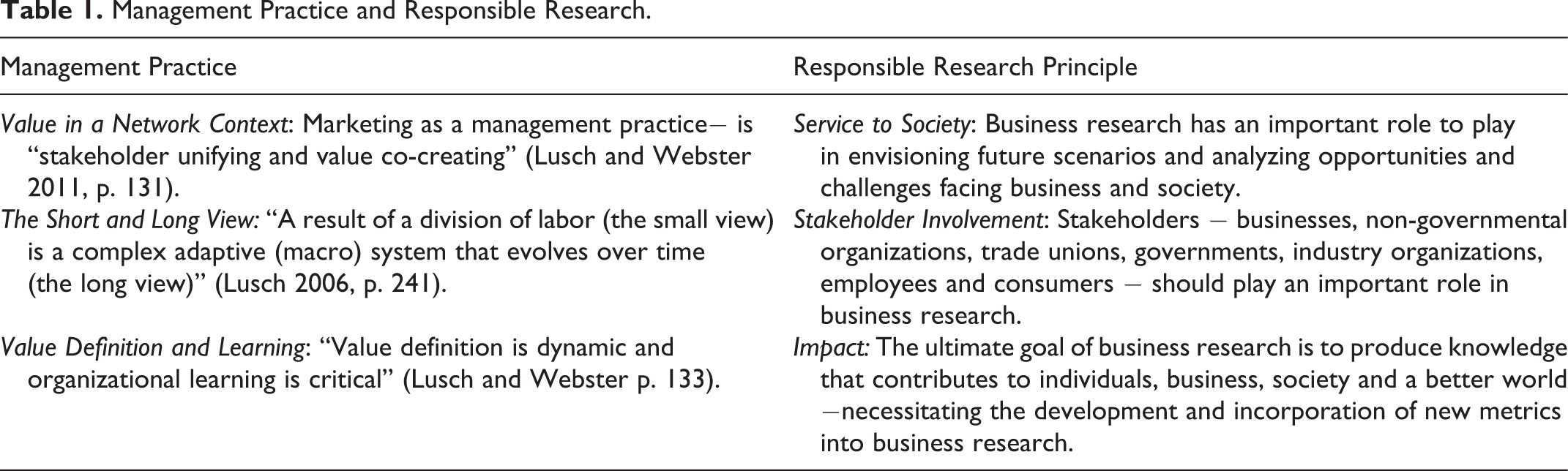
The concept of responsible research (RR) originated in philosophy of science. Its core idea is that science should be socially responsible, as well as credible (Tsui 2016). Specifically, RR must be useful – that is, connected to the real-world –and credible– that is, reliable and valid. RRBM is a virtual organization dedicated to encouraging business research that builds knowledge to help make the world a better place (Community for RRBM 2017). Three RRBM principles guide scholars on how to build knowledge that will be useful: service to society, stakeholder involvement and impact on stakeholders. This article is organized around how Bob’s scholarly work relates to current management practices and to these three principles. See Table 1.
Management Practice and Responsible Research.
Value in a Network Context: Service to Society as a Purpose
On August 19, 2019, the Business Roundtable released a remarkable statement – signed by 181 chief executive officers (CEOs) of leading companies – that the purpose of a corporation is to create benefits for all stakeholders: customers, employees, suppliers, communities and shareholders. (See: https://www.businessroundtable.org/). Since 1997, the Business Roundtable had endorsed the notion that corporations exist principally to serve shareholders. Hence, the new statement was greeted with a mixture of praise and consternation by business and government leaders, as well as the press (Denning 2019; Emmott 2003; Economist 2019; Gelles 2019; Gelles and Yaffe-Bellany 2019; McGregor 2019). Notably, the Business Roundtable’s new statement of purpose embraced business priorities beyond shareholder value, including investing in employees (e.g., diversity and inclusion), protecting the environment (e.g., sustainability) and treating suppliers fairly and ethically.
The new statement reflects an underlying premise that business −and marketing as a management practice− is “stakeholder unifying and value co-creating” (Lusch and Webster 2011, p. 131). This premise has been a central theme in Bob’s scholarly work for many years (Vargo and Lusch 2004a; 2004b; 2008). It also provides a foundation for RRBM’s first principle, namely that business research plays an important role in envisioning future scenarios and analyzing opportunities and challenges facing business and society. For example, marketing scholars might conduct research to help society address the United Nations’ 2030 Agenda for Sustainable Development, such as achieving sustainable production and consumption patterns (the 12th goal). This research problem is a specific application of two underlying meta questions raised by Lusch (2017, p. 323): “Can some (or most) of the unseen costs of exchange be calculated?” and “What is the role of…institutions in increasing the efficiency and effectiveness of the macromarketing system?”
The Small and Long View: Stakeholder Involvement is Critical
The majority of countries in the Organization for Economic Co-operation and Development (OECD) give the workforce representation in corporate governance. The United States is a notable exception. Hence, in 2018, Elizabeth Warren, Massachusetts senator, proposed the Accountable Capitalism Act. The Act would require very large companies to obtain a new federal charter under which directors would have to consider the interests of all corporate stakeholders (Wartzman 2019). It is consistent with an underlying premise of Bob’s scholarly work over the past two decades. Specifically, Lusch (2006) emphasized the importance of stakeholder involvement in networked systems in his article, “The Small and Long View.” He wrote: “[E]ach entity in this interconnected system is always attempting to do better or improve its condition, [so] the system becomes adaptive. Thus, what emerges as a result of a division of labor (the small view) is a complex adaptive (macro) system that evolves over time (the long view)” (p. 241).
The “small and long view” provides the foundation for RRBM’s second principle, which emphasizes that stakeholders − businesses, non-governmental organizations, trade unions, governments, industry organizations, employees and consumers − should play an important role in business research. Stakeholder involvement is necessary for beneficial long run outcomes for all parties. For example, research is needed to identify new ways for businesses and marketers to collaborate with employees, suppliers and consumers (or potential consumers) to bring needed products to their communities – thereby improving the welfare of all stakeholder groups. Thus, marketing scholars must broaden their research focus to involve multiple stakeholder groups within an ecosystem. This example leads to an underlying meta question raised by Lusch (2017, p. 323): “How do societies historically and today vary their practices in doing deals with strangers…and is society overall better or worse off?”
Value Definition is Dynamic and Learning is Critical: Measuring Impact
In recent years, business time horizons have become shorter and shorter – and so have the tenures of CEOs and chief marketing officers (Pearlstein 2013). These phenomena have led firms to rely on short term changes in share price as a proxy for shareholder value. Yet, neither share price nor shareholder value are good proxies for the value co-created –or the benefits provided− to customers, employees, communities over the long term. Many managers and academics have argued that a balanced scorecard (i.e., a comprehensive set of metrics) should be employed to assess business outcomes (e.g., Ambler and Roberts 2008; Kaplan et al. 2001; Pfeffer 2009). In the long run, a balanced scorecard can help managers and policy makers identify outcomes that benefit all stakeholders and (at least) have a neutral effect on shareholder value (McWilliams and Siegel 2000; Porter and Kramer 2019).
Consistent with these notions, RRBM’s third principle emphasizes that the ultimate goal of responsible research is to have impact – that is, to produce knowledge that contributes to individuals, business, society and a better world (including the bioenvironment)—which necessitates the development and incorporation of new metrics into business research. Hence, business and marketing scholars should measure outcomes beyond traditional measures of business productivity, employee/customer satisfaction, and profitability. Moreover, marketing metrics should assess the impact of organizational decisions on all stakeholders, not just current or potential customers.
This perspective on measuring impact (of organizations or scholarly work) is consistent with the Service Dominant Logic (Vargo and Lusch 2004a; 2004b). Lusch and Webster (2011, p. 132-3) observed that, “the organization should be an effective and efficient service support system for helping all stakeholders, beginning with the customer, become effective and efficient in value cocreation” (italics mine). At present, business scholars and academics do not agree on the best ways to measure business impact on stakeholder groups. However, Lusch and Webster (p.133) point out that “value definition is dynamic and learning is critical” – suggesting that business metrics will inevitably change. Indeed, Lusch (2017, p. 323) noted that human use of technology has evolved over time, leading to meta questions about the societal consequences of our use of different technologies – including metrics.
Concluding Remarks
I am very pleased to contribute an article to this special issue honoring Dr. Robert F. Lusch, colleague and friend. His path-breaking work has made major contributions to understanding the interplay among marketing, business and society. I have enjoyed tracing how his work has influenced – and been influenced by – changes in business practice and scholarship. However, due to space limitations, I have drawn on only a few of his many influential articles and books. Bob Lusch’s research focused on deepening our understanding of how to improve the well-being of people, business, society and the bioenvironment. His legacy provides us with principles that can help us emulate him.
Footnotes
Declaration of Conflicting Interests
The author(s) declared no potential conflicts of interest with respect to the research, authorship, and/or publication of this article.
Funding
The author(s) received no financial support for the research, authorship, and/or publication of this article.
