




Abstract
Despite the lack of consensus in existing literature regarding the societal functions of advertising, brands have been increasingly incorporating aspects of their stance on key social issues and/or contributions to societal wellbeing, into advertising messages. However, notable failures of contemporary societal advertising campaigns indicate that their effectiveness in achieving marketing objectives and advancing social causes remains ambiguous. To appraise the commercial and social consequences of societal advertising, the present research proceeds to examine its interrelationship with the social value system and conceptual differences with similar concepts. Although advertising is able to reflect and also reinforce a subset of existing social values, effective contribution to positive social change is likely to necessitate synergies between elements of the entire marketing process. Overall, given its risks and limitations, there is not sufficient evidence to posit that the practice of societal advertising is always for the best interest of business and society.
Keywords
Introduction
In the contemporary, volatile and highly competitive business environment, organizations strive to develop and sustain meaningful brand positions. Although marketing, as a theoretical concept and business function, encompasses numerous tactics and sophisticated processes, marketers consider advertising as a crucial element of marketing communications, through which they reach mass audiences, enhance customer awareness and differentiate their brands from competition (Jobber 2004). Suggestive of advertising’s importance within the promotional mix is the substantial amount of marketing investment associated with it. By the end of 2020, global advertising spend is expected to reach approximately $656 billion across all media (WARC 2019). Large volumes of advertising expenditures, along with the proliferation of marketing communications channels, evince that audience members are experiencing a state of over-communication. As a result, consumers have been forced to develop additional perceptual mechanisms to filter unnecessary or irrelevant advertising information (Heckler and Childers 1992; Ries and Trout 2001). The conscious and unconscious filtering of marketing communications messages by audience members, suggests that advertising effectiveness is critically affected by decisions relating to timing, media and content.
On the surface, business organizations utilize advertising communications to achieve their commercial objectives. However, in addition to its commercial value, advertising has been assumed to function within a broader social context as well. Prior efforts to evaluate the institutional role of advertising have led to disagreements among academics and practitioners, particularly in respect of advertising’s ability to exert, either positive or negative, influence over social values. In view of the above, the present paper aims to briefly discuss the contrasting views about advertising and whether it has the institutional power to shape the existing system of social values.
In the past, advertising was accused of greenwashing and neglecting progressive social values, such as social justice (Ciochetto 2011). However, during recent years, business organizations have been increasingly incorporating aspects of their social stance into their advertising campaigns (Eilert and Nappier Cherup 2020). The current political polarization and socially-charged climate have led consumers to an expectation that brands ought to be expressing their viewpoints on controversial sociopolitical issues (Rim, Lee, and Yoo 2020; Vredenburg et al. 2020). Coca Cola’s 2014 ‘It’s Beautiful’ and Pepsi’s 2017 ‘Live for Now’ advertisements, attempted to endorse multiculturalism and unity in America. Similarly, Nike communicated its support for racial justice and women empowerment with its 2017 ‘Dream Crazy’ and 2019 ‘Dream Crazier’ advertising campaigns respectively. This form of advertising has elicited mixed consumer responses, and some advertisers have been confronted with considerable backlash. In response to Pepsi’s 2017 ‘Live for Now’ commercial, consumers across social media platforms accused the brand of being insensitive to social reality and trivializing the ‘Black Lives Matter’ movement. Although a growing number of corporations convey messages of social or environmental character, their effectiveness in achieving marketing objectives and advancing societal wellbeing remains ambiguous. Consequently, the present paper also aims to assess whether the practice of communicating a corporate stance on key social and environmental issues is for the best interest of business and society. To facilitate discussion of advertising’s potential impact on business and society, the study introduces the concept of societal advertising, in contrast to existing and overlapping concepts found in marketing literature.
Growing consumer empowerment (Papaoikonomou and Alarcón 2017; Shaw, Newholm, and Dickinson 2006) and resistance (Ciochetto 2011), as well as pressing concerns about societal progress and environmental sustainability, have forced numerous companies to reevaluate their marketing and advertising strategies. Nowadays, more than ever before, marketers are expected to achieve quantifiable contributions to business performance (Stewart 2009), in addition to serving and protecting societal welfare (Kotler, Armstrong, and Opresnik 2017). Moreover, factors such as the growing distrust of advertising (Callister and Stern 2007; Ciochetto 2011; Edelman 2019; Mitra et al. 2019; Obermiller and Spangenberg 1998; Sethi 1979; Tsang, Ho, and Liang 2004), complexity of social and environmental issues, and multifaceted challenges of advertising planning, compromise advertisers’ efforts to achieve the desired business and/or societal outcomes.
Macromarketing theory is based upon the premise that marketing activity can have positive and negative effects on society, either intentionally or unintentionally (Mittelstaedt, Kilbourne, and Mittelstaedt 2006). Given the paucity of contemporary macromarketing studies that focus on the relationship between advertising and society, the present study examines the function of advertising under the prism of marketing systems. In view of the marketing systems concept (Layton 2007), the institutional role of advertising is underscored by its ability to serve the flow of information within and from marketing systems. To fulfil the primary aim of the present research, which is to appraise societal advertising’s potential consequences on both the micro (i.e. advertiser) and macro (i.e. society) levels, the study proceeds to examine its institutional power, interrelationships with the social value system and conceptual differences with similar concepts. Substantial consumer resistance to contemporary societal advertising campaigns (Dodd and Suppa 2014; Nyilasy, Gangadharbatla, and Paladino 2014; Swimberghe, Flurry, and Parker 2011; Vlachos et al. 2009; Vredenburg et al. 2018) highlights the tentative nature of controversial social issues (Schommer-Aikins and Hutter 2002) and the risks of societal advertising practice.
Linking Advertising with Social Values
Discussions regarding the nature of the association between advertising and social values are related to the criticism of contemporary marketing and advertising practices, the appraisal of different socioeconomic systems and the evolution of marketing theory. Existing literature indicates that social values are at the core of advertising messages (Pollay and Gallagher 1990), and thus advertisements can be seen as dynamic and aesthetic portrayals of social values (Lears 1994). Advertising uses signals and meanings that are external to the marketing domain and creatively transforms them, in order to generate novel representations of brands (Hackley 2005). By associating product and brand consumption with values, advertising affects consumers’ sociocultural perspectives and participates in the process of social change (Hackley 2005).
Message appeals are the main devices employed by advertisers to depict social values (Albers-Miller and Gelb 1996). As the central themes of advertisements, appeals also determine the balance between rational and emotional persuasion in advertising messages (Albers-Miller and Stafford 1999). Given that advertising persuasion can be grounded in the rational and/or emotional dimensions of consumption, advertisers adjust the mix of message appeals and values they believe to be most effective in every situation.
Due to the hypothesized association between message appeals and social values, advertising is considered to perform significant socioeconomic functions. Past researchers have argued that advertising is a key factor in the functioning of capitalist markets (Tellis 2005). Although there is no doubt that advertising is an important agent of the socioeconomic environment, there are conflicting views on the nature of its institutional role(s). The diversity of existing interpretations may be explained by the fact that advertising is a complex and controversial activity, extending to both the micro and macro-levels of the global business environment. Apart from the specific marketing objectives it is intended to achieve, advertising has been thought to perform the societal functions of information and persuasion (Sandage 1972), market power (Norris 1966), and social control (Potter 1954).
Because of consumers’ connections with products, advertising links culture with economic activity (Ciocetto 2011). The institutional perspective of advertising suggests that advertising messages communicate and shape social values (Pollay 1983; 1986). During China’s ‘westernization’ in the late 1990s, Chinese commercials emphasized the values of youth and modernity (Lin 2001). In the collectivist culture of Mexico, effective advertisements conveyed traditional cultural norms, such as femininity for women and masculinity for men (Gregory and Munch 1997). From 1900 to 1980, advertising messages across traditional media in the United States were found to place more emphasis on family, modernity and self-centeredness, rather than on tradition and community (Pollay and Gallagher 1990). Through its rhetoric and imagery, advertising had successfully associated smoking with masculinity and independence, ice-cream with love and nostalgia, and casual shoes with relaxation and carefreeness (Durgee and Stuart 1987).
Values have been defined as “enduring prescriptive or proscriptive beliefs that a specific end state of existence or specific mode of conduct is preferred to an opposite end state or mode of conduct for living one’s life” (Kahle 1983; Rokeach 1968, 1973), and ultimately represent “persistent beliefs about what is important in life” (Shimp 2010, p. 228). Such beliefs have been described as desirable trans-situational goals, deriving from universal human needs, requisites of social interaction and institutional requirements (Schwartz and Bilsky 1987; Schwartz 1994). Thus, values are viewed as individual representations of societal goals and every time social change takes place, advertisers modify their strategies according to the resulting shifts in predominant social values (Kahle, Poulos, and Sukhdial 1988). Obtaining an understanding of social values and adapting to change is critical for advertisers, because values govern the daily lives and purchase behavior of consumers (Belch and Belch 2003). Given that consumer motivations are greatly affected by underlying values, acquisition of products may be perceived as the means to achieving personal goals that are directly linked to desired values (Solomon et al. 2006). With every purchase they make, consumers attain the emotions and values attached to the products (Ciochetto 2011).
While the relationship between advertising and social values has been acknowledged in the relevant literature, its direction remains unclear. A number of authors have argued that advertising has the necessary power to influence consumer attitudes, values and preferences (Pollay and Gallagher 1990). This viewpoint is characteristic of advertising’s critics and is often part of a broader critique of capitalist economic systems (Fill 2009). Although advertising was originally employed to introduce goods to the market, provide essential product information and support market economies, over time it has been increasingly performing functions which were traditionally performed by other social institutions (Dyer 1982). Due to their access to detailed market information, powerful media channels, professional skills and abundant resources, advertisers are able to employ sophisticated persuasion techniques and thus hold a position of power against message recipients (Dyer 1982). The impact of professionally developed and often irrational advertising rhetoric on consumption is amplified by the pervasiveness and repetition of advertising messages across media channels, and the alleged detachment of consumers from traditional social institutions (Pollay 1986). Advertisers are capable of distorting the relative importance of individual values, by placing emphasis on those that are more effectively linked to their offerings and positively responded to by consumers (Pollay 1986). As a result, by exercising its authority and serving its commercial objectives, advertising contributes to the commercialization of culture and association of consumption with euphoria, frequently at the expense of long-run consumer and societal wellbeing.
Empirical data indicate that the majority of consumers have generally negative attitudes towards advertising, employ advertising avoidance strategies and do not trust the majority of brands they buy (Edelman 2019; Sethi 1979; Tsang, Ho, and Liang 2004). Public distrust of advertising is often the product of unethical practices, such as the targeting of advertisements to vulnerable social groups and the use of misleading persuasive tactics. During the financial crisis of 2007-2008, approximately two-thirds of citizens in the United States maintained that advertising coerced unnecessary purchases and conspicuous consumption, and, thus, they perceived advertisers as partly responsible for the resulting economic downturn (Moriarty, Mitchell, and Wells 2012). Examples of unethical advertising practices include racial and sexual stereotyping, persuading consumers with the use of idealized imagery to consume products which are often dangerous (e.g. alcohol), and targeting susceptible consumers, such as children (Drumwright and Murphy 2009; Hyman, Tansey, and Clark 1994). Apart from deliberately attempting to create false beliefs about products and brands, advertising messages may give rise to discrepancies between advertising claims and facts, or between consumer beliefs and facts (Russo, Metcalf, and Stephens 1981). In view of the above, arguments against advertising suggest that by employing unethical and misleading tactics, it hinders long-run consumer and societal welfare.
An alternative view, as expressed by academics and practitioners, suggests that advertising reflects existing social values and lacks the power to shape them (Holbrook 1987; Ogilvy 1983). Apart from lacking the necessary institutional power (Aaker and Myers 1975), advertising is thought to benefit from adjusting to the existing system of social values. Any attempts to oppose the predominant social values would result in irrelevant and unsuccessful marketing communications (Petit and Zakon 1962). Advertising message effectiveness is contingent upon adaptation to a plethora of geodemographic, psychographic and behavioural buyer characteristics (Holbrook 1987). Consequently, via the application of diverse message strategies, advertising resonates with target audiences and adjusts to the shifting marketing environment (Kouremenos, Livas, and Tsogas 2016).
Due to the omnipresence of advertising messages in modern society, they are understood through the cultural context surrounding them (Belch and Belch 2003). Advertising seeks to create meanings that reflect and activate the social identity, values, ambitions and imagination of recipients (Belch and Belch 2003). To have the desired effects on prospective buyers, effective advertising must be related to the needs, desires and values of the target audience (Shimp 2010). Provision of relevant information in every stage of the consumers’ buying process ensures that advertisers establish powerful connections with their target audiences and elicit positive responses. Overall, this approach presupposes that advertising is a tool of existing socioeconomic relations aiming to activate and welcome the current socioeconomic structure (Dyer 1982). In that way, advertising adapts to the predominant social values so as to produce favorable consumer attitudes and behavior.
In light of the above, this paper assumes an intermediate approach regarding the relationship between advertising and social values. While advertising communicates values that are considered profitable by business organizations (Mueller 1987), it does not have the power to directly manipulate the existing system of social values, as it operates alongside other fundamental social institutions (Aaker and Myers 1975), such as family, philosophy, art, literature, culture, religion and education. Despite the diminishing status of traditional social institutions in affluent societies (Pollay 1985), there is no concrete evidence to imply that advertising has the authority and power required to create or directly shape social values. However, advertisers retain control over the selection and communication of existing values that best serve their purposes.
The vast majority of commercial messages are based on common meanings and reflect social trends, but advertisers are selective about the reality they present, since they promote values and ideals that are most useful to them (Dyer 1982). By placing increasing emphasis on the communication of certain social values, advertising further endorses and reinforces a specific subset of ideas, attitudes and behaviors that were already present in society. Though single advertisements are ephemeral, they cumulatively form a collection of messages that represents the sociocultural context in which they were created (Hackley 2005). The resulting collection of messages performs a dual function: it reflects the values of powerful social groups that produced these messages and operates as a point of reference for the wider community (Goddard 1998).
The social systems’ perspective acknowledges the same two-way interaction between marketing and society (Dixon 1984). Although society and culture provide inputs to the marketing system, marketing performs institutional functions that have effects on society and produce cultural outputs as well (Dixon 1984). As a predominant and omnipresent marketing communications option, the advertising function is an important agent of the marketing system. At any level of aggregation (Layton 2007), it contributes to the flow of information within or between social systems (Fisk 1967), and may have positive or negative socioeconomic impacts (Mittelstaedt, Kilbourne, and Mittelstaedt 2006). Given the nature and strength of association between advertising and social values (Moriarty, Mitchell, and Wells 2012), advertising is able to reflect and also reinforce a selection of social values.
In agreement with the preceding theoretical analysis, the proposed conceptual framework (Figure 1) illustrates the hypothesized interrelationship between the system of social values and advertising message content (i.e. message appeals and creative execution). The framework suggests that a specific subset of existing values, which are complementary to advertisers’ purposes, are incorporated into advertising message content (path A to B). Although the system of social values undergoes constant change due to the direct influence of several powerful social institutions (path A to C), it is also indirectly affected by the emphasis placed by advertising on a selection of preexisting values (path B to C). The resulting evolved system of social values forces advertising message adaptation to the new contextual conditions (path C to D), in order for it to remain relevant and persuasive (Livas et al. 2013). Given that social values are subject to constant change (Gurel-Atay et al. 2010), advertising message adaptation to the evolving system of social values is a process rather than a single task.

Advertising and social values.
The examination of whether and to what extent advertising has the institutional power to shape social values according to the will of marketing executives, serves as a prerequisite for assessing whether and how corporate advertisers ought to pursue such institutional roles in society. Nevertheless, conceptual investigation of the societal functions of advertising takes place in view of the evolving marketing concept.
Societal Marketing
Although marketing was initially viewed exclusively as a business function, it was later regarded as a universal societal activity (Kotler and Levy 1969, p. 10). The original marketing concept placed emphasis on the better understanding of target markets and delivery of superior satisfactions than competitors (Kotler, Armstrong, and Opresnik 2017). Growing public concern for social and environmental issues, along with increasing pressures from educated and empowered consumers (Abratt and Sacks 1988; Broniarczyk and Griffin 2014), led to the emergence of the societal marketing concept, which stipulates that business organizations should aim at offering products that are desirable by the market and serve long-run consumer and societal wellbeing (Kotler 1972). Proponents of societal marketing argue that consumers immediate desires may often oppose their long-term interests (Crane and Desmond 2002), and that securing consumer welfare in the long-run is ultimately to the advantage of business. Marketers are expected to adhere to a universally required moral minimum, with the purpose of avoiding or correcting social injury (Abratt and Sacks 1988). Despite some criticism, societal marketing has been prevalent in business practice (Crane and Desmond 2002) with organizations increasingly focusing their marketing efforts on satisfying customer needs, meeting business requirements, and being socially and environmentally responsible (Kotler, Armstrong, and Opresnik 2017). The societal marketing concept precedes and is associated with novel strategic approaches that have emerged in contemporary business literature. The notion of creating shared value (CSV) suggests that by reconceiving products and markets, redefining productivity and building industry clusters, companies are able to identify and augment the connections between societal and economic progress (Porter and Kramer 2011). In order to discover market opportunities, achieve sustainable business performance and contribute to long-run societal welfare, business organizations are required to thoroughly explore changing societal needs and optimize the utilization of organizational resources and capabilities (Porter and Kramer 2011).
On the other hand, critics of the societal marketing concept have argued that marketers do not possess the competence and should not be given the authority to decide what is in the public’s best interest in respect of key social and environmental issues (Gaski 1985). Societal welfare and protection against the negative consequences of free market economies are viewed solely as governments’ responsibility (Levitt 1958). At its core, recent criticism of societal marketing is driven by Friedman’s (1962; 1970) doctrine, which suggests that firms’ responsibilities are only to their shareholders, so long as they abide to existing rules and regulations. Although Friedman’s shareholder theory has been criticized by those advancing the cause of societal marketing, many authors have expressed concerns about the exploitation of societal marketing as a tactic to achieve financial gains. Because marketing actions ought to resonate with target audiences’ attitudes, the growing popularity of progressive views on social and environmental issues may be forcing brands to endorse such causes. In that case, corporate attempts to implement the principles of societal marketing can be perceived as directed towards developing sustainable competitive advantage (Gaski 1985). Although in theory societal marketing does not oppose business profitability and long-term corporate survival (Abratt and Sacks 1988; Kotler, Armstrong, and Opresnik 2017), critics have argued that absolute adherence to its principles necessitates the sacrifice of at least some customer satisfaction and profit opportunities (Gaski 1985).
Nevertheless, there is insufficient evidence to assert that the public’s sincere concerns about key social and environmental issues transcend other fundamental and practical consumer desires, such as the ability to make convenient and value for money purchases (Boulstridge and Carrigan 2000). Despite the growing importance of ethical consumerism and the genuine intentions of ethical consumers, evidence suggests that actual consumption behaviour is often unaffected by ethical concerns, thus indicating the existence of an attitude – behavior gap (Carrington, Neville, and Whitwell 2010; Papaoikonomou, Ryan, and Ginieis 2011). Prior research has firmly established that consumers support, and are likely to develop positive attitudes toward, socially responsible company initiatives and communications (Green and Peloza 2011; Mohr and Webb 2005). However, the extent to which consumers deem corporate social responsibility to be more important than other factors affecting consumers’ decision making remains unclear. Some authors have argued that responsible business activity has a positive impact on consumers’ purchase intent, which may be even greater than the impact of price (Mohr and Webb 2005). On the other hand, evidence suggests that consumers may suspect that socially responsible activities are financed by higher prices and develop negative perceptions of price fairness (Habel et al. 2016). Purchase decisions are substantially influenced by functional attributes of product offerings, such as price and quality, to which corporate social responsibility is often deemed irrelevant (Green and Peloza 2011).
Considering the uncertainties surrounding the applicability of societal marketing in practice, its ability to bring about a moral reconstruction of marketing has been questioned (Crane and Desmond 2002). Transition to societal marketing requires fundamental changes in organizational philosophy, as well as the introduction of diverse consumption values that are incompatible with the dominant social paradigm and the traditional marketing concept (Kilbourne and Carlson 2008). Because societal problems are perpetuated by underlying social values and institutionalized behavioral norms, recent studies have argued that a type of macro-social marketing could be applied on a national or global level to achieve positive systemic change (Kennedy 2016). Social marketers can contribute to making society more susceptible to fundamental macro-level change, by creating desirable images, generating positive attitudes and promoting social flexibility (Kennedy and Parsons 2012).
Societal Advertising
The principles of societal marketing extend to almost every aspect of the marketing process, including market research, positioning, product development and marketing communications. Amidst all marketing communication types, advertising is the main instrument organizations employ to reach mass audiences and generate awareness about their socially responsible stance. Apart from providing product information and inducing audience members to exhibit some form of favorable consumer behavior, advertising is also used to develop brand image, establish corporate identity and communicate various causes (Moriarty, Mitchel, and Wells 2012). Consequently, selected social or environmental issues are frequently incorporated into advertising message strategies and transmitted across various media channels.
On a regular basis, business firms employ institutional advertising to communicate their viewpoints, corporate initiatives and organizational personality (Moriarty, Mitchel, and Wells 2012). A critical characteristic of institutional advertising is that it focuses on enhancing corporate image rather than on promoting particular products (Fill 2009; Pearlin and Rosenberg 1952; Shimp 2010). Over the years, this type of advertising may have been driven by growing public concerns over sociopolitical deterioration but, at the same time, it has served as a means of establishing a differentiated brand positioning (Sethi 1979). In order to elicit positive attitudes towards the corporate brand and gain approval, institutional advertisements inform and persuade consumers about business contribution to societal wellbeing (Sethi 1979).
As a subcategory of institutional advertising, advocacy advertising delivers an appropriate corporate stance on key social issues of public importance, so as to positively influence public opinion about the advertiser, establish a socially responsible market position and proactively protect the business against potential criticism (Haley 1996; Sethi 1979). It involves advocating matters of social significance that are deemed relevant to the organization (Shimp 2010), in order to generate public support for either the position or the advertiser (Fill 2009). Consequently, although institutional advertising attempts to enhance the overall image of the organization through a variety of advertising messages, advocacy advertising attempts to do the same by focusing specifically on issues of public importance. A prevalent form of advocacy advertising is environmental or green advertising, which is employed to establish an environmentally responsible corporate image (Nyilasy, Gangadharbatla, and Paladino 2013).
Although some corporations may be genuinely concerned about societal welfare (Haley 1996), others may resort to institutional or advocacy advertising when they perceive their vital economic interests to be at stake (Sethi 1979). The criticism of institutional and advocacy advertising has been rather similar to that of societal marketing, and advertisers have been accused of bestowing purpose upon beneficial, but unintentional, social implications of business activity (Pearlin and Rosenberg 1952). For instance, positive social implications such as investment in technological research, provision of employment, tax compliance and protection of workplace safety are realized in the process of fulfilling the primary business objective of profit maximization. However, they are frequently portrayed as purposeful contributions to societal welfare, rather than as inherent requirements to improve business performance. Advertisers may also emphasize the ways firms are committed to the cultivation of fundamental and well-appreciated social values and institutions, such as personal development, teamwork and family (Pearlin and Rosenberg 1952), even though any contributions of this sort are made in the process of serving organizational objectives.
Existing theory posits that the main types of advertising employed to convey societal messages are institutional and advocacy advertising (Fill 2009; Haley 1996; Moriarty, Mitchell, and Wells 2012; Sethi 1979; Shimp 2010). However, companies can, and very often do, incorporate important social and environmental issues into their corporate, marketing and advertising strategies. Existing literature has identified a plethora of societal concepts that are relevant to contemporary organizations (Table 1). With respect to business strategy, organizations may achieve a sustainable competitive advantage by focusing on the advancement of the social communities in which they operate (Porter and Kramer 2011). They are required to demonstrate their corporate social responsibility by integrating social demands into their business conduct, and practice what is ethically correct (Garriga and Melé 2004). Through public speech and actions involving the entire organization, brands may frequently engage in political activism and take a stand on controversial sociopolitical issues (Eiler and Nappier Cherup 2020; Moorman, 2020; Vredenburg et al. 2020). In view of the marketing process, plans and activities are expected to consider consumer and societal long-run interests (Andreasen 1993; Kotler, Armstrong, and Opresnik 2017; Schmidt and Hitchon 1999), in order to achieve individual or systemic change (Kennedy and Parsons 2012).
Predominant Societal Concepts in Business and Marketing.
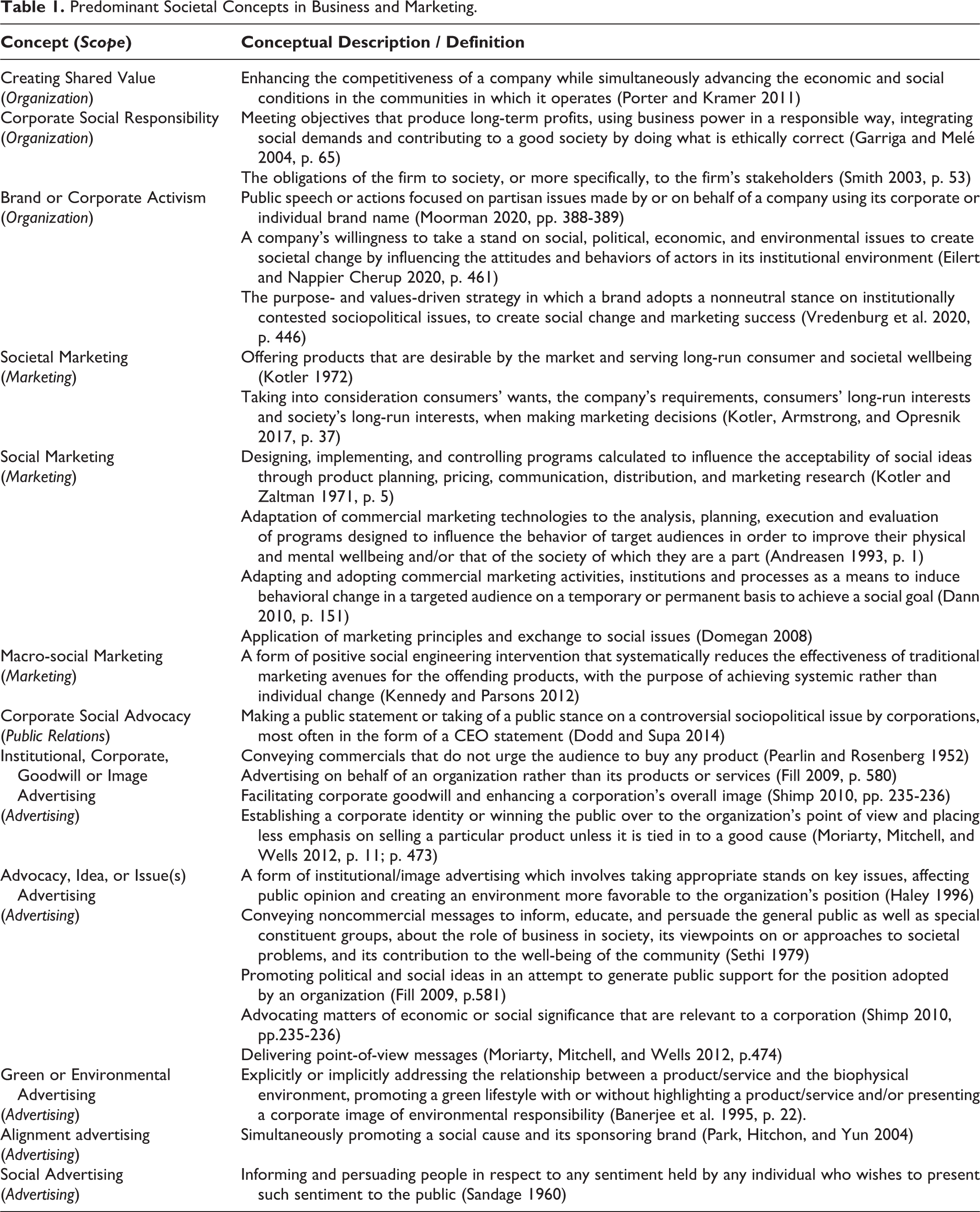
Marketing communications, including advertising, are intended to ensure the delivery of appropriate messages to the right target audiences. The overlapping concepts of institutional, advocacy and social advertising represent special types of advertising that focus on establishing a positive image for the corporate brand, primarily by informing and persuading the public about the organization’s viewpoints on important social issues and contributions to society. Although they may seemingly differ in terms of precise message content, creative execution and goals, such advertisements are considered to be of noncommercial character (Sethi 1979) and thus unrelated to the promotion of specific products or services (Fill 2009; Pearlin and Rosenberg 1952). Some authors have acknowledged that alignment (Park, Hitchon, and Yun 2004) and green (Banerjee et al. 1995) advertising may simultaneously promote causes and commercial information. However, the former is limited to establishing a corporate image and the latter is solely related to environmental issues.
As a function of public relations, corporate social advocacy (CSA) involves adopting a public stance on controversial sociopolitical issues, usually in the form of CEO statements (Dodd and Supa 2014). Whether intentionally or not, organizations engaging in CSA align themselves with the selected issues (Dodd and Suppa 2015) and experience positive or negative financial consequences (Dodd and Suppa 2014). Apart from denoting a vivid interest in the broad topic of societal marketing, the proliferation of similar, overlapping and/or overly specific concepts inevitably creates confusion. In one attempt to examine the network structure that emerged around boycotting and advocating for Budweiser, as a result of the company’s stance on the issue of immigration (Rim, Lee and Yoo 2020), CSA was perceived to encompass a 60-second Super Bowl commercial. However, the practice of reaching broad audiences through paid mass media is a fundamental characteristic of advertising (Kotler, Armstrong, and Opresnik 2017; Moriarty, Mitchell, and Wells, 2012). The concept of societal advertising mitigates the risk of confusion because it offers a common theoretical foundation for multiple related concepts in the field of advertising (i.e. alignment, institutional, advocacy, green and social advertising).
In the present study, societal advertising is conceived as an umbrella term for advertising practice, rather than as a particular type of advertising messages. Advertisers can, and often do, engage with significant social and environmental issues in any type of commercial or noncommercial advertising, including product-specific, promotional, institutional, advocacy, alignment or green advertising. The abundance of available creative tactics and elements facilitates the integration of key issues, product information and aspects of brand image in advertising messages. With its latest societal advertising campaign, Lacta, a leading Greek chocolate brand which has been consistently associating its brand name with the notions of love and bonding, advocated against social stereotyping and prompted consumers to ‘see the love’ (i.e. 2020 ‘#DesTinAgapi’ campaign). In its 120-second television commercial, the company was also able to subtly display its classic chocolate bar, as part of the advertisement’s dramatizations. Skip, a well-established laundry detergent brand in Greece, communicated its objection to racial discrimination by suggesting that separation based on color is only appropriate when doing laundry (i.e. 2020 ‘#SkipTousDiaxorismous’ campaign). Nike celebrated women empowerment by highlighting the accomplishment of female athletes, all of which wore Nike’s sportswear or uniforms (i.e. 2019 ‘Dream Crazier’ campaign). Hence, societal advertising encapsulates, but is not necessarily limited to, the types of advertising included in Table 1.
On the other hand, given the nature of advertising as a marketing communications’ option, societal advertising is distinguished from other similar concepts in the marketing and strategy domain due to its scope. For example, the ideas of creating shared value, corporate social responsibility and brand activism extend to all functions of the organization. Although the latter is instinctively associated with marketing, it can be carried out by other organizational functions as well. Apart from using advertising communications or adapting their product mix in response to sociopolitical issues, brands engaging in political activism may introduce targeted human resource policies or withdraw key resources from institutional actors (Eiler and Nappier Cherup 2020; Moorman, 2020; Vredenburg et al. 2020). In contrast, the principles of societal and social marketing primarily affect aspects of the marketing process, including marketing strategy and potentially all marketing mix elements. Lastly, contrary to societal advertising, corporate social advocacy is allegedly enacted through public relations tactics (Dodd and Supa 2014).
All of the previous business and marketing philosophies may share similar ethical foundations and overarching objectives with societal advertising. However, societal advertising does not represent a progression, evolution and/or transition from societal marketing, as it denotes a different and narrower concept. Instead, it can be viewed as a manifestation of societal marketing, which is specific to advertising practice. Therefore, due to its limited scope, even though advertising can contribute to social change, it is unlikely to be successful on its own.
In view of the above, societal advertising is conceptualized as the practice of incorporating aspects of the company’s stance on key social issues and/or contributions to societal wellbeing, into advertising messages. Although corporate intentions can vary, companies often implement societal advertising to develop organizational identity and strategic positioning, gain public approval, and/or proactively protect from potential criticism (Haley 1996; Moriarty, Mitchel, and Wells 2012; Sethi 1979). The underlying motivation to convey societal advertising messages may be that of a genuine corporate interest for societal wellbeing, an aspiration to enhance business performance, or both. Lastly, the notion of societal advertising encompasses all issues of public importance, including social, environmental and health related issues (O’Cass and Griffin 2006).
While it is far from evident that advertisers fully recognize the potential perils of engaging with societal advertising, its inherent risks should be carefully examined well in advance. Social and environmental issues are ‘dangerous territory’ for companies (Gaski 1985), as they are often universally controversial. Individuals, social institutions and other social groups approach such issues from extremely diverse viewpoints and thus strongly disagree on appropriate courses of action. For instance, contrary to global efforts to convince the public about anthropogenic climate change, there is a significant number of individuals who deny its existence and strongly oppose any mitigation efforts (Bain et al. 2012; Bohr 2016). Similarly, disagreement between scientific consensus and public beliefs on the topic of public health is evinced by the popularity of alternative and probably unreliable sources of (mis)information regarding the current COVID-19 pandemic (Mian and Khan 2020).
Discussions regarding key social and environmental issues very often turn into heated debates because the preferred solution will fundamentally affect the lifestyle of those opposing it. Communicating a corporate stance on such heated debates may backfire and result in harming the business and even societal progress. For example, existing literature on environmental advertising posits that, apart from having ethical consequences, green ads may negatively affect brand attitudes and financial performance due to perceived ‘greenwashing’ (Nyilasy, Gangadharbatla, and Paladino 2013). If societal advertisers fail to resonate meaningfully with their target audiences and experience a loss of valuable resources, they may turn consumers against beneficial social causes or ultimately reduce their capacity and willingness to promote positive social change. Finally, irrespective of organizational capabilities and intentions, there are often no definitive solutions to controversial social issues and societal advertisers are in danger of hindering rather than advancing social progress. Given the significant risks associated with it, the practice of societal advertising requires additional attention with respect to selecting the right message strategy and targeting of appropriate audiences.
The Perils of Societal Advertising
Over the years, companies have been increasingly incorporating aspects of their social stance and contribution into their global and/or national advertising campaigns, albeit without always eliciting positive reactions. Contemporary examples of such campaigns include Nike’s 2017 ‘Dream Crazy’ against police brutality and racial injustice, Gillette’s 2019 ‘We Believe: The Best Men Can Be’ against ‘toxic’ masculinity, Sephora’s 2020 ‘The Unlimited Power of Beauty’ celebrating diversity and inclusion, Skip Greece’s 2020 ‘#SkipTousDiaxorismous’ (i.e. ‘skip discrimination’) against discrimination and Lacta’s 2020 ‘#DesTinAgapi’ (i.e. ‘see the love’) against bigotry, bullying, discrimination and stereotypes of any sort. Despite their high frequency of occurrence, societal advertising campaigns are regularly being rejected by a significant number of consumers and are often dismissively characterized as forms of ‘woke or conscious capitalism’, ‘woke washing’, ‘corporate virtue signaling’ and ‘wokevertising’ (Goto Gray et al. 2020; Rectenwald 2019; Sobande 2019; Vredenburg et al. 2018; Vredenburg et al. 2020; Wallace, Buil, and de Chernatony 2020).
Growing consumer skepticism about societal advertising communications is driven by different but intersecting reasons (Figure 2). As is the case with the societal marketing concept, a significant portion of consumers distrust and question the motives of corporate advertisers (Edelman 2019) (Figure 2 - Peril A). Many consumers are convinced that the overarching purpose of business is to make a profit and that brands will not hesitate to mislead the public about having a higher purpose in order to improve their financial performance. In other words, marketing executives are accused of seeing a business case in the majority of key social and environmental issues they engage with. Past research has established that consumer trust significantly diminishes if corporations are perceived to engage in socially responsible activities or communications with the purpose of exploiting rather than advancing a cause, attaining business objectives or appeasing stakeholders (Vlachos et al. 2009).

Perils of societal advertising.
The real intentions of corporate advertisers are also questioned by traditionalist and conservative consumers. They argue that societal advertising is merely a tactical reaction to protect business from increasingly vocal liberal customers. Ideology is frequently expressed in consumption (Crockett and Wallendorf 2004) and prior research has argued that politically liberal consumers are passionate advocates of progressive ideas, such as environmentalism (Gilg, Barr, and Ford 2005) and social justice. In comparison to politically conservative consumers, liberals are also more likely to get upset about business practices and do something about it (Warland, Herrmann and Willits 1975). However, when companies adopt a progressive position on controversial social issues, they are at risk of sparking furious backlash from conservative audiences. Campaigning for birth control and abortion, sexual freedom or cultural inclusion (e.g. promoting the term ‘holidays’ instead of ‘Christmas’) may dissatisfy consumers with conservative beliefs and bring about increases in complaints and boycotts (Swimberghe, Flurry, and Parker 2011). In protest of Nike’s advertising campaign against racial discrimination, many consumers shared videos of them on social media platforms destroying Nike products, to demonstrate their patriotism and respect for the American flag. Similarly, Gillette’s advertising campaign against toxic masculinity was accused of being feminist propaganda, to which offended consumers threatened to respond with boycotts. Thus, unless they are prepared to risk a probable deterioration of financial performance and/or brand equity, business organizations have been advised to undertake a thorough examination of their target audience’s commitment to religious and conservative values, before overtly expressing their progressive views on controversial social issues (Swimberghe, Flurry, and Parker 2011).
The lack of trust in societal advertising, otherwise informally referred to by consumers as ‘trustwashing’ (Edelman 2019), is further amplified by the perceived mismatch between societal advertising messages and actual business practices. Past research in green advertising suggests that advertisers face a danger to be accused of being insincere, opportunistic and egotistical, particularly if consumers assume a discrepancy between advertising claims and actual environmental performance (Nyilasy, Gangadharbatla, and Paladino 2013). Accusations levelled against large corporations for sustaining hazardous working conditions, polluting the environment and offering extravagant pay packages to top executives, cast further doubt on the sincerity of societal advertisers’ claims. Lack of authenticity in brands’ sociopolitical messaging may impair brand equity and hinder social change (Vredenburg et al. 2020).
Additionally, corporate advertisers are in danger of promoting social causes or values that are yet to be accepted by the majority of their target markets (Figure 2 - Peril B). As previously mentioned, a significant number of consumers may be negatively predisposed against particular social causes or ideas advanced by societal advertisers (Bain et al. 2012; Bohr 2016; Swimberghe, Flurry, and Parker 2011). Although initial resistance to the introduction of novel ideas is normally anticipated, including such notions in marketing and advertising strategies may result in permanently estranging the target audience and impairing performance. Bearing in mind that the issues incorporated intro brand activist efforts are often relatively new, taboo or of partisan nature, they may be irrelevant to a large part of the target audience and accentuate the division between different social groups (Eiler and Nappier Cherup 2020; Moorman 2020). Furthermore, because of their novelty and radicalness, some of the sociopolitical ideologies promoted by brands have not been thoroughly examined and could be dismissed by society as it progresses.
The traditional viewpoint of business activity suggests that all marketing functions are aimed at creating profits for shareholders within the boundaries of existing regulations and legal requirements (1970; Crane and Desmond 2002; Friedman 1962; Gaski 1985). Moreover, one of the primary institutional functions originally bestowed upon advertising has been that of persuading consumers about product merits by providing essential and relevant information (Sandage 1972). In view of such long-established perspectives, audience members may consider societal advertising messages as irrelevant to the informational purpose of advertising (Figure 2 - Peril C).
Furthermore, societal advertisers are at risk of focusing on social and environmental issues which are seemingly irrelevant to their brand or product category. Following its advertising campaign against racial, sexual and social discrimination, Skip Greece was told by consumers to withdraw from conveying sociopolitical messages and focus its efforts on selling washing powder. Despite the creativity and sophistication of the tactics employed by advertising teams, some consumers may find it difficult to understand how social justice, diversity and inclusion are associated with detergents, chocolates and razors. It is evident that advertising message content, perceived as irrelevant by the target audience, is more likely to be ignored and rejected (Holbrook 1987).
Mass communication of similar ideas and message strategies can also be potentially damaging to brand differentiation and positioning (Figure 2 - Peril D). When Ben & Jerry’s, Chevrolet and Virgin all communicated similar viewpoints on the issue of marriage equality, their messages were perceived as lacking originality and authenticity (Vredenburg et al. 2018). If most societal advertisers are focusing their advertising communications on associating their brands with similar causes and public stances on social issues, they risk increasing advertising clutter, causing audience fatigue and obscuring their competitive positions. To successfully differentiate their brands in the minds of target audiences, organizations are required to coordinate their entire marketing mix, including advertising, so as to consistently convey a clear, credible and unique message (Jobber 2004).
From a communications’ point of view, corporate advertisers may inappropriately communicate their stance on social and environmental issues (Figure 2 - Peril E). Such mistakes are most likely unintentional and involve errors in message content and creative execution. Inspired by the ‘me too’ movement and while trying to advocate against toxic masculinity, Gillette managed to alienate members of its target audience and stir outrage on social media. Although all efforts to increase awareness about toxic behaviour are commendable, vast numbers of particularly male consumers regarded Gillette’s ‘The Best Men Can Be’ advertising campaign as accusatory of all men and dismissive of even good male traits (Rectenwald 2019). Instead of highlighting examples of positive masculinity, the patronizing tone employed in Gillette’s advertising campaign was perhaps one of the main reasons a lot of male consumers took a defensive stance and disapproved the company’s message. Overall, companies attempting to tackle sensitive and controversial issues should be extra careful when making creative decisions, because they are in greater risk of having their message misunderstood and triggering negative reactions from displeased or offended members of the target audience.
As with Peril B, Peril E highlights the risk of societal advertisers alienating their target audience. However, the difference lies in that Peril B involves communicating a social cause or idea to which the target audience is unreceptive. Thus, the probable ineffectiveness of societal advertising efforts is unrelated to the choice of message content and creative execution. On the other hand, Peril E focuses on mistakes in the communications’ tactics of societal advertisers and suggests that irrespective of message recipients’ predisposition towards particular social causes or ideas, they may become alienated from brands because of particular message elements.
Given that both proponents and critics of societal marketing agree that marketing activity should not be economically harmful to the business (Abratt and Sacks 1988; Gaski 1985; Kotler, Armstrong, and Opresnik 2017; Sethi 1979), past failures of societal advertising campaigns call into question advertisers’ capability to effectively incorporate controversial social and environmental issues into advertising campaigns. Although macromarketing thought focuses on societal implications, overall consumption goals and general business paradigms, managerial and institutional actions are iteratively and dynamically interrelated with the global macro-environment (Amine 2003). Collectively, in the course of time, organizational communications may have a notable impact on society. If societal advertisers fail to gain consumer trust (Peril A), relate to target audiences (Perils B and C), break through advertising clutter (Peril D) and employ appropriate creative tactics (Peril E), they will be unable to successfully convey their societal messages to intended audiences and contribute to social progress. Furthermore, ineffective societal advertising may turn consumers against beneficial social causes and prove costly to brands in terms of financial resources and brand equity. Consequently, failing organizations are less likely to be able and willing to invest their limited resources in advancing societal welfare.
Besides intentionally advocating for causes that are ‘good for business’ but ‘bad for society’, companies may unintentionally promote causes of questionable social value as well (Figure 2 - Peril F). Controversial social and environmental issues are particularly complex phenomena (Misthos et al. 2017) involving multiple agents of the global environment. An issue can be characterized as controversial when arguments among interested parties do not reach a conclusion because of differences in the information used, interpretations, worldviews or value systems (Oulton, Dillon, and Grace 2004). To maximize the probability of reaching optimal solutions, stakeholders may be required to assume multiple perspectives, modify their beliefs, wait until additional information is available and, in any case, recognize the tentative nature of controversial social issues (Schommer-Aikins and Hutter 2002).
Although corporate advertisers have an abundance of financial resources, creative talent and good intentions, their ability to take on key social and environmental issues is limited by their commitment to achieving advertising objectives and their inexperience with the complex dynamics of evolving contextual conditions. In view of advertisers’ limitations and the uncertainty surrounding controversial social issues, societal advertisers may advance a social stance, cause or idea that is not definitely beneficial for society in the long run. For example, irrespective of the extent to which one acknowledges the human embryos’ ‘right to live’, women’s’ right to decide whether or not to abort a pregnancy may have negative societal impacts. The prevalence of induced abortions in the small country of Greece has contributed to a constantly declining and ageing population, which in turn, has raised concerns over the country’s economic prosperity (e.g. viability of the social security system and decrease in workforce) and national security (Barmpouti 2015).
Risk Mitigation and Future Directions
Societal advertisers possess high levels of control over the message content they choose to convey across media channels. By exploiting their abundant resources and capabilities, they attempt to produce advertisements that bring about desired outcomes and resonate with target audiences. Advertising message strategy aims at evoking and using consumers’ real or imagined experiences, emotions, lifestyle choices and personality traits, in order to relate with audience members and ultimately establish a powerful brand image (Frazer 1983). Hence, if societal advertisers opposed the existing system of social values, they would increase the likelihood of their messages being perceived as irrelevant and rejected by the target audience. Furthermore, there is no evidence to assert that advertising has the institutional power to create and subsequently impose novel values on society. Given the noticeable failures of some societal advertising campaigns, fundamental macro-level change seems more likely to necessitate an effective coordination of all marketing mix elements (Kotler and Zaltman 1971). Nonetheless, social advertisers should consider that the formulation and diffusion of novel social values are complex processes, involving multiple and long-established social institutions.
From the existing pool of emerging or predominant social values, advertisers are able to incorporate any social value the choose into their advertising messages. Even though the values promoted by advertisers are preexistent in society, the sheer volume of advertising messages and use of sophisticated creative tactics amplify the visibility of selected values. In that way, advertising is able to transform emerging into dominant social values or prolongate/diminish the popularity of the latter. All in all, although advertising content is confined to the boundaries of the existing social value system, advertisers retain the power to select which values to emphasize. Through this indirect route, societal advertisers are able to influence the rates of approval and disapproval of certain preexisting social values or trends among audience members.
Any endeavor to identify and communicate appropriate social values, causes or ideas is perilous. For societal advertisers, appropriateness involves the selection and conveyance of values that serve business and societal best interests in both the short and long-run. The notion of societal advertising imposes additional considerations to advertising executives, many of which transcend the boundaries of existing rules, regulations and ordinary business conduct. Consequently, both advertisers and society are faced with a number of business and societal risks.
Although advertising is very effective in developing brand awareness, values and associations (Fill 2009), it can also cause serious harm in a short period of time. To mitigate risks, societal advertisers ought to overcome growing consumers’ distrust of brand communications by ensuring that the company is committed to the desired cause and acts on its words. The seemingly conflicting interests of profit maximization and advancement of social welfare brings about a consumer paradox. Consumers believe that they should be able to trust brands to do what is right for society, but at the same time, they do not trust brands to actually act on their words (Edelman 2019). Product characteristics should also be taken into consideration, as not all products can be clearly linked to social and environmental issues. Existing literature on alignment advertising suggests that when audience members perceive an uncontroversial social issue as descriptively matching to the product category (e.g. health and food, or drunk driving and alcoholic beverages), advertisements prompt greater recall and produce favorable message evaluations (Schmidt and Hitchon 1999). Failure to provide valid and clear reasons for engaging in societal advertising may result in the creation of ambiguous and incongruous message content, to which consumers will not relate. Apart from the necessity to establish meaningful connections between products and causes (i.e. descriptive congruency), societal advertisers should also provide some type of relevant and valuable information. Otherwise, they risk having their messages perceived as purely emotional and untrustworthy persuasion tactics. Societal advertisers must keep in mind that the primary societal function of advertising is to ensure an effective flow of information, which is required for the smooth operation of the market system (Dixon 1984).
From a strategic point of view, societal advertisers may benefit from focusing their efforts on formulating consistent associations between their brands and particular social issues or causes. Lack of product-issue congruency and consistency in communications’ efforts may prove detrimental to the brand, as consumers are more likely to view societal advertising as being insincere and opportunistic (Schmidt and Hitchon 1999). To enhance brand differentiation and avoid alienating the target audience, corporate advertisers should associate their brand with a unique social issue, that is relevant to product or brand characteristics and meaningful to their target audience members. However, in the case of controversial social issues, such endeavors have to also take into consideration the nature of existing attitudes and public opinion. The extent to which the target audience agrees or disagrees with societal advertisers’ stances on controversial issues (i.e. evaluative incongruency) may significantly affect message effectiveness (Dodd and Suppa 2014; Schmidt and Hitchon 1999; Wyer, Srull, and Gordon 1982).
From a tactical point of view, creative executional elements and devices have to effectively communicate the intended position without being overly critical or offensive. Although successful advertising may often evoke powerful emotions, it should be the result of a thorough assessment of contextual factors. Otherwise, societal advertisers are at risk of allowing empowered and vocal consumers to dictate their course of action and rush them into employing inappropriate creative strategies.
Business activity cannot be viewed separately from the socioeconomic context within which it takes place. It is affected by institutional agents but it also has the potential to affect the general public. Thus, from a societal point of view, the perils of societal advertising are justifiably amplified. If societal advertisers promote inappropriate issues, causes or stances, they are actually doing a disservice to society and hamper societal progress. Identifying what is for the best interest of society at any given time, as well as predicting the effects of current decisions on societal welfare in the long run, are extremely difficult tasks. Even if all activities are undertaken correctly, they may result to the introduction of unpopular ideas or courses of action. Taking into consideration that contemporary advertising, like all marketing functions, is market-driven (Kotler, Armstrong, and Opresnik 2017), and assuming that consumers do not always know ‘what is right’, societal advertisers risk opposing the overarching marketing philosophy by conveying appropriate social causes but unpopular messages. A number of influential factors, such as technological progress, research developments, evolving societal needs and unexpected events, obstruct the accuracy of any social institution’s forecasts about society’s best interests in the long-run. Advertisers’ inexperience with the multidimensional characteristics of social and environmental forces, along with their commitment to achieving commercial objectives, diminish their capacity and willingness to contribute to long-run societal welfare.
Apart from the increased probability of communicating unpopular messages and the inherent difficulties in identifying what is for the benefit of society, advertising’s ability to affect social values has ethical implications as well. Societal marketing critics have opposed the idea that marketers, and therefore advertisers, should be allowed to decide what is in the public’s best interest and promote their perspectives on what is right or wrong for society (Gaski 1985). Although it is beyond the scope of this paper to undertake a thorough ethical assessment of societal advertising, it should be noted that ethical considerations are inherent in most business activities, particularly when they are intended to affect society at large. Uncertainty about the consequences of societal advertising is increased by the fact that advertisers’ views of what is morally right are contingent upon their own ethics, understanding and beliefs (Lewis 1985). In the social marketing domain, ethical issues relate to the context, process, method and/or outcomes of social marketing interventions, and may contradict the principles of social fairness (Kennedy and Santos 2019). For instance, companies engaging in brand activism can influence institutional actors and advance their sociopolitical agenda by creating coercive pressures (Eilert and Nappier Cherup 2020). From a commutative justice perspective, such pressures may be perceived as incompatible with the notion of social fairness, the attainment of which requires that marketing interactions between individuals or groups should be coercion-free (Kennedy and Santos 2019; Santos and Laczniak 2009).
Notwithstanding the quality of the moral judgements made by societal advertisers, advertising is a pervasive and persuasive marketing activity that bears significant impact on society (Pollay 1986). Acknowledging the positive or negative socioeconomic consequences of marketing activity is also representative of the notion of marketing systems, which is at the core of macromarketing theory (Layton 2007; Mittelstaedt, Kilbourne, and Mittelstaedt 2006). Consequently, identification of the social outcomes resulting from marketing actions is critical to systems’ analysis (Layton and Grossbart 2006) and should be of particular interest to marketing managers, public policy officials and civic leaders (Mittelstaedt, Kilbourne, and Mittelstaedt 2006).
Despite the long-established interrelationship between marketing and society (Dixon 1984), there is a lack of contemporary macromarketing studies focusing on the societal role of advertising. As a marketing function, advertising facilitates the flow of information within and from the marketing system. Such information often relates to the ideas, positions and contributions of message sponsors with respect to important and controversial social issues. Irrespective of their underlying motivations, societal advertisers are able to affect the existing system of social values. However, advertising is arguably unable to promote social change on its own. Apart from the influences of other social institutions, marketing contribution to social change requires synergies between elements of the entire marketing process: market research, marketing strategy and marketing mix.
To be effective in advancing their societal agenda, advertisers have to consider a number of critical factors. Societal advertising may prove detrimental to business organizations if messages fail to negate existing distrust of advertising practice, enhance meaningful differentiation, reach receptive target markets and employ the correct creative tactics. Although macromarketing primarily focuses on the macro-level consequences of marketing activity, ineffective societal advertising communications may hinder the advancement of beneficial social causes or ideas, as well as the ability and willingness of business organizations to contribute to social progress. In other words, multiple and ongoing failures of societal advertising efforts at the micro level may ultimately affect the macro-level as well.
Even if advertisers avoid making strategic or tactical mistakes, have a genuine interest in societal welfare, and are willing to displease a significant number or their target audience in order to ‘do good’, their ability to identify what is for the best interest of society has yet to be proven. The complexity of the factors affecting social change along with increasing environmental dynamism, present a challenge to social engineering efforts. Furthermore, given that societal advertising can be viewed as a form of institutional power, it has a number of ethical implications that need to be considered.
On the whole, there is not sufficient evidence to posit that the practice of societal advertising is always for the best interest of business and society. To begin with, future research ought to investigate whether and under which circumstances is societal advertising beneficial for business organizations, considering potential consumer backlash and the sacrifices brands are required to make in order to practice what they preach and gain consumer trust. Moreover, there is limited knowledge regarding the extent to which brands’ societal communications match their actual business practices. Apart from the uncertainty surrounding business conduct and decision making, organizations may often spend more funds to publicize their societal contribution than to the actual contribution itself (Porter and Kramer 2004). To gain a deeper understanding of the nature, process and impact of societal advertising decisions, future studies could investigate: (a) the ways advertisers select social values, ideas or causes to associate their brands with; (b) whether advertisers intentionally or unintentionally communicate social values, ideas or causes that are (not) popular among their target audience members; (c) the effectiveness of societal advertising tactics employed (i.e. message strategy and creative executional elements), in terms of business and sociocultural outcomes, and (d) consumer perceptions of and attitudes towards societal advertising. In order for marketing and advertising to assist a type of positive social engineering (Kennedy and Parsons 2012), decision makers ought to promote socially advantageous causes with use of appropriate strategies and tactics. However, with respect to controversial social issues, opinions differ and advantageous courses of action may be unpopular and detrimental to the business. To contribute to long-run societal welfare, advertisers may be required to oppose the overarching marketing philosophy, infuriate their target audiences and jeopardize brand equity. In light of its nature and limitations, societal advertising can be viewed as a necessary but not sufficient condition for planned social change.
Footnotes
Acknowledgements
The author would like to gratefully acknowledge helpful suggestions from the anonymous reviewers and editors on earlier versions of this article.
Declaration of Conflicting Interests
The author(s) declared no potential conflicts of interest with respect to the research, authorship, and/or publication of this article.
Funding
The author(s) received no financial support for the research, authorship, and/or publication of this article.
