




Abstract
This essay discusses social disruptions, social discontinuities, and associated interventions by social marketers and public policymakers. Prescriptive touchpoints for such interventions are (1) mitigating social disruptions via phronetic marketing, (2) foreseeing and anticipating social disruptions and discontinuities via marketing futurology.
Introduction
The current Covid-19 pandemic, which has thoroughly unsettled daily life, and the societal changes sparked by the growing Black Lives Matter movement, illustrate social disruption and social discontinuity. Disruptions are abrupt events without precedent (Pullen 1993). Responses to disruptive events that are discontinuous with previous trends—discontinuities—are associated with environmental complexity, event novelty, and faulty assumptions (Pullen 1993).
Because these notions first appeared in the management literature within a disruptive innovation context (Christensen 1997; Christensen and Rayor 2003), subsequent treatments generally assumed a technological perspective that overlooked disruptions’ social implications (Millar, Lockett, and Ladd 2018). The dearth of research linking disruptions to destabilizing phenomena—the ecological, political and social sources collectively labeled ‘volatility, uncertainty, complexity and ambiguity’—further obscured these implications (Johansen and Euchner 2013; Millar, Lockett, and Ladd 2018; Pandit et al. 2018). Discontinuities related to climate change, global terrorism, and big data create volatility, uncertainty, complexity and ambiguity “in a way we’ve never experienced before” (Johansen and Euchner 2013, p.11).
To manage social disruptions and associated discontinuities ethically, we suggest melding phronetic marketing imperatives (Kotler and Komori 2020) and marketing futurology (Hyman and Kostyk 2019) with social marketing and public policymaking. Our commentary suggests how social marketers and public policymakers can foster the shared identity that society needs to mitigate disruptions and adverse discontinuities (Al Saidi et al. 2020).
Disruptions and Discontinuities
Disruptions are ubiquitous in social and ecological life (Mayntz 1989; Vollmer 2013). They gain prominence when their magnitude and relevance compromise people’s ability to continue their pre-disruption activities. Ancient Greek philosophers recognized evolutionary (i.e., gradualistic) versus revolutionary (i.e., discontinuous) responses to disruptions (Masters 1989). Gradualist models of continuous change, which Aristotle and Darwin favored, vividly contrast Hobbes’ and Marx’s discontinuity models.
Social disruptions differ by the magnitude of social “shock, stress, frustration or trauma” (Vollmer 2013, p. 13), which factors related to volatility, uncertainty, complexity and ambiguity can compound (Johansen and Euchner 2013; Millar, Lockett, and Ladd 2018; Pandit et al. 2018). Generally, greater disruptions induce greater discontinuities (Pullen 1993). In management sciences, efforts to understand disruptions trace back to disruptive innovations that induce discontinuities of varying severity (Christensen 1997). Complete discontinuity demands radical innovation, and incremental innovations can mitigate partial discontinuities (Garcia and Calantone 2002).
Social disruptions and associated discontinuities occur at several and often intersecting levels, from a micro-level of small organizations to the macro-level of international alliances. All social discontinuities have one commonality: effective responses to discontinuities require non-traditional managerial approaches. Amid powerful social upheaval, chaos and change impede institutional operations. “A sense of helplessness prevails as organizations rapidly try one change strategy after another in a frantic search for stability, equilibrium with the environment, and a return to normal” (Pullen 1993, p.33). For example, as higher education is facing substantial disruption due to the Covid-19 pandemic, university administrative and academic staff members might feign stability by denying a disruption (e.g., claiming in-person and temporary online course delivery differ minimally) while maintaining a facade of normalcy (e.g., premature campus reopening).
In the case of pandemic-induced disruptions, environmental turbulence and unpredictability can activate anxiety stressors associated with heightened mortality salience (Courtnery, Goldenberg, and Boyd 2020) and terror management (Solomon, Greenberg, and Pyszczynski 2015), which can disrupt people’s senses of ontological security and self-worth (Greenberg, Pyszczynski, and Solomon 1986). Hence, pandemic-related sociopsychology is polysemous because personal anxieties and recoveries fuse with collective anxieties and recovery (Aaltola 2012), as the “experience of disruptions…is a result of individuals being exposed to the run of social situations” (Vollmer 2013, p.13).
During cataclysmic disruptive events, social marketers and public policymakers risk public alienation (i.e., a sense of dispossession or spiritual and material isolation from centralized interventions) (Burke 1984; Laidlaw and Moffatt 2019). The greater the alienation, the greater the risk of a maladaptive discontinuity (Jack 2008). Thus, mobilizing social coherency and exchange through social marketing and public policy is central to framing the narratives inspired by social disruptions (Scott et al. 2020; Vollmer 2013). To foster public preparedness and compliance, social marketing can harness public policy by clarifying the costs and benefits of recommended actions (French et al. 2020; Guion, Scammon, and Borders 2007; He and Harris 2020; Scott et al. 2020).
We posit that social marketers and public policymakers faced with social disruptions and subsequent discontinuities should intervene per the framework depicted in Figure 1. Our proposed interventions revolve around two maxims: (1) a phronetic approach to social marketing can mitigate social disruptions, and (2) foresight/future studies can anticipate and help plan for social discontinuities.
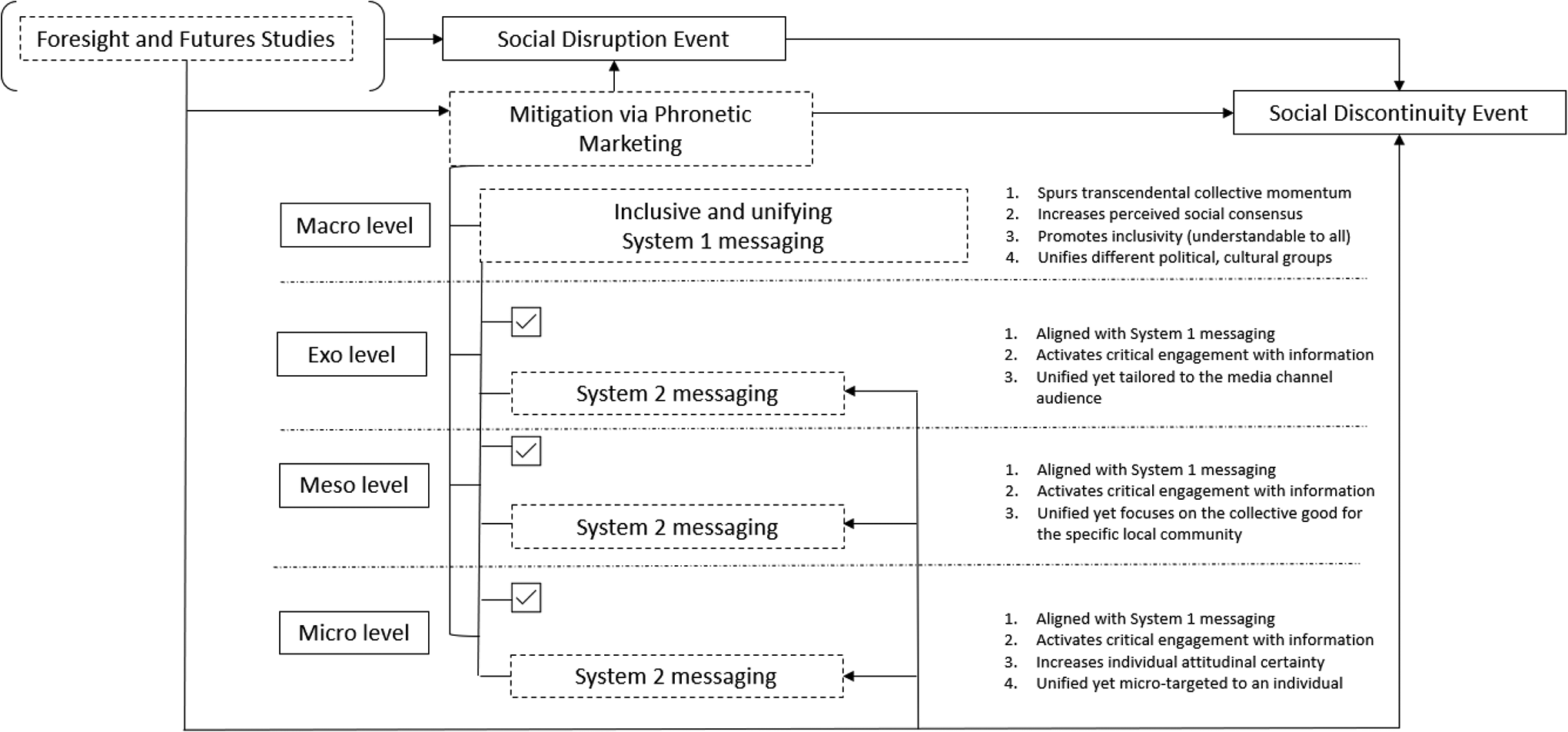
Social marketing and public policy interventions.
Mitigation of Social Disruptions via Phronetic Social Marketing
Social marketers “influence the voluntary behavior of target audiences to improve their personal welfare and that of the society” (Andreasen 1994, p.110). Initially, the concept arose as a direct response to Wiebe’s (1952) question: Why can’t you sell brotherhood like you sell soap? (Kotler and Zaltman 1971). Typically, social marketers encourage positive behaviors (e.g., recycling) and discourage negative behaviors (e.g., smoking). They beget downstream (via individual psychological changes), upstream (via structural, policy and regulatory changes), or midstream (a combination of both) changes (Andreasen 2006). Social marketing lends itself to a phronetic approach because it is rooted in the pursuit of the common good (Kotler and Lee 2008).
Phronesis, which is the wisdom associated with practical action (i.e., practical virtue), can create the positive energy people need to transcend disruptive events (Adair 2005; Kotler and Komori 2020). It parallels the ‘practical sense’ of distributing the ability to induce other parties to co-operate (Fligstein 2001) and encapsulates the practical guidance of “what way to go, what to do next, when to do it, how to do it and with whom to do it” (Adair 2005, p. 50). Greater intelligence, experience, integrity, compassion, and humility characterize phronetic more than traditional leadership (Adair 2005; Kotler and Komori 2020; Nonaka, Toyama, and Hirata 2008). A capacity to act correctly and resist sudden pressures suggest phronesis can “maintain the social occasion under difficult circumstances” (Goffman 1967, p.229).
Leaders “need to provide enough clarity to make disruption tolerable and even motivational. They will also need to communicate realistic hope through their own stories of clarity” (Johansen 2017, p.6). Phronetic leaders can ‘find the right way’ to extend human freedom despite the challenges and achieve the common good (Nonaka, Toyama, and Hirata 2008). During disruptive events, such leaders encourage public acceptance of adaptive values, which entails ongoing sensemaking and multidirectional interactions between leaders and their followers instead of top-down dissemination of leaders’ values (El-Meligi 2005; Kotler and Komori 2020).
Disruptive events can deter society from following its moral principles when “things get bad enough” (Sandin 2009, p.114), putting its “deepest values…radically at risk” (Walzer 2004, p.40). To maximize the collective good during such events, governments must ‘thread the needle’ between devaluing negative liberties (i.e., discounting barriers/obstacles as unimportant in practice) and promoting positive ones (i.e., advocating the available options are desirable) (Berlin 1959). Convincing consumers post-9/11 that watching movies on a big-screen TV is better than watching them at a movie theatre is an example of the former; using relative prices to encourage more socially desirable behaviors is an example of the latter. Hence, social marketers and public policymakers could countermarket negative freedoms as maladaptive discontinuities. Alternatively, social marketers and public policymakers could reinforce positive freedoms by persuading followers that available options are superior to discontinued alternatives; for example, the U.K. government meant its ‘Eat Out to Help Out’ program for discounted everyday dining out to encourage restaurant patronage and stave off restauranteur bankruptcies. These examples illustrate the nexus between social disruptions and related intervention strategies for social marketers and public policymakers.
We propose social marketers and public policymakers rely on phronetic interventions during socially disruptive events to achieve the common good by fostering positive energy for collective momentum. Successful phronetic interventions must entail transparent (i.e., clear and authentic) and inclusive (i.e., understandable to all members of society) communication (Armitage and Nellums 2020). Phronetic framing can help engineer collective transcendence or ‘symbolic bridging and merging’ meant to create adaptive discontinuities that convert old negatives into new positives (Burke 1984; Jack 2008).
System 1 versus System 2 Messaging
Compassionate or relational messages can galvanize the collective identity critical to comprehensive disruption-related messaging (Lucero, Kwang, and Pang 2009; Maitlis and Sonenshein 2010). Such messaging facilitates inclusive persuasion and behavioral changes that mitigate a disruption’s adverse effects. Given multiple social stakeholders’ resistance to ‘buying in’, inclusive and unifying messaging meant to harness positive energy is critical. Messaging strategies that assume System 1 (heuristic) processing are efficient. When a massive disruption looms, consistent and repetitive social marketers and public policymakers messaging can mitigate adverse effects by easing message processing, which induces an ‘illusory truth effect’ while enhancing perceived social consensus and message popularity (Schwarz and Jalbert 2020). In essence, such messaging is necessary to spur transcendental collective momentum.
For example, New Zealand Prime Minister Jacinda Arden’s unifying appeal to her citizens through Facebook Live described them as a ‘team of five million’ fighting the consequences of Covid-19. Similarly, Queen Elizabeth’s national appeal galvanized public goodwill in the U.K., mainly due to its compassionate and unifying style (Morris and Hazell 2020). The U.K. government’s call for action attempted to build collective momentum around its treasured National Health Service (NHS). Their System 1-friendly message—”Stay at Home; Protect the NHS; Save Lives”—merged personal and collective goals and called for transcendence by ‘saving lives’. The polysemic framing—to protect frontline NHS employees—linked personal anxieties to a collective recovery that reinforced widely accepted attitudes about healthcare workers’ sacrifices. Critically, this approach captured public sentiment, irrespective of political and cultural affiliation. In contrast, many U.S. political leaders punctuated their divisive discourse with racial slurs (i.e., “Kung Flu/Chinese virus”), issued inconsistent messages about Covid-19-related disruptions, and relied on a federalist, non-unified model that left each governor to develop an independent pandemic response. U.S. congressional delays in passing the Heroes Act (i.e., a multi-trillion-dollar pandemic relief package) reflect partisan-heavy incohesive messaging.
Despite the efficiency of unifying messages that rely on heuristic-based cognitive processing, this messaging strategy can be problematic if it violates message recipients’ autonomy (c.f. Smith, Goldstein, and Johnson 2013; Hyman 2009). When mitigating social disruptions, social marketers and public policymakers must overcome ethical challenges related to harnessing their constabulary functions (Burke 1984), ‘upstream framing’ the rhetorical devices they use to create order and prevent disorder (Laidlaw and Moffatt 2019). Critical social marketing, which is sensitive to noncompliance with prevailing thought about the common good, emerged in response to upstream and social engineering misuses (Gordon 2011; Hyman and Aguirre 2015). Social marketers and public policymakers should establish a balance between their “power to change people and the legitimate demands of ethical transparency” (Spotswood et al. 2012, p.167). Consequently, we recommend that social marketers and public policymakers create unified and in-depth System 2-friendly messages that ensure audience autonomy (via activation of critical engagement with presented information) (Anker 2020). Such messages can enhance audiences’ attitudinal certainty, especially to overcome alienation-related sentiments. Because System 2 message processing demands high motivation and involvement, parsing a System 2 message from its System 1 origins can elicit a negative response analogous to changing a brand meaning for highly involved consumers (Gaustad et al. 2018). Indeed, criticisms of the U.K. government’s repositioning its original call to the public during the Covid-19 crisis typify such a negative response. Thus, consistent and diffused phronetic messaging is paramount in securing public support for disruption mitigation.
Message Diffusion
The ecology model, which best reflects diffusion complexity (Bronfenbrenner 1974; 1976; 1977; 1979), has proven useful to health promotion researchers (Dresler-Hawke and Veer 2006; Elder et al. 2007; McLeroy et al. 1988). Through its inclusive design, this model circumvents the current and emerging concerns of social marketers and public policymakers (e.g., see Scott et al. 2020). The ecology model encapsulates four influence levels nested around each person: micro (e.g., family, friends, peers), meso (e.g., community, workplace), exo (e.g., media, local government), and macro (e.g., sub-cultures, customs, lifestyles). Given the polysemic nature of social disruptions, an upstream narrative can foster a collective momentum aligned and consistent across all levels. Social marketers and public policymakers can tailor phronetic values that diffuse quickly among levels. The ecology model can remind social marketers and public policymakers where to apply phronetic marketing during a disruption.
Each level within the ecology model requires a customized System 2 intervention because possible discontinuities may differ within and across levels but be bound by a unified System 1 intervention. At the macro-level, we suggest social marketers and public policymakers send inclusive and unifying System-1 messages meant to spur transcendental collective momentum and increase perceived social consensus. These messages should unify all societal groups and promote inclusivity by being understandable to all. In-depth System-2 messaging should reinforce and complement macro-level messages at other ecology model levels by activating engagement with vital information while avoiding negative audience responses. Specifically, exo-level messages should be customized to the audience, meso-level messages should focus on each local community’s collective good, and micro-level messages should induce maximal personal attitudinal certainty. Across exo-, meso-, and micro-level, tailored messaging must nevertheless remain unified, in line with the imperative of phronetic marketing.
The ecology model parameters provide a possible nexus through which collective momentum can achieve the collective good. Integrating collective message frames across ecology model levels can circumvent social marketers and public policymakers’ efforts as a purely upstream activity during a disruption that avoids maximizing the freedom of one sub-group at the expense of another subgroup.
Anticipating Social Discontinuities with Foresight/Futures Studies
The lack of a phronetic approach in social marketing and public policy directives is often symptomatic of inadequate analyses about alternative futures (Bell 2003). We believe social marketers and public policymakers can mitigate social discontinuities’ adverse effects by adopting foresight/future studies tools tailored to anticipate social disruptions. Although social marketers and public policymakers often use scenario planning to benchmark best practices, many Western countries neglected such planning while formulating their Covid-19 preparedness policies (Shokoohi, Osooli, and Stranges 2020). Western commentators have been averse to extolling the pandemic-preparedness of Asian and African nations to Covid-19 (Hirsch 2020).
Thinking about alternative futures is a learnable skill, akin to ‘immersive learning through simulations’ (Johansen and Euchner 2013) and creating a management system that can anticipate future discontinuities (i.e., a scenario construction system; Kotler and Caslione 2009; Kotler and Komori 2020). Such systems require social marketers and public policymakers to adopt the “mindset of professional futurists” (Eckersley 2001, p.22) by explicitly and systematically (1) examining and evaluating possible, probable, and desirable futures, (2) informing societal expectations about the future, and (3) promoting efforts to shape the future (Bell 2003; Kotler and Caslione 2009). Proactive anticipation efforts can allow social marketers and public policymakers to “invent the future, to learn the future faster, and to deliver the future earlier” (Pattinson and Sood 2010, p.417).
Analysis of possible and probable futures should yield an inventory of possible and probable social disruptions. Consequently, social marketers and public policymakers can assess possible and probable social discontinuities with foresight methods such as the futures wheel (Benckendorff 2008) and map the timeline of these discontinuities with tools such as the futures polygon (Pacinelli 2018). The challenge for social marketers and public policymakers is to determine what is likely to happen and what is most desirable for all stakeholders, i.e. “circumscribed by a fair distribution of costs and benefits” (Hyman and Kostyk 2019, p.1486). Once society selects a collective agenda for a desirable future, social marketers and public policymakers can use phronetic marketing to optimize the collective behaviors needed to achieve this future and avoid adverse social discontinuities. “Personkind’s sustained flourishing” can guide social marketers and public policymakers decision-making (Hyman and Kostyk 2019, p.1491).
However, establishing such a collective agenda requires a careful balance between macro-level collective good, meso-level group flourishing, and micro-level personal autonomy. The difficulty lies in the differential effect of social disruptions and discontinuities on persons and groups (e.g., specific industries, vulnerable consumer groups, vulnerable individuals) (Pullen 1993). Social marketers and public policymakers must use foresight methods to avoid the most damaging social discontinuities.
Social marketers and public policymakers can address such issues by deploying foresight methods that provide nuanced insights (instead of “one size fits all” planning). For example, a recently proposed scenario planning method blends traditional foresight approaches with the marketing technique of creating ‘consumer personas’, enabling analysis of different social groups rather than treating populations as homogeneous (Vallet et al. 2020). Furthermore, social marketers and public policymakers can use standard marketing research and product development tools to determine each stakeholder group’s values and the societal compromises (akin to product design tradeoffs) that should influence the collective agenda for effectuating a desirable future (Hyman and Kostyk, 2019).
Discussion
This essay contemplates social marketers’ and public policymakers’ interventions for managing social disruptions and associated social discontinuities. Key identified touchpoints for such interventions are (1) mitigating social disruptions via phronetic marketing, and (2) relying on futurology to foresee and anticipate social disruptions and discontinuities. To address social disruptions, phronetic marketing (i.e., marketing management with ‘practical wisdom’) can provide agile leadership. Systematically evaluating possible, probable and desirable futures, and promoting efforts to shape future benefits to a diverse and exhaustive range of stakeholders, can achieve the common good.
Per phronetic marketing’s imperative to create the positive energy needed for collective perseverance, we suggest that social marketers and public policymakers frame and propagate messages that characterize disruptions as no worse than tolerable and perhaps inspirational. To ensure message diffusion on all ecological model levels, System-1 and System-2 messages (1) must be clear and consistent to ensure optimal public processing, and (2) should increase public acceptance of adaptive values by stressing collective transcendence, i.e. the unification of targeted groups.
During disruptions, relational and empathic communications, which is more typical of female leaders, can foster public trust and build phronetic momentum (e.g., Sergent and Stajkovic 2020; Garikipati and Uma Kambhampati 2020). A relational approach is critical when mobilizing for social change, as “nurturing the interconnectedness of all human beings” (Todd 2009, p.178) is vital for leveraging the compassion needed to attain the common good (Shabbir et al. 2020). Tapping into our humanity can rupture the “normalized roles of the surrounding social collective” (Lorenz and Watkins 2000, p.7), such as repressive racial agendas. An empathic approach enables people to develop morally, which ensures sufficient moral capital for enacting the emancipatory change required to prevent maladaptive discontinuities. Hence, we advocate a phronetic marketing approach to disruptions grounded in compassion for all stakeholders.
Often discounted by policymakers, vulnerable communities have suffered inordinately from the Covid-19 pandemic. For example, marginalized people without paying jobs or the resources for surviving pandemic-induced self-isolation represent an armed suicidal time bomb (Ferguson 2020). The wellbeing of people with disabilities (Lund and Ayers 2020), the elderly (Oliver 2020), and BAME (Black, Asian, and minority ethnic) communities (Kirby 2020) is similarly threatened. Preventable deaths in elder care facilities and from rising backlogs of chronic illnesses rage (Heneghan and Jefferson 2020; Maringe et al. 2020). Many grassroots advocacy groups for disabled persons have emerged in response to the growing ubiquitous ableism of Covid-19 healthcare rationing. Disability groups have insisted the U.S. Office for Civil Rights remind states and health care providers that “disability civil rights law remains in effect during the pandemic and must be adhered to in pandemic planning and guideline” (Lund and Ayers 2020, p.210). The disproportionately higher death rate from Covid-19 within the BAME community in the U.S. and the U.K. highlights the need to eliminate racial health disparities. These health crises jointly illustrate the intersectional nature of macro-level disruptions, i.e. inadequate planning for one disruption can amplify a hibernating disruption.
Universal fairness is especially poignant for disruptions characterized by incomplete guidance, uncertain consequences, ever-shifting information, and life-and-death decisions (Bell et al. 2004). Social marketers and public policymakers should decouple from the polysemic trap of a purely upstream focus and instead remain rooted in a more equitable midstream model, with public engagement pre-planned and optimized across all levels of the ecology model.
Returning to Figure 1, providing tailored System-2 messaging on the micro-, meso- and exo-level of the ecology model allows policymakers to consider, forecast, and anticipate specific discontinuities targeted audiences, local communities, and other stakeholders are likely to experience. Although a unifying macro-level message promotes inclusivity and sets the tone of ‘transcendental collective momentum’, relying on this type of messaging alone is insufficient and excessively upstream-oriented. Informed by ongoing forecasting and futures studies, tailored inter-level-consistent System-2 messages and interventions can spur effective responses to heterogeneous societal groups’ diverse needs.
Social marketers and public policymakers should strive to prevent and mitigate the adverse effects of social disruptions and discontinuities by optimizing society’s collective behavioral preferences. In a collective other than a monarchy, no person’s preferences are always honored because people’s preferences are not universal; hence, interpersonal compromise is compulsory. Attempts to maximize personal autonomy assume a problematic micro-level focus because a collective cannot achieve a global maximum by focusing on local maxima. Efforts to maximize personal liberty cannot maximize societal (i.e., macro-level) freedom. For example, some U.S. politicians’ efforts to encourage social divisiveness overtly (e.g., racism) or covertly (e.g., systemic racism) promote a minority’s anti-diversity preferences at the expense of maximizing the collective’s preferences. Instead, a societal preference calculus should rely on determining preference discrepancies across all societal members weighted by each preference’s relative importance (i.e., more critical discrepancies are weighted more heavily). It is especially important to identify and prevent disruptions and associated discontinuities to vulnerable groups. Based on this calculus, marketing futurists can identify, mold, and promote the most socially advantageous discontinuity.
Footnotes
Author Contribution
The authors contributed equally and thus are listed in alphabetical order.
Declaration of Conflicting Interests
The author(s) declared no potential conflicts of interest with respect to the research, authorship, and/or publication of this article.
Funding
The author(s) received no financial support for the research, authorship, and/or publication of this article.
