



Abstract
The state remains an undertheorized actor in studies of market change. Further, when the state's market-shaping activities are considered, they are generally characterized by notions of control over, or conflict with, market actors. In this project, we draw on theories of institutional change and management to develop and deploy an alternative perspective on state involvement in markets—one premised on collaboration. Using this conceptual framework, we examine how the state works to shape markets disrupted by ostensibly innovative entrants. Specifically, we examine the state's response to the market entry of transportation businesses Uber and Lyft, whose strategies of disregarding existing regulatory arrangements attempt to deliberately exclude the state from markets. Leveraging an institutional work perspective, we find the state engaging in four novel practices as it works to understand and shape market arrangements in conjunction with an array of interested market actors. We discuss the implications of this collaborative state behavior for studies of market change.
Keywords
Introduction
It has become commonplace for technology-driven firms to deploy business models that sidestep existing regulatory regimes and the social, political, and legal power structures these regimes embody. For example, AirBnB and VRBO connect hosts with travelers seeking short-term rental accommodations as alternatives to hotels, while Uber and Lyft connect drivers with passengers seeking alternatives to taxis or public transportation. These firms argue the decentralized, platform-based nature of their business models precludes them from being grouped with market incumbents, and consequently, existing rules governing incumbents do not apply to their activities. In this way, firms pursue a strategy of spontaneous deregulation (Edelman and Geradin 2016) by attempting to deliberately exclude the state from markets. In so doing, they argue that existing regulatory frameworks act as barriers to effective competition and innovation.
Attempts at spontaneous deregulation have provoked varied responses from governments around the world. In some cases, governments give platform businesses free rein to operate, consistent with a relatively laissez-faire, free market logic (Lindblom 2001). In other situations, governments contest the right of these businesses to operate and even enact outright bans. Through contestation, states exert considerable power over markets, enforcing market arrangements and consumer subjectivities (Giesler and Veresiu 2014; Harris and Carman 1985; Veresiu and Giesler 2018), and negotiating marketplace practices and meanings (Ertimur and Coskuner-Balli 2015; Humphreys and Thompson 2014; Karababa and Ger 2011).
Existing investigations into the role of the state in market change largely overlook another common approach taken by states in response to the arrival of platform businesses. Rather than acquiescing to firms, or pursuing conflictual strategies, many governments have chosen to cooperatively engage with businesses and other local stakeholders. This engagement has resulted in dynamic compromise solutions that allow the platforms to operate within novel regulatory regimes that attend to local community needs (Fitzsimmons 2018; Henley 2017). These solutions represent a form of market change enacted, in part, by actively engaged states working collaboratively with a range of market actors to balance disparate interests. However, the marketing literature has little theoretical understanding of the nature of this collaborative work, owing to a focus on market environments as contentious arenas within which attempts at change are linked to contests over power and control (King and Pearce 2010).
Our research adopts an institutional work perspective to explore how the state collaborates with other market actors as part of its market-shaping activities. Institutional work approaches focus on understanding how a diverse range of actors contribute to social change, including how those changes occur in connection with other actors’ interests, beliefs, and goals (Fligstein and Dauter 2007). In keeping with calls to expand market change analysis to a range of institutional actors beyond the marketer-consumer dyad (Baker, Storbacka, and Brodie 2019), we explore how the state works to shape a market disrupted by ostensibly innovative market entrants. We observe the state engaging in market shaping through the collaborative development of regulatory changes. The state's effort aims at encouraging new technologies and business models to flourish, while providing for public safety and ensuring fairness between market entrants and incumbents.
We begin with a discussion of the institutional perspective on market change, focusing on models of change arising from this institutional foundation. Institutional approaches to market change are consistent with marketing systems theorizing (Domegan et al. 2019; Layton 2015), particularly as it relates to the ways in which marketing systems evolve as a result of the co-evolution of beliefs and practices linked with members of a human community (i.e., a market). Our approach seeks to extend marketing systems theorizing by focusing on the collaborative forms of institutional work undertaken by a specific market actor: the state. A collaborative change model represents a novel lens through which to understand how the state contributes to marketing systems change. After developing our institutional perspective, we describe a multi-site empirical context involving spontaneous deregulation (Edelman and Geradin 2016). This context situates our investigation and provides points of comparison regarding the co-evolution of beliefs and practices involving the state. We then develop our findings, and finish by discussing the implications of our findings for marketing systems theorizing and marketing practice.
Institutional Perspectives on Market Change
Marketing and consumer research have embraced the view of markets as social institutions wholeheartedly (Baker, Storbacka, and Brodie 2019; Handelman and Arnold 1999; Humphreys 2010a; Yngfalk and Yngfalk 2020). The power of institutional perspectives stems from the focus on the reciprocal influences that exist between market actors and the broader system of which they are a part (DiMaggio and Powell 1983; Meyer and Rowan 1977; Scott 2008; Selznick 1996). The goal of institutional analysis is to explain systemic change in terms of the nature of the system undergoing change, the actors involved in change, and how change occurs. Thematically, institutional perspectives afford three models of how market change occurs: through control, through conflict, and through collaboration. In the following sections, we review these models of change to draw out their key assumptions and compare their views of the state as a market actor. We then develop a theoretical approach integrating the collaboration model with an institutional work framework.
Control Model
Institutional approaches to understanding environments and change are premised on assumptions of relatively closed systems within which particular beliefs, norms, and behaviors are interpreted and enacted (Scott 2008). In these systems, actors promote their ideas and interests by vying for control through entrepreneurially-oriented shaping activities (DiMaggio 1988). To the extent these actors have or accrue power, they are understood to exert a controlling influence over the institutional environment. Shaping of the environment is undertaken from the top-down by those actors, typically by virtue of their perceived authority.
The control model of institutional thinking aligns with what McHugh and Domegan (2013) term the reductionist systems approach. Reductionist systems exemplify command and control governance structures predicated on hierarchical relationships between system members. In reductionist systems, the state pursues “oversimplified solutions to complex policy issues” (McHugh and Domegan 2013, p. 81) that are effectively imposed from the top down (Carman and Harris 1984; Harris and Carman 1985).
In marketing and consumer research, the control model appears in studies adopting Foucauldian governmentality perspectives, especially where such forces are focused on the construction and enforcement of specific consumer subjectivities (Giesler and Veresiu 2014; Veresiu and Giesler 2018). For example, the state may work with corporations to develop a model of consumer subjectivity in which consumers, rather than governments, are primarily responsible for large scale environmental change (Giesler and Veresiu 2014). This moralizing of consumption practices is packaged and transmitted by governments and corporations to consumers, reminiscent of the top-down fashion system approach to meaning transfer (McCracken 1986). In these studies, the state is a powerful authority that plans and constructs arrangements and subjectivities that others, especially consumers, are required to adopt and fulfill.
A shortcoming of the control perspective is that it ignores the ways in which all market actors may participate in contesting and negotiating market arrangements and practices (King and Pearce 2010). So, while certain actors may assert their desires for structuring the marketplace, others work to alter or resist those initiatives (e.g., Scaraboto and Fischer 2013; Thompson and Coskuner-Balli 2007). Such contestation calls into question the extent to which the control model of institutional thinking fully accounts for the state's role in the market.
Conflict Model
A second model of institutional change relaxes the closed, hierarchical perspectives of the control model, and views market environments as inherently open and highly conflictual (King and Pearce 2010). In this view, market actors with varying degrees of power, capabilities, and resource endowments compete to influence change processes (Arndt 1981). Research that adopts a conflictual perspective asserts that change is motivated and undertaken by a variety of market actors—rather than a select group of powerful elites—who engage in overt contestation as they negotiate their marketplace positions and sets of relations. For example, firms compete over resources, consumers negotiate the nature and degree of their market inclusion, activists both advocate and denigrate specific brands and forms of market-mediated practices, and social movements target firm and consumer practices (Ertimur and Coskuner-Balli 2015; Giesler 2008; Scaraboto and Fischer 2013; Weber, Rao, and Thomas 2009). Driven by political and ideological concerns, actors assert their views and work to construct social arrangements that align with those views, in attempts to maintain or shift market structures and relationships (Kozinets and Handelman 2004; Press et al. 2014; Scaraboto and Fischer 2013). Change happens through negotiations within and between actor groups, with outcomes tied to the mobilization of power through which actors assert and maintain their preferred social arrangements.
The conflict perspective affords a different view of the state as a market actor, relative to the control model. Under assumptions of conflict, the state is responsible for ensuring competition in the marketplace, as market dynamics are understood to achieve optimized aggregate outcomes (Lindblom 2001). Effectively, the state may be seen as akin to a referee, enforcing the rules that govern competitive dynamics and prosecuting digressions from established rules and regulations. In addition, the state may itself act as a competitive actor, pursuing its own goals through mechanisms of contestation and negotiation (Karababa and Ger 2011). However, competition-based behaviors are not the only form of market dynamic that can emerge from open systems (Domegan et al. 2019).
Collaborative Model
A third institutional perspective considers change as arising from interactive, shared decision-making, with disparate views and interests being accommodated simultaneously (Lawrence, Hardy, and Phillips 2002; Reay and Hinings 2009), rather than simply competing with one another for dominance. From this perspective, networked actors collaborate as they work to address issues of concern, and in the process, fuel market change dynamics. Like the conflict perspective, the collaborative perspective assumes dispersed authority and divergent interests among actors. But where the conflict model focuses on outcomes arising from competitive maneuvers between these actors, the collaborative model emphasizes outcomes generated from the shared management and accommodation of their differing interests. Accordingly, co-operation and consensus-building among market actors, made possible through continuous communication and adaptive feedback loops (Domegan et al. 2019, 2020; McHugh and Domegan 2013) become key drivers of change.
While collaborative relationships may be based on shared trust and commitment (McHugh and Domegan 2013), they may also arise out of more pragmatic concerns over institutional arrangements, where cooperation is more or less mandatory (Reay and Hinings 2009). Prior research has shown how consumers and firms may collaborate to drive market change (Kjeldgaard et al. 2017; Maciel and Fischer 2020; Scaraboto and Fischer 2013; Thompson and Coskuner-Balli 2007). However, this work has focused on collaboration between actors that share an existing, common interest. For example, the beer firms of Maciel and Fischer (2020) engage in collaborative market driving because they share a common vision but lack the necessary resources to drive the market independently. Similarly, groups linked with community supported agriculture band together to resist corporate cooptation of the organic food movement (Thompson and Coskuner-Balli 2007). In these cases, collaboration is the result of instrumental calculation and the alignment of interests in common cause. These studies provide little insight into how divergent interests among disparate market actors may be reconciled through collaboration.
The state is an actor uniquely situated to engage in such collaborative action in the marketplace. Work in economic history and theory demonstrates that states, working dynamically with business partners, have been essential in mobilizing resources, providing foundations for innovation, and facilitating market transformations (Hacker et al. 2021; Mazzucato 2013). In addition to their economic functions, states have responsibilities to civic society—including promoting the public interest and defending the welfare of the citizenry—that extend beyond those of corporations and other market actors (Bishop 2012; Dahan, Doh, and Raelin 2015). This consideration of both commercial and civic interests makes the state a market actor of particular importance. States, particularly at the local level, attempt to build consensus among a range of disparate actors when overseeing community planning and development (Innes 1996; Jamal and Getz 1999), ensuring a multiplicity of interests are accounted for.
From a marketing systems perspective, the state can be said to be concerned with positive chrematistics, or “increas(ing) the use value of the system for all stakeholders” insofar as it works to ensure markets operate to the long-term benefit of all involved (Kadirov, Varey, and Wolfenden 2016, p. 56). The state thus endeavors to ensure the public good through positive market outcomes generated by cooperation and mutual understanding between actors. Importantly, it also possesses the requisite authority to ensure its priorities are enacted. These unique responsibilities and priorities distinguish the state from other market actors, such as firms and consumers, and suggest the possibility of novel market-shaping activities. However, we lack an account of such activities; specifically, we know little about how the state may work collaboratively to shape markets and build consensus when the arrival of ostensibly innovative market entrants disrupts institutionalized arrangements.
Institutional Work and Market Change
From an institutional perspective, the marketplace is a social arena composed of actors engaged in work aimed at the creation, maintenance, and disruption of market arrangements (Dolbec and Fischer 2015; Handelman and Arnold 1999; Humphreys 2010a; Scaraboto and Fischer 2013; Yngfalk and Yngfalk 2020). At their core, institutions consist of sets of rules, norms, values, and beliefs organized and expressed in ways that attempt to illustrate congruence with social expectations (Scott 2008). Market actors rely on taken-for-granted rules and norms to guide their behaviors and also contribute to shifting those rules and norms through forms of entrepreneurial work (DiMaggio 1988). Investigations of market dynamics leveraging institutional approaches have focused on how markets change over time in response to the intentional and unintentional efforts of marketers (Coskuner-Balli, Pehlivan, and Üçok Hughes 2021; Ertimur and Coskuner-Balli 2015; Handelman and Arnold 1999; Humphreys 2010a; 2010b; Ozdamar Ertekin and Atik 2020 ), consumers (Dolbec and Fischer 2015; Scaraboto and Fischer 2013), and, to a lesser extent, other actors, such as not-for-profit organizations (Yngfalk and Yngfalk 2020). This evolving interest in “the purposive action of individuals and organizations aimed at creating, maintaining and disrupting institutions” (Lawrence and Suddaby 2006, p. 215) has been increasingly connected with the notion of institutional work (Hampel, Lawrence, and Tracey 2018; Lawrence and Suddaby 2006). Given its connection to practice theoretics, an institutional work approach is better suited to our research aims than are other theoretical approaches.
For example, at the systems level, firm attempts at spontaneous deregulation—and state response to these attempts—can be interpreted using the mechanism, action, structure model (MAS) forwarded by Layton (2015) and invoked in more recent theorizing of market systems (e.g., Domegan et al. 2019, 2020). From this perspective, spontaneous deregulation appears as a co-evolutionary outcome. In this sense, firms may (re-) frame their business models in ways that preclude the application of existing market arrangements and instead assert alternative arrangements that exclude the state as an active participant (Domegan et al. 2019). To the extent that these business models are positively received amongst consumers, businesses extend and entrench their new models, setting up new fields of strategic contention and market arrangements (Layton 2015). Rooted in the concept of social mechanisms (Gross 2009), MAS offers analysts robust methods of tracing the emergence and evolution of systems-level dynamics. However, it is less well-suited to providing an understanding of the practices that comprise mechanisms. Adopting an institutional work perspective, by contrast, “encourages a shift in attention from field-level patterns to the specific practices that underpin them” (Hampel, Lawrence, and Tracey 2018, p. 3).
In this project, we examine how the state works to shape market arrangements in local regulatory contexts. Our focus on the local level of government reflects the notion that, far from being mere conduits through which higher-order politico-economic ideals pass unaltered, local governments are actively involved in the creation of initiatives that shape and respond to local conditions experienced in the day-to-day lives of citizens (Jones and Stewart 2012). This is where higher-order ideals co-mingle with local priorities and are transformed into workable market arrangements (Bech-Larsen and Aschemann-Witzel 2012; Truong 2017). We examine this dynamic in the context of spontaneous private deregulation (Edelman and Geradin 2016) of the for-hire vehicle market. Specifically, we address the following questions: How does the state work to achieve compromise and consensus amongst market actors with conflicting goals, values, and priorities? How is this work linked to specific market-shaping outcomes?
Context and Method
To develop a collaborative model of state engagement in market shaping, we examined a context in which high-profile, technology-driven firms enacted business models that sought to diminish the role and influence of the state by willfully ignoring market boundaries set by existing licensing and regulatory regimes. These new market entrants have asserted that they function as platforms connecting like-minded consumers to one another, in contrast to existing service providers, and were thus not subject to regulations governing market incumbents. In many markets, the arrival of these types of firms has generated tension among an array of local stakeholders, including taxicab brokerages, neighborhood associations, community organizations, and local consumers. As a result, local governments have been drawn into complex and ill-defined situations, necessitating the development of novel regulatory solutions to accommodate the new entrants. Such circumstances are ideal for exploring the ways in which the state engages in market shaping.
Data
We undertook a historical investigation of state reaction to the entry of private, for-hire transportation services Uber and Lyft to two cities: Toronto, Canada and San Antonio, U.S.A. Each jurisdiction had in place longstanding regulations governing taxicabs, but new entrant firms initially asserted that their platforms were not subject to existing regulations, as they simply connected consumers with vehicles-for-hire, and thus did not constitute taxicab brokerages. Owing to these dynamics, each city was well-suited for our research purposes. In accordance with established guidelines for historical research (Witkowski and Jones 2006), we collected data from a range of archival sources, including video recordings of municipal legislative debates, as well as planning documents, meeting notes, newsletters, discussion papers, community feedback summaries, presentations, consulting reports, ordinances, and news articles. Employing a wide array of sources and media types allowed us to examine events from the perspective of multiple state actors, including elected officials and city employees. As is the norm with historical research, selection of data sources and types was based on relevance to our research questions (Golder 2000). Data sources were critically evaluated by both authors; those that were judged to be highly pertinent to our questions and provide authentic accounts—as determined by their proximity to the relevant events and the source of their authorship (Golder 2000)—were selected for inclusion in our study. Primary archival data, which comprised the majority of our data set, provided ‘real time’ accounts of the work conducted by state actors. Interpretation of these sources provided insight into how state actors developed their understandings of problems, gathered information from relevant market actors, navigated between conflicting priorities, and made and justified their decisions. Secondary data, including news articles, provided additional detail, and assisted in connecting the state's work to specific market outcomes.
We began by collecting data pertaining to the City of Toronto; this served as an exploratory entry into the broader context, allowing us to begin developing an understanding of the issues at stake and the processes involved in state shaping of markets. Toronto was chosen based on ongoing developments that made it a particularly rich site for exploration. While some municipalities gave for-hire transportation services free rein to deploy their models, and others enacted outright bans, Toronto pursued a strategy of bringing the firms into the fold through the creation of new regulatory solutions. The city also provided ready public access to a rich set of archival data, including recordings of its council and committee meetings, as well as associated documents and reports. We extended our investigation of the Toronto context by collecting relevant news articles from The Globe and Mail, Toronto Star, and National Post, three of the largest English-speaking outlets in the country. Using the Nexis Uni database, we collected articles that contained the words “Uber” or “Lyft”, and “Toronto” in the headline or first paragraph, published between 2012—the year Uber arrived in Toronto—and 2019. These data provided an initial immersion in the context, as well as a set of discursive material for later analysis. Next, we constructed a timeline of events relevant to the city's ongoing attempts to craft a regulatory framework for platform transportation businesses. We used this timeline to identify historical touchpoints—the introduction of a new piece of legislation, for example—that we traced to related sets of archival data. Relevant archival data identified this way was saved for analysis. These data allowed us to understand the interpretive and discursive strategies employed by state actors—including the mayor, city councilors, and senior city staff members—in their dealings with one another and various stakeholders, including representatives of taxicab brokerages, Uber, Lyft, and community groups.
Analysis of data gleaned from the Toronto context yielded several preliminary themes and provided an initial understanding of how the state engages in market shaping. In the interest of testing and expanding our understanding, and extending and revising our ongoing theory building, we elected to examine the additional context of San Antonio. San Antonio was selected for similar reasons as Toronto—each city had worked to craft some type of regulatory solution to accommodate platform transportation companies, rather than outlawing these companies outright or giving them free reign, and each offered ready availability of data. Data collection procedures for San Antonio mirrored those utilized for the Toronto context (see Table 1 for an overview).
Data Sources.
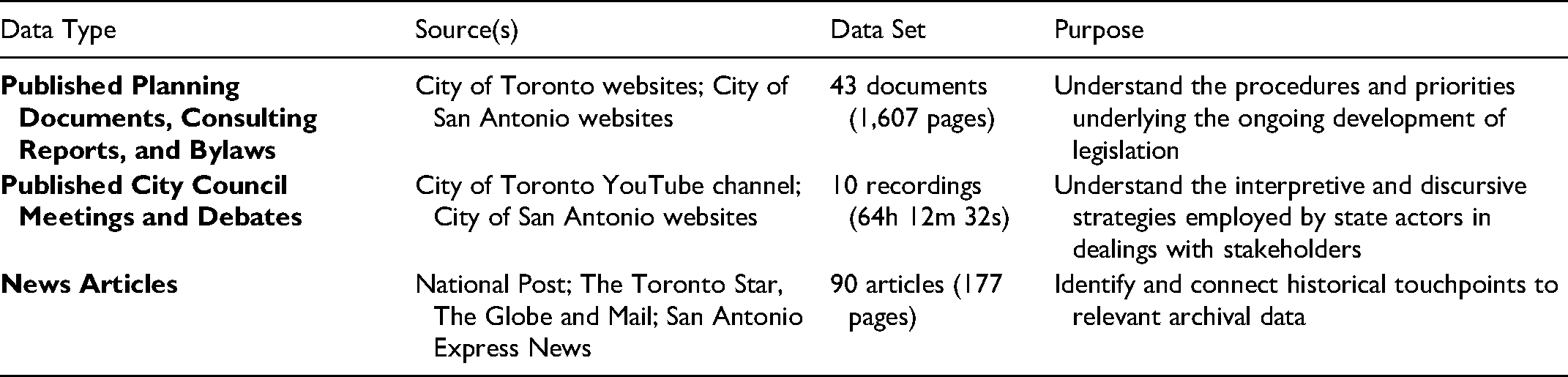
Analysis
Following in the hermeneutic tradition (Thompson 1997), our interpretive analysis of content and discourse was iterative in nature (Spiggle 1994). Analyzing recordings of council and committee meetings helped us develop an emic understanding of how state actors interpreted challenges, understood their roles as state decision-makers, interacted with stakeholders, and ultimately made and justified their decisions. These data helped us address our first research question by granting insights into how the state built its knowledge of, and worked to find common ground between, market actors with conflicting goals, values, and priorities. Analyzing official reports and legislation allowed us to develop an understanding of regulatory changes occurring over time, and of the formal knowledge used by actors to guide their decision making. These data helped us address our second research question, enabling us to draw connections between the state's consensus-seeking efforts and specific market outcomes. Iterating between these sources allowed us to progressively build an understanding of how state actors made sense of the market dynamics introduced by Uber and Lyft's entry, and how these actors used their understandings to develop and implement specific regulatory frameworks.
Recordings of meetings and debates were transcribed, read, and open coded (Charmaz 2006); moving between these transcriptions and assorted planning documents, reports, and legislation allowed us to connect themes to legislative outcomes. Coding was conducted through NVivo, a software program designed to assist in the categorization and analysis of qualitative data sets. We began our coding process by generating lower-level codes pertaining to the actions taken by state decision-makers and the key actors involved in these decisions. Many codes were generated from this analysis, including “fairness”, “safety”, “diligence”, “communication”, “uncertainty”, “voice”, “involvement”, “community outreach”, “categorization”, and “protection”, among others. As our data gathering continued and our analysis evolved, connections emerged between these lower-level codes, allowing us to consolidate them into higher-level categories. For example, the codes “community outreach”, “involvement”, “voice”, and “diligence” connect to a broader notion of states engaging in conscious two-way dialogue with stakeholders as part of its efforts to build compromise and consensus (see Web Appendix for a table outlining codes for each of our themes). As with our earlier coding, connections between codes and themes developed iteratively through emergent back-and-forth between researchers. Next, we analyzed the relationships between themes via theoretical coding (Charmaz 2006). The structure of our findings emerged as a result of this iterative analysis. We ceased data collection when additional data no longer contributed to the development of additional theoretical categories, consistent with theoretical saturation in grounded theoretic studies (Glaser and Strauss 2017). That is, additional data did not lead to changes in our inductively-generated codes and themes, rooted in the institutional work a priori conceptual framework that organized our findings (Saunders et al. 2018).
Throughout the analysis process, rigor was ensured through the deployment of an iterative ‘devil's advocate’ approach (McAlexander and Schouten 1998), whereby the individual interpretations of either researcher were subject to a structured process of counter-argumentation by the other. In this way, interpretations were intentionally scrutinized; those that withstood critique remained part of our ongoing analysis, while those that did not were either modified and re-proposed or rejected outright.
Findings
Our data illustrate the state engaged in an interconnected two-stage process of collaboration and consensus-building intended to shape markets in ways that attend to the concerns of various interested actors. In the first stage, the state works collaboratively with local actors, including marketers, consumers, and public advocacy groups, to deepen its understanding of the local issues arising from spontaneous deregulation, while simultaneously engaging with other jurisdictions to understand how they have dealt with similar issues. In the second stage, the state uses this understanding to craft regulatory solutions in ways that attempt to balance concerns brought to the fore during the first stage. In this way, the state's collaboration acts to inform and support its consensus-building work. As market actors implement regulations, these stages continue in overlapping iteration, such that information gleaned from ongoing collaboration is used to fuel subsequent consensus-building work and regulatory development during periods of re-assessment.
Collaboration
Following the arrival of platform transportation businesses (hereafter Transportation Network Companies or TNCs, the terms employed by officials in San Antonio), local governments engaged in two forms of institutional work aimed at better understanding ongoing market dynamics. These efforts—which we label “dialoguing” and “benchmarking”—involve collaborating with local and extra-local stakeholders, respectively, to gather information. While this work did not involve the creation of regulation, it served to guide regulatory development with the intention of ensuring that local stakeholders view the resulting regulatory frameworks as legitimate.
Dialoguing
To better understand local perspectives and priorities for the development of new regulation, the state initiated ongoing discourses with a variety of local stakeholders. As part of this effort, governments organized public consultation events, including town hall meetings and open forums, as well as closed-door meetings with industry and consumer groups. Feedback from these events was incorporated into the process of regulatory development, as outlined by San Antonio Mayor Ivy Taylor, during a city council meeting at which new regulations were voted into place: Whether you’re with the TNCs, or large taxi companies or small taxi companies, thank you all for your involvement in the process, your discussion, and for being at the table. And thank you to all the consumers and drivers who have come out, who’ve played a part, all the organizations that have let their voices be heard. I feel very good about where we are today, knowing that we have had such thorough conversations with all the various stakeholders, and that we have examined several options. (San Antonio City Council Meeting, December 8, 2016)
Mayor Taylor's comments illustrate how engaging in discourse acts as a foundation for the state's collaborative approach and informs its market-shaping activities. In its efforts to achieve consensus around new market arrangements, the state seeks to ensure that the priorities of affected stakeholders are balanced and ultimately reflected in new regulation; dialoguing with a range of local actors allows the state to better understand these priorities. The intelligence gathered during this collaborative exercise forms part of the basis from which new regulations will be created; in ensuring these regulations reflect a balance of local priorities, the state contributes to the legitimacy of new market arrangements.
A similar dynamic played out in the Toronto context, where city officials utilized information gathered through collaboration to inform regulatory development. In the following quote, Toronto Deputy City Manager Tracey Cook outlines how the city's collaboration with the local populace helped guide the creation of policies she was bringing before city council: We actually had over 70,000 respondents on an online survey that we had, and the focus groups were very active. And we really saw that people regard (taxis and TNCs) as different services they’d like to use at different times, for different reasons. Certainly what we heard through the consultation is that the public wants choice, and they want a level of regulation that does not take away that choice, but is appropriate for the service that's being offered.
Here, Deputy City Manager Cook draws a direct connection between proposed legislation governing the for-hire transportation industry and the demands of local stakeholders as evidenced through the city's intelligence gathering. A public demand for greater choice in this industry manifests itself in legislation aimed at accommodating TNCs while providing a fairer market environment in which incumbent taxi firms may also thrive.
In addition to providing the knowledge necessary to ensure local priorities are reflected in regulation, dialoguing provides an opportunity for the state to publicly attest to its responsiveness to local concerns. Mayor Taylor's suggestion that council arrived at a regulatory solution only after “thorough conversations with all the various stakeholders” serves to demonstrate that the processes followed to arrive at new regulation are in alignment with norms of good governance, including accountability and public engagement. By publicly asserting that it followed proper procedures, the state lends further legitimacy to eventual regulations and resultant market arrangements.
However, these proclamations of success belie the fact that not all relevant actors chose to participate in mutual dialogue with the city. While Lyft worked closely with city officials and public advocacy groups when invited to do so, Uber elected against such engagement, and in so doing, earned rebuke from public officials. In the following quote, San Antonio Council Member Joseph Krier directs praise towards a Lyft representative, Olivia, present at the meeting, while decrying Uber's approach to its operations in the city: I am grateful to Lyft for being willing to do this differently. One of the things that has offended me from the beginning of this process was Uber's approach, coming into this market in the state of Texas with an attitude that says “We know how to do it better than you do, and you’re either going to do it our way, or we ain't gonna play the game”. I don't respond very well to companies that take that approach to city council or to me personally, and I think the experience that Uber had with the Texas legislature is an indication that they don't take very well to that approach either. (San Antonio City Council Meeting, August 13, 2015)
Here, Council Member Krier works to maintain and reinforce the institutionalized role of the state in overseeing market dynamics—as well as the importance of the state's collective dialoguing efforts—through the public valorization and demonization of certain conduct (Lawrence and Suddaby 2006). Lyft, in (eventually) adhering to established institutional norms and acknowledging the state's central role in shaping markets, is publicly lauded as an example to be followed by future market entrants. Meanwhile, Uber is held up as a warning to those that would follow in its steps. However, this work goes beyond the maintenance of existing institutional arrangements; in framing collaborators as good public citizens while chastising non-collaborators, the Council Member works to foster an environment in which all relevant actors are encouraged to work together toward the creation of new arrangements. These pronouncements also illustrate that dialoguing functions not simply as a means for the state to gather information and build legitimacy for institutional arrangements, but as a way for firms and other market actors to signal their (non-)engagement in civic life.
Benchmarking
In concert with efforts aimed at understanding local concerns, governments worked to develop accounts of how other jurisdictions responded to the challenges posed by spontaneous deregulation. Council members and city staff developed collaborative relationships with counterparts in other cities as they sought to understand best practices elsewhere and generate intelligence to assist in their decision making. We term this form of work “benchmarking”, reflecting its similarity to the intelligence gathering and comparison processes conducted by commercial firms (Day 1994). Benchmarking was integral to the planning and development of local regulations; in the following quote, San Antonio Council Member Michael Gallagher discusses how the city utilized benchmarking to better understand the potential ramifications of lifting a previously enacted cap on the number of taxi drivers, as other cities had done in the wake of TNCs’ market entry: I’m very pleased that we’re looking at [the cap] over the next six months, because I think that is one of those free enterprise issues that we are going to have to carefully look at. And I like the idea that you’ll be going to other cities that have removed those caps and see what's happened there. Because before we would ever make a decision on something like cap removal, I want us to have a very clear roadmap ahead on what we should do in that area. (San Antonio City Council Meeting, December 8, 2016)
While the city had identified removal of the cap on taxi drivers as a means of allowing incumbent firms to better compete with TNCs, there existed a need for a “very clear roadmap” before any decisions were made, reflecting the potentially far-reaching consequences of such changes. This roadmap could be provided by examining how other cities had implemented, and been impacted by, similar policies. In linking the issue to symbolic concerns around free enterprise, Council Member Gallagher establishes it as one that requires extensive state consideration; meanwhile, his framing of it as an otherwise-intractable problem that can be addressed via collaborative relationships with other communities sets the stage for the city's benchmarking efforts. As with dialoguing, benchmarking serves as both an information-gathering exercise and as a means by which the state demonstrates that it has conducted its due diligence in the public interest; rather than prematurely enacting policies it believes will address local concerns, the state works to account for, and protect citizens from, the unforeseen consequences of these policies. The potential for benchmarking to mitigate uncertainty in decision making is further illustrated in the following quote from San Antonio Council Member Ray Lopez: I don't know what Austin is going to do. But I know that the recommendation based on the transcript that I read, was the committee recommending that they follow the Houston model. So, I think there's still a lot more dialogue and discussion to find out, what are they actually going to do. They’re probably having the same struggles as we are: economics versus safety. (San Antonio City Council Meeting, August 13, 2015)
Here, Council Member Lopez identifies specific peer communities dealing with the same issues as San Antonio and engaging in similar processes of benchmarking—just as Austin looks to Houston as a model, so does San Antonio look to these communities. Each community is seen to be grappling with the tension between fostering economic growth and ensuring public safety; one community's methods for alleviating this tension may prove instructive to all.
While these benchmarking efforts share similarities with those conducted by commercial firms—both involve the conscious monitoring of peer and aspirant actors with the goal of improving relevant metrics—state benchmarking is unique in both its process and outcome. While firm benchmarking is a competitive exercise focused on identifying capabilities to emulate in pursuit of sustainable advantage (Day 1994), state benchmarking is a collaborative pursuit centered on ensuring decisions are made in the public interest. This shift in focus reflects the state's unique responsibility for ensuring markets operate to the benefit of all stakeholders (Bishop 2012; Dahan, Doh, and Raelin 2015).
In conducting and publicly attesting to its dialoguing and benchmarking efforts, the state works to assure citizens it has acted responsibly and responsively; best practices in other jurisdictions are integrated with local priorities to form the basis of new market regulations. In this way, the state works to pre-emptively legitimize the regulatory outcome by demonstrating that it has followed proper processes to arrive at that outcome (see Web Appendix for additional data).
Taken together, dialoguing and benchmarking represent efforts at setting the stage for regulatory creation, as the state gathers the information needed to enact rules in alignment with local priorities and extant best practices. Developing—and publicly demonstrating—this understanding serves to inform the state's institutional change efforts, as well as achieve buy-in for these efforts from the local stakeholders to whom the state is accountable.
Consensus-Building
Building on the understanding developed through dialoguing and benchmarking, local governments worked to develop consensus around new market regulation by balancing the concerns of market entrants, incumbents, consumers, and other groups. From an institutional perspective, consensus comprises a meso-level aspect of legitimacy; it is “the degree to which individual members of a reference group (e.g., team, organization, industry, field, or society at large) agree that the essence, features, or activities of a legitimacy object are proper for a given social context” (Haack, Schilke, and Zucker 2021, p. 750). As a meso-level construct, consensus acts as the connective tissue between individual judgments of propriety and institutionalized, collectively accepted arrangements. In our context, this focus on consensus arises from the imperative for democratic states—and local governments in particular—to represent, and be accountable to, various publics within the broader citizenry (Jones and Stewart 2012). We witness the state endeavoring to ensure collective acceptance of potential regulatory arrangements by understanding the priorities of these publics and finding common ground between them. These goals were achieved through amending existing regulations governing incumbent firms and creating market categories and regulations to incorporate TNCs’ business models. This work served to modify the market's boundaries—the conceptual distinctions employed by social actors in categorizing other actors, objects, practices, and spaces (Lamont and Molnár 2002)—through the creation and transformation of market actor categories. Building from a focus on safety and fairness, the state worked to legitimize previously-illicit TNC activities for usage by market incumbents; in keeping with the historical notion of “bandit cabs”—taxicab providers who operated outside of official regulatory structures—we label this form of work “borrowing from the bandits”. The state also facilitated regulatory oversight of new entrants by constructing market actor categories that delineated the entrants as legitimate targets of regulation, a form of work we label “building boundaries”. We proceed with a discussion of this work.
Borrowing from the Bandits
As part of the process of modifying existing regulations to enact a new, more relevant framework for market incumbents, the state worked to legitimize and incorporate previously unregulated practices associated with TNCs. Building on its earlier work, the state leveraged its collaborative relationships with market actors to identify several previously-outlawed practices—including mobile app usage, up-front pricing policies, vehicle customization, and surge pricing—that would work as legitimized options for all private for-hire vehicle services. While other industries had long employed similar practices, including dynamic pricing, these strategies remained legally off-limits for incumbent taxi firms until the arrival of TNCs. Adoption of, and justification for, these practices followed from the intelligence gathered through benchmarking and dialoguing, as the state developed its understanding of how their widespread adoption could contribute to its broader civic aims. Based on its conversations with local stakeholders, the city of Toronto identified salient issues—a lack of available for-hire vehicles in certain areas during certain times of day, and the inability of incumbents to effectively compete with TNCs—that it believed could be addressed through the legitimization and adoption of previously-outlawed practices. The adoption of surge pricing, in particular, was also connected with notions of fairness, as outlined in the following quote by Toronto Councilor Glenn De Baeremaeker, in which he expresses his support for proposed legislation governing for-hire transportation in the city: We have a package before us that helps control the chaos that is out there now. Uber exists, it is out there now, it is stalking people's customers right now, it is stealing their fares right now, it is taking their business right now. And what do we have out there today? We have one company that believes in surge pricing, and another company that isn't allowed to surge price. There is no level playing field (…) This report is not perfect, but it's good, and I can support it, and it gives our legitimate, tax-paying, law-abiding drivers, owners, and operators a chance to compete, instead of getting killed, which is what they’re doing now. (Toronto City Council Meeting, May 3, 2016)
Here, Councilor De Baeremaeker works to legitimize the previously outlawed practice of surge pricing by linking it with notions of fairness; the city currently lacks a “level playing field”, resulting in TNCs “stalking” and “stealing” customers from incumbents that are too constrained by existing regulation to effectively compete. Surge pricing is seen as key to solving this dilemma: a practice heretofore associated with TNCs engaging in illicit, predatory behavior is re-articulated as a means of restoring balance in the marketplace and preventing incumbents from “getting killed”, a responsibility the state owes to its “legitimate, tax-paying, law-abiding” citizens (see Web Appendix for additional data). In arguing that incumbents should enjoy the ability to adopt this and other previously illegitimate practices, the state works to soften the symbolic boundary between TNCs and incumbents, a process that would later continue as TNCs’ business models were incorporated into new regulations. Elected officials also framed the adoption of surge pricing as contributing to increased safety for consumers who might otherwise find themselves without reliable transportation options—those who live in in isolated areas, or who need to travel late at night or during inclement weather, for example. In the following quote, Toronto Mayor John Tory outlines his justification for this policy change: You would hope that the effect of surge pricing, if somebody implemented it, isn't just some kind of a money grab—if you try to grab for too much money, people won't use your service…From what I hear, the public now are frustrated that half the time there's no car of any kind to get in—they’re standing around on a street corner at 2 in the morning and can't get a ride from anybody, they’re thinking about hitchhiking. And that, we have to try and fix, and that's fixed by creating an incentive for different people to come in and drive at that time. (Toronto City Council Meeting, May 3, 2016)
Here, the mayor works to redefine a practice previously dominated by financial concerns; what would otherwise be “some kind of money grab” becomes a means of ensuring public safety for those would otherwise be unable to procure transportation. Mayor Tory thus imbues surge pricing with a civic character, working to alter the meaning of the practice to reflect the needs of the local community. However, the financial elements are not stripped away; rather, they constitute an incentive for the market to help the state ensure the public good. Thus, this definitional work on behalf of the state is not aimed at sidestepping market logics (Kozinets 2002) or contesting prevailing logics (Ertimur and Coskuner-Balli 2015; Giesler 2008, 2012; Scaraboto and Fischer 2013), but at imbuing practices with an additional civic logic to balance the existing market logic. This approach to balancing logics is consistent with ways in which hybrid organizations have been found to work towards identity construction that will sustain their hybridity (Battilana and Dorado 2010). This suggests that in institutionalizing practices from the new entrant firms, the state works to establish and sustain its identity as a hybrid entity within the marketplace.
Building Boundaries
The process of bringing new entrants into the regulatory fold began with the creation of new market actor categories by the state. Uber and Lyft had long hailed themselves as “ridesharing” platforms, rhetorically positioning their offerings as separate from, and thereby not subject to the same regulatory strictures as, traditional taxi companies. In response, local governments worked to symbolically link these firms’ practices back to established, regulated modes of business by creating new categories—including “Private Transportation Company” in Toronto and “Transportation Network Company” in San Antonio—and assigning these categories to the entrants. In highlighting similarities between new entrants and incumbents, this act of categorization served to bound new entrants within a familiar normative and regulatory framework, thereby rendering the entrants legitimate targets of the regulatory oversight they had sought to avoid. The rhetorical elements of this work are illustrated in the following quote by San Antonio Council Member Shirley Gonzales: A really important message that I have for the TNCs is that we really want you to operate here. But unfortunately, there are rules, and they’ve been in place for a very long time. And while I’d like to think that it's new, and it's innovative, and there's this new industry that's popping up that's technology based, the fact of the matter is, what you’re doing is giving people rides. And that's not really innovative or exciting or whatever, it's just a ride. And so, there are rules for that. And they’ve been in place for a very long time. The taxi cabs have been following them for many years now. (San Antonio City Council Meeting, August 13, 2015)
Council Member Gonzales engages in symbolic work aimed at stripping TNCs of their innovative pretensions, drawing parallels between TNCs and other, well-established market actors who have followed existing rules “for many years now”. In this way, Gonzales simultaneously situates TNCs as a legitimate target of state oversight and proposes a framework for that oversight; if TNCs are simply “giving people rides”, fairness dictates they follow similar rules as incumbent firms providing the same service.
Taken together, these efforts comprise work aimed at “defin(ing) boundaries of membership” in ways that enable the state to shape the institutional environment of the market (Lawrence and Suddaby 2006, p. 222). In contrast to the boundary work noted in Dolbec and Fischer (2015), which emerged more or less organically as a result of consumers interacting with one another in the marketplace, we observe the state strategically using boundary work as a tool to complete its market-shaping objectives. To paraphrase the reflexive question posed by Levitt (1960), the state asks what business these new entrant firms are really in. How the state answers this question, developed from its earlier collaboration-driven activities, then informs the nature and degree of the boundary construction that occurs.
In concert with the boundary work, the state endeavored to manage new market actor categories by enacting regulations that reflected its priorities around safety and fairness. Specific policies differed by location, but in each, TNCs were subjected to new requirements that incumbents had long adhered to, including scheduled vehicle inspections, mandatory insurance coverage for drivers and passengers, and in-vehicle camera systems. TNCs had attempted to eschew the material responsibilities shouldered by incumbents—including scheduled vehicle inspections and licensing requirements—by way of creative self-definition and appeals to the virtues of technological interconnectedness. In response, the state re-asserted authority by establishing connections between these business models and material infrastructure overseen by state-controlled agencies.
Throughout the process of building boundaries and creating regulations to govern new market categories, the state strove to reach consensus by addressing local concerns and finding common ground between stakeholders. These efforts were enabled by the relationships the state had worked to cultivate with stakeholders. Thus, TNCs were invited to engage in the process of helping formulate the regulations to which they would be subject, but they were one of many stakeholders involved, and the disparate perspectives of these stakeholders were reflected in the resultant market arrangements. In San Antonio, for example, disagreement existed over a proposal that would have required TNC drivers to undergo a city-administered background check significantly more onerous than the existing checks administered by the TNCs. City officials, cognizant that the increased availability of for-hire vehicles ushered in by TNCs’ market entry was helping alleviate the city's ongoing problems with intoxicated driving, and fearing that a more onerous background check could deter potential drivers and thereby reverse these advances, agreed to a compromise solution whereby TNCs were permitted to conduct their own checks, but where drivers who voluntarily underwent the city-administered check were highlighted in the app as having done so, potentially differentiating them from other drivers in the eyes of safety-minded consumers. Meanwhile, TNCs remained subject to other strictures surrounding licensing, permits, and vehicle inspections. In this way, the state worked to ensure values of safety and fairness were reflected in resultant market arrangements in ways that addressed local issues and attended to the priorities of different stakeholders.
Despite efforts to ensure regulatory arrangements would attend to the priorities of, and be viewed as legitimate by, local stakeholders, the state was keenly aware of the potential for unintended consequences. Rather than viewing the process of market shaping as a one-way path with new regulations as a defined endpoint, the state anticipated needing to re-assess the viability of these regulations on an ongoing basis, in light of potential new developments. The contingent nature of new arrangements is illustrated in the following quote from San Antonio Council Member Roberto Treviño: All city council decisions involve finding the right balance between conflicting issues or concerns. The right balance has to be found in order that the best possible decision can be made for the benefit of our citizens. So we find ourselves today looking for the right balance between accepting innovation and protecting public safety. In our decision-making process, we have to take the best information available at the time and make our decisions…We may revisit this issue again. We may revisit it several times. When and if we do, we will always be seeking the right balance between encouraging innovation in our city and protecting our citizens. (San Antonio City Council Meeting, March 5, 2015)
Here, Council Member Treviño reaffirms the state's role in seeking consensus through the balancing of disparate interests, while stressing the need to remain flexible and responsive to ongoing developments. Accordingly, some new regulations were implemented on probationary bases, with clearly-defined periods during which re-evaluation—and ongoing dialoguing and benchmarking—would occur. In this way, the state becomes engaged in a circuit of understanding and shaping the institutional environment, as generated understandings inform regulations that are periodically re-visited following new cycles of intelligence gathering.
In summary, the state strategically engages in institutional work aimed at understanding and shaping markets in ways that align with local priorities. Throughout this process, the state engages in collaborative work with local stakeholders and outside jurisdictions, with an eye toward developing consensus around new market arrangements.
Discussion
Current theorizing about the role of the state as a market actor largely aligns with Foucauldian notions of governmentality, whereby the state works alone or in conjunction with powerful institutional actors, such as corporations, to structure the subjectivities of consumers and implement market arrangements (Giesler and Veresiu 2014; Veresiu and Giesler 2018). For example, the state can work to foster a political economic framework that promotes consumers as responsible for large scale, prosocial change by weaving together ideological discourses that emphasize self-governance and self-reliance (Giesler and Veresiu 2014), or it can work to reduce ethnic group conflict through the market-mediated commodification of consumer differences (Veresiu and Giesler 2018). Rooted in Foucault's understanding that the state views citizens as entities to be managed (Giesler and Veresiu 2014, p. 853; Veresiu and Giesler 2018, p. 554), governmentality perspectives offer a useful but one-sided view of how the state engages in the marketplace.
The present study provides an alternative perspective of the state as a collaborative and interactive market actor, and in so doing, contributes to the growing literature on MAS (Domegan et al. 2019; Layton 2015) and market systems (Giesler and Fischer 2017). As a complement to governmentality perspectives, this view offers insights for market contexts where the state's longstanding involvement has been challenged by disruptive, market-based approaches, such as education, healthcare, and finance (Stiglitz 2017). Disruptive innovations are a particularly pernicious policy problem because they may challenge both existing market boundaries and the assumed roles and responsibilities of market actors inherent in existing regulatory regimes (Edelman and Geradin 2016). In this way, disruption stems not from rhetoric or discussion regarding dissatisfaction with the existing regulatory environment (Andrews et al. 2022), but from firms ignoring existing regulatory regimes altogether (Edelman and Geradin 2016). Our findings contribute to theory-building and policy-related discourses (Akkerman, Hajer, and Grin 2004; Andrews et al. 2022; Stewart 2014; Swyngedouw 2005) by illustrating how the state undertakes institutional work designed to enact forms of market stability rooted in safety and fairness—core tenets of the state's role in modern society (Stiglitz 2017)—to enable policy development that is more attentive to variations in actor subjectivity and market boundaries connected with disruptive innovation attempts.
The State of Play
In response to TNC attempts to sidestep the state, actors across our data set worked to support stronger state involvement in market affairs, especially in terms of protecting the rights and well-being of citizens. These responses appear as forms of ‘play’ that have previously been reserved for discussions of marketers and consumers (Firat and Venkatesh 1995). By leveraging the interplay of disparate views of what constitutes appropriate state involvement in the marketplace, playful state actors pursue market regulation that is fundamentally open-ended and sensitive to the array of value sought by market participants. In this way, the state behaves in a manner consistent with socio-cultural perspectives on consumers and marketers (Arnould and Thompson 2005).
This view of the state offers a sobering corrective to managers asserting the iconoclastic status of their product, service, or brand to negate the relevance of existing regulatory arrangements. While managers may characterize their offerings as innovative—and, by extension, distinct from existing market categories—such efforts remain subject to contestation. The diffusion of innovations occurs partially through interactions between producers and consumers, as both product meanings and boundaries between product categories are contested and reconfigured (Giesler 2012). Our study extends prior research by illustrating how the state invokes its unique civic responsibilities to engage in boundary work. However, unlike producers and consumers, the state possesses the ability to codify and enforce boundaries through regulation. As part of its market shaping efforts, the state engages in boundary work to rearticulate market categories in ways that draw ostensibly innovative offerings back into regulatory arrangements. However, the state also provides opportunities for a variety of stakeholders—including managers—to join in the process of crafting these arrangements. Our findings suggest managers should be proactive about engaging with state-led processes of collaboration to have some voice and influence on how arrangements will be amended. Such engagement also functions as a means for firms to strategically signal their broader civic engagement and thereby build legitimacy (Handelman and Arnold 1999; Tracey, Phillips, and Haugh 2005). However, increased collaboration between firms and the state may lead to negative market outcomes. For example, prior research has shown that third-party actors, such as firms, may influence the ways in which regulatory frameworks are interpreted to shape their implementation (Hiatt and Park 2013). Future research should explore how collaborative models of regulatory development can best preserve citizen well-being and avoid cooptation by narrow commercial interests.
Market Boundaries
Construction and shaping of market boundaries are central to theory development in market systems. For example, prior literature has examined how consumers work to expand the scope of available products and services (Scaraboto and Fischer 2013), and how organizations work to strategically reconfigure market arrangements and consumer preferences (Humphreys and Carpenter 2018). However, the role of the state in these efforts has been largely overlooked, despite increased attention on expanding analyses to include a greater range of market actors (Baker, Storbacka, and Brodie 2019; Yngfalk and Yngfalk 2020). A dominant theme within research on market shaping is the malleability and permeability of market boundaries, with attention focusing on how marketers and consumers generate shifts in market scale and scope (Chimenti 2020; Dolbec and Fischer 2015; Giesler 2008, 2012; Humphreys 2010a; Humphreys and Carpenter 2018; Scaraboto and Fischer 2013; Thompson 2004). In general, this work leverages conflict model approaches, emphasizing the ways consumers and marketers influence market boundaries, either intentionally through forms of contestation (Kozinets and Handelman 2004; Scaraboto and Fischer 2013; Thompson and Coskuner-Balli 2007; Weber, Rao, and Thomas 2009), unintentionally by engaging in activities that align with desired practices (Dolbec and Fischer 2015), or by resisting the change influences of others (Humphreys and Thompson 2014; Thompson and Coskuner-Balli 2007).
Our research contributes to these efforts by illuminating how the state works to establish market boundaries while balancing desires for economic development and innovation against concerns for public welfare and safety. This more collaborative orientation stands in contrast to conflict perspectives in terms of how competing value and belief systems are negotiated to encourage market stability (Reay and Hinings 2009). While consistent with the idea that market stability may occur as tenuous, temporary settlements (Giesler 2008), the collaboration and consensus-building work undertaken by the state is done with the understanding that market stability emerges from building commonality and communality through mutually-established definitions of market practices and scope, rather than power struggles aimed at asymmetrical control over market arrangements (Ertimur and Coskuner-Balli 2015; Scaraboto and Fischer 2013; Weber, Rao, and Thomas 2009).
Consistent with a conflict perspective on market boundary shaping, one important competitive tactic deployed by entrepreneurial firms is to treat established, legal market boundaries as illegitimate and attempt to define their own boundaries. This approach appears, for example, amongst cannabis industry entrepreneurs (Klein 2017) who assert their legitimacy in contrast to what they see as constraints imposed by illegitimate institutions. In our study, for-hire vehicles firms similarly treated established legal boundaries as illegitimate and attempted to instead define their own boundaries premised on the notion that existing regulatory frameworks were inefficient and outdated. Our findings extend Klein (2017) by illustrating how states respond to disregard for established boundaries and work to re-establish market stability through a consensus-building process, consistent with the notion of markets as social and cultural systems (Scott 2008; Thompson 2004). We find consensus building undertaken via an iterative process designed to provide a foundation for market actors to pursue exchanges in ways that align with the normative social values of a particular polity. Here, higher-order ideals and local priorities are instantiated in formal regulations that delimit the scope of legitimate market practices (Zietsma and Lawrence 2010). Further, the state pursues consensus building with the aim to reconfigure market boundaries in ways that incorporate the behaviors and identities of firms acting as disruptive elements.
Our exploration of the state's involvement in market boundary work also adds to contemporary sociocultural approaches to theorizing boundaries, and in particular the potential for emancipation from market influence (Kozinets 2002; Murray and Ozanne 1991). The contemporary position on these issues is that conceptions of inside versus outside the marketplace are antiquated because market influence in the form of mythology-infused discourses permeate across social contexts (Thompson 2004). In other words, notions of inside versus outside the market are largely irrelevant in societies configured by mythologically-structured power relationships. Exploring the role of the state illustrates the importance of market structures, including what constitutes the legitimized market space (i.e., ‘inside’) and what constitutes activities and practices deemed ‘outside’ those legitimized spaces. In particular, the processes and practices we theorize illustrate how the state works to articulate the inside and outside of market environments, drawing from its concerns about the safety and welfare of citizens. Citizenship is a category of social life that asserts at least a partial non-market orientation, despite marketing's continuing focus on blended citizen-consumer subjectivity (Coskuner-Balli 2020; Thompson 2007). We find the state, an actor uniquely situated to spanning market and non-market boundaries, considering where and how market-oriented logic permeates the lives of citizens, and working with a variety of stakeholders, including marketers, to establish market arrangements that consider individuals beyond their narrower economic dimensions.
Illuminating the State in Theories of Marketing Systems
Layton's (2015) influential marketing systems theory builds from a co-evolutionary explanation of markets as a social system, focusing on the dynamics that emerge within and between market actors that contribute to ongoing development of market structures and arrangements. Within the MAS framework, Layton posits the social mechanism of cooperation to explain how market actors may work together to produce market stability. Our investigation complements Layton's work by offering grounded insights into how the state may foster such cooperative behavior amongst an array of market actors. Through the forms of institutional work developed in our study, the state undertakes to develop and impose practices on a market environment that align with “culturally acquired beliefs” (Layton 2015, p. 310). Consistent with the holistic systems perspective (McHugh and Domegan 2013), we find the state adopting an approach to developing market regulations that is adaptive and collaborative. The collaboration and consensus-building processes we identify operate at a meso-level. At this level, mechanisms contribute to the co-production of systemic shifts that bring market actors together under a common rubric, in the service of establishing what counts as legitimate forms of market behavior. Future research should continue to explore meso-level processes, practices, and mechanisms in the service of refining systemic theories, such as MAS. Such work will offer theoreticians and practitioners greater understanding of ‘how’ market actors come together in action fields, in line with particular social mechanisms, to contribute to system-level structures and arrangements.
Limitations and Future Research
Our research suggests the potential for disruptive effects emerging from state efforts to build consensus and stabilize markets. Like those of the fashion bloggers of Dolbec and Fischer (2015), the state's actions in pursuing its market-oriented mandate may give rise to unintended market disruption. For example, institutional work undertaken by the state may serve to alter market boundaries and practices in ways that improve safety and security for citizens. However, such boundary alterations may enact conditions under which new entrant firms could pursue disruptive competitive maneuvers that were not possible prior to the state's boundary work occurring. Alternatively, altering boundaries and practices may serve to inhibit disruption, which is consistent with the regulatory shifts investigated in our study that introduced constraints on TNCs as part of leveling the competitive playing field. Further research should explore the ways in which consensus-building efforts undertaken by the state both enable and constrain innovation as well as certain forms of competitive dynamics.
As with all studies, this project is necessarily limited by operationalization decisions made in pursuit of theory development. This study explores two North American contexts, one in Canada and one in the southern United States. While these sites were chosen for their relevance and accessibility, future work should explore diverse global contexts to better understand how disparate state actors respond to market disruptions. The contexts we chose offered well-developed archives containing a plethora of data regarding city planning and decision-making. Future work could augment archival data sources with depth interviews with key actors from the public sector, firms, and other relevant stakeholders. Interview data could account for the lived experiences of change and provide greater opportunity for researchers to probe into the temporary, negotiated nature of the settlements that regulations represent. We also recognize that the state is not a monolithic entity, but a complex system encompassing many different—and sometimes competing—aggregate levels. While we opted to examine state engagement at the level of local government, future work could explore how state agencies at various levels of government work to facilitate collaboration.
Supplemental Material
sj-docx-1-jmk-10.1177_02761467221133759 - Supplemental material for Government at (Institutional) Work: The State and Market Dynamics
Supplemental material, sj-docx-1-jmk-10.1177_02761467221133759 for Government at (Institutional) Work: The State and Market Dynamics by Jeffrey Wiebe and Alexander I. Mitchell in Journal of Macromarketing
Footnotes
Associate Editor
Karim Ben Slimane
Acknowledgments
The authors would like to extend a heartfelt thank you to Jay M. Handelman for his insightful comments on early iterations of this manuscript.
Declaration of Conflicting Interests
The author(s) declared no potential conflicts of interest with respect to the research, authorship, and/or publication of this article.
Funding
The author(s) received no financial support for the research, authorship, and/or publication of this article

Supplemental Material
Supplemental material for this article is available online.
Author Biographies
References
Supplementary Material
Please find the following supplemental material available below.
For Open Access articles published under a Creative Commons License, all supplemental material carries the same license as the article it is associated with.
For non-Open Access articles published, all supplemental material carries a non-exclusive license, and permission requests for re-use of supplemental material or any part of supplemental material shall be sent directly to the copyright owner as specified in the copyright notice associated with the article.
