



Abstract
Within a dominant marketing ideology, a firm's strategic orientation is grounded in the exchange of value with potential and existing customers and collaborators. Beyond an overarching value exchange objective, what compels firms to change or not change their strategic orientation? This work explores what external entities influence a firm's strategic orientation, and how do firms interact with those entities? A dynamic framework is presented to articulate the effects of three broad forces (ideology, legitimacy, and criticism) on a firm's strategic orientation. Specifically, a firm's strategic orientation both influences, and is directly influenced by, marketing ideology (i.e., what marketing is) residing within the collective state of mind of the discipline's members (academics, practitioners, consultants, authors, and associations). Legitimacy expressed by a firm's stakeholders via a number of proxies (e.g., market share, stock value, brand equity) serves as a primary objective for firms and therefore influences strategic orientation. Finally, criticism (i.e., critical dialogue and conflict) originating from society at large, serves as a separate force of influence on a firm's strategic orientation, directly and via legitimacy. In an effort to articulate how firms interact with the market, we assert that strategic orientation may be captured by a 2 × 2 matrix characterizing a firm's orientation as response-based (low and high) and change-based (low and high). The dynamic nature of markets is captured in this matrix wherein firms can shift to/from a market changer from/to a market defender.
What determines a firm's orientation to the market? Within a dominant marketing ideology, a firm's strategic orientation is grounded in the exchange of value with potential and existing customers and collaborators. Presumably then, companies shift their orientations in an effort to sustain or improve value exchange. Successful shifts (e.g., IBM—computing to consulting), unsuccessful shifts (e.g., Sears—storefront to online), and current shifts (e.g., Facebook—social media to metaverse) may be evidence of this causality. Beyond an overarching value exchange objective, what compels firms to retain or modify their orientation? One might argue that a firm's orientation reflects its shareholders’ expectations and market needs. Press et al. (2014), however, point out that firms can adopt or retain orientations that are seemingly contrary to market incentives.
Alternatively, prominent members of the discipline (e.g., Sheth and Parvatiyar 2021; Varey 2012) call for marketing to shift from its historical consumption orientation to a proactive sustainable/collective orientation. These calls suggest a higher purpose for marketing, not just to respond to market needs, but to change them. They reflect the macromarketing perspective that firms can influence the societies and environments in which they operate. As Varman and Costa (2008) point out, marketing goes beyond a transaction-centric paradigm; the market is “a socially embedded institution in which community ties are formed and sustained.” Humphreys (2010, p. 1) argue that new markets arise through a “political and social process” of legitimization in an environment external to firms, which they must in turn “navigate.” Through the lens of a firm's strategic orientation, we begin to explicate the ways in which firms influence, and are influenced by, the market and social structures in which they operate.
This work is crafted with the following questions in mind; what external entities influence a firm's strategic orientation, and how do firms interact with those entities? A dynamic framework (Figure 1) is presented to articulate the effects of three broad forces (ideology, legitimacy, and criticism) on a firm's strategic orientation. Specifically, a firm's strategic orientation both influences, and is directly influenced by, marketing ideology (i.e., what marketing is) residing within the collective “state of mind” of the discipline's members (academics, practitioners, consultants, authors, and associations). Legitimacy, expressed by a firm's stakeholders via a number of proxies (e.g., market share, stock value, brand equity), serves as a primary objective for firms and therefore influences strategic orientation. Finally, criticism (i.e., critical dialogue and conflict), originating from “society at large,” serves as a separate force of influence on a firm's strategic orientation, directly and via legitimacy. These separate forces share common influences and agents, as well as interact with and serve to inform each other. Local, regional, and global markets are the manifestations of the strategic orientations of the firms participating in those markets. These orientations, in kind, are necessarily dynamic because of the forces influencing the firms.
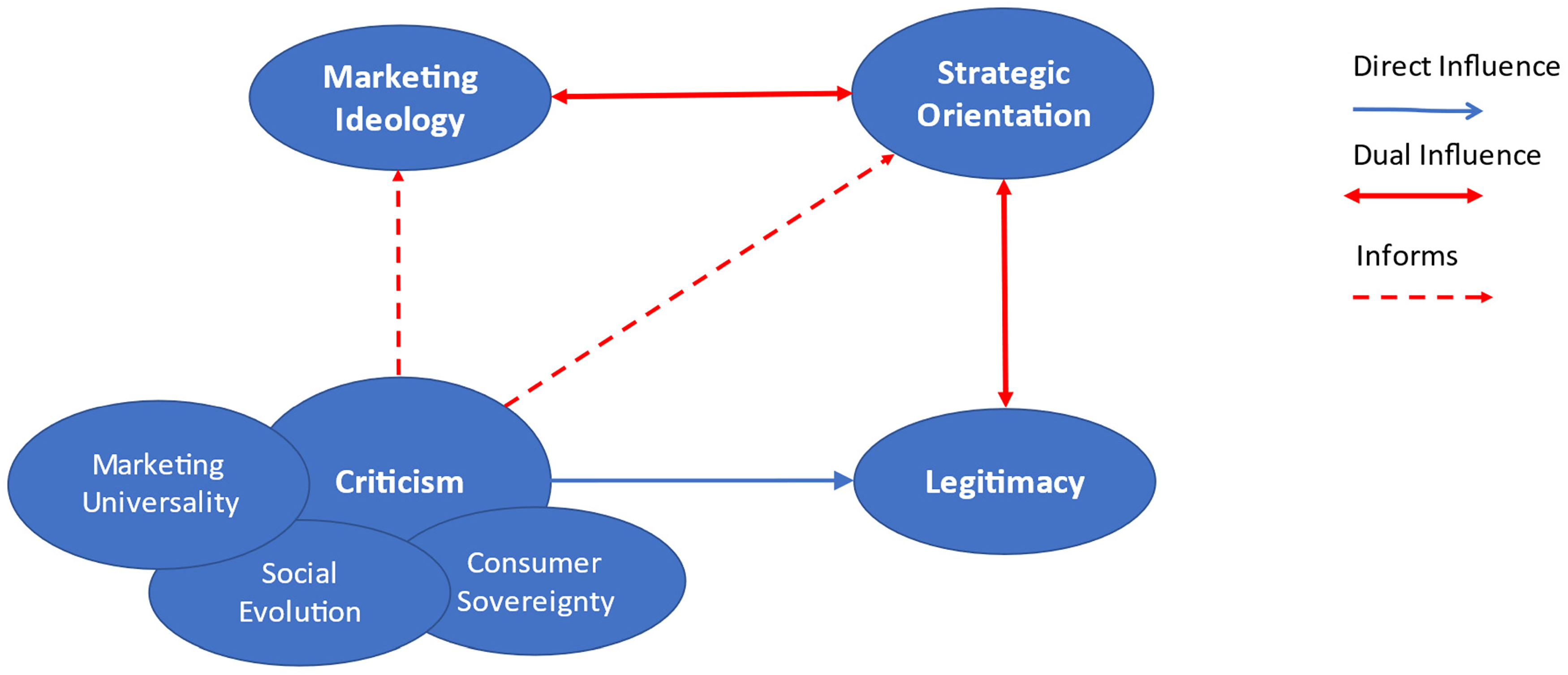
Dynamic framework: forces on strategic orientation.
Through this inquiry we hope to provide practitioners a means to better understand the influence of external forces on their firms’ strategic orientations. This understanding is valuable, as it helps practitioners recognize external forces (e.g., ideological paradigms, market response/legitimacy, and social criticism) which are relevant to their market and objectives, allowing them to better craft strategies and anticipate market opportunities.
Academically, illuminating the interaction of marketing ideology and legitimacy with strategic orientation (at the firm level) extends the rich research stream in macromarketing thought development (e.g., Callon and Roth 2021; Fullerton 1988; Hollander, Keep, and Dickinson 1999; Humphreys 2010; Hunt, Hass, and Manis 2021; Kilbourne, McDonagh, and Prothero 1997; Kjellbert and Murto 2021; Kumar 2015; Varman and Costa 2008; Wilkie and Moore 2007; Zwick and Dholakia 2004; Zwick and Bradshaw 2016; Levy and Luedicke 2013; Marion 2006).
Additionally, investigation of criticism and market drama as a causal mechanism (originating from consumer sovereignty, social evolution, and marketing universality) builds on the exploration of marketing's role in society (e.g., Bagozzi 1975; Giesler 2008; Kotler and Zaltman 1971; Monieson 1988; Rassuli and Hollander 1986; Sheth and Parvatiyar 2021). Finally, we introduce the concept of characterizing a firm's strategic orientation from an external point of view: the perceived strategic orientation of a firm based on its market impact and response to its markets. An external firm view as a market defender or market changer extends previous work in strategic orientation (e.g., Gatignon and Xuereb 1997; Press et al. 2014; Voss and Voss 2000) and lays a foundation for more expansive future research.
Strategic Orientation
What is a firm's strategic orientation? Narver and Slater's (1990) foundational assessment of “market orientation” (comprised of customer orientation, competitor orientation, and interfunctional coordination) leads to a significant investigation of “orientation” as an informative construct. This investigation has traditionally focused on adoption, composition, implementation, and outcomes of market orientation, with the beneficial outcomes associated with a firm's adoption of market orientation rarely contested (Press et al. 2014).
Authors such as Gatignon and Xuereb (1997), Voss and Voss (2000), and Press et al. (2014) articulate a firm's “strategic orientation.” These works differentiate a firm's strategic orientation from its market orientation in order to capture the effects of the broader set of orientations or ideologies on a firm's performance. They explore internal characterizations of a firm's strategic orientation possessing customer, competitor, and product dimensions (Voss and Voss 2000) or customer, competitor, and technological dimensions (Gatignon and Xuereb 1997), or the effects of differing ideologies (Press et al. 2014). Following these works, we adopt a firm's “strategic orientation” as the firm's orientation to the market.
Our objective, however, is to better understand the forces acting on the firm's strategic orientation, specifically external forces. To do so, we must consider the firm's orientation from the perspective of those external entities, potential sources of influence. We do not dispute the value of regarding a firm's strategic orientations as prescribed by Gatignon and Xuereb (1997), Voss and Voss (2000) and others. We suggest, however, that through the lenses of external parties, a firm's orientation is interpreted by its visible actions and performance. Similar to Sheth and Parvatiyar (2021), we offer a characterization of strategic orientation from the market's perspective and provide that a firm's strategic orientation may be perceived in the market in relation to its relative impact on the markets in which it resides. At any given time, firms are perceived according to the degree to which they change a dynamic market and the degree to which they respond to a dynamic market. For example, in 1994 Amazon disrupted (i.e., changed) the consumer products market by internalizing online acquisition and delivery. Alternatively, Walmart + 's car-side pickup and home delivery in 2020 is a response to a dynamic market calling for alternative forms of product acquisition.
In an effort to articulate how firms interact with the market, we assert that strategic orientation may be captured by a 2 × 2 matrix (Figure 2) characterizing a firm's orientation as response-based (low and high) and change-based (low and high). This matrix illustrates how firms adopt and change their strategic orientations based on their existing or desired position in the “mind” (i.e., perception) of the market. Market defenders are adept at responding to the market through the lens of legitimacy, i.e., their ability to create value and profits in its defined markets. Their behavior is largely driven by their perception of the market's response to their marketing strategies and the behavior of their competitors. They respond to their target markets and competitors’ strategies. The dynamic nature of market(s) may require either periodic or more frequent adaptation and response based upon the criticism perceived by the firm. As such, firms may move between low and high levels of responsiveness depending on their response to markets and internal objectives. Conversely, market changers tend to look for opportunities to influence markets and may seek to disrupt or change current or new markets. They are driven by market success resulting from market disruption. They are less focused on competitive strategies as compared to where they perceive the market to be going vis-à-vis their own strategies. Market success, however, may necessarily require market changers to adopt a more adaptive orientation. Thus, the market may perceive market changers also as market defenders.
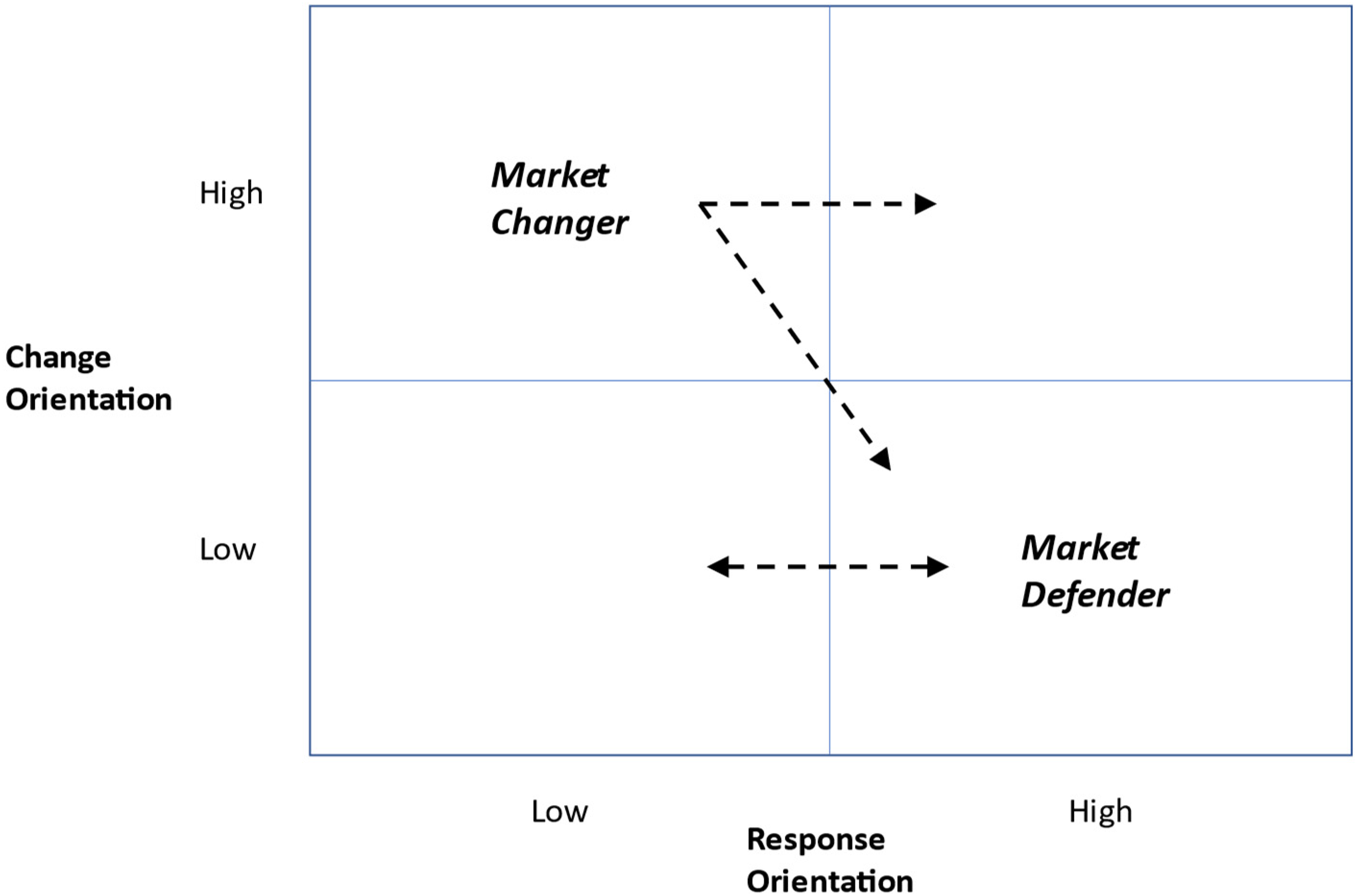
Strategic orientation.
The dynamic, therefore temporal, nature of a market is also captured in this matrix. Firms can shift to/from a market changer from/to a market defender. For example, Uber clearly changed the car-for-hire market and was perceived for a period of time as a market changer. After the market adapted to the change, however, Uber shifted to a market defender orientation positioning itself against competitors such as Lyft. Concurrently, Uber may be perceived as a market changer in the evolving food and consumer products home-delivery market.
Marketing Ideology on Strategic Orientation
In a sentiment that continues to this day (e.g., Araujo and Mason 2021; Hunt, Hass, and Manis 2021; Kjellbert and Murto 2021; Sheth and Parvatiyar 2021), Kotler and Zaltman 1971 note there “is no universal agreement on what marketing is.” Marketing as an “ideology” would reflect some consensus among members (academics, practitioners, consultants, authors, associations) about the systems, beliefs, and values surrounding what they consider to be the scope and role of marketing in society.
The essential phenomenon of marketing is based on social exchange theory (Kjellberg and Helgesson 2007), wherein two parties voluntarily exchange value. However, the scope of that exchange has been the subject of academic analyses (e.g., Bagozzi 1975) and discourse for well over a century. This is perhaps for the simple reason that marketing is continuously changing or is market driven. Marketing has been characterized as an agricultural function, distribution mechanism, system, process, concept, and an integral business function, to name a few. Its evolution has been chronicled by numerous scholars in a variety of ways, including periods, stages, turning points, and external triggers (Fullerton 1988; Hollander, Keep, and Dickinson 1999; Hollander et al. 2005; Hunt, Hass, and Manis 2021; Kumar 2015). The scope of marketing has clearly changed and expanded, argued by numerous scholars to now be the primary mechanism for the advancement of global neo-liberalism (Hietanen, Andéhn, and Bradshaw 2018).
Thus, the role of marketing also continues to evolve. Scholars such as Kotler and Zaltman (1971) refer to marketing's key contribution to society as satisfying society's needs. Alternatively, Monieson (1988) provides a dim view of marketing's contribution, tying the growth of the marketing concept as a “value-added activity” to a post WW2 “rationalization” that marketing supports increases in consumption, which in turn leads to higher standards of living. Numerous scholars paint a similarly dim view of marketing's role in society: e.g., Kilbourne, McDonagh, and Prothero (1997) assess the societal consequences of marketing, referring to a “consumption ideology” residing in the dominant social paradigm of western culture. Eckhardt, Dholakia, and Varman (2013) refer to “marketing veneers” that provide legitimacy to neoliberal acts that lead to ‘‘consumerization’’ of the target constituencies of the large institutions. Further, they observe that marketing strategies are often employed “to advance the preferred ideologies in various spheres such as politics, science, and art.” Zwick and Bradshaw (2016) assert that ideological objectives can drive marketing thought. In their assessment of online customer communities, they determine the substantive existence of the communities to be fabricated by marketers in an effort to “mobilize and extract value from the production of consumer communication, lifestyles and subjectivities.” More recently, scholars such as Sheth and Parvatiyar (2021) call for marketing to be a driver of social change and sustainability.
Wilkie and Moore (2007), Marion (2006), Araujo and Mason (2021) and others suggest that there are “layers” to marketing. For Marion, these layers include a practice, a branch of knowledge, and an ideology or “the enduring beliefs and collective representations (perspectives, frame of reference, viewpoints) shared by marketers.” Wilkie and Moore (2007) expressed the third layer not as an ideology, but as a “philosophy.” It is akin to a higher order view of what marketing entails. For academics, this ideology is expressed within the definition of marketing to illustrate what markets are. Within a firm's ideology, this may be seen as a brand or corporate identity.
Numerous scholars have debated the concept of a marketing ideology. Brownlie and Saren (1992) describe the marketing concept as not merely a “concept,” but an ideology that emerges with powerful normative elements. Crockett and Wallendorf (2004) explore how normative political ideology is at the heart of consumer behavior. Eckhardt, Dholakia, and Varman (2013) refer to the globalization of “a translucent ideological veneer” comprised of “marketing-think and marketing-speak.” Levy and Luedicke (2013) trace the history of marketing ideology from pre-1900 to the present and, borrowing from Crockett and Wallendorf (2004), define it as “a worldview found among marketing practitioners, researchers, and commentators, including ideas and values that cohere, that are used publicly to justify the marketing action, and that shape and are shaped by market interactions and political regulations” (pg. 58). They also offer a number of possible directions for the future of marketing ideology, including one in which “commercial entities become hypersensitive about their brands” and “marketing becomes a function of branding” (pg. 63).
We can also argue that other ideologies comprise marketing, such as service dominant logic offered by Vargo and Lusch (2004). While the term “ideology” is never used in their work, their premise for a new “emerging dominant logic” for marketing is based on the argument that marketing thought is not fragmented. Rather, it is evolving toward a new paradigm that “integrates goods with services and provides a richer foundation for the development of marketing thought and practice” (pg. 1). There are yet other areas of study in marketing that are normative and potentially ideological, such as globalization and international institutionalism, corporate social responsibility, macromarketing and public policy, consumerism, networks, interorganizational behavior, etc. While there is no uniform consensus among members of the marketing community regarding marketing's ideology (as embodied within its scope and role), there is a general understanding that marketing necessarily evolves in response to pressures from internal and external forces.
What seems consistent in these illustrations of marketing ideology is an attempt to understand the marketing strategic response to the changing landscape of what marketing is. Each seeks to address the fluid nature of marketing, or as Wilkie and Moore (2007) contend, the systems of marketing. Both metaphorically and practically, marketing ideology is an exceptionally large tent with an ever eclectic and evolving membership (Hunt, Hass, and Manis 2021). It is utilized by those members in a variety of ways: to help ground the discipline as academics, to align investment strategies through corporate strategies, or to help define a firm's position and brand identity to customers. Marketing ideology then is something beyond marketing itself and becomes a meta-concept. It is a unique, complex, describable, and evolving set of ideas and beliefs about the nature of marketing systems and their interaction with society (i.e., macromarketing).
As indicated in Figure 1, marketing ideology and strategic orientation influence each other. Firms possess unique congruences of ideologies, sometimes conflicting (Press et al. 2014; Giesler 2008), including a marketing ideology specific to the firm. For firms, these ideologies inform their daily actions and long-term strategies (including strategic orientation). Firms also necessarily seek a clear understanding of their own ideologies, as they are essential to their strategic orientation, e.g., building brand identity, ensuring consistent and proper communication with stakeholders, and aligning strategies through their mission, vision, and values. For a firm, a clear definition, highlighted by a mission or vision statement, illustrates the ideology and strategic orientation of the firm. It denotes to its stakeholders what the firm is about, whether in a consumer response and the firm's brand identity, or through the mission statement to address corporate investments.
Strategic orientations are influenced by marketing ideology via formal and informal education, academic publications, assessments, popular business publications and press, and consultation. Conversely, marketing's membership is influenced by what they observe and perceive to be the causal relationships between firms’ strategic orientations and market outcomes. Thus, marketing ideology influences firm strategic orientation (normatively) and is influenced (positively) by it.
Our focus is the influence of marketing ideology on a firm's strategic orientation as a market defender or market changer (Figure 2). Given the breadth and fluid nature of marketing ideology, as well as the differing views of its effects on society, one might conclude that marketing ideology is non-specific in guiding firms’ strategic orientation. This proposition is based on the notion that marketing ideology may be perceived by a firm's practitioners as ambiguous and contradicting, rather than informative (Wieland, Nariswari, and Akaka 2021). Eckhardt, Dholakia, and Varman (2013, Pg. 7) state that “for the last three decades, marketing ideology has proliferated,” and that “ideas of ‘marketization’ and ‘consumerization’ have swept across political—economic landscapes.” As a result, firms may be more inclined to pick and choose what components of marketing ideology appear to be applicable to their context. They adopt these ideological components in the formation of their strategic orientation based largely on what they perceive to be the causality between strategies and outcomes. When firms choose the applicable components to apply to their strategies, they actively engage in either serving as market changers, who use the ideology to transform or disrupt the market, or they use these components as market defenders solidifying their position.
This “pragmatic” process of identifying and implementing cogent elements of marketing ideology appears well-suited for a market defender orientation. Varey (2012, p. 424) seems to confirm this argument, pointing out that academic market research “almost fully” focuses on finding more opportunities for commercialization, competitive selling, and improving proficiency. Press et al. (2014) offer that conflicting ideologies can also converge in a firm, resulting in inconsistent market behaviors.
To the extent that there are elements of marketing ideology advocating change (e.g., Sheth and Parvatiyar 2021; Varey 2012), we argue that marketing ideology may also have a strong influence as a market changer. However, the valence of that influence may be highly dependent on either the context or the congruence among its various ideologies. As a result, the influence of the marketing ideology may serve both to enhance the firm's strategic orientation in some instances and hinder it in others as either a market defender or a market changer.
Legitimacy on Strategic Orientation
To fully understand a firm's strategic orientation, we must also consider a firm's underlying motivation to establish and retain legitimacy as viewed by external parties. In their elaboration of the marketing concept, Kotler and Zaltman (1971) assert that the objective of marketing is to achieve a mutually beneficial exchange, requiring “most of the effort to be spent on discovering the wants of a target audience and then creating the goods and services to satisfy them” (pg. 5). They point out that “consumer sovereignty” is preserved through this process, making marketing actions socially acceptable. This characterization, now five decades old, suggests that social acceptability, or legitimacy, is something to be earned, and informs the notion that consumers may not always view marketing as inherently valuable in and of itself. Instead, outcomes such as customer satisfaction, mutual gain, and value are important because they serve as evidence of the social acceptability or “legitimacy” of a firm's strategic orientation. It also suggests that the fundamental function of marketing is to be responsive to the wants of society through fulfillment. It is noteworthy that this conception of marketing's purpose does not articulate marketing as a driver of social change, unless one assumes want fulfillment inherently drives higher standards of living (i.e., social change).
Much has changed in the social economic context since Kotler and Zaltman (1971). However, despite huge shifts in social behavior, technology, and the global economy, their assertion appears to remain valid, albeit conditional. That is, marketing remains socially acceptable if its ideology and actions (i.e., strategic orientation) focus on value through meeting society's wants.
Legitimacy has received considerable attention in organizational/institutional theory (Bitektine 2011; Bitektine and Haack 2015; Deephouse and Suchman 2008; DiMaggio and Powell 1983, Humphreys 2010). Definitions include the perception or judgment of an organization (e.g., existence of shared values, the right to exist, social fitness, acceptability, and appropriateness), and/or the assessment of behavioral consequences (e.g., acceptance or endorsement by certain social actors) of the organization (cf. Bitektine 2011). Marion (2006, pg. 249) builds upon Suchman's 1995, pg. 574) definition, focusing marketing legitimacy “within the market economy.” Within these broad views of legitimacy, there are extant typologies, such as moral, cognitive, internal/external, managerial, regulatory, structural, personal, and sociopolitical (Bitektine 2011). However, within these typologies and perceptions, there seems to be a common component of legitimacy as a “generalized perception or assumption that the actions of an entity are desirable, proper, or appropriate within some socially constructed system of norms, values, beliefs, and definitions” (Suchman's 1995, pg. 574).
Marketing legitimacy relates to the assertion that marketing is what it says it is. Marion extends that assertion when he refers to the “congruence between the behaviour of marketers and the shared beliefs of customers/consumers.” In effect, legitimacy becomes a symbiotic relationship between the marketing community and the parties that affirm its actions. Levy and Luedicke (2013) characterization that marketers seek to “justify” marketing actions “publicly” suggests marketing seeks to be deemed a legitimate activity by a wide spectrum of parties. Humphreys (2010) asserts this point in terms of new markets and the legitimization of the casino gambling industry.
Unfortunately, literature has little to say regarding criteria for marketing legitimacy. What does legitimacy look like? Common to the earliest characterizations of the marketing concept (e.g., Kotler and Zaltman 1971) and social exchange theory is the exchange of value between parties. The criterion of “value” in an exchange suggests that each party, possessing transparent and non-transparent motivations, will assess the exchange in terms of value on their own terms. That perceived value can be seen as a subjective assertion of worth.
At its core then, marketing legitimacy may be seen to be based on a pragmatic typology. Each party involved in an exchange, presumably as a result of marketing actions, will ultimately make a practical assessment as to the value generated. Each party assesses the worth of the transaction, asking themselves if it is legitimate, or “desirable and appropriate,” to use Marion (2006) and Suchman's (1995). The desire to achieve such legitimacy ultimately influences the firm's strategic orientation.
Most business research and press still view a firm's performance as the assessment of a firm's market value and success (i.e., legitimacy). Katsikeas et al. (2016) argue that the most widely used measures of marketing performance outcomes in academia (based on 998 published articles spanning 1981 − 2014) are indicators of profit, sales revenue, and market share. Further, the fastest growing performance measures focus on financial market returns, not customer-based measures such as mindset, behavior, or performance. Following this cue, we suggest a firm's strategic orientation is substantially influenced by financial and market performance indicators. Measures such as market share, profits, revenue growth, etc. are regarded as proxies for the legitimacy of the firm's actions. In effect, firms regard performance metrics as indicators of whether their strategic orientation is seen as having value or worth. Borah et al. (2022) capture this notion in their investigation of marketing levers and investor attention. They determine that investor attention (i.e., an indicator of legitimacy) differs in terms of perceived short- and long-term effects of marketing actions on profitability, as well as by level (firm vs. industry). Specifically, the actions of a firm and its competitors on short-term effect metrics (advertising and WOM) were more impactful on investor attention (positively) than long-term effects metrics (NPD and customer satisfaction).
Legitimacy based on market performance would seemingly influence firms to seek continuous improvement in market responsive behaviors, become adept in anticipating change, and even affect market change if possible. In effect, performance-based legitimacy serves as the transcending catalyst and sustaining fuel for a dynamic market that rewards both market defenders and market changers. For instance, the rapid rise and fall of Peloton is arguably a study in market legitimacy and strategic orientation. In July of 2019, the company's public offering opened at a share price of $29.00 USD. It positioned itself as a market changer, offering technology-enabled home fitness equipment with instructor-led streaming, at a premium price point. Market performance was somewhat lackluster until January of 2020, when the global pandemic began. The company enjoyed extraordinary growth thereafter, causing many market analysts to speculate that Peloton had truly changed the personal fitness market; consumer preference had been shifted to at-home streaming fitness rather than gym membership. The company's share price peaked at $162.72 on December 27, 2020; however, it has been in steady decline since April 2021, opening at $9.37 on July 12, 2022. The company has recently announced a change in strategy away from making equipment, and instead focusing on tech-enabled home-streaming of boutique training. Peloton's story illustrates the potential for success and failure associated with a market changer strategic orientation. One may argue that Peloton would never have realized success had it not been for the global pandemic. Thus, it illustrates the potential for the marketing community to differentiate market changing from exploitation and good timing.
However, what about legitimacy when it is based upon non-financial performance measures? For example, the B Corp movement, now embraced by over 4000 companies in 77 countries (B Lab, 2022), exemplifies a mission to change the measure of a firm's legitimacy away from traditional market and financial measures. They envision an economic system that is “more inclusive, equitable, and regenerative,” wherein “all stakeholders, not just shareholders, are valued and prioritized” (B Lab, 2022). While there are certainly valuable opportunities in asserting legitimacy based upon exclusively non-financial performance metrics, we suggest that the prominence of financial and market performance measures as reported by Katsikeas et al. (2016) serve as the primary assessment of “legitimacy.” Most firms are not oriented nor incentivized to be drivers of social change. The measure of legitimacy by “their stakeholders” is largely based on market financial performance and return on investment. Even non-financial signals ultimately are in service to financial performance (Gondhalekar and Lehnert 2017). As firm performance generally has a positive correlation to increasing consumption, Kilbourne, McDonagh, and Prothero (1997) seemingly support this argument when they state that micromarketing (i.e., firms’ strategic orientations) cannot solve the negative effects of increasing consumption on quality of life in western cultures.
While stakeholder demand for social change is an important consideration, firms’ strategic orientations are more likely to be based on relevant financial outcomes married to social demands. Thus, calls for firms to become market changers for social change (e.g., Sheth and Parvatiyar 2021) may not resonate with many firms as a criterion for legitimacy in the eyes of their dominant stakeholders.
Criticism's Influence on Strategic Orientation
A third force which influences a firm's strategic orientation is criticism. Criticism, or “market drama” between stakeholders, as referenced by Giesler (2008), is another mechanism by which a firm's legitimacy is assessed. Giesler (2008, pg. 740), notes that it is through such conversations that “a market system's ideals, norms, and values are historically institutionalized.” Thus, criticism may influence a firm's strategic orientation indirectly through the firm's perception of its effects on legitimacy. However, criticism may also directly inform a firm's strategic orientation based on its assessment of the criticism's relevance.
Firms expect criticism from stakeholders and would naturally consider that criticism as an indicator of legitimacy. Marion (2006) points out that criticism is the “‘price to pay’ if customers/consumers are to consider marketing activities—and firms which implement them—to be legitimate.” When such expressions of criticism are positive, firms build upon them to enhance and extend the base of their legitimacy. When negative, firms reassess their strategies and restate their position to address the damage to their legitimacy. Such criticism and conflict (i.e., drama, Giesler 2008) are means to refine the rules of legitimacy, to provide feedback to the firm to help enhance the legitimization strategies of the firm.
Technology and the prominence of social media increasingly provide the means and empowerment for other external parties to voice their opinions of a firm's behavior. These parties extend beyond the firm's direct stakeholders and include individuals and institutions that are not (and may never) fall within the conventional definition of “stakeholder.” We argue that criticism originating from this larger group, i.e., “society at large,” presents a growing challenge for firms, because it may have a direct impact (positive or negative) on the firm's financial and market performance (i.e., its legitimacy). Further, the sources of that criticism may not be vested (unlike stakeholders) in the firm's performance or may also possess other motivations or agendas. Criticism may also be directed at an industry, such as fast-food restaurants, rather than at a specific company. Thus, criticism originating from stakeholders and society at large directed at an industry or specific firm can be interpreted as an affirmation or attack on its legitimacy. As such, it can influence the strategic orientation of a firm or of an entire industry. As indicated in Figure 1, criticism can also be informative. Criticism, originating from society at large, may serve to directly influence a firm's strategic orientation, even if it is not directed at the specific firm or its industry. Firms which are attuned to market criticism may recognize its relevance and potential for enhancing their capabilities (as a market defender or market changer).
We suggest, however, that market defenders and market changers may not regard criticism similarly. Market defenders tend to regard criticism more often as an affirmation of legitimacy or as an attack on legitimacy. They then may adjust their strategies to respond to the criticism. Market defenders are adept at this behavior; they view criticism as feedback and formulate strategies to incorporate that feedback. A classic example of this behavior is the response of Coca-Cola to the criticism of New Coke. The dramatic critical response to Coke's new formulation required Coke to revert to the Classic formula to defend its position. At the industry level, fast-food restaurants’ responses to criticism about their offerings’ contribution to child obesity was varied. Some acted more dramatically and quickly than others, with menu and packaging changes.
Arguably, all companies regard criticism as an affirmation or challenge to their legitimacy and adjust their behaviors to enhance/defend that legitimacy. However, market changers regard criticism directed at them, their industry, or other industries somewhat differently. Market changers tend to also regard criticism as an indicator of shifting social needs or perspectives that can inform strategic thinking. Consider Patagonia, which has consistently responded to evolving concerns from a global and diverse group of stakeholders regarding the ecological impact of its products. Instead of merely addressing those concerns, Patagonia placed ecological impact at the forefront of its strategic orientation. As such, Patagonia changed the market perception of how outdoor companies should address the environment.
Market changers consider such criticism as a bellwether and use it to inform and adjust their overall strategy, seeing it as an opportunity for new market or product development. This behavior is observed in market-disrupting firms such as Uber. Informed by longstanding criticism of institutionalized urban taxi service, they developed a strategy to integrate technology and contractual drivers into the market. Its legitimacy as a market changer was affirmed; however, criticism and competition by Lyft and entrenched taxi services compelled them to defend their legitimacy. Apple's launch of the iPad in 2010 was also based on criticism, reflecting changing social behaviors, of the limitations of laptops and smart phones. Netflix foresaw changing social attitudes toward home entertainment and harnessed streaming technology to displace DVDs and change how movies were consumed. More recently, Netflix has pivoted to a market defender position by limiting password sharing and reducing investment in new programming. Here Netflix is combating new entrants into the streaming marketplace and responding to the evolving behavior of streaming consumers.
Criticism's Key Catalysts
To better understand the influence of criticism on strategic orientation, it is important to understand the catalysts for criticism that may be unrelated to firm performance. We build upon the work of Marion (2006), who spoke of criticism broadly arising from three catalysts: consumer sovereignty, social evolution, and marketing universality. For Marion (2006) these broad views are justifications for the existence of the marketing discipline. We note there are challenges to such a generalization; however, Marion's categories can serve as large brushstrokes for the specific critical pathways that firms respond to in their strategies and that serve as a grounding for how criticism can impact strategic orientation. While it may be true that marketing uses these three constructs as reasons for marketing to exist, we suggest that they are also the categorical origins of feedback toward firms, expressing support or concern for a firm's apparent strategic orientation. As such, criticisms are catalysts for market-changing or -defending strategies. These critical catalysts are less the justification of marketing and more the expression of the fulfillment, or not, of marketing of the firm's ideological legitimacy.
Consumer Sovereignty as a Catalyst. As alluded to by Kotler and Zaltman (1971), firms are faced with the challenge of maintaining a socially acceptable level of consumer sovereignty, while implementing highly effective marketing strategies. Maintaining this balance in a competitive marketplace, where new marketing tactics are employed continuously, leads to an inherent challenge for marketers.
The notion of consumer sovereignty broadly suggests that consumers feel they have some control over the narrative relating to consumption, that they are informed and have a choice as to their consumption decisions. Consumers will respond negatively to a perceived loss of sovereignty and positively to a perception of control. Here, consumer demands address the critical narrative related to their perception of knowledge and choice. Kotler and Zaltman (1971) specifically refer to consumer sovereignty as the key to social acceptability, but also point out that “in practice, since at any time there are both products in existence and new products being born, most marketing efforts are a mixture of selling and marketing; that is, a change strategy and a response strategy.” They suggest that this reality is acceptable; that at least some of marketing is related to changing consumer wants, not just to fulfilling them. Their assertion suggests that consumer sovereignty is not necessarily overturned by “a change strategy,” as long as there is some balance. Consumer sovereignty is at the core of Zwick and Dholakia (2004) exploration of database marketing and digital consumer identity. They assert that consumers must have access to companies’ databases to maintain “a sense of control over their identities in the marketplace.”
Consumer sovereignty can also be observed when a firm crafts a product that is decidedly objectionable to an established group of customers. customer's desire. The example of Coca-Cola's launch of New Coke is such an instance. Another is Warner Brother's handling of “Snyder Cut” of Justice League (c. 2021). The established fan base expressed significant criticism of the release, prompting reediting/re-release of the film costing over $70 million. At the time, ATT/Time Warner used this response to legitimize a new distribution mechanism of film and intellectual property, positioning HBOMax against competitors.
The challenge consumer sovereignty-based criticism presents to firms is how to incorporate it. There is a wide breadth of contexts in which consumers assess their sovereignty, since it is fluid, and its inconsistencies can have a confounding effect. Numerous academics ridicule the very notion of consumer sovereignty (Baudrillard 1998; Holt 2002; Horkheimer and Adorno [1944] 1996), particularly in relation to product development and the cocreation of value (Cova, Dalli, and Zwick 2011). Hatch and Schultz (2010) criticize the notion of cocreation. They assert that the act of consumer sovereignty is nothing more than another means of collecting market information. One such example of cocreation is Lego, where Lego “allows” customers to customize their own creations which can be submitted to enter into mass production through their “Ideas” program.
There is clearly not a panacea for strategies relating to consumer sovereignty. Rather, the framework we provide focuses on the need for members of the discipline to continuously assess how their strategic orientation aligns with prevailing perceptions of contexts and categories wherein consumers assess their sovereignty, and firms must decide in which ways they respond to it. Firms should consider how specific marketing strategies in specific contexts will be perceived by consumers in terms of their perceived sovereignty: as changers or defenders? As alluded to by Sheth (2021), questions about marketing's role and the ideological position of marketing have arguably never been more prevalent in this categorical criticism. In marketers’ exuberance to create, communicate, and deliver value to target customers, when is the customer's sovereignty lost? Simply, are marketers fulfilling society's needs, or are marketers stimulating, creating, or supplanting those needs?
Social Evolution as a Catalyst. Although clearly related to consumer sovereignty, we distinguish social evolution as a separate critical catalyst because it goes beyond individual consumers’ perceptions of their abilities to affect their condition. We define social evolution as a broad construct capturing social change in light of economic, environmental, and technological change. Broadly, as numerous authors allude (e.g., Humphreys 2010; Hunt, Hass, and Manis 2021; Kumar 2015; Sheth 2021), as society, the physical and economic environment, and technology change, so must marketing, hence a firms’ strategic orientations. Similar to consumer sovereignty, the contexts and effects of social evolution are seemingly endless. Market changers continue to evolve a strategic orientation that places the market environment and technology at the center. Further, the pace of social evolution in a global context places constant pressure on firms to challenge their value propositions and segmentation strategies on a continuous basis. Paradigm shifts in the U.S. such as “consume for enjoyment” versus “consume for enjoyment in moderation” have been embraced by marketers for products such as alcohol, but that does not necessarily suggest that “rational” or “sustainable” consumption has been lost or forgotten, as these ideologies are also continuing to emerge.
The advent of blockchain technology (c. 2009) and the shift to online transactions (2004) are two examples of how social evolution can impact market defending or changing strategies and legitimacy. Blockchain technology and digital currency allow for quicker internal transfer of payments, security, and adjustments of supply chain. Within a broader blockchain technological framework, firms are realizing the efficiencies within blockchain for internal transfers of payments. This technology is rapidly being seen as a means for creating efficiencies and defending a strategic position. In addition, firms are able to highlight technological superiority and quicker responses through blockchain technologies, granting competitive advantages and legitimacy within their industry. Conversely, firms are jumping onto the blockchain bandwagon, with NFTs to highlight their position within the industry, a legitimization strategy that has been met with only a modicum of success at best, as those investing in NFTs are “cooling” off from the initial hype.
The shift to an online marketplace, where firms can service and engage with customers virtually and wholly online, is another example. This was initially a market-changing strategy with firms such as Amazon (c. 1994) redefining the bookstore and then later expanding to include other products and incorporating the broader market to include third-party sellers. Such strategic market changing orientations revolutionized the retail sector, with traditional brick and mortar stores still scrambling to catch up. The COVID-19 global pandemic had an exponential effect on the growth of online marketing. Firms were required to fulfill their customer interactions in the virtual space to even begin to maintain and defend their legitimacy in an environment in which person-to-person interactions were limited. The introduction of the metaverse represents another shift to a market changing strategy in the virtual space, with many firms racing to defend their position in such a space with bit brands such as Nike and Gucci experimenting with virtual products and interactions.
Social evolution is accelerating. This evolution is a result of advances in technology, globalization of markets, increased global access to markets, cultural shifts, and political shifts. The market is arguably more dynamic than ever before, and marketers must be attentive to the implications for their value propositions, adapt as a market defender, and/or seek opportunities to exploit and harness change as a market changer.
Marketing Universality as a Catalyst. Marion (2006), Eckhardt, Dholakia, and Varman (2013), and others allude to the potentially negative implications of brand dominance and “marketing-think and marketing-speak” on a global scale; thus, marketing universality may be inherently problematic. Marketing universality is the critical reflection that marketing is pervasive throughout the firm and the customer experience (Marion 2006). It reflects constant contact and expression within the marketing framework and challenges the implications of marketing as a dominant global paradigm. The critical catalyst of marketing universality reflects the state of being in constant contact and expression within the marketing framework, wherein social perceptions and beliefs are largely driven by marketing systems. For example, Delta and American Airlines possess substantial brand equity (a marketing construct) within (and arguably outside) their industry. Does that brand equity lead, due to the general pervasiveness of marketing in society, to an expectation of each firm's position (i.e., ideology) vis-à-vis social issues? In 2020 Delta and American Airlines were both challenged as to their positions on voting laws changes in their respective headquarters locations (Atlanta and Dallas). The answer appears to be yes, at least within a periodic context. Their positions relative to voting legislation are arguably no longer a focal point for customers today. However, ongoing social debates on a variety of topics such as voting rights remain a relevant consideration for firms in managing their brand.
If, as Eckhardt, Dholakia, and Varman (2013, pg. 7) assert, “marketization” and “consumerization” ideology has “silently and surreptitiously seeped into the substrates of daily life, popular culture, personal relationships, and even individual psyches” globally, are firms’ strategic orientations robust enough to grasp the potential implications? It would initially appear that the marketing discipline is enhanced by its growing universality, but it is clearly fraught with potential negative consequences. For example, Pepsi's 2017 attempt to align with and express support for the Black Lives Matter movement resulted in highly negative criticism, versus Coke's 1971 “Hilltop / I’d Like to Buy the World a Coke” campaign, which received highly positive feedback.
Other examples of marketing universality and the way marketing has become embedded into our daily lives include the advent of mobile marketing (c. 2000) and geolocation-based promotional activity. While this example is clearly related to technology, the ability for firms to have a mobile presence and an app for continuous contact with customers has changed the notion of marketing. The convergence of marketing systems (e.g., pop-ups and search tracking) and information inquiry (e.g., a search for a restaurant) has profoundly changed the perception of marketing in the eyes of the recipients. In effect, marketing is now a component of their active and passive economic activities.
As foreseen by Zwick and Dholakia (2004), the ownership and control of consumers’ data has become a subject of social discourse. Evolving social norms and government regulation related to the use of consumer data (c. 2016) exemplifies the effects of criticism on firms’ strategic orientations. Facebook, a pioneer in social media and market changer, now faces consumer and government scrutiny for consumer data privacy and monetization. They must defend their practices as new laws are holding big data firms accountable for how their apps utilize, target, and protect consumer data, especially that of minors. Firms now must have data collection strategies and security. Concurrently, Apple is attempting to position its brand based upon (c. 2021) data privacy and security to protect its market share and appear as a market changer. As such, data protections are redefining the market experience, and a failure to adequately protect and communicate data protections limits a firm's legitimacy.
In summary, the omnipresence of marketing arguably conditions humans and society at large to regard all information as a product of marketing systems. This conditioning has positive and negative implications. Both market defenders and changers can leverage marketing's prominence and systems to deliver their value propositions more effectively. The most obvious challenge presented by marketing universality, however, is that society becomes increasingly skeptical, perhaps cynical, about all things related to marketing systems; “marketing” becomes an increasingly pejorative term.
Conclusion and Further Research
Hunt, Hass, and Manis (2021, pp. 20) discuss the “long-term viability” of the marketing discipline and argue that it is reliant upon cooperation between the macromarketing and marketing management/strategy fields; consumer research and modeling are inherently independent of marketing. We attempt to explore the intersection, and perhaps common ground, of macromarketing and marketing strategy. In addition, we look at those external entities that influence a firm's strategic orientation and the way firms respond through market creation or market defensive strategies. Strategic orientation at the firm level is not independent of other ideologies and strategies. Nonetheless, members of the marketing discipline seek to learn from what is happening at the firm level. At the same time, members of the discipline (the same academics, consultants, authors, and associations) aspire to influence firm behavior through prescriptive means such as the marketing concept. Through marketing education, marketing training, and marketing publications, the discipline's members seek to define marketing ideology and mold strategic orientation at the firm level.
The motivations for these behaviors are multi-dimensional, but the ultimate goal, as pointed out directly by Marion (2006) and indirectly by Kotler and Zaltman (1971), is the legitimization of marketing ideology and, therefore, a firm's strategic orientation. Other than market practitioners at the firm level, the members of the discipline, however, have a limited ability to directly influence legitimacy. They may, through the use of publicly available indexes such as consumer satisfaction or brand equity calculations, seek to have some impact on legitimacy. Instead, we argue that legitimacy, assessed by stakeholders largely on market performance, influences and is influenced by firms’ apparent strategic orientations. A firm's strategic orientation may be characterized externally by the degree to which it appears to defend its market position or change the market in which it resides. As such, firms may consider marketing ideology and legitimization when adopting or shifting strategic orientations characterized as high or low levels of adoption or change, market defending, or market changing, respectively.
Criticism, originating from stakeholders and society at large, also have an influence on this relationship. Criticism may be regarded as reflective of three catalysts: consumer sovereignty, social evolution, and marketing universality. Firms may respond indirectly to criticism should they perceive it as an attack on, or affirmation of, their strategic orientation. Those firms which more often assess criticism in this manner would tend to be perceived externally as market defenders. Other firms may regard criticism more broadly and consume it as informative to their strategic orientation. Firms that consider criticism as strategically informative and respond directly to it, regardless of its apparent impact on legitimacy, would tend to be perceived externally as market changers.
This framework has distinct implications for managers and firms. Firms can understand the role of this framework to help define and ground their strategic orientation and response to criticism, as viewed through the light of legitimacy. For firms having a strong understanding of their position as it relates to market changing or defending strategies, it can help them craft a response to criticism. These strategies can then serve to communicate their legitimacy to stakeholders. By looking at strategic responses through a lens of legitimacy and market changing and defensive strategies, firms can respond in a more succinct and efficient manner. Instead of seeing criticism as reactionary and negative, firms can embrace criticism as a means to strengthen its value proposition. Such critical understanding and awareness of criticism can help a firm extend their strategies to either craft a new market position or defend their current one more efficiently.
This framework also informs important questions and implications for research and practice, recontextualizing strategic orientation in terms of ideology, legitimacy, and criticism/market drama. Viewing strategy through these lenses may evoke a clearer understanding of marketing as a discipline and of its contribution to society. By recontextualizing the strategic framework, research may find new insight into how strategy is formulated by businesses. Such an envisioning may allow us to better understand how criticism is understood by important social parties and how firms are best able respond to it. Future research could employ these constructs and expand upon the role of criticism, as well as develop market-defending and market-creation strategies. Such research would then be able to test whether and how such a strategic mindset can more appropriately respond to various critical catalysts. Future research would also be well served to unpack and qualify the role of the market defender vs. the market changer, investigating how these two constructs relate to a firm's strategic orientation.
The mechanism of feedback to the firm via criticism is highly reactive. As such, it may result in a lack of response to certain important parties, and an over response to parties possessing conflicting motivations for criticism. The framework may also provide a mechanism to more fully understand the implications of consumer sovereignty, the effects of social evolution fueled by technology in the form of social media, ecommerce, mobile information, etc., as well as the impact and implications of marketing universality. The global pervasiveness of branding and “marketing-speak and marketing-think” (Eckhardt, Dholakia, and Varman 2013) suggests a more expansive and complex role for marketing. Future research should explore the effects and relative importance of these catalysts on firms’ market defending or market changing strategies.
Finally, the framework challenges marketers as to the contribution and legitimacy of marketing in a dynamic and global context. As Hunt, Hass, and Manis (2021, pp. 20) assert, marketing's true components are marketing management/strategy and macromarketing. Its legitimacy (from a strategic, managerial, and societal point of view) validates its symbiotic relationship between its direct stakeholders and society. We explore what impacts marketing legitimacy in light of a strategic orientation matrix, where firms assert their legitimacy based upon a response-based orientation (i.e., a market defender) or a change-based orientation (i.e., a market changer). As a firm's ability to respond to criticism increases, it can adapt its strategies to facilitate change or shift to defend their market position. As such, we highlight the factors which may facilitate or constrain firms’ motivations or abilities to adopt new strategic orientations of the kind suggested by Jagdish Sheth (UCD, 2021), to meet the future challenges of a “People-Work-Society Triad.”
Footnotes
Associate Editor
Andrea Prothero
Declaration of Conflicting Interests
The author(s) declared no potential conflicts of interest with respect to the research, authorship, and/or publication of this article.
Funding
The author(s) received no financial support for the research, authorship, and/or publication of this article
