



Abstract
Consume-less appeals in social marketing can help reduce the lavish consumption in wealthy countries, which poses a major threat to the climate. This study experimentally examines the effectiveness of three different types of consume-less appeals (informative, social normative, and emotional appeals) on participants’ actual spending levels during a real shopping trip compared to a control group (no appeal). In addition, the study tests whether these appeals evoke negative rebounds (in terms of post-purchase climate donation) or positive rebounds (in terms of accepting post-purchase material giveaways). A field experiment in a grocery store in Germany with 170 participants shows that social normative and the emotional appeals reduce actual shopping spending. Informative and social normative appeals increase donations, and emotional appeals reduce the items of taken giveaways. The findings further support certain indirect impacts of the consume-less appeals on rebounds in terms of spending levels.
Introduction
The lavish overconsumption of wealthy nations and the corresponding extraordinarily high use of fossil resources represent a serious threat to the climate. Keeping the average temperature rise due to climate change below 1.5 degrees requires, among other factors, sustainable consumer behavior (see United Nations sustainable development goal, SDG, number 12, U.N. 2015). Consumers can behave eco-friendlier by buying green products. However, even though these products are eco-efficient and thus require less resources per unit of output than conventional products, they still deplete resources (Hüttel et al. 2018). Despite gains in the world's resource productivity, the use of natural resources and the greenhouse gas emissions (GHG) have been rising worldwide consistently since 1970 (IEA 2022; OECD 2008; United Nations 2019). This means that while relative resource consumption has decoupled from the development of economic growth, the absolute GHG emissions are still growing. Thus, beyond resource productivity, in order to stop global warming, an absolute reduction in consumer resource use is required. Notably, according to anti-consumption research (e.g., Balderjahn, Hoffmann, and Hüttel 2023; Hüttel, Balderjahn, and Hoffmann 2020), persons who abandon from overconsumption despite having the financial means to buy more, do not suffer and they even experience a higher quality of life. To consume less, people can extend the lifespan of a not completely dispensable products (e.g., repair it instead of replacing it with a new one) or, better yet, not buying certain products at all (Chatzidakis and Lee 2013; Gorge et al. 2015; Ertekin and Atik 2015; Schaefer and Crane 2005; Varey 2010, 2012).
Since the typical objective of commercial marketing is not to persuade customers to buy less, social marketing campaigns are better suited for this task. Nonetheless, under certain circumstances, it might be advisable for for-profit businesses to convince their customers to buy less (Gossen, Ziesemer, and Schrader 2019). Companies with a good reputation and high-quality products may encourage customers to buy less in the respective category for environmental reasons. In this manner, demand shifts can be achieved in favor of the advertised brand and at the expense of suppliers of low-cost mass-produced goods. This strategy is called green demarketing (Reich and Armstrong Soule 2016), a new extension of Kotler's 2011 traditional demarketing concept. This green demarketing strategy was made famous by outdoor clothing manufacturer Patagonia's 2011 “Don’t buy this jacket” ad in the New York Times (Hwang et al. 2016). Still, in general, for-profit businesses have little reason to ask their customers to buy less from them. As a result, we investigate how consume-less appeals can work in the context of social marketing campaigns. While commercial advertising aims to increase consumers’ desire to buy, the objective of this study is to investigate whether advertising can also achieve the opposite, namely encouraging people to limit their consumption levels.
Consumption reduction is undoubtedly beneficial to the environment and climate preservation. However, traditional governmental instruments, such as statutory consumption prohibitions and market-based incentive programs have limitations in mitigating global climate change. It has frequently been noticed that the majority of the populace in industrialized countries is unwilling to accept government consumption prohibitions. For instance, despite numerous attempts, German policy makers could not successfully impose a highway speed limit or a meat eating ban (e.g., Mao 2023). Furthermore, government regulations that provide financial incentives are frequently exaggerated in terms of their effectiveness. The problem with applying financial incentives to influence citizens’ consumption behavior is that the responses of individuals to these incentives can only be predicted very imprecisely in advance. The reason for this is that the cost of a product is simply one criterion for purchasing or using it, albeit an important one. Depending on the product, other criteria may be more important. Government financial incentives meet a population that reacts to them in different ways that are hard to predict. In their study, Sierzchula et al. 2014 examined the amount of financial incentives for electric vehicle adoption and their respective market shares for 30 nations. They were unable to establish the relationship between these two variables. The level of incentives varied in between these nations far more than the countries’ market shares. In this view, it makes sense that policy makers employ social marketing campaigns as an additional instrument to encourage individuals to voluntarily reduce their level of consumption for the sake of the climate. Traditionally, social marketing plays an important role in society by addressing socially desirable behavioral changes (e.g., non-smoking, abstinence from alcohol, health behavior, and environmental protection) (Helmig and Thaler 2010).
Motivating people to voluntarily consume less, however, needs well-designed, effective social advertising campaigns. Policy makers and social marketers need empirical evidence on whether consume-less appeals can work in principle and, if so, how they can design effective appeals. Only a few prior studies have addressed this new issue. The study by Reich and Armstrong Soule (2016) compares consumer responses to a print advertisement for a fictitious green product with an ad for the same product that includes a call to consume less. The results show that study participants respond with higher environmental concern to the ad calling for the purchase of a green product than to the ad that additionally calls for lower consumption. Using the case of the advertisement “Don’t buy this jacket” from the outdoor clothing manufacturer Patagonia the experimental study by Hwang et al. (2016) reported less positive attitudes and intentions toward buying the jacket for those participants who were exposed to an anti-consumption advertisement than participants who viewed a classic advertising for buying this product. In conclusion, although the macromarketing literature is in agreement that social marketing campaigns are required to encourage consumption reductions for the environmental reasons (e.g., Gossen, Ziesemer, and Schrader 2019; Hwang et al. 2016; Peattie and Peattie 2009; Reich and Armstrong Soule 2016), research lacks evidence-based knowledge on how to design successful consume-less appeals.
The present paper aims to fill the outlined gap by making the following contributions to the literature. First, we change the focus away from advertising designed to persuade consumers to stay away from a specific product (Hwang et al. 2016) and toward social marketing appeals designed to encourage consumers more generally to refrain from overconsumption. Second, rather than focusing on the effect of a single communication influence strategy (Hwang et al. 2016), this study examines the behavioral outcomes of three different consume-less devices, including informational, social, and emotional appeals. These influencing techniques are frequently employed in commercial marketing (Arthur and Quester 2004; Bennett 1996; Bagozzi and Moore 1994), as they target the three main factors that drive consumer behavior: information, social expectations, and emotions. The design of this study allows us to distinguish between the distinct effects of the three consume-less appeal types. To extend and supplement prior research on the impact of social strategies for consumer abstinence, we apply the consume-less appeals used by Balderjahn and Appenfeller (2023) in their study. But in contrast to Balderjahn and Appenfeller's (2023) work, which was based on an online experiment, our study is built on a field trial that allowed us to record actual shopping behavior.
Third, we extend past research (Balderjahn and Appenfeller 2023; Hwang et al. 2016; Reich and Armstrong Soule 2016) by examining various rebound effects. Concentrating solely on single non-purchases only provides half of the story when it comes to climate preservation. If customers are encouraged by the appeals to give up non-essential things but then utilize the money saved to purchase other, additional goods, the resource-saving benefit of not consuming is offset. This effect is referred to as a positive, resources consuming rebound effect (Reimers et al. 2021). If the money freed up by foregoing consumption is not used to purchase other goods but for a purpose that further reduces resources or greenhouse gas emissions (e.g., donating for climate protection), this is referred to as a negative rebound (Reimers et al. 2021). In conclusion, this study contributes fresh and insightful knowledge to the macromarketing literature on the subject of how social consume-less appeals might effectively encourage people to voluntarily forgo consumption. The study results are useful for both governmental and non-governmental organizations when developing programs to encourage voluntary restraint in consumption.
Background and Hypotheses Development
Consume-less Appeals in the Context of Macromarketing
This paper investigates whether broad consume-less appeals can be used to improve societal environmental and climatic protection. It builds on specific macromarketing literature and supplements it with new insights. This study refers to macromarketing topics, such as sustainable marketing (Sheth and Parvatiyar 2021), sustainable consumption (Kilbourne, McDonagh, and Prothero 1997), environmentally-motivated anti-consumption (García de Frutos, Ortega-Egea, and Martínez-del-Río 2018), social marketing (Peattie and Peattie 2009), and green demarketing (Armstrong Soule and Reich 2015). More precisely, this paper relates to the controversial discussion on sustainability, degrowth and well-being. The global economy is continuing to grow, which has caused the planetary boundaries of a sustainable resource economy to be severely breached (Burroughs 2010; Global Footprint Network 2023; Varey 2010).
Despite significant improvements in resource productivity, global material consumption and greenhouse gas emissions continue to rise (IEA 2022; OECD 2008; United Nations 2019). Some authors therefore consider efficiency as the “weak sustainability” condition (Lorek and Fuchs 2013). Therefore, to halt climate change, efficiency approaches must be accompanied by sufficiency strategies that are able to reduce the absolute consumption of resources (Brinken, Trojahn, and Behrendt 2022; Sandberg 2018; Vita et al. 2019). In terms of the individual, sufficiency indicates that consumption should be adequate but not wasteful (Hoffmann et al. 2023; Gossen, Ziesemer, and Schrader 2019; Sandberg 2018). For example, consumption styles of frugality and voluntary simplicity follow the principle of sufficiency (Alexander and Ussher 2012; Peyer et al. 2017; Seegebarth et al. 2016). However, the positive effects of individual endeavours to save resources on the environment and climate can only be seen at the social, macro level. This micro-macro-link must be considered when developing macromarketing strategies that strive to reduce overall societal consumption demand for the sake of environmental and climate protection. As a consequence, social interventions to promote consumer abstinence have to endeavour to influence consumers’ individual behavior (Gollnhofer and Schouten 2017; Gossen, Ziesemer, and Schrader 2019; Kilbourne, McDonagh, and Prothero 1997; Kilbourne et al. 2009).
Numerous publications on the motivations of anti-consumption lifestyles are available, which can be used to conceptualize societal calls for to refrain from consumption. The anti-consumption concept described in the literature encompasses several different forms of renunciation of consumption. Voluntary simplicity (e.g., Alexander and Ussher 2012; García de Frutos, Ortega-Egea, and Martínez-del-Río 2018; Hüttel, Balderjahn, and Hoffmann 2020; Lasarov et al. 2019; Seegebarth et al. 2016), frugality (e.g., Lastovicka et al. 1999), and slow consumption (e.g., slow fashion; Chhabra, Sindhi, and Nandy 2022; Ertekin and Atik 2015) are examples of these. Armstrong Soule and Sekhon (2022), for example, have demonstrated that not just environmental concern, but also the prospect of making this less consumption style prominent in the social context via status symbols, might inspire consumers to engage in anti-consumption behavior. Furthermore, recent research indicates that the more selfish motivations of self-determination, independence, and hedonism increase the willingness to refrain from consuming (e.g., Balderjahn et al. 2020; Mai, Hoffmann, and Balderjahn 2021; Seegebarth et al. 2016).
Commercial marketing with its primary goal to stimulate consumption is considered one of the main drivers of overconsumption (Gossen, Ziesemer, and Schrader 2019). Rising economic growth, however, often does not lead to rising life satisfaction in the population (Burroughs and Rindfleisch 2002). In developed countries, life satisfaction has widely become decoupled from economic growth (Easterlin 2013). On the other hand, recent research shows that consumers often consider voluntary renunciation of consumption not as a sacrifice, but as a gain in self-determination and well-being (Balderjahn, Hoffmann, and Hüttel 2023; Hüttel, Balderjahn, and Hoffmann 2020). This finding is the starting point of our study. If more consumption does not lead to more satisfaction and voluntarily giving up consumption has largely no negative impact on personal well-being, then social marketing tools to encourage people to consume less in order to protect the environment and the climate could be successful.
Social marketing campaigns essentially aim to enhance citizens’ mental and physical health by employing influencing communication methods and techniques similar to those employed by commercial marketing (Andreasen 1993, 2002; Peattie and Peattie 2009). According to the macromarketing literature, social marketing actions focused at individuals are particularly geared at bringing about changes in individual behavior that benefit society as a whole (Kennedy 2016; Kennedy and Smith 2022). In the case of widespread adiposity in the population, for example, avoiding overconsumption can help to minimize the strain on the health-care system. Similarly, low-waste consuming habits, which are encouraged through social marketing tools under the umbrella term of “social” green demarketing (Peattie and Peattie 2009), contribute to overall environmental and climate protection. Green demarketing is defined as a “strategy in which a for-profit brand encourages reduced overall category consumption for the sake of environmental protection” (Reich and Armstrong Soule 2016, p. 442). Armstrong Soule and Reich (2015) indicate in their study that consumers’ attitudes toward for-profit green advertising for products are better than toward commercial green demarketing advertising. Worth noting is that when the goal of green demarketing is not to give a particular brand a green image, but to change the general perception of that brand, this effect reverses. This work incorporates Armstrong Soul and Reich's (2015) findings into their research design and does not evaluate product-specific appeals, but rather broad consume-less messages.
Conceptual Model
The objective of this study is to investigate the effects of several general, non-product specific consume-less appeals on actual shopping expenditures in the context of a field experiment in a supermarket. This is the initial stage in analyzing if generically phrased messages on abstaining from consumption can be effective in reducing real consumption by citizens. Therefore, this research employs three distinct persuasive consume-less appeals: information provision, social norm cues, and emotional stimuli (see Appendix A). These three persuasive appeal types fall within the commonly used categorization of advertising claims as rational, normative, and emotional (Arthur and Quester 2004; Bennett 1996; Bagozzi and Moore 1994).
This study investigates the impact of consume-less appeals on two different behavioral categories. First, people may reduce their consumption by focusing on the things they need when shopping and avoiding useless and unnecessary products. The three consume-less appeals used here might promote this readiness to forego consumption in various ways. Second, we want to know if further acts that might be triggered by a previous consume-less appeal can alter the positive impact of consumption renunciation on the environment and climate (so-called rebound-effects). On the one hand, money saved by refraining from consumption can be donated to climate protection (reduced ecological footprint: negative rebound-effect). Accepting giveaways, like chocolate bars, on the other hand, can reduce any existing “psychological pain” caused by product renunciation (increase of the ecological footprint: positive rebound-effect) (Figure 1).
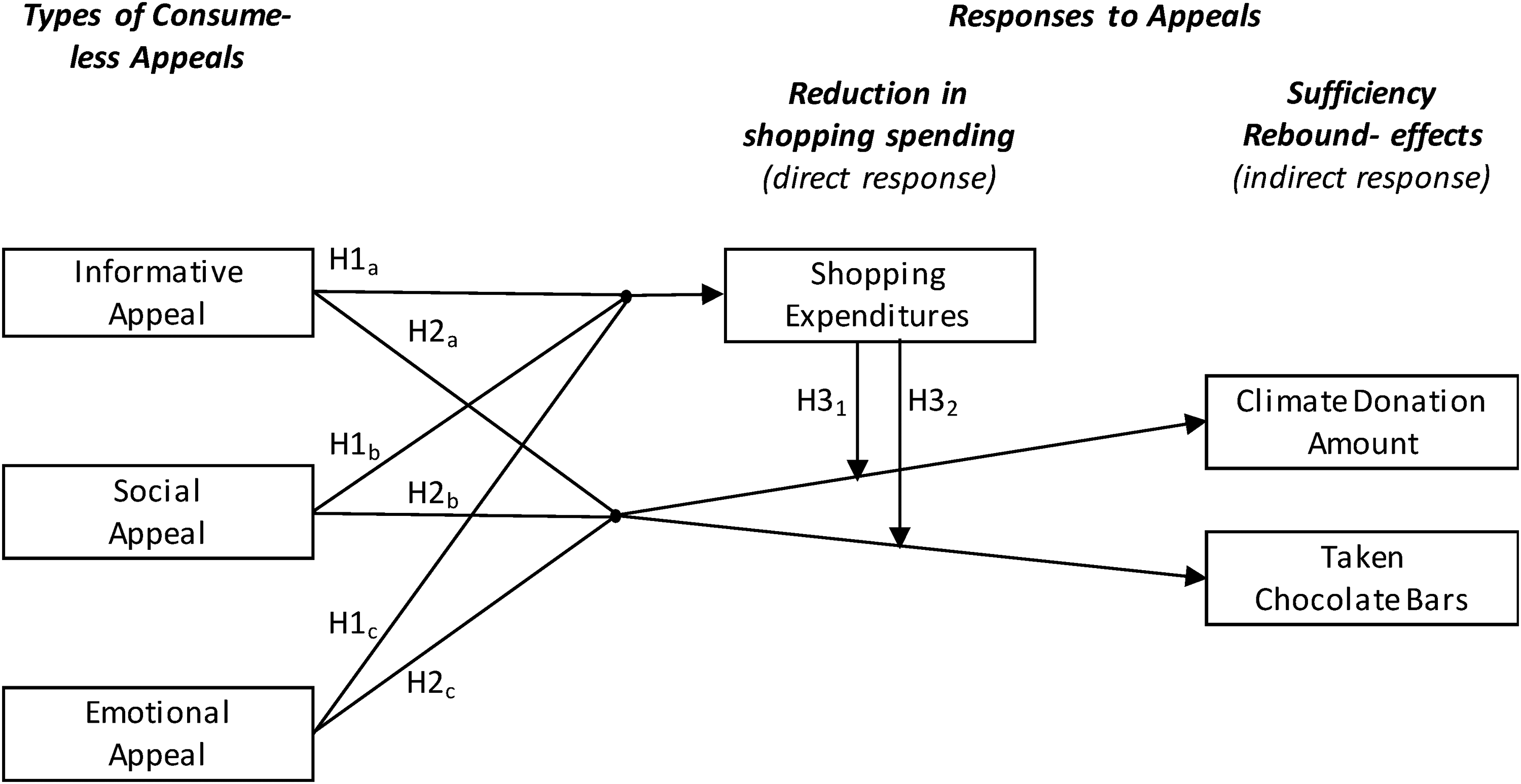
Framework and Hypotheses.
The Informative Consume-less Appeal
Informative appeals represent the basic approach of influencing communication strategies. Many scholars expect that the provision of information enables the decision maker to decide more rationally (e.g., Medway, Warnaby, and Dharni 2010). Past research has confirmed the particular importance of giving information for the goal of promoting resource-efficient consumer behavior (e.g., Gorge et al. 2015; Jung and Jin 2016). According to studies, smart meters’ feedback information can encourage users to adopt greater energy-saving habits (Tiefenbeck et al. 2013). Providing information empowers people to make thoughtful trade-offs between decision options in pursuit of their own interests. If environmental and climate preservation is simply a matter of considering the pros and drawbacks of many possibilities for climate-helping acts, then information can assist make prosocial decisions appear rational.
Referring to the protective motivation model (PMM-model, Tanner, Hunt, and Eppright 1991), a cognitive appraisal process stimulated by a climate-relevant informative appeal should include an assessment of the individual threat posed by climate change, an evaluation of whether a particular behavioral option (in this case, less consumption) is purposeful in mitigating that threat, and an assessment of whether one's motivation is sufficient for coping behavior. Furthermore, believing that by avoiding climate-damaging behavior, one is doing something good for the climate and society can induce the warm glowing giving-effect, which gives personal happiness and satisfaction (Andreoni 1995; De Young 1996). Based on these results from the literature, we assume that an informative consume-less appeal can, on the one hand, strengthen the citizen's sense of responsibility for climate protection and, on the other hand, trigger feelings of happiness in the belief that they are doing something good. In this regard, we anticipate that the informative appeal will induce consumers to avoid lavish purchasing and therefore spend less money when they go shopping (H1a). Since supermarkets primarily sell food, information on the respective emissions of individual foodstuffs provides a rational basis for climate-friendly consumption renunciation. In this study, therefore, an infographic depicting the carbon emissions of selected food products is used as an informative consumer-less appeal (Appendix A).
H1a: Informative consume-less appeals lead to a reduction in shopping spending.
On the basis of the readiness to donate to the climate (negative rebound) and to accept promotional giveaways in the form of chocolate bars (positive rebound), we examine the potential for rebound effects due to a preceding consumption renunciation. Referring to the PMM theory, we assume that willingness to donate for climate protection depends on whether the motivation for such a donation is high enough. In addition, citizens must consider a donation to climate protection as an effective way to protect the climate. Aside from the rational thinking about the impact of a donation on climate preservation, the emotional response to doing something good, the warm glow giving effect, can also increase willingness to donate. We therefore assume that the informative consume-less appeal increases the willingness to donate (H2a, 1).
Furthermore, we anticipate that the informative appeal will have a positive impact on the desire to take home a number of chocolate bars after shopping. The informative graphic used as an appeal highlights chocolate's relatively large carbon footprint. As a result, the desire to consume chocolate may clash with the rationally justified desire to abstain from consumption prompted by the appeal. This psychological conflict can be overcome, according to the moral licensing effect (Blanken, van de Ven, and Zeelenberg 2015; Effron and Conway 2015), by holding up the intended consumption abstinence triggered by the appeal as moral permission to justify chocolate intake as a “one-time sin.” We therefore hypothesize a positive effect of the informative, consume-less appeal on the number of chocolate bars taken home after shopping (H2a, 2).
H2a: Informative consume-less appeals increase (1) the willingness to donate to climate protection and (2) the willingness to take home a certain number of chocolate bars.
Finally, we investigate how actual shopping expenses modify the effects of the informative appeal on the amount of climate donation made (negative rebound) and the number of chocolate bars taken (positive rebound) after the shopping trip. We expect that participants in the study who reduced their purchases after viewing a carbon footprint infographic will be more aware of the link between consumption and climate damage than others. As a result, they will be more ready to donate to climate protection (H3a, 1). In principle, it can be assumed that chocolate that can be taken away free of charge triggers an incentive to take it away in many people. We expect that those who have limited their purchases due to the informative appeal will take chocolate more often as a “compensation for giving up” (moral licensing effect) than those whose purchases have not or only hardly changed due to the appeal. As a result, we propose that, among all participants exposed to the informative consume-less appeal, those who carried home the most chocolate bars were those who had cut back on their shopping expenses (H3a, 2).
H3a: Participants who respond to informative appeals by lowering their shopping spending will be more willing respond to the appeals by (1) making climate donations and (2) taking home free chocolate bars.
The Social Norm Consume-less Appeal
The influence of social norms on consumer behavior is well established (Dahl 2013; Lasarov, Mai, and Hoffmann 2022; Lowe, Lynch, and Lowe 2015; Mattern and Neighbors 2004; McKenzie-Mohr and Schultz 2014). Scholars usually differentiate between injunctive and descriptive social norms (Cialdini, Reno, and Kallgren 1990; Reno, Cialdini, and Kallgren 1993; White and Simpson 2013). Injunctive social norms formulate a moral imperative (e.g., to do anything in particular is not right). In contrast, descriptive social norms set the majority's behavior as the standard for socially correct behaving (e.g., doing what the majority does). Descriptive social norms take advantage of herd behavior and bandwagon effects. The literature suggests to use social norms to encourage people to consume more sustainably (White and Simpson 2013). For example, the studies by Nolan et al. (2008) and Goldstein, Cialdini, and Griskevicius (2008) show that descriptive norm messages were more effective than other norm appeals in influencing individual conservation behavior. In an experimental study by Goldstein, Cialdini, and Griskevicius (2008) to encourage the reuse of towels in a hotel, two different messages were printed on the towel rails: “Help the environment” (appeal to an injunctive norm) and “Join your fellow guests in helping to save the environment” (appeal to a descriptive norm). Appealing to the descriptive norm of joining the majority of guests in reusing towels resulted in a towel reuse rate (44.1%) that is a significantly higher than the towel reuse rate brought about by the reference of helping the environment (injunctive norm: 35.1%; Goldstein, Cialdini, and Griskevicius 2008).
White and Simpson (2013) further point out that the effect of social norms depends on whether the message is considered at an individual or a collective level of the self (self-framed /other framed; also Brewer and Gardner 1996). When norm appeals address the individual level of the self, self-interests become salient. In contrast, addressing the collective level of the ego raises social and ethical challenges (e.g., Gardner, Gabriel, and Lee 1999; White and Argo 2011). A social norm directed at the collective, as in Goldstein, Cialdini, and Griskevicius (2008) experiment (“… joining the majority of guests …”), shows impacts on sustainable behavior that are higher than the impacts of self-framed messages. However, other studies show that descriptive norm appeals to refrain from consumption can also provoke rejection and lead to the opposite of what was intended (Schultz 1999; Yakobovitch and Grinstein 2016).
Descriptive social norms paint a picture of sustainable behavior that corresponds better to individual goals of social belonging and the fulfilment of social obligations than injunctive norms, which morally request behavior that is not always in the best interests of consumers (White and Simpson 2013). Because studies indicate that descriptive appeals are more effective when phrased positively (Elgaaied-Gambier, Monnot, and Reniou 2018), we use an appeal with the statement that many people feel happy and satisfied when they refrain from consuming for this study (see Appendix A). Because descriptive norms, on the one hand, refer to the behavior of a majority without imposing requirements on individuals, and on the other, can emphasize individual benefits of sustainable behavior, such as happiness and satisfaction, they appear to be better suited for the analysis of consume-less behavior than disjunctive, moral norms. As a result, we propose the following hypothesis:
H1b: Descriptive social norm appeals to abstain from consumption lead to a reduction in shopping spending.
The effect of descriptive norms on changes in consumption habits is based solely on the implicit cue to behave in accordance to the majority, rather than on rational information processing. Participants who were exposed to the descriptive “follow-the-majority norm and consume less” will mentally connect reduced consumption to climate action by referring to being able to donate to the climate. The desire for consistency in behavior in general causes participants to develop this mental connection. Therefore, we suppose that norm-induced purchase abandonment increases the willingness to donate to climate protection (H2b, 1). In this study, the descriptive appeal associated abstaining from consumption is (positively) linked with satisfaction and happiness (see Appendix A). Under the impression of this normative, happiness-promising appeal, overconsumption would evoke negative sentiments. Therefore, we expect that participants will refrain from taking candy bars under the impression of the descriptive norm appeal (H2b, 2).
H2b: Descriptive social norm appeals to consume-less (1) improve the willingness to donate for climate protection and (2) reduce the number of chocolates bars taken home.
In contrast to the formation of a purely “cognitive” link between consumption renunciation and climate protection predicted in H2b, participants who followed this appeal and actually purchased less will be far more concerned with appearing consistent to the outside world. As a result, the warm glow giving impact of a climatic donation will help fulfill the normative consume-less appeal's promise of happiness (H3b, 1). On the other hand, we suppose that “actual” suffering regarding abstaining from consuming weighs more strongly than “imagined” suffering (H2b). In this regard, we suppose, as in H3a, that participants who spent less money at the grocery now feel morally justified in taking many chocolate bars with them because of their genuine perceived pain (moral licensing effect, H3b, 2).
H3b: Participants who respond to the descriptive social norm appeal by lowering their shopping spending will be more willing respond to the appeals by (1) making climate donations and (2) taking home free chocolate bars.
The Emotional Consume-less Appeal
In consumer behavior research, the effect of emotions on purchase decisions is well established (e.g., Bagozzi, Gopinath, and Nyer 1999). Past research has shown that emotional arousal generated by advertising improves the persuasiveness of advertising messages. Several empirical studies provide evidence that positive emotions like pleasure, joy and happiness are positively linked to prosocial behavior (Mesurado et al. 2019). Conversely, the stimulation of negative emotions like anger, sadness, and fear can elicit empathic-driven prosocial responses (Bagozzi and Moore 1994; Lindenmeier 2008; Matthes, Wonneberger, and Schmuck 2014; Mesurado et al. 2019). Despite the well-known effect of emotions on consumer behavior, few studies investigated how emotional appeals can encourage sustainable consumption. In an experimental study, Matthes, Wonneberger, and Schmuck 2014, for example, found that both an emotional and a mixed type of emotional-functional advertising significantly improve attitudes toward a green brand. To the best of our knowledge, no research has examined the effect of emotional appeals on the willingness to voluntarily abstain from consumption. This study employs an emotional appeal to abstain from consuming in the form of a videos that addresses their parents and grandparents from the children's point of view, encouraging them to spend less time for shopping and more time caring for them. This emotional consume less appeal may elicit emotions of shame in (grand)parents, motivating them to shorten their current shopping trip short and, as a result, spend less money.
H1c: Emotional consume-less appeals lead to a reduction in shopping spending.
The literature also shows that happiness and pleasure increase people's willingness to spend money not only on themselves but also on other causes such as charitable giving (Aknin, Dunn, and Norton 2012). However, if an emotional appeal elicits negative feelings, as was the case here, the emotional appeal is likely to cause study participants to not be in the mood to make a climate donation (H2c, 1). Moreover, this emotional appeal could lead to an erosion of the notion that children are happy when they get something sweet. They will subsequently be more likely to decide to spend more time with the children rather than bring goodies. In this regard, it can be expected that participants, under the impression of the emotional “consume less, take more care of your children” appeal, will refuse chocolate giveaways (H2c, 2).
H2c: Emotional consume-less appeals (1) do not affect willingness to donate to climate protection but (2) reduce the number of chocolate bars taken home.
The emotional appeal, like the social appeal, emphasizes the happiness and well-being associated with abstaining from consumption rather than the climate-protecting effect. The emotional consume less appeal highlights the value of spending more time with children by reducing purchasing. Participants who purchased less as a result of the emotional appeal to do something nice for their own family or children may experience an intellectual change from “me” to “others and others.” In this respect we expect that this mental shift away from one's own interests and toward other interests following the “reduced” purchase will increase one's motivation to donate (H3c, 1). Participants who have spent less money than usual on the present shopping trip due to this consume less appeal may, when driven to take care of their children, refrain from bringing any more goodies such as chocolate bars. After all, the “gift” is the extra time spent together with the children, not the chocolate. This argument is contradicted by the assumption that by actually abstaining from consumption, participants feel morally justified in consuming a large number of chocolate bars. We assume that the moral licensing effect clearly dominates the “spend extra time with children” effect due to the typically high incentive character of chocolate bars (H3c, 2).
H3c: Participants who respond to the emotional appeal by lowering their shopping spending will be more willing respond to the appeals by (1) making climate donations and (2) taking home free chocolate bars.
Design
Procedure
This field study consists of a post-test control-group experimental design under real-life conditions at a large grocery retailer's outlet. For this study, we chose a supermarket so that we could test causal hypotheses for actual purchasing behavior and acquire results with a high degree of ecological validity. As a result, the study overcomes difficulties with survey response tendencies, which distort data. Of course, the products available at the supermarket only cover a portion of what is typically consumed. This study can only make statements on the consumption of regular products in this regard. However, for the realization and significance of this study, concentrating on items bought virtually every day, as opposed to those acquired less frequently, like apparel and durables, proves beneficial.In addition, the supermarket is very well suited to control other influencing factors.
We asked the customers of the grocery store to participate in the field experiment and if they agreed they were randomly allocated to either one of three experimental groups or a control group. Participants in the experimental groups were exposed to either an informational, social norm, or emotional consumer-less appeal before they began their shopping trip (see Appendix A). All appeals were shown to the participants for a sufficiently long time to ensure that they actually understood the specific consume-less appeal. Participants in the control group went shopping directly after registration and allocation without being exposed to any appeal. After the shopping, the participants gave us their receipt such that we could record the amount of money spent. Afterward, we measured the rebound responses (donations given, number of chocolate bars taken). Lastly, the survey concluded with records of demographic characteristics (see Figure 2).

Experimental design of the study.
Appeals Manipulation and Design
As previously discussed, we used three different forms of consume-less appeals (informative, social-normative, and emotional) as experimental factors in this study (Table 1). In designing the appeals, we considered the usual aspects of advertising form (e.g., style of the advertising claim, framing).
Overview of the Experimental Consume-less Appeals.

Translated from German language; for the full video text, please see Appendix A.
Please see Appendix A for illustrations.
Informative Appeal
The informative appeal used in this study provides data on the CO2 emissions of a wide range of foods per 100 g. The above-mentioned data is provided in an infographic arranged according to the level of these emissions from low (fruits and vegetables) to very high (beef) (see Appendix A). This information can help consumers decide thoughtfully to abstain from foods with high greenhouse gas emissions for climate protection reasons. Presenting objective CO2 emissions in the informative appeal will stimulate rational information processing and evaluation processes. A direct link between consumption and climate protection is established. Furthermore, this appeal is self-framed (“it is your decision”) without addressing any particular personal advantage or disadvantage of buying only low carbon dioxide emitting foods.
Social Norm Appeal
We used a hedonic social norm appeal. This appeal consists of the verbal message that more and more people say they are happier the less they consume (see Appendix A). The appeal includes a social reference to the behavior of a majority (“follow the majority”) and a focus on the personal advantage of being happier by consuming less (gain-framed). The message of the descriptive social norm used in our study is: “More and more people say they are happy and satisfied when they consume less.” Personal happiness and satisfaction is promised as an incentive to abstain from consumption. A reference to climate protection is not explicitly addressed.
Emotional Appeal
The emotional appeal uses an advertising spot from a large German food retailing chain (see Appendix A). With the slogan “Simple is more,” this commercial emotionally addresses the situation of children when their parents do not have enough time for them because parents waste time while shopping. This appeal is self-framed (“parents who do not spend enough time with their children”) and gain-framed (“make time for your kids and shop simpler and less”). No explicit reference is made to climate protection.
Manipulation Check
To test whether the participants mentally understood the three consume-less appeals, we asked the following question at the end of the experiment: “I often buy more than I could actually afford.” The participants had to answer this question according to a five-point scale (1: does not apply at all; 5: completely applies). We assume that the consume-less appeals triggered participants’ feelings that they had bought too much too often in the past. This feeling was particularly prevalent in the social norm and emotional appeal group, whose mean values (2.00 and 2.09) are significantly higher (p < .05) than in the control group (1.53). The mean value in the informative appeal group is also higher than in the control group but not significantly (see Appendix B). This result is quite plausible, since the social norm and the emotional appeals point to direct benefits of abstaining from consumption (makes people happy and gives them more time for children), while this is not the case with the informative appeal. In sum, the results show that the consume-less appeals used as experimental treatments were understood by participants with the manipulative purpose intended.
Response Variables
This study is conducted as a field experiment under real purchasing conditions and uses actual observed behavior as the response variables. In their literature review on the effectiveness of social marketing campaigns, Helmig and Thaler (2010) found that among experimental studies, most studies were conducted as lab experiments and that the outcome variable in most cases was self-reported behavior. Only 8% of the studies considered actual observed behavior as the dependent variable. Focusing on actual behavior, we use shopping spending and two measures of rebound effects in this study.
First, we asked participants to hand in their purchase receipts of the completed shopping trip to measure the actual purchase expenditures (Shopping Spending). We compare the average spending of participants exposed to a consume-less appeal with the average spending of the control group. Significantly lower spending in an experimental group compared to the control group would then be an indication of the assumed consumption-reducing effect of the particular consume-less appeal.
Second, we measured a negative and a positive rebound variable after the participants had handed in their purchase receipts: As a negative rebound measure, we considered the amount of a voluntary donation to climate protection (Climate Donation). We asked participants to donate to a reforestation project. The participants could put cash in a box to make their donation. Higher donations further add to the positive effect of the carbon emissions already saved. As a measure of a positive rebound, we used free giveaways. We offered the participants free chocolate bars at the end of the experiment and we recorded the number of bars they had taken (0 to a maximum of 5; Chocolates Taken). The more of these chocolate bars consumers take away, the stronger the effect of the carbon emissions they had already saved decreases.
Sample
In sum, 170 customers of a grocery store in a major city in Germany participated in the field experiment in fall 2019. The participants’ mean age is 45.9 years (ranging from 14 to 90 years, SD = 16.2). Of the participants, 64.1% are female. The participants’ household size is distributed as follows: 17.8% living alone, 30.2% two persons, 19.5% three persons, 20.7% four persons, 8.3% five persons, 3.6% six persons. About two thirds of the participants have no children (68.6%), while others have one (12.4%), two (13.0%), or three (5.9%) children. The distribution of the income is as follows: up to EUR 1,000 (16.8%), EUR 1,001 to EUR 2,000 (30.7%), EUR 2,001 to EUR 3,000 (27.0%), EUR 3,001 to EUR 4,000 (13.1%), more than EUR 4,000 (12.4%). Education levels are as follows: no formal education (2.4%), secondary school (23.2%), high school (33.5%), and university degree (40.7%). Participants were randomly allocated to three experimental groups and a control group (group sizes approximately 43 customers). Notably, we received the receipts of only 123 participants, and hence all analyses, which include spending, are based on this sample. This sample does not differ from the whole sample in terms of socio-demographics (age: t = 0.822, p = 0.206; sex; C = 0.283, p = .595) and the participants are equally distributed across the experimental groups. Demographic characteristics were included as control variables in all analyses. They were only included in the presentation if they had significant effects. Notably, we did not find statistically significant differences in the shopping spending depending on the household size (ANOVA: F(5,116) = .633, p = .675).
Results
Shopping Spending
The Kolmogorov-Smirnov test for normality of shopping spending lead to a rejection of this hypothesis. Since group sizes in the field experiment are quite small, this rejection of the normal distribution is not trivial. Consequently, as recommended in the literature, we used the HC2 method for a robust estimation of the parameters’ standard deviations (Hayes and Cai 2007). Given that we ran a study in the field with the shoppers being recruited in the supermarket, we controlled in each analysis especially for those variables that are particularly relevant with regard to the dependent variable. In addition to the three consume-less appeals (fixed factors), we included income as a control variable in the regression model since income can have a direct independent influence on the consumers’ spending. All analyses were performed with SPSS version 28.
Table 2 shows the results of the regression analysis. Figure 3 (upper panel) depicts the descriptive results. The mean value of shopping expenditure is highest in the control group (see Figure 3). This result indicates that the intended effect of the three consume-less appeals to restrain purchases in the subsequent shopping trip is generally achieved. The regression analysis shows that in the emotional and social norm appeal groups these effects are marginally significant. The results therefore confirm H1b (social norm appeal) and H1c (emotional appeal) but not H1a (informative appeal).
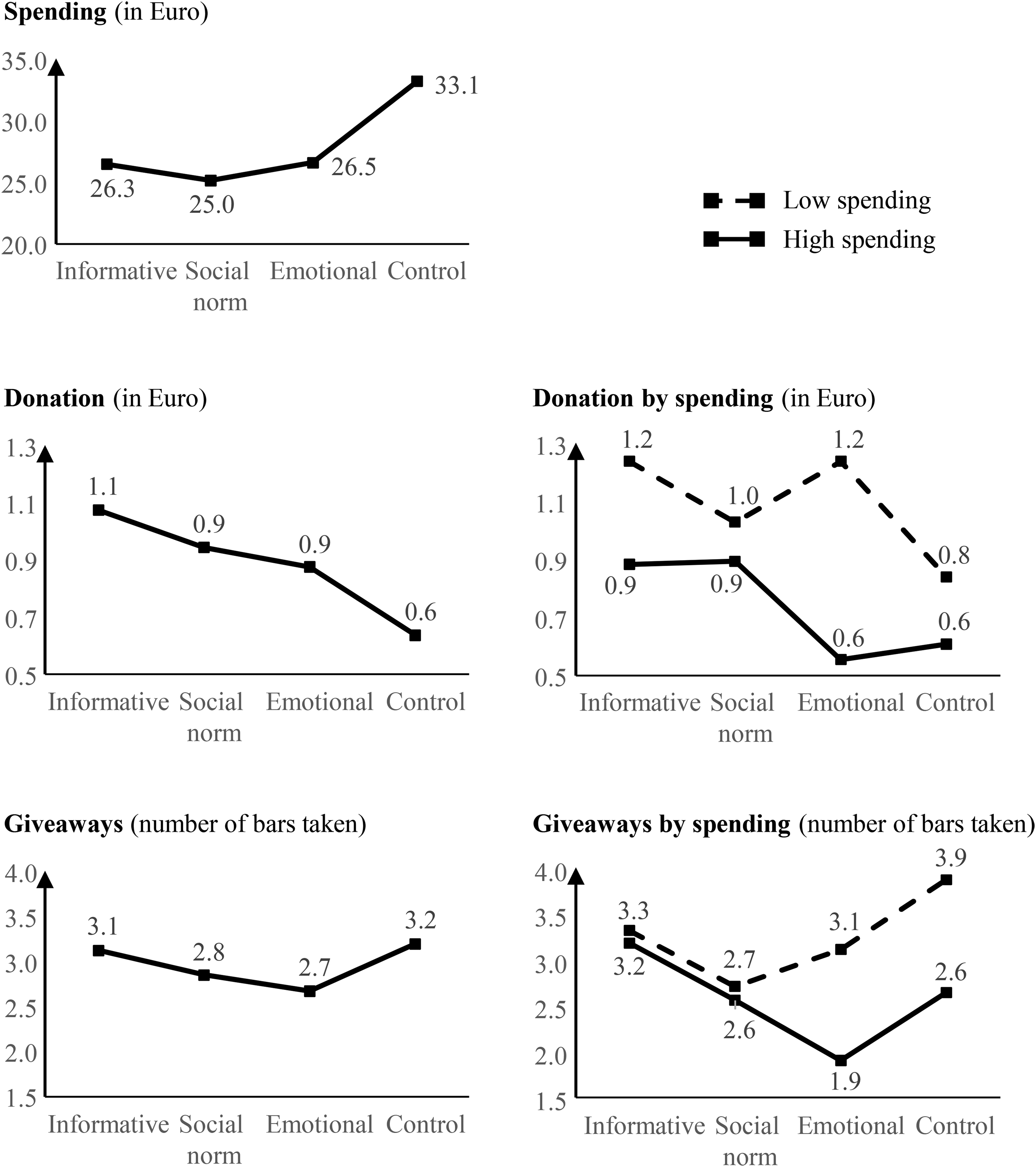
Spending, donation, and giveaways across the experimental groups.
Effects on Shopping Spending.

Notes. OLS regression, DV = shopping spending, N = 123. F(4,95) = 2.71, p = 0.035, R² = 0.102). Level of significance: †p ≤ .10, *p ≤ .05, **p ≤ .01, ***p ≤ .001.
Robust Standard Errors (HC2 Method used). Without the control variable income the effect of the social norm appeal is still marginally significant (p = .098), while the effect of the emotional appeal disappears. A further robustness check shows that the household size adds no statistically significant effect and other effects remain stable.
Climate Donation
Climate donation amounts varied in this study between EUR 0 and EUR 5, with clear clusters at the round amounts EUR 0, EUR 1, EUR 2, and EUR 3. Consequently, we rescaled this measure to a three-point scale (0: < 1€, 1: 1€ to < 2€, 2: ≥ 2€). According to this measurement level, we used the generalized ordinal regression model procedure for parameter estimation (Table 3). The ANOVA analysis yielded an F-value of 3.41 for the model with 3 degrees of freedom, R2 = 0.059, and a significance level of p < .05. The appeal treatment factor is also significant at this level.
Effects on Climate Donation.

Notes. Generalized ordinal regression model. DV = climate donation (3 categories), N = 170. Level of significance: †p ≤ .10, *p ≤ .05, **p ≤ .01, ***p ≤ .001. We replicated the analysis with the reduced sample of N = 123. The pattern of significant results remains stable: informative: p = .022, social norm: p = .056.
The results in Figure 3 (middle panel) show that participants in all experimental groups donate more money to climate protection after their shopping trip than participants in the control group. However, only the effects in the informative and social norm groups are significant as hypothesized in H2a and H2b (Figure 3). This means that the informative and the social norm consume-less appeals do not only address the shopping expenditures directly but also evoke the side effect of promoting the willingness to donate to climate protection. This finding suggests that many participants in these appeal groups were able to make a link between their personal consumption intensity and its negative impact on the climate. We observe a slightly higher propensity to donate in the emotional appeal group compared to the control group. However, as expected in H2c, this effect is not significant.
Chocolates Taken
Following the same approach, we used to examine the influence of consume-less appeals on willingness to donate, we proceeded to analyze the effect of the consume-less appeals on the number of chocolate bars taken home after the shopping trip. However, we added sex and age as control variables to the regression model when analyzing the main effects of the appeals. This is due to the very strong and significant taste preference differences with regard to the consumption of chocolate when it comes to sex and age. Tests for normality of the dependent variable “chocolates taken” lead to a rejection of this hypothesis. Consequently, we used robust estimators for the standard deviations of the regression parameters using the HC2 method (see Hayes and Cai 2007). Since the dependent variable used in this study, the chocolates taken, can take six distinct values (none to five chocolate bars taken), we first used the generalized ordinal regression model procedure for parameter estimation. Since these results hardly differ from the linear regression analysis, we present results of the linear regression analysis here. The analysis (Table 4) yielded an F-value of 2.66 for the model with 5 degrees of freedom, R2 = 0.080, and a significance level of p < .05. The appeal treatment factor is not significant, whereas sex and age have significant impacts (p < .05).
Effect on Chocolate Bars Taken.

Notes. Linear regression model, DV = number of chocolate bars taken as giveaways.
HC2 method.
Sex: 0 = male, 1 = female. N = 170. Level of significance: †p ≤ .10, *p ≤ .05, **p ≤ .01, ***p ≤ .001. We replicated the analysis with the reduced sample of N = 123. The effect of the emotional appeal remains significant: p = .045, and the effect of the social norm appeal even turns significant: p = .048. With the reduced sample and without the control variables, the social norm appeal's effect is marginally significant (p = .094) and the emotional appeal turns insignificant (p = .108).
The results in Table 4 show that our assumption of strong age-specific and gender-specific preferences for chocolate was confirmed. With regard to the hypotheses on the three consume-less appeals’ direct impacts on decreasing participants’ willingness to consume, only the emotional appeal showed a significant effect on the chocolate bars taken after the shopping trip. The average number of chocolates taken home is, however, lower in all three consume-less appeal groups than in the control group (Figure 3, lower panel). Hypothesis H2 is confirmed only for the emotional consume-less appeal.
Rebound Effects Qualified by Shopping Spending
Climate Donation
In H3a-c, we hypothesize that the appeal-induced savings on current purchases qualify the rebound effects. To test this hypothesis, we need to include an interaction term between appeal groups and purchasing expenditures in the regression model. This effect captures the consume-less appeal's effect on the climate donation or the chocolate bars taken home qualified by the reduction in prior shopping spending. To investigate whether, in the case of a direct effect of the three appeals on a reduction of shopping spending, indirect rebound effects can be observed in the form of a climate donation in an amount resulting in the permanent renunciation of consumption (negative rebound) and in the form of additional consumption by means of free chocolate takeaways following the purchase (positive rebound), we added the interactive terms organized as appeals by spending in the model. The analysis (Table 5) for climate donation as dependent variable yielded an F-value of 5.36 for the model with 7 degrees of freedom, R2 = 0.103, and a significance level of p < .10.
Main and Interaction Effect on Climate Donation.

Notes. aGeneralized linear regression model estimates. DV = climate donation, N = 123. Level of significance: †p ≤ .10, *p ≤ .05, **p ≤ .01, ***p ≤ .001.
The results in Table 5 show that the informative and emotional consume-less appeals exert, qualified by shopping spending, significant moderation effects on willingness to donate. With lower shopping spending, the willingness to donate to climate protection generally increases (confirms H3a-1 and H3c-1). In this respect, the informative and the emotional consume-less appeals not only lead to a climate-friendly reduction of purchasing expenditure but also increase the willingness to donate to climate protection (negative rebound effect). Carbon emissions are therefore reduced twice: by consuming less and by making a climate donation. For the social norm appeal to consume-less, this indirect effect could not be confirmed (rejection of H3b-1). For the graphical representation of the interaction terms (see Figure 3, middle panel), we have divided the shopping spending into two groups, i.e., a larger group (about two thirds of the participants) with relatively low shopping spending (EUR 1 to EUR 30) and a smaller group (about one third) with relatively high spending (EUR 31 to EUR 82).
Chocolates Taken
To analyze hypothesis H3 that consume-less appeals have an indirect effect on the take-home of chocolate bars offered qualified by the effect on the amount of shopping spending, we added the interaction term between appeal groups and shopping spending to the regression model. The analysis for chocolates taken as dependent variable yielded an F-value of 1.87 for the model with 9 degrees of freedom, R2 = 0.136, and a significance level of p < .10. Of the indirect effects of appeals on chocolates taken, only the one for the emotional consume-less appeal group is significant (Table 6). The higher the spending of the emotional appeal group's participants, the fewer the bars of chocolate that are taken home. H3b-2 is therefore partly confirmed.
Main and Interaction Effect on Chocolate Bars Taken.

Notes. DV = chocolate taken, N = 123. Level of significance: †p ≤ .10, *p ≤ .05, **p ≤ .01, ***p ≤ .001.
HC2 method.
Sex: 0 = male, 1 = female.
Discussion
The current experimental study aimed to provide new answers to the macromarketing literature on how policymakers and social marketers ought to implement campaigns to avoid overconsumption and encourage consumers to use resources more sufficiently and thus sustainably. This study shows that the standard types of appeals employed in commercial advertising for stimulating demand (informative, social-normative, and emotional) can also be used to encourage consumption abandonment. Our study adds to the literature on sustainability rooted anti-consumption in several aspects (e.g., García de Frutos, Ortega-Egea, and Martínez-del-Río 2018). Empirical research in this field has mainly analyzed the motives of the highly involved consumers why they abandon consumption (Lasarov et al. 2019; Seegebarth et al. 2016). This recent studies mainly considers anti-consumption as an individual lifestyle (e.g., Hüttel, Balderjahn, and Hoffmann 2020). This study broadens and supplements this individual view of anti-consumption by looking at consumption avoidance as a societal phenomenon. The appeals employed here capture general environmental and social messages to reduce consumption that are addressed at the entire population. Our findings corroborate the notion made by Peattie and Peattie (2009) that social marketing can be applied to reduce consumption for environmental reasons. Furthermore, this work contributes to the literature on commercial enterprises’ green demarketing (Hwang et al. 2016; Reich and Armstrong Soule 2016). While green demarketing seeks to elicit particular product-specific purchase rejections from customers, our research reveals that cross-product, general population-targeted consumption abandonment messages can also have an effect.
The present research is the first of its kind to assess the effectiveness of three distinct advertising messages (informative, social normative, and emotional) to actually lower consumer expenditure using ad design concepts from commercial as well as social marketing (Arthur and Quester 2004; Bennett 1996; Bagozzi and Moore 1994; White und Peloza 2009; White und Simpson 2013). Previous studies in the realm of green demarketing investigated just one appeal type at a time (Hwang et al. 2016; Reich and Armstrong Soule 2016), making impact comparisons impossible. We used the actual amount of shopping expenditures after considering the respective appeal and, second, two rebound effects, donating to the climate (negative rebound) and taking home chocolate bars (positive rebound), after completing the shopping trip, to measure the impact of the three consumption refrain appeals. Of the total of 15 sub-hypotheses formulated with recourse to a number of relevant theories, nine (60%) could be confirmed (see Appendix C). According to this, a one-appeal-fits-all approach of consume-less messages in social marketing is not possible. The three types of consume-less appeals show quite differentiated impact picture. The different types of appeals evoke different outcomes. This information can be highly relevant for policy makers to design consume-less campaigns. They need to choose the most effective appeal depending on the most relevant outcome for their campaign. In the following, we will discuss the findings structured by the outcome variable.
In terms of shopping expenditure (H1a-c), only the descriptive norm and emotional consume-less appeals statistically significantly reduce participants’ actual shopping spending. As a result, it appears that directly addressing the personal benefits (happiness and satisfaction) of social behavior (“follow-the-majority”) in an appeal, as well as creating an emotional mood to shift preference to child care at the expense of consumption, has a greater effect on consumption foregone actions than simply pointing out the pure carbon emissions of products (as in the information appeal). This result follows on findings from earlier studies that imply that changes in social behavior are more likely to occur when the appeals utilized stress the personal rewards of socially and environmentally beneficial behaviors (White and Simpson 2013; Mai, Hoffmann and Balderjahn 2021). This direct reference to a personal benefit of a consumption renunciation is missing from the study's informative appeal.
In terms of the negative rebound effects (H2a-c), the study discovered that only the informative and social norm consume-less appeals were statistically significant in terms of increasing climate donations. As expected, the emotional appeal did not exert a statistically significant effect. With regard to of positive rebound effects, the study demonstrates that the three types of appeals elicit varied responses. The number of chocolate bars brought home in our study was used as an indicator of willingness to consume more than necessary (positive rebound effect). Only the group that received the emotional consume-less appeal taken home significantly fewer chocolates than the control group. This is the first study to empirically assess the occurrence of rebound effects on the individual level as a result of a reduction in consumption. The occurrence of rebounds depends on by the nature of the specific consume-less appeal. This study's emotional appeal addressed a temporal trade-off between shopping and child care. This could explain why participants are less eager to pick up chocolate bars when compared to the other two appeals. However, we cannot make a general statement about the rebound effect of consume-less appeals. Nevertheless, social marketing strategies for lower consumption can leverage the study findings to avoid positive rebound effects.
To gain greater insight of the occurrence of rebound effects, we examined not only the direct effects of consume-less appeals on rebounds, but also their indirect effects via actual reductions in shopping expenditures (H3a-c). The analysis suggests that if the informed and emotional consume-less appeal resulted in a reduction in shopping expenditures, participants were more inclined to give to the climate. Both consume-less appeals therefore result in a twofold, a direct and a second indirect reduction in carbon emissions (negative rebound effect). On the other hand, the indirect effect of normative consume-less appeal was not statistically significant. According to Lasarov, Mai, and Hoffmann 2022, this non-social conduct of not donating could be owing to the fact that participants follow the descriptive norm and cut back on their purchases, but view the behavioral aim primarily in the stated personal happiness and not in protecting the climate. The morally desirable act of consuming less is then interpreted as a license to act less ecologically in the future. In terms of taken chocolate bars, only those who were exposed to the emotional appeal and then bought less than usual took more of the chocolates offered. This confirms our hypothesis about the moral licensing effect (Blanken, van de Ven, and Zeelenberg 2015), which states that abstaining from consuming may lead to additional consumption, which can only be proven by the emotional consume-less appeal.
Finally, in an experimental design, this study causally explains actual consumption behavior, i.e., cutting shopping expenditures, giving to the climate, and taking home free chocolate bars, using three alternative consume-less appeals. This clearly distinguishes this work from recent research with a similar purpose, which frequently relied on self-reported beliefs and behavior (e.g., Reich and Armstrong Soule 2016; Hwang et al. 2016). Furthermore, because this data was obtained on-site at the point of sale, the study's findings had some degree of external validity. As a result, for policymakers and social marketers, this study presents evidence-based knowledge for the design of “consume-less” social marketing initiatives aimed at the general public. In conclusion, this study shown that people can be persuade to lower their consumption by traditional techniques of influencing communication. Furthermore, this is the first study that provides evidence that consume-less appeals may trigger both negative and good rebound effects. The study indicates that “best format” for a consume-less appeal exists. Each of the three appeals investigated demonstrated distinct effect characteristics.
Limitations and Future Research
This is the first experimental study to look at the influence of generic, product- and brand-unspecific consume-less appeals on actual purchase decreases and the magnitude of rebound effects. The focus of this study is not to stimulate demand through advertising appeals, but rather to reduce demand in the context of social marketing initiatives. The study demonstrates that traditional communicative influence approaches can successfully reduce consumer consumption levels. However, the effects on reducing consumption and forming rebound are different for the three appeals examined here (informative, social-normative, and emotional). Thus, our research cannot yield generalizable effect statements in this regard. More research in this field is required to get more accurate insights into the processes of effect of various consume-less appeals. Now, more than ever, policymakers and social marketers must possess the knowledge required to construct effective environmental and climate protection initiatives. Campaigns aimed at reducing a country's overall consumer demand fall into this category. This knowledge should be supplemented by additional research that addresses the following limitations of this study.
First, the study results are based on a field experiment and capture actual behavior in the dependent variables. This is a major advantage above studies that solely investigated self-reported attitudes and purchasing intentions. However, due to the field-experimental approach, the sample size of our study is quite small. As a result, experimental studies with larger sample size are needed in the future. Furthermore, this research was conducted in a branch of a German retail company. Even though the demographics of the participants generally correspond to the average of the German population, these data cannot be used to determine representativeness. Future experimental research in this area should rely on a more geographically diverse distribution of participating retailers.
Second, the three forms of consume-less appeals used in this study—informative, social-normative, and emotional appeals—capture key influencing techniques. The appeals chosen cover the most relevant consumer values (Smith and Colgate 2007) and they build on the wide-spread analysis on informative vs. emotional appeals and self- vs. other-benefit appeals (Teichert et al. 2018; White and Peloza 2009; White and Simpson 2013). Nevertheless, the concrete appeals employed are only a unique sample of what is possible in terms of variation in advertising claims. The social norm and emotional appeals were framed positively, i.e., addressing personal benefits of abstaining from products (social norm: more satisfaction; emotional: happier children). Future research could supplement this analysis by assessing whether claims regarding prospective environmental and climate benefits or hazards have an effect that is beneficial or detrimental.
Third, in order to create informative, social norm, and emotional appeals, we had to adjust the format of the advertisements. For example, the emotional appeal uses a video format to create the necessary level of vividness to evoke emotions, which is not needed for informative appeals. Moreover, the information appeal refers directly to food, while the other appeals are more general. Future research could look into the effects of diverse appeal formats (e.g., textual, graphic, pictorial, commercials) on consumer readiness to abstain. Such research could help provide a better understanding of how people interpret consume-less appeals. This study could offer light on whether appeals for reducing consumption are more likely to elicit environmental, societal, or personal concern. The objective of this study is to examine the effectiveness of three different consume-less appeals on the willingness to reduce personal consumption in the context of a field experiment in a supermarket. While this study employed general rather than product- or brand-specific appeals, a subsequent research step would be to apply similar consume-less appeals to socially (e.g., alcohol and cigarettes) and environmentally (e.g., meat, air travel) critical products and consumption patterns (e.g., personal obesity, food waste, fast clothing change).
Finally, we call for more research that replicates our work with a different operationalization of the rebound effects. In this study, we employ a climate donation as a negative rebound after foregoing consumption and taking free chocolate bars as a positive rebound. In our study, the climate donation may have been made irrespective of the reduced purchase. It couldn’t be seen immediately as a rebound of consuming renunciation in this circumstance. The taking of chocolate bars can be seen as both a simple consequence of the strong attraction that chocolate has for so many individuals as well as a compensation for any sacrifice of possible consuming abstinence. Future research should be able show whether rebound effects can be quantified in a more precise, and unbiased way.
Footnotes
Acknowledgments
This work was supported by the German Federal Ministry of Education and Research (BMBF) as a part of the iReliefs project (grant FZK 01UT1706B) which belongs to the framework program Social-Ecological Research. The content of this publication lies within the responsibility of the authors.
Associate Editor
M. Joseph Sirgy.
Declaration of Conflicting Interests
The author(s) declared no potential conflicts of interest with respect to the research, authorship, and/or publication of this article.
Funding
The author(s) disclosed receipt of the following financial support for the research, authorship, and/or publication of this article: This work was supported by the Bundesministerium für Bildung und Forschung (grant number FZK 01UT1706B).
