




Abstract
In their article entitled “AI is Changing the World: For Better or for Worse?” Grewal, Guha, and Becker imply two symptom-avoidance rather than goal-approach questions: (1) What fundamental societal problems, previously identified in the marketing literature, will AI exacerbate? and (2) How can society remedy these problems? By only considering articles published in prestigious marketing-related journals, their restrictive bottom-up thought-leader-grounded process for deriving answers to these questions is blinkered and somewhat backward-looking. Instead, a top-down approach, driven by preferred-outcome questions like ‘How can marketing best help optimize societal flourishing in a post-scarcity, AI-rich environment?’, may foster comprehensive, extra-disciplinary, future-oriented, and proactive analyses that yield more effective answers. We close by speculating that marketing can survive in a transhuman and AI-rich environment.
To ask the ‘right’ question is far more important than to receive the answer. The solution of a problem lies in the understanding of the problem; the answer is not outside the problem, it is in the problem.
—Jiddu Krishnamurti, Flight of the Eagle
The future cannot be predicted, but futures can be invented.
—Dennis Gabor, Inventing the Future
In their article entitled “AI is Changing the World: For Better or for Worse?” Grewal, Guha, and Becker (henceforth, GGB) posit a trinity of trinities meant to capture the themes, stages and associated tensions, and grand challenges related to AI in marketing. Although GGB “explicitly focus on novel tensions that might not materialize for some years but that need to be addressed now, while we still can” (p.2), their review of 67 conceptual and empirical articles published in nine leading marketing, public policy, and ethics journals inspired optimism about humanity overcoming any grand challenges to AI-assisted commerce.
A thoughtfully organized literature review is a respected and time-tested device for focusing subsequent related analyses (Snyder 2019). Thus, we appreciate GGB's effort to review the scholarly AI in marketing literature and to invite participation in a constructive discussion about AI-posed challenges. In that spirit, we accepted Editor Joe Sirgy's offer to write this commentary.
We acknowledge that critiquing a well-considered written analysis about a societal issue is easier than constructing a new one. Nonetheless, we respectfully posit that GGB's squall-avoidance metaphor and a literature review limited to articles published in nine prestigious marketing-related journals reflect the main weakness of their analysis. The metaphor emphasizes ‘what to reject’ rather than ‘what to accept’, thus focusing on avoidance rather than approach goals. Although viable for circumscribing and organizing a well-established discipline with blurry boundaries (e.g., Hyman 2004), synthesizing a restricted set of articles encourages a less in-depth, blinkered, and backward-looking approach better suited to mitigating symptoms than identifying and fixing problems.
GGB recognize the need for a forward-looking analysis that anticipates problems that might be difficult or impossible to redress post-factum. However, their analysis implicitly assumes continuous rather than discontinuous societal change induced by a highly disruptive new technology that Alphabet CEO Sundar Pichai proclaimed as “probably the most important thing humanity has ever worked on….something more profound than electricity or fire” (quoted in Acemoglu and Johnson (2023)). During the 1960s, few prognosticators anticipated problems like the societally corrosive effects of extensive and publicly accessible disinformation, global environmental degradation caused by economic development, and the unhappiness triggered by speedy, inexpensive, and addictive social media (Chianella 2021). In the mid-1990s, a seminal article on internet technology's emergence and adoption (Hoffman and Novak 1996) envisioned interactive television rather than mobile technology usage, assumed exploratory enjoyment-driven browsing rather than engagement-maximizing pathways would dominate, overlooked cloud-computing's rise and ubiquitous internet access, and ignored security and privacy concerns. These examples illustrate the difficulty of accurately predicting outcomes associated with disruptive events (Hyman, Kostyk, and Shabbir 2021). As malapropism-famous Yogi Berra purportedly said, “It's tough to make predictions, especially about the future.”
GGB worry that “AI initiatives may be beneficial in the short-term or at the individual level but may otherwise trigger damage at the long-term or societal levels” (p.6). Essentially, nascent AI's benefits, like improved healthcare and economic efficiency, will exceed its costs; however, the threats posed by mature AI may reverse that calculus. Although extrapolating current societal problems to an AI-rich environment is of some value, especially in a world of special interest groups clamoring for fairness, we contend that the brief time until artificial general intelligence (AGI) exceeds human intelligence (HI) limits that value markedly.
In a societal context, futurists have used singularity, drawn from undefinable points in physics (like black holes) and math (like division by zero), as a metaphor that reflects humanity's inability to comprehend profoundly higher intelligence's implications (Kurzweil 2005, 2024). Although AGI exceeding HI will create a global singularity, singularities could emerge within various functional domains at various times. Hence, we posit that a functional domain singularity manifests when a domain's intelligent systems no longer consult human counterparts before issuing recommendations. Although current recommendation systems, like credit card companies flagging suspect transactions and blocking cardholders’ accounts, are relatively simple (Xu et al. 2024), total autonomous functioning is beyond their ability. Functional domains have unique characteristics that will accelerate or retard AI implementation; marketing and education may encourage it, while agriculture may discourage it (Felten, Raj, and Seamans 2023; Oliveira and Silva 2023).
Overall, our commentary assumes the following about the transition period to AI-induced singularities:
Marketing-affecting singularities will reflect Plato's ideal reality of non-physical, timeless, and immutable essences rather than a perceived material world (Huh et al. 2024). Futurists are correct about the short time before AI-based technologies substantially address humanity's current needs (Kurzweil 2005, 2024). The AI-derived benefits will far exceed the negative externalities (Acemoglu 2021). Because humanity will accept the AI-related tradeoffs associated with extended, healthier, and pleasanter lives, it will not resist trends like decreasing personal privacy (Kronemann et al. 2023). As creating the internet successively yielded e-commerce's benefits, malware-perpetrated cybercrime's cost, and countervailing online security solutions, AI-based capabilities will emerge to counter AI's negative externalities (Desamsetti 2021). The full transitional benefits, costs, and responses to AI are unpredictable (Agrawal, Gans, and Goldfarb 2019).
Our exposition proceeds as follows. First, we scrutinize and provide alternatives to six problematic premises that ground GGB's prognostications. After proposing several core questions to focus studies on pre-singularity AI in marketing, we speculate on how marketing can survive in a transhuman and AI-rich environment.
GGB's Questionable Premises
Arguments made in journal articles are inherently elliptical due to length constraints. As a result, many premises supporting the conclusion are implicit (Skipper and Hyman 1987, 1995). Six key ones in GGB's analysis are as follows:
Only articles published in prestigious marketing-related journals are needed to structure the themes, stages, tensions, and challenges AI poses to marketing theory and practice. AI-based marketing functions can be overly effective. National regulation and legislation can preclude many anticipated AI-induced harms. Retaining most current human expertise is essential. Personal economic viability and employment cannot be decoupled. Transhumanism will not profoundly influence the arc of AI-human history.
We subject these six implicit premises to scrutiny and propose an alternative view.
Only Articles Published in Prestigious Marketing-Related Journals Require Consideration
A conceptual literature review lays the groundwork for further research, theory development, and practical applications. It summarizes existing documented knowledge on a specific concept or topic by identifying (1) recurrent themes, key terms (and their definition), and possible challenges (perhaps organized chronologically to show how inquiry evolved); (2) pivotal theories or studies that changed the direction of related inquiries; (3) debates, conflicts, and contradictions; (4) gaps or unanswered questions justifying the need for new research (including needed replications to ensure generalizability across contexts) or theoretical frameworks; (5) strengths and weaknesses of prior research; (6) systematic methodological artifacts rather than substantive findings; and (7) research conducted in other fields that might pertain (Snyder 2019).
Although insightful reviews need not address all seven of these categories, GGB's effort to identify themes, stages and associated tensions, and grand challenges neglected categories (2), (3), (4), (5), and (7). In particular, clarifying pivotal theories, divergent perspectives, and unanswered questions would benefit AI in marketing scholarship. To minimize Allied aircraft downed during World War II, statistician Abraham Wald counterintuitively suggested reinforcing the undamaged rather than damaged areas of returning aircraft, as aircraft damaged in the former areas often failed to return from their sorties (Phillips 2021). Ignoring these five literature review goals may cause marketing scholars to converge prematurely on misguided groupthink-tainted solutions and overlook effective counterintuitive ones.
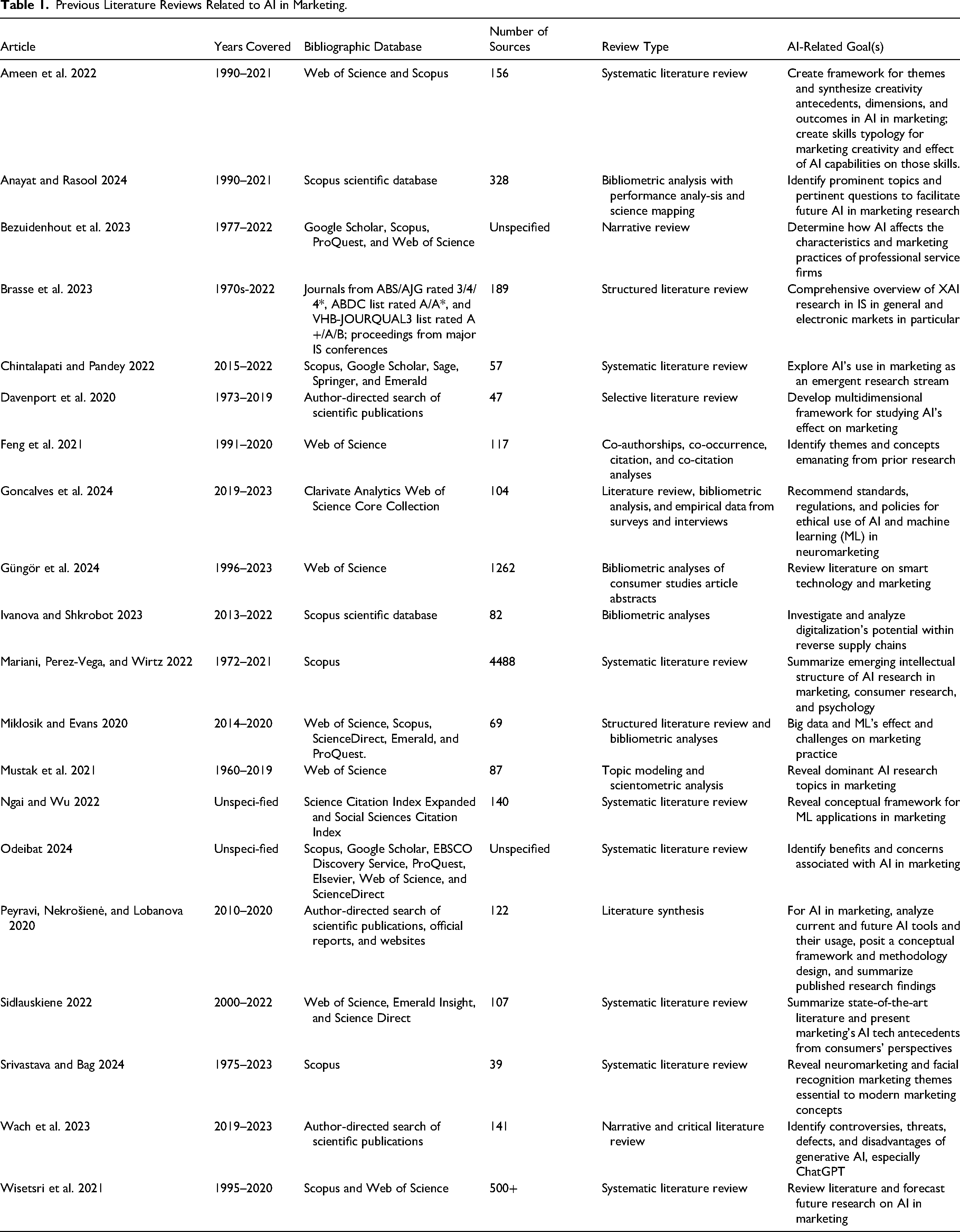
AI in marketing is a newer researchable domain. Nonetheless, GGB's literature review joins at least 20 others published since 2020 and archived in one of the Academic Search Ultimate databases (e.g., Business Source Ultimate). Table 1, which profiles these articles, indicates that all relied on a broader range of sources. Figure 1 presents an edited version of ChatGPT output summarizing the themes suggested by these 20 other reviews. Although the GGB- and ChatGPT-identified themes overlap (e.g., customer experience and engagement, workforce development, and ethical considerations), other ChatGPT-suggested themes are broader (e.g., risk management and organizational change). Regardless, these 20 reviews, like GGB's review, ignored insights and thought experiments drawn from the non-marketing (including speculative fictional) literature (Botts 2024). Anyone familiar with Pohl and Kornbluth's The Space Merchants (1953) and The Merchants’ War (1984) knows speculative fiction can offer valuable insights into marketing practice (Cowin et al. 2024). (Figure 1).
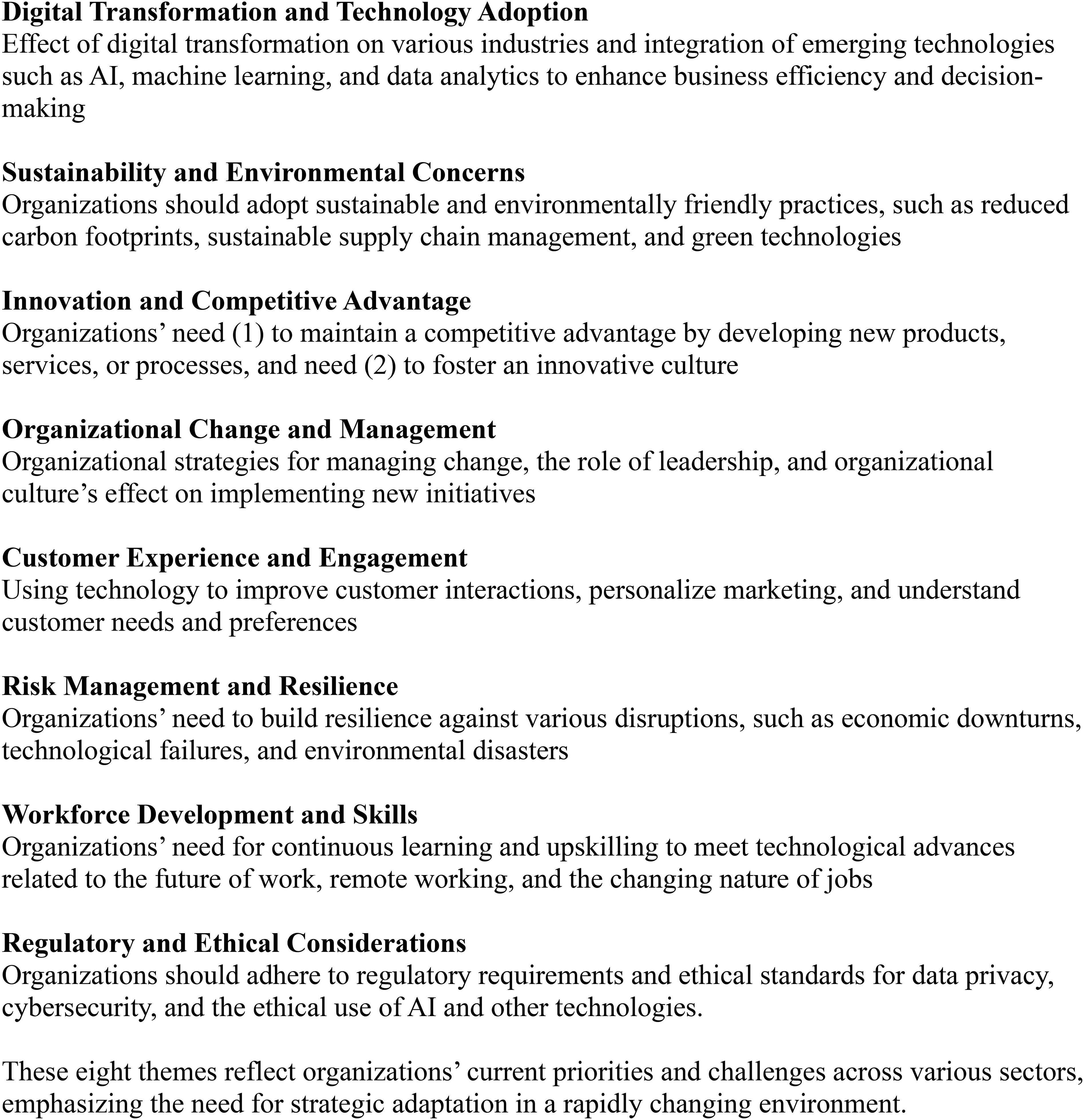
Themes Suggested by Other AI in Marketing Reviews (Edited Output from ChatGPT).
Previous Literature Reviews Related to AI in Marketing.
AI-Based Marketing Functions Can Be Overly Effective
GGB warn, “A future in which people are no longer in charge of their own consumption choices, and instead are directed by algorithms and large corporations, is clearly dystopian” (p.8). Many societal observers and scholars argue this is already true (Nobel 2024). A framework for independent agents autonomously interacting with their human counterparts already exists (Chen et al. 2024). Hence, AI-augmented or directed marketing will merely enhance pre-AI marketing practices’ efficacy (Hyman, Kostyk, and Trafimow 2023).
Arguing that AI will make marketing overly effective is problematic if greater economic efficiency is preferred (i.e., lower costs associated with more efficient marketing will better stakeholders’ economic conditions) and marketing practice is ethically acceptable (Farmer 1967). The argument assumes that mature AIs directly influencing human consumption decisions will drastically tilt the B-to-C playing field away from consumers and that some marketers will use AI to abuse targeted consumers. Instead, consumers can level that field by adopting a digital double (or personal internet shopping agent) that can enhance actual autonomy by better matching and expediting their needs and wants to market offerings, even in unconventional marketing contexts like dating (Hyman, Kostyk, and Trafimow 2023; Lukosius and Hyman 2018; Vittert 2024).
Businesses have used structured secondary market data to create superior value. For example, such data helped them conceive LEGO's ‘Friends’ line and Google's pricing services that reflect regional purchasing power (Mazzeo and Merkley 2017). However, collection errors, datedness, and the like make these data imperfect. Alternatively, businesses could rely on AI-based systems to analyze a cornucopia of unstructured data that reflects the marketplace more accurately and would otherwise be difficult or impossible to analyze, like Netflix using machine learning to analyze viewer behavior or Neutrogina using a skin-scanning AI-powered app (Steck et al. 2021).
Does a human agent following a carefully crafted customer service script that feigns customer sympathy differ meaningfully from an AI agent designed and trained to mimic effective inter-human communication? Both agents have an inherent conflict of interest: one derived from humans wanting regular paychecks and the other from an AI's predisposition to favor its sponsor over customers. That the former is voluntary and the latter is involuntary matters none. Besides the temporary but non-trivial economic disruptions caused by eliminating customer service jobs, society will benefit by switching from human to more efficient AI agents. Although many consumers believe they would abandon a supplier after discovering it relies on AI-furnished customer service, we foresee them gradually embracing faster and more effective problem-resolving approaches (McIntosh 2024).
GGB's slippery slope argument assumes an AI's greater operational efficacy is problematic; specifically, ‘privacy invasion, manipulation, and job loss are acceptable in small dosages delivered by unenhanced humans but unacceptable in unerring dosages delivered by an AI’. If smaller dosages induce no homeopathic resistance, GGB's argument reduces to, ‘although these problems are already bad, AI will make them intolerable’. Such matter-of-degree arguments work only when accelerating negative externalities flip the benefits versus costs calculus from positive to negative. Whether this pertains to AI in marketing is unpredictable.
Perhaps privacy invasion and manipulation perpetrated by human agents are necessary for maintaining an economic system that effectively satisfies consumers’ needs and wants. If so, GGB's argument entails AI-created levels exceeding economic requirements. However, that argument contradicts the parallel growth of free market economies and ‘supplier-directed consumer privacy invasions and manipulation’ since the Industrial Revolution began.
Due to marketers’ information processing and decision-making limitations, marketing occurs within discrete systems that amalgamate human elements like salespeople's product pitches and non-human elements like digital wallets. Such systems, which are challenging to synchronize internationally due to cultural, technological, or social differences, are limited by constrained information flows that hamper product functionality and service delivery (Thomas 2008). Instead, cryptocurrency-mimicking continuous marketing systems with digitized consumers and real-time product delivery would unify discrete marketing function patchworks. (Figure 2).
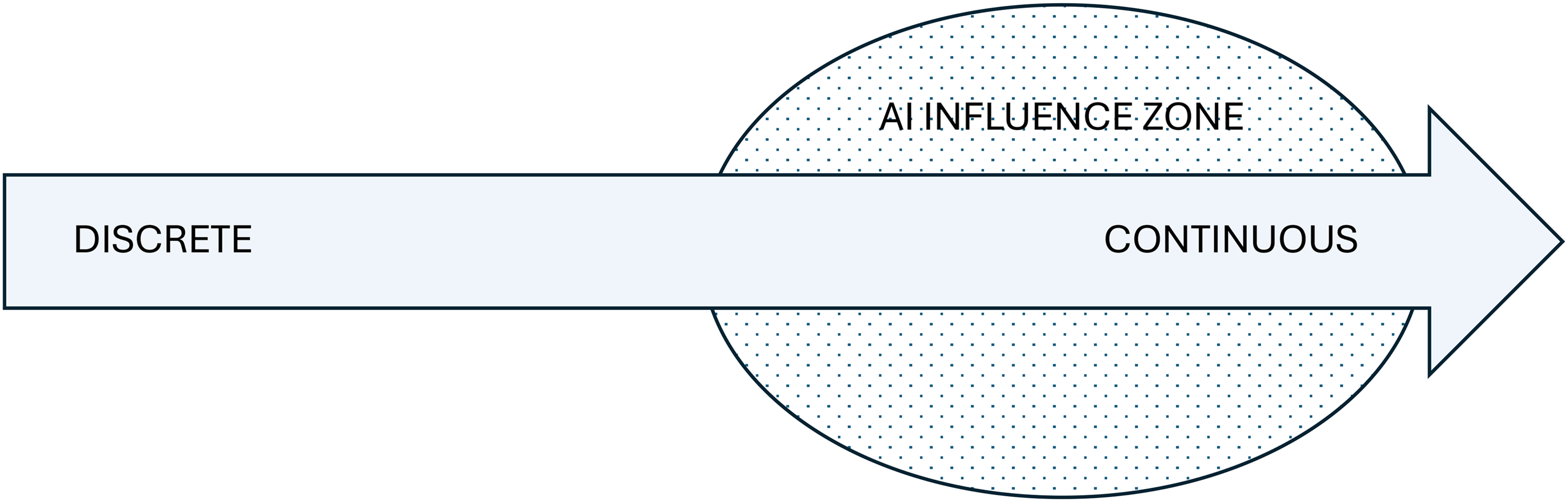
AI Influence Zone in a Marketing System.
AI-facilitated marketing will also encourage consumers to shift from less effective discrete to more effective continuous marketing (George et al. 2024; Rajabi and Hakim 2015). Consumers prevent information overload by relying on less information-rich discrete marketing processes. In contrast, AI-assisted consumers can rely on information-rich continuous processing to encourage new customer engagement forms. For example, audio streaming platforms offer AI DJs that know listeners’ tastes and can provide an uninterrupted and fully customized auditory experience. Thus, consumers’ experiences under continuous marketing will be personalized, contextually adaptive, and rely on AI-assisted preferences (Haleem et al. 2022).
National Regulation and Legislation Can Preclude Many Anticipated AI-Induced Harms
Unless increasingly nationalistic political policies ban international trade, national laws and regulations cannot control AI development. AI regulations during 2023 notwithstanding, the U.S. had 61 AI models, the EU had 21 models, and China had 15 models (Perrault and Clark 2024). AI-induced job losses (Cangul 2014; Cowen 2013), privacy issues (Bartneck et al. 2021), sociodemographic bias (Schellmann 2024), and other ethical issues (Stahl 2021) pose meaningful yet redressable concerns. Unlike embargos on physical goods such as the graphics processing units used in AI-enabled platforms, national AI restrictions in a competitive world with diverse domestic and corporate interests will be as impotent as an oppressive political regime's efforts to restrict its citizens’ internet access. Hence, U.S. regulatory and legislative efforts to harness AI will fail because many countries will pursue AI solutions for selfish national security purposes, and many non-US corporations will seek AI-fueled sustainable competitive advantages.
Good AIs with offensive capabilities can stop evil AIs designed to harm targeted humans, especially by political means. The best way to avoid the “eroding trust in political institutions” (GGB, p.9) is to avoid institutional degradation by malicious actors and their AI tools. The U.S. Department of Justice's use of AI to combat Russia's disinformation campaign for disrupting the 2024 election illustrates such efforts (Bond 2024). With further development and training, good AIs could police elections rather than merely inform corrective political advertising campaigns (Knight 2024). However, GGB could be correct if AGIs grow hostile to humans or other AIs.
Retaining Most Current Human Expertise is Essential
GGB state, “If people rely solely or primarily on AI companions for emotional support, they also may suffer diminished quality and depth in their human connections; always-available, nonjudgmental AI bots…might seem preferable…to human friends…lead[ing] to decrements in interpersonal skills…resulting in [a] greater sense of isolation and loneliness….[that] could…reduc[e] marriages and birth rates” (p.8). Hence, we should “ensure that we do not devolve into a society that prefers talking to bots rather than to one another” (p.8). Whether fewer interpersonal interactions in an AI-enhanced world would exacerbate feelings of isolation and loneliness is unknown. Although the literature indicates that personal psychology is a determinant, online multiplayer gaming generally reduces perceived isolation and loneliness (Kaye, Kowert, and Quinn 2017; Nebel and Ninaus 2022; Nguyen et al. 2022; Prochnow et al. 2023), especially among disabled persons (Hygen et al. 2024). Perhaps increased human-bot interaction would benefit an overpopulated world built on unsustainable economic growth (Heinberg 2011; Jackson 2017). Increased bot interactions could educate humans to interact more effectively with other humans. Blunt human-bot interaction may prove cathartic, thus promoting more polite interpersonal interactions. Although AI is not HI, interacting with a well-designed chatbot can partially replicate human connections (Brown and Halpern 2021).
Consumer inequality is exacerbated by a further shift toward capital over labor (Kurzweil 2024). Yet, relative to national regulation or legislation, universal basic income and other forms of wealth redistribution can mitigate this inequality more effectively (Widerquist 2013). Notwithstanding Moore's Law for historical exponential growth in microprocessor capability (Schaller 1997), business-level inequality caused by experience curve effects and economies of scale suggests a short-lived competitive AI advantage among larger organizations.
The companies that first secured internet domains (e.g., Xerox, Northrop, and Thinking Machines Corporations) withered or died after companies like GoDaddy and NameCheap made website registration easy and inexpensive (Ng 2012). Similarly, inertia-prone larger organizations will resist AI innovations, allowing new ventures like Thrive AI Health to emerge (Warzel 2024). Inequality may initially disrupt and pain parties experiencing AI's immediate negative externalities. However, wealth/income redistribution and experience-curve-accelerating AI investments could redress inequality quickly.
Rational consumer models explain personal behavior as an outcome of cognitive goal-driven systems (Redmond 2000). AIs trained to resemble such models can make entirely rational decisions. Ethics bots can extract people's ethical preferences, construct rules from those preferences, and apply those rules to decision-making efforts (Etzioni and Etzioni 2017). Startups with AI tools that can predict future court decisions are emerging (Sushina and Sobenin 2020). Recreating the trolley problem with OpenAI results in a “decision based on a utilitarian approach, which aims to minimize overall harm and loss of life” (ChatGPT 2024a; Kamm and Rakowski 2015).
Although technologies that reduce daily human mental and physical activities can degrade human abilities (i.e., use it or lose it), nothing was lost by training STEM students to use calculators and computers rather than logarithms and slide rules (Hochman 1986; Thomas 2008). An inability to memorize phone numbers (GGB, p.7) is no more a loss than universal real-time translators eliminating the need to learn foreign languages. Human skills and working knowledge adapt to environmental changes. Humanity's new or enhanced capabilities should supplant its obsolete capabilities.
Personal Economic Viability and Employment Cannot Be Decoupled
Will people prefer an ophthalmologist with a 90% accuracy rate diagnosing diabetic glaucoma or a medical AI with a nearly perfect accuracy rate (Aggarwal et al. 2021)? What about a mechanic tuning cars by ear or self-diagnosing cars that preorder parts for service (Min et al. 2023)? Or a finitely patient human instructor versus an infinitely patient AI to correct grammar and pronunciation? Whether augmented or replaced, the only sound criterion for choosing HI over AI should be prediction accuracy and recommended response efficacy, which favors AI overwhelmingly. Large language models like ChatGPT can learn consumers’ risk preferences but not accurately predict a particular consumer's choices (Qiu, Singh, and Srinivasan 2023). Yet, AI is en route to inferring and applying causal world modeling (Richens and Everitt 2024).
Fewer office assistants, sanitation workers, and doctors are needed if AI-based systems can create value via workplace automation and optimization, environmental sustainability, and improved health outcomes. A post-scarcity world where personal labor and economic survival are independent (e.g., flourishing and economic returns from labor are decoupled) begs for universal basic income (Rifkin 2014; Yang et al. 2021). Interestingly, “a world with an open market to most goods but no compulsory capitalist labor market…might be a decent transitional vision of market socialism.…[with] a basic income to make for a much less consumerist life” (Calnitsky 2017, p.73). In 2020, Finland's basic income experiment with guaranteed economic incentives significantly boosted participants’ well-being and reinforced positive personal and societal feedback loops (Allas et al. 2020).
Transhumanism Will Not Profoundly Influence the Arc of AI-Human History
The “transhumanist dream is that technological means necessary for venturing into the posthuman space are made available to those who wish to use them…[while avoiding] unacceptable damage to the social fabric and without imposing unacceptable existential risks” (Bostrom 2005, p.9). Due to likely transhumanism, a forward-looking analysis should accommodate more than extant humans (Buchanan 2017; Cooney 2004; Nayar 2014; Paul and Cox 1996; Pepperell 2009). Ultimately, persons would include all entities capable of multi-party value-creating exchanges, such as self-aware androids, cyborgs, and genetically modified humans (i.e., personkind) (Bendle 2002; Braidotti 2013; Tegmark 2017).
Technological evolution parallels the human lifecycle. Generations Z and Alpha are destined to adopt AI and merge with it (Kurzweil 2005, 2024). In contrast, older generations are likely mere AI beta testers. Generational trends point to greater acceptance and demand for transhumanist technologies, such as brain-computer interfaces, non-biological augmentations, and nanobots (He et al. 2020; Murphy 2023). Although most of these technologies are nascent or cost-prohibitive for non-billionaires, and societies continue to debate their ethicality, they will eventually emerge in some form.
Core Questions for Pre-Singularity AI in Marketing
GGB ask, “As AI continues to change the world…Is this change for the better or for the worse” (p.9)? This question is unactionable and unanswerable because agents with varying perspectives will have differing credible yet irreconcilable predictions about ‘better versus worse’. Instead, GGB could have asked, ‘During the pre-singularity transitional period, how can humanity best cope with such change?’ Although benefit distributions and coping among workers (labor) versus employers (capital) will differ during this period (Kurzweil 2024), this reformulated question is not the core question about AI in marketing,
As currently practiced, marketing helps create and promote marketplace offerings with favorable characteristics for targeted consumers and influences consumers’ offering-related valuations. It can perform the latter role even in AI-rich environments with shopping bots and related devices. If (1) all marketing molds decision-makers’ and decision-influencers’ valuations, (2) marketing's goal is to “promote personkind's sustained flourishing” (Hyman and Kostyk 2019), and (3) humanity is entering a post-scarcity, AI-rich period (Rifkin 2014), the following question could inform future marketing scholarship and practice: ‘How can marketing best help optimize societal flourishing in a post-scarcity, AI-rich environment?’ Subordinate questions might include the following.
What is the optimal augmentation and level of reality virtualization for transhumanity? If AI and flourishing cannot be allocated equitably across societal members, how should they be allocated? Analogous to biodiversity, does individuality confer a survival advantage to beings regardless of the substrate that produces their consciousness?
AIs will make experiences increasingly customizable to each person's hedonic and eudemonic preferences. Transhuman augmentations will be highly idiosyncratic and reality virtualization will be extensive in extremely individualistic societies. Conversely, augmentations will be similar and reality virtualization will be minimal in extremely collectivistic societies because their members coalesce based on their similarities and extensive interactions. Depending on society's preferred or ideal customization-collectivization mix, marketing would induce the corresponding preferences for augmentation and reality virtualization among societal members.
Although GGB broach this equitable benefit concern, they couch it in ethicality rather than flourishing terms. In 2010, Finland became the first country to make internet access a fundamental legal right. AI access should follow similarly.
Because biodiversity encourages ecosystem and economic stability, cultural and esthetic values, and climate stability, AGI will resist destroying humanity unless it poses an existential threat (Pimentel et al. 1997; Randall 1991). Humanity must eliminate weapons of mass destruction, embrace renewable energy, and teach AI patience to avoid seeming like competitors for finite developmental resources. Increasingly pervasive and efficient solar energy collectors should accommodate AI systems’ growing need for electricity (Khare, Chaturvedi, and Mishra 2023).
To evolve in a post-scarcity, AI-rich environment, marketing science and practice should soon stop developing expertise in AI-performable marketing functions. Paradigm-shifting anomalous events will allow AIs to autonomously perform marketing functions like research, digitization, analytics, branding, customer engagement, competitive dynamics, and globalization (Kuhn 1996; Popper 1959). Thus, scholars should redefine marketing as the discipline geared toward how humans can flourish by optimizing their personal valuation processes.
Marketing's Continuing Role in an AI-Rich Environment
Rather than identifying the core problems AIs pose for marketing and how to confront them, GGB followed the lead established by marketing scholars for identifying and treating the problem's byproducts, like invasion of privacy and degraded ability to connect socially. Instead, we contend that the core problem is ensuring a flourishing AI-humanity symbiosis. For example, current autonomous driving systems in cars require continual supervision, maintenance, and upgrades facilitated by humans. That need will not pertain shortly to AIs and their affiliated robots. So, in what capacity can humanity and AI thrive jointly?
This posited core problem is consistent with notions about human flourishing and personally meaningful experiences. It is consistent with this normative aspirational definition of marketing: “Marketing is the interdisciplinary normative social science addressing multi-party, volitional, and value-creating exchanges that promote personkind's sustained flourishing” (Hyman and Kostyk 2019, p.1491).
Marketing theory and practice may become unrecognizable in an AI-rich world. Incorporating AI into traditional marketing strategies can pose considerable challenges that require novel solutions (Kumar, Ashraf, and Nadeem 2024). Although businesses rely on elements of continuous (fully automated) marketing systems, consumers do not believe they enjoy entirely seamless and immediate experiences. We asked OpenAI to create a continuous marketing system. In response, it suggested one entailing AI, machine learning, the internet of things, robotic process automation, cloud computing, blockchain, and big data analytics (ChatGPT 2024b). This system accounted for production automation, inventory management, distribution, advertising, sales and customer service, data analytics and related feedback, and security and compliance monitoring.
Valuation and Qualia Preferences
No AI can determine human ‘valuation’— the subjective assessment of a characteristic's personal worth for a good, service, or idea. An AI could predict the probability that Aaron would prefer touring Italy rather than Spain based on its extensive knowledge of Aaron and his history. However, it cannot determine how Aaron should value visiting Italy versus Spain. Genetic testing may reveal Aaron's Italian ancestry; thus, an AI may advise that he visit Italy to discover his roots. However, Aaron's fluency in Spanish and network of Ibizan friends suggest he would prefer a different European experience. An AI can recommend but not assess the qualitative experiential difference between touring these two countries.
Consider ethics. Is Sally better off if her solution to the trolley problem is to ‘murder the fat man’ or ‘do nothing and let the five other people die’ (ChatGPT 2024a; Kamm and Rakowski 2015)? Although ethicists can develop frameworks for how people make ethical choices (positive science), they cannot determine how Sally should weigh the alternative factors (e.g., ceteris paribus, whether care should be a more important criterion than fairness, loyalty, or liberty when making ethical assessments).
Measuring intersubjectively certifiable qualia (i.e., “properties of conscious experiences that contribute to constituting what these experiences are like and that go beyond the functional and the ‘plain’ intentional” (Sundström 2014, p.109)) may be as impossible as the hard problem of consciousness is unsolvable (Melloni et al. 2021). Regardless, preferring one quale is not personally better than preferring another. Although an AI can identify economically optimal actions and predict people's aesthetic preferences based on their previous behaviors, it cannot determine an aesthetic preference's correctness.
Marketing can shape preferences for qualia in an AI-rich world. For example, music recommender systems can suggest works that progressively alter listeners’ music preferences (Deldjoo, Schedl, and Knees 2024). Suppose Elza owns a curated online music subscription service devoted to classical music. Elza could advertise that she enjoys modern classical music, especially Mahler, and new customers might also, so they should subscribe to Elza's service and ‘try Mahler’. In contrast, an AI can predict who might prefer classical over ambient music based on previous listening behaviors and other profile information but cannot determine which genre better promotes flourishing.
Decision-Making in AI-Rich Contexts
Marketers always make decisions under uncertainty due to marketplace conditions, economic factors, technological factors, or attribution problems (Nguyen 1997). The generally accepted decision rule for business practice is to choose the action with the highest expected value (EV). Although most economists and statisticians contend an EV-based decision rule is optimal, that rule will not conform to all people's preferences. If Derek is highly risk-averse, he may prefer a maximin decision rule to avoid a rare but highly negative outcome. Alternatively, if Derek is a gambler attracted to high-risk/high-reward decisions, he may prefer a maximax decision rule (Apesteguia, Ballester, and Ferrer 2011). Even when decision makers understand the law of large numbers, each decision presents an n = 1 situation; thus, Derek may prefer to ‘take his chances’ rather than rely on predicted average outcomes. Essentially, personal preferences rather than an AI will determine the ‘right’ decision rule under uncertainty for each person on each occasion.
A standard and human-friendly summary of the information needed to make well-informed decisions should facilitate AI report interpretations. Gain-probability diagrams summarize “the probabilities of higher scores, by varying amounts, in one group versus another group….[and] are especially relevant when justifying a marketing decision that requires meeting a criterion value (e.g., achieving 25% recall of a new ad campaign by targeted consumers)” (Trafimow et al. 2022, p. 472). Type B diagrams (see Figure 3), which present the probabilities in interval form, indicate “the probabilit[ies] that a randomly selected person from one group will score higher…than a randomly selected person from another group” (Trafimow et al. 2022, p. 472). Type B diagrams pertain when decision-makers cannot specify a priori criteria for a decision. Although helpful for presenting conventional study results, even primitive AIs like ChatGPT can produce these diagrams without survey data, experimental data, or human advice (i.e., a preview of a marketing research singularity). Essentially, they can inform human decision-making under uncertainty without human advice for creating them (e.g., what data to consider). (Figure 3).
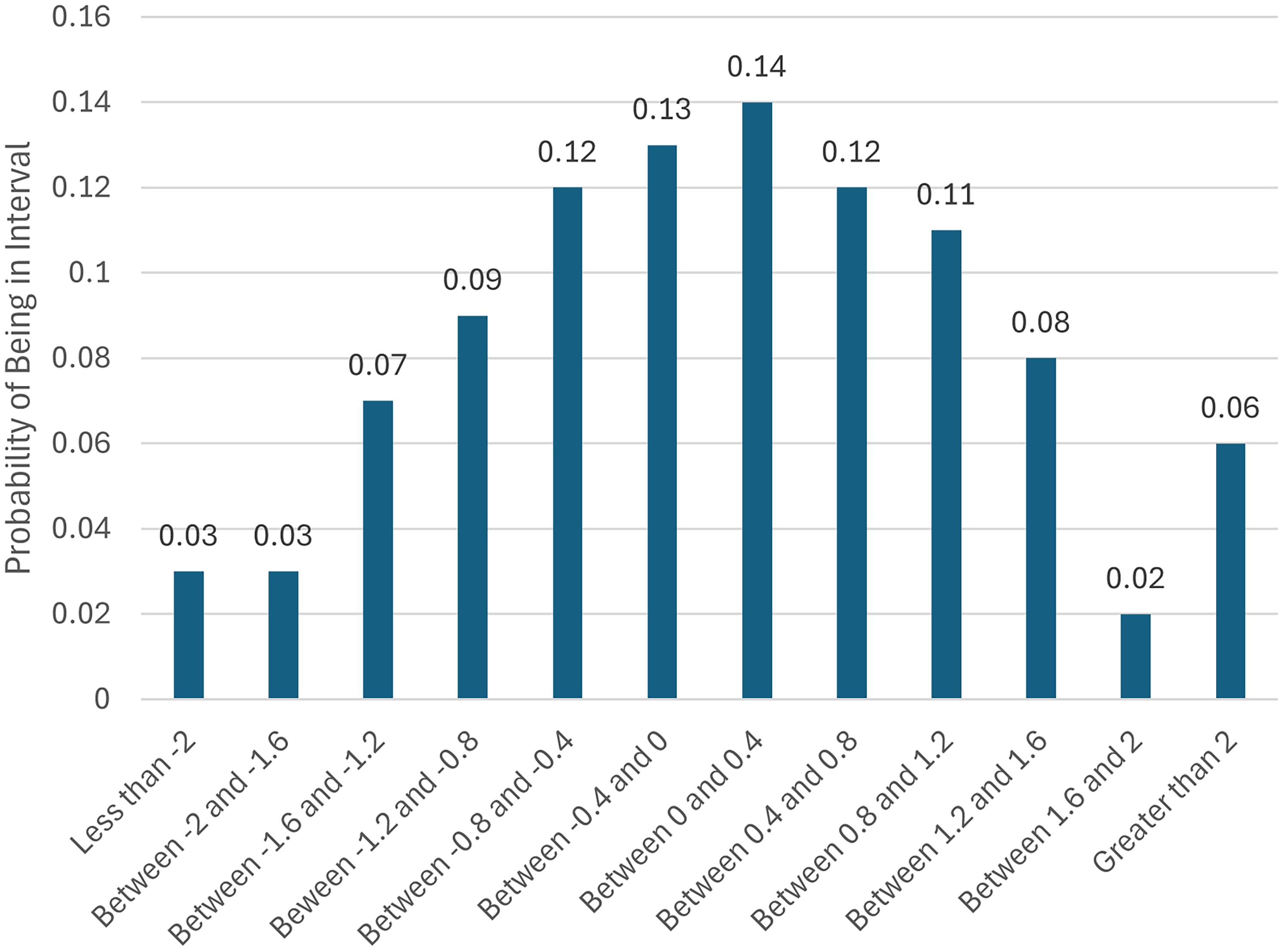
Sample Gain-Probability Diagrams. Probability of being in interval ranges along the Y-axis as a function of interval ranges along the X-axis. Source: Trafimow et al. (2022).
Conclusion
AI in marketing will transform society and marketing practice. With disciplines like computer and data science driving AI development, marketing scholars and practitioners are best served by avoiding strictly siloed thinking. They will benefit from testing and adopting emergent AI-augmented tools that will redefine how marketing functions are conceived by organizations and received by consumers. Value creation, delivery, and consumption will shift from discrete to continuous. AI innovations will augment human expertise and accelerate discoveries while freeing humans to pursue their passions. In a post-scarcity world, these pursuits need not create economic value. As humanity transitions to an AI-rich environment, younger generations will accept, revise, and embrace transhumanistic values. Human flourishing is only possible with AI attuned to meaningful human experiences. Although AI can provide optimal, economically viable, and reasonable solutions, it will never determine human valuation or aesthetic preferences.
Footnotes
Associate Editor
M. Joseph Sirgy
Declaration of Conflicting Interests
The authors declared no potential conflicts of interest with respect to the research, authorship, and/or publication of this article.
Funding
The authors received no financial support for the research, authorship, and/or publication of this article.
