




Abstract
Institutional storytelling is an increasingly prominent communication strategy, yet research has primarily focused on how institutions tell stories to individuals rather than how they can elicit stories from individuals. This conceptual paper explores the identity-shaping potential of institution-initiated storytelling, positioning it as a transformative communication process that operates across micro (individual), meso (peer/community), and macro (cultural) levels. Drawing from research on narrative identity, self-persuasion, and macromarketing systems, we develop a framework showing how storytelling fosters self-reflection, professional identity development, and social belonging, while also influencing collective norms and cultural narratives. To ground this framework, we provide an illustrative case study of a storytelling intervention designed to strengthen STEM identity and reduce impostorism among graduate students. Findings suggest that institutional storytelling can be a powerful mechanism for empowerment and social change, but also reveal its complexity, highlighting the importance of ethical and inclusive design in storytelling practice.
Introduction
Institutions across sectors are increasingly inviting individuals to share personal stories tied to identity, growth, and belonging. For example, the UNHCR's “Refugee Stories” campaign provides a platform for displaced individuals to share their lived experiences, with the goal of challenging stigma, building empathy, and shaping global narratives about migration. Similarly, Dove's #ShowUs initiative invited women and non-binary individuals to share personal stories and images that promote a more inclusive vision of beauty, reshaping cultural ideals through lived experience. These examples reflect a broader shift in public communication, where institutions, whether commercial, civic, or humanitarian, actively engage individuals in co-constructing meaning. This pull-oriented approach contrasts with traditional push institutional communication, where institutions broadcast messages to audiences regardless of personal resonance or relevance (Barnes, 2002).
Research suggests that organizations adopting a pull-oriented communication approach can reap significant benefits, including increased individual engagement (Okazaki & Barwise, 2011) and greater public communication effectiveness (Trivedi et al., 2020; Zhang et al., 2023). In contrast, work on storytelling in institutional and marketing contexts has focused on the effects of push-oriented approaches, where institutions craft and disseminate stories to shape public perception and help achieve organizational goals (Orazi et al., 2025; Turner, 2025; Van Laer et al., 2014). Both research streams have primarily emphasized benefits for institutions and the institution-audience relationship, often overlooking implications for the individual consumer as well as broader, systemic-effects. What are the consequences for the individuals who participate in these campaigns beyond shifts in perceptions of the institution? And, beyond the institution-individual dyad, how might these initiatives shape the wider social environment?
In this paper, we explore how institution-initiated storytelling—a form of communication in which institutions invite or elicit personal stories from individuals—can catalyze social change at the micro (individual), meso (peer/community), and macro (societal) levels (Akaka et al., 2023). We focus on storytelling given its prevalence in the business communication landscape (Dahlen et al., 2009; Turner, 2025) and its well-documented ability to influence not only those who hear stories, but also those who tell them (Rogers et al., 2023). We outline how institutions can serve as platforms that empower individuals, such as employes, customers, or students, to share personal stories of challenge and growth in ways that reinforce identity, activate reflection, and ripple outward to influence others.
Our contributions to the literature on macromarketing and institutional storytelling are threefold. First, we introduce and conceptualize institution-initiated storytelling—distinct from institution-focused storytelling—as a mechanism for advancing stakeholder wellbeing and social good. While prior work has primarily examined institutional storytelling in terms of organizational outcomes such as engagement or reputation, we highlight its potential to generate prosocial, identity-related change for participants themselves. Second, we extend research on narrative persuasion by shifting attention from the audience to the storyteller, demonstrating how the act of constructing and sharing personal stories can transform the narrator's self-view, values, and sense of belonging. Third, we develop a multi-level framework that situates institutional storytelling within macromarketing systems, linking individual identity work (micro) with peer and community dynamics (meso) and broader cultural discourse and policy influence (macro). In doing so, we advance macromarketing theory toward a richer understanding of how narrative practices contribute to wellbeing and systemic social change.
Conceptual Development
Storytelling in Marketing Communications
A great deal of research in the narrative persuasion literature illustrates the foundational importance of storytelling in promotional and marketing communication (Glaser & Reisinger, 2022; Turner, 2025). This work largely focuses on how stories persuade audiences; that is, how stories induce narrative transportation, an experience in which people mentally detach from their physical environment and relocate to the story world (Green & Brock, 2000; Van Laer et al., 2014). The transportation process can cause audiences to generate mental images of story events, become cognitively and emotionally engaged in a story as it unfolds, and reduce their generation of counterarguments. As a consequence, they are more likely to think and act in a story-consistent way (Escalas, 2004; Van Laer et al., 2014).
Yet, this focus on audience effects has led to a relative neglect of another potentially influential role in storytelling: the storyteller themselves. While some research implies that telling a story may influence the storyteller (e.g., Escalas, 2004), few studies directly examine how crafting and narrating a story shape the storyteller's own thoughts, feelings, or behaviors. However, research outside of the domain of narrative transportation provides a starting point as to how storytellers might become influenced by their own stories (Petrican et al., 2008). Classic work on self-perception (Bem, 1967) and self-persuasion (Aronson, 1999) has found that the mere act of communicating one's position on a topic can influence one's subsequent attitudes (Bernritter et al., 2017) and behaviors (Schwardmann et al., 2022).
We build on prior marketing and self-perception work to examine how storytelling can influence not only those who receive messages but also those who construct them; particularly when institutions provide the platform. We focus on what we term institution-initiated storytelling: the practice in which institutions prompt, invite, or incentivize individuals to share their own narratives through structured prompts, public campaigns, or storytelling platforms. This stands in contrast to institution-focused storytelling, where institutions themselves construct and disseminate stories to shape public perception or promote organizational goals. For example, a nonprofit that shares a video about its community impact is engaging in institution-focused storytelling, whereas one that invites volunteers to share how their service shaped their lives is practicing institution-initiated storytelling. While both approaches leverage narrative as a tool of institutional communication, institution-initiated storytelling places individuals at the center of the narrative, offering opportunities for identity construction, reflection, and prosocial transformation.
Narrative Identity
Identity is a foundational concept to institutional communication and consumer research, with decades of research illustrating that how people see themselves (i.e., their identity) drives what they do and how they consume (Reed et al., 2012; Shavitt et al., 2009). Gee's (2000) multiple identity framework posits that all people possess multiple co-existing identities. These identities are continually shaped through personal, social, and contextual forces. Further, reminding people of a certain identity can guide behavior in relevant ways. For instance, making prosocial aspects of identity salient can nudge individuals to behave in a socially responsible manner (White et al., 2019).
A large body of research conceptualizes identity as narrative in form: individuals integrate experiences into evolving life stories that provide unity and purpose (McLean et al., 2020; McAdams & McLean, 2013). What shapes understanding is not the objective event itself, but how people assign meaning through storytelling. Individuals who find redemptive meaning in adversity and emphasize agency in their life stories tend to experience greater wellbeing (Adler et al., 2015).
Narrative identity research and identity research, more generally, converges on the notion that identity is constructed, and thus malleable. For instance, a common theme in research on role transitions explores the interplay between external changes (e.g., a new job) and one's internal self-view trying on provisional selves (Ibarra, 2023). People construct and amend their identities through reflection, which is a process where an individual revisits an experience and assigns meanings to it that can guide future action (Dewey, 1910). Through reflection, one imposes meaning on situations by framing and reframing events retrospectively to achieve coherence and continuity (McAdams & McLean, 2013). Importantly, recent evidence demonstrates that prompts to reflect on oneself can causally influence aspects of one's self-view: Rogers et al. (2023) showed that story-based prompts encouraging people to view their lives in terms of the hero's journey—a common cultural narrative—are associated with shifts in self-view and meaning in life.
In summary, prior work supports identity as a fundamental aspect of human psychology that can influence individual behavior in prosocial ways; identity takes the form of a story; and that positive changes in self-view and behavior can emerge from reflection. These changes can have impacts at the individual, group, and societal level, which we outline next.
Institution-Initiated Storytelling as Transformative Ecosystemic Intervention
We propose that when institutions invite individuals to reflect on and share meaningful personal stories, they initiate a form of communication that has the potential to generate change across interconnected levels of social experience. Grounded in a macromarketing perspective, we conceptualize storytelling as a systemic force that shapes not only individual identity but also peer norms, institutional cultures, and broader societal narratives. Macromarketing scholarship emphasizes the dynamic interdependence of marketing systems, institutions, and societal well-being (Layton, 2007; Mittelstaedt et al., 2006). Within this systems-oriented tradition, markets are understood as evolving social structures shaped by cultural narratives, institutional norms, and stakeholder relationships. We extend this view by positioning institutional storytelling as a mechanism through which marketing systems communicate values, reconfigure identity roles, and support or challenge dominant ideologies (Kilbourne et al., 1997). When institutions elicit and elevate personal narratives aligned with their social mission, they participate in the co-creation of cultural meaning, helping to reinforce or transform the social conditions in which marketing systems operate. In the sections that follow, we examine how these effects unfold across the micro (individual), meso (peer/community), and macro (societal) levels. See Figure 1 Below.
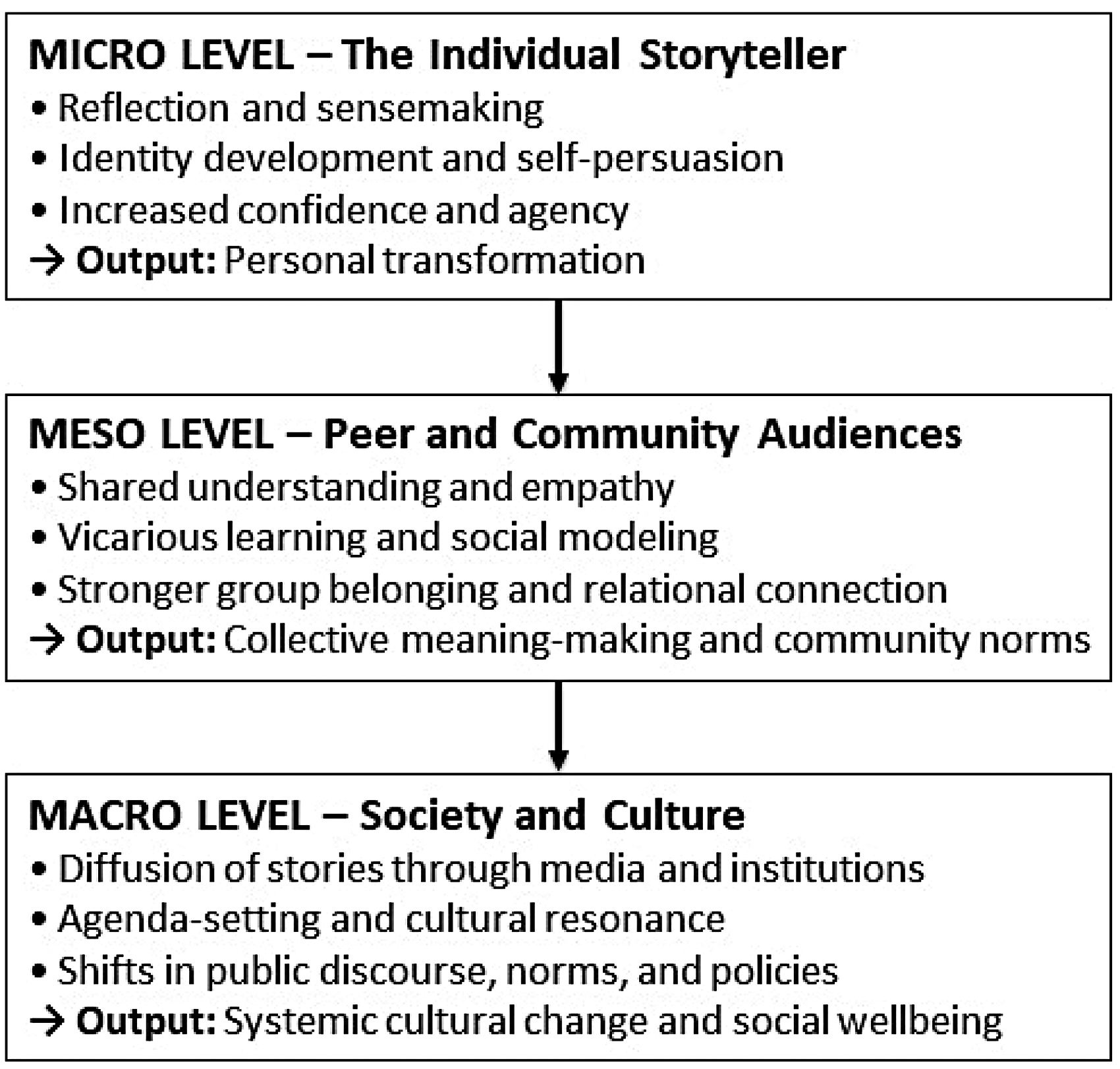
Institution-Initiated Storytelling Levels of Influence.
Micro-Level: The Individual Him/Herself
Relevant Processes
At the micro- or individual level, the unit of analysis is the storyteller themself. Here, the literature on narrative identity (Ibarra, 2023; McAdams & McLean, 2013; McLean et al., 2020) suggests that sharing a story can shape an individual's self-view. To be clear, it is the act of communicating a story that is especially impactful (Rogers et al., 2023), which may prompt several mutually-reinforcing processes: First, the commissive acts of writing or speaking, even privately, are more likely to evoke reflection than merely thinking about one's experiences alone (Boud et al., 1985). Reflection is the process of critically assessing the content, process, and premises of one's experiences to gain a deeper understanding of them (Mezirow, 1990). It involves questioning assumptions and recognizing how they shape perceptions, actions, and decisions. Communicating about one's experiences requires organizing thoughts in a coherent way, which encourages deeper examination of beliefs. For instance, an institution whose corporate social responsibility (CSR) efforts focus on being a climate upstander (Lteif et al., 2024) may ask people to share stories on their social media platform about a time they took pro-environmental action even when it was not easy. When individuals share these experiences, the process of reflection may crystallize their view of themselves as someone who is environmentally conscious.
Second, because institution-initiated storytelling typically involves public sharing, narrating self-related stories in these contexts may shape identity through another mechanism: cognitive consistency. Humans have a basic need for personal consistency in internal views and external communications (Cialdini, 2001) and in turn find cognitive dissonance aversive (Festinger, 1957). Sharing a story publicly committing to a certain type of identity may shape an individual's self-view such that it accords with the theme in the original story. Indeed, research shows that openly communicating a stance helps people further internalize and behave consistently with that view (Cialdini, 2001). Sharing a story via social media where one's friends, family, and community can view one's post about taking a pro-environmental action is an initial public commitment regarding one's identity that may shape behavior in the future.
The Role of the Institution: Micro Level
The role of the institution at this level is to guide the storytelling process in a way that yields positive benefits for the individual with respect to identity. This is most readily done through the process of prompt engineering: just as the output from generative AI models is enhanced when users take the time to strategically craft instructions, questions, or input formats, storytellers benefit from prompts that are thoughtfully designed to shape their self-view in specific ways. For example, instead of a prompt such as “How have you used our product?” a prompt such as “Tell us about a time when [Institution Name] helped you take charge of a challenge or achieve something meaningful” is more likely to elicit or shape content related to one's sense of agency a common theme or identity-related dimension (McLean et al., 2020). Examples may help, as well: “For instance, Maria shared how switching to our financial planning app helped her take control of her budget and save for her dream vacation. How has [Institution Name] empowered you to take action in your life?” See Table 1 for examples of prompts across various platforms designed to elicit stories related to individual agency.
Micro Level: Examples of Institution-Initiated Storytelling Prompts for Empowerment and Agency Across Common Public Communication Platforms.
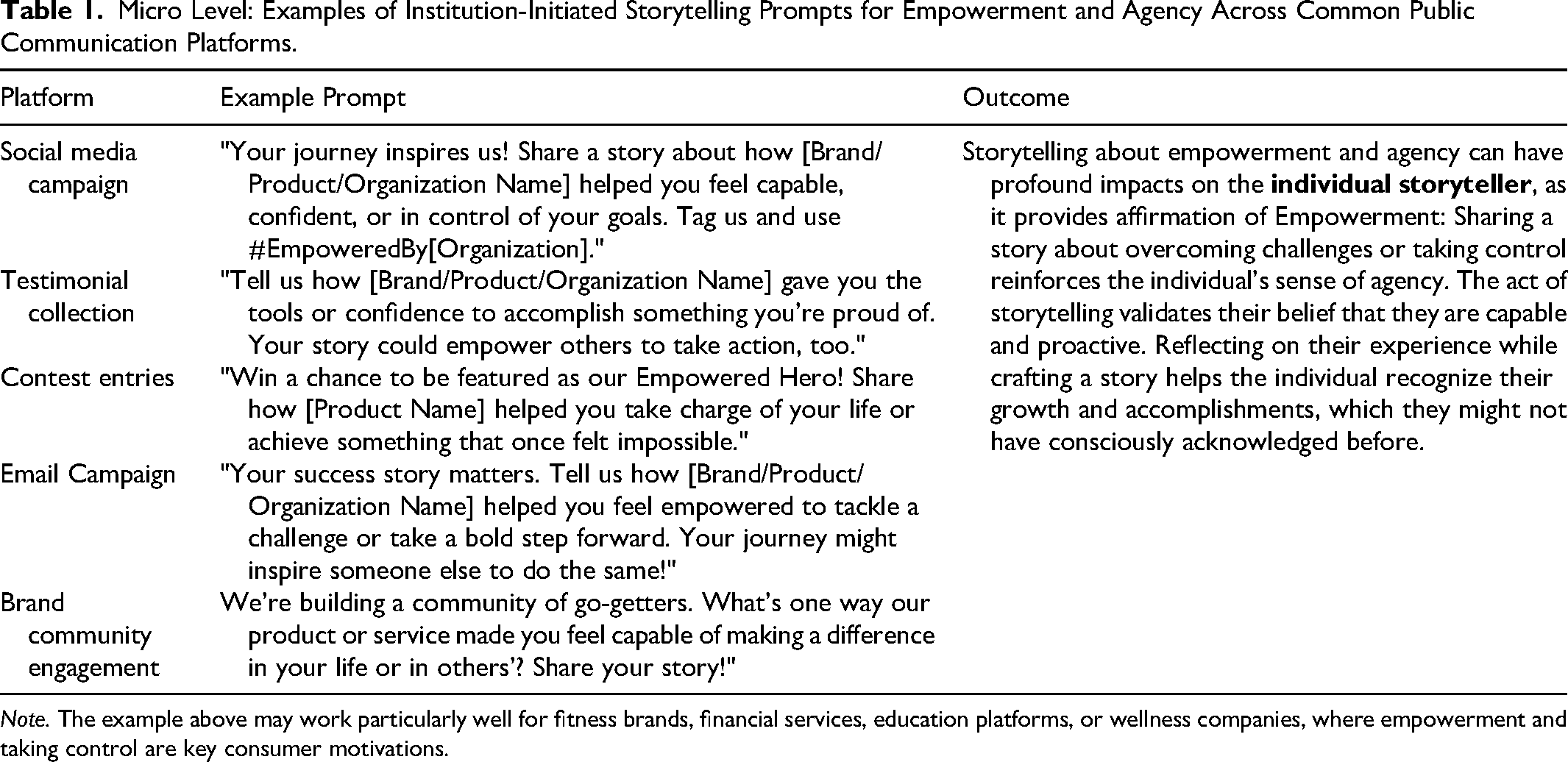
Note. The example above may work particularly well for fitness brands, financial services, education platforms, or wellness companies, where empowerment and taking control are key consumer motivations.
At a broad level, reinforcing aspects of especially prosocial identity can offer benefits for individuals, personally. Adams and Marshall (1996) proposed that identity formation provides five functions: it can provide a structure and order to self-knowledge; a sense of consistency and coherence to beliefs, goals, and self-knowledge; a sense of continuity for one's history and future; goals and direction; a sense of personal control of their choices and outcomes. Thus, institutions’ efforts to help individuals form prosocial identities, such as those related to professional identity, disability, and a sense of personal control through storytelling, can offer well-being-related benefits for the individual storyteller.
Meso-Level: the Individual's Immediate Peer Group
Relevant Processes
At the meso level, the unit of analysis is the storyteller's immediate physical or digital audience. Seeing or hearing a story can influence an immediate audience's behavior through several processes. First, being exposed to others’ stories can shape others’ views on a target through the process of narrative transportation, or becoming immersed in a story (Van Laer et al., 2014). When transported, audiences empathize with the protagonist, vividly imagine the story world, and align their thoughts and beliefs with the narrative's internal logic, making them more receptive to its messages (Green & Brock, 2000). Meta-analyses have demonstrated this persuasive storytelling effect in the context of institutional communication (Oschatz & Marker, 2020), health communication (Shen et al., 2015), and interventions focused on reducing stigma (Zhuang & Guidry, 2022). Thus, individuals who share their stories online may shape their audience's beliefs and attitudes in story-consistent ways.
Individual stories may also provide opportunities for vicarious learning, captured by Bandura's social learning theory (Bandura, 1977a, 1977b). Social learning theory emphasizes that individuals learn behaviors, attitudes, and norms by observing others, especially when outcomes are positive. Stories demonstrate how others have taken actions to achieve a goal and, in the case of institutional storytelling, may show how an individual successfully used the institution's product to solve a problem, offering strategies the audience can emulate. For instance, hearing how someone used a financial app to pay off debt inspires the audience to take similar actions, believing that they, too, can succeed.
The Role of the Institution: Meso Level
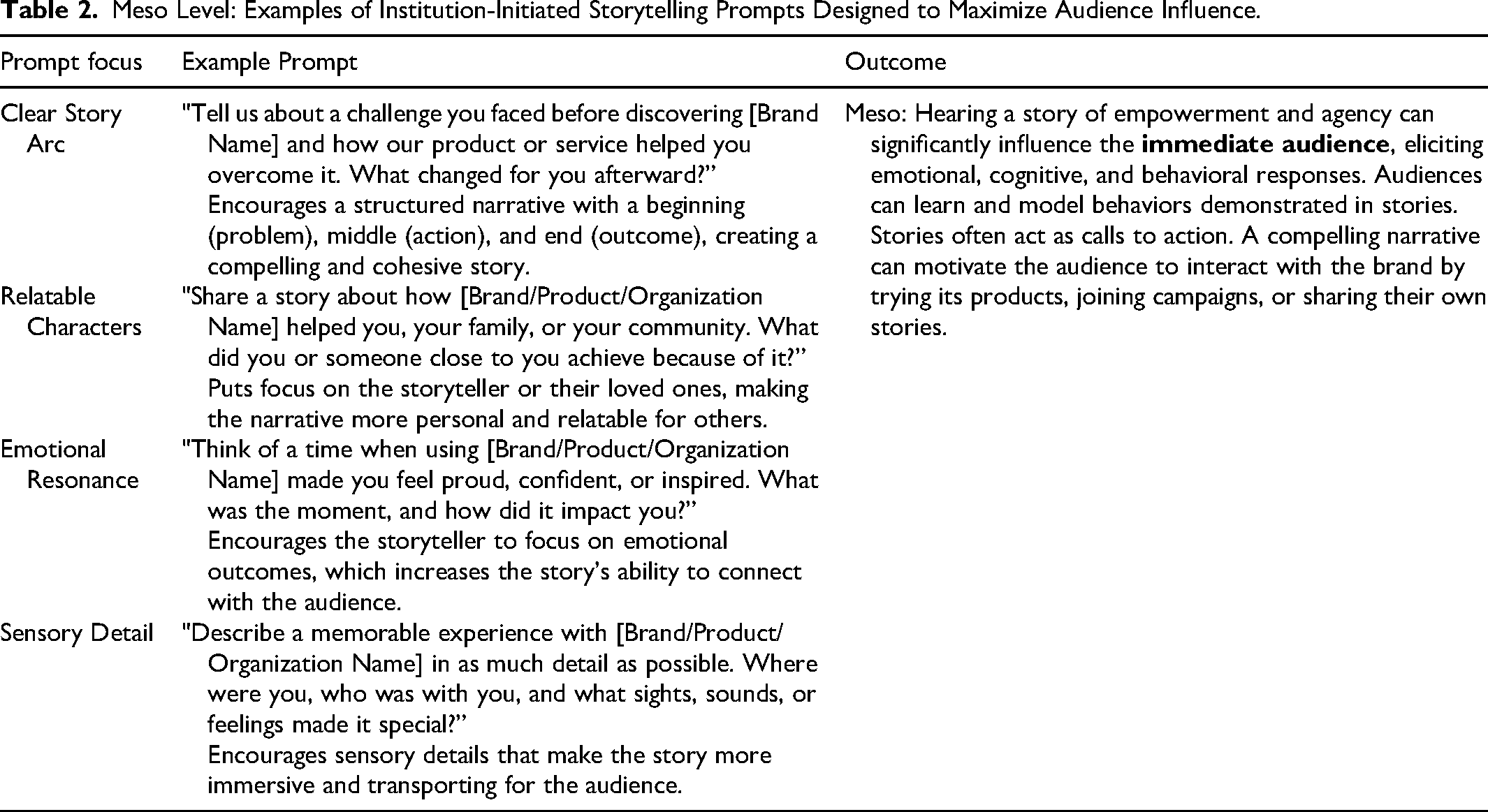
The role of the institution at this level is to elicit stories from individuals in ways that have been shown to maximize story influence. This can also be done through attention to prompt engineering; however, the focus here differs from the micro level. For example, past research on narrative transportation shows that stories featuring rich, specific descriptions of sights, sounds, smells, and textures help the audience visualize the story world (Elder & Krishna, 2022). Prompting storytellers for such details “Where were you? What could you see/smell/hear?” can help maximize the impact of their stories. Relatedly, stories with an engaging plot – featuring a central conflict or challenge that is resolved in a meaningful way – keep the audience emotionally invested (Green & Brock, 2000). Prompting storytellers to include a clear beginning, middle, and end provides a satisfying narrative arc. Social learning theory emphasizes the importance of storyteller characteristics, such that relatable or aspirational storytellers are more likely to foster audience identification and behavioral modeling. Characters the audience can identify with or aspire to emulate also increase emotional connection to them, and stories with characters who feel genuine make the story more believable and immersive. For instance, a story about a single parent overcoming financial struggles with a budgeting app resonates because the protagonist's challenges and triumphs feel authentic and relatable. See Table 2 below.
Meso Level: Examples of Institution-Initiated Storytelling Prompts Designed to Maximize Audience Influence.
Macro-Level: Society at Large
Relevant Processes
Eliciting identity-relevant stories at the individual level has the potential to influence society at large by influencing cultural norms, inspiring collective action, and fostering systemic change (Akaka et al., 2023). When shared widely, these narratives create ripple effects that transform societal values, behaviors, and structures. Classic communication research on cultivation theory posits that long-term exposure to media shapes how the individuals of media perceive the world as well as conduct themselves in life (Gerbner & Gross, 1976; Shrum, 1999). Thus, when a growing mass of stories showcase positive, prosocial actions, these behaviors become more culturally normative and aspirational. When one hears stories from friends, family, and media more broadly about times they acted as climate upstanders, for instance, this action is more likely to be viewed as normal and desirable (White et al., 2019). Stories from underrepresented or marginalized groups can break the “spiral of silence” (Noelle-Neumann, 1974), challenge stereotypes, broaden societal understanding, and foster inclusivity. For example, stories of women in STEM overcoming challenges and excelling in their fields can help shift societal perceptions of gender roles and normalize female leadership in traditionally male-dominated industries.
Numerous contemporary and historical campaigns illustrate how institution-initiated storytelling can influence cultural norms and inspire collective action. For instance, the #MeToo movement, which has its roots in survivor-focused activism led by Tarana Burke, illustrates how aggregated personal disclosures can reshape norms around sexual harassment and power (Murphy, 2019). The accumulation of these narratives transformed workplace policies and media discourse. Similarly, climate-activism efforts such as the youth-led Fridays for Future movement, which mobilized millions with hashtag activism, school strikes, and trans-national coordination (Uba, 2025), and the U.N.'s ActNow campaign (which uses storytelling, digital engagement tools and social media to encourage individual sustainable behaviors) (United Nations, 2025) provide concrete examples of how storytelling platforms and narrative-sharing can contribute to macro-level mobilization. As noted earlier, humanitarian organizations such as the UNHCR's Refugee Stories and corporate initiatives like Dove's “Real Beauty” campaign (Millard, 2009) demonstrate how institution-initiated storytelling can broaden representations of marginalized identities and challenge cultural stereotypes. Across these movements, the diffusion of personal stories through institutional platforms demonstrates how individual-level narratives can, through cumulative visibility, generate cultural resonance, amplify shared values, and catalyze system-level discourse and change.
These multi-level effects can be understood through well-established macromarketing and communication mechanisms. Network diffusion theory explains how stories spread through interpersonal and digital networks, allowing localized narratives to gain collective visibility (Watts & Dodds, 2007). Agenda-setting processes describe how repeated exposure to certain story themes shapes what issues audiences and policymakers perceive as socially important (McCombs & Shaw, 1972; Scheufele & Tewksbury, 2007). Finally, cultural resonance theory clarifies why some narratives (those aligning with widely shared values or symbolic frames) achieve greater traction and longevity, embedding themselves in public discourse (Polletta & Jasper, 2001; Snow & Benford, 1988).
The Role of the Institution: Macro Level
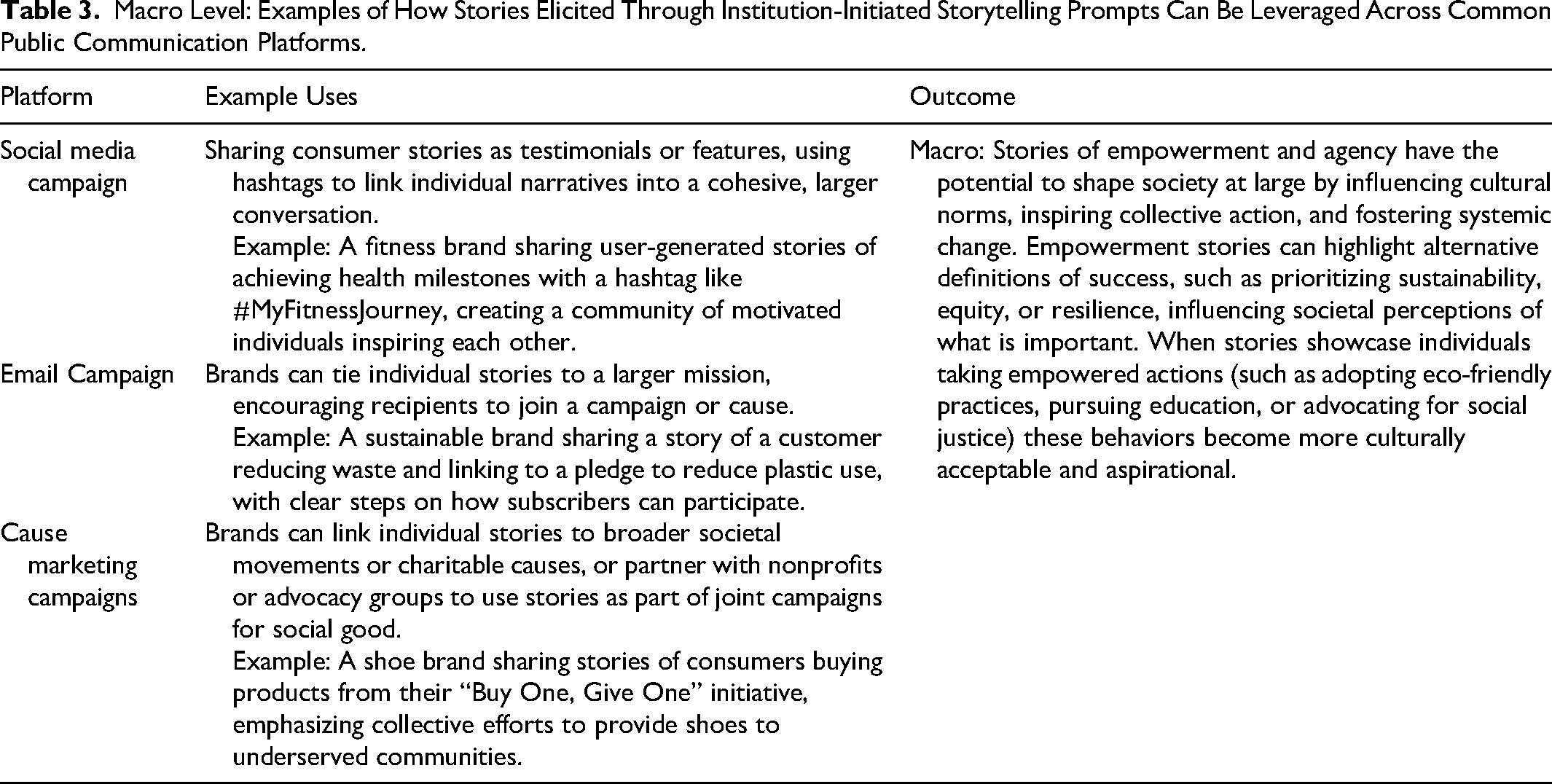
The role of the institution at this level is to leverage the individual stories generated as tools to drive collective action. Institutions use individuals’ narratives with their consent to inspire, mobilize, and unify their audience around shared values or causes, turning individual stories into catalysts for broader societal or community action. Table 3 features examples of how this might be enacted across various public communication channels, including social media, email campaigns, and broader initiatives.
Macro Level: Examples of How Stories Elicited Through Institution-Initiated Storytelling Prompts Can Be Leveraged Across Common Public Communication Platforms.
To empirically examine the impact of these efforts, researchers could conduct longitudinal media analysis, tracing how narrative themes emerging from institutional campaigns diffuse across news, social media, and policy discourse over time. Network diffusion models could reveal how individual stories propagate through online and offline communities, identifying when and how they achieve cultural resonance. Similarly, policy-tracking studies could assess whether sustained storytelling initiatives correspond with observable shifts in institutional practice, funding priorities, or legislative action related to their focal issues. Finally, large-scale survey or panel designs could capture how repeated exposure to aggregated institutional narratives shapes collective attitudes, perceived social norms, and participation in prosocial behavior.
While the institution may choose to take an active role in driving collective action, passive but equally powerful societal impact may occur from the mere diffusion of a mass of thematically-aligned storytelling. As noted in the aforementioned cultivation theory research, there is not a “broader agenda” behind the content displayed in popular media, yet long-term exposure to it has a homogenizing influence on audience worldview (Gerbner & Gross, 1976; Shrum, 1999). For instance, some posit that the mass of thematically similar stories shared on social media has facilitated and popularized ideologies underlying recent global societal trends such as Tang Ping in China and quiet quitting (BBC, 2021; Hamilton, 2025). See Table 3 below.
Illustrative Case Study: Professional Identity Development in STEM
In this section, we describe the narrative-based campaign we collaboratively developed with The Story Collider, a national storytelling-focused nonprofit that reaches a broad general audience worldwide. This illustrative case study is intended as a theory-building illustration. In line with macromarketing's tradition of conceptual–illustrative inquiry, we use this example to show how institution-initiated storytelling operates across micro, meso, and macro levels in practice. The goal is to illuminate how the proposed processes might manifest in a real-world institutional setting. Our approach differs from traditional case study or intervention research methods, which typically aim to generate transferable empirical findings or evaluate program effectiveness. Instead, we adopt what Eisenhardt (1989) describe as an illustrative case logic: a qualitative, contextually grounded example that helps refine theoretical propositions and demonstrate conceptual coherence within macromarketing systems.
This initiative leverages research on narrative identity and cognitive consistency outlined above to bolster professional identity among STEM (science, technology, engineering, mathematics) graduate students, yielding broader societal benefits associated with reduced attrition of underrepresented minorities and stereotypes associated with STEM professionals. Here, we describe the recruiting and workshop activities of our collaborative intervention, and the analysis of the participant work to measure impact on micro and meso (as well as potential impacts on the macro level) of the focal ecosystem.
Method
We obtained funding from the National Science Foundation to implement this collaborative intervention. Consistent with our illustrative intent, the following methods are described to provide transparency and context rather than to support inferential testing. We recruited 38 graduate students (Mage = 29.42, 36% female) enrolled in STEM programs at the Masters and PhD level, offering a $250 stipend for completing the study activities. Participants completed a day-long workshop hosted by Story Collider representatives. The workshop is a hands-on experience that provides an overview of the personal storytelling literature and Story Collider's framework for developing personal stories. The workshop begins with establishing community participation norms and defining personal stories with an example story shared live by one of the workshop leads. This is followed by activities to identify past events that might serve as a story focal point, related to the themes of discovery, fitting in and/or doubt with regard to their experience in a STEM graduate program. Additional activities help participants develop the content of their stories throughout the course of the day. The day concludes with a story sharing session during which a subset of participants step forward to share the story they developed. Afterwards, students submit a written draft of their story. We view this as the micro-level dimension of the intervention. The workshop culminated in an event in which members of the campus and the broader local community attended a performance produced by the Story Collider. We view this as the meso-level dimension of our intervention. The performance was free, but audience members signed up for a ticket to the event and in that process entered their email addresses, which enabled us to collect measures from them about the impact of the storytelling activities.
While this study is modest in scale, it serves as a theory-building case designed to illustrate the mechanisms proposed in our conceptual framework. By integrating qualitative interviews, pre/post surveys, and audience perception data, we aim not to generalize across populations but to consider how institution-initiated storytelling operates across micro, meso, and macro levels in practice. Our findings offer proof-of-concept insights that point toward future research opportunities with larger samples and more diverse institutional settings.
Micro-Level Impact on the Individual Storytellers
To measure the impact of the storytelling activities, we collected both qualitative and quantitative measures. A subset of students N = 14 were interviewed in the weeks following the workshop. Additionally, students completed a survey one week before the workshop and one week after the workshop, to assess changes in their sense of belonging, professional identity, and impostorism, described subsequently.
Interviews
We developed a semi-structured interview protocol to capture participants’ experience with the storytelling initiative and how it impacted them. The structured portion of the protocol featured six questions, including the overall experience with the workshop, the process of developing a personal story, the ways in which such development influenced participants’ views of themselves, the impact of performing telling a personal story, whether the participants would recommend the workshop to others, and anything else that they wished to share from the workshop experience. We also employed a series of flexible probes with each main question. Example probing questions centered around how the activities impacted participants’ views of themselves in general, as graduate students, or as future professionals. We additionally probed into impacts the act of telling a story to others had on how participants saw themselves, how they thought others saw them, or what it meant for their communication skills. The fourteen interviews were completed via Zoom, and each lasted for approximately 20–30 min. Participant numbers, as presented in this paper, matched the participant number as assigned during the workshop. Interviews were recorded and transcribed in Zoom, verified and de-identified by a single research team member, and then independently coded by three research team members using inductive qualitative content analysis techniques (Saldaña, 2021). Consensus was built among the three researchers via three collaborative coding meetings to ensure the reliability and validity of the data analysis. Consensus driven codes were iteratively combined into thematic categories.
Surveys
We use a validated survey instrument at two time points to quantify micro-levels of professional identity, sense of belonging, and impostor phenomenon: the Graduate Engineering Identity scale (Bahnson et al., 2021), Walton and Cohen's (2007) Sense of Belonging scale, and the Clance (1985) Impostor Phenomenon instrument. Reliability analysis using Cronbach's alpha demonstrated strong internal consistency, with values ranging from 0.81 to 0.95.
Meso-Level Impact on Storyteller Community
Audience members received a link to a Story Collider pre-show survey measuring judgments of engineers’ warmth (eight items) and competence (eight items) (Fiske et al., 2007). A survey with the same measures was sent a day following the performance, comprising a pretest-posttest measurement design (α's > .92). Audience participation was incentivized by offering the opportunity to win one of five $25 gift cards. A total of 12 individuals completed both the pretest and posttest.
Results From Interviews: Micro Level
At the micro level, the storytelling process evoked main themes related to processes of reflection and sensemaking, and to impacts on the self with regard to professional identity, sense of belonging, and reduced impostorism.
Reflection and Sense Making
First, the Story Collider's activities prompted personal reflection. Many storytellers engaged in retrospective sense-making, leading to deeper understanding and meaning-making of their experiences, such as recognizing their courage, self-empowerment, capabilities, uniqueness, and deserved place in their field. For many participants, this was a novel and empowering process. As one explained, “Introspection of looking at different parts of your life to validating yourself and your own experiences, building your power back” (Participant 38). Another participant reflected, “I didn’t know that my journey [was] courageous” (Participant 40). Similarly, Participant 41 observed, “I realize my own journey is different from other STEM professionals, and I don’t have to compare my success with theirs.” Expanding on this realization, the same participant elaborated: When I got here at the beginning, I was having, like, a lot of doubts and all of that. But the whole story, that journey, and then making me reflect back to all the events that let me be here made me realize that I’m here because I deserve to be here and I’m actually capable of doing the degree that I am [in].
Reflection was sometimes therapeutic. As one participant described, “Reflecting on those types of things was beneficial to me on a personal level. It was therapy” (Participant 28). This suggests that beyond fostering self-awareness and personal growth, storytelling also served as a form of emotional processing, providing participants with a sense of validation and psychological relief.
Self-View: Professional Identity
Telling a story as elicited by the Story Collider shaped the storytellers’ self-view in terms of their professional identity. For many participants, storytelling reinforced their professional identity by helping them see their experiences as legitimate and meaningful within their field. Through the storytelling process, they gained confidence in articulating their professional trajectory and the value of their work. As one participant reflected, “It's made me more accepting of my journey” (Participant 3), suggesting that narrating their experiences allowed them to reframe past challenges and milestones as integral to their professional growth.
Storytelling also supported the development of key professional skills. Several participants emphasized how presenting their stories improved their public speaking and communication abilities, which are crucial for professional success. One participant noted, “My presentation skills renewed…” (Participant 29), indicating that storytelling provided a valuable opportunity to refine their ability to present ideas with confidence. Another participant highlighted the benefits of storytelling for science communication, explaining, “It will help you realize that there is a way you can communicate your research to others like [a] more interesting and relatable [way]” (Participant 41). This example demonstrates how storytelling strengthened participants’ ability to convey complex ideas to broader audiences, reinforcing their professional identity as effective communicators.
Sense of Belonging
Storytelling played a crucial role in fostering individuals’ sense of belonging. Through sharing and listening to stories, participants connected with others in their field, reinforcing their identification with their academic and professional communities. One participant described how storytelling deepened their connection to their program, stating, “It empowered me a lot to feel more that sense of belonging to the same program” (Participant 14). This example highlights how hearing and telling personal narratives helped individuals see themselves as part of a shared experience.
The collaborative nature of storytelling also helped participants recognize the common struggles and successes within their community, reducing feelings of isolation. As one participant explained, “I was not alone. Everyone is on the same boat” (Participant 17). By hearing others’ stories, participants were able to place their own experiences in a broader context, realizing that their challenges were not unique but rather part of a collective journey. As another participant reflected, “Hearing the stories made me feel really connected to what was happening in the workshop” (Participant 3). These accounts illustrate how storytelling created an environment of mutual understanding and support, strengthening their sense of belonging in STEM and related professional spaces.
Reduced Impostorism
Finally, storytelling helped participants overcome impostorism by reinforcing their self-worth and confidence in their professional abilities. Many participants initially doubted the significance of their experiences, but storytelling challenged these perceptions. One participant acknowledged, “We do all have a lot of really cool stories to share that other people would love to hear, and I think sometimes I kind of discount my own experiences” (Participant 27). This example suggests that storytelling served as a mechanism for participants to validate their own journeys and recognize the value of their contributions.
The public sharing aspect of storytelling played an important role in combating impostor feelings. Through audience engagement, participants gained external affirmation of their experiences, reinforcing their legitimacy in their professional field. Storytelling was not only about personal reflection but also about engaging with an audience, fostering a reciprocal process where the speaker felt validated and affirmed by the listeners’ reactions. Some reflected on the broader impact of storytelling beyond self-acceptance, emphasizing the importance of communicating their work to others. One participant explained, Working on science and technology does not mean anything if we cannot impact the lives of others or cannot communicate those things to the general people. So we need to make people understand what we're doing and why it is important. And I think building the story would help us communicate better with some other people and help us succeed in what we're doing (Participant 7).
Thus, as participants gained confidence in telling their own stories, they also recognized the importance of making their work accessible to wider audiences. In this way, storytelling reinforced their professional mission and sense of purpose.
Results from Survey: Micro Level
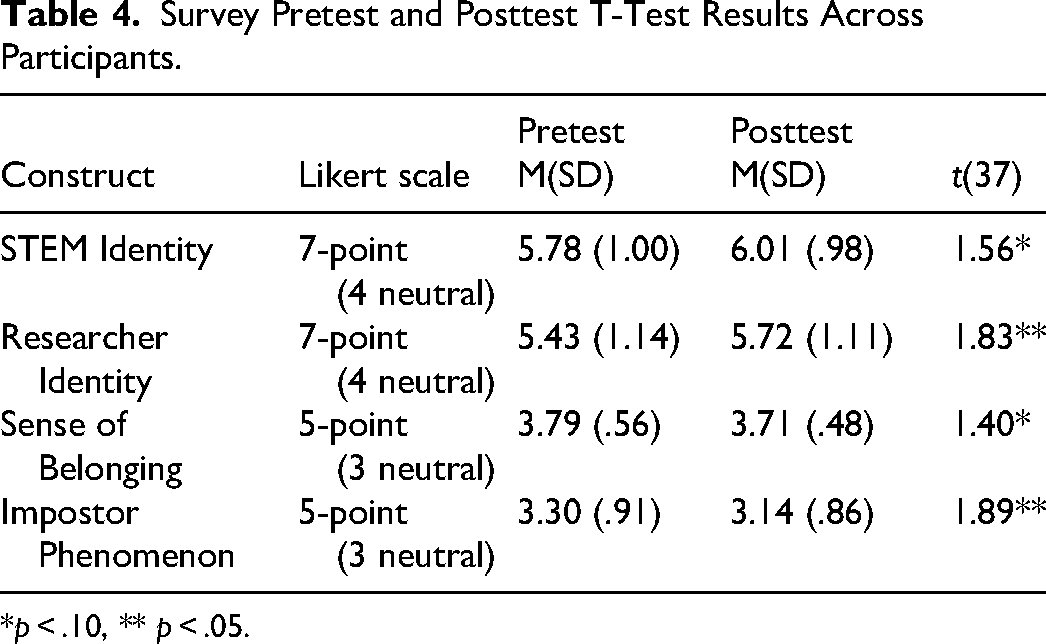
We conducted paired-samples t-tests to compare participant data from pre- and post-tests. The results revealed that participants experienced slight, yet statistically significant (a) improvements in STEM and researcher identities as expected, (b) declines in social fit which were unexpected, and (c) declines in impostorism as expected. See Table 4 below.
Survey Pretest and Posttest T-Test Results Across Participants.
*p < .10, ** p < .05.
These quantitative findings aligned with our qualitative results, which suggested that storytelling reinforced participants’ recognition of themselves as legitimate members of their professional communities. The observed declines in impostorism further support the idea that storytelling helped participants validate their experiences and feel more secure in their professional trajectories. However, the unexpected decline in social fit indicated in the quantitative results suggests that, while storytelling fostered a sense of personal legitimacy and professional identity, it may have also made participants more aware of ways in which they differed from their peers or institutional environments.
One possible interpretation is that the storytelling process may surface latent feelings of exclusion or highlight identity tensions that were previously unarticulated. By prompting participants to reflect on and narrate their trajectories, the workshop may have made certain social or cultural misalignments more salient, particularly for individuals who already navigated marginality within STEM contexts. In this sense, the decrease in perceived social fit does not necessarily contradict the gains in identity clarity and reduced impostorism; rather, it may reflect an increased awareness of the broader institutional environment in which their identities are situated. Despite these nuances, the overall impact of storytelling was one of growth, self-acceptance, and skill development.
Results from Survey: Meso Level
We conducted paired-samples t-tests comparing audiences’ responses to the warmth and competence measures before and after attending the performance to examine the shifts in audience perceptions. The Warmth and Competence Scale (Fiske et al., 2007), which measures friendliness and trustworthiness warmth alongside capability and skill competence, showed a significant increase in warmth ratings from 4.2 to 4.8 on a 5-point scale p < .05, while competence ratings, already high at 4.9, remained unchanged. That is, hearing the storytellers’ personal stories about challenges they experienced in STEM altered audience stereotypes related to low warmth perceptions, but did not change stereotypes related to high competence perceptions.
Macro Level
While the present study does not measure changes at the broader, cultural level, we briefly consider what changes might look like at the macro level and how they could be assessed. When institutional storytelling is amplified across audiences, individual narratives can shape public discourse, contribute to evolving cultural norms, and inspire systemic change. There are several possible approaches to determine whether micro- and meso-level changes scale to the macro level. One approach could involve analyzing media coverage and public conversations surrounding STEM professionals before and after the widespread implementation of institutional storytelling initiatives. Content analysis of news articles, social media discussions, and public campaigns could reveal whether the framing of professional identity in STEM shifts to include a broader range of experiences and depictions.
Another avenue for measurement could involve tracking changes in STEM workforce participation and retention trends over time, particularly among groups historically underrepresented in these fields. If storytelling interventions contribute to stronger professional identities and reduced impostorism at the individual level, we might expect to see increased persistence in STEM education programs, higher retention rates in STEM careers, and more diverse representation in leadership roles. Longitudinal studies that follow individuals who have participated in storytelling initiatives could provide insight into whether these experiences influence long-term career trajectories.
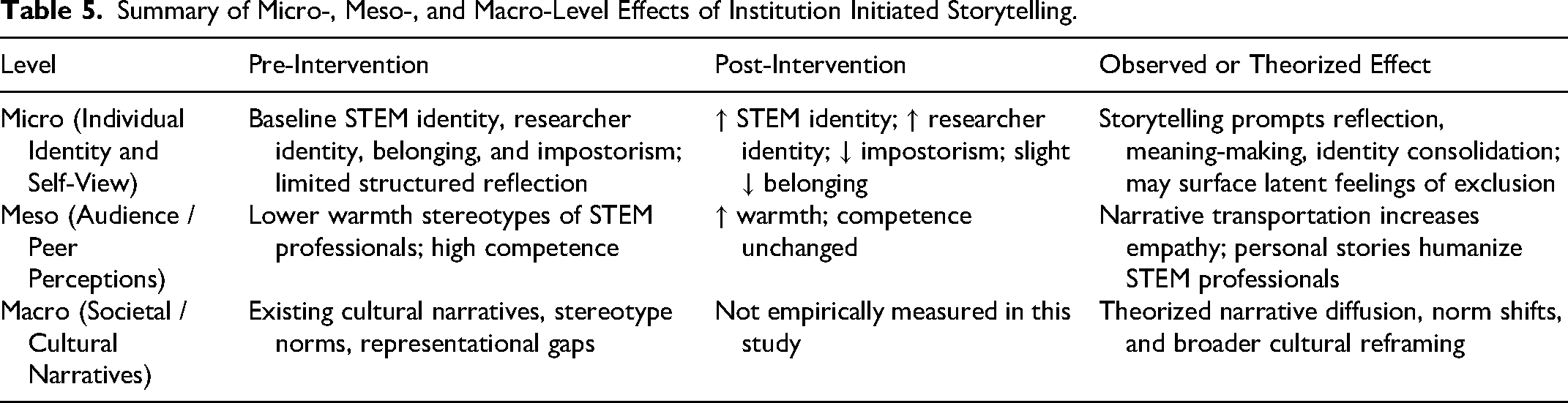
At the institutional level, we could examine policy and organizational changes within academia and industry. Have universities and STEM organizations integrated more storytelling-based programs into professional development initiatives? Tracking funding allocations and organizational adoption of storytelling-based identity interventions would provide concrete indicators of systemic impact. See Table 5 for a summary of the micro-, meso-, and macro-level effects of institution initiated storytelling.
Summary of Micro-, Meso-, and Macro-Level Effects of Institution Initiated Storytelling.
General Discussion
We examine how institutional storytelling functions as a meaning-making mechanism with multi-level implications for identity, social connection, and cultural discourse. By integrating insights from narrative identity theory, self-persuasion, and macromarketing systems thinking, we demonstrate how storytelling initiated by institutions can influence individuals, shape peer audiences, and contribute to broader shifts in societal understanding. Our empirical case, focused on professional identity development in STEM, illustrates how institutions can use storytelling to cultivate belonging, reduce impostorism, and influence stakeholder perceptions.
At the micro level, storytelling participation encouraged reflection and self-redefinition. At the meso level, it altered peer audience perceptions of warmth and relatability in STEM. At the macro level, we theorize that the aggregation of such narratives, particularly when amplified by institutions, media, or policy, has the potential to reshape dominant cultural narratives and shift institutional norms. Finally, we reiterate that the empirical case presented in this paper serves as an illustrative example designed to elaborate and contextualize our conceptual framework, consistent with macromarketing's tradition of conceptual–illustrative inquiry. The case is intended as a theory-building demonstration of how institution-initiated storytelling operates across micro, meso, and macro levels. In the following sections, we explore implications for macromarketing theory and practice.
Theoretical Implications
We propose three theoretical contributions. First, we introduce and conceptualize institution-initiated storytelling (distinct from institution-focused storytelling) as a mechanism for advancing stakeholder wellbeing. Second, we reposition the storyteller, rather than the audience, as a central unit of analysis, showing how narrative expression can shape self-concept, belonging, and agency. Third, we develop a multi-level framework illustrating how institutional storytelling operates across micro, meso, and macro levels of social organization, linking individual identity work to systemic cultural change. Together, these contributions extend macromarketing theory by positioning storytelling as a process that connects identity formation, communication systems, and collective transformation.
Prior research emphasizes the benefits of storytelling for institutions—such as engagement, loyalty, and reputation management—but our work reframes storytelling as a stakeholder-centered process. By examining how telling one's story within institutional contexts fosters identity development, belonging, and self-persuasion, we extend macromarketing's emphasis on stakeholder wellbeing (Layton, 2007; Sirgy, 2021) and demonstrate how institutional storytelling can catalyze prosocial outcomes for the storyteller, not just the organization.
Drawing from narrative identity theory (McAdams & McLean, 2013; McLean et al., 2020) and self-persuasion research (Aronson, 1999), we further highlight the role of narrative agency, or the idea that storytelling functions as identity work embedded in larger systems of meaning and power. Through storytelling, individuals negotiate belonging and social recognition, illustrating how narrative expression reshapes the storyteller's self-view, values, and behavioral intentions.
Finally, our multi-level framework shows how institution-initiated storytelling connects individual identity work to systemic cultural change. Storytelling prompts reflection and self-concept revision at the micro level, shapes peer perceptions and social learning at the meso level, and influences cultural norms and institutional logics at the macro level. In this way, institutions act as cultural intermediaries that curate, validate, and disseminate stakeholder narratives (Layton, 2007; Mittelstaedt et al., 2006), linking micro-level identity work with broader meaning-making processes across marketing systems.
Applied Implications
This research offers practical guidance for institutional actors such as marketers, educators, nonprofit leaders, and public-sector organizations seeking to use storytelling as a tool for stakeholder engagement and systems-level influence. To maximize impact, institutions should design storytelling initiatives that empower participants, foster authentic co-creation, and translate individual reflection into collective meaning.
How stories are elicited, structured, and supported strongly shapes the self-perceptions and agency of those who share them. Institutional prompts that emphasize personal growth, resilience, or social contribution are more likely to foster narrative coherence and identity reinforcement. Providing reflection tools such as guided prompts, coaching, or storytelling templates helps participants construct narratives that are both personally meaningful and publicly resonant.
Within organizations, storytelling can serve as a tool for culture-building, leadership development, and inclusion. Practices such as team storytelling workshops, leadership narrative training, and onboarding storytelling sessions can build shared purpose and psychological safety, particularly for underrepresented groups. Beyond organizations, policymakers, educators, and advocacy groups can use storytelling to elevate lived experiences, inform program design, and challenge exclusionary narratives embedded within systems. In doing so, institutional storytelling becomes a mechanism of institutional learning and social participation, which are central concerns of macromarketing research.
Finally, although we distinguish between institution-initiated and institution-focused storytelling for conceptual clarity, many real-world practices fall along a continuum rather than fitting neatly into one category. In hybrid models, narratives originate with individuals but are subsequently curated, edited, or strategically amplified by institutions to serve both stakeholder and organizational goals. Such hybrid forms raise unique opportunities in which institutions can elevate authentic lived experiences while also advancing mission-aligned communication objectives. Recognizing these hybrid storytelling configurations helps situate institution-initiated storytelling within a broader ecosystem of narrative exchange between stakeholders and institutions.
Limitations and Future Research
While this research advances understanding of institutional storytelling within macromarketing systems, several limitations highlight important directions for future inquiry. First, although we document micro- and meso-level outcomes, future research should examine how institution-initiated storytelling scales to shape cultural narratives and policy environments. Longitudinal and media analyses could assess how small-group narratives aggregate into systemic change related to inclusion, equity, and representation.
Second, while our study focuses on the constructive potential of storytelling, the process of crafting and publicly sharing personal narratives can expose individuals to emotional and social risks. This raises critical ethical considerations for institutions that solicit stories about identity, adversity, or marginalization. Ethical best practices should ensure informed consent and participant agency; that individuals understand how their stories will be shared, retain control over content and visibility, and can withdraw participation without penalty (Ellis, 2007). Institutions must also take steps to avoid tokenization of marginalized voices by ensuring that storytelling initiatives are co-created rather than extractive, with participants involved in shaping the purpose and framing of their narratives (Couldry, 2010). In addition, providing support resources such as debriefing, peer counseling, or referral to mental-health services can mitigate potential distress arising from revisiting emotionally charged experiences (Ellis & Bochner, 2000). Finally, institutions should develop clear ethical guidelines, ideally in partnership with advocacy organizations, educators, or mental-health professionals, that articulate standards for transparency, representation, and care. Embedding these principles within institutional storytelling practices would advance macromarketing's broader concern with wellbeing, dignity, and social justice. This perspective resonates with prior work on the political potentials and limits of personal storytelling, which shows that narratives can both contest and inadvertently reinforce institutional power structures (Orazi & van Laer, 2023; Polletta, 2006).
To help institutions navigate the ambivalence inherent in identity-related storytelling, we propose several practices that allow organizations to monitor and mediate potential trade-offs. Structured peer dialogs, such as facilitated small-group reflections or post-storytelling debriefs, can provide safe spaces for participants to process emerging identity tensions collectively. Feedback loops, including anonymous surveys, periodic check-ins, or iterative co-design sessions, enable institutions to identify unintended consequences early and adjust prompts or framing accordingly. Institutions might also implement optional follow-up conversations or provide access to mentorship and affinity groups, ensuring that participants who become more aware of their difference or vulnerability have avenues for connection and support. Together, these practices help institutions approach storytelling as an ongoing, relational process centered on participant wellbeing.
Further research is needed to explore potential unintended consequences of institutional storytelling. While storytelling can enhance inclusion and connection, it may also accentuate social differences or reinforce existing boundaries. Our findings suggest that some participants became more aware of their nonconformity within institutional settings, leading to a decline in perceived social fit. This paradox highlights the ambivalence of identity work in institutional contexts. While storytelling can foster self-affirmation and visibility, it can also make individuals more conscious of the ways their identities diverge from institutional norms (Bird, 2007). Such heightened awareness of difference may temporarily reduce perceived belonging even as it strengthens personal authenticity. Theoretically, this duality underscores that identity construction within institutions involves both integration and differentiation; individuals seek recognition not only as members of a collective but also as distinct selves (Alvesson & Willmott, 2002; Ibarra & Petriglieri, 2010). For institutions, this suggests the importance of coupling storytelling initiatives with practices that validate diverse experiences and create structural inclusion. Facilitated reflection sessions, peer support networks, or follow-up dialogs can help participants process these tensions and translate individual self-expression into collective understanding. Recognizing and planning for this ambivalence transforms storytelling into a sustained tool for cultural learning and institutional change, and is an important area for future research.
Finally, while the real-world storytelling movements discussed at the macro level illustrate the cultural force of aggregated narratives, these cases are necessarily retrospective. A promising direction for future work is the real-time empirical tracking of institutional storytelling initiatives as they unfold (for example, through longitudinal social media monitoring, network diffusion modeling, or digital ethnography) to capture how stories emerge, spread, and evolve within marketing systems. Relatedly, researchers should examine the growing role of algorithmic storytelling platforms such as TikTok and Instagram Reels. These platforms curate, amplify, and suppress narratives through opaque algorithmic processes that may shape users’ identity construction, perceived social norms, and opportunities for narrative visibility. Understanding how algorithmic infrastructures influence institutional storytelling and stakeholder identity represents a fertile research agenda with important macromarketing implications.
Footnotes
Acknowledgments
This material is based on work supported by the NSF under Grants 2325041 and 2325042. All findings, opinions, conclusions, and recommendations are those of the authors and do not necessarily reflect the views of the NSF. The authors thank The Story Collider for their contributions to the development of this project.
Associate Editor
Michael Lee

Ethical Considerations
This research has been approved by the Boise State University's Institutional Review Board; approval number (IRB23-273).
Consent to Participate
Written consents have been obtained and approved by the previously referenced IRB23-273.
Consent for Publication
The IRB23-273 incorporates approval to use quotes in an anonymous fashion. Regarding individual details, images, or videos, they are not applicable as we do not include them in our study.
Funding
This research is funded by the National Science Foundation grant #2325041 “Scalable Storytelling Interventions to Support Graduate Student Success in STEM”
Declaration of Conflicting Interests
The authors declared no potential conflicts of interest with respect to the research, authorship, and/or publication of this article.
Supplemental Material
Supplemental material for this article is available online.