




Abstract
Past research in the literature on the self has addressed how self-concept clarity changes over time. In this study, we use a cross-sectional research design to examine the relationship between self-perceptions of identity change and self-concept clarity, showing how fluctuations in self-concept clarity relate to two discrete dimensions of perceived identity change: the magnitude and direction of change. A survey was administered to 854 study participants that measured perceived changes in 12 discrete identities (four person, four role, and four social identities) over a 6-month period. The results reveal that generally the more severe one's perceived experience of identity change, the lower their degree of self-concept clarity. However, when the direction of one's perceived identity change is progressive (i.e., developing into an identity) rather than regressive (i.e., exiting out of an identity), one's degree of self-concept clarity increases.
Self-concept clarity represents the structural aspect of the self, or the extent to which self-beliefs are clearly and confidently defined, internally consistent, and stable (Campbell et al., 1996). Since the initial research on self-concept clarity emerged a few decades ago, scholars have examined how it operates as both an influencer and outcome of a variety of psychological and social psychological processes. Self-concept clarity has been found to correlate with self-esteem, the Big Five personality dimensions, chronic self-analysis, rumination, and internal state awareness. Scholars have also established that a relationship exists between self-concept clarity in individuals and depressive disorders (Boelen, Keijsers, & van den Hout, 2012) and between self-concept clarity and suicide (Au, Lau, & Lee, 2009). A review of the literature on self and identity reveals that self-concept clarity is a commonly addressed and thoroughly investigated internal process.
In this study, we contribute to the literature by examining the relationship between self-concept clarity and self-perceptions of identity change. Traditionally, research on identity change has examined change longitudinally, with studies generally measuring and comparing individuals' identities at different points in time. Such studies address what might be considered actual identity change or objective change that occurs over time. However, recent studies have begun to consider imagined or perceived identity change, that is, how individuals believe that they have changed over time (Carter, 2017; Carter & Marony, 2018). In this approach to studying identity change, individuals' self-reflections on how they believe they have changed as a holder of an identity over a specific time period is addressed. Research that examines self-perceptions of identity change is aligned with the symbolic interactionist theoretical framework, which emphasizes that subjective perceptions, interpretations, and imaginations of events are central to any understanding of the self in relation to society—see Blumer (1969), Carter and Fuller (2016), and Stryker (1980) for detailed summaries of symbolic interactionism. We employ this approach in this study to understand how perceived identity change relates to self-concept clarity.
Past studies of identity change have shown that both positive and negative outcomes can occur when individuals experience fluctuations in their self-concept. For example, studies have shown that a heightened sense of well-being can develop when one's identity change relates to being promoted at work, being accepted by a college, or joining an organization (Iyer, Jetten, & Tsivrikos, 2008). Identity change can also relate to negative outcomes. For example, negative emotions can emerge when the source of one's experience of identity change regards the death of someone close, being fired from a job, or withdrawing from a group (Breakwell, 1986; Burke, 2006). While both positive and negative outcomes can emerge when one's identities change, it has been established that when an individual experiences severe changes in their self-concept, they tend to have less perceived continuity of who they are and have more difficulty accepting who they become (Van Knippenberg, Van Knippenberg, Monden, & de Lima, 2002). While previous studies on identity change have revealed much, there is more to know, particularly regarding the relationship between perceived identity change and self-concept clarity.
The plan of this article is as follows: We first review the recent literature on self-concept clarity, focusing on research that has examined self-concept clarity as it relates to topics associated with temporal change. Next, we discuss how our understanding of self-concept clarity can be improved by considering how it relates to two discrete dimensions of perceived identity change. We provide hypotheses that predict variance in self-concept clarity depending on the magnitude and direction of change in three distinct identity types (person, role, and social identities). We then present the study procedure and methodology and lastly discuss the findings and implications of the results.
Self-Concept Clarity: A Review of the Literature
Over the past decades, scholars have examined the relationship between self-concept clarity and various psychological and social psychological processes. For example, some have recently examined the relationship between self-concept clarity and body dissatisfaction in women, finding that low self-concept clarity can contribute to body image problems because it increases women's vulnerability to thin-ideal internalization and appearance-related social comparison tendencies (Vartanian & Dey, 2013). In related research, the impact of family adversity, self-concept clarity, and thin-ideal internalization on body dissatisfaction has been addressed, with findings revealing that early adverse experiences can impair individuals' self-concept clarity, and that low self-concept clarity can increase the risk of internalization of the thin ideal (as a means of defining the self) and consequently body dissatisfaction (Vartanian, Froreich, & Smyth, 2016).
Others recently have examined the effect of self-concept clarity on discretionary spending tendencies, showing that those who have less clearly and confidently defined, internally consistent, and temporally stable self-knowledge (i.e., those who have low self-concept clarity) have higher discretionary spending tendencies (Sarial-Abi, Gürhan-Canlib, Kumkalec, & Yoon, 2016). A conclusion of this study was that low self-concept clarity individuals have higher discretionary spending tendencies because they are more likely to adopt avoidant coping strategies than high self-concept clarity individuals. Indeed, a review of the literature reveals that self-concept clarity is a commonly investigated empirical process, with recent studies examining how it relates to social class (Na, Chan, Lodi-Smith, & Park, 2016), anxiety (Kusec, Tallon, & Koerner, 2016), self-harm (Lear & Pepper, 2016), psychosis (Berna et al., 2016), and even social media use (Yang & Brown, 2016).
Included in the literature on self-concept clarity includes studies that examine how self-concept clarity changes over time. Past research by Nezlek and Plesko (2001) found that changes in daily levels of self-concept clarity covary with daily positive and negative events, with daily mood, and with daily self-esteem. Analyses that simultaneously included self-esteem, mood, and events suggested that relationships between daily self-concept clarity and daily events are mediated by daily negative affect and daily self-esteem. Such mediation suggests that daily events lead to changes in mood and self-esteem, which in turn lead to changes in self-concept clarity. Additional analyses found that temporal variability of self-esteem, positive affect, negative effect, and self-concept clarity was negatively correlated with trait self-concept clarity. 1
In more recent work, Diehl and Hay (2011) examined self-concept differentiation and self-concept clarity change over time, across adulthood. They found that older adults are more likely than young adults to be self-assured, whereas young adults are more likely to have more fragmented and confused self-concepts. A main conclusion was that age is positively associated with psychologically adaptive self-concept profiles.
In related research, Lodi-Smith and Roberts (2010) sought to discover the cross-sectional age differences in self-concept clarity during adulthood and the importance of social role experiences for age differences in self-concept clarity. They found that self-concept clarity had a curvilinear relationship to age, and that self-concept clarity was positively related to age from young adulthood through middle age and negatively related to age in older adulthood. They also found that this relationship was moderated by annual income and community investment, and that annual income and health-related social role limitations mediate age differences in self-concept clarity.
Lodi-Smith, Spain, Cologgi, and Roberts (2017) also addressed the development of self-clarity and content in adulthood, examining self-concept clarity over time with the aims of establishing patterns of stability and change across adulthood. They found that self-concept clarity predicts and corresponds to trait maturation over time, and that decreasing self-concept clarity corresponds to increasing role limitations. And, Van Dijk et al. (2014) examined how self-concept clarity evolves over time in adolescents, finding that low self-concept clarity in youth leads to higher levels of depressive and anxiety symptoms later in life.
Of the literature that examines how self-concept clarity changes over time, there is a lack of research that specifically examines the relationship between perceived identity change and self-concept clarity. As constructs, identity and self-concept clarity have overlapping features. However, identity has been cited as having a more complex set of elements than self-concept clarity, and the processes have been determined to be theoretically and empirically independent (Campbell et al., 1996). Those that have examined the relationship between some form of change in the self-concept and self-concept clarity have examined daily dynamics between these processes, and how the relationship between the two affect distress (Schwartz et al., 2011). Research in this vein has found that self-concept clarity and identity commitments influence one another reciprocally across days, and that day-to-day fluctuations in identity predicted later anxiety and depression. In this study, we continue to investigate how self-concept clarity fluctuates over time by addressing how two dimensions of perceived identity change not commonly addressed in the literature relate to self-concept clarity.
Identities, Dimensions of Identity Change, and Self-Concept Clarity
The self or self-concept represents the totality of an individual's thoughts and feelings about oneself as an object (Rosenberg & Kaplan, 1982). Identities are internal positional designations, or meaning structures that define an individual as a unique person, role player, or group member (Stets & Serpe, 2013; Stryker, 1980). As a construct, the self involves several constituents. These constituents include the self's components, structure, dimensions, regions, planes, motives, and foci of attention (Rosenberg & Kaplan, 1982). Identities are a component of the self-concept (another component regards one's traits). Self-concept clarity is a dimension of the self-concept (other dimensions include self-esteem and self-efficacy). Identities are commonly classified as person (or personal), role, or social (Burke & Stets, 2009). Let us elaborate on these distinctions to provide a more thorough understanding of how identities are differentiated within the self-concept.
Person Identities
Person identities represent one's characteristics that are not shared with others or directly attached to greater social structures, such as seeing oneself as moral, competitive, or attractive. Person identities represent who one is as a unique individual and are idiosyncratic attributes of one's personality (Hogg, 2006, p. 115). Person identities are different from role and social identities since they are not directly attached to other entities in the social structure. Since person identities are not linked to others in the social structure, they are generally understood to be stable components of the self. Because of this stability, person identities are often called master identities; they are active in many social situations and perpetuate throughout the life course (Burke, 2004). For example, if one has a highly prominent (important) moral identity, it is likely to be active as a master identity—at home, at work, or at church (Carter, 2013; Stets & Carter, 2006, 2011, 2012).
Since, compared with role and social identities (described later), person identifies are not as strongly connected to social structural arrangements that can change over time, past theorists have posited that person identities are more resistant to change (Goffman, 1963; Stone, 1962). For example, one's identity as a competitive person might perpetuate throughout one's life, regardless of changes in one's role performances or group memberships. It should be noted though that, as with all bases of identity, person identities can (and do) change. One who lacks a caring identity might develop one after gaining dependents. One who cares little for achieving success might develop a competitor identity upon starting their own business. Regardless of individual occurrence, compared with role and social identities, person identities are understood to be more enduring and stable with regard to change.
Role Identities
Role identities are meanings attached to a status position that involves some behavioral expectation, such as being a student, worker, or parent. They represent one's imaginative view as an occupant of a social role (McCall & Simmons, 1978). While person identities are defined by their unique meaning structures, role identity meanings are linked to the expectations of others—they correspond to status positions in the social structure (Stryker & Burke, 2000). Role identities involve both conventional and idiosyncratic meanings (McCall & Simmons, 1978, p. 68). The conventional facet regards meanings or definitions for being a role player that are shared by significant others and by greater society. The idiosyncratic facet regards an individual's unique, self-defined meanings for being a role player. One's conventional and idiosyncratic meanings combine to represent who one is as a specific role player. For example, an individual's “student” role identity may include meanings that resonate in the collective conscience or meanings that are shared by all (such as being attentive, respectful, and responsible). These cultural meanings define all types of students. However, not all individuals identify as a student in like manner. For some, being a student means being someone who parties every night. For others, being a student means spending 20 hours per week in the library. These are idiosyncratic (unique) meanings for playing the student role.
Compared with person and (certain) social identities, (some) role identities may be less stable and more likely to change over time. This is possible since many role identities are not master identities as are person and (some) social identities. Another reason role identities may be more likely to change compared with other identity types has to do with the sources of identity change. There are four main sources of identity change: (a) changes in situations, (b) conflicts between competing identities, (c) conflicts between identity standards and behavior, and (d) mutual verification contexts (Burke, 2006; Burke & Cast, 1997). Role identities in particular are likely to be affected by the second source: role conflict (Schmidt, Roesler, Kusserow, & Rau, 2014; Vogel, Wester, Hammer, & Downing-Matibag, 2014).
Another reason role identities may be more likely to change compared with person or social identities regards role identities' relative salience within the overall self-concept (Callero, 1985; Stryker & Serpe, 1982, 1994) and the manner in which identities are tied to other identities (Burke, 2003; Burke & Stets, 2009; Smith-Lovin, 2003; Thoits, 1986). Since the self is conceived as a stable entity (with its component identities resisting change; Stryker, 1980), identities that are most salient (likely to be activated), prominent (important), and central (close to the core self-concept) tend to be the most enduring and stable. Identity scholars have maintained that compared with master identities such as one's moral (person) or ethnic (social) identities, role identities are generally located further down in the overall identity salience hierarchy (Burke, 2004). Because of this, role identities are theorized to be more likely to change compared with other types of identities.
Social Identities
Social (or group) identities represent one's identification with groups or organizations, such as being American, Catholic, or part of the National Rifle Association (Hogg, 2003; Tajfel, 1972). While role identities are understood in relation to a complementary counter-identity (e.g., professor or student and mother or daughter), social identities represent shared meanings with others. Social identities have three facets: (a) centrality (the cognitive accessibility of the identity), (b) a self-evaluative emotion that is attached to the identity, and (c) in-group ties that attach one to the group in which the identity signifies (Ellemers, Kortekaas, & Ouwerkerk, 1999; Hogg, 2006; Jackson & Smith, 1999). Some have addressed social identities with regard to their distinct, qualitative differences, distinguishing social identities that are centered on religious belief, racial identification, or political preference (Deaux, Reid, Mizrahi, & Ethier, 1995).
A crucial dynamic with social identity development regards the generation of in-group and out-group feelings. Those who are part of an in-group develop shared meanings of togetherness and forge common expectations. Being part of an in-group also means dis-identifying with those belonging to an out-group. The relationship between social identities and in-groups or out-groups has been examined thoroughly in the literature on social identity. Scholars who have studied social and group identities have addressed a variety of processes relating to the self-concept, including social categorization, prototype creation, and depersonalization (Hogg, 2003; Tajfel, 1972, 1982).
Some social identities are ascribed, while others are achieved. Ascribed social identities are obligatory and often inherited at birth. Examples of ascribed social identities include one's sex and race. Such social identities represent membership in a categorical group. Achieved social identities are more voluntary and (potentially) ephemeral. Examples of achieved social identities include being a university alumnus or a fan of the Los Angeles Lakers. Achieved identities represent membership in a corporate group (Turner, 2010). Generally, ascribed social identities are permanent and unlikely to change. Because of achieved social identities' ephemeral nature (or potential ephemeral nature), compared with ascribed social identities, they are more likely to change. 2 To sum up our discussion of the differences among person, role, and social identities, each type of identity has unique features and has been posited to vary in terms of relative stability and resistance to change (Burke, 2004; Carter & Marony, 2018). These theoretical distinctions inform our predictions regarding the relationship between the magnitude of person, role, and social identity change and self-concept clarity (Hypotheses 2 and 3), which we will return to and elaborate on later.
Identity Change and Self-Concept Clarity
Traditionally, empirical studies on identity change have focused on relatively limited, or narrow, conceptions of change. One conception of identity change addressed in the literature regards how self-meanings that define an identity become redefined over time, particularly during role transitions (e.g., how the meanings of being a spouse change during the first year of marriage; Burke, 2006). In research that has examined how roles relate to self-concept clarity, Slotter and Walsh (2017) tested the relationship between self-change and positive emotions in reaction to a role transition predicting self-concept clarity, including both role entries and role exits. Results showed that among individuals who experienced low levels of positive emotions after a role transition, greater self-change predicted reduced self-concept clarity. These results help us begin to understand the relationship between identity change and self-concept clarity, though the focus of this study was the entry into and exit out of social roles rather than identities per se.
Another conception of identity change regards the process of accumulating or abandoning identities (Thoits, 2003). The focus here regards how developing multiple identities relates to psychological well-being. In focusing on identity meanings or the outcome of accumulating or abandoning identities, scholars have addressed how identities change as a result of fluctuations in a situation, conflicts between identities, conflicts between identities and behavior, and the presence of others (Burke & Stets, 2009; Carter, 2016). Studies that have examined the processes discussed earlier generally represent the most prevalent understanding and treatment of identity change.
In this study, we examine and measure identity change by focusing on individuals' self-perceptions of how they have changed as a holder of an identity over time, for example, how an individual perceives that they have changed as a student or worker over the past 6 months. We follow identity scholars who have recently begun to conceive self-perceptions of identity change as a multidimensional process (Carter, 2017; Carter & Marony, 2018). Rather than conceiving perceived identity change as an alteration of meaning structures or an accumulation of identities within the self-concept, we consider both the magnitude and direction of one's perceived experience of identity change. The magnitude dimension of identity change represents the severity of change, that is, whether a shift in an identity is mild or severe. For example, one's college student identity might not change that drastically after transitioning from being a sophomore to being a junior. Here, the individual experiences some degree of change in their student identity, but the change is likely to be minor. On the other hand, if an individual gets caught plagiarizing or cheating at their university and is subsequently reprimanded and expelled, the experience of change in the individual's student identity after this experience would likely be much more severe. When one experiences identity change, the magnitude of change can occur in varying degrees, ranging in intensity from low (little change) to high (severe change).
In past research, scholars have shown that regardless of whether identity change leads to positive or negative outcomes, the process of identity change itself can affect psychological well-being and one's emotional state (Iyer et al., 2008; Jetten, O'Brien, & Trindall, 2002). Using this logic, a more severe experience of identity change should lead to a more severe impact on well-being and emotions. These findings provide a foundation that helps us understand how the magnitude dimension of identity change might relate to self-concept clarity. Based on previous research that has found that identity change of any sort relates to distress and instability, and that transitions into and out of roles can reduce self-concept clarity (Slotter & Walsh, 2017), we offer the following hypothesis regarding relationships among person, role, and social identities, the magnitude (or severity) of identity change, and self-concept clarity: Hypothesis 1 (H1). The more severe one's perceived experience of change in a person, role, or social identity, the lower one's level of self-concept clarity. Hypothesis 2 (H2). When an individual experiences changes in person and role identities, the magnitude of change in person identities will have a greater effect on self-concept clarity than the magnitude of change in role identities. Hypothesis 2 (H3). When an individual experiences changes in person and social identities, the magnitude of change in person identities will have a greater effect on self-concept clarity than the magnitude of change in social identities.
Most research that has addressed identity change has not directly addressed or controlled for directional identity change as it is conceived here. However, related research that has addressed outcomes of multiple identity development (Baruch & Barnett, 1986; Marks, 1977; Verbrugge, 1986), role-exit (Ebaugh, 1988), and identity formation (Meeus, 1996), all reveal that developing into identities tends to lead to positive outcomes of the self, and contrarily, developing out of identities tends to lead to negative outcomes of the self. Research that has examined the impact of progressive and regressive change on processes related to the self has shown that progressive changes in various identities relates to lower levels of depression (Carter, 2017). Based on these findings, we offer a final hypothesis regarding the relationship between directional identity change and self-concept clarity: Hypothesis 4 (H4). Progressive change in a person, role, or social identity will be related to a higher level of self-concept clarity.
Method
Participants
Data for this study were collected in 2015 to 2016. Study participants included college students recruited from sociology and public administration courses at a large southwestern American university. Students were offered extra credit in their respective courses for participating in the study, which consisted of completing an online survey. Eight hundred fifty-four individuals participated in the study (10 classes with a total of 883 enrolled students were selected for the study, for a 97% completion rate).
Study participants included undergraduate students (90%) and graduate students (10%). Of the students who were undergraduates, 38% were freshmen, 26% were sophomores, 19% were juniors, and 8% were seniors. The average participant age was 21 years (SD = 5.23). More females (71%) than males (29%) completed the study. Participants' race was Hispanic or Latino (64%), White (15%), Black or African American (8%), Asian (8%), American Indian or Alaska Native (1%), and Native Hawaiian or Pacific Islander (1%). Five percent listed some “other” race. Participants reported their religion being Christian (26%), Catholic (47%), Muslim (2%), Jewish (2%), and Buddhist (1%). Some reported “other religion” (3%), and some reported having no religion (18%). On average, participants reported working between 11 and 20 hours per week. Participants' average income ranged from $25,000 to $45,000 per year.
Measures
Degree of self-identification
Twelve survey items measured the degree to which participants saw themselves as a unique person, role player, or group member. These variables are referred to as participants' degree of self-identification for each identity. Items measured included four person identities (the “moral,” “attractive,” “competitive,” and “intelligent” identities), four role identities (the “friend,” “worker,” “son/daughter,” and “student” identities), and four social identities (the “college community identity” [representing the degree to which a student felt they were a member of their campus community], “church member identity,” “city community identity” [representing the degree to which a participant felt they were a Los Angelino, the city in which study participants resided], and “sports team identity” [representing the degree to which a participant identified as being a fan of a sports team]). For each identity, participants were asked, “To what degree do you see yourself as being an attractive person?”, “To what degree to you see yourself being a member of your campus community?” and so on. Each item was measured on a scale from 1 (not at all) to 7 (very much).
The degree of self-identification measures are used as control variables in the analysis. While the main study variables measure the degree and direction of change in various identities, interpreting these changes is impossible without knowing the degree to which an individual identifies as being a particular identity. Measuring the magnitude or direction of one's identity change is nonsensical if they do not identify as being a student, worker, and so on. Measuring the degree of self-identification to the identities examined here allows us to properly consider the effects of the varying dimensions of identity change.
The 12 identities examined in this study were selected for two reasons. The first reason was to select identities that have commonly been examined in previous empirical studies of identity (e.g., the moral, worker, and student identities are commonly addressed in the identity literature). The second reason for selecting the identities was because they are highly relevant to study participants in the sample. For example, the student, college community, and city community identities are likely salient among all participants (to varying degrees). The sports fan identity was selected since the geographic region in which the sample resides has many high-profile collegiate and professional sports franchises that together share a large fan base.
Magnitude of perceived identity change
Twelve survey items measured the degree of change participants perceived that they experienced in their identities over the 6 months prior to completing the survey. Participants were asked, “Generally, over the past six months how much have you changed as a student, worker, member of your campus community, etc.” Each item was measured on a scale from 1 (I have not changed at all) to 7 (I have changed a lot).
Direction of perceived identity change
Twelve survey items measured the direction of participants' perceived identity change (i.e., how progressive or regressive their perceived experience of identity change had been over the 6 months prior to completing the survey). Participants were asked, “Generally, over the past six months have you become MORE or LESS of a friend, worker, moral person, etc.” Each item was measured on a 7-point scale ranging from −3 to 3, where −3 = I am less of this characteristic than before, 0 = I am exactly the same as this characteristic as before, and 3 = I am more of this characteristic than before.
Self-concept clarity
The Campbell et al.'s (1996) self-concept clarity scale was used to measure participants' degree of self-concept clarity. This scale consists of 12 items measured on a 5-point Likert scale. Participants were asked whether they (1) strongly disagreed, (2) disagreed, (3) were neutral, (4) agreed, or (5) strongly agreed to the following items: 1. “My beliefs about myself often conflict with one another,” 2. “On one day I might have one opinion of myself and on another day I might have a different opinion,” 3. “I spend a lot of time wondering about what kind of person I really am,” 4. “Sometimes I feel that I am not really the person that I appear to be,” 5. “When I think about the kind of person I have been in the past, I'm not sure what I was really like,” 6. “I seldom experience conflict between the different aspects of my personality,” 7. “Sometimes I think I know other people better than I know myself,” 8. “My beliefs about myself seem to change very frequently,” 9. “If I were asked to describe my personality, my description might end up being different from one day to another day,” 10. “Even if I wanted to, I don't think I could tell someone what I'm really like,” 11. “In general, I have a clear sense of who I am and what I am,” and 12. “It is often hard for me to make up my mind about things because I don't really know what I want.” Items 1, 2, 3, 4, 5, 7, 8, 9, 10, and 12 are reverse-coded in the analysis.
Consistent with Campbell et al.'s study, the internal reliability of the scale was high (Cronbach's α = .90). The 12 items were then summed to create a single measure. This variable is called self-concept clarity in the analysis and ranges from 12 (lowest degree of self-concept clarity) to 60 (highest degree of self-concept clarity).
Procedure
A survey questionnaire was created and administered to 854 college students to measure the relationships among the perceived identity change variables and self-concept clarity. The survey was administered using Survey Monkey, an online survey website. The study was introduced in students' respective courses, and then they were sent an invitation over e-mail to participate. Students were told that the study involved answering questions about who they are and how they have changed over the past 6 months. Students needed to be at least 18 years of age to participate in the study. After informing participants of the potential risks of the study and their rights as a human subject, they were prompted to begin the survey in their Internet browser. The survey took approximately 20 minutes to complete. Proper guidelines for the treatment of human subjects were followed in administering the study.
Results
Means and Standard Deviations of Study Variables.

aNote. Minimum = 1, Maximum = 7.
bMinimum = 4, Maximum = 28.
cMinimum = 12, Maximum = 84.
dMinimum = −3, Maximum = 3.
eMinimum = −12, Maximum = 12.
fMinimum = −36, Maximum = 36.
gMinimum = 12, Maximum = 60.
Regarding the degree to which participants self-identified as the person identities, we see that the mean values for each identity are higher than the midpoint of the scale (meaning that, on average, participants felt they were highly moral, attractive, competitive, and intelligent). We also see that most study participants recently experienced at least some magnitude of perceived change in their person identities, and that the nature of this change is progressive (meaning that study participants saw themselves as more moral, more attractive, more competitive, and more intelligent when they completed the survey than they did 6 months prior). The direction of change is progressive because the mean values for the direction of identity change variables are positive across all person identity types.
The means in Table 1 also show that the degree to which participants identified as the role identities was higher than the midpoint of the scale. On average, participants felt they were a friend, worker, son or daughter, and student to a relatively high degree. In addition, many study participants experienced at least some magnitude of perceived change in how they saw themselves as a friend, worker, son or daughter, or student over the 6 months prior to completing the survey. The results also show that the nature of these changes is progressive, as the mean values for the direction of role identity change variables are all positive.
In again examining Table 1, we see that the degree of self-identification for the social identity variables is not as high on the scale as person and role identities. There also is more variance among these variables compared with the person and role identity variables. For example, the church member identity loaded below the scale midpoint (mean = 2.87), and the sports team identity has a mean slightly below the scale midpoint (mean = 3.70) with a relatively high standard deviation (SD = 2.26).
Most study participants experienced some magnitude of perceived change in their identification as one of the social identities, though the severity of the change was not as high compared with the person and role identities. The results regarding the direction of social identity changes show that (with the exception of the college community identity) study participants generally experienced regressive identity change in their social identities. Study participants saw themselves as less of a church member, less of a city community member, and less of a fan of a sports team when completing the survey than they did 6 months prior to completing the survey.
Ordinary Least Squares Regression Coefficients for Person Identity Variables and Self-Concept Clarity (N = 844).
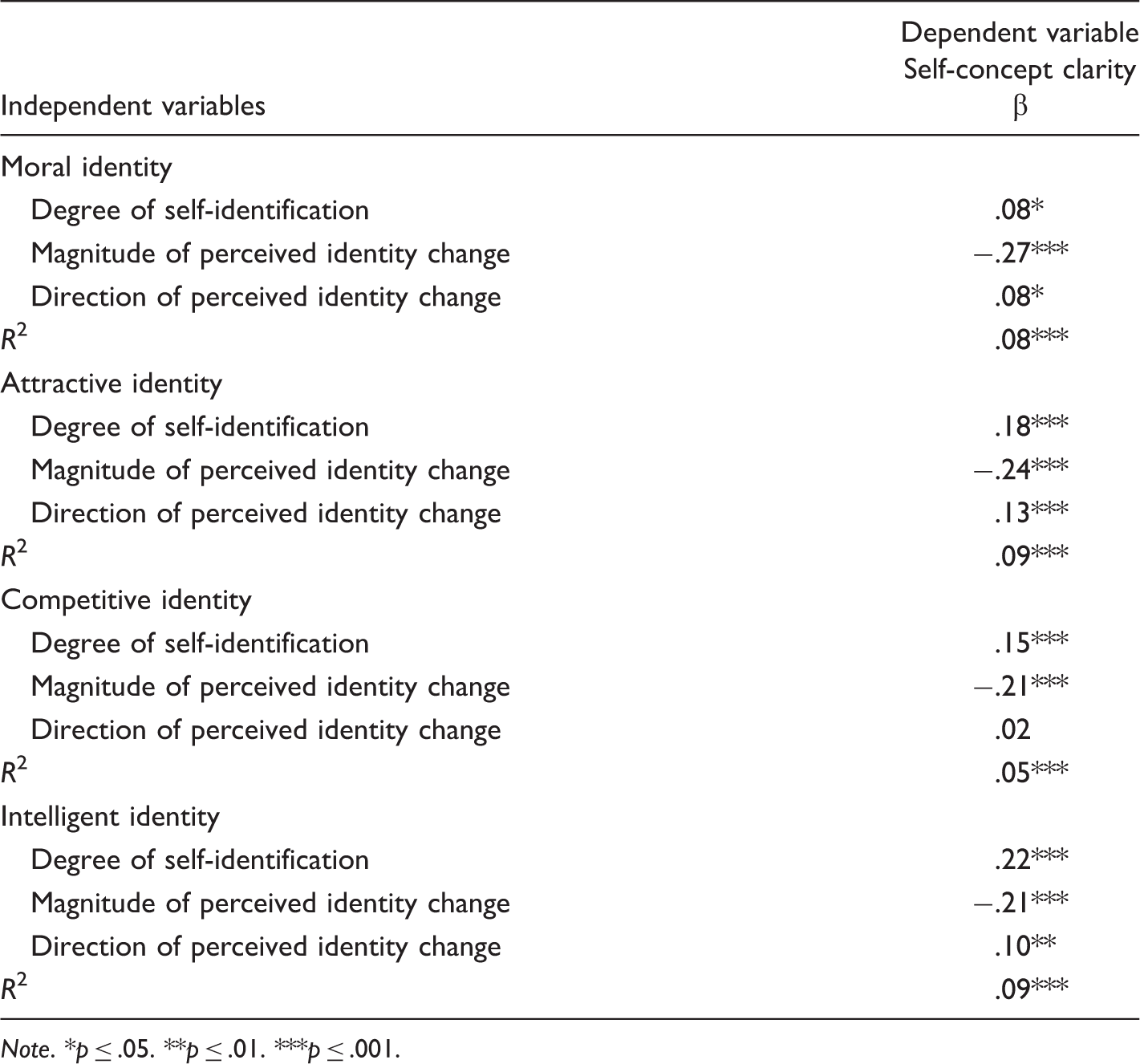
Note. *p ≤ .05. **p ≤ .01. ***p ≤ .001.
Ordinary Least Squares Regression Coefficients for Role Identity Variables and Self-Concept Clarity (N = 844).

Note. *p ≤ .05. **p ≤ .01. ***p ≤ .001. †p ≤ .10.
The effects regarding the relationship between the direction of role identity change and self-concept clarity were not as consistent compared with the person identities. Regarding the role-identity directional change variables, the findings show that only progressive change in the student identity relates to a greater level of self-concept clarity. So, while the result regarding the student identity is in line with what was expected, the results for the other three identities offer no support for Hypothesis 4.
Ordinary Least Squares Regression Coefficients for Social Identity Variables and Self-Concept Clarity (N = 844).
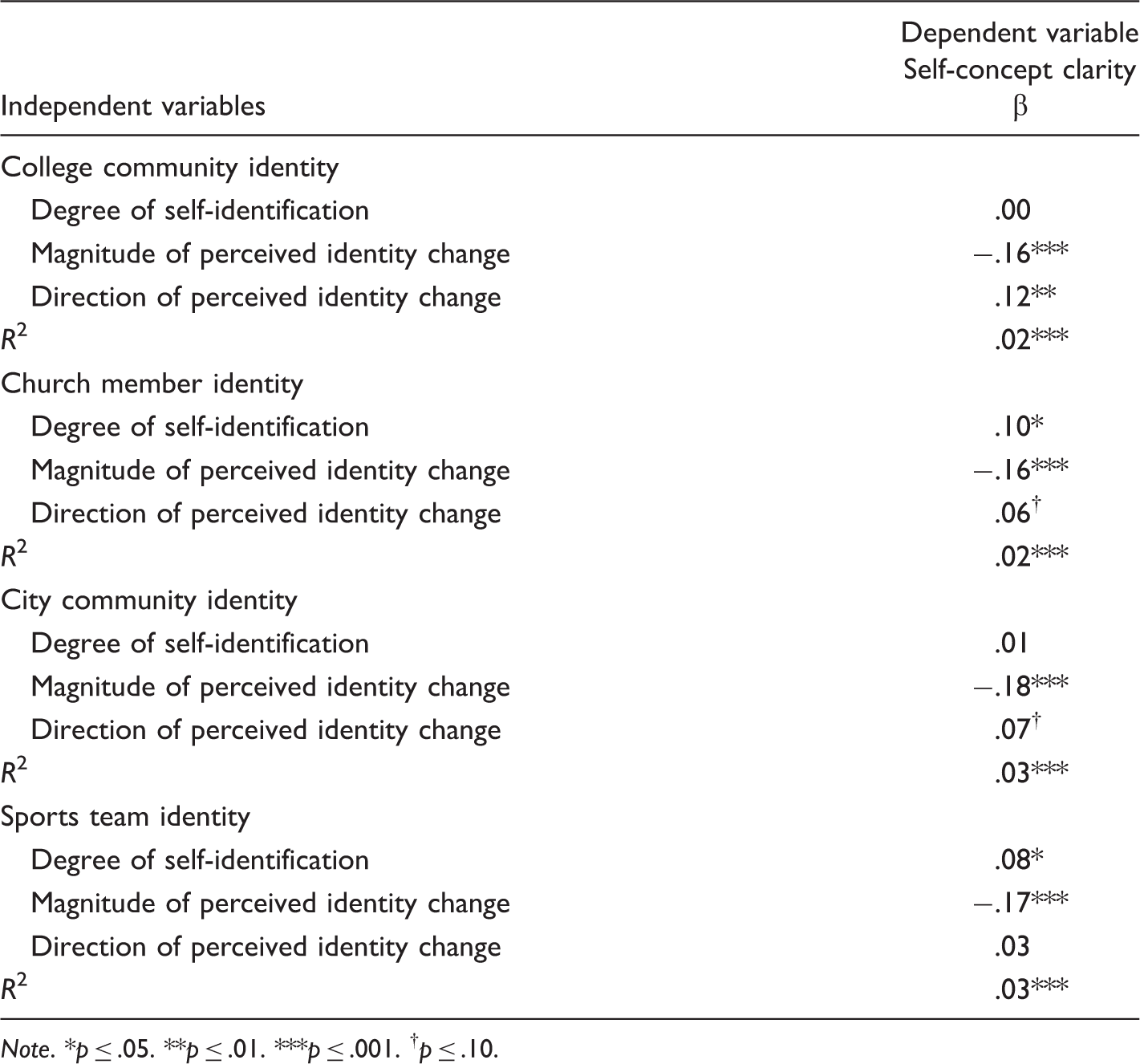
Note. *p ≤ .05. **p ≤ .01. ***p ≤ .001. †p ≤ .10.
Like the results for the role identities, the effects regarding the relationship between the direction of social identity change variables and self-concept clarity were not as consistent compared with the person identities. When we examine the coefficients for the social identity directional change variables, the findings show that only progressive change in the college community identity relates to a greater level of self-concept clarity. So, as with the role identity findings, while the result regarding the college community identity is in line with what was expected, the results for the other three identities—in isolation—offer no support for Hypothesis 4.
Ordinary Least Squares Regression Coefficients for Combined Variables and Self-Concept Clarity (N = 844).

Note. *p ≤ .05. **p ≤ .01. ***p ≤ .001.
In examining Table 5, we see that across all person, role, and social identities, the more participants see themselves as being the identities that represent an identity base (combined), the greater their level of self-concept clarity. And, when combining all the degree of self-identification variables and considering the combined degree of identification with the variables in the overall self-concept, the more individuals identify as the identities, the greater their level of self-concept clarity.
Regarding the perceived identity change variables, the more severe one's perceived experience of identity change in all combined person, role, and social identities, the lower their level of self-concept clarity. When combining all the magnitude of perceived identity change variables and considering the combined impact of overall magnitude of perceived identity change one's experiences in their overall self-concept, the more severe one's perceived experience of identity change, the lower their level of self-concept clarity. These results clarify and provide further support for Hypothesis 1.
Regarding the direction of perceived identity change variables and the hypothesized relationship between progressive identity change and self-concept clarity, progressive change in person and social identities together (respectively) relates to greater self-concept clarity. Directional change in the role identities together had no effect on self-concept clarity. Across all identities, when individuals experience progressive identity change in their overall self-concept, they have a greater level of self-concept clarity. These findings provide further support for Hypothesis 4.
To test Hypotheses 2 and 3, we used the suest command in Stata, which allows the comparison of coefficients across regression models (i.e., the combined person identity, role identity, and social identity magnitude of perceived identity change coefficients reported in Table 5 were compared with one another to see if they were significantly different across models). In examining the magnitude of perceived identity change coefficients for person, role, and social identities, the results showed that the person identity magnitude of change variables affects self-concept clarity more than role identity magnitude of change variables (χ2 = 4.76, p ≤ .05). This supports Hypothesis 2. The person identity and social identity magnitude of perceived change coefficients were not significantly different. This disconfirms Hypothesis 3. 5
Discussion
This study has examined the relationship between perceived identity change and self-concept clarity by addressing perceived identity change as a multidimensional construct. The results generally support the notion that different dimensions of perceived identity change impact the self in unique ways. We have seen conclusively that one dimension of perceived identity change, the magnitude (or severity) of such change, relates to a lower degree of self-concept clarity. And, though not as conclusive as the magnitude of identity change variables, the results generally support the notion that self-concept clarity varies depending on whether one's perceived experience of identity change is progressive (i.e., entering into an identity) or regressive (i.e., exiting out of an identity). Generally, progressive identity change relates to greater self-clarity.
The results presented here also provide empirical support for the theoretical expectation that person identities are more stable entities within the self, compared with role identities. The results show that self-concept clarity is affected more when individuals experience changes in person identities than when they experience changes in role identities (though the same relationship was not found regarding the relationship between person and social identities). In furthering the understanding of how person, role, and social identities operate as discrete types of identities, this study has answered the call from identity scholars who have noted that more research is needed that addresses differences among the three bases of identity (Burke & Stets, 2009; Stets & Burke, 2014). While the results presented here add to the understanding of the operation of the bases of identity, more research is needed to discover more about the nature of person identities in relation to role (and social) identities.
Overall, there are two main benefits of this study. First, the results presented here inform the literature on self-concept clarity. By examining the relationship between perceived identity change and self-concept clarity, we have furthered the understanding of how and why individuals experience fluctuations in the clarity of their self-concept. Specifically, the results presented here contribute to recent research by Diehl and Hay (2011), Lodi-Smith and Roberts (2010), Lodi-Smith et al. (2017), and Van Dijk et al. (2014) who have examined how self-concept clarity changes over time. By revealing that self-concept clarity fluctuates depending on the experience and nature of perceived identity change, we gain a better understanding of the self as an evolving entity and temporal process.
Second, the results presented here also inform the literature on identity change. As discussed earlier, empirical research on identity change has generally focused on changing identity meanings or the accumulation (or abandonment) of multiple identities. By conceiving perceived identity change along dimensions of magnitude and direction, we gain a richer, more complete understanding of how individuals experience changes in their identities and in their self-concept overall.
While conceiving the impact of the magnitude and directional dimensions of perceived identity change extends the understanding of the changing self as a fluid and flexible entity, there are additional dimensions of change to consider. For example, when an identity changes, it implies a chronological process. The temporality of a changing identity is another discrete dimension of identity change. When individuals experience a change in an identity, the change might develop rapidly or longer over time. Change in one identity might occur over a month; change in another identity might occur over a year (or more). So, considering all this, we see that identity change as a process can be conceived in terms of the magnitude of change, the direction of change, and the duration of change—all discrete dimensions that operate in concert. There may be additional dimensions of identity change as well that can be isolated and examined empirically. Classifying, operationalizing, and empirically testing these dimensions should be a goal for identity scholars moving forward.
Study Limitations and Recommendations for Future Research
While the results presented here are useful in helping to understand the process of identity change, there are limitations worth noting. First, the study data are cross sectional rather than longitudinal. Participants were asked to recall past experiences and report how they believed they had changed over time. An additional limitation regards the identities examined here. While the identities that are examined in this study are generally relevant to the sample population (and a relatively wide variety of identifies has been examined), they do not represent the self-concept in its entirety. Future research is needed to discover if the results presented here are generalizable to other identities.
Another limitation regards the age of the sample; study participants, on average, were relatively young. Identity scholars have documented that identities form and change differently across the life span (Roberts, Walton, & Viechtbauer, 2006). So, while the results presented here help clarify the process of perceived identity change and its impact on self-concept clarity, the results ultimately are generalizable to the age-groups that define the sample. An additional limitation regards the causal effect of the perceived identity change variables on self-concept clarity. We have relied on theory and past research to infer the variable relationships and interpret the study results, but because of the nature of the data, the relationships reported in this study are more correlational than causal. Thus, the results presented here offer a starting point for future work. Further research is needed to better understand how dimensions of identity change relate to self-processes such as self-concept clarity. For example, it will be interesting to investigate how identity prominence, salience, and commitment relate to perceived identity change and how these identity processes affect self-concept clarity.
Conclusion
In this study, we have shown how identity change relates to self-concept clarity. We have shown that, generally, the more severe one's experience of identity change, the lower one's degree of self-concept clarity. We found this in all identity types examined in the study, including person identities (being moral, attractive, competitive, and intelligent), role identities (being a friend, worker, son or daughter, and student), and social identities (being a member of a college community, member of a church, member of a city, or fan of a sports team). This study also provides empirical evidence for the previous theoretical contention that person identities tend to be more stable entities within the self, compared with role identities. We have shown that when person and role identities change, the impact of change on clarity of the self-concept is more disruptive (and impactful) for person identities than for role identities, which is expected based on previous theory. And, even though the study results were not as conclusive for the directional dimension of perceived identity change variables as they were concerning the magnitude of perceived identity change variables, we have shown that generally, progressive identity change (i.e., developing into an identity) relates to a greater degree of self-concept clarity. By examining the relationship between different dimensions of identity change and self-concept clarity, we gain a better understanding of what happens when individuals experience changes in their self-concept, and how perceived identity change operates along discrete dimensions.
Footnotes
Declaration of Conflicting Interests
The authors declared no potential conflicts of interest with respect to the research, authorship, and/or publication of this article.
Funding
The authors received no financial support for the research, authorship, and/or publication of this article.