



Abstract
Humans and agents of artificial intelligence (AI) participate in human-machine communication (HMC) more frequently now than ever before – especially in the U.S. Voice powered assistants (VPAs) are widely accessible software agents that enact various social roles, such as personal assistants, and are increasingly packaged with AI-devices to complete simple-tasks, such as sending texts, more efficiently. VPAs are designed to mimic human-human interactions (HHIs) to facilitate more natural human-VPA interactions (HVPAIs). The focus of this study is on the psychological effects of HVPAIs with Amazon’s VPA, Alexa, to identify predictors of frequent Alexa-use through six functions of imagined interactions (IIs) – rehearsal, self-understanding, relational maintenance, conflict linkage, compensation and catharsis. A modified survey of imagined interaction was distributed to 810 self-reported Alexa-users recruited through Amazon’s Mechanical Turk (MTurk). Results suggest that HVPAIs with Alexa impacts the imagination of participants similarly to HHIs, and that use of specific functions of IIs are significant negative predictors of Alexa-use. Moreover, the inclusion of machine-interlocutors as part of imagined interaction theory appears to be compelling as humans and machine interactions evolve in the 21st century.
Keywords
For thousands of years, people have exhibited a desire – or possibly even a need – to create human-like companionship from other objects (Lawry, 2018), and in this age machines are now most prominent. observed how machines co-exist with humans in society at multiple levels, especially in working environments (Bernstein et al., 2007), public hospitals, private homes (Guzman, 2019), and personal spaces. Lee and Liang (2018) showed how agents of AI have a subtle influence on the personal choices of users, along with the capacity for evoking empathy, improving product attitude, and encouraging interaction (Lawry, 2018, p. 25). Interactions with machines have become practically unavoidable in the 21st century, and will likely affect the social evolution of humanity in unexpected forms of communication behavior.
Elon Musk warned our interactions with AI could potentially endanger humanity without proper understanding and sensible regulation (Vincent, 2017). Undoubtedly, understanding AI and its impact achieves a higher degree of relevance than mere abstract curiosity. In gaining insights into the communication implications of interaction with artificial companions like Home Google or Alexa, which are happening more frequently in our depersonalized society (Guzman, 2019), we might then understand how these interactions affect human behavior. Consider the impact on imagination, for example, which relates to social cognition and raises questions about how interactions with Alexa change the process and effects of communication.
People perceive humans and specific technologies as distinct interlocutors when exchanging messages during their AI interactions (Guzman, 2019). Imagined interaction theory examines imagined interactions (IIs) and typically explores IIs with significant others for a specific communicative purpose (Honeycutt, 2003b, 2010, 2019). Millions of Americans interact with Alexa on a daily basis, and yet the extant literature on this phenomenon indicates a deficiency of established knowledge on both the process and its effects in a similar context.
The present study went beyond the examination of imagined interaction with other people and chose instead to analyze the effects of interacting with Alexa. We used a contextually modified survey of imagined interaction to probe the impact of AI-use on the six functions of IIs defined by Bodie et al. (2013) as rehearsal, self-understanding, relational maintenance, conflict linkage, compensation and catharsis. Our survey also assessed the length of ownership and frequency of use while taking into account the demographics of respondents who own and use at least one Alexa-enabled device. This data analysis served tocreate an essential path of study to alleviate the dearth of research on the role of imagination in human-AI relationships.
Mou, Xu, and Xia (2017) showed how humans use different approaches and patterns of communication when interacting with different machines, while imagined interaction theory magnifies the use of IIs as a psychological process associated with communicative encounters with significant others (Honeycutt et al., 2015). Bridging the gap between imagined interaction theory and human-machine communication (HMC) through Alexa-use seems an obvious next step within the realm of imagined interaction study. It is thus reasonable to seek insights into the imaginative consequences of AI communication to understand how artificially intelligent machines may be somehow affecting how humans engage with themselves and with others.
Literature Review
Amazon’s Alexa
Alexa, or Alexa Voice Service (AVS), is Amazon’s voice-activated assistant included in most of the company’s Alexa-enabled products. “The Alexa Voice Service enables […users…] to access cloud-based Alexa capabilities with the support of AVS APIs [application programming interfaces], hardware kits, software tools, and documentation” (Amazon Alexa, n.d.-b, para. 2).
According to Amazon’s official website (Amazon Alexa, n.d.-a): Alexa is Amazon’s cloud-based voice service available on hundreds of millions of devices from Amazon and third-party device manufacturers. With Alexa, [people] can build natural voice experiences that offer […] a more intuitive way to interact with the technology they use every day. (para. 1)
According to Chung et al. (2017), Alexa communicates with various machines on behalf of humans by means of either Alexa-enabled devices or third-party, companion clients available on smart devices, laptops, and personal computers. Alexa-enabled devices include smart-speakers, entertainment devices, kitchen appliances, car systems, and robots.
Amazon posts on its website (Amazon Alexa, n.d.-b): Alexa built-in is a category of devices created with the Alexa Voice Service (AVS) that have a microphone and speaker. You can talk to these products directly with the wake word ‘Alexa,’ and receive voice responses and content instantly. Alexa built-in products work with Alexa skills and Alexa-compatible smart home devices. (para. 1)
Human-AI Communication
Interpersonal communication is based on symbolic interactionism, which involves the transmission of messages from a sender to a receiver via symbols, such as words, pictures, figures, and graphics (Berelson & Steiner, 1964). It is the process of bridging experiences to form understandings and social realities (Giddens, 1979) that is described as a flow of information from one person to another (Axley, 1984). Fragkoulidi (2017) preferred the definition of interpersonal communication without using “person,” replacing it instead with the terms “agent” or “others.” Dainton and Zelley (2019) argued that interpersonal communication involves at least two independent agents (p. 77). Interpersonal interactions contribute to the development of relationships and consequently influence self-talk or intrapersonal communication, and vice versa. This study focuses on applying imagined interaction for English-speaking, adult Alexa-users living in the U.S.to human-agent interaction (HAI), specifically human-virtual personal assistant interaction (HVPAI).
Imagined Interactions
Intrapersonal communication defines the internalized dialogue one has with self, and within the context of symbolic interactionism we have the study of how individuals simultaneously examine and understand both self and social actions (Mead, 1934). Mead’s (1934) claim serves as the foundation of imagined interaction theory, but it does not stop there. Internalized dialogues allow one to consciously take the role of others by imagining how they might respond to one’s particular message, as well as test the outcome of alternative messages prior to real conversations (Honeycutt et al., 1989). One area of intrapersonal communication involves imagined interactions (IIs).
This abbreviation, of IIs is used to signify conscious interactions that occur at any time and anywhere. They also may involve anyone and any topic, but they exist within the realm of imagination similar to, yet different from daydreams (Honeycutt, 2003b). Several observations are relevant to use of IIs in this context. They precede interpersonal interactions and are used to manage social expectations with internal dialogues through the development of operational scripts (Honeycutt et al., 2015). They also are used for the purpose of activating or developing mental scripts or procedural records (Honeycutt et al., 1989). In sum, IIs are mindful cognitive interactions easily viewed either in verbal, visual or mixed terms that allow individuals to test communicative outcomes and develop mental scripts prior to and/or after social interactions (Honeycutt, 2003a, 2003b).
It must be further noted the development of IIs is the intentional process of internally testing potential outcomes and planning operational responses to future responses or variations (Honeycutt, 2003b). Rosenblatt and Meyer (1986) unknowingly pioneered the study of imagined interaction theory by suggesting IIs have various similarities to interpersonal interactions within the context of psychological counseling. Similarities include variance in frequency of occurrence regarded as either fragmentary, extended, rambling, repetitive, or coherent. It also involves actors from daily interactions such as one’s family, friends, significant others, or coworkers (Honeycutt et al., 1989). They perceive IIs to be attempts to simulate real-life conversations with significant others from daily life, as opposed to strangers or acquaintances (Honeycutt et al., 2015). IIs also have been used to investigate various aspects of communication such as social apprehension and competence (Honeycutt et al., 2009), sex (Honeycutt et al., 1992), culture, relational quality (McCann & Honeycutt, 2006), and personality (Honeycutt, 2008), as well as various aspects of cognition and communication (Honeycutt & Keaton, 2012). Imagined interaction theory suggests various contexts of communication can trigger the employment of IIs (Honeycutt et al., 2015).
It should be noted IIs are similar to vignettes. Vignettes afford the ability to review and appropriately edit mental scripts at will and are usually logical in progression although not limited to reality (Honeycutt et al., 1989). Vignettes are a type of social cognition directed to prepare for anticipated communicative encounters and to clarify and organize thoughts to improve communicative effectiveness (Bodie et al., 2013; Honeycutt, 2008). Specifically, IIs have generally been explored through two constructs: attributes and functions, which respectively indicate both the IIs and the reasons for their use (Bodie et al., 2013). The present study squarely focuses on the functions of IIs.
Functions of IIs are a foundational facet of imagined interaction theory and occur either individually or in some combination – either instantly or over a period of time, orderly or simultaneously, and fully, partially, or even not at all (Honeycutt, 2003b). Again the six functions of IIs are rehearsal, self-understanding, relational maintenance, conflict linkage, compensation, and catharsis (Bodie et al., 2013; Honeycutt, 2010). According to Bodie et al. (2013), rehearsal refers to using IIs to prepare for upcoming conversations by forming procedural scripts (p. 180). Individuals imagine various outcomes and responses to potential interactions in efforts to reduce anxiety and increase the likelihood of the most ideal communicative outcome occurring (Honeycutt, 2003b). Forensic competitors, for example, rehearse various situations of debate using IIs to prepare for competition (Honeycutt & Gotcher, 1991). Self-understanding is a function of IIs used to clarify the particular meanings of actions, symbols, and words of both self and others (Bodie et al., 2013). Relational maintenance occurs when individuals have IIs about an actor to keep a relationship alive, since relationships are intangible and exist almost entirely within the realm of IIs (Honeycutt, 2003b). For example, Bodie et al. (2013) followed people imagining interactions with geographically distant partners in an attempt to maintain and keep relationships alive.
Conflict linkage is used to relive, as well as prolong, arguments or internal conflict within the mind. According to Bodie et al. (2013), when using IIs for this function people think about old arguments and plan for upcoming topics of disagreement (p. 179). An example of conflict linkage is dwelling on past conflicts to maintain negative emotions and keep conflict with others alive, a process known as ruminating (Honeycutt, 2010). Compensation is used in substitution of real interactions (Bodie et al., 2013, p. 23). One example of compensation would be the occasion of alonely individual who would imagine interactions with deceased relatives or another interaction-partner who is unavailable either physically or emotionally (Honeycutt, 2003b). Catharsis is a function of IIs used to reduce both tension and uncertainty without the need to form procedural scripts (Honeycutt et al., 2015). According to Bodie et al. (2013), catharsis refers to having IIs in order to relieve tension and anxiety through an imaginary, cathartic experience. One such circumstance would be a defeated individual who envisions causing harm to an argumentative partner in an imaginative scenario to fulfill this catharsis function.
Alexa Use and Imagined Interaction
How are IIs among Alexa-users relevant to understanding human interaction with AI?
First, we see how most users consider voice assistants to be sporadic and limited, although some were more satisfied using them for simple-tasks where preserving context is crucial. Frequent voice assistant users are more satisfied with their use overall and yet noted the poor system accuracy and inadequate language understanding skills prevented regular VPA-usage. Outcomes from such scenarios may benefit from some imaginative work prior to using a voice assistant, as people who choose IIs to prepare for upcoming conversations by both rehearsing plans and relieving unresolved tensions and anxieties to improve overall communication effectiveness and competence (Honeycutt et al., 2015).
Rehearsal IIs enable people to mentally practice for potential communication encounters to improve communication-efficiency and overall satisfaction (Bodie et al., 2013; Honeycutt, 2008, 2003b). If people find their IIs cause anxiety they naturally will be less likely to participate in choose such activity. Individuals avoided anticipated interactions causing high-levels of anxiousness as a result of IIs (Choi et al., 2015). Because HVPAIs are relatively new interactions for humanity and humans are learning to interact with them, we hypothesize the following:
H1: Use of rehearsal IIs with Alexa predicts frequent Alexa-use.
H2: Use of self-understanding IIs with Alexa predicts frequent Alexa-use.
H3: Use of relational maintenance IIs with Alexa negatively predicts Alexa-use.
H4: Use of conflict-linkage IIs with Alexa negatively predicts Alexa-use.
H5: Compensation IIs are most used among Alexa-users.
H6: Catharsis IIs are least used among Alexa-users.
Methods
Participants
Participants (N = 810) voluntarily answered demographic questions that investigated age and sex. Data showed that participants (N = 810) had an average age of 34.33 years (SD = 10.39) ranging from 18 to 55, and were mostly female (58.3%, n = 472), whereas the remainder reported they were either male (40.7%, n = 330) or other (.1%, n = 1).
Sixty percent of participants reported owning at least one Alexa-enabled device (n = 482), 27.5% reported owning two Alexa-enabled devices (n = 223), and 11% reported owning three or more Alexa-enabled devices (n = 89). Average duration of use among users was 10.62 months (SD = 7.80). “Frequent users” (80.1%, N = 810) used an Alexa-enabled device at least once a week (18.8%, n = 152), several times a week (31.1%, n = 252) or several times a day(31.2%, n = 253), while “infrequent users” (19.9%, N = 810) used an Alexa-enabled device at least once a month (11%, n = 90), less than once a month (7%, n = 54) or not at all (1%, n = 9).
Procedures
After receiving IRB approval from the investigators’ university, a digital survey was constructed with SurveyMonkey (n.d.) and used to examine the use of functions of IIs among Alexa-users. The questionnaire was accessed by participants (N = 871) through Amazon Mechanical Turk (MTurk), and presented in five sections: consent form, Alexa-measures, survey of imagined interaction with Alexa, demographics, and submission page. Questionnaire responses were excluded (n = 61) if they failed to meet participation criteria. For example, participants were required to be American, speak English, and report ownership of at least one Alexa-enabled device.
The questionnaire was distributed to a limited pool of MTurk workers that matched participation criteria. Employees were compensated $0.25 for at least five minutes of participation, after submitting the completion code to MTurk. Compensation costs were distributed on a first-come-first-serve basis until the budgeted funds were depleted. All financial transactions were dependent on MTurk’s withdrawal policies. Additional costs included funding for Amazon to facilitate laborers and payment for an Echo Dot (3rd generation), which was raffled off to encourage participation. All costs were individually funded. Along with the MTurk compensation code, instructions to enter the giveaway were presented after the submission page. Giveaway entries were emailed to a specific Gmail account created for this study, then recorded in order of submission.
The giveaway yielded114 submissions and email addresses were put into an online random-number generator called Research Randomizer (Random-ize, n.d.). Results produced the number seven. After a submission number was chosen, the winner was contacted via email to confirm shipping arrangements. The device was delivered and received several days later through the United States Postal Service. The Gmail account was deleted once the giveaway was concluded. Data were then loaded into the Statistical Package for the Social Sciences (SPSS) for analysis.
Measures
Alexa ownership and use were measured with contextually modified scales from relevant peer-reviewed studies (National Public Media, 2018) that meant specifically, VPA-ownership and frequency of use. Measures included number of devices owned, frequency of use, functions of IIs, and demographics.
Frequency of use
This study used National Public Media’s (2018) six-point frequency of VPA-use, which was contextually modified for Alexa. This measurement asked, “How frequently do you use your Alexa-enabled device(s)?” Choices were presented as six close-ended, multiple-choice options and included (1) not at all, (2) less than once a month, (3) at least once a month, (4) at least once a week, (5) several times a week, or (6) several times a day.
Functions of imagined interaction with Alexa
Functions of imagined interaction were measured using Honeycutt’s (2010) function scales in the Survey of Imagined Interaction. These scales assessed conflict linkage, self-understanding, rehearsal, relational maintenance, compensation, and catharsis as functions of IIs. All items were contextualized for imagined interaction with Alexa and each item was measured with 4–5 items on a seve-point Likert scale with various levels of agreement, which included (1) strongly disagree, (2) disagree, (3) somewhat disagree, (4) neither agree nor disagree, (5) somewhat agree, (6) agree, or (7) strongly agree. A sample statement from the rehearsal index included, “IIs help me plan what I am going to say for an anticipated encounter with Alexa.” A sample statement from the self-understanding index included, “IIs help me understand Alexa better in relation to me.” A sample statement from the conflict-linkage index included, “my IIs with Alexa usually involve conflict.”
Demographic variables included age, sex, United States citizenship, and English proficiency. (Please see
Items in Survey of Imagined Interactions With Alexa.
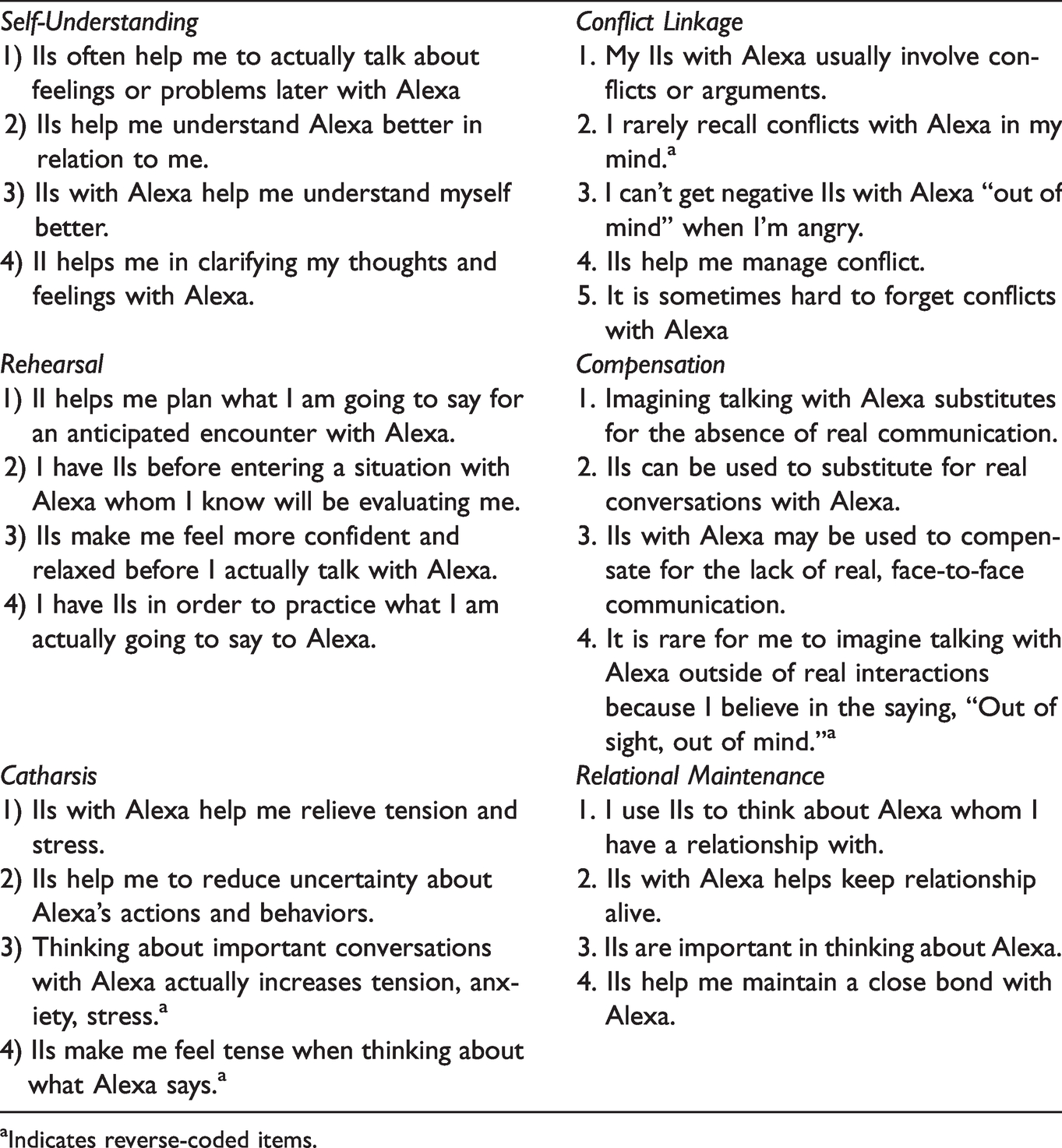
aIndicates reverse-coded items.
Age
Age was a ratio-level measure that asked, “What is your age? (In years).” The answer choices were located in a drop-down box, with options ranging from18 to 65, including “65+.”
Sex
This measurement asked, “What is your sex?” Choices were nominal and presented as three close-ended, multiple-choice options, which included (1) male, (2) female, and (3) other. If “other” was selected, respondents were provided the opportunity to provide a short answer as well.
Results
Functions of IIs were compiled into scales (see
Means, Standard Deviations and Scale Reliability.
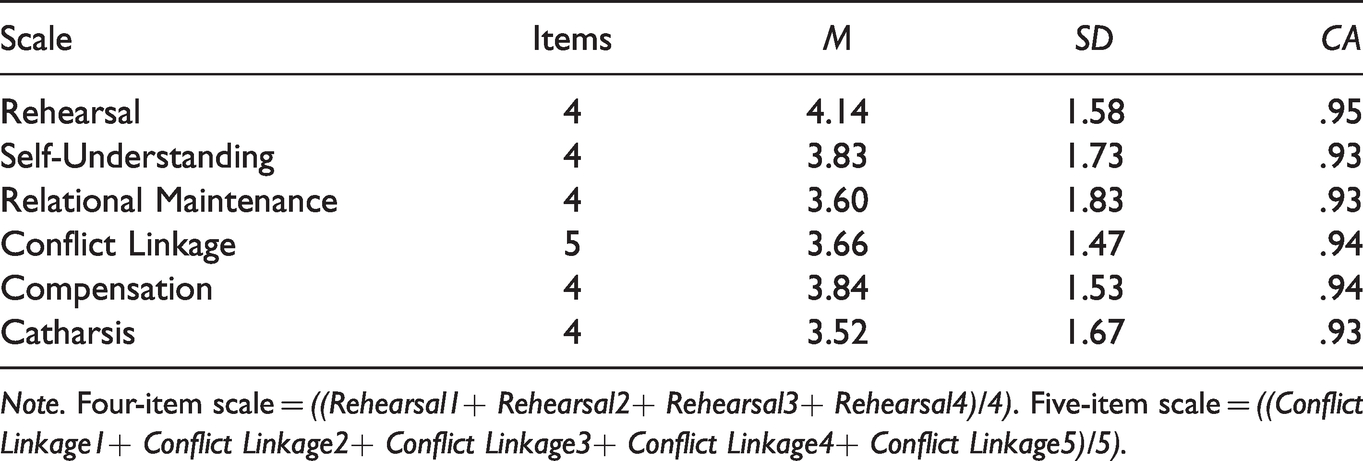
Note. Four-item scale = ((Rehearsal1+ Rehearsal2+ Rehearsal3+ Rehearsal4)/4). Five-item scale = ((Conflict Linkage1+ Conflict Linkage2+ Conflict Linkage3+ Conflict Linkage4+ Conflict Linkage5)/5).
H1 stated that the use of rehearsal IIs predicts frequent Alexa-use. Simple linear regression revealed that rehearsal IIs failed to predict frequency of Alexa-use (ß = −.05, p = N.S.). H1 was not supported by the data and therefore we failed to reject the null. H2 stated that the use of self-understanding IIs predicts frequent Alexa-use. Simple linear regression revealed that use of self-understanding IIs failed to predict frequency of Alexa-use (ß = −.10, p< .01). H2 was not supported by the data and therefore we failed to reject the null.
H3 stated that the use of relational maintenance IIs negatively predicts Alexa-use. Simple linear regression revealed that use of relational maintenance IIs negatively predicts frequency of Alexa-use (ß = −.12, p< .01). Therefore, the data supported H3 and the null was rejected.
H4 stated that use of conflict-linkage IIs negatively predicts Alexa-use. Simple linear regression revealed that conflict-linkage IIs negatively predicts frequency of Alexa-use (ß = −.16; p< .01). Therefore, the data supported H4 and the null was rejected (see
Regression Analyses Predicting Frequency of Alexa-Use.
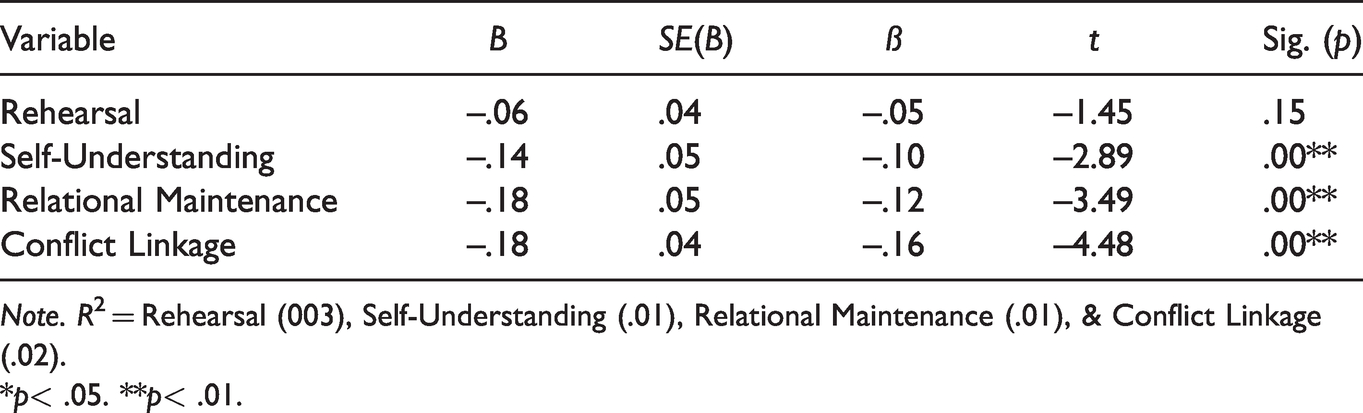
Note. R2 = Rehearsal (003), Self-Understanding (.01), Relational Maintenance (.01), & Conflict Linkage (.02).
*p< .05. **p< .01.
H5 stated that compensation IIs are most used among Alexa-users. A descriptive analysis revealed that compensation IIs had a mean of 3.84 (SD = 1.53), whereas rehearsal IIs had a mean of 4.14 (SD = 1.58). In other words, rehearsal had the highest mean and was found to be the most used function of IIs among Alexa-users, instead of compensation. Therefore, H5 was not supported by the data and we failed to reject the null.
H6 stated that catharsis IIs are least used among Alexa-users. A descriptive analysis revealed that catharsis IIs had a mean of 3.52 (SD = 1.67). Data showed that catharsis IIs were used least. Therefore, H6 was supported by the data and its null rejected.
Discussion
One observation point is clear – owners often imagine interacting with Alexa. This finding and others in this study offer important contributions to imagined interaction theory because, until now, researchers had yet to explore the use of IIs with voice powered assistants, although Chiou et al. (2018) believed participants do in fact treat computers as social actors. Other research notes distinctions based on gender in this context, p. 263) argued “[…] that females have more frequent and pleasant imagined interactions […]” and “[…] are more likely to imagine and recall the scene of imagined interactions than males,” which is pertinent to the present study because a majority of these participants also were female. Additionally, participants tended to be millennials and frequent Alexa-users. National Public Media (2018) identified millennials as early adopters and an early majority on the adoption-of-technology curve among individuals that own an Alexa-enabled smart-speaker.
In the present study, rehearsal IIs were reported to be the most commonly used function among participants. The use of rehearsal IIs, however, failed to predict frequent Alexa use. Rehearsal IIs allow individuals to mentally prepare and plan for communicative encounters (Bodie et al., 2013). The rehearsal function of IIs often compensates for a person’s lack of experience (Honeycutt & Gotcher, 1991). This finding suggests people approach interacting with Alexa in some of the same ways they approach interacting with human partners, that is when it comes to imagining conversations before they happen.
Self-understanding IIs predicted infrequent Alexa-use; imagining interacting with Alexa simply to clarify one’s position in the human-VPA relationship led to using Alexa less frequently. Self-understanding IIs allow individuals to clarify opinions and beliefs about social constructs within the imagination (Bodie at al., 2013). These findings might be insignificant since individuals use these functions of IIs on a daily basis to prepare for and better understand themselves within the context of communicative encounters (Bodie et al., 2013; Honeycutt et al., 2015), although IIs do not govern behavior in real-life since IIs exist purely in the minds of individuals and as noted are in some ways comparable to daydreams (Honeycutt, 2003b).
Use of the relational maintenance and conflict linkage functions of IIs were significant negative predictors of frequent Alexa-use. The more participants had relational maintenance and conflict-linkage IIs regarding Alexa, the less likely they were to interact with an agent-enabled device on a frequent basis. Honeycutt et al. (2015) held relational maintenance IIs are used to psychologically maintain relationships by thinking about significant others within interpersonal contexts and that conflict-linkage IIs are used to sustain conflict between arguments in real-life. saw a majority of users prefer not to use VPAs frequently because of unnatural and “clunky” interactions, which would indicate miscommunications still occur as a result of HVPAIs despite advancements in this technology and natural language processing.
Based on previous literature and the data in the present study, it appears that relational maintenance and conflict-linkage IIs with Alexa actually might introduce dysfunction into the human-VPA relationship, especially since the AI is relatively new and relationships with Alexa are substantially uncharted. Relational maintenance and conflict-linkage IIs with Alexa may give rise to emotions of the human user which cannot be reciprocated by Alexa, and therefore lead to a frustrated, imagined landscape in which Alexa is used less frequently and only for specific tasks. Users who seek emotional comfort associated with the device and focus on companion-like stimuli with Alexa are unlikely to achieve any reasonable satisfaction but are likely to draw more dependent on its functional relationships that may also influence its communication habits.
In the present study, rehearsal was the most used function rather than the compensation function. Compensation IIs are used in place of real conversations (Honeycutt et al., 2015). Although Alexa obviously is not a biological creation, users may attempt interactions with the digital interlocutor similarly to IIs with other humans. Finding that rehearsal IIs are most used instead of compensation IIs is not surprising since rehearsal IIs are shown to be used the most by individuals in other studies without the necessity of a personal response. This is a potentially useful finding for II theory because it suggests humans rely on a certain approach to dealing with partners – both human and AI – much of IIs simply involves imagined rehearsal.
Catharsis IIs were used least by Alexa-users, and this is not surprising since modern machines endowed with AI capabilities use artificial narrow intelligence to accomplish analytical and cognitive tasks (Agha, 2006; Lucci & Kopec, 2013b), and are of course incapable of exhibiting genuine emotions (Wirtz et al., 2018). Catharsis IIs are used as an emotional outlet to reduce uncertainty by relieving tension and anxiety (Bodie et al., 2013), however, smart device owners prefer to not use VPAs because they perceive interactions as unnatural. In light of this and among all the functions of IIs explored in this study, Alexa users engaged in cathartic IIs the least.
The findings for relational maintenance, conflict linkage, and catharsis suggest that humans actually try to introduce emotion into their IIs with Alexa, which in an extreme case might lead to a dysfunctional relationship due to the machine’s incapacity for reciprocating feelings. Alexa would be more likely influencing human users to forego sharing emotions, a distinct form of human communication, potentially rendering consumers more machine-like as a result of continual influence of call-and-responses embedded into AI-saturated communication.
Additional Implications
This research bridges the gap between HMC and imagined interaction theory. Finding American MTurk workers have IIs with Alexa suggests AI challenges humans to adjust their imaginative work to accommodate new forms of intelligence. Here participants have IIs with agents of AI as a result of increased HAIs. The average age of participants was 34, which confirms this comfortable accommodation to AI is a generational trait of millennials more than other age groups, which National Public Media (2018) acknowledges in their publication.
Another psychological effect of HVPAIs is anthropomorphism, which is a mental condition where individuals attach human characteristics and traits to nonhuman entities so they appear more human-like (Fragkoulidi, 2017). An example of anthropomorphism is when individuals treat pets, such as dogs or cats, like human infants. Although AI is not a perfect replica of human consciousness (Lucci & Kopec, 2013a), the imaginations of users are increasingly coaxed to imagine agents of AI as human entities. AI is not human. This study suggests even imagining it as such, particularly when emotions are involved, leads to a diminished level of interactions with Alexa because trying to do so would be futile for the human-Alexa relationship.
In light of these data, how humans do imaginative work involving other humans could be affected over time as IIs adjust to AI, since the effects of consciously altering imaginative work on a large scale will likely affect human-human relationships. show that less social individuals have more IIs than others. McCredie and Morey (2018) claim that MTurk employees have unique personality traits such as lower social engagement. No prior research investigates mental personality traits as predictors of frequent Alexa-users, however, Honeycutt et al. (1989) use imagined interactions to predict measures of self-awareness.
Limitations and Future Research
First, limitations include self-selected participation and cross-sectional data. Participants were voluntarily employed and compensated on a first-come, first-serve basis using an online data collection service called MTurk. Salthouse (2011) argued that an analysis from cross-sectional data is misleading if used as a proxy for longitudinal relations since opinions and trends tend to change over time. For example, results from a survey in the year 1950 will more likely than not be different from the results of an identical survey conducted in the year 2020. Bowen and Wiersema (1999) suggest solving the limitation of cross-sectional data with analytical methods that use pooled time-series in combination with cross-sectional data. Regularly and consistently collected data provides more accurate insights into a specific phenomenon than data gathered at a single moment in time (Berger, 2016). Therefore, future studies should take a longitudinal approach for greater accuracy of results and consequential findings.
Second, employees of MTurk tend to carry distinguishing personality attributes, such as higher affect and lower social engagement levels compared with a national U.S. census-matched normative sample and are not a precise representation of the American public (McCredie & Morey, 2018). Therefore, the sample of this study is potentially biased in terms of personalities and economic motivation to participate in the study.
Third, MTurk employees are also “permanent participants,” which Huff and Tingley (2015, p. 7) described as respondents that “[…] have taken a number of similar studies which can then subsequently affect the ways in which they both answer questions and respond to treatment conditions.” Permanent participants have the potential to undermine assumptions of research methods such as the modified survey of imagined interaction implemented in this study because they have had more practice at taking surveys than other people. Testing for effects of treatment on seasoned survey-taking MTurk workers should be an avenue for future studies to address the limitation of permanent participants and further ensure data validity (Huff &Tingley, 2015).
Additional insights into the psychological impacts of interactions with AI on the imagination of users also should be investigated further, since IIs play a key role in the formation of procedural scripts that individuals mentally refer to when enacting behaviors in reality (Honeycutt, 2010). IIs with different VPAs (e.g.: Siri, Cortana) are additional avenues of research because Echo devices were designed specifically for English-speaking Americans (Hoy, 2018), and data permanency, ownership of data, and limited human-like interactions are relevant factors across all VPA-devices. IIs with other VPAs such as Apple HomePod and Google Assistant are important to gather more accurate generalizations of VPA-users as a whole.
Finally, we must be open minded to alternative theoretical approaches when exploring HVPAIs. Applicable theoretical frameworks include parasocial interactions/relationships (Auter & Palmgreen, 2009; Derrick et al., 2008; Madison & Porter, 2016) and diffusion of innovations. According to Derrick et al. (2008), parasocial interactions occur when individuals engage in one-sided interactions with mediated personae. Often these one-sided interactions occur during viewing experiences (Dibble et al., 2016), and may lead to lasting relationships through imagined interactions (Madison & Porter, 2016). Parasocial relationships, as consequential as they may be in a person’s life, are not true dyadic relationships. With Alexa unable to experience a “true” dyadic relationship with human beings, further research should consider PSI/PSR as an alternative approach to exploring HVPAIs.
At the epicenter of technological advancement and innovation, Americans are the ideal population to sample and examine through the theoretical lens of diffusion of innovation, which explains various motivations to the spread and use of technology. Each avenue of research would provide expansive and worthwhile insights into the realm of HMC. The machine-like influence of AI over the human capacity for empathy and consideration is but one area of concern, if machines continue to fulfill social roles human may adopt personal communication habits to match their cold, but automatically responsive traits.
Footnotes
Declaration of Conflicting Interests
The author(s) declared no potential conflicts of interest with respect to the research, authorship, and/or publication of this article.
Funding
The author(s) received no financial support for the research, authorship, and/or publication of this article.
