




Abstract
How does art expertise through creation and appreciation relate to perceptual and cognitive skills? Previous research suggests that visual arts training may improve attention and observational skills. Little research has investigated whether visual arts appreciation similarly facilitates perceptual skill development. We administered a study (N = 132) containing online and in-person samples assessing how art expertise and engagement relate to a battery of measures, including visual attention, working memory, creativity, mental rotation, emotion recognition, empathy, and mental imagery. Additionally, we assessed art expertise and knowledge with questionnaires and two drawing tasks measuring skill and creativity. Drawing skill was positively correlated to mental rotation, performance on the out-of-focus-images (OOFI) task, and creativity. Art knowledge was also correlated to the OOFI-task, but was additionally related to emotion recognition skills, and to vividness of imagery. These results suggest that both art creation and appreciation may be differentially linked to enhanced perceptual and cognitive skills.
Introduction
Expertise in any domain is generally synonymous with honing a specific set of technical skills. Visual arts training, the focus of our investigation in this paper, involves training a host of perceptual and cognitive skills in service of creating precise visual representations. Artists need to hone their fine motor skills so as to precisely control tools like pencils or brushes; they must learn to attend to and observe the world more closely so as to more accurately represent objects; they must understand the physical and perceptual qualities of the world such as how light interacts with objects, so as to appropriately convey shape and shadow; and they must recognize and be able to discriminate between subtle emotions that others exhibit in order to create an emotionally evocative portrait. Similarly, art lovers, such as individuals who regularly frequent museums, expert art historians, or curators, are highly adept at closely examining and interpreting visual art, and thus likely also train up perceptual and attentional skills at the local and global level through their appreciation.
In the current study, we examine how each of these forms of arts training – drawing expertise and visual arts knowledge – may confer both specific and generalized perceptual and cognitive advantages. We examined individuals’ performance on a host of perceptual, cognitive, and socioemotional skills that we hypothesized were related to visual arts expertise in some way. We were especially interested in how drawing expertise and visual arts knowledge may be related to global and local attentional processing, mental rotation, and creativity.
Advantages Associated with Drawing Expertise
There is already a relatively robust body of evidence that visual artists look at the world differently while drawing and painting than do non-artists. In an eye-tracking study, artists deployed their attention differently than non-artists, tending to use more global-looking strategies than non-artists did while actively drawing. In contrast, non-artists spent more time examining local details while drawing. Artists also needed to spend less overall time looking at the image they were drawing than non-artists did, suggesting an increased representational efficiency (Park et al., 2022). Likewise, Drake and colleagues (2024) show that during drawing, college-aged art students choose to begin drawings by sketching out global features more so than non-art students.
These attentional strategies vary for artists relative to non-artists outside of the context of drawing as well. Research shows that visual artists excel in visual processing tasks that relate to the skills they need to accurately render objects, including pattern recognition, geometric reasoning, envisioning and visualization, global and local attentional flexibility, and visuospatial reasoning (Angelone et al., 2016; Chamberlain & Wagemans, 2015; Chamberlain et al., 2019; Drake, 2014; Drake et al., 2024; Kozbelt, 2001; Kozbelt, 2017; Perdreau & Cavanagh, 2013a, 2013b; Vodyanyk & Jaeggi, 2025). This is especially true for highly skilled artists operationalized by their ability to accurately copy an image in a short time. There is evidence, for instance, that drawing ability predicts performance on local processing tasks (Chamberlain et al., 2019; Drake, 2013; Kozbelt, 2001; Ryder et al., 2002) and is positively related to global processing skills (Chamberlain and Wagemans, 2015). With respect to local processing, art students outperform non-art students on tasks such as the embedded figures test, in which they must identify a target shape amongst many other figures (Chamberlain et al., 2019; Drake et al., 2024; Kozbelt, 2001; Ryder et al., 2002). Art students also excel at mental rotation and transformation (Vodyanyk & Jaeggi, 2025), showing improvement in this ability over the course of their training (Chamberlain et al., 2021). Mental rotation positively correlates to performance on local processing tasks such as the embedded figures test (Chamberlain et al., 2019).
Moreover, artists are especially skilled at integrating local information into a coherent form, outperforming non-artists in more readily identifying an object within an out-of-focus image (Drake et al., 2024). Relatedly, there is evidence that artists employ distinctive viewing strategies while inspecting visual art, focusing on contextual relationships among objects, relative to nonartists who focus more on individual objects (Pihko et al., 2011; Nodine et al., 1993; Vogt & Magnussen, 2007).
One explanation for artists’ superior performance on both local and global processing tasks is that they may have honed their attentional flexibility, allowing them to more readily deploy local and global attention as needed, depending on the task at hand (Chamberlain and Wagemans, 2015; Chamberlain et al., 2018; Ostrofsky et al., 2013). For example, in Chamberlain and Wagemans (2015), artists were faster at switching between local and global attentional scales in a Navon task.
Importantly, visual artists don’t seem to be just better at all tasks, but are specifically better at tasks that align with the skills they are honing during their art practice. For example, there does not seem to be a difference in performance between artists and non-artists with respect to their verbal IQ, which we don’t expect to be especially relevant to drawing (Drake et al., 2021). Furthermore, Vodyanyk and Jaeggi (2025) demonstrated that whereas visual artists perform better in mental transformation tasks, expert writers exhibit better vocabulary knowledge, showing that expertise in a specific domain confers specific cognitive advantages.
Advantages Associated with Arts Appreciation
As with drawing, we similarly expect that specific perceptual and cognitive skills would be enhanced by increasing one's art knowledge through careful looking and art appreciation.
This is a field of inquiry that is increasingly studied within the medical humanities. In these studies, medical or nursing students are generally assigned either to a control group or to an art “intervention” group during which they participate in some type of visual arts workshop or a museum-based arts program, often with an arts educator acting as facilitator. Studies show that these interventions help foster students’ clinical observation and diagnostic abilities (Gurwin et al. 2018), allowing them to better recognize and understand patients’ emotions and symptoms (Bardes et al., 2001). The arts workshops also significantly improve students’ interpretive skills outside of an arts context, such that they are more open to ambiguity and multiple potential interpretations (Pellico et al., 2009). In one key study, researchers compared a control group who completed a close-looking workshop engaging with clinical photographs and cases to two groups who engaged with art. Although the students who examined clinical photographs scored better on symptom recognition than the students in the arts group, the arts group students performed better at holistic and contextual observation, seeing the patient as a whole person, rather than as a collection of symptoms. This suggests improved socio-emotional skills, consistent with other research showing that medical or nursing students with more art exposure, and who enjoy art more, exhibit greater empathy and better emotional understanding of their patients than their peer group. (Charon, 2001; Chen et al., 2017; Hardy, 2017; Xue et al., 2023).
Research outside of medical contexts is still limited, but there is some evidence examining how arts appreciation may improve cognition. For instance, after a multi-week guided museum-based workshop, children (ages 6–12) had increased emotion understanding in response to story vignettes, suggesting that the benefits of arts appreciation may extend beyond the learned context (Ebert et al., 2015). Individuals with more visual arts knowledge also tend to enjoy negative content in visual art more than non-experts do, and exhibit less extreme physiological responses in their facial muscles to artworks featuring negative content than non-experts (Leder et al., 2014), perhaps due to greater emotion recognition and regulation capacities.
Although many of the results described don’t directly point to art exposure conferring domain-general performance improvements, they are suggestive of the importance of arts appreciation and interpretation for improving cognition and perception both within and outside of arts contexts. We thus might expect individuals such as art historians or museum goers who frequently engage with visual art but do not produce their own art to exhibit a host of perceptual, cognitive, and socioemotional advantages.
The Current Study
The goal of the current study is to build upon previous research by more holistically investigating whether art engagement facilitates cognitive and perceptual skill development. We hypothesized that individuals involved in the arts – both creators and appreciators – would perform better than individuals who are not involved in the arts on a wide variety of visuospatial, creative, and attentional tasks. Moreover, we were interested in examining how creators and appreciators compare to each other with respect to their domain-general cognitive skills. Discriminating between art-making skill and art knowledge developed through art appreciation is challenging, however, as these often co-occur. To get at this distinction, we operationalized visual art-making skill through two drawing tasks previously used in the literature (Chamberlain & Wagemans, 2015; Clark, 1989). Art appreciation skills were operationalized using a validated art-knowledge scale, VAIAK-R (Specker, 2024; Specker et al., 2020). We tested performance on a battery of cognitive tasks used in prior literature and included tasks that we thought would reflect the benefits of such skill development as well as other cognitive tasks (e.g., digit span) that would be unlikely to be impacted by involvement with visual arts. We intentionally recruited a broad sample to target people involved in creation as well as people who have art expertise and fluency without being active creators of art. For instance, we recruited professional art historians and students of art history specifically because they have training in visual analysis without being professional makers.
Methods
Participants
We recruited 132 participants: 48 undergraduates from Occidental College, 55 participants recruited from Prolific, and 29 participants recruited based on their previous experience in the arts (17 from a database of professional artists, and 12 by emailing faculty and graduate students in art history and fine arts graduate programs). The sample included 71 females, 55 males, and 6 non-binary individuals. Across the whole sample, 81 participants fell between the age range of 18–24 (with 51 being over the age of 25). 58 participants had a bachelor's degree or higher, and 43 participants had some college or technical training.
All study materials were approved by Occidental College's IRB (Protocol # SP23-09-SHE). Participants received $18 to $23 or partial course credit for participating in this study.
Materials and Procedures
All participants were tested within a 1-h session. The study included a battery of tasks administered online via the Gorilla software. Of the 132 participants, 91 completed the task unsupervised online, while 41 completed the online task in person at Occidental College. The battery consisted of questionnaires and a series of cognitive tasks measuring visuospatial thinking, memory, attention, empathy, and creativity. In-person participants completed the drawing tasks on paper, whereas unsupervised participants completed their drawings on paper and uploaded a high-resolution photo of their drawings to Gorilla.
Participants who completed the task online were instructed to: “Please complete the study all at once in a quiet space, with limited distractions. Check that you are using a laptop, desktop, or tablet for this study. Please place the tab in full screen and exit all other windows and browsers.”
With the exception of the drawing task, participants completed the following tasks in a standardized order: Demographic questions, art expertise ratings, the Vienna Art Interest and Knowledge-Revised (VAIAK-R) Questionnaire, the Toronto Empathy Questionnaire, the Object-Spatial Imagery Questionnaire, the Reading the Mind in the Eyes Test, Digit-Span, Navon Global, Navon Local, Mental Rotation, Embedded Figures, Out-of-Focus Image, Alternative Uses Task, and the Remote Association Tasks. 75 participants completed the Drawing Tasks immediately after the art expertise rating, 16 participants completed the Drawing Tasks in a separate session after their initial participation in the study, and 41 participants did not complete the Drawing Tasks at all (though they received invitations to participate). Below, we describe each of the tasks in the battery in detail.
Demographics
Participants completed a comprehensive questionnaire covering several demographic details. The questionnaire included questions about their age, sex/gender identity, current employment status, level of education, race/ethnicity, and if applicable where they attend college.
Predictor Variables
Art Expertise. Participants self-rated their art experience on a 5-point scale from None: I have no experience creating art (1) to Expert: Highly skilled with extensive experience (5). They were then asked to describe their art-making experiences in an open-ended response prompted by the question: “Describe your art-making experiences and practice (Please feel free to define art broadly– i.e., visual art, music, literature, film.). Because many participants either did not describe their experiences or had varied expertise that was outside of the domain of the visual arts (for example, being a highly proficient musician and assigning themselves a high score, albeit having limited visual arts expertise), we do not include this metric in our analysis.
Observational Still-Life Drawing Task. To assess drawing skill, participants completed an observational still-life based on Chamberlain & Wagemans’ (2015) method. They were given an image of a hand (Figure 1, left) and had 5 min to draw it as accurately as possible. Drawings were rated by three independent raters on a scale from 1 (no skill) to 7 (highly skilled). Example drawings are shown in Figure 1 (middle, right). To derive a single score per drawing, ratings were averaged across the three raters. Interrater reliability was assessed with a two-way mixed-effects intraclass correlation coefficient, single measures, absolute agreement [ICC(3,1)]. Interrater reliability was excellent, ICC(3,1) = 0.881, 95% CI [0.836, 0.915], indicating high agreement among the three raters.
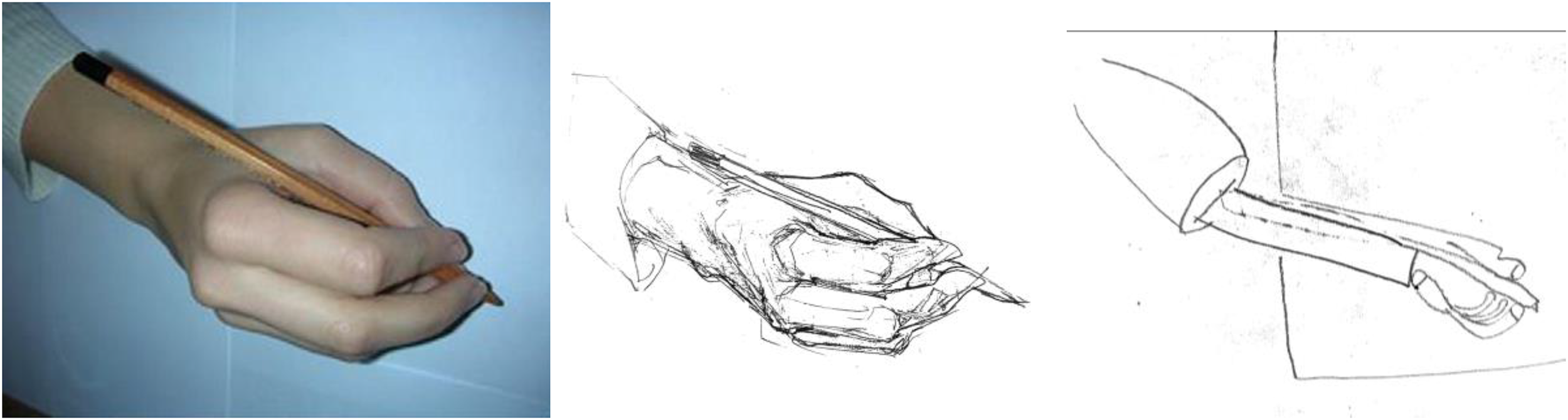
A photograph of the still life participants were asked to copy (left); an example of a high-rated drawing (middle); and an example of a low-scored drawing (right).
Adapted Clark's Drawing Abilities Test (Clark, 1989). Participants were given 10 min to draw a house from their imagination. The following instructions were given: “Draw an interesting house as if you were looking at it from across the street.” They were encouraged to make it as creative and interesting as possible. Drawings were scored by 3 independent raters separately for creativity and interestingness, using a scale of 1 (not at all creative/interesting) to 5 (very creative/interesting). The final scores were computed by averaging the three independent ratings. Figure 2 shows examples of high (left) and low-scoring drawings (right). Interrater reliability was assessed with a two-way mixed-effects intraclass correlation coefficient, single measures, absolute agreement [ICC(3,1)]. Interrater reliability was excellent for creativity, ICC(3,1) = 0.853, 95% CI [0.801, 0.895], and for interestingness, ICC(3,1) = 0.884, 95% CI [0.841, 0.918], indicating high agreement among the three raters.
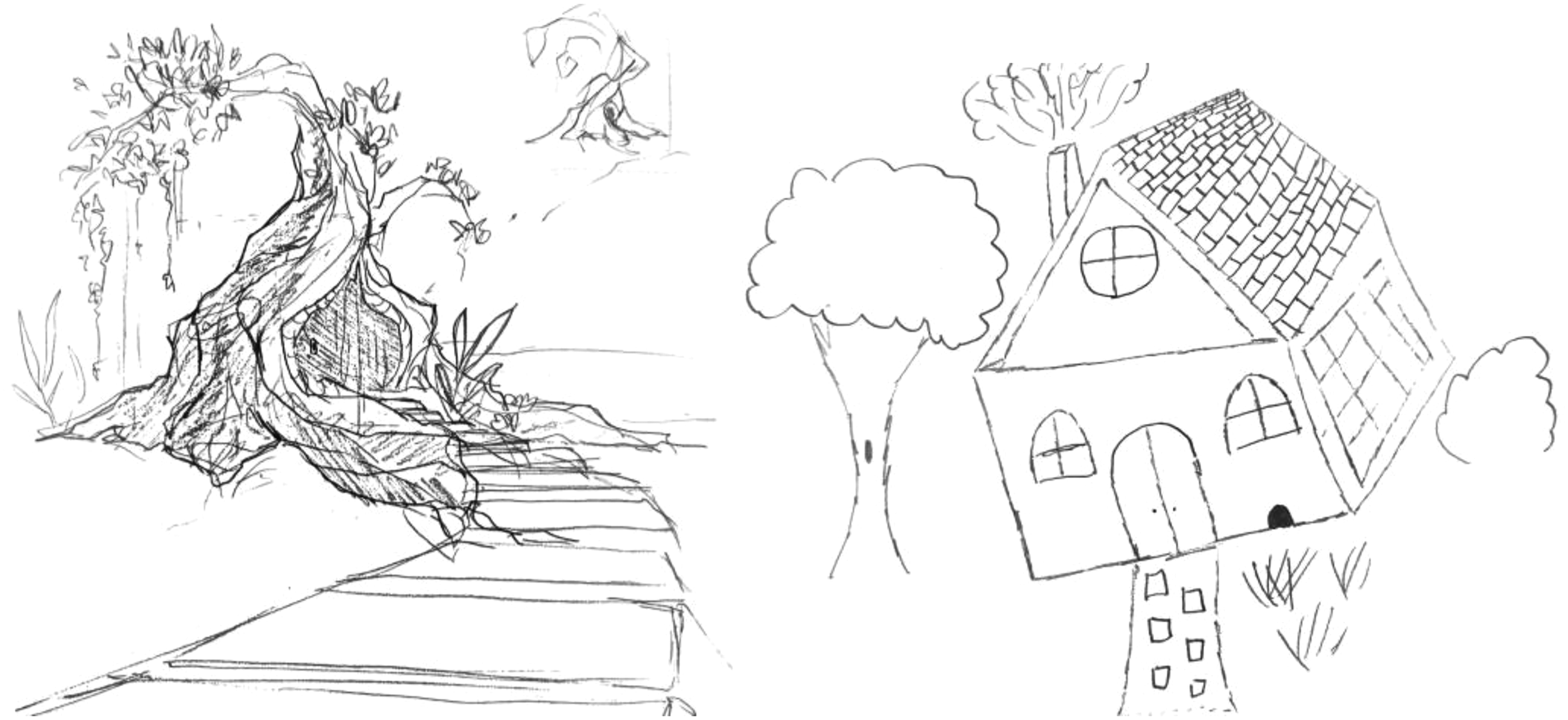
Drawing was rated as highly creative and interesting (left), and drawing was rated as neither creative nor interesting (right).
Vienna Art Interest and Art Knowledge Questionnaire. We adapted the VAIAK-R (Specker et al., 2020) to measure art interest and expertise. Art interest was assessed using an 11-item questionnaire. Seven of the questions asked participants to rate their agreement with statements like “I enjoyed going to art class in school” and “I am always looking for new artistic impressions and experiences”. Four of the questions asked participants to estimate how often they seek out art experiences (e.g., “How often do you visit art museums or art galleries on average?” and “How often do you view images of artworks (picture books, internet, etc.)?”).
Art knowledge was then assessed using images of well-known artworks. Participants were first presented with 6 images of visual artworks and given multiple-choice knowledge questions about the art. They were then presented with 10 images of different visual artworks, and for each, they were asked to the artist and the style (fill-in-the-blank) as well to identify their familiarity with the artwork (yes/no). The total art knowledge score was computed by summing the correct responses to the objective questions with the total number of “yes” responses for familiarity.
Empathy-Related Variables
Toronto Empathy Questionnaire (TEQ). The TEQ consists of 16 items assessing both cognitive and affective empathy (Spreng et al., 2009). An example of cognitive empathy was: “I can tell when others are sad even when they do not say anything” and an example of affective empathy was: “When someone else is feeling excited, I tend to get excited too”. Four of the items (2, 10, 12, and 14) were slightly reworded (2, 10, 12, and 14) for clarity based on feedback from an initial pilot. Participants rated each question on a scale from 0 (never) to 4 (always). The total score was the sum of all responses (note that questions 4,7,11 and 15 were reverse-scored). Higher scores indicated greater empathy.
Reading the Mind in the Eyes Task (RMET). The RMET consists of 36 items assessing emotion recognition abilities (Oakley et al., 2016). Participants were shown a black-and-white image of a person cropped so that only the eyes were visible and were asked to identify the correct emotion from a set of four options. Performance was computed by calculating the number of correct identifications.
Imagination-Related Variables
Object-Spatial Imagery Questionnaire (OSIQ). The OSIQ consists of 30 items assessing individual differences in object-based visual imagery and spatially-based visual imagery (Blajenkova et al., 2006). Fifteen of the items asked participants to rate their subjective experiences and preferences for visually representing and processing colorful and pictorial images of individual objects (e.g., “My images are very colourful and bright” and “When I imagine the face of a friend, I have a perfectly clear and bright image”). Another 15 items asked participants to rate their experiences and preferences for processing schematic images, spatial relations amongst objects, and spatial transformation (e.g., “I was very good in 3-D geometry as a student” and “I can easily imagine and mentally rotate 3-dimensional geometric figures.”) Object-based imagery 30 items was summed for each participant.
Mental Rotation. A variation of the mental rotation task from Chamberlain et al. (2019) was used to assess individual differences in visual imagery capacities. Participants viewed pairs of two-dimensional drawings depicting three-dimensional block objects, presented as black drawings on a white background. After 4 practice trials, participants completed 48 experimental trials. In each experimental trial, they were given 15 s to determine whether the two presented shapes were the same or different shape. Accuracy was computed for each participant.
Attentional Scope/Visual Processing Variables
Navon Global and Local Attention Task. We assessed visual attention using an adapted version of a Navon global and local attention task (Chamberlain & Wagemans, 2015). Each trial displayed a large shape (square or X) composed of smaller shapes (square or X) on a white background for 250 ms. In the global block, participants were shown 30 trials in which they were asked to identify the global shape and ignore the local shape. Following the global block, they completed 30 local trials, in which they were asked to identify the local shape and to ignore the global shape. Each block included a practice trial with feedback. Accuracy and reaction time were recorded. Due to a technical error, only 54 participants completed the Global and 53 participants completed the Local task. One participant who did not follow the instructions (indicated by a 0% accuracy) was removed.
Embedded Figures Task. Participants completed a modified Leuven Embedded Figures Test to assess local processing abilities (Chamberlain et al., 2019). This task was used to complement the Navon task in assessing local attention. Across 2 blocks of 24 trials (48 total trials, and an additional 4 practice trials with feedback), they viewed black shapes on a white background and were asked to identify the target shape within one of three complex 2D images. Each trial lasted 2.5 s. Accuracy was recorded per trial for each participant.
Out of Focus Images Task. To complement the Navon task in assessing global attention, we used the out-of-focus images task to assess global processing skills (Kozbelt, 2001). Participants were shown 45 blurry images and were given up to 15 s to identify each one. Responses were open-ended. They completed two practice trials (with feedback) before the main trials. Three independent raters scored responses for accuracy, accepting specific exemplars (e.g., tulip) as well as broader categories (e.g., flower). All disagreements were accounted for until 100% interrater reliability was achieved. Accuracy scores were recorded for each participant.
Creativity Variables
Alternative Uses Task (AUT). We used the AUT to measure individual differences in divergent thinking (Cortes et al., 2019). Participants were asked to generate unique uses for three everyday objects (a fork, a brick, and a tin can). They were given up to 45 s to list as many novel uses as possible. Scores were based on fluency, flexibility, elaboration, and originality, following Guilford's (1967) criteria. Three independent raters scored AUT based on a scoring guidelines sheet created based on Guilford's (1967). All disagreements were accounted for until 100% interrater reliability was achieved.
Remote Association Task (RAT). The RAT, developed by Mednick (1962), measures convergent thinking by asking participants to find a common word that links three unrelated words (e.g., scout, flower, friend → girl) (Cortes et al., 2019). Participants were shown 9 trials, and given unlimited time to type their response. They were not given feedback. Accuracy was lower than we expected (mean = 2.878, SD = 2.468). We reasoned that this may be due to cross-cultural differences in word associations (e.g., girl scout is a very specific association in the USA, but may not be in other countries). As many participants were recruited from outside the U.S., we excluded the RAT from further analysis.
Memory Variables
Digit Span Task. Short-term memory capacity was assessed using an adaptive version of a forward digit span task (Wells et al., 2018). Participants were presented with a series of digits and asked to immediately recall the presented sequence. Participants first completed a practice trial with feedback. In experimental trials, the sequence length was adaptively increased when the sequence was correctly recalled and decreased when there were errors. The maximum correctly recalled sequence length was used as a metric of individual performance.
Results
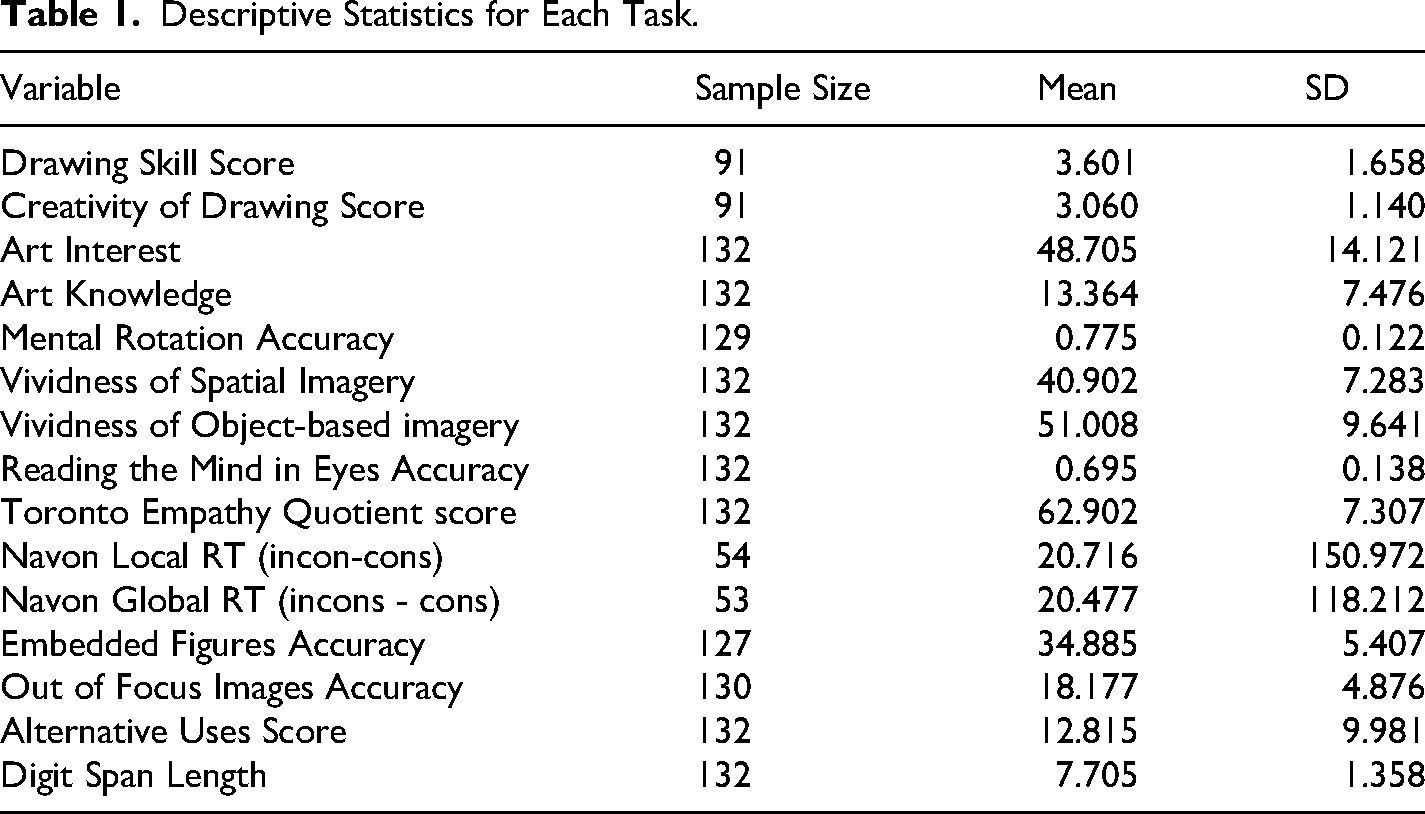
Processed data (including individual's drawings) is available on OSF. Descriptive statistics for each task are shown in Table 1. Our primary goal was to determine whether drawing skill and art knowledge predicted performance on a series of perceptual and cognitive tasks. Drawing skill was operationally defined as participants’ scores on the observational still-life drawing of the hand. Art knowledge was operationally defined as a sum of the subjective and objective knowledge subscores of the VAIAK-R questionnaire.
Descriptive Statistics for Each Task.
We began by computing first-order Pearson's correlations between each predictor variable (drawing skill and art knowledge, respectively) and each dependent variable (performance on each individual task). Correlation coefficients are shown in Table 2. Drawing skill and art knowledge were each significantly positively correlated to accuracy on the out-of-focus images task. Art knowledge, but not drawing skill, was significantly positively correlated to RMET accuracy and was significantly negatively correlated to vividness of spatial imagery. In contrast, drawing skill, but not art knowledge, was significantly positively correlated to mental rotation accuracy and to embedded figures accuracy. We found no significant correlations between drawing skill and performance on the Navon task (Table 2).
First-Order Pearson's Correlations Between the two Primary Predictor Variables and the Battery of Cognitive Tasks.
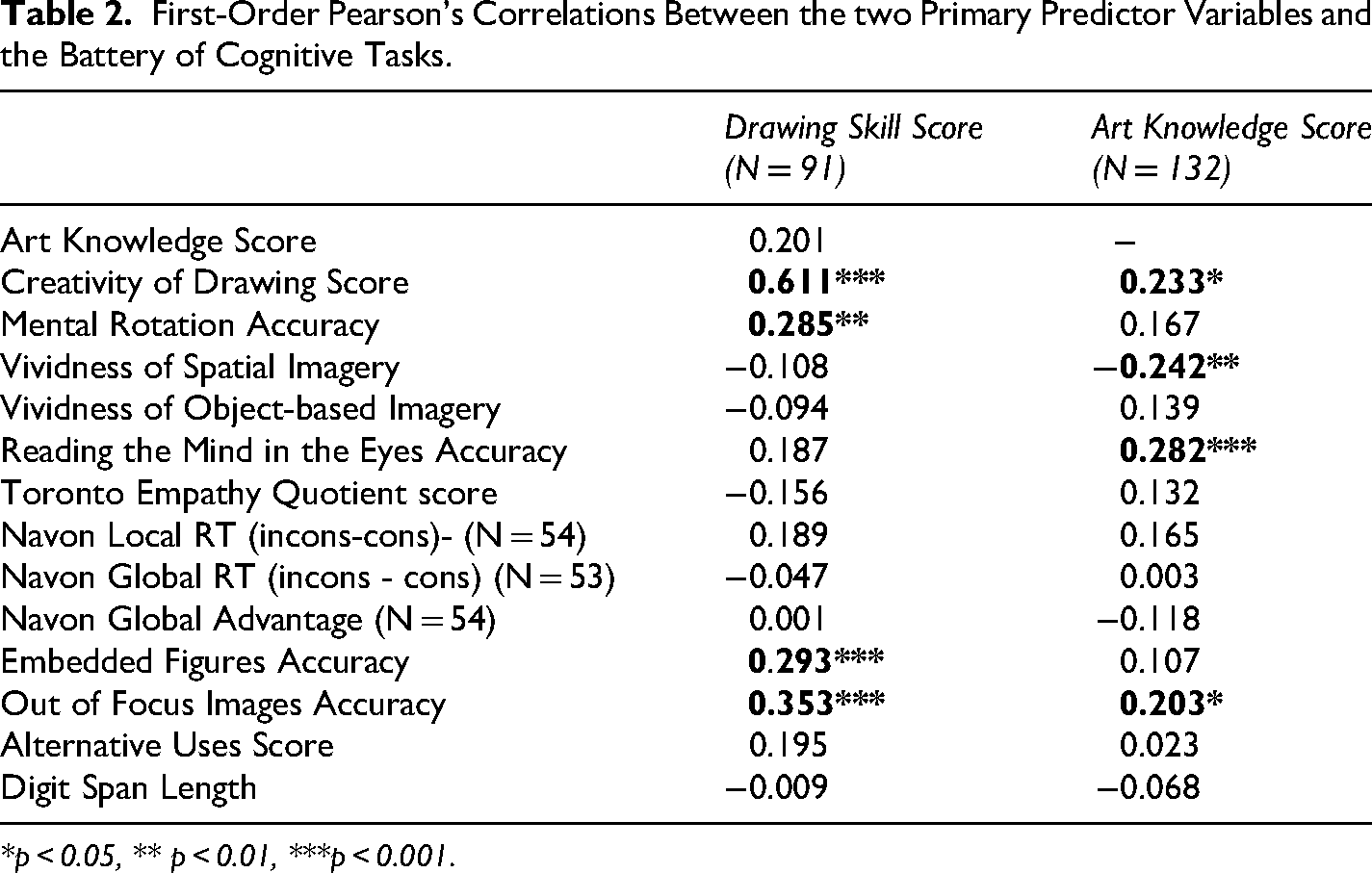
*p < 0.05, ** p < 0.01, ***p < 0.001.
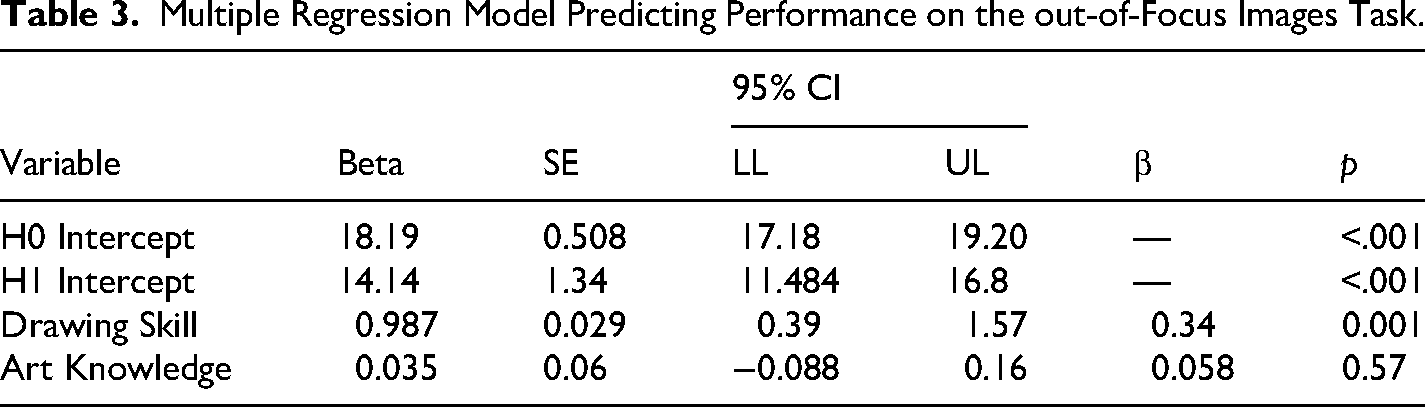
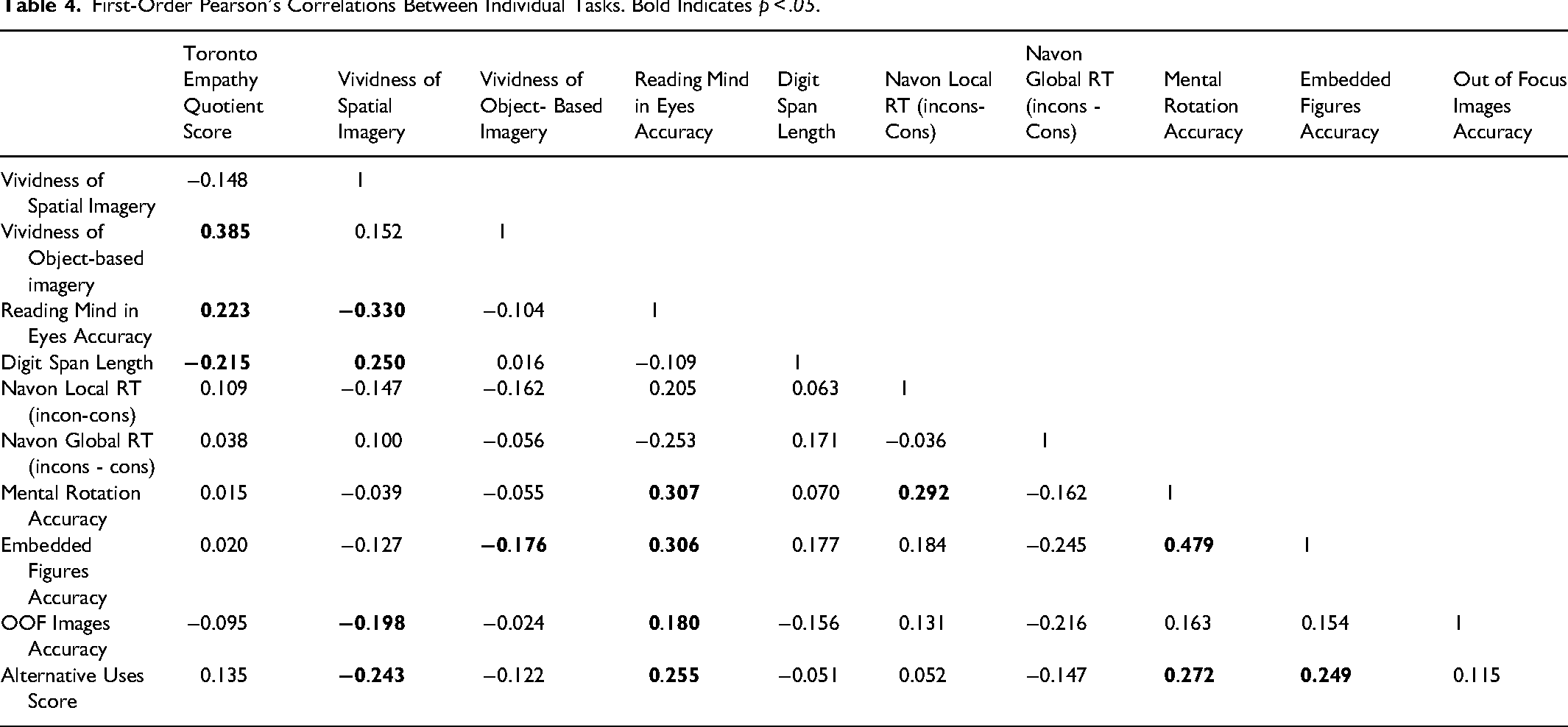
To better examine the task where both art knowledge and drawing skill predicted performance, we conducted a multiple regression with art knowledge and drawing skill as predictors and out-of-focus images task performance as the dependent variable (Table 3). Art knowledge and drawing skill were not significantly correlated to each other (r(89) = 0.201, p = 0.056), though the relationship was positive. Importantly, collinearity between the predictors was not observed (VIF = 1.037; Tolerance = 0.965) and the model had acceptable independence of errors (Durbin-Watson = 2.166). The H0 intercept represents the mean out-of-focus images task performance in the null model with no predictors (18.19), whereas the H1 intercept represents the predicted baseline performance when drawing skill and art knowledge are included (14.14). Drawing skill and art knowledge together explained a significant amount of the variance in performance on the out-of-focus images task (R2 = 0.128; F(2,86) = 6.306, p = .003) than each individual predictor on its own. However, only drawing skill significantly predicted performance for the out-of-focus images task (B = 0.987, SE = 0.29, 95% CI [0.39, 1.57], β = .34, p = .001). In contrast, art knowledge was not a significant predictor, (B = 0.04, SE = 0.06, 95% CI [–0.09, 0.16], β = .06, p = .57), despite showing significant first-order correlations (Tables 1, 3, 4).
Multiple Regression Model Predicting Performance on the out-of-Focus Images Task.
First-Order Pearson's Correlations Between Individual Tasks. Bold Indicates p < .05.
We also assessed internal consistency for the variables that were composite measures of multiple different items. The VAIAK scale has already been well-validated; the original paper validating the VAIAK (Specker et al., 2020) had a sample including both psychology students and art historians. The authors reported reliability for the art interest scores of ω = .94 for the total sample, ω = .92 for psychology students, and ω = .82 for art history students. For art knowledge, the reliability was ω = .89 for the total sample, ω = .77 for lay people, and ω = .85 for art history students. A follow up paper by Specker (2024) pooling together a larger sample found overall reliability on the art interest scale of ω = .94 and on the art knowledge scale of ω = .85. In our study, we evaluated internal consistency for art interest via McDonald's Omega using a non-parametric bootstrap procedure with 1,000 samples. The scale demonstrated strong reliability for the entire sample (ѡ = 0.91; SE = 0.01; 95% CI [0.89, 0.93]. For art knowledge, which utilizes dichotomous scoring (correct/incorrect), we used the Kuder-Richardson 20 (KR-20) coefficient, which is mathematically equivalent to Coefficient Alpha for binary data. A non-parametric bootstrap procedure with 1,000 samples was employed. The scale demonstrated strong reliability (KR-20 = 0.88; SE = 0.02; 95% CI [0.83, 0.91].
We separately examined the reliability of the vividness of object-based imagery items and the vividness of spatial-based imagery items, as these sets of items measure distinct constructs that are negatively correlated. Both scales were evaluated using McDonald's Omega. The vividness of object-based imagery scale demonstrated strong reliability (ѡ = 0.85; SE = 0.02; 95% CI [0.81, 0.88]) for the entire sample. The vividness of spatial-based imagery scale demonstrated acceptable reliability (ѡ = 0.677; SE = 0.07; 95% CI [0.50, 0.75]) for the entire sample. In the original study validating the OSIQ questionnaire in sample of undergraduate college students, the authors reported Cronbach's α = 0.83 for the object scale and Cronbach's α = 0.79 for the spatial scale (Blajenkova et al., 2006); thus while our numbers were comparable for the object-based scale, our spatial-based imagery scale demonstrated worse reliability than we had expected.
The internal consistency for the 36-item RMET, which utilizes dichotomous scoring (correct/incorrect), was assessed using the Kuder-Richardson 20 (KR-20) coefficient. The RMET demonstrated acceptable reliability, with a KR-20 coefficient of 0.735 (SE = 0.035; 95% CI[ 0.655, 0.790]. One item (item 7) correlated negatively with the sample. To maintain the integrity of the scale as much as possible, we left the item as is. We note that the literature reports considerable variation in reported internal consistency. A recent metaanalysis by Kittel et al. (2021) examined internal consistency, pooling together a total sample of 4305 participants, found overall acceptable internal consistency (α = .73, 95% confidence interval [CI: .65, .79], p < .001; I2 = 94.90, τ2 = .10, k = 21) with a range of Cronbach's α scores from .45 to .96, with 50% of the samples reporting estimates below .70. Our results were comparable to these findings.
Internal consistency for the Toronto Empathy Questionnaire was evaluated using McDonald's Omega. The scale demonstrated strong reliability for the entire sample (ѡ = 0.86; SE = 0.02; 95% CI [0.86, 0.90], as well as for each subpopulation (Prolific sample: ѡ = .87, SE = .04; CI [.78, .91]; undergraduate sample: ѡ = 0.86, SE = .04, CI [.76, .92]; art experts: ѡ = .75; SE = .19; CI [.090, .919]). Our findings are consistent with a metaanalysis that reported α = 0.79 to 0.87 (Lima & Osório, 2021).
For the Leuven Embedded Figures Test, which utilizes dichotomous scoring (correct/incorrect), internal consistency was assessed using the Kuder-Richardson 20 (KR-20) coefficient. The scale demonstrated acceptable reliability for the entire sample (
The internal consistency for the Out-of-Focus images task, which utilizes dichotomous scoring (correct/incorrect), was assessed using the Kuder-Richardson 20 (KR-20) coefficient. The scale demonstrated acceptable reliability for the entire sample (
Discussion
The primary goal of this study was to examine the extent to which people's knowledge of art and their skill on drawing tasks could predict their performance on a range of cognitive tasks. Our sample included art experts (both art historians and art practitioners) as well as non-experts. We found that art knowledge and drawing skill were distinct capacities; they were not significantly correlated to one another, and each had different patterns of correlation to the perceptual, attentional, and creative measures in our test battery. Moreover, in broad strokes, these patterns roughly lined up with our predictions; while both knowledge and skill were linked to performance on the out-of-focus imaging task, the correlations to performance on the other tasks were separable.
Consistent with our hypothesis that creation of art might be linked to enhanced perceptual skills, drawing skill was positively correlated with performance in some tasks related to mental representation, specifically the out-of-focus image and mental rotation tasks. Although we did not find significant correlations between drawing skill and performance on the Navon tasks, we did find a significant correlation between drawing skill and performance on the embedded figures task. These results are consistent with the pattern of results reported in Chamberlain et al. (2019), where measures of both observational and creative drawing skill correlated positively with performance on the mental rotation and embedded figures tasks, but not the out-of-focus image or the Navon task. Drake et al. (2024), found that their artists performed better than non-artists on both the out-of-focus image and mental rotation tasks, which is also consistent with our results.
We note some key methodological differences when comparing our results to those of Chamberlain et al. (2019) and Drake et al. (2024). In both studies, the researchers compared a group of students at an elite art and design school (the majority of whom reported sustained and very frequent drawing) to a group of psychology students at a different school (with very few of those students drawing regularly). Thus their groups were quite distinct in terms of art skill, while also being well-matched for age and education. In our case, we combined several different samples, including targeting sampling of art experts, and treated art skill (and expertise) as continuous variables across our full sample rather than as categorical variables. Moreover, our samples were much more diverse than those reported in Chamberlain et al. (2019) and Drake et al. (2024); for example, the age range and educational attainment of art graduate students were both different from our undergraduate sample. Because age and education are correlated with cognitive capacities, it is possible that some of the differences we found were due to other factors beyond art expertise. Indeed, when Chamberlain et al., 2019 controlled for non-verbal IQ, they no longer had a significant correlation for performance on the mental rotation task. However, due to the length of our testing, we could not include every possible relevant measure, and with a correlational design, untangling such factors is challenging. Methodologically, these results also somewhat call into question the relationship between the various tasks: on their face, the out-focus-images task and the Navon Global task seemingly both measure our capacity to see the global representation. The out-of-focus images task, however, may be a more accurate representation of what artists are actually doing when they attempt to draw something realistically. That is, they may physically blur their vision to better “see” the global shapes. This could also be connected to Drake et al. (2024)'s finding that artists initially tend to focus more globally when they draw compared to non-artists.
We also assessed whether art appreciators would show enhanced performance on certain cognitive and perceptual tasks due to their experience with visual analysis of art. We found evidence for this performance advantage on the out-of-focus images task and the RMET task, an emotion recognition task. Additionally, on the OSIQ, we found a negative correlation between art knowledge and vividness of spatial imagery. Interestingly, there was no correlation with empathy as measured with the TEQ. When considering the potential of visual art training in the context of training physicians or nurses, as in Gurwin et al. (2018) and Pellico et al. (2009), it is worth noting that the specific skills of analysis of unclear images and reading emotions may both be directly relevant to clinical practice, while the role of empathy in medicine is quite nuanced (Decety, 2020). Moreover, as with drawing skill, we cannot make direct statements about causality; for instance, it seems plausible that people with higher vividness of imagery might be more inclined to take courses in art history.
There also is the possibility that the act of drawing or looking at art itself has short-term cognitive benefits. Drawing has been shown to reduce anxiety (Turturro & Drake, 2022) and improve mood (Drake et al., 2016); viewing art seems to have similar benefits (Trupp et al., 2025). These factors may in turn impact cognitive performance (Derakshan & Eysenck, 2009). Our battery did not manipulate the order of the tasks, but it is plausible that there would be differential performance on cognitive tasks based on order, and future work could more directly investigate the short-term and long-term benefits of arts engagement. This consideration is particularly important when considering the applicability of art training to other contexts such as medicine, where observational skills are paramount.
Longitudinal work following people receiving targeted training and with appropriate control groups would be required to determine whether the differences we found are causal in nature, or if people with enhanced perceptual and cognitive capacities are more interested in, or more likely to engage in and persist in the arts. Some of the work on art appreciation takes this approach by tracking impacts of a series of workshop sessions, such as in the medical humanities literature (Bardes et al., 2001; Gurwin et al. 2018), and with children (Ebert et al., 2015). Treating expertise as a continuous variable allows for the assessment of growth over time, which could be linked to specific improvements in perceptual and cognitive skills.
Taken together, our results demonstrate that art knowledge and drawing skill both are linked to enhanced cognitive and perceptual capacities, but in distinct ways. Further work could build on this to explore the extent to which art engagement fosters these capacities for people with varied levels of art interest and expertise.
Footnotes
Acknowledgements
We are grateful to Occidental College's Undergraduate Research Center for providing funding to Candace Farling to conduct and complete the study. We are also grateful to the contribution of multiple undergraduate research assistants in ideation and piloting: Anissa Basnayake, Mundra Turtogtokh, Joy Botros, and Melissa Dodson.

Ethical Considerations
All study materials were approved by Occidental College's IRB (Protocol # SP23-09-SHE) on February 28, 2023. Consent to participate was obtained through Gorilla's software. All consent was written.
Consent for Publication
Participant's identifying information is not included in the open-access files.
Author Contributions
CF, AS, and CL participated in all phases of the research process: conceptualization, study design, survey instrument development and coding, participant recruitment, data collection, data analysis, manuscript preparation. RC did not collect data but contributed in all other aspects.
Funding
The authors disclosed receipt of the following financial support for the research, authorship, and/or publication of this article: Occidental College's Undergraduate Research Center provided academic year and summer funding to Candace Farling to conduct and complete the study. University of London Goldsmiths’ Psychology Department provided participant credits through their subscription to Gorilla.
Declaration of Conflicting Interests
The authors declared no potential conflicts of interest with respect to the research, authorship, and/or publication of this article.