



Abstract
Recent studies on the development of face processing argue for a late, quantitative, domain-specific development of face processing, and face memory in particular. Most previous findings were based on separately tracking the developmental course of face perception skills, comparing performance across different age groups. Here, we adopted a different approach studying the mechanisms underlying the development of face processing by focusing on how different face skills are interrelated over the years (age 6 to adulthood). Specifically, we examined correlations within and between different categories of tasks: face domain-specific skills involving face recognition based on long-term representations (famous face), and short-term memory retention (Cambridge Face Memory Test), perceptual face-specific marker (inversion effect), global effects in scene perception (global–local task), and the perception of facial expressions. Factor analysis revealed that face identity skills have a similar pattern of interrelations throughout development, identifying two factors: a face domain-specific factor comprising adultlike markers of face processing and a general factor incorporating related, but nonspecific perceptual skills. Domain-specific age-related changes in face recognition entailing short- and long-term retention of face representations were observed, along with mature perceptual face-specific markers and more general perceptual effects predicting face perception skills already at age 6. The results suggest that the domain-specific changes in face processing are unlikely to result from developmental changes in perceptual skills driving face recognition. Instead, development may either involve improvement in the ability to retain face representations in memory or changes in the interactions between the perceptual representations of faces and their representations in long-term memory.
Introduction
Face perception is probably one of the most important visual skills humans have. Faces provide critical information such as gender, identity, age (Ishai, 2008), expressions (Fox et al., 2000), and intentions (Van’t Wout & Sanfey, 2008), which humans use for social interactions and interpersonal communication (McKone, Crookes, Jeffery, & Dilks, 2012). Despite their significance and the very early onset of the sensitivity to human faces apparent soon after birth (e.g., Pascalis, de Schonen, Morton, Deruelle, & Fabre-Grenet, 1995; Simion, Valenza, Umilta, & Barba, 1998; Valenza, Simion, Cassia, & Umiltà, 1996), face perception has been shown to develop well into late childhood (Carey, Diamond, & Woods, 1980; Golarai et al., 2007; Mondloch, Le Grand, & Maurer, 2002; O’Hearn, Schroer, Minshew, & Luna, 2010; Peelen, Glaser, Vuilleumier, & Eliez, 2009). There are, however, major disagreements as to whether age-related changes observed in face perception tasks are domain specific or rather reflect a more general improvement in perceptual and attentional skills during childhood. Moreover, it is still unclear whether such changes reflect qualitative differences in the way faces are processed across age.
In adults, it has been argued that face perception relies on perceptual skills that differ from those engaged in processing other categories of visual stimuli (e.g., Carmel & Bentin, 2002; Farah, 1992; Yovel & Kanwisher, 2004). For example, adults with normal face perception skills exhibit capacity of newly learned faces that exceeds that of newly learned nonface objects (Curby & Gauthier, 2007). Additional support for this notion comes from several behavioral paradigms such as the inversion effect (Yin, 1969), and the part-whole effect (Tanaka & Farah, 1993), that have a greater influence on face compared with object processing. Other studies, however, posit that the observed differences between faces and objects are a consequence of the greater experience humans have with faces which leads to expertise in processing these stimuli compared with objects (Gauthier & Bukach, 2007; Gauthier et al., 2014; Richler & Gauthier, 2014).
Domain-Specific Development of Face Processing
The question of domain specificity in the development of face perception has led to two main views. One is the face-specific perceptual development theory, which assumes a prolonged domain-specific development of the mechanisms underlying face perception skills along childhood. Alternatively, the general cognitive development theory argues that basic face perception abilities are present early in development and that the behavioral differences in performance between children and adults in face perception tasks reflect age-related differences in cognitive, perceptual, attentional, and motor abilities (reviewed in Crookes & McKone, 2009). One of the strongest evidence taken to indicate domain specificity in the development of face processing comes from the early selective sensitivity to face-like patterns exhibited by newborns (Goren, Sarty, & Wu, 1975; Johnson, Dziurawiec, Ellis, & Morton, 1991; Reid et al., 2017; Valenza et al., 1996). This preference at birth may be due to a subcortical low spatial frequency detector mechanism that interacts with visual cortical processes and allows an early attentional bias toward faces. Such a mechanism is assumed to later enable the development of the facial neural network. However, it would be equally likely to suggest that the early onset of such sensitivity may be caused by the structural properties of an immature visual system driven by shape elements, such as top heaviness and congruency between the shape of a contour and its inner features, that are dominant but not exclusive for faces (see Simion & Di Giorgio, 2015 for a review).
Evidence for domain specificity also comes from studying later stages in development, that is, ages 6 to 16 (Aylward et al., 2005; Crookes & McKone, 2009). However, conclusions regarding domain specificity of faces were not always established with adequate comparisons equalizing difficulty levels for tasks involving faces versus those involving other objects. Thus, developmental changes that were often attributed specifically to face mechanisms could not always be disentangled from other factors that inherently differentiate face and nonface processing (Weigelt et al., 2014). Moreover, it has been recently suggested that domain specificity associated with age-related changes in face perception is evident in memory-based aspects of face processing but not necessarily in face perception per se (Weigelt et al., 2014). Support for this notion comes from studies demonstrating differential age-related changes for faces compared with other objects in memory-based tasks but not in tasks involving perceptual discrimination (Johnston et al., 2011; Weigelt et al., 2014). Another recent study, however, did not find any difference between face and object development in both memory and perceptual tasks (Bennetts, Murray, Boyce, & Bate, 2017).
Quantitative Versus Qualitative Age-Related Changes
Even if attributed to a specific mechanism of face processing, age-related changes may indicate quantitative differences reflecting general improvement in the mechanism with age or, alternatively, reflect qualitative differences in the way face processing is carried out throughout development. Face-specific effects, such as the composite effect (e.g., de Heering, Houthuys, & Rossion, 2007; Macchi Cassia, 2011), part-whole effect (Pellicano & Rhodes, 2003; Tanaka, Kay, Grinnell, Stansfield, & Szechter, 1998), and the face inversion effect (Crookes & McKone, 2009), have all been demonstrated very early in development. However, as shown for other perceptual skills (Hadad, 2018; Hadad & Kimchi, 2018; Hadad, Maurer, & Lewis, 2010), the early emergence of face-specific effects does not necessarily indicate rates of development and the extent to which they are interconnected with other face perception processes, nor does it imply the age at which this skill reaches adultlike level. For the inversion effect, for example, newborns as early as 1 to 3 days after birth (Turati, Macchi Cassia, Simion, & Leo, 2006), and even fetus (Reid et al., 2017), show sensitivity to inversion. Yet, this processing advantage of upright over inverted faces may continue to change in magnitude with age (Carey & Diamond, 1994; Itier & Taylor, 2004; Sangrigoli & De Schonen, 2004, but see Brace et al., 2001; Carey, 1981; Crookes & McKone, 2009; Mondloch et al., 2002), implying late quantitative maturity in which skills are present but do not reach full adult levels until late childhood or adolescence. Moreover, beyond this dispute of whether or not the inversion effect increases in magnitude with age, there are hardly any studies testing the extent to which the effect is associated with face recognition, and with memory-based computations supporting face recognition, in particular.
Development of the Perception of Facial Expressions
Although tested extensively in adults, the relation between face recognition and the processing of facial expression is still under debate. While some posit that these skills are interconnected (Ganel & Goshen-Gottstein, 2004; R. Wang, Li, Fang, Tian, & Liu, 2012; Y. Wang, Fu, Johnston, & Yan, 2013; Wild-Wall, 2004; Yankouskaya, Booth, & Humphreys, 2012), others claim for dissociable mechanisms between the two (Bruyer et al., 1983; Humphreys, Donnelly, & Riddoch, 1993; Jones & Tranel, 2001; Nunn, Postma, & Pearson, 2001). Recently, it has been shown that experience may play an important role in the interdependence of recognizing facial expression and facial identity (Yankouskaya, Humphreys, & Rotshtein, 2014). Although these relations between identity and facial expression recognition during development could provide important insights into the developmental mechanism of face processing, they have not been investigated in children. The ability to recognize facial expressions has an early onset in infancy (see Nelson & de Haan, 1997 for a review), but continues to develop during childhood (Boyatzis, Chazan, & Ting, 1993; Odom & Lemond, 1972; Philippot & Feldman, 1990), with different trajectories for the different facial expressions (Gross & Ballif, 1991). While recognition of certain expressions such as happiness, surprise, fear, and disgust continue to improve with age, sadness and anger seem already mature at the age of 6 (Lawrence, Campbell, & Skuse, 2015). Other findings, however, suggest that sensitivity to happy faces reaches adultlike levels by age 5, while other expressions such as surprise, disgust, fear, and mainly sadness continue to develop until the age of 10 or later (Gao & Maurer, 2010).
Other Related, Nonspecific Perceptual Skills
Face perception skills have also been suggested to be related to the extraction of the global representation of hierarchical, compound stimuli (Navon, 2003). This has been demonstrated in a study in which an activation of global processing using the compound letters task (i.e., stronger representations of a global letter composed of the same local letters) improved face recognition (Gao, Flevaris, Robertson, & Bentin, 2011; Macrae & Lewis, 2002). The association between global perception and face processing has also been observed in abnormal face perception (Avidan, Tanzer, & Behrmann, 2011; Behrmann, Avidan, Marotta, & Kimchi, 2005; Duchaine, Germine, & Nakayama, 2007; Duchaine, Yovel, & Nakayama, 2007). In congenital prosopagnosia, for example, the perception of the global representation of compound letters was associated with the composite effect taken to indicate configural or holistic 1 processing of faces, that is, the first-order relations between the local features of the face (Avidan et al., 2011). The role of global perception in the development of face perception has not been tested. Moreover, the developmental trajectory of the perception of hierarchical shapes in itself is yet unclear. An increased global precedence has been observed over the years in some studies (Dukette & Stiles, 2001; Poirel, Mellet, Houdé, & Pineau, 2008; Scherf, Behrmann, Kimchi, & Luna, 2009), while a decreased representation of the global shape has been demonstrated in others (Huizinga, Burack, & Van der Molen, 2010). Developmental rates have also been shown to vary with the nature of the stimuli (Kimchi, Hadad, Behrmann, & Palmer, 2005).
To better understand the developmental trajectory of face processing, we tested a range of behavioral skills on a large cohort of children and adults with normal face perception. Rather than tracking the developmental course of each of the skills separately, our main goal was to study the mechanisms underlying development of face processing focusing on how different typical face skills are interrelated over the years. Our secondary goal was to provide a basis for standardized tests for identifying difficulties in face processing in children. Tasks were thus selected based on known markers of face processing difficulties in adults (Tanzer, Weinbach, Mardo, Henik, & Avidan, 2016).
Because domain-specific developmental rates have been shown to differ between memory and perception (Weigelt et al., 2014), face tasks in the current study involved memory-based as well as perceptual representations of faces. Long-term memory for faces was measured using a version of the famous face questionnaire and was compared with short-term memory measured by the Cambridge Face Memory Test-Kids (CFMT-K) task (Dalrymple, Gomez, & Duchaine, 2012). To determine whether age-related changes in the CFMT task were specific to faces, performance was directly compared with that in a shoe discrimination task that was otherwise identical. Perceptual skills that presumably support face processing (e.g., inversion effects, configural processing) and have been shown to contribute to face recognition abilities in adults (Dennett, McKone, Edwards, & Susilo, 2012; Wang et al., 2012) were also tracked along childhood. Processing advantage for upright over inverted faces (inversion effect) was measured and compared with the face memory tasks to determine whether age-related changes in face processing are qualitative. Finally, recognition of facial expressions was studied to test the developmental course of the relations between recognition of faces and the processing of the expressions they convey.
We first tested age-related changes in each task comparing performance across the different age groups. Critically, obtaining within-subjects measurements of performance in all tasks allowed considering the way these related perceptual skills interact during development. A factor analysis was thus carried out to identify face-specific skills and differentiate them from related, but nonspecific skills associated with a more general perceptual ability. If age-related changes in face processing indicate late quantitative maturity in which skills are present but do not reach full adult levels until late childhood, the different skills in children, similarly to adults, would be loaded on two factors of face-specific and general perceptual factor throughout development.
Methods
Participants
A total of 192 typically developing Caucasian individuals took part in the study in four different age groups: 6 to 8 years (
Materials
All tasks ran on a Dell Latitude 15.6-inch E5540 Notebook with a resolution of 1,920 × 1,080 pixels. All participants were situated 57 cm from the screen at eye level. Keyboard keys that were relevant to the tasks were marked by colorful stickers. Experimental tasks were programmed using E-Prime 2.0 software (Psychology Software Tools Inc., 2002).
Autism Spectrum Screening Questionnaire and the Autism Spectrum Quotient
Because of the high prevalence of face perception deficits among individuals diagnosed with autism spectrum disorders (ASD), guardians of all participants were asked to fill the Autism Spectrum Screening Questionnaire (ASSQ; Ehlers, Gillberg, & Wing, 1999), a 27-item questionnaire that is used for screening out high-functioning ASD in children with intact intellectual skills. Adult participants in the adult-task group were asked to fill the Autism Spectrum Quotient (AQ; Baron-Cohen, Wheelwright, Skinner, Martin, & Clubley, 2001) to screen out participants with high autistics traits.
Famous Face Questionnaire for Children
To test long-term memory of familiar faces and to detect impairments in memory for familiar faces, the famous face questionnaire for adults (Avidan & Behrmann, 2008) was adapted to children using 20 faces of familiar faces from the media and 20 faces of unfamiliar faces of famous figures from foreign countries which Israeli children are not familiar with. All stimuli were Caucasian men and women. The order of all pictures was randomized. Participants had to determine for each face if it was familiar or not, and if so, to provide the name of the person or other substantial contextual information. The specific set of pictures of famous/unfamiliar faces was suited to each age-group (one version for the 6–8-year-olds, a second for the 9–14-year-olds, and a third for adults), and their familiarity was confirmed in pilot studies. All faces were presented without remarkable identity cues, such as hats and beard, and were presented in gray scale, standard-size pictures. To ascertain that participants were indeed familiar with the famous figures, after the completion of this task, participants were presented with only the names of the famous figures that were previously presented and had to mention if they are familiar with it and provide contextual information regarding that figure. Accuracy was calculated based on the proportion of correct face identification out of correct name identification. The adults (n = 30) completed the adult’s version of the famous face questionnaire to allow within-subject comparisons of the different tasks.
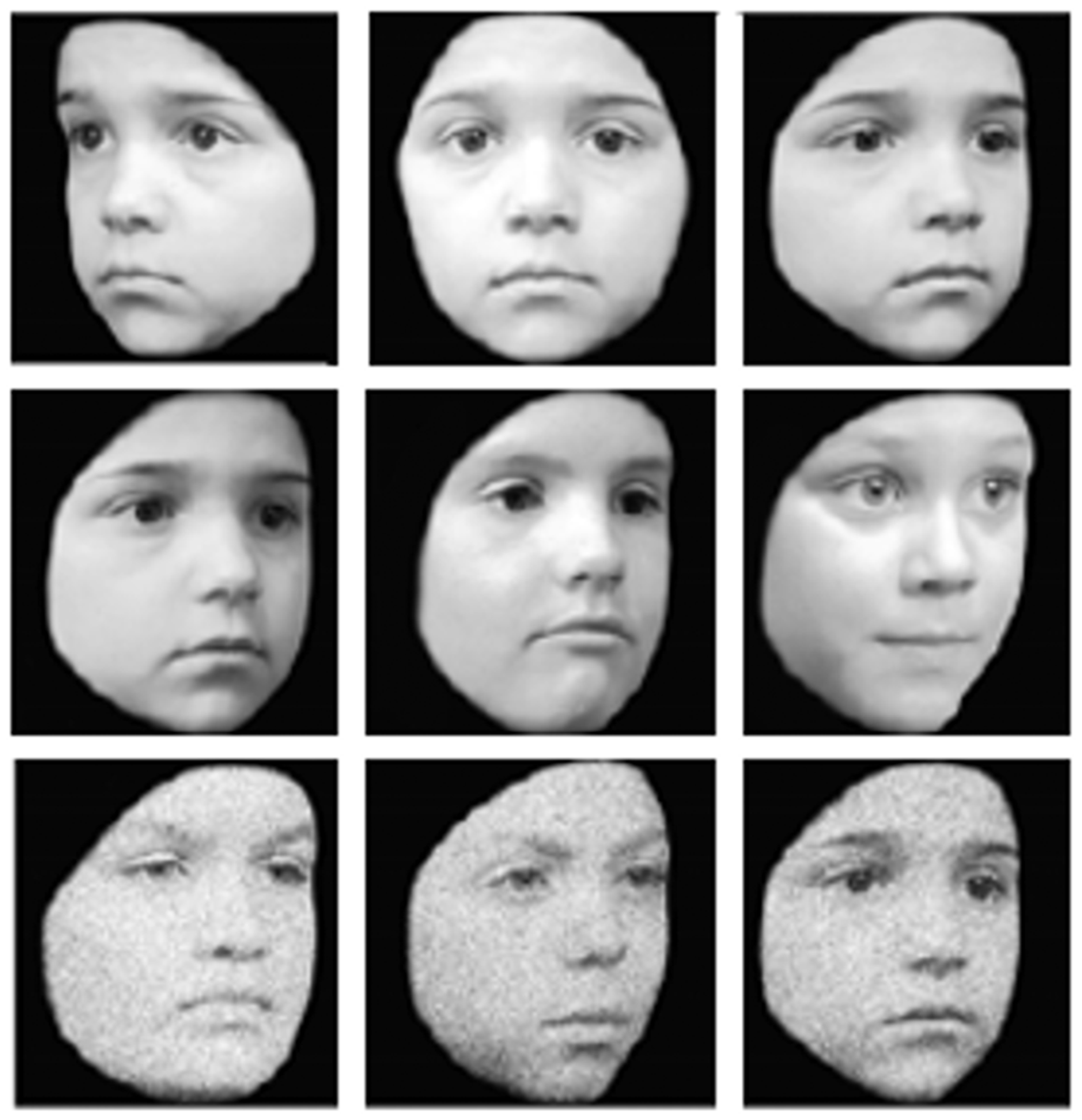
Examples of stimuli used in the CFMT-K task.
CFMT-K and CFMT—upright versions
Short-term memory for faces was tested using the CFMT (Duchaine & Nakayama, 2006) for half of the adults group (n = 30). The CFMT-K (Dalrymple et al., 2012), an adapted version that uses children’s faces to prevent the own-age bias in children (Golarai, Liberman, & Grill-Spector, 2015; Perfect & Moon, 2005; Wright & Stroud, 2002), was used for the other half of the adults group (n = 30) and for all groups of children. The test is composed of three blocks in ascending levels of difficulty. In the first block, each trial was consisted of a learning stage in which a target face was presented on the screen in three different viewpoints, followed by a test phase in which participants were asked to determine which of three different pictures of different faces was identical to the target face from the learning stage. In this block, there were six different identities with three test trials in different viewpoints for each identity, composing a total of 18 trials. The second block contained a learning phase during which six frontal views of faces (same identities of Stage 1) were presented simultaneously for 20 seconds. Participants were instructed to memorize the faces. In the test phase of this block, participants were simultaneously presented with three faces of different identities, in different views than those presented in the learning phase. Participants had to judge which of the three appeared in the learning phase. This block included 32 trials. The third block contained 24 trials that were identical to those in the second block, except for different lighting and a Gaussian noise that was added to the test faces to increase task difficulty (Figure 1). Accuracy rates were measured in all blocks. Half of the adults (n = 30) completed the adult’s version of the task, while the remaining half (n = 30) filled the children’s version to control for other-age effects.

Examples of shoes stimuli in the shoe memory test.
Object Memory Test
To test short-term memory for objects, we used the
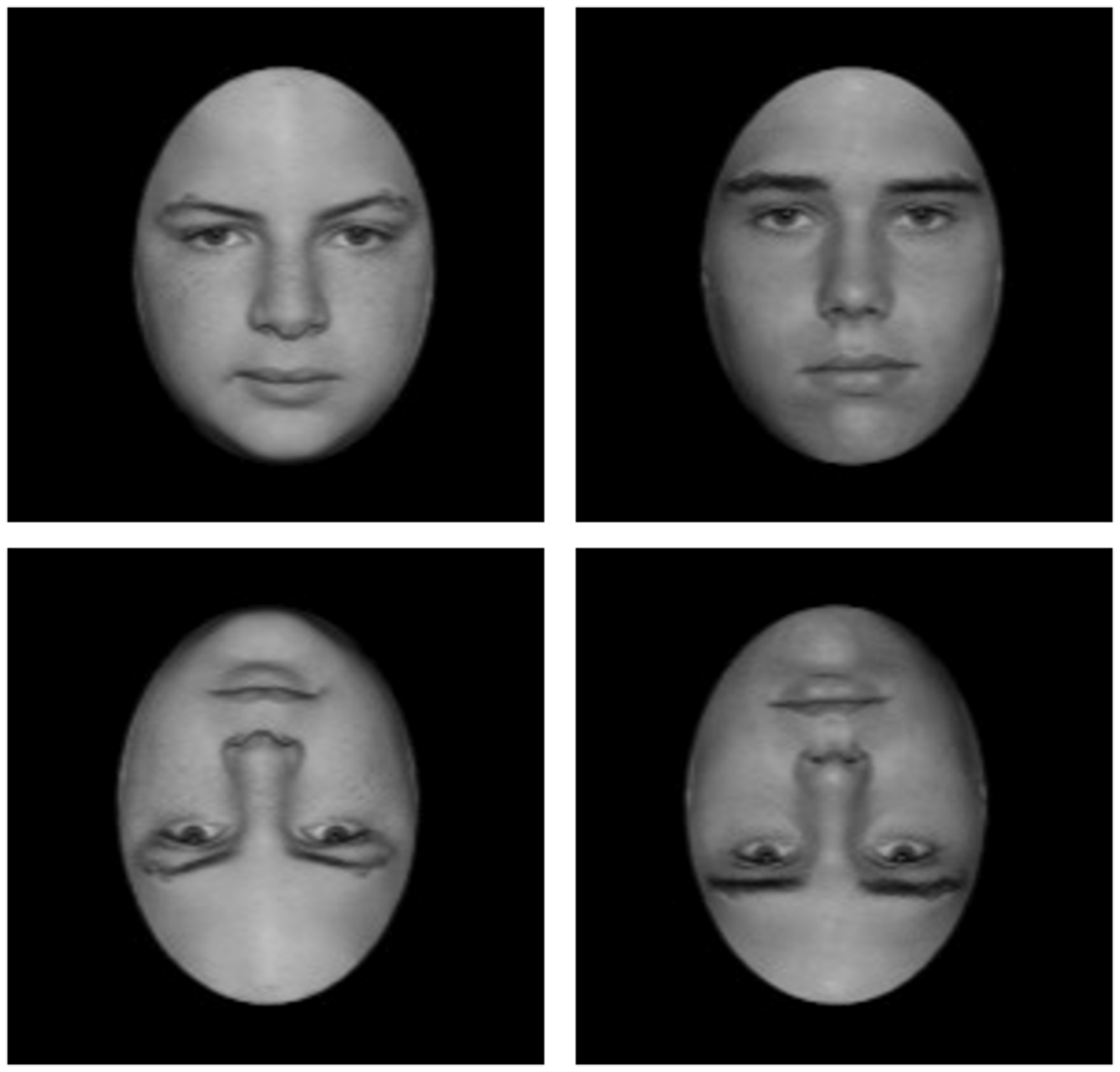
Examples of upright and inverted stimuli.
Upright/Inverted Test
The purpose of this test was to examine the well-documented inversion effect, by which performance decreases substantially for inverted compared with upright faces (Farah, Tanaka, & Drain, 1995). This effect, which is more pronounced for faces compared with other object categories, is taken to indicate configural processing of faces and is used here to tap qualitative differences in the way faces are processed over development. The task included two blocks of 50 trials each, one for each orientation (Figure 3). Upright faces were always presented in the first block. Before each block, participants were given relevant instructions and underwent six practice trails with feedback. To minimize reliance on memory (Mestry, Menneer, Wenger, & Donnelly, 2012), the two faces were presented simultaneously, and the participants were asked to indicate whether the faces were the same (identical) or different (different identities). All face stimuli in the task were Caucasian and were presented with a neutral expression and in a frontal view. The adult's version used adult faces provided by the Max Planck Institute for Biological Cybernetics in Tuebingen, Germany (Troje & Bülthoff, 1996), and the child version used children’s faces from the National Institute of Mental Health Child Emotional Faces Picture Set (Egger et al., 2011). In each trial, participants were presented with a fixation point for 250 ms followed by the simultaneous presentation of two upright or inverted faces. The face stimuli remained on the screen for an unlimited time until response. Participants were instructed to respond as quickly and as accurately as possible. Accuracy and reaction time (RT) were recorded for this task.

Examples of congruent and incongruent stimuli.
Hierarchical Shapes Test
A version of the global–local test (Navon, 1977) was adapted for testing children. Adults typically demonstrate perceptual dominance of the global representation of the shape, indicated by superior performance in judging the global structure of hierarchical figures along with asymmetric global-to-local interference. Global precedence may vary with stimulus characteristics (e.g., Enns & Kingstone, 1995; Kimchi, 1988, 1992; Kimchi et al., 2005; Kinchla & Wolfe, 1979; Lagasse, 1993; Lamb, Robertson, & Knight, 1990; Martin, 1979; Navon, 1983); however, the main goal of this experiment was to derive a relative measure (rather than an absolute one) such that the performance of each participant was assessed relative to his or her age-group and relative to their own performance on other tasks in the battery. To simplify the displays, we used basic geometric shapes, instead of letters (Mondloch, Geldart, Maurer, & de Schonen, 2003). Four stimuli composed of circle and square shapes formed two experimental conditions: congruent condition, in which the global and local structures were composed of the same shapes (i.e., a large square composed of small 24 squares, or a large circle composed of small 24 circles), and incongruent condition, in which the global and local structures were composed of different shapes (i.e., a large square composed of small circles, or a large circle composed of small squares; Figure 4). Participants were required to determine whether the global structure (in the global task), or the local elements (in the local task), was a circle or a square. Participants were presented with the relevant instructions and 10 practice trials before each block. Each trial started with a fixation point for 500 ms followed by the test stimulus. The stimulus remained on the screen for an unlimited time until response. Each of the two blocks was composed of 200 trials, 50 of each of the four stimuli conditions, presented in a randomized order. Participants were instructed to respond as quickly and as accurately as possible. Both their accuracy and RT were recorded.
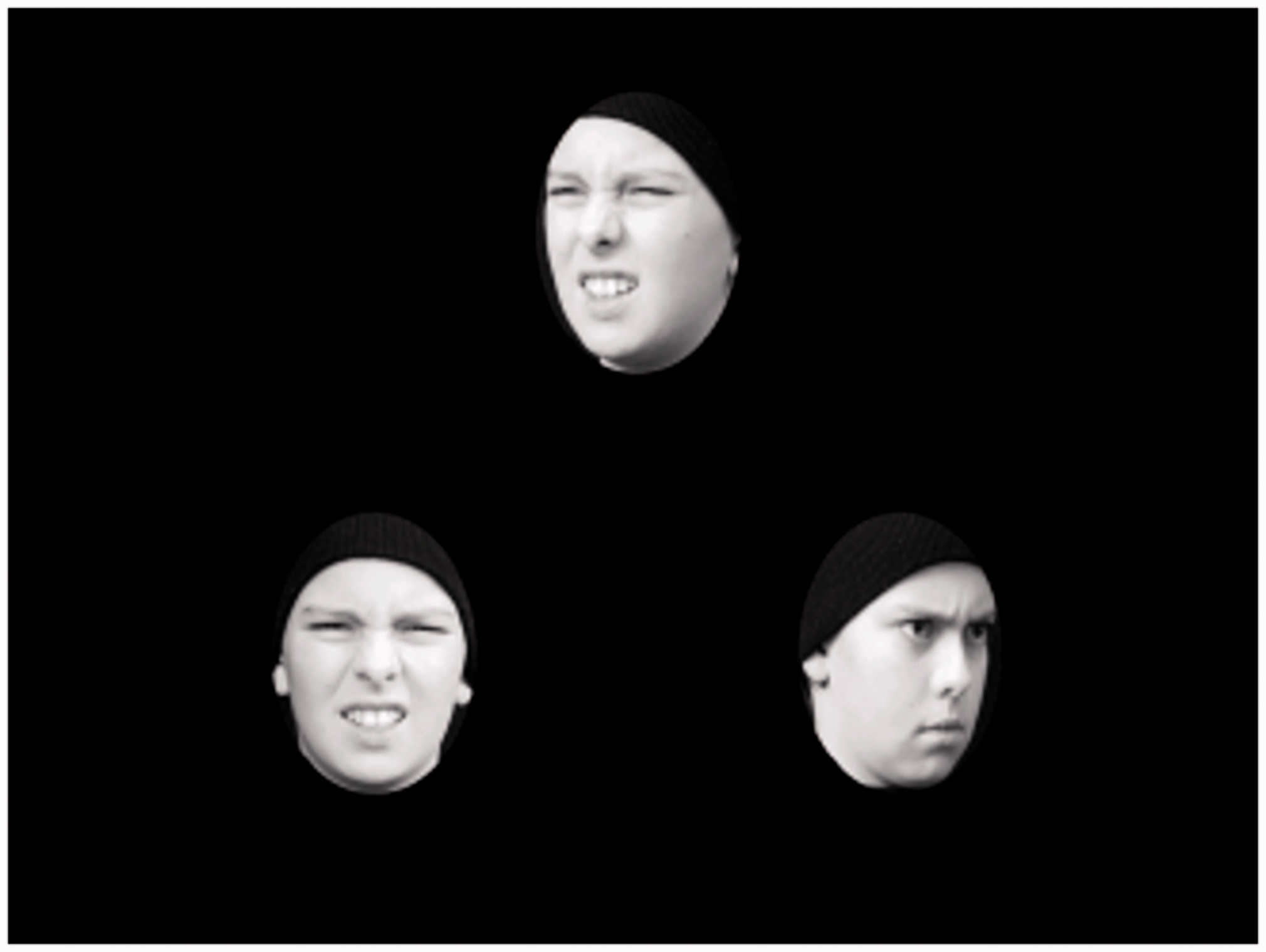
An example of a trial in the expression matching task.
Expression Matching Test
Facial stimuli for this task were of Caucasian children and taken from the Dartmouth Database of Children’s Faces (Dalrymple, Gomez, & Duchaine, 2013). Adult participants completed the same children’s version of the task. On each trial, participants were presented with a fixation point for 250 ms followed by the presentation of three emotional faces: The target face was presented at the top, and two others at the bottom. Participants were asked to determine which of the two faces at the bottom expressed the same emotion as the one expressed in the target face. Each of the three stimuli was presented in a different view to minimize the effects of local cues. Target and distractors’ expressions consisted of six different combinations: happy–sad, sad–disgust, disgust–angry, fear–angry, surprise–fear and happy–surprise. The stimulus remained on screen for an unlimited time until response. Participants were instructed to respond as quickly and as accurately as possible. The task included 72 trials with randomized order of the different expressions (Figure 5). Both accuracy and RT were recorded.
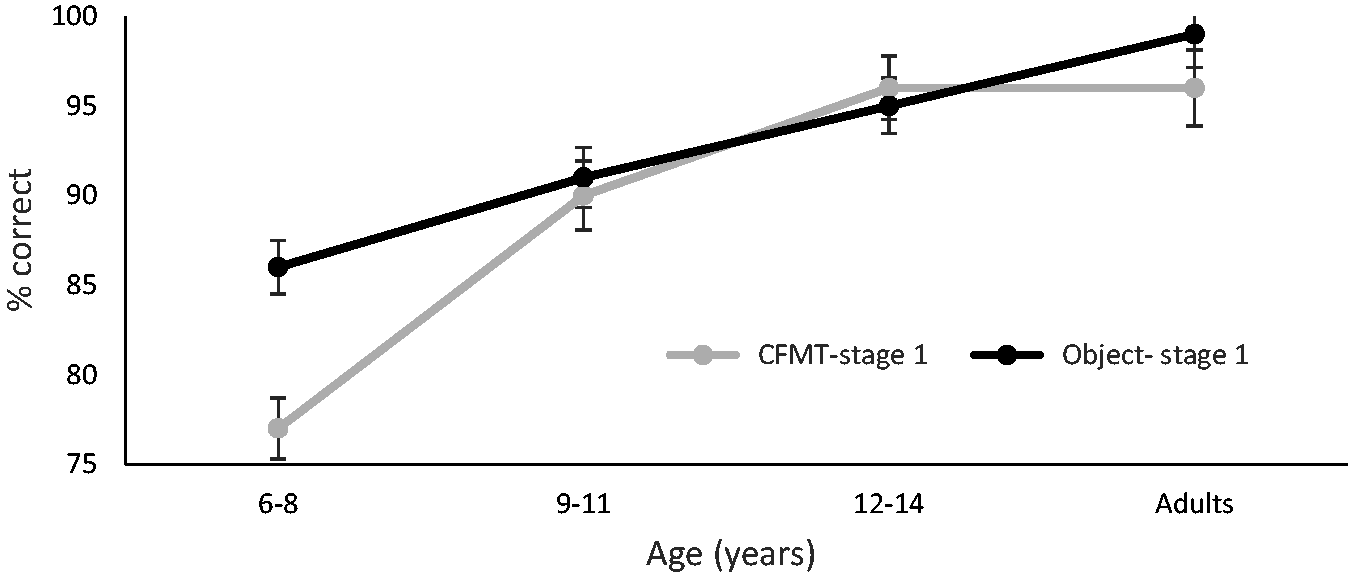
Mean accuracy rates for the CMFT and the object tasks (shoes version for children and cars version for adults) as a function of age. Trend analysis shows that while a linear gradual improvement that continues well into adulthood is evident for shoe discrimination, face discrimination, although undergoes larger developmental change, becomes adultlike earlier, at the age of 12.
Results
ASSQ and AQ
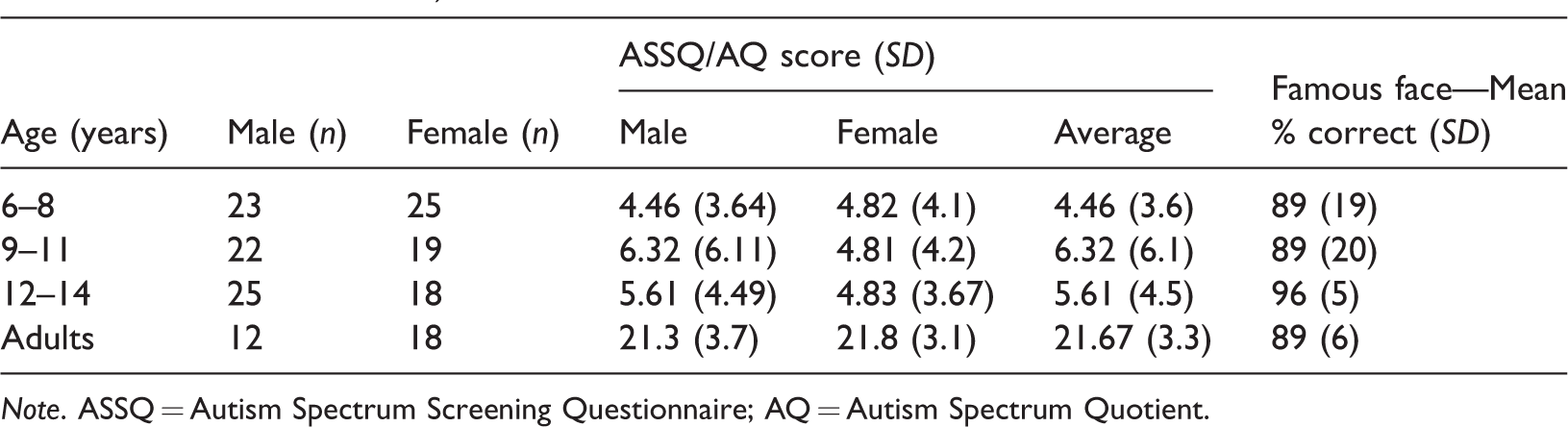
ASSQ scores were obtained from the three groups of children. Mean scores for all age groups (Table 1) was overall higher than those obtained for norms collected from the whole population of primary school-aged children in Finland (M = 2; SD = 3.5; Mattila et al., 2009). The score of one participant was rated substantially higher than the normal range (score = 21), and therefore, his data were excluded from the analysis. Data collection for the AQ was obtained from adults (M = 21.4; SD = 3.2), with all participants rated within the normal range.
ASSQ Scores and Performance on the Famous Face Questionnaire for Children in the Three Age Groups and for the Adult Group (Which Were Not Included in the Developmental Analysis of This Specific Skill Due To Task Differences).
Note. ASSQ = Autism Spectrum Screening Questionnaire; AQ = Autism Spectrum Quotient.
Famous Face Questionnaire
Mean accuracy rates for each group are presented in Table 1. Because of the differences in the adults’ and the children’s versions of the task, a developmental analysis of this skill was conducted in children only. A between-subject analysis of variance (ANOVA) on accuracy rates revealed a marginally significant difference between age groups, F(2, 124) = 1.8, p = .06, ηp2 = 0.045. Specific comparisons revealed a significant difference between the 9- to 11-year-olds and the 12- to 14-year-olds, p < .05. The improvement in performance, found only between the older age groups, suggests that improvement with age in retaining and individuating familiar faces in long-term memory, rather than differences in prior exposure, are more likely to account for these results.
Face and Object Short-Term Memory Tests
Accuracy rates were overall higher in the object task (shoes in the version for children and cars in the version for adults) compared with the CFMT, with some variability across the different blocks (Table 2). A mixed-design ANOVA with age-group as a between-subjects factor and task (face/shoe) as a within-subjects factor revealed a significant main effect for task, F(1, 153) = 224.5, p < .001, ηp2 = 0.59, and a significant interaction between age and task, F(3, 153) = 5.3, p = .002, ηp2 = 0.09, suggesting more substantial age-related changes for face over shoe discrimination. However, to rule out the possibility that differences in task difficulty underlie the different age-related changes, we further compared these changes in the two tasks using only the first and the easiest part of each (Block 1), for which task performance was found to be equal at the age of 9. Trend analyses carried out across the different age groups revealed different age-related functions for face versus shoe discrimination (Figure 6). Both linear, F(1, 154) = 64.1, p < .001, ηp2 = 0.29, and quadratic trends, F(1, 154) = 12.2, p = .001, ηp2 = 0.07, were observed for the CFMT task, while only a linear trend for the shoe discrimination task, F(1, 154) = 40.3, p < .001, ηp2 = 0.2. As shown in Figure 6, this linear trend for shoe discrimination indicates a gradual improvement that continued well into older ages. Face discrimination, in contrast, although underwent larger developmental change during early childhood, became adultlike earlier, at the age of 12. This pattern further suggests that task difficulty is less likely to account for the changes between age groups in face discrimination: Although starting as more difficult at the age of 6 compared with the shoe task, F(1, 46) = 11.7, p = .002, ηp2 = 0.2, face discrimination reached adultlike levels earlier. To conclude whether age-related changes in the CFMT task indeed reflect domain specificity in the development of face memory, we also performed an analysis of covariance testing the influence of different age groups on performance of the CFMT task (whole task) controlling for performance in the shoe task. Results revealed a significant effect of age on performance in the CFMT task, F(3, 152) = 29.3, p < .001, ηp2 = 0.37, indicating age-related changes in face perception that are beyond the expected general perceptual differences between participants across age.
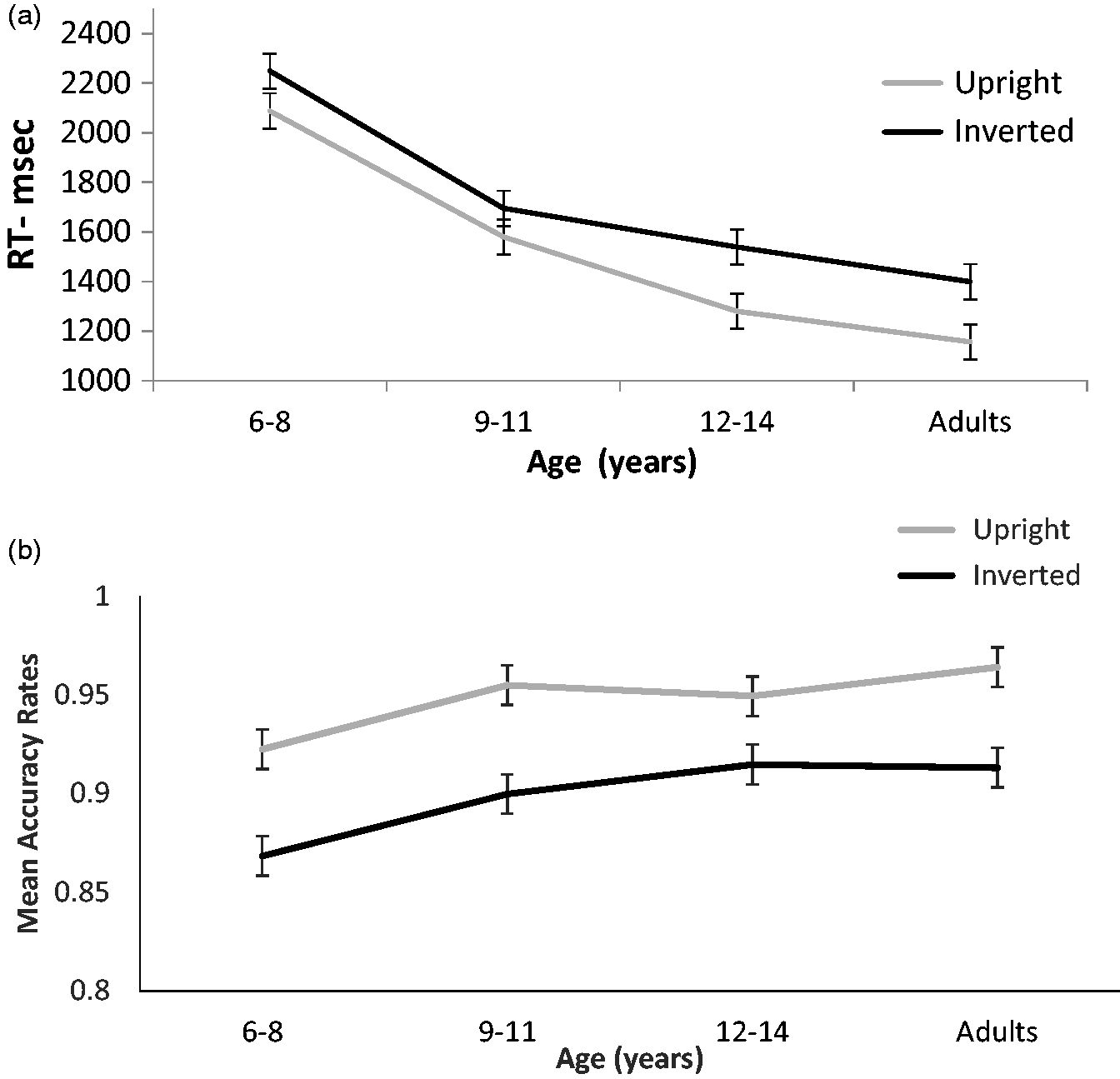
(a) Mean RTs for upright and inverted faces. An inversion effect of the same magnitude was present at all age groups despite overall improvement in RT with age (adults group completed the adult's version). Error bars denote CI. RT = reaction time. (b) Mean accuracy rates for upright and inverted faces. An inversion effect of the same magnitude was present at all age groups despite overall improvement in accuracy with age (adults group completed the adult's version). Error bars denote CI.
Performance on the CFMT and Object Tests (Shoes for Children and Cars for Adults) as a Function of Age.

Note. CFMT = Cambridge Face Memory Test.
Left columns represent scores on the complete test. Right columns represent scores on the first block of each test.
Upright-Inverted Test
RTs (for correct trials only) less than or above two standard deviations from the individual averaged performance were discarded from further analysis for both children and adult versions of the task (5.6%, 5.1%, and 5.1% of the upright trials were discarded for the 6-year-olds, 10-year-olds, and adults, respectively; 4.8%, 5.2%, and 5.2% of the inverted trials were discarded for the 6-year-olds, 10-year-olds, and adults, respectively). For both RTs and accuracy rates, a mixed-design ANOVA with age as a between-subjects and face orientation as a within-subjects factor revealed a significant effect for orientation, F(1, 152) = 38.2, p < .001, ηp2 = 0.2; F(1, 152) = 61.7, p < .001, ηp2 = 0.29, for RTs and accuracy, respectively, with processing advantage of upright (mean accuracy = 94%, mean RTs = 1,571 ms) over inverted faces (mean accuracy = 89%, mean RTs = 1,763 ms). Critically, for both RTs (Figure 7(a)) and accuracy rates (Figure 7(b)), the interaction between age and orientation did not reach significance, F(3, 152) = 1.2, p > .05; F(3, 152) = 0.452, p > .05, for RTs and accuracy, respectively, suggesting that the face inversion effect is present already at the age of 6 and is stable across age groups.
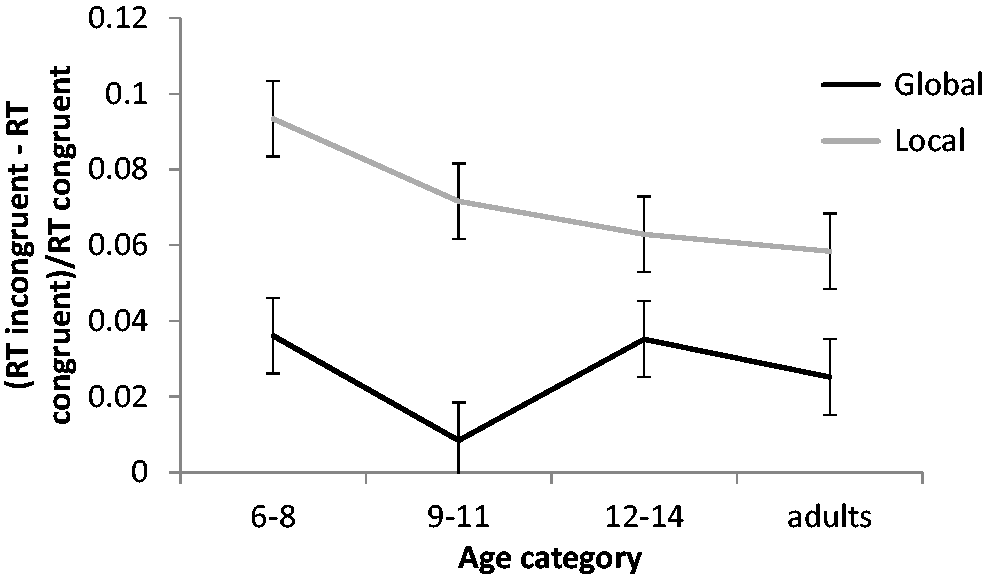
Mean RTs for the global–local task for the congruent and the incongruent conditions as a function of age. Global precedence is evident in all age groups. Error bars denote CI.
Hierarchical Shapes Test
Accuracy rates were at ceiling—mean accuracy rates for each age-group (SD): global block: 6 to 8 years—92% (6%), 9 to 11 years—95% (3%), 12 to 14 years—95% (4%); local block: 6 to 8 years—93% (5%), 9 to 11 years—94% (4%), 12 to 14 years—95% (4%). The main analysis thus focused on RTs for correct trials only. A mixed-design ANOVA with task (global/local) and congruency (congruent/incongruent) as within-subjects and age-group as a between-subject factor revealed a main effect for task, F(1, 155) = 184, p < .001, ηp2 = 0.54, indicating a processing advantage for global (mean = 628 ms) over the local task (mean = 748 ms). A significant interaction between task, congruency, and age, F(3, 155) = 5.2, p < .002, ηp2 = 0.09, implies greater global-to-local interference in children. However, standardizing the RT for each participant in the global and local conditions using the formula (RTincongruent – RTcongruent)/RTcongruent showed that although performance improved significantly with age, F(3, 155) = 2.2, p = .09, ηp2 = 0.04, interference scores did not vary with age, F(3, 155) = 1.5, p > 0.2. These results reveal a global precedence and a global-to-local interference across all age groups, demonstrating a rather stable global dominance across age (Figure 8).
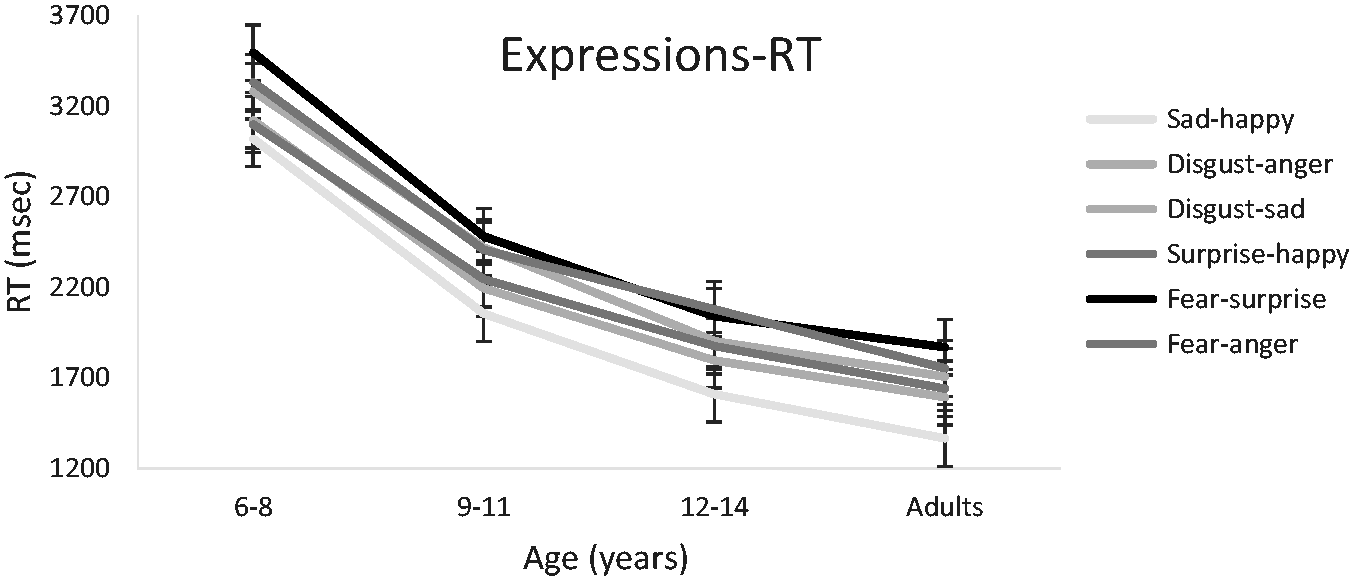
Mean RTs (msec) for the different expression combinations as a function of age. Error bars denote CI.
Expression Matching Test
Accuracy rates for all expression combinations reached ceiling with no significant differences between age groups for each of the expression combinations tested (see Table 3). The main analysis is therefore focused on RTs for correct trials only. A mixed-design ANOVA with expression combination as a within-subjects and age-group as a between-subjects factor on RTs revealed an overall significant improvement with age in discriminating facial expressions, F(3, 154) = 37.8, p < .001, ηp2 = 0.42. The analysis also revealed a significant effect for expression combination, F(5, 765) = 22.4, p < .001, ηp2 = 0.13, indicating that some expressions were generally easier to discriminate than others, for all age groups. Importantly, no interaction with age was found, F < 1, indicating similar age-related changes for all facial expressions. Age-related changes cannot be attributed to task difficulty, as if anything, the combination of happy–sad expressions, which was the easiest, as evident by faster RTs for all age groups, was in fact characterized by the longest developmental trajectory. Indeed, when the easiest combination (happy–sad) was compared with the most difficult one (surprise–fear), a significant interaction of expressions with age, F(3, 153) = 22.4, p < .001, ηp2 = 0.31, indicated higher developmental rates for the easiest sad–happy discrimination (Figure 9). Overall, the results depict a rather protracted development for processing expressions that does not reach adultlike levels before 9 to 11 years of age.
Accuracy Rates for the Expression Matching Test for All Age Groups and Expression Combinations.

Relations Between Face Domain-Specific and General Perceptual Tasks During Development
Factor analysis was conducted on all tasks to explore the way these different skills are generally interrelated across development. For the adult group, only participants who were tested on the adults’ versions of the tasks were included, to have the best relative measures for this age-group in all skills, not influenced by other-age effects or task difficulty. For the famous face, CFMT, and the shoe/car tasks, we used accuracy, while for the expression task, we used the raw RTs. For the global/local task, we used a congruency index: ([incongruent local RT – incongruent global RT] – [congruent local RT – congruent global RT])/(congruent local RT – congruent global RT). For the upright/inverted task, we calculated the inversion effect (RT inverted – RT upright).
A principal component analysis on the scores of each task for all subjects produced two underlying factors (eigenvalue > 1). The loadings, after varimax rotation, are shown in Table 4 with the first factor explaining 42.1% of the total variance and the second factor accounting for 62.8% of the total variance. The first factor was loaded by various tasks, reflecting general perceptual demands that are not necessarily related to face processing. Interestingly, the second factor was loaded by the famous faces and the upright/inverted tasks, both of which are specific face tasks, used to tap different aspects of the development of face perception. Specifically, the face inversion effect serves as a face-specific marker of perceptual processing, and the famous face task taps long-term facial representations. These results indicate that adults’ markers of face processing, such as the face inversion effect and long-term memory for familiar faces, seem to be evident early in childhood.
Factor Structure for All Subjects.
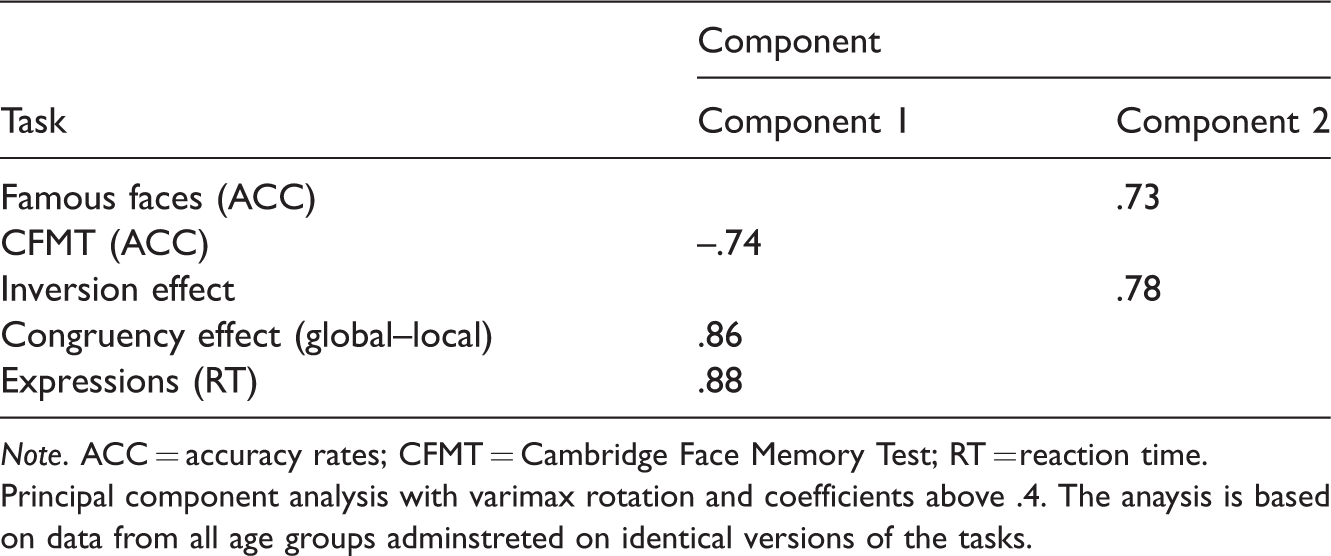
Note. ACC = accuracy rates; CFMT = Cambridge Face Memory Test; RT = reaction time.
Principal component analysis with varimax rotation and coefficients above .4. The anaysis is based on data from all age groups adminstreted on identical versions of the tasks.
To directly examine whether this domain-specific factor of face perception is already loaded by the same tasks early in childhood, the same analysis was conducted separately on participants younger and older than 10 years of age. We chose age 10 as the cutoff as it is considered the minimum age in development at which face processing skills seem as adultlike in most previous studies, although some studies find that face processing reaches maturity earlier, already at 4 to 5 years of age (reviewed in McKone et al., 2012). Results of participants younger than the age of 10 (n = 51) revealed the same pattern of loadings on the two factors, the face specific and the general one (Table 5), explaining 59.6% of the total variance. Consistent with this pattern, correlation analysis that were carried out between all tasks in this group (Table 6) revealed a significant correlation between performance in the famous face and the magnitude of inversion effect (r = .33, p = .02). Correlations between tasks loaded on the second general factor were also found significant (Table 6). Finally, the analysis also revealed a correlation between performance in the global/local and performance in the expression tasks (r = .41, p = .003), indicating that larger congruency effects were unexpectedly associated with slower RTs in the expression task. This may point to the involvement of local processing and the extraction of details in discriminating facial expressions.
Factor Structure for Subjects 6 to 10 Years Old.

Note. CFMT = Cambridge Face Memory Test; RT = reaction time.
Principal component analysis with varimax rotation.
Correlation Table for All Tasks for Children 6 to 10 Years Old.
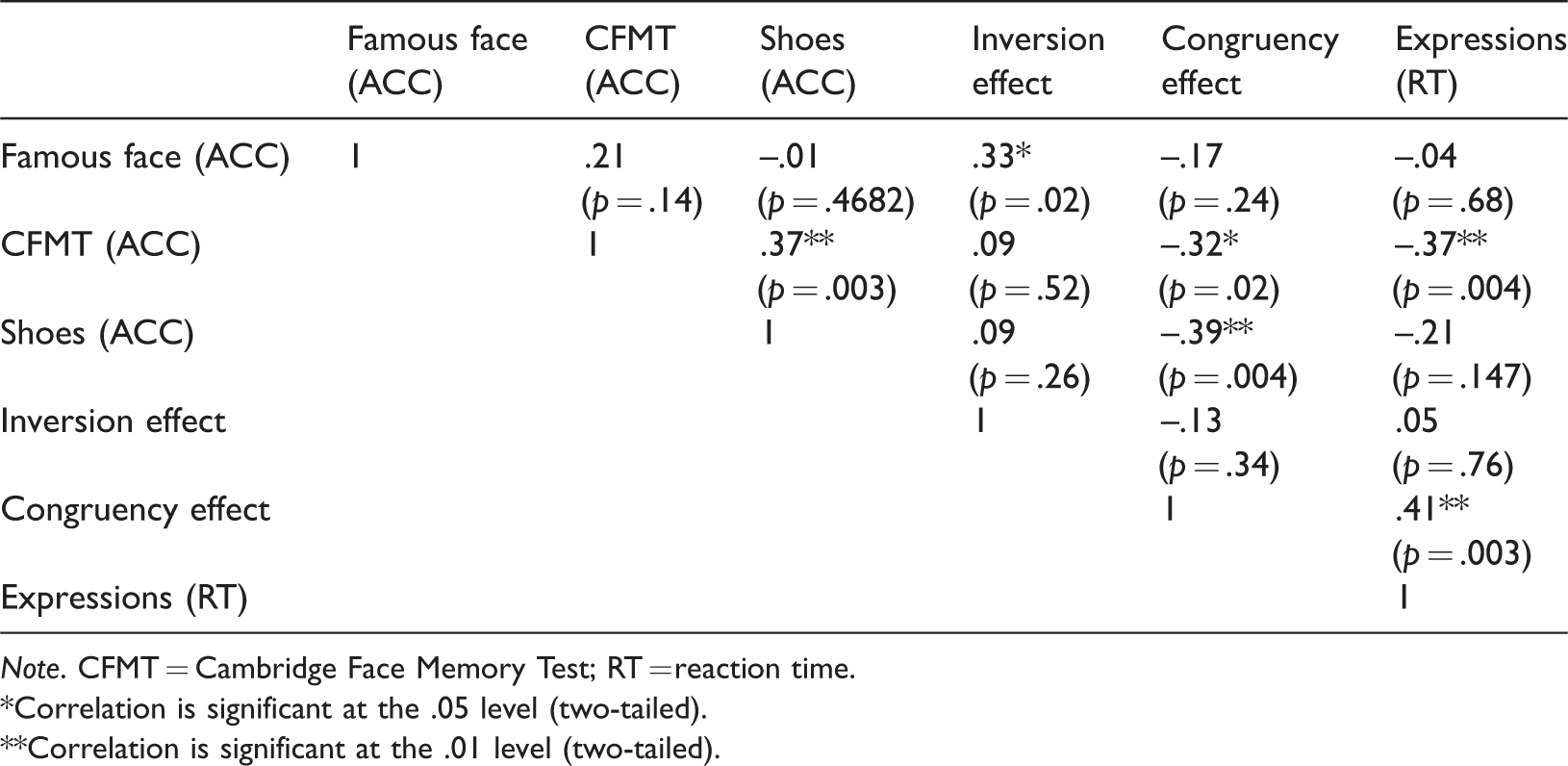
Note. CFMT = Cambridge Face Memory Test; RT = reaction time.
*Correlation is significant at the .05 level (two-tailed).
**Correlation is significant at the .01 level (two-tailed).
For participants aged 10 years and older (n = 103), the same analysis revealed a similar pattern explaining 54.6% of the total variance, with the exception that the domain-specific factor now included the CFMT, in addition to famous faces and the upright/inverted task (Table 7). Correlation analysis (Table 8) revealed a significant correlation between performance in the famous face and performance in the CFMT tasks (r = .24, p = .01), between performance in the CFMT and magnitude of inversion effect (r = .2, p = .04), and between performance in the famous faces and the magnitude of inversion effect (r = .18, p = .06). Correlations between tasks loaded on the second general factor were also found significant (Table 8).
Factor Structure for Subjects 10 Years and Older.
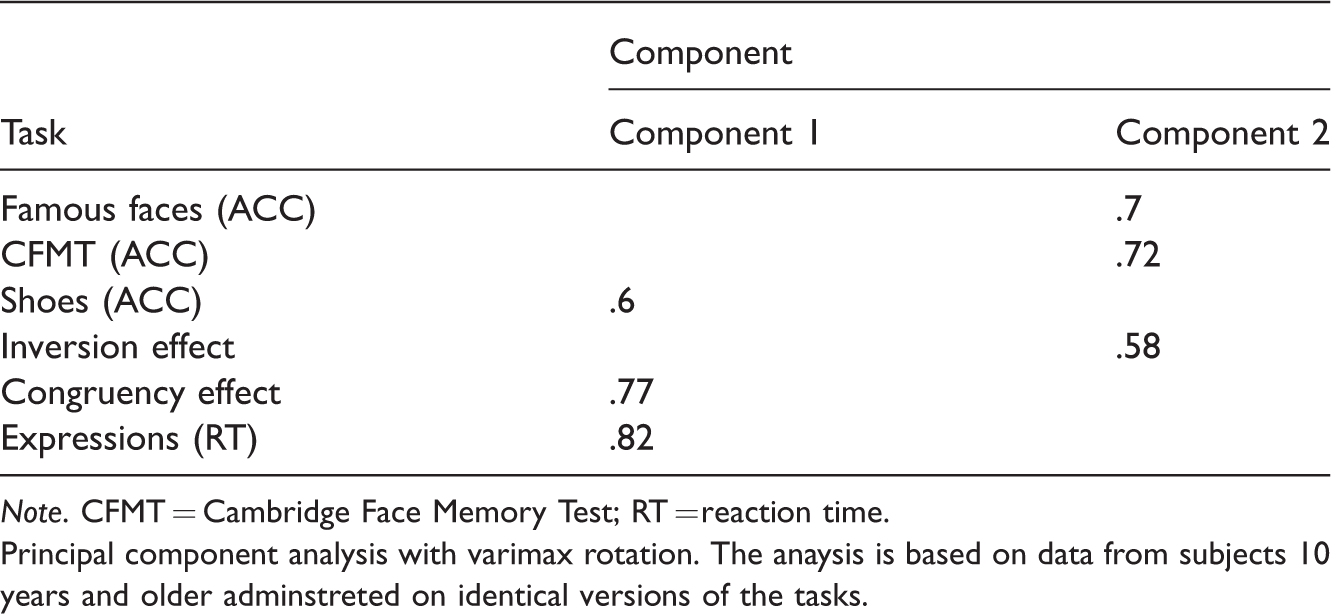
Note. CFMT = Cambridge Face Memory Test; RT = reaction time.
Principal component analysis with varimax rotation. The anaysis is based on data from subjects 10 years and older adminstreted on identical versions of the tasks.
Correlation Table for All Tasks for Participants 10 Years or Older.

Note. CFMT = Cambridge Face Memory Test; RT = reaction time.
*Correlation is significant at the .05 level (two-tailed).
**Correlation is significant at the .01 level (two-tailed).
General Discussion
We tracked the developmental trajectories of perceptual skills mediating face processing, asking whether the identified face-specific skills in adults are evident early in childhood. We employed a battery of tests on a large cohort of children (aged 6–14) and adults, comparing face domain-specific skills involving face recognition based on long-term representations (famous face), and short-term memory retention (CFMT), perceptual face-specific marker (inversion effect), global effects in scene perception (global–local task), and the perception of facial expressions. The within-subject comparisons of these tasks across different age groups allowed us not only to track the developmental course of each skill but also to examine the relationship between these different skills across age. The results demonstrate that face identity skills have a similar pattern of interrelations over development, suggesting that the same mechanisms underlying face processing in adults mediate this skill in young children. Specifically, the face inversion effect, a well-known marker of face processing in adults (Rezlescu, Susilo, Wilmer, & Caramazza, 2017), is highly associated with the famous face task at all age groups, indicating an early presence of face-specific perceptual skills already at age 6. Age-related changes in face processing, although evident throughout childhood, do not undergo qualitative change over the years, at least not beyond the first 6 years of age.
Specifically, performance in the famous face task is shown to improve over the years. This skill of identifying known faces from unfamiliar ones is a central daily behavior known to have greater social significance compared with other socially-related domains such as voice identification (Gainotti, 2014; Hanley, 2014; Quaranta et al., 2015). Indeed, this skill of representing faces in long-term memory has been shown to be one of the markers for impaired face abilities in adults, both in acquired and congenital prosopagnosia (acquired: e.g., Barton, 2008; Xivry, Ramon, Lefevre, & Rossion, 2008; congenital: e.g., Avidan, Hasson, Malach, & Behrmann, 2005; Behrmann et al., 2005; Bentin, Deouell, & Soroker, 1999; de Gelder & Rouw, 2000; De Haan & Campbell, 1991). Although previous studies compared the way familiar and unfamiliar faces are processed in children (Bonner & Burton, 2004; Campbell, Walker, & Baron-Cohen, 1995; Campbell & Tuck, 1995; Ge et al., 2008), there are hardly any studies providing a quantitative measurement of long-term memory for faces during development. Using an adapted version of the famous face test, the current study demonstrated improvement in retaining and individuating faces in long-term memory along childhood. The subtle, but significant, improvement with age in the ability to represent faces in long-term memory and explicitly retrieve previously learned faces continues well into late childhood, as predicted by the late maturity theory.
This late maturity of face recognition is characterized by quantitative age-related changes. The inversion effect, a well-known face-specific effect, seems evident already at the age of 6 with a fairly similar magnitude across all age groups. This finding is consistent with some studies, (Brace et al., 2001; Carey, 1981; Crookes & McKone, 2009; Mondloch et al., 2002), however, not with others, showing an increase in the inversion effect with age (e.g., Itier & Taylor, 2004), or even a decrease (e.g., Carey & Diamond, 1994). These inconsistent results in the inversion effect with age could be related to floor or ceiling effects (Crookes & McKone, 2009), or to confounding more general cognitive skills, such as memory capacity, with the perceptual aspects of the inversion effect. Our approach, testing both age-related changes in each of the tasks and the interrelations between tasks across development, allowed drawing a stronger conclusion about the configural manner of face processing already during early childhood. Specifically, this conclusion was supported by both the comparable inversion effect across age, and by its high association with performance in the famous face task, suggesting that the inversion effect is likely to reflect a face-specific perceptual effect (Rezlescu et al., 2017; Rosenthal, Levakov, & Avidan, 2017), which can serve as a marker of face identity processing already at 6 years of age. The observed age-related changes in face recognition are thus likely to reflect development of memory-based computations supporting face recognition rather than age-related changes in perceptual processing supporting face processing.
Surprisingly, the inversion effect and long-term memory for familiar faces was not highly associated with the ability to learn new faces at an early age. Performance in the CFMT, a face discrimination task that involves perceiving and retrieving face representations from memory, was loaded on the face-specific factor only in the older group. This could be related to relatively high demands of the CFMT and to the possibility that performance at early ages could reflect some nonspecific perceptual and more general cognitive aspects. Indeed, performance of young children was quite low at both the CFMT and
Pertaining domain specificity in development of face processing is consistent with earlier studies (Carey et al., 1980; Golarai et al., 2007; Weigelt et al., 2014). There are, however, other studies suggesting otherwise. Aylward et al. (2005), for example, failed to find any developmental changes in short-term memory for faces or houses; however, their study was conducted on two age groups of 8- to 10-year-olds and 12- to 14-year-olds, with only a few children in each age-group (11 and 10 children, respectively). These small samples and limited age groups might have masked the developmental changes. Crookes and McKone (2009) showed similar improvement in memory along development for both faces and other visual stimuli; however, they used dogs as control stimuli for human faces. Perceptual processes for animals may be more akin to those of human, thus masking possible domain-specific processes for faces compared with other visual objects (for similar arguments, see Weigelt et al., 2014).
Investigating the relations between the other general perceptual skills known to be related to face perception points to important observations. The rather comparable global-precedence effect that was found across age groups was not significantly associated with the inversion effect, implying different mechanisms of global processing of hierarchical stimuli and those involved in processing faces (e.g., Kimchi, 1992; Pomerantz, 1983). Hierarchical displays are designed to test the precedence of either the global, higher level units, or the local, lower level units but appear to be less related to the question of the ability to perceive the configural properties of visual information. Rather, configural processing of visual objects entails interelements relational processing, which, like in faces, is determined by the nature of the individual elements rather than by their mere spatial positions (Pomerantz, 1983).
Interestingly, global processing was negatively associated with discriminating expressions, pointing to the involvement of local strategies in processing facial expressions (Calder, Young, Keane, & Dean, 2000; Calvo & Nummenmaa, 2008). Protracted development of facial expression recognition has also been documented for all expressions. Discriminating between happy–sad, sad–disgusted, disgusted–angry, fear–angry, surprise–fear and happy–surprise expressions takes up until 9 to 11 years to become adultlike. Surprisingly, the ability to discriminate between happy–sad expressions takes even longer, reaching adultlike level at 12 to 14 years of age. This finding is inconsistent with Lawrence et al. (2015) study, which found a mature ability to recognize happy and sad faces by the age of 6, but does fit others showing continuous development of sensitivity to sad expressions beyond age 10 (Gao & Maurer, 2010). A possible account for this discrepancy could be related to differences in task demands. While Lawrence et al. (2015) study asked participants to label the emotion that best described the presented facial expression, our task was more similar in its demands to Gao and Maurer (2010) task, which measured the ability to discriminate between expressions that simultaneously appeared on the screen. Differentiating between emotions in Gao’s study and in ours may involve more fine-tuned representations than those required in Lawrence’s study and thus shows more protracted development. The current results further show that some expressions, though the easiest to discriminate, may be slower to develop than others. Importantly, as in adults, the ability to recognize facial expressions and face identification skills are loaded on two different factors, suggesting weak relations and presumably different mechanisms underlying these two different skills, already at 6 years of age.
Before concluding, it is important to note that performance was tested for skills known to be impaired in adult individuals with difficulties in face perception (Tanzer et al., 2016). Thus, in addition to studying typical developmental trends in face processing, the current battery of face-specific and general perceptual tasks also allows diagnosis of face recognition difficulties at early ages. This battery can thus serve as a platform for establishing norms required for investigating abnormal development that is specific to face perception, such as in the case of congenital prosopagnosia, or more broadly, for neurodevelopmental disorders, such as ASD, for which difficulties in face processing are prominent (Dawson, Webb, & McPartland, 2005; Schultz, 2005).
In sum, tracking face processing skills and related perceptual abilities shows that adults’ predictors of face recognition, such as the inversion effect or the ability to recognize familiar faces, are present early in age and are interconnected during development. The comparable face inversion effect across the different age groups, predicting face perception already early in childhood, suggests that developmental changes in the current face tasks are less likely to result from age-related changes in perceptual skills driving face recognition. Instead, the results imply that the mechanism of developmental trends in face memory involves either age-related changes in the ability to retain and individuate face representations in memory or changes in the interactions between the perceptual representations of faces and their representations in long-term memory. The exact mechanism of this developmental change, however, must await further investigation. The results emphasize the importance of exploring a wide range of skills that are associated with face perception to conclude both on the mechanism of change in normal development and on that of abnormal developmental trajectories.
Footnotes
Declaration of Conflicting Interests
The author(s) declared no potential conflicts of interest with respect to the research, authorship, and/or publication of this article.
Funding
The author(s) disclosed receipt of the following financial support for the research, authorship, and/or publication of this article: This work was supported by the Israel Science Foundation (ISF) grant to BSH (967/14) and to GA (296/15) and a grant from the Ministry of Education Israel to BSH and GA.