



Abstract
A novel motion stimulus is perceived to last longer than the subsequent motion stimulus moving in the opposite direction. A previous study suggested that the discrepancy in the processing latency for different onset types, as measured by reaction time, may play a role in this duration expansion. The present study examined whether the speed of motion stimuli influences this duration expansion. Experiment 1 demonstrated that the duration expansion ceased to occur when the stimulus speed increased. Experiment 2 showed that the increase in the speed reduced the reaction time for various onset types. However, the size of the changes in the reaction time did not match the reduction in the magnitude of the duration expansion observed in Experiment 1. These results suggest that the increase in speed eliminates the duration expansion of the novel motion stimulus, but the difference in the processing latency alone may not be the sole mechanism.
Temporal judgment is a crucial component of human perception. However, perceptual duration does not always correspond to physical duration (Eagleman, 2008; Matthews & Meck, 2016). Psychophysical studies have demonstrated that numerous non-durational visual features such as spatial frequency (Aaen-Stockdale et al., 2011), motion (Kanai et al., 2006; Yamamoto & Miura, 2012, 2016), size (Ono & Kawahara, 2007; Xuan et al., 2007), and luminance (Matthews et al., 2011) can affect perceived duration of visual events.
The onset of a visual event is also known to affect perceived duration. Kanai and Watanabe (2006) measured the perceived duration of two successive motion stimuli moving in opposite directions. Their results demonstrated that the first motion stimulus was perceived to last longer than the second motion stimulus, which is known as the Time Expansion Illusion (TEI). They further showed that the TEI becomes greater when the first motion appeared from a blank screen (i.e., stimulus onset) than when the first motion was preceded by a stationary stimulus (i.e., motion onset). These results imply that a motion stimulus is perceived to last longer when the onset is determined by the appearance of a novel motion stimulus, rather than when the motion reversal of a preceding motion stimulus or motion onset of a preceding stationary stimulus determines the onset.
The processing latency hypothesis posits that the difference in processing time for different visual onsets primarily drives the TEI. Kanai and Watanabe (2006) showed that the reaction time for a stimulus onset of a motion stimulus is faster than that for its motion reversal. They also demonstrated that the reaction time for the stimulus onset was 40–60 ms faster than that for the motion onset of preceding stationary stimulus. Based on these observations, they concluded that the TEI reflected the difference in reaction time for different onset types. Visual evoked potential (VEP) is known to show distinct temporal dynamics for the stimulus and motion onsets (Torriente et al., 1999). For example, the initial VEP response for the stimulus onset is known to be N125, whereas the initial VEP response for the motion onset is reported to be N170. Because the 45 ms difference in the initial VEP responses matched the difference in the reaction time for stimulus and motion onsets, Kanai and Watanabe (2006) proposed that discrepancy in the processing latency, as measured by the reaction time, plays a role in the TEI.
In the present study, we examined whether the speed of the motion stimuli influences the TEI. Motion speed is known to impact reaction time (Burr et al., 1998; López-Moliner, 2005; Tynan & Sekuler, 1982). For example, López-Moliner (2005) compared the reaction times for motion onset of static square at different speeds and found that the reaction time decreased as the stimulus speed increased. This effect of motion speed on reaction time is observed using contracting and expanding squares (López-Moliner 2005), sinusoidal grating (Burr et al., 1998), and random dot motion (Tynan & Sekuler, 1982). On the other hand, stimulus speed is reported to have a negligible effect on the reaction time for the stimulus onset and offset of a motion stimulus (Kaneko & Murakami, 2009). Thus, if the TEI is primarily driven by the difference in processing latency measured by reaction time, an increase in the speed of the two successive motion stimuli would decrease the TEI magnitude as a result of faster reaction time for the motion onset and motion reversal. In Experiment 1, we measured the perceived duration of the first motion stimulus in two different onset conditions (stimulus onset and motion onset) with three different stimulus speeds. In Experiment 2, we measured the reaction time for the stimulus onset, motion onset, motion reversal, and stimulus offset in the three different speed conditions.
Experiment 1
Methods
Participants
Thirteen university students (mean age ± SD = 20.8 ± 1.4) participated in the experiment including the first author (SS). Data from one participant was not recorded correctly due to a technical error. Data from two participants was excluded from the formal analysis because the participant did not report the first stimulus as being shorter more than 50% of the time, even when the duration of the first stimulus was 35% shorter compared to the second stimulus. Thus, the final sample size was 10. All the participants had normal or corrected-to-normal visual acuity. They were naïve to the purpose of the study except for SS. The study was approved by the internal review board of Waseda University.
Apparatus
The experiment took place in a darkened room. The experimental code was programmed using PsychoPy (Peirce, 2007). Stimuli were presented on a gamma-corrected LCD monitor (1920 × 1080 pixels, 23.5-inch, 100 Hz), controlled by an Apple Macintosh computer. A chin-rest restrained participants’ head movement at a viewing distance of 57.5 cm from the display.
Stimuli
We used 200 moving random dots which appeared within an 8° × 8° imaginary square. Each dot had a lifetime of 120 ms. At the beginning of a trial, the lifetime of each dot was randomly determined between 0 and 120 ms after the appearance to prevent the dots from appearing and disappearing at the same time. When the lifetime of a dot expired, another moving dot appeared at a random position within the square.
Procedure
The experimental procedure was based on Kanai and Watanabe (2006). Figure 1 shows the task structure. Participants started a trial by pressing a space bar and viewed a pair of random dot stimuli in succession. Both motion stimuli moved at the same speed. The duration of the first random dots was 480 ms. The duration of the second random dots was randomly determined from the seven possible durations (312, 384, 432, 480, 528, 576, and 648 ms). The participants indicated which stimulus appeared longer in duration by pressing “<” for the first or “>” for the second stimulus respectively. There were 15 trials for each duration of the second stimulus, thus 105 trials were conducted for each condition. There were two onset conditions (stimulus onset and motion onset) and three different speed conditions (2.70, 10.76, and 18.73 °/s). Thus, each participant performed 630 trials. Each onset × speed condition was tested in separate blocks, with the order counterbalanced across the participants.
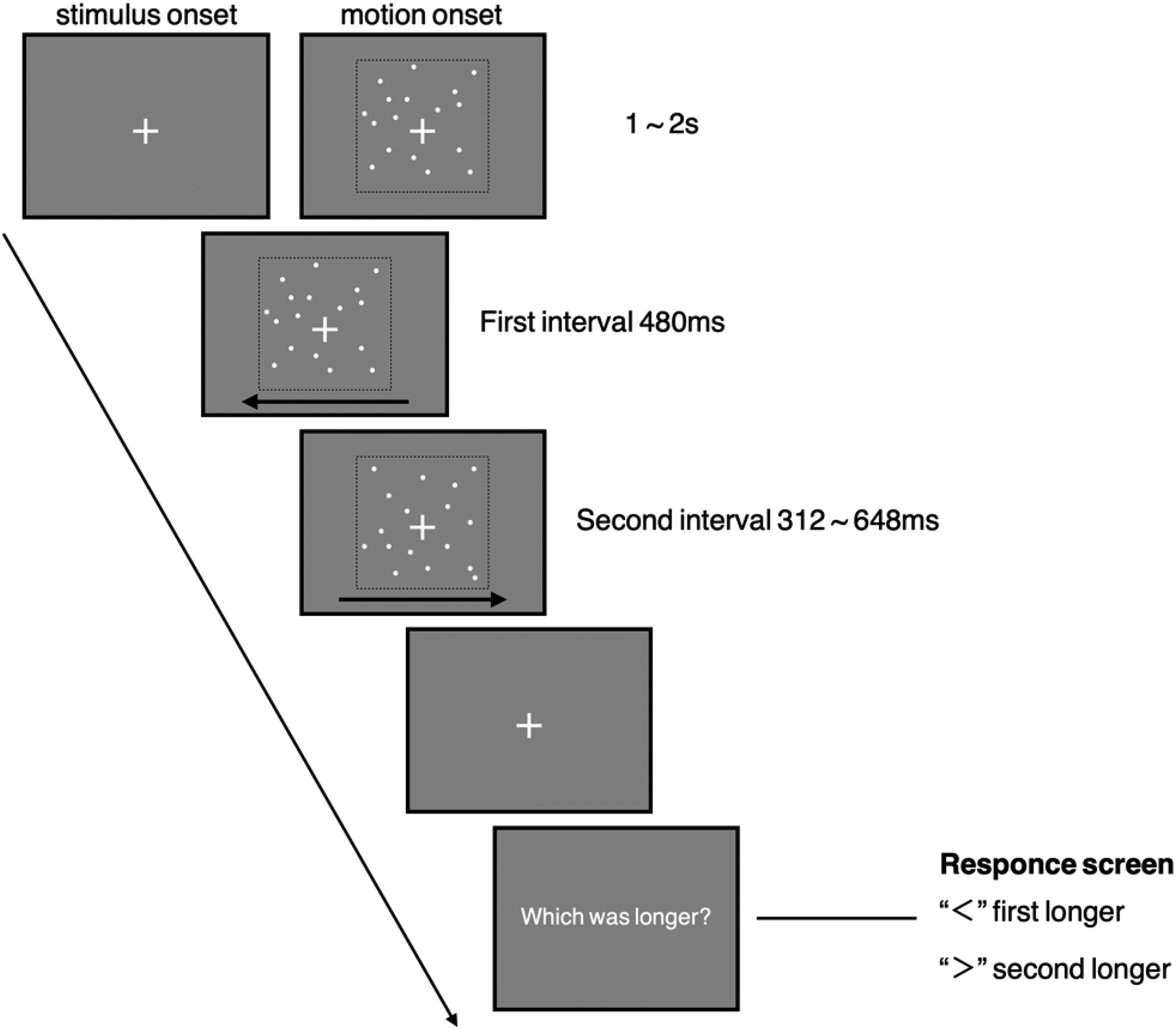
A schematic illustration of a trial sequence. In the stimulus onset condition, the first motion stimulus appeared from a blank screen. In the motion onset condition, stationary dots preceded the first interval, and then the dots started to move. Note that the square and the number of dots used in the illustration are only for visualization purposes.
In the stimulus onset condition, the first motion stimulus appeared and immediately moved to the left direction, and then moved in the right direction after a random duration (uniformly sampled from between 1 and 2 s). In the motion onset condition, stationary random dots appeared and then started to move after a random duration (uniformly sampled from between 1 and 2 s).
Analysis
A logistic psychometric function was fitted individually for each participant and each condition using psignifit package for Python (Wichmann & Hill, 2001a, 2001b). The duration of the second motion stimulus with which the psychometric function crossed 50% was taken as the PSE. We calculated time expansion amplitude (TEA) of first motion stimulus by subtracting the PSE from the standard duration of 480 ms to qualitatively evaluate the magnitude of duration expansion of the first stimulus. The positive TEA indicate that the first stimulus is perceived to last longer than the second stimulus. We then performed a 2 × 3 repeated measures ANOVA with factors onset type and speed to compare the TEAs between the conditions. Multiple comparisons were conducted using the Bonferroni correction (i.e., raw p-values were multiplied by the number of comparisons). A significance threshold of p < .05 was chosen for all tests. We also performed a Bayesian statistical analysis on the data.
Results & Discussion
The psychometric functions averaged across participants and the mean TEAs are shown in Figure 2(a) and (b). One-sample t-tests with the Bonferroni correction revealed that the TEA in the low-speed motion onset condition (t(9) = 3.75, p = .030, BF10 = 11.75) and low-speed stimulus onset (t(9) = 3.79, p = .024, BF10 = 12.13) was significantly larger than zero. However, TEA was not significantly larger than zero in any other conditions (ps > 0.99). A two-way repeated measures ANOVA revealed a significant main effect of speed (F(1.15,10.32) = 9.76, p = .009, η2 = .317, BF10 = 22.53). However, neither the main effect of onset (F(1,9) = .078, η2 = .001, p = .786, η2 = .001, BF10 = 0.37) nor the interaction (F(1.27,11.45) = 2.47, p = .14, η2 = .05, BF10 = 1.27) was significant.

(a) The participants averaged-psychometric function for each condition. (b) The mean and individual TEA of the first stimulus compared to that of the second stimulus in each condition. Error bars indicate standard error (* p < .05).
The results of Experiment 1 replicated the original TEI, where the first motion stimulus is perceived to last longer than the second one, but only in the low-speed conditions. Additionally, the results of Experiment 1 demonstrated that the stimulus speed influenced the perceived duration of the first motion stimulus and the TEI ceased to occur when the motion speed increased. These results suggest that the duration expansion of the first interval occurred only when the stimulus speed was relatively low, which is consistent with the processing latency account of the TEI. In Experiment 2, we measured the reaction time for each stimulus switch to examine whether the change in elimination of the TEI reflected the reduction in reaction times.
Experiment 2
Methods
Participants
The 11 university student, who also participated in Experiment 1, participated in Experiment 2.
Procedure
Figure 3 shows the task structure. We measured the reaction time for the four different stimulus switches (stimulus onset, motion onset, motion reversal, stimulus offset) in three different speed conditions (2.70, 10.76, and 18.73°/s). The target stimulus appeared after the participants viewed the preceding stimulus for a random duration (1–2 s). The participants responded to the change of stimulus state as quickly as possible with a keypress. Each participant performed 20 trials for each stimulus switch by speed condition, completing 240 trials in total. Each condition was tested in separate blocks, with the order counterbalanced across the participants.
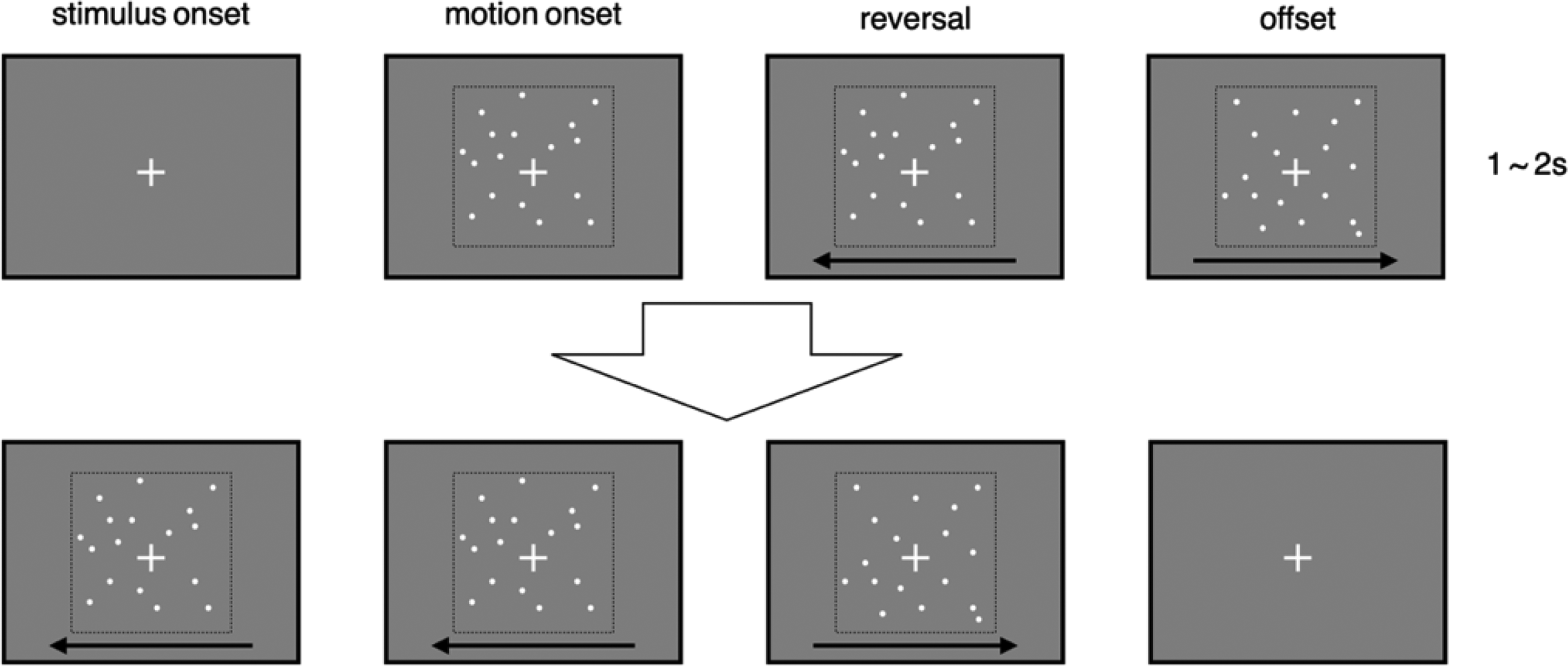
A schematic illustration of a trial sequence in Experiment 2. In each condition, after the preceding stimulus was presented randomly for 1–2 s, the target stimulus appeared.
Analysis
All trails which had reaction time shorter than 200 ms were pre-excluded. Furthermore, we used per-participant per-condition outlier removal criteria to exclude reaction time data points 2 standard deviations away from the average. Based on the pre-processed reaction time, we calculated the estimated TEI by the following equation (Kanai & Watanabe, 2006):

We first conducted a 4 × 3 repeated measures ANOVA on the reaction time with factors stimulus switch and speed to compare the reaction time between the conditions to confirm whether the speed manipulation was successful. We then performed a 2 × 3 repeated measures ANOVA with factors onset type and speed to compare the estimated TEI between the conditions.
Results & Discussion
The mean reaction time and estimated TEI are shown in Figure 4(a) and (b). A two-way repeated measures ANOVA on the reaction time showed that the main effects of speed (F(2, 20) = 43.16, p < .001, η2 = .091, BF10 = 11,036) and stimulus switches (F(1.39, 13.97) = 18.65, p < .001, η2 = .52, BF10 = 32,684) were significant. The interaction was also significant (F(3.10, 31.00) = 7.57, p < .001, η2 =.038, BF10 = 14,302). A two-way repeated measures ANOVA on the estimated TEI revealed significant main effects of speed (F(1,10) = 4.95, η2 = .28, p = .018, BF10 = 3.26) and onset (F(2,20) = 13.50, η2 = .054 p = .004, BF10 =

The results of Experiment 2. (a) The mean reaction time for each condition. (b) The mean and individual estimated TEI based on the reaction times for different stimulus switches.
The results of Experiment 2 showed that increase in stimulus speed reduced the reaction time for the motion onset and motion reversal more than stimulus onset and stimulus offset, confirming that the speed manipulation was successful. Furthermore, the increase in stimulus speed decreased the magnitude of the estimated TEI, which is consistent with the results of Experiment 1. However the size of the estimated TEI was much larger than the actual magnitude of the TEI observed in Experiment 1. This overestimation was present in all the speed conditions. Because these results drew inconsistent conclusions regarding the processing latency hypothesis, we also examined the correlation between the TEA and the estimated TEI to further explore the relationship between the influences of the stimulus speed on the perceived duration and reaction time. Figure 5 shows the scatterplot of each data. We performed correlation analyses on the data of nine participants who provided valid data for both Experiments 1 and 2. Data points obtained in the different speed conditions were collapsed for the correlation analysis, providing 27 data points for each onset condition. The correlation analyses revealed that there was no significant correlation between the estimated TEI and the TE observed in either of the onset conditions (motion onset, r = .167, p = .405; stimulus onset, r = .238, p = .232). These results suggest that the changes in the reaction time may not solely account for the elimination of TEI in the higher speed conditions.

Scatter plots of individual data. Data points obtained in the different speed conditions were collapsed for the correlation analysis. (a) The plot of TEA and estimated TEI in the motion onset condition. (b) The plot of TEA and estimated TEI in the stimulus onset condition.
General Discussion
In the present study, we manipulated the stimulus speed to examine whether the difference in reaction time for different visual onsets accounts for the TEI. Experiment 1 revealed that the TEI ceased to occur when the stimulus speed increased. Experiment 2 demonstrated that the increase in stimulus speed reduced the reaction time for motion onset and motion reversal more than stimulus onset and stimulus offset. However, the magnitude of the estimated TEI based on the reaction time did not match the TEA observed in Experiment 1. Furthermore, the correlation analyses revealed no significant correlations between the TEA and estimated TEI. These results suggest that stimulus speed influenced both the TEI magnitude and the reaction time, but the changes in the perceived duration may not only reflect the difference in the reaction time.
Consistent with the previous findings, we observed that the first interval was judged to be longer than the second interval in the low-speed condition, indicating that the TEI was replicated. However, the size of the duration expansion was smaller than the original report. Kanai and Watanabe (2006) reported that the first motion stimulus was perceived to last approximately 120 ms longer than the second motion stimulus, whereas we observed approximately 45 ms expansion. There are several possible reasons for this discrepancy. First, the range of comparison duration may influence the magnitude of the TEI. Although we used the same standard duration of 480 ms as Kanai & Watanabe, we selected the comparison durations linear-symmetrically around the standard duration (312, 384, 432, 480, 528, 576, and 648 ms), whereas they used an asymmetric placement of comparison durations around the standard duration (427, 480, 533, 587, 640, and 693 ms). Asymmetrically placing comparison durations is reported to cause an overestimation of duration expansion in the temporal oddball paradigm (Seifried & Ulrich, 2010). Thus, the symmetrical placement of comparison duration might have reduced the TEI magnitude in the present study. Second, predictability regarding the motion direction of the first stimulus might also have influenced the TEI magnitude. Studies have shown that unexpected events are perceived to last longer than the expected ones (Pariyadath & Eagleman, 2007; Sadeghi et al., 2011; Ulrich et al., 2006). We only used rightward motion to minimize the effect of predictability on the perceived duration, whereas Kanai & Watanabe randomly determined the motion direction across the trials. Given that the predictability regarding the second stimulus is constant (i.e., the opposite direction of the first stimulus) regardless of the first motion direction, the unpredictability about the direction of the first stimulus may have inflated the TEI in the original report of Kanai and Watanabe (2006).
The results of the present study showed that the speed of the motion stimulus influenced both the magnitude of the TEI and reaction time. Although the disappearance of the TEI in the higher speed conditions theoretically supports the processing latency account, the results of Experiment 2 also indicated that the estimated TEI based on the reaction time does not match the actual TEI observed in Experiment 1. Furthermore, Experiment 1 revealed that the type of onset had no impact on the perceived duration in any of our experimental conditions, whereas Experiment 2 demonstrated the significant main effect of onset types on the reaction time. The correlation analyses also revealed that the perceived duration of the first interval did not correlate with the magnitude of the estimated TEI based on the reaction time. These results imply that changes in the perceived duration of the first motion may not solely reflect the processing latency measured by the simple reaction time task.
One possible explanation for the elimination of TEI in higher speed conditions is the coding efficiency hypothesis, which posits that the perceived duration of a visual stimulus reflects the amount of neural activity required to represent the stimulus (Eagleman, 2008; Eagleman & Pariyadath, 2009). Because the TEA of the first motion stimulus was calculated relative to the second motion stimulus, the disappearance of the TEI could also be interpreted as the duration expansion of the second motion stimulus, rather than duration contraction of the first motion stimulus. When a moving object goes through a sudden change in its visual features, such as size or brightness, the moving object is perceived as two distinct objects (Moore et al., 2007). Thus, it is possible that the random dots in the 2.7 °/s conditions were perceived as one object switching its motion direction, whereas those in the higher speed conditions were perceived as two different objects moving in opposite directions. Given that the appearance of a novel object evokes greater neural activity (Grill-Spector et al., 2006; Henson & Rugg, 2003), a sudden change in the motion direction induced by greater speed may require a larger number of neurons to represent the second motion. This could cause the duration expansion of the second motion stimulus under the coding efficiency hypothesis, resulting in the disappearance of the TEI in higher speed conditions.
Footnotes
Author Contribution(s)
Declaration of Conflicting Interests
The authors declared no potential conflicts of interest with respect to the research, authorship, and/or publication of this article.
Funding
The authors disclosed receipt of the following financial support for the research, authorship, and/or publication of this article: This study was supported by JSPS Research Fellowships for Young Scientists 23KJ2029 to AS and KAKENHI 22H00090 to KW.
