




Abstract
The role of the armed forces in Latin America is characterized by their participation in multiple internal missions. These range from security functions to the provision of social, educational, and public services, among others; their role also involves providing emergency relief. However, some of the armed forces involved in this type of mission do not have specialized units or corps. This poses obvious problems not only from a technical and operational point of view, but also from the perspective of civil-military relations and the definition of the roles of armies. Some Latin American countries have looked to the Emergency Military Unit in Spain as an example to follow for the implementation of a civil defense model based on specialized military resources. The aim of this paper is therefore twofold. First, it seeks to explain that the militarization of emergencies does not involve expanding the use of force but that it can become a “wildcard” policy tool instead. Second, it intends to show how the apparent success of the Spanish Emergency Military Unit resulted from some—not always positive—lessons that can be replicated in the armed forces in Latin America.
Introduction
A trend that has been observed in public security and defense policies around the world is the increasing involvement of the armed forces in missions unrelated to the protection of national sovereignty and territorial integrity (the traditional realm of armies), or deployments in different types of international peacekeeping operations, which are paradigms of the liberal post-Cold War context. These distinctive missions have ranged from the provision of basic services, development assistance, surveillance of borders and prison perimeters, public order, and environmental protection, to responding to natural disasters and civil emergencies (Jenne & Martínez, 2022, pp. 64–67). The management of the COVID-19 pandemic has only reinforced or accelerated this trend, as many European and Latin American countries have employed their militaries in supporting civilian operations (RESDAL, 2020a; 2020b; Rostoks & Gavrilko, 2020; Erickson et al., 2020).
When natural disasters or emergencies occur, the armed forces are often used to provide supplementary support. In general, the legal systems of democratic states allow the executive power to resort to all available private and public resources, including military ones, in exceptional circumstances. However, the decision to involve the military in combating these hazards tends to result from an exercise of political will, regardless of whether their professional expertise is suitable or not. While they may have the essential material capabilities and human resources for emergency response (aircraft, logistics, rapid response capacity, numerous bases throughout the territory), these were not acquired for this purpose nor do the personnel usually possess the necessary training.
The deployment of the armed forces in civil emergencies is not a new or anomalous phenomenon, nor should it cease to exist. What is questionable, however, is the assumption that the armed forces should take a leading role in these tasks, as this involves militarizing areas that do not correspond to the military. In fact, this could be the prelude to praetorianism or militarism, an old acquaintance in Latin America (Diamint, 2015). The growing development of multifunctional armies in the region is a cause for concern (Martínez, 2020a; 2020b; 2022a; 2022b), since they have often been designed to act as substitute institutions in the face of a weak or an absent state (Kruijt & Koonings, 2022). It is not a question of extending the order to be supposedly produced by the military; rather it would be a case of turning to a versatile, adaptive administration, with a large number of troops and a presence throughout the territory: an institution to be employed as a “wildcard” (Jenne & Martínez, 2022, pp. 77–78).
These widespread developments warrant the discussion of a relevant case study. While most Latin American armies operating in disasters and emergencies lack specific training and capabilities, the Spanish government created a brigade-sized military unit and the necessary chain of command specifically and exclusively dedicated to responding to floods, forest fires, snowfalls, volcanic eruptions, and earthquakes: the Emergency Military Unit (Unidad Militar de Emergencias, known as UME for its initials in Spanish). The UME was the first nationwide instrument to contribute to the national civil defense system, reporting to the governments of the autonomous regions in Spain.
This article therefore asks what lessons can be drawn from the Spanish experience that can be applied to Latin American policies. Its aim is twofold. First, to use the case study of the Spanish UME to show how militarization dynamics do not necessarily entail expanding the order in the military and relying on force to solve problems. There is a different dynamic that has been highly developed in Latin America which includes taking action in emergencies caused by catastrophes and calamities. It seeks to take advantage of the military’s versatility and supposed effectiveness to carry out tasks that are totally unrelated to its functional role, making it readily available for use in multiple sectors. Second, to use the case of the UME as a successful political and social policy innovation, and to illustrate how pragmatic bias may have driven similar initiatives in Latin America. While the UME has been taken as a reference point for many Latin American armed forces, this case study sheds light on the disadvantages related to this model.
The UME case study is relevant to the Latin American region. The unit is not the result of the increased militarization of various areas, as is the case in Latin American militaries, but of a political decision with two goals in mind. The first one was to provide a material response to a political problem, namely, overcoming obstacles and deficits in the national civil defense system by helping coordination efforts between public administrations (Bueno & Martínez, 2023). On the other hand, to create a friendlier, more socially accepted image for the Spanish Armed Forces—as they were somewhat trapped by their legacy— (Martínez, 2020c), by linking them to a totally different role from their purely military defense capabilities.
The UME case challenges the logics of theoretical approaches to militarization (Saint- Pierre & Donadelli, 2014; Diamint, 2015; 2020; Jenne & Martínez, 2022), as it is an example of a defense institution that is partly stripped of its military elements. However, while it is true that the actions of the UME are highly valued by society and the political elites in Spain, it is equally important to consider that handing over some areas of civil defense to the armed forces means both giving them a budget that the military should not have, and militarizing emergencies, which could be highly problematic for democratic civil-military relations.
To address these issues, the structure of the article is as follows. Firstly, there is a theoretical section that discusses the concept of militarization and hence explains how the military administration can become a “wildcard” policy tool, as well as why the UME represents a sui generis case in this context. Secondly, it analyses the roles of Latin American armies in emergencies and disasters. Thirdly, it discusses how the UME was established and has evolved over time, with special emphasis on its institutional framework and deployed missions. This also tackles the main problems and opportunities that may arise in the development of similar units. Finally, the conclusions address the article’s twofold focus: that of the scientific and the political.
Different Approaches to the Multifunctional Management of the Armed Forces
Militarization is understood here as the normalized use of the military (and potentially, of military force) for providing services that are alien to military roles. Militarization is therefore an incremental process whereby the use of the military and its procedures are justified and legitimized. In other words, it does not involve armies taking on an increasing number of roles and missions, but rather, understanding that military procedures are the most appropriate for resolving security policy problems among the options available to the state (Robledo Hoecker, 2022). It is a demand for “order” for which the use of military force is the most obvious choice. In this sense, Kuehn and Yagil (2020) distinguished between material militarization and discursive militarization. Material militarization refers to the military influence on the formation and dissolution of governments, and the relative weight of military resources in society; it seems to be an allusion to the more classical concept of militarism. These authors use to measure it the coups d'état.
Militarism is a perverse set of beliefs whereby the military is not only considered to be autonomous from political power, but also in control of all political life (Lleixà, 1986a; 1986b). As described by Diamint, it is “military empowerment coupled with poor civilian control” (2022, p. 36). Thus, there is an aspect of military power that undermines the very viability of democracy. Enacting militarism not only swamps government and decision-making spheres with uniformed personnel, but also establishes the use of violence as an expedient method for resolving conflicts for situations where there should be a political solution. Hence, it is “the imposition of a military ethos, of the military values of its organizational culture, its language, its discipline towards different areas of civilian life” (Diamint, 2018, p. 40).
In contrast, discursive militarization is based on a narrative that legitimizes and justifies the use of force in areas of security that are not the domain of the military. This form of militarization ultimately makes the armed forces the tool of choice for all kinds of security threats. If, in addition, social and economic agendas become securitized in the political system by including the involvement of armies, other problems unrelated to security such as poverty, deprivation, and illiteracy could become militarized.
In Latin America, it is undeniable that very broad sectors have become militarized, a process that has no small amount of political and social support (Latinobarómetro, 2021, pp. 31–36). However, this is not discursive militarization. The reason for this incremental trend in their roles and missions is not a call for the use of force. On the contrary, there is a belief that the armed forces are a wasted resource and there is little expectation that they may be used defense purposes. Therefore, rather than perpetuating idleness, there is a belief that it is better to keep them occupied so that they can make themselves useful. Martínez (2022b, p. 3) has provided several reasons for attributing these views to the armed forces: their size (volume of troops and material resources), their hierarchical and disciplined administration, territorial deployment, and quick mobilization response, and their versatile/adaptive organization, thanks to their institutional autonomy.
These armies are not expected to resort to a use of force in the various tasks they are entrusted with because these are not military operations that require shortcuts to enforce order, but rather large-scale activities in terms of volume, space, and accessibility.
Moreover, military personnel are engaged in activities in these operations for which they are neither trained nor equipped. Military multifunctionality not only disregards the fact that the primary task of armies is defense, but it also usually entails flouting applicable laws, circumventing necessary military reforms, hindering the development of civilian skills for the specific activities the military undertakes, and implementing undemocratic political culture trends (Jenne & Martínez, 2022). Furthermore, the military may be enjoying privileges for undertaking these tasks, which then creates major problems for democratic governance. Additionally, this approach can give the armed forces greater social legitimacy and economic and institutional bargaining power (Mazziotti, 2022c).
The form of militarization adopted by the UME in Spain is neither part of the logic of material militarization nor of discursive militarization. It is not aimed at extending the use of military force to areas where the apparatus of order is inoperative or is overwhelmed. Nor does it take advantage of military capabilities and the supposed adaptability of the military to employ it in other activities (as in the case of Latin America), and thus keep otherwise idle forces occupied. In the UME case, although the result is the use of the armed forces as a “wildcard,” the rationale behind it is not to increase the functionality of the military, but to decrease its defensive role.
This process cannot be described as “demilitarization,” because these dynamics do not entail the departure of the armed forces from certain areas they used to control; nor can we speak of “desecuritization,” as this would mean reversing issues and problems that originally had been securitized, even though they could and should have been resolved differently.
The development of this Spanish military unit was part of a process of reducing the “war component” of the armed forces. It was intended to tone down the profile of the armed forces to make them more palatable to a society where a civil-military gap existed (Martínez, 2020c). The military will continue to engage in the traditional missions that will be overshadowed in the eyes of society because they provide humanitarian aid, extinguish fires, distribute blankets and hot drinks to drivers trapped by snowfall, rescue the population after earthquakes, evacuate citizens in floods, etc. In order to appropriately deal with the new demands placed on the armed forces, two requirements should be met: (a) the army must be trained in these new tasks, including the development of a specific doctrine; and (b) the army must be provided and equipped with the necessary suitable material for this role. Two problems arise in this case. One is that all the time spent on retraining will be time not spent on military defense training; hence, there is a question of whether more troops will be needed. The other problem is that, unless the defense budget increases in order to acquire the necessary equipment and meet these new demands, defense spending will be reallocated. A scenario is then reached in which the military is not prepared for combat but for other types of missions in which military weapons and platforms are replaced by civilian material, as weapons are not believed to be necessary and may even be regarded as a superfluous expense.
The Armed Forces and Emergencies in Latin America
Natural disasters in Latin America (2000–2019).

Source: Developed by the authors based on data from the United Nations Office for the Coordination of Humanitarian Affairs (OCHA, 2020).
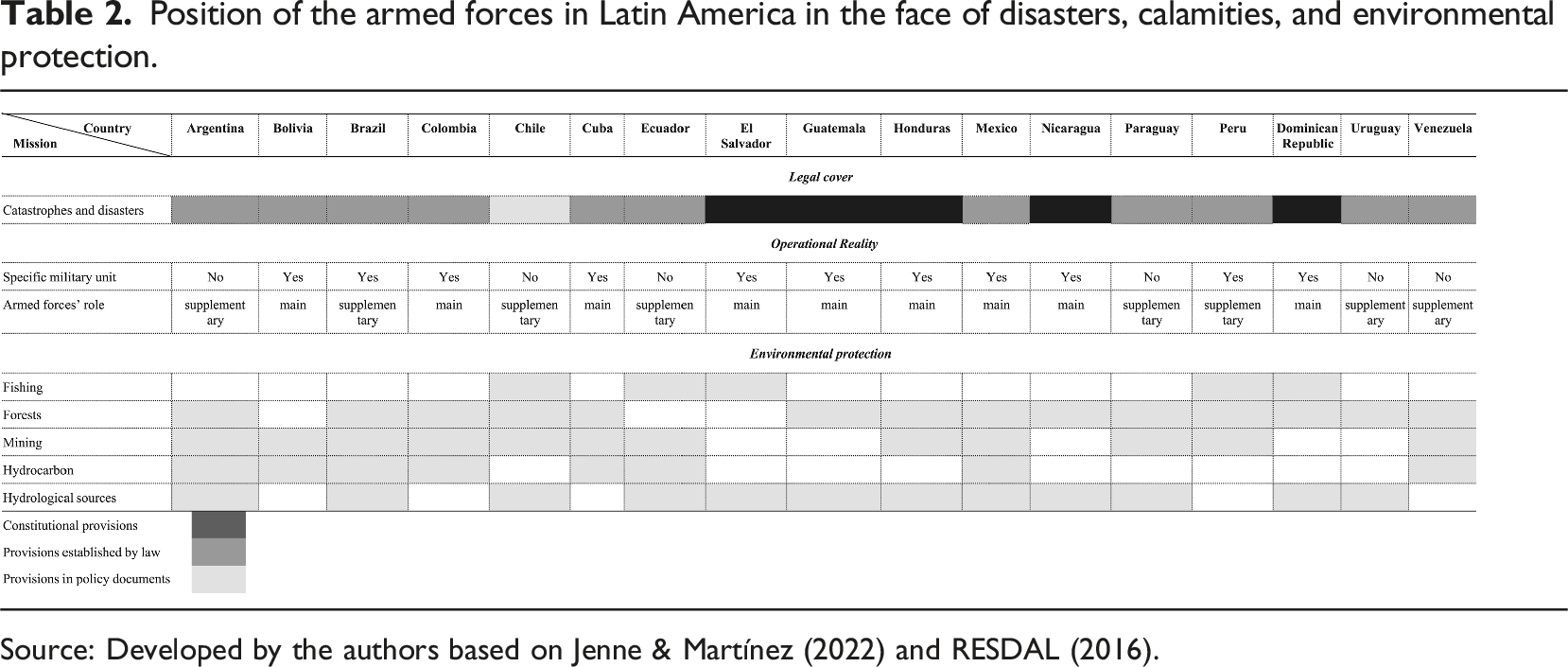
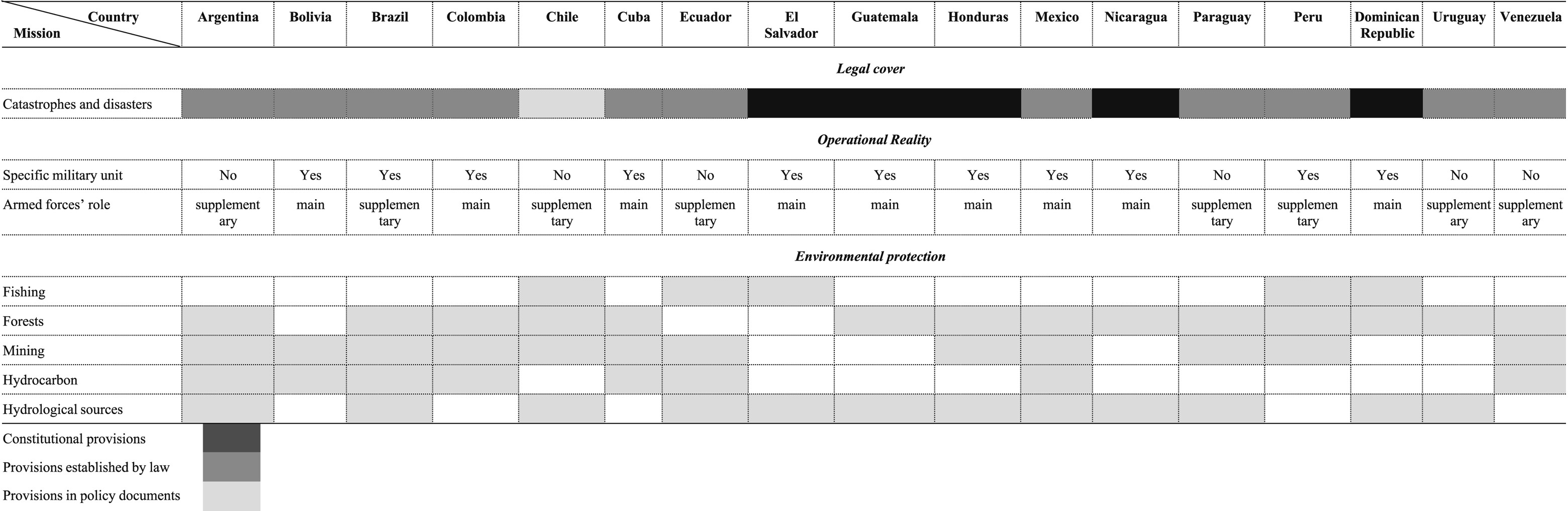
Position of the armed forces in Latin America in the face of disasters, calamities, and environmental protection.
Source: Developed by the authors based on Jenne & Martínez (2022) and RESDAL (2016).
Two steps have been taken to address this problem: (i) creating military units that are specialized in emergencies; and (ii) generically assigning a supplementary role to the armed forces and determining which capabilities would be needed for each emergency. As noted by Arroyo de la Rosa (2012), while the first response is a step toward effectiveness, the second involves entrusting the mission to non-specialized military units, which lack appropriate training and equipment. This means that they engage in a lot of collaboration but have little effectiveness. He therefore suggested reinforcing civil defense systems with specific military units. Although they do not play a military role, they can undertake missions to that effect as and when required. In this sense, the UME model has proven effectiveness and has achieved social and political success.
For Frenkel (2019), these responses combine two very different approaches, a physicalist one and a constructivist one. The first approach assumes that natural disasters are inevitable phenomena which society merely suffers, for which it bears no responsibility. As natural disasters are a hazard, the potential catastrophe is securitized and the core response is to provide the capabilities and means to cope with it. This usually entails a militarized response, as the necessary resources are sought from the armed forces. The second approach relies on the assumption that human actions are responsible for the vulnerability to which society is exposed in the face of natural disasters. Therefore, even though a reparative response is provided when necessary, efforts are focused on prevention, on mitigating risks by controlling human action.
The reality of the region is that little attention has been paid to the constructivist perspective; instead, a securitized model of response to natural disasters has been predominant, where the military have played a major role. In analyzing the main and secondary missions in the region, RESDAL warned that the shortcomings of using the armed forces in risk management are: (i) the dire need to clarify the mechanism responsible and having appropriate training to ensure effective inter-institutional coordination, (ii) the absence of adequate planning, (iii) the lack of a suitable diagnosis, (iv) the poor levels of training and (v) the absence of clear regulations and protocols for action. (Kussrow, 2018).
Table 2 shows three types of response that have been adopted by different countries: (i) countries that continue to use the classic approach whereby the military is responsible for civil defense and provides the human and material capabilities required (Argentina, Chile, Ecuador, Paraguay, Uruguay, and Venezuela); (ii) countries that have civil defense mechanisms available for managing emergencies (both before and after), but have reinforced this with a military emergency unit (Brazil and Peru); and (iii) countries that have not only created an ad hoc military unit for civil defense which goes beyond a mere supplementary role and have handed over responsibility for emergencies to the Ministry of Defense (Bolivia, Colombia, El Salvador, Guatemala, Honduras, Mexico, Nicaragua, and the Dominican Republic).
In this dynamic of securitizing natural disasters and providing a militarized response, the Spanish UME is not only a model of success because of its level of specialization; but it is also an example of best practice worldwide, as it has implemented the Military Emergency Unit Training Plan (known as FORUME), which offers a package to share its know-how with anyone who requests it. It combines advice, training and the provision of specific equipment and materials. In the summer of 2021, the Spanish government even proposed the creation of a European UME following the Spanish example, a project that has not come to fruition to date. 1
Further to this point, the UME is expansive in nature and has organized the training of similar units in third countries as part of the FORUME Plan. According to the Spanish Ministry of Defense, more than 40 countries have shown interest in this military unit. 2 Many Latin American countries, such as Chile, Peru, Ecuador and El Salvador, and some institutions, such as the CAF-Development Bank of Latin America and the Conference of the Armed Forces of Central America, have expressed an interest in being, or have been trained by the Spanish UME.3 The participation of Latin American military personnel in the Disaster Management Course organized by the UME has also become a regular occurrence. Countries such as Brazil, Chile, Ecuador, and Peru have participated in UME drills as observers. In addition, Argentina, Chile, Colombia, Ecuador, Mexico, Panama, and Peru have shown an interest in replicating the Spanish model, and the countries of the Confederation of Central American Armed Forces (CFAC) have signed a technical support agreement for their Humanitarian Rescue Units (HRU). 4
In Argentina, emergencies are managed by the National System for Comprehensive Risk Management and Civil Defense, Law 27287 of 2016. The Ministry of Defense includes a Secretariat for the military coordination of emergencies and a Military Directorate for emergency assistance within the General Staff Command. There is no specialized unit, but rather ad hoc deployments. Something similar happens in Chile, which hands over management to the National Emergency Office of the Homeland Security Department (ONEMI). 5 Although Ecuador it expressed an interest in having a unit similar to the UME in 2011, it has not created one to date. It follows a management system run by the National Risk and Emergency Management Service, with the armed forces providing logistical support. Paraguay’s situation is similar. These hazards are addressed by the National Emergency Secretariat, created in 2005 under Law 2615/05, whose head has the rank of minister. In 2020, the Active Military Reserve was created to provide assistance in natural disasters. It is not a specialized unit and costs nothing to maintain, but it lacks suitable training. 6 In Uruguay and Venezuela, responsibility for emergencies falls, respectively, on the National Emergency System (SINAE) (under Law 18621 of 2019) and on the national director of Civil Defense and Disaster Management, under the Ministry of Homeland Security.
In Brazil, although military performance is supplementary to civil defense responsibilities, they have had Natural Disaster Response Groups (GRD) since 2020. Peru has had the National Disaster Risk Management System (SINAGERD) since the enactment of Law 29664 of 2011. Article 17.3 provides for the creation of the Rapid Intervention Companies for Disasters (CIRD) of the Armed Forces. In 2017, they trained the Special Response Command in collaboration with the UME, but it did not come to fruition. The CIRD was created and has been operational since 2018.
Among the countries that not only have a specific military unit for emergencies, but also hand over responsibility for this matter to the Ministry of Defense, Bolivia, Colombia, Cuba, and Mexico have similar structures in place, each with their individual characteristics. In Bolivia, there are two general directorates in the Ministry of Defense: (i) the General Directorate of Emergency and Relief, which encompasses the Early Warning Unit and the Immediate Response Unit, and (ii) the General Directorate of Prevention and Reconstruction. In Colombia, disaster management is the responsibility of the Ministry of Defense through the Disaster Attention and Prevention Brigade (BRIAD). In Cuba, this role is played by the Ministry of the Revolutionary Armed Forces, which has the Production and Defense Brigades. Mexico, for its part, has the Disaster Support Force (FACD).
In contrast, all the remaining Latin American countries (El Salvador, Guatemala, Honduras, Nicaragua, and the Dominican Republic) face this military mission through the HRUs, which were created in the CFAC agreement. Under a technical collaboration, the UME not only provides advice but also provides training for all the personnel, specifically, a basic emergency course and a disaster management course.
In short, with a few exceptions, military multifunctionality is well established in Latin America. It would not be surprising if the armed forces in the region expanded their scope to cover emergency management not on a secondary basis but to make it their main role. “The region is characterized by a deficit of traditional threats in terms of defense systems, which leaves a vacuum that can be ‘filled’ with other aspects” (Frenkel, 2019, p. 190). However, this is not without its problems: since the armed forces are called upon to provide the state’s response to emergencies due to their organizational determinants and logistical capabilities, this situation creates “an imbalance within the state apparatus, between the security and civilian sectors […] in favor of the military institution” (Klepak, 2020, pp. 16–17).
According to Goodman (1996), if military personnel engage in functions outside their traditional scope, they must not go beyond certain bounds. They must not (1) replace other social groups that are capable of performing these tasks; (2) be granted privileges for doing so; or (3) neglect their main defense role. Therefore, the conditions under which the military can intervene outside its traditional role in the domain of defense must be very stringent: exceptionality, emergency, overstretching of traditional instruments, lack of alternatives, temporary basis, guidance of those in power, and limited duration (only until the state can muster the tools it needs) (Pion-Berlin & Martínez, 2017).
Extending the scope of military functions to areas that are not natural to the armed forces is a risky venture. Indeed, resorting to the armed forces is currently becoming commonplace and, as a result, any issue can be militarized. While pressing need and guaranteed efficiency supposedly offered by the military can be invoked, this overlooks the fact that such dynamics sow the seed of militarism (Martínez, 2022a). Additionally, this tends to happen without an appropriate phasing out plan (Saint-Pierre & Donadelli, 2014; Diamint, 2018; 2020). As Jenne & Martínez have demonstrated, military multifunctionality not only disregards the primary task of armies, namely, defense; the frequent internal use in Latin America, in fact has: “1) challenged the rule of law as its deployment domestically often contravened existing legal frameworks; 2) shielded the armed forces from pressures to reform; 3) worked against the development of civilian capacities; and 4) undermined public confidence in the efficacy of democratic systems and civilians’ ability to solve problems” (2022, p. 81).
As has often been noted, this is nothing to do with an a priori reluctance against the military but is a serious warning in the face of discourses that assume that any problem should be indisputably securitized and justify militarization as an adaptive necessity.
The Spanish Emergency Military Unit: A “Wildcard” for Militarized Emergencies
The establishment of the Emergency Military Unit as a specific corps for the management of civil emergencies in 2005 was the result of an initiative of the then Spanish president José Luis Rodríguez Zapatero. Since its creation, 7 it has become one of the military corps with the greatest social recognition and political support. Three circumstances converged in this initiative. First, the perceived failure of the autonomous regions to manage emergencies and disasters. 8 Second, the demand from the Spanish society to respond to these crisis situations with more suitable resources and the need for the central administration to have its own civil defense resources (Roldán Pascual, 2013, pp. 11–12). And third, the idea of softening the military component of the armed forces. José Bono, the defense minister in Rodríguez Zapatero’s government, believed that an army for peace was more desirable than an army for war, since the chances of a conventional war occurring were scant (Bono, 2015, pp. 280–281).
Certain principles traditionally linked to military organization were seen as advantages for this unit: hierarchy, discipline, high readiness, full availability, and having their own resources, as well as specific instruction, training, and doctrine (Sierra Méndez, 2013; Saldaña García, 2016). The decision to create the UME was so personal to Zapatero and Bono that the UME was initially functionally attached to the president. This structure in fact broke the military chain of command.
The foundation of the UME was surrounded by controversy and was harshly criticized by many civilian organizations, part of the media, and some institutions, including the army. Its problematic origin was even recognized by the UME itself (UME, 2015).
From certain sectors, especially conservative ones, the initiative of the incumbent socialist party representatives was branded as wasteful: It was described as having “expensive firefighters,” and the government was accused of wanting to organize an “army of its own” and seeking to demilitarize the armed forces or diverting essential resources to secondary army functions (Candil, 2008; Colomer, 2008; GEES, 2012). Other stakeholders more linked to pacifist and antimilitarist groups argued that the UME militarized civil defense (Torres, 2019), some claimed that it was part of humanitarian militarism (Centre Delàs, 2007), and others believed that it took resources and opportunities away from for civilian agencies (San José, 2021). Criticism from within the Spanish Armed Forces themselves was highly relevant. They accused the government of creating an “army-NGO,” of diverting significant resources from an always meager defense budget, and of engaging the military in missions that are not part of its core task; in other words, the militarization of emergencies was rejected by the very institution in charge. Even today, the distribution of resources in comparison with the rest of the armed forces, its relationship with the three armies, and its political prominence continues to be the subject of debate and criticism (Alejandre, 2022, pp. 254–265).
The background circumstances in the creation of the UME explain why it was not part of the Spanish Military Transformation (Colom, 2016). Whereas the 2004 National Defense Directive explicitly envisaged that the armed forces should collaborate in natural disasters with civilian authorities, and ultimately it was political conditioning factors, rather than military requirements, that led to the establishment of this unit. This explains the budgetary implications for the adaptation process, as well as the ex post adaptation of the relevant first-level political, strategic and legal documents.
However, the anomaly related to the chain of command was corrected in 2007, when it became functionally and administratively answerable to the Minister of Defense. Nonetheless, this position has changed several times and represents a clear dysfunctionality in the structure of the Spanish Armed Forces, where this “fourth army” is directly subordinated to the minister and not to the Chief of Defense. In addition, the UME was integrated into defense planning in 2009 (Saldaña García, 2016), thus becoming operationally answerable to the Chief of Defense Staff. These changes helped consolidate the new unit (Muro Benayas, 2015, p. 188) and anchor it in the military structure. Since 2008, the UME has devised its own operational plan, different from what the Army, Navy, and Air Force had devised so far to work with civilian authorities in emergencies.
When the UME is deployed, it plays a subsidiary and complementary role to that of other civilian administrations and authorities. The UME acts when these administrations are overwhelmed by the scale of an emergency, which may lead to increased crisis levels. 9 Nonetheless, the UME maintains its natural military chain of command, that is, it is not under the direction of the regional governments (Sierra Méndez, 2013, 72).
There are two exceptions to this statement: in situations of serious emergency or national interest, the commanding general of the UME (GEJUME) may assume operational direction and coordination under the Ministry of the Interior, responsible for homeland security.
Located in the Ministry of Defense and headquartered in Madrid, the idea behind the UME structure is for it to have a broad national presence. A detailed observation of the unit’s headquarters provides insight into the geostrategic positioning of its various brigades, which facilitate rapid territorial deployment. The UME battalions are distributed throughout the territory of Spain, in Army and Air Force bases. This confirms that the UME was built on the foundations of the other armies, especially the Army, and exploits some of their resources. For instance, the UME employs the air arm of the 43rd Air Forces Group, which organically belongs to the Air Force, and the Emergency Helicopter Battalion, which belongs to the Army.
The UME is often required to coordinate relief efforts with the various regional administrations. It is these regional governments that can request intervention through the Minister of the Interior or directly, in the cases mentioned above. The Minister of Defense orders the intervention of the UME at the request of the Homeland Security Minister, as the latter is responsible for civil defense. Then, the Minister of Defense is required to notify the Department of National Security, which reports to the President’s Office. This also emphasizes the strong link to the presidential decision-making level that existed when this unit was created.
The duties of the UME are aimed at taking action in the event of natural hazards, wildfires, chemical, biological, radiological, and nuclear (CBRN) hazards, environmental pollution and any others decided by the authorities. This last prerogative opened the door to expanding its tasks and duties.
Since its creation, and from 2007 onward, the UME has progressively increased its interventions in civil emergencies, most frequently combating wildfires (see Figure 1). In many interventions in storms and floods, the UME has also participated in search and rescue missions. In the past 15 years, there have been no interventions to address CBRN hazards. Much of the Unit’s training has been directed at responding to terrorist attacks. Between 2020 and 2021, the UME was actively involved in the “Balmis” and “Baluarte” Operations, both dedicated to the fight against the global COVID-19 pandemic (essentially in health support tasks and the disinfection of spaces) by the Spanish Armed Forces. Operations of the Spanish emergency military unit (2007–2021). Source: Developed by the authors based on UME data. UME operations related to the COVID-19 pandemic during the years 2020 and 2021 have not been included.
Another type of mission not considered at the time of the UME’s creation was its possible deployment in international missions. Although the Organic Law of National Defense constitutionally established these possible operations abroad (Articles 15–19), until it was enacted they had not been carried out under the legal protection of the Constitution, so the UME had not been able to carry out any operations abroad. In 2010, the UME had its first deployment in Haiti. It was also deployed in the earthquakes in Nepal (2015), Ecuador (2016), and Mexico (2017) in search and rescue work, and the shoring up of infrastructure, in the wildfires in Chile (2017), Portugal (2017), Greece and Turkey (2021), as well as in UNIFIL’s “Libre Hidalgo” mission in Lebanon, led by Spain, providing training in forest firefighting in Lebanese civil defense centers.
In this way, the functions of this military unit were resized as part of the Spanish State’s external action. For this reason, the UME has also been used as a tool for the Spanish defense diplomacy (César Bartolomé, 2017). This policy is part of Spain’s soft power approach and has been explicitly aimed to have an impact on relations between Spain and Latin America (Bueno & Gallego-Cosme, 2021).
Spain is not a case of multifunctional dynamics or widespread militarization. However, the Spanish UME is on a definitive path toward the militarization of a particular issue, which is generally perceived as a success story. This is because, among other reasons, the Spanish Armed Forces has lost part of their resources more closely related to war and the use of military force to the UME.
Lessons to Be Drawn for Latin American Armies
The creation and development of the UME merits a nuanced judgement. Its experience is extremely useful for drawing lessons that can be applied in Latin American contexts. The Spanish UME can be considered to be a success story for operational, institutional, and social reasons, but its operations also have some deeper civil-military relations implications.
First, the UME solved a problem in the Spanish civil defense system vis-à-vis the autonomous regions, both in terms of their own resources and coordination between administration levels. The UME became a specialized, highly available corps with nationwide deployment capabilities. However, there has been some criticism that the autonomous regions have neglected their powers, assuming that it is normal to expect that the UME will intervene as a last resort, which could ultimately weaken the global system.
The truth is that Latin America does not need many excuses for its armed forces to be multitasking; but this argument could be used by countries like Argentina and Chile that do not have this propensity but do have territorial divergences that are not always well resolved.
The UME is an example of radical militarization, in that it involves assigning tasks to the armed forces that were neither in their jurisdiction nor their responsibility in the first place, and subsequently modifying laws and documents to fit them into the legal and operational structure. The idea that the armed forces can be used as a “wildcard” is even taken one step further: the use of the military in this way is deemed preferable to its role as a military tool of defense. For this reason, part of the Armed Forces’ institutional resistance to the creation of the UME and the militarization of civil emergencies is understandable. It was a clash between political power and military management.
Jenne y Martínez (2022) have already demonstrated the region's propensity to view the Armed Forces as wildcard administration. They have also explained that the military accepts any activity if it allows them to protect their volume of troops and their budget levels. Thus, the UME, for many countries, is not showing them a new mission, but a path of military improvement in disaster response.
Second, the UME made it possible to fundamentally resize the Army by transferring part of its resources, both human and material, to the newly created unit. This covert organizational reform of the Air Force, the Navy, and especially the Army, without formally changing the number of troops and officers assigned to each, has not been sufficiently emphasized in official documents. However, the soldiers who belong to the UME put their careers in the infantry, artillery, etc. on hold for several years in order to be trained to provide assistance in civilian emergencies; after that time, they leave the unit and return to their previous careers. In other words, the UME is not a stable, specialized corps. It is not designed to retain talent. It is a temporary posting for military personnel who are rotated and must always be trained from scratch. This makes it an expensive unit (Bueno y Martínez, 2023). Nevertheless, it has its own doctrine and is strongly specialized in civil emergency response, which explains part of its success. If Latin America follows the Spanish example, as it seems, it will opt to create a specialized unit which, like Sisyphus, is always starting from the beginning.
Part of the financial resources that were to be dedicated to the processes of change in the Spanish Armed Forces were diverted to the UME. This was also not included in the planning process until some years later, nor was their participation in international missions initially envisaged. Furthermore, how it fits into the chain of command has been the subject of dispute. The institutional and political perception was that the Armed Forces should play a more socially useful role in the fight against emergencies and catastrophes, which are more likely to occur than a classic armed conflict. Thus, the creation of a potential UME within some Latin American militaries should be based on a specialized corps with nationwide deployment capabilities for civil emergency response and the resizing of the different militaries by transferring resources to the unit. On the other side of the coin, diverting financial resources from other military processes to that unit may lead to strained budgets and resentment among military personnel.
The foundation of UME was related to the view of the future of conflict expressed by Rodríguez Zapatero’s Minister of Defense about the end of conventional wars; the open question is whether these assumptions still hold after the war in Ukraine. In any case, the UME offered society a “friendlier” image of the Spanish Armed Forces, which are in turn perceived to have greater commitment to people and a sense of usefulness, as well as an image that portrays the military as being distant from war and weapons. Interviews with political, military and defense industry elites showed that they all agreed that the Unit enjoys a good image in Spanish society. 10 What is no longer so obvious is whether the image of the Armed Forces should be improved by means of a Unit whose mission is unrelated to military functions; the same doubt that could be raised in the context of Latin America: It is worth considering whether improving the image of the armed forces through a unit unrelated to military functions is an appropriate approach for Latin American societies. However, it is true that the UME has become a tool for external defense diplomacy, opening up new opportunities in states’ international policy.
Conclusion
A changing international scenario and the different preferences in the demands of domestic politics drive the wide range of existing armed forces models and missions. A pragmatic approach advocates their involvement in internal security due to their potential multifunctionality. Nevertheless, in advanced democracies, the military should be kept away from issues that are not concerned with international security. The armed forces, under the authority of the political power, must be an instrument that engages in restrictive and expansive missions abroad and, exceptionally, in the homeland. However, natural catastrophes and other types of civil emergencies increasingly demand the use and deployment of the military within national borders, changing the boundaries between these two domains.
In Spain, the UME is a case where a dual process has taken place. On the one hand, Spanish Armed Forces are currently specializing mainly in civil emergencies. This is a process in which its defensive role has become less important, where military management is distanced from the functions related to the use of force. It is a process involving toning down the role of the military to make it more friendly in the eyes of society (in the short term) and more useful. This allows the government to manage a more obedient, self-sacrificing, and (possibly) cheaper resource. The argument that is always used is that society values the Armed Forces more highly when they undertake these kinds of activities. In contrast, it is a process whereby the response to civilian emergencies becomes militarized, which has probably prevented the creation of other relevant specialized civilian agencies. It is an obvious process of militarization that was resisted by the Armed Forces themselves, and this certainly weakens civilian-military relations.
This process is relevant for Latin America because the dynamics of multifunctionality are growing in almost the entire region. Rather than modernizing the military, Latin American governments prefer to increase the armed forces’ tasks and thus justify both their size and the weight of their budgets. In this regard, the case of the Spanish UME has been of interest to several governments in Latin America. It represents a European model that justifies the transformation into a “wildcard” approach to the management of military resources and the militarization of non-defense-based missions. A process which may hinder the strengthening of democracy, delay military modernization, and hamper democratic civil-military relations in the case of Latin America.
Footnotes
Acknowledgments
The authors would like to thank the comments of the two peer reviewers, and their colleagues for their suggestions and comments who participated in the seminar ‘The Comeback of the Latin American Armed Forces’, which took place at the University of Oxford on 21-22 June 2022, especially their chairs Markus Hochmüller, Carlos A. Pérez Ricart, and Carlos Solar.
Declaration of Conflicting Interests
The author(s) declared no potential conflicts of interest with respect to the research, authorship, and/or publication of this article.
Funding
The author(s) disclosed receipt of the following financial support for the research, authorship, and/or publication of this article: This article has been funded by the Spanish Agencia Estatal de Investigación project PID2019-108036GB-I00/AEI/10.1339/501100011033.
