



Abstract
The current study examined the association of different uses of music, music consumption, and individual differences in personality, trait emotional intelligence, and demographics. A total of 535 British participants completed a battery of scales including the Uses of Music Inventory, the International Personality Item Pool, and the Trait Emotional Intelligence Questionnaire (Short-Form), a novel scale designed to assess music consumption, and provided their demographic details. Results showed significant positive effects of all music uses factors, as well as negative effects of age, onto music consumption. In addition, effects of Neuroticism on emotional music use and Openness on cognitive music use were replicated, though the hypotheses of a positive effect of Extraversion onto background music use or trait EI onto emotional use of music were not supported. Results are discussed in terms of their applied implications for consumer research, as well as their theoretical implications with regard to the psychology of musical preferences.
Annual sales figures (e.g., Schwartz & Fouts, 2003) and average daily listening hours (e.g., North, Hargreaves, & O’Neill, 2000) both testify to the important role that music plays in the personal and social lives of individuals in contemporary cultures (Arnett, 1991; Christenson & Roberts, 1998; Sikkema, 2005; ter Bogt, Raaijmakers, Vollebergh, van Well, & Sikkema, 2003). For instance, recent studies have shown that music facilitates social interaction with peers (Bennet, 2001; Rentfrow & Gosling, 2006; Urberg, Degirmencioglu, Tolson, & Halliday-Scher, 2000), particularly in adolescence (Rentfrow & Gosling, 2007; Selfhout, Branje, ter Bogt, & Meeus, 2009). More generally, music is also of interest because of its clinical applications, particularly in terms of emotional regulation and coping (e.g., Juslin & Laukka, 2003).
Given this, it should come as no surprise that psychologists have long taken an interest in individual differences in musical preferences and appreciation (e.g., Cattell & Anderson, 1953; Little & Zuckerman, 1986). While this body of work has developed in recent years, the existing research remains somewhat piecemeal, with a wide range of individual differences falling under the purview of researchers. For example, early work focused on demographic (e.g., Frith, 1981; Gans, 1974) and familial (e.g., Gold, 1987) factors as explanations for music behaviours. Other work has focused on personality traits, such as sensation seeking, Jungian personality types (e.g., Myers Briggs’ types), and psychoticism (e.g., Daoussis & McKelvie, 1986; Little & Zuckerman, 1986; McCown, Keiser, Mulhearn, & Williamson, 1997; Pearson & Dollinger, 2004; Rawlings, Hodge, Sherr, & Dempsey, 1995), although the definition of individual differences in these studies has varied (Chamorro-Premuzic, Fagan, & Furnham, in press).
In recent years, the conceptualization of the Big Five personality factors – a hierarchical model of personality with five theoretically orthogonal traits (Openness to Experience, Conscientiousness, Extraversion, Agreeableness, and Neuroticism) with good predictive validity in relation to many real-world outcomes (Chamorro-Premuzic, 2007) – has renewed academic interest in music preferences and applications. Thus, in an important study, Rentfrow and Gosling (2003) reported significant associations between the Big Five factors, particularly Openness, and preferences for different types of music classified by the authors. Moreover, a longitudinal replication of this study among Dutch adolescents confirmed that the Big Five were reliably associated with music preferences (Delsing, ter Bogt, Engels, & Meeus, 2008).
A different way in which trait psychologists have approached this topic has been to examine the association between the Big Five personality factors with the functions and purposes of listening to music. Much of this research has focused on the context-dependent nature of motivations for listening to music (e.g., North & Hargreaves, 2007; Sloboda, O’Neill, & Ivaldi, 2001). For example, Sloboda et al. (2001) showed that positive outcomes of music use (e.g., positivity) were related to listeners having personal choice over the music, a finding corroborated by the use of music in everyday settings (e.g., Batt-Rawden & DeNora, 2005; Hays & Minichiello, 2005; Mitchell & MacDonald, 2006). Although these studies have succeeded in identifying some of the core psychological functions of music in everyday life, their approach is primarily exploratory and naturalistic (focused on demographic and behavioural data, such as listening hours and activities performed while listening to music), rather than psychographic - i.e., based on personality-congruent segments. This latter approach has been favoured by Chamorro-Premuzic and colleagues, who set out to identify personality-congruent motives or uses of music with the goal of understanding individual differences underlying musical preferences as a function of established personality traits (Chamorro-Premuzic & Furnham, 2007).
Thus Chamorro-Premuzic and Furnham (2007) devised the Uses of Music Inventory, a 15-item scale that assesses three distinct motives for using music:
the extent to which music is used for inducing moods that change an individual’s experienced emotionality (emotional use of music);
the extent to which an individual listens to music in an intellectual or rational manner, analysing the structure of the composition or parts played by different instruments (cognitive use of music), and;
the extent to which an individual uses, tolerates, and enjoys music while working, studying, socializing, or performing other tasks (background use of music).
The available literature has shown that the Uses of Music Inventory has a reliable structure (Chamorro-Premuzic & Furnham, 2007), including in its Malay (Chamorro-Premuzic, Swami, Furnham, & Maakip, 2009) and Spanish versions (Chamorro-Premuzic, Gomà-i-Freixanet, Furnham, & Muro, 2009). Moreover, these studies have examined the associations between uses of music and the Big Five personality factors, as well as a number of other individual difference traits. Thus, in all four previous studies (Chamorro-Premuzic & Furnham, 2007; Chamorro-Premuzic, Swami et al. 2009, Chamorro-Premuzic, Gomà-i-Freixanet et al. 2009) emotional use of music has been found to positively correlate with Neuroticism (explained in terms of higher emotional sensitivity to music among neurotics), although mixed results have also been reported in relation to Extraversion, sometimes positively and sometimes negatively related to emotional use of music.
In addition, background use of music has been found to be positively correlated with Extraversion (Chamorro-Premuzic, Swami et al., 2009, Chamorro-Premuzic, Gomà-i-Freixanet et al., 2009), explained as a function of extraverts’ lower resting levels of cortical arousal and, as a consequence, their greater tolerance of background stimuli. Finally, cognitive use of music has been shown to be positively correlated with Openness, the Big Five dimension that measures individual differences in aesthetic sensitivity and intellectual curiosity (Chamorro-Premuzic & Furnham, 2007; Chamorro-Premuzic, Swami et al., 2009, Chamorro-Premuzic, Gomà-i-Freixanet et al., 2009). Further support for this association is provided by reports that cognitive use of music is positively correlated with objective (Chamorro-Premuzic & Furnham, 2007) and subjective (Chamorro-Premuzic, Gomà-i-Freixanet et al., 2009) measures of intelligence.
The present study
While the available studies provide support for the internal reliability and convergent validity of the Uses of Music Inventory, three important limitations currently affect this body of work. First, previous studies have typically relied on relatively small samples (Chamorro-Premuzic et al., in press) that compromise the reliability of reported associations, or student samples with a disproportionate number of women (Chamorro-Premuzic & Furnham, 2007; Chamorro-Premuzic, Swami et al., 2009, Chamorro-Premuzic, Gomà-i-Freixanet et al., 2009), which limits the generalizability of findings. In the current study, therefore, we sought to replicate previous work on the Uses of Music Scale using a larger sample with increased number of male participants and a wider age range. This would also enable us to assess the potential impact of educational level, which, like IQ, may be related to uses of music (Chamorro-Premuzic & Furnham, 2007).
Second, the focus on the Big Five personality factors in previous work possibly obscures other relevant individual difference traits that may explain additional variance in the uses of music factors. The present study, therefore, sought to extend previous work by examining the association of uses of music with trait emotional intelligence (EI), which measures an individual’s emotional self-efficacy or their perceived ability to recognize and control their own and others’ emotions (Sevdalis, Petrides, & Harvey, 2007).
Given that trait EI is assessed via self-reports, it is considered a personality trait, related to, but different from, the Big Five personality traits (Chamorro-Premuzic, 2007). As such, it is orthogonal to the construct of ‘ability’ EI (Warwick & Nettlebeck, 2004), which is concerned with emotional abilities measured through maximum-performance tests (Brackett & Salovey, 2006). In the current study, we opted for a measure of trait EI because of the current limitations associated with the objective measurement of the broad ability EI construct, no doubt a function of the subjective nature of emotional experiences (Robinson & Clore, 2002). Trait EI, on the other hand, can be measured reliably via self-reports and has been found to have significant associations with a number of criteria over-and-above the Big Five personality traits, such as goal self-integration (Spence, Oades & Caputi, 2004), job competencies (Van der Zee & Wabeke, 2004), and recognition of facial expressions of emotion (Petrides & Furnham, 2003). That said, trait EI is substantially related to the Big Five traits of Emotional Stability, Extraversion, and Openness (Chamorro-Premuzic, 2007), which begs the question of whether any significant correlation between trait EI and use of music remains significant when other Big Five traits are considered. There is currently very little literature relating trait EI to music. However, as trait EI is negatively correlated with Neuroticism, one would expect that individuals with higher trait EI would be less likely to use music for emotional regulation and therefore score lower on the emotional use of music.
Thus, trait EI could relate to individual differences in music uses, particularly emotional use of music. Specifically, higher trait EI scores would be associated with using music for positive emotional regulation, that is, to maintain or produce positive mood states. In the only previous study to have examined this possibility, Chamorro-Premuzic et al. (in press) reported an association in the predicted direction, although the correlation was weak (r = −.20) and the sample small (N = 100).
Finally, while the Uses of Music Inventory measures an individual’s proclivity to use music for different reasons, it does not measure actual use of music (e.g., the extent to which individuals buy or download music, attend music performances, read about musicians, or watch music-related programmes on television). This is important because measurement of actual use of music (henceforth ‘music consumption’) offers researchers the opportunity to examine the association of individual differences and a behavioural aspect of music use (albeit through self-reports rather than objective measures). Despite the absence of previous research in this area, it seems conceptually plausible that all three uses of music subscales should be positively associated with music consumption; that is, the more individuals use music for cognitive or emotional stimulation, or as background to other activities, the more music they should consume.
In sum, the present study examined the association between the three subscales of the Uses of Music Inventory (emotional, background, and cognitive use of music), music consumption, the Big Five personality factors, and trait EI. Based on previous work (Chamorro-Premuzic & Furnham, 2007; Chamorro-Premuzic, Swami et al., 2009, Chamorro-Premuzic, Gomà-i-Freixanet et al., 2009), we predicted that Neuroticism would be positively correlated and trait EI negatively correlated with emotional use of music; Extraversion would be positively correlated with background use of music, and; Openness would be positively correlated with cognitive use of music. In addition, we predicted that all three subscales of the Uses of Music Inventory would be positively correlated with actual use of music. As in previous work (Chamorro-Premuzic, Swami et al., 2009, Chamorro-Premuzic, Gomà-i-Freixanet et al., 2009), these predictions were tested using structural equation modelling (SEM), which has the advantage of accounting for the unique contribution of any number of predictors on more than one dependent variable and enables variables to be both predictors and criteria at the same time (Byrne, 2006). In line, a hierarchical model was tested whereby individual difference factors (including demographic variables) affected uses of music dimensions, which, in turn, affected music consumption.
Method
Participants
In all, 535 participants (365 men, 170 women) took part in the current study. They were directed to the website for the study via different social networking sites (e.g., Facebook and MySpace), emails, and university-linked webportals; in addition, several banners advertising the study were placed at university campuses. Participants’ ages ranged from 18 to 64 years, with a mean of 24.2 (SD = 7.9); 2.1% described themselves as African/Black, 7.3% as Asian, 77.5% as European/Caucasian, 1.3% as Latino/Hispanic, 2.9% as Middle Eastern, 0.2% as Pacific Islanders, and 6.9% as ‘other’. With regards to educational level, 1.4% had completed up to high school or less, 9.7% were high school graduates, 24.9% had completed some college education, 21.8% were college graduates, 16.3% had some postgraduate education, 25.9% had completed postgraduate studies (e.g., MBA, PhD, etc.).
Measures
Uses of Music Inventory (Chamorro-Premuzic & Furnham, 2007). This 15-item scale was constructed to measure views about when and why one listens to music. All items were rated on a 5-point Likert-type scale (1 = Strongly disagree, 5 = Strongly agree), and five items were summed to compute scores for each of the inventory’s three components: Emotional use of music [M(emot); sample item: ‘Whenever I want to feel happy I listen to a happy song’]; cognitive use of music [M(cog); sample item: ‘Listening to music is an intellectual experience for me’], and; background use of music [M(back); sample item: ‘If I don’t listen to music while I’m doing something, I often get bored’]. Previous work has shown that the measure has high internal consistency and good internal reliability (Chamorro-Premuzic & Furnham, 2007; Chamorro-Premuzic, Swami et al., 2009, Chamorro-Premuzic, Gomà-i-Freixanet et al., 2009). Cronbach’s alpha coefficients for the subscales in the present study are reported in Table 1.
Descriptive statistics and inter-correlations for all target variables

Note: N = 535; Sex coded 1 = Women, 2 = Men. * p < .05, ** p < .01.
Trait Emotional-Intelligence Questionnaire-Short Form (TEIQue-SF; Petrides & Furnham, 2006). The TEIQue-SF is a 30-item instrument designed to assess individuals’ emotional self-efficacy or ability to identify and manage their own and others’ emotions (e.g., ‘Others admire me for being relaxed’, ‘I often pause and think about my feelings’). It is based on the theory of trait EI, which regards the construct as a personality disposition at a higher order hierarchical level than the Big Five personality factors. All items were rated on a 7-point Likert-type scale (1 = Strongly disagree, 7 = Strongly agree). Excellent internal consistencies and broad coverage of the sampling domain of the construct have been reported in previous work (Petrides & Furnham, 2006). Cronbach’s alpha coefficient for the TEIQue-SF in the present study is reported in Table 1.
International Personality Item Pool (IPIP; Goldberg, 1999, 2001). The IPIP comprises 50 items assessing Extraversion (e.g., ‘I am the life of a party’), Agreeableness (e.g., ‘I feel little concern for others’), Conscientiousness (e.g., ‘I am always prepared’), Emotional Stability (low Neuroticism, e.g., ‘I get stressed out easily’), and Openness to Experience (or Intellect, ‘I have a rich vocabulary’) (Goldberg, 2001). In the present study only Openness, Neuroticism, and Extraversion were assessed for both time limitations and theoretical reasons – neither Agreeableness or Conscientiousness has been conceptually related to uses of music in past studies. Each item was rated on a 5-point Likert-type scale (1 = Very inaccurate, 5 = Very accurate). Cronbach’s α for the present sample (see Table 1) were in line with previously reported internal consistencies (which tend to average at.84). Goldberg (2001) reported strong correlations (corrected rs .85 —.92) between the IPIP factors and their equivalent factors as assessed by the NEO-FFI (Costa & McCrae, 1992), another widely-used measure of the Big Five.
Music consumption. This was a purpose-designed 10-item scale to assess the frequency with which individuals used music in actual terms. Items (see Appendix 1 for a full list) included statements about the frequency with which individuals bought and downloaded songs and music videos, as well as how often they attended music performances or watched music programmes on television. The selection of items was based on pilot interviews with students (N = 16, 50% female, age M = 22.2, SD = 6.3), from which an initial item pool of 50 items was generated by the researchers. Several bibliographic sources, notably North et al. (2000) and Rentfrow and Gosling (2003) were also consulted and, in a second stage of the pilot study, a different set of participants (N = 20, 50% female, age M = 24.3, SD = 7.3) was given the option to generate novel items not present in the provisionally constructed scale. Items were intended to assess individual differences in music consumption (mp3s, CDs, videos), and music-related hobbies or activities other than buying or listening to music alone (e.g., reading about musicians, playing an instrument, attending concerts). A principal components analysis identified a clear single factor underlying the 10 items. The single factor was labelled ‘music consumption’ and explained 40.3% of the variance. All items were rated on a 5-point Likert-type scale (1 = Very rarely, 3 = Sometimes, 5 = Very often). Cronbach’s alpha for this scale is reported in Table 1.
Procedure
Once ethical approval was obtained from the university ethics committee, participants were recruited over the internet using email and social networking sites (e.g., MySpace and Facebook), as well as the University of London intranet. The questionnaire was hosted online using the Unipark software and website. Participants were initially briefed, asked to provide consent, and notified that information would be stored anonymously and confidentially. However, participants had the option of providing an email address in order to enter a £500 prize draw. They then completed the questionnaire at their convenient time and in the order described above. Average completion time was around 29 minutes. The final page provided debriefing information and the contact details of the experimenters.
Statistical analyses
All statistical analyses were conducted in SPSS v. 16. We initially computed descriptive statistics and bivariate correlations between all variables of interest. However, bivariate correlations do not take into account the simultaneous effects of multiple predictors on different criteria. Consequently, SEM was carried out using AMOS 4.0 (Arbuckle & Wothke, 1999) in order to: (1) account for the overlap between different predictors; (2) account for the overlap between different criteria, and; (3) assess the validity of a hierarchical model in which the same factors are both predictors and criteria.
To assess the fit of the model, the following indices were used: χ2 (Bollen, 1989), which tests whether an unconstrained model fits the covariance/correlation matrix as well as the given model (although non-significant χ2 values indicate good fit, well-fitting models often have significant χ2 values); the parsimony goodness-of-fit indicator (PGFI; Mulaik et al., 1989), which measures power and is optimal around .50; the CFI (Bentler, 1990), which compares the hypothesized model with a model based on zero-correlations among all variables (values around .90 indicate very good fit); for the root-mean-square error of approximation (RMSEA; Browne & Cudeck, 1993), values <.08 indicate good fit; Akaike’s information criterion (AIC; Akaike, 1973) provides an estimate of the extent to which the parameter estimates from the original sample will cross-validate in future samples, and; Hoelter’s critical N (CN; Hoelter, 1983) provides the maximum sample size for which a model with same sample size and df would be acceptable at the .01 level.
Results
Descriptive statistics and bivariate correlations
Descriptive statistics (Ms and SDs) and internal consistencies (Cronbach’s α) for all composite measures are reported in Table 1. The Uses of Music Inventory and trait EI scores and consistency values were in line with previous studies (Chamorro-Premuzic & Furnham, 2007; Chamorro-Premuzic, Swami et al., 2009, Chamorro-Premuzic, Gomà-i-Freixanet et al., 2009). Due to the nature of the IPIP, norms are not available for this personality measure. However, as shown in Table 1, all αs were acceptable at least, and mostly high.
Table 1 also reports the inter-correlations among target measures. As seen, music consumption was substantially correlated with background use of music and moderately correlated with the other two music uses. There were also modest but significant correlations between music consumption and Openness (positively) and age (negatively). As hypothesized, Openness correlated positively with cognitive use of music, whereas Neuroticism correlated positively with emotional use of music. The predictions of a positive link between Extraversion and background use of music, and trait EI and emotional use of music, were not supported. Additional significant correlations – not predicted – between personality and uses of music were the positive link between Extraversion and emotional use of music and the negative link between Extraversion and cognitive use of music. With regard to demographic factors, men were more likely to use music in a cognitive way, whereas women were more likely to use music in an emotional way. Age and educational level were both negatively related to background use of music.
Structural Equation Modelling (SEM)
Next, SEM was applied to the data. Missing values (<5% per variable, in line with Tabachnik & Fidell, 2007) were first replaced with the series mean at the item level – prior to computing factor scores. Prior to analysis, variables (factor scores) were standardized across the whole sample to a mean of zero and unit variance. We used standardized variables in our analysis because personality and music preference scores lie on different scales, as suggested by Loehlin (1992). Using SEM, we treated participant demographics (age, sex, and educational level), the Big Five personality factors, and trait EI as exogenous variables; the uses of music factors were modelled as mediators, and music consumption was treated as the criterion or exogenous variable. The hypothesized model included paths from Openness to cognitive use of music, from Neuroticism, trait EI, and sex to emotional music use, from sex to cognitive music use, and from age and Extraversion to background music use. In addition, effects of the three uses of music factors on music consumption were hypothesized, but direct effects of the exogenous variables on music consumption were not allowed. The point of not allowing direct paths from the exogenous variables to music consumption was to test these effects via inspection of the modification indices; specifically, any improvements in fit suggested by modification indices indicating that direct effects of either personality (including trait EI) or demographic variables were necessary to improve model fit. It should however be noted that (as per Table 1) the only exogenous variables that were significantly correlated with music consumption were age and Openness (therefore, these would be the only mediated effects). In line with Feingold (1994), we allowed sex to covariate with the three Big Five traits, whilst in line with Petrides and Furnham (2006), we allowed sex to correlate with trait EI. Finally, inter-correlations among the Big Five were allowed in line with Chamorro-Premuzic (2007), Rushton and Irwing (2008), whilst inter-correlations among uses of music factors were allowed in accordance with Chamorro-Premuzic and Furnham (2007). Age and educational level were also allowed to covary, whereas (in line with Table 1) sex was allowed to affect both cognitive and emotional use of music.
The hypothesized model did not fit the data well: χ2 (df = 35, N = 535) = 147.30, p < .01 CFI = .86, GFI = .94, AGFI = .91, PGFI = .52, RMSEA = .08 (.07 –.09). In line with modification indices (statistical indicators for model fit improvement) and Silvia and MacCallum’s (1988) recommendations, theoretically meaningful parameters were added – in decreasing order – until satisfactory fit could be achieved. These included correlations between sex and age (a sampling issue), and paths from trait EI, educational level and Openness to background use of music, and from Extraversion to cognitive use of music; in addition, a path from age to music consumption was also added.
The modified model (see Figure 1) explained the data well: χ2 (df = 28, N = 535) = 44.31, p > .01 CFI = .98, GFI = .97, AGFI = .98, PGFI = .44, RMSEA = .03 (.01–.04). As shown in the model in Figure 1, there were significant effects of all uses music on music consumption, which was also affected by age. In combination, these predictors accounted for 36% of the variance in music consumption (most of this variance was explained by uses of music rather than age). In regards to uses of music, background use was affected by all exogenous variables except sex and Extraversion, cognitive use of music was affected by Openness, Extraversion and sex, whereas emotional use of music was affected by sex, trait emotional intelligence, and Neuroticism.

Modified model of predictors of uses of music and music consumption.
Discussion
The results of the present study contribute to the available literature on the uses of music, specifically in terms of the Uses of Music Scale (Chamorro-Premuzic & Furnham, 2007; Chamorro-Premuzic, Swami et al., 2009, Chamorro-Premuzic, Gomà-i-Freixanet et al., 2009). In terms of supportive results, we found that participants’ personalities were associated with different uses of music, although our results also highlighted a number of unexpected associations in relation to Extraversion. Our findings also supported previous work showing that men were more likely than women to use music for cognitive uses, whereas women were more likely to use music for emotional reasons. Finally, the current findings extend previous work in showing that all three uses of music factors had significant effects on music consumption, which was not affected by the three personality traits examined or trait EI (only Openness correlated significantly with music consumption, but had no significant effects on this factor once uses of music were accounted for).
Individual differences and uses of music
First, our results support previous findings in showing that Neuroticism positively predicted emotional use of music, an association that has been explained in terms of the higher emotional sensitivity of neurotics to music in relation to their emotionally stable counterparts (Chamorro-Premuzic & Furnham, 2007). In addition, we also replicated previous work showing that Openness positively predicted cognitive use of music. As discussed elsewhere (Chamorro-Premuzic & Furnham, 2007; Rentfrow & Gosling, 2003), open individuals have an interest in more sophisticated forms of music. This result is also consistent with the finding that cognitive use of music is positively associated with self-assessed intelligence (Chamorro-Premuzic, Gomà-i-Freixanet et al., 2009), which is explicable in terms of the positive correlation between Openness and intelligence scores (Ackerman & Heggestad, 1997).
Also supporting previous work with a British sample (Chamorro-Premuzic & Furnham, 2007), we found that Extraversion was negatively linked with cognitive use of music. However, this association was not found in other studies. Moreover, the current results did not replicate with the previously found positive associations between Extraversion and emotional use of music among Spanish and Malaysian samples (Chamorro-Premuzic, Swami et al., 2009, Chamorro-Premuzic, Gomà-i-Freixanet et al., 2009). Additionally, the present study failed to find a significant association between Extraversion and background use of music, which is consistent with previous work among British (Chamorro-Premuzic & Furnham, 2007), but not cross-cultural samples (Chamorro-Premuzic, Swami et al., 2009, Chamorro-Premuzic, Gomà-i-Freixanet et al., 2009). Taken together, these results suggest that a more in-depth examination of the influence of Extraversion on uses of music may be warranted, as there have been few consistent associations found in this respect.
Another noteworthy aspect of our study was the lack of a significant correlation between trait EI and emotional use of music. Previous work has shown that trait EI was positively correlated with emotional use of music (Chamorro-Premuzic et al., in press), but that its effects on uses of music was negligible once other personality traits had been taken into account. Taking these results together, it is possible to conclude that trait EI does not have an incremental validity over the Big Five in relation to explaining the uses of music. This is probably due to the strong inter-relation between trait EI and the Big Five personality factors of Extraversion, Neuroticism, and Openness (Chamorro-Premuzic & Bennett, 2007), all of which were included in our model. Indeed, the significant effects of trait EI on emotional use of music shown in Figure 1 may be regarded as ‘suppressor’ effect (given that trait EI was not significantly correlated with this variable – as shown in Table 1 – but became a significant predictor once its overlap with other Big Five factors was accounted for). However, the negative association between trait EI and emotional use of music may be more than a mere statistical ‘artefact’ and warrants further investigation. It is possible that the ambiguous nature of the emotional use of music factor – which, as said, comprises items referring to both positive and negative emotional experiences – may partly account for the inconsistent associations found here with trait EI. This suggests it may be beneficial to break down the emotional use of music factor into two components, one referring to the use of music for negative affect regulation (which may be hypothesized to be negatively correlated with trait EI) and one referring to use of music for positive affect refulation (which may be hypothesised to be positively correlated with trait EI). Clearly, this would require an expansion of the uses of music inventory (with new items added).
On the other hand, trait EI was found to have negative effects on background music use, an association which was not hypothesized. Although further replications are needed, this finding is counter-intuitive because trait EI is positively correlated with Extraversions, and extraverts have been found to be more likely to use music as background to other activities (though not in the present study). That said, the fact that the effects of trait EI on background use of music were found even when individual differences in Extraversion were accounted for suggests that there are other underlying causes to the significant correlation between trait EI and background use of music (furthermore, in the present study Extraversion had no significant effects on background use of music). This begs the question of why individuals with lower trait EI would be more likely to listen to music as background to other activities. Although this may require further studies, particularly some which look at the different aspects or dimensions of trait EI, it is possible that music as background to other activities could help individuals combat boredom and other negative thoughts (e.g., worry, lack of meaning or intrinsic motivation in everyday activities and routine, etc.) which can be expected to be associated with low rather than high trait EI.
Our results also showed that participant demographics were significant predictors of certain uses of music. First, men were more likely than women to use music for cognitive or intellectual reasons. Recent work (Chamorro-Premuzic et al., in press) has explained this association both in terms men’s greater cognitive musical skills, though see Furnham and Bunclark (2006) for a different account. In terms of self-presentational styles, where men may report greater use of music for cognitive reasons to create a gender-congruent external image for others (cf. Rentfrow & Gosling, 2003). In contrast, women were more likely to use music for emotional reasons, which is consistent with previous work showing that men and women differ with regard to their perception of emotional expression in music (e.g., Kamenetsky, Hill, & Trehub, 1997; but see Lundqvist, Carlsson, Hilmersson, & Juslin, 2009).
In the current study, we also found that older participants were less likely to use music for background purposes. One possible explanation for this finding is that music is typically more important in the lives of younger people, particularly adolescents (e.g., Arnett, 1991; Christenson & Roberts, 1988; Sikkema, 2005; ter Bogt et al., 2003). As postulated by Chamorro-Premuzic et al. (in press), increasing age may also be associated with a decline in the appreciation of music, which may result in greater distraction experienced by older individuals in the presence of background music. Finally, we also found that education level was negatively associated with use of music for background situations, independently of age. The fact that less educated participants were more likely to use music as background to other activities may highlight the less intellectual, cognitive and creative nature of these participants’ everyday jobs or occupations, which may be more suited to distraction and even benefit from the arousing properties of music if their jobs are somewhat more monotonous, physical, or non-cerebral (Chamorro-Premuzic, 2007). However, this interpretation will remain speculative until further evidence is provided.
Music consumption
An important independent contribution of the current study to the extant literature was the finding that most individual difference variables, with the exception of age, did not affect music consumption. On the other hand, our results showed that all three uses of music factors were significantly and positively correlated with actual use of music, explaining a good deal of variance in this outcome even when other predictors, such as age, are taken into account. This finding is important because it suggests that the different reasons that music is used for are stronger predictors of music consumption than dispositional and even demographic individual difference variables.
These results may have important implications for researchers seeking to understand actual music-related behaviour. Specifically, our results suggest that, in order to understand music consumption, it is more important to focus on the reasons why individuals use music rather than individual difference factors such as personality or demographics (other than age). Indeed, although uses of music are affected by demographic and less proximal/more dispositional individual differences, such as personality traits, they do not account for any dispositional or demographic effects on music consumption because such variables have trivial and non-significant effects on that outcome. Of course, it is important to note that, in our study, music consumption was operationalized using self-reports, which may be affected by socially desirable responses or self-presentation and shares method variance with the predictors examined. Future work could extend the current study by utilising more objective measures of music consumption, such as the weekly number of music downloads or concert attendance, though this information is harder to obtain, particularly for large samples.
Limitations and conclusion
It is noteworthy that the current study did not examine all possible uses of music, but only those assessed via Chamorro-Premuzic and Furnham’s (2007) inventory. Indeed, this inventory misses at least four important functions of music listening, namely coping for distress, identity formation (for example Christenson & Roberts, 1998), social identity formation (see, for instance, the extensive work by North & Hargreaves, 2000), and interpersonal exchange and communication (e.g., Rentfrow & Gosling, 2006). Moreover, Agreeableness and Conscientiousness, which have been omitted from the test battery in the current study, could also be related to music uses. In particular, Agreeableness could be linked to emotional music use via aggression (e.g., low agreeable people are more likely to prefer martial music, hard rock, etc.); Conscientiousness could likewise inform why a person does not listen to music at work (or does listen at work). Other limitations of the current study include the use of an opportunistic sample. Although this allowed us to obtain a relatively large sample with a wide distribution of ages, opportunistic samples do not fully allow researchers to generalize their findings to wider populations, though the fact that our music consumption scale included several items relating to ‘digital’ music use may also restrict its applicability to older individuals (e.g., adolescents are much more likely to consume music in this form).
In addition, and as noted in passing above, further studies would do well to include a wider array of individual difference factors in their models. This might include the sub-factors of the Big Five traits as measured by the NEO-FFI (Costa & McCrae, 1992), as well as objective measures of cognitive ability and creativity. In similar vein, further research in non-Western cultures may assist researchers to explicate some of the contradictory findings in the extant literature (e.g., Rana & North, 2007). In future work, it may also prove fruitful to examine the stability of the uses of music factor scores temporally, to examine in greater depth whether age is associated with changes in the use of music, and to use different methodological designs (e.g., Lamont & Webb, in press).
These limitations notwithstanding, the present study supports previous work showing that individual differences in personality and demographics can help explain differences in the use of music. The uses of music factors, in turn, appear to have greater predictive validity in relation to actual music consumption than individual difference variables. All in all, the available literature shows that personality has a noticeable impact on the uses of music and music preferences. That is, the uses to which individuals put music partly reflects their personalities and those uses in turn affect behavioural aspects of music consumption.
Footnotes
Appendix
Items used in the Music Consumption Scale
| Item | Item content |
|---|---|
| 1 | Purchase music from online music stores (iTunes, 7digital, etc.) (.78) |
| 2 | Download music (free downloads) from internet sites (.77) |
| 3 | Share music (exchange, record, borrow) with friends or colleagues (.75) |
| 4 | Read about musicians’ biographies (online/books/magazines) (.74) |
| 5 | Update my mp3 player with new music (.73) |
| 6 | Watch television programmes or films about musicians (.68) |
| 7 | Attend musical concerts or recitals (.64) |
| 8 | Visit music shops (HMV, Zaavi, etc.) with the idea of buying music (.59) |
| 9 | Play a musical instrument (including vocals) (.50) |
| 10 | Imagine myself performing the song I am listening to (.49) |
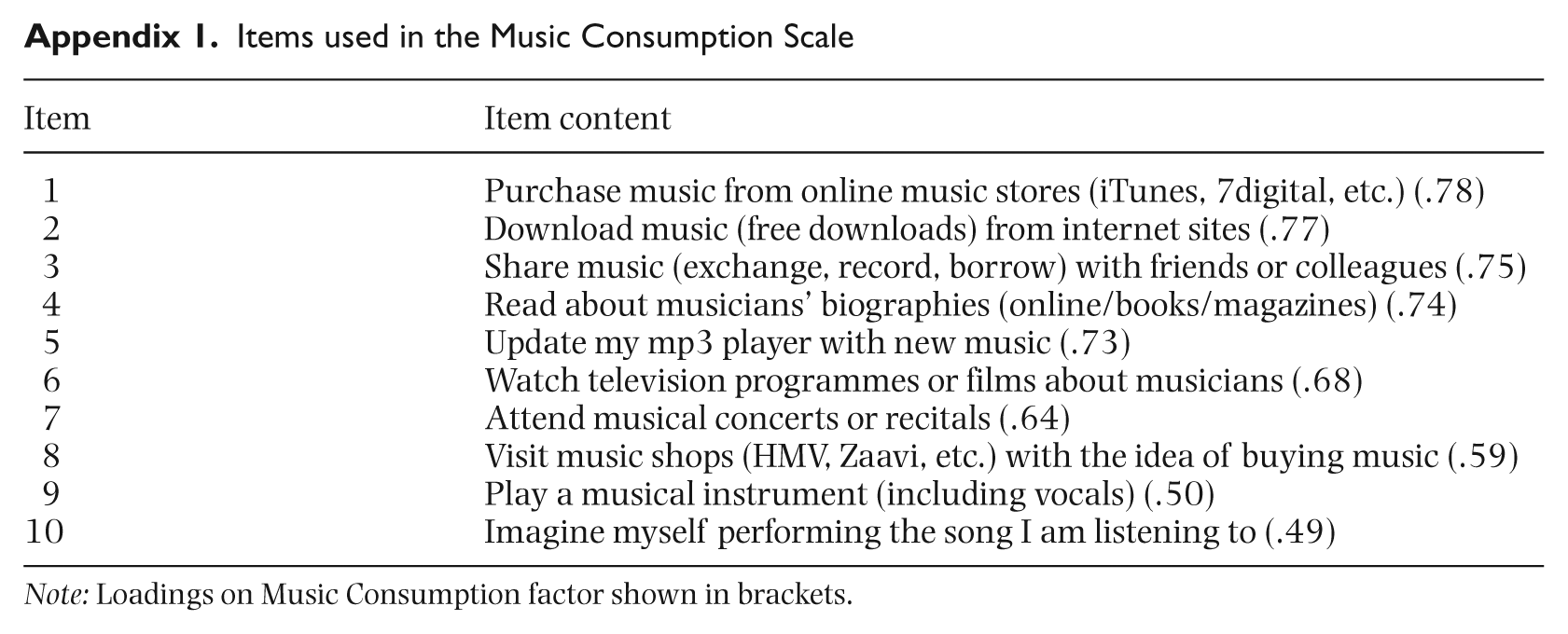
Note: Loadings on Music Consumption factor shown in brackets.