




Abstract
Trait emotional intelligence (EI) is a constellation of emotion-related self-perceptions located at the lower levels of personality hierarchies. This article examines the validity of the Trait Emotional Intelligence Questionnaire–Child Form and investigates its relationships with Big Five factors and cognitive ability. A total of 690 children (317 Males; M Age = 10.25 years; SD = 1.58 years) completed the TEIQue-CF, the Raven Progressive, Matrices and the Big Five Questionnaire; in addition, a subsample of 136 participants answered to Depression and Anxiety scales. Results evidenced that TEIQue-CF is a reliable measure of Trait EI that is partially determined by all of the Big Five factors but independent of cognitive ability. Trait EI predicts depression and anxiety scores over and above the five higher order personality dimensions.
Introduction
Emotional Intelligence (EI) has increasingly gained widespread popularity among both lay people and scientists in a wide range of contexts and across several research areas. In spite of rigorous inquiry into its applications in educational, organizational, and clinical settings, there is no universally accepted definition. Petrides, Furnham, and Mavroveli (2007) maintained that progress in the field depends on the acceptance of the fundamental conceptual distinction between trait EI (or trait emotional self-efficacy) and ability EI (or cognitive-emotional ability). This distinction is based on the type of measurement used to measure the construct: Trait EI is measured via self-report questionnaires, whereas ability EI is assessed via maximum performance tests, as in IQ tests (e.g., Austin, 2004; Austin, Saklofske, & Egan, 2005; Petrides & Furnham, 2000; Tett, Fox, & Wang, 2005). Differences in the method of assessment of EI have far-reaching implications (for a detailed discussion, see Petrides & Furnham, 2001) and are directly reflected in very low correlations between measures of trait and ability EI (e.g., Brannick et al., 2009; Warwick & Nettelbeck, 2004).
Given the inherently subjective nature of emotional experience (Watson, 2000), serious doubts have been raised about the possibility of measuring emotional intelligence via maximum performance tests for both theoretical as well as methodological reasons (Føllesdal & Hagtvet, 2009; Locke, 2005). For this reason we focused primarily on trait EI, which comprises a constellation of emotional self-perceptions located at the lower levels of personality hierarchies (Petrides, Pita, & Kokkinaki, 2007).
To date, trait EI research has focused primarily on adults with fewer studies conducted with child samples. To address this imbalance, a child form of the Trait Emotional Intelligence Questionnaire (TEIQue-CF; Mavroveli, Petrides, Shove, & Whitehead, 2008) has been developed, based on a content analysis of the literature on socioemotional development. The TEIQue-CF comprises nine facets (i.e., adaptability, affective disposition, emotion expression, emotion perception, emotion regulation, low impulsivity, peer relations, self-esteem, and self-motivation) and it has shown satisfactory reliability and validity in children between 8 and 12 years. The initial facets included in the sampling domain were not psychometrically derived, rather their selection was based on a comprehensive review of the literature on children’s social and emotional development. However, the final list of nine was derived after rigorous statistical examination on data from child samples. Trait EI is independent of cognitive ability, but strongly predictive of socioemotional criteria (Mavroveli, Petrides, Sangareau, & Furnham, 2009; Mavroveli & Sánchez-Ruiz, 2011) such as recognition of facial expressions, peer evaluations of kindness, leadership, and overall social competence. In addition, pupils who have been excluded from school or have received unauthorized absences obtained lower trait EI scores compared to their well-adjusted counterparts (Petrides, Frederickson, & Furnham, 2004). At present, more research is needed to investigate the factor structure of trait EI in children and the relationship of the construct with the Big Five (i.e., Neuroticism, Extraversion, Openness to Experience, Agreeableness, and Conscientiousness). Since trait EI is conceptualized as a personality trait, locating it in personality space is important because it will allow us to connect the construct to the mainstream personality literature. We are also interested in investigating the incremental validity of the construct in children.
The aims of the present study are to investigate the factorial structure of trait EI in children as measured via the TEIQue-CF and to examine the interrelationships between trait EI and the Big Five in a sample of Italian children and preadolescents. With regard to factor structure, it should be noted that trait EI theory predicts that children’s responses will show significantly less differentiation (i.e., fewer factors) than adult responses (which yield a four-factor structure). This is because children’s self-perceptions are limited and less sophisticated, which is reflected in their self-reports. In line with similar research with adult samples, we expect that trait EI will correlate significantly with the Big Five dimensions, and particularly with Neuroticism, Extraversion, and Conscientiousness (see Petrides et al., 2010). We also expect that trait EI will be unrelated to general cognitive ability, as measured by Raven’s Standard Progressive Matrices (Raven, 1981), confirming previous findings. In addition, a further aim of the present study is to evaluate the criterion and incremental validity of trait EI in children and adolescents. We hypothesize that trait EI will exhibit incremental validity over the Big Five dimensions in predicting depression and anxiety, as in Petrides et al. (2007).
Material and Method
Participants and Procedure
Seven hundred thirty-seven pupils ranging in age from 8 to 13 years participated in the study. All were recruited from elementary (third, fourth, fifth grade) and middle (sixth and seventh grade) state schools in the districts of Bologna, Ancona, and Firenze. Pupils with special educational needs (n = 12), those who had Italian as an additional language (n = 45), and those (n = 10) who missed more than 8 items on the TEIQue-CF (10%) were excluded from subsequent analyses. The final effective sample size was 670 (317 males; M Age = 10.25 years; SD = 1.58 years).
A letter explaining the aims and rationale of the study was sent to the headmasters and teachers in each school. Informed consent was obtained from parents. All participants filled out the questionnaire individually in their classrooms, after brief group instruction on the answer formats. Administration of all materials lasted approximately 30 min.
Measures
Trait Emotional Intelligence Questionnaire–Child Form (TEIQue-CF)
The TEIQue-CF comprises 75 short statements (e.g., “It’s easy for me to show how I feel”) responded to on a 5-point Likert-type scale, ranging from completely disagree to completely agree (Mavroveli et al., 2008). The English version of TEIQue-CF demonstrated satisfactory levels of internal consistency and temporal stability over a 3-month interval (see Mavroveli et al., 2008; Mavroveli & Sánchez-Ruiz, 2011). The Italian TEIQue-CF was prepared with a graphic layout appropriate to the age of the respondents and pretested on a small group of subjects (N = 30) assessing comprehension and ease of answering. For each participant, scores on the nine facets and on global trait EI were computed.
Standard Progressive Matrices (SPM)
The SPM is a measure of pure nonverbal reasoning ability that is thought to be relatively independent of specific learning acquired in a particular cultural or educational context (Raven, 1981). The SPM test consists of 5 sets of 12 different matrices (60 items) gradually increasing in difficulty. In this study, we administered the SPM to students aged from 11 to 13, and the Colored Progressive Matrices (CPM) to pupils aged from 8 to 10 years. The CPM is a simpler version of the test, often used with children, consisting of 36 items presented in 3 sets of 12. Research in many different samples and settings has consistently revealed good psychometric properties for these measures (Raven, Raven, & Court, 2000). Raw scores of SPM and CPM were standardized according to age normative scores (see, Belacchi, Scalisi, Cannoni, & Cornoldi, 2008; Valseschini & Del Ton, 1994).
The Big Five Questionnaire–Children (BFQ-C; Barbaranelli, Caprara, Rabasca, & Pastorelli, 2002) is a 65-item questionnaire developed for measuring the Big Five (i.e., Neuroticism, Extraversion, Openness to Experience, Agreeableness, and Conscientiousness) in children and adolescents. Each Big Five factor was measured by means of 13 items and raw scores were transformed in T scores according to age normative scores (see Barbaranelli et al., 2002).
SAFA Depression and Anxiety Scales
The “Scale Psichiatriche di Autosomministrazione per Fanciulli e Adolescenti” (SAFA) is an Italian instrument, intended for children and adolescents aged 8 to 18 (Cianchetti & Sannio Fascello, 2001). It allows for a preliminary assessment of psychiatric conditions by means of six different scales that are organized according to clinical criteria. The SAFA scales displayed satisfactory psychometric properties and validity (e.g., Franzoni et al., 2009). In the present study, only the Depression and Anxiety scales were administered to a subsample of 136 students (71 Females and 65 Males; M Age = 10.83; SD = 1.58 years). The anxiety scale consists of 42 items, measuring generalized anxiety, social anxiety, separation anxiety, and school-related anxiety. The Depression scale consists of 48 items measuring depressed mood, anhedony and disinterest, touchy mood, sense of inadequacy and low self-esteem, insecurity, guilt, and hopelessness. Anxiety and depression raw scores were transformed into T scores according to age normative scores (Cianchetti & Sannio Fascello, 2001).
Statistical Analyses
The reliabilities of TEIQue-CF were estimated using Cronbach’s alpha. Age and gender effects were investigated by means of ANOVA. Principal Axis Exploratory Factor Analysis was conducted on the 9 facets of the TEIQue-CF. To determine the number of factors to retain, we combined Parallel Analysis (Horn, 1965; for a detailed description, see Hayton, Allen, & Scarpello, 2004) with Velicer’s minimum average partial (MAP) test (Velicer, 1976), as suggested by O’Connor (2000). In the present study, Parallel Analysis was applied using the “Marley Watkins Monte Carlo PCA for Parallel Analysis” program (Watkins, 2000) and the MAP test was performed using a SPSS syntax file provided by O’Connor, 2000.
To evaluate the contribution of trait EI in the prediction of self-reported depression and anxiety, two stepwise hierarchical regressions were performed with depression and anxiety scores as the dependent variables. Trait EI was entered on its own at Step 1 to investigate criterion validity, followed by gender, age, and the Big Five at Step 2, to investigate the incremental validity of TEIQue-CF global score.
Results
Descriptive statistics, number of items, and internal consistencies for the TEIQue-CF and its nine facets are presented in Table 1.
Descriptive Statistics, Reliability and Gender Differences on the Italian TEIQue-CF
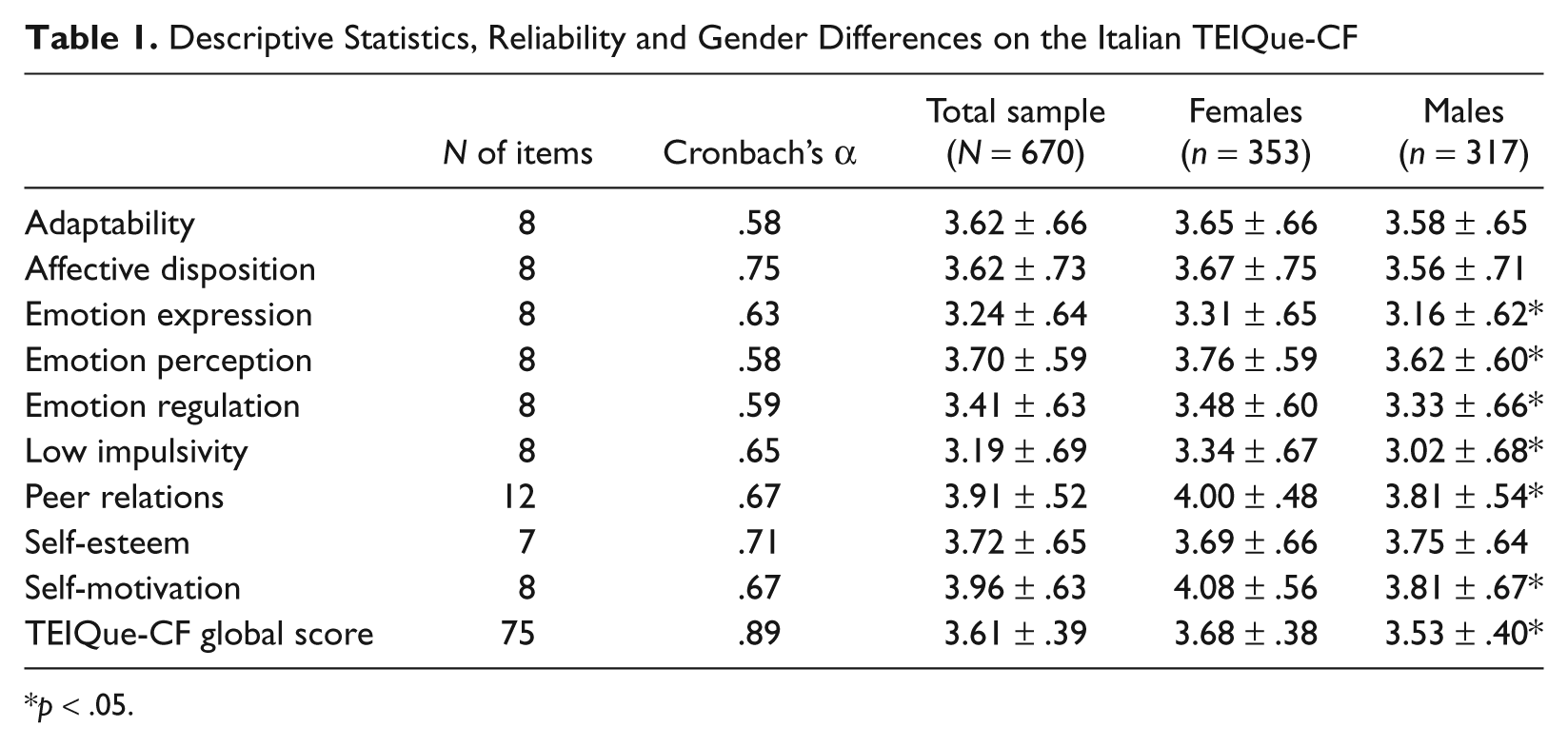
p < .05.
As already observed (Mavroveli & Petrides, 2011), some facets (e.g., affective disposition, peer relations, self-esteem, and self-motivation) present a slightly negatively skewed distribution; however, the TEIQue-CF total score is normally distributed, as indicated by the Kolmogorov–Smirnov test (K-S z = .56; p > .05). The reliability of the TEIQue-CF was high in the total sample (Cronbach’s α =.89) as well as in the two subsamples (Children: α =.88; Preadolescents: α =.90). In the total sample, the internal consistencies of some of the nine facets would be considered acceptable while others are quite low (about .60). The mean average Cronbach’s alpha over the nine facets was higher for older (.69) than for younger children (.62), indicating that the latter responded less consistently on the TEIQue-CF facets.
With respect to gender differences, girls scored higher on some of the facets (see Table 1) as well as on global trait EI. No significant relationship was detected between trait EI and age (r = –.03; p > .05).
Factor Analyses
To evaluate the factor structure of the TEIQue-CF, the nine facets were subjected to Principal Axis Exploratory Factor Analysis on the total sample. Based on the Velicer MAP test, a single factor solution (explaining 39.1% of the variance) would be appropriate. The facets displayed the following factor loadings: Peer Relations (.76), Affective Disposition (.66), Emotion Regulation (.58), Emotion Perception (.57), Self-Esteem (.57), Adaptability (.51), Self-Motivation (.50), Emotion Expression (.46), and Low Impulsivity (.39). In constrast, based on Parallel Analysis, two oblique (factors intercorrelation = .39) factors should be retained, explaining 53.1% of the variance. Onto the first factor loaded the facets of Peer Relations (primary loading =.76), Emotion Expression (.58), Self-Esteem (.58), Adaptability (.57), Affective Disposition (.53), Emotion Perception (.54), and Emotion Regulation (.37), while the facets of Low Impulsivity (.89) and Self-Motivation (.47) loaded onto the second factor. Beyond any statistical considerations, from a theoretical point of view, the second factor suggested by PA was not well differentiated, probably as a result of the relatively young sample. For this reason, we decided to proceed with the unifactorial solution, noting, however, that the two factor solution will likely be more appropriate, especially for older children.
Correlations and Regression Analyses
Correlations between the key variables in the study are given in Table 2.
Correlations Between Trait EI, Nonverbal Intelligence and Big Five (N = 670)

Note: Correlations greater than |.07| are significant. Correlations greater than .30 are displayed in boldface. E = Extraversion; A = Agreeableness; C = Conscientiousness; N = Neuroticism; O = Openness to experience.
Inspection of Table 2 indicates that trait EI is moderately related to all of the Big Five. At the facet level, analyses showed that some facets (e.g., Emotion Perception and Self-esteem) were similarly related to all of the Big Five factors, while others present a variable pattern of associations. For example, Adaptability and Emotion Expression are primarily related to Extraversion, Self-motivation and Low impulsivity were strongly related to Conscientiousness, and Affective Disposition was strongly related to Neuroticism. No significant relationship was observed between trait EI and nonverbal intelligence (r = .06, p = ns), as suggested by trait EI theory.
About 50% of the variance in global trait EI scores was accounted for by a linear combination of the Big Five, Regression Model F(5, 669) = 119.0; p < .001; adjusted R2 =.469, with all five factors contributing significantly (p < .05) to the prediction of the global trait EI score. Specifically, the betas for the Big Five were Extraversion (β =.27), Agreeableness (β = .16), Conscientiousness (β = .18), Neuroticism (β = –.41), and Openness (β = .09).
A two-step hierarchical regression was performed for each criterion (i.e., depression and anxiety). Trait EI was entered on its own at Step 1 and the Big Five dimensions followed at Step 2. This procedure allows for the examination of both criterion (at Step 1) and incremental (at Step 2) validity. The results are shown in Table 3.
Hierarchical Regressions With Trait EI Entered at Step 1 and the Big Five at Step 2

p < .05. **p < .01.
At Step 1, global trait EI predicted a significant amount of the variability in both anxiety, R2 adj = 18%: F(1, 134) = 30.13; p < .01; β = –.43, and depression, R2 adj = 35%; F(1, 134) = 72.99, p < .01; β = –.59). At Step 2, with gender, age, and the Big Five dimensions entered into the equation, trait EI remained a significant negative predictor of both anxiety (β = –.23; t = 2.36; p < .05) and depression (β = –.34; t = 4.03; p < .001), which constitutes strong evidence of incremental validity.
Discussion
The main aims of the present study were to test the psychometric properties and factorial structure of the Italian TEIQue-CF and to evaluate the relationship between trait EI and the Big Five personality dimensions in a child sample. The study is important both from a psychometric perspective, given that there have been very few systematic investigations of the TEIQue-CF with reference to the Big Five, as well as from a cross-cultural perspective, since this is the first investigation of the TEIQue-CF in an Italian sample.
The internal consistency of trait EI as measured by the TEIQue-CF was very high. At the facet level, some Cronbach’s alphas were acceptable, whilst others (adaptability, emotion perception, and emotion regulation) were low (slightly below .60). The age-specific reliability analyses revealed that younger children responded less consistently compared to their older counterparts. Although low values of alphas can be considered almost satisfactory due to the small number (fewer than 10) of items in each facet (Loewenthal, 2001), further refinement at the facet level may be desirable, deleting some of the original items and adding some new ones for each facet. However, during the development of the scale, the authors aimed at providing comprehensive coverage of each facet. In view of the young age of the current sample, the temptation to lengthen the instrument to increase alphas should be weighted against fatigue considerations, which can be particularly problematic for child measures. Overall, extant evidence indicate that the TEIQue-CF can provide a highly reliable assessment of global trait EI although facet scores should be used with caution.
With regard to the factor structure of trait EI in children, Parallel Analysis and Velicer’s minimum average partial (MAP) test yielded divergent results as regards the true number of factors. Thus the latter suggested a unifactorial solution, while the former suggested a bifactorial solution, which was in line with the factor structure observed in a recent study conducted on English pupils (Mavroveli & Petrides, 2011). O’Connor (2000) claims that PA and MAP typically result in the same decision, but when results are not identical, parallel analysis leads to overextraction, whereas MAP leads to underextraction. Beyond such statistical considerations, a general hypothesis of the trait EI theory (Mavroveli et al., 2008) is that children’s responses will show significantly less differentiation (i.e., fewer factors) than adult responses (which yield a four-factor structure for trait EI). The results of the present study suggest that in our particular age group the second factor was not well-differentiated, and for this particular age group the monofactorial solution should be regarded as preferable. Future factor analytic studies should clarify this issue to gain a deeper understanding of structural changes in trait EI over the lifespan.
The results of the present study connect trait EI to the established differential psychology literature by demonstrating that it is partially determined by all of the Big Five personality dimensions, but is independent of cognitive ability. These results are in line with previous findings showing overlap between trait EI and the Big Five (e.g., Freudenthaler, Neubauer, Gabler, & Scherl, 2008; Vernon et al., 2009) and with the conceptualization of trait EI as a lower order personality trait (Petrides et al., 2007). It should be noted that personality traits do not have any sort of physical existence; they are useful as long as they can help explain and predict relevant behaviors.
On this issue, there is mounting evidence that trait EI is a useful concept that predicts a host of meaningful criteria over and above the basic dimensions of personality (e.g., Ferguson & Austin, 2010; Kreifelts, Ethofer, Huberle, Grodd, & Wildgruber, 2010; Laborde, Dosseville, & Scelles, 2010; Mikolajczak, Petrides, & Hurry, 2009; Petrides et al., 2007; Saklofske, Austin, & Minski, 2003; Swami, Begum, & Petrides, 2010). This is the case also for the prediction of anxiety and depression in own study. In particular, trait EI predicts a very substantial portion of the variance in depression and anxiety. Furthermore, the regression analyses clearly showed that the predictive contribution of trait EI remains significant even after controlling for the effects of the Big Five. Overall, these results confirm previous findings indicating a negative relationship between trait EI and psychopathology across all age groups (e.g., Fernandez-Berrocal, Alcaide, Extremera, & Pizzaro, 2006; Martins, Ramalho, & Morin, 2010; Mavroveli et al., 2008) and firmly support the incremental validity of trait EI as measured by the TEIQue-CF.
Finally, some limitations of the present study should be acknowledged. First, it was based on a correlational and cross-sectional design that does not allow any inferences about the direction of influence in the observed relationships. Second, our results are limited to the specific measures we included in the study; future studies could analyze the relationships between trait EI, depression, and anxiety using a multimeasure approach. Third, relatively low Cronbach’s alpha values for some of the TEIQue-CF facets represents a limitation that may have attenuated the size of the coefficients reported in our results. Despite these limitations, we believe that our data showed that the TEIQue-CF is a reliable and valid index of global trait EI in Italian children and that trait EI predicts important psychopathological criteria, such as depression and anxiety, over and above the five higher order personality dimensions. Consequently, we are confident that the Italian adaptation of the instrument can be usefully employed in studies seeking to investigate the role of trait EI in childhood and early adolescence.
Footnotes
The authors declared no potential conflicts of interest with respect to the research, authorship, and/or publication of this article.
The authors received no financial support for the research, authorship, and/or publication of this article.