



Abstract
Previous studies that examined the roles music plays in homosexual life focused on how it was used after “coming out.” In the present study, we qualitatively examined whether music played special roles before and during the “coming out” process. Seven gay men of varying ages and cultural backgrounds were interviewed and asked to describe their “coming out” process and to specify whether music was somehow involved in the process. An analysis of the transcribed interviews revealed three main roles: music as a companion (music offered the support that a friend might have provided); music as a means for concealing and exposing (music helped to regulate the extent of exposing homosexuality); and music as means of making change (music served as a catalyst for “coming out”). The results are discussed in light of Cass’s (1979) model of homosexual identity formation and suggestions for further studies are provided.
Little is known about possible roles that music might have among gays prior to and during their “coming out” process. However, it is known that music has many functions in adolescence (e.g., Arnett, 1995; Laiho, 2004; Larson, 1995; North, Hargreaves, & O’Neill, 2000), the stage of life when identity is shaped and formed, so perhaps music plays more specific roles in the formation of sexual identity and the “coming out” process. The goal of this study was to examine whether music had special roles before and during the “coming out” process of gay men and if so, to find out what these special roles were. We will begin with a brief review of key concepts in the field of homosexuality and then refer to the roles music plays in adolescence and identity formation.
Homosexuality, homosexual identity formation, and “coming out”
Warren (1974) describes homosexual identity as a complex set of components of same-sex sexual activity, same-sex sexual attraction, self-identification as homosexual, involvement in the homosexual subculture, and same-sex romantic attachments. Homosexual identity is formed during a long and sometimes painful process. This is described by different models (e.g., Cass, 1979; Coleman, 1982; Minton & McDonald, 1984; Troiden, 1989), all of which describe the process of realizing and coming to terms with homoerotic feelings and desires. This process requires a change in one’s self-concept and action. It also requires that one accepts his identity, feelings and desires, and adapts them to his life.
Cass (1979) was the first to publish a comprehensive model on homosexual identity formation, which integrates both psychological and sociological elements. This model laid the foundation for other models to be established in the field of sexual identity formation and the “coming out” process. Although many other models had been formulated (e.g., Coleman, 1982; Troiden, 1979), and although there are other approaches to the ideas of homosexual identity and homosexual identity formation (e.g., Riggs, Clarke, Ellis, & Peel, 2010), this model continues to be the standard model and is frequently cited in the literature (Clarke et al., 2010; Marszalek, Cashwell, Dunn, & Heard, 2004). 1
This model includes six consecutive stages: (1) Identity Confusion, where the question of “Is it possible that I am homosexual?” begins to surface and create confusion. The person might start seeking information about homosexuality, or, if they live in a less accepting environment, might try to deny these threatening feelings; (2) Identity Comparison, where the person is in conflict between understanding that he is homosexual and thoughts such as “it is just a phase…” or “I may be bisexual…” This is an inner dialogue and it might result in feelings of loneliness and social isolation; (3) Identity Tolerance, where the person accepts the possibility that “I am probably homosexual…” and they might seek homosexual friends and companions and tighten connections with the homosexual community. Still, unhealthy emotional connections, negative sexual experiences, or disappointing relationships might hinder contact with the gay community and hinder the “coming out” process; (4) Identity Acceptance, where the process of homosexual identity formation is completed and the person is unambiguous about their homosexual identity. Relationships with the gay community are tightened and “coming out” to a close friend and/or family members is considered; (5) Identity Pride, where pride of the homosexual identity sprouts. An awareness of homophobic experiences that were encountered in the past and present results in viewing the world as a dichotomous “them” (straight people) and “us” (gay people); (6) Identity Synthesis, where the “them vs. us” dichotomy relaxes, and one’s homosexual identity is integrated with other identities, such as religious and professional identity. Feelings of anger towards the world abate, and one may see the general picture of how his homosexual identity is a part of one’s life and the world around one. It should be noted that more contemporary theories refer to the concept of Sexual Fluidity, which argues against the underlying assumptions of stage models (such as Cass’s) that there is a simple heterosexual/homosexual binary, and that “coming out” is the expected normal and successful way to deal with the identity struggle that preceded. These stage models do not take into account the notion of bisexuality and the possibility that gender and sexuality might intersect, forming different shades of trans-sexuality (Clarke et al., 2010; Cohler & Hammack, 2007; Savin-Williams, 2005).
A key concept in the process of homosexual identity formation is “coming out,” the act of revealing one’s homosexual identity to others (Fontaine, Hammond, & Nancy, 1996). This is a continuous process in which the gay person reveals their homosexuality to others with whom they feel secure. This might be a close friend, a family member, or a colleague. Over time, “coming out” might expand to other social and familial circles (Cramer, 1995). According to Cramer (1995) there are different factors that drive a person’s decision to “come out.” These include being fed up with social isolation, being unable to keep “the secret” anymore, and sometimes, being forced to “come out” due to external circumstances. For many, “coming out” is a very difficult stage and it requires tremendous effort and mental energy. In relation to Cass’s model, “coming out” will occur somewhere between the third (identity tolerance) and fourth (identity acceptance) stages.
Homosexual identity formation and “coming out” occurs, in many cases, during adolescence (Fontaine et al., 1996). Although homosexual identity formation may not necessarily be associated, at that period, with actual homosexual contacts or “coming out,” questioning one’s sexual identity and sometimes identifying as a gay person often occurs during this stage of life. It is well known that adolescence is a challenging period of life in which identity formation is one of the major tasks (Erikson, 1975; Marcia, 1980). The gay adolescent, therefore, is required to deal not only with the regular challenges of identity formation, but also with the complex challenges of homosexuality (Fontaine et al., 1996). Hetrick and Martin (1987) explain that because homosexuality is regarded as taboo in many cultures, the gay adolescent might find himself in complete isolation, trying to cope with his perplexing thoughts on his own.
Music, adolescence, and homosexuality
Much has been written about the centrality of music in adolescent life (e.g., Arnett, 1991, 1995; Laiho, 2004; Larson, 1995; Lull, 1987; North et al., 2000; Tarrant, Hargreaves, & North, 2001; Tarrant, North, Edridge, Kirk, Smith, & Turner, 2001; Tarrant, North, & Hargreaves, 2000). Laiho (2004) comprehensively reviewed the literature that refers to the roles that music has in adolescence and the meanings that adolescents give to it. She found that music functions in four main fields: The emotional field (music can regulate the ever-changing moods of adolescents; through song and lyrics, music can legitimize emotions that are perceived as unacceptable or extreme; music can serve as a refuge for adolescents to practice extreme emotions that they can later openly express); the identity field (music can give a reflection of the self and subsequently help to define oneself; music makes each adolescent feel unique and helps in distinguishing one from others; choices of different musical styles, singers and bands give the opportunity to experiment with different identities); the interpersonal relationships field (music is an important element in defining who your friends are; music and idols serve as transitional objects to support the process of separation from the family; music can be perceived by the adolescent as a good friend that provides companionship and decreases loneliness); and the agency field (music, in contrast to other pre-defined fields in life, can enhance feelings of personal control, competency and responsibility; feelings of control can enhance positive self-esteem). Apparently, there is a strong connection between the developmental tasks in adolescence and the role music plays during this period. Music can help adolescents safely endure the hardships of this complex stage of development.
Despite the clear links between music, adolescents, and identity issues, not much has been written about music in connection to homosexuality and “coming out.” Lewis and Seaman (2004) give a very general account of gay people’s attraction to the arts, such as music, in the 1960’s. They describe how opera houses became a place for covertly “coming out” and meeting other gay men. Kivel and Kleiber (2000) discuss music’s ability to enable gay adolescents to understand themselves in a new context relative to gender and different sexual norms. Through different genres of music, lyrics, and musical styles, they are able to “try on” various sexual identities.
Other studies show how musical activities help to form and strengthen homosexual identity. Henderson and Hodges (2007), for example, researched a unique exclusively homosexual choir. This phenomenological study showed how participation in the choir helped to form a community and reach out to other communities. This connects nicely with a larger phenomenon documented by Hayes (2008), in which many American lesbians, homosexuals, bisexuals, and transexuals were keen participants in choirs where music provided a sense of unity and community and bridged between homosexual and heterosexual communities. According to this study, membership in the choirs also gave an opportunity to express a political point of view and feel safe and secure about the homosexual identity.
Lemish (2004) addressed a widespread phenomenon in Europe, where the Eurovision Song Contest plays a major role in the construction of individual and collective homosexual identity. Participants in this study described how the broadcasting of the contest was celebrated in clubs and private parties throughout Europe, thus empowering their homosexual identity. Notably, the stage at which gay men consume Eurovision music is usually after they have already “come out” and when they already feel as part of the gay community. It is less clear, however, whether music plays roles before and during the actual “coming out.”
The present study
In the present study, we wish to explore the roles that music may play with gay men before and during “coming out.” In the scope of the current study, we focused on gay men and decided to leave lesbians, bisexuals, and trans-genders to future research. Seven gay men of varying ages and cultural backgrounds were interviewed. They were asked to describe their musical preferences during different stages of their lives, the formation of their homosexual identity, and if relevant, to refer to connections between their homosexuality and their music. They were also asked to elaborate on the specific music and songs that helped during the formation of their homosexual identity and to compare them to other media (e.g., books, movies, fashion) that might have helped them cope with the challenges of homosexual identity formation. The research question that we examined was: Does music play roles in the process of “coming out”? If yes – what are they?
Method
Participants
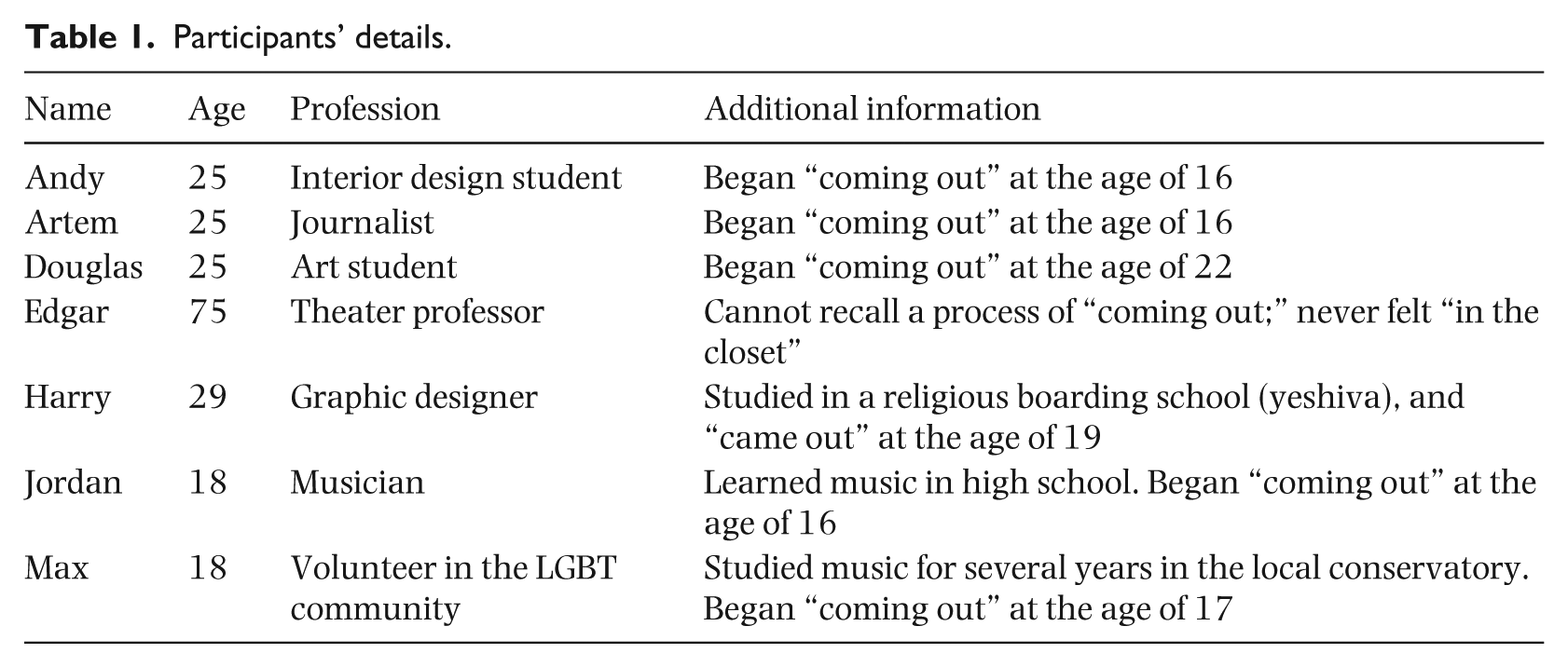
There were seven participants in this study, all of whom identified themselves as gay men. Participants were sampled according to two types of purposive sampling (Given, 2008): criterion sampling (all participants were gay men) and maximum variation sampling (we addressed participants with diverse life stories, from different age groups and cultural backgrounds). Table 1 summarizes participants’ details in alphabetic order. 2
Participants’ details.
Tools
Data was collected using semi-structured in-depth interviews (Smith, Flowers, & Larkin, 2009: see full interview protocol in Appendix 1). The interviews lasted between 1 and 2 hours. They were all tape-recorded on an Olympus digital VN-5500PC voice recorder, and later transcribed word by word for further analysis.
Procedure
Participants were contacted by telephone based on prior acquaintance or through Facebook. They were given an explanation of the general idea of the study and asked to participate in a one-on-one interview at a location of their choice. If they consented, an appointment was made. The interviews were conducted at various locations: at the interviewee’s home, at a quiet park, and at a café. At the beginning of each interview, the purpose of the study was reiterated and the interviewee was asked to sign an informed consent form. At the end of the interview, interviewees were thanked and their complete anonymity was reassured. They were asked whether they would like to see the results once they were ready. This was done to enhance research credibility but also to provide interviewees with the feeling that they had control over the information they revealed during the interview and that they could omit or revise parts of their interview, if they felt the need. The study was approved by the music department ethical committee at Bar-Ilan University.
Data analysis
The verbatim interview scripts were analyzed qualitatively, according to the Interpretative Phenomenological framework of Analysis (IPA; Smith & Osborn, 2003). According to this framework, the researcher refers not only to the explicit description of participants’ experience of the phenomena (the phenomenological part of the analysis) but also to possible implicit interpretations of what the participant is saying (the interpretative part of the analysis). In the first phase of the IPA, materials are thoroughly read and the meanings bestowed to the phenomena are denoted. In addition, meanings of the phenomena that the researcher understands and interprets from the script are denoted. In the second phase, recurring themes are noted and subsequently organized hierarchically into categories. To enhance research credibility, materials were analysed independently by each of the authors of this article and only then compared. Categories were not generated upon a priori theory but rather each author came up with categories which he generated from the data. Differences between the analyses were negotiated and then an agreed upon set of categories was generated. In addition, interview scripts and the complete results section were given to participants for their feedback. No disagreements were found so we did not alter the scripts and findings section.
Results
In general, the interviews showed, in different ways and in different social environments, that music played a significant role in the lives of the interviewees and in their “coming out” process. Compared to other media such as TV, books, movies, and the internet, music emerged as the most powerful and relevant medium. We will now present an elaborate report of the roles that music was found to play in the lives of the interviewees.
Roles of music
The interpretative phenomenological analysis revealed three categories of roles that music played for the interviewees. We will describe each of these categories and give examples to substantiate them.
Music as a companion
Many interviewees referred to music as their main or only companion in the period before “coming out.” This phase was described as extremely lonely and music was there to fill the void. Friends play many roles in life, some of which are to express empathy, support, and containment in difficult times, to share intimate thoughts and secrets, to express similar feelings, especially when these seem awkwardly exceptional, and in the case of social rejection – to protect from vicious assaults. We will see that music can replace human friendship when friends are unavailable.
Harry directly referred to music as a friend:
Before you “come out,” music is very supportive. It is something else that gives you a hand so that you can feel that there is a different place and a different reality. It’s a bridge to life out of the closet…
He also added that “You feel that music is like your spokesman, a representative of the world that tells you – ‘hey, listen, you can do this.’” Indeed, Harry described how, before he had gay friends, he used to dance alone in his room to music that would connect him to imaginary friends and serve as a substitute for them, to some degree. In addition to this, music provided Harry with models to identify with: “Listening to these bands gave me an alternative to what male identity was and I could look at them and say, ‘hey, I identify with them.’ I don’t have [any other] such role models in my social surroundings…”
Harry also related to the singers and their lyrics in a way that could alleviate his hardships:
I was listening to this rock star, who was talking about how he was suffering, and everything was so difficult for him… even if my life was not exactly like his, it was very easy for me to identify with him… I had nobody else to talk to about this.
Through the song, the singer functioned like a good friend, helping Harry to feel that he was not alone. Similarly, Jordan used to endlessly listen to Rachmaninov’s music:
There were times when I used to sit and listen only to this music… alone with my earphones on … In a way this gave me strength because it said to me “OK, you’re not the only poor guy in the world…you’re not the only one with a bitter life”…
Such behavior is typical with regards to good friends: You can complain to them as much as you want, and sometimes they can join in with their own complaints. Such emotional expression may provide relief.
Artem, who was born in Russia, described the tough social environment he grew up in and how he used music to defend himself against his classmates’ attacks. In Russia, there was no awareness of homosexuality and it was extremely suppressed. As a teenager forming his homosexual identity, he had no information about homosexuality, no models to emulate, and no literature about the subject. He was completely surprised when t.A.T.u, a rock music duo featuring two girls singing and acting out lesbian behaviors, achieved fame and popularity in Russia and worldwide. They immediately became his best friends:
[t.A.T.u] was one of the best things that happened to me. Suddenly, someone could make a whole album… based on gay experiences, based on problems that gay people face, based on how difficult it is to live in a country like this and be gay. That was amazing. That was something I never expected! …
For Artem, this was the first time he was reassured of his homosexuality, and understood that there were others like him. The t.A.T.u girls seemed to share Artem’s emotional state, enabling him to identify with them. Artem summarizes this special relationship:
This music, these artists, they made this process easier, they gave me more confidence and support in a situation where you are not accepted but taken as gay. When I was freaking out, scared and depressed, this music gave me confidence every time I heard it: “Relax, it’s all ok. You’re gay so live your life. You are not the only one like this in this world.”
Artem used this “friendship” as a remedy against hostile attacks:
After this experience [humiliation from his classmates], you are broken. Completely… So there was this one t.A.T.u. song called “30 Minutes” and there’s a video as well… It’s a ballad where these girls make a bomb and blow up a carousel with all these horses and shining lights… So I was walking home feeling really down and I couldn’t do anything about it, talk to anybody about it. So I just played this song and when I heard this ballad through my headphones, I heard someone singing about the same problem, the same situation, the same depression – then second by second this music made me feel better, made me feel like… they can say whatever they want, they can do whatever they want, I am who I am and I will not let them change me… t.A.T.u. is the music that heals after being insulted for being gay…
Music as a means for concealing and exposing
The issue of “true self” and “false self” (Winnicott, 1953) becomes extremely relevant with gay people before “coming out.” They are constantly maneuvering between their true sexual identity, of which they are aware, and their disguised, false, heterosexual identity, which they are forced to pretend. Some of the interviewees mentioned how music was involved in these dynamics.
Douglas gave a fascinating example. The choice of what song he listened to was a conscious way of making his sexual preferences known to his surroundings. When he wanted to disguise his homosexuality, he listened to what he referred to as “straight music” (he gave the example of “Mulder and Scully” by Catatonia). Although he liked this music, it was not his first choice. Douglas’s favorite music was Disney music, which he categorized as “gay music.” He was, however, too embarrassed to openly listen to these songs because they would insinuate that he was gay. Interestingly, the appeal of these songs intensified in the weeks before he “came out.” When Douglas was already out, he felt freer to admit his love of Disney music and he even recalled singing the songs out loud with female friends on several occasions. He added a new genre of music to his repertoire, which he termed “gay music:” “Although these songs weren’t my taste, I forced myself to like them . . . maybe because I wanted people to notice I was listening to these songs.” In other words, Douglas was announcing that he was gay through his musical choices.
With Harry, music’s role was mainly to strengthen his inner self and help him muster the courage to admit his true sexual identity. The musical choices he made during that stage were always songs with truthful messages that were relevant to his life. Harry explicitly said that:
I think that this [the songs] strengthened my inner world very much. When I was 15 I realized that I was gay and it didn’t matter what people said. For me, it was clear that the messages I was getting through music were my true world, and the “real” world was a different world… at that time I was managing a very clear dichotomy between what I was feeling inside and what I was reflecting outside.
Music as a means of making change
As mentioned in the literature review, for many gay men, “coming out” is a very difficult stage that requires tremendous mental energy. Music was reported to be a factor in the decision to make a change and “come out.” Jordan, for instance, needed something to drive him out and he found Rachmaninov’s music, which he used to listen to intensively, to push him to make such a change:
At one point, I couldn’t stand listening to this music any more. I said to myself “OK, I don’t want to hear minor anymore, I want to start hearing some major,” and I actually started to make changes in my life that were connected to my “coming out” – I joined Igy,
3
I started telling people, I started to reveal myself, and I stopped being afraid of telling my closest friends.
His first “coming out” experience, to a female friend whom he was in contact with through emails, was also powered by music:
I was on the bus listening to this music “Had Enough” by Breaking Benjamin on their Phobia album… I remember listening to [this song] on high volume and telling myself “I’ve had enough.” I got off the bus, I met her [the female friend] and I told her “listen, I’m gay.” . . . This song gave me some kind of ultimatum and it made me “come out” that same day.
In Jordan’s case, repeatedly listening to the song reflected how overwhelmed he was at that point. The song’s title, lyrics, and perhaps also the songwriter’s biography influenced his decision to make a change.
Artem described how two homophobic songs forced him out of the closet. As mentioned before, Artem endured humiliating attacks by his classmates. One of the ways they used to hurt Artem was through music:
One day there was a new hit on the Russian music scene, which was kind of about homosexuality. It was called Blue Moon (“blue” in Russian means “faggot”) … it was basically gay bashing. And this is my first musical experience connected to the “coming out” process. Every time I got to school, these boys, my schoolmates, would start singing this song to me out loud so everybody would know that I, the faggot, had arrived at school. I would need to walk by them to this soundtrack.
Later on, another similar song became popular:
The song was very aggressive with rude lyrics that went something like “faggots are coming, faggots are coming.” The song was extremely offensive, not funny… they would abuse me with that song. Of course, this was all a negative experience for me.
Paradoxically, these songs forced Artem to make a change.
These bad songs… made the musical announcement that I was gay. You know, if I’m just walking and people are quiet, then… maybe nobody knows. I may not even know whether I’m gay or not. If they are already singing the song to me, screaming those lyrics at me, then they are announcing to the world “he’s a faggot.” They forced an improvised “coming out”!
Other aspects of the phenomena
Contribution of elements of the music
Interviewees referred to specific elements of the music that were relevant to their “coming out” process. In some instances they referred to the song’s lyrics and the ideas they conveyed, as having a tremendous impact on them. Douglas, for example, referred to the words expressed by the Little Mermaid in the Disney music he liked so much. He said, for instance, that the words “I want to be in a different world, out of the water” echoed his situation in which he had to stay in the closet against his will. To give another example, Harry mentioned the lyrics from Pet Shop Boys’ song “Go West” that encouraged him to “come out.”
In other instances, it was the singer that was influential. It was usually the singer’s personality and beliefs, regardless of the singer’s sexual orientation, that was the influential factor. Harry, for example, described his affinity to British rock bands that started gaining popularity when he was 14–15: “…their wave was really powerful… it was something so androgynous, an unclear identity of a man who looks a bit like a woman… These groups gave me a completely different alternative to what masculine identity could be…” Harry also mentioned Dana International, a transgender singer who won the 1998 Eurovision contest: “… she simply did it [changed her sex] and she couldn’t care less what people said.”
In some cases it was the musical style in general that was influential. Jordan, for example, explained why he loved the music of Avishai Cohen, a Jazz bassist and composer. In a very interesting musical-psychological analysis, he explained how this musician’s special combination of sounds and styles were similar to his own identity and therefore helped him define who he was.
“Gay music”
The notion that there is a style of “gay music” was repeatedly mentioned by interviewees. Interestingly, this was an integral part of the discourse, as if it is a natural and widespread concept: “The gay songs are mostly sung by females” (Douglas), or “This is very gay of me but I really love all of the musicals… I also like House music like any other ‘professional’ gay….” Other than musicals (e.g. Priscilla Queen of the Desert, Hair) and New York House music, other big stage productions were mentioned as “gay music,” as well as the Eurovision Song Contest, and specific bands such as Abba. These findings extend Lemish’s (2004) study about the Eurovision phenomena and it is recommended that this topic receives further investigation.
The “coming out” song
Several interviewees referred to their “coming out” song. For example, Jordan’s “coming out” with “Had Enough,” which was previously described, and Douglas’s “coming out” with two songs that his friend sent him “…I went to the club, and I told myself – this is my ‘coming out song. ’” Interestingly, this echoes the “they’re playing our song” phenomena in which people (e.g., couples) feel personally connected to or even ownership over a popular song because of its personal relevance (Ahlkvist & Faulkner, 2006; Frith, 1981, 1996; Klein, 2002; Schulkind, Hennis, & Rubin, 1999).
When does music cease to be relevant?
The roles of music described above were limited to the time before and during “coming out.” For the stages after “coming out,” music did not seem to have any special roles. Artem, for example, who as a teenage gay listened to t.A.T.u extensively, stopped listening to it at one point when he felt more confident and secure with his homosexuality.
Music was not relevant to all participants
Another important finding is that not all of the interviewees referred to music as a central factor in their homosexual life. Edgar, for example, did not remember any instances in which music influenced his feelings, choices, or challenges as a gay person. For Andy, music was mentioned only in minor instances. He mentioned other media that helped him during his homosexual identity formation, such as the internet, books, TV, and movies. Interestingly, both Edgar and Andy were exceptional in our sample of interviewees in that they experienced a very easy “coming out” process. Edgar explicitly said “For me it [‘coming out’] was very simple… the truth is, I was never in the closet…” and similarly, Andy reported “I don’t know if being in the closet is the right figure of speech in my case…” Later, in the discussion, we will attempt to explain Edgar and Andy’s cases in the context of the other interviewees.
Discussion
The purpose of this study was to examine whether music played special roles in the “coming out” process of gay men and, if so, to discover what they were. Evidently, music played several roles in the “coming out” process for the majority of our interviewees. Three central roles were found: “music as a companion,” “music as a means for concealing and exposing,” and “music as a means for making change.” If “coming out” is considered a chronological process, these roles could be referred to as representing three consecutive stages in the process (see Figure 1).
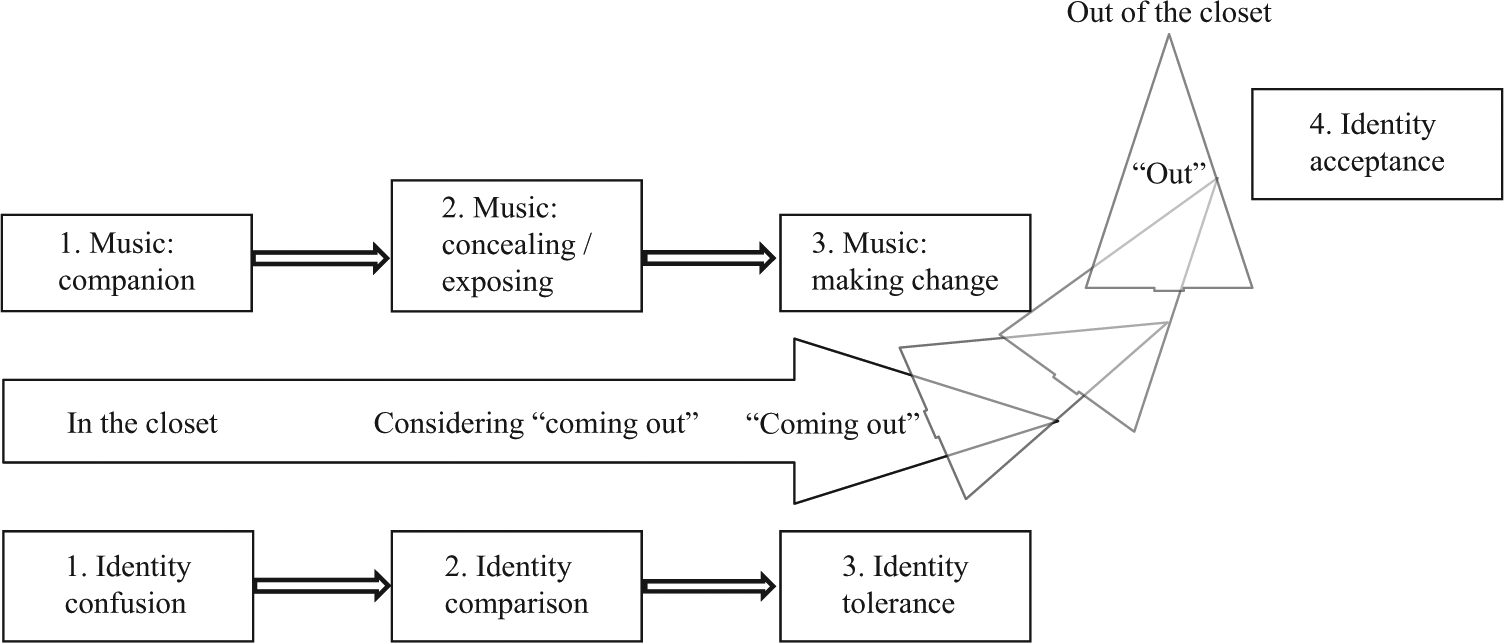
The roles of music in the “coming out” process: A three-stage model.
In the first stage, which to some extent overlaps Cass’s Identity Confusion stage, the gay person is not yet convinced regarding his sexual identity and is overwhelmed with feelings of confusion. What makes this phase especially difficult is the fact that it is usually experienced in complete isolation and loneliness. At this stage, music’s central role is to be a companion, assuming functions that are usually carried out by friends and close family members. In the second stage, which to some extent overlaps with Cass’s Identity Comparison stage, the gay person negotiates whether to present his true sexual identity or his false one. At this stage, music’s central role is to serve as a means by which one can practice concealing and exposing his sexual identity. As we saw before, this can be done using deliberate musical choices that announce to the social surroundings whether one is a homosexual or heterosexual. In the third stage, which to some extent overlaps with Cass’s Identity Tolerance stage, the gay person decides to “come out.” This is a gradual process in which the secret is revealed to growing circles of acquaintances. At this stage, music’s central role is to serve as a means by which one can execute the change. Later, when the “coming out” process has reached its conclusion, it seems that music ceases to affect gay people in these unique ways. They reported that after “coming out,” the music they used to listen to became useless, and in some cases, ridiculous.
Perhaps after “coming out,” music plays different roles that are directed at strengthening homosexual identity in a more collective and communal way. Indeed, it seems that this study’s findings complement those of previous studies (Hayes, 2008; Henderson & Hodges, 2007; Lemish, 2004). The present study focuses on the roles music plays while in the closet (the left part of Figure 1), while previous studies referred to music while out of the closet (the right part of Figure 1). Accordingly, the roles that music was found to play in the present study were all personal and carried out in intimate environments (e.g., one’s room, one’s personal MP3 player), while in previous studies, music was found to play more collective roles (e.g., choirs, watching the Eurovision) and it was carried out in public with the aim of forming and strengthening the sense of communal identity.
It is questionable, however, whether the three-stage model presented here is relevant in all contexts and to all people. Firstly, some gay men may never actually experience being “in the closet” and subsequently do not undergo a dramatic “coming out” process or, as one of our interviewees put it, “the door of my ‘closet’ was quite transparent…” Similarly, the argument of more contemporary LGBTQ researchers is that for some people sexuality is not experienced in a “heterosexual/homosexual” dichotomy but in what they term as Sexual Fluidity (e.g., Amestoy, 2001; Clarke et al., 2010; Cohler & Hammack, 2007; Savin-Williams, 2005; Weinrich & Klein, 2002). In such cases, it seems that music does not play a major role in gay people’s lives before “coming out.” Indeed, as we previously noted, the two interviewees who did not report a significant role that music played in their homosexual lives were the ones who reported a very easy “coming out” process.
Another factor that might be connected to music’s involvement in “coming out” is the access to information and more specifically, to the internet. It is questionable whether adolescents with a developing homosexual identity still need a companion such as music today: Information is much more accessible and communities can easily be formed with guaranteed anonymity. Indeed, Clarke et al. (2010) and Savin-Williams (2005) note that young people today are more likely to disclose their LGBTQ identity partly due to a greater exposure to issues of sexuality including homosexuality. Other studies have showed the important role of the internet in the identity development and coming out of gay men (e.g., Hillier & Harrison, 2007; Thomas, Ross, & Harris, 2007). The internet provides a space in which people can feel more confident to be themselves and to explore what it is like to be gay, thus, in a sense making music’s contribution somewhat redundant. The sample in this study was mostly comprised of interviewees who “came out” a decade or two ago, when the internet, forums, and Facebook did not yet exist, or were not as accessible. Therefore, it is important to examine music’s role in the “coming out” process of younger gay people to see if things have changed as a result of technological progress.
A third factor that could predict whether music is important in one’s “coming out” process is the individual’s cultural environment and more specifically, the culture’s attitude to homosexuality. Indeed, Clarke et al. (2010) have mentioned that “socio-historical factors may be responsible for considerable differences in experiences of identity development between cohorts” (p. 157). In the present study, interviewees who came from cultures that were inherently opposed to the idea of homosexuality, such as Artem (Russian culture in the 1980s) and Harry (religious culture) were the ones who relied most heavily on music. Apparently, their cultural environments led them to complete social isolation, hence, the increased need for music.
These assumed factors are tentatively presented here on the basis of our explorative study and they should be treated with caution. Further research is required to examine the model and the factors that might influence it. We recommend several directions of inquiry. First, larger samples of interviewees should be addressed to determine whether they also experienced music in similar roles during their “coming out” process. Perhaps other interviewees, from different cultural backgrounds and age groups, will highlight other roles that music may play. Based on the findings of such a process, a second direction of inquiry would be to construct a questionnaire to measure the extent to which music was relevant in the “coming out” process. Third, a larger scale survey study could be conducted to examine possible factors that influence the relevancy of music during “coming out” such as the extent of difficulty presented by one’s “in the closet” stage, the extent to which one has access to the internet, and the extent to which one’s culture is homophobic. Another issue that emerged from the present study and that requires further research is the “gay music” genre, which was repeatedly mentioned. This issue was discussed in Lemish’s (2004) study in the context of “camp music,” that is, music that challenges aesthetic assumptions of the mainstream. According to Lemish, Eurovision music, like other forms of music associated with gay people, is over-dramatic, exaggeratingly feminine, or at times, cross-gendering, grandiose, and over-sentimental. We therefore recommend continuing to explore the characteristics and social meanings of “gay music.”
The findings of this study might be very useful to people who come in contact with gay people at the final stages of their “coming out” process, such as parents, siblings, teachers, and psychotherapists. Knowing how meaningful music can be to a person “in the closet” can help one better understand the complexities involved in being gay and be better attuned to a gay friend or relative. Music therapists who heavily rely on music in their clinical work have already taken interest in LGBTQ clients and formulated best practice guidelines for treating them (Whitehead-Pleaux et al., 2012). In line with this it is suggested that the insights presented in this study further develop music therapists’ sensitivity to gay clients and improve their understanding of the roles music might play in gay people’s lives.
Footnotes
Appendix 1: Interview protocol
Funding
This research received no specific grant from any funding agency in the public, commercial, or not-for-profit sectors.