



Abstract
Past research has referred to either the concepts of self-regulation or deliberate practice to explain the relationships between learning strategies and musical achievement and performance. In addition, even though most scholars agree that formal practice time plays an important role in musical achievement, empirical investigations have failed to show consistent associations between practice time and achievement. The aim of this article is to suggest an integrative framework in which self-regulation, deliberate practice strategies and practice time are simultaneously taken into account in the prediction of musical achievement. In this framework, we propose that formal practice should be defined as a goal-directed and focused period of practice that includes both self-regulation and deliberate practice strategies. We further posit that practice time will predict musical achievement only if associated with formal practice. This integrative framework was tested in a 4-month prospective study using structural equation modelling. Results revealed that this integrative model was a better predictor of musical achievement than traditional methods of measurement. The suggested integration of self-regulation and deliberate practice within a single framework provides a more complete picture of the associations between learning strategies, practice time and musical achievement.
Keywords
Isobel is 18 years old and loves to play the piano, her favourite instrument. She believes she is quite competent at it. She is proud of the 6 hours of practice she puts in each day, 6 days a week, even though she sometimes feels that she is not improving as fast as she should. Matthew, also 18 years old, also believes that he is skilled at playing the piano. He loves playing the piano but feels that he only has time for 2 hours of very deliberate practice a day. In 1 month, Isobel and Matthew will both have to perform at their respective college music examinations. The question is who, between Isobel and Matthew, is likely to be the most successful?
According to motivational theorists, the belief in one’s own capacity to master a task influences the course of actions taken to accomplish this task (e.g. perceived competence or self-efficacy in socio-cognitive theory; Bandura, 1986; and self-determination theory; Deci, Schwartz, Sheinman, & Ryan, 1981). As such, perceived competence has been defined as an individual’s evaluation of his or her own capacity in a given area (Nicholls, Cheung, Lauer, & Patashnick, 1989) and, in music performance, refers to a musician’s belief in his or her own musical ability. Perceptions of academic competence (or the related concept of self-efficacy), an inherent component of the motivational profile of students, has repeatedly been linked with academic achievement, both overall and in specific domains such as mathematics and sports (e.g. Anderman & Midgley, 1997; Bouchey & Harter, 2005; Bouffard, Boisvert, Vezeau, & Larouche 1995; Caprara et al., 2008; Nicholls, 1984), as well as with the use of learning skills (e.g. Pintrich & de Groot, 1990). In turn, the different learning skills, especially those that draw on concepts such as self-regulation and deliberate practice strategies, have received a great deal of attention in recent research in music education and psychology. With little disagreement, these investigations corroborate the importance of learning strategies for musical achievement.
Within this framework, high achievers are thought to have higher perceptions of their academic competence, better organize their time, use efficient strategies to enhance their cognitive and motor skills, and spend more time doing so than lower achievers. Over recent decades, researchers have assessed the various forms of practice within either the self-regulation or deliberate practice frameworks in order to explain their nature and the role they play in musical achievement. However, increasing evidence suggests that these concepts are in fact interrelated.
This article builds on previous work by proposing a conceptual framework of the links between self-regulation, deliberate practice, and practice time in predicting musical achievement. It organizes a set of related findings on the strategies that help explain musical achievement. These findings have provided valuable information on subsets or categories of strategies, mainly from two complementary perspectives. First, the capacity to self-regulate has been considered to be an important part of academic success across all disciplines, including music (Bandura, 1986; Schunk & Zimmerman, 2008). Second, the concept of deliberate practice suggests that levels of performance are directly related to the accumulated time spent on ‘deliberate’ practice (Ericsson, Krampe, & Tesch-Römer, 1993). Lastly, in the field of music, a consensus has emerged to the effect that only the cumulative amount of formal practice time – as opposed to informal practice time – predicts higher levels of performance. Our model aims to integrate these three components. The proposed model was tested in a short-term prospective study involving college music students.
Self-regulation, deliberate practice and practice time
Self-regulated learning has been defined as active metacognitive, motivational, cognitive, and behavioural participation in one’s own learning and has been related to perceived competence and to academic achievement (see Pintrich & de Groot, 1990; Zimmerman, 1986, 2002). Metacognitive strategies are related to planning, goal setting, self-assessment, and selecting environments that are conducive to success (Bouffard-Bouchard, Parent, & Larivée, 1993; Zimmerman, 1990). Cognitive strategies refer to the task-specific strategies used, such as the repetition of words in a verbal memory task or the practice of sight-reading in music. To be effective, these metacognitive and cognitive skills must be accompanied by motivation regulation and management strategies (e.g. avoiding distractions: Boekaerts, 1996; Pintrich & de Groot, 1990; Zimmerman, 1990).
Self-regulation of instrumental practice has been found to be related to musical achievement and performance (McCormick & McPherson, 2003; McPherson & McCormick, 2006). McCormick and McPherson (2003) and McPherson and McCormick (2006) showed that the use of self-regulation strategies had indirect effects on performance through formal practice and self-efficacy. In a recent study with a comparable sample, Hallam (2013) found that self-management strategies, when entered into a model with various predictors of performance, did not directly predict performance. Hallam et al. (2012) also found that only organization strategies were effective for predicting performance. In two other studies, Nielsen (2004, 2008) found that the use of cognitive, metacognitive and resource management strategies (e.g. planning, organization, and time management) was positively related to self-efficacy. However, due to the small sample sizes and the subjectivity of the performance measures used, Nielsen failed to detect consistent effects of these variables on musical achievement. In sum, two of the studies that specifically assessed the links between self-regulation and musical achievement found that self-regulation had an indirect effect on achievement whereas the other studies did not find consistent links between self-regulation and achievement. The diverse methods of measurement used by the researchers might partly explain these inconsistent findings.
From another perspective, in their research on expert performance, Ericsson et al. (1993) showed that the best violinists with a solo career had accumulated over 10,000 hours of deliberate practice before the age of 20 (Ericsson & Charness, 1994; Ericsson et al., 1993; Ericsson & Lehmann, 1996; Lehmann & Davidson, 2002). Deliberate practice can be defined as goal-directed practice aimed at improving performance. It requires effort, determination and concentration and is usually closely monitored by a music tutor (Ericsson & Lehmann, 1996; Hallam, 1998).
The first set of studies on deliberate practice in music examined biographical reports of cumulative lifetime practice time put in by amateurs, music teachers, and soloists, and found substantial quantitative and qualitative differences which correlated to the different levels of expertise (with experts having practised thousands of hours more than amateurs; Ericsson & Charness, 1994; Ericsson et al., 1993; Sloboda, Davidson, Howe, & Moore, 1996). Another set of studies examined the specific cognitive and motor skills, or strategies, needed to attain excellence. Mikzsa (2006, 2007) coded practice techniques used by college music students and their relationships with short-term improvement. Lastly, a study by Bonneville-Roussy, Lavigne, and Vallerand (2011) showed the existence of a positive relationship between the frequency of deliberate practice and achieving a high level of musical excellence.
The third component of music practice referred to above is practice time, measured by the cumulative number of hours, months or years spent practising. A consensus exists in the music literature concerning the conceptualization of practice time: researchers agree that the amount of practice time should be divided into formal and informal practice time (Hallam, 2013; McPherson & McCormick, 2006; Miksza, 2012). Deliberate practice has most often been associated with formal music practice and entails a period of training aimed directly at improving skills. It is not inherently enjoyable and requires concentration and effort on the part of the musician (Lehmann & Davidson, 2002). Hambrick et al. (2013) re-evaluated the results of eight observational or retrospective studies investigating the links between deliberate practice and musical performance and concluded that approximately 70% of the variance in performance could be explained by factors other than the concept of deliberate practice. Formal practice has further been described by McPherson & McCormick (2006) as the use of a warm-up routine and the practice of technical exercises, including scales, studies, and sight-reading.
Formal practice can be contrasted with informal practice, which has been defined in various ways in the literature. Informal practice also involves playing alone with the instrument, but includes activities that are less formal, such as playing by ear, improvising, ‘messing about’ with the instrument and playing one’s favourite music (McPherson & McCormick, 2006; Sloboda et al., 1996). Other musical tasks such as ‘work and play,’ that is, time spent playing in a band or concert (work) or simply playing informally with the instrument (play), have also been assessed (Ericsson et al., 1993).
Scholars have found that beginner musicians often do not have enough self-regulation skills to practise formally and that 90% of their practice time could be considered to be informal, thus less effective (McPherson & Renwick, 2001). Their mastery of task-specific or instrument-specific skills increases as their self-regulatory repertoire improves, making their practice time more efficient. In the same vein, Hallam et al. (2012) found that the use of effective practice strategies and the amount of weekly practice time increased with the level of expertise, while the use of ineffective strategies decreased. Consistent with both the self-regulation and deliberate practice perspectives, formal, or deliberate, cumulative practice time has been found to be a predictor of music performance (Bonneville-Roussy et al., 2011; Ericsson & Charness, 1994; Ericsson et al., 1993; Jabusch, Alpers, Kopiez, Vauth, & Altenmüller, 2009; McPherson & McCormick, 2006; Sloboda et al., 1996), whereas informal practice has not. However, Hallam (2013) highlighted the fact that even when formal practice time was assessed, its direct relationship with musical achievement did not seem as straightforward as the expertise conception posits (see also Hallam, 1998; Williamon & Valentine, 2000).
To sum up, practice time refers to the quantity of time devoted to practice, which can be more or less formal. Results from the aforementioned studies suggest that the discrepancies regarding the effects of formal cumulative practice on performance might be related to the way formal and informal practice have been operationalized in previous research.
Where then does the difference lie?
Some evidence has suggested that self-regulation and deliberate practice are both components of formal practice and should be assessed simultaneously in order to obtain the best predictive power for musical performance and achievement. As mentioned above, beginner musicians, even when they practise alone, are more likely to ‘practise informally’ because they have not yet acquired the self-regulatory skills to ‘practise formally.’ On the other hand, self-regulated musicians display better practice strategies and tend to ‘practise formally’ (McCormick & McPherson, 2003; McPherson & McCormick, 2006). Expert musicians are more likely to use deliberate practice (Bonneville-Roussy et al., 2011). Time alone is insufficient for predicting an increase in performance (Hallam et al., 2012; Williamon & Valentine, 2000) but becomes a significant predictor when used to master a specific skill (e.g. a scale; Jabush et al., 2009) or in combination with deliberate practice (e.g. the various studies examined in Hambrick et al., 2013).
Building an integrative framework of musical practice
In summary, the literature provides evidence of the co-occurrence of self-regulation, deliberate practice and practice time in the prediction of musical achievement, although, to date, no research has adequately integrated these three components. We propose an integrative framework that builds on this previous research in which self-regulation, deliberate practice strategies, and practice time are simultaneously taken into account in the prediction of musical achievement. In this framework, we posit that self-regulation, deliberate practice and practice time, taken separately, are necessary but insufficient for explaining musical achievement. In other words, it is necessary to combine all three constructs in order to attain optimal performance.
Building on the work of Ericsson et al. (1993) and McPherson and Zimmerman’s (2002) models of musical learning and expertise, we further propose that ‘formal practice’ is a latent construct comprising a focused and goal-directed period of practice, in which self-regulation and deliberate practice strategies are used. At the macro level, formal music practice has at its core two criteria, namely, the express purpose of improving musical performance and focused practice (Ericsson et al., 1993, Ericsson & Lehman, 1996). Formal music practice also includes both self-regulation strategies (McPherson & McCormick, 2006; McPherson & Renwick, 2011) and deliberate practice strategies (Miksza, 2007). Peripheral to these components, formal practice should also include at least moderate levels of motivation and self-perceptions of competence with the instrument (Bonneville-Roussy et al., 2011; McCormick & McPherson, 2003; McPherson & McCormick, 2006; Nielsen, 2004) and the musician should devote a sufficient amount of time to it (Ericsson et al., 1993). Lastly, we suggest that at the micro level, the specific components will have a cumulative effect on musical achievement.
Our framework is presented in Figure 1. In short, we propose that the motivational profile of the musician is linked to both the quantity of practice (amount of practice time) and the quality of practice (formal practice) and that it is directly related to musical achievement. Moreover, our framework posits that the qualitative aspects of practice (formal practice) mediate the link between the quantity of practice (amount of practice time) and achievement. That is, we expect that practice time will have a positive impact on achievement only if mediated by the use of ‘formal practice’ strategies.

Proposed framework of the links between practice time, formal practice strategies and musical achievement
We tested this framework with a sample of college music students. These students, no longer novices but not yet experts, constituted the ideal sample for investigating the intertwining links between these variables. The methodology used involved a 4-month study. At the beginning of the college term, self-perceptions of musical competence and weekly practice time were assessed. At mid-term, the criteria of formal practice, namely, goal direction and focused attention (concentration), as well as self-regulation and deliberate practice strategies, were assessed. The students’ final grade in the music performance course was taken as the measure of musical achievement. At the macro level, each separate component of the model was first regressed on musical achievement. We then tested a structural equation model comprising a latent trait, namely, ‘formal practice’ and a regression model on musical achievement. At the micro-level, we examined the relationships between each of the variables taken separately and musical achievement.
Method
Participants and procedure
A total of 235 music students participated in a larger study that aimed to assess the correlates of music performance and persistence and included data on their musical achievement (see also Bonneville-Roussy, Vallerand, & Bouffard, 2013). Of these 235 students, 177 students had valid entries for all the variables included in this study. A preliminary analysis of outliers revealed four multivariate outlier cases (standardised residuals > +/− 3.00). In most of these cases, the students had particularly low final grades compared to their group means (e.g. final grade of 36 compared to a group mean of 71). The remaining analyses were thus performed with a sample size of n = 173. Only this sample is further discussed.
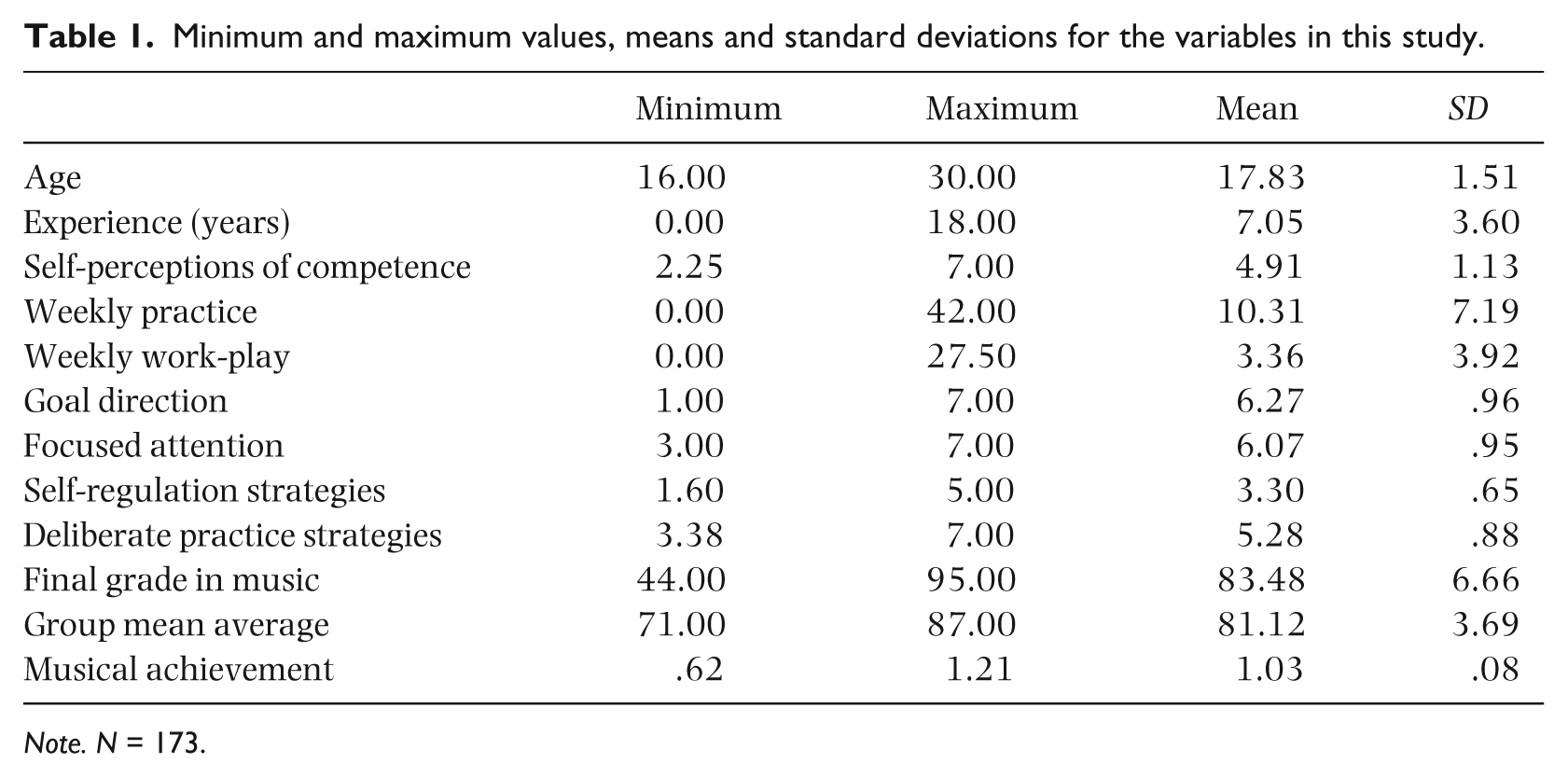
The 173 students were between the ages of 16 and 30 (M = 17.83, SD = 1.51) and 92 of them were males. They had been playing their instrument for an average of 7.05 years (SD = 3.60) and 122 of them studied classical music. Of these, 30 were pianists, 24 were singers, 21 were guitarists, 18 played wind instruments, 18 played string instruments, 10 played brass instruments and one played the harpsichord. The other 51 students played a jazz instrument (unspecified). To ensure that our sample of music students was representative of the general sample of students, we recruited the students at two colleges that offered general education along with specialised training in music. The college system in the province of Quebec offers a 2-year pre-university or 3-year technical diploma and is roughly equivalent to the senior grades of high school or community college in the rest of Canada and the USA or to Sixth Form College in England and Wales (UK). In order to obtain a college degree, in addition to courses in their chosen field of study, students must earn credits in literature, French or English as a second language, philosophy and physical education. They can also choose to focus on more than one domain (e.g. music and natural sciences).
This study covered one term of these students’ college program (Fall 2009). Participants completed the survey, and a consent form, between September (T-1) and November 2009 (T-2). Then, for those who agreed, their fall term final grades in music were collected from the colleges’ registrars at the beginning of the following term (T-3).
Measures
For each variable, the average score for the items assessed was taken as the measure. General information about age, gender, music practice and musical experience was taken at T-1. Descriptive statistics are shown in Table 1.
Minimum and maximum values, means and standard deviations for the variables in this study.
Note. N = 173.
Motivational profile
Self-perceptions of musical competence were used as the measure of the motivational profile and measured at T-1.
Self-perceptions of musical competence
The Perceived Competence in Life Domains Scale measures individuals’ perceptions of their own competence in specific domains (Losier, Vallerand, & Blais, 1993). In the present study, four items, assessed on a 7-point Likert-type scale ranging from 1 (very strongly disagree) to 7 (very strongly agree), measured students’ perceptions of their own musical skills (e.g. ‘Music is an area in which I excel.’). Cronbach’s alphas for the three initial validation studies ranged from .81 to .87. In the present study, the internal consistency reached α = .71.
Formal practice
The four criteria of formal practice: goal direction, focused attention, self-regulation and deliberate practice strategies were measured at T-2.
Goal direction
One item, assessed on a 7-point Likert-type scale ranging from 1 (never) to 7 (always), measured the extent to which students practised with the specific goal of improving (‘I practise with the specific aim to improve’).
Focused attention
One item, assessed on a 7-point Likert-type scale, ranging from 1 (never) to 7 (always), measured the extent to which students stayed focused during practices (‘When I practise, I try to stay focused’).
Self-regulation strategies
This questionnaire used a Likert-type scale ranging from 1 (never) to 5 (always). It included 9 statements taken from a pre-existing questionnaire (Bouffard et al., 1995) adapted to music practice. The scale consisted of strategies including management and planning (‘I plan my practice time’), motivation management (‘I practise in a place that allows me to stay focused’), and distraction avoidance (‘When I practise, I stay away from any form of distraction [phone, email…]’) (α = .78).
Deliberate practice strategies
This questionnaire was adapted and improved from existing questionnaires (Bonneville-Roussy et al., 2011; McPherson & McCormick, 2006; Miksza, 2006, 2007). It used a Likert-type scale ranging from 1 (never) to 7 (always) to assess the frequency of use of strategies related to developing expressivity (‘I vary the speed, sound and intensity to find the best way to make my playing more expressive’), technical and warm-up exercises (‘I practise technical exercises [scale, arpeggios, etc…]’), and specific rehearsal strategies (‘I practise my pieces in smaller sections’) (8 items, α = .73).
Practice time
Two measures of time spent with the instrument were used at T-1.
Weekly practice
Students were asked to indicate the number of hours per day and the number of days per week they spent practising alone. The amount of weekly practice time was computed by multiplying the number of hours by the number of days.
Weekly work-play
Students were also asked to report the number of hours per week they spent on musical work and play (e.g. recordings, gigs, recitals, etc.).
Musical achievement
The end-of term objective final grade in music was taken as the measure of musical achievement (T-3). In the Quebec college system, final grades can range from 0 to 100. We obtained this information for the 235 participants in this wave. Participants’ final grades ranged from 0 to 95 (M = 81.18, SD = 14.42). Their group means ranged from 71 to 89 (M = 81.11, SD = 2.40). This final grade was the one that appeared on the students’ official record and was a sum of two sources: the music tutor’s evaluation of the student’s improvement over the course of the term (no more 50% of the final grade) and a recital-like end-of-term examination assessed by two examiners. Descriptive statistics of the students’ mean scores and their group means prior to transformation and after transformation can be found in Table 1 (n = 173). Because the scores differed greatly depending on the instrument and the institution, it was necessary to normalize the final grades when determining the students’ musical achievement score by taking into account not only the student’s final grade, but also the overall group mean. To do this, we followed two steps. First, we divided the student’s final grade by their group mean. For instance, a student who had a final grade of 80 with a group mean of 80 would have a normalized musical achievement score of 1. Another student with a final grade of 80 but with a group mean of 70 would have a normalized musical achievement score of 1.15. This variable was highly positively skewed and a logarithmic transformation was performed.
Results
Preliminary analyses
The following analyses were performed using SPSS 16.0 software. No gender difference was found for the dependent and independent variables, F(6, 166) = .88, p = .51, η2 = .03. Years of musical experience did not affect the relationships between the variables, F(8, 164) = 1.47, p = .17, r = .26, R2 = .07, adj R2 = .02. A significant age effect was found, F(8, 164) = 2.02, p = .05, r = .30, R2 = .09, adj R2 = .05: the significant negative link found with deliberate practice strategies indicated that younger participants used these strategies less often than older participants, B = −.33, SE(B) =.16, β = −.20, p = .04. No other significant age difference was found.
Correlation analyses
Pearson correlation analyses were performed and the coefficients are shown in Table 2. Self-perceptions of musical competence were positively and moderately related to weekly practice time, focused attention during practice, and the use of both self-regulation and deliberate practice strategies, but unrelated to weekly work-play or musical achievement. Weekly practice time was related to all other variables except musical achievement, although the two practice time variables were only weakly interrelated. Weekly work-play was only significantly linked with the use of self-regulation strategies. The four components of the proposed ‘formal practice’ construct were all moderately to strongly positively interrelated. Lastly, musical achievement was positively related only to self-regulation strategies and deliberate practice strategies.
Pearson correlation coefficients for the main variables.

Note. N = 173; * p ≤ .05; ** p < .01; *** p < .001.
Testing the framework
Our model seeks to integrate parallel concepts of formal practice used to predict musical achievement. This integrative model proposes that formal music practice comprises various strategies that can be integrated into four components: goal direction, focused attention, self-regulation strategies and deliberate practice strategies. It also proposes that these components are linked with the motivational profile of music students and their cumulative amount of practice time when it comes to predicting better musical achievement. This final model was validated against two traditional ways of measuring the correlates of musical achievement, namely, regression and path analysis models, as presented below. The three following sets of analyses were conducted using MPlus 6.11 software (Muthén & Muthén, 1998–2011).
Regression model
This first model used standard multiple regression analysis to replicate the links, found in other studies using a similar statistical method, between self-regulation strategies, deliberate practice strategies, weekly practice and weekly work-play in predicting musical achievement (e.g. Hallam, 2013). Results are shown in Table 3. Self-regulation strategies and deliberate practice strategies were positive predictors of musical achievement whereas goal direction, focused attention, self-perceptions of musical competence and weekly informal practice were not. Rather surprisingly, weekly practice time was negatively related to musical achievement when entered simultaneously with the other variables. This model explained 13% of the variance in musical achievement.
Regression model of musical achievement.

Note. N = 173; * p ≤ .05; ** p < .01; *** p < .001.
Path analysis model
The second model used standard path analyses within the structural equation model framework, in which focused attention, goal direction, self-regulation strategies and deliberate practice strategies, the four variables hypothesized to be inherent components of formal practice, were assessed separately as predictors of musical achievement (e.g. Bonneville-Roussy et al., 2011; McCormick & McPherson, 2003; McPherson & McCormick, 2006). Due to temporal precedence of motivation over practice in our study design and consistent with McCormick & McPherson’s findings (2003), we predicted that self-perceptions of musical competence would be positively linked with weekly practice time, the four measures of formal practice (goal direction, focused attention, self-regulation strategies, and deliberate practice strategies) and achievement. We further hypothesized that weekly practice time would predict the four formal practice measures (McPherson & McCormick, 2006), which would in turn predict musical achievement (Bonneville-Roussy et al., 2011, McPherson & McCormick, 2006). Lastly, we hypothesized that weekly work-play would be negatively linked with musical achievement (McPherson & McCormick, 2006).
The model tested did not achieve a satisfactory fit but it was suggested post-hoc that focused attention, goal direction, self-regulation strategies and deliberate practice strategies, the hypothesized measures of ‘formal practice,’ should be allowed to correlate in order to improve the overall fit. When this was done, the fit of the model was comparable to that of McPherson and McCormick’s (2006), but only marginally satisfied the goodness-of-fit criteria for SEM (Kline, 2010), χ27 (n = 173) = 15.74, p = .03; RMSEA = .09 (.03–.14), p = .13; CFI = .96, TLI = .83, SRMR = .06. The results of this model explained 12% of the variance in musical achievement. In this model, self-perceptions of musical competence positively predicted weekly practice time (β = .27, p < .001, R2 = .07). Regarding the four criteria of formal practice, self-regulation strategies were linked to both weekly practice time and self-perceptions of musical competence (β = .39, p < .001 and β = .21, p = .002, respectively; self-regulation R2 = .24), while weekly practice time and self-perceptions of musical competence were also associated with deliberate practice strategies (β = .34, p < .001, and β = .15, p = .04, respectively, practice strategies R2 = .17) and focused attention (β = .21, p = .005, and β = .15, p = .04, respectively, focused attention R2 = .08). Goal direction was associated only with weekly practice (β = .25, p = .001, goal direction R2 = .07). Lastly, self-regulation and deliberate practice strategies positively predicted musical achievement (β = .23, p = .01, and β = .18, p = .05, respectively) whereas weekly practice time was a negative predictor of musical achievement (β = −.24, p = .004) and weekly work-play was only marginally significantly related to achievement (β = −.14, p = .06). Goal direction, focused attention and self-perceptions of musical competence were not significant predictors of musical achievement in this model.
Proposed model with a latent ‘formal practice’ variable
The results of the path analysis suggested that the four components of formal practice might be better explained by a single underlying latent ‘formal practice’ construct which would in turn be a better predictor of musical achievement. In order to test this hypothesis, a variant of the previous model was designed. This final model is presented in Figure 2. The main assumption was that the practice components would better fit the data if explained by a latent component. The latent component tested in this model included the criteria of formal practice, namely, goal direction, and focused attention, as well as both self-regulation and deliberate practice strategies. Consistent with the results of our previous model, we also posited that self-perceptions of musical competence would be positively linked with weekly practice time and formal practice. We further hypothesized that weekly practice time would predict the latent ‘formal practice’ variable, which would in turn predict musical achievement. Lastly, we hypothesized that weekly work-play would be negatively linked with musical achievement. Most importantly, we hypothesized that the relationships between the variables would be stronger with this latent ‘formal practice’ construct.

Structural equation model of musical achievement with latent formal practice variable
The overall fits were excellent, χ217 (n = 173) = 20.52, p = .25; RMSEA = .04 (.00–.08), p = .66; CFI = .98; TLI = .97; SRMR = .05. In summary, ‘formal practice’ was successfully explained by goal direction, focused attention, self-regulation strategies and deliberate practice strategies. A strong link was found between weekly practice time and the latent ‘formal practice’ variable (β = .49, p < .001), and a moderate link was found between self-perceptions of musical competence and formal practice (β = .24, p = .002). Formal practice also strongly predicted musical achievement (β = .48, p < .001). The indirect mediating effect of weekly practice time on musical achievement through formal practice was also significant (β = .24, p < .001). The indirect effect between self-perceptions of musical competence and musical achievement through formal practice was significant (β = .10, p = .008), and through weekly practice time and formal practice was also significant, although weak (β = .06, p = .01). Lastly, both practice time variables negatively predicted musical achievement when not mediated by formal practice (β = −. 31, p = .001 for weekly practice time; β = −.13, marginal p = .07 for weekly work-play). This model explained 18% of the variance in musical achievement and 36% of the variance in formal practice.
Discussion
This article aimed to integrate the findings from previous research on the links between practice and musical achievement by incorporating the various constructs found in the literature into a single framework. This framework proposes that formal practice includes components from both the deliberate practice and self-regulation theories. In this framework, formal practice is considered to be a goal-directed, focused period of practice that includes both self-regulation and deliberate practice strategies. Formal practice is enhanced by a high motivational profile and greater amounts of practice time. The proposed model is a new view of music practice in which the components are grouped together in a latent construct. The proposed framework is parsimonious as it aims to explain the maximum variance in musical achievement with the minimum number of constructs: motivational profile, practice time, and formal practice. In this study, motivational profile was conceptualized as the students’ perceptions of their own musical competence, practice time was the number of hours per week spent practising alone as opposed to the time spent on work-play (in a concert, for example), and ‘formal practice’ included four criteria: goal direction, focused attention, self-regulation strategies and deliberate practice strategies. When this model was tested against traditional measurement methods such as a multiple regression model and a path analysis, this integrative framework proved to better explain musical achievement than each of the constructs taken separately.
Motivational profile
Our proposed framework, consistent with the literature, suggests that motivational factors are determinants of practice and performance (e.g. Bouffard, Bouchard, Denoncourt, Goulet, & Couture, 2005; Caprara et al., 2008; Usher & Pajares, 2008; Wood & Bandura, 1989; Zimmerman, 1995). The positive indirect relationship between self-perceptions of musical competence and musical achievement predicted in our hypothesis was confirmed. Moreover, although we did not find a direct link between self-perceptions of musical competence and achievement, this does not mean that there was no relationship between these two variables. Several studies have shown that self-perceptions of competence develop primarily from four sources: experiences of successes and failures, social comparisons, the nature and quality of the feedback received, and physiological and emotional reactions to the task (Bandura, 1986, 1993, 1997). Self-perceptions of musical competence were measured at the beginning of the term and these perceptions most likely evolved over the 3 months between their assessment and the assessment of musical achievement. Our framework also posits that self-perceptions of musical competence are linked to both practice time and formal practice. This was indeed the case; music students who perceived themselves as better in music reported practising more often and more ‘formally.’ In the literature, the temporal precedence of motivation over practice has been somewhat challenged (as seen in the two articles on this very subject: McCormick & McPherson, 2003; McPherson & McCormick, 2006). We believe that this process is cyclical, with motivation (which derives from perceived competence) predicting practice, which in turn predicts performance, and successful performance leads to greater perceived competence and motivation, and so on (see also McPherson & Zimmerman, 2002). However, given the large amount of effort required to practise efficiently, we would argue that motivation is a greater predictor of practice than vice versa.
Formal and informal practice
As highlighted by our framework, formal practice involves goal direction (improving musical skills), focused attention (concentration), and the use of various self-regulation and deliberate practice strategies. Our proposed model achieved a good fit only when goal direction, focused attention, self-regulation strategies and deliberate practice strategies were grouped together to form a latent ‘formal practice’ variable. Moreover, when taken together, these four constructs explained a greater amount of variance in musical achievement (18%) than when taken separately (13%). To begin with, our integrative model demonstrates quite clearly that goal direction and focused attention are included among the core components of formal practice. While this concept has often been explored during the last 20 years in research on self-regulation and deliberate practice in music (e.g. Ericsson & Charness, 1994; Ericsson et al., 1993; Nielsen, 1999), the present study firmly establishes that these components are necessary conditions to be included in a definition of formal practice.
In addition, as seen above, self-regulation strategies were defined as the general learning processes used by students. Self-regulation can be seen to be qualitatively different from deliberate practice, in which learners use these self-regulation skills and other task-specific skills to build on their cumulative experience. As shown by McPherson & McCormick (2006), in order for practice time to be focused and efficient, musicians need to have prior knowledge of the areas in which they need improvement – in general and in their specific repertoire – and need not only to have acquired the skills to overcome these difficulties but also to know when and how to use these skills. In our study, both self-regulation and deliberate practice strategies were only slightly to moderately related to musical achievement when measured separately in the regression model. Results of the path analysis showed little if no improvement over the regression model in the predictive power of these two constructs for musical achievement. However, when included in a latent ‘formal practice’ construct, self-regulation and deliberate practice strategies seemed to have an additive predictive power. In our study, self-regulation and deliberate practice strategies, when combined with the two core criteria of formal practice mentioned above, predicted musical achievement quite well. This supports our hypothesis that self-regulation and deliberate practice strategies should simultaneously be taken into account when assessing the roles of practice in musical achievement.
In past research, quantitative researchers have defined formal and informal practice using criteria such as the practice of studies (formal practice) versus improvisation (informal practice, e.g. McPherson & McCormick, 2006). However, in line with our model, we would argue that musicians can practice a study informally, and practice improvisation formally. According to our model, informal practice would lack one or more of the proposed criteria of formal practice: goal direction, focused attention, self-regulation strategies and deliberate practice strategies. Although we did not assess a latent ‘informal practice’ variable, we would expect it to encompass poor self-regulatory strategies, such as lack of time management, and poor practice strategies, such as always practising pieces in a row. Therefore, as evidenced in jazz music, improvisation becomes formal practice when it is goal-directed, focused, self-regulated and uses specific practice strategies targeted for it.
Pertaining to the development of formal and informal practice, in their milestone study on musical practice in childhood and adolescence, Sloboda and colleagues highlighted that a differentiation in music practice habits occurs very early on in the course of one’s musical tuition. They also pointed out that during childhood and adolescence, the quantity of practice in itself is predictive of musical achievement. As such, they stated that: [The data] suggest that individual differences in practice efficiency are not, in themselves, determinants of differences in achievement. Individuals with sub-optimal practice strategies may be able to compensate for their qualitative deficiencies by engaging in very large quantities of practice in order to sustain high levels of achievement. (Sloboda et al., 1996, p. 307)
The present study highlights that a somewhat different process occurs when musicians attain a higher level of expertise. Our results strongly suggest that for music students at a higher level (and most likely through to the professional level), a fewer number of hours of formal practice is more predictive of achievement than the number of hours of practice per se. This result can be interpreted in light of the task complexity and acquisition of expertise literature. Up to a certain level of expertise, a beginner piano player will be able to improve simply by playing informally, providing that this individual puts enough time into the task. Without formal practice, however, this pianist will eventually reach a plateau because the cognitive loading imposed on him or her by more complex tasks will not be decreased simply by playing the piece over and over again. Research in the neurosciences has shown that, for expert pianists with many years of formal practice, the execution of complex motor tasks on the piano does not significantly increase their cognitive loading whereas the cognitive resources of amateur pianists or non-musicians are significantly called upon when they perform the same complex tasks (Imfeld, Oechslin, Meyer, Loenneker, & Jancke, 2009; Rosenkranz, Williamon, & Rothwell, 2007). The stage at which informal practice turns out to be not enough and formal practice becomes essential to further performance improvement or achievement has not yet been defined. We would suggest that this stage might coincide with the transition between a general music tuition phase aimed at discovery, which can be achieved by many individuals, and a specialization phase (e.g. enrolling in a conservatory) wherein complex tasks become predominant. Future research is needed to assess this hypothesis.
Practice time
The difference between formal and informal practice, within our framework, refers to the qualitative aspect of practice. The quantitative aspect is simply the number of hours spent practising alone, without any further connotation. Some students conceive practice as simply playing alone and thus report practising a great number of hours. However, because their practices are not goal-directed or focused, and do not include relevant strategies, their performance is likely not to improve. The limited importance of mere practice time was demonstrated in five different ways in the present study. First, in the correlation analyses, neither weekly practice time nor weekly informal practice was associated with musical achievement. This suggests, in line with the findings of other researchers, that these variables are not important for the musical achievement of students. Also, the link between weekly practice time and weekly informal practice, although significant, was weak and suggested that these constructs were dissociated. Second, in the multiple regression analysis, weekly practice time became moderately negatively associated with musical achievement. This puzzling result was confirmed in the path analysis performed. Third, the path analysis allowed us to better understand the relationship between practice time, self-perceptions of musical competence, and the four criteria of formal practice, although the overall model fit was not satisfactory.
Fourth, it was only when these variables were entered into the structural model that the links between practice time and the other variables became clear. Weekly practice time was indirectly positively related to performance through formal practice. When the variance associated with formal practice was controlled for, the direct link between practice time and performance became quite strongly negative. This suggests that ‘empty’ practice time – the kind of practice that students might call ‘formal practice’ but that does not involve goal direction, focused attention, self-regulation strategies and/or deliberate practice strategies – is actually detrimental to musical achievement. Fifth, and lastly, weekly informal practice, defined here as any other music playing activities not included in practice, such as recitals or gigs, was also negatively associated with musical achievement, although only marginally and weakly. These results are in line with or replicate those found by Ericsson et al. (1993), McCormick and McPherson (2003), and McPherson and McCormick (2006) regarding the effects of informal and formal practice on musical achievement.
Several conclusions can be drawn from these results. Music practice is rather subjective and students may interpret its meaning differently. When asked to report the number of hours per week they practise, some students might include only the elements pertaining to formal practice: a goal-directed and focused period of practice that includes both self-regulation and deliberate practice strategies. Others might include anything that is not work or play but that does not necessarily constitute formal practice. For instance, musicians who usually play their studies without correcting their mistakes or without specific goals in mind might report that they practise formally although, according to the definition of ‘formal practice,’ this might not actually be the case. This is highlighted in our framework and in our results, where weekly practice time was positively linked with musical achievement only when mediated by the formal practice components. On the contrary, practice time that was not accompanied by the criteria of formal practice negatively predicted performance.
Sloboda et al. (1996) and others (e.g. Ericsson et al., 1993) found a direct relationship between practice time and expertise in their biographical reports. However, most studies that have measured practice time using traditional methods have failed to find a significant direct or mediated link with performance (Hallam, 2013). In light of the present framework, these results can be reinterpreted. In their biographical reports, Sloboda et al. used a specific definition of what accounted for the number of hours of deliberate practice: Average daily formal practice time in minutes was estimated for each instrument learned and for each year of learning. This was done by direct questioning and the recording of responses on a specially designed grid. Participants were also asked to estimate time spent on three other activities: improvisation, playing through previously learned pieces and unstructured informal activities (‘messing about’). (1996, p. 292)
This line of research was conducted through interviews and diary studies that allowed the researchers to perform targeted coding of the answers (also refer to the ground work of Ericsson et al., 1993). The formal practice variable included in these studies broadly corroborates the four components of ‘formal practice’ put forward in the present study. In subsequent research (e.g. McPherson & McCormick, 2006), questions about practice were more roughly targeted; students did not have the opportunity to ask for clarification. Their answers thus more or less reflected what they thought ‘formal practice’ should be. In light of the present framework and past research, it is easy to see how practice time measured without taking into account its relationships with formal and informal practice might have lacked predictive power for musical achievement.
Limitations and future research
This framework is the first to integrate various constructs related to music practice into one component, and to test its validity in an empirical study. As such, this framework is not faultless. The following section describes several limitations and ways to overcome them. First, the independent measures were self-reported and the design was correlational in nature. Although both a short-term study design and an objective measure of musical achievement were used, causal effects should be interpreted with caution. Future research would benefit from investigating the links found in this study in quasi-experimental or experimental study designs.
Our measures of self-regulation and deliberate practice assessed a relatively small number of strategies, compared with the vast number reported in the literature (e.g. Miksza, 2006, 2007, 2011, 2012; Nielsen, 1999, 2008, 2012). For instance, this study did not capture instrument-specific practice strategies or some self-regulation strategies. Due to the sample size, we used parcelling of strategies instead of ‘observed’ strategies to assess the latent formal practice variable. Future work is needed to more deeply examine the roles and importance of self-regulation and deliberate practice strategies in terms of performance. A second-order factor (specific observed strategies explaining self-regulation and deliberate practice, which in turn explain a second-order ‘formal practice’ variable) could also help understand the links between the variables. In addition, this model measured the mediating effects of practice on performance. Examining the interactive effects of practice time, self-regulation strategies and deliberate practice strategies would help build on our understanding of the interrelations between these variables. The sample studied was a relatively homogenous group of college students. Future research should take into account various levels of expertise, from novices to experts. For beginners, time spent practising might be more important for predicting performance, regardless of the type of strategies used, whereas the improvement of specific motor skills could predict performance better at the expert level. This highlights the need for more extensive longitudinal studies.
In closing, this study raises a number of implications that need to be considered. Our framework has highlighted the need to better define what practice is and how it can be effectively measured. At the conceptual level, previous research has mainly focused on either self-regulation or deliberate practice in explaining musical achievement. The present study has shown that examining music practice within both of these paradigms simultaneously greatly improves their predictive power. As more is understood about self-regulation and deliberate practice strategies taken separately, future investigations should examine their interacting and mediating roles more thoroughly. At the practical level, two implications are worth mentioning. First, music educators can focus on the mastery of both self-regulation and deliberate practice skills when teaching music. Second, music students, who tend to focus on their cumulative amount of practice time and often overlook the quality of their practice, would benefit from frequently being reminded that informal or ‘empty’ practice time has no proven effect on musical achievement. That is, practising less may lead to better outcomes if practice is always focused, goal-directed and accompanied by effective self-regulation and deliberate practice strategies. Indeed this study has shown that a large amount of unfocused practice time can be detrimental to musical achievement. It is hoped that this framework will serve as a valuable tool for future music performance research.
Footnotes
Funding
This research was facilitated by a master’s fellowship from the Fonds de Recherche sur la Société et la Culture (FQRSC) for the first author, and funded by grants from Social Sciences and Humanities Research Council of Canada (SSHRC) to the second author.