



Abstract
Professional musicians employ self-regulation and deliberate practice strategies when learning music. Although self-regulation is difficult for beginners, presumably students practice deliberately as music becomes more difficult and they develop musical skills. It is not clear to what extent intermediate piano students self-regulate during learning. This study explored practice strategies used during at-home practice of nine intermediate-level teenaged piano students. Over a two-month period, piano students recorded three videos of themselves practicing. Data were triangulated from coded video, teacher interviews, and student questionnaires regarding practice habits, strategy use, and perceived challenges. Students regularly practiced under less-than-ideal circumstances and had limited attention spans, but skill level was not an indicator of self-regulation. Nine practice strategies were observed and reportedly employed. While six of the students mostly played through repertoire, three participants were motivated to deliberately use practice strategies and they attempted to self-regulate when practicing without a teacher present.
Keywords
Professional musicians
There is broad agreement within the music profession that practicing effectively is essential for successful learning and performance (Chaffin, Imreh, & Crawford, 2012; Chaffin & Lemieux, 2004; Hallam, 1997; Miklaszewski, 1989; Nielsen, 2001). Expert musicians engage in deliberate practice (Chaffin & Lemieux, 2004; Ericsson & Lehmann, 1996; Krampe & Ericsson, 1996) where they expend considerable mental and physical energy to improve current limitations (Lehmann, Sloboda, & Woody, 2007). Lehmann et al. (2007) suggest that “deliberate practice is evident when there are explicit goals [set by oneself or a teacher] and the possibility of feedback” (p. 66), which requires self-regulation. Through observation and study of professional and advanced musicians, researchers have documented that professionals employ self-regulation strategies to reach specified goals (Chaffin & Imreh, 2001; Chaffin et al., 2012; Hallam, 1997; Miklaszewski, 1989; Nielsen, 2001). Zimmermann (2000) suggests that self-regulation involves three phases: forethought (goal setting and motivation), volitional control (self-instruction and observation), and self-reflection (self-evaluation and attribution). This complex process includes various components that relate to metacognition including planning, evaluation, and executive function, such as knowing about and choosing the practice strategy appropriate for the task and being flexible by changing that strategy if it is not effective (Jørgensen, 2004).
While there is considerable similarity between the metacognitive strategies used by experts during formal practice, researchers note that young professionals vary in their effectiveness or use of deliberate practice techniques (Hallam, 1997; Nielsen, 1997, 2001). Studies of music students in higher education indicate that while they can discuss ways to practice (Santos & Gerling, 2011), there is variability in the effectiveness of practice and students are not necessarily being instructed in how to develop successful and practical strategies at the undergraduate level (Hallam, 1997; Pike, 2014, 2016). However, those students who learn how to practice deliberately meet with more success during performance throughout their degree programs (Nielsen, 1997; Pike, 2014) and effective practice among professionals improves with age (Araujo, 2016). Could students learn to practice more effectively or autonomously prior to university?
Pre-college student musicians
In one study of 300 elementary-age beginning music students, 67% identified practice as an important part of being a good musician (Shouldice, 2014). Yet, beginners may lack the “appropriate schemata against which to evaluate progress” (Hallam et al., 2012, p. 654). If students cannot evaluate their playing, self-regulation becomes impossible as they may not know what needs to improve, even if they have some practice strategies in their toolkit. At the early stages of development, students rely on the teacher to point out errors and instruct them on correct practice technique, which lays the foundation for self-regulation (Barry & Hallam, 2002; McPherson & Zimmerman, 2011; Pitts, Davidson, & McPherson, 2000). Beginning (Pitts et al., 2000) and intermediate (Hallam, 1997; Hallam et al., 2012) instrumental students tend to merely play through pieces, without stopping to correct errors. Teenaged instrumental students practice with very few specific practice strategies, taking a surface approach by merely playing through and frequently not correcting errors or working on musical elements such as technique or dynamics (Cantwell & Millard, 1994; Hallam, 1997; Hallam et al., 2012; Lisboa, 2008; McPherson & Renwick, 2001). The most frequently used practice strategies reported by intermediate-level sixth-grade instrumental students included repetition, slow practice, additive practice (learning a chunk, then adding the next new chunk), and simplification of the music (Austin & Berg, 2006). These students rarely reported using metronomes or recording devises to monitor practice, but students who ranked high in self-regulated practice and motivation (both self-reported) used at least two different practice strategies. This does not suggest that there was a deep bank of practice resources from which the students drew. The authors also failed to find a direct relationship between private lessons and practice strategies. Apparently, most of the students who made use of practice strategies in the study learned the techniques at orchestra or band rehearsals, rather than from a private teacher.
Presumably, as students gain more experience with their instrument and develop technical and musical expertise, self-regulation will begin. There is evidence that practice efficacy (including self-regulation, error detection, evaluation, and use of practice strategies) improves as a student’s level of playing skill and expertise increases (Gruson, 1988; Hallam et al., 2012), though it is not clear when or how this occurs. By the time students reach high school and become more advanced, those who exhibit higher performance achievement tend to avail themselves of a limited number of practice techniques and engage in some self-regulation. Miksza (2007) found that high school wind players who repeated sections, marked the score, slowed down, and used a metronome exhibited better performances than those who did not employ such practice strategies. The most common practice strategies employed by another group of teenaged brass and woodwind players included restarting a measure, repetition of a measure and repeating a beat, followed less frequently by working on dynamics, articulations, fingering, counting or clapping (Leon-Guerrero, 2008). It might be argued that replaying a beat or restarting a measure are not practice strategies but stutters that occur while playing through a piece and it is not clear whether the self-regulation strategies were learned through trial and error, large-ensemble rehearsals, or private instructors.
Educators have been arguing that teachers must train students to become more autonomous, to self-regulate and teach themselves to learn music outside of the lesson or ensemble rehearsal (Jørgensen, 2000, 2004; Leon-Guerrero, 2008; Hallam, 2001; McPhail, 2010, 2013; Varela, Abrami, & Upitis, 2016). While teachers report teaching students how to practice (Barry & McArthur, 1994), evidence from studies of pre-college band and string students indicates that many are using few if any strategies during their practice outside of lessons. To date, there has been little published research on deliberate practice, self-regulated learning, or autonomy outside of the studio among intermediate-level teenaged pianists.
Method
Purpose and participants
The purpose of this case study was to observe intermediate-level teenaged piano students practicing in their homes, so that we might see how they problem solve and self-regulate when the teacher is not present. Following institutional review board approval to study and video children, nationally certified piano teachers in a mid-sized US city were asked to identify students from their studios who, although successful in performance at festivals, recitals, and local contests, were average or typical in terms of motivation, weekly practice, and lesson preparation. In other words, although these students were successful by typical performance markers, they were not exceptional either in their innate musical ability or in their motivation to practice between lessons. Nine students (from three different studios) between the ages of 10 and 16 years, along with their parents and teachers, participated in the study which lasted two months.
Data collection
Data were collected from the following sources:
Video of practice sessions (three sessions per student, each 20 minutes in length)
Interviews with teachers (three per student)
Informal discussions with parents
Written student questionnaire responses
Modeled after Pitts, Davidson, and McPherson’s (2000) methodology, parents video-recorded their child practicing at home on three separate occasions within a two-month time period. Parents were asked to wait a minimum of two weeks between recordings so that students would be solving different musical problems as they worked on and perfected their repertoire.
All recordings were made using the onboard cameras and microphones on iPads or personal computers. The video and sound quality were adequate for observation of practice strategies and musical nuance during the students’ rehearsals. Recordings were submitted to the researcher via Dropbox or USB storage drives. Since the presence of an observer can alter participants’ actions during field work (Bogdan & Biklen, 1998), practice sessions were not observed in person in order to keep the rehearsal as authentic and normal as possible. Parents confirmed that the recorded sessions were typical in length and substance. Following each videoed practice session, teachers participated in interviews about their perception of each student’s practice and activities that took place during lessons. Once the final recording had been submitted, students completed a written questionnaire regarding at-home practice.
Data analysis
The researcher and a graduate student trained in coding video data reviewed the 27 practice videos. Using NVivo software and constant-comparison analysis, we identified and coded practice strategies, self-regulatory behaviors, and other unanticipated themes (Creswell, 1998). The teacher interviews and parent discussions were transcribed and subsequently coded. Data were triangulated through practice videos, student questionnaires, teacher interviews, and parent comments. Initially, a case study of each student was created using all data sources (Creswell, 1998). Sample profiles of two representative participants appear below, to give readers a sense of what happened during at-home practice. Then, the nine cases were compared to discover whether there were themes common among the collective cases of students (Stake, 2005). The common themes are discussed in the results section.
Limitations
Although observing the at-home practice of the teenagers over a two-month period provided a unique view of what these students were doing during their practice time, the results of the case study cannot be generalized to all teenaged piano students. Initially, we were concerned that the presence of the video camera might change the way the students would practice. Based on the consistency between practice sessions, the overall lack of useful strategies employed, parental feedback, and the honest concerns expressed in the questionnaires, we believe that the videos revealed typical practice sessions for the students.
Sample student practicing profiles
“Jeanine” (somewhat-effective rehearser)
Jeanine is 14, exhibits self-regulation, confidence and a working knowledge of several useful practice strategies. She has only been taking piano lessons for four years, but since the first lesson she has been responsible for taking her own practice notes during lessons and developing reasonable practice goals for the week. As she sits down to practice after dinner, she reviews her lesson notes and decides that during her brief 20-minute practice session she only has time to work on learning part of one composition and her daily sight-reading assignment. She begins with sight reading and completes all of the suggested tasks listed in her sight-reading book. Satisfied, she moves on to “Impertinence” (HWV 494) by Handel. She begins playing through the composition but stumbles in the second measure of the B section. She stops, thinks for a moment, and correctly identifies insecurity with the left-hand notes. She isolates measures 9–12 and, realizing that the fingering is not consistent, spends a few minutes choosing the best option and writing that fingering onto her score. Then she switches to the right hand and slowly practices a short two-bar sequence. It only takes a few repetitions of this small passage for her to gain confidence, at which point she plays both hands together. Having successfully completed those measures, she stumbles next at measure 15 where a different pattern emerges in both hands. Once again, she isolates and breaks down the difficult spot but now counts aloud to help coordinate the hands. She even pulls out her metronome to ensure that she is maintaining a steady pulse. Once she achieves success (but without repeating too many times), she speeds up this spot, then using the metronome backs up to measure 9 and plays the area she has worked on. She takes another moment after playing this section and realizes that she has ignored the dynamics. After highlighting the dynamic markings in yellow on her score, she attempts the passage a little more slowly, but executes the correct dynamics. She glances at the time and realizes that she must stop practicing, but her smile suggests that she is pleased with her accomplishments during her rehearsal. She has not practiced everything that was on her weekly practice assignment, but she has accomplished the small goals that she set for that practice session. During this research project, there was little overlap in the repertoire that Jeanine practiced on each video. In fact, she learned and completed more repertoire during the course of the eight-week study than did most of the other students.
“Sam” (surface rehearser)
Sam is also 14 but has been playing piano for five years. During lessons, his teacher demonstrates useful practice strategies, sets practice goals, and writes notes in his assignment book. At the beginning of his practice session, Sam sets the timer on his watch and starts playing. He does not have his assignment book open on the piano, does not consult practice notes at any point during his 20-minute practice session, and moves quickly from one activity to the next without appearing to take any time for reflection on practice goals. Sam plays four pieces during his practice session. He begins with scales and arpeggios, which he plays through quickly and somewhat automatically. The scales do not relate to his subsequent repertoire, though they will be required at his examination later in the spring. His first piece is a Bach minuet, which he plays straight through. There are several stumbles, incorrect notes, and incorrect fingerings during his performance. His teacher has bracketed the B section and told him that he must isolate this. Remembering this, he begins at the B section and plays to the end of his piece one more time, making the same mistakes upon repetition. There is no attention to dynamic contrast or balance between the hands. Sam then moves on to his contemporary piece, with which he is much more familiar. He plays this from memory. Upon completion, he moves on to a Czerny etude which he plays through twice, and then proceeds to play his part of a duet that he is learning for the recital. After playing through all four pieces that his teacher asked him to practice, he looks at his watch, realizes that he still has time left in his practice session and proceeds to begin again with the Bach minuet. He goes through his repertoire in the same order and completes the process exactly as he had the first time; not surprisingly, the musical results remain much the same. Finally, when he finishes the last piece, he leaps up from the piano even before he has released his hands from the final cadence of the duet. Despite video evidence to the contrary, Sam reported that he uses five practice techniques regularly and that he always stops to fix mistakes. Although improvements in Sam’s repertoire were noted during the course of this study, he only worked on five compositions during the two-month time period.
Results
The students profiled above represent the two general categories of students that emerged: (a) somewhat-effective rehearsers and, (b) surface rehearsers. The first group exhibited forethought, and attempted to engage in volitional control and self-reflection. The second group did not display any of Zimmermann’s (2000) three phases of self-regulation. Five basic components of self-regulation were observed: goal setting, listening, trying practice strategies, evaluating, and problem solving. Figure 1 shows the cyclic nature of these strategies, how each component moves the student closer to effective self-regulation, and where participants were observed in the cycle during their practice.
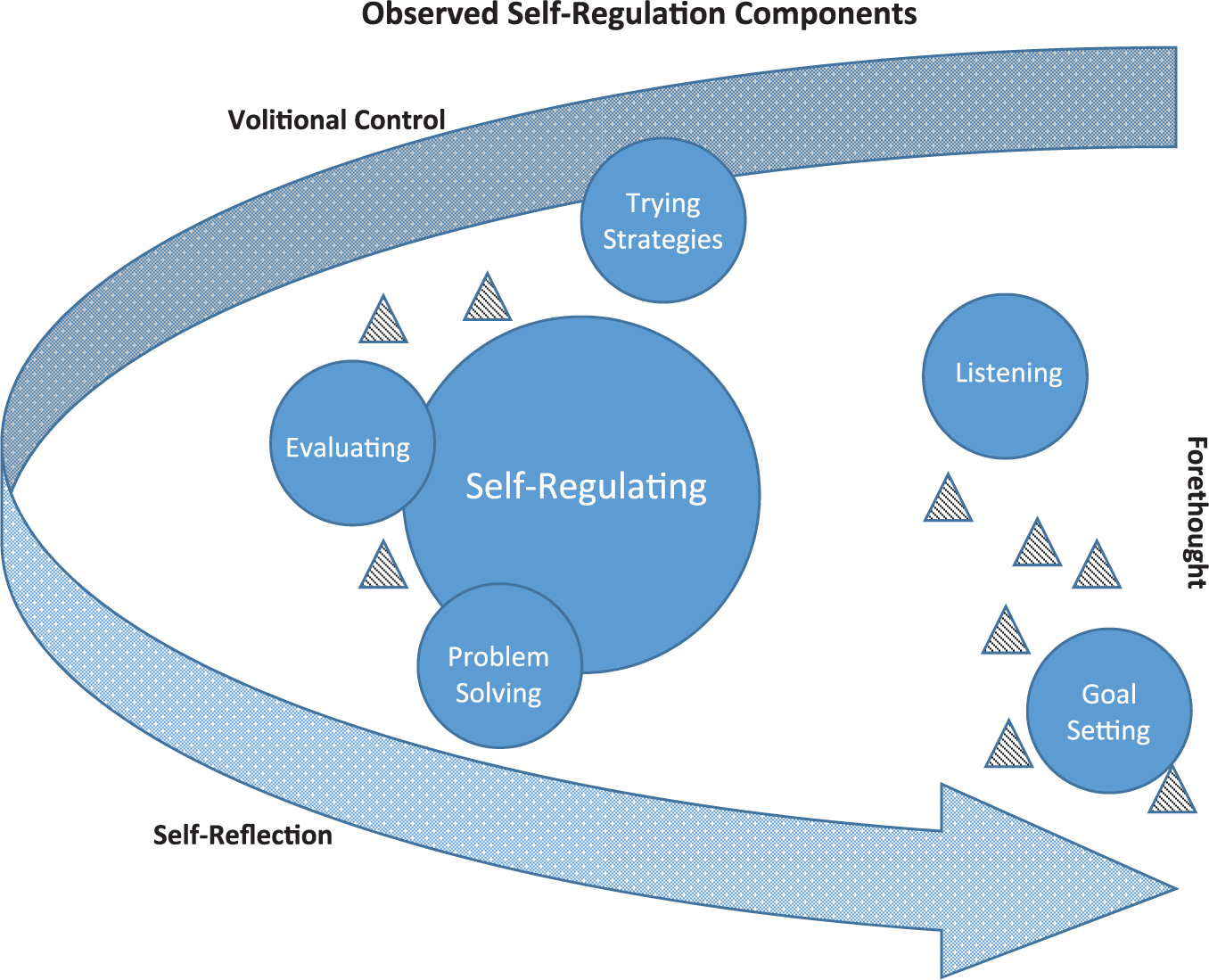
Observed self-regulation components.
Jeanine and two other students engaged in some self-reflection and deliberate practice. Although Jeanine was more productive and problem-solved better than the other somewhat-effective rehearsers, everyone in this group set goals, used practice strategies, tried to evaluate their playing, and attempted to solve problems on their own throughout the week. In other words, they engaged in all five self-regulation components. Sam’s practicing was representative of the six students who did not plan explicit or attainable goals for daily practice sessions, used few practice strategies (despite knowing several), and generally played through on a surface level without listening to the sounds that they were creating at the instrument. Teachers confirmed that effective rehearsal and use of strategies was occurring at lessons under each teacher’s guidance. However, not all students transferred these skills to home practice. All teachers had students in each category, suggesting that techniques which encouraged one student to practice effectively did not necessarily motivate another to do so. The somewhat-effective rehearsers were not necessarily more technically advanced than the surface rehearsers.
In general, all of the students were tired when practicing (which has implications for learning and sustaining mental focus). Parents were supportive and encouraged their children to practice, but did not interfere during practice sessions. Most students reported using more strategies than were observed. Students did not display flexibility in adapting strategies that were not working. Issues with technique, fingering, tone, musical nuance, and listening or evaluation were apparent with most students. Several students misidentified problems in their playing which led to use of ineffective or inappropriate practice strategies. The level of student autonomy was higher among students who attempted to engage in deliberate practice. For most students, progress was made at the lesson and they simply maintained and consolidated learning during daily practice sessions. A more detailed discussion of findings follows.
Attention span and energy level during rehearsal
The teenagers had a focused attention span of 8–10 minutes, where they concentrated on playing without appearing distracted. Five of the students practiced while other family members moved about the room and carried on discussions in the background. In four of the videos, siblings even walked to the piano and interrupted the students briefly. Although these distractions lasted less than 15 seconds, the students lost their train of thought and took several minutes to regain focus. Since the students were only practicing for 20 minutes, even short distractions wasted valuable learning time.
Several students practiced in their pajamas and reported that this was their last activity before bed. Unfortunately, many of them appeared to be tired, they yawned frequently, and their posture indicated that they were fatigued. Physical and mental exhaustion may have contributed to the rote-like playing through repertoire (rather than actively listening and responding to the sounds that they were creating at the piano) that was observed throughout the course of the study.
Goal setting, self-assessment, and achievement
While all teachers said that they discussed and set goals with their students, the pupils reported that they did not always know what to do when they sat down to practice or when they encountered difficulties during rehearsal. Three students reported not always knowing when they played a passage correctly; surprisingly, two of these were among the somewhat-effective rehearser group. Since the students saw their teachers only once weekly, the lack of specific small daily objectives, combined with limited problem-solving skills and inability to accurately assess their playing, led to unproductive practice sessions among half of the students. Only three of the nine students consistently exhibited self-regulation during practice though this was rudimentary at times.
Volitional control and self-assessment also surfaced as issues. Five of the nine students said that they did not or sometimes could not identify problems in their repertoire. Thus, even though they each reported having practice techniques at their disposal, there was no guarantee that using a strategy would improve the problem. Three of the students, who believed that they could identify problems, noted that they were not always certain that the chosen strategy worked. This suggests that they: (a) did not know how the passage should sound; (b) could not identify the actual problem; or (c) could not assess whether the strategy solved the problem. Indeed, sometimes the students did not have or use a strategy that was appropriate for the problem. At other times, they misdiagnosed the problem, thus chose the wrong strategy. Additionally, not recognizing when a problem had been fixed led to some unnecessary repetition for all students.
Practice techniques: Actual verses reported strategies
Each student reported using between two and nine practice techniques (six was the reported mean). Nine techniques were observed or reported as having been used on the 27 practice videos, though not by all students. These practice strategies, along with the number of students who used, them are identified in Figure 2.
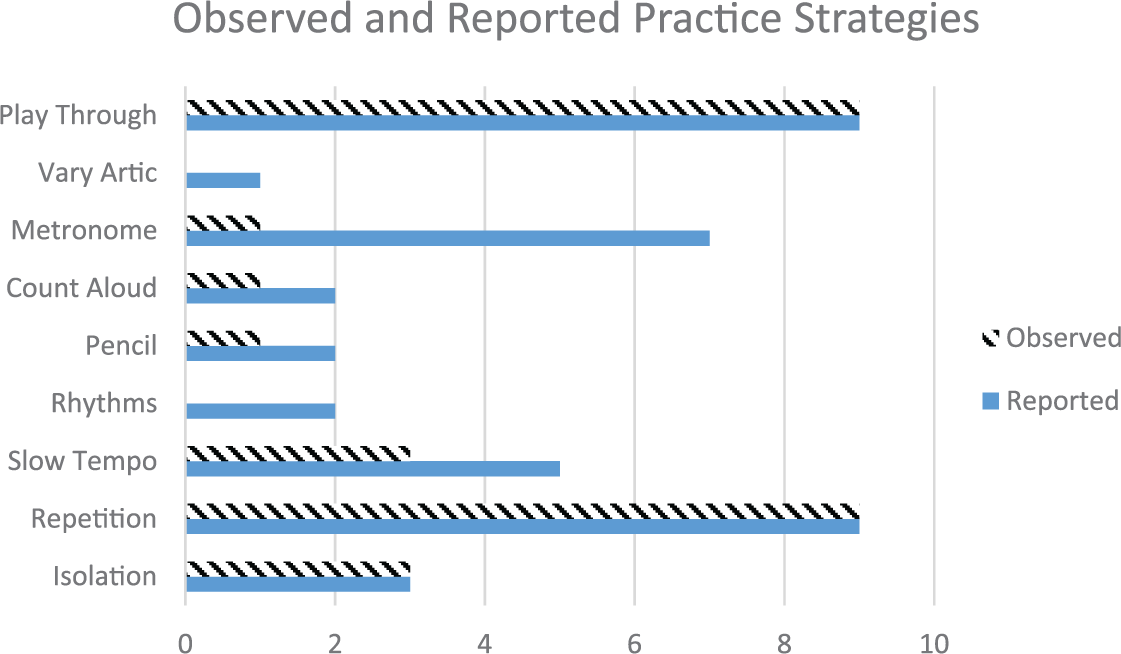
Observed and reported practice behaviors.
The most commonly observed strategy was playing through the repertoire. While not an effective technique for most of the students, three of them used it purposefully as an assessment tool to diagnose problems, either at the beginning or end of practice. The other six students, however, primarily played through the music over and over. The effect was to ingrain mistakes.
Repetition was the next most commonly employed technique, followed by slow practice and isolation of sections. Of the three students who did isolate problem spots, two chose areas that were too large to process effectively or to assimilate new motor skills during the practice session. So, while it was promising that they were isolating problem sections, they did not experience as much success as they might have, had they isolated smaller passages. The issue was compounded by the lack of flexibility in choosing or changing strategies to fix problems in those passages. Several of the practice strategies reportedly used (using rhythms, varying articulation, marking the score, counting aloud, and practicing slowly) were not observed during the practice sessions of those who reported usage.
Common problems: Listening and self-regulation during the learning process
Not having a sound ideal, or knowing how the music should sound, was a common problem. Few reported listening to recordings, even though the teachers gave listening assignments. Only one of the students reported recording herself (Jeanine), which may have contributed to students not hearing poor voicing, balance, or lack of dynamic contrast. The majority of the students relied on their teachers to tell them what to do. Six of the nine teenagers were not engaging in the kind of problem solving that could develop their practice autonomy at home.
Rhythmic or fingering issues were rarely addressed by seven of the teenagers, even though these issues were the source of the stumbling. Two of the students recognized that fingering was a problem, but only one felt confident enough to explore fingering alternatives and pencil in her solution during the practice session. The majority of the teenagers did not recognize or report that fingering or rhythm were problems encountered during rehearsal. While improvements were made by all students with respect to rhythm and fingering during the course of the two-month observation period, the teachers tended to point out and fix these problems at the lesson. Sometimes the incorrect rhythms or fingerings had become ingrained through incorrect, repetitive practice throughout the week, which made the lesson frustrating for both teacher and student.
During the practice sessions, there was little attention to technique, tone, dynamics, or musicality. The surface rehearsers did not appear to be actively listening to themselves during rehearsals. Rather, they automatically played through their repertoire, rarely making adjustments between one iteration and the next. The teachers confirmed that any changes in technical or musical details occurred under direct teacher supervision at the lesson for those students. The three somewhat-effective rehearsers attempted to work on dynamics, voicing, and musical phrasing, but did not always recognize when they were successful. This issue was not just due to lacking a sound ideal. Rather, the large cognitive load when learning new repertoire and assimilating motor skills likely prevented them from hearing detailed nuance as they played. It may have been helpful to have recorded themselves and listened to the recording during rehearsal. This activity would have permitted the students to assess their playing without the distraction of processing information. The teachers acknowledged that they rarely recorded or guided students through self-assessment activities during the lesson due to lack of time.
Autonomy, progress, success, and intrinsic motivation
As already suggested, most of the teenagers were making progress during their weekly lesson and simply maintaining the new learning during practice throughout the week. Thus, several students were ingraining poor habits, incorrect technique, fingering, and musical elements between lessons, making it more challenging to fix these problems. Although Jeanine was farther along the self-regulation continuum than the other participants, she still was not operating at a competent level. Yet, she more accurately identified problems during practice. While Gruson (1988) and Hallam et al. (2012) found that error detection and self-regulation improved with skill level, Jeanine was less technically advanced than the others in the somewhat-effective rehearser group. Perhaps correct leveling is important for autonomy and progress. Although all teachers believed that the level of repertoire assigned to each student was appropriate, Jeanine learned and perfected more music during the eight weeks of the study and she transferred techniques from previously learned repertoire when working on new pieces. Perhaps her repertoire was truly at the correct level, pushing her just slightly beyond her current technical and musical abilities, which is desirable for engaging in deliberate practice.
The level of repertoire and the musical goals for Jeanine’s weekly practice appeared to extend her abilities just the right amount to both engage her in deliberate practice and meet attainable goals for improvement (Ericsson & Lehmann, 1996). Although she was still discovering how to practice effectively, Jeanine was the most independent learner among those observed. Because she was succeeding during each practice session, she was empowered to practice more effectively, transfer knowledge, and became more intrinsically motivated by the music and the process of learning. As a result, at lessons musical nuance was explored and new techniques were introduced. Both Jeanine and her teacher expected that she would transfer learning and practice strategies autonomously at home. The two other students who displayed some use of practice strategies were attempting to learn independently, but remarked that they needed their teacher to tell them how to fix many problems encountered in the music. Even though these two students knew where problems occurred, they frequently misidentified the problem; thus, their chosen practice strategy did not produce improvement or increase self-efficacy. Although they were diligent when fixing problems identified by their teachers, they had yet to develop much practicing autonomy or flexibility with choosing practice techniques.
Of the students who participated in this study, only three appeared to engage in any kind of self-regulation during practice; six of the teenagers seemed to be oblivious of the fact that they needed to listen to their playing during rehearsal, identify problems, and experiment with practice strategies to fix musical issues. They were simply putting in time, playing through their music over and over; they appeared to be unmotivated to practice deliberately. However, at the end of the semester, after the observational portion of the study had ended, the teachers reported successful performances at recitals and festivals by all of these students. Although the majority of the students were not exhibiting self-regulation during rehearsals, they were able to perform that repertoire successfully three months later. One wonders, however, how much more music could have been learned and how much more intrinsic motivation could have been developed had the students engaged in self-regulation and attributed their success to their daily deliberate practice.
Conclusion
The relatively short attention span, lethargic body language, and reported tiredness during practice should cause some concern among teachers. Clearly, students who are tired and unable to maintain focus on the task will not be able to engage in deliberate practice, which requires vast amounts of physical and mental energy (Chaffin & Lemieux, 2004). Since music teachers may not be able to control the time of day and other activities in which students are engaged, helping them learn to set reasonable objectives for each practice session (not just big goals for the entire week) is imperative. As in previous research, the teachers in this study reported that they taught students how to practice and set goals (Barry & McArthur, 1994). However, these strategies were not adopted by all. In discussing her lessons, Jeanine’s teacher repeatedly mentioned how she used various approaches to engage Jeanine in setting good objectives for short practice sessions. Perhaps having her actively set small goals and devise appropriate learning and practice activities during the lesson was a key to developing Jeanine’s self-efficacy and practicing autonomy. Based on videos, questionnaires, and teacher interviews, the six surface-practicing students took the path of least resistance, letting their teachers do the effortful and important work of identifying mistakes and practice strategies during lessons. Because motivation plays a role in self-regulation, students must develop self-assessment, practice, and problem-solving skills and begin to attribute these to their musical success. Learning to set realistic and appropriate goals based on time, mental stamina, and physical energy may be an area where teachers can help students and parents to become more aware and proficient.
Helping students learn how to assess their playing involves correctly identifying the mistakes and the underlying issues causing problems. Finding ways to engage students in critical listening and decision making during the lesson can empower them to practice well. Although it is easier and quicker to tell a student where a mistake is and how to fix it, teachers might explore ways to encourage students to assess their playing and solve problems during the lesson. Teachers could record small segments of students’ repertoire (to reduce cognitive load) and lead them to identify mistakes and experiment with potential solutions. If a student relies solely on the teacher to correct errors, she will never learn how to practice independently. In addition, time might be taken at the lesson to listen to teacher performances or professional recordings of the music, so that students have a reasonable end goal or sound ideal with which to compare their performance. In the long run, students who learn to assess their playing (accurately identifying mistakes, their underlying causes, and possible solutions), will become more confident and autonomous when practicing alone between lessons.
In this study, teachers reported teaching practice strategies and students believed they used more of these than they did. Perhaps students were remembering practice during the lesson, where they employed the strategies. From the earliest stages of study, students should be encouraged to experiment with new practice techniques, under the teacher’s guidance, at the lesson. As students experience success with newer strategies they will be more flexible in adapting them during rehearsal. Additionally, linking practice strategies to specific problems should help students to choose the correct practice tool once an issue has been identified. Students could even create their own lists of problems and potentially helpful strategies. At the lesson, students should write in fingerings, count aloud, and set the metronome rather than relying on the teacher. Students should listen to, assess, and comment on tone during the lesson, and adjust technique as needed. If students learn to experiment with tone production while in the teacher’s presence, they may be willing to explore it on their own during practice. Student-generated strategies that are employed at the lesson will more likely be used at home.
Finally, teachers might consider the importance of appropriately sequenced and leveled music in a student’s curriculum. Music that is too difficult for a student will require an inordinate amount of time to learn, may limit the success experienced during practice, and could impair motivation. Repertoire that pushes students just beyond their limits can be learned and perfected more quickly, giving them ample exposure to more music during the course of a year. When students learn more music, they have increased opportunities to explore practice strategies, transfer learning, and hone assessment skills required for deliberate practice. Although this was a small case study, observing students practicing in their homes provided a unique window into what they do during the six days between lessons. While several students appeared to be developing some deliberate practice strategies, many of them were reliant on the teacher. Thus, learning and progress were only happening once a week (at the lesson) rather than daily during practice sessions. If we can empower students to become more creative, flexible, and engaged during their daily practice, they will become better at practicing and likely more motivated to play their instrument.
Footnotes
Acknowledgements
I wish to thank the students, parents, and teachers who generously opened their homes and studios for this project.
Author note
Pamela D. Pike is the Aloysia L. Barineau associate professor of piano pedagogy at Louisiana State University.
Ethics approval
Ethics approval for this project was given by Louisiana State University IRB (ref. number 3515).
Funding
The author received no financial support for the research, authorship, and/or publication of this article.