



Abstract
This study explores complexity, musical dimensions, and the use of music for cognitive, emotional, or background purposes. In the pilot study, participants rated the complexity of 70 song excerpts representing the Reflective and Complex, Upbeat and Conventional, Intense and Rebellious, and Energetic and Rhythmic dimensions. In the main study, participants listened to 30 songs that were rated as high, moderate, or low complexity in the pilot study. They rated their use of each song on a modified version of the Uses of Music Inventory. The results indicated that highly complex music is used more for cognitive purposes and low complexity music is used more for emotional purposes. Ultimately, these findings confirmed that use of music is influenced by complexity.
Much research on music has examined music preferences and music uses in relation to personality and situational factors. For example, Rentfrow and Gosling (2003) identified a factor structure to categorize musical preferences and associated this structure with personality characteristics. Other researchers have examined the qualities of music (e.g., complexity) and music uses (Chamorro-Premuzic & Furnham, 2007; Hargreaves & North, 1999; North, Hargreaves, & Hargreaves, 2004; Schäfer & Sedlmeier, 2009; Tarrant, North, & Hargreaves, 2000). Although past research has studied the connection between music qualities (e.g., complexity) and music preferences, there is a paucity of research examining how the qualities of the music affect the manner in which the music is used (Heyduk, 1975; McMullen, 1974; North & Hargreaves, 1995, 1997; Steck & Machotka, 1975; Vitz, 1966). Thus, the present study sought to explore the link between subjective complexity and music use.
Music complexity
Music complexity can be described as the organization of music on the dimensions of pitch and rhythm (Finnäs, 1989). Perception of complexity largely varies from person to person, causing it to be subjective. Subjective complexity is based on elements of the music combined with individual differences between listeners, such as the listener’s level of musical training, the listener’s familiarity with the song, and the listener’s age (Hargreaves, 1984; North, 2010). Therefore, the subjective complexity of a piece can be determined through the listener’s response to that piece, such as a complexity rating. The present study will be measuring subjective complexity in the form of participant ratings.
Defining musical categories and dimensions
Several studies have attempted to identify the dimensions underlying musical genres; however, there is little agreement on how to classify different types of music. For instance, Tekman and Hortaçsu (2002) classified music according to participant-reported similarity of the genres, while Rentfrow and Gosling (2003), Rentfrow et al. (2012), and Schäfer and Sedlmeier (2009) organized music dimensions based on musical preference. In this current study, Rentfrow and Gosling’s (2003) dimensions of music are employed as a way of grouping musical genres, as these dimensions most closely match the common dimensions shared among previous studies.
Rentfrow and Gosling (2003) found four dimensions that encompassed 14 genres: Reflective and Complex, Upbeat and Conventional, Energetic and Rhythmic, and Intense and Rebellious. Reflective and Complex music is perceived to be complex, includes both positive and negative affect, and is low in energy. Upbeat and Conventional music is structurally simple, conveys positive emotion, and is moderate in energy level. Energetic and Rhythmic music is perceived to be moderate in energy, moderately complex, and unemotional. Intense and Rebellious music is moderately complex, high in negative affect, and high in energy level.
After determining the four dimensions of music, Rentfrow and Gosling (2003) examined the correlations between musical preference and personality. A relationship was discovered between Reflective and Complex music and Openness to experience, whereas the Energetic and Rhythmic dimension was linked to Extraversion. Additionally, Upbeat and Conventional music was found to be positively correlated with Extraversion, Agreeableness, and Conscientiousness, but negatively correlated with Openness to experience. These results were supported and replicated in later research (Zweigenhaft, 2008).
Musical uses
Schäfer and Sedlmeier (2009) suggest that understanding the functions of music is the key to understanding why people prefer different types of music. The major functions of music include: to express personal identity and values (Hargreaves & North, 1999; Rentfrow & Gosling, 2003; Schäfer & Sedlmeier, 2009;), to meet and communicate with others (Schäfer & Sedlmeier, 2009; Merriam, 1964), and to elicit a physical response (Merriam, 1964). Schäfer, Sedlmeier, Städtler, and Huron (2013) found that most uses of music are related to three dimensions: self-awareness, social relatedness, and arousal/mood regulation. Other motives for listening to music include enjoyment, habit, to pass the time, and to create the right atmosphere (North et al., 2004). Recent research suggests that current technology can lead to more complex music usage by enabling individuals to exert greater control over listening to music (Krause, North, & Hewitt, 2015). While there are several models of music uses, the present study will follow Chamorro-Premuzic and Furnham’s model because it encompasses the most reported functions of music and organizes the functions into a simple and easy to understand structure.
Chamorro-Premuzic and Furnham (2007) explored the relationship between uses of music and personality and found that music use fell into three basic categories: emotional, background, and cognitive. Emotional use consists of employing music for mood manipulation and emotional regulation. Cognitive use encompasses reasons associated with the rational appreciation of music. Background use involves music as a backdrop to other activities. This model has been shown to generalize across cultures (Chamorro-Premuzic, Furnham, Gomá-i-Freixanet, & Murro, 2009; Chamorro-Premuzic, Furnham, Maakip, & Swami, 2009).
When Chammorro-Premuzic and Furnham (2007) studied their model in relation to personality, they found that participants who were high in Openness to experience were more likely to use music for cognitive purposes. In a later study, Chamorro-Premuzic, Fagan, and Furnham (2010) discovered a positive relationship between Extraversion and the background use of music. Additionally, they found positive associations among Openness, the cognitive use of music, and musical complexity.
The current study
This study builds on previous research that has examined music complexity and music preferences (Heyduk, 1975; McMullen, 1974; North & Hargreaves, 1995) and music uses (Chamorro-Premuzic & Furnham, 2007; Chamorro-Premuzic et al., 2010) by investigating how different levels of complexity of music are used for different purposes. In the pilot study, songs were grouped into high, medium, and low complexity categories. These song groupings were then used in the main study to evaluate whether individuals utilize music of various complexity levels (i.e., high, moderate, and low) for different purposes (i.e., cognitive, emotional, or background; Chamorro-Premuzic & Furnham, 2007).
Based on previous findings that individuals high in Openness to experience are more likely to listen to complex music (Chamorro-Premuzic et al., 2010) and to utilize music for cognitive purposes (Chamorro-Premuzic & Furnham, 2007), it was hypothesized that highly complex music would be used more frequently for cognitive purposes. Further, Rentfrow and Gosling (2003) found that individuals who are high in Extraversion prefer to listen to Energetic and Rhythmic music, a musical dimension characterized by moderate complexity, while Chamorro-Premuzic and colleagues (2010) indicate that Extraversion is related to the background use of music. As such, it was hypothesized that moderately complex music would be employed more frequently for background use. A formal hypothesis was not developed concerning the emotional use of music, as previous research provides little indication of the connection between emotional use and complexity. However, the current study will explore whether high, moderate, or low complexity music is utilized more frequently for emotional purposes in hope of providing a deeper understanding of the reasons behind why people listen to different types of music for diverse purposes.
Pilot study
Method
Participants
A total of 23 students from a university in the northeastern region of the USA took part in this study in partial fulfillment of a requirement for a psychology course. Participant ages ranged from 18 to 22 (Mage = 18.83) and the sample consisted of 18 females (Mage = 18.72, age range: 18–22) and 5 males (Mage = 19.2, age range: 18–21).
Procedure
The current study was approved by the university’s exempt review board. Participants were tested in a small-group setting overseen by the researchers. All participants were given a participant letter, which explained the purpose of the study, confidentiality, and procedures. After completing the demographic questionnaire, the experimenter explained the definitions of subjective complexity. This definition was the same as the definition used by North and Hargreaves (1995). Participants then listened to 30-second clips of the 70 songs selected from a list of songs provided by Rentfrow and Gosling (2003). Although the goal was to present 5 songs from each of the 14 genres, due to experimenter error, the religious genre contained 6 songs and the rock genre only contained 4 songs (Appendix 1). While listening to each song, participants responded to the subjective complexity on an 11-point scale (0 = very low, 10 = very high). Please note that although validity data is not available for this scale, it is based directly on previous research (i.e., North & Hargreaves, 1995). Participants were also asked to rate songs on arousal, familiarity, liking, and fit with each genre. This data was gathered for use in future research and digresses from the focus of the current study. As such, the results are not presented in this manuscript. To avoid order effects and to control for possible effects of fatigue, the 70 songs were played in two different sequences.
Results
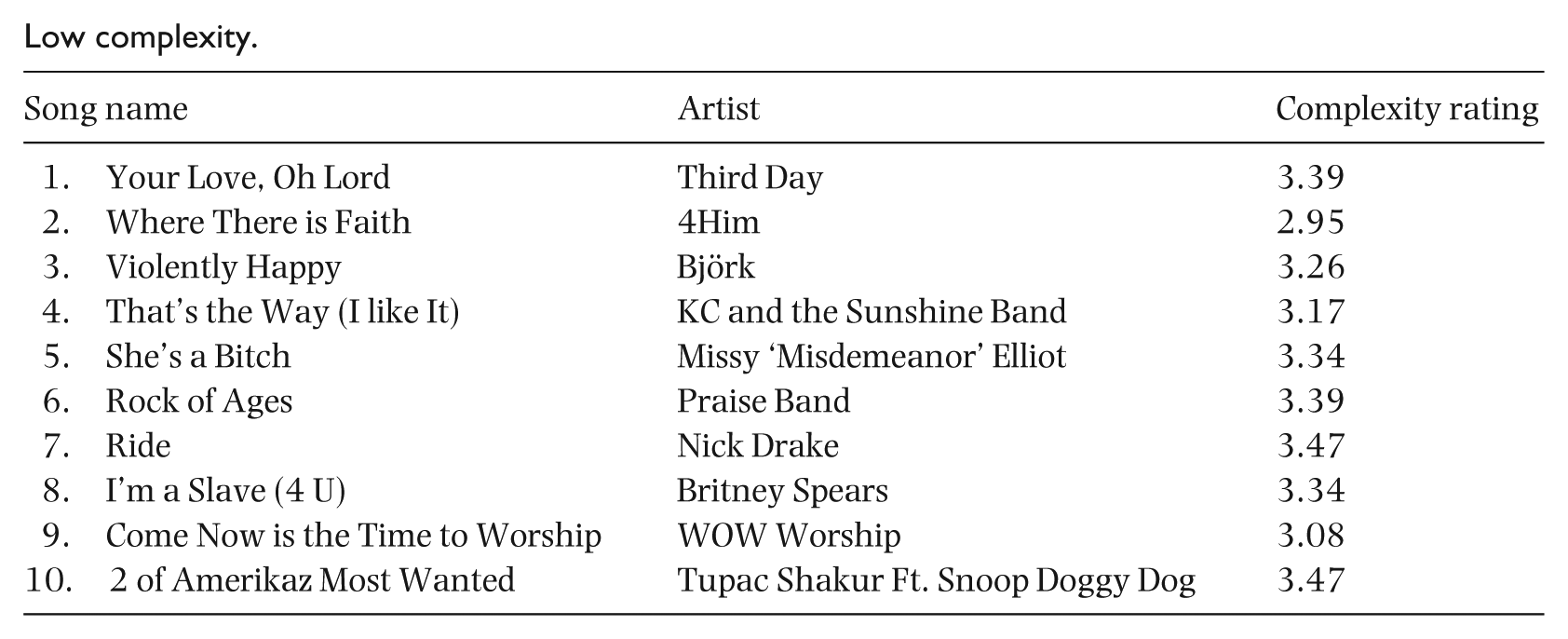
This pilot study was used to categorize music into high, moderate, and low complexity and to narrow the song selection from 70 songs to 30 songs. The 70 songs were ranked based on the average complexity rating for each song. The 10 most complex songs, the 10 least complex songs, and the middle 10 moderately complex songs were used for the main study (see Appendix 2).
Main study
Method
Participants
A total of 34 participants from a university in the northeastern region of the United States took part in this study. None of these participants were involved in the pilot study. Participants received credit in partial fulfillment of a course research requirement for their participation. Due to incomplete responses, data from three participants were excluded from the results. Of the 31 participants who had complete data, ages ranged from 18 to 43 (Mage = 19.61) and the sample consisted of 28 females (Mage = 19.69, age range: 18–43) and three males (Mage = 19.67, age range: 18–21). The large ratio of male to female reflects the demographics of the university.
Materials
As in the pilot study, a participant letter describing the study procedures and the promise of confidentiality was given to each participant before they began the study. In addition, all participants completed a demographic questionnaire.
Assessing music uses
To assess uses of music, participants completed a modified version of Chamorro-Premuzic and Furnham’s (2007) Uses of Music Inventory. Chamorro-Premuzic and Furnham evaluated their inventory using a principal component analysis and found three reliable factors: emotional, background, and cognitive (αemot = .78, and αback = .76, αcog = .85). More recently, Chamorro-Premuzic, Swami, and Cermakova (2012) re-examined their Uses of Music Survey using a broader and more representative sample. They found that internal consistencies for each subscale matched those of previous studies and ranged from α = .65 to α = .68. Validity estimates are not available for this scale.
For the current study, the questions from the Uses of Music Inventory were modified to be specific to a single song. For example, instead of asking “listening to music is an intellectual experience for me,” the statement was modified to, “I might listen to this type of song for the intellectual experience.” By modifying the scale, the use of a specific song was assessed rather than uses of music in general. This modified version was composed of 12 questions. Specifically, three questions were removed from the original Uses of Music Inventory (i.e., “I am not very nostalgic when I listen to old songs I used to listen to”; “I don’t enjoy listening to pop music because it is very primitive”; “I often feel very lonely if I don’t listen to music”). Participants answered the 12 questions for each of the 30 songs using a 5-point scale (1 = strongly disagree to 5 = strongly agree).
Procedure
Participants were tested in a small-group setting that was overseen by one of the experimenters. All participants were given a participant letter. Once the participant letter was reviewed, participants completed a demographics questionnaire. Based on the data from the pilot study, the ten highest complex songs, ten lowest complex songs, and ten moderately complex songs of the original 70 song-set were selected to use in this second experiment; thus, participants listened to 30 second clips of 30 musical pieces (see Appendix 2 for complexity ratings for each song). The average complexity ratings were analyzed using a One-Way ANOVA to ensure that complexity ratings between groups were significantly different. The results confirmed that all three groups of songs (low, medium, and high complexity) were significantly different, F(2,28) = 3041.25, p < .001, ηp2 = .99; with average ratings of 3.29, 4.25, and 6.32, respectively. While listening to the songs, participants were asked to respond to the modified version of the Uses of Music Inventory. To avoid order effects, the songs were presented in three different sequences across groups of participants. To ensure that participants had enough time to answer each question, the experimenter regulated the intervals between songs by waiting for each participant to complete the survey before playing the next musical piece.
Results
Cronbach’s Alpha was used to assess the reliability of the modified Uses of Music Inventory for each subscale (i.e., emotional, background, cognitive). In each case the subscale reliabilities (αemot= .70, and αback = .75, αcog = .86) were acceptable and comparable to those found by Chamorro-Premuzic and Furnham (2007) for the original Uses of Music Inventory.
Separate one-way within-subjects ANOVAs were used to compare high, moderate, and low complexity for each use (i.e., emotional, cognitive, background). The Bonferroni adjustment was used to account for the increased risk of error from running multiple ANOVAs. This adjustment changed the alpha level from .05 to .017.
The ANOVA examining the emotional use of music indicated a significant difference between levels of complexity for emotional use, F(2,60) = 5.90, p < .005, ηp2 = .3. Pairwise comparisons revealed that low complexity music is used significantly more than moderately complex music for emotional purposes, p < .01 (See Figure 1).

Mean emotional use ratings representing the participant-rated emotional use of music of different levels of complexity (errors bars are standard error).
The ANOVA for cognitive use of music also revealed that complexity levels differed significantly, F(2,60) = 26.72, p < .001, ηp2 = .63. Pairwise comparisons indicate that highly complex music is used significantly more than both moderate and low complex music for cognitive purposes, p < .001 (see Figure 2). This confirms our initial hypothesis that people prefer highly complex music for cognitive uses.
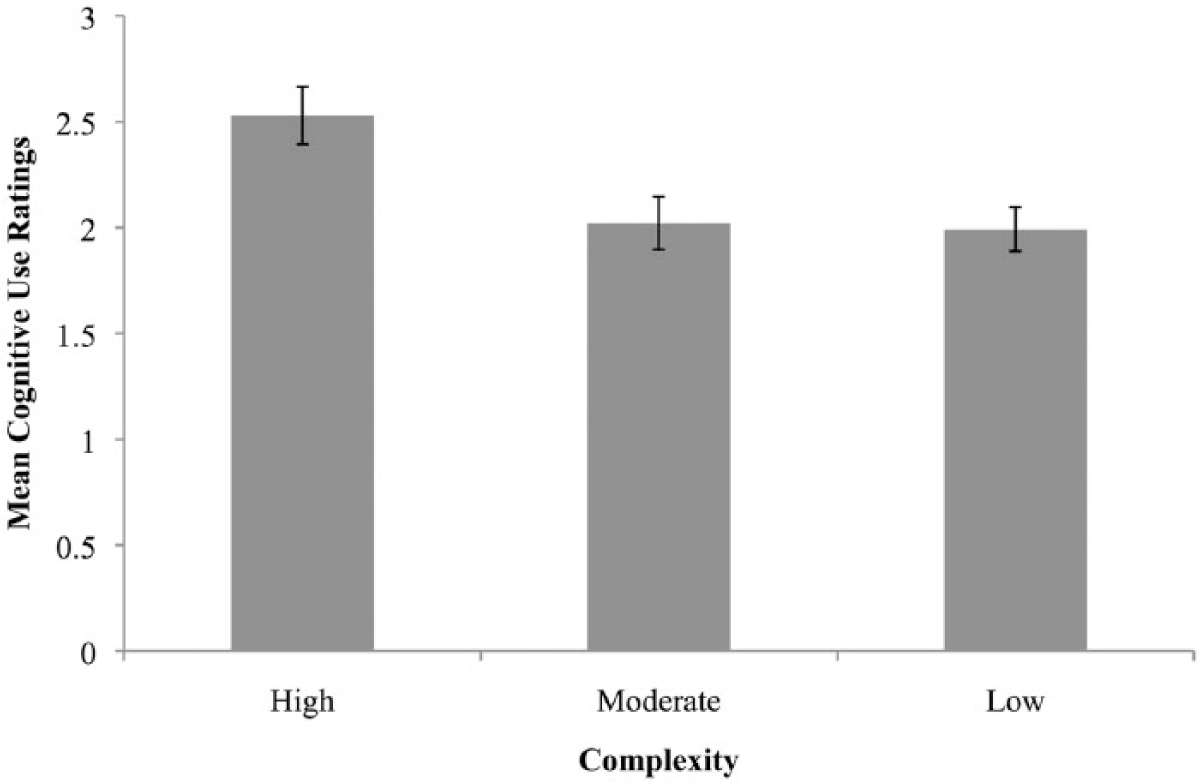
Mean cognitive use ratings representing the participant-rated cognitive use of music ofdifferent levels of complexity (errors bars are standard error).
Contrary to our initial hypotheses, background use did not differ as a function of complexity levels, F(2,60) = 2.21, p = .12, ηp2 = .12. Thus our hypothesis that moderately complex music would be used more than high and low complexity music for background purposes was not supported.
Discussion
The current study extends previous research completed by Chamorro-Premuzic and Furnham (2007) on the uses of music (i.e., cognitive, background, and emotional). While Chamorro-Premuzic and colleagues (2010) explored individuals’ preferences for complex music, they failed to examine subjective complexity in relation to music uses. As such, the current study sought to explore subjective complexity and uses of music in order to provide greater insight into the types of music individuals employ for different purposes.
The results of the current study were somewhat conflicting. The finding that high complexity music is used significantly more than low and moderately complex music for cognitive purposes supports the initial hypothesis. However, the hypothesis that moderately complex music would be used more than high and low complexity music for background purposes was not supported. Instead, the results indicate that subjective complexity does not have a significant impact on the background use of music. Because the Energetic and Rhythmic dimension, which was previously described as moderately complex by Rentfrow and Gosling (2003), and the background uses of music were found to both be related to Extraversion, it was hypothesized that Energetic and Rhythmic dimension would be used for background purposes. However, in the pilot study, few songs from the Energetic and Rhythmic dimension were rated as moderately complex by participants. Instead, participants rated the songs from the Energetic and Rhythmic dimension as low in complexity. This finding contradicts Rentfrow and Gosling’s (2003) finding that the Energetic and Rhythmic dimension is perceived as moderately complex and may account for the lack of support of the current hypothesis.
The current study further explored complexity in relation to the emotional use of music. The results indicate that low complexity music is used more for emotional purposes than moderately complex music. This contradicts Myer’s Theory of Expectation (as cited in Unkefer and Thaut, 2002), which implies that complex music is used to create an emotional response. It may be useful for future studies to further investigate how musical complexity affects the emotional function of music.
In addition, further research should be conducted on the structure of music uses. The current study followed Chamorro-Premuzic and Furnham’s (2007) model for music uses. However research suggests that the functions of music are diverse and complex, and are influenced by many factors, such as an individual’s association with different songs (Hargreaves & North, 1999; Merriam, 1964; North et al., 2004; Schäfer & Sedlmeier, 2009; Tarrant et al., 2000; Tekman & Hortascu, 2002). Most studies on music uses are exploratory and only involve identifying uses. Further investigation should focus on creating a structural and replicable model of music uses that can be tested, confirmed, and employed in other studies.
The current findings are also limited by the sample of participants, which was largely composed of college-aged students. Middle-aged and older adults may have different preferences and use music for different functions compared with college-aged students. For example, Chamorro-Premuzic et al. (2012) found that background use of music was negatively correlated with age. In addition, Lima and Castro (2011) indicate that age can affect people’s emotional recognition of music, which can in turn influence their use of music for emotional purposes.
Another limitation of the current study is the small, mainly female, sample size. Research indicates that gender may affect music uses and preferences. For instance, Boer et al. (2012) found that, in comparison to males, females employ music more frequently for emotional and background uses. Other research demonstrated that males show a greater preference for Intense and Rebellious music, while females display a greater preference for Upbeat and Conventional music (Clark & Giacomantonio, 2013). Subsequent studies should investigate how age and gender are related to music preference and use before the current results can be generalized to a broader range of people.
An additional limitation of the current study involves the validity of the survey instruments. In the pilot study, subjective complexity was assessed by employing a scale that was adopted from previous research (North & Hargreaves, 1995). Despite prior use of this scale, there is no information on the scale’s validity. Similarly, there is no research available on the validity of the Uses of Music Survey (Chamorro-Premuzic & Furnham, 2007). Future research is needed to investigate the validity of these measures and to develop novel survey tools that assess subjective complexity and music uses.
Despite these limitations, the current results offer an important contribution to the formation of a music preference theory (Rentfrow & Gosling, 2003). How music is used is an important contributor to an individual’s preference for a certain type of music (Schäfer & Sedlmeier, 2009). By determining what elements of the music, such as perceived complexity, influence music use, the current study extends understanding of music preferences.
Footnotes
Appendix
Low complexity.
| Song name | Artist | Complexity rating |
|---|---|---|
| 1. Your Love, Oh Lord | Third Day | 3.39 |
| 2. Where There is Faith | 4Him | 2.95 |
| 3. Violently Happy | Björk | 3.26 |
| 4. That’s the Way (I like It) | KC and the Sunshine Band | 3.17 |
| 5. She’s a Bitch | Missy ‘Misdemeanor’ Elliot | 3.34 |
| 6. Rock of Ages | Praise Band | 3.39 |
| 7. Ride | Nick Drake | 3.47 |
| 8. I’m a Slave (4 U) | Britney Spears | 3.34 |
| 9. Come Now is the Time to Worship | WOW Worship | 3.08 |
| 10. 2 of Amerikaz Most Wanted | Tupac Shakur Ft. Snoop Doggy Dog | 3.47 |
Ethical approval
Ethical approval for this project was given by Marywood University Exempt Review Committee [204376-2].
Funding
The author(s) received no financial support for the research, authorship, and/or publication of this article.