



Abstract
Huron (2011) theorized that listening to music that induces sadness could lead to higher levels of prolactin, which would lead to increased liking of music that induces sadness, but this relationship would depend on individual factors of age, gender, depression, and personality. This study explored the link between these individual factors on liking music that induces sadness and music that induces happiness to determine if further testing would be viable. This study surveyed 488 college students (338 women, 146 men) and included measures of age, depression, absorption in music, and gender as predictors of liking music that induces sadness and music that induces happiness. Gender and depression predicted liking music that induces sadness, where both men’s and women’s liking increased as depression increased but did so much more for men than it did for women. Gender and absorption in music interacted to predict liking music that induces happiness. For women, there was no relation between absorption in music and liking. For men, there was a positive relation between absorption in music and liking. Age did not affect liking either types of music. These results imply that Huron’s (2011) model could depend on gender, general depression, and absorption in music.
Liking music that induces sadness is a perplexing paradox. It appears to be counter-intuitive that people would like something that increases their sadness, but liking music that induces sadness is a very common experience. Studying this phenomenon can help explain how people mitigate negative experiences, find pleasure in suffering, and use music to cope with challenges.
Huron (2011) developed a theory about why certain people like music that induces sadness more than others. He stated that music that induces sadness would create psychological pain, which would then release epinephrine and endorphins. If the listener then decreased epinephrine production, prolactin production would increase, which would then lead to greater pleasure in the song that induces sadness and lead to liking the song more. He qualified this theory, though, by stating that this process depends on individual factors, which could include depression, age, gender, and personality. The current study explored what roles these factors have on liking music that induces sadness to determine if Huron’s theory merits further testing. It did so through a survey without having the participants listen to music.
Depression
Self-verification theory states that people prefer self-confirming evaluations (Lecky, 1945), and Giesler, Josephs, and Swann (1994) adapted self-verification theory to account for individuals with depression. They found that most people with depression chose unfavorable feedback over favorable feedback, implying that people with depression prefer stimuli that match their negative state. Transferring these results to liking music that induces sadness, people with depression should like music that induces sadness more than music that induces happiness.
Punkanen, Eerola, and Erkkilä (2011) had depressed and non-depressed individuals listen to music clips that evoked sadness, happiness, anger, high energy, low energy, positive valence, and negative valence. The people who were depressed liked the high-energy and angry songs less than the non-depressed people. The depressed and non-depressed people showed similar liking for the low energy songs, songs that induce sadness, and songs that induce happiness. These results did not strictly support self-verification theory, but depressed people liking high-energy music less than non-depressed people follows a similar pattern. As Punkanen et al. stated, the high energy of the music may have disrupted the depressed people’s low energy systems, and this energy mismatch was thought to lead to lower liking.
These results suggest that depressed people do not differ in liking music that evokes happiness or sadness. Even though sadness is different from depression, sadness is a part of depression. When Friedman, Gordis, and Förster (2012) manipulated mood (happy, sad, and neutral) through viewing films, they found that people who are sad may say that they want to listen to music that induces sadness, but, when actually listening to a sad song, they do not have a stronger desire to listen to the song than their happy and neutral counterparts. Because of this difference, the current study focused on reporting liking through self-report without listening to music. It explored the effect that the strength of depression has on liking music that induces sadness and music that induces happiness.
Personality
Garrido and Schubert (2011) tested the effect that personality has on liking music that induces sadness by correlating ratings of music empathy, empathic concern, general absorption, fantasy proneness, dissociation, and rumination with liking music that induces sadness, but they did so in a survey without asking people to listen to music. In their study, music empathy, empathic concern, and general absorption positively correlated with liking music that induces sadness. The stepwise regression resulted in general absorption and music empathy as the two best predictors of liking music that induces sadness.
Levinson (1997) postulated that absorbing oneself into music that induces sadness brings about rewarding experiences (e.g., catharsis, communion with a song, testing different emotions), and that these rewarding experiences were why people like listening to music that induces sadness. Garrido and Schubert’s (2011) finding that general absorption was one of the best predictors of liking music that induces sadness supports Levinson’s theory. Additionally, general absorption correlated with fantasy and measurements of empathy (Garrido & Schubert, 2011), and different measurements of empathy positively correlated with liking music that induces sadness (Vuoskoski, Thompson, McIlwain, & Eerola, 2012). Therefore, absorption could have a strong impact on liking music that induces sadness, especially when considering the positive correlations between liking different genres of music (e.g., classical, new age, rock, and country) and general absorption (Rhodes, David, & Combs, 1988).
Although past research has looked at the effect of general absorption, the current study measured absorption in music because Levinson’s (1997) theory is concerned with absorbing oneself in the music. General absorption is a personality trait that is the ability to feel emotions while disconnecting from and not being distracted by reality. More specifically, it is “a capacity for absorbed and self-altering attention” and can be for anything, such as a landscape, a human being, or a sound (Tellegen & Atkinson, 1974, p. 276). Absorption in music can be viewed more narrowly in terms of how much one becomes absorbed by music; it is people’s “ability and willingness to allow music to draw them into an emotional experience” (Sandstrom & Russo, 2013, p. 216).
Gender
Absorption and depression symptoms may predict liking music that induces sadness, but, according to Huron (2011), so could gender. For example, women liked listening to nine minutes of Barcarolle in F sharp minor by Chopin more than men did (Wheeler, 1985). Positive correlations with agree–disagree gratification items showed that listening to music helped women feel less alone, elevate their mood, and distract them from their worries more than it did for men (Christenson & Peterson, 1988). Therefore, it appears that there are gender differences in how people listen to music and how people who are depressed use music.
Past research has shown that men and women cope with depression differently. In these studies, men saw coping as a private process (Warren, 1983), and men isolated themselves and turned to addictive stimuli to cope with depression (Brownhill, Wilhelm, Barclay, & Schmied, 2005; Daughtry & Paulk, 2006; Kelly, Sereika, Battista, & Brown, 2007; Kleinke, Staneski, & Mason, 1982), such as drugs, alcohol, and sex. Research has also shown that women often address their feelings and cry to cope with depression (Daughtry & Paulk, 2006; Kleinke et al., 1982). Because strongly emotional music has been found to activate the same neural pathways as addictive stimuli (Blood & Zatorre, 2001; Zatorre, 2005) and to increase liking (Schäfer & Sedlmeier, 2011), it is plausible that men with depression would turn to music as a way to cope with depression symptoms. Because of the differences in how men and women use music to cope with depression, depression could predict liking music that induces sadness differently based on gender, where one gender could like the music more than the other gender when highly depressed, but no difference might exist when depression is low or nonexistent.
Furthermore, it is possible that gender could interact with absorption in music in predicting liking music that induces sadness. Knobloch-Westerwick (2015) manipulated participants’ moods (good, bad, or neutral) and then asked the participants to choose a song and to listen to that song. The songs “featured either low or high absorption potential” (p. 83). After having their mood impacted upon, women decreased the amount of time with the absorbing music, but men increased the amount of time with the absorbing music. Therefore, choosing to listen to music when emotional can depend on one’s gender and on how much one can become absorbed in music.
Age
Huron (2011) surmised that age would predict liking music that induces sadness. In one study, music became less important to people as they aged (Bonneville-Roussy, Rentfrow, Xu, & Potter, 2013), but Leblanc, Sims, Siivola, and Obert (1996) found that liking art songs, traditional jazz, and rock decreased from grade one to grade six and then increased from grade six to college students (LeBlanc et al., 1996). These results suggest that liking music could depend on age.
Age could also predict how strongly people respond to emotions from musical stimuli. Lima and Castro (2011) found that the older people (roughly mid-60s) were less responsive to the sad emotional content when listening to a musical excerpt that induced sadness than younger people (roughly early 20s) were, but they were similarly responsive to the happy content of the excerpt that induced happiness. Viellard and Bigand (2014) had older (between 62 and 91 years of age) and younger (between 19 and 25 years of age) participants listen to 40 musical excerpts that conveyed different emotions. They found that older participants liked music that induced happiness more than younger participants but found no differences based on ages in liking music that induced sadness. Overall, these studies indicate that age could impact the response to emotional musical stimuli and, consequently, the liking of the emotional musical stimuli, but these effects have been inconsistent and need to be investigated further.
Research questions
Huron (2011) expected age, depression, gender, and personality to affect liking music that induces sadness, but past research has not considered how the strength of these factors and their combinations predict liking music that induces sadness. Although participants did not listen to music, the current exploratory study used these variables to predict liking music that induces sadness and music that induces happiness to determine if the same people react differently to emotionally different music. It also addressed Huron’s (2011), Levinson’s (1997), and Lecky’s (1945) theories, and combined gender, absorption, depression, and age from those theories to determine main effects as well as interactions.
Liking music that induces sadness
Will age, gender, depression, and absorption in music each significantly predict liking music that induces sadness?
What interactions among depression, gender, and absorption in music will be significant?
Liking music that induces happiness
Will age, gender, depression, and absorption in music each significantly predict liking music that induces happiness differently than they do music that induces sadness?
Will the interactions among depression, gender, and absorption in music predict liking music that induces happiness differently than they do liking music that induces sadness?
Method
Participants
There were 488 college students (338 women, 146 men) from a Midwestern university in this study. The mean age was 22.34 (SD = 5.12, range: 18–56), and 88% of the sample was Caucasian. A little under half (42%) described themselves as self-professed musicians, and a little over half (57%) were not musicians. When asked to indicate their musical training on a 1 (None at all) to 5 (A lot) scale, the average (M = 2.92, SD = 1.34) showed “Some” training. Music, however, was highly important to this group. Using the same scale, the average (M = 4.44, SD = .76) was between A fair amount and A lot. The participants also named the one genre of music to which they most prefer to listen. Despite the directions, some listed multiple genres, which provided a total of 576 responses. Most responses (24%) were for rock or its various forms (e.g., indie rock, alternative rock, etc.). Other responses included country (15%), pop (10%), alternative (9%), indie (5%), hip hop (4%), classical (4%), metal (3%), and numerous other genres that represented less than 2% of the responses each.
Measures
Age and gender
Age and gender were collected in the demographics portion of the survey and are described above. In the analyses, gender was coded as 0 for women and 1 for men.
Absorption in music
Sandstrom and Russo’s (2013) Absorption in Music Scale (AIMS) is a 34-item scale with each item measured on a 5-point Likert scale of Strongly Disagree to Strongly Agree, and it was designed specifically to measure one’s ability to absorb oneself in music. Their test-retest reliability showed a strong, positive correlation (r = .91) over time, and its scores correlated strongly with the Tellegen Absorption Scale (r = .76). Given the high internal consistency, the high test-retest reliability, and the high correlation with the Tellegen Absorption Scale for general absorption, the AIMS was reliable and valid enough to use on music preferences in this study. For the current study, Cronbach’s alpha for these items’ scores was .95.
Depression symptoms
Every respondent completed the entire Inventory of Depression and Anxiety (IDAS; Watson et al., 2007). It is a 64-item test that measures General Depression as well as 11 other symptom clusters of depression and anxiety. Analyses for this study only utilized the General Depression subscale. This subscale used 1 (Not at all) to 5 (Extremely) scales. Cronbach’s alpha for this study was .89 for General Depression scores.
Liking
To measure liking of music that induces happiness and music that induces sadness, we created six items detailing emotional and collative properties of the music. Three items were intended to measure liking music that induces happiness: 1) I like fast songs; 2) I like songs that make me happy; 3) I like cheerful and uplifting music. Three items were intended to measure liking music that induces sadness: 1) I like songs that make me feel sadness and grief; 2) I like slow music; 3) I like dark and melancholy music. All items used a 1 (Strongly Disagree) to 5 (Strongly Agree) scale.
Using a Principal Axis Factoring (PAF) factor analysis with a Promax rotation on the six items, the scree plot showed that two factors could be retained. These two factors together explained 64% of the variance. Factor 1 explained 34% of the variance, and Factor 2 explained 29% of the variance (see Table 1 for the factor loadings). It appears Factor 1 measures liking songs that induce happiness, and Factor 2 measures liking songs that induce sadness. Because “I like slow music” and “I like fast songs” items loaded on both factors, further analyses did not include these items. Cronbach’s alpha for the liking music that induces sadness scores was .68 for the two remaining items. Cronbach’s alpha for liking music that induces happiness scores was .79.
Principal-Axis Factoring (PAF) factor matrix with Promax rotation.

Procedure
Students received an email detailing the study. Interested students checked a box stating that they read the informed consent, and that they agreed to participate. They then completed the survey. All data were collected online. For completing the survey, we thanked the respondents and gave them the option of entering to win a $25 gift card as compensation.
Results
To satisfy statistical assumptions, two participants’ data were removed as outliers before running the analyses (see Table 2 for correlations among all of the measures). Means, standard deviations, and inferential results from independent samples t-tests between men and women on absorption in music and depression are also shown at the bottom of Table 3. Absorption in music and depression did not differ between men and women.
Correlations among measures.
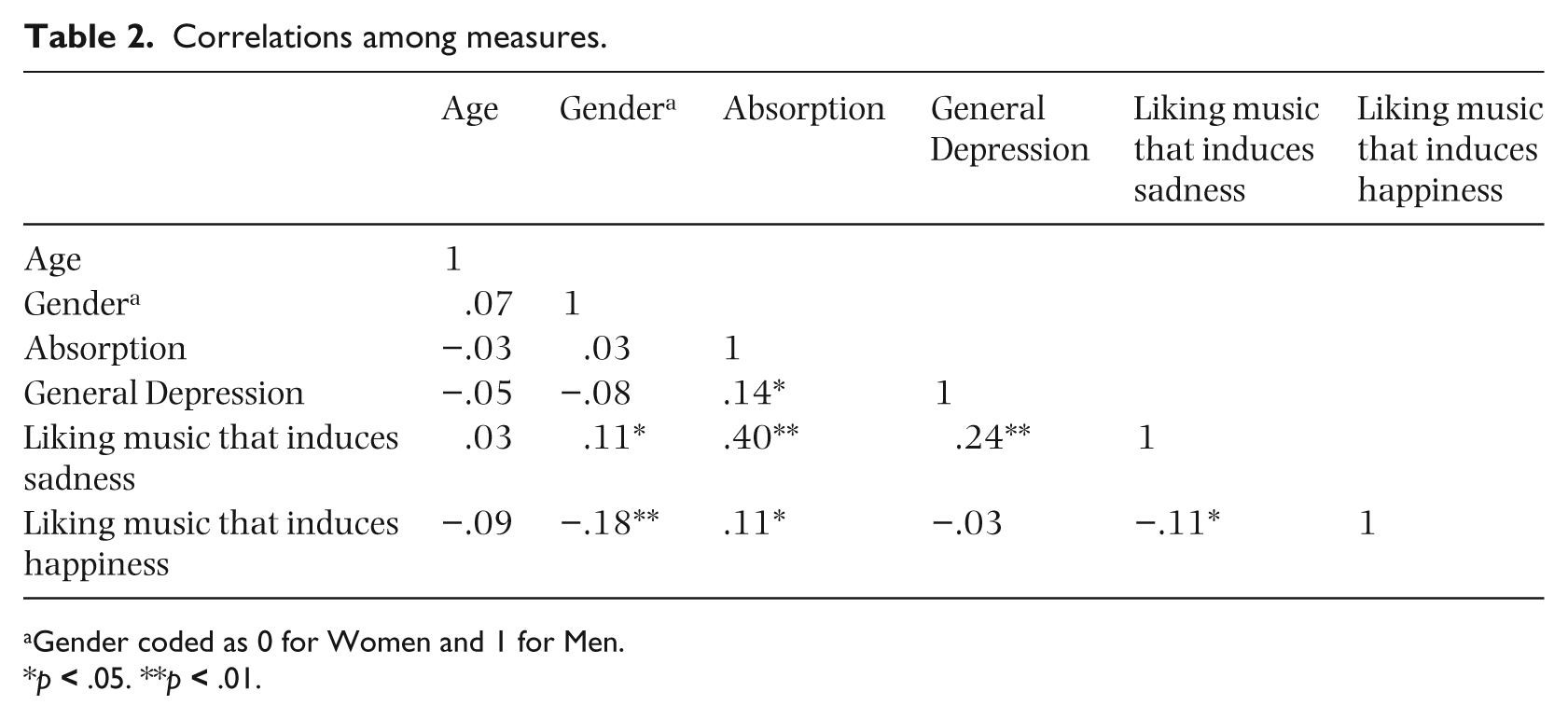
Gender coded as 0 for Women and 1 for Men.
p
Means and standard deviations by gender.

Test used corrected degrees of freedom to account for unequal variances.
For the following OLS regression analyses, we used age as a covariate because of the possible effects of age (Huron, 2011). The distribution of ages mostly included people in their early 20s. Therefore, cross-generational effects as moderators would be inappropriate in this study. The results showed how age predicts liking, and the analyses of depression, absorption in music, and gender as predictors of liking (and the interactions) controlled for age.
Music that induces sadness
The average scores of the two retained items measuring liking music that induces sadness was the criterion variable. The upper half of Table 4 shows the results of the regression analysis.
Results of the predictors on liking music.

Gender was coded as 0 for Women and 1 for Men.
In Step 1, age by itself was entered but did not significantly predict liking, R2 = .002, F(1, 445) = .99, p = .32. For Step 2, gender, absorption in music, and depression were entered as predictors. Controlling for age, men liked music that induces sadness more than women did. Also, as the respondents’ absorption in music and depression scores increased, so did their liking of music that induces sadness. The three variables significantly explained an additional 20% of the variance, ΔF(3, 442) = 37.30, p < .001. Step 3 controls for age as well, and gender was considered as a moderator on depression and absorption in music, so the interactions were created using product scores between gender and absorption in music and between gender and depression. They were entered together, and these interactions explained a significant change in the explained variance, ΔR2 = .02, ΔF(2, 440) = 4.46, p = .01. We computed simple slopes to determine the nature of the significant interaction between gender and depression. As seen in Figure 1, the positive relation between depression and liking music that induces sadness was stronger for men (b = .04, t[472] = 5.59, p < .001) than it was for women (b = .01, t[472] = 3.19, p = .002). The absorption-by-gender interaction did not significantly predict liking.

Interaction between gender and general depression on liking music that induces sadness. Liking music that induces sadness increased as general depression increased much more for men than it did for women.
Music that induces happiness
For liking of music that induces happiness, the same procedure was used as above, except the averaged scores of the two items retained for liking music that induces happiness were used as the criterion. The lower half of Table 4 shows the results. Similar to liking music that induces sadness, age did not significantly predict liking in Step 1, R2 = .008, F(1, 447) = 3.81, p = .051. Controlling for age in Step 2, women liked music that induces happiness more than men did, which was the opposite of the gender difference on liking music that induces sadness. Also, absorption in music positively predicted liking of music that induces happiness, which was the same as with liking music that induces sadness. Depression did not predict liking music that induces happiness, whereas depression was positively related to liking music that induces sadness. These three variables significantly explained an additional 5% of the variance, F(3, 444) = 7.48, p < .001. Also controlling for age in Step 3, gender did not interact with depression, but gender and absorption in music interacted to significantly predict liking of music that induces happiness. These interactions significantly explained an increase in variance in liking and were different for liking music that induces sadness, ΔR2 = .02, ΔF(2, 442) = 3.92, p = .02. For the interaction between gender and absorption in music, women’s liking of music that induces happiness was not significantly related to their absorption in music scores (b = .00, t(456) = .28, p = .78), but men’s liking of music that induces happiness was positively related to absorption in music, b = .007, t(456) = 3.87, p < .001 (see Figure 2).
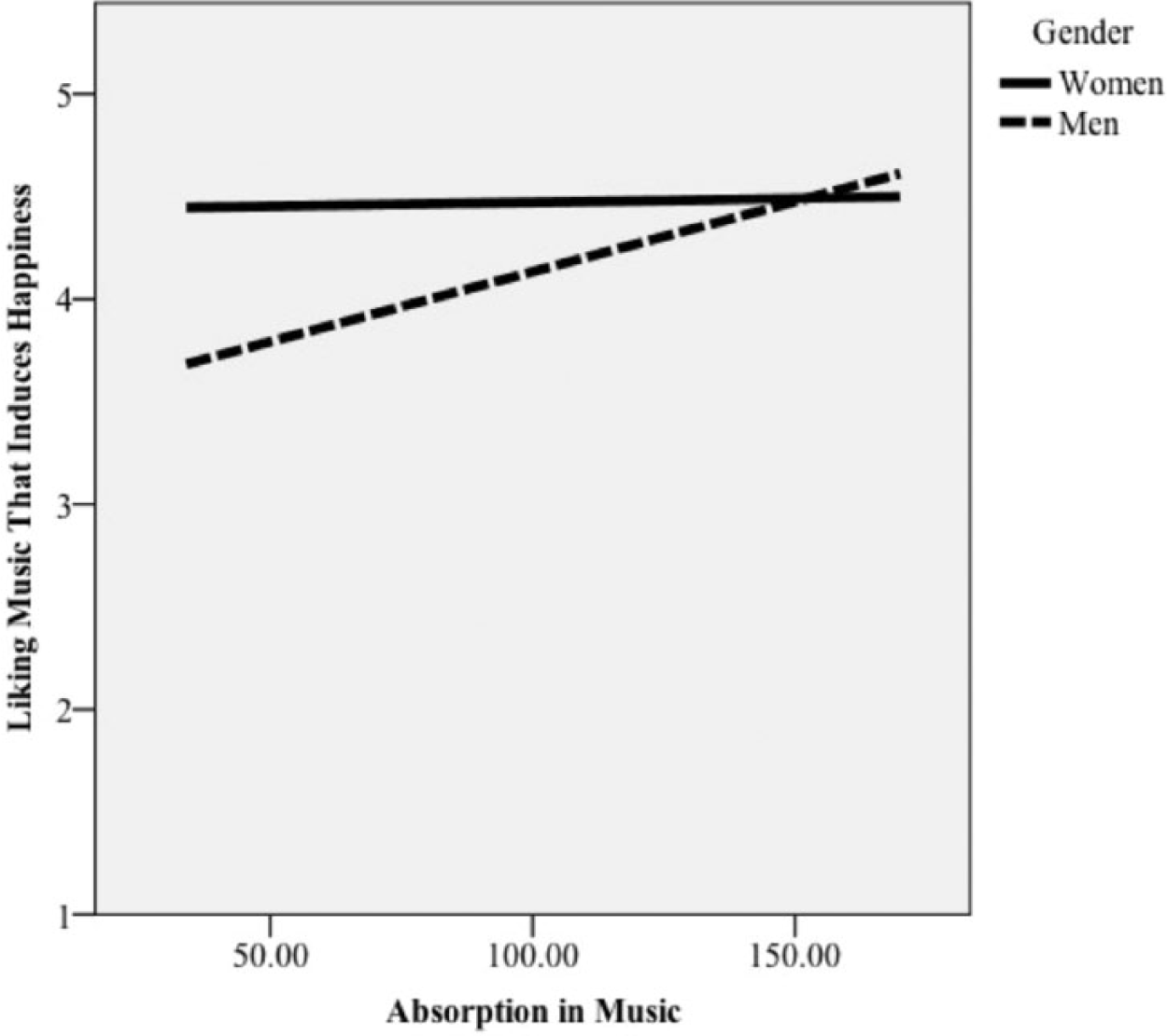
Interaction between absorption in music and gender on predicting liking music that induces happiness. Men liked music that induces happiness less than women. Liking increased as absorption in music increased for men but did not change for women.
Conclusion
The results for predicting liking of music that induces sadness unveiled interesting answers to the research questions. Controlling for age, these results showed that men liked music that induces sadness more than women did, that people who could highly absorb themselves into the music liked music that induces sadness more than people who could not, and that people who were relatively more depressed liked music that induces sadness more than people who were not. Interactions revealed that for both men and women, liking music that induces sadness increased as depression increased, but did so much more for men than it did for women. These data, however, did not show that absorption in music interacted with gender on liking music that induces sadness.
These results support one of Levinson’s (1997) rewards of listening to music that induces sadness: Emotional Potency. In this reward, the listener identifies a song as expressing his or her own emotional state. Levinson claimed that this matching of mood allows the listener to feel a genuine and organic emotion from the song. These results also support Giesler et al.’s (1994) modification to Self-Verification Theory: that people with depression like music that induces sadness because it matches their self-perception and worldview, therefore validating their negative perceptions. These results, though, do not support Punkanen et al. (2011), who found that liking music that induces sadness was similar between people with and without depression. Punkanen et al.’s findings were collected when the participants actually listened to music. Because the current study utilized self-report measures without having the participants listen to music, perhaps people who are depressed initially state that they like and want to listen to music that induces sadness but still find no pleasure in the act of listening to such music. For example, the current study supports Friedman et al.’s (2012) initial finding that people who are sad state that they want to listen to music that induces sadness. Yet they also found that participants’ liking of such music was no greater than the people who were happy when actually listening to it. As a result, there could be a parallel between sadness (as Friedman et al. examined) and depression (as we examined). Specifically, for both sadness and depression there may be a difference between one’s statements about liking music that induces sadness and one’s actual liking of it when listening to it. Another possibility could be that people have a different definition of what music that induces sadness is than how the experimental literature has defined it.
These results also support past research (Kurdek, 1987; Warren, 1983) on gender differences in coping strategies. Perhaps men with high levels of depression like music that induces sadness more than women who have high levels of depression do because music provides men with a coping strategy, where they can isolate themselves but still engage in a stimulating activity. Women with relatively higher depression still liked music that induces sadness more than women with relatively lower depression did, but this relation was not as strong as it was for men. Perhaps the difference stems from women’s use of other coping strategies that do not isolate them, so music, while still important, would not be as important for women as it is for men in coping with depression.
For liking music that induces happiness, most of the results were different than they were for liking music that induces sadness. Women reported liking the music that induces happiness more than men did (whereas men liked music that induces sadness more than women did). Also, people with high absorption in music liked music that induces happiness more than people with low absorption in music did (which was the same finding as liking of music that induces sadness).
Gender and absorption in music interacted with each other for liking music that induces happiness (but not for liking music that induces sadness). Men who were relatively high in absorption in music liked music that induces happiness more than men relatively low in absorption in music did, but women’s liking did not change as a function of absorption in music. Depression and the interaction between gender and depression did not significantly predict liking music that induces happiness. Interestingly, depression and the interaction between gender and depression both predicted liking music that induces sadness differently than they did liking music that induces happiness.
For the interaction between gender and absorption in music on liking music that induces happiness, the positive relation between absorption in music and liking music that induces happiness for men could have existed because the music would become more stimulating for them. Therefore, men would like the music that induces happiness more if they were better able to absorb themselves in the music. Women’s liking of music that induces happiness, however, was higher than men’s liking. It is possible that women’s liking was not related to absorption in music because of a ceiling effect.
Regardless of this interaction, absorption in music by itself predicted liking both music that induces happiness and music that induces sadness and had the highest correlation with liking music that induces sadness out of the other variables. This higher correlation supports Garrido and Schubert’s (2011) finding that general absorption was one of the best predictors of liking music that induces sadness. Also, this study was able to determine if absorption in music was different for men and women, which Sandstrom and Russo (2013) were not able to do because of a large majority of women in their sample. As Sandstrom and Russo expected, no significant differences were found.
The bigger picture of these results shows that people respond differently to music that induces happiness and music that induces sadness. These results also indicate that different types of people and their traits combine to influence liking. The results for music that induces sadness support Huron’s (2011) claim that individual differences of gender, personality, and depression predict liking music that induces sadness, but they do not support the theory that age predicts liking. Because age in this study was skewed towards people in their early 20s, perhaps there was not enough variance in age to accurately depict cross-generational age effects.
Perhaps these results imply that different people have different prolactin responses to listening to music that induces sadness. In prior research, people had lower levels of prolactin when they were depressed than when they were in recovery (Asnin, Nathan, Halbreich, Halpern, & Sachar, 1980; Lisansky et al., 1984) or not depressed (Garbutt, Loosen, Blacharsh, & Prange, 1986; Roccatagliata et al., 1982). Prolactin levels were higher for women who were depressed after treatment than they were for men who were depressed (Maes et al., 1989; Zis, Albala, Haskett, Carroll, Bernard, & Lohr, 1986). Therefore, perhaps after experimentally listening to a song that induces sadness, depressed men and women would produce differing levels of prolactin, which would lead to differing levels of preference based on the strength of their depression.
Limitations and future research
Because the current study did not have the participants listen to music, it is difficult to say exactly how people would respond when listening to music that induces happiness and music that induces sadness. Past research, though, has shown that just listening to music can decrease depression levels (Brandes et al., 2010; Castillo-Perez, Gomez-Perez, Valasco, Perez-Campos, & Mayoral, 2010; Chan, Wong, Onishi, & Thayala, 2012). Therefore, future research should test Huron’s (2011) mediated process of music altering prolactin levels, which could alter liking of music that induces sadness, by having participants listen to music and include depression, gender, and absorption in music as individual differences moderators.
The current study also did not analyze the effect of anxiety on liking music. The IDAS (Watson et al., 2007) does not include a measure of general anxiety. Preferred music can decrease anxiety levels (Walworth, 2003), and the slow tempo of the music would make the song a sedative if it also did not have accented beats, percussion, or syncopation (Gaston, 1968). Given that just listening to a slow, steady tempo can reduce anxiety compared to sitting in silence (Gadberry, 2011), it is possible that the slow tempo of the sad-sounding music would be enticing to someone with high anxiety (Schellenberg, Peretz, & Vieillard, 2008). Further research should determine if general anxiety predicts liking similarly to depression.
Finally, Rhodes et al. (1988) found through correlations that general absorption is important for liking music in general. This study found that absorption in music positively predicts liking both music that induces happiness and music that induces sadness. Therefore, more experimental lab research is needed for causal relations to address whether or not absorbing oneself in the music creates a more stimulating and, thus, more enjoyable experience regardless of the emotional content of the music.
Footnotes
Funding
The author(s) received no financial support for the research, authorship, and/or publication of this article.