



Abstract
It has been repeatedly shown that sad music induces mainly pleasant or mixed emotions, and is particularly relevant for self-regulation goals. However, this is not entirely compatible with the view that sadness is one of the basic emotions experienced in the face of an unpleasant event or a loss. Also, a distinction between grief and sadness is often drawn, which seemingly does not have relevance in relation to musical experiences. The discrepancy between the positive accounts of emotions associated with sad music and those present in ordinary sadness may be related to the previously unacknowledged spectrum of affects associated with music-related sadness. The present study aims to expose the underlying affective experiences of music-related sadness. To examine this, a large qualitative data, consisting of open-ended answers from 363 participants, was subjected to thematic content analysis. The analysis revealed a range of emotions experienced which were classified into three themes: Grief, Melancholia, and Sweet sorrow. These themes differed depending on the valence of the overall experience and the contextual aspects. In addition, emotion induction mechanisms distinguished the themes and several previously unidentified types of affect regulation were observed. Variations in the ways people conceptualise sadness and music lead to differences in the affect regulation processes. In contrast to past research, the results suggest that truly negative emotions are relevant in association with music-related sadness. Dividing the music-evoked sadness into different categories of affective experiences helps to explain the current discrepancies and paradoxes surrounding sadness and music.
In everyday language, sadness appears to be an unproblematic concept. People consider it to be a negative emotion that occurs in situations where a person is faced with some unfortunate affair. In the field of psychology, sadness is counted as one of the basic emotions, typically a response to a personal loss (e.g., Barr-Zisowitz, 2000; Bonnano, Goorin, & Coifman, 2008). Furthermore, a distinction between sadness and grief is often made: both are seen as natural reactions to loss, but sadness is considered to be a short-term emotion, whereas grief is seen as more of an enduring, yet fluctuating, affective state with peaks of high and low arousal emotional experiences (Archer, 1999; Bonnano et al., 2008). Moreover, in adults, grief is associated with multiple negative emotions, such as shock, anger, fear, hostility, and guilt, which typically evoke longer-term coping efforts, whereas sadness – being an ephemeral phenomenon – is generally implicated in proximal, short-term coping efforts (Archer, 1999; Bonnano et al., 2008; Littlewood, 1992). Both sadness and grief are seen as negative experiences that people tend to avoid in their everyday life.
However, in situations involving music, defining sadness becomes rather complicated. It is quite a commonly accepted notion in the field of music and emotion research that if music is capable of arousing felt emotions 1 in the listener, the emotions induced are mainly positive ones (Juslin, 2013; Sloboda & Juslin, 2010). Thus, paradoxically, sadness is often linked with positive emotions: even if we recognise that music is somehow expressing negative emotions, we can still experience it as being pleasurable. Sadness represented by music has been demonstrated to be able to induce pleasant, if somewhat mixed, emotions in the listener (e.g., Juslin, Liljeström, Laukka, Västfjäll, & Lundqvist, 2011; Kawakami, Furukawa, Katahira, & Okanoya, 2013; Taruffi & Koelsch, 2014; Vuoskoski & Eerola, 2012; Vuoskoski, Thompson, McIllwain, & Eerola, 2012), and it may also be able to confer experiences of aesthetic pleasure to listeners (Zentner et al., 2008; Vuoskoski & Eerola, 2013). A notable proportion of people seem to seek out these kinds of experiences, although not all (Eerola, Peltola, & Vuoskoski, in press), and many use sad music as a tool for self-regulation of emotions (Taruffi & Koelsch, 2015; Van den Tol & Edwards, 2013).
Yet, there is much that we do not know about this phenomenon of engaging with self-defined sad music. Despite several studies focusing on this issue, the ultimate reason – or most likely a variety of reasons – behind the enjoyment of experienced sadness has not been fully covered. In our opinion, the first issue of difficulty in this task lies in understanding the nature of these emotional experiences; it is unclear whether the emotion experienced while listening to sad music can actually be classified as sadness, since these experiences are reported to be positive (Garrido & Schubert, 2013; Vuoskoski & Eerola, 2013), and they often comprise of other emotions such as nostalgia and peacefulness (Taruffi & Koelsch, 2015; Vuoskoski & Eerola, 2013) or melancholy (Zentner et al., 2008). We also have evidence that people do exhibit negative biases in their cognitive processes after listening to sad music, similar to those exhibited in a state of sadness evoked by autobiographical recall (Vuoskoski & Eerola, 2012). Hence, the actual emotional experience of listening to sad music is complex and multifaceted, and unlikely to be clarified with existing self-reports instruments used in previous studies (e.g., GEMS in Taruffi & Koelsch, 2014 and Vuoskoski et al., 2012; scales from the basic emotions in Vuoskoski et al., 2012; and valence and arousal scales in Garrido & Schubert, 2013 and Vuoskoski et al., 2012), because these instruments are limited and biased by the researchers’ own emotion-word lexicon (Frijda, 2009).
The second issue of importance concerns the possible positive bias of the existing studies. Most of the previous research – based on convenience samples of people willing to respond to questions about sad music – emphasises positive feelings experienced by listeners, but these studies may neglect the experiences of those who do not care for sad music; what kinds of feelings do they experience when listening to sad music? Or what about such listeners who even actively avoid this emotion? Is it possible that painful feelings of grief and bereavement exist in relation to listening to sad music, as suggested by studies in ethnomusicology (e.g., Finnegan, 2003) and music therapy (Bailey, 1984)? It has been recognised that listening to sad music induces negative feelings in some people, and the overall experience is rather unpleasant (Eerola et al., in press; Peltola & Saresma, 2014), or memory retrieval during music listening feels displeasing (Van den Tol & Edwards, 2013). It is, of course, possible that differences in personality traits, such as empathy or openness to experience, which have been observed to be linked with preferences for sad music (Garrido & Schubert, 2011, 2013; Vuoskoski et al., 2012) might explain a part of the diversity associated with the topic. However, we propose that the way people conceptualise sadness and sad music has a larger role in this process. Such conceptualisations need to be understood in the appropriate contexts, which have often been left outside the focus of attention, although it has been shown that extramusical information does contribute to emotions induced by sad-sounding music (Vuoskoski & Eerola, 2013), and that even physical pain can be experienced as pleasant in a certain context (Leknes et al., 2013). In this study, the term context refers broadly to surrounding culture (including music cultures), social settings (including life situation and listening situation), and native language, which are important aspects of emotion concepts, affecting the emotional experiences (e.g., Barrett, 2006; Niedenthal, 2008).
The motivation for the present study is to cast light on these unanswered questions. Thus, the main research questions are:
What kind of affect do people experience when they listen to music they consider to be “sad”?
What contextual aspects contribute to experiences induced by listening to music associated with sadness?
How do these experiences relate to emotion regulation?
As Juslin (2013, p. 7) has it, “[j]ust as there are different shades of blue, there can be different shades of sadness”. The broad aim of this article is to distinguish these possible shades, and the ways they are experienced by a relatively large sample of listeners.
Before launching into the empirical part, we will clarify the theoretical foundations of the study.
How sad experiences in music are constructed and regulated
Assuming that basic emotions are constituted of emotion categories, or “emotion families”, which each include emotions of a certain theme and their variations (Juslin, 2013), how these emotions are experienced by different individuals in different situations may vary greatly. When experiencing emotions, people have explicit knowledge about emotions (Niedenthal, 2008), which has an effect on their overall emotional experience. In this study, instead of considering emotions as purely “natural kinds” or discrete categories, which are usually referring to basic emotion theory (e.g., Zentner & Eerola, 2010), they are considered as acts of conceptualisation. Acts of conceptualisation, in general, refer to different kinds of cognitive meaning-making processes, where mental representations of “entities (natural and artifactual), situations, experience, and action” are categorised rapidly and automatically without much conscious effort (Niedenthal, 2008, p. 587; Shweder, Haidt, Horton, & Joseph, 2008).
When conceptualising feelings into certain emotions, learned conceptual knowledge (such as embodied information, the specific social setting where the feelings are elicited, as well as the environment’s reactions to that specific emotion) contributes to how and when those feelings are experienced and labelled as being a specific emotion (see Barrett, 2006; Barrett, Mesquita, Ochsner, & Gross, 2007; Niedenthal, 2008). When people verbalise their affective state, they are referring to – to quote Barrett (2006, p. 30) – “some physical activity in their brain and body that is occurring as the result of their interaction with the world”. In other words, people categorise their learned associations between their thoughts, bodily feelings, action tendencies, and their interaction with the world in that specific moment as a certain emotion. There is variation in which emotions are experienced and how, based on individual and cultural differences (Barrett, 2006; Mesquita & Ellsworth, 2001; Niedenthal, 2008), yet regardless of these differences, people are able to explicitly describe feelings of valence and (in most cases) arousal when reporting their experiences of emotion (Barrett, 2006).
Emotion concepts are important for individual experiences, but they have an even more crucial role in mutual communication about the experiences with others (e.g., Niedenthal, 2008). They are learned and internalised in social contexts (e.g., Rudd, 2003), thus the sociocultural meanings of emotions are intermediated in social interaction. Hence, although emotions are biologically evident, they are also socially constructed and shared (Barrett, 2012). In different contexts these conceptualisations of sadness, for example, have different meanings, which may result in different kinds of emotional experiences.
Some variations in music- and sadness-related experiences fall out of this framework quite naturally. Music listening in general should be pleasurable (Juslin, 2013; Sloboda & Juslin, 2010), yet, for instance, recognition of music mimicking negative emotion may cause listeners to describe the experienced feelings as negative, or the actual painful memories evoked by sad-sounding music lead to displeasure. The way music communicates emotions by means of expressive cues is fairly well understood, even for sadness (Eerola, Friberg, & Bresin, 2013; Huron, 2008, 2011), and the distinction between recognised and felt emotions has been acknowledged (Gabrielsson, 2002). Often there is a strong interdependency (Evans & Schubert, 2008), but the two may diverge. Music that expresses sadness may lead the listener to feel emotions entirely different than sadness due to lack of contextual fit (i.e., sad music in an inappropriate situation), or because a particular mechanism of emotion induction gives rise to a specific emotion, for instance, due to association with powerful memories. Eight such mechanisms have been put forward by Juslin and Västfjäll (2008; updated by Juslin et al., 2008), where episodic memories, contagion, and aesthetic judgment are probably most pertinent for the experiences of sad music. The mechanisms are useful for distinguishing between sources of emotion, but they do not describe the content of these emotional experiences. For a better understanding of the nature of experiences associated with sad music, that is to say, what kinds of feelings are being experienced as certain emotions and when, it is necessary to examine how experiences are conceptualised (cf. Barrett, 2006, 2012). Failing to address the conceptual aspects of these experiences might lead to inconsistent observations and results concerning music and sadness.
General accounts of affect regulation with music have offered frameworks that account for three to nine overlapping strategies, such as communication/self-reflection, emotional, physiological, and cultural/social (Schäfer & Sedlmeier, 2009; Schäfer, Sedlmeier, Städtler, & Huron, 2013; see also Saarikallio & Erkkilä, 2007; Van Goethem & Sloboda, 2011). Despite the large amount of studies on music in mood regulation, the jury is still out on the most parsimonious palette of affect regulation strategies for music in general (Sloboda et al., 2009). Furthermore, fewer studies have examined regulation that is done by using specifically sad or otherwise negative music. The case of negative music is intriguing, because it seems to be in conflict with the mood management theory, which assumes that individuals are “hedonically motivated to select media content that facilitates positive mood state” (Stevens & Dillman Carpentier, 2015). Van den Tol and Edwards (2013, 2015) proposed four strategies and seven functions of sad music listening for regulative purposes, based on a modest internet survey, of which (a) seeking connection, (b) retrieving memories, (c) re-experiencing affects, and (d) cognitive strategies were particularly relevant for self-selected sad music. According to other studies, there are people with certain personality types (e.g., tendency to ruminate) who seem to be attracted to sad music, although it does not improve their mental state but actually sustains the dysphoria (Garrido & Schubert, 2011, 2013), or that there are certain situations, such as emotional distress or social isolation, that promote the usage of sad music (Taruffi & Koelsch, 2014). Nevertheless, possibly because of the utilisation of convenience samples (people who actively engage with sad or angry music), the listeners’ active role in seeking music that matches their internal arousal, and thus improving their mood by listening to self-selected negative music, has been emphasised (DeMarco, Taylor, & Friedman, 2015; Sharman & Dingle, 2015; Taruffi & Koelsch, 2014).
Yet, this phenomenon needs more attention, as there are unanswered questions. Besides understanding what the affective experience is like and in which context (situational and musical) it takes place, it is crucial to know what exactly is being regulated – or if the affect regulation is a voluntary process at all. We aim to demonstrate that focusing on the experiential level of listening to music associated with sadness can reveal the variability in the kind of affect experienced in relation to sad music. We argue that there are contextual aspects affecting how people conceptualise both sadness and sad music, and that variations in these aspects lead to differences in both experience and regulation.
Method
To understand the issue of what the experiences associated with sad music are, we asked people to describe their emotional experiences induced by self-defined sad music. The data collection was part of a large research project and the qualitative dataset used in this study had already been analysed for another study (Peltola & Saresma, 2014), in which the metaphoric contents of the descriptions were explored.
Data collection procedure
The data was collected in February 2012 via online questionnaire (for details, see Peltola & Saresma, 2014). There were three open-ended questions concerning sad music:
In general, does listening to sad music evoke any feelings in you? If yes, please describe these feelings.
Recall the last time you heard/listened to sad music. Did it evoke any feelings in you? If yes, please describe these feelings.
Has music (no matter what genre) ever evoked sadness-related feelings in you? If yes, please describe these feelings and consider what might have caused them.
The answers to these three open-ended questions form the qualitative dataset analysed in this study. The term “sad music” was not explicitly defined for the participant, as the aim was to grasp participants’ own concepts of sad music and the experiences relating to that. The responses consisted of brief lists of emotions to questions 1 and short descriptions of the reasons for question 3. In terms of words, the data consisted of 11,402 words (median number of words per participant was 17, minimum 1, maximum 180 words), which, in turn, consisted of 1,447 separately coded items (whole, or partial sentences). In sum, the majority of the answers were short descriptions of certain emotions, but there were also long, detailed accounts of emotional experiences in the data.
Participants
Participants were invited to partake in the study via email invitation distributed to mailing lists of student organisations at the University of Jyväskylä and also on social media sites. A total of 373 answers were received from Finnish volunteers, ranging in age from 19 to 75 years (M = 26.11, SD = 7.5). Of all the participants, 290 were women (77.7 %), 53 were men, and 30 did not indicate their gender. Similar tendencies to obtain a higher number of responses from women have regularly been observed in other samples of Finnish respondents to voluntary surveys involving media and leisure time activities (e.g., Purhonen, Gronow, & Rahkonen, 2009). For more details, see Peltola and Saresma (2014).
Respondents were each coded with a letter and number: the letter indicating their gender (N = non-identified gender, F = female, M = male), and the number ranking them according to when their response was received.
Thematic content analysis
The research paradigm of the study involved constructionist assumptions of social reality being subjective, situational, and culturally variable, which is typical for qualitative research (e.g., Marvasti, 2004). The main focus of the analysis was on socio-culturally shared conceptualisations of emotional experiences in relation to sad music listening. The material was analysed utilising thematic content analysis, which is a descriptive analytic method for identifying a limited amount of themes in textual data (Howitt, 2010). Because of the previous inductive analysis (Peltola & Saresma, 2014), the first author was already familiar with the data. Thus, instead of being data-led the analysis was theory-driven (see Braun & Clarke, 2008), focusing on the valence and arousal level of the participants’ emotional experiences.
Based on the assumption that people describe feelings of valence and arousal when conceptualising and reporting their experiences of emotion (Barrett, 2006), the coded data was categorised firstly based on the valence, and secondly on the arousal level. The classification was done based on ratings of valence and arousal of the most common Finnish affect terms relevant to music. 2 This previously collected pre-categorisation was considered an important tool in extending the analysis from the researcher’s subjective interpretation of the language used in the participants’ accounts to collectively agreed meanings of these terms, and thus, to bringing a wider sociocultural extension to the analysis. For the same reason, the second author, unfamiliar with the data, coded each item using the same criteria as the first author. After his initial coding, intermediate comparison of coding was done with the result that 89% of the codes matched. After discussing and negotiating on the definitions, each unclear item was recoded, resulting in a 96.8% match. Although this kind of collaborative coding might seem like a rather unusual decision for the type of qualitative research paradigms that emphasise the researcher’s subjectivity (e.g., Lincoln & Cuba, 2000), the mutual negotiation was considered as deepening the socio-culturally shared interpretations of these conceptualisations of experienced emotions.
When the coding was finished, the first author defined and labelled the established themes. Three broad themes of different emotional experiences emerged: (1) experiences with negative valence and high arousal; (2) experiences with negative valence and low arousal; and (3) experiences with positive valence. Sub-themes were identified to establish structure around complex themes. The interpretations were again negotiated with the second author throughout the process. The analysis was conducted mainly in Finnish, and only during the writing process were the selected quotes translated into English.
Results and discussion
The three experience-related themes were labelled based on the representative emotion, utilising the participants’ accounts and their definitions of their experienced emotions. The first group of experiences with high arousal and negative valence was entitled Grief, the second one with low arousal and negative valence was called Melancholia, and the third one with positive valence Sweet sorrow. It is important to note that these themes are distinguished only for the sake of the analysis, as they often overlap in actual practice. Hence, it was typical that more than one theme was present in participants’ accounts (18% of all the participants had descriptions of emotions from all the three themes, 49% from two themes).
Grief
The theme consists of experiences with high arousal level and negative valence that people described using emotion words such as anger, anxiety, bitterness, despair, fear, and guilt. In the psychology field these emotions are considered part of the grieving process (see Bonnano et al., 2008; Littlewood, 1992). Twelve percent of all the accounts had descriptions of strong negative emotions experienced while listening to sad music. Within this theme, three sub-themes were identified: (i) Grief and bereavement, (ii) Cathartic grief, and (iii) Anxiousness.
Grief and bereavement
The typical context for grieving while listening to sad music seems to be a painful situation in one’s life, where a personal loss had taken place. Many participants reported that after losing a family member or a friend, listening to sad music had even been unbearable. F270 described how even unfamiliar sad music reminded her of a deceased loved one, which made her anxious, which is why she tries to avoid listening to that [sad] kind of music: I miss [the deceased] and I feel desperate, so I don’t listen to sad music nowadays if I can avoid it; if I hear a sad song from the radio, I immediately try to change the channel. However, sometimes, if I’m home alone, I can bear to listen to sad music, because then it doesn’t matter if I get teary-eyed.
F270 did not report that she had actually used music for self-regulation purposes; music induces painful emotions and makes her cry easily, but there is no evidence that she would feel better or even different after having listened to sad music.
Similar accounts were repeatedly found in the data. F258 remembered how she experienced “anger, sadness, despair, hopelessness, deep hatred and vengeful feelings” when she listened to sad music after one of her family members had committed suicide. She mentioned how “in the right moment, certain music is capable of bringing back sad and painful memories”, but did not reveal any details about her emotional state after the music listening. F131 explained that she constantly listened to music by one specific artist after the death of a friend, and experienced “sadness, disbelief, longing, despair, anger, and powerlessness”. For F085, sad music made her “cry out loud, because I missed my dad who had died a while ago. I felt sadness and bitterness towards life and the fact that people have to grow old”.
There are similarities between these accounts and the listening strategies memory triggers and re-experiencing affect identified by Van den Tol and Edwards (2013), but an important distinction here is that the participants did not report consciously selecting music to be listened to for self-regulative purposes. On the contrary, the music brought back unwanted memories and emotions from participants’ pasts, and the experience was usually reported to be unpleasant or even avoided.
Cathartic grief
Catharsis may also result from listening to sad music while one is grieving. Many respondents described how, in emotionally distressing situations, listening to painful music was relieving. These kinds of accounts illustrate the “comforting and healing power of music”, as M216 explained: “[A]t the moment of grief, the music can strengthen the feeling of sadness, and make it an even more concrete and comprehensive experience” and that “even if it feels even more crushing at that specific moment, the feeling passes more quickly with the help of music”. For M216, music works as a tool for intensifying his feelings and helping him to move on faster. Van den Tol and Edwards (2013) call this kind of self-regulatory function (re-)experiencing affect.
In addition to re-experiencing affect, the strategy memory triggers is again visible in this account. Listening to sad music may indeed be unpleasant, if it reminds one about painful occasions in one’s past. Sad music is a painful reminder of a traumatic event for F325, and she therefore does not enjoy listening to it: I really don’t like to listen to sad music, because it brings up memories of the time when an important person passed away. […] I remember just how sorrowful and desolate I was back then, and those feelings attack me again; instantly I feel just as sad, anxious and sorrowful as I did then. I have a vivid memory of all that pain I was going through. If I hear the music unexpectedly, it induces despair in me and makes me want to turn the music off. On the other hand, if I let myself go through these feelings, I usually feel relieved afterwards.
For her, listening to sad music appears to be a difficult yet useful self-regulatory strategy – whenever she is psychologically strong enough to implement it. Clearly it requires preparation, as she refers to her desire to turn off the music if it plays unexpectedly. Still, if she forces herself to re-experience these feelings, music-induced catharsis music may occur.
F081 explained that when she had difficulties in her life, such as ill-health or the death of a loved one, sad music induced a “wide range of desperate feelings, from hatred to powerlessness”. Music had also brought her “memories that are painful and sad”. Although unpleasant, she too finds this useful, “because while I’m listening to music, these feelings are bearable, and I can relive them again”. For F081, the experience is not as distressing as for F325; the music soothes the re-experienced feelings and makes the pain tolerable. M068 pointed out that music’s temporality is one of the most important aspects in this process, because while my own sadness feels like it will never end, in music the sadness gets somehow solved (it feels cathartic for me), and even if there wasn’t really resolution in the music, the song will end eventually – and that is the path I already know.
These accounts illustrate the conscious self-regulatory function of listening to sad music (e.g., Saarikallio & Erkkilä, 2007; Van den Tol & Edwards, 2013). Even if some participants did not actually choose to listen to the music that made them grieve, the music offered them relief nonetheless, if they were willing to give themselves up to the experience. These descriptions are examples of the necessary function of grief; although a painful and distressing process, grieving is beneficial if the person involved is regaining a sense of understanding of their loss (Littlewood, 1992).
Anxiousness
Contrary to catharsis, sad music is capable of inducing anxiety in some listeners. Descriptions of a kind of irrational fear recurred in these accounts. Many participants reported that listening to sad music induces fear of death and loss in them. M050 described how sad music made him experience “[f]ear of losing a friend (although I know that it is not very probable that he will die any time soon), and it also makes me admit to myself that we, as humans, are mortals”. F009 confessed that she does not really understand why she listens to sad music in the first place, because it only induces negative feelings in her, such as “longing, sadness, deep sorrow, and fear of death”, whereas F307 explained: “[when I listen to sad music] I start to fear losing my loved ones”. These fears could be interpreted as a result of participants re-evaluating their situation (cognitive function, by Van den Tol & Edwards, 2013), but contrary to the cathartic result of self-regulation, the emotions experienced are highly unpleasant. The accounts presented above illustrate the complex inter-subjective connection between the music, the listener, and his/her emotions in their social context.
Not limited only to the fear of losing those closest to us, sad music seems to also induce undefined anxiousness in people. These accounts have described contextless experiences of fear, despair, and anxiety. F291 explained how “[m]usic brings out unconscious feelings in me, or feelings that I’ve already forgotten I had, such as sadness, fear, bitterness, anger, despair, and maybe most of all that fear”. Participants reported painful feelings, such as “fear of a loss, sadness, longing, pining that makes me cry” (F349), and “yearning, longing, fear, anxiety, sadness, and guilt” (F282). F071 stated that she has been “weepy, inconsolable, and desperate” when listening to sad music, while for F199, typical feelings induced by sad music are “anxiety, despair, powerlessness, longing, and shame”.
Some participants explicated that even listening to unfamiliar sad music makes them feel so bad they have actively started to avoid it. F092 stated that she cannot listen to sad music unless she listens to something happier afterwards as an “antidote”: “Listening to sad music makes me feel like I’m drowning in a depression from which I cannot escape. It makes me sad, anxious and bitter”. For F320, the whole existence of sad music is a mystery, since she does not understand why anybody would enjoy listening to it: Sad music makes me anxious. I can’t get why anybody even makes sad music. If I have to listen to it, I get bored and tired. I start thinking negative things, and everything feels depressing and hopeless.
F320 does not seem to appreciate any aesthetic value of sad-sounding music, but her account reveals that it is not simply a matter of disliking the music; listening to that kind of music affects her both mentally and physically in an unpleasant way.
These descriptions appear to illustrate emotional contagion (Juslin et al., 2008) where the listener “catches” the emotion perceived from the music by internally mimicking it. F341 seemed to have recognised this type of contagion: It feels like the negative feeling [of the music] is somehow transmitted to me. The music itself can be good, but it doesn’t make me feel good. [Last time when listening to sad music] I thought that the song was good, but it still induced unpleasant feelings, such as anxiety and depression, in me.
For F341, the unpleasant feelings are not related to the aesthetic value of the music, as may be the case with F320, but even the music that she thinks sounds good is capable of making her feel anxious. Besides being contagious, sadness expressed by music may lower one’s mood, as is the case for F040: Last time I listened to a song that was depressing and full of hopelessness, I had to stop in the middle. It not only induced sadness in me, but also anger and disgust. I turned the music off, but after a while I noticed I was still in a bad mood.
Unlike listeners who use sad music for mood enhancement (Schäfer et al., 2013; Van den Tol & Edwards, 2013), F040’s mood is affected by the music in a negative way.
Melancholia
Fifty-four percent of all the accounts described experiencing negative emotions with a low arousal level while listening to sad music. Accounts describing sadness, depression, disappointment, or tiredness came under the theme Melancholia. In psychology, these kinds of emotions are often considered signs of resignation, and that they turn one’s attention inward, which is an essential part of experiencing sadness (e.g. Bonnano et al., 2008). Two sub-themes were identified within this theme: (i) Longing, and (ii) (Self-)pity.
Longing
Feelings of longing were usually linked with participants’ memories, and appeared most frequently within the accounts from this category. Again, functional memory triggers (Van den Tol & Edwards, 2013) are present, but without conscious selection of music by participants. Typically the music evoked memories, which induced certain feelings, making the experience unpleasant. In the case of happy memories, people experienced feelings of longing, loneliness, or sadness, of which they did not report as having pleasurable aspects. Often, a specific piece of music seemed to be linked to a certain memory, but also descriptions of memories evoked by unfamiliar or non-specified music were identified from the data. F004 stated that she was “shedding tears [when listening to sad music] because of the memories that induced desperate longing and yearning for another person’s presence”.
Similar to Grief, there is a strong inter-subjective quality within this theme. Memories of other people and social situations were predominantly mentioned in the accounts. F119 described how sad music is capable of bringing back memories of a person or situation that is not even sad per se, but still induces feelings of sadness in me. For example, if I hear a song that I relate to good times in my life, I can become sad that those days are over. At the same time happy memories induce warm feelings of longing and love, but also melancholy and yearning.
This quote is an example of the ambivalent nature of emotional experience, which seems to be typical for sad music listening: positive feelings intermingle with negative ones, leaving the listener in a state of bittersweet melancholia.
In the case of sad memories, participants re-experienced painful feelings from their past. F153 reported both good and bad memories that make her experience feelings of sadness: [Sad music induced] melancholic feelings and evoked sad memories. Music can bring back painful memories, or it can remind me of good times and important people who have since disappeared from my life. This induces longing and feelings of loss in me.
In accounts like hers, there are similarities with Grief, but the quality of negative emotions seems to be less painful and their arousal level lower. The unpleasant aspects of reminiscing and re-experiencing feelings are visible in these accounts. F356 explained how melancholic/sad music brings back old sad feelings or memories, which itself often feels unpleasant. Also, it often feels unpleasant or frustrating, because you don’t feel like having those emotions at that specific moment.
Unwillingness to re-experience or process somewhat traumatic feelings and episodes from her past influences F356’s listening experience. In addition to this, she mentioned incongruousness between the feelings induced by music and her current mood; again, the music triggers emotional reaction at the wrong moment leaving the listener feeling frustrated.
(Self-)pity
Besides autobiographical aspects, sad music seems to induce sad mood and negative feelings without any apparent link to a person’s past life. These kinds of reactions were described by participants who explained how listening to sad music made them empathise with the narrative of the music and thus induce undesired feelings in them. This is quite a contrary process to distraction (Van den Tol & Edwards, 2013), where people seek out sad music to create distance from their sad feelings. In these cases, sad music actually reminded the participants of the tragic aspects of life, or made them reflect on their own situation of the narrative conveyed by music. F017 reported she had felt sad while listening to sad music, because I felt the music having a link to my own life: it told about my difficulties and made me think about my life story and the misfortunes I’ve had. I also thought about my loved ones and their feelings, and that made me sad.
Although her description could be interpreted as an example of cognitive function of sad music listening (Van den Tol & Edwards, 2013), or a dimension of self-awareness (Schäfer et al., 2013), the cathartic result of self-regulation is missing in this account. Contrary to those who benefit from re-evaluating their lives with the help of music, this participant reported feelings of explicit sadness. Similarly, F090 stated that she empathises with sad music quite easily: I often give myself up to sadness, and when I listen to sad music, I miss a person dear to me. I’ve felt myself powerless and also I’ve had feelings of longing [while listening to sad music]. Especially if I’m already sad or feeling vulnerable, sad music can increase my feelings of sadness, longing or melancholia.
According to Van den Tol and Edwards (2013), cognitive function of listening to sad music often leads to re-evaluation of one’s situation, and thus decreases the emotional impact of that situation, or provides wider insight by offering “peer support” to a person’s difficulties in life. However, if the person does not actively seek self-regulation, listening to sad music can affect their mood in quite the opposite way. Furthermore, cognitive re-evaluation while listening to sad music has been associated with gaining a more realistic view on life – an aspect considered to be a comforting self-regulative process in previous studies (e.g., Taruffi & Koelsch, 2014). Yet, on an experiential level, this appears to trigger an unpleasant reaction in some participants. M260 described this type of experience: I should not listen to sad music too much, otherwise I’ll lose my optimistic attitude towards life. [Sad music] makes me think about unfortunate facts of life, and it reminds me that things don’t always go as I wish.
His account illustrates how listening to sad music can lead to more realistic negative attitudes, resembling the notion of rumination (Garrido & Schubert, 2011, 2013; Smith & Alloy, 2009).
Moreover, reacting to music in an empathetic fashion can also lead to feelings of depression without any apparent reason. Similar to Anxiousness, many descriptions within this theme illustrated emotional contagion, except using emotion terms with a lower arousal level; F058 described how sad music affected her: “I started to cry, and felt sadness and longing, although I wasn’t sad or melancholic before the music listening”. For F141, listening to sad music lowers her mood inexplicably: “It makes me experience sadness and depression that can go on for a long time, even after I’ve stopped listening to the music already”.
Some participants seemed to have a strong, empathic reaction, especially to vocal music in which the lyrics play an important role in inducing feelings. F318 stated that even empathising with imaginary people can induce unpleasant feelings in her: I feel sad and sorrowful for the people whose feelings and misfortunes are transferred to me by music. […] I can feel empathy for them. It makes me feel so sad that I just really don’t want to listen to that kind of music anymore.
However, it is not the lyrics alone that can induce an unpleasant empathic reaction. As F139 described: Sad instrumental music makes me feel sad. I remember once when my boyfriend was playing some sad classical music from YouTube, and I had to tell him to turn it off, because I started to feel sad and didn’t want to listen to it.
Again, these kinds of accounts seem to be conflicting with previous conclusions made of sad music listening, where the trait empathy is associated with the liking of sad music (Vuoskoski et al., 2012). Since no personality measures were done in this study, it is impossible to tell if these participants would have scored high on empathy, but based on their descriptions, they seem to have empathised with the music, even when the result was unpleasant. Some discrepancies, however, could be explained by the difference between identifying and engaging in empathic reactions and having self-awareness or detachment from these (Decety & Jackson, 2004).
Sweet sorrow
The last theme consists of accounts describing pleasurable experiences in relation to sad music. Thirty-four percent of the participants reported they had experienced positive feelings, such as nostalgia, comfort, and pleasure, when listening to sad music. These kinds of emotions have often been reported to be typically induced by self-identified sad music (e.g., Taruffi & Koelsch, 2014; Van den Tol & Edwards, 2013). Two sub-themes were identified: (i) Consolation, and (ii) Aesthetic pleasure.
Consolation
As proposed before, people often use music as a tool for self-regulation (Saarikallio & Erkkilä, 2007; Schäfer et al., 2013; Van den Tol & Edwards, 2013). Similar descriptions were found in our data. Participants used sad music to (re-)experience emotions, reflect on their present situation in life, get comfort from the music, or listen to it for relaxation. Often there are feelings of security involved in these experiences. These accounts uniformly presented sad music listening as an overall pleasurable experience.
F043 described her experiences where sad music had acted as a supportive “other”: Listening to sad music makes me think about my own difficulties in life. It kind of strengthens me, because I realise I’m not the only person dealing with these kinds of things. Hence, it induces sadness but also feelings of hope that things can change.
Contrary to the accounts in Melancholia, her experience involves sadness, but the overall feelings are strength and hope. Re-evaluating her situation with the help of music leads to a positive outcome. Music’s ability to act as “peer support” can be comforting and lead to acceptance, as described by F238: “I feel relieved that somebody understands me, and that the feelings I’m experiencing are justified”.
Many participants stated that they regularly listen to sad music for self-regulative purposes. For F034, listening to sad music seems to be an established practice for self-regulation: If I’m feeling sad, I like to listen to sad music, and it makes me feel even sadder. Sad music is also good for relaxation: whenever I want to calm down, I listen to sad music.
Her account reveals two self-regulative functions for listening to sad music. First, she wants to experience emotions and with the help of music she can experience them on a deeper level. Second, she uses music to relax. This type of multifaceted process was found repeatedly within this theme: sad music triggers many reactions and induces many types of feelings in the listener, but eventually the results of the experience are positive. F040 tried to describe her experience after stating that it is difficult for her to label music-induced feelings: Maybe it is melancholia and longing that I feel. But also happiness, especially when there is often a section in the music that makes me think things eventually went well, even if the overall feeling in the music would be sad. I also feel respect for the depicted sadness, which is such a powerful emotion. [Last time I listened to sad music] I identified myself in it. I had a chance to project my own feelings to the music and after the music stopped, I felt much better.
For her, empathising with the music and re-evaluating her own feelings lead to relief. Besides the self-regulative function, her account reveals aesthetic admiration for the musical representation of “the powerful emotion”, sadness. These types of experiences constitute the final sub-theme of our analysis that will be presented next.
Aesthetic pleasure
For many participants, listening to sad music appears to be enjoyable mainly for aesthetic reasons. These listeners experience music-induced feelings as being pleasurable; it could be that in these cases the feelings are not quite comparable to “everyday sadness”, but they represent more “musical” or “aesthetic” emotions that are considered pleasant because they do not have any “real-life” consequences (e.g., Kivy, 1990; Taruffi & Koelsch, 2014). Sad music is described as being so beautiful that the feelings it induces are sometimes even overwhelmingly pleasurable. F025 reported this type of an experience: [When I listened to sad music] I had to close my eyes, because the music was so beautiful, sad, and touching that it made me cry. […] I wanted to enjoy the beautiful, melancholic moment and savour those pleasant feelings inside me.
Aesthetic pleasure can be evoked by the beauty of music. Alternatively, it can be the beauty of the emotion itself that evokes pleasure in some participants. In these accounts, there is a certain aesthetic value to sadness – or cultural representations of sadness – that cannot be found in other emotions. F027 described music as inducing “beautiful wistfulness” in her, while for M210 “‘sadness’ can be a heading for many great feelings, such as wistfulness, nostalgia, longing, being touched, or feelings relating to desperate love”. F107 explained that she enjoys feelings of melancholia and sadness in relation to music, whenever she does not experience those feelings too often in her everyday life: It is great to feel longing and even apathy, because experiencing a wide range of emotions feels empowering and sometimes it gives me even feelings of rapture.
N249 stated that for him/her, “wistful feelings are related to love and happiness. For me, longing is the most common sad feeling induced by music. I think it is very beautiful to long for somebody”.
These descriptions illustrate the idea of aesthetic tragedy, which has existed in Western culture for centuries (see, e.g. Eagleton, 2003). Here, avoidable everyday negative feelings are linked with sublime qualities: heartache is not painful but poetic, apathy feels empowering, and sad longing is not a sign of loneliness or loss but a cultured expression of romantic emotions – depicted in a way familiar to us from countless of pieces of visual art, literature, and drama. M210 actually pondered this phenomenon and explained that he has probably conditioned himself to react in a certain way, guided by cultural norms: When I think about sad music, I basically think about cinematic music or music familiar to me from TV-shows or computer games – and they are always linked to some narrative and emotional state that they want to convey to the audience.
However, he stated that he found other types of music – such as Finnish religious songs – sad in a negative way: “[That music] makes me feel anxious, depressed and sleepy”. For M210, sadness induced by “good sad music” is not necessarily similar to sadness induced by some everyday occasion. This type of an emotional reaction, or (re-)experiencing affect, may be identical with rewarding listening to sad music, often identified in previous studies (Taruffi & Koelsch, 2014; Vuoskoski et al., 2012). Yet, he too experienced avoidable feelings in relation to the “other kind of sad music”. Similar to many other participants, M210 made distinctions between different types of sad music with different functions for him and triggering different kinds of emotional responses.
Distinctions such as these have been recognised before (e.g., Juslin, 2013; Tagg & Clarida, 2003), but they only relate to the recognition of emotions, whereas a fuller account of the process involves conceptualising the experiential aspects of emotions as well. This awareness for conceptualising emotions is particularly relevant for Sweet sorrow. Both aspects (recognising and experiencing the emotion) of this process are present in the act of conceptualisation (cf. Barrett, 2006), where people conceptualise both the music they hear and the affect they experience based on their learned conceptual and cultural knowledge about that certain type of music and the emotion sadness.
A summary of frequencies of the themes and sub-themes is displayed in Figure 1. For themes, the proportion of items (out of 1451 items) for each theme is shown. For sub-themes, the item counts are shown by the number of participants mentioning each sub-theme to highlight the overlapping sub-themes. For example, there are 43 participants who mention both Longing and (Self)-pity in their responses, and this theme itself is the most frequent one (54%, 784 items) in the data. The figure illustrates the intertwined quality of the experiences within the themes: there are emotions that cannot be easily classified, as they are somewhat ambivalent or mixed (cf. Juslin et al., 2011; Kawakami et al., 2013; Taruffi & Koelsch, 2014; Vuoskoski & Eerola, 2012; Vuoskoski et al., 2012).
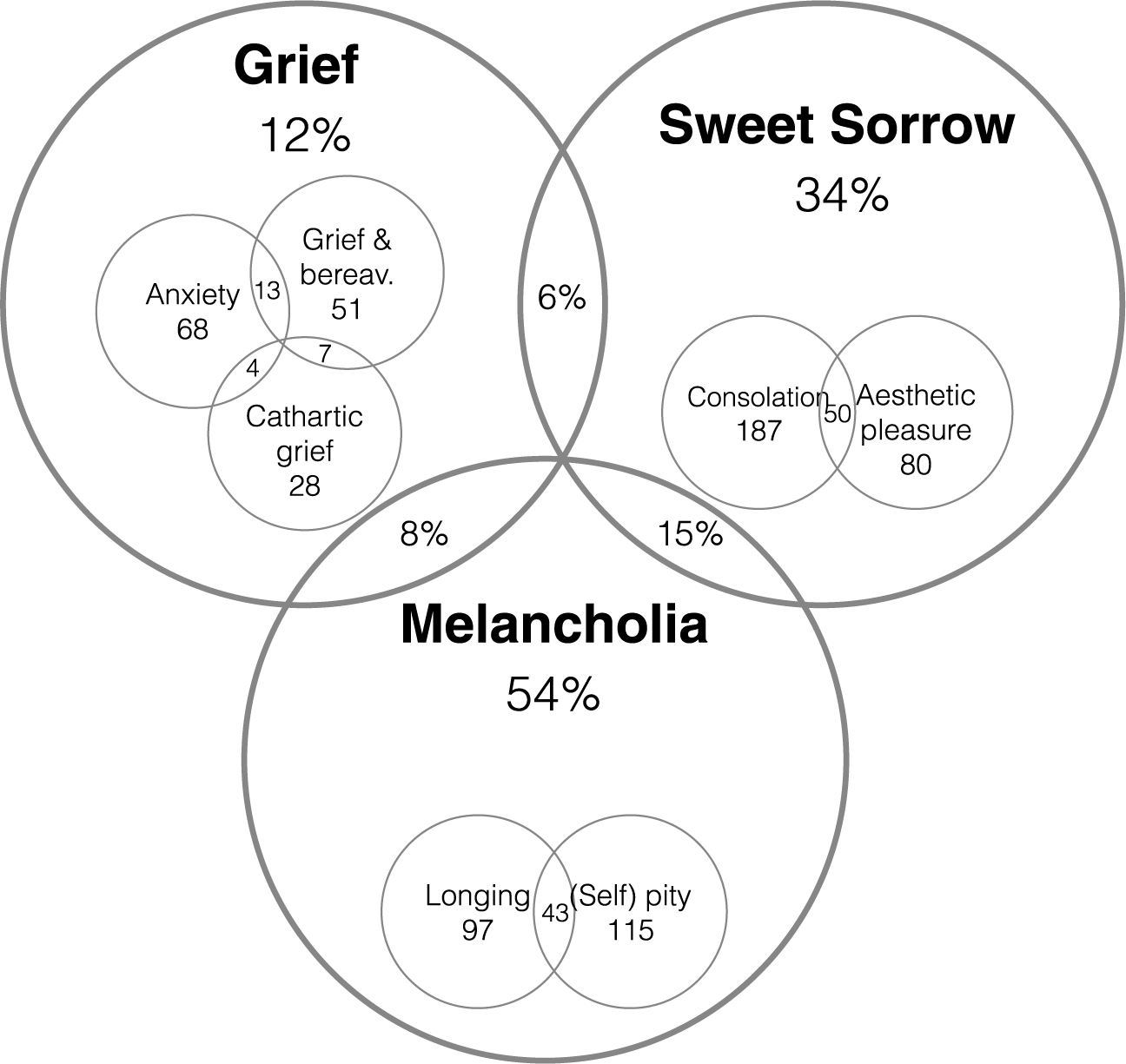
Overlap of the themes (see text for further details).
Conclusions
We have investigated emotional experiences evoked by listening to self-defined sad music. We focused on (i) the kinds of affects that people experience when listening to sad music, (ii) the contextual aspects relating to these experiences, and finally, (iii) how these experiences relate to emotion regulation. A classification of experiences related to sadness associated with music into three distinct themes resulted in both negative (Grief and Melancholia) and positive emotions (Sweet sorrow). This also revealed important differences in how contextual aspects – such as surrounding culture, social settings, and the type of music that was considered as sounding sad – affect conceptualisation of emotions induced by sad music. Since there seems to be different scripts for sadness in different situational contexts, and since there are different musical cues in different genres, it is possible to have many kinds of emotional reaction to many kinds of sad music. Furthermore, variations in the ways people conceptualise sadness and sad music seem to lead to differences in both their affect regulation processes and the overall emotional experience. Besides these differences, the analysis revealed the ambivalent nature of the conceptualised emotions that have resemblance with previous observations of mixed emotions in relation to sad music listening (e.g., Juslin et al., 2011; Vuoskoski et al., 2012). This study demonstrated that – contrary to most of the ideas in previous literature – negative emotions have a salient place within experiences of listening to sad music. In addition to pleasurable emotions, people report having unpleasant, and even painful, experiences of grief-type emotions as well as “everyday sadness” induced by music. Also, many of the experiences are the outcome of undesired emotional reaction – not part of the voluntary affect regulation process – which is an observation given little weight in prior analyses of sadness and music. These three types of experiences were also linked with different contextual situations (life situation, listening situation, the type of music that was heard, listener’s mood, etc.) in which music was related to different affect regulation mechanisms.
The most common mechanisms of affect regulation in these descriptions were (1) memory triggers, (2) (re-)experiencing affects, (3) emotional contagion, (4) social function, (5) cognitive function, and (6) aesthetic value/judgement. It is important to note that, although the same mechanisms were often present within the themes, there were remarkable differences in the valence of these emotional experiences; for instance, cognitive function as well as (re-)experiencing affect within the themes Grief and Melancholia have negative outcomes, whereas in Sweet sorrow they result in a positive experience. Also, in the case of memories evoked by music, the experiential level appeared to be rather unpleasant, as the emotions were mainly negative ones. These findings raise questions about the appropriateness of the previous affect regulation strategies, or at least they challenge the idea of affect regulation being an active, conscious, and goal-directed process (e.g., Taruffi & Koelsch, 2014; Van den Tol & Edwards, 2013). As we have witnessed in the accounts from this study, there seems to be a certain involuntary nature to many of the music-induced experiences, as the affects experienced while listening to music are not always voluntary and going in the desired direction. Interestingly, there seems to be a connection between the empathetic reaction to music and induced negative emotions, as people reported feeling empathetic sorrow made them want to avoid that type of music. This finding conflicts with previous results that suggest that especially those with strong trait empathy enjoy listening to sad music (Vuoskoski et al., 2012), although it is possible that empathising with sad music might only be pleasurable for those with high trait empathy.
The limitations of this study should be addressed. First, the sample of participants is somewhat biased, thus one should be careful not to make strong generalisations based on these findings. Although a convenience sample was utilised, contrary to the previous studies about sadness and music (e.g., Van den Tol & Edwards, 2013; Garrido & Schubert, 2013), the volunteers were not told that the main questions concerned sadness. Also, it is possible that similar data collected from people in another country would be quite different, as Finnish (music) culture – known for its melancholic shades – may have an effect on how sadness and sad music are/have been conceptualised. Methodological choices made in this study have their own drawbacks: the qualitative data comprised of short open-ended answers is not as rich as full interviews would have been. Furthermore, relying on retrospective data is problematic when studying people’s experiences, since retrospective descriptions are vulnerable to memory inaccuracies. It is not possible to verify if the participants’ descriptions equate to their actual experiences, or if the participants were experiencing rapid alternation between multiple emotions that affected their overall experience. Thematic analysis concentrating on differences in valence and arousal of emotional experiences led to the classification presented in this article; another analysis method or chosen focus might have led to a different kind of division between the experiences. However, this classification was well motivated based on the previous literature and how people naturally describe their emotional experiences (Barrett, 2006).
Regardless of these limitations, we propose that classifying experiences in a more nuanced fashion will sharpen the focus of research in future studies of music and sadness. The majority of previous studies have involved the emotions that we would call Sweet sorrow, as the theme appears to be paradoxical and the positive aspects of these experiences have received the most attention. However, this is clearly not the full story since truly negative experiences dominated the responses (Grief and Melancholia accounted for 66% of the coded items). This clearly suggests the need for incorporating different types of emotional experiences in relation to sad music within the field of music research as well as affect regulation research. For instance, here ruminative listening seemed to be typical for experiences of Melancholia, while Aesthetic pleasure appeared to be an entirely different experience. Differences such as these should be acknowledged and incorporated in future study designs for a comprehensive account of the phenomenon.
In conclusion, sadness in relation to music appears to be an intriguingly multifaceted phenomenon. The fact that most of the participants had both positive and negative emotional experiences in relation to sad music listening suggests that previous views on sadness might have been too narrow. We propose that music-associated sadness needs to be broadened and re-defined to encompass the range of emotional responses music is capable of evoking in listeners.
Footnotes
Funding
This research received no specific grant from any funding agency in the public, commercial, or not-for-profit sectors.