




Abstract
Growing up and becoming an active participant in society can be challenging for young people. Factors such as ethnicity, disability and gender can, separately, pose difficulties. When combined, they can develop into insurmountable obstacles. The use of music interventions and activities to overcome some of these obstacles is explored in this article, using two cases of young First Nations people diagnosed with autism, in British Columbia, Canada. Although there are similarities, the differences in severity of ASD, place of residence and school situation, to mention a few factors, make a huge difference in their daily lives. Their contrasting possibilities to be present and participate in society may have implications for their social inclusion in adulthood. Results show that both traditional and contemporary music interventions can provide foundations for inclusion and they need to be carefully designed for each individual.
Being young in today’s world offers many opportunities, but there are also challenges. Challenges can be difficult for any young person, but if the young person is of an ethnic minority and diagnosed with a disability, some of the challenges may prove to be extremely hard, or impossible, to overcome. By discussing the diverse living conditions of two young First Nations people in British Columbia (BC), Canada, diagnosed with autism, this article aims to highlight the use of music as an intervention and activity to overcome obstacles and facilitate social inclusion.
First Nations
First Nations (also referred to as Indians in official Canadian documents) are one of three Aboriginal peoples recognized by the Canadian constitution, alongside the Inuit and Métis (Aboriginal Affairs and Northern Development Canada, 2014). In this article, the terms First Nations and Indigenous will be used except when referring to or citing publications, because Indian and Aboriginal are names that were given to the peoples by the colonists. First Nations can live on reserve land, but also in urban locations. A complex set of regulations defined in the Indian Act determine if a First Nations individual is eligible to have what is referred to as Indian status (Justice Law Website, 2014). This status gives eligibility to both provincial and federal services and funding. According to Aboriginal Affairs and Northern Development Canada (2014), there are more than 50 Nations and over 600 First Nations communities in the country, which illustrates the diversity within First Nations. In British Columbia, the 2011 National Household Survey reported that there were 155,020 First Nations individuals (Statistics Canada, 2015). In Canada, Indian Residential Schools were in operation from the late 1870s until 1996. First Nations children were taken from their families and separated from their culture with the goal of assimilating them to the dominant culture, resulting in cultural genocide (Truth and Reconciliation Commission of Canada, 2015).
Autism
Autism spectrum disorder, ASD and herein also referred to as autism, is a neurodevelopmental disorder that consists of difficulties within two areas: social communication and interaction, and restricted and repetitive behaviours (American Psychiatric Association, 2013). Autism has implications in all aspects of an individual’s life. Some individuals have exceptional skills in music, academia and visual ability, while others are not able to live an independent life (Autism Speaks Canada, 2015). Autism prevalence has risen (Centers for Disease Control and Prevention, 2012). Despite this, autism appears to be underdetected among First Nations children in British Columbia (Lindblom, 2014). British Columbia offers autism funding to families to enable them to purchase intervention services for their child (Ministry of Children and Family Development, 2015). According to Wilkinson (2010) there are many interventions for school-aged children diagnosed with ASD, and he states that “Supporting students with ASD requires individualized and effective intervention strategies” (p. 99). This can be interpreted as a need for cultural sensitivity within Indigenous contexts.
There is a dearth of publications on Indigenous peoples and autism but cultural diversity and autism is an emerging topic in autism research. Although Indigenous worldviews are diverse, they are perceived to be more inclusive than Western disability models. Publications in the Canadian context are difficult to find but there are a few from other Indigenous peoples. Kapp (2011) suggests that Navajo traditional wellness philosophy is inclusive and beneficial to people with ASD. Bevan-Brown (2013, p. 571) notes that “Core Māori values support Inclusion.” Furthermore, Bevan-Brown concludes that bringing these values into education and disability services will result in both cultural sensitivity in support provision and more inclusion for people with disabilities. Margret, Searing, Graham, and Grainger (2015) report the need for culturally designed supports for Māori caregivers of children with ASD in New Zealand.
Music and young people
Listening to music outside of school is important in the lives of most teenagers (North, Hargreaves, & O’Neill, 2000). Adolescents find others more favourable if that person likes the same kind of music (North & Hargreaves, 1999). In a questionnaire study with 2,465 young people in England aged between 13 and 14 years, it was found that the respondents preferred pop music and spent a lot of time listening to music (North et al., 2000). Not many music teachers are educated in Indigenous music, hence, a challenge regarding music in schools is that it may lie beyond what the teachers are comfortable teaching. Music teachers may be more comfortable teaching “the music they know in the way that they were taught and in the way that they were taught to teach it” (Saunders, 2010, p. 72). The implication for Indigenous pupils is that they may not have access to their own cultural music. It has been found that culture-based and language immersion education could be beneficial to First Nations pupils (Morcom, 2014). Moreover, Indigenous knowledge systems should be linked to Western perspectives in order to meet cultural, personal and academic needs of Aboriginal students (Rahman, 2012).
Music and social inclusion
Hargreaves, Purves, Welch, and Marshall (2007) point out that music is powerful in promoting social inclusion and conclude that it has a “vital importance in the lives of young people” (p. 678). Bunt (2012, p. 167) notes the contribution that music therapy can make towards individuals’ ability to cope with difficulties and provide a foundation for social communication and the use of music and sounds to “support social and emotional development.” Accordingly, the aim of this study was to examine how traditional and contemporary music is used to facilitate social inclusion in the two cases.
According to Heyworth (2013, p. 235), music is a school subject that is “social and interactive,” and can help build a sense of belonging. He concludes that “music is a powerful tool for social learning, particularly if used as an integral part of a whole school approach.” Heyworth conducted an action research study to investigate the use of music to enhance students’ learning and to help them develop a sense of belonging and manage their behaviour in a school from a lower socio-economic area in Australia in which 30% of the students in the class were of Indigenous origin. Music was used to build an inclusive culture in the school. Every adult at the school played an important role in this endeavour. In a study on music teachers’ inclusive approaches when teaching students with difficult and challenging behaviours, one of the strategies used to overcome exclusion was “democratizing music learning as a social practice” (Burnard, 2008, p. 59). This required reflective, active teachers.
Reconciliation is a current topic in all Indigenous communities affected by colonialism. In Australia, a project on arts-based service learning involving Indigenous communities and both Indigenous and non-Indigenous students promoted “intercultural reconciliation and reciprocity” (Bartleet, Bennett, Marsh, Power, & Sutherland, 2014, p. 6). Key concepts in the project were “relationships, reciprocity, reflexivity and representation” and Elders from the communities were involved (Bartleet, Bennett, Marsh, Power, & Sutherland, 2014, p. 2). The opportunity for young refugees and immigrants newly arrived in Australia to contribute to school-based music activities with their own culture, for instance music style, instrument or dance, was studied in a project (Marsh, 2012). The outcomes included verbal and nonverbal communication, social inclusion and cross-cultural transmission and interactions between students who speak different languages and come from various ethnic backgrounds. Baines (2013) examines music therapy from an anti-oppressive standpoint as the theories and music that music therapy is based on are derived from Western traditions. She addresses questions of power balance and colonialism in the music-therapy setting.
Music and autism
There is extensive research on the impact of music on human development. In a review of quantitative and qualitative studies concerned with music research and studies of the brain using advanced technology, Hallam (2010) concludes that active engagement with music in early childhood is beneficial to the development of perceptual skills and that positive experiences are necessary for positive outcomes. Social skills, language development and teamwork are examples of areas impacted in the study, which are also areas in which children with ASD are affected. Many studies report positive outcomes from music interventions, music therapy, listening to music or engaging in musical activities for individuals diagnosed with ASD. Social benefits, such as making friends and interacting with peers were reported in a study conducted with adolescents and young adults between the ages of 13 and 30 years (Greher, Hillier, Dougherty, & Poto, 2010). Improvement in social integration was reported as a personal experience of listening to music in a study with high-functioning adults on the spectrum (Allen, Hill, & Heaton, 2009). Furthermore, it was found that although individuals with ASD can have difficulty talking about their experiences of music, they used music for changing mood, relieving tension, reducing loneliness and defining their identity. Marsh (2013, p. 506) found that refugee children in Australia use music “as a vehicle for emotional expression.” For First Nations children as a minority group within a dominant culture, particularly when also having an ASD diagnosis, the use of music to express emotions could be valuable. Individuals with ASD appear to be able to recognize simple emotions when listening to music, and effective music interventions may stimulate the mirror neuron system in individuals with ASD and benefit socio-emotional functioning (Molnar-Szakacs et al., 2009). Music can be used as a coping strategy when, for example, when a person is angry (Duncan & Klinger, 2010).
In a review of music therapy interventions done with children between the ages of 2 and 9 years with diagnoses on the autism spectrum, Gold, Wigram, and Elefant (2010) conclude that research usually involves small samples. They describe music therapy as a way to communicate without verbal language. Simpson and Keen (2011) reviewed literature on music interventions in communication, socialization and behaviour for children with ASD, and although they conclude that more research is needed, some individuals with ASD are responsive to elements of music. The music classroom provides opportunities for students with ASD to succeed both with their behaviour and academically, as many children with ASD have a natural aptitude for music (Darrow & Armstrong, 1999).
Aim and research questions
The aim of this study is to investigate the meaning of music for First Nations children diagnosed with ASD in BC. The research questions addressed are:
- In which ways is music used as a motivator?
- In which ways is music used to facilitate inclusion?
- How is the meaning of music perceived by the children, parents and staff?
- What role does music play in other domains of the children’s lives?
- Is traditional Indigenous music used in music interventions?
Methods and material
This section will briefly describe ethnography as a method. This is followed by a description of myself as a researcher, and how being me has made my research possible. Furthermore, Indigenous research methodologies will be put into the context of my study. For further reading, see Lindblom (2016b).
Ethnography
Ethnography is used to study a community or culture and involves doing field studies in everyday context. The data consists of observations, interviews, and field notes and requires access to the field. Gatekeepers may be able to help the researcher gain access to the community or culture, but relationships must be made (Hammersley & Atkinson, 2007). In ethnographic fieldwork, the researcher and participant affect each other. Emotional consequences have historically been unaccepted or unspoken of in accounts of ethnography, but they are a reality for the researcher and must be taken into account during the whole research process (Blackman, 2007; Erickson, 2011). These relationships cannot be taken for granted and must be acknowledged and treated with respect. Traditionally, ethnography is conducted in one location over a long period of time. This research project can be better described as multi-sited ethnography (Marcus, 1995) in which a research topic, First Nations children diagnosed with ASD, is followed in several places for shorter periods. Given the scarcity of First Nations children with ASD in BC, it was necessary to go to the locations where they live. This entailed covering an area of over 1000 kilometres to visit the five participants in the study.
The researcher
An important factor in gaining access to the field has been who I am. In the Western context, being a researcher may confer credibility, but coming into an Indigenous context, meeting with people on reserve, in their homes, and wanting to talk about their children, meant that I needed to prove myself trustworthy and credible in ways other than academic. I am fortunate that, with regard to the Indigenous context, I have some things in my favour such as growing up in BC and having paternal sisters who are First Nations (these factors are briefly mentioned in Lindblom, 2016b).
Indigenous research methodologies
Indigenous research methodologies have been emerging for a couple of decades as Indigenous researchers have reacted to the misfit of Western methods with the epistemologies, protocols and traditions of the peoples being researched. Linda Tuhiwai Smith’s (2012, p. 1) statement has been greatly cited since the first edition came out in 1999, “The word itself, ‘research’, is probably one of the dirtiest words in the indigenous world’s vocabulary.” According to Geertz (1973/1993, p. 5), researching culture is an interpretive search for meaning. Historically, these interpretations have misrepresented the researched cultures. The historical trauma of colonialism is still present in the everyday life of First Nations people in BC and, as a Western, non-indigenous researcher, it is important not only to address Western research ethics, but also position myself within Indigenous worldviews and to respect protocol. In practice, this means that I must reflect on every step of my research to ensure that I am being ethically responsible. I am accountable to all my relations, which Wilson (2008) refers to as relational accountability. One example of respecting this accountability in the study is the follow up interviews in order to ensure correct interpretation of the participants’ and informants’ statements.
Research ethics
In the initial stage of the study, ethical approval was sought and granted by the ethical committee at the University of Eastern Finland (UEF). All participants (with the exception of Connor) and informants gave their written consent after receiving written and verbal information about the project. Connor consented nonverbally by accepting my presence and during the first visit at school by coming up and leaning against me. The consent form included information about the aim of the research and publication intent. Transcripts will be stored at UEF after the project is finished and recordings and video-recordings will be destroyed in accordance with UEF regulations. All names have been changed and tribal affiliation and locations excluded to ensure confidentiality (Creswell, 2009). Approval was not sought from any tribal council as the participants come from different First Nations bands and the research was not done on reserve.
Material
Ethnographic fieldwork consisting of interviews, observations, field notes, filmed observations and music interactions with the researcher has generated the material used for this article. The material was collected during 6 weeks in 2013 and 6.5 weeks in 2014 in home, school and after-school club settings. Interviews were transcribed in verbatim, analysed and manually colour-coded in accordance with the five research questions (music as a motivator, music for inclusion, the meaning of music, the role of music in other domains, and the use of traditional Indigenous music) which became the themes. A grid with music activities was filled out before or during the first interviews regarding types of activities, where they take place, alone or with others, etc. The First Nations children with ASD are referred to as participants and the parents, family members, teachers and other professionals as informants.
After the first interviews in 2013, mind maps were made from the transcripts, one with general information and one about music. In the follow-up interviews, the mindmaps were discussed and the participants and informants could confirm the interpretations, make changes or update with new information. In addition to this, the accounts were written as narratives, including material putting music in the context of the young people’s life situations. Field notes from observations were read through and colour-coded in the same manner as the transcripts. Selected sections of filmed material from observations and interventions were analysed and coded in the ELAN program, which allows frame by frame viewing and is useful when analysing nonverbal data (Lausberg & Sloetjes, 2015). The data from all methods (interviews, follow-up interviews, observations, video-filmed observations and field notes) were examined using the themes. This technique is referred to as triangulation (Hammersley & Atkinson, 2007).
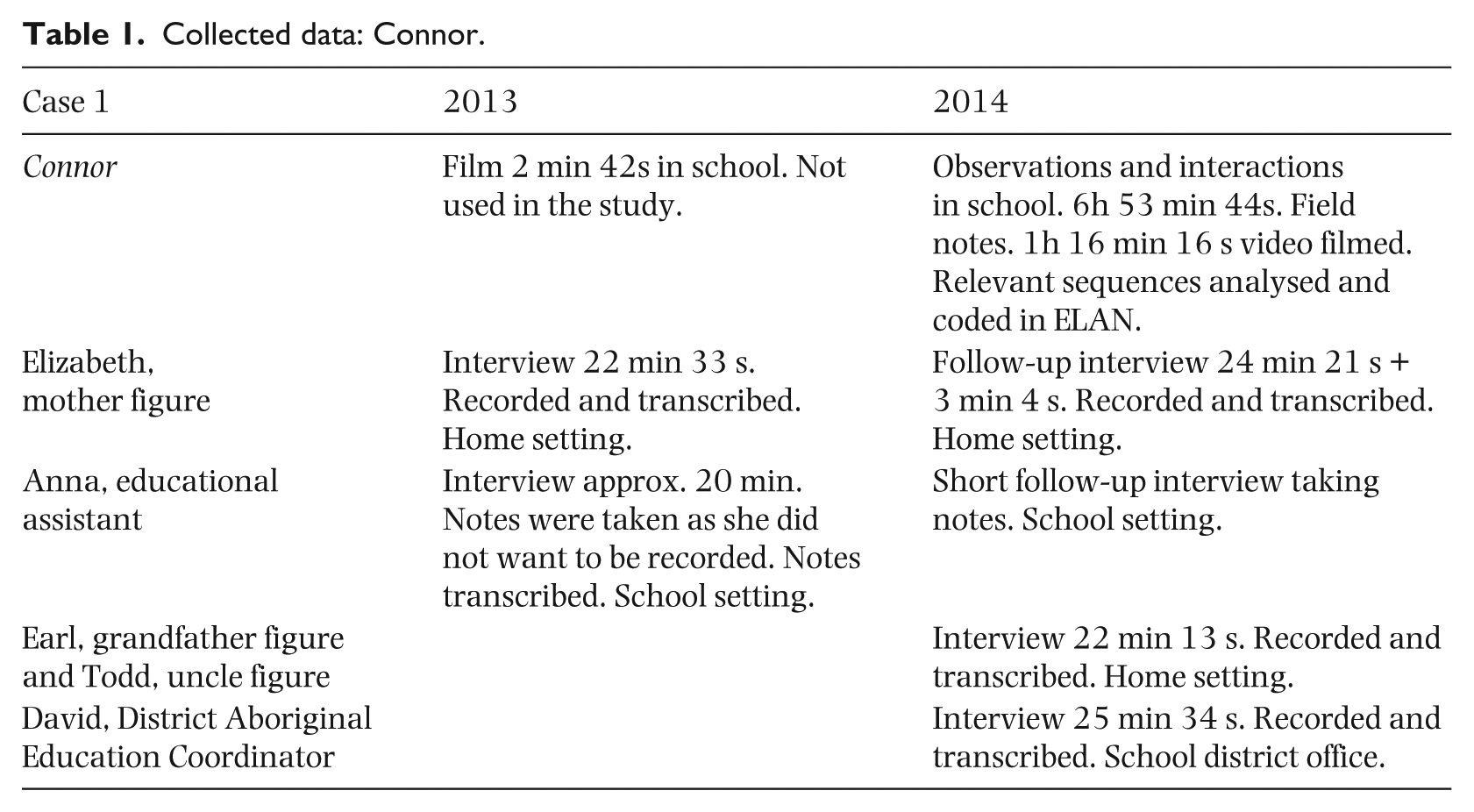
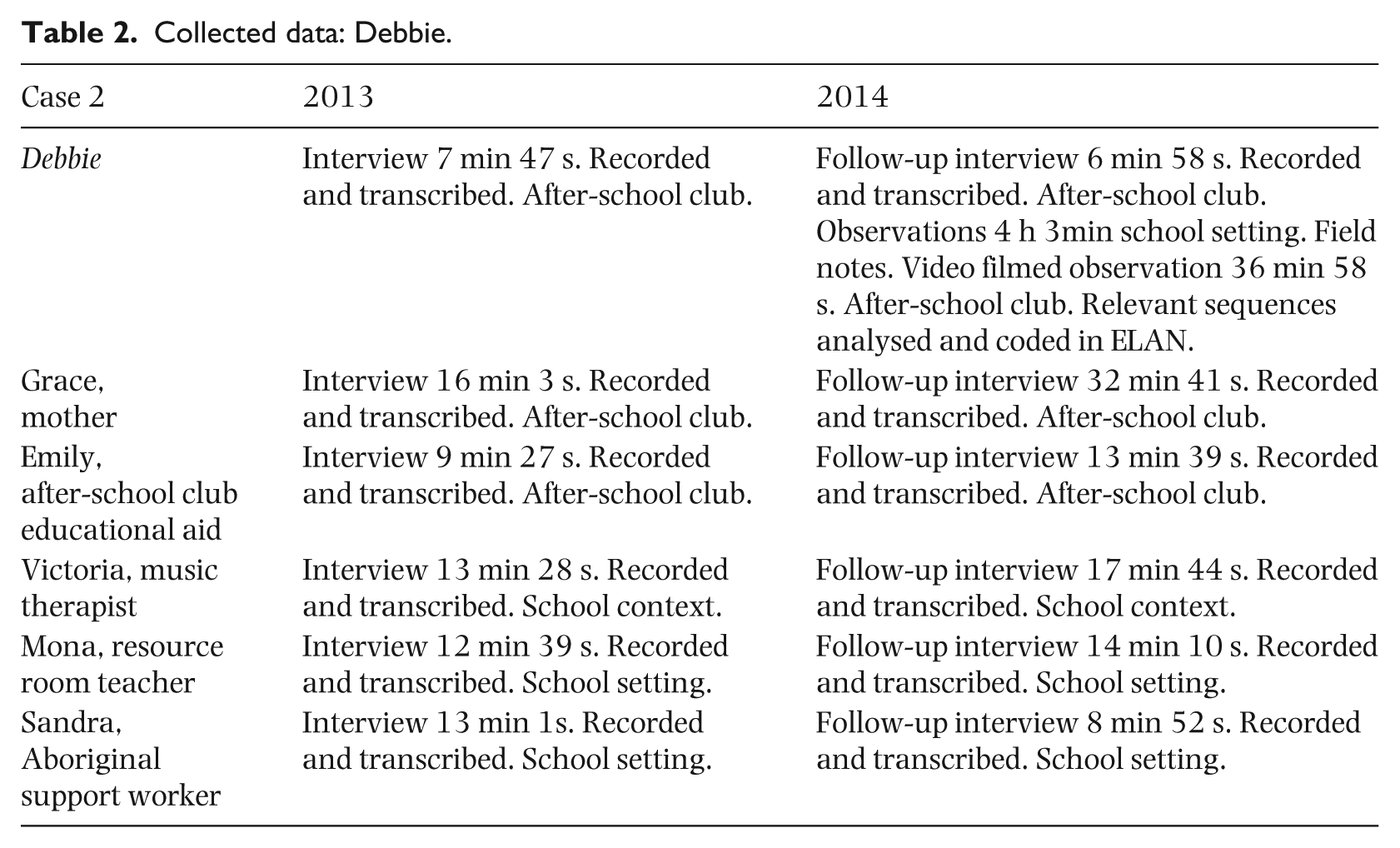
This article aims to emphasize the use of music as an intervention and activity to overcome obstacles and facilitate social inclusion using two contrasting cases from a total of five. The two cases illustrate how diverse conditions can be for First Nations children with ASD, even if they seem similar from the onset. They are also the cases with most collected data; see Tables 1 and 2. All five cases are described and analysed in another publication (Lindblom, 2016a) and will also be used in the forthcoming dissertation at the University of Eastern Finland.
Collected data: Connor.
Collected data: Debbie.
Cases
In the following section, two cases will be presented by age, gender, status, disability, family and living conditions, and school environment. How music is used and the meaning of music is incorporated in the descriptions.
Connor
Connor, an 8-year-old boy with Indian status, was diagnosed with autism around the age of 1. At first the doctors thought Connor might have Fetal Alcohol Spectrum Disorder (FASD) because his mother was diagnosed with that. They had to go about 300 kilometres to access diagnosis services. Connor is minimally verbal and has severe social and communication problems.
Try talking to him just in case . . . he might answer someone . . . We’re not gonna talk to him in English all the time. He’s got to talk our language too. (Earl, Connor’s grandfather figure)
When he was a baby, his mother died of cancer. The family who had taken care of his mother since she was a child now cares for Connor. In 2013, there were four generations living together in a house on a reserve in a rural area. Everyone in the family helps to take care of Connor and have different roles.
. . . we all make the main caregiver . . . Chip in, take turns . . . (Elizabeth, Connor’s mother figure)
The elders, grandmother and grandfather figures, have now passed away, but the grandmother used to listen to Indigenous music and watch the Aboriginal Peoples Television Network in the house. The grandfather, Earl, and his son Todd, the uncle, are the custodians, and Todd takes care of all the financial business and paperwork. The mother figure Elizabeth takes care of the nurturing of Connor in the home environment, but also when they go for doctor appointments and other meetings.
. . . I go with them with the meetings but I try and put my input in and that, but usually I’m running after him ’cause he’s in the office getting into things. (Elizabeth, Connor’s mother figure)
Her son, Dennis, is the brother figure and takes Connor to school every day and also picks him up and brings him home. Betty, the sister figure, helps take care of Connor at home. The family is taking care of Connor, but has not received formal custody yet, which they say is why they do not get any autism funding. The First Nations band helps out too, and sometimes gives the family money for gas to travel the 300 kilometres to the doctor. They also give them a room to stay in.
Connor can be violent and sometimes hurts himself or others. The family must choose activities very carefully. Most of the time, someone stays at home with Connor. Every week or so, some people come from the college and observe Connor to see what he likes doing and how he behaves.
Connor and music
Connor used to hear Indigenous music at home before the grandmother figure passed away. Sometimes Dennis plays it in the vehicle when he drives Connor to or from school. He is afraid of loud noises so they cannot take him to band functions. Elizabeth thinks he would like drumming and singing just with her.
If he’s with somebody, the it’s just one person . . . He’s not comfortable with crowds. (Elizabeth, Connor’s mother figure)
During musical interactions involving an Indigenous song and drum, Connor engaged in eye contact, playing the drum and singing (see figure 1).

Excerpt from coding in ELAN
He also showed interest when watching a video on his iPad where a woman from his Nation sang and played the drum. Connor does not sing, but he hums a lot. Connor likes listening to Sesame Street and ABC songs when he is in the mood, but what he likes changes all the time.
But he likes Lady Gaga . . . When mom was alive we would drive him around and I found a CD we had in there . . . When we turned it off, Connor would get angry. (Todd, Connor’s uncle figure)
He has had a few small instruments at home, but they have all been broken. Sometimes he can relax to sounds of water. On a scale from one to ten, Elizabeth thinks the meaning of music for Connor is a seven.
Connor spends most of his school day with an educational aid in his own small room. Sometimes he listens to music there, from his favourite movie, Cars, for instance. He enjoys one-on-one singing and loves dancing to music. He loves piano music and likes playing the piano. His educational aid Anna thinks guitar music might be soothing for him and drums motivational.
Haven’t tried the Indian drum. (Anna, Connor’s educational aid)
Anna says Connor uses humming for communication. She thinks two to three people would be good in musical situations and that the meaning of music is nine to ten for Connor.
Debbie
Debbie, a 16-year-old girl with Indian status, was diagnosed with autism at the age of 4. Diagnosis services were available in a nearby city. Debbie is very social and verbal. Debbie lives with her mother and older sister, off reserve, in a city. Her father passed away when she was quite young. Debbie’s mother has adapted their life around what works for Debbie, which means routines and structure.
. . . then we go home and it’s like right to her room. She wants the radio on. It’s very routine. It’s very much structured. (Grace, Debbie’s mother)
At times, Debbie can have violent tantrums.
. . . whatever. . . keeps her stable . . . anything to prevent a tantrum. (Grace, Debbie’s mother)
Autism funding provides two workers, and another worker is financed through a fund. One worker has Debbie every day at the after-school club, and one takes her out once every other week for some exercise.
. . . then the one that takes her Sundays for a few hours . . . (Grace, Debbie’s mother)
Debbie and her mother usually stay at home in the evenings after six o’clock. The last time we met, I told Debbie I was going back home and we probably would not meet again. She asked why and then declared she would miss me (field notes, 2 June 2014).
Debbie and music
Debbie loves music and music is a big part of her daily structure at home, in school, at the after-school club, in every situation every day of her life. Her mother Grace, music therapist Victoria, and Emily her worker at the after school club, think the meaning of music for Debbie is a ten on a scale from one to ten.
. . . I don’t think she’s gone a day without hearing it somehow . . . (Grace, Debbie’s mother) . . . it struck me that if there was no music in her life I could see her being a very different person, because she . . . gets very excited, she’s smiling, singing along when there’s music . . . if that wasn’t in her life it would be a huge gap in her and who she is. (Victoria, Debbie’s music therapist)
Mona, her resource room teacher, thinks it is an eight or nine.
. . . She uses music to . . . make the world a safer place for herself . . . when she’s listening to it she feels good, she feels happy, so that’s why I let her listen to it . . . (Mona, Debbie’s resource room teacher)
Debbie has difficulty verbally expressing music’s importance and the songs she likes, but answers direct questions.
Could you go a day without music? (Emily, Debbie’s worker at the after school club)
No (Debbie)
Debbie enjoys listening to her favourite radio station, watching music videos and singing and dancing.
It’s just a natural talent. (Grace, Debbie’s mother) . . . and knows every word to every song. It’s pretty amazing. She’s pretty unique. (Sandra, Aboriginal support worker)
Debbie likes popular dance music, which means that sometimes the lyrics or dance moves are inappropriate in the school setting. She also can get overly excited. A couple of songs by one particular group can cause her to get agitated.
. . . I think there are certain songs that everybody knows will set her off. (Mona, Debbie’s resource room teacher)
At the after-school club, Debbie enjoys performing.
. . . ’specially the kids downstairs, they all ask her to sing. (Emily, Debbie’s worker at the after school club)
There was a youth group at the after-school club where Debbie would interact with peers in singing and dancing. Unfortunately, it was shut down. Sensitivity to loud noises prevents Debbie from attending assembly at school or going to concerts. Grace, her mother, has tried taking her to a jazz festival, but they had to leave.
She couldn’t stand the noise. (Grace, Debbie’s mother)
At home, Debbie has access to keyboards and a guitar. She has not played them, but has recently expressed the interest in learning how to play the guitar. She has taken a voice lesson, but did not like sitting still and following instructions. At school, Debbie participates in music therapy in the resource room. Peers come in for music therapy, something they call reverse integration. Music is not used as a tool for inclusion.
Well because she’s already in a special needs classroom so I guess there’s less emphasis on inclusion. (Victoria, Debbie’s music therapist)
There she plays small rhythm instruments. At summer camp Debbie has played instruments and is going to try musical theatre.
Debbie has not heard much Indigenous music but her mother has an uncle who has a dance troupe which she has seen. Occasionally, in Aboriginal class in elementary school, Indigenous music was played in the background. When they had pow wow dancing, Debbie did not participate. In high school, they have an optional Aboriginal class that Debbie is taking.
. . . it gives them a place to be proud . . . (Grace, Debbie’s mother)
There she has made her own drum and participated in drumming.
I played on my own drum (Debbie)
Oh, did you like it? (researcher)
Oh yeah (Debbie)
Did you like it as much as you like the music on your iPod? (researcher)
Yes (Debbie)
Discussion
This article examines music interventions as a facilitator for social inclusion for First Nations children in British Columbia, Canada, diagnosed with Autism Spectrum Disorder. Despite the limitation that only two cases are included, it may provide an important contribution to the field as there is no prior research with this focus. On the surface it may seem that the same conditions apply for both Connor and Debbie, as they both are young First Nations people and have both been diagnosed with ASD. In their cases, gender may play a minor role in their possibilities for social inclusion, but this has not been investigated in this article. Adolescents find others more favourable if they like the same kind of music (North & Hargreaves, 1999), so Debbie’s talent for learning lyrics and singing popular songs could make it easier for her to interact with peers. For Connor, being minimally verbal and having severely impaired social and communication skills can prove to be a bigger obstacle. Nonverbal communication can be enhanced and social inclusion promoted by school-based music activities if pupils can bring their own cultural heritage to the group, for instance, music style or dance (Marsh, 2012). Music therapy is defined by Gold et al. (2010) as a means to communicate without verbal language. These opportunities could be beneficial for Connor in his social development (Bunt, 2012). Both Connor and Debbie are sensitive to loud noise, which has limited their ability to attend and participate in Indigenous functions, both with family and in school settings. Hallam (2010) found that active, early childhood engagement in music activities has a positive impact on the development of perceptual skills. This could have implications for music interventions and support in education.
Connor lives on reserve, which makes access to the Indigenous culture easier. His exposure to his culture has been limited to being able to hear music and see culture on the television at home with his grandmother figure. Connor lives in a family where everyone participates in providing him care, albeit in different roles. Connor rarely leaves the house after school because of his behaviour, and in school he spends most of his time in a small room with an assistant. The First Nations Band also contributes by providing money for petrol and hotel rooms when they have to visit the doctor. This is very helpful as the family has no autism funding. The way that the family, and the Band, take care of Connor can be seen as a more traditional or Indigenous way of living. Indigenous worldviews, such as those of the Navajo (Kapp, 2010) and Māori (Bevan-Brown, 2013), hold values that promote inclusion, which is beneficial to people with ASD and other disabilities.
Debbie lives off reserve, which makes access to Indigenous culture a little bit more difficult. Debbie lives with her mother and sister, and although they usually do not go out after 6 p.m., they sometimes go on little trips and mini-vacations on weekends. Debbie has autism funding (Ministry of Children and Family Development, 2015), which enables her to go to an after-school club, to go exercising and to go out on Sundays. She also has been to camp. Debbie is very interested in pop and dance music but has taken Aboriginal class since she started high school. There she has made a drum and participated in various cultural activities. She says that she liked playing the drum and singing as much as she likes the music on her iPod. She has been more exposed to pop music than other forms of music, which may have to do with her teachers’ lack of knowledge of Indigenous music and reliance on teaching what they know (Saunders, 2010). In Aboriginal class, all but one pupil are Indigenous, which means that opportunities for cross-cultural transmission (Marsh, 2012) and intercultural reconciliation (Bartleet et al., 2014) are limited at best. Debbie also uses music to make herself feel happy, which supports findings in previous research (Allen et al., 2009; Marsh, 2013). At school, Debbie attends a resource room but also goes to regular classes for some subjects. Debbie and her family live in the community and receive services through autism funding. This can be seen as a more contemporary or Western way of living.
It is important to point out that Indigenous people can be, and most likely are, both traditional and contemporary at the same time. Therefore, both traditional and contemporary music offer possibilities for social inclusion. Connor is still quite young and likes ABC songs and music from contemporary films such as Cars. He also likes Lady Gaga. If music interventions were designed so that he could participate with a few peers, his interests could provide a foundation for inclusion (North & Hargreaves, 1999). Culturally-sensitive music interventions could enable interaction with others within the First Nations community (Bartleet et al., 2014; Morcom, 2014; Rahman, 2012). Connor is minimally verbal and sensitive to sound, which means interventions have to be carefully designed. Debbie seeks out every chance to sing and be a part of music, which, especially in the after-school context, gives her many opportunities to interact with peers. She knows all the newest songs and dances and is a good singer. In the musical context, her autism is perhaps more of an asset, and is not an obstacle. Although she has not been exposed to much traditional music, she likes it very much, and has made her own drum in Aboriginal class. This has included her in the Indigenous context with her peers.
Closing remarks
Although Connor and Debbie’s families have built their lives around the care and support needed for their social and communicative difficulties related to autism spectrum disorder, their situations are very different.
Connor is not included in the school setting although attempts are made to integrate him in some activities by bringing him in to different settings. He is rarely seen on the reserve; perhaps only on short walks or in the car to or from school. There appear to be many obstacles in the way of social inclusion for Connor in the community that the reserve is situated in.
Debbie attends a resource room at school but goes to several regular classes in which she participates. To determine if these situations can be defined as inclusion, this would have to be observed and studied. When going to and from other classrooms, Debbie says hello to other pupils and they respond. Her resource room class goes for a walk every day and Debbie recognizes people and places. At the after-school club, everyone knows Debbie and often they want her to sing for them. When they had a youth club there, Debbie often sang and danced with other young girls her age. In the community, Debbie goes out both with her family and with workers and has gone to summer camp. Debbie appears to have several possible routes for social inclusion.
For young First Nations people like Connor and Debbie, both designed culturally-sensitive and contemporary music interventions could make a difference in facilitating social inclusion. In Australia, there have been successful projects that actively use music as a tool for inclusion with both Indigenous and non-Indigenous students (Bartleet et al., 2014; Heyworth, 2013). Social skill interventions are needed in various settings such as school and community so that adolescents with ASD can transition successfully to, for instance, secondary education and employment (Duncan & Klinger, 2010). Music could be such an intervention where social skills can be utilized. However, Saunders (2010) points out that music teachers may prefer teaching the way they were taught and the way they were taught to teach, which may impede access to Indigenous music for First Nations children.
Many First Nations people are distanced from their culture due to colonialism and have been educated according to Western tradition. Educators need to be aware of the power imbalance created since theories and music used in music therapy come from Western traditions (Baines, 2013). Increasing democracy in music education is important when creating inclusive approaches to teaching students with challenging behaviours (Burnard, 2008). This may be a challenge when designing culturally-sensitive music interventions. First Nations are diverse, thus, designing such interventions would require educators with competence within specific First Nations cultures. More research is needed, and collaborating with First Nations Bands and Elders could be a step in the right direction. Bartleet et al. (2014) conducted a project in Australia involving Elders with Indigenous and non-Indigenous university students with a positive outcome. The key concepts in the project could be applicable to the educational context for younger Indigenous children in other countries.
Debbie’s mother Grace says that Aboriginal class “. . . gives them a place to be proud.” I believe that the Indigenous music itself also can be seen as a room filled with many opportunities for those who enter.
Footnotes
Acknowledgements
I want to give special thanks to my Indigenous family members and all the Indigenous participants, informants and gatekeepers who have been a part of my research project. I also want to thank The University of Eastern Finland; Karlstad University, Sweden; Stiftelsen Kempe-Carlgrenska Fonden, Sweden; Stiftelsen Lars Hiertas Minnesfond, Sweden; and Helge Ax:son Johnssons Stiftelse Sweden, for making this research project possible.
Funding
The author(s) disclosed receipt of the following financial support for the research, authorship, and/or publication of this article: Stiftelsen Kempe-Carlgrenska Fonden, Sweden; Stiftelsen Lars Hiertas Minnesfond, Sweden; and Helge Ax:son Johnssons Stiftelse Sweden.