




Abstract
The exposure of young people to alcohol in the media is a major concern given its potential impact on drinking behaviours. Young people spend increasing amounts of time listening to popular music, within which US studies have found a growth in alcohol references and brand promotion. Little information exists on alcohol-related content in UK popular music despite its international influence. We examined the lyrics of Top 10 UK singles in 1981, 1991, 2001 and 2011 for references to alcohol. Prevalence of alcohol references increased sharply between 2001 and 2011, when almost one in five (18.5%) songs referred to alcohol and one in eight (12.6%) to heavy drinking. In multivariate analyses, alcohol-related lyrical content was associated with the year 2011, Urban music genres (R&B/Rap/Hip-Hop) and artists from the USA. Alcohol-related references were often positively framed, linking alcohol use to valued attributes and favourable outcomes. Up to 3.0% of songs contained branded alcohol references. Further research should identify the impacts of alcohol references in lyrics on drinking attitudes and behaviours. Health and other professionals should recognize increased alcohol promotion in popular music and ensure this does not reinforce binge drinking culture or contribute to already high burdens of alcohol on young people.
Listening to music is one of the most popular leisure time activities for young people across the globe (Louie, 2003; Nippold, Duthie, & Larsen, 2005; Roberts & Foehr, 2008; Schramm, 2006; Yin, 2005); providing entertainment, a distraction from life’s problems and a means of identity formation and integration into youth culture (North, Hargreaves, & O’Neill, 2000). Popular songs are played repeatedly by radio stations, music television channels and young people themselves, increasingly through new digitalized platforms such as computers, mobile phones and MP3 players. Studies suggest that these new platforms are increasing young people’s access to music (Australian Communications and Media Authority, 2010). In 2009, 8–18-year-olds in the USA were estimated to spend an average of 2 hours and 19 minutes per day listening to music (Engels, Slettenhaar, ter Bogt, & Scholte, 2011). In the same year, UK surveys found that the average digital music collection of 14–24-year-olds contained 8,159 tracks (Bahanovich & Collopy, 2009) while 65% of teenagers were regularly streaming music from sites such as YouTube (The Leading Question and Music Ally, 2009). With such widespread music exposure, debate exists as to the effects of lyrical content on young listeners; particularly as digital music consumption can mean parents have little knowledge of or control over the music their children listen to. Whilst some studies have suggested that children pay little or no attention to the actual words of a song and that understanding is limited and related to the listener’s personal lived experiences (Greenfield et al., 1987; Sousou, 1997), others have argued the opposite (Wass, Miller, & Stevenson, 1989) and raised questions concerning the influence that the music industry may have on the development of social attitudes and behaviour (Daykin et al., 2009).
A number of studies have examined the extent and nature of references to alcohol in the lyrics of popular music (e.g. Herd, 2005; Oksanen, 2011; Primack, Dalton, Carroll, Agarwal, & Fine, 2008; Primack, Nuzzo, Rice, & Sargent, 2012). Although media are generally assumed to influence behaviour primarily through effects on consumer attitudes and brand salience (Engels, Hermans, van Baaren, Hollenstein, & Bot, 2009), it has also been suggested that alcohol-related lyrics may be connected to certain traits, goals and stereotypes that, when activated, may lead to increased alcohol consumption (Dijksterhuis, Smith, van Baaren, & Wigboldus, 2005). In addition to such habit formation and the normalization of excessive drinking behaviours, the social learning model suggests that behaviours can be learned through exposure to modelled behaviour and subsequent imitation, such that individuals exposed to representations of alcohol use are more likely to go on to replicate drinking behaviours themselves (Quigley & Collins, 1999). Perhaps crucially, Bargh, Chen and Burrows (1996) argue that the priming effect of particular words (i.e., alcohol references) on thoughts, perceptions and behaviour can occur even when the stimulus has not been consciously recognised, as may be the case with specific lyrical content that is difficult to comprehend. Evidence exists to support this notion, with study participants consuming more alcoholic drinks when exposed to alcohol portrayal in films and commercials (Engels et al., 2009), and when visiting licensed establishments in which music incorporating alcohol references was played aloud (Engels et al., 2011).
In the UK, alcohol and drinking behaviours are widely discussed and presented by youth-focused media, often being portrayed as normal and unproblematic (Atkinson, Elliott, Bellis, & Sumnall, 2011; Daykin et al., 2009). This has prompted concerns that media portrayals of alcohol may be contributing to the culture of excessive alcohol use found among young people. The 2011 European School Survey Project on Alcohol and Other Drugs (ESPAD), for example, found that 85% of 15–16-year-olds in the UK had used alcohol in the past 12 months, with 26% reporting having been drunk in the last 30 days, compared with 17% on average across Europe (Hibell et al., 2011). Such excessive alcohol use is associated with a range of harms including overdose, unintentional injury, risky sexual behaviour, violence, and involvement in antisocial behaviour (Champion et al., 2004; Charalambous, 2002; Cook et al., 2010; French & Maclean, 2006; Swahn, Simon, Hammig, & Guerrero, 2004;). Early initiation to alcohol and heavy drinking in adolescence also increases the likelihood of continued heavy drinking and alcohol dependence in later life (Hingson, Heeren, & Winter, 2006).
Although research suggests that alcohol references are not only noteworthy in their widespread inclusion in song lyrics across all genres (Primack et al., 2008; Roberts, Henriksen, & Christenson, 1999) but also increasing in prevalence (Herd, 2005), studies have been conducted almost exclusively in the USA and relatively little is known about the frequency and nature of alcohol references within the UK charts. Despite the UK accounting for less than 1% of the world’s population (United Nations Population Division, 2010), its music industry accounts for around 10% of total music revenue globally, making it one of the world’s largest music markets (after the USA, Japan and Germany; Ofcom, 2011). Thus, this study aims to develop understanding of the extent of, and changes in, alcohol-related references in popular music by examining the lyrical content of songs appearing in UK Top 10 singles in 1981, 1991, 2001 and 2011.
Method
Sample selection
The most popular songs in the UK in 1981, 1991, 2001 and 2011 were identified using the Official Singles Chart, compiled by the Official UK Charts Company Ltd (www.officialcharts.com). This chart is based on a survey across a panel of all significant retailers (high street chains, independent stores, supermarkets, internet mail order and download services) and purportedly accounts for 99% of all singles sold in the UK (Official Charts Company). All songs that reached a Top 10 chart position in the target years were included, providing a dataset of 611 unique songs; 137 from 1981, 141 from 1991, 198 from 2001 and 135 from 2011. Lyrics for each song were obtained from well-known web-based lyrics databases, with two or more sources corroborated for accuracy (e.g. www.lyrics.com; www.azlyrics.com). In cases of discrepancies between proposed lyrics, original recordings of the songs were screened and lyrics transcribed.
Coding procedures
The lyrics of each song were assessed independently by two researchers to identify references to alcohol and alcohol consumption. Attention was paid to frequently used slang terms related to alcohol use (e.g. booze, wasted). Lyrics referring only to the act of drinking that did not occur within an alcohol-related context such as nightlife environments or parties and did not reference alcoholic beverages directly (e.g. “Sippin’ on a different drink,” Snoop Dogg vs. David Guetta – Sweat, 2011) were not included as alcohol references. Non-specific references to drinking establishments in which there was no mention of actual beverages or consumption (e.g. “We’re dancing on the bar,” The Saturdays – All Fired Up, 2011) were also deemed too ambiguous for inclusion. For those songs that contained alcohol references, data were collected on whether the song referred to multiple alcoholic drink consumption or drunkenness (referred to as heavy drinking; e.g. “Drank too much last night, got bills to pay, my head just feels in pain,” Dido – Thank you, 2001), and whether alcohol was framed with positive, neutral or negative connotations (e.g. positive: “And in the end drinking Hennessey made all my enemies envy me,” 2Pac – Until the End of Time, 2001; vs. negative: “He like a cowboy died drunk in a slumber,” Squeeze – Labelled with Love, 1981).
Additional data were collected to categorise the genre of the song (Pop, R&B/Hip Hop/Rap [referred to as Urban], Dance, Rock/Metal, and Other): whether the song was performed by a solo artist, a group or a collaboration between artists (e.g. Jennifer Lopez, featuring Pitbull); the gender and nationality of the artist(s); the song’s highest chart position (identifying those that reached number one); and how long the song remained within the Top 40 charts (less than or more than 10 weeks). Cohen’s Kappa was used as a calculation of inter-rater agreement for each of the variables above. Agreement between raters was high for the existence of alcohol references (k = .856, p < .001). Slightly less agreement was found when rating the valence attached to alcohol consumption (k = .683, p < .001) and references to drunkenness or quantities of alcohol consumed (k = .557, p < .001). Where the two researchers were found to disagree, a third independent researcher adjudicated.
Data were analysed using SPSS version 17. Analyses used chi squared for bivariate exploration. Backward conditional logistic regression was used to identify independent relationships between alcohol or heavy drinking references and attributes of a chart entry.
Results
Changes in chart composition
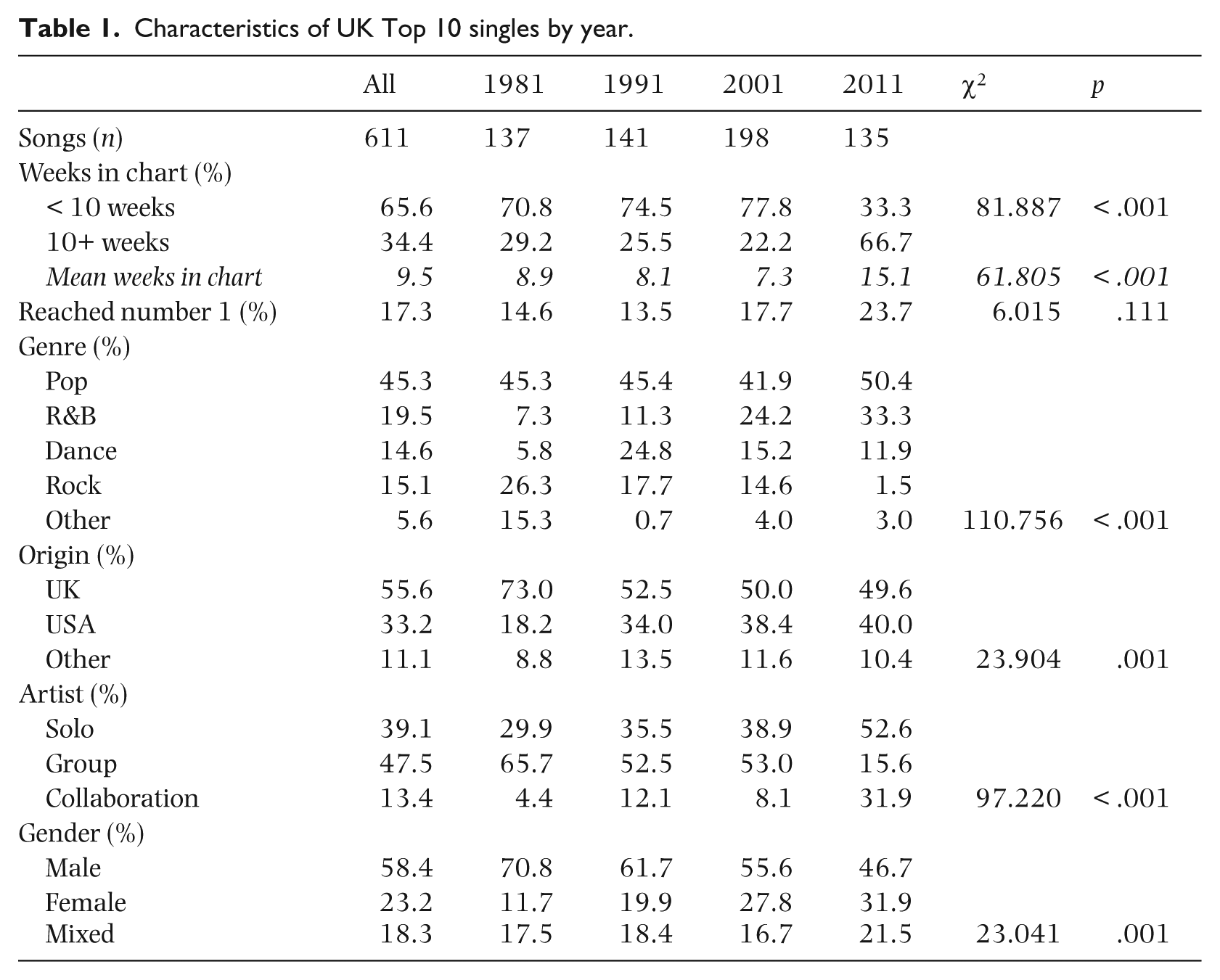
Songs reaching a Top 10 position in 2011 remained in the Top 40 Singles chart for significantly longer than Top 10 singles from earlier years, with the mean chart run in 2011 extending just over 15 weeks (Table 1). Despite increased chart longevity, more songs reached number one in 2011 than in previous years, although this difference was not significant. Pop music was consistently the most popular genre across all focal years, although the second most popular genre changed from rock music in 1981, to dance music in 1991, and Urban music in both 2001 and 2011. From 1981 to 2011, the UK singles chart became less insular and more influenced by songs from the USA. Whilst 73.0% of Top 10 songs in 1981 were of UK origin, this dropped to less than half in 2011 when songs from the USA made up 40.0% of Top 10 singles. Significant differences were also seen in the types of artists achieving Top 10 songs. Over half of songs reaching the Top 10 in 1981, 1991 and 2001 were recorded by groups, yet this dropped sharply to 15.6% in 2011 when solo performers and collaborations dominated the Top 10. The predominance of male artists seen in 1981 (70.8%) also gradually declined across subsequent years, with female artists accounting for almost a third of hits in 2011.
Characteristics of UK Top 10 singles by year.
References to alcohol and heavy drinking
The proportion of Top 10 songs containing reference to alcohol increased sharply between 2001 and 2011 (Table 2). In 2011, almost one in five (18.5%) Top 10 singles referred to alcohol and one in eight (12.6%) referred to heavy drinking. Although there was no relationship between reaching the top of the charts (number one) and alcohol references, songs that remained in the charts for more than 10 weeks contained significantly more references to alcohol and heavy drinking. Both types of reference were also more prevalent in Urban songs (20.2% and 10.1% respectively) than any other music genre. Songs from the USA contained significantly more references to both alcohol and heavy drinking than those from the UK or elsewhere. Songs released by collaborating artists were more likely to contain alcohol references but the relationship between artist type and heavy drinking content was not significant. No relationship was found between alcohol or heavy drinking references in lyrics and the gender of the artist.
Prevalence of alcohol references and heavy drinking references in Top 10 singles by year and song characteristics.

Alcohol = song refers to alcohol at least once.
Heavy drinking = song refers to either being drunk or drinking multiple drinks.
Only 11 songs across the 4 years contained reference to specific alcohol brands (1981, n = 1, 0.7%; 1991, n = 0; 2001, n = 6, 3.0%; 2011, n = 4, 3.0%), with branded products appearing in 12.5%, 0%, 37.5% and 16.0% of songs with alcohol-related lyrics, respectively, each year. Over half (54.5%) of references to alcohol brands appeared in Urban songs, and 72.7% in songs by US artists.
In multivariate analyses (Table 3) year of chart success remained strongly associated with alcohol references, with songs charting in 2011 having significantly increased odds of containing any alcohol reference (adjusted odds ratio [AOR] 3.39, 95% confidence intervals (CIs) 1.33–8.66, p < .05) and reference to heavy drinking (AOR 3.96, 95% CIs 1.27–12.41, p < .05) compared with those charting in 1981. After controlling for confounders, relationships between alcohol references and both number of weeks in the chart and artist type were no longer significant. Odds of a song containing any alcohol reference were significantly elevated in Urban songs (compared with Pop songs; AOR 2.67, 95% CIs 1.30–5.50, p < .01), while compared with songs originating in the UK, those from the USA had increased odds of both any alcohol reference (AOR 2.15, 95% CIs 1.11–4.17, p < .05) and reference to heavy drinking (AOR 2.43, 95% CIs 1.11–5.31, p < .05).
Adjusted odds ratios for references to alcohol and heavy drinking in UK Top 10 singles.
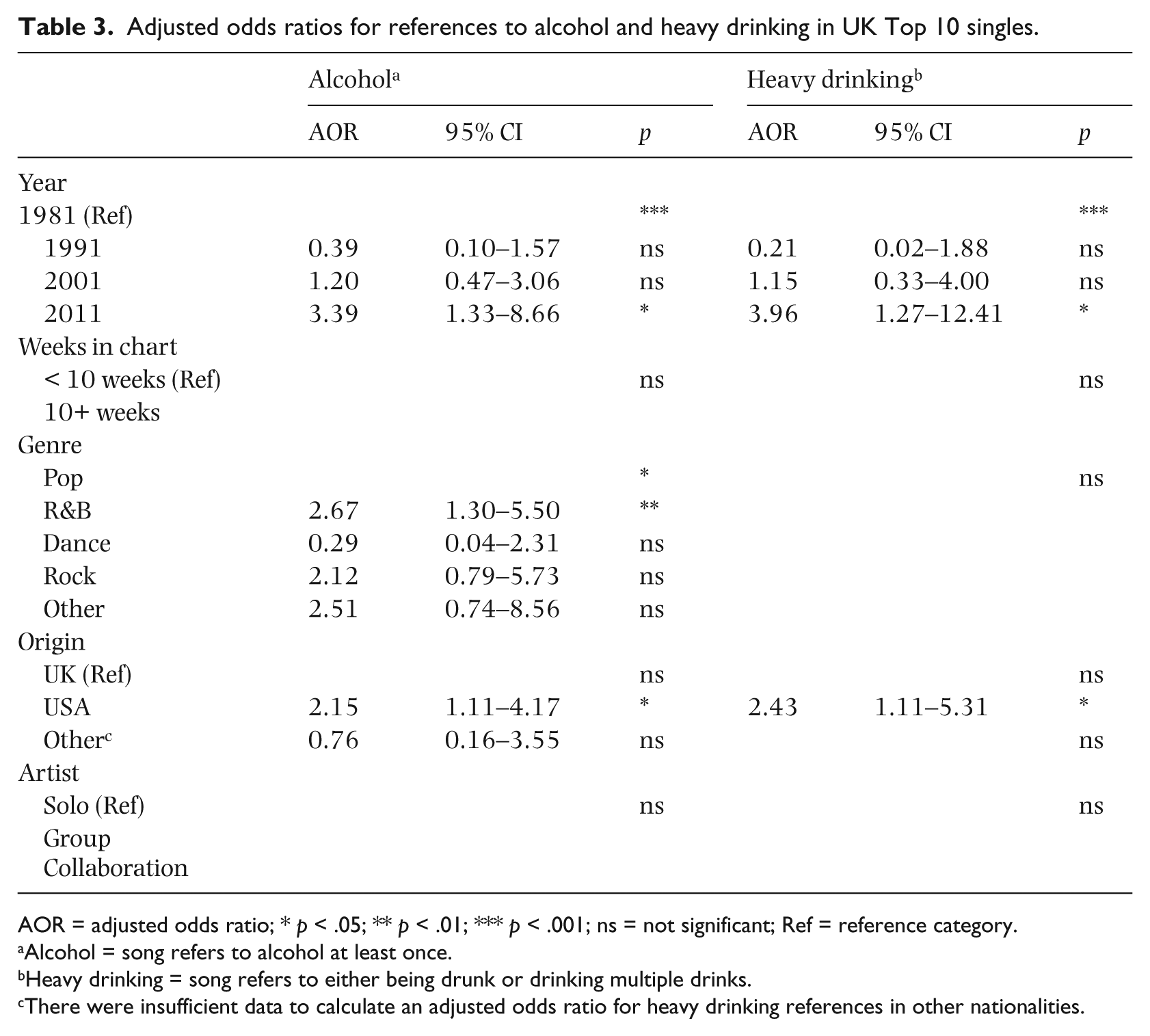
AOR = adjusted odds ratio; * p < .05; ** p < .01; *** p < .001; ns = not significant; Ref = reference category.
Alcohol = song refers to alcohol at least once.
Heavy drinking = song refers to either being drunk or drinking multiple drinks.
There were insufficient data to calculate an adjusted odds ratio for heavy drinking references in other nationalities.
Positive, neutral and negative valences
Figure 1 shows the valence of alcohol references in songs, indicating the number of songs each year that had positive, neutral, or negative connotations. Positive references to alcohol were found in all 4 focal years. Valences were mixed in 1981 while in 1991, despite only a very small number of songs containing alcohol-related lyrics (n = 3), all such lyrics portrayed a positive image of alcohol and drinking behaviour (e.g. “You light up another cigarette, and I pour the wine. It’s four o’clock in the morning and it’s starting to get light. Now I’m right where I want to be, losing track of time,” Beverley Craven – Promise me, 1991). Songs from 2001 contained more negative and neutral alcohol references than positive (e.g. negative: “Some dude was drunk and drove his car over a bridge, and had his girlfriend in the trunk, and she was pregnant with his kid,” Eminem – Stan, 2001). However in 2011, positive and neutral references (n = 11 songs each) out-weighed the much smaller number of negative references (n = 4) (e.g.”My wine is good to me, it helps me pass the time. And my good old buddy whiskey keeps me warmer than the sunshine,” Aloe Blacc – I need a dollar, 2011).

Number of songs with positive, neutral and negative alcohol references by year.
Discussion
This study provides a preliminary analysis of alcohol-related lyrical content in popular music from the UK singles charts. Across the 4 focal years analysed, comparing charts across 4 decades, a noticeable increase in the prevalence of references to alcohol was found. Relatively few references to alcohol were found in songs charting in 1981 and the number actually declined in 1991, likely due to this period’s association with rave culture in which alcohol was often eschewed by young people in favour of Ecstasy (Collin, 2009; Critcher, 2000). By 2001, however, 8.0% of popular hits contained alcohol-references and this prevalence more than doubled in 2011, when alcohol-related lyrics were identified in almost one in five (18.5%) Top 10 songs. This pattern of increasing reference to alcohol in popular music is consistent with previous research from the USA, although overall levels of alcohol-related content are still somewhat lower in the UK charts. A study by Primack et al. (2008) for example, reported a 17.0% prevalence of alcohol lyrical content in popular music in the USA in 1999, rising to 23.7% by 2008. A study of Rap music in particular found the prevalence of alcohol references increased from 8% in 1979 to 44% in 1997 (Herd, 2005).
Consistent with the elevated levels of alcohol-references in lyrics seen in US studies, our findings suggest that the increased prevalence of alcohol references in the UK chart in 2011 can be largely accounted for by an infiltration of music from the USA, either directly through the inclusion/popularity of more groups and artists from the USA in the charts, or indirectly through the increased popularity of Urban music (R&B/Hip Hop/Rap/). The foundations of Urban genres such as R&B generally lie in the American music scene of the 1940s and are thought to have spread to the UK during the Second World War (Garofalo, 2002). Today’s Urban music scene is dominated by US artists such as Jay-Z and Alicia Keys, with many artists from the UK music scene attempting to emulate the sounds and styles of their American counterparts.
Although young people may often be exposed to music in settings such as shops, food outlets or bars, listening in these contexts is largely passive and attention to lyrical content may be limited. In their own homes or when using personal listening devices on the move, however, the music choices people make are deliberate and often motivated by the desire to achieve or maintain a particular psychological state. For example, people exercising often choose to listen to loud, fast music to help them achieve a highly aroused state (North et al., 2000). A range of studies have examined associations between music preference, lifestyle and substance use, with several finding a preference for Urban genres to be associated with increased socializing and alcohol use (Chen, Miller, Grube, & Waiters, 2006; Miranda & Claes, 2004; North & Hargreaves, 2007), although findings are not consistent (ter Bogt et al., 2012). Thus, the relationship between lyrical content and alcohol consumption may be cyclic or reinforcing in nature, such that alcohol is referenced in Urban song lyrics to appeal to or reflect the lifestyle choices of listeners, with the potential for these references to further influence the drinking behaviours of higher risk youths.
While there is much debate surrounding whether or not music has a negative effect on young people, for many “problem behaviours” for which correlational evidence is presented, song lyrics offer only a portrayal or implied endorsement of this behaviour (e.g. self-harm, violence, or aggressive behaviour towards women). However, the inclusion of alcohol references in popular music can be more than just a portrayal of drinking behaviour, but also a form of advertising and marketing for alcoholic products. The existence of lyrics communicating positive connotations of alcohol consumption and brand references supports this premise. In their study, Primack and colleagues (2008) identified 169 songs referring explicitly to alcohol from Billboard Magazine’s top hits in 2005–2007, with 41 (24.3%) of these containing references to specific alcohol brands. Herd’s (2005) analysis of US Rap songs found that over 70% of those containing alcohol references in 1997 mentioned brand names. Although few brand references were found in UK Top 10 songs, it is likely that levels would increase if the chart continues to evolve in response to changes in, and influences from, the US music scene. The increasing prevalence of alcohol-related references in US music is perhaps unsurprising when one considers the substantial interests that many popular US artists have in alcohol marketing and sales (see Primack et al., 2012), particularly within the Rap and R&B genres. This raises additional concerns as studies have demonstrated an association or dose-response relationship between prior alcohol advertising and marketing exposure and subsequent alcohol drinking behaviour in young people (see Anderson, de Bruijn, Angus, Gordon and Hastings, 2009, or Smith and Foxcroft, 2009, for review). With the results of our study indicating that alcohol-related lyrics are increasing in prevalence in the UK singles charts, and the close relationships between the alcohol and music industries, current measures of overall advertising (including direct advertising in broadcast and print media and indirect means such as offers and promotions in retail outlets) are likely to underestimate the extent of exposure among youths.
Children and young adolescents are unlikely to have a reference point for assessing or regulating their drinking behaviour and their developing expectancies will be largely influenced by normative assumptions about teenage drinking and observations of alcohol consumption by parents, peers and celebrities, including popular music artists (Velleman, 2009). Rock and pop fame has long been associated with alcohol consumption, drug use and the party lifestyle, and stars’ hedonistic behaviours (as well as their consequences, such as addiction and premature death; Bellis, Hughes, Sharples, Hennell, & Hardcastle, 2012; Oksanen, 2012) are constantly discussed in international media. Evidence also suggests that adolescents’ favourite entertainers and athletes may influence their purchase intentions (Martin, 2000). Beyond the lyrical content of popular music, listeners may also be exposed to depictions of alcohol consumption or drunken behaviour within music videos (Gruber, Thau, Hill, Fisher, & Grube, 2005), which are often accompanied on sites such as YouTube with explicit advertising material. A more detailed qualitative analysis of lyrical content would be of benefit in informing the debate on alcohol exposure in popular music. Equally, although this study did not assess the effect of popular music messages on young people’s knowledge, attitudes and behaviours, it provides a pervasive indication of the importance of future research to do so.
In the past 4 decades, the UK music charts have changed considerably, today containing significantly more songs in which lyrics make reference to alcohol and drinking behaviour compared with previous years. Alcohol-related song lyrics are associated with Urban song genres and US artists and are typically positively framed, linking alcohol consumption to valued attributes (e.g. confidence, gregariousness or physical attractiveness) and favourable outcomes (e.g. wealth, success or sexual activity), whilst largely neglecting the negative impacts that alcohol consumption can have on health and wellbeing. Although our analysis was limited to songs appearing in the UK charts, its findings may have global relevance as both US and British songs are pervasive in popular music throughout the world. For example, the 2011 single “Last Friday Night” by the US artist Katy Perry (describing a night of drinking “too many shots” and engaging in a range of risky and anti-social behaviours; with the intention to do it all again the following week) achieved a Top 10 position not only in the USA and the UK, but also in Australia, Austria, Canada, Croatia, Czech Republic, Hungary, Ireland, Italy, Lebanon, Netherlands, New Zealand, Poland, Slovakia, Spain and Venezuela. An analysis of charts in the Netherlands, Germany and France over 4 decades (1965–2006) found that US and British artists accounted for 53.4% of the most popular songs in the Netherlands, 41.6% of those in Germany and 21.7% of those in France (Achterberg, Heilbron, Houtman, & Aupers, 2011). While musical preferences can vary widely between countries, with charts becoming increasingly dynamic as access to music moves beyond traditional boundaries it may be inevitable that references to alcohol in popular music will continue to increase both in the UK and elsewhere. Public health concerns are already focused on the impacts of alcohol advertising on the drinking behaviours of young people, yet the growing reference to alcohol in popular music could mean that positive alcohol promoting messages are reaching much larger audiences; regardless of restrictions (e.g. age) on direct advertising. A greater understanding of the impacts of alcohol-related popular music content on young listeners is urgently needed. Health and other professionals should be vigilant for increases in alcohol-related lyrics and work to ensure that popular music does not become a medium for reinforcing and extending cultures of intoxication and alcohol-related harm.
Footnotes
Funding
This research received no specific grant from any funding agency in the public, commercial, or not-for-profit sectors.