



Abstract
In the present study, the predictive values of gender, coping strategies, and guilt/shame orientation were examined in relation to music performance anxiety (MPA) and stress symptoms among university-level Turkish music students. The sample consisted of 399 participants (244 females and 155 males) who were being trained in various instruments. Independent t-test analyses revealed that females had higher scores than males on MPA, stress, helpless and submissive coping strategies, guilt, and shame orientation. Hierarchical regression analyses showed that gender, solo concert experience, helpless and self-confident coping, and shame orientation significantly predicted MPA scores. A similar analysis revealed that gender, helpless and socially supported coping, and shame significantly predicted stress scores. Since gender was a significant predictor in the preliminary regression analyses, gender-based regression analyses were performed. These analyses indicated that, for females, solo concert experience, helpless approach, and shame predicted MPA; and helpless approach and shame orientation predicted stress scores. On the other hand, for males, solo concert experience and the helpless approach appeared as the significant predictors of MPA; and only helpless approach predicted stress scores. Findings are discussed in the light of current literature and cultural characteristics.
Music Performance Anxiety
Music performance anxiety (MPA) is a frequent problem among musicians, with a potential to decrease actual performance at all ages and threaten musicians’ careers (Çırakoğlu & Coşkun Şentürk, 2013; Merritt, Richards, & Davis, 2001; Nicholson, Cody, & Beck, 2015; Thomas & Nettelbeck, 2014). Studies indicate that higher levels of MPA impair musical performance. James (1998) reported that 70% of participating musicians had MPA that impaired their musical performance. Van Kemenade, Van Son and Van Heesch(1995) surveyed orchestral musicians in the Netherlands and found that 59% of the participants reported levels of MPA severe enough to impair musical performance.
It is well known that fear of failure and negative evaluation from the audience in a real or perceived threatening situation has a crucial role in MPA, which is related to both psychological and physiological responses (Fehm & Schmidt, 2006; Hopko, McNeil, Zvolensky, & Eifert, 2001). People with MPA have complained of a wide a range of physiological symptoms, including hot or cold sensations in the hands, muscle tension, sweaty hands, hyperventilation, increased heart rate, uncontrollable shakiness in the muscles, dry mouth, and gastrointestinal problems (Brugués, 2011; Demirbatir, 2012). MPA also has behavioral symptoms that are mostly related to muscle activity (Yoshie, Kudo, & Ohtsuki, 2008; Yoshie, Kudo, Murakoshi, & Ohtsuki, 2009). These behavioral symptoms include arm and neck stiffness, shoulder lifting, and difficulty in maintaining posture and moving naturally. Cognitive symptoms of MPA include disturbing mental processes that are related to dysfunctional thinking or self-defeating cognitions about performing, such as the fear of making mistakes, difficulty in concentration, and loss of confidence (Levy, Castille, & Farley, 2011).
Previous studies indicated that MPA is related to performers’ trait anxiety (Cox & Kenardy, 1993). Kenny, Davis and Oates (2004) found that opera singers had a similar state anxiety levels to participants from different professions. However, opera singer trait anxiety was found to be significantly higher. Kenny, Fortune and Ackerman (2011) stated that flute players who reported higher levels of MPA during performance also reported higher levels of trait anxiety.
A wide range of adaptive and maladaptive coping behaviors have been identified in relation to MPA such as use of drugs with or without supervision of a physician, meditation, yoga, exercise, praying, self-help books, deep breathing, relaxation and rehearsal (Biasutti & Concina, 2014; Fehm & Schmidt, 2006; Fishbein, Middlestadt, Ottati, & Straus, 1988; Ryan & Andrews, 2009; Studer, Gomez, Hildebrandt, Arial, & Danuser, 2011; Wesner, Noyes, & Davis, 1990). In a recent study, Biasutti and Concina (2014) found that MPA was predicted by hours of practice per week, experience and two coping strategies (seeking social support and avoidance). However, a study among adolescent music students revealed that both short- and long-term strategies to cope with negative effects of MPA were moderately helpful (Fehm & Schmidt, 2006). Boucher and Ryan (2011) found that musical performances of very young musicians were affected positively by the number of performances and familiarity with the performance environment. Although these studies identified many coping behaviors, further research is needed to explore the relationship between coping styles and MPA.
Gender differences in experiencing MPA have been explored in many studies. Although studies tend to report gender differences in MPA, drawing a clear conclusion regarding gender differences is still difficult. Several studies found that, regardless of age, female musicians experienced higher levels of MPA (e.g., Kenny & Osborne, 2006; Osborne & Kenny, 2008; Rae & McCambridge, 2004; Ryan, 2004; Thomas & Nettelbeck, 2014) and perceived the audience as more threatening (Iusca & Dafinoiu, 2012; LeBlanc, Jin, Obert, & Siivola, 1997) than male musicians. For instance, in a recent scale development study, Çırakoğlu and Coşkun Şentürk (2013) found that females had significantly higher levels of MPA and trait anxiety in three different samples. On the other hand, other studies have found no gender differences in MPA (e.g., Allen, 2011).
Stress, coping and performance
It is obvious that performing on stage is an important source of stress for some musicians. Cannon (1929) stated that organisms always try to maintain homeostasis in continuously changing environments. He discovered that organisms react to stressors with a set of physiological reactions termed the fight-or-flight response. Selye (1956) stated that anything that seriously threatens homeostasis is called stress. In light of these definitions, actual or perceived threats are referred to as “stressors” and organisms’ responses to the stressors are called “stress responses.” Although many different definitions of stress have been proposed, the main and common point shared by these definitions is that the stress response is physiological and it is evolutionarily adaptive. Contrary to many species in natural life, human beings respond not only to physical threats but also psychological ones, which makes the stress response difficult to manage. Simeons (1961) stated that the human brain had failed to develop at the pace needed to respond to psychological stressors of 20th-century life. In this tradition of stress research, symbolic stressors such as threats to self-esteem (e.g., worrying about musical performance, making mistakes during a performance, what other people think of you) also causes activation of the fight-or-flight response. However, activation of the stress mechanism is only adaptive when the stressor is physical but not psychological. MPA can be interpreted as a stress reaction in the face of a psychological threat. Therefore, the interpretation of bodily, emotional and cognitive reactions to a stressor as well as the stressor itself become crucial to the experience of stress and effective coping.
Lazarus and Folkman (1984) argued that, depending on the appraisal of a perceived threat, human beings and many other animals produce both stress and coping responses. According to Lazarus and Folkman (1984), coping is defined as “constantly changing cognitive and behavioral efforts to manage specific external and/or internal demands that are appraised as taxing or exceeding the resources of the person” (p. 141). The stress response in humans is produced by the integrated functioning of several systems, mainly, the nervous, cardiovascular, endocrine, and immune systems. Because of the activation of these systems, stress hormones are released to energize the body in the face of acute stress, and stress hormones are distributed all over the body to be used by the organs. This fight-or-flight response is adaptive under acute stress and helps organisms to survive. However, when the stress response is repeatedly and continually activated, it may become maladaptive. Chronic stress is associated with negative physiological and psychological health outcomes such as cardiovascular, skin, gastrointestinal, and endocrine problems, and depression and anxiety (Ben-Shoshan, Blinderman, & Raz, 2013; Gaman & Kuo, 2008; Kurd, Troxel, Crits-Christoph, & Gelfand, 2010; Tomer & Huber, 2009). Based on these findings, it can be argued that musicians who suffer from chronic stress and higher levels of MPA performance are prone to health problems.
The relationship between stress and performance has been examined in various studies. According to the Yerkes-Dodson law, which is the most common model, there is an inverted U-shaped relation between stress and performance. That is, low levels of arousal result in poor performance, medium levels result in optimal and adaptive performance and higher levels of arousal result in poor performance (Papageorgi, Hallam, & Welch, 2007; Wilson, 2002).
Existing evidence suggests that there are gender differences in experiencing different psychological problems. It has been suggested that, even when women and men are confronted with similar stressors, women may be more vulnerable than men to developing depression and related anxiety disorders such as posttraumatic stress disorder (Breslau, Davis, Andreski, Peterson, & Schultz, 1997). Lewinsohn, Gotlib, Lewinsohn, Seeley, and Allen (1998) found that, among current and recovered cases, female adolescent participants reported significantly higher degrees of anxiety symptoms than males. In another study by Hewitt and Norton (1993), women diagnosed with anxiety disorders reported more severe cognitive and somatic symptoms of anxiety. A recent study with 43,093 participants indicated that women are more likely to be diagnosed with anxiety disorders and depression (Eaton et al, 2012). On the other hand, men are more likely to be diagnosed with substance abuse or antisocial disorders. The authors argued that while women with anxiety disorders are more likely to internalize emotions, which may result in withdrawal, loneliness, and depression, men are more likely to externalize emotions, which may lead to aggressive, impulsive, coercive, and noncompliant behavior. These internationalizing and externalizing differences may also account for gender differences in different diagnosis.
The stress literature reveals a tendency for females to report higher stress levels than males (e.g., American Psychological Association, 2006; Bangasser et al., 2010; Gentry et al., 2007; Kajantie & Phillips, 2006). Matud (2004) studied gender differences in stress and coping in a large community sample. The study showed that women scored significantly higher than men in both chronic and daily minor stressors. Although the number of significant life events experienced in the previous two years was not significantly different, women rated their life events as more negative and less controllable than men. Women scored significantly higher than men on somatic symptoms and psychological distress. In the study, it was also found that women used emotional and avoidance coping styles more frequently than men. Men were found to have more emotional inhibition than the women. Several researchers have attributed women’s greater reactivity to stressors to a combination of gender differences in biological responses, self-concept, and coping styles (Nolen-Hoeksema, 2001, 2012; Nolen-Hoeksema, Larson, & Grayson, 1999).
Guilt/shame proneness
In light of existing literature and clinical evidence, it is possible to argue that both guilt and shame (self-conscious emotions) are linked to psychological symptoms. Both guilt and shame involve negative affect, although their focus differs in relation to their nature. Specifically, shame is associated with a global punitive judgment of self that leads to a desire to withdraw and hide. Treeby and Bruno (2012) stated that, in the face of aversive experiences of shame, individuals focus on the self (e.g., “I did a bad thing”) and tend to perceive the responsible behavior as evidence of a deficit in the self (e.g., “I am a bad person”). On the other hand, guilt, the focus of the negative evaluation is a specific behavior rather than the entire self (e.g., I did a bad thing). Therefore, it is associated with less intense affective responses. It is likely that guilt will motivate individuals toward reparative behavior (e.g., “I have to solve this problem”). Although these self-conscious emotions are related, there are several distinctions among them (Akbag & Imamoglu, 2010; Tangney & Dearing, 2002). First, when people feel shame, they usually experience feelings of worthlessness and powerlessness. On the other hand, they usually feel tension, remorse, and regret when they experience feelings of guilt. Second, people who feel shame are more sensitive to evaluation by others. In contrast, people who feel guilt tend to be concerned with their emotions. The final difference between these emotions is related to motivation. Shame feelings generally lead people to a desire to hide and escape while guilt directs them to apologize and confess.
Research indicates that guilt and shame proneness are related to different psychopathologies (Tangney et al., 1992). These studies have focused mostly on depression and anxiety (O’Connor, Berry, Weiss, & Gilbert, 2002; Treeby & Bruno, 2012), social anxiety and performance (Beltzer, Nock, Peters, & Jamieson, 2014; Grabhorn, Stenner, Stangier, & Kaufhold, 2006), bulimic symptoms (Hayaki, Friedman, & Brownell, 2002), bipolar disorder (McMurrich & Johnson, 2009) and obsessive-compulsive disorder (Clerkin, Teachman, Smith, & Buhlmann, 2014). In general, guilt proneness is associated with depression and shame proneness is associated with anxiety problems. Treeby and Bruno (2012) found that shame proneness is positively associated with problematic alcohol use among university students and that drinking is a means of coping with anxiety and depression. There are also other studies indicating that shame proneness is associated with problematic substance use (e.g., Dearing, Stuewig, & Tangney, 2005; O’Connor, Berry, Inaba, Weiss, & Morrison, 1994). To our knowledge, no studies to date have explored the relationship between guilt/shame proneness and MPA and stress among music students. Depending on the existing literature, it is possible to predict that high MPA and stress will be predicted by higher shame proneness and negative coping strategies among females.
As for gender differences in experiencing shame and guilt, Tangney and Dearing (2002) reported that females experience these two emotions more than males across all ages. In a meta-analysis, it was found that females experience significantly higher level of guilt and shame than males even though the magnitude of the difference was small (Else-Quest, Higgins, Allison, & Morton, 2012).
Current study
In the light of previous literature, we believe that guilt/shame proneness can be one of the important variables that explains MPA. The literature summarized above indicates a gender difference tendency in experiencing MPA and stress, with females having higher scores. A similar pattern of gender difference regarding guilt/shame proneness has been reported (Else-Quest et al., 2012). Previous studies have also shown a strong relationship between shame proneness and anxiety-related problems. Based on existing findings, we hypothesized that (1) gender will predict both MPA and stress scores; (2) shame, rather than guilt, will predict both MPA and stress scores; (3) destructive coping strategies (helpless and submissive approaches), rather than constructive ones (self-confident approach and seeking social support), will predict both MPA and stress scores.
Methods
Participants
The sample in the present study consisted of 399 students receiving instrumental and vocal training in the Department of Music Education under the Faculty of Education. Since music education can start at earlier ages, most of the participants are graduates of fine arts high schools where they followed the regular curriculum while being trained on a musical instrument of their choice. These students were accepted to music education departments by an entrance exam depending either on their vocal performance or on their performance in playing their instruments. After a 4-year education, they become music teachers. Therefore, their curricula include courses in both music and education.
The data was gathered from six music education departments and conservatories in Turkey. The sample consisted of 244 females (61.15%) and 155 males (38.85%) who were being trained on various instruments. The number of females being trained in these departments is usually higher than males and this is a general tendency observed across music education institutions in Turkey. For this reason, females were overrepresented in the study. The mean age for females was 21.42 (SD = 2.36), for males 22.81 (SD = 2.88), and 21.96 (SD = 2.66) for the entire sample. Participants were receiving training on one of 18 different instruments or vocal training. Since the sample consisted of students, nearly one third of the participants (32.8%) reported no solo concert experience. On the other hand, the majority of them (91.50%) reported that they had played in a concert within a group or ensemble at least once. Table 1 provides the descriptive information regarding instruments and concert experiences.
Descriptive statistics of instruments and concert experience of the sample.

Procedures
Data were collected on a voluntary basis during class or the individual practice sessions. Before data collection, all participants were informed about the purpose of the study, methods of analyses, and ethical standards such as confidentiality.
Measures
Demographic information
On a demographic information sheet, participants were asked questions on their age, gender, instrument(s), and concert experiences.
Performance Anxiety Scale for Music Students (PASMS)
PASMS was developed by Çırakoğlu and Coşkun Şentürk (2013). The scale is a six-point Likert-type scale (0 = certainly disagree to 5 = certainly agree) that measures MPA in university-level music students. The PASMS consists of 24 items with three subscales: fear of the stage (e.g., “I am so anxious during concerts that sometimes I cannot even read the notes”), symptoms (e.g., “While playing pieces during concerts, I think that I am going to panic”), and avoidance (e.g., “Whenever the idea of playing on stage comes to my mind, I try to think of something else”). Internal consistency for the whole scale was found to be .93. Higher scores in PASMS indicate higher MPA. In the present study, total scale mean scores were used in the analyses.
Guilt and Shame Questionnaire (GSQ)
GSQ (Şahin & Şahin, 1992) is a 24-item, five-point Likert-type scale that measures guilt and shame proneness. High scores on the guilt and shame subscales indicate higher levels of these self-conscious emotions. The scale has a negative correlation with depression scores. Internal consistency for the guilt and shame subscales were .81 and .80, respectively.
Coping Style Scale (CSS)
This scale was derived from the Ways of Coping Inventory by Lazarus and Folkman (1984) and adapted for the Turkish population by Şahin and Durak (1995). The CSS consists of 30 items (e.g., “I made a plan of action and followed it,” “Hoped a miracle would happen”) rated on a four-point Likert-type scale. Factor analyses revealed five factors, which are optimistic, self-confident, helpless, submissive approach, and seeking social support. Internal consistencies of its factors varied between .47 and .80. Increasing scores in the scale indicate higher frequency of using a given coping style.
Stress Symptoms Scale (SSS)
This scale was originally developed by Miller, Smith, and Mahler (1988) and consists of 70 five-point Likert-type items concerning symptoms observed in the seven systems of the body (e.g., sympathetic nervous system, parasympathetic nervous system, endocrine system, immune system). It was adapted to Turkish by Day (1992). The scale has been used in many studies (Şahin & Durak, 1994, Durak Batıgün, Hisli Şahin, & Karslı Demirel, 2011) and its psychometric properties were found to be satisfactory. Internal consistency of its subscales varied between .91 and .96 (Şahin & Batıgün, 1997). Higher scores indicate higher stress symptoms. In the present study, mean score for whole scale was used rather than subscale scores.
Results
Descriptive statistics
Independent t-test analyses were performed in order to explore gender differences on observed variables. Independent t-test analyses revealed that females had higher scores than males on MPA, stress, helpless and submissive coping strategies, and guilt and shame proneness. Means and t-values are shown in Table 2.
Independent samples t-test results for gender.
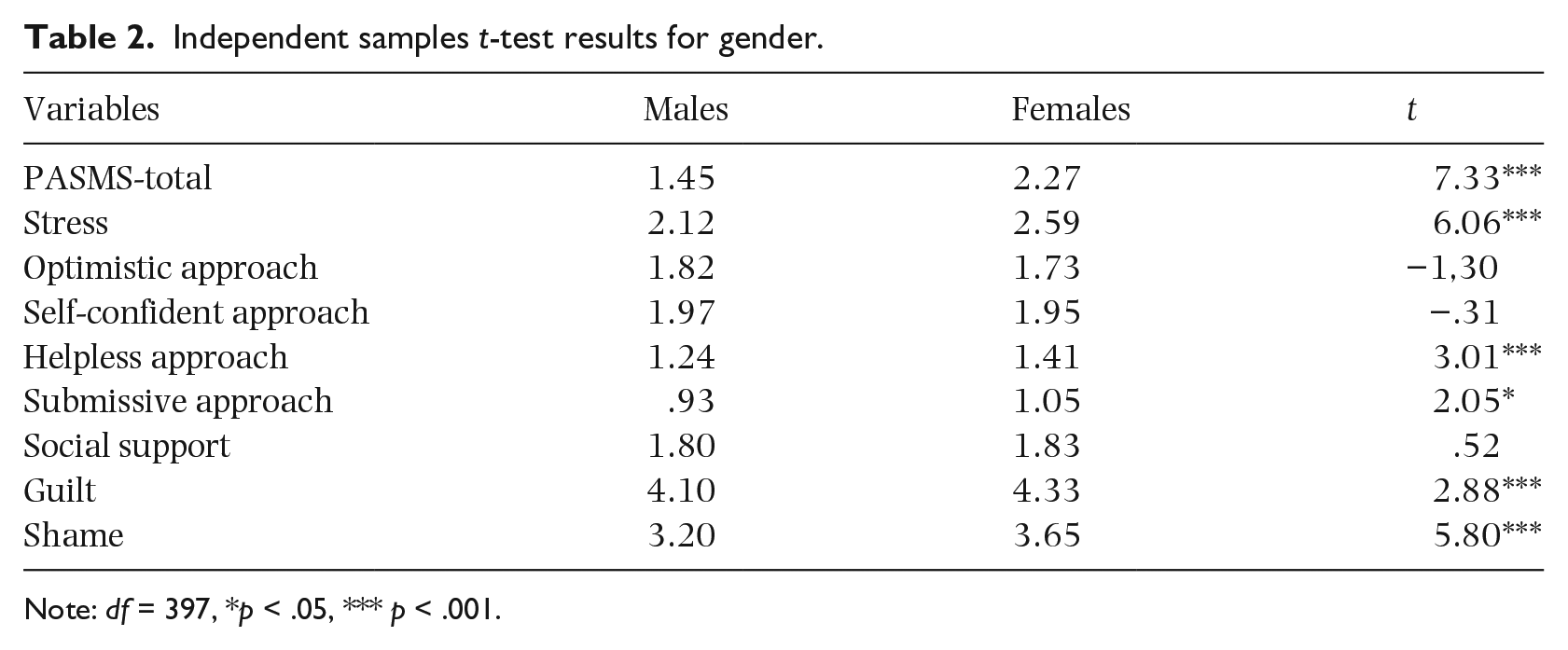
Note: df = 397, *p < .05, *** p < .001.
Preliminary regression analyses
Hierarchical regression analyses were performed in order to assess the predictive value of variables on the MPA and stress scores. Kenny and Ackermann (2015) stated that tolerance values near 0 and variance inflation factor (VIF) values greater than 2 indicate a multicollinearity problem. All variables were checked in terms of tolerance and VIF values before regression analyses in order to assess multicollinearity. No multicollinearity problem was detected in the data.
Initially four-stage hierarchical multiple regressions were conducted with MPA and stress symptoms as the dependent variables. In the regression analysis for MPA, potential predictors were entered into the equation according to theoretical relationships among them and the hypothesis of the study. Since previous studies placed more importance on shame-psychopathology relationships, guilt and shame were entered in the equation as different blocks. Therefore, the following variables were entered in the equation as theoretically constructed blocks: gender, solo, and group concert experiences (first block), coping strategies (second block), guilt (third block) and shame (forth block). Analyses revealed that gender, solo concert experience, helpless, and self-confident approaches and shame significantly predicted MPA scores (Table 3). These five variables explained 29% of total variance. Gender (12%) and having a helpless approach (13%) were the most significant contributors of the model. Although, shame proneness was one of the significant predictors, its contribution to the model was limited (1%). The effect size was calculated based on Cohen (1988) and found to be .41, which represents a medium-high effect size.
Preliminary regression analyses for MPA and stress (N = 399).

Note: *p < .05, **p < .01, ***p < .001.
As for the stress scores, solo and group concert experiences were excluded from analyses since we wanted to explore effects of coping strategies and guilt/shame proneness on general stress scores. Therefore, only gender was entered into the equation in the first block and the rest of the equation remained unchanged. Regression analysis for stress scores indicated that gender, helpless and social support coping, and shame significantly predicted the dependent variable (Table 3). These four predictors explained 23% of total variance. Again, gender (9%) in the first block and helpless approach (13%) in the second block were the most significant predictors. Social support (1%) and shame proneness (1%) made limited contributions to the model. The effect size was medium (.30).
Analyses indicated that coping strategies utilized in MPA and stress shared more similarities than differences. For both MPA and stress, gender and helpless coping were the most important predictors. As predicted shame proneness also contributed to the models in two separate analyses although its contributions were limited.
Since gender was a significant predictor in both regression analyses, the same analyses were again performed for male and female participants separately. Group concert experience was excluded from following analyses since it was not a significant predictor.
Gender-based regression analyses
In a hierarchical regression analysis with MPA as dependent variable, solo concert experience, coping strategies, guilt and shame were entered in the equation accordingly. As seen in Table 4, for females, solo concert experience, helpless approach, and shame predicted MPA scores at the final step. Three variables explained 17% of the total variance. The most significant contribution to the model was made by helpless approach (13%). Shame proneness explained 2% of the variance. The effect size was .20, which represents a low to medium effect size. On the other hand, for males, only solo concert experience (5%) and helpless approach (17%) were significant predictors of MPA. The effect size was low to medium (.26).
Gender-based regression analyses for MPA.
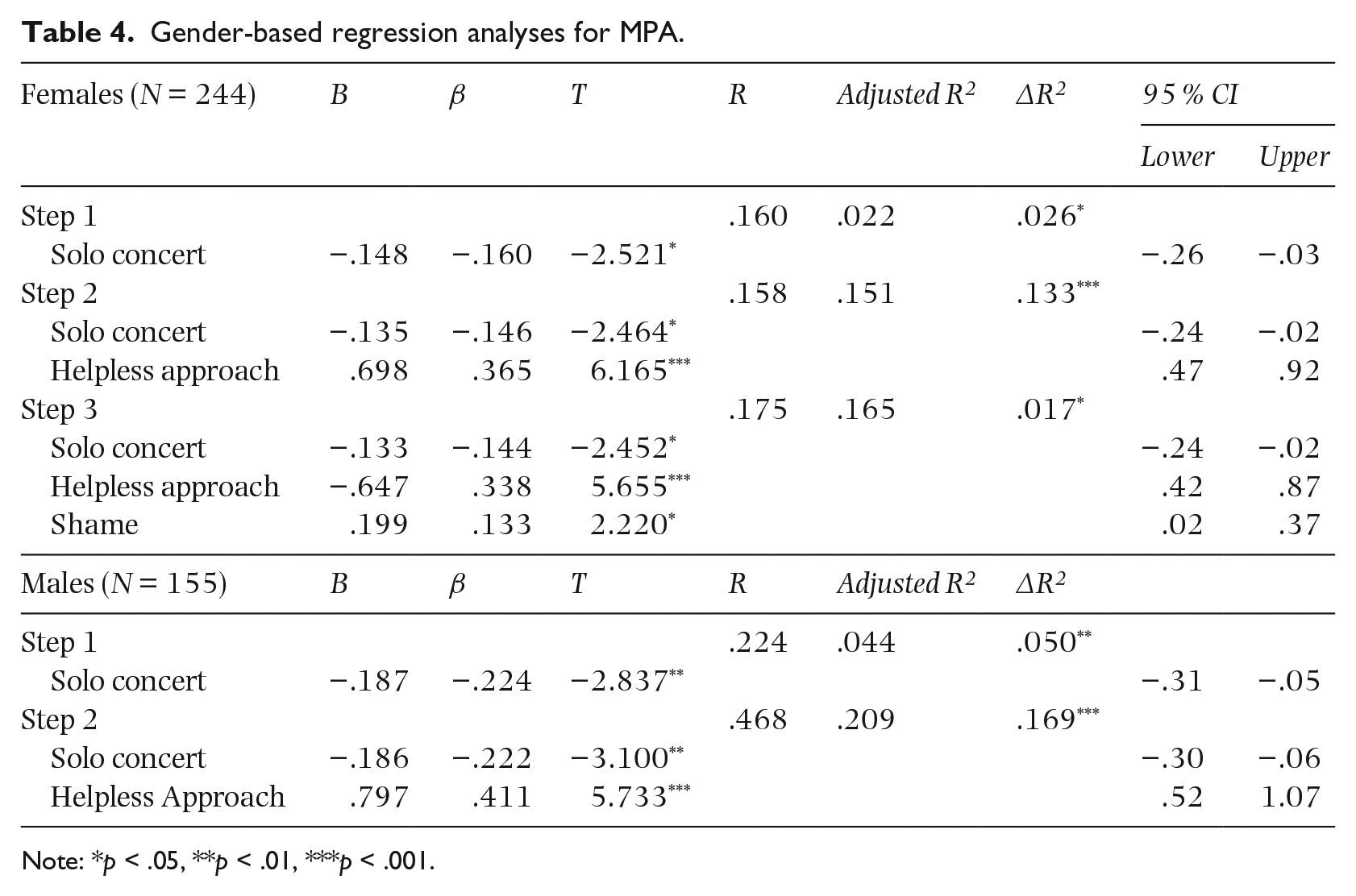
Note: *p < .05, **p < .01, ***p < .001.
In the hierarchical regression analysis with stress scores as dependent variable, coping strategies, guilt, and shame proneness were entered in the equation as predictors (Table 5). Helpless approach (18%) and shame proneness (3%) were the significant predictors of stress scores for females. The effect size was .26, which represents a low to medium effect size. However, only helpless approach (7%) was a significant predictor of stress scores for males. From the gender-based regression analyses, it was observed that, while helpless approach was the most significant coping strategy for the both sexes, shame proneness was retained only for females. The effect size was low (.06).
Gender-based regression analyses for stress symptoms.
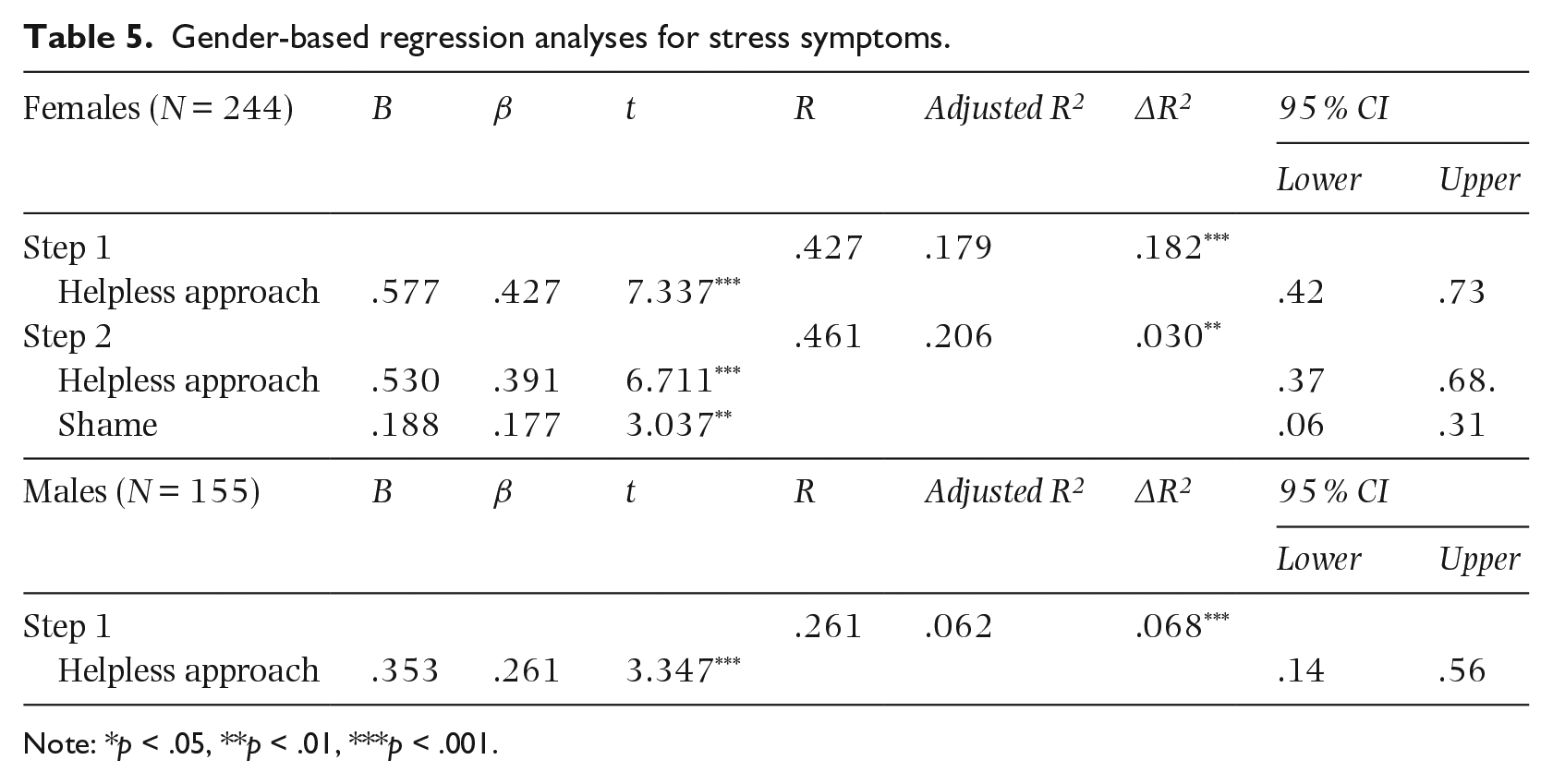
Note: *p < .05, **p < .01, ***p < .001.
Discussion
In the present study, the predictive values of gender, coping strategies, and guilt/shame proneness were examined on MPA and stress among university-level Turkish music education students. Preliminary descriptive analyses revealed that females had higher scores on several variables measured in the study. Female scores on MPA, stress, helpless approach, submissive approach, guilt and shame were significantly higher than males. That is, females experienced higher levels of MPA and stress in general, used destructive coping styles more, and experienced self-conscious emotions more strongly than males. The mean PASMS scores that were obtained in the present study showed a similar pattern with the mean scores obtained from three different samples from a similar population (Çırakoğlu & Coşkun Şentürk, 2013). Although previous studies provide conflicting results on gender differences in MPA, our findings supported studies showing that females experience a high level of MPA (e.g., Çırakoğlu & Coşkun Şentürk, 2013; Kenny & Osborne, 2006; Osborne & Kenny, 2008; Rae & McCambridge, 2004; Ryan, 2004; Thomas & Nettelbeck, 2014).
The results of the hierarchical regression analyses with the whole sample showed that gender, solo concert experience, helpless approach, self-confident approach, and shame significantly predicted MPA scores. Since the sample consisted of music students who always should perform on stage, the predictive value of having a self-confident approach is understandable. As predicted, shame rather than guilt was associated with MPA. Although its contribution to the constructed models was limited (1–2%), shame contributed to the model significantly. It was clear from the analyses that the most significant predictors of the model were gender (12%) and helpless approach. As for the analysis of stress scores, a similar pattern was observed; gender, helpless approach, seeking social support, and shame predicted stress scores significantly. Again gender (9%) and helpless approach (13%) appeared as the most significant predictors.
The results of the present study revealed significant gender differences on both MPA and stress. These findings are consistent with the previous research findings regarding both MPA (Kenny & Osborne, 2006; Osborne & Kenny, 2008; Rae & McCambridge, 2004; Ryan, 2004; Thomas & Nettelbeck, 2014) and stress (e.g., American Psychological Association, 2006; Bangasser et al., 2010; Gentry et al., 2007; Kajantie, & Phillips, 2006; Matud, 2004). In the present study, helpless coping predicted dependent variables for both sexes but shame proneness was a significant predictor only for females. It is clear that females have a disadvantage in the face of stressful situations in social, educational, and occupational life. Nolen-Hoeksema (2001) proposed that the higher vulnerability of females to stress may be result of a number of factors. Both stress experiences and stress reactivity contribute directly to women’s greater rates of stress-related experiences. She stated that stress experiences and stress reactivity have a reciprocal relationship, i.e., they feed off each other. As women suffer from more stress, they may become more hyperresponsive to stress. This may undermine their ability to control their environments and overcome stress, leading to more stress in the future. Our results showed that having a helpless coping strategy was a significant predictor of MPA and stress for females. This finding may be interpreted as an evidence for Nolen-Hoeksema’s point of view. Another implication with this finding can be the relationship between stress and MPA. Our findings suggested that females have a tendency to show a similar pattern in coping with stress in general and MPA. This general pattern of negative coping may cause more stress and reinforce the perception of negativity and lack of control in stressful experiences.
Another important finding of the present study was that shame proneness significantly predicted MPA and stress scores only for females. These findings may be interpreted in the light of the type of culture and child-rearing practices as well as discriminative societal practices against women. Turkish collectivist culture may impose and reinforce worldviews that are shame-related to a greater extent on females during developmental stages. According to Sığrı, Tabak, and Sağır (2008) females have historically been exposed to gender discrimination, which may cause females to feel gender-based differences more intensely. One of the most destructive effects of this perception on females may be focusing more on how they are being seen or observed by others. Starting from adolescence, having realized a gender difference, women who usually are exposed society’s restrictive and discriminating practices may experience shame due to mistakes they have made. It may be considered as a common characteristic of collectivist cultures that women are exposed to child-rearing practices based on gender discrimination, brought up in conservative social relations compared to men, and exposed more to the pressure of moral and social norms. Accordingly, it can be suggested that women may experience more shame when they face interpersonal and performance-related stress factors and may perceive the failures resulting from such situations in a catastrophizing way.
Lutwak, Panish, Ferrari, and Razzino (2001) found that feelings of shame and guilt have different relative intensities among men and women; moreover, women experience both more intensely than men. Similarly, in a study conducted by Sığrı et al. (2008) with a Turkish sample, it was found that shame and guilt scores of women were higher than those of men. Our study also revealed that the women experience both shame and guilt more intensely. This difference may have resulted from the characteristics of the sample of our study. In general, the literature suggests that shame is a more destructive emotion and is more difficult to cope with. That the sample in the study by Sığrı et al. is composed of employed individuals brings about the idea that coping with guilt may ease due to age and experience.
When the literature is reviewed, it is seen that shame is associated more with psychopathology, especially with anxiety disorders, than guilt (Grabhorn et al., 2006; Hedman, Ström, Stünkel, & Mörtberg, 2013). Although coping is conceptualized in a different way in these studies, it is known that shame proneness has positive correlations with problematic drinking and alcohol use, which are used to cope with anxiety and depression (Treeby & Bruno, 2012). Because the MPA, stress, helpless coping scores, and shame scores of females are meaningfully higher than men, it might be proposed than female musicians may have more difficulties in coping.
The solo concert variable was found to be an important predictor for the MPA for both genders. Females’ higher shame proneness and higher utilization of helpless approach may show that they have more difficulty in coping with MPA. When the t-test results were analyzed, it was clearly seen that males had higher scores in all variables that ease coping whereas females had higher scores in variables that make coping more difficult.
Limitations
The present study has certain limitations. The first important limitation is related to the types of measurements. The study was based on self-report measures, although all scales in the study have satisfactory psychometric properties. The second limitation of the study is related to the unequal distribution of female and male participants. As mentioned in the Methods section earlier, female students are more common in university music education programs. Another limitation is related to culture. This study was conducted on a collectivist culture. In an individualistic culture, different effects of guilt and shame proneness may be observed. Finally, this study did not utilize a random sampling methodology, which may cause difficulties in generalizing the result. Therefore, all these limitations should be taken into consideration when interpreting the results.
Conclusion
The findings of this research show that having a helpless approach is an important predictor for both genders’ stress and MPA scores, while shame proneness is an important predictor on these variables for women. Women who are culturally exposed to more restrictive practices may experience bigger risks in terms of MPA and their careers may be more negatively affected than men.
The findings of the present study have certain implications which may be used in educational and clinical settings. It is more likely that mental health professionals will focus on bodily symptoms, anxiety-inducing cognitions, and maladaptive schemas when working with people who are suffering from MPA. On the other hand, shame proneness seems to provide a reinforcing basis, especially for avoidance behaviors, which may also reinforce anxiety in the long run. For this reason, it would be reasonable to work on the shame proneness of (especially female) clients.
Our study revealed that gender, coping strategies and shame proneness may affect music students in different ways when faced with MPA and stress. However, in the present study, guilt and shame were used as continuous variables. Therefore, the functional level of these emotions is not known. Future research may focus on differentiating functional and dysfunctional levels of guilt and shame proneness among music students.
Footnotes
Acknowledgements
The authors thank Ayşegül Durak Batıgün for her invaluable comments on statistical analyses and Aras Onur for his useful suggestions on our manuscript.
Funding
The author(s) received no financial support for the research, authorship, and/or publication of this article.
Ethical approval
Ethical approval for this study was given by the Scientific Research and Application Ethical Board, at Başkent University, Faculty of Science and Letters, Department of Psychology.