



Abstract
This article describes the development of a music practice microanalysis protocol that is based on the three-phase model of self-regulated learning (i.e., Forethought, Performance, and Self-Reflection). Up until now, most studies on music practice have tended to focus on behavioural aspects. The expanded view presented here outlines a technique for mapping the types of behaviours (actions), cognition (thoughts), and affect (feelings) that can help focus musicians’ practice. To explain the technique, we describe the practice of two first year Bachelor of Music students studying at a prominent university music school who are compared at three time points across one semester as they prepare an étude for a performance exam. These case studies demonstrate two broadly contrasting self-regulated learning profiles of how microanalysis can be used to cue students to think about what they are doing and then reflect critically on the strategies they can use to improve their playing. As a technique, microanalysis can inform educational interventions aimed at breaking the cycle of habits that typify musical practice by encouraging musicians to become more behaviourally, metacognitively, and motivationally involved in their own learning.
Keywords
The profession of music is replete with well-worn quotes highlighting practice as an essential ingredient for musical success. We have all heard the adage that “practice makes perfect” and the expression “the quickest way to Carnegie Hall is to practice, practice, practice. . .” In our view however, understanding how musicians reach the highest levels of musical achievement involves understanding how they think about the task, themselves, and their performance, as well as the amount of time they spend practising.
One of the challenges of teaching music performance is how to encourage developing musicians to develop into autonomous learners (Hoyle & Dent, in press; McPherson & Zimmerman, 2011). To achieve this goal, musicians need to learn how to balance the effortful components of practice with the broader self-regulatory skills required for them to systematically organise their own thoughts, feelings, and actions as they seek their goals (Usher & Schunk, in press). Learners possess the capacity to plan, set goals, and imagine future success, and this shapes how they will subsequently behave as they pursue increasingly advanced levels of performance. Accordingly, people can also self-react as they strive to achieve their goals, by recognising where they are going wrong and adjusting tactics to achieve their goals. Due to the capacity for reflective self-consciousness, learners can examine their own actions, thoughts, and feelings before, during, and after their attempts at learning something new or something that was already learnt (Usher & Schunk, in press). Consequently, successful learners are those who have learnt to harness these attributes and regulate their own learning.
While previous attempts to research practice efficiency have largely concentrated on behavioural aspects (e.g., Chaffin, Imreh, & Crawford, 2002; Gruson, 1988; Jørgensen, 2002; Lehmann & Ericsson, 1998), the expanded view we present here outlines a technique that focuses on the types of behaviours (actions), cognition (thoughts), and affect (feelings) that encourage musicians to become metacognitively, motivationally, and behaviourally active participants in their own learning (McPherson & Zimmerman, 2011).
In this article, we describe a microanalysis protocol that can be used to cue students to describe their actions and then reflect critically on the strategies they choose to improve their playing in-situ. The protocol is based on an extensive body of literature across the past two decades in education, medicine, science, athletics, developmental psychology, and counselling domains (Cleary, Callan, & Zimmerman, 2012; Cleary & Zimmerman, 2001) that draws on the three phases of self-regulated learning: Forethought, Performance, and Self-Reflection. In the sections that follow, we outline the self-regulated learning process and describe how microanalysis techniques have been used in other domains to better understand learning.
Self-regulated learning
Grounded in social-cognitive theory, self-regulated learning (SRL) emphasises the role of social sources to reciprocally enhance or adversely impact how students perceive their help seeking capabilities over time (Bandura, 1997). An important assumption of social-cognitive theory is that people need to proactively control and manage the triadic reciprocal relationships between person, behaviour, and environment through self-observation, self-judgement, and self-reaction (Bandura & Schunk, 1981). Zimmerman (2011) and Zimmerman and Campillo (2003) expanded the social-cognitive framework to include self-generated thoughts, feelings, and behaviours that are planned and cyclically adapted based on performance feedback in order to attain self-set goals (see Figure 1). A key principle is the cyclical nature of the dynamic processes of forethought, performance, and self-reflection, which over multiple iterations of a task provides a continuous line of goal directed, strategically defined, and emotionally satisfying improvement.
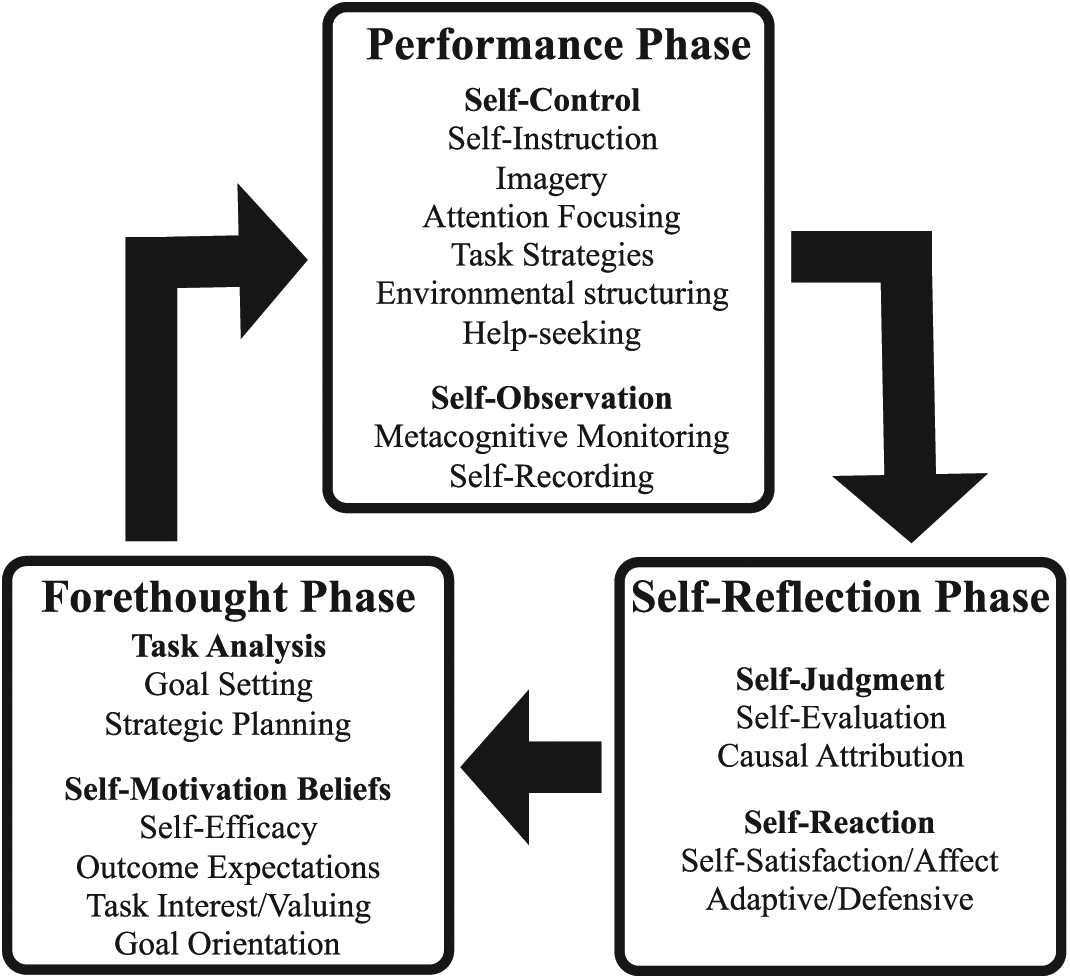
Phases and sub-processes of self-regulated learning. Reproduced with permission from “Motivating Self-Regulated Problem Solvers” by B. J. Zimmerman and M. Campillo in The nature of problem solving (p. 239), by J. E. Davidson & R. J. Sternberg (Eds.), 2003, New York, NY: Cambridge University Press. Copyright 2003 by Cambridge University Press.
In the Forethought Phase, self-regulated musicians analyse the task they are about to complete and draw on a range of self-motivational beliefs that will form the basis of their approaches to rehearsing or performing music. In the Performance Phase, musicians would apply various self-control and self-observational skills that aid focused attention and willpower on the music that is being performed. In the Self-Reflective Phase, an assessment of how well the performance went occurs when self-judgements and self-reactions are formed that then impact on the planning for further refinement in subsequent musical practice and performance.
Assessing self-regulated learning
Self-report questionnaires of SRL are the most widely used measures by researchers and educational practitioners (Cleary et al., 2012; Wolters & Won, in press). Such measures typically define SRL as an aptitude (a relatively enduring attribute of a person which predicts future behaviour) using self-report ratings of frequency of behaviour: never /always / most of the time / typical of me (Winne & Perry, 2000). Research using this methodology to study self-regulated practice behaviours in highly skilled musicians has shown that advanced musicians rely heavily on self-regulatory skills when practising their instrument (Araújo, 2015). Unfortunately, this methodology has insufficient corroboration with actual traces of individuals’ thoughts and behaviours, being typically retrospective and decontextualised (Cleary et al., 2012). Furthermore, most self-report questionnaires are not intended to assess SRL as a whole, but rather, particular aspects of the SRL process, calling into question the validity of the conclusions of many SRL studies (Wolters & Won, in press). Reliance on traditional survey measures is therefore limited as an assessment tool for the contextualised and dynamic processes of the three-phase model of SRL. Microanalytic techniques can provide a more valid and reliable assessment of SRL by documenting the contextually-bound behavioural, cognitive, and affective processes involved during real time music learning.
Microanalysis
Microanalysis is an ecologically-sensitive SRL assessment technique which targets reciprocal triadic interactions between person (namely, cognition, affect, behaviour) and environment factors in specific situations (Cleary & Callan, in press). A key feature of this technique is that it assesses “authentic moment-to-moment behavioural interactions” which “minimise the response biases and errors associated with retrospective self-reports about behaviour or interactions” (Cleary et al., 2012, p. 4). Learning events are conceptualised as a temporal entity with a clear beginning, middle, and end (i.e., an event), which is reflective of students’ efforts to self-regulate their learning (Zimmerman, 2000). In this manner, the event is demarcated by a prior event and subsequent event, capturing the sequential dependency of responses, and enabling causal inferences about student’s self-regulatory changes in the practice context to be determined. Importantly, true microanalytic protocols apply specifically to the practice session in which students are about to engage, and not to longer-term performance goals (Cleary et al., 2012).
Microanalysis is now used across multiple educational settings (Cleary & Callan, in press). For example, in an assessment of medical students’ clinical reasoning skills, undergraduates were given a microanalytic assessment including open-ended questions targeting forethought and performance phase sub-processes and requiring verbal responses, while reading a clinical case and formulating the most probable diagnosis (Artino et al., 2014). Results indicated that most students in the formative stages of learning diagnostic reasoning skills were aware of at least one reasoning strategy. Notably, only about one-third of students set goals or developed plans that incorporated strategies, and those who did achieved better course grade outcomes. This underscores the potential importance of forethought regulatory processes to facilitate student educational achievements (Artino et al., 2014). This methodology also enabled an assessment of robust declines in students’ self-efficacy beliefs and regulatory processes following negative feedback about their performance on the diagnostic reasoning task (Cleary, Dong, & Artino, 2015).
The differential and construct validity of microanalytic protocols has been established through research in science education (DiBenedetto & Zimmerman, 2010) and novice, non-expert, and expert athletes (Cleary & Zimmerman, 2001; Kitsantas & Zimmerman, 2002). These studies show that high achievers tend to exhibit more strategic thinking and regulation as they perform specific tasks than do low achievers. Microanalysis has also shown that high performing individuals tend to set more specific goals, approach tasks more strategically, and make strategic attributions and adaptations following failure or poor performance on a task (Cleary et al., 2012).
Self-regulated learning and microanalysis in music
Within music, studies on practice are still relatively scarce compared to other academic subjects and sports. Much of this literature focuses on the behaviours of musicians and the efficacy of differing techniques that are employed during practice sessions (Jørgensen & Hallam, 2016; Lehmann & Jørgensen, 2012). Examples include studies that observe and then record the accuracy of skilled motor control learning through to studies that examine musicians’ ability to document and reflect on individual practice sessions through questionnaires, interviews, and learning journals of practice over time. Consequently, most findings on music practice are derived from studies that have concentrated on what happens during practice, musicians’ reflections about their own practice, or the quality and quantity of practice and how this might relate to differing levels of expertise (Miksza, 2011).
Researchers have adapted the social-cognitive perspective on musical skill development to examine six psychological dimensions of SRL in music (McPherson & Zimmerman, 2011). Using this framework, researchers have examined SRL in beginning, intermediate, and advanced students (McPherson, Davidson, & Faulkner, 2012; McPherson, Miksza, & Evans, in press; McPherson & Renwick, 2011; McPherson & Zimmerman, 2011; Miksza, 2015; Miksza, McPherson, Herceg, & Meider, in press). A natural outgrowth of this work is to investigate SRL in music practice as a cyclical process according to the three phases of SRL. Preliminary music evidence provides strong support for this approach. For example, Miksza and Tan (2015) found that music students who perceive themselves to be more self-regulated and efficient in their practice also tend to display more determination to accomplish short- and long-term goals, experience flow while practising, and exhibit thoughtfulness, metacognition, and self-awareness while practising. Furthermore, augmenting traditional practice strategies (such as slowing and repetition) with SRL music practice instruction (such as goal-selection, planning, self-evaluation, and rest/reflection) significantly improves performance achievement and facilitates nuanced music objectives (such as dynamics, articulation, and interpretation) in tertiary music student practice (Miksza, 2015).
Purpose
Despite growing evidence supporting the role of SRL for enhancing music practice and achievement, conclusions that can be drawn from existing research are limited by the predominant reliance on a decontextualised self-report methodology which does not provide for direct observation and assessment of practice behaviours. Microanalysis offers a more detailed, context-based understanding of the ways learners monitor and manage their progress towards learning goals. The purpose of this study was to adapt the microanalysis technique to frame research aimed at improving musicians’ self-regulated practice, and to understand the content and level of detail this process might yield in instrumental music learners.
Method
The task-specific nature of the microanalytic technique across performance domains and contexts means there will be considerable variability in its application. However, the three-phase structure remains the same: forethought questions are administered before the task, performance questions during the task, and self-reflection phase questions after the task (Cleary & Callan, in press). An in-depth case study protocol was developed to adopt this three-phase structure (McPherson, Osborne, Evans, & Miksza, 2015) to explore the behavioural, cognitive, and emotional states that occur before, during, and after practice sessions. The case study approach was used in order to gain a rich understanding of the content and potential range of student attributes, so as to inform future developments of the protocol as a potential measurement and intervention tool. It also enabled an examination of the extent to which musicians optimise their SRL as they actively draw upon processes and techniques aimed at maximising personal goals, motivation, positive emotions, and resilience (Butler & Cartier, in press).
Participants
Two students, “Helen” and “Suzie”, participated in the case study. These students were part of a group of 33 first year pianists who auditioned and were admitted into a Bachelor of Music (Music Performance) programme at a large comprehensive university music school. One student received the highest-ranking audition score, and the other the lowest-ranking audition score as measured on a scale of A+ (“definitely suitable for Bachelor of Music/highly recommended for scholarship”) to C+ (“suitable for BMus with reservations about performance quality”).
Helen, a 17-year old musician who had been learning piano for 13 years, achieved the highest audition ranking (A+) for entry into the course. During the study, she worked on two Chopin études in the core first year music performance subject. At first, she was given Opus 10, No. 1, which she was working on at the start of the study, but this was changed by the teacher during week six of the semester because the construction of the first piece (octave jumps) required movements that were judged to be incompatible with the physiology of her hands. The replacement piece she worked on for the majority of this research study was Opus 10, No. 8. Her end of semester 1 performance exam result was 92 out of 100, which represented an “outstanding” result in approximately the top 5% of her cohort.
Suzie, who received a C+ for her audition, is an 18-year-old musician and had been learning piano for nine years. She worked on Chopin étude Opus 25, No. 2. She continued working on this piece across the semester and performed it at her examination. Her semester 1 performance exam result was 56 out of 100, which represents a “pass” result that was in the bottom 5% of her cohort.
Procedure
The microanalysis protocol was administered at the beginning of the semester (2–3 weeks in), in the middle, and towards the end of the semester just prior to the participants’ performance examination. The three sessions occurred in a university practice room where the students normally practised. Prior to starting their practice, the researcher met with the participant in the practice room to ask questions addressing the forethought phase of the SRL model. Both the participant and researcher worked through a printed copy of the microanalysis protocol. This enabled the researcher to check with participants to clarify their understanding of the questions posed and the researcher’s understanding of their answers.
The researcher then left the participant to practice alone and for as long as they wanted while being recorded by a video camera. When they had finished their practice session, the researcher returned to ask them to reflect on their practice using questions addressing the performance and self-reflection phases of the SRL model. To address questions in the performance phase, the first 30 minutes of the video recording of the étude practice was replayed to the participant. Participants provided open-ended descriptions of their metacognitive monitoring strategies while watching the video. These responses were noted by the researcher and subsequently coded into self-regulatory processes soon after the session. Approval for the study was granted by the researchers’ university human research ethics committees.
Microanalysis Protocol
Development of our music practice microanalysis technique adhered to the procedure for ensuring a valid and reliable self-regulation protocol, as detailed by Cleary et al. (2012):
Step 1: Select a well-defined task. A music practice session.
Step 2: Identify target SRL processes. All processes in the three-phase SRL model shown in Figure 1 were targeted.
Step 3: Develop SRL microanalytic questions. Based on self-regulation theory and previous music research, we developed 18 questions linked to the task and context of the practice session.
Step 4: Link cyclical phase processes to task dimensions. Forethought phase questions were administered prior to practice. Performance phase questions were posed during review of the video of their practice. Self-reflection phase questions were administered immediately after practice.
Step 5: Scoring procedures. Likert scales, ranking items, and open-ended question formats were used, and verbatim recordings were taken. Open-ended questions were independently coded by two researchers, facilitated by a structured scoring rubric that included definitions and examples for each category.
The 18-item guided interview protocol and self-report tool (McPherson et al., 2015) was developed to capture all three phases and sub-processes of self-regulation as shown in Figure 1. Expert consensus and prior research by four researchers across three institutions in Australia and North America was used to develop a pool of potential questions, drawing from their expertise in research and pedagogy using the SRL framework in music practice (see McPherson, Miksza, & Evans, in press; McPherson, Nielsen, & Renwick, 2013; McPherson, Evans, Kupers, & Renwick, 2016; Miksza, 2012, 2015; Evans, 2015; Evans & Bonneville-Roussy, 2016). This item pool was tested in practice workshops with students and subsequently refined to improve comprehension and minimise repetition.
Administration
At the commencement of the study, before the first practice session, participants were asked to reflect on their ideal practice session, one in which they were improving technically and musically with two questions: “What do you do?” and “How do you structure it?” This enabled us to gauge the participants’ standards for practice efficacy and quality.
Forethought
Before their practice sessions, participants were asked a number of questions to understand the forethought phase. To understand their task analysis, participants were asked to identify their technical, musical, and personal goals, and report on how fixed (vs. flexible) and clear (vs. unclear) their plans were. Self-motivation beliefs were assessed by asking participants to assess their self-efficacy (from 0 to 100% confidence) and the expectations they had for their examination mark. Interest was reported on a scale of 0 to 100. Goal orientations were reported as a ranking of various statements relating to mastery and performance goals.
Performance
The performance phase questions were asked as soon as the session ended. Prior to assessing performance sub-processes, the researcher asked the participant to compare the present session to an excellent practice session the participant had experienced in the past. Participants commented on the way they structured their environment, the level and quality of their focus, the strategies they were employing in the performance phase, and the degree to which they would get help (e.g., from their teacher). The second and third practice sessions asked whether and how help had been sought from the participant’s teacher or other resources (e.g., peers, books, sound recordings). The researcher then played the video of the practice session to the participant, asking about features of their practice behaviours. Metacognitive monitoring was assessed by asking the participant to identify moments where decisions led to strategies, their consequences, and their thought processes while learning. The dimension of self-recording was assessed by indicating the degree to which their session was planned and how dynamic it was.
Self-reflection
Participants were asked to evaluate whether their practice session was productive and fulfilling of the goals they had set. The attributions of these judgements were assessed by asking the participants to elaborate on the extent to which their performance was a product of their self or their environment, and the degree to which they were predictable or not. The participants were asked how good they felt about their practice, and also the extent to which they agreed with several affective descriptors (e.g., exhilarated, apathetic, empowered). They were also asked to describe how optimistic they felt about their next practice session and how well it would go.
Results
General approach to practice
The responses to the opening question “Describe your ideal practice session—one where you’re improving technically and musically” immediately differentiated the depth of SRL between the two participants. Helen’s approach involved “specific techniques within the pieces” and how to play them in a way that “minimises tension and fatigue” after starting with scales and arpeggios. She was mindful of addressing musical elements of expression and character of the music, and the intentions of the composer. In this respect, Helen could be identified as a proactive learner, with an emphasis on higher-order contextual goals with the aim of achieving an individualised interpretation and mental model of the score, within which she identified and employed specific strategies and short-term goals in order to frame her progress. In contrast, Suzie identified no overarching specific goals, and her strategy preference was to work on sections she “has trouble with”, focusing “mainly on the difficult parts”. Her comments indicated reactive, habitual strategy use, responding to her perceived difficulty of parts of the piece.
Forethought
Both participants described poorly self-regulated and reactive learning styles with vague goals. Helen made comments such as “I want to work on technique—the stretch between the fingers” (Time 1), “Refining specific sections that might not be as good. Working on contrasting dynamics” (Time 3). In contrast, Suzie was less specific: “Wanting to get étude hands together” (Time 1), and “Making it musical” (Time 3). Thus, rather than articulating goals, both participants referred to specific strategies without reference to a goal related to the practice session. Strategic Planning differentiated the learners only in the middle of the semester, where Helen rated substantially improved strategic planning, while Suzie attained the same level of strategic planning but only at Time 3.
For Self-Efficacy, Helen demonstrated a reasonable awareness of the expected standard of mastery of the étude that increased across the three practice sessions: 20% at Time 1, 50% at Time 2, and 80% at Time 3. Her reasons also differentiated across the three practice sessions from Time 1 (“Haven’t had it very long”) to Time 2 (“Working on technique. Doesn’t have to be performance standard right now”) and immediately before her examination at Time 3 where she was focused on a desired performance standard (“Fixing up little errors and polishing the whole performance overall”). Although Suzie’s estimates of mastery also increased from the beginning to the end of the semester (30%–40%–70%), she provided less sophisticated reasoning as to why she expected to have achieved these levels of mastery across time: at Time 1, “Just repetition, nothing in particular”; at Time 2, “I don’t know what ‘master’ means. Just practice it. Kind of trying to get it more musical, I guess”; and at Time 3, “Playing it through. Working on harder sections”.
Outcome Expectancies clearly elicited contrasting responses. Helen consistently aimed for a very high score, with the minimum cut-off for the highest-grade category being “just” good enough. This motivated her to invest a high degree of effort to achieve her desired high-performance outcome. In contrast, Suzie’s estimates of her grade were consistently lower (ranging between 54 and 67 out of 100). She based the estimate of her grade on her teacher’s estimation: “My teacher said that’s where I’m at, the standard, at the moment.” Across the semester, we observed consistent evidence of low to moderate performance expectations for her exam, and poor confidence that she could master the étude. For example, her expected mark for the exam by Time 3 is 67/100, with the explanation “Don’t know—it’s a pretty high expectation. I kinda know my pieces I guess” (Time 3).
Helen rated considerably higher intrinsic motivation to learn and practice the piece in order to achieve greater skill on her instrument (90–100) than Suzie (40–70). But they provided identical rankings on the four performance–mastery/approach–avoid goal orientation statements. Both students reported their main goal at each practice session as mastery–approach (to achieve their personal best). However, probing for elaborations as to why both participants responded in this way revealed notable differences, particularly at Time 1 and Time 3. We see Helen’s desire to achieve her personal best related to an understanding of herself as a consistently improving musician: “As a musician, the most important thing is playing, practising, and achieving to the best that I can. The personal sense of achievement and working hard. Because I might not be ‘the best’, but as long as I keep improving and developing” (Time 1) and “I need to play to my personal best and that is achieved through practice” (Time 3), and contrasting with the performance approach: “This whole thing is my personal achievement, it’s not like I’m trying to beat other people.”
Although Suzie restates that same desire for mastery as Helen in her Goal Orientation elaborations, the simplicity of her response indicated that she seemed to lack an understanding of how she could actually achieve her personal best, for example, “That’s what I’m here to do, to achieve. That’s it” (Time 1), and “I want to achieve my best” (Times 2 and 3). The absence of behavioural and cognitive strategies indicates a less motivated and aware orientation.
There were also consistent differences at all three time points in Valuing practice and perceived locus of causality of practice goals. Helen’s goals were fully internalised and self-determined, as she clearly articulated the importance of practice as a valued means for achieving performance excellence: “Because the only way I can keep improving is through practice. Therefore, it’s something I value” (Time 1). Although Suzie also noted the importance of practice, her self-endorsement of practice goals as a means to feel better about herself at all three time points was not related to incremental causal improvements in order to achieve better performance outcomes. Instead they were vague and non-specific: “That’s what I’m here to do, to achieve” (Time 1); “I know I’ve practised. It means a sense of achievement” (Time 2); and “Because it’s coming close to exam Time, I feel the need to practice more” (Time 3).
Performance
Helen’s practice sessions typically lasted for two hours, and she purposefully chose to practice on the grand piano (closely approximating the performance exam instrument) in the formal dining room of her university residential college. This was a large, quiet, aesthetically pleasing room (approximately 20 m × 10 m) with wooden floorboards providing an acoustically vibrant environment to practice in. The choice of a grand piano in a large room is important, given Helen’s use of the performance phase dimension of Environmental Structuring to enhance the quality of her practice. In contrast, Suzie’s structured her practice environment by choosing a piano in a small (3 m × 2 m) carpeted room in one of the music department practice facilities that housed an upright piano, stool, one or two sitting chairs, a music stand, and a mirror. These rooms are available on a first-come, first-served basis to students. Suzie aimed to arrive early to secure a room but was sometimes unsuccessful.
The Self-Control sub-phase also highlighted differences between the students: Helen demonstrated more interest, focus, and sustained concentration across the three time points than Suzie. Helen’s self-instructions across the three time points were “targeted—very clear, more fixed than expected”, stimulating, mindful, focused, attentive, with consistent and often deep attentional focus. In contrast, Suzie reported the sessions to be tedious, frustrating, and provided largely surface-level depth of attention comments that oscillated between mindful focus and lack of focus.
The Task Strategies of both participants showed a reactive, indiscriminate, SRL process with an emphasis on teacher-directed strategies with one exception, the use of whole-part-whole chaining strategy which was not teacher-directed. At Time 2 we saw a clear connection between the Forethought and Performance phases for Helen. She applied strategies that were consistent with her goal for the practice session which was to learn a new étude. “It’s a new étude, so I’m playing it slow. Trying to improve technique. Really slow practice, trying not to lift the fingers too high.” Her Task Strategies comments included “Trying to overcome the trouble with my hands getting tired. Trying to minimise movement in my fingers. Trying to keep fingers as close to the keys as possible—teacher observed I was attacking keys from too high.” In contrast, at Time 2, Suzie’s comment indicated an external regulatory style: “Aim is achieving contrast between left hand slurring and right hand more staccato-like. That’s what makes the piece interesting, apparently.” Helen also rated consistently higher belief in the effectiveness of the techniques she was applying than Suzie.
There are notable differences in the degree of Help Seeking across students. Both actively sought advice from their teacher and used YouTube, but only Helen consulted CD recordings, which she had done for the étude prior to Time 1. Helen had listened to “a lot” of different recordings, compared to “a few” for Suzie. At Time 2, Helen shows a more proactive and individualised approach, while Suzie benefitted from advice she was given within her teacher- and peer-directed contexts.
In order to determine whether this method could delineate more or less sophisticated metacognitive strategies, we coded their descriptions into three types of responses: deliberate (planned, specific, challenging, contextual), routine (unplanned, habitual, non-contextualised) or off-task (non-productive) events. The percentage frequency of each type of statement out of the total number of events (descriptions) is presented in Table 1.
Percentage of deliberate, routine, and off-task metacognitive monitoring events across three assessments.
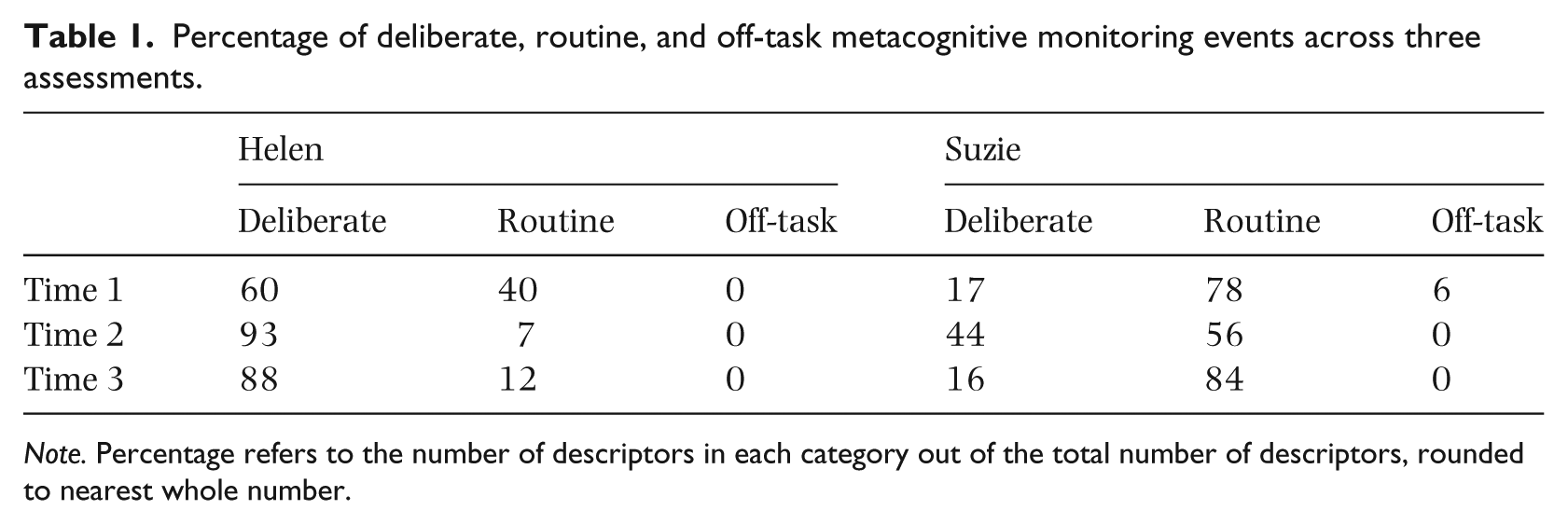
Note. Percentage refers to the number of descriptors in each category out of the total number of descriptors, rounded to nearest whole number.
The participants’ Metacognitive Monitoring displayed two contrasting profiles. Helen’s was planned: “Start étude with right hand only because of trouble with a specific section.” (Time 1); on-task and challenging: “Varying tempo and rhythm to get a different feel. Helps me think more, instead of mindless repetition” (Time 1); solution-focused: “Now this is the section I noticed when I was playing it fast that wasn’t good enough. So I’m repeating the specific bars, trying to make it clearer.” (Time 2); “Running through sections until hitting a snag, then slower and repeated. I’m stopping at the parts that have errors, to fix them. Fixing them by repeating them, or hands separately” (Time 3); and contextualised: “Playing the whole thing really fast after I’ve worked through a specific section. This helps me see how it fits together and what else needs work. Do this every practice” (Time 2).
Suzie displayed an almost inverse profile of Metacognitive Monitoring. Hers was unplanned: “Étude start, from the beginning, because I didn’t know what I was going to do” (Time 2); habitual with limited problem solving in response to problems: “ Stopped, then right hand. Repeating right hand. It’s hard to remember why I was doing this” (Time 2); and non-specific: “I did the chords, then grouped a section of it” (Time 1); and off-task: “Annoyed by squeaky pedal” (Time 1).
Self-reflection
All items in the self-reflection phase captured differences in SRL that discriminated across time and between the two participants. Helen’s Self-Evaluation ratings were consistently higher for productivity and goal fulfilment (7–10 out of 10) than Suzie (4–5 out of 10). Helen, the high achieving student, rated the most important reason for practice effectiveness as internal-stable factors of work ethic and effort. In contrast, Suzie’s external-stable reason (“Help from teacher”) suggests that she felt minimal control over her performance outcomes in music.
Affective responses varied between both learners. At Time 1, Helen reported that she had met her goals by following her planned structure for the session. Although vague, they nevertheless facilitated focus and resulted in positive feelings about her approach and practice accomplishments. Another notable feature distinguishing Helen and Suzie, which corresponds to the eventual performance result outcome, is that Helen’s affective response to all three practice sessions was positive (e.g., “I felt really good about this practice. I did the things I planned to do”), which she related to her achievement of practice goals, strategies, and progressive mastery of the piece.
Suzie’s Affect reactions were negative (e.g., “I felt really bad about it. I didn’t get as far as I thought I would”). At Time 1 there is no clear articulation of goals, therefore impeding benchmarking of progress to strategy, and encouraging attribution to internal, stable causes. Importantly, at Times 2 and 3, Suzie reports both positive and negative affect for the same vague approach, that is, how she “normally” practices; e.g., Time 2 “I feel good about it . . . It’s how I normally practice, just doing what the teacher says, hopefully”. This suggests that Suzie not only has weak goal setting and strategic planning skills, but that her habitual and externalised strategies (especially at Time 2) left her disempowered to achieve her potential and susceptible to seemingly random positive or negative affective responses to her practice efforts.
Helen’s responses consistently linked motivation with mastery goals. She linked incremental progress at each time point to the overall performance mastery goal she had set to achieve prior to the end-of-semester exam. Given the characteristics of the responses in respect of the level of achievement of the two respondents, it would seem that these self-reflection questions in the microanalysis protocol are particularly indicative of eventual performance success (or lack thereof).
Suzie, on the other hand, felt “bad” about her progress in the first session because it was ineffective. This prompted her to feel motivated and enthusiastic about the following session, with a resolve to work in a more methodical manner and consolidating progress section-by-section rather than repeating the haphazard approach she adopted in her first session. Yet, following this more effective session, she felt “helpless” and poorly motivated about what she might do in the future. She seemed to be broadly optimistic: “Next session will be slightly different” (Times 1, 2 and 3), but unaware of how she could improve her practice approach in a way that would lead to a constructive difference: “I don’t know what to do next” (Time 2).
Discussion
In this study, we developed a microanalysis protocol that aimed to effectively cue students to describe the SRL processes embedded within their music practice. The protocol provided broad coverage of the forethought, performance, and self-reflection phases of SRL. The participants’ responses provide initial evidence that first year university music students are receptive to the questions and broader constructs covered by this technique. While we did not expect vast differences in all facets of self-regulated learning between only two students, the case studies demonstrated two broadly contrasting SRL profiles of behaviour, cognition, and affect. Helen was a proactive learner who tended to discuss higher-order contextual strategies with the aim of achieving an individualized interpretation and mental model of the score. Suzie indicated less self-regulated goal setting, and reactive and habitual strategy use.
This study presents a notable divergence from existing SRL literature. Research in music to date is most often conducted using large scale surveys (Araújo, 2015; McPherson & McCormick, 1999, 2000; Miksza, 2012; Nielsen, 2004). However, researchers in music have yet to apply specific microanalysis techniques, shown to be successful in other domains (Cleary, Callan, & Zimmerman, 2012; Cleary & Callan, in press) to understand students’ SRL strategies in the music context. Our focus has been on methodological development reflecting the breadth of SRL strategies and within-subject, moment-to-moment fluctuations in practice quality that determine the intensity and quality of practice within and across time. Our working assumption was that no single factor would be able to define, or fully explain, each individual student outcome. Rather, we expected that SRL would be highly individualistic and involve a choreography of learning habits, strategies, and abilities that have been developed over the learner’s entire education. Consequently, we sought to develop a tool that could be used to help musicians become more aware of their own practice efficiency, and an aid that could be used by teachers who wished to adopt the technique to improve their student’s learning.
Implications for future research
In this study, we have shown that microanalysis techniques built on the three phases of SRL can be adapted to study music practice. Now that we have a working protocol for monitoring and cueing practice strategies (McPherson et al., 2015), our continuing work will include intervention studies aimed at helping developing musicians become more behaviourally, metacognitively, and emotionally involved in their learning. We have repurposed a microanalytic protocol from an educational context to music practice using the types of cues that can allow students to scaffold to higher levels of practice efficacy. Readers are encouraged to modify and adapt the protocol for their own particular research or teaching situation. Thus, our protocol should serve as a guiding framework rather than a fixed set of questions.
The present research used a case study trial approach to applying a particular microanalytic protocol (McPherson et al., 2015). This methodology had the advantages of providing deep illustrative information about the nature of each participant’s practice during the three phases. However, it was not a test of effectiveness of the protocol. To this end, future research may adopt techniques to examine effectiveness. This could consist of using the present methodology but applying a longitudinal perspective to look at changes in practice habits over time, or larger-scale quantitative approaches where microanalytic teaching and practice techniques are analysed in relation to student performance examination results or other indices of music performance ability.
Applications of the microanalytic technique for teaching and learning
Self-regulation is not a single construct, and conceptions of self-regulation must be framed as a cyclical rather than static process. The technique developed in this study offers researchers the advantage of mapping out developmental paths across time in terms of cognitions, behaviour, and affect. It also offers teachers the opportunity to gain more clarity on the particular parts of a musician’s learning profile that might need to be optimised in order to improve performance.
We observed pianists who typically relied on habitual approaches every time they sat down to practice, and who rarely adopted the types of strategies that can optimise learning. For example, the students with whom we worked showed little awareness of key attributes within the forethought and self-reflection phases of SRL. Optimising their practice might therefore involve devising strategies for encouraging them to set more specific goals and identify ways of planning and motivating themselves. It would also be important for them to implement richer self-reflective assessments that could serve as a stimulus for more efficient and goal directed practice sessions.
Our future work will attempt to customise the protocol devised for this study so that individual musicians can focus on specific aspects of the self-regulatory process in which they most need to change. We will attempt to understand the degree to which the use of the three phases can help shape, maximise and optimise individual practice sessions and whether students are able to increase their capacities to make even more sophisticated judgements about the goals, motivation orientations, and adaptive self-evaluations that allow their practice to be more effective.
In conclusion, our aim in this study was to develop a global self-regulation measure that could form the basis of attempts aimed at optimising music practice. The resultant microanalysis protocol is based on the three phases of the cyclical SRL process involving forethought, performance, and reflection. In proposing this approach, we are very much aware that changing habits into productive optimised practice strategies will only occur when students and their teachers start to think differently about the nature of music practice. We therefore realise that what we are proposing will challenge the beliefs of musicians more generally if the techniques suggested by the self-regulation literature are to be fully implemented by individual students, teachers, and within music schools. It is important to understand also that our proposal is not to define a single invariant microanalysis technique, but to provide a framework that outlines the types of processes and abilities that encompass efficient self-regulation in music. This technique, therefore, should be adapted and modified to fit particular learning contexts, depending on the abilities of the music learner (Wolters & Won, in press).
Footnotes
Funding
The author(s) disclosed receipt of the following financial support for the research, authorship, and/or publication of this article: This research was funded by the Australian Government through an Australian Research Council (grant number DP150103330). This study is part of a larger study funded by an Australian Research Council Discovery Project (DP-150103330) held by the first, third, and fourth authors.