



Abstract
Research investigating methods of facilitating classical music performance has tended to focus on treating the debilitating effects of Music Performance Anxiety (MPA). It has been suggested that flow and MPA may be antithetical experiences and that fostering techniques for facilitating flow may provide a powerful tool for helping to alleviate MPA. However, there is a scarcity of data exploring professional classical musicians’ experiences of flow, and little empirical evidence supporting a relationship between flow and MPA. The current study examined the flow experiences and the relationship between flow and MPA amongst 202 professional classical orchestral musicians in Israel. Results showed that the majority of participants regularly experience flow. Hierarchical regression analysis provided evidence of a strong, negative relationship between flow and MPA, supporting the suggestion that facilitating flow may provide a helpful approach for alleviating MPA. An additional exploratory investigation was made into performers’ experiences of Musical Emotional Contagion (MEC), the influence of the emotional contents of the music on the performer. Results showed that the majority of participants reported experiences of MEC and there was evidence of significant associations between MEC, flow and MPA. The clinical implications of the findings are discussed.
Keywords
Classical professional orchestral musicians make use of great expertise in a wide variety of cognitive and physiological skills in order to carry out their everyday work of performing music (Kenny, 2006). They “process and execute complex musical information with novel artistic insight and technical facility … efficiently and effectively” (Williamon, 2004, p. 3), whilst simultaneously being responsive to the continuously changing music-making of surrounding others (Davidson & King, 2004). However, in spite of the musician’s command of a wide range of strengths, most of the literature devoted to facilitating optimal music performance is focused on developing techniques for treating the pathological, debilitating effects of Music Performance Anxiety (MPA; Kenny, 2011). This is in contrast to the fields of work (Kirchner, 2011), education (Bakker, 2005) and particularly sport (Swann, Keegan, Piggott, & Crust, 2012), where research on performance excellence is focused on building on strengths and enhancing positive functioning (Seligman, 2008), and there has been a growing interest in the concept of “flow”, the subjective psychological state often associated with optimal functioning (Csikszentmihalyi, 1975, 1990). Several authors have suggested (Fullager, Knight, & Sovern, 2013; Kirchner, Bloom, & Skutnick-Henley, 2008; Lamont, 2012) that fostering techniques for facilitating flow may provide a powerful tool for helping to alleviate the destructive influences of MPA. However, there are few investigations of flow in music performance, nearly all of which have been carried out with student populations (Sinnamon, Moran, & O’Connell, 2012; Wrigley & Emmerson, 2011) and there is only a single study exploring the relationship between flow and MPA, also carried out with music students (Kirchner et al., 2008). Given the evidence that students and professional musicians suffer from different sources of MPA (Steptoe, 1989) and the absence of studies examining the flow experiences of professional musicians, there is a need to gather data on professional musicians’ experiences of flow, and to examine the relationship between flow and MPA amongst professional musicians. This information would enable a deeper understanding of the experience of flow amongst classical musicians, and provide support for the suggestion that fostering techniques to facilitate flow may help to alleviate MPA.
Optimal music performance and flow
Despite the reluctance of some musicians to explore the subject of optimal music performance, fearing that talking may spoil the artistry of music making (Dunsby, 1995), concepts of optimal performance have started to filter into the world of music performance from the fields of sport, work and education (Williamon, 2004). Recently there has been growing interest (Chirico, Serino, Cipresso, Gaggioli, & Riva, 2015) in the concept of “flow”, the subjective psychological state often associated with peak performance (Nakamura & Csikszentmihalyi, 2009).
Flow is generally understood as having nine dimensions (Nakamura & Csikszentmihalyi, 2009). Three of the dimensions are defined as pre-conditions of flow: 1) perceived skill/challenge balance; 2) clear goals; and 3) clear, immediate feedback. The remaining six dimensions are defined as experiential characteristics of flow: 1) focused concentration; 2) the experience is intrinsically rewarding; 3) a merging of action and awareness; 4) sense of control; 5) lack of self-consciousness; and 6) a distortion of temporal experience. Flow has been found to occur across a variety of domains: in sport (Jackson & Csikszentmihalyi, 1999), work (Eisenberger, Jones, Stinglhamber, Shanock, & Randall, 2005), education (Bakker, 2005; O’Neill, 1999) and leisure (Johnson, Wyeth, Sweetser, & Gardner, 2014); across a wide spectrum of ages: amongst adults (Butkovic, Ullén, & Mosing, 2015), students (Wrigley & Emmerson, 2011), school children (O’Neill, 1999) and even very young children (Custodero, 2005). Flow has been found to be stable across class, gender and culture (Hart & DiBlasi, 2015) and is conceived of as a continuous variable rather than as an all-or-none experience (De Manzano, Theorell, Harmat, & Ullen, 2010). It is thought that flow may play a key role in motivation (Cseh, Phillips, & Pearson, 2014), as the experience of flow is intrinsically rewarding, and “encourages a person to persist in and return to an activity … and thereby fosters the growth of skills over time” (Nakamura & Csikszentmihalyi, 2009. p. 199).
Although some authors differentiate between “flow”, “peak performance” and “optimal performance” (Privette, 1983), others use these terms interchangeably (MacDonald, Byrne, & Carlton, 2006; Nijs et al., 2012). In this paper, the following commonly used working definition of flow will be adopted: “flow” or “being in a state of flow” describes a person’s subjective psychological state of mind, when they are completely immersed and fully concentrated in an activity; the activity is experienced as enjoyable and intrinsically rewarding, and is associated with peak performance (Fritz & Avsec, 2007; Fullager et al., 2013; Hart & DiBlasi, 2015; Marin & Bhattacharya, 2013; Wrigley & Emmerson, 2011). Preliminary explorations into the psychophysiological basis of flow suggest that there is an inverse-U relationship between physiological arousal and flow (Peifer, Schulz, Baumann, & Antoni, 2014), and a positive association between dopaminergic function and proneness to flow (De Manzano et al., 2010).
There have been investigations of flow in music listening (Chirico et al., 2015; Diaz, 2012), composition (MacDonald et al., 2006) and music performance (Fullager et al., 2013; Lamont, 2012; Sinnamon et al., 2012; Wrigley & Emmerson, 2011), but nearly all have been carried out only with student musicians, not with professional classical musicians.
Music performance anxiety (MPA)
In contrast to the field of optimal music performance, there is a substantial body of Music Performance Anxiety (MPA) research, providing evidence that MPA is a disturbing and debilitating phenomenon for a significant number of performing classical musicians (Brugues, 2011; Kenny, 2011). Despite the lack of standardization in the terms and tools used (Brodsky, 1996) and the unwillingness of musicians to talk openly about the subject (Patston, 2014), there is evidence that MPA can affect musicians at any stage of their career: highly experienced professional performers (Fishbein, Middlestadt, Ottati, Straus, & Ellis, 1988; Kenny, Driscoll, & Ackermann, 2014), amateurs (Hoffman & Hanrahan, 2012), student musicians (Kirchner et al., 2008; Osborne, Greene, & Immel, 2014), adolescents (Braden, Osborne, & Wilson, 2015; Patston & Osborne, 2016) and even young elementary school children (Ryan, 2005). The phenomenology of MPA can be understood as comprising four interactive, yet partially independent components (autonomic arousal, behavioural responses, cognitions and emotions) in which a change in any one of the components may trigger changes in the other components (Kenny, 2011), and a variety of models have been proposed describing factors that may contribute to the creation and maintenance of MPA (see Kenny, 2011, and Papageorgi, Hallam, & Welch, 2007, for an overview of this subject).
Despite the suggestion (Lamont, 2012; Simoens, Puttonen, & Tervaniemi, 2015; Wrigley & Emmerson, 2011) that fostering techniques for facilitating flow may provide a powerful tool for helping to reduce the destructive influences of MPA and encouraging optimal performance, the relationship between flow and MPA has barely been explored in the literature. Csikszentmihalyi (1975, 1990) described the perceived skills/challenge balance as central to the experience of flow, with anxiety resulting when the perceived challenge exceeds perceived skills, and boredom resulting when skills exceed challenge. Fullager et al. (2013) carried out an investigation of the relationship between skill/challenge balance, flow and MPA amongst music students. They found that when performance anxiety was highest, flow was lowest and vice versa. We would argue that flow and anxiety are not antipodal states (in that they are not opposite ends of the same continuum), but that they are antithetical (in that they are negatively related). Our findings indicate that flow and performance anxiety can exist simultaneously, but that the presence of one minimises the magnitude of the other. (Fullager et al., 2013, p. 251)
Other than Fullager et al.’s study, there is only one other published empirical study investigating the relationship between flow and MPA, which provides evidence of a moderate negative association, r = -0.20, p < .05, in a population of music students (Kirchner et al., 2008). Unfortunately, the method used for measuring flow in this study is unclear. Hence, a second aim of the current study is to provide evidence of the relationship between flow and MPA amongst professional classical musicians, using recognized, standardized measures.
It is readily recognized in the music psychology literature that music has the ability to influence us physiologically, through changes in skin conductance, muscle tension and heart rate (Liljeström, Juslin, & Västfjäll, 2013; Lundqvist, Carlsson, Hilmersson, & Juslin, 2009), and to induce strong emotions (Juslin & Laukka, 2004; Swaminathan & Schellenberg, 2015). Most of the research in this field has been carried out with listener subjects (Schubert, 2013), however, it is possible that performers may also be influenced physiologically and emotionally by the music that they are playing, and that the emotional contents of the music itself may play a part in contributing to experiences of MPA and flow. This is an area that has been little explored.
Musical emotional contagion (MEC)
Several mechanisms have been proposed to account for our physiological and emotional responses to music (Lundqvist et al., 2009), including Juslin and Vastfjall’s (2008) concept of “musical emotional contagion” (MEC). MEC is defined as “the process whereby an emotion is induced by a piece of music … the music can express an emotion that then ‘infects’ its listener” (Juslin & Vasfjall, 2008, p. 565). Steptoe (2001) has suggested that performers may also be influenced by the emotions evoked by the music, but there is little empirical evidence to support this. As both MPA and flow are recognized as having strong emotional aspects (Csikszentmihalyi, 1975; Kenny, 2011), MEC may be relevant to performers’ experiences of MPA and flow. This is supported by Van Zijl and Sloboda’s (2013) report of performers’ descriptions of the potential dangers of getting carried away with the emotion in the music and losing control of the performance, and also by Marin and Bhattacharya’s (2013) findings that piano students’ flow experiences appear to be facilitated by the emotional contents and musical style of the music played. Based on Kenny’s (2011) model of MPA as comprising four partially independent yet interactive components (autonomic arousal, behavioural responses, cognitions and emotions), it is possible that a performer might become “infected” by MEC, potentially leading to changes in the four interactive components of MPA, and resulting in a possible escalation (or reduction) in MPA. Given Fullager et al.’s (2013) suggestion that MPA and flow are antithetical experiences, it is possible that MEC may act as a moderator of the relationship between MPA and flow. Currently there is little investigation of MEC amongst performers, or of its relationship with experiences of MPA and flow.
The present investigation will examine the following two hypotheses:
The majority of professional classical orchestral musicians will report experiencing flow.
There will be a significant negative association between flow and MPA amongst professional classical orchestral musicians.
Additionally, an exploration will be made of professional classical orchestral musicians’ experiences of musical emotional contagion (MEC) and of its potential moderating effect on the relationship between MPA and flow.
Methods
Participants
Participants were 202 professional classical orchestral musicians (49.5% female) from seven professional orchestras in central Israel: three symphony and four chamber orchestras. Participants’ mean age was 43.22 years (SD = 12.18), with an average professional experience of 21.57 years (SD =12.64), with 60.0% playing string instruments, 20.5% woodwind, 15.0% brass and 4.5% percussion, and 33.8% were section principals, 25.6% associate principals and 40.5% tutti players. Participants’ country of origin was Israel (40.8%), countries in the former USSR (42.8%), Western European countries (4.5%), USA and Canada (4.0%), countries in the former Eastern Bloc (3.0%), countries in South America (2.0%), and other (3.0%).
Measures
Flow was measured using Martin and Jackson’s (2008) short version of Jackson and Eklund’s (2002) 36-item Dispositional Flow Scale–2 (DFS-2), designed to measure an individual’s disposition to experience flow whilst participating in a particular target activity. The DFS-2 (short) contains nine items, each item representing one of Csikszentmihalyi’s nine dimensions of flow as follows: challenge-skill balance (I feel competent to meet the high demands of the situation), merging of action and awareness (I do things spontaneously and automatically), clear goals (I have a strong sense of what I want to do), clear feedback (I have a strong sense of how well I am doing), focused concentration (I am completely focused on the task at hand), sense of control (I have feelings of total control over what I am doing), loss of self-consciousness (I am not worried about what others think of me), transformation of time (time passes differently from normal), and autotelic experience (the experience is extremely rewarding). Subjects are instructed: “Think about how often you experience each characteristic during music performance and circle the number that best matches your experience”. Items are rated on a 7-point Likert scale (1 = strongly disagree, 2 = disagree, 3 = mildly disagree, 4 = neither agree nor disagree, 5 = mildly agree, 6 = agree, 7 = strongly disagree) with higher scores reflecting a higher frequency of flow and the 7-point scale providing respondents with a neutral mid-point. Psychometric data for high school classical musicians and high school athletes yielded Cronbach alphas of .83 in sport and .84 in music (Martin & Jackson, 2008). The DFS-2 (short) is recommended for use when time constraints prevent use of the long measure and when global flow is of interest (Martin & Jackson, 2008). The current study focused on obtaining measurements of global flow and the questionnaires were completed during time-limited orchestral rehearsal breaks, so the DFS-2 (short) was deemed an appropriate tool.
MPA was measured using the Performance Anxiety Inventory (PAI; Nagel, Himle, & Papsdorf, 1981), a specifically developed and frequently used tool for investigating MPA (Biasutti & Concina, 2014; Hoffman & Hanrahan, 2012), and the tool used in Kirchner et al.’s (2008) investigation of the relationship between MPA and flow amongst music students. The PAI consists of 20 items, scored using a 4-point Likert scale (1 = almost never, 2 = sometimes, 3 = often, 4 = almost always), which describe the cognitive (e.g., item 7: “Thoughts of doing poorly interfere with my performance”), physiological (e.g., item 18: “I feel my heart beating very fast during performances”) and emotional/behavioural (e.g., item 8: “I feel very jittery when giving an important performance”) aspects of MPA. Responses to all 20 items (the first item requiring reverse-scoring) are added up, and mean MPA scores calculated, with higher scores indicating higher MPA. The PAI has been shown to yield excellent alpha Cronbach scores of .89 (Nagel, Himle, & Papsdorf, 1989) and .92 (Biasutti & Concina, 2014).
MEC was measured using the MEC questionnaire, specially developed for this study. Vuoskoski and Eerola’s (2011) overview of models of music-induced emotion found that most of the variance in music-induced emotion could be accounted for by two principal components, corresponding to the two orthogonal dimensions of Arousal and Valence in Russell’s (1980) two-dimensional circumplex model of emotion. Marin and Bhattacharya (2013) used these two dimensions of arousal and valence in their explorations of flow and musical emotions in piano students, and these two dimensions were used to form the basis of the MEC questionnaire in the current study here (here named “tension” and “mood”). Investigation was made of the influence of MEC on the player’s physiological arousal (Music Emotional Contagion body: MECbody), and of the influence of MEC on the player’s mood (Musical Emotional Contagion mood: MECmood). Pilot investigations (N = 39) revealed that some professional musicians were unfamiliar with reflecting on their experiences of playing and were uncomfortable acknowledging that they were influenced physiologically or emotionally by the music, feeling that it was in some way unprofessional. Consequently, wording was chosen to present the concepts simply and clearly, and to facilitate a greater openness to considering these experiences. Respondents were asked to answer “yes/no” as to whether they experienced MECbody and MECmood, and if they answered “yes” they were asked to grade how much on a 10-point scale. The 10-point scale was chosen to provide a broad range within which subjects could locate their experience. The questions asked were: (1a) The mood and character of the music that I am playing can influence the tension in my body: YES/NO (please circle one); (1b) If you answered “yes” to the previous question, please rate how much, from 1 = a small extent, to 10 = really a lot; (2a) The mood and character of the music that I am playing can influence my mood: YES/NO (please circle one); (2b) If you answered “yes” to the previous question, please rate how much, from 1 = a small extent, to 10 = really a lot. Demographic information including participants’ country of origin, age, number of years of playing, instrument, role in orchestra and questions about pre-performance routines was also gathered.
Procedure
The first author obtained authorizations from the Musicians’ Committees and the Orchestral Management for participation in the research project. Due to the unique demographics of Israeli orchestras, questionnaires were translated from the original English into Hebrew and Russian, by bilingual native speakers of these languages, until a consensus was obtained. This allowed the players to fill in the questionnaire in their preferred language. The questionnaire was given in two versions, counterbalanced for order. In six of the seven orchestras, players completed the questionnaires during a long day of rehearsals. In the seventh orchestra, due to orchestral time limitations, players received the questionnaires in personal orchestra mail boxes and placed the completed questionnaires in a sealed box. In all cases, anonymity was preserved. The mean of the response rate in six out of seven of the orchestras was 70.3%. 1 The questionnaire took approximately six minutes to complete. The study was approved by the ethical review committee at Bar-Ilan University.
Results
Flow data
Cronbach reliability analysis of the nine item DFS-2 scale yielded a value of α = .68. To facilitate comparison with other investigations of flow in the literature, and similar to the procedure used in Sinnamon et al. (2012) and Wrigley and Emmerson’s (2011) studies, the DFS-2 item response categories were compressed into a dichotomous variable of either high frequency of flow (strongly agree, agree and mildly agree) or low/no frequency of flow (neither agree nor disagree, mildly disagree, disagree and strongly disagree). Results for the mean global flow scores (the average of all nine flow items), ranked mean scores, standard deviations, and frequencies of high flow for the each of the flow items are presented in Table 1.
Mean global flow scores, ranked mean scores of flow items, SDs and frequency of flow experience (N = 173 a ).
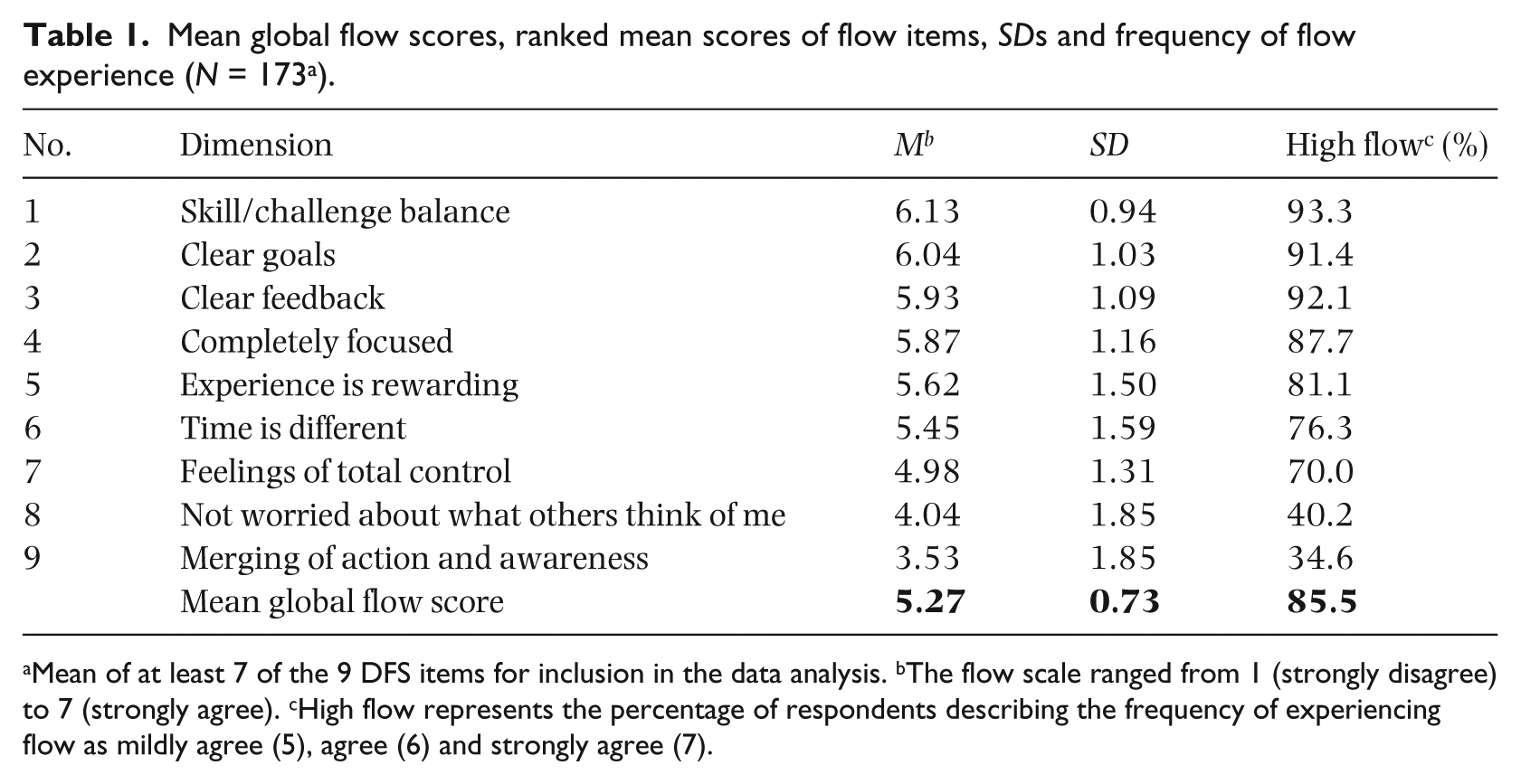
Mean of at least 7 of the 9 DFS items for inclusion in the data analysis. bThe flow scale ranged from 1 (strongly disagree) to 7 (strongly agree). cHigh flow represents the percentage of respondents describing the frequency of experiencing flow as mildly agree (5), agree (6) and strongly agree (7).
The results for the mean global flow scores (see Table 1) showed that 85.5% of participants experienced high global flow, thus supporting the first hypothesis that the majority of professional classical orchestral musicians will report experiences of flow. The highest ranked mean scores and frequencies for the individual flow items were for skill/challenge balance, clear goals and clear feedback, with 93.3% of participants experiencing a skill/challenge balance, 91.4% experiencing clear goals, and 92.1% experiencing clear feedback. The items for loss of self-consciousness and merging of action and awareness received lower mean scores and frequencies, with only 40.2% of participants experiencing a loss of self-consciousness and only 34.6% experiencing merging of action and awareness.
There were significant deviations from normality for the mean scores of each of the nine flow items (Shapiro-Wilk < .05), therefore non-parametric Spearman-Rho correlations were calculated. These showed that all nine flow items were moderately to highly correlated with mean global flow scores, ranging from r = 0.39, p < .001, for merging of action and awareness, to r = 0.72, p < .001, for sense of control. The items for transformation of time, r = 0.45, p < .001, and merging of action and awareness, r = 0.39, p < .001, had the lowest correlations with mean global flow and there was a lack of significant inter-correlations between these two items with most of the other items.
MPA data
Cronbach reliability analysis of the PAI scale yielded a value of α =. 92. The mean MPA score was relatively low (M = 1.69, SD = 0.52), and 43.7% of musicians reported almost never experiencing MPA; however 56.3% reported experiencing MPA sometimes, often or almost always. When players were asked “Do you regularly take any medications or other substances to help with performances?”, 25.6% answered “yes”, and 47.6% of these reported regularly taking beta-blockers, a beta-adrenergic drug blocking agent used to reduce the somatic symptoms of anxiety (West, 2004). In answer to the question: “Have you ever taken any medication or other substances to help with performances”, 57.9% of the players said “yes”, and 69.5% of these reported using beta-blockers. Other substances taken included homeopathic medicines (21.0%), alcohol (4.2%), tranquilizers (10.5%), caffeine (14.7%), nicotine (6.3%) and other (11.6%), with some players using more than one type of substance.
Relationship between flow and MPA
Inter-correlations between the study variables (see Table 2) showed that there was a strong, negative correlation between flow and MPA, r = -.48, p < .001. There were no significant correlations between gender and either flow or MPA. There was a moderate positive correlation between flow and players’ age, r = .20, p < .01, but none between MPA and players’ age.
Means, standard deviations and inter-correlations of the study variables (N = 173 c ).

Note. Pearson product coefficients are presented for continuous variables, and point-biserial coefficients are presented for gender.
Mean of at least 7 of the 9 DFS items for inclusion in the data analysis. bMean of at least 16 of the 20 PAI items for inclusion in the data analysis. cOutliers of 3 SD above or below the mean global flow score or mean PAI score were excluded. dcoded 0 = male, 1 = female.
p < .05. **p < .01. ***p < .001.
It was ensured that all assumptions for regression analysis were met (independence of variables, normality of residuals, homoscedasticity, VIF values < 1.06 and Tolerances > 0.61, indicating that multicollinearity was not a concern). Hierarchical regression analysis was carried out, with MPA as the dependent variable and flow as the independent variable. This showed that, after controlling for age and gender, the relationship between flow and MPA remained negative and significant, β = -0.568, SE = 0.071, ΔR2 = .303, p < .0001, thereby supporting the second hypothesis that there would be a significant negative relationship between flow and MPA.
MEC data
The exploration of MEC showed that the majority of the musicians in the sample (79.1%) reported that the emotional contents of the music performed influenced the tension in their body quite a lot (MECbody: M = 6.59, SD = 2.53), and the majority (83.6%) reported that the emotional contents of the music played influenced their mood quite a lot (MECmood: M = 6.48, SD = 2.49).
Relationships between flow, MPA, MECbody and MECmood
Exploration of the associations between flow, MPA, MECbody and MECmood showed (see Table 2) that there was a strong positive correlation between MECbody and MECmood, r = .55, p < .001, and a moderate positive correlation between MECbody and MPA, r = .28, p < .01. No significant correlations were found between MECmood and MPA, or between flow and either MECbody, or MECmood.
In light of the significant correlations found between MPA and MECbody, and between MECbody and MECmood, further steps were added to the hierarchical regression analysis. In addition to controlling for age and gender in the first step, and analysing the contribution of flow to MPA in the second step, the contribution of MECbody to MPA was examined in the third step, and found to be significant, β = 0.290, SE = 0.019, ΔR2= .082, p < .002. In a fourth step, the contribution of MECmood to MPA was investigated, and was not found to be significant, β = -0.104, SE = 0.024, ΔR2= .007, p = .365. The SPSS macro PROCESS (Hayes, 2013) was then used to explore for a moderating effect of either MECbody or MECmood on the relationship between flow and MPA.
The results of the moderation analysis showed that (see Figure 1) there was a significant interaction between flow and MECbody, ΔR2 = 0.051, F(1,91) = 7.073, p < .01, in which at higher levels of MECbody (+1SD), there was a significant negative relationship between flow and MPA, B = -.478, SE = .083, p < .0001, whereas at lower levels of MECbody (-1SD), the relationship between flow and MPA was not significant, B = -.139, SE = .104, p = .183. There was no evidence of a significant interaction between flow and MECmood in contributing to MPA, ΔR2 = 0.025, F(1,91) = 3.445, p = .067. To explore the contribution of MECbody and MECmood to flow, a further set of reverse-direction hierarchical regression analyses were conducted, with MPA and MEC as independent variables and flow as the dependent variable. This analysis showed that after controlling for age and gender in the first step, the relationship between flow and MPA in the second step was negative and significant, β = -0.536, SE = 0.126, ΔR2 = .286, p < .001, but the contribution of MECbody to flow in the third step, β = 0.088, SE = 0.028, ΔR2 =.007, p = .371, and the contribution of MECmood to flow in the fourth step, β = 0.019, SE = 0.035, ΔR2 < .001, p = .874, were not significant. Using PROCESS (Hayes, 2013), there was no evidence of an interaction between either MPA and MECbody or between MPA and MECmood in contributing to flow.
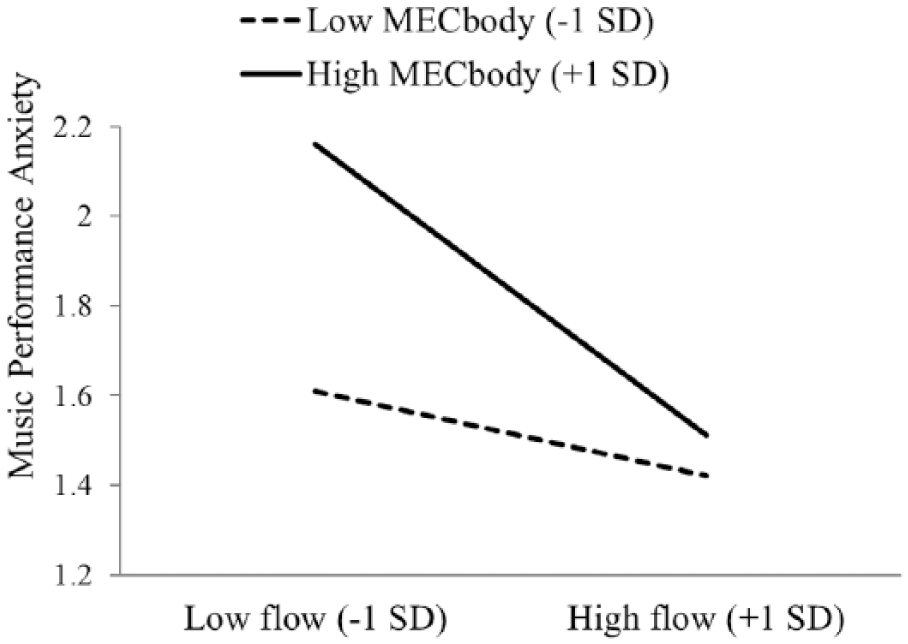
The interaction between flow, MECbody and MPA.
Discussion
The primary aims of this study were to provide flow data, and evidence for the relationship between flow and music performance anxiety (MPA) for professional performing classical musicians. The rationale behind this part of the study was to provide support for the suggestion (Fullager et al., 2013; Lamont, 2012; Wrigley & Emerson, 2011) that facilitating flow may provide a powerful tool for encouraging optimal performance and helping to reduce music performance anxiety (MPA) amongst classical musicians. The study found that the majority of professional classical orchestral musicians reported a high frequency of flow experiences, that MPA was a concerning issue for approximately half of the musicians, and that there was a strong negative relationship between flow and MPA. Thus the study’s two main hypotheses were supported. Regarding the exploration of musical emotional contagion (MEC), the results showed that the majority of professional classical orchestral musicians reported experiencing the influence of MEC on their bodies (MECbody) and moods (MECmood), and there was evidence of a significant interaction between MECbody and flow in contributing to MPA, in which MECbody acted as a moderator in the relationship between flow and MPA. These findings will now be discussed in greater detail.
The finding that the majority of the participants had frequent experiences of global flow provides the first report in the literature of the flow experiences of professional classical orchestral musicians. The evidence that all nine flow items were moderately to highly positively correlated with mean global flow scores replicates existing findings in the literature for student musicians (Marin & Bhattacharya, 2013; Sinnamon et al., 2012), and supports the theoretical basis on which the flow scale is built, that each of the nine items, representing the nine dimensions of flow, makes a significant contribution to the experience of flow (Martin & Jackson, 2008). The finding that the three flow items with the highest ranked mean scores and frequencies (skill/challenge balance, clear goals and clear feedback) corresponds to the three dimensions of flow defined by Nakamura and Csikszentmihalyi (2009) as the pre-conditions of flow, provides empirical support for Nakamura and Csikszentmihalyi’s (2009) model of flow. The item for skill/challenge balance ranked higher in this study with professional musicians than in studies of student musicians (Marin & Bhattacharya, 2013; Sinnamon et al., 2012), reflecting the higher skill level of professional musicians and providing an explanation for the higher levels of global flow found in this study, compared to studies with student populations (Wrigley & Emmerson, 2011).
The moderate positive correlation between flow and age found in the current study has not been found in studies of student musicians (Marin & Bhattacharya, 2013; Wrigley & Emmerson, 2011) and supports findings that professional musicians tend to enjoy their work and be highly motivated (Brodsky, 2006).
The low frequencies, ranked mean scores and low inter-correlations between lack of self-consciousness, merging of action and awareness and transformation of time with the other flow items, replicate findings with student musicians (Marin & Bhattacharya, 2013; Sinnamon et al., 2012; Wrigley & Emmerson, 2011). Jackson & Csikszentmihalyi (1999) group these three aspects of the flow experience together in their examination of flow in sports, as characterizing “a state of mind that has become transformed beyond our normal day-to-day experience” (p. 72). It is possible that these particular aspects of the flow experience, which are reported as central to the experience of flow in sports, may be less important for the performing musician, who may need to maintain an awareness of the music-making of surrounding others. However, given Jackson and Csikszentmihalyi’s (1999) description of the merging of action and awareness as “the most telling aspect of the flow experience” (p. 20), the low scores for this aspect of flow observed amongst musicians (Marin & Bhattacharya, 2013; Sinnamon et al., 2012; Wrigley & Emmerson, 2011) may indicate psychometric weaknesses in the DFS-2 for measuring flow in the domain of music, and it is possible that “flow is not being experienced as often as high global flow scores suggest” (Sinnamon et al., 2012, p. 20). The somewhat low Cronbach alpha (.68) yielded in the current study may be a function of the small number of items in the DFS-2 (short) scale (Field, 2009), however it may reflect the psychometric weaknesses in the DFS-2 for measuring musicians’ flow experiences. It is suggested that further examination of professional classical musicians’ flow experiences be carried out, using the DFS-2 (long), which would help provide a detailed picture of the contribution of each aspect of flow to the experience of global flow, and help to examine the psychometric adequacy of DFS-2 in the domain of music.
The mean PAI score obtained in the current study was lower than the score described by Nagel et al. (1981) as indicating clinical levels of MPA. However, the finding that over half of the players reported experiencing MPA and had, at least on one occasion, used substances or medications to help them perform, suggests that many professional performing musicians do not feel that they have the necessary skills to deal with the stress of performance without pharmacological help. The high beta-blocker use reported is similar to that reported by Kenny et al. (2014), and is concerning, given that beta-blockers only address the physiological symptoms of MPA, can have negative side-effects, may dull the playing experience and their effectiveness decreases over time (Kenny, 2011). Additionally, evidence suggests that beta-blockers are often used in the absence of medical supervision and their use is almost certainly under-reported (Kenny et al., 2014; Patston & Loughlan, 2014). Furthermore, these professional musicians are often the teachers of student musicians and are ill-equipped to help their students learn adaptive approaches to coping with the stresses of performing (Patston, 2014). Despite evidence recognizing student classical musicians as a population suffering from MPA, and in need of help in managing the stresses of performing (Kenny, 2011; Papageorgi, Creech, & Welch, 2013), few institutions currently offer performing skills programmes (Osborne et al., 2014). Developing suitable performance skills interventions for music students is an area in need of further research.
The significant negative association found between flow and MPA amongst professional classical orchestral musicians was stronger than that found by Kirchner et al. (2008) amongst student musicians. This can be explained both by the higher levels of global flow amongst professional musicians compared to student musicians (Wrigley & Emmerson, 2011), and the lower levels of MPA reported by professionals, compared to students (Biasutti & Concina, 2014; Kirchner et al., 2008). This finding also supports the evidence that professional classical orchestral musicians may have developed more effective strategies for dealing with MPA than their student counterparts (Biasutti & Concina, 2014). Thus, the current study supports the suggestion that flow and MPA are antithetical states in which the presence of one minimizes the magnitude of the other (Fullager et al., 2013), and supports the suggestion that fostering techniques for facilitating flow may provide a useful tool for helping to reduce MPA and facilitate optimal performance (Iusca, 2015; Lamont, 2012).
The exploration of MEC provides the first quantitative evidence that the majority of professional musicians experience the influence of MEC on both their body and their mood. The finding that, in addition to the significant negative association between flow and MPA, there was also a significant positive association between MECbody and MPA, and a significant moderating effect of MECbody on the relationship between flow and MPA, such that at higher levels of MECbody the negative association between flow and MPA was significant, whereas at lower levels of MECbody it was not, can be understood by examining the role of autonomic arousal in MPA (Fredrikson & Gunnarsson, 1992; Yoshie, Kudo, Murakoshi, & Ohtsuki, 2009) and in flow (Peifer et al., 2014). Using Kenny’s (2011) four-component model of MPA (as described earlier), it is possible that, at high levels of MECbody, the extra autonomic arousal from raised MECbody may add to the autonomic arousal generated by MPA, resulting in an overall increased level of autonomic arousal. Based on Kenny’s (2011) interactive model, this raised level of autonomic arousal may then interact with the other components of MPA, leading to an overall increase in MPA, which would then be reflected by the significant, negative relationship between flow and MPA. At lower levels of MECbody, the escalation in autonomic arousal would not occur, thereby explaining the absence of a significant negative relationship between flow and MPA at lower levels of MECbody. This suggests that performers who are strongly physically influenced by the emotional contents of the music played may be more vulnerable to experiencing MPA than players with lower levels of MECbody. For these players, an intervention focusing on developing awareness of MECbody and learning skills for regulating physiological arousal maybe very helpful for preventing an escalation in MECbody that could result in raising MPA. The absence of correlation between flow and MECbody, and the absence of interaction between MECbody and MPA in contributing to flow, can also be explained by recent explorations in theories of flow and arousal. Peifer et al. (2014) found evidence of an inverse U-shaped relationship between physiological arousal and proneness to flow in which flow was most likely to occur at moderate levels of arousal. Thus, when physiological arousal is raised above a moderate level as a result of increased MPA or MECbody, flow is unlikely to occur.
The absence of significant relationships between MECmood and the other study variables, despite the strong positive correlation between MECbody and MECmood and the absence of problems with multi-collinearity, may be explained by understanding music performance as an intense, visceral, physical activity in which changes in mood may well be the consequences of the physical bodily responses elicited by the music (Goffin, 2014). This approach has much in common with ideas from the developing field of Embodied Music Cognition (Leman, 2008), in which the human body is considered to be the natural mediator between the musicians’ mind and the physical environment containing musical sound. Further investigations into physiological measures of performers’ autonomic arousal, together with self-reported measures of MPA, flow, MECbody and MECmood using the psychophysiological methodologies and technologies of Embodied Music Cognition, could help validate the measures of MEC, greatly enhance our understanding of these phenomena, and provide important insights into the mechanisms underlying the relationships between these phenomena. This is beyond the scope of the current cross-sectional study and should be the focus of future studies.
A further limitation of the current study is that due to the unique demographics of professional orchestral musicians in Israel, it was not possible to control for the varied cultures of the participants. An analysis of the effect of the player’s country of origin on experiences of MPA, flow and MEC was beyond the scope of the current paper and merits further investigation. Another study limitation concerns the response rate, which was comparable with that of other studies of professional orchestral musicians in the literature (Fishbein et al., 1987; Kenny et al., 2014). Nevertheless, the conclusions that can be drawn are limited by the absence of data for those musicians who chose not to participate in the study.
In conclusion, the current study provides evidence that professional classical orchestral musicians experience flow and that there is a significant negative relationship between flow and MPA amongst professional classical orchestral musicians, thereby supporting the suggestion that developing techniques for facilitating flow may provide a useful tool for helping to reduce MPA. Additionally, the findings suggest those musicians who are prone to experience higher levels of MECbody may be more vulnerable to experiences of MPA and could be helped by learning to develop an awareness of the influence of the music performed on their bodies, and learning techniques for regulating levels of physiological arousal. Seligman (2011) suggests, in his work on “flourishing”, that well-being and success are not attained merely when there is an absence of pathology, but rather that methods for facilitating positive functioning also need to be actively cultivated. Based on these ideas, a targeted intervention that focuses on both facilitating flow, as well as reducing MPA, might be beneficial for helping musicians to perform optimally. If such an intervention became a normative part of the music education process, musicians would be able to acquire the necessary performing skills to enable them to produce optimal performances, without suffering from stigmatized, debilitating MPA or needing to resort to pharmacological help. This is an area that merits further investigation.
Footnotes
Acknowledgements
We thank all the orchestral musicians for participating in the study. Thanks also to Tirza Gur-Arieh and Elena Dubnova for help translating the questionnaires.
Funding
The author(s) received no financial support for the research, authorship, and/or publication of this article.