



Abstract
The present study investigated the mediating processes of emotional awareness, positive emotions, and negative emotions between music engagement and well-being among Chinese adolescents. Through a process-oriented approach, the association between music engagement activities, including music listening, music instrument playing, and music training, and adolescents’ functioning were examined. A total of 1,318 Chinese adolescents at 12–15 years of age were recruited from secondary schools in Hong Kong. Findings based on structural equation modeling provided differential support for the association between music engagement and adolescents’ well-being. As cognitive and affective processes, both emotional awareness and emotions mediated between music training and well-being. Positive and negative emotions also mediated between music listening and adolescents’ well-being. Surprisingly, music instrument playing was not associated with emotional awareness, positive or negative emotions, or well-being. These findings supported previous frameworks and call attention to the emerging mechanisms underlying music engagement and well-being in adolescence.
Music engagement has long been considered as a medium in altering emotions (Juslin & Sloboda, 2001), particularly in adolescence (DeNora, 2000; Laiho, 2004). Adolescence is a period of a relatively dramatic biological, social, and psychological transformation (Arnett, 1999). In the face of new challenges such as puberty and school transitions, mood disruption is more likely to occur, suggesting potential rises in emotion dysregulation (Cicchetti & Rogosch, 2002). As such, it is important to identify critical processes of well-being and health outcomes at this period. Previous research defined well-being as comprising affective functioning, psychological functioning, and social functioning that leads to more happiness, greater life satisfaction, and better mental health (Keyes, 2002; Ryff, 1989; Ryff & Keyes, 1995). This study aims to investigate the cognitive and affective processes underlying music engagement and well-being in adolescence.
Theoretical frameworks of music engagement and individual functioning
The cognitive theory of emotion and aesthetics in music (Bever, 1988) suggests that when people engage in musical experiences or with musical stimuli, their focused attention arouses emotions that may be associated with their individual experiences. These perceptual and cognitive processes make music “an emotional trigger and amplifier” of a wide range of emotions (Miranda & Gaudreau, 2011; Steptoe, 2001). Although this theory suggests that music engagement triggers both positive and negative emotions, other theories highlight the emotional and psychological benefits of music engagement. For example, the theory of music, mood, and movement (Murrock & Higgins, 2009) suggests that music increases cognitive recognition and mindful affective responses, thereby altering long-standing mood and facilitating better well-being. In highlighting the contributions of music in adolescence, Laiho (2004) theorized that music provides an avenue for individuals to overcome intense mood swings and cater for the need of an increased emotional turmoil (Larson, 1995). For example, the engagement of music enhances adolescents’ emotion regulation skills, including their emotional awareness, identification, and modulation, as well as their well-being (DeNora, 2001; Dingle, Hodges, & Kunde, 2016; Jonas-Simpson, 1997; Juslin & Laukka, 2003; MacDonald, 2013; Mas-Herrero, Marco-Pallares, Lorenzo-Seva, Zatorre, & Rodriguez-Fornells, 2013; Pelowski & Akiba, 2011; Ruud, 1997; Vallerand, 2012). Although much work has been done to conceptualize the benefits of music engagement (Bever, 1988; Laiho, 2004; Murrock & Higgins, 2009), little is known about the underlying mechanisms of why and how music engagement fosters emotions and well-being. As such, the present research aims to fill the gap by testing the mediating processes between music engagement activities and adolescent well-being. As proposed by Bever (1988), music engagement activities such as music listening, instrument playing, and training arouse different types and levels of emotional responses (see also Blood & Zatorre, 2001; Khalfa, Isabelle, Jean-Pierre, & Manon, 2002; Zentner, Grandjean, & Scherer, 2008). The following section reviews the literature for the effects of music engagement activities on emotions and well-being.
Music listening
Music listening arouses and alters both positive and negative emotions, including fear, happiness, sadness and peacefulness, and impacts subsequent health outcomes (DeMarco et al., 2012; Khalfa, Isabelle, Jean-Pierre, & Manon, 2002; Siedliecki & Good, 2006). Depending on individual preferences, daily and intentional music listening increases positive and negative emotions (Kreutz, Ott, Teichmann, Osawa, & Vaitl, 2008; Miranda & Gaudreau, 2011; Rickard, 2012) and a better understanding about personal feelings (Laiho, 2004). Within the clinical setting, DeMarco, Alexander, Nehrenz, and Gallagher (2012) found that listening to music desirable for therapeutic use led to lower levels of stress and anxiety among individuals undergoing cosmetic surgery. In particular, participants who listened to music prior to surgery reported 18% less anxiety than participants who did not, suggesting that music listening mitigated negative emotions in a stressful situation. These findings established the linkage between music listening and emotional arousal, which echo with Bever’s (1988) theory in that music engagement elicits both positive and negative emotions.
Music instrument playing
Unlike music listening, music instrument playing was found to be primarily associated with positive emotional and well-being outcomes (Hallam, Creech, Varvarigou, & McQueen, 2012; Stacy, Brittain, & Kerr, 2002). Previous research indicated that playing musical instruments helped individuals sustain concentration (Kovarovic, 2012), as focused attention was required to discriminate small changes in pitch (Baumann, Meyer, & Jäncke, 2008; Fujioka, Ross, Kakigi, Pantev, & Trainor, 2006; Moreno et al., 2008). Additionally, instrument playing enabled individuals to disengage or redirect their focus away from negative to positive stimuli (Kovarovic, 2012). For example, when individuals engaged in piano playing, they were able to express their emotions and manage their stress more effectively, thereby reducing anxiety and improving mental health (Toyoshima, Fukui, & Kuda, 2011). Through the enhancement of attention, the above findings suggested that instrumental playing facilitates psychological well-being and mental health (Vallerand, 2012).
Music training
In this study, music training is defined as engagement in developing skills and competencies in music; for example, through repeated and regular participation in learning music theory, learning musical instruments, and singing. Music practice and training strengthen cognitive functions (Besson, Chobert, & Marie, 2011; Strait, Kraus, Parbery-Clark, & Ashley, 2009). Studies found that musically trained children demonstrated higher levels of selective attention (Corrigall, Schellenberg, & Misura, 2013) and better emotion comprehension than did children without training (Schellenberg & Mankarious, 2012). Moreover, regular and repeated engagement in activities such as music training fostered positive emotions, diminished negative emotions, and contributed to psychological well-being (Croom, 2015; Vallerand, 2012). Van Goethem and Sloboda (2011) found that music experience, as reflected by music listening and music-related activities such as dancing, singing, and going to concerts, was an important correlate of happiness and relaxation. Koenig and colleagues (2013) further evidenced a “spontaneous and fast-acting effect” of music-induced emotions, in that music practice modulated negative emotions and elicited positive emotions. These findings suggested cognitive, emotional, and psychological benefits of training in music.
In sum, studies accumulated to date have indicated that music engagement, including music listening, playing, and training, offers numerous well-being benefits. As a next step, it is crucial to investigate the mechanisms underlying music engagement and well-being outcomes.
Emotional awareness, emotions, and well-being
Increased emotional awareness may serve as one of the ways to explain the psychological benefits of music engagement. Previous research suggested that personal awareness, attention, and understanding of emotions are essential to well-being (Coffey, Hartman, & Fredrickson, 2010; Hill & Updegraff, 2012; Schutte & Malouff, 2011), especially in adolescence (Ciarrochi, Kashdan, Leeson, Heaven, & Jordan, 2011; Froh, Yurkewicz, & Kashdan, 2009). Emotional awareness is defined as the ability to accurately identify and differentiate various positive and negative emotions (Boden & Berenbaum, 2011; Huang, Berenbaum & Chow, 2013). Facets of emotional awareness, including attention to emotions and recognition of specific emotional states, are crucial to quality of life (Boden, Irons, Feldner, Bujarski, & Bonn-Miller, 2015). Similarly, the ability to identify and label emotions enables one to intensify and prolong emotions that improve mental health (Lieberman et al., 2011).
Positive emotions are beneficial to individual functioning. According to the broaden-and-build theory (Fredrickson, 1998, 2001), when people are aware of their positive emotions, they try to cultivate and maintain relevant experiences and resources. These positive emotions broaden the momentary thought–action repertoire and build enduring personal resources, thereby facilitating physical and psychological health (Fredrickson, 1998). Individuals with more positive emotions experience greater life satisfaction, better well-being, and fewer psychological complaints (Robinson & von Hippel, 2006; van Harreveld, van der Pligt, Claassen, & van Dijk, 2007). On the contrary, negative emotions limit individuals’ processing skills, judgment, and adaptations (Schwarz & Clore, 2007). The limitations brought by negative emotions further deteriorate life satisfaction as well as physical and psychological health (Kuppens, Realo, & Diener, 2008; Wiech & Tracey, 2009). As such, the awareness of both positive and negative emotions is pertinent to well-being.
The current study
Guided by music engagement and psychological theories (Bever, 1988; Fredrickson, 1998, 2001; Laiho, 2004; Murrock & Higgins, 2009), the current study examined the mediating roles of emotional awareness and emotions between music engagement and well-being in adolescence. More specifically, we hypothesized that (a) music engagement, as measured by music listening, instrument playing, and music training, would positively predict emotional awareness, (b) emotional awareness would positively predict positive and negative emotions, (c) both positive and negative emotions would predict well-being, and finally, (d) emotional awareness, positive emotions, and negative emotions would mediate between music engagement and adolescents’ well-being. The hypothesized model is illustrated in Figure 1.
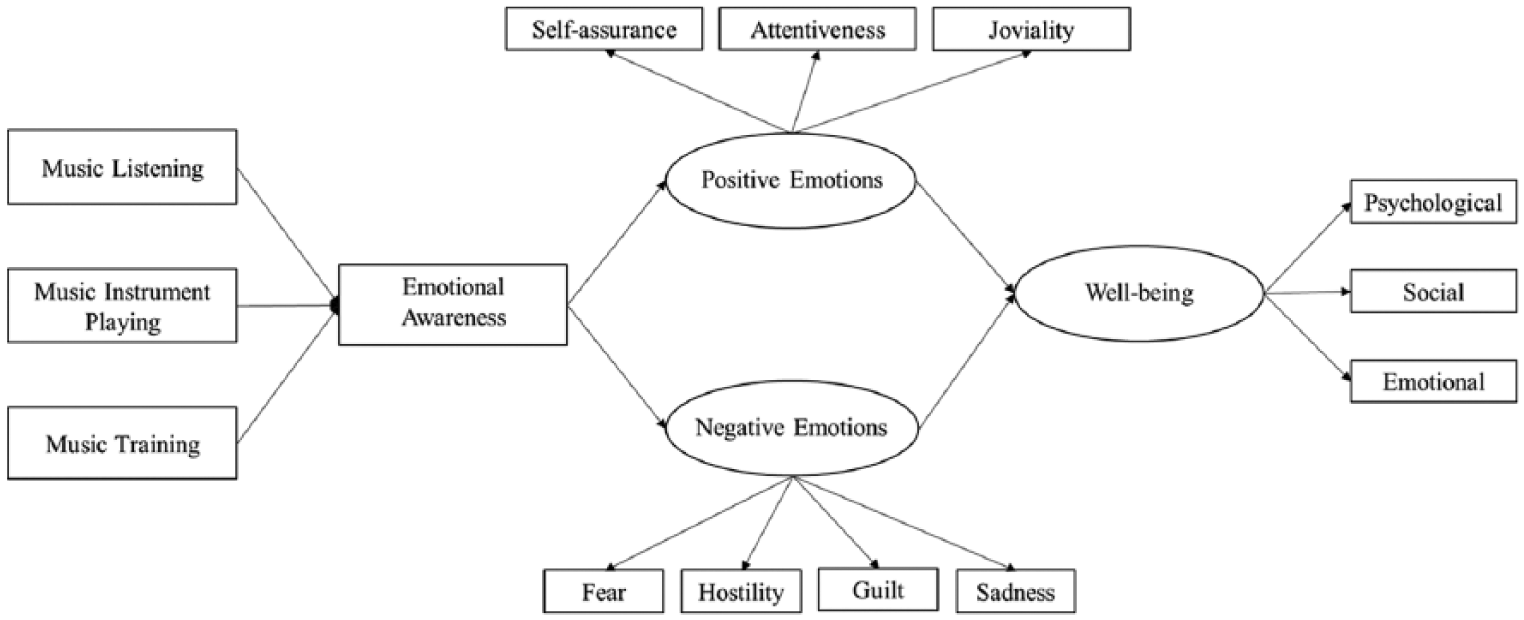
Conceptual model of music engagement, adolescents’ positive and negative emotions, and well-being. Direct pathways between music engagement activities and well-being are not included for clarity.
Method
Participants
Chinese adolescents from Hong Kong between 12 and 15 years of age (M = 13.51, SD = 1.28) were invited to participate in this study. Specifically, 1,318 secondary one to three students (52.4% boys, 47.6% girls) from local schools were recruited. Prior to their participation, both student assent and parent consent were obtained. Upon the study completion, the schools were given a brief report as a token of appreciation for school teachers’ and student participants’ time and effort spent in the study. Ethical approval was sought and granted by the Human Research Ethics Committee at a local institution prior to the conduct of the study.
Measures
Chinese versions of the following measures were used. The original measures were translated to Chinese via the procedures of forward and backward translation (Brislin, 1986; Werner & Campbell, 1970).
Music engagement
Music USE (MUSE; Chin & Rickard, 2012) was used to measure respondents’ level of music engagement and experience. For the purpose of this study, the eight-item subscale of music experience included (a) Indices of Music Listening (IML), which assessed listeners’ intentional music listening; (b) Music Instrument Playing (IMIP), which assessed participants’ instrument playing intensity (duration and frequency) and regularity; and (c) Music Training (IMT), which assessed participants’ music education training and qualification levels. Based on the existing scoring directions (Chin & Rickard, 2012), composite scores were calculated to form the indices of IML, IMIP, and IMT.
Emotional awareness
The six-item Emotional Awareness subscale of the Difficulties in Emotion Regulation Scale (DERS; Gratz & Roemer, 2004) was used to measure individuals’ awareness of emotions on a five-point scale from 1 (almost never) to 5 (almost always). The measure has been validated in an adolescent sample (Weinberg & Klonsky, 2009) and used in Chinese samples (Han, Qian, Gao, & Dong, 2015). The measure yielded adequate internal consistency, with α = .77.
Positive and negative emotions
The 18-item Basic Positive Emotion Scales and 23-item Basic Negative Emotion Scales from the Positive and Negative Affect Schedule–Expanded Form (PANAS-X; Watson & Clark, 1999) were used to capture the extent to which individuals’ had felt various positive and negative emotions during the past few weeks. Respondents were asked to rate their emotions on a Likert scale ranging from 1 (very slightly or not at all) to 5 (extremely). The positive and negative emotions subscales, respectively, had acceptable (joviality α = .90, self-assurance α = .66, and attentiveness α = .64) and adequate internal consistency (fear α = .84, hostility α = .82, guilt α = .84, and sadness α = .85).
Well-being
The 14-item adolescent version of the Mental Health Continuum Short Form (MHC-SF; Keyes, 2009) was used as a measure for well-being over the last month on a Likert scale ranging from 0 (never) to 5 (every day). The MHC-SF has been validated in a Chinese adolescent sample and yielded good validity and reliability (Guo et al., 2015). The MHC-SF subscales had adequate internal consistency (emotional well-being α = .90, psychological well-being α = .91, and social well-being α = .82).
Results
Table 1 shows the means, standard deviations, and correlations among all study variables. Compared to boys, girls exhibited lower levels of emotional well-being (Mgirls = 3.40, SDgirls = 1.12; Mboys = 3.59, SDboys = 1.12), t(1310) = 2.96, p < .01, social well-being (Mgirls = 2.53, SDgirls = 1.20; Mboys = 2.74, SDboys = 1.17), t(1310) = 3.26, p = .001, and psychological well-being (Mgirls = 2.87, SDgirls = 1.22; Mboys = 3.16, SDboys = 1.12), t(1310) = 4.52, p < .001.
Correlations and descriptive statistics.
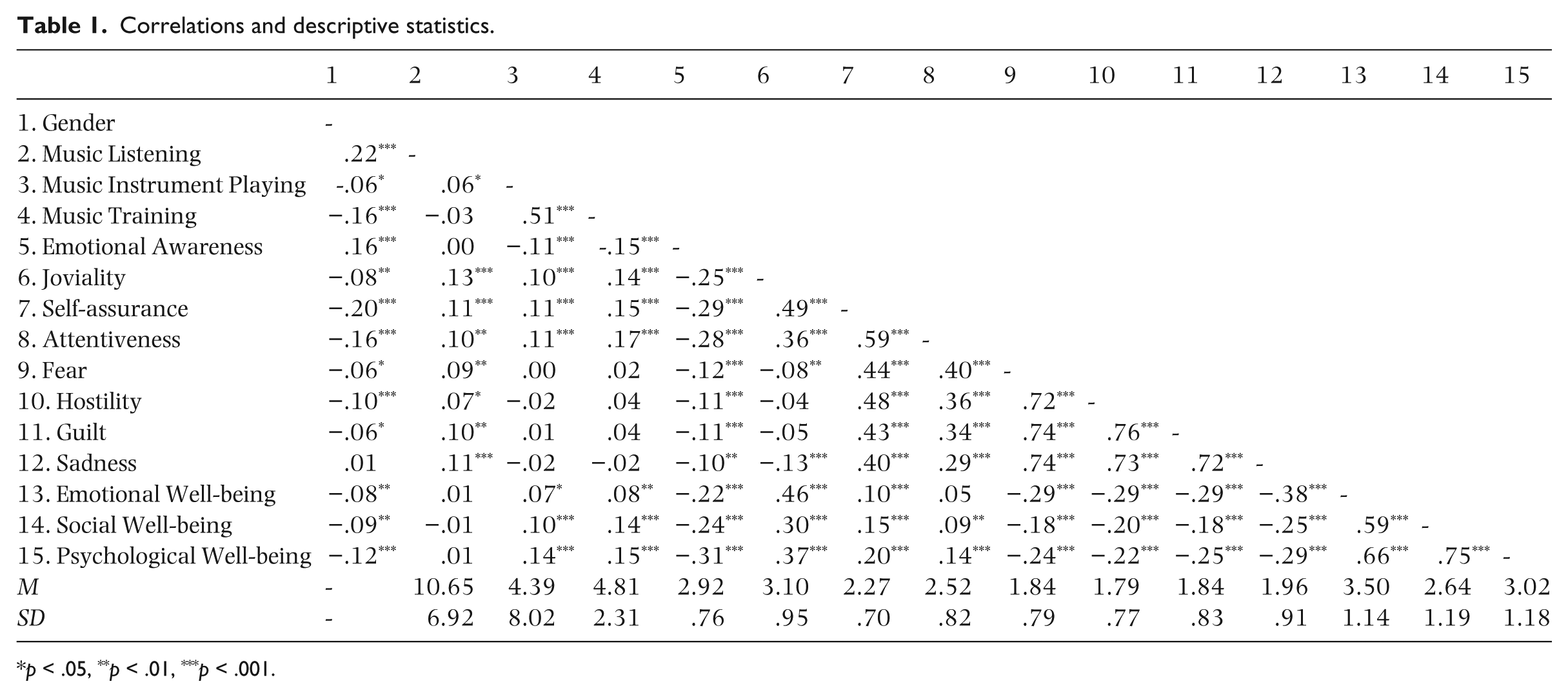
p < .05, **p < .01, ***p < .001.
To investigate the relations in a structural equation model, Mplus Version 7 (Muthén & Muthén, 1998–2012) was used, with maximum likelihood method to examine the model fit to the observed variance and covariance matrices. Latent constructs were created for positive emotions, negative emotions, and well-being. Full information maximum likelihood estimation was used to handle missing data. Adolescents’ gender was incorporated in the model to control for their well-being, as previous research suggested that male and female adolescents indicated that females usually reported more adjustment problems, such as depression and anxiety, than did their male counterparts (Åslund, Starrin, & Nilsson, 2010; Derdikman-Eiron et al., 2011). Mediation was tested by bootstrapping, as it could yield more accurate estimates of the indirect effect standard errors than other approaches to testing mediation (Shrout & Bolger, 2002).
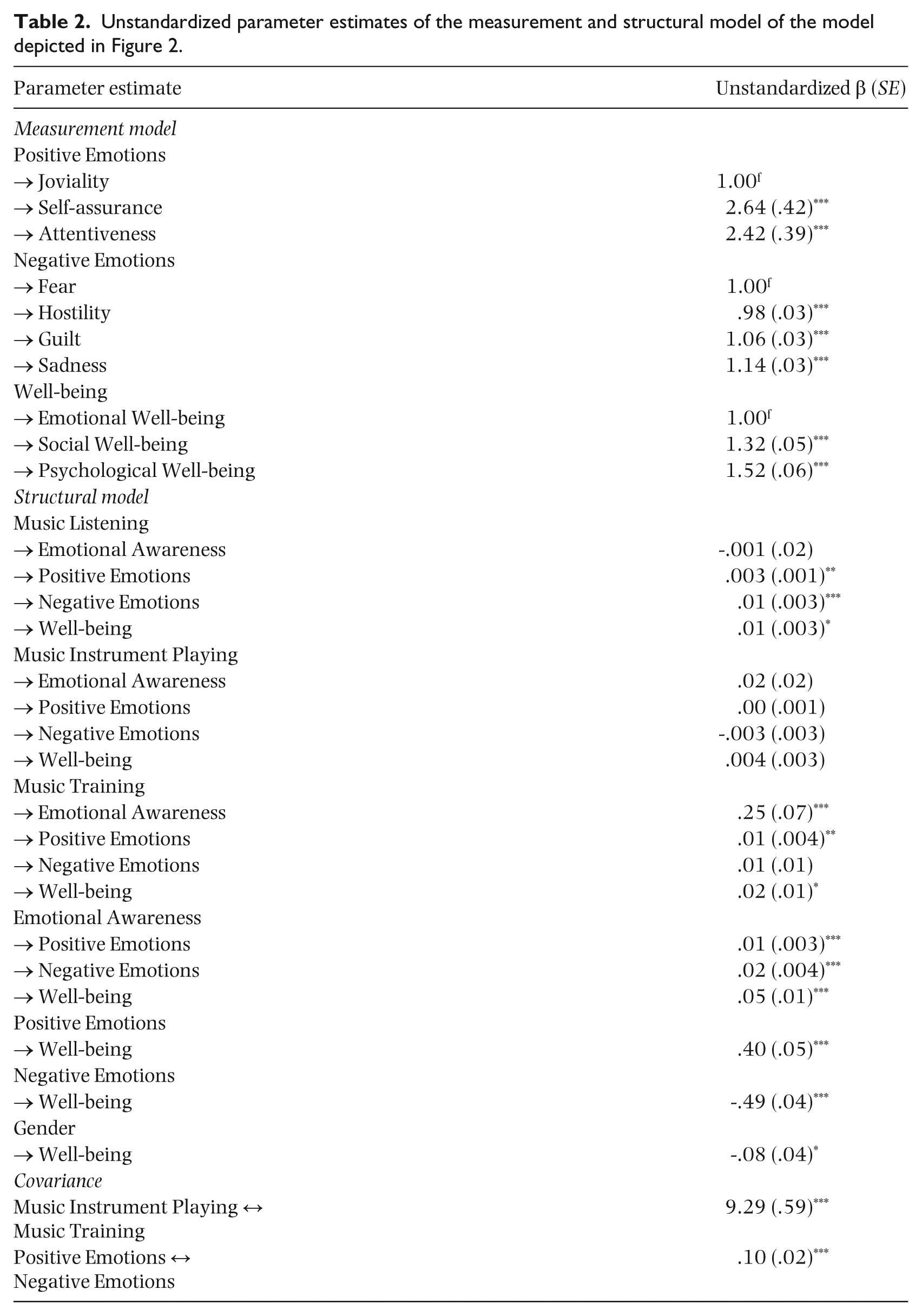
Findings indicated that the model fit was adequate, χ2(29) = 590.43, p < .001, CFI = .94, TLI = .91, RMSEA = .07, SRMR = .08 (see Figure 2). Table 2 shows the unstandardized parameter estimates, standard errors, and the significance levels in the measurement and the structural models. Specifically, music instrument playing was strongly correlated with music training (r = .50, p < .001; see Cohen, 1988). Music listening predicted positive emotions (β = .07, p < .01), negative emotions (β = .11, p < .001), and well-being (β = .05, p = .05). Music training predicted positive emotions (β = .07, p < .01) and well-being (β = .08, p < .05), but not negative emotions (p > .05). However, music instrument playing did not predict any outcome variables (ps > .05). Emotional awareness predicted positive emotions (β = .18, p < .001), negative emotions (β = .12, p < .001), and well-being (β = .31, p < .001). Both positive and negative emotions predicted well-being (β = .20 and -.47, ps < .001, respectively).
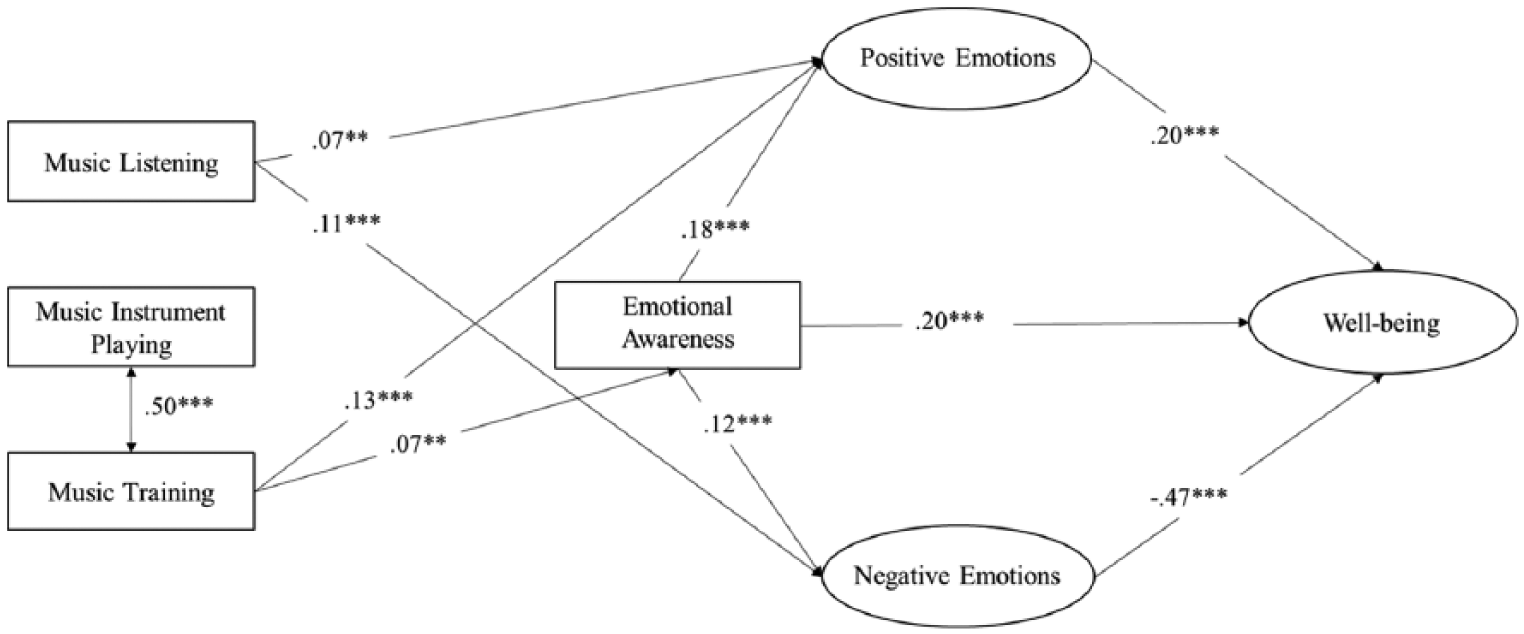
Simplified structural model of overall music listening, music instrument playing, music training, emotional awareness, positive and negative emotions, and well-being. χ2(29) = 590.43, p < .001, CFI = .94, TLI = .91, RMSEA = .07, SRMR = .08. Standardized parameter estimates are presented. *p < .05, **p < .01, ***p < .001. Gender has been added as a control variable for well-being. Direct effects between music engagement activities and well-being are not included for clarity. Non-significant pathways are not included for clarity. However, unstandardized estimates and standard errors can be found on Table 2.
Unstandardized parameter estimates of the measurement and structural model of the model depicted in Figure 2.
In terms of mediation, the 95% confidence interval [CI] based on 1,000 bootstrap samples with replacement indicated that the total indirect effects of music listening and well-being did not include a zero (95% CI: -.01, -.001), suggesting positive and negative emotions as mediators. The 95% CI based on 1,000 bootstrap samples with replacement indicated that the total indirect effects of music training and well-being did not include a zero (95% CI: .001, .02), suggesting emotional awareness, positive emotions, and negative emotions as mediators. However, the 95% CI based on 1,000 bootstrap samples with replacement indicated that the total indirect effects of music instrument playing and well-being included a zero (95% CI: 0, .01), suggesting emotional awareness and emotions did not serve as mediators. These findings suggested emotional awareness and emotions as pathways between music engagement and well-being.
Discussion
The present findings provided differential support for the association between music engagement and adolescents’ well-being. As mediating mechanisms, emotional awareness and emotions served as underlying processes through which music training predicted well-being. Similarly, emotions mediated between music listening and well-being. Surprisingly, music instrument playing was not associated with emotional awareness, positive and negative emotions, and well-being. This study supports theories and previous empirical findings (Bever, 1988; Laiho, 2004; Murrock & Higgins, 2009) in calling attention for the emerging mechanisms underlying music engagement and well-being in adolescence.
Music listening
Consistent with previous findings in music engagement and emotions (Bever, 1988; Juslin, 2013; Juslin, Liljeström, Västfjäll, Barradas, & Silva, 2008), this study suggested that intentional music listening was associated with adolescents’ positive and negative emotions. In particular, music listening enables the listener to recall specific memories about the music. Such memories may arouse a wide range of emotions including positive and negative ones (Juslin, 2013). In addition, the nature of music including genres, lyrics, and other expressive properties may elicit a range of emotions (Ballard, Dodson, & Bazzini, 1999; Labbé, Schmidt, Babin, & Pharr, 2007). For example, excerpts that arouse happiness often have a fast tempo and a major mode, whereas excerpts that arouse sadness often have a slow tempo and a minor mode (Vieillard et al., 2008). Interestingly, music listening itself was predictive of better well-being. This finding is consistent with other studies that demonstrated the merits of music listening on health and well-being (e.g. MacDonald, 2013). Future work is needed to replicate these findings and identify longitudinal pathways through which music listening enhances well-being.
Music instrument playing
Although music instrument playing was strongly associated with training (Cohen, 1988), playing itself did not contribute to emotional awareness, positive and negative emotions, or well-being in adolescence. That is, controlling for music listening and training, knowing how to play a musical instrument was comparatively trivial in predicting awareness, emotions, and well-being. In a Hong Kong Chinese context where outcome-based learning is valued (Pang, Ho, & Man, 2009), learners’ measurable achievements and performance are prioritized over and above learning experiences and processes. Local adolescent music learners often participate in various competitions and examinations as proof of music achievements. This accelerates the intensity of practice that involves both instrument playing and training. Consequently, the effect of music training on adolescents’ well-being might have overridden the effect of music playing in the current model. On the contrary, any adolescent can listen to music without having the obligation to acquire music training or play an instrument. That is, it is not necessary for music listeners to engage in any music playing and training. As such, music listening was independent of music instrument playing and training to predict emotions and well-being.
Music training
Our findings suggested cognitive and emotional benefits of music training, in that training facilitated emotional awareness and positive emotions, but not negative emotions. This finding supports the association between continuous and intensive music training and one’s ability to recognize and understand positive emotions (Hallam, 2010; Resnicow, Salovey, & Repp, 2004; Schellenberg & Mankarious, 2012). As proposed in the broaden-and-build theory (Fredrickson, 1998, 2001), when adolescents are cognizant and aware of their positive emotions, they are more likely to sustain and intensify those emotions (Lieberman et al., 2011). The positive emotions induced by music training are crucial to adolescents’ sense of achievement and improved focus and patience (van Goethem & Sloboda, 2011; Hannesdottir & Ollendick, 2007). These findings extended previous work on the relations between music training and emotion comprehension (François, Chobert, Besson, & Schön, 2013; Schellenberg & Mankarious, 2012). Furthermore, findings suggested both emotional awareness and emotions as intervening processes between music training and well-being. Future work is needed to investigate different forms of music engagement, such as dancing, to identify potential pathways through which music training is associated with emotions and well-being.
Design strengths, limitations, and future directions
The present study has several conceptual and methodological strengths. First, the large sample size increases generalizability to adolescents. Second, multiple dimensions of music engagement, including music listening, music playing, and music training, were assessed comprehensively. To our knowledge, most of the existing studies only examined music participation through one of the activities (Miranda & Gaudreau, 2011; Schellenberg & Mankarious, 2012; Toyoshima, Fukui, & Kuda, 2011). Finally, given that a majority of research has been conducted in the Western societies (Galambos & Constigan, 2003), the present findings serve to fill the research gap in the Chinese context.
Despite these strengths, the findings should be interpreted in light of the study’s limitations, which also point to future research directions. First, the cross-sectional nature of this study precluded us from inferring causality or directionality. Future studies should examine these processes longitudinally to establish their temporal sequence. Researchers may also conduct experiments to establish a causal linkage between music engagement and individual functioning. Second, the variables were assessed through self-report. Future research may utilize multiple informants, including teachers, peers, and parents, to more objectively capture the variables of interest. Researchers may also utilize multiple methods of assessment, including structured interviews, observations, or physiological measures, to assess emotions and well-being. Third, the internal consistency of positive emotions subscales including self-assurance and attentiveness were relatively low. Caution must be made to interpret the present findings. Fourth, although the examination of gender effect was beyond the scope of our study, adolescents’ gender may moderate the associations hypothesized in the model. Future studies may further examine the role of potential moderators including adolescents’ gender, race, and cultural orientations (e.g., Cheung & Park, 2010; Froh et al., 2009). Finally, the current findings were based on a Chinese community sample. Future studies may test the relevant theories in diverse samples to draw a broader conclusion about the potential effects of music engagement.
Conclusion
The present study sheds new light on the association between music engagement and well-being among adolescents. Multiple mechanisms emerged to suggest the unique mediating processes of emotional awareness, positive emotions, and negative emotions between music engagement activities and well-being. These findings highlighted the importance of the emotional and psychological benefits brought by music engagement at adolescence. The current study has implications for intervention efforts toward adolescent mental health and well-being. Adolescent’s participation in music activities, particularly in music training, can facilitate emotional awareness, which is crucial to well-being. Translational research concerning music engagement in gearing toward improving adolescent well-being merits future investigation.
Footnotes
Funding
The author(s) disclosed receipt of the following financial support for the research, authorship, and/or publication of this article: This work was supported by the Graduate School at The Education University of Hong Kong. Ethical approval for this project was granted by the Human Research Ethics Committee from the University.