



Abstract
Everyday stressors—the irritating and disturbing events that happen in the context of everyday life—are common. The present research examined the relationship between everyday stressors and the use of music listening as a coping mechanism. In particular, it examined the use of music listening to cope with different types of everyday stressor and examined the relationship between this usage and listener characteristics, including demographics and music engagement style. Participants in the USA, Australia, and Malaysia (N =553) completed an online survey. A factor analysis was used to identify five types of everyday stressor: Social, Financial, Performance Responsibilities, Work-related, and Daily Displeasures. Individuals listened to music significantly more often to cope with social and work-related stressors than performance responsibilities and daily displeasures. Moreover, individuals who demonstrated a stronger affective listening style and those who reported listening to music for emotion/problem-orientated and avoidance/disengagement reasons were found to listen to music most often to cope with everyday stressors. These findings have implications, for both listeners and health professionals, when considering how music listening can be used as a self-administered tool for coping with everyday stressors.
Stress is typically characterized as occurring when an individual becomes unable to cope with the demands placed on them due to a lack of available resources (Fink, 2009; Lazarus & Folkman, 1984; Lundberg, 2006). Everyday stressors—the stressful, irritating, and/or disturbing events that happen in the context of everyday life—are common and occur naturally as a by-product of living (Yehuda, 2011). Such stressors include social or interpersonal difficulties and conflicts, work difficulties, home difficulties, and financial challenges (e.g., Almeida et al., 2002; Bolger & Schilling, 1991; Kohn & Macdonald, 1992). While these are often harmless and serve an important adaptive function (Dhabhar, 2014), even moderate amounts of stress, if experienced continuously, may lead to negative outcomes for health (e.g., Clark et al., 2016; Dhabhar, 2014; Dimsdale, 2008). Examples of such negative outcomes include poorer immune function and higher susceptibility to disease or illness (Ferrer et al., 2014); disruptions to personal relationships (Bodenmann et al., 2006; Lewandowski et al., 2014); and anxiety and depression (Cohen et al., 2007).
It is perhaps unsurprising, therefore, that people are increasingly interested in using easy and non-invasive approaches, such as music listening, to mitigate stress (MacDonald, 2013). Indeed, a growing body of research demonstrates the role of music in promoting health and well-being (Bradt et al., 2011; Rickard & McFerran, 2012). People often listen to music to regulate their moods (Baltazar et al., 2019; Boer & Fischer, 2012; Lonsdale, 2019; Lonsdale & North, 2011; Schäfer, 2016), reduce negative emotional states (North et al., 2004; Sloboda, 2010), and help relieve or manage everyday stress (Laukka, 2007). Indeed, music listening may function as “an escape and a comfort from the difficulties of life” (Boer & Fischer, 2012, p. 188), which could be considered a coping strategy (Lazarus & Folkman, 1984; Miranda & Claes, 2009; Pearlin & Schooler, 1978). Attending to the music in this way shifts attention away from pain or arousal (Bradshaw et al., 2012; Radstaak et al., 2014). Researchers have investigated people’s use of music listening to cope in a range of contexts, including healthcare, university, and work settings.
The utility of music for distracting the listener from perceived pain, stress and anxiety within healthcare settings is well documented (Mitchell et al., 2008; Roy et al., 2008). For example, patients who listen to music prior to surgery require less sedation (Dijkstra et al., 2010; Tam et al., 2008), report lower stress and anxiety levels (Liu et al., 2016; Thoma et al., 2015), and are more relaxed (i.e., have lower blood pressure and heart rate) after surgery (Karakul & Bolışık, 2018). Additionally, music listening reduces work-related stress (e.g., Beck et al., 2015; Haake, 2011; Lesiuk, 2008; Lima et al., 2017): music can help employees with mood regulation, relaxation, concentration and the management of workplace interruptions (Haake, 2011). Workers on stress leave or returning to work in various employment contexts have been found to benefit from music listening (Beck et al., 2015), as do those in high-stress work environments such as air traffic control (Lesiuk, 2008).
The utility of music listening has also been documented in university settings (Linnemann et al., 2015; Pelletier, 2004). For example, students who listened to music to relax experienced decreases in their levels of stress and arousal (Linnemann et al., 2015). Students who listened to music having taken a test had lower levels of stress than those who did not (Labbe et al., 2007), as did those who listened to music having been instructed to prepare to give a speech (Sandstrom & Russo, 2010).
The extent to which music listening is effective in reducing stress is unique to each individual. Both age (Galanakis et al., 2009) and gender (Dawson et al., 2014; Verma et al., 2011) influence how individuals respond to and cope with stress. In addition, musical preferences (Jiang et al., 2016) and the genre of music to which the individual listens influence stress reduction (Chafin et al., 2004; Yehuda, 2011). Differences in the extent to which music listening reduces stress may be accounted for by individuals’ listening styles and levels of engagement with music (Greenberg & Rentfrow, 2015; Miranda & Claes, 2009). For example, those who have an affective listening style, characterized by emotional responses to music, are likely to experience catharsis and mood regulation (Greenberg & Rentfrow, 2015; Miranda & Claes, 2009).
Most research on music listening and stress has been carried out in the context of experiments (Linnemann et al., 2015; Västfjäll et al., 2012). Laboratory research has shown, for instance, that music improves participants’ ability to cope with and recover from stress (e.g., De La Torre-Luque et al., 2017), and that participants who listened to classical music having carried out a stressful task experienced lowered blood pressure, unlike those who did not listen to classical music (Chafin et al., 2004). Yet the generalizability of such findings remains questionable due to their lack of ecological validity (Lewandowski et al., 2014). Indeed, both social context (Linnemann et al., 2016, 2017), and cultural environment (Chun et al., 2006; Tweed et al., 2004) have been found to influence the ways in which individuals respond and cope with stress.
Research questions and hypotheses
Previous research on music listening and stress has been undertaken in settings such as work and universities, or using experimental methods in the laboratory. The present study extends this work by exploring the use of music listening to cope with stressors broadly, in everyday life. Using a survey that included three questionnaires, it addressed two overarching research questions and tested three hypotheses. The first research question (RQ1) asked (a) what types of stressors people use music listening to cope with and (b) if music listening is used more often to cope with some types of everyday stressor than others. Previous research has categorized everyday stressors as pertaining to social conflicts, work difficulties, home difficulties, and financial changes (e.g., Almeida et al., 2002; Bolger & Schilling, 1991; Kohn & Macdonald, 1992). It is possible that these categorizations may also pertain to music listening as a coping strategy. Because previous research has shown that listening to music is commonly used to relieve work-related stress (e.g., Almeida et al., 2002; Bolger & Schilling, 1991; Kohn & Macdonald, 1992), it was hypothesized (H1) that participants in the research would report listening to music as a way of coping with work-related stressors.
The second research question (RQ2) asked if style of musical engagement is related to the general use of music listening as a way of coping with everyday stressors, once individual differences are accounted for. Musical engagement was defined in relation to both Greenberg and Rentfrow’s (2015) five styles of engagement (narrative, affective, physical, cognitive, and social) and Miranda & Claes’ (2009) three styles of coping (avoidant, emotional, and problem-orientated). Because of the links between affective listening style and emotional state, and prior support for the notion that individuals listen to music for emotional regulation (e.g., Miranda & Claes, 2009; Saarikallio, 2011; Schäfer, 2016), it was hypothesized that (a) affective listening style (H2) and (b) emotion-orientated coping style (H3) would be positively associated with the use of music listening to cope with everyday stress.
Method
Participants
Ethical approval for the study was sought and granted by the Curtin University Human Research Ethics Committee (Approval number: RDHS-100-16). There were 553 participants, of whom 301 (54.40%) lived in the United States, 146 (26.40%) in Australia, and 106 in Malaysia (19.20%), selected as a reference group. Participants were aged 17–79 years (M = 24.49, Mdn = 21, SD = 9.90); 383 (69.26%) participants identified as female, 169 (30.56%) as male, and one (0.18%) as non-binary. Participants were recruited using snowball sampling via social media posts (e.g., Facebook and Twitter), a university research participation scheme (online), and flyers posted around a university campus. As an incentive to take part in the study, participants who were students accessing the survey through the university research participant scheme were eligible to obtain credit toward their coursework. All other participants had the opportunity to enter a prize draw to win a $50 AUD gift voucher.
Measures
The survey consisted of demographic questions and three standardized questionnaires. First, participants were asked to provide information as to their age, gender, nationality, occupation, and country of residence. They rated the importance of music in their life (1 = Not at all important; 7 = Extremely important) and reported the average number of hours they spent listening to music each day. Participants answered a single question using a yes/no response as to whether they considered themselves to be an “active musician.” The question was deliberately phrased broadly and did not include a definition so as to embrace all types of musical participation and encourage participants to define themselves as musicians or otherwise (Krause et al., 2019).
Survey of Recent Life Experiences (SRLE)
The SRLE (Kohn & Macdonald, 1992) was chosen because it concerns people’s experience of 51 day-to-day stressors in 6 categories: social and cultural difficulties (issues to do with gossip and interpersonal problems), work (job-related stressors), time pressure (not having enough leisure time, or having inadequate time to finish tasks), finances (conflicts surrounding money), social acceptability (social isolation and rejection), and social victimization (feeling taken for granted, cheated, or disrespected). Past studies employing the original version of the SRLE (e.g., Goldstone et al., 2011) and a subsequent, amended version (e.g., Brenner et al., 2018) have reported that the six subscales have satisfactory reliability. Participants were asked to say how often they listen to music as a way of coping with each stressor using a seven-point scale from 1 = Never to 7 = Always.
To assess the underlying structure of the amended SRLE measure, an exploratory Principal Components Analysis with Promax rotation was used. The Kaiser-Meyer-Olkin Measure of Sampling Adequacy of the correlation matrix was .966, Barlett’s test of sphericity was statistically significant (p < .001), and Measures of Sampling Adequacy (MSA) were all acceptable (≥.939). A parallel analysis determined that five factors should be retained; thus, the analysis was re-run forcing a five-factor solution that accounted for 58.846% of the variance (detailed in Table 1).
Principal components analysis with Promax rotation of stressor items (N = 553).

Note. Loadings < .4 suppressed.
The dimensions were labelled as Social, Financial, Performance Responsibilities, Work-related, and Daily Displeasures, respectively.
Given the pattern of loadings in Table 1, the factors were labelled Social, Financial, Performance Responsibilities, Work-related, and Daily Displeasures, respectively. Items contributing to Factor 1, Social stressors, included “having your trust betrayed by a friend” and “social rejection.” The highest loadings for Factor 2 were associated with “getting ripped off or cheated in the purchase of goods,” so it was labelled Financial stressors. Factor 3’s label, Performance Responsibilities, denotes feelings of having “too many things to do at once” or having “a lot of responsibilities.” Work-related stressors, Factor 4, included “finding work uninteresting” and “unwanted interruptions of your work.” Finally, Factor 5, Daily Displeasures, referred to items such as “disliking your daily activities.” This factor structure is congruent with types of everyday stressor identified in previous work, such as categories of stressor related to interpersonal tension and work (e.g., Almeida et al., 2002; Bolger & Schilling, 1991; Kohn & Macdonald, 1992).
Musical Engagement Test (MET)
The MET comprises 23 items defining five styles of musical engagement: narrative (e.g., “music creates a story or narrative in my mind”), affective (e.g., “music magnifies my emotions”), physical (e.g., “music makes me want to dance”), cognitive (e.g., “when listening to music, I tend to concentrate on the melodies and counter-melodies”), and social (e.g., “when listening to live music, I feel in-tune with the musicians”). Responses to each item are made using a seven-point scale from 1 = Not at all characteristic to 7 = Very characteristic. Scores for each dimension derive from the original authors’ coding of items on each subscale (Greenberg & Rentfrow, 2015). Higher scores on a dimension indicate the participant’s style of musical engagement. Cronbach’s alpha values were .881, .889, .842, .888, and .856 for the cognitive, affective, physical, narrative, and social dimensions, respectively.
Music Listening Coping Style Scale (MLCSS). This 10-item scale measures three music listening coping styles: emotion-orientated (e.g., “help myself to let off steam”), problem-orientated (e.g., “help myself study or work better”) and avoidance/disengagement (e.g., “avoid thinking of my problem”). Participants respond using a five-point scale from 1 = Never to 5 = Always. The original questionnaire was in French, as it was developed for use by French-Canadian adolescents, and demonstrated robust reliability (subscale Cronbach alphas of .69–.88; Miranda & Claes, 2009). To ensure its applicability to Australian, Malaysian, and American adults, an English-language version of the measure was used, with only minor changes to the wording (e.g., “at university” rather than “at school”).
A Principal Components Analysis with Promax rotation examined the structure of the amended measure. The Kaiser-Meyer-Olkin value was .905, Barlett’s test of sphericity was statistically significant (p < .001), and Measures of Sampling Adequacy (MSA) were greater than .805. Together, the two components accounted for 67.417% of the total variance (Table 2). The first dimension reflected the combination of Miranda and Claes’ emotion-orientated and problem-orientated styles (Cronbach’s alpha = .904) and was labelled Emotion/problem-orientated. The second dimension demonstrated the avoidance/disengagement style (Cronbach’s alpha = .880) and was therefore labelled accordingly.
Factor loadings for the principal components analysis with Promax rotation of listening coping style items (N = 553).
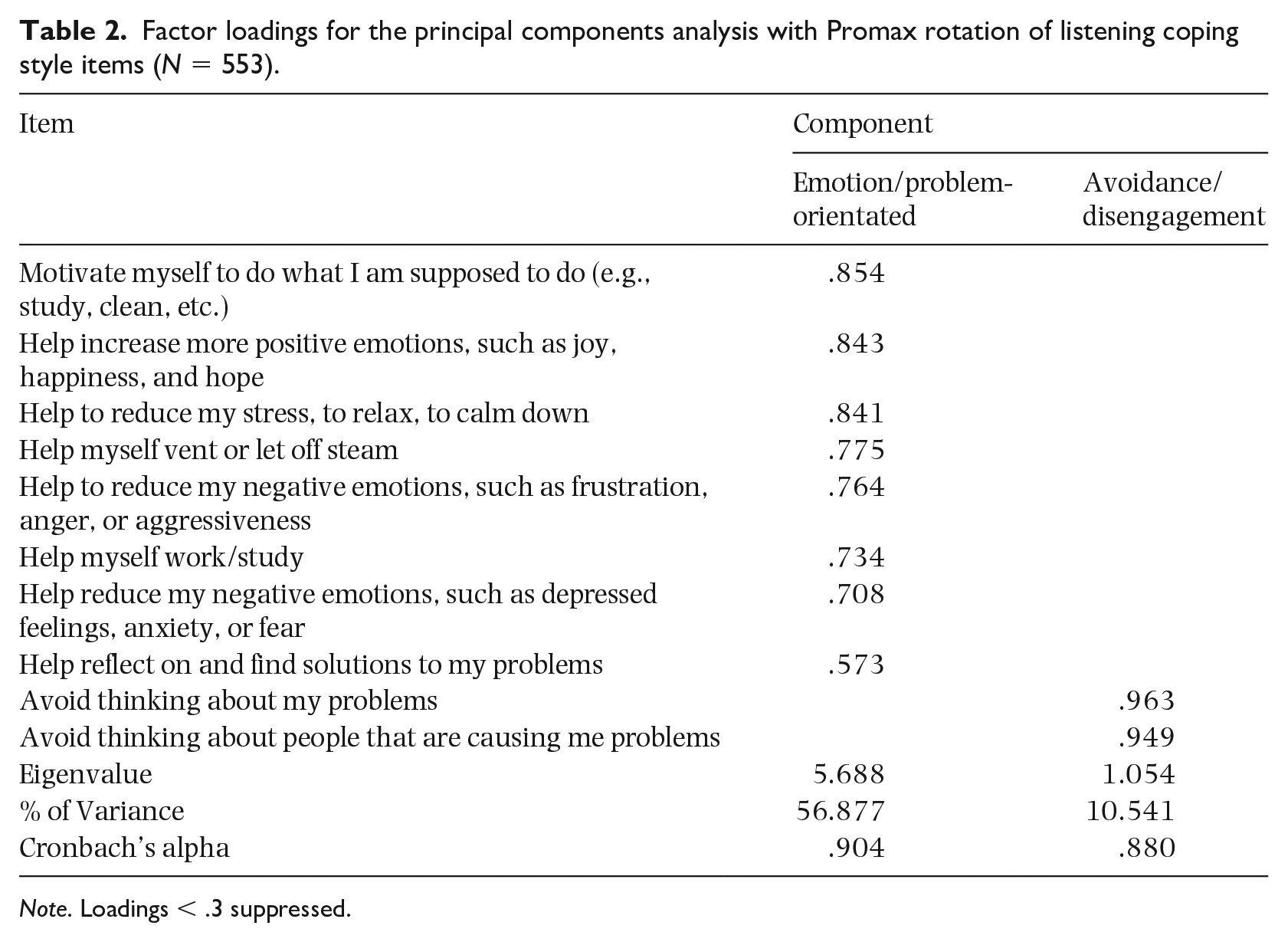
Note. Loadings < .3 suppressed.
Procedure
The survey was hosted by Qualtrics and accessed online by participants using a direct web-link to the participant information web-page. After giving informed consent, indicated by clicking Yes or No on the consent web-page, participants moved through a further series of web-pages to complete the survey, which took around 20 minutes. On completion, participants were thanked for their participation and debriefed. If applicable, they were then able to enter their contact details to receive the participation incentive.
Results
Music listening to cope with everyday stressors
As outlined in the Method section of this article, the factor analysis of responses to the SRLE showed that listening to music may be used to cope with five types of everyday stressor (RQ1(a)): Social, Financial, Performance Responsibilities, Work-related, and Daily Displeasures. A To find out whether music listening was indeed used to cope with specific types of everyday stressor more often than others (RQ1(b)), a one-way repeated-measures analysis of variance (ANOVA) was conducted, with a statistically significant result, F(3.774, 2082.978) = 212.95, p < .001, np2 = 0.278. The Hyunh-Feldt statistic is reported because Mauchly’s test indicated that the assumption of sphericity was violated. Pairwise comparisons using a Bonferroni adjustment (see Table 3) indicated that participants reported listening to music significantly more often to cope with certain types of stressor than others. In particular, the pattern of results indicated that participants listened to music more often to cope with social stressors than financial stressors, performance responsibilities, and daily displeasures; less often to cope with financial stressors than the other four types of stressor; more often to cope with work-related stressors than performance responsibilities and daily displeasures; and more often to cope with performance responsibilities than daily displeasures.
ANOVA means, standard deviations, and pairwise contrasts.
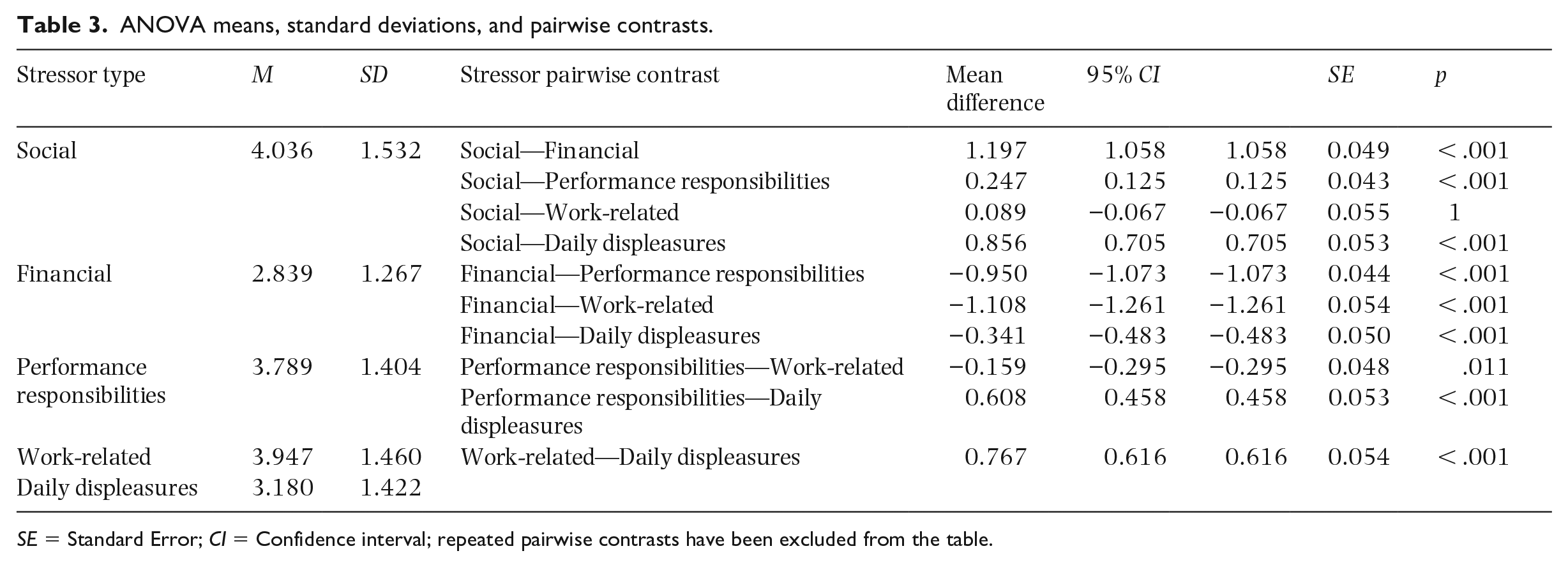
SE = Standard Error; CI = Confidence interval; repeated pairwise contrasts have been excluded from the table.
Listener characteristics and listening to cope with everyday stressors
A Generalized Linear Model (GLM) analysis was used to assess the associations between (a) the tendency to use music to cope with everyday stressors and (b) musical engagement and (c) coping style (RQ2, H2 and H3). For this analysis, each participant’s overall coping score, indicating their use of music to cope with everyday stressors, was calculated by averaging their responses to the 46 items pertaining to the five factors. Gender, age, country of residence, musician status, music importance rating, daily listening amount, the five MET scores representing music engagement, and the two MLCSS scores were entered as predictor variables, with the overall coping score entered as the dependent variable. The single participant who identified themself as having a non-binary gender was excluded from the analysis.
The overall model was statistically significant, adjusted R2 = .360, F(14, 442) = 19.350, p < .001, ηp2 = .380. When controlling for the other variables in the model, there was a significant association between country of residence and use of music listening for coping with everyday stressors. As can be seen in Table 4, individuals living in the United States and Australia did not differ significantly from the reference group, individuals living in Malaysia, in terms of their overall coping via music listening. The pairwise comparison of estimated marginal means indicated that individuals living in the United States were significantly more likely to use music to cope with everyday stress than individuals living in Australia (p = .011). Three additional variables were significantly and positively associated with listening to music to cope with everyday stressors: scores on the MET affective dimension, and both emotion/problem-orientated and avoidance/disengagement listening coping styles.
Parameter estimates for the GLM model with overall coping score as the dependent variable.
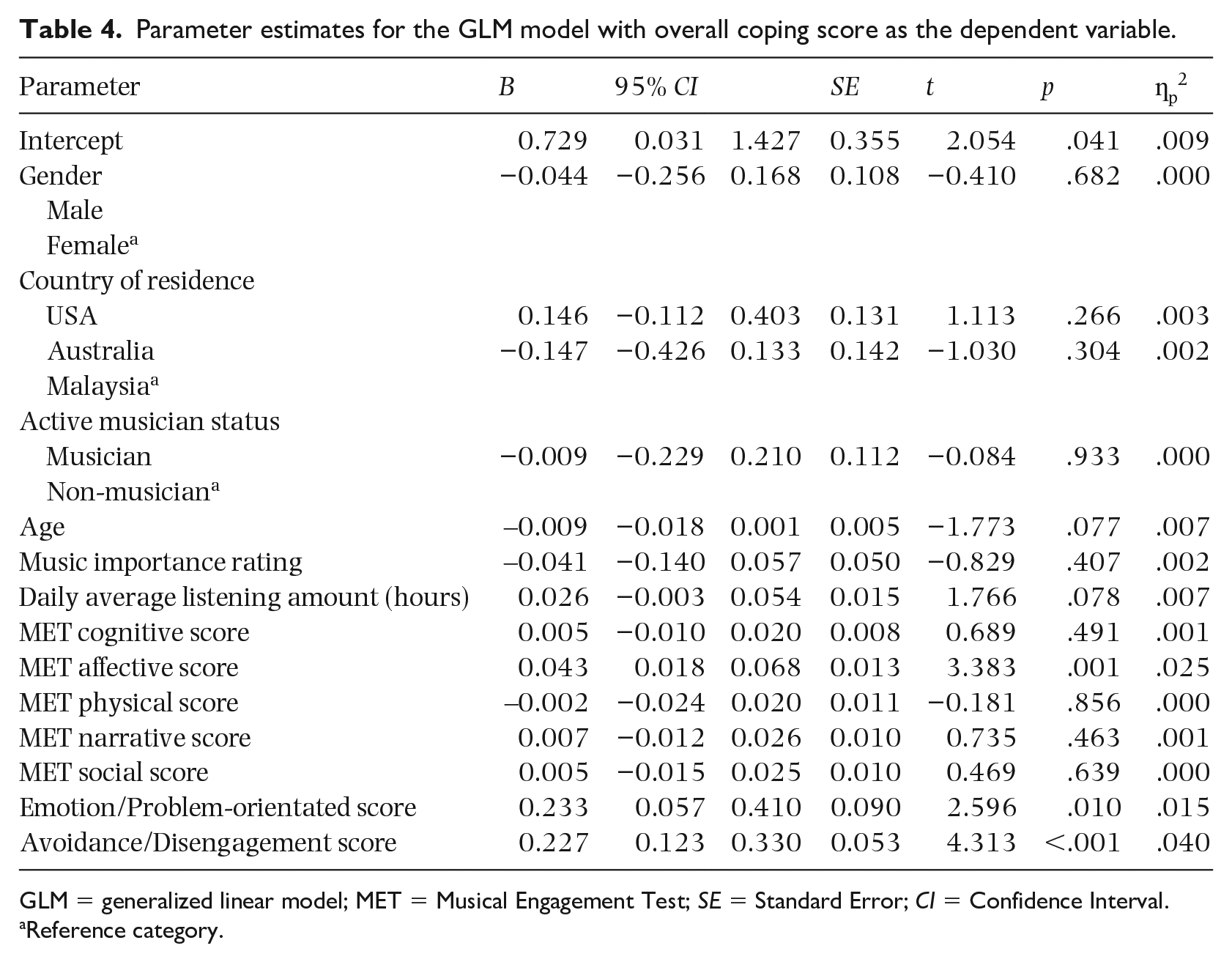
GLM = generalized linear model; MET = Musical Engagement Test; SE = Standard Error; CI = Confidence Interval.
Reference category.
GLM analyses were run again with the same predictor variables listed above but using music listening to cope with each of the five types of stressor (social, financial, performance-related, work-related, and daily displeasures) as the dependent variable in five separate analyses. Due to limitations of space, the parameter estimates for each of the five models are shown in Tables 1–5 in the Supplementary Materials. The MET affective score was positively associated with music listening to cope with all but financial stress, while the MET cognitive score was positively associated with music listening to cope with financial stress and the MET social score was negatively associated with music listening to cope with work-related stress. Avoidance/disengagement coping style was positively associated with music listening to cope with all five types of stressor. Emotion/problem-orientated coping style was positively associated with music listening to cope with three types of stressor: financial, performance-related, and work-related.
Discussion
The present study used an amended version of the SRLE to investigate the use of music listening to cope with stressors, broadly, in everyday life. The first research question (RQ1(a)) asked what types of everyday stressor people use music listening to cope with. The factor analysis produced the following categories of stressor: Social, Financial, Performance Responsibilities, Work-related, and Daily Displeasures. The second research question (RQ1(b)) asked if music listening is used more often to cope with certain types of stressor than others. The findings indicate that it is used most often to mitigate social stressors. The first hypothesis (H1), that participants in the research would report listening to music as a way of coping with work-related stressors, was supported. This is consistent with the results of previous experimental and laboratory-based research (e.g., Linnemann et al., 2015), at least insofar as participants reported listening more often to music to cope with work-related stressors (e.g., Beck et al., 2015; Haake, 2011) than to cope with performance responsibilities and daily displeasures. It can be inferred from these findings that not every kind of everyday stressor might be mitigated by music listening. Rather, it seems that people are more likely to manage social conflict and work stresses by listening to music. This is perhaps not surprising, given that Schäfer et al. (2013) identified three reasons for listening to music: to regulate arousal and mood, to achieve self-awareness, and as an expression of social relatedness.
The second research question (RQ2) asked if style of musical engagement is related to the general use of music listening as a way of coping with everyday stressors, once individual differences are accounted for, and it was hypothesized that (a) affective listening style (H2) and (b) emotion-orientated coping style (H3) would be positively associated with the use of music listening to cope with everyday stress. H2 was supported in that having an affective listening style was positively associated with the overall use of music listening to cope with everyday stressors and, specifically, social stressors and those associated with performance responsibilities, work, and daily displeasures. H3 was partially supported in that both emotion/problem-orientated and avoidance/disengagement listening coping styles were positively associated with the overall use of music listening to cope with everyday stressors; these too were shown to have significant relationships with most of the individual types of stressor. These findings support the results of previous research showing that emotion regulation is the main reason why people listen to music (e.g., Boer & Fischer, 2012; Schäfer et al., 2013). Given that the affective dimension of the MET is characterized by “emotional processes involved with cathartic and expressive engagement” (Greenberg & Rentfrow, 2015, n.p.), it may be that people are seeking catharsis when they listen to music to cope with stressors, as well as an outlet that supports the expression of emotions to process stress. Although the significant association found between music listening and avoidance/disengagement coping style suggests that people’s strategies may also involve distraction and avoidance, it would be interesting in future research to examine the relative effectiveness of different types of strategy for dealing with different stressors.
Implications, limitations, and future directions
The present study builds upon previous research that has examined the use of music listening to cope not only in particular settings (e.g., work, university) but also more broadly, in everyday life. The findings have the potential to be applied in practice: as people report using music more often to cope with certain types of everyday stressor, listening to music might be a low-cost and effective method of reducing both psychological and physiological stress (de Witte et al., 2020). In particular, people may find it easier to modify the ways in which they react to and deal with stress in everyday life if they are aware of what triggers it for them and can learn to use effective coping techniques that, in turn, can lead to healthier coping patterns. Indeed, young people generally experience reduced stress and improved mood as a result of their unconscious selection of music (McFerran & Saarikallio, 2014; Saarikallio et al., 2015). However, it is important to note that listening to certain types of music can also be associated with negative outcomes (Garrido et al., 2020; Saarikallio et al., 2015), and that individuals’ use of music, as well as the type of music listened to, should be considered (Baltazar et al., 2019). To these findings can be added those of the present study, particularly in relation to people who use music for self-regulation: that in addition to considering type of coping strategy it is also important to consider type of stressor.
Given the negative association between stressors and health (Cathcart & Pritchard, 2008; Hertig et al., 2007; Kanner et al., 1981; Lu, 1991), the present findings also have implications for clinicians such as music therapists and allied health professionals who may be interested in helping clients by recommending non-pharmacological strategies for mitigating stress. For example, clinicians could promote music listening as a self-administered tool for coping with social and emotional conflict. The everyday use of music listening could be extended into medical and/or mental health interventions (de Witte et al., 2020).
The present study is not without its limitations. First, while the study was specifically aimed at the experience of everyday stressors, participants’ self-reported responses were limited to Likert-scale responses. As stress is a multidimensional construct and experienced subjectively, future research is needed to explore in more detail the use of music as a coping mechanism in everyday life. Second, no measures of generalized stress or mental health issues were included. Anxiety or depression, for example, may be linked to everyday stressors, or influence people’s reactions to these stressors. Third, while we examined how often music listening was used, we did not investigate how effective it was for coping with everyday stressors in comparison with other coping strategies. It is possible that using music in this way is merely habitual, or that it has a placebo effect. Further research could address the effectiveness of music for coping with each of the five types of stressor identified in the present study. Fourth, while we included individuals’ styles of music engagement in our analyses, other variables representing individual differences could also be considered. These include personality, in particular, given that previous studies have found associations between specific personality traits and the use of music listening to regulate emotions (e.g., Liljeström et al., 2013; Miranda & Blais-Rochette, 2020) and respond to stress (e.g., Lesiuk, 2008). Finally, while a strength of the present study is that we were able to recruit a cross-cultural sample with participants from the United States, Malaysia, and Australia, and although the results indicate an influence of country of residence on music listening behaviors, we did not take into account potential cultural differences between these three countries. The prevalence and/or effects of everyday stressors may vary from one country to another, and this offers another possible direction for future research.
Further work could address the lack of research surrounding long-term interventions involving music (see de Witte et al., 2020 for a review of recent research), using methods of data collection that permit longitudinal reporting as well as the monitoring of actual usage. For example, diary and/or experience sampling methods (e.g., Randall & Rickard, 2017) would provide more detailed data. Moreover, mapping the uses and functions of music (e.g., Groarke & Hogan, 2016) to (potentially coincidental) motivations for music listening would contribute greatly to an understanding of the use of music listening to cope with everyday stressors. Finally, consideration of the contextual features of everyday stressors and music listening (e.g., Greb et al., 2018; Krause et al., 2015) would also help to identify any relationship between music selection behaviors and stress-related outcomes.
In summary, this study contributes to an understanding of how people use music to adapt to the challenges of daily life, particularly the use of music listening to cope with everyday stressors. The findings show that people report using music more often to cope with everyday social and work stress than other kinds of stressor and that the tendency to use music listening as a coping strategy is related to broader styles of music engagement. With advances in technology leading to an increase in music listening that is, in turn, increasingly under our own control, it is of great importance to continue working to understand the effects that our everyday experiences with music may have on us, particularly in regard to influences on our health and well-being.
Supplemental Material
sj-docx-1-msx-10.1177_10298649211030318 – Supplemental material for Listening to music to cope with everyday stressors
Supplemental material, sj-docx-1-msx-10.1177_10298649211030318 for Listening to music to cope with everyday stressors by Amanda E. Krause, William G. Scott, Sarah Flynn, Beatrice Foong, Kitye Goh, Stephanie Wake, Daniel Miller and Darren Garvey in Musicae Scientiae
Footnotes
Acknowledgements
The authors express sincere gratitude to all of the participants who have participated in this research.
Contributorship
AK, SF, BF, KG, and SW collaborated to conceive and develop this research. SF, BF, KG, and SW gained ethical approval, and conducted participant recruitment. AK, SF, BF, KG, SW, DG, and DM conducted the data analysis. SF, BF, KG, and SW drafted initial versions of the manuscript, with AK, DG, and WS offering additional revision. All authors collaborated to write and approve the final version of the manuscript.
Data Statement
The Ethics approval for this project stated that the data would be destroyed after 7 years. Further, it did not permit the sharing or re-use of the collected data.
Funding
The authors received no financial support for the research, authorship, and/or publication of this article.

Supplemental Material
Supplemental material for this article is available online.
References
Supplementary Material
Please find the following supplemental material available below.
For Open Access articles published under a Creative Commons License, all supplemental material carries the same license as the article it is associated with.
For non-Open Access articles published, all supplemental material carries a non-exclusive license, and permission requests for re-use of supplemental material or any part of supplemental material shall be sent directly to the copyright owner as specified in the copyright notice associated with the article.
