



Abstract
Following terror management theory (TMT), we hypothesized that listening to a disaster song could increase cultural worldview defenses in a manner similar to the mortality-stimulating essay typically used in TMT research. Participants were divided into four groups. Two of the groups received death-related themes: one wrote an essay about dying and the other group heard a song about men who died in a shipwreck. The other two groups received pain-related stimuli: one wrote an essay about dental pain and the other heard a song about a migrant worker’s painful separation from family. Dependent variables examined pro-social behavior, ranking one’s country, children, and emotions. Results showed similar effects for the mortality-stimulating essay and the disaster song on two variables: ranking one’s country in the world and the importance of having children. In addition, compared to the pain-of-separation song, the disaster song produced significantly more negative and less positive emotion ratings; the emotion ratings of the essay groups did not differ significantly. Results show that a disaster song can produce effects similar to those that have been observed for a mortality-stimulating essay. Further, the effects of disaster songs may extend to strengthening cultural worldview defenses.
Sound sent at speed of light Phone calls from young men dying. These walls bought and paid for By labours on board Gone months to clothe and feed us, Gone now, forever more.
The story of the sinking of the Capitaine Torres, as told in James Keelaghan’s song “Captain Torres,” is a moving tribute to men dealing with a disaster, specifically the sinking of their vessel in the frigid North Atlantic (Sparling, 2013a). “Captain Torres” is a disaster song (Scanlon, Johnston, Vandervalk, & Sparling, 2012). Disaster songs often tell a compelling story, but perhaps the psychological effects of such songs run deeper. The present research examines the effects of disaster songs on listeners from a uniquely applicable theoretical perspective, terror management theory (TMT).
Terror Management Theory
TMT proposes that thoughts of death strengthen an individual’s attachment to his or her culture. A key premise of TMT holds that the purpose of developing and maintaining a culture is to offer protection from the terror of one’s individual mortality, specifically the awareness of one’s own eventual death (Greenberg, Solomon, & Pyszczynski, 1997; van den Bos, Poortvliet, Maas, Miedema, & van den Ham, 2005). TMT proposes that humans have developed two psychological structures to cope with this awareness: faith in cultural worldviews and self-esteem (Kashima, 2010). A cultural worldview, defined as the socially constructed principles people live by, is connected to self-esteem through the perception that a person is a valuable contributor to something larger, more meaningful, and longer lasting than one’s self, such as the strengthening of one’s culture (Landau, Sullivan, & Solomon, 2012). The combination of values embodied in cultural worldviews and self-esteem enhances a sense of meaning in a person’s life and acts as a buffer system against anxiety associated with the terror of realizing one’s mortality (Kashima, 2010; Kneer & Reiger, 2016). TMT theory holds that thoughts of mortality increase the need for symbolic protection, thereby increasing the strength of cultural affiliation and worldview defenses (Landau et al., 2012).
A considerable amount of research has tested TMT. The typical method used in TMT studies contrasts people who have been asked to write about their own death (mortality stimulus or MS) with a group writing about another topic, often dental pain (e.g., Shatil, 2012). For example, Kashima (2010) suggests that participants who were reminded of their own deaths, for whom mortality was made salient, as compared to those who were reminded of a non-death concept, tended to evaluate a worldview-consistent target (specifically, an essay praising their worldview of their group) more favorably than a worldview-threatening target (specifically, an essay criticizing their group). These effects are observed after a brief time delay, allowing the active thinking about death to recede, but the unconscious effects continue for some time. TMT refers to this phenomenon as distal death defense, and it often results in the strengthening of attachment to the values and beliefs of one’s own group while activating ingroup–outgroup contrasts, in both desirable and undesirable ways. Mortality stimulation has been associated with positive effects such as increased charitable donations (Jonas, Schimel, Greenberg, & Pyszczynski, 2002); helping behavior (Gailliot, Stillman, Schmeichel, Maner, & Plant, 2008); optimism (Kelley & Schmeichel, 2015); and engagement in a creative task (Routledge, Arndt, & Sheldon, 2004). There also are negative effects, such as increased tolerance for racism and aggression toward people outside one’s culture (Greenberg, Landau, Kosloff, Soenke, & Solomon, 2016); negative evaluations of people of a different religion (Greenberg et al., 1990); and an increase in support for extremist views, suicide terrorism and extreme military tactics (Iqbal, O’Brien, Bliuc, & Vergani, 2016). A meta-analysis of 277 experiments (Burke, Kosloff, & Landau, 2013) shows that terror management effects can be observed across a wide variety of dependent variables.
Everyday experiences, such as reading news articles about accidents, crime, war, or terrorism, can trigger death thought accessibility in memory, increasing both unconscious concerns about death and worldview defense (Das, Bushman, Bezemer, Kerkhof, & Vermeulen, 2009; Landau et al., 2004). Directly triggering thoughts of mortality is not necessary to observe TMT effects; in fact, there are many potential day-to-day reminders of mortality that can have the potential to generate or buffer TMT effects. Vail, Arndt, Motyl, and Pyszczynski (2012) found that visibly damaged buildings activated TMT effects. Other research shows that advertisements (Kneer, Hemme, & Bente, 2011), television shows (Dar-Nimrod, 2012) and films (Hofer, 2013) reduce the effects of MS and the fear of death when they offer a connection to meaning in life.
Music and terror management
Music might also have the potential to activate TMT effects, though, when included in studies, it has typically been used as a control condition rather than as the mortality stimulus. Music itself is an expression of culture, from the sounds themselves (culturally-specific melodic structures, rhythms, harmonies, and forms) to behaviors surrounding music creation and consumption, from ideas about ownership and authorship to audience behaviors, and from transmission processes to the roles and functions of music in daily life (Gaunt & Hallam, 2016). Declaring that one enjoys a certain type of music can be a way of expressing shared values, attitudes and beliefs and can help shape one’s cultural identity (O’Hagin & Harnish, 2006).
In the only study to date testing the potential for music to have mortality-stimulating effects, Kneer and Reiger (2016) examined heavy metal music, a genre that has particularly strong themes of mortality and death. The authors report differing effects of heavy metal music for fans of the genre versus non-fans. For metal fans, the music appeared to serve as a cultural buffer against mortality-stimulated anxiety, but the same effect was not observed for non-fans. Results such as this suggest an interaction between the effects of musical themes and cultural experience or familiarity with the themes. Metal fans embrace the death themes consciously and conspicuously in ways that people outside the group of fans do not. This leads to the question of whether other music, specifically disaster songs that also feature themes rated to death, might have mortality-stimulating properties.
Disaster songs
Listening to a song written about a disaster might have mortality-stimulating effects, comparable to images of destroyed buildings (see Vail et al., 2012). Although there is some debate about its definition (Perry 2006), for the purposes of this article, we consider disasters to be events that cause or threaten harm to people and are outside normal experience (Sparling, 2013b). Disaster songs are songs written about such events, and typically they begin emerging soon after the incident.
Disaster songs are songs defined by a shared subject, appearing in many musical genres from gospel and country music to folk ballads and pop songs. Disaster songs have been written in many languages (see, for example, Manabe, 2015). Burke et al. (2013) report that Anglo-Americans may be especially susceptible to mortality stimulation because their cultural patterns tend to avoid direct discussion of death (Mitford, 1998) compared to other cultures (e.g., Asian) or parts of the world (e.g., Israel). Sparling (2017) has suggested that one reason that disaster songs continue to be written in large numbers up to the present is as a means of processing grief, serving as the intangible equivalent of material memorials (Sparling, 2013c).
Songs about disasters provide fertile ground for emotional expression for songwriters, but why do people choose to listen? Sad music has great appeal; the notion of pleasurable sadness has been puzzling music scholars for years (Levinson, 1997). Tragic events cause a complex response that can include feelings of loss, pain, and sadness, but also the portrayal of close friendships, bravery, love, perseverance, and courage in the face of danger. These are recognized as culturally valued character strengths (Peterson & Seligman, 2004). Behavior during disasters, as documented in song, can both reveal admirable character traits and affirm a commitment to a greater good such as altruism or self-sacrifice. It is plausible that one of the effects of listening to a disaster song is to help manage anxiety about death, instantiating culturally-respected attributes in the face of death, as part of the grief processing associated with disaster songs (Sparling, 2017). If this is the case, a disaster song may produce the interconnected effects of both increasing death thought accessibility and alleviating anxiety about mortality by connecting to deeper meaning (Kneer & Reiger, 2016).
The present study
To our knowledge, the present study is the first experimental research to consider the psychological effect of disaster songs. The 2 × 2 experimental design involves respondents engaging with either death-related or non-death-related themes, in either a music listening task or a writing task. Using TMT as a framework, we hypothesized that listening to a disaster song, such as “Captain Torres,” would increase both death thought accessibility and attachment to culture, in a way similar to typical TMT mortality salience essay writing. Disaster songs are particularly important to study as they are quite likely to be encountered in everyday life, potentially making mortality salient and triggering unconscious effects such as enhanced attachment to culture. In contrast, the mortality salience essay-writing task used in much of TMT research to date is not a typical, everyday activity. The specific dependent variables used in the present study are: the importance placed on having children, desired number of children, memory for pro-social behaviors, rewarding acts that respect cultural norms, and the ranking of one’s country on a United Nations (UN) Human Development Index. These variables were chosen based on previous research, including a study conducted by Rosenblatt, Greenberg, Solomon, Pyszczynski, and Lyon (1989) which found that having mortality made salient encourages favorable treatment of heroic individuals, and other work that suggests that parents maintain a sense of culture by living on through their children (Becker, 1971, 1973; Landau et al., 2012). The Positive and Negative Affect Schedule (PANAS; Crawford & Henry, 2004) was also chosen to be included in the present study, as it is typically used as a distraction task to remove thoughts of death in TMT studies (Greenberg, Pyszczynski, Solomon, Simon, & Breus, 1994). We test the following hypothesis derived from TMT along with a research question pertaining to use of music in the experimental manipulation:
H1: Compared to control groups, mortality-stimulated groups (i.e., disaster song and mortality essay) will desire more children, assign more importance to having children, rank their country more highly, give a greater momentary reward for pro-social action, and will report having previously engaged in more pro-social behavior.
RQ: Does the mode of presenting the mortality stimulation (essay versus song), or the interaction of mode with mortality stimulation, affect the strength of the effects on any of the dependent variables? The hypothesis and research questions will be integrated and tested with a Multivariate ANOVA.
Method
Participants
Participants were invited to a study of “music and culture.” A total of 149 participants (32 males, 117 females) were recruited from psychology courses offered at Cape Breton University, a small university in Canada near several shipping and fishing ports on the Atlantic Ocean where there is a long history of shipwrecks and marine tragedies. To avoid ambiguity about cultural reference group, only data from English-speaking Canadian-born participants was included in the analysis. Participants were randomly assigned to one of four groups, as described below.
Materials
To create the four groups in the experiment, respondents engaged with either death-related or non-death-related themes, in either a writing task or music listening task.
Group 1: Mortality essay
The Projective Life Attitudes Assessment was given to the mortality salience essay group. The task asks participants to “Please briefly describe the emotions that the thought of your own death arouses in you and write about what would happen to you physically as you die and are physically dead” (Greenberg et al., 1990).
Group 2: Dental pain essay control
To create a parallel writing task to mortality stimulus, a second group received the essay topic: “Please briefly describe the emotions that the thought of dental pain arouses in you and write about what would happen to you physically as you experience dental pain” (from Greenberg et al., 1990).
Group 3: Disaster song
The third group listened to a disaster song, “Captain Torres,” written and performed by singer-songwriter James Keelaghan. The song tells the story of crew members on a distressed vessel making their final call home to say goodbye to their families before the ship sinks.
Group 4: Control song
The control group listened to “Harvest Train,” also written and performed by James Keelaghan. The song was selected after consulting an ethnomusicologist familiar with Keelaghan’s song catalog to find a comparable song by the same artist. The song has a melancholy theme (sadness about being separated from family) and shares musical elements with “Captain Torres” but does not deal directly with disaster or death themes.
Dependent variables
Positive and negative affect
Participants completed the PANAS questionnaire immediately following the experimental manipulation. This scale consists of 20 words that describe emotions, divided into positive and negative. Reliability estimates were acceptable for both the positive (Cronbach’s alpha = .83) and negative (Cronbach’s alpha = .80) emotion lists. Examples of positive emotions include “active” and “inspired,” negative emotions include “scared” and “ashamed” (Crawford & Henry, 2004). The participants were asked to indicate to what extent they have felt each emotion over the last week on a five-point Likert scale, with 1 being very slightly or not at all and 5 being extremely. Although this scale is most often used to introduce a delay that allows thoughts of death to recede from conscious awareness, we will analyze the data provided by the scale.
Self-report altruism scale
The Self-Report Altruism Scale is a 20-item scale that asks participants to “Check the category on the right that conforms to the frequency with which you have carried out the following acts” (Rushton, Chrisjohn, & Fekken, 1981). The items are designed to measure pro-social behaviors, and include statements such as “I have given directions to a stranger,” “I have done volunteer work for a charity,” and “I have offered my seat on a bus or a train to a stranger who was standing.” The participants’ choices were Never, Once, More Than Once, Often, and Very Often. We expected participants who listened to the disaster song or wrote the essay on their own death to choose “Often” and “Very Often” more often than the control groups. The scale was shown to have acceptable reliability (Cronbach’s alpha = .85).
Financial reward for pro-social action
Pro-social intentions were measured through a scenario reading and question about reward for pro-social action. The reading explained that a criminal was on the loose but was finally turned in by a woman who risked her own personal safety to have him caught. Participants were to reward the woman an amount between $0 and $10,000. Rosenblatt et al. (1989) found that mortality salience encourages unfavorable treatment of a moral transgressor (the burglar) and favorable treatment of a heroic individual (the woman). This is a one-item variable and Cronbach’s alpha is not calculated.
Importance of having children
The notion that children provide a form of continuing legacy after death was measured by asking the questions “How important is having children to you” and “How many children would you like to have?” When mortality is made salient, people are likely to want more children and rate having children with higher importance. Each single-item variable will be analyzed separately.
National ranking
A ranking scale was used which read, “Of the 197 countries in the United Nations, where do you think your home country ranks on each of the following (#1 is the best; #197 is the worst).” Three items were chosen from the UN Human Development Index (United Nations Development Programme, 2015). Specifically, life expectancy, literacy rate, and enrolment in education were selected and averaged to create a human development index, with a Cronbach’s alpha of .93.
Demographics
Participants were asked to answer questions about their sex, age, and nationality.
Procedure
At the beginning of the experiment, all participants met in the same room. After obtaining informed consent, and completing a demographic questionnaire, participants then were randomly divided into four groups. Two of the groups left the room in order to listen to their assigned song (either “Captain Torres” or “Harvest Train”) in separate, sound-isolated rooms. The rest of the participants remained to complete their assigned essay task. Writing the essay took approximately 5 minutes. Following the experimental manipulation, all participants responded to the dependent measures. In total, the experiment took approximately 20 minutes to complete.
Results
Data are analyzed using a 2 × 2 completely randomized multivariate analysis of variance (MANOVA). After assessing effects at the multivariate level as a control for type I error, we turn attention to the univariate level to assess effects on each of the dependent variables separately (Tabachnick & Fidell, 2013). The independent variables are mode of presentation (essay vs. musical) and mortality stimulus (mortality vs. pain). The dependent variables are positive affect, negative affect, financial reward, past pro-social behavior, national ranking, number of children, and importance of children.
A significant multivariate main effect was shown for mode of presentation, Pillai’s trace = 0.14, F(7, 120) = 2.69, p < .05, partial eta squared = 0.14, and for mortality stimulus, Pillai’s trace = 0.19, F(7, 120) = 4.00, p < . 01, partial eta squared = 0.19. The interaction was not significant at the multivariate level, Pillai’s trace = 0.07, F(7, 120) = 1.29, p = 0.26, partial eta squared = 0.07.
Univariate tests next were examined. The assumption of homogeneity of variance was tested using Levene’s test, and was found to be nonsignificant for all dependent variables except the national ranking on the Human Development Index, likely because of the broad range of observed values (1–142) for the average ranking given for the three questions that comprise the index. 1
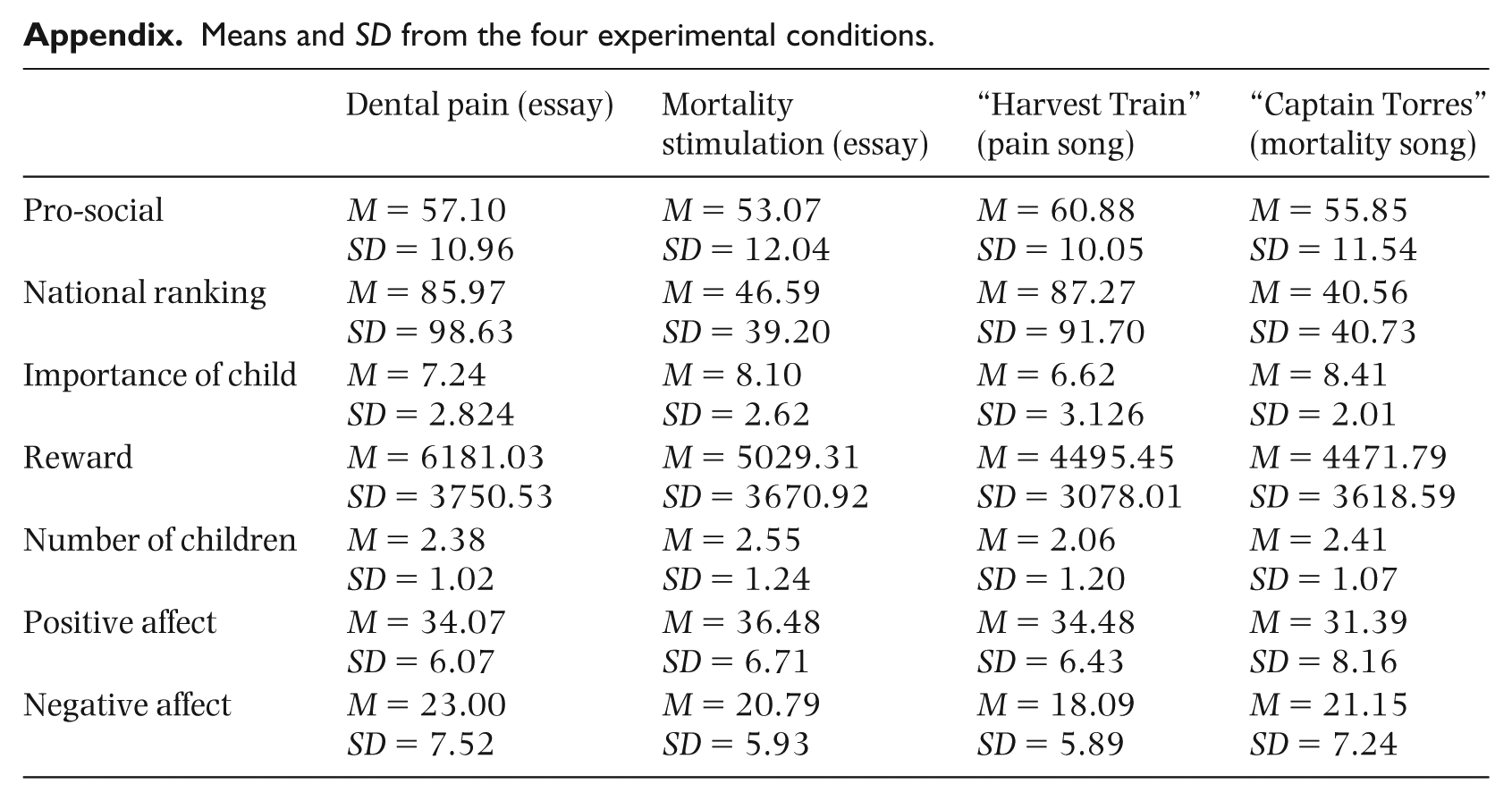
The univariate results from the MANOVA are presented in Table 1 and a detailed breakdown of means is presented in the Appendix. A significant main effect for mortality stimulus was observed for three of the dependent variables: national ranking, pro-social behavior, and importance of children (see Table 1 for univariate level results). As expected, those in the mortality groups assigned their country a more favorable ranking (M = 14.4, SD = 13.3), closer to the top spot (#1) on the UN Human Development Index than those in the pain groups (M = 28.9, SD = 31.4). In addition, the mortality-stimulated groups showed higher mean ratings on importance of having children (M = 8.28, SD = 2.29) than those in the pain groups (M = 7.18, SD = 2.78). Finally, the pain groups unexpectedly reported stronger mean self-reported altruism scores (M = 59.11, SD = 10.57) than did the mortality-stimulated group (M = 54.66, SD = 11.75).
ANOVA summary table (univariate level).
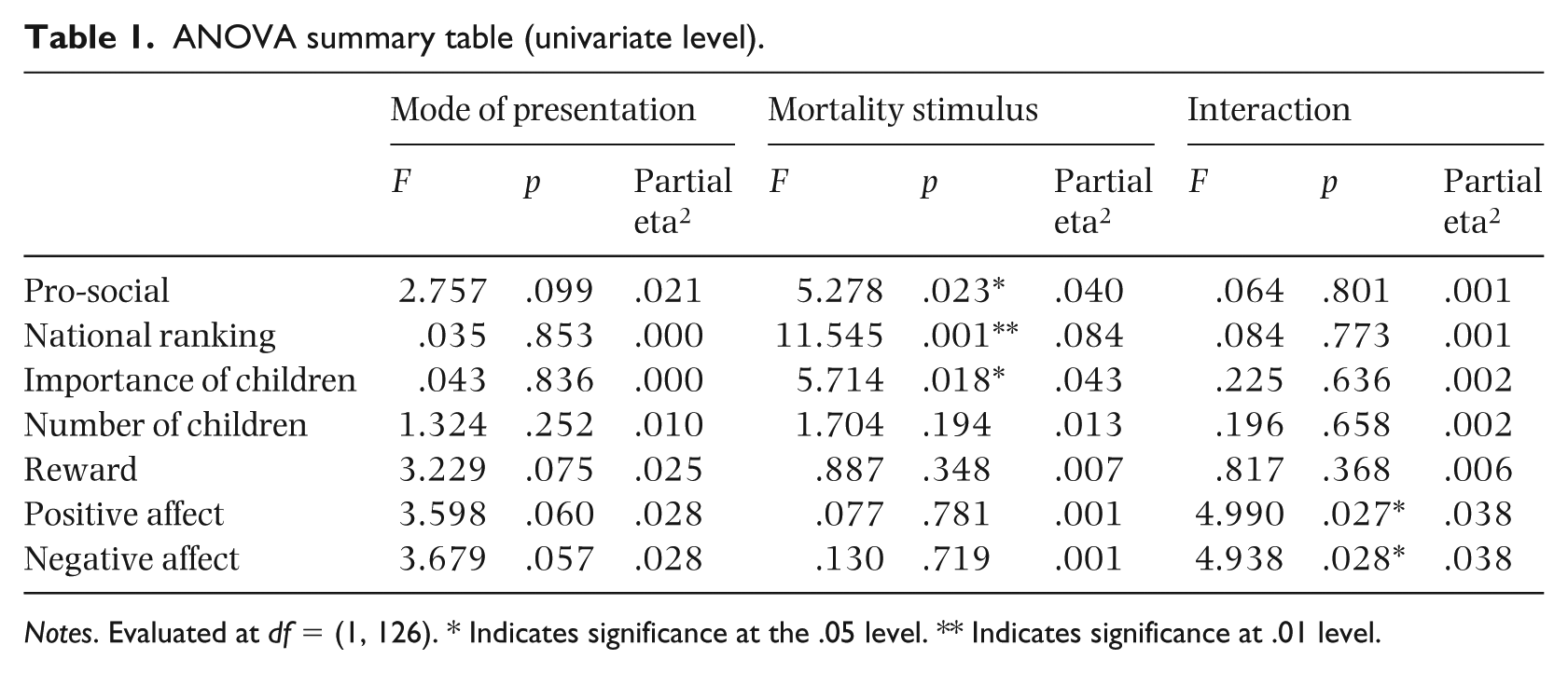
Notes. Evaluated at df = (1, 126). * Indicates significance at the .05 level. ** Indicates significance at .01 level.
In addition to the above main effects, two significant interactions were found at the univariate level for positive and negative emotions. To interpret the interactions, a Tukey’s HSD post hoc test was performed on the simple main effect of mortality stimulus, comparing the means for mortality stimulus versus the pain stimulus, in the music and essay conditions separately (see Table 2). Examining the means shows a significant difference between the music groups: the mortality song produced more negative emotion than the pain-of-separation song, q(2, 122) = 3.08, p < .05. In contrast, no significant difference in negative emotion was found between the two essay groups, q(2, 122) = 1.58, ns. Similarly, the Tukey’s HSD test revealed that the mortality-stimulating song produced lower levels of positive emotion than did the pain-of-separation related song, q(1, 122) = 2.92, p < .05. Again, no significant difference in positive emotions was found between the two essay groups, q(1, 122) = 1.506, ns. 2
Interaction means and standard deviations of positive and negative affect.

Note. Comparing essays with each other, and songs with each other, means with different superscripts a, b are significantly different from each other (p < .05).
Discussion
The present study tested whether listening to a disaster song could produce effects similar to the typical essay-writing mortality stimulus in TMT. The results showed an interesting pattern: they support terror management effects of both disaster songs and mortality essays on two of the dependent variables (national ranking and importance of children), and show an effect on reported prior pro-social behavior that was in the opposite direction from the hypothesis and also noteworthy differences in their effects on positive and negative emotions.
A significant main effect for mortality stimulus was found for the respondents’ home country’s national ranking on a Human Development Index and importance of having children. As hypothesized, participants who were mortality stimulated rated their country more highly than those who were not. TMT proposes that because people fear their own death, they develop and maintain a commitment to culture to protect themselves from their own mortality. The mortality group also rated having children as being more important than did the pain group, which also is expected based on TMT. Cultures are greater than the individuals that create and embody them, and people develop cultures as something meaningful to which they can contribute which will continue even after they die. Children likewise constitute legacies within a family, while also contributing to the continuity of one’s culture. The main effect, coupled with the absence of an interaction with mode of presentation, suggest that having mortality made salient through either essay writing or listening to music may have similar effects, contributing a novel approach to mortality stimulation for TMT research.
We also found, contrary to expectations, that the pain groups (pain essay and the pain-of-separation song) rated themselves as having been more pro-social in the past than the mortality-stimulated groups. Research has shown that individuals experience feelings of ambivalence when confronted with requests for pro-social behavior after mortality is made salient (Hirschberger, 2010). For some individuals, the reaction can be a desire to help, but for others, the result may be a focus on the self, and a desire to get away from any reminders of death (e.g., pro-social behaviors involving those with physical disabilities, or innocent people who have been harmed; Hirschberger, Florian, & Mikulincer, 2005; Hirschberger, 2006). This might explain why the pain groups reported being more pro-social in the past than the mortality-stimulated groups using the scenario tested here. However, these findings might also be attributable to having asked participants if they had taken part in numerous pro-social behaviors in the past, rather than if they would do so in the future, or if they value altruism as a cultural ideal. Much of the previous TMT research has used behavioral intention as a dependent variable (Burke et al., 2013). Therefore, future research might test the difference between reporting previous pro-social behavior and the rating of future pro-social behavior.
Our results are consistent with the idea that disaster songs may be able to increase attachment to culture in ways similar to the well-studied mortality-stimulating essay, but the findings regarding positive and negative affect are also of interest. Within the music conditions, the group who listened to “Captain Torres” (i.e., the mortality-song group) showed higher levels of negative affect and lower levels of positive affect when compared to those who listened to “Harvest Train” (i.e., the pain-song group). It therefore appears that having one’s mortality made salient impacted participants’ self-reports of their emotions in a negative way. The essay-writing task did not show differences in positive or negative emotions between the mortality-stimulated and control groups.
Interestingly, because the PANAS was the first scale our participants completed after listening to a song or writing an essay, it took the place of a distraction task typically used in TMT studies. Results show that the music groups experienced stronger emotional reactions than did the essay-writing groups. This interaction effect might be attributed to the way music evokes emotions over a brief period of time (Juslin & Västfjäll, 2008). TMT proposes that mortality effects are not simply the result of immediate emotional reactions; the delay between mortality stimulus and testing the dependent variables is necessary to observe distal defenses against thoughts of death. However, the present results show that the delay task itself might convey interesting information about the process of dealing with different mortality-stimulating events, particularly when music is the mortality stimulus. Unlike the published study that examined heavy metal songs, which are associated with a distinct subculture of fans or non-fans (Kneer & Reiger, 2016), participants in the present study were likely unfamiliar with the singer-songwriter who composed and performed the songs they heard: they reported hearing the songs for the first time.
The process of dealing with mortality stimulation, and its downstream effects for listeners over time, poses potentially interesting implications with respect to disaster songs. Future research could consider how such effects might change with repeated exposure to a given disaster song. As a group, disaster songs potentially can be seen as both cues of mortality but also as culturally meaningful representations of ways of dealing with tragedy within a community. Goldenberg et al. (1999) found that participants responded more emotionally to a tragic literary passage (compared to a neutral passage) following a mortality salience manipulation. They noted that
(f)rom the perspective of terror management theory, human beings are in constant battle with existential concerns and spend a great deal of effort seeking effective terror management strategies. Therefore, a story that enables one to approach these fears in a safe way may be of value even in the absence of a mortality salience treatment. (1999, p. 322)
If disaster songs also evoke conscious thoughts of tragedy and death, they might provide the balm for those thoughts at the same time 3 (see also Kneer & Reiger, 2016). The potential dual role of the disaster song—provoking and relieving anxiety—could also potentially account for inconsistent results across the dependent variables observed in the present study where we saw attachment to country and importance of children (family) increase with both types of mortality stimulation, with the musical presentation of mortality stimulation being especially emotion provoking.
Although the study was successful in providing initial evidence of the possibility of terror management effects from disaster songs, the study has limitations that should be taken into account when interpreting the results and considering future research. It is not known whether other disaster songs might also produce effects consistent with TMT, though future research can test other songs. It is possible that the specific artist and songs chosen, the imagery of the lyrics, or even the songs’ particular sonic characteristics might produce unique effects. It also is possible that the familiarity of the participants with the potential of disasters at sea (living, as they do, near the North Atlantic shoreline) contributes to the observed effects. Would songs about other types of disasters have similar effects, and is it necessary for the disaster type to personally resonate with the respondents for such effects to emerge? Would songs about a hurricane, mine cave-in, or flood affect people who have experienced such events differently from those who have not? Further, the disaster song selected for the present study featured men calling their families for the last time from a sinking ship, tapping into cultural values of courage and responsibility, and prescribing a culturally valued way of acting during a disaster. Are such elements necessary in disaster songs to produce terror management effects? Future research also might consider accessing different qualities for the control song. Although “Harvest Train” does not feature death themes, it might have triggered thoughts of responsibility to family that may have affected the results. We are assuming that the death themes were obvious in the disaster song and not in the pain song, but we lack a direct test of death thought accessibility; such a check would be recommended in future research. We note also that our study also employed university students as raters and other age groups might react differently to the songs (Burke et al., 2013). Finally, given their potential role in prescribing reactions to tragedy, future research might also consider the terror management effects of the process of creating a disaster song on the songwriter herself or himself.
Conclusion
This study found that listening to a disaster song, such as “Captain Torres,” created effects similar to typical TMT mortality salience essay writing. Songs may provide an alternate route to studying terror management effects. These findings suggest further that music generates more powerful emotional reactions than does the essay-writing task typically used in TMT studies. A number of additional questions are raised about the possible terror management effects of disaster songs, and we hope that this study will stimulate further research in this area. Future research might consider a host of additional questions about the specific types of connection between music and culture that are articulated through disaster songs. But if the potential for research in the area is realized, we envision a greater understanding of the complex psychological effects associated with disaster songs.
Footnotes
Appendix
Means and SD from the four experimental conditions.
| Dental pain (essay) | Mortality stimulation (essay) | “Harvest Train” (pain song) | “Captain Torres” (mortality song) | |
|---|---|---|---|---|
| Pro-social | M = 57.10 SD = 10.96 |
M = 53.07 SD = 12.04 |
M = 60.88 SD = 10.05 |
M = 55.85 SD = 11.54 |
| National ranking | M = 85.97 SD = 98.63 |
M = 46.59 SD = 39.20 |
M = 87.27 SD = 91.70 |
M = 40.56 SD = 40.73 |
| Importance of child | M = 7.24 SD = 2.824 |
M = 8.10 SD = 2.62 |
M = 6.62 SD = 3.126 |
M = 8.41 SD = 2.01 |
| Reward | M = 6181.03 SD = 3750.53 |
M = 5029.31 SD = 3670.92 |
M = 4495.45 SD = 3078.01 |
M = 4471.79 SD = 3618.59 |
| Number of children | M = 2.38 SD = 1.02 |
M = 2.55 SD = 1.24 |
M = 2.06 SD = 1.20 |
M = 2.41 SD = 1.07 |
| Positive affect | M = 34.07 SD = 6.07 |
M = 36.48 SD = 6.71 |
M = 34.48 SD = 6.43 |
M = 31.39 SD = 8.16 |
| Negative affect | M = 23.00 SD = 7.52 |
M = 20.79 SD = 5.93 |
M = 18.09 SD = 5.89 |
M = 21.15 SD = 7.24 |
Acknowledgements
We would like to thank the participants for their co-operation in sharing their experiences and the anonymous reviewers for their comments and insights.
Funding
The authors disclosed receipt of the following financial support for the research, authorship, and/or publication of this article: this research was facilitated by grants from the Social Sciences and Humanities Research Council of Canada to the second and fourth authors.
