



Abstract
The purpose of this study was to compare the effectiveness of and preference for different auditory stimuli on mindfulness meditation in musicians. A second purpose was to compare musician responses with non-musician responses from a previous study. A repeated-measures design exposed participants to four auditory stimuli of increased complexity. Participants (N = 49) were undergraduate musicians with limited mindfulness experience. Data included absorption in music, mindfulness, and preference and usefulness of auditory stimuli. A repeated-measures analysis of covariance, with absorption of music as a covariate, found no significant differences between stimuli on mindfulness meditation according to musicians. Friedman’s analyses of variance indicated that musician rankings of usefulness and preference were significantly different among conditions. Both musicians and non-musicians ranked Melody and Harmony conditions as most preferred and most useful for mindfulness meditation. A mixed effects model with both groups indicated not only a significant effect of auditory stimuli on mindfulness but also interaction due to group status. A significant result was only obtained when the covariate was not considered. Absorption in music scores between groups was significantly higher for musicians than non-musicians. These outcomes support the hypothesis that absorption in music and music expertise may mediate the effect of a music intervention. Clinical implications are discussed.
Mindfulness is a natural human capacity that allows awareness of the internal and external events in the present, without judgment, rejection, or attachment to them (Kabat-Zinn, 2012). Descriptions of mindfulness vary, but they all include the process of focusing attention on an “object” (e.g., breath, body sensations, or image), being distracted from the object, noticing and acknowledging the distraction, and returning attention back to the object (Bishop et al., 2004; Kabat-Zinn, 1990; Steinfeld & Brewer, 2015). Mindfulness is not limited to meditation (Steinfeld & Brewer, 2015) and is documented in a wide variety of experiences (Csikszentmihalyi, 1990; Ives-Deliperi, Solms, & Meintjes, 2011; Linehan, 2015; Rathus & Miller, 2015). Music, when structured appropriately, may support mindfulness meditation (Dvorak, under review). Specifically, Dvorak (under review) identified three ways to use music to support or enhance mindfulness practice: (a) music as a support for mindfulness meditation, (b) music as a focus for mindful listening, and (c) music as a focus for mindful active engagement. In this study, we address only the first.
Music and mindfulness
Music as a support for mindfulness meditation is the “use of music specifically designed, composed, or selected, based on the best available research, to support internal and external responses for mindfulness meditation practice” (Dvorak, under review). In a previous study (Dvorak & Hernandez-Ruiz, 2019), researchers investigated whether a musical stimulus of low timbral complexity, minimal melodic or harmonic complexity, with a steady beat, and unfamiliar to the participants (i.e., original composition) would support a mindfulness meditation exercise. Researchers also hypothesized that gradually increasing melodic, harmonic, and timbral complexity would be correlated with decreasing mindfulness efficiency.
Two cognitive mechanisms were hypothesized to be at work in the music stimuli. The first mechanism was based on deactivation of the default mode network by eliminating autobiographical references (i.e., unpreferred and unfamiliar music; Barret & Janata, 2016; Garza-Villarreal et al., 2015; Janata, 2009; Kay, Meng, DiFrancesco, Holland, & Szaflarski, 2012; Wilkins, Hodges, Laurienti, Steen, & Burdette, 2014) eliminating melodic references (Alluri et al., 2011), and maintaining a minimum of timbral complexity (Alluri et al., 2011; Sridharan, Levitin, Chafe, Berger, & Menon, 2007). The second mechanism was the deactivation of the reward system, through eliminating temporal, melodic, and harmonic ambiguity which, even if pleasurable, might induce emotional and evaluative processes (Alluri et al., 2011; Spada, Verga, Iadanza, Tettamanti, & Perani, 2014). In other words, unfamiliar music with a steady beat; slow to moderate tempo; repetitive, simple, non-syncopated rhythm; predictable, consonant harmonies; pleasing timbre; and constant dynamics might decrease amygdala function and increase activation of cognitive control areas (Alluri et al., 2011; Barret & Janata, 2016; Moore, 2013; Spada et al., 2014). Music structured according to these guidelines would allow the music to support mindfulness meditation without distracting attention from the meditation itself. Although neuroimaging was not conducted, behavioral results of that study (Dvorak & Hernandez-Ruiz, 2019) support these hypotheses. Please refer to Dvorak and Hernandez-Ruiz (2019) for further detail on the rationale of using music for mindfulness meditation.
Music training differences
The amount of musical training and exposure makes a difference in participants’ music processing and responses (Kraus & Chandrasekaran, 2010). Early research found that explicit focus of attention to music seemed to differ between musicians and non-musicians. Definitions of “non-musician” vary across studies; for the purposes of this discussion, non-musicians are individuals with fewer than 5 years of formal music lessons. Formal music education, in turn, refers to participation in music lessons, music group classes, or ensembles directed by music professionals (e.g., music educators or conductors). When listening to musical excerpts, musicians and non-musicians spent different amounts of time listening to rhythm, dynamics, timbre, melody, or “everything,” and attend to each element in different orders (Madsen & Geringer, 1990). Contrastingly, more recent research indicates similar music-induced emotions reported by musicians and non-musicians (Bigand, Vieillard, Madurell, Marozeau, & Dacquet, 2005). In fact, untrained judges evaluate music with a high degree of accuracy and reliability when compared to musicians, but they seem to use different evaluation criteria, such as more attention to pitch interval variation, but less to number of contour errors and modulation variation (Larrouy-Maestri, Magis, Grabenhorst, & Morsomme, 2015). This discrepancy may point to different cognitive mechanisms for music processing, but similar overt ratings of music preference.
On the contrary, music training does seem to have a consistent effect on implicit detection of acoustic features, such as pitch, timing, timbre, and musical structure (Deguchi et al., 2012; Hartmann, Lartillot, & Toiviainen, 2017). These skills are correlated with increased skills in other domains, such as speech and language skills (Slater et al., 2015; Tierney, Krizman, & Kraus, 2015), temporal integration of auditory and visual signals (Lee & Noppeney, 2011), auditory verbal memory (Chan, Ho, & Cheung, 1998), and executive functions (Moreno et al., 2011). These results are similar for both short-term and long-term music training programs (e.g., Lee & Noppeney, 2011; Moreno et al., 2011).
Furthermore, these behavioral differences have correlated with structural and functional neural changes (Gaser & Schlaug, 2003; Hyde et al., 2009; Kraus & Chandrasekaran, 2010; Schmithorst & Wilke, 2002). For example, Zuk, Benjamin, Kenyon, and Gaab (2014) found that adults with musical training showed enhanced cognitive flexibility, verbal fluency, and working memory compared to non-musicians. Similarly, children with musical training showed enhanced executive function, verbal fluency, and processing speed, which correlated with greater activation of pre-supplementary motor area and supplementary motor area and right ventrolateral prefrontal cortex (Zuk et al., 2014). Concurrently, Chapin, Jantzen, Kelso, Steinberg, and Large (2010) found differences in neural response to music among “experienced” (i.e., more than 5 years of formal musical training) and “inexperienced” participants, even when all participants were considered “deep listeners” (i.e., intensive use and value of music). The experienced group showed increased activity when listening to music in the right ventral striatum compared to the inexperienced group, while the inexperienced group showed increased left anterior parahippocampal and hippocampal activity, indicating the use of different mechanisms to process music stimuli. Using diffusion tensor imaging, Schmithorst and Wilke (2002) found increased white matter architecture—indicating increased brain connectivity—among musicians.
Previous findings in mindfulness and music
Given the differences in cognitive and neural responses to music among musicians and non-musicians, it stands to reason that a mindfulness meditation with music would have dissimilar results among these groups. A previous study by Dvorak and Hernandez-Ruiz (2019) investigated the effectiveness, preference, and usefulness of music stimuli of increasing complexity on mindfulness practice in non-musicians. Participants listened to four conditions: recorded voice of instructions for mindfulness meditation (i.e., Script condition); the Script with a bass sound played on a steady beat (i.e., Beat condition); the Script with Beat and harmonic accompaniment played by sampled strings (i.e., Harmony condition); and the Script, Beat, Harmony, and melody played by a sampled viola (i.e., Melody condition). Participants then rated the effectiveness of the mindfulness experience in each condition and ranked the stimuli from most to least preferred, and from most to least useful.
With the understanding that pre-conditioned responses to music seem to mediate the effects of musical stimuli (Barret & Janata, 2016; Hernandez-Ruiz, James, Noll, & Chrysikou, 2018; Sandstrom & Russo, 2013), researchers assessed and controlled for participants’ absorption in music. Absorption in music, as defined by the Absorption in Music Scale (AIMS), is a composite variable that measures participants’ understanding of emotion in music, their willingness to be drawn into sensory stimuli, and their propensity to be influenced by music (Sandstrom & Russo, 2013). The ability and willingness to be “drawn in deeply [by a musical stimulus]” is a trait that could explain dissimilar findings in music perception and music intervention research (Sandstrom & Russo, 2013). In Dvorak and Hernandez-Ruiz (2019), researchers found that absorption in music seemed to mediate participants’ responses to the musical stimuli.
Results from Dvorak and Hernandez-Ruiz (2019) also showed that non-musicians found the two least complex audio stimuli (Script and Beat), more effective for mindfulness meditation, but they rated the most complex stimuli (Harmony and Melody) as the most preferred and useful. In this study, we investigated the effectiveness of and preference for different aural stimuli in supporting mindfulness meditation for musicians, while controlling for absorption in music. We also compared these results with responses from non-musicians in the previous study (Dvorak & Hernandez-Ruiz, 2019). The research questions included the following:
Do different aural stimuli of varying complexity (i.e., Script, Beat, Harmony, and Melody) have different effects on mindfulness meditation, as reported by musicians?
Does level of absorption in music moderate musician responses to the stimuli (Script, Beat, Harmony, and Melody)?
What type of stimulus (Script, Beat, Harmony, and Melody) is considered by musicians to be more useful for mindfulness meditation?
What type of stimulus (Script, Beat, Harmony, and Melody) is most preferred by musicians for mindfulness meditation?
Are musician responses to aural stimuli different from non-musician responses (data from previous study)?
Considering previous literature regarding the effect of music training on music processing, we hypothesized that a more complex musical stimuli (Harmony or Melody) would be the most effective for musician meditation practice, given musicians’ increased expectations and implicit music processing. We hypothesized that the more complex musical stimuli (Harmony and Melody) would be the most preferred and useful for musicians, similar to non-musicians’ evaluation of the stimuli. We also hypothesized that this group’s absorption in music would have a mediating effect on their response to stimuli, and that musicians would show an increased absorption to music, compared to non-musicians in Dvorak and Hernandez-Ruiz (2019).
Method
Recruitment and informed consent
The study received approval from the University Review Human Research Protection Program (#00141275) prior to participant enrollment. Participants were recruited through an online student recruitment system (SONA Systems Software, 2018) and through invitation to students in music theory classes. Participants recruited through SONA received research credit in a psychology course. To avoid interference with mindfulness experiences, students were asked to refrain from alcohol, drugs, and medication consumption (except contraceptives) 36 hr prior to the study, and caffeine or exercise 3 hr prior to the study. When students arrived at their scheduled appointment, the researchers explained the informed consent, allowed time for questions, and invited the students to participate. Participants signed the informed consent document prior to starting the study.
Participants
Participants were college students at a large Midwestern university selected if they were (a) over the age of 18; (b) enrolled in SONA or a music theory class; (c) able to speak, read, and write in English; (d) musicians as evidenced by more than 5 years of formal music; and (e) with no significant hearing loss that impacted their ability to listen to music using headphones at 55 dB.
The demographic data for all participants (N = 49) were analyzed through descriptive analysis and are reported in Table 1 (first column). Most participants were young adults (M age = 18.76, SD = 1.54); mostly Caucasian/White (n = 37, 75.5%); female (n = 31, 63.3%); from middle, upper-middle, or upper class (n = 38, 77.5%); had English as their first language (n = 44, 89.8%) or had spoken it for more than 11 years (n = 5, 10.2%); and had more than 5 years of formal music training (n = 47, 95.9%). Importantly, two participants (4% of the sample) indicated fewer than 5 years of musical training but simultaneously reported having a “major instrument.” Their data were retained given our inability to determine which was the accurate response and the low impact on statistical analyses (see further discussion in the Limitation section).
Demographic information of participants.

Data from previous study (Dvorak & Hernandez-Ruiz, 2019).
Study design
This study used a repeated-measures design. The four conditions of aural stimuli (Script, Beat, Harmony, and Melody) were counterbalanced and randomized across participants. Three-minute pauses interspersed between each condition avoided carry-over effects and allowed participants to answer a brief questionnaire. All participants received all conditions. The total testing period for each of the participants was approximately 30-min long. Participants were tested in groups of four to five at a time in a music perception laboratory.
To compare musician and non-musician responses, data from a previous study (Dvorak & Hernandez-Ruiz, 2019) was pooled with current data for this model. A mixed design was used for the mindfulness scores (see MAAS in Measures), with the four conditions (Script, Beat, Harmony, and Melody) as the within-subjects factor, and the group (musicians and non-musicians) as the between-subjects factor. To compare responses from the Preference and Usefulness ratings for musicians and non-musicians, mean scores for each condition were graphically displayed and compared.
Measures
Absorption in music (AIMS)
The 34-item AIMS (Sandstrom & Russo, 2013) measures the individual’s level of immersion in an emotional experience while listening to music. A person’s level of absorption in music may help explain dissimilar findings in psychological and physiological responses to music (Sandstrom & Russo, 2013). Researchers included this scale as a covariate, as our previous results showed that absorption in music may mediate the effect of music on the mindfulness meditation experience.
The AIMS has good internal consistency (Cronbach’s alpha ranging .92–.94), and strong test–retest reliability (.86, p = .001). Convergent validity is supported by its correlation with similar scales such as the Tellegen Absorption Scale (.76, p = .01; Tellegen & Atkinson, 1974) and the Musical Absorption Scale (.74, p = .01; Nagy & Szabó, 2004; Sandstrom & Russo, 2013). A test of criterion validity revealed that emotional responses correlate well with the AIMS scale, as desired; however, the AIMS scale did not correlate with measures of empathy or music training, indicating that absorption in music happens regardless of music training (Sandstrom & Russo, 2013).
Mindfulness Attention Awareness Scale
The Mindfulness Attention Awareness Scale (MAAS; Brown & Ryan, 2003) assessed participants’ mindful state after each condition by asking them to rate their experience through seven Likert-type scales of six points (almost always to almost never experienced). For the purposes of the MAAS construction, Brown and Ryan (2003) defined mindfulness as “enhanced attention to and awareness of current experience of present reality” (p. 822).
The MAAS has a sample alpha of .87, and a test–retest intraclass correlation of .81 (p = .0001). Brown and Ryan (2003) also tested a State version of this measure (with slightly modified wording of Questions 3, 8, 10, 13, and 14) and found it to have an internal consistency of .92. A slightly different adaptation was performed (MAAS-adapted), excluding Question 8 (due to similarity to Question 10), and with three more questions (1, 5, and 11 in the original) to reflect in-the-moment mindful states while performing the intervention. Although we did not conduct consistency tests, the similarity with Brown and Ryan’s (2003) version and our use of this version in a previous study (Dvorak & Hernandez-Ruiz, 2019) indicate that this adaptation seemed appropriate for our purposes.
Ranked rating of usefulness and preference
At the end of the study, participants also ranked the four aural stimuli in order of usefulness and preference. In response to the question “Which track helped you follow the mindfulness exercise the best?” participants ranked the four responses from 1 = most useful to 4 = least useful. In response to the question “Which audio track would you prefer to use when practicing the mindfulness meditation exercise?” participants ranked the stimuli from 1 = most preferred to 4 = least preferred.
Materials
Demographic form
Participants responded to an online demographic questionnaire for age, gender, major, hearing, religion, first language, socioeconomic status, year in school, previous mindfulness training, and previous musical experience. This information was gathered for population description and explored for patterns.
Music stimuli
Based on a previous literature review (Gadberry, 2011; Holbrook & Anand, 2009; Knight & Rickard, 2001; Moore, 2013; Radocy & Boyle, 2003; Tan, Yowler, Super, & Fratianne, 2012; Thaut & Davis, 1993; Thaut, McIntosh, & Hoemberg, 2015; Voss et al., 2004), the elements most conducive to mindfulness practice were incorporated in an original composition that included a mindfulness meditation script. The script included common mindfulness words, phrases, and images found in the literature and focused on the mindfulness skill of observing (Kabat-Zinn, 1990; Linehan, 2015; Rathus & Miller, 2015). The most complex music stimulus (Melody) was a four-track recording that included the recorded voice (Track 1); a steady beat in the bass, as the simplest rhythmic pattern (Track 2); predictable, consonant harmonies played with sampled string orchestra sound (Track 3); and repetition of an 8-bar musical phrase with a repetitive motif, and simple, non-syncopated rhythm in the melody played with a sampled viola sound (Track 4). The piece used a moderate tempo, pleasing timbre, and constant dynamics. The Harmony stimulus included only track 1 (voice), 2 (bass), and 3 (strings), while the Beat stimulus included only Track 1 (voice) and 2 (bass). The stimuli are available for review at https://soundcloud.com/mindfulness-music/sets/mindfulness-music-stimuli/s-fO0Wl.
Procedure
Given that the data collected for this study were compared to a previous study, the procedure was identical as reported in Dvorak and Hernandez-Ruiz (2019). In essence, after providing informed consent, participants provided demographic information, listened to the audio stimuli, and responded to the MAAS, the AIMS, and Preference and Usefulness rankings through an online platform. Further details can be found in Dvorak and Hernandez-Ruiz (2019).
Results
A priori power analyses with online computational programs G*Power and GLIMMPSE (Kreidler et al., 2013)—which allows for calculations of linear models with baseline covariates—indicated that a sample size of 32 (GLIMMPSE) to 35 (G*Power) would yield a power of .80 (α = .05). Our sample size (N = 49) exceeded the minimum requirements for a well-powered study.
To answer the first research question, Do different aural stimuli of varying complexity (i.e., Script, Beat, Harmony, and Melody) have a different effect on mindfulness meditation, as reported by musicians?, descriptive statistics and a repeated-measures analyses of variance (ANOVA) were used to compare the participants’ scores in the MAAS-Adapted between conditions. An exploration of outliers indicated the presence of an outlier in all conditions, and an outlier in the Melody condition. Both cases were excluded from analysis. Shapiro–Wilk tests indicated normal samples for the MAAS in all conditions. Following Sullivan and Artino’s (2013) recommendations, and given our large sample size (n = 47), MAAS scores were analyzed with parametric tests. Results indicate a similar effect of all conditions on mindfulness with no significant differences between conditions, F(3, 138) = .37, p = .772, η2 = .008, Power = .12. Table 2 provides means and standard deviations of each condition.
Musician mindfulness awareness and attention (MAAS) mean scores per condition.
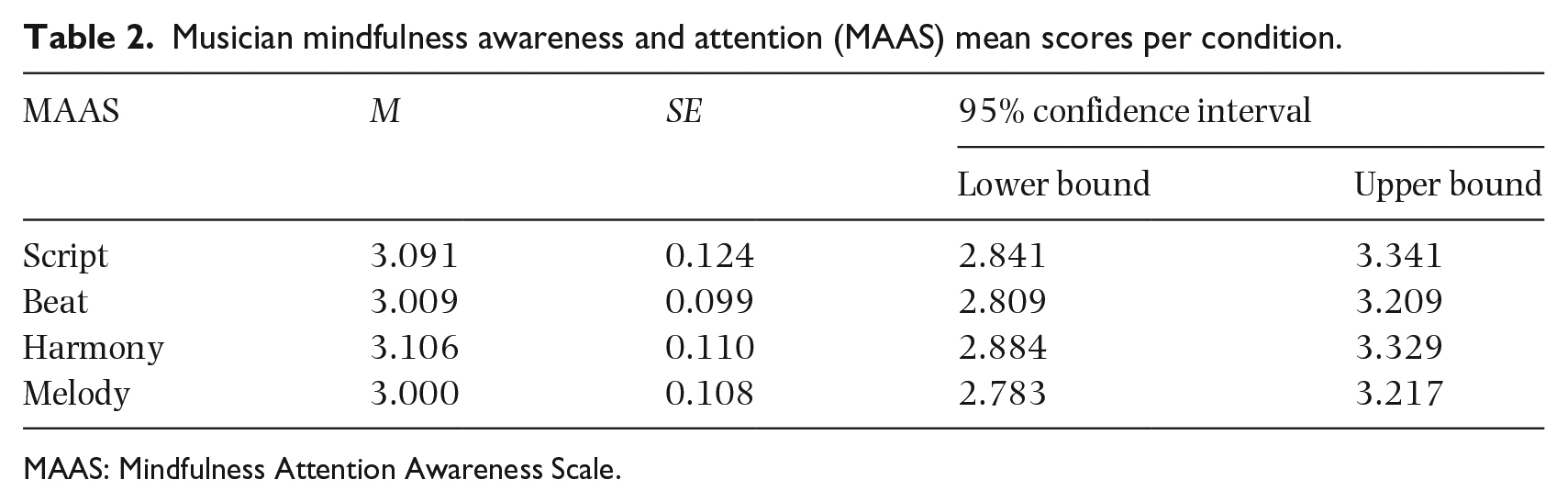
MAAS: Mindfulness Attention Awareness Scale.
To control for a possible effect of individual’s willingness and ability to be immersed in the musical experience (i.e., absorption in music, Question 2), AIMS scores were incorporated as a covariate of MAAS scores. The resulting repeated-measures analysis of covariance (RM-ANCOVA) did not show a significant difference between conditions, F(3, 135) = 1.21, p = .307, η2 = .026, Power = .32. Figure 1 represents average MAAS scores per condition, with AIMS as a covariate.
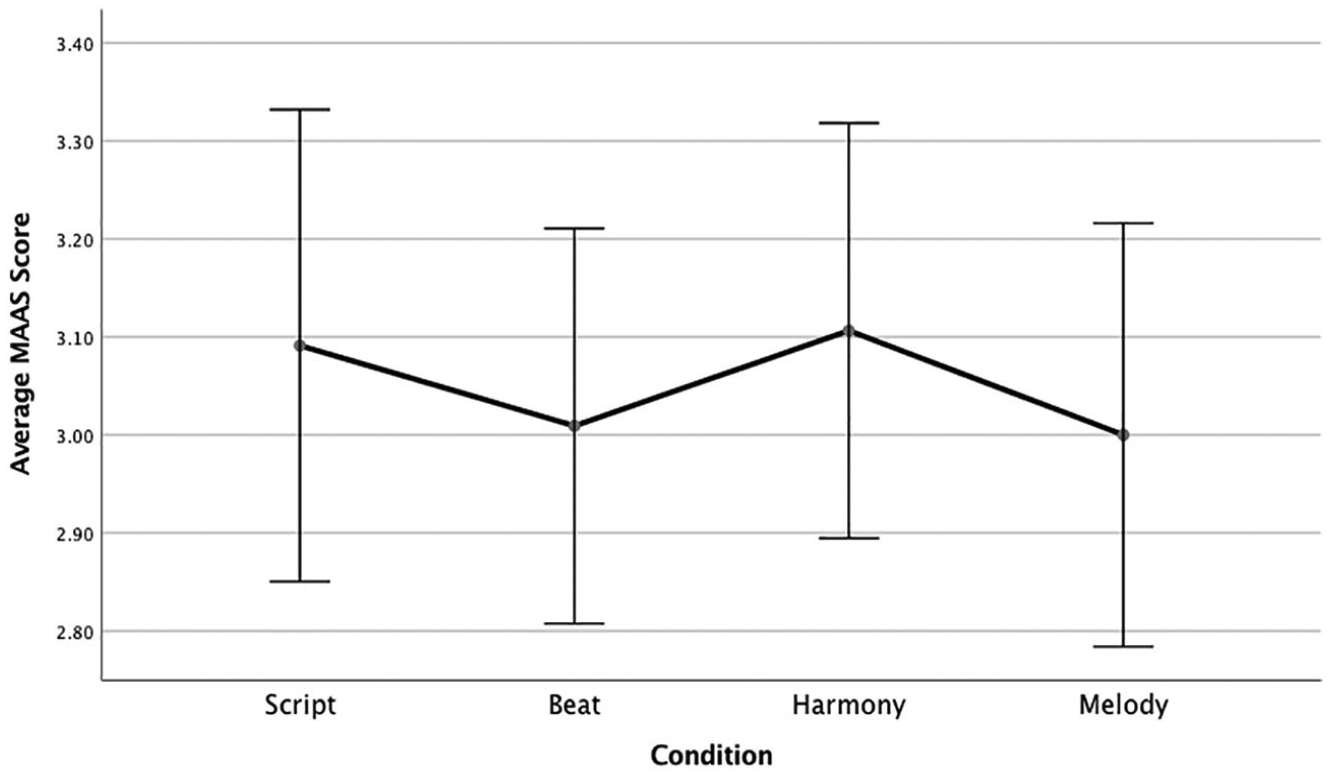
Average scores on the MAAS per condition. Error bars represent the 95% CI.
To investigate perceived usefulness of the different aural stimuli (Question 3), participants (n = 48, with one case excluded due to missing data) were asked to rank the four aural stimuli from most to least useful. A Friedman’s ANOVA showed a significant difference between conditions, χ2(3) = 14.425, n = 48, p = .002, with the Melody condition ranked most useful, followed by Harmony, Beat, and Script as least useful. Figure 2 shows mean rankings of Usefulness per condition. Post hoc Wilcoxon Signed tests, with an alpha level of .008 (adjusted for multiple comparisons), indicated a significant difference in participants’ preference between Melody and Script (p = .005) only.

Mean ranking of usefulness per condition as reported by musicians. Error bars represent the 95% CI.
Preference of aural stimuli (Question 4) was investigated by asking participants (n = 48, with one case excluded due to missing data) to rank the four conditions from most to least preferred. A Friedman’s ANOVA yielded a significant difference between conditions, χ2(3) = 34.50, n = 48, p < .001, with the Melody condition ranked most preferred, followed by Harmony and Beat, and Script condition as least preferred. Figure 3 shows average rankings of Preference per condition. Post hoc Wilcoxon Signed tests, with an alpha level of .008 (adjusted for multiple comparisons), indicated a significant difference in participants’ preference between Harmony and Script (p < .001), between Melody and Script (p < .001), between Harmony and Beat (p = .001), and between Melody and Beat (p = .004), but not between Melody and Harmony, or Beat and Script.
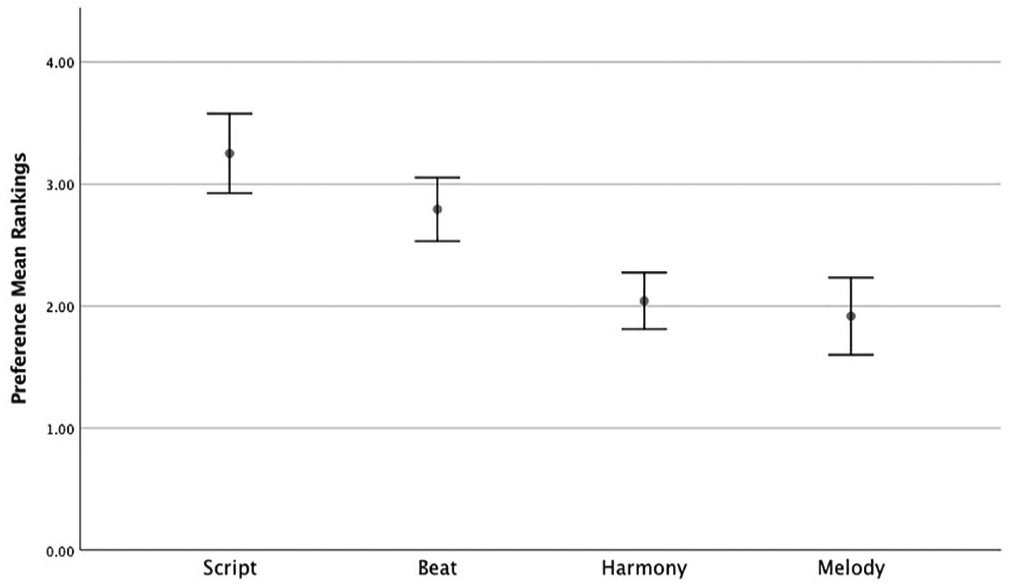
Average ranking of preference per condition as reported by musicians. Error bars represent the 95% CI.
To answer the fifth research question regarding comparisons between musicians and non-musicians, data from a previous study (Dvorak & Hernandez-Ruiz, 2019) were pooled, for a total of 103 participants (56 non-musicians, 47 musicians, excluding outliers and missing data). Demographic data for both groups are presented in Table 1. For the MAAS scores, a mixed effects design (within–between subjects) was used, defining the four aural conditions as the within-subjects factor, and the two groups (musicians, non-musicians) as the between-subjects factor. The within-subjects test indicated a significant main effect, F(2.63, 266.03) = 3.68, p = .017, η2 = .074, Power = .63, and a significant interaction with musician/non-musician status, F(2.63, 266.03) = 3.41, p = .023, η2 = .074, Power = .63, both with Greenhouse–Geisser adjustments, due to a significant Mauchly’s Test of Sphericity. The between-subjects test indicated no overall significant difference between groups, F(1, 101) = 2.55 p = .114, η2 = .025, Power = .35.
As in previous analyses, we included the AIMS scores as a covariate in the mixed model to explore a possible mediating effect of Absorption in Music. No significant differences were found in the within-subjects test, F(2.64, 263.48) = 2.33, p = .083, η2 = .023, Power = .54, or the between-subjects test, F(1, 100) = .33, p = .568, η2 = .003, Power = .088, when the AIMS was accounted for, supporting a mediating effect of absorption in music on mindfulness attention and awareness (MAAS scores). Figure 4 shows the average MAAS scores of both groups, with the AIMS as a covariate.
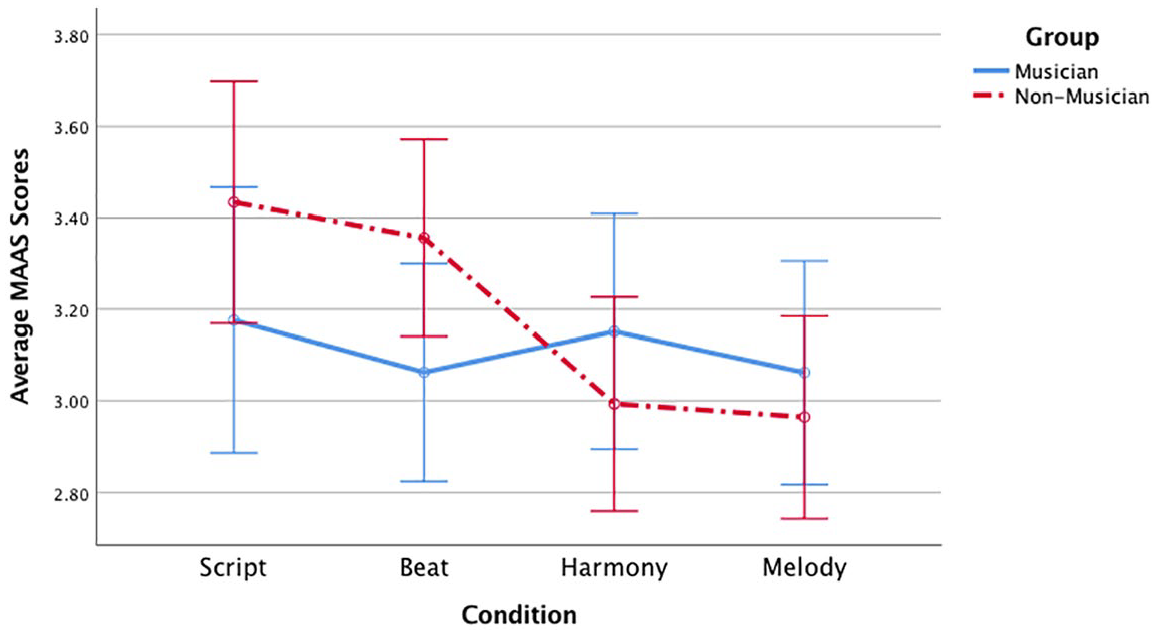
Average MAAS scores of musicians and non-musicians per condition, with AIMS as a covariate. Error bars represent the 95% CI. Crossing lines indicate an interaction between condition (i.e., music stimuli) and group. In other words, musicians and non-musicians showed a different pattern of responses across the stimuli. Non-musician data are taken from previous study (Dvorak & Hernandez-Ruiz, 2019).
To further understand the effect of absorption in music, we conducted independent t tests to compare AIMS scores between musicians (n = 49) and non-musicians (n = 57), finding a significant difference, t(104) = 4.98, p < .001, 95% confidence interval (CI) [12.63, 29.35], with higher scores for musicians. Finally, Usefulness and Preference average rankings per condition were graphed and compared. Results showed very similar patterns of response for both groups, with the Melody and Harmony conditions considered the most preferred and useful (Figures 5 and 6).

Average Usefulness rankings of musicians and non-musicians per condition. Lower scores indicate a higher ranking of preference. Non-musician data are taken from previous study (Dvorak & Hernandez-Ruiz, 2019).
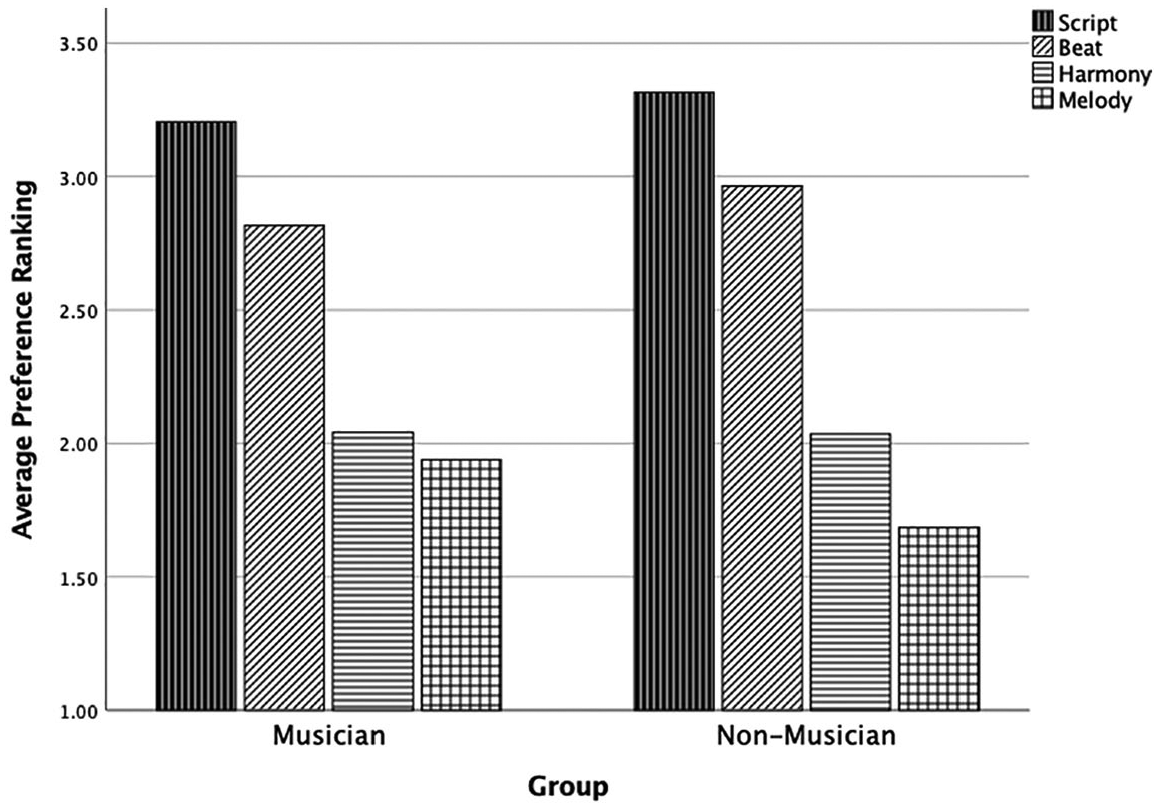
Average Preference rankings of musicians and non-musicians per condition. Lower scores indicate a higher ranking of preference. Non-musician data are taken from previous study (Dvorak & Hernandez-Ruiz, 2019).
Discussion
In this study, musicians (i.e., defined by having 5 or more years of formal music lessons), rated their mindfulness experience when exposed to four auditory stimuli of increasing complexity (Script, Beat, Harmony, and Melody). Participants also ranked the stimuli from most to least preferred, and from most to least useful. Researchers then compared these results with data from a previous study with non-musicians. Researchers hypothesized that musicians would rate the mindfulness experience with the Harmony and Melody stimuli higher, given musicians’ increased expectations for music and increased ability to process musical complexity (Deguchi et al., 2012; Hartmann et al., 2017). This hypothesis was not supported, in that musicians did not rate their mindfulness experience differently when exposed to each auditory stimulus. On the contrary, this result—lack of statistical significance between conditions—may support the notion that musicians’ more effective implicit processing of the music avoided interference of more complex music on their mindfulness practice (Deguchi et al., 2012; Hartmann et al., 2017).
Another possible explanation regarding the lack of difference between music stimuli might be related to speech processing, executive functioning, and auditory verbal memory. Previous research has found increased speech processing ability among musicians, particularly in noisy conditions (Slater et al., 2015). This ability to process speech (i.e., the mindfulness script) despite potentially distracting stimuli (i.e., the music) might help explain why musicians did not show a difference in mindfulness attention and awareness (MAAS scores), even when exposed to more complex stimuli. Furthermore, increased executive functioning and auditory verbal memory, also found in musicians (Chan et al., 1998; Moreno et al., 2011; Zuk et al., 2014), could help explain their ability to focus on the verbal instructions despite competing stimuli of increased complexity. This ability seems to be different for non-musicians (Dvorak & Hernandez-Ruiz, 2019).
Interestingly, musicians did seem to prefer and find more useful the Harmony and Melody conditions, similar to non-musicians (Dvorak & Hernandez-Ruiz, 2019), with significant differences between Melody and Script for the Usefulness ranking, and between Harmony-Script, Melody-Script, Harmony-Bass, and Melody-Bass conditions for the Preference ranking (Figures 2 and 3). In fact, the Usefulness and Preference Rankings show an almost identical profile for musicians and non-musicians (Figures 5 and 6). Consistent with previous literature regarding explicit evaluations of emotion and preference of music (Bigand et al., 2011; Larrouy-Maestri et al., 2015), our results indicate that musicians and non-musicians may find more complex musical stimuli more pleasant and supportive for mindfulness practice, even if the cognitive processes implicated in their listening might differ (Deguchi et al., 2012; Hartmann et al., 2017; Slater et al., 2015; Tierney et al., 2015).
Researchers pooled and compared the ratings of four conditions on mindfulness practice from musicians in this study with non-musicians in a previous study (Dvorak & Hernandez-Ruiz, 2019). A mixed model indicated a significant main effect of auditory stimuli on mindfulness but also an interaction due to group status (Figure 4). Interestingly, a significant result was only true when absorption in music was not considered. Once included, the difference among conditions disappeared, supporting a mediating effect of absorption in music. It seems reasonable that the ability and willingness to be “drawn in deeply [by a musical stimulus]” explains, at least partially, the effect of the auditory stimuli on the mindfulness intervention, both for musicians and non-musicians, consistent with previous literature (Barret & Janata, 2016; Dvorak & Hernandez-Ruiz, 2019; Hernandez-Ruiz et al., 2018; Sandstrom & Russo, 2013). Moreover, a comparison of average absorption in music indicated that musicians have higher scores, which might help explain the lack of significant differences for the auditory stimuli for musicians. In other words, musicians’ increased ability to be immersed in the music (and their hypothesized improved implicit music processing, as discussed before) allowed all auditory stimuli to be equally effective for mindfulness meditation, compared to non-musicians, who might have been distracted by the more complex stimuli (Dvorak & Hernandez-Ruiz, 2019). Whether absorption in music is innate among musicians, or the product of their training, our study cannot say. What these results do support is the importance of considering absorption of music as a factor that could either partially explain the effectiveness of a music intervention (i.e., mediating effect) or could modify the strength and direction of it (i.e., moderating effect) (Sandstrom & Russo, 2013).
Limitations and delimitations
The limitations of this study include the lack of homogeneity in our sample. First, although we pre-screened participants for music expertise (more than 5 years of formal music experience), two participants (4%) indicated that they had between 1 and 5 years of formal training, while also indicating having a “major instrument” (guitar and flute). Given the inability to determine which responses were accurate, the possibility that they had 5 years of training (which was the cutoff point), and the low percentage and impact on the statistical test, we decided to keep the data from these participants. Furthermore, only 24% of our sample were music majors. Although our definition of “musician” accounted for 5 or more years of musical training, engagement in higher education in music (i.e., music major) would clearly have increased demands on time for practice and theory than musical training without these extensive demands. On the contrary, high levels of musicianship (with its consequential effects on neural and cognitive changes) are possible even when not engaged in professional music making (Larrouy-Maestri et al., 2015). Further research might attempt to disentangle these factors.
Another limitation of our study is missing data on participants’ previous mindfulness meditation. Only 73% (n = 36) of our participants answered this question, precluding incorporating this variable in our statistical tests. Undoubtedly, meditation experience can have an impact on participants’ ability to immerse themselves in this practice (Brefczynski-Lewis, Lutz, Schaefer, Levinson, & Davidson, 2007). This limitation could be overcome in future studies through changes in the survey response item. Finally, an environment that was not completely sound proof might have impacted participants’ concentration and attention to the stimuli. However, the environment was kept consistent throughout the study, thus limiting its effect on overall results.
Implications for clinical practice and research
The first important implication of this study for clinicians is the need to explore pre-treatment factors that may impact the effectiveness of a music intervention, such as music expertise and absorption in music. Although it is intuitively apparent that these factors would draw a person to/from music therapy treatment, very few studies and intervention protocols systematically assess these elements before intervention. Based on these and previous results (Dvorak & Hernandez-Ruiz, 2019), we encourage clinicians to incorporate measures of responses to music before providing treatment, to better tailor the interventions to each recipient.
A second implication is the need to carefully assess and distinguish between client self-reported preference and usefulness, and measures of clinical effectiveness. In this case, for example, none of the auditory stimuli seemed to show an increased efficiency on the therapeutic outcome (mindfulness practice) for musicians, based on differences in music complexity. However, musicians reported distinct preference and usefulness for the most complex stimuli. As music therapists know, preference for musical stimuli should not be the only consideration when selecting music for its therapeutic effect, but it is indeed an important one. Clinicians are encouraged to balance preference and effectiveness of musical stimuli when crafting music interventions.
Finally, results from this study and our previous study indicate that music composed at an optimal level of complexity (including harmonic and melodic progressions) (Berlyne, 1971) seem to support mindfulness meditation. Future studies can seek to replicate these results in other populations and settings, as well as contrast musical stimuli with similar compositional principles (i.e., steady beat in the bass, predictable, consonant harmonies, and repetition of regular musical phrases with a repetitive motif, and simple, non-syncopated rhythms in the melody).
Conclusion
In this study, we investigated the effect of aural stimuli at increasing levels of complexity (script, beat, harmonic progression, and melody) on mindfulness meditation, and musicians’ ratings of preference and usefulness of the music to support this mindfulness exercise. We did not find differences in the effect of the auditory stimuli (different from non-musicians), despite the fact that musicians did consider the Harmony and Melody conditions most preferred and useful (similar to non-musicians). Furthermore, absorption in music was significantly higher for musicians, which might help explain the lack of difference between auditory stimuli, and the differences compared to non-musicians. Similar to previous results with non-musicians, this study supports the hypothesis that absorption in music and music expertise might mediate the effect of a music intervention. Other factors such as experience with mindfulness meditation may have also impacted our results. Further research including this and other demographic variables is needed.
Footnotes
Acknowledgements
The authors would like to thank the University of Kansas Center for Undergraduate Research, Jim Barnes and the Lawrence Public Library Sound + Vision Studio, Mike Vitevitch for his assistance with SONA, KU theory professors Scott Murphy and Brad Osborn for their help with recruitment, the music therapy and music education students who served as data collectors, and all of the KU undergraduate students who participated in the research study.
Declaration of conflicting interests
The author(s) declared no potential conflicts of interest with respect to the research, authorship, and/or publication of this article.
Funding
The author(s) disclosed receipt of the following financial support for the research, authorship, and/or publication of this article: Funding was provided by the Graduate Research Consultant Program through the University of Kansas Center for Undergraduate Research.
