




Abstract
Music listening behavior has changed significantly due to technological advancements, leading to new listening contexts in which the situational circumstances play an increased influencing role. The aim of this study was thus to investigate the relationship between situational characteristics captured by the Situational Eight DIAMONDS and psychological characteristics of music (Arousal, Valence, and Depth) people listen to in different situations. Hence, an online study was conducted, in which 198 participants described and reported on features of 3 typical, self-selected listening situations. Results suggested that individuals adapted their music listening behavior dependent on the situational characteristics reflected by the eight DIAMONDS. Furthermore, utilizing a Latent Class Analysis, we established a taxonomy of music listening situations, including positive-social, ambivalent-individual, and negative-demanding situations. Finally, both DIAMONDS and the established classes reliably predicted reported music listening behavior and therefore are recommended to be considered in future research on social and music psychology.
Keywords
Music listening from past to present
Music is an essential part of people’s daily lives, and technological innovation has enabled the modern individual to listen to any song, anywhere and at any time (Greasley & Lamont, 2006; Krause, North, & Hewitt, 2015; Sloboda & O’Neill, 2001). Hence, contexts of music listening are now more versatile than ever before in human history, affecting the motives of music listening as well as musical choices. Notwithstanding, music listening has been dependent on situational factors, such as location, for thousands of years. From ancient Greece and China to concert music of the 19th century, listeners were solely able to experience music at the locations of performance (Landels, 1999; North, Hargreaves, & Hargreaves, 2004; Wang, 2004). In contrast to the present time, however, music was highly immobile, and the number of listening situations was limited accordingly (North et al., 2004). These restrictions were overthrown in 1878 by the first major technological revolution in the field of music creation: the beginning of recorded music. From that point on, people were able to listen to music via phonograph boxes in their living rooms replacing the obligatory concert visit and changing human listening behavior (Byrne, 2012).
In the late 20th century, the number of listening contexts and situations grew even more through further technological advancements. Inventions like the compact cassette, the compact disk, and the Walkman created several new opportunities of listening, making it possible to conveniently listen in the car, at home or anywhere on the go (Byrne, 2012; North et al., 2004).
Finally, in the course of digitalization and the Internet, consumers are now able to stream and download large song databases from different digital platforms. Combined with the mobility provided by portable devices such as smartphones, modern individuals can listen to music in an (in human history) unprecedented variety of situations (Krause et al., 2015; North et al., 2004). These situations are commonly linked to a performed activity and take place during commuting, physical activity, working, relaxing, and socializing among other daily listening contexts (Greasley & Lamont, 2011; Greb, Schlotz, & Steffens, 2018).
The role of situational factors in music listening
Compared to person-related variables such as musical taste or musicality, situational factors have not received a sufficient amount of attention in research on music listening behavior overall. Earlier research recognized that the reaction toward music is based on a combination of musical, personal, and situational factors (Merriam, 1964) and that music fulfills different needs across people’s daily situations (Hargreaves & North, 1999). Other studies have pointed out that individuals adapt their listening behavior in accordance with the situation they are experiencing. Different studies which applied Experience Sampling Method highlighted music being consciously utilized in support of specific activities (Greasley & Lamont, 2011; Sloboda, O’Neill, & Ivaldi, 2001) and scarcely for pure music listening alone (Juslin, Liljeström, Västfjäll, Barradas, & Silva, 2008). Furthermore, quantitative studies by Greb and colleagues, who obtained retrospective and actual self-reports of music listening situations in daily life, suggested that situational factors contribute more to the prediction of the functions of music listening and actual musical choices than person-related factors (Greb, Schlotz, & Steffens, 2018; Greb, Steffens, & Schlotz, 2018, 2019). These studies revealed, for example, that intellectual stimulation through music was observed to be a more common function during work/study and pure music listening, while music listening on the move tends to fulfill the function of killing time and overcoming loneliness. These results are in line with those found by North et al. (2004) regarding the functions of music in different situations. Their study, in which a young and socially heterogeneous group of participants received a daily text message for 14 days asking them to complete a survey, showcased that individuals reacted to different situations they were in with a “mood-optimization strategy” and adapted their music listening behavior accordingly (North et al., 2004, p. 68). Observed relations between functions of music and particular situations were, for instance, atmosphere creation when going out, support of concentration in a situation demanding intellectual capabilities, enjoyment through pure music listening at home or on the road, music listening for the pleasure of others in social situations, and listening for pastime in situations at home or in traffic.
Beyond that, studies have shown that individuals employ emotional self-regulation strategies through music, in a way which benefited them in a particular situation. In a behavioral experiment by Tamir and Ford (2012), 48 students were asked to take on the role of a landlord or a tenant in a hypothetical negotiation situation. Students preparing for a confronting situation were more likely to listen to aggressive music beforehand to increase their anger, and thus their functioning in the subsequent situation, compared to students preparing for collaboration. Also, individuals were shown to utilize happy music in social situations for the sake of other people’s pleasure (North et al., 2004) and sad music for musical self-therapy, ultimately helping the listener feel better in situations of emotional pain (Chen, Zhou, & Bryant, 2007; Van den Tol & Edwards, 2014). The emotional contagion taking place while listening to sad songs was found to trigger the hormone prolactin, which is comparable to endorphins in its effect, making the overall listening experience feel pleasurable (Huron, 2011).
Taken together, past research suggests that a deeper understanding of situational factors and their psychological effects on individuals and their music listening behavior would be beneficial for general, social, and music psychology as well as for practical real-life applications, such as music recommendation systems. However, most studies focused on situational factors such as the social context, activity, time of day, and location. While these factors constitute fundamental descriptors of situations, they leave out the meaning a particular situation has for the listener. Besides, these studies did not provide a thorough conceptualization of what a situation is and how it can be categorized.
Recent research in general and personality psychology, however, has proposed a situational taxonomy differentiating between three aspects of situational information, also called the “three situational Cs” (i.e., cues, characteristics, and classes; Rauthmann, 2015, p. 181). First, according to Rauthmann (2015), a situation contains cues representing five questions: “Who is with you?” “Which objects are around you?” “What is happening?” “Where are you?,” and “When is this happening?” (p. 364). Cues as one aspect of situational information thus represent the physical environment of situations, most likely agreed upon by the experiencing individuals. However, cues do not imply any psychological meaning and need to be processed by individuals first for an interpretation and reaction. The second kind of situational information is represented by situational characteristics reflecting the meaning of different perceived cues to an individual on a psychological level. Based on the 89-item Riverside Situational Q-sort (RSQ) for situational categorization (Wagerman & Funder, 2009), Rauthmann et al. (2014) developed a reduced model that is easier to apply, while still including the most common situational characteristics. Characteristics in the reduced model were determined by surveys featuring participants (N = 1,589) rating previously experienced situations based on the RSQ items on a Likert-type scale (Rauthmann et al., 2014). Included in the resulting Situational Eight DIAMONDS are eight situational dimensions, consisting of different items capturing the psychological implications of a situation. The eight DIAMONDS consist of Duty (does something need to be done?), Intellect (is deep information processing required?), Adversity (is someone being overtly threatened?), Mating (is the situation sexually or romantically charged?), pOsitivity (is the situation pleasant?), Negativity (do negative things taint the situation?), Deception (is someone deceptive?) and Sociality (is social interaction or and relationship formation possible, desired or necessary?) (Rauthmann, Sherman, & Funder, 2015, p. 364)
Empirical research on the Eight DIAMONDS has shown them to be highly agreed upon by different raters, to predict different behaviors accurately, and to exhibit high consistency and validity (Rauthmann et al., 2014; Rauthmann & Sherman, 2015). Finally, the last of the three situational Cs, namely situational classes or clusters, integrates the two former kinds of situational information. Classes/clusters can be distinguished by different cues as well as different characteristic profiles. For example, all situations at a certain time of day (cue), all situations exhibiting Adversity (characteristic) or all situations characterized by a particular DIAMONDS or cue composition can be subsumed under one class/cluster (Rauthmann, 2015).
Aims and hypotheses
Up until this point in time, the three situational Cs, in particular situational characteristics and classes, have not been connected to research on music. The aim of the present study, therefore, was to bridge this gap and to integrate situational characteristics and classes into the research on music listening behavior. It was generally assumed that, in an everyday situation, individuals purposely choose music in congruence with the characteristics of the situations they experience.
First, it was investigated whether classes of typical music listening situations can be derived statistically through a Latent Class Analysis (LCA; i.e., a model-based cluster analysis) on situational characteristics measured by the Situational Eight DIAMONDS. Second, it was tested whether the obtained classes would be able to predict the psychological characteristics of music in various listening situations. Here, recent studies have highlighted the role of the three factors arousal, valence, and depth (AVD) in music perception and preferences (Greenberg et al., 2016; Fricke, Greenberg, Rentfrow, & Herzberg, 2018, 2019; Fricke & Herzberg, 2017). Based on a Principal Component Analysis on 102 song excerpts ratings by 9,454 participants, Greenberg et al. (2016), for example, observed that the 38 psychological attributes used could be organized into these 3 dimensions. They observed that high-arousal music included attributes such as intense and aggressive, while low-arousal music encompassed characteristics such as mellow and gentle. The valence dimension included attributes such as happy and fun (positive valence) as well as depressing and sad (negative valence). Attributes loading highly on depth were intelligent and inspiring, for instance, while danceable and party music exhibited a negative loading on depth (Greenberg et al., 2016).
Therefore, based on previous research on music listening behavior and the influence of situational factors, the following hypotheses were formulated:
In line with the previous findings that individuals preferred happy music in social situations (North et al., 2004), it was suggested that participants in this study would report listening to high valence music more frequently in situations scoring high on the dimensions Sociality and Positivity.
Corroborating findings on the role of sad music for musical self-therapy (Chen et al., 2007; Van den Tol & Edwards, 2014), it was hypothesized that participants in this study would report listening to negative-valence music in situations scoring high on Negativity and Adversity.
Based on previous findings that individuals listen to high-arousal music such as aggressive music in preparation for a stressful situation (Tamir & Ford, 2012), it was assumed that individuals in this study would report listening to high-arousal music more frequently in those situations scoring high on the dimensions Negativity and Adversity.
Finally, in line with findings by Greb, Schlotz, & Steffens, (2018) regarding listening to complex music for intellectual stimulation, it was expected that “deep” (i.e., sophisticated and inspiring, Greenberg et al., 2016) music was listened to more frequently in those situations scoring high on Intellect.
Method
Sample
Data for this study were acquired via an online questionnaire advertised through university mailing lists, social media forums, and personal emails sent to heads of various German and international university faculties teaching music-related majors (see Supplemental Materials online for details). Altogether, 309 people started the survey, from which 166 completed the description of three self-selected music listening situations, while 143 questionnaires were partially completed (description of one situation: 17 participants; description of two situations: 15 participants). One-hundred-eleven entries were deleted, as they included less than one complete description and rating of a music listening situation. From this final sample of 198 participants, 124 participants were female (62.6%), 70 were male (35.4%), 1 participant selected other sex (0.5%), and 3 participants selected no answer (1.5%). The mean age of participants was 29.2 years (SD = 9.6), including a 14-year-old as the youngest and a 75-year-old as the oldest participant.
Design and procedure
The survey design was partially based on the one utilized by Greb, Schlotz, and Steffens (2018) who asked participants to report on three typical music listening situations and associated situational and person-related factors.
In the main part of the present study, participants were requested to freely describe three everyday situations in which they typically listened to music. For each of the three situations, participants were asked to describe the respective scenario by using a short but detailed and precise sentence. This approach was utilized because it gave those providing descriptions freedom to express the particular situation without constraints, hence not forcing them to fit into any predefined settings. Subsequently, participants rated the characteristics of the described situation based on 24 items capturing the Situational Eight DIAMONDS dimensions within the respective situational context (Rauthmann & Sherman, 2015). Out of the original 24 items, 3 were modified regarding their wording, to make them more applicable to describing typical situations of music listening. While the original version of the questionnaire inquired about “being” blamed, criticized, or threatened, the three modified items instead captured how strongly participants “felt” blamed, criticized or threatened in the respective situational context. Finally, participants were requested to rate the music they typically listened to in the described situation regarding psychological attributes. Here, attributes were selected based on the study by Greenberg et al. (2016). More concretely, those attributes were used which loaded highest on the three factors AVD as observed by Greenberg et al. (2016), respectively, namely Intense, Aggressive, Mellow, Happy, Depressing, Enthusiastic, Sophisticated, Inspiring and Danceable.
The process of describing and rating a typical music listening situation was performed three times overall. After completing the survey, participants were given the option to type in their email address to participate in a raffle.
Data analysis
The situation descriptions were checked by the authors regarding plausibility. Implausible or ambiguous descriptions and false entries were deleted, including the associated ratings. This process resulted in a dataset of 545 valid described and rated situations.
The musical/psychological items were aggregated to the three AVD factors in line with Greenberg et al. (2016). That is, the single items used to measure the respective factor were multiplied with their factor loadings (Greenberg et al., 2016, Table 1) and added up to a factor store which was then z-standardized. Regarding the Situational Eight DIAMONDS representing situational characteristics, ratings on the 24 items were summed up to 8 respective dimensions.
Relative frequencies of high scores (upper 50%) on the DIAMONDS dimensions and reported activities across the three obtained situational classes.

To establish situational classes (i.e., a taxonomy) of music listening situations, we conducted a LCA on these eight DIAMONDS dimensions. LCA is a model-based approach which, in contrast to methods such as cluster analysis, estimates a statistical model assumed to represent the population from which the data was gathered (Schreiber, 2017). Both latent class and cluster analysis are seeking divisions that maximize the between-cluster differences and minimize the within-cluster differences. In contrast to cluster analysis, LCA allows examining residuals between items used in the analysis and thus estimating the overall model quality (Schreiber, 2017). LCA approaches further have been shown to outperform k-means clustering (Magidson & Vermunt, 2002). The calculation of the LCA was performed using the mixture procedure of M-Plus 7 (Muthén & Muthén, 2004) taking into account the clustered data structure (up to three repeated measures [situations] nested within individuals) by using a robust sandwich estimator. The eight (continuous) DIAMONDS were dichotomized employing median splits to reduce the cells of the multidimensional contingency table. The number of situational classes was assessed through the Bayesian information criterion (BIC; Schwarz, 1978) which is a good indicator for choosing the correct number of classes (Nylund,sparouhov, & Muthén, 2007). To the best of our knowledge, LCA has not yet been applied in the context of the situational DIAMONDS.
The clustered data structure made it further necessary to utilize linear mixed-effects models to determine the ability of the obtained situational classes to predict the AVD musical dimensions. Hypotheses were then tested through several linear mixed-effects models in SPSS including a random intercept for each participant and using restricted maximum likelihood estimates of variance components and Type III Analysis of Variance via Satterthwaite’s degrees of freedom method.
Results
Classes of music listening situations
To establish classes of music listening situations, several LCA models were computed with the eight dichotomized DIAMONDS dimensions as variables of interest. All models converged, and the best loglikelihood value was replicated at least 10 times in all models. Accordingly, the resulting 2–6 class solutions were compared with regard to the BIC. As depicted in Figure 1, the BIC reached its minimum for a model including three classes, leading to a well-interpretable class solution. Table 1 shows the relative frequencies of high values (upper 50%) of the Eight Situational DIAMONDS and the reported activities for this three-class solution. The table suggests that Class 1 predominantly included situations scoring high on Duty, Intellect, Negativity, Deception, and Sociality and is related to the activities “in transit” and “work/study.” It thus tends to subsume rather negative situations involving work and duties as well as other people around and could, therefore, be named “negative-demanding.” Typical free-text situation descriptions belonging to Class 1 include “When I sit at my laptop in the morning and answer my emails,” “Working, but only when I have something repetitive to do,” “When I retire to my room at home because I need time for myself after an argument or similar” or “Background music while shopping.”
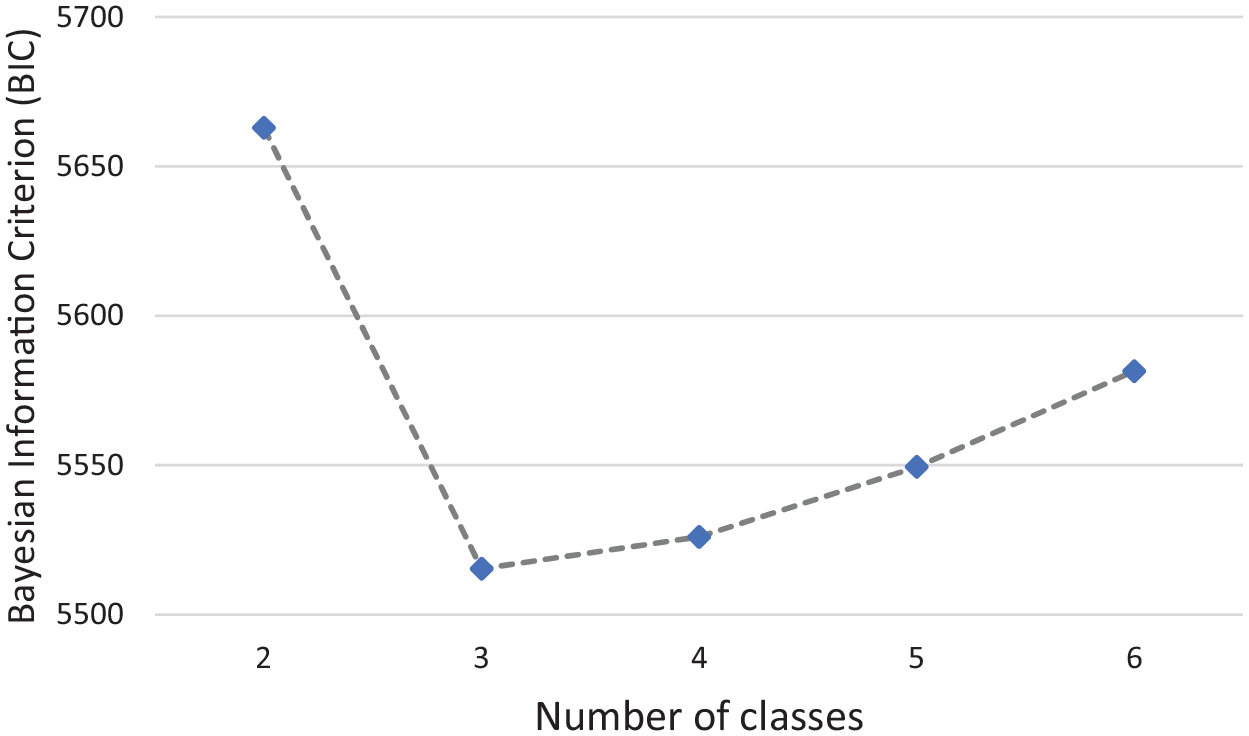
BIC Values of the Different Class Solutions Obtained Through Latent Class Analyses on the Eight Situational DIAMONDS.
Class 2, in contrast, shows rather average scores on Duty and Negativity and minimal scores on Sociality and is associated with a relatively high frequency of transit situations, “getting ready for the day” and household activities. Thus, it could be labeled “ambivalent-individual.” Characteristic situation descriptions assigned to Class 2 are “When I spend long periods of time on trains or long-distance buses,” “At home in the morning after getting up I listen to music while I prepare breakfast or take my morning bath.” “Going for a walk in my district, in the evening around 6 pm” “In the car on the motorway, in the evening on the way back from work” or “When I cook in my kitchen at night.”
Finally, Class 3 comprises situations scoring high on Sociality, Positivity, and Mating. Accordingly, it includes most of the socializing activities as well as partying, attending concerts, and getting ready for the day, and thus could be entitled “positive-social.” Typical free-text descriptions belonging to Class 3 include “Together with friends and music in the background,” “At night in a (music) club / disco,” “In the evening when I go to a concert,” or “When I relax and talk to my boyfriend in the evening.”
Prediction of psychological characteristics of the music
In the next step, we investigated whether psychological characteristics of the music measured by the three AVD dimensions can be predicted through the obtained situational classes negative-demanding, ambivalent-individual, and positive-social. Results of a linear mixed-effects model revealed that the three situational classes significantly predicted the emotional valence of the music participants reported listening to in different situations, F(2, 520) = 18.3, p < .001, R²marginal = .047. As illustrated by Figure 2, the emotional valence of the music was highest in positive-social situations compared to the other two situational classes, confirming Hypothesis 1. The results further support Hypothesis 2, which assumed that negative and adverse situations (i.e., Class 1) would predict listening to negative-valence music.

Psychological Characteristics of the Music Depending on the Three Situational Classes: Z-Standardized Means With 95% Confidence Intervals.
Also, the linear mixed-effects model with emotional arousal as dependent variable revealed a significant effect of the situational classes, F(2, 533) = 5.3, p = .005, R²marginal = .021. Here, Figure 2 illustrates that the arousal conveyed by the music was highest in negative-demanding situations compared to the other two classes. This result confirms Hypothesis 3, which assumed that individuals would listen more to high-arousal music in those situations scoring high on dimensions Negativity and Adversity (i.e., Class 1 “negative-demanding”).
Finally, a linear mixed-effects model predicting musical depth demonstrated a small but significant effect of the situational classes, F(2, 528.8) = 3.1, p = .047, R²marginal = .001. In line with Hypothesis 4, the depth and complexity of the music participants reported listening to was highest in Class 1 (which also showed high values on “Intellect”) compared to the other two classes.
As for all three models, the effect sizes R²marginal must be considered rather low. Therefore, for the sake of comparison, three linear mixed-effects models were computed with the Situational Eight DIAMONDS as independent variables and the three psychological characteristics of music as dependent variables. As shown by Table 2, all R²marginal values increased strongly compared to the models with situational classes as independent variables. This holds true in particular for valence and depth where 20% of the variance was explained by the situational DIAMONDS, respectively.
Results of three linear mixed-effects models predicting the psychological characteristics of music arousal, valence and depth (AVD) with the Situational Eight DIAMONDS.

SE: standard error.
p < .05.
Estimates for the Situational Eight DIAMONDS dimensions as predictors for AVD are in line with the results of the situational classes. As depicted in Table 2, the assumption that individuals chose music according to the psychological meaning of the particular music listening situation receives further empirical support. In situations scoring high on Adversity, individuals tended to predominantly listen to music with a negative valence (sad/depressing), whereas positive musical valence was found to be significantly associated with situations scoring high on Positivity. Another finding is the tendency of participants to listen to positive Valence music in situations where a task had to be performed or duty had to be fulfilled. This context most likely occurred at work or on the way to work. Negative-valence music was being listened to in situations involving intellectual stimuli and cognitive activity (Intellect dimension).
The results of the linear mixed-effects models presented in Table 2 provide further empirical evidence for the stated assumption that individuals experiencing negative situations would choose arousing music. In addition, in situations with potential romantic partners present and increased importance of attractiveness (mating dimension), there was an increased chance of people selecting arousing music.
The third musical dimension Depth, reflecting sophisticated and inspiring music, exhibited opposite relationships with Duty (negative) and Intellect (positive). In line with the analysis of the situational classes, people reported listening to high-depth music in situations scoring high on Intellect. On the contrary, it was less likely that listeners listened to high-depth music while fulfilling duties. Finally, musical Depth was shown to be negatively associated with situations scoring high on Sociality and Mating.
Discussion
This study investigated the relationship between situational characteristics and classes and musical listening behavior. Results of several linear mixed-effects models indicated that the Eight Situational DIAMONDS (Rauthmann et al., 2014) could be considered an appropriate measure to reflect and characterize the psychological meaning of music listening situations and to reliably predict psychological characteristics of reported musical choices in terms of arousal, valence, and depth. Moreover, three situational classes were established in the course of a LCA covering (1) negative-demanding, (2) ambivalent-individual, and (3) positive-social situations.
To the best of the authors’ knowledge, this is the first time that a situational taxonomy on music listening has been established based on situational characteristics and derived from statistical (model-based) approaches. The obtained three-class solution suggests that the perception and interpretation of a music listening situation is predominantly based on the valence (Negativity and Positivity) and sociality of the situation. Besides rather explicit negative or positive situations, the obtained class solution also included an “ambivalent” class containing both positive and negative or neutral situations. The results related to the frequency of specific activities in the three classes further highlight the fact that in many cases, it is not possible to derive the psychological meaning of a situation by the activity-at-hand alone. For instance, frequent activities such as “in transit,” ‘getting ready for the day,’ or “housework / cooking” occur in all three classes demonstrating the unspecificity of their psychological meaning.
The three music listening classes can be regarded as a useful measure for future studies to obtain the psychological meaning of a music listening situation by only using one categorical item. Besides, despite the rather low amount of explained variance, the classes were shown to significantly predict psychological attributes of music people reported listening to in a particular situation. Here, both the analysis of situational classes and characteristics as predictors of musical attributes clearly showed a tendency of individuals to adapt their music listening behavior dependent on the respective situational circumstances. For example, listening to positive-valence music in positive situations hints at a desire to maintain the positive psychological meaning of the respective context, corroborating previous findings (e.g., North et al., 2004). In reality, this would predominantly be the case when individuals are listening to music while socializing with others or when a cheerful mood is to be upheld in a situation being alone. A negative association between musical valence and situations scoring high on Adversity further suggests that listeners avoided positive musical valence and preferred negative valence when they experienced psychological stress. This finding emphasizes the self-therapeutic aspect of music illustrated by Van den Tol and Edwards (2014) and Chen et al. (2007). In this study, negative valence was also found to be connected to situations involving the use of intellectual capacities, reflected by a significant negative correlation between the DIAMONDS item Intellect and the musical dimension Valence. This finding hints at sad music being listened to as an intellectual stimulus which can be further associated with the crucial role of sadness and melancholy as an aesthetic emotion in different kinds of art forms (e.g., Brady & Haapala, 2003).
Furthermore, people in strongly and moderately negative situations were shown to prefer stimulating music, thus regulating their emotional state in order to handle better the psychological circumstances they were confronted with, as already observed in previous research (e.g. Tamir & Ford, 2012). However, arousing music was also reported to be listened to in positive situations and thereby proved to be versatile in its utilization across listening contexts. In this case, it can be assumed that arousing music is frequently listened to because it exerts pleasure in the listener in terms of a physiological reaction (see also Salimpoor, Benovoy, Longo, Cooperstock, & Zatorre, 2009).
A positive connection between the DIAMONDS dimension Mating and listening to arousing music supports anecdotal evidence that arousing songs are preferred in a context of partying. Moreover, a negative connection between arousal and situations containing interpersonal communication (Sociality dimension), hints at individuals’ preference of music that is more mellow when communicating interpersonally, while preferring energetic music when not verbally communicating or when by themselves.
In this study, work/study was a fairly common activity and Duty represented a frequently reported situational characteristic across the evaluated music listening situations. An increased consumption of high-valence and low-depth music in situations of Duty suggests that individuals more likely preferred cheerful and simple music in the background during work. On the contrary, musical depth was positively associated with situations scoring high on Intellect. It is highly plausible that a work-related situation involves duty, while intellectual capacities are not required in all forms of work such as physical labor or monotonous tasks. Consequently, it can be assumed that situations scoring high on Duty are work-related, while situations scoring high on Intellect and low on Duty are non-work-related. Thus, the intellectual stimulus in the latter situations most likely stems from the music itself. In future studies, a differentiation between cognitively demanding and mundane scenarios of work is advisable, since the musical factor depth, as in listening to complex and sophisticated music, most likely varies depending on the loading of Intellect within a situational context. A more thorough look into the effects of different music types on working and studying would support potential music creation in support of concentrated work. At this point, listeners can resort to curated playlists on streaming-platforms and artificial intelligence-driven audio apps to enhance their ability to work. Nevertheless, it is uncertain how effective the respective playlists and apps are and whether they incorporate any scientifically valid empirical data.
Furthermore, social situations were associated with low-depth music, which is highly plausible as music most likely plays a background role in situations involving verbal communication or romantic companionship. This also includes party situations in music venues and clubs, where (dance) music is played to promote social interaction and amusement.
The only DIAMONDS dimension which exhibited no significant relationship with any of the applied psychological characteristics of music was Deception. This finding is reasonable because situations in which individuals can be significantly untruthful and deceptive are, for one, particular and relatively uncommon and most likely do not constitute typical music listening situations.
Some limitations associated with the design of the study have to be addressed. First, the findings are based on a rather young sample with a mean age of around 30 years which cannot be considered as representative of the general population. Also, this study adopted retrospective self-reports of behavior which are more prone to memory biases than in-situ reports (Shiffman, Stone, & Hufford, 2008). Finally, we had to limit the number of listening situations due to time constraints of online surveys. To overcome these biases, studies utilizing the Experience Sampling method should be conducted to replicate and generalize the obtained findings. To overcome limitations associated with self-reports in general and to further establish relationships between situational cues and characteristics, future work might also focus on triangulating different methods and combine the report of situational characteristics or classes with observations of situational cues, for example, associated with the environmental context (e.g., time, location, weather) and actual behavior.
Regardless of these limitations, this study is the first to successfully connect situational characteristics (measured by the Situational Eight Diamonds) and situational classes to psychological characteristics of music people report listening to in a particular situation. Results offer several potential transferences into real-life applications. For instance, taking into account the listening situation as perceived by the listener could enhance the perceived quality of music recommendation services. That is, music titles could be recommended depending on the situational class the listener experiences at a particular moment or based on the situational characteristics reported. Furthermore, knowing which musical attributes are preferred and exert specific effects in typical situations could stimulate the creation of context-specific songs and playlists, for example to help listeners focus while driving or to support concentration during work. As of yet, there is a myriad of songs created explicitly for relaxation and anti-anxiety; however, contextual playlists for a few listening situations. However, scientific proof of the actual effectiveness of those songs and playlists are yet to be investigated, and the number of contexts could still be increased. Here, this study can be regarded as a further step toward the understanding of the relationship between the listener, the situation and actual musical choices.
Supplemental Material
sj-DOCX-1-pom-10.1177_0305735620968910 – Supplemental material for Musical DIAMONDS: The influence of situational classes and characteristics on music listening behavior
Supplemental material, sj-DOCX-1-pom-10.1177_0305735620968910 for Musical DIAMONDS: The influence of situational classes and characteristics on music listening behavior by Sami Behbehani and Jochen Steffens in Psychology of Music
Footnotes
Authors’ note
Jochen Steffens is also affiliated to the Institute of Sound and Vibration Engineering, Hochschule Düsseldorf, Düsseldorf, Germany.
Funding
The author(s) received no financial support for the research, authorship, and/or publication of this article.

Supplemental material
Supplemental material for this article is available online.
References
Supplementary Material
Please find the following supplemental material available below.
For Open Access articles published under a Creative Commons License, all supplemental material carries the same license as the article it is associated with.
For non-Open Access articles published, all supplemental material carries a non-exclusive license, and permission requests for re-use of supplemental material or any part of supplemental material shall be sent directly to the copyright owner as specified in the copyright notice associated with the article.
