



Abstract
This qualitative study used semi-structured interviews to explore daily experiences with music among a convenience sample of 12 autistic adults interning at a video game development lab. Our analysis indicates that music technologies enabled autistic individuals to explore new music and to engage reflexively with personal taste and self-curation. We also show that participants used music to accompany a range of cognitive and emotional tasks. These findings are consistent with broader sociological literature on music-listening habits of typically developing adults and indicate that autistic adults use music to meet their personal needs. Our cohort also described expressly creative and proactive engagement with music, suggesting that habits with music may differ among unique sub-populations of autistic individuals.
Autism Spectrum Disorder (ASD) is characterized by deficits in social interaction and communication, as well as ritualized behavior and routine (5th ed.; DSM-5; American Psychiatric Association, 2013). While research has focused significantly on how autistic people perceive and experience music, little attention has yet to be given to autistic people’s personal uses for music in daily naturalistic settings. For example, controlled studies have shown enhanced pitch memory and pitch discrimination among autistic children and adolescents (Bonnel et al., 2010; Bonnel et al., 2003; Heaton, 2003; Heaton, Hermelin, & Pring, 1998). While studies such as these show above-average local auditory processing among autistic youth, others have found preserved global processing abilities, such as detecting melodic contour (Heaton, 2005; Mottron, Peretz, & Ménard, 2000) and judging congruent and non-congruent musical chords within harmonic progressions (Heaton, Williams, Cummins, & Happé, 2007).
Meanwhile, other experimental studies have sought to explore emotional responsiveness to music by autistic individuals. Heaton, Hermelin, and Pring (1999) found that autistic children successfully matched schematic representations of happy and sad faces with musical excerpts in major and minor modes. More recent studies have found that autistic individuals identified emotional states in music as successfully as typically developing (TD) controls, once verbal mental age was accounted for (Heaton, Allen, Williams, Cummins, & Happé, 2008; Quintin, Bhatara, Poissant, Fombonne, & Levitin, 2011). Allen, Davis, and Hill (2013) further explored the impact of verbal ability on emotional processing by screening participants for type-II alexithymia, a common symptom in ASD marked by difficulty identifying and verbalizing one’s inner emotions. Although ASD participants scored lower on verbal responsiveness to music overall than the TD group, they found no significant differences after controlling for alexithymia. They, therefore, suggest that emotional responsiveness to music remains intact in autism, but that ability to articulate responses is mediated by alexithymia.
Other quantitative studies have explored physiological responsiveness to sound and music and their broader effects. Bhatara, Quintin, Fombonne, and Levitin (2013) found sensitivity to sound in early childhood had no negative impact on ability or interest in music later in life. Their study also found that more ASD participants reported classical music as a preferred genre than did TD controls. Hillier, Kopec, Poto, Tivarus, and Beversdorf (2016) also considered musical preference by having participants bring in a favorite song. They found no significant differences in responses to pre-determined musical excerpts between ASD and TD groups. However, ASD participants showed stronger physiological responses to self-selected music than did the TD cohort. Contrary to Bhatara et al. (2013), a majority of participants brought in samples from various genres of pop music.
Generally, music has been proven to be an effective therapeutic tool across multiple domains, successfully enhancing social, communicative, attention, and motor skills (Janzen & Thaut, 2018). Allen and Heaton (2010) have also speculated that controlled music-based interventions could be used to mitigate the effects of alexithymia by building cognitive links between music and internal emotional states. Exploring an immersive therapeutic approach, Hillier, Greher, Poto, and Dougherty (2012) gave autistic adolescents and young adults 8 weeks to complete creative, multimedia group projects, thereby broadening the scope of musical creation past performance to include peer collaboration and engagement with technology and music production software. Pre and post self-evaluations demonstrated reduced anxiety and increase in self-esteem and positive attitudes toward peers.
Combined findings that autistic individuals experience music both emotionally and physically have laid the groundwork for a turn toward qualitative methodologies necessary for exploring the granularity of these personal and dynamic relationships. Existing sociological literature has explored the ways in which TD individuals in diverse cultural contexts use music in their daily lives, most often to accompany other tasks (DeNora, 2000; North, Hargreaves, & Hargreaves, 2004). Using her own interviews with women in the United Kingdom, DeNora (2000) argues that people use music as a resource for asserting agency and constituting self-identity, a “technology of self” (p. 46). She calls upon further research to continue to examine other local environments of music in use, thereby making visible these personal and social activities.
Other recent literature has examined the ways in which increased ease of access to music through new technologies has impacted personal and social practices of music-listening among TD populations (Hagen, 2016; North et al., 2004; Spilker, 2018). North et al. (2004) used text message reporting to gather data on daily encounters with music. They found motivations for listening to music were situation-dependent and most often directed toward fulfilling specific needs alone and in social contexts. They speculate that choices afforded by new listening technologies mediated control over the parameters of music-listening. Krause, North, and Hewitt (2015) extended these findings through a similar study that focused on the devices participants used and their behaviors with them. While North et al. (2004) found passive attitudes toward music, Krause et al. (2015) discovered active and complex patterns of engagement with music and music technologies. Similar heterogeneous user practices have also been found among interactions with streaming services alone (Hagen, 2016; Hagen & Lüders, 2017).
Allen, Hill, and Heaton (2009) published the first qualitative study to extend questions regarding music in daily life to autistic adults. They used semi-structured interviews, transcribed and analyzed in NVivo7, to learn how 12 participants use and experience music in their daily lives. Their thematic analysis produced two primary code categories: “Motivations” and “Characteristics.” Their findings showed that their cohort used music for a range of purposes consistent with reporting in TD literature, including mood management, self-healing, aesthetic pleasure, and social belonging. They also found that participants tended to describe their responses to music in “arousal” terms, such as intensity, rather than “valence” terms, or emotional qualities. In their follow-up study, Allen et al. (2013) found no similar tendency toward internally focused words, though their study design differed in several key ways, including the use of word cues.
In this study, we aimed to follow through with this line of inquiry by dialoguing with a group of autistic adults interning at University of California San Diego’s Research on Autism and Development Lab (RADLab). This group formed a convenience sample, as the interns were participating in an 8-week video game development project. Many, but not all, described themselves as programmers, although all elected to join the internship due to intense interests in video games. Given our cohort’s assumed proficiency with technology, we considered how recent music-listening technologies, such as cloud-based streaming services and smartphone technologies, might shape the contours of everyday life.
Recent discourse in the growing field of music in everyday life has called for closer examination of the ways in which people become experts in personal self-curation (Sloboda, Lamont, & Greasley, 2009). Our study, therefore, aimed to extend findings by Allen et al. (2009) by focusing on the ways in which music technologies mediate the act of listening among autistic adults. Our framework contextualized these relationships to technologies as central and recurring methods for curating one’s daily music experiences. The objective of our interviews was to understand how participants use media platforms to listen to music throughout their daily routine and what activities and motivations did they accompany. We see the study of music and agency as a rich area for deepening our understanding of autism using the language of autistic individuals themselves.
Method
Participants
Our study involved a convenience sample of 12 autistic adults (11 men and one woman) between 18 and 37 years of age (mean age = 25.5, SD = 5.78). As a prerequisite for entrance to the internship program, all participants self-identified as having a community diagnosis of ASD or Autistic Disorder (AD). All interns scored higher than 80 on full scale IQ as measured by Wechsler Abbreviated Scale of Intelligence. Written informed consent was obtained from all participants in accordance with UC San Diego’s Institutional Review Boards, and research protocol was overseen by UCSD’s RADLab in the Department of Neurosciences. Participants were recruited on a volunteer basis and compensated. All names that appear in this document are pseudonyms created to protect participants’ anonymity.
Semi-structured interviews
We drew from DeNora (2000) in crafting our primary research questions, which explored how autistic adults understand their experiences with music and its roles in their everyday lives. We felt that the in-depth, semi-structured interview design gave participants the most flexibility to share their musical interests in rich detail, and to relate them to their daily habits. In line with methods of qualitative data collection, we designed our primary questions and follow-up probes to be open-ended and exploratory in nature.
Our interview guide was structured in two parts, beginning with a preliminary series of simple questions about the participant’s basic occupational and living situation, and method of commute to the lab. The two main portions of the interview centered on musical preferences and daily routine (Appendix 1, Interview Guide). In the first part, our probes focused primarily on autobiographical history with music and development of taste. In the second, we asked participants about their listening devices as they walked us through a typical day.
Interviews were conducted in a soundproof office in the lab and recorded using a hand-held digital recording device. Each interview was conducted by the lead author and assisted by the same team member. Neither administering researcher had any prior relationship to any of the participants.
Transcription, coding, and analysis
We based our analytic approach off of key strategies from Grounded Theory (Glaser & Strauss, 1967) and qualitative coding methods from Bryman (2016). As such our overall process was both iterative and recursive. Debriefs after each interview allowed both of the two administering researchers to discuss the sessions and document ideas in memos. After data collection, audio recordings of the interviews were transcribed and coded in Dedoose, a data-analysis app for qualitative and mixed-methods research (“Dedoose Version 8.2.14, Web Application for Managing, Analyzing, and Presenting Qualitative and Mixed Method Research Data,” 2019). Although our ultimate code categories adhered to and extended previously reported frameworks for understanding music in everyday life, we aimed to approach our data without any preconceptions. This guided the early analytical phases, which included immersion in the data by reviewing transcripts and memos, followed by several generative rounds of initial coding, done independently by the two administering researchers (Bryman, 2016). The final code categories and codebook were confirmed by all members of the research team before the final round of coding by the lead author.
Results
Among the ways we could have interpreted the data, the most salient to our research goals involved understanding what the participants reported doing. Behaviors with music and music technologies encompassed nearly all of the most important themes brought up in the interviews and provided a way of understanding agencies afforded by music. Our final coding scheme, therefore, selected for “Platform approaches” to listening technologies and “Activities” accompanied by music-listening. As a comparison to previous literature on musical preferences (Bhatara et al., 2013; Hillier et al., 2016), we have also presented our code data for mentions of favorite genres.
Platform approaches
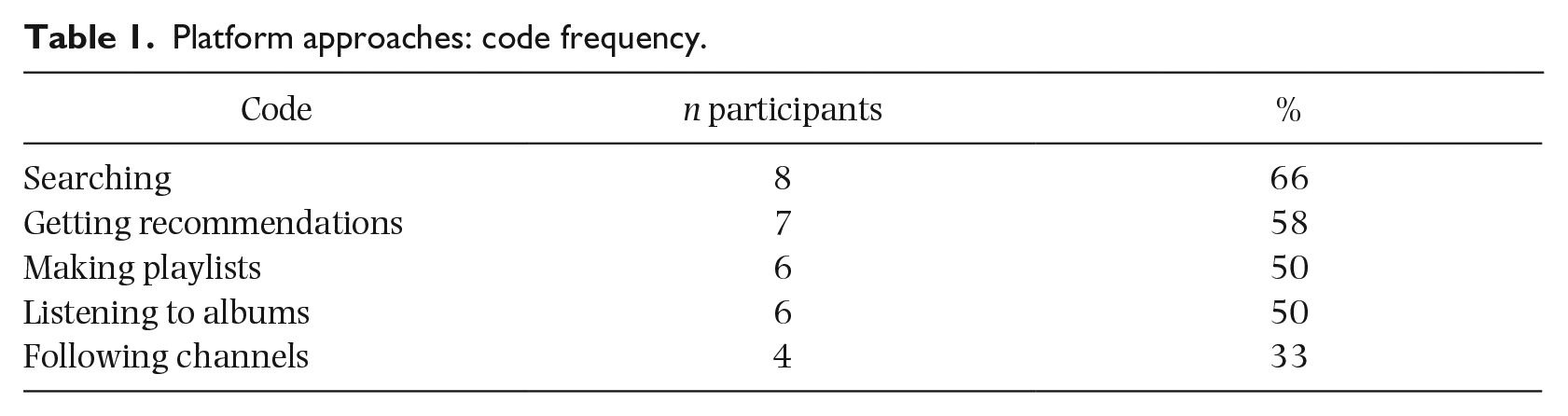
We observed that music technologies emerged as a natural focus in each of our conversations. In our initial coding, we were interested in understanding the specific roles technologies play in enabling daily listening habits. Rather than coding the platforms themselves, we chose to compare similar technological functions applied across a broad range of devices and apps. This was because many online-based platforms replicate functions of other more conventional music services. Apps like YouTube and Spotify, for example, offer streamed content through stations similar to broadcast radio. Therefore, the code “Following channels” was borrowed from the concept of following a media producer, and included this analogous function across all online, cloud-based, and AM/FM platforms. Our cohort explicitly described using five primary functions for discovery and organization, represented in Table 1 and Figure 1.
Platform approaches: code frequency.
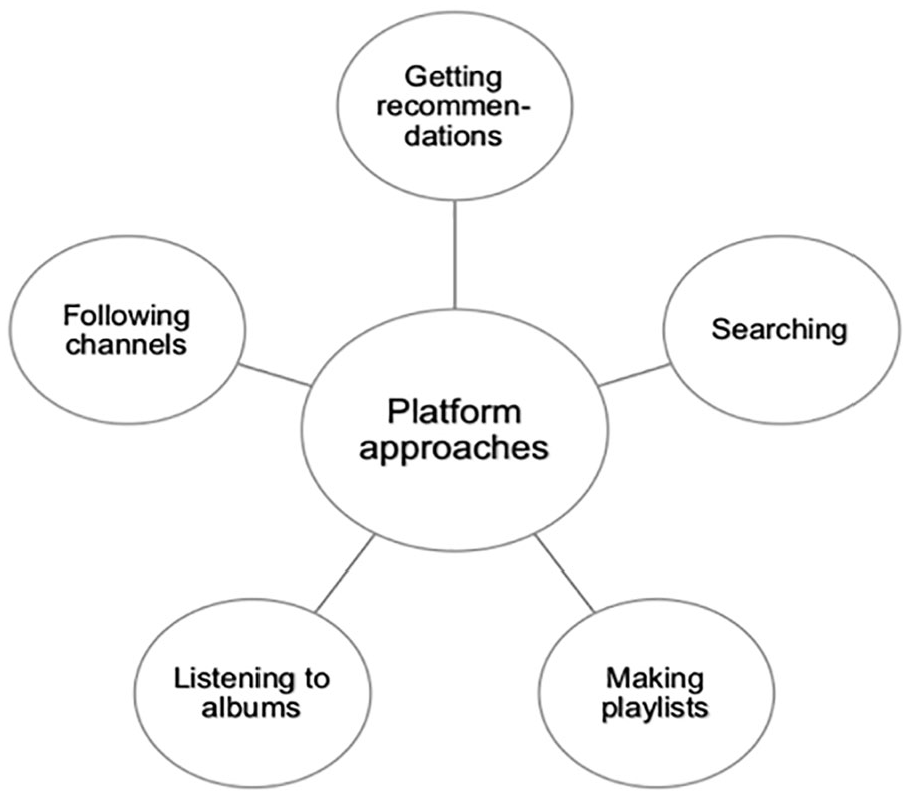
Platform Approaches Code Web.
Searching
Searching was the most commonly described platform capability, with mentions by eight participants (66%). In all cases, the act of searching for specific songs or artists evoked a kind of following up with an interest, like looking up a song that they heard on the radio. Response variation included general internet searches, as well as looking for music on various platforms like CDs, Spotify, YouTube, and Soundcloud: I started noticing in other games that I played, “oh, I kinda like the music from this thing, maybe I’ll look into getting the soundtrack for it so I can just listen to it whenever I want.” And I just started a pattern and I just kept doing it. (John) This one time I was looking up music, since I found a folk-metal radio station . . . I had a list of all these different folk-metal artists and I decided to look up certain songs, cause I liked those. (Ethan)
Getting recommendations
Seven participants (58%) described using a range of platforms to get recommendations for new music. The code title was drawn from Spotify’s Recommendations services and accurately evoked the overall nature of this discovery activity described across all platforms. In addition to Spotify, participants also mentioned watching YouTube sidebar suggestions, browsing Soundcloud artist tags and reading online forums. In all cases, music was suggested to the participant through platform-specific mechanisms. The two participants who mentioned online forums both recalled browsing topics of special interest to them. Isaac, for example, who enjoys humor and “kitschy stuff,” said, “You never know what I’ll discover. I actually own three albums as a result of going on a forum and hearing people share what they thought were the worst songs they’d ever heard”: Sometimes I’ll go on YouTube and I’ll find a song I recognize and it’s like, I wonder what this song is that’s on the sidebar, and I listen to it . . . Sometimes I’ll know in a pretty short time if I like a song or not. (Nolan)
Making playlists
Six participants (50%) said that they make playlists, often as a means of easy access to their favorite artists or genres. Four of those participants described making “miscellaneous” playlists of their most listened to songs: And then I have another playlist that just has a bunch of miscellaneous, like fun songs to sing along to. Stuff like old 80s stuff, “Toxic” by Britney Spears, a couple songs from Disney movies. Just generally stuff like that. (Patrick) I do have a playlist that I just put songs in that I really like. (Robert)
Listening to albums
Six participants (50%) also mentioned complete albums as an essential component of their music-listening experiences. Most often, participants brought up albums to comment on their favorite artists. Fred, for example, mentioned listening to a recent album by the Gorillaz, which he appreciates for their musical diversity. John said that he discovered metal by listening to albums by groups like Rammstein, whose records are “infrequent,” but “normally pretty good when they do come out with them.” Meanwhile, Kyle talked at length about the diverse range of rock and metal concept albums, understood as musical statements: I like listening to full albums now a lot, which is different than I used to. Now that I have the ability to do so cheaply with Spotify. It’s a lot more interesting to see what they try to do with the full album. (Kyle)
Both Kyle and Katherine mentioned listening to albums for their stories. Katherine, who enjoys listening to and attending musicals, said “it’s like the whole story, almost. It seems incomplete if you just listen to them on shuffle”:
Following channels
Four participants (33%) explicitly mentioned “Following channels.” For each respondent, following specific media producers appeared to be a means of reliable access to preferred music, as well as a way of differentiating between genre subsets. John, for example, described following two YouTube producers. “One is maybe more techno-oriented remixes of songs. And the other one has been doing more symphonic metal remixes of songs.” Similarly, Nolan described his favorite radio stations according to the kind of Christian music they play. “I often listen to some of the contemporary church music, like Air1 and KLove. And I occasionally listen to more traditional stuff like FamilyRadio sometimes”:
Activities
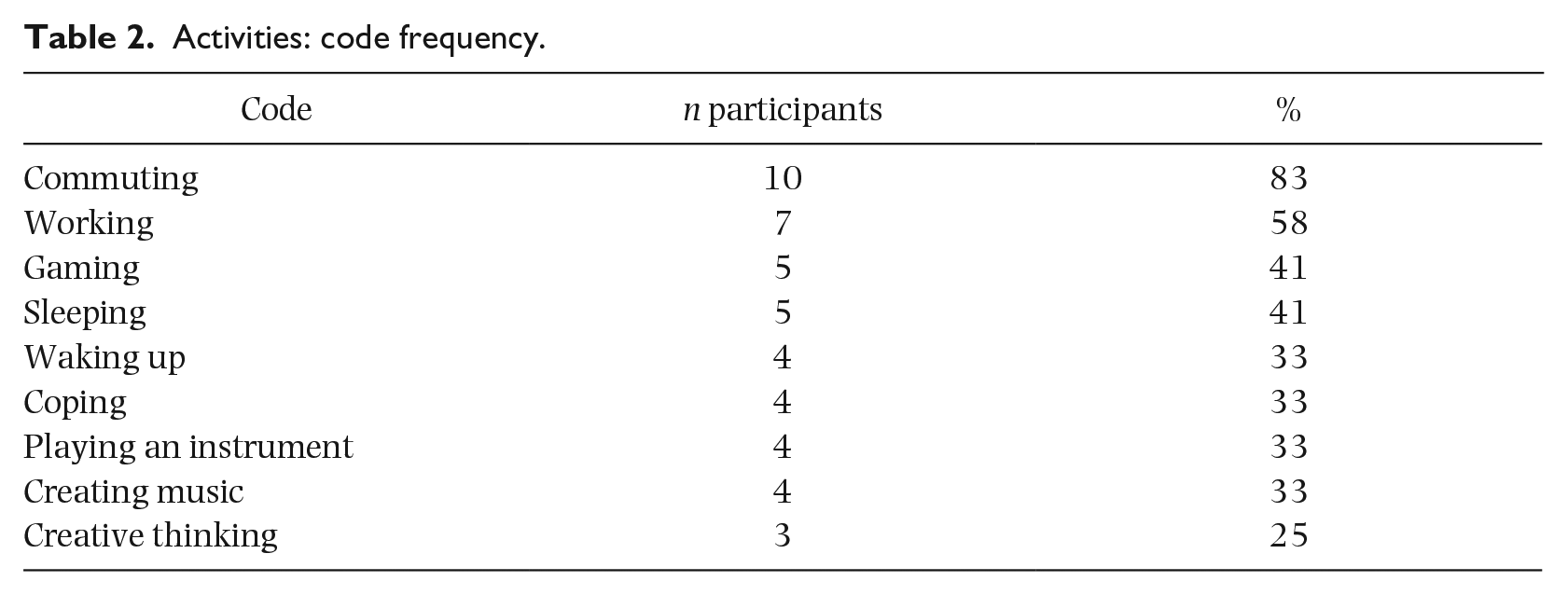
Our cohort used music to accompany a range of work-related and leisure activities shown in Table 2 and Figure 2. They are grouped here thematically for comparative purposes.
Activities: code frequency.
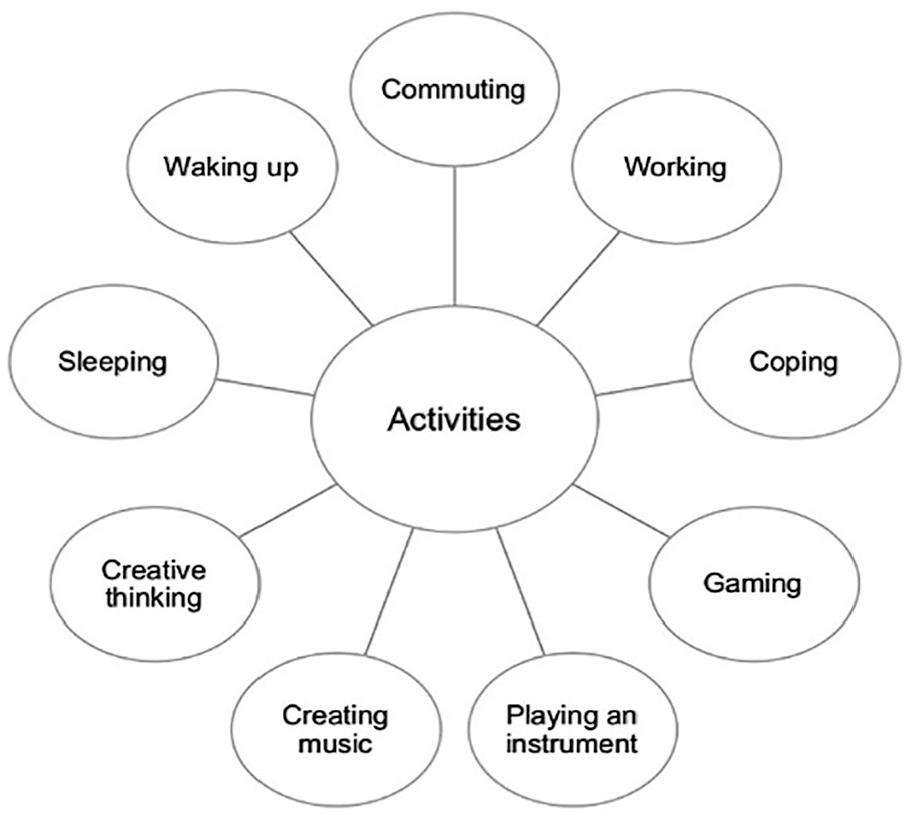
Activities Code Web.
Waking up and sleeping
We asked participants explicitly about the beginnings and endings of their daily routine. Four participants (33%) described listening to music to “help” them get ready in the morning. Meanwhile, five (41%) reported using some sort of aid to help them fall asleep. Only two participants actually reported listening to music before bed. The three others mentioned listening to non-musical sounds while falling asleep: horror story narrations, brown noise, and TV shows.
Commuting
Nearly all participants, 10 total (83%), reported listening to music on their daily commute to work. All four of those who regularly take public transportation described listening to music for the entire duration of the commute.
Of the seven participants who drove themselves, six (50%) reported listening to music in the car. They described using the car stereo system for a range of purposes. Three reported using music to help them kill boredom. For example, Charles said, “Usually when I go to work, I turn on the radio. Usually gets through traffic.” For others, the car was a site of musical discovery and self-DJing. Kyle, who has satellite radio in his car, explained that Sirius XM’s “very targeted” channels played a role in his “slow progression” getting into metal, and continues to be a daily source of music. Meanwhile, Isaac uses his car radio to find exactly what he wants to hear: In my car, just about all bets are off. I just flip through channels finding stuff I like and stopping on that. When it comes to a commercial I usually start flipping again. (Isaac)
Working
We also asked participants explicitly about their listening habits at the lab. Seven total participants (58%) described using music to help them work. For six of those, music helped them to focus and to balance their mental space: “It’s almost like I’m using only a percentage of my brain power.” (Matthew) “Sometimes I put the music on and it’s way easier to focus on work, you know?” (Dylan) Two participants who listen to music for focus, also mentioned using music to boost their energy: [At] work I usually, since we do a lot of stuff independently here, I listen to music just cause it helps to keep my energy up. (Matthew)
Meanwhile, four participants also described using music to block out environmental noise or distract from internal thoughts: I’ll hear the stuff of other people shuffling down the hall or in the room next door and it can be distracting. But if it’s blotted out just by ambient music, I’ll be less likely to notice it at least. (John)
Katherine described a combination of all three: It helps me focus. Also, it maybe gives me a little bit of stimulation. It’s weird I kinda sometimes need some stimulation to be able to focus. It’s kinda weird. Some people, like they need absolute quiet. But if it’s absolutely quiet, it’s hard for me to focus. It’s kind of like this balance in between.
Coping
Four participants (33%) mentioned using music as a tool for coping. In this code, we included descriptions of emotional healing and stress management since both involved using music as a therapeutic tool. In all cases, participants expressed being self-aware of their feelings and using music to improve their internal state: Sometimes I listen to that kind of music when I’m upset . . . And the themes of some of it is just terrible things that happen to people or whatever and it’s good to help vent out . . . It can be cathartic. (Patrick) I do have anxiety problems . . . It just takes some of the stress off. It makes you feel like you don’t have to worry as much. (Matthew)
Gaming
Five participants (41%) described listening to music to accompany playing video games. Most often, responses pertained to discovering music within video games, as well as searching for and downloading soundtracks. Ethan explained how music is an integral part of the gaming experience: Good video game music can stand on its own . . . but added with good gameplay and stuff like that, and it turns a good game into an absolutely memorable one for me. (Ethan) (Robert)
Playing an instrument
Four participants (33%) mentioned playing an instrument, usually only dabbling at home. Nolan, for example, talked at length about the sound qualities of various pianos, including the three his family owns. He said his piano playing is inconsistent. “Sometimes I play a lot. Sometimes I might not touch a piano for a week or a month.” Two other participants described taking lessons for a short period of time as a teenager, before cutting off their pursuits. “I tried to learn guitar and didn’t have a very good teacher, so I just learned ‘Taps’ and never went too far with that.” (Isaac)
Creating music
Four participants (33%) explicitly described wanting to be involved somehow in the creation of music in a way that did not involve singing or playing an instrument. For example, Katherine expressed interest in joining a musical theater group in college, doing tech work or building sets. Having expressed a passion for musicals, she said, “I’ve kinda always been a spectator for it, but it’d be interesting to participate in it to see what it’s like, you know?” Isaac said that he writes “avant-garde rap songs” that “poke fun at the whole rapper image and make fun of other aspects of culture as well.” Meanwhile, Dylan who said he has “always been interested in making music” recalled using production software like Logic for his own creative projects. Ethan also writes his own music using computer synthesizers and Sibelius, a notation software program.
Creative thinking
Meanwhile, three participants (25%) made unambiguous references to using music to inspire creative thinking. For example, Fred described his dream video game, in which certain levels were inspired by specific pieces of music. He said that he likes to listen to music “to make creative thoughts happen.” John meanwhile described using music as a “brainstorming tool” for coming up with narrative solutions for tabletop games he plays with his friends: If I’m thinking about something creatively, I found that listening to music can help me . . . I’ll think my thoughts. I’ll move along with the music in my head and then it helps me come to a conclusion maybe I wouldn’t have come to otherwise. (John)
Genres
In an early round of coding, we selected for mentions of preferred musical genres. Table 3 shows that Rock and Metal were the most popular musical genres in our cohort. We chose to code these two together because most mentions of either were grouped in context. However, several participants made nuanced distinctions between the two. At least half of the cohort also mentioned “Pop,” “Soundtracks,” and “Decades” music. Meanwhile, the three least popular genres with only one mention each were “Christian,” “Jazz,” and “Live music.”
Genres: code frequency.

Common among nearly all of the interviews was an effort to define and to describe tastes. This often led to detailed discussions of subgenres and nuances within styles. As mentioned, “Following channels” and “Listening to albums” were methods of distinguishing between these types of genre preferences. However, sometimes these musical identifications stood on their own: I just like old school metal more than I like newer stuff . . . I can handle a bit of the screaming with the screamo . . . I do like some Megadeath and stuff . . . (Kevin) A lot of Soundcloud rap, you know, Smokepurpp, Lil Pump, SHORELINE MAFIA, that kinda stuff. I like more EDM stuff. I like dubstep, trap, Kpop sometimes. (Dylan) Lots of free jazz I find I don’t necessarily care for. Still might listen to that stuff though . . . free jazz is almost like the ultimate challenge musically . . . it’s like synchronized car racing or something. (Ethan)
Discussion
Sociological research has explored how TD populations use music in daily life, specifically as a resource for personal and social agency. While experimental studies have addressed topics of music perception in autistic children and adults, only one study to date has applied a qualitative methodology toward understanding the kinds of roles music plays in the everyday lives of autistic individuals (Allen et al., 2009). Coding for “motivations” for listening to music and “characteristics” of preferred music, they found that participants used music for mood management, aesthetic pleasure, and social belonging.
This study aimed to extend this line of inquiry by exploring daily listening activities among a cohort of autistic creatives and programmers at UCSD’s RADLab. Where Allen et al. (2009) coded for qualitative descriptions of musical properties, such as external characteristics and internal affects on the listener, our thematic analysis focused entirely on discrete actions mentioned by participants. As anticipated, personal uses of music technologies featured prominently in our interviews. Routine daily activities, such as commuting and working, were the most frequently mentioned as being accompanied by music, followed by using music in creative contexts.
Intentional engagement with technology
Our cohort demonstrated a range of personal approaches to using their preferred media platforms. Specifically, we were able to group responses into five major code categories of explicitly described technological uses: “Searching,” “Getting recommendations,” “Making playlists,” “Listening to albums,” and “Following channels.” These findings are in line with the complex patterns of engagement by TD individuals made possible by new music-listening technologies (Krause et al., 2015). Mirroring these results, our convenience sample actively engaged with the discrete choices afforded by music technologies. For example, more than half of our cohort used platforms like YouTube, Spotify, and Sirius XM radio explicitly for “Getting recommendations” and “Searching.” Results in these categories indicate clear patterns of behavior directed toward proactive and intentional engagement with music discovery. Half of our participants also reported “Making playlists” based on artists, genres, and miscellaneous favorites. Personal use of this organization tool demonstrated yet another axis of decision-making embedded within music devices.
The presence of “Albums” as its own method of consumption is noteworthy. Participants in our study referenced albums to comment on artists and trends and to exemplify their musical taste. As a unified musical product, albums therefore afforded participants one specific way to describe their criteria for preferences and decision-making. Two participants also said that they listen to albums in their entirety for their storyline and the narrative experience. Like listening to albums, the four participants who described “Following channels,” did so to make clear distinctions with regard to their preferred subgenres. This shows that some autistic adults use albums and music stations to self-curate their daily listening based on specific genre criteria.
The significant volume of responses in the “Platform approaches” codes suggests that our cohort overall makes full use of these music platform functions in their everyday lives. However, many of these actions like making playlists or listening to the radio may easily be taken for granted. We speculate that music technologies may offer even deeper affordances in daily life, such as defining sonic boundaries at home or attending to sensorial needs in personal spaces. Further research is needed to understand how autistic individuals use music for environmental control.
Music as a resource
Results in “Activities” agree with the broader understanding that people consciously use music as a resource in daily life (DeNora, 2000; North et al., 2004). The two most mentioned tasks accompanied by music were “Commuting” and “Working.” In their reasons for having or not having music in these scenarios, our cohort demonstrated awareness of environmental needs necessary for accomplishing these tasks. Characterizations of music’s impact on work productivity included helping to focus, staying energized, and isolating unwanted noise. The fact that commuting and working were inherent to the structure of their daily routines as interns was a unique aspect of our convenience sample. Since each participant commuted to work, we were able to ask them specifically about their habits with regard to these tasks.
The mention of using music to manage stress and emotions (“Coping”) is significant and demonstrates an additional internal awareness of personal needs. It also confirms previous findings by Allen et al. (2009) that autistic individuals use music for its therapeutic benefits. However, given the framework of our analysis, we are unable to comment on their corollary finding that autistic individuals favored using arousal states over valence terms to describe internal responses to music, possibly due to the presence of alexithymia (Allen et al., 2013; Allen et al., 2009). Our interview guide and coding scheme selected for discrete actions with music, rather than motivations for listening to it. Therefore, it is possible that if we had probed and analyzed for responsiveness, our cohort may have demonstrated a similar tendency. We do, however, interpret the presence of “Coping” as having some indication of an awareness of music’s mood-altering potential. Without having screened for participants for alexithymia, we cannot correlate these responses to severity of symptoms.
One of our most interesting findings concerned the use of music in creative contexts. “Creating music” and “Creative thinking” responses made up 50% of our sample and represented a spectrum of clear outcomes. These ranged from composing/producing music, writing rap lyrics, participating in stage production, designing video games, and making up tabletop game stories. Music-related activities like these extend previous findings that key motivations for listening to music among a sample of autistic individuals included “aesthetic pleasure,” a positive internal response to certain musical qualities (Allen et al., 2009). In the case of our cohort, musical appreciation included a desire for proactive and creative engagement with music. Given that participants in our convenience sample worked in a technology-based creative field, we speculate that they already saw themselves as creative agents. Overall, we interpret these data as suggesting a strong connection between music-listening and the activities and priorities most relevant to an individual’s present everyday life.
These findings also have important implications for therapeutic design, specifically in light of the observed benefits of creative media collaboration by autistic individuals (Hillier et al., 2012). The presence of self-motivated creative engagement with music and music technologies in our study suggests continued potential for non-performance-based music therapies.
It has been demonstrated that autistic individuals use music to feel a sense of social connection and belonging (Allen et al., 2009). In this study, social activities and attitudes toward others were occasionally brought up in the interviews, but were not the primary subject of our analysis. One participant, for example, explicitly described wanting to be a part of a creative team that produces musicals. Since this was our only explicit mention of social belonging, we chose instead to compare it to other examples of “Creating music.” On a few occasions, participants shared rich descriptions of listening to music with family and friends, especially as it concerned boundaries, memories, and differences in taste. Thus, our focus on daily routine in the interviews lent itself most naturally to an analysis in terms of these sorts of activities accompanied or inspired by music.
Genres
Similar to findings by Hillier et al. (2016), our cohort of young adults demonstrated a clear preference for various popular music genres, as opposed to classical music. Due to the small sample size, we are limited in our ability to generalize these data to other autistic populations. Instead, we note that the presence of a range of musical styles within our cohort is indicative of their ability overall to specify and articulate the nuances of their musical preferences.
We speculate that music-listening platforms play a role in teaching its users new genre-related vocabularies and how to engage with them. For our cohort, favorite channels and albums were reliable sources for preferred music, as well as discursive tools for expressing their tastes in the interviews. Future work in autism and music technology may explore the impacts of reflexive learning through technology, and how it is used independently by autistic individuals to construct taste.
Reliability, generalizability, and comparison groups
Since we were unable to double code in the final round of coding, we cannot provide intercoder reliability with respect to our ultimate results. However, the extensive process of interpreting the data through discussion and generating categories, which did include blind double coding, was recursive and exhaustive and followed standard procedures for qualitative analysis. The fact that we were also unable to conduct follow-up interviews limited the degree to which our analysis could be confirmed or expanded.
In addition, the relatively small sample size and gender imbalance limits the degree to which our findings can be generalized to other autistic adults. Nonetheless, the makeup of our convenience sample being video game designers allowed us to examine the specific use of music for creative inspiration. Further research is needed to understand how other life-stage and occupational factors manifest in one’s daily choices of music.
The use of a comparison group in a future study would enable inquiry into differences and similarities between ASD and TD groups with respect to listening patterns. Since these behaviors appear to be closely tied to many aspects of daily routine, a study would also benefit from selecting inclusion criteria based on controlled sociological factors. For example, the daily lives of ASD and TD college commuter students might provide a rich framework for comparison. Of interest would be specific of outcomes with music relevant to student life and how they are achieved using music-listening technologies. For our cohort, exploring and selecting preferred musical genre was an important motivational factor when engaging with music technologies. A comparison group would further enable exploration of how taste and musical identity influence platform approaches across ASD and TD groups.
Conclusion
Music featured prominently in the daily lives of a convenience sample of autistic creatives and programmers. Our study extends previous qualitative research on music and autism (Allen et al., 2009) by showing that autistic individuals make full use of various functions afforded by music-listening technologies. These personalized approaches enabled flexible regulation of music discovery, organization, and self-curation. The nature of these relationships to music and new technologies is an open space for continued research.
Our cohort reported using music to accompany a variety of daily activities, including cognitive and emotional work. In so doing, participants demonstrated nuanced internal self-awareness with regard to music-listening and its effects. The use of music for creative engagement, including participating in the creation of music and thinking creatively, is perhaps a distinctive feature of our convenience sample of video game design interns. Further ethnographic research may shed light on how the particulars of adult life shape the kinds of relationships autistic individuals develop with music.
In total, our findings confirm that autistic adults use music and music technologies as a resource in daily life. This significantly aligns with our understanding of the use of music by TD individuals in a growing body of literature. Exploring the differences and similarities between ASD and TD groups will further clarify the nature of these behaviors and may continue to provide a new dimension for understanding autism in adulthood.
