



Abstract
Interest in the influence of musical training on executive functions (EFs) has been growing in recent years. However, the relationship between musical training and EFs remains unclear. By dividing EFs into inhibitory control, working memory, and cognitive flexibility, this study systematically examined its association with musical training in children, and further verified whether there was a sensitive period for the influence of music training on EFs. In Experiment 1, musically trained and untrained children were asked to complete the Go/No-go, Stroop, Continuous Performance, and Switching tasks. Results showed that musically trained children had an advantage in attention inhibition, response inhibition, and working memory, but not in cognitive flexibility. Moreover, the level of musical training was positively correlated with response inhibition and working memory abilities. In Experiment 2, results showed that early-trained musicians performed better on measures of attention inhibition, response inhibition, and working memory than did the age-matched control group, but late-trained musicians only performed better in attention inhibition. Thus, our findings suggest that music training is associated with enhanced EF abilities and provide the first evidence that early childhood is a sensitive period when musical training has a more powerful effect on the development of EFs.
Keywords
Executive functions (EFs, also called executive control or cognitive control) refer to a complex set of skills that allow us to regulate our thoughts and behavior (Diamond, 2013; Nancy, Bryson, & Smith, 2008). Typically, its core skills comprise inhibitory control, working memory, and cognitive flexibility (Diamond, 2013; Zelazo, Blair, & Willoughby, 2016). Childhood plays a critical role in the development of EFs (Diamond, 2016; Nancy et al., 2008). For example, previous studies have shown that EFs in childhood positively predict scholastic achievement, health, and well-being later in life (Diamond, 2016; Diamond & Lee, 2011; Nancy et al., 2008). It is, therefore, not surprising that plasticity of EFs in childhood has received great interest among researchers and educators alike (Diamond, 2012, 2016; Zelazo et al., 2016).
Previous studies have demonstrated that computerized training can improve EFs in childhood (Holmes, Gathercole, & Dunning, 2009; Johann & Karbach, 2018), but the benefits are limited to task-specific skills and typically cannot be transferred to unpracticed EF skills (Diamond & Lee, 2011). Although several studies support that physical exercise, mindfulness practices, and bilingual experience can promote the development of EFs (Carlson & Meltzoff, 2008; Xue, Yang, & Huang, 2019; Zelazo & Lyons, 2012), one limitation is that these trainings require motivation and endurance, making it difficult for young participants to stick with them (Okada & Slevc, 2017; Redick et al., 2013). Musical training, on the contrary, offers a useful framework for improving EFs in an engaging and entertaining way (Moreno et al., 2011; Saarikivi, Putkinen, Tervaniemi, & Huotilainen, 2016; Slevc, Davey, Buschkuehl, & Jaeggi, 2016). For example, playing instruments in a group requires one to inhibit interfering information (i.e., melodic and harmonic information generated by other musicians), update multiple components of a musical piece (i.e., musical notation, tone, and rhythm), and flexibly adjust the own play to match the group performance as a whole (Moradzadeh, 2014; Okada & Slevc, 2017; Slevc et al., 2016). Moreno and Farzan (2015) put forward a multidimensional model of the musical training effect, suggesting that musical training benefits EFs by recruiting similar cognitive processes and brain networks.
However, previous attempts to outline the influence of musical training on EFs (inhibitory control, working memory, and cognitive flexibility) in children yielded mixed results. For example, while some studies found that musically trained children outperformed untrained children on tasks requiring inhibitory control (Jaschke, Honing, & Scherder, 2018; Joret, Germeys, & Gidron, 2017), other studies reported no performance differences between these groups (Guo, Ohsawa, Suzuki, & Sekiyama, 2018; Zuk, Benjamin, Kenyon, & Gaab, 2014). Similarly, examining the effects of musical training on working memory performance (Herrero & Carriedo, 2018; Janus, Lee, Moreno, & Bialystok, 2016) and cognitive flexibility (Moradzadeh, 2014; Sachs, Kaplan, Sarkissian, & Habibi, 2017) yielded mixed findings. However, these inconsistencies might be ascribed to several reasons: First, only very few studies have investigated the effects of musical training on inhibitory control, working memory, and cognitive flexibility within the same study, allowing the effect of music training on each subcomponent to be compared (Sachs et al., 2017; Zuk et al., 2014). Second, these studies did not account for the interaction of musical training with the heightened plasticity during early sensitive periods. In a recent paper, Zuk and Gaab (2018) emphasized that the effects of music training are not only determined by practice alone, but are a product of the interaction between predisposition, environmental experiences, and training-induced plasticity. A particularly fascinating example of this interaction is the sensitive period before 7 years of age. Here, it has been shown that training before this age is more effective than training after this age (Penhune, 2011). For example, early-trained musicians (those who started musical training before the age of 7 years) outperformed late-trained musicians (those who started musical training after the age of 7) on tasks requiring rhythm synchronization and melody discrimination (Bailey & Penhune, 2010, 2013; Ireland, Iyer, & Penhune, 2019). However, it is not yet clear whether the advantage of musical training within this phase also leads to an enhancement of EFs.
Based on the abovementioned considerations, two studies were carried out to investigate the association between musical training and EFs. First, we aimed to investigate the effect musical training has on different subcomponents of EF within the same experiment (Experiment 1). Second, we aimed to verify whether there was a sensitive period for the influence of musical training on EFs—in other words, whether early training was more effective than late training (Experiment 2). In Experiment 1, we asked a group of musically trained and a group of musically untrained children to complete four classical EFs tasks (Go/No-go, Stroop, Continuous Performance Task [AX-CPT], and Task-Switching). Based on findings that support the effect of musical training on EF development, we hypothesized that musically trained children would demonstrate enhanced EFs compared with untrained children. In Experiment 2, we divided musically trained children into two groups: those who started music training before the age of 7 years (early-trained) and those who started training after the age of 7 years (late-trained). If the age at onset of training modulates the relationship between musical training and EFs, then the training effect would be stronger for early-trained musicians than for late-trained musicians.
Experiment 1
Method
Participants
A total of 151 children (7–13 years old) were recruited from public primary schools. The musically trained group comprised 75 children (31 boys), who played instruments (piano, violin, guitar, drums, flute, or Koto) or received vocal music training, and who had a minimum of 3 years of learning experience. The control group consisted of 76 children (30 boys), who had no musical experience beyond the regular school music lessons. Participants were screened to ensure that they met the following inclusion criteria: normal or corrected-to-normal vision, and no diagnosis of a learning or neurological disorder. Both groups were matched in age (10.15 vs. 9.76), t(149) = 1.64, p = .10, and socioeconomic status (2.11 vs. 2.31), t(149) = –1.69, p = .09. For each task, individual performance data were excluded from analysis if the mean was more than 2.5 SDs away from the grand mean. The same criterion was applied in Experiment 2. Both experiments received ethical approval from the Research Ethics Committee of the Hunan Normal University. All parents and children gave written, informed consent and received presents.
Procedure and analyses
To reduce effects of fatigue, the experiment was carried out across two sessions, 1 week apart. Each session contained two tasks and lasted about 40 min. Task sequence was counterbalanced within groups. After the second session of the experiment, children filled out the Goldsmith Musical Sophistication Index (Gold-MSI; Lin, Kopiez, Mullensiefen, & Wolf, 2019; Mullensiefan, Gingras, Musil, & Stewart, 2014).
During the Go/No-go task, children had to respond to a specific type of stimulus (white stimuli, Go-trials) by pressing a key, whereas they had to inhibit responding to another type of stimulus (purple stimuli, No-go trials). The task consisted of 160 trials presented in a random order (128 Go-trails and 32 No-go trials). Each stimulus was presented for 500 ms with a variable interstimulus interval (500–1,000 ms). Performance was evaluated using a signal detection approach by calculating perceptual sensitivity via d′ = z (No-go hit rate) − z (Go false alarm rate). Higher d′ values indicate better response inhibition.
In the Stroop task, children were presented with Chinese color-words (red, green, blue, and yellow) printed in different colors. Stimuli were divided into word-color consistent trails (congruent) and word-color inconsistent trails (incongruent). A stimulus was presented for 1,500 ms with a random interstimulus interval of 1,500–2,000 ms. Children had to name the color in which the word was presented without paying attention to the word’s meaning. The experiment consisted of 144 trials, presented in a random order. The differences between the congruent and incongruent conditions in accuracy and reaction time are referred to as Stroop interference effect. Smaller effects are indicative of better interference control.
The AX-CPT was used for examining working memory ability. In each trial, five letters were presented consecutively: first, a cue stimulus was presented for 800 ms, then three irrelevant letters were presented for 300 ms each, and finally, a target stimulus was presented for 1,000 ms (Figure 1). Children were asked to accurately respond to a target probe X, but only when it followed a specific valid cue A. A total of 150 trials were presented in random order. The goal of the AX-CPT was to distinguish proactive control and reactive control in working memory. The d′ score = z (AX hits) – z (BX false alarms) indicates the sensitivity of the clue information, with higher d′ scores representing better proactive control in working memory. The d′ score = z (AX hits) – z (AY false alarms) indicates the sensitivity of the response information, with higher d′ scores representing better reactive control in working memory.

Schematic Overview of the AX-CPT.
A task-switching paradigm was employed to investigate the ability of cognitive flexibility. In all blocks, the red or green numbers 1–9 (excluding the number 5) were presented, along with the task requirement (numerical or color task; Figure 2). In the numerical task, children were asked to press “F” for numbers smaller than 5 and “J” for numbers larger than 5. In the color task, children pressed “F” for green numbers and “J” for red numbers. Task requirements were switched randomly between trials, so all trials could be categorized into either switch or stay conditions. The experiment consisted of 182 trials, presented in a random order. The difference between accuracy on stay trials and switch trials was termed switch costs, and smaller switch costs indicate better switching performance.

The Outline of the Task-Switching Paradigm. (a) Stay Conditions and (b) Switch Conditions.
The level of musical training was assessed with the “music training” subscale in Gold-MSI (ranging from 1 to 7; Mullensiefan et al., 2014), with higher scores indicating higher levels of musical training. This questionnaire considers the duration and frequency with which one has taken music lessons into account, as well as the number of instruments played, thereby providing a comprehensive measure of musical training (Mullensiefan et al., 2014).
Results and discussion
Independent-samples t-tests were used to compare musically trained and untrained children on the four tasks. In the Go/No-go task, the music training group showed higher d′ scores than the untrained group, t(146) = 4.27, p < .001, Cohen’s d = 0.71 (Figure 3(a)). In the Stroop task, the interference effects in accuracy were smaller in the music training group than in the control group, t(146) = 2.61, p = .01, Cohen’s d = 0.43 (Figure 3(b)). However, the interference effects in reaction time were similar between these two groups, t(146) = 0.21, p = .83.
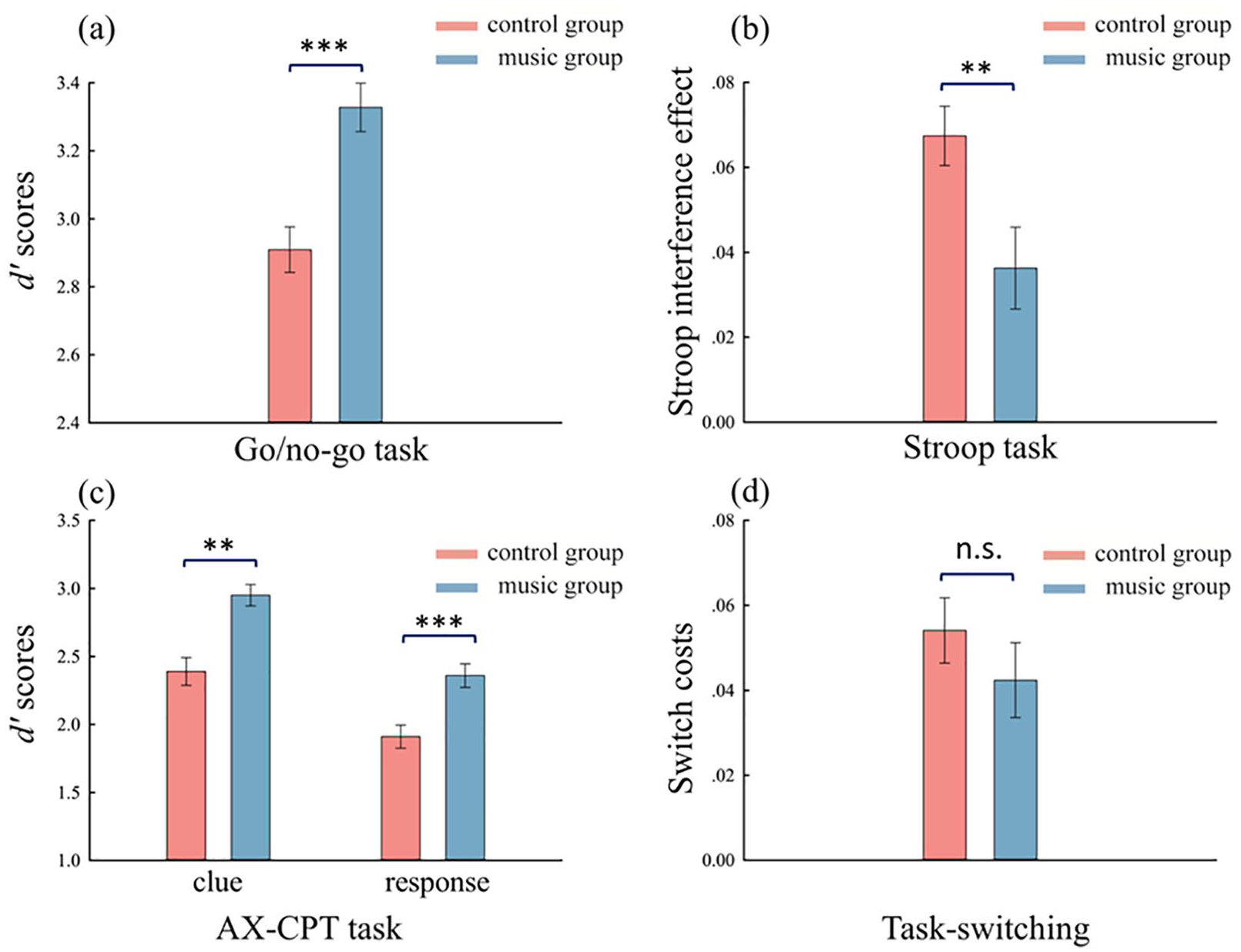
Mean Values for Music Group and Control Group in the four EF Tasks. (a) The d′ scores in the Go/No-go task (b) The Stroop interference effect in the Stroop task (c) The clue d′ and response d′ scores in the AX-CPT task (d) The switch costs in the task-switching paradigm. Error bars indicate the standard error of the mean.
In the AX-CPT task, the music training group outperformed the control group on both clue d′ scores, t(146) = 3.15, p = .002, Cohen’s d = 0.51, and response d′ scores, t(146) = 3.80, p < .001, Cohen’s d = 0.64 (Figure 3(c)). Finally, in the task-switching paradigm, the two groups did not significantly differ on switch costs, t(146) = 1.00, p = .32 (Figure 3(d)). Overall, the music group outperformed the control group on three tasks (see Table 1).
Mean scores (M) and standard deviations (SD) of EF measures in both groups.

SD: standard deviation; AX-CPT: continuous performance task; EF: executive function.
p < .05; **p < .01; ***p < .001.
To assess the relationship between EFs and musical training, we calculated Pearson’s correlations between EF task performances and standard musical training scores in the music group. The correlation coefficient was corrected with the false discovery rate. We found that standard musical training scores were positively correlated with the Go/No-go d′ and AX-CPT clue d′ scores (Figure 4). However, training scores were not associated with performance on other tasks.
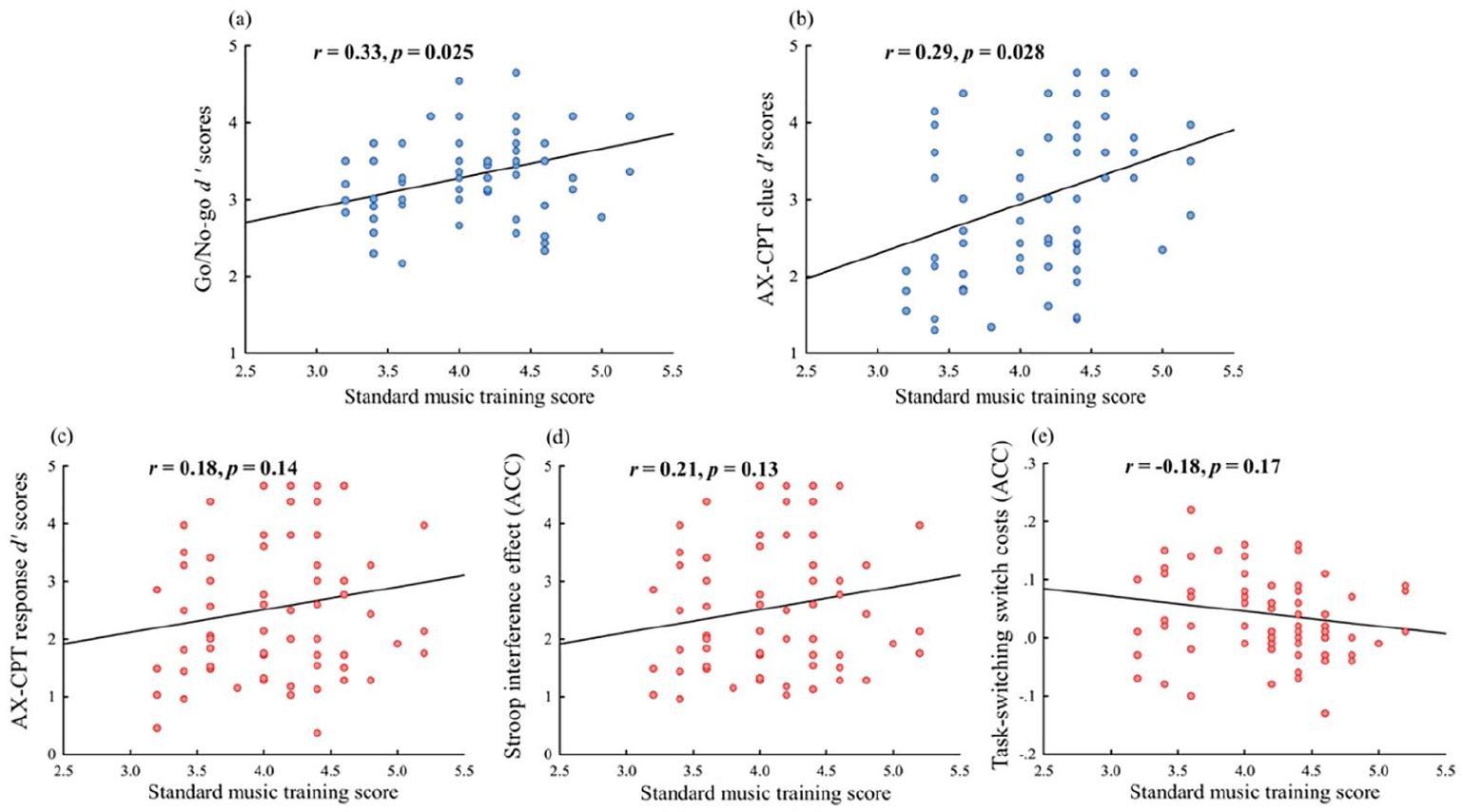
Scatter plots with correlation analysis between the standard musical training score and performances in the (a) Go/No-go task (b) AX-CPT task (clue d′ scores) (c) AX-CPT task (response d′ scores) (d) Stroop task and (e) Task-switching paradigm.
In addition, we proposed that the effect of musical training is influenced by the age at training onset, suggesting that the facilitation effect of musical training is stronger during a sensitive period in early childhood. To test this idea directly, Experiment 2 examines the effect of early and late musical training on EF development.
Experiment 2
Method
Participants
The music training group (7–13 years old) consisted of 81 children who were divided into two groups: early-trained musicians, who started music training before the age of 7 years, and late-trained musicians, who began their studies after the age of 7 years. While there was a significant difference between the groups in the age at onset of musical training (6.44 vs. 9.24), t(79) = –14.30, p < .001, they did not differ in the level of musical training (2.82 vs. 2.83), t(79) = –0.12, p = .91. Meanwhile, two age-matched control groups were recruited. The early-trained music group (n = 32, 13 boys) and Control 1 (n = 33, 22 boys) did not differ in age (8.45 vs. 8.31), t(63) = 0.68, p = .50, nor in socioeconomic status (2.58 vs. 2.50), t(63) = 0.49, p = .62. Similarly, the late-trained music group (n = 49, 23 boys) did not differ from Control 2 (n = 49, 33 boys) in age (11.14 vs. 11.10), t(96) = 0.22, p = .83, nor in socioeconomic status (2.31 vs. 2.51), t(96) = –1.78, p = .08.
Procedure and statistics
The experimental procedures and instructions were the same as in Experiment 1. In contrast, here the musically trained children were divided into early-trained and late-trained groups, and compared against age-matched control groups that did not receive any musical training.
A two-way analysis of variance (ANOVA) was conducted on d′ scores in the Go/No-go and AX-CPT tasks with group (music vs. control) and age at training onset (early vs. late age) as between-subject factors. In the Stroop and task-switching tasks, a three-way mixed-design ANOVA on accuracy and response time was conducted with condition (congruent vs. incongruent in the Stroop task, and stay vs. switch in the task-switching task) as a within-subject factor, and group (music vs. control) and age (early vs. late age) as between-subject factors.
Results and discussion
Executive functioning results
In the Go/No-go task, there was a two-way interaction, F(1, 154) = 6.52, p = .012,
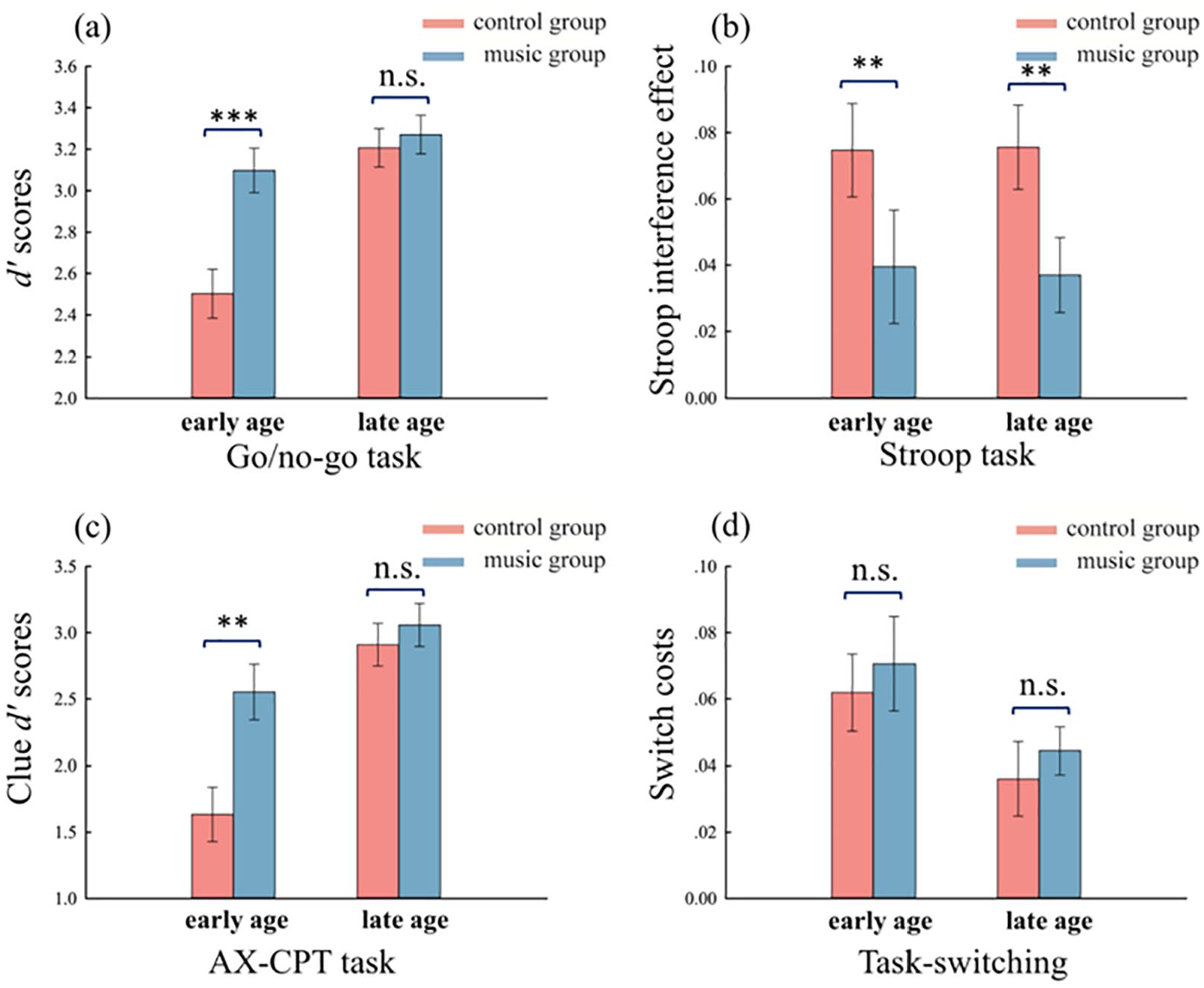
Mean Values for the Music (ET and LT) and Control Groups in theof the Four EF Tasks. (a) Go/No-go task (b) Stroop task (c) AX-CPT task and (d) Ttask-switching paradigm. Error bars indicate the standard error of the mean.
In the Stroop task, a three-way ANOVA was conducted on performance accuracy, revealing significant main effects of condition, F(1, 154) = 66.91, p < .001,
In the AX-CPT paradigm, the results on clue d′ scores revealed significant main effects of group, F(1, 154) = 8.37, p = .004,
In the task-switching paradigm, the three-way ANOVA revealed significant main effects of condition, F(1, 154) = 92.39, p < .001,
General discussion
The relationship between musical training and EFs
This study aimed to delineate the effects of musical training on inhibitory control, working memory, and cognitive flexibility in children. Our results indicated that children who received music training showed enhanced performance on several aspects of inhibitory control (response inhibition, interference control) and working memory (proactive and reactive control). These findings resonate with previous work suggesting that musical training promotes these EFs both in children and in adults (George & Coch, 2011; Herrero & Carriedo, 2018; Moreno et al., 2011; Moreno, Wodniecka, Tays, Alain, & Bialystok, 2014; Pallesen et al., 2010). Possible mechanisms through which music training may facilitate them is through enhanced involvement of top-down suppression of irrelevant information, as well as working memory updating, which are typically required when playing an instrument (Okada & Slevc, 2017). For instance, reading of musical notation requires learners to constantly update which notes have been played and which will be played next (Slevc et al., 2016). Furthermore, in a music ensemble, musicians need to focus on their own part and ignore distracting harmonics played by the others (Joret et al., 2017).
Unlike previous studies, this study differentiated between two subcomponents of inhibitory control (response inhibition and interference control) and two subcomponents of working memory (proactive control and reactive control). Interestingly, we observed that only response inhibition and proactive control, but not interference control or reactive control, correlated with music training experience. This is probably because these EF skills involve different levels of cognitive processing (Friedman & Miyake, 2004), and musical training may show different effects on these EF components.
Our results further showed that task-switching ability did not differ between children who received music training and those who did not, suggesting that the malleability of cognitive flexibility through music training in children is weak. These results are consistent with previous studies showing that musically trained children aged 8–12 years do not show superior cognitive flexibility (Sachs et al., 2017; Schellenberg, 2011). Notably, reports on the beneficial effects of music training on task-switching abilities largely stem from studies on young adolescents (9–15 years; Saarikivi et al., 2016) or adults (Moradzadeh, 2014; Moradzadeh, Blumenthal, & Wiseheart, 2015). In fact, cognitive flexibility has been reported to have a slower developmental trajectory compared with other, more basic EFs, such as response inhibition and working memory (Garon, Bryson, & Smith, 2008), with 13-year olds still not having reached adult-like performance levels (Davidson, Amso, Anderson, & Diamond, 2006). Thus, the facilitative effect of musical training on cognitive flexibility may only manifest later in development and is therefore more clearly observed in adolescence and adulthood (Saarikivi et al., 2016).
The role of musical training onset
This study further aimed to verify whether there was a sensitive period for the influence of musical training on EFs, evidenced by early training being more effective than late training. Our results showed that music training before the age of 7 years led to advantages in response inhibition, interference control, and working memory, whereas music training after the age of 7 years only resulted in enhanced interference control. These results support the hypothesis of a sensitive period, during which early music training is more effective in promoting some EFs than later training. It has been shown that EFs undergo significant and rapid developments in early childhood, and the malleability of EFs ought to be great in early childhood (Carlson, Zelazo, & Faja, 2013; Diamond, 2013). Thus, it is not surprising that early cognitive training would lead to greater and widespread transfer of training effects on EFs such as attentional control and working memory than later training (see review Melby-Lervåg & Hulme, 2013; Wass, Scerif, & Johnson, 2012). For example, a short EF training on preschoolers could improve their performance on working memory and inhibitory control tasks sharing few surface features with the trained tasks, and this training effect remained significant even 3 months later (Blakey & Carroll, 2015). Musical training is considered to be an effective EF training paradigm since it is a multifaceted activity and involves multiple cognitive processes such as inhibitory control and working memory (Okada & Slevc, 2017). Thus, similar to early cognitive training, our findings suggest that early music training also leads to widespread transfer effect during the period of rapid EF development.
Although sensitive periods are reflected in behavior, they are typically considered to be a property of neural circuits and neuroplasticity (Knudsen, 2004; Richardson & Thomas, 2008). The emergence of a sensitive period may be due to the interaction between specific experience and the maturational trajectories of related brain networks (Bailey & Penhune, 2013). It has further been suggested that training-based interventions for young children may lead to extensive changes in EF-related neural networks, which in turn affect task performance (Wass, 2015; Wass et al., 2012). Hudziak et al. (2014) suggested that early exposure to music training was associated with more rapid cortical thickness development in dorsolateral prefrontal cortex, a brain region crucial for EFs. In addition, the anterior corpus callosum, which connects the prefrontal cortices of the two hemispheres, has been also found to be larger in musicians who began their training before the age of 7 years than those who began their training later (Schlaug, Jancke, Huang, Staiger, & Steinmetz, 1995). The corpus callosum is the major fiber tract connecting the two hemispheres and undergoes significant maturational changes between the age of 6 and 8 years (Westerhausen et al., 2011), when our early-trained group began their musical training. Larger corpus callosum size and greater connectivity reflect higher efficiency of interhemispheric communication (Schlaug et al., 1995; Steele, Bailey, Zatorre, & Penhune, 2013) and have been shown to be predictive of executive functioning (Bettcher et al., 2016; Kok et al., 2014; Marco et al., 2012; Zhao et al., 2020). Thus, during the period of rapid brain development, musical training may better promote structural and functional changes in EF-related brain regions, resulting in enhanced EFs. However, future neuroimaging studies should directly examine how developmental and experience-dependent changes in brain structure and function regulate the relationship between early musical training and the development of EFs.
The time points of peak development differ between EF components, with changes taking place between early childhood and early adulthood (Diamond, 2013; Zelazo & Carlson, 2012). For instance, response inhibition develops more rapidly between 5 and 8 years of age (Best & Miller, 2010; Romine & Reynolds, 2005), whereas working memory growth curves are steeper at 7–9 years compared to 10–12 years (Lensing & Elsner, 2018). However, while it is difficult for young children to suppress interfering information, the key development period for interference control takes place later in childhood (6–13 years; Davidson et al., 2006; Roy et al., 2018). This prolonged developmental progression may contribute to the fact that early music training in this study did not have a stronger effect on interference control than later training.
The present study sheds new light on the relationship between musical training and EFs. In general, children with musical training exhibit better EFs than those without training. The most notable contribution is that musical training has a sensitive period in which early musical training may yield better EFs than late training. To the best of our knowledge, this is the first study to directly examine the relationship between the age of music training onset and EFs. This not only points out the important role of age of onset in musical training but also provides empirical support for tailoring effective musical training approaches to maximize the benefits brought about by the plasticity of the human brain.
Footnotes
Data availability statement
The data that support the findings of this study are available from the corresponding author upon reasonable request.
Funding
The author(s) disclosed receipt of the following financial support for the research, authorship, and/or publication of this article: This research was supported by National Natural Science Foundation of China (NSFC31771240), Hunan Provincial Fund for Philosophy and Social Sciences (15YBA263), Foundation of Education Department of Hunan Province of China (18A036), and Hunan Provincial Innovation Foundation for Postgraduate (CX2018B274).
