




Abstract
The purpose of this study was to examine the extent to which children’s executive function predicted their reading comprehension performance. Participants were approximately 18,000 kindergartners in the Early Childhood Longitudinal Study, Kindergarten Class of 2010–2011. The results suggest that individual differences in reading comprehension were influenced by variations in executive function. Cognitive flexibility, inhibitory control, and working memory all accounted for unique variance in reading comprehension. Language comprehension and fluency mediated the relations between children’s executive function and their reading comprehension. Working memory accounted for the highest total effect among the three core aspects of executive function. Children’s first-grade language comprehension contributed the most indirect effect, while fluency had the reading comprehension. The importance of considering ways to improve executive function, language comprehension, and fluency when implementing reading instruction and what the parents can do to help their children’s executive function and reading skills are discussed.
Keywords
Introduction
In 2017, the percentages of students who performed at or above the proficient level were 37 percent, and 36 percent for the fourth and eighth grade, respectively, in the Nation’s Report Card (U.S. Department of Education, 2018). Reading comprehension is one of the critical components necessary to succeed in education and employment, and to achieve satisfactory life outcomes. Parents, educators, researchers, policymakers, and others all have a role in helping students learn to read well. Numerous factors have been proven to be responsible for individual differences in reading comprehension, such as word reading, inferences, strategies, vocabulary, and background knowledge. Furthermore, researchers in the fields of education, developmental sciences, cognitive neuroscience, and others have studied executive function (EF) in a wide variety of paradigms in an attempt to improve our understanding of learning (Zelazo et al., 2016), and in the hope to increase reading achievement.
What is Executive Function?
According to Anderson (2002), the principle elements of EF include “anticipation, goal selection, planning, initiation of activity, self-regulation, mental flexibility, deployment of attention, and utilization of feedback” (p. 71). These can be condensed into three major components: (1) cognitive flexibility, (2) working memory, and (3) inhibitory control (Hughes, 1998; Miyake and Friedman, 2012; Zelazo et al., 2016), and different components of EF are correlated (Miyake and Friedman, 2012), “inter-related, inter-dependent and function together as an integrated supervisory or control system” (Anderson, 2002: 72–73). Taken together, the three components of EF are implicated in planning and facilitating our ability to think flexibly and regulate behaviors that are potential influences to various academic, clinical, and general life outcomes (Best et al., 2011).
Cognitive flexibility and reading comprehension
Cognitive flexibility is the ability to overcome previously held beliefs or habits when presented with new situations, to take other’s perspectives, to be open to multiple ways to approach a problem, and to change priorities when needed (Anderson, 2002). Prior studies show that cognitive flexibility begins to develop in infancy, improves throughout the elementary school years, and reaches relative maturity by age 13 (Davidson et al., 2006). Cartwright (2012) asserted that cognitive flexibility is a skill particularly important for reading because of the need to simultaneously understand both the words and the meaning of a passage. Readers need to actively shift focus between word and text meanings, letter–sound correspondence, and syntactic structure during reading. However, cognitive flexibility has received less research attention than working memory and inhibitory control, even though readers with specific reading comprehension difficulties showed the tendency to habitually focus on decoding processes without attention to the whole passage they are reading (Kieffer et al., 2013).
The National Early Literacy Panel (National Center for Literacy, 2009) identified rapid automatic naming (RAN) of letters or digits and RAN of objects or colors as two of the six early literacy skills or precursors that were predictive to later measures of reading development. These two skills, among others, are characteristics of cognitive flexibility (i.e. response time and switching between rules). Meta-analysis results showed that cognitive flexibility was significantly associated with performance in both math (r = .26) and reading (r = .21; Yeniad et al., 2013). More importantly, Kieffer et al. (2013) reported that cognitive flexibility on reading comprehension was mediated by language comprehension. Studies also indicated that cognitive flexibility can be trained to improve reading comprehension in typically developing and struggling readers (Espinet et al., 2013).
Inhibitory control and reading comprehension
Inhibitory control is the ability to voluntarily regulate attentional or behavioral responses to focus on relevant stimuli in the presence of irrelevant ones (e.g. to ignore distraction and to attend to the teacher’s instructions), to inhibit acting on one’s immediate desires in favor of more adaptive and socially acceptable behaviors, and to override strong but inappropriate behavioral tendencies (Zelazo et al., 2016), an important factor in learning. Inhibitory control improves between ages 3 and 6 (Montgomery and Koeltzow, 2010), the time when children’s verbal ability improves and they are more able to express themselves instead of being frustrated and throwing tantrums, which in turn helps them adjust to the behavioral and academic demands of the school setting.
Studies of reading comprehension have frequently acknowledged the role of working memory while paying much less attention to inhibitory control and cognitive flexibility (Kieffer et al., 2013). Good comprehenders must inhibit activation of unfitting or incongruous word meanings or irrelevant connections to facts and thoughts encountered in passages. Inhibitory control has been found uniquely linked to children’s reading comprehension (Kieffer et al., 2013), and impairments in inhibitory control have been implicated in conduct disorder and attention-deficit/hyperactivity disorder (ADHD), and a role of right frontostriatal circuitry in response inhibition and ADHD (Casey et al., 1997). Specifically, inhibitory control was significantly correlated with phonemic awareness and letter knowledge in Head Start and kindergarten, with stronger coefficients in kindergarten (Blair and Razza, 2007), which might suggest that as the reading content difficulty increases, inhibitory control becomes more indispensable.
The inefficiency of inhibitory mechanisms negatively influenced the ability to regulate the quality and the quantity of working memory (Friedman and Miyake, 2004). Inhibiting information irrelevant for in-progress comprehension might free up the mental work space vital to make meaning of the ongoing input of information in a passage as the reader proceeds through the text (Cain, 2006). Failure to inhibit irrelevant information overloads working memory, which then obstructs meaning construction. Individual differences that affect inhibitory control during childhood seem to remain largely stable over time. In a 32-year longitudinal study, Moffitt et al. (2011) found that those who had poor inhibitory control in childhood grew up to have poor health (e.g. substance dependence) and poor wealth (e.g. single-parent child rearing, financial struggles), and more criminal conviction as adults than those who had better inhibitory control. Studies reported that improvement in inhibitory control after training preschoolers and young adults, particularly for those who were motivated (Beauchamp et al., 2016), served to advance their school and career attainments.
Working memory and reading comprehension
Baddeley (2007) defined working memory as the cognitive mechanisms capable of retaining a small amount of information in an active state for use in ongoing tasks. Studies provide evidence that memory representation and attentional focus were present in 4-month-old infants (Hoehl et al., 2008), and 4-year-olds could hold information in mind (Davidson et al., 2006) with growth spurts between 2 and 5 years old and at puberty (Dawson and Guare, 2010).
Working memory is crucial for making sense of communication that unfolds over time, because such communication requires holding in mind what happened earlier and relating it to what is happening now, and then deriving meaning out of the linguistic information, whether read or heard. Working memory has thus been examined extensively in individual differences in reading comprehension and the role of working memory as a direct predictor of reading comprehension is well established (Swanson, 2000). For young children who have a hard time keeping information, phonics rules, and the storyline in mind as they are reading, an explanation might be their developing working memory. Recent studies have found that individual differences in working memory were negatively associated with mind-wandering while reading (McVay and Kane, 2012). Working memory accounted for 50 percent of the variance (Gerst et al., 2017) and is linked to the ability to make inferences (Pike et al., 2010). Therefore, the ability to make inferences is a predictor of reading comprehension.
The National Early Literacy Panel (National Center for Literacy, 2009) identified phonological memory as another one of the six early literacy skills or precursors that were predictive to later measures of reading development. Daneman and Merikle’s (1996) meta-analysis concluded that measures that tap the combined processing and storage capacity of working memory (e.g. reading span, listening span) are better predictors of comprehension than measures that tap only the storage capacity (e.g. word span, digit span). Working memory has an indirect effect on reading, which was mediated by word recognition (Chang, 2004). Auspiciously, various studies demonstrated that working memory can be trained to yield beneficial effects in children’s reading comprehension development (Thorell et al., 2009).
Language comprehension (interpretation of stories read to children)
Reading comprehension is a componential process influenced by two major skill domains: word reading and language comprehension (National Institute of Child Health and Human Development (NICHD), 2000), and reading is the product of two cognitive elements (language comprehension and decoding; Southwest Educational Development Laboratory (SEDL), n.d.). Language comprehension had an indirect effect on cognitive flexibility (Kieffer et al., 2013), a vital factor in children’s reading comprehension. Preschool children’s abilities of working memory, inhibitory control, oral comprehension, and narrative recall had indirect effects on reading comprehension transmitted through inference skill (Pike et al., 2013). Chang’s (2004) path analysis results showed that children’s decoding skills mediated the relation between language comprehension and working memory, and the effect of decoding on reading comprehension was transmitted through word reading, and depicts it as follows: (language comprehension→[decoding]→working memory and decoding→[word reading]→reading comprehension).
Fluency (read first-grade books fluently)
The NICHD National Reading Panel defined reading fluency as “the ability to read text quickly, accurately, and with proper expression”, and identified fluency as one of only five critical components of reading. According to LaBerge and Samuels (1974), attention is needed for processing at the accuracy level of performance, but it is not at the automatic level, denoting that those who had not reached automatic word reading skill would need more cognitive resources, for word meaning leaves less resources for text meaning. Consequently, efficient and automatized word reading grants more work space for working memory to be utilized for meaning construction (Chang, 2004; Perfetti, 1992), and fluency has a reciprocal relationship with comprehension, with each strengthening the other (Stecker et al., 1998).
Accuracy, rate, and fluency are three key elements of oral reading performance, a significant indicator of overall reading competence (Fuchs et al., 2001). Also note that the panel (2000) concluded there is no convincing experimental research to show that increasing independent reading would increase fluency or reading achievement, although there was strong correlation between independent reading and fluency. As a result, they recommended the use of repeated reading procedures with frequent practice that would enhance fluency and ultimately, comprehension. Comprehension improved with each additional rereading, the student was better able to comprehend given that the decoding barrier to comprehension was progressively overcome. Contrary to the concern that repeated readings might lead to boredom, Samuels (1979) found that the students were motivated by the gains they made in fluency.
Study Aims
The research reviewed previously suggests that there are a wide range of factors that are fundamental for reading comprehension skills, including all three aspects of EF, language comprehension, and reading fluency. A substantial body of research emphasized that EF plays a critical role in the development of academic skills such as reading comprehension (Cartwright, 2012); however, far less often, authors examined how the EF factors jointly or uniquely account for variation in reading comprehension performance and searched for prospective mediators that might help to transmit the effect of EF on reading comprehension. The aim of this study was to better examine how these factors relate with one another and account for shared or unique variance in reading comprehension. Students with proficient EF skills would be more likely to effectively manage and control their behavior, exhibit flexible thinking and learning strategies, adjust emotional processes, and to develop peer relations which might in turn advance their reading comprehension. Thus, this study focused on three aspects of children’s EF measured in the fall of kindergarten and its possible effect on their second-grade reading achievement with an additional intent to search other factors that might be constructive and indispensable between EF and reading achievement. The hypothesized path model was tested on the public-use national data from the Early Childhood Longitudinal Study, Kindergarten Class of 2010–2011 (ECLS-K: 2011; Tourangeau et al., 2017) to examine the direct and indirect effects of EF on children’s reading comprehension.
Method
Participants
The ECLS-K: 2011 is a nationally representative sample of children from kindergarten (2010–2011) through fifth grade (2015–2016). During the 2010–2011 school year (base year), approximately 18,000 kindergartners enrolled in 1000 schools and their parents, teachers, school administrators, and before- and after-school care (BASC) providers participated in the study. The data were representative of all 50 states and the District of Columbia, including the Northeast, Midwest, South, and West census regions and city, suburb, town, and rural locales. Students enrolled in schools on overseas military bases and dependent territories of the United States were not sampled. Participants comprised about 51 percent boys, and many ethnic groups, namely, White (47%), Black (13%), Hispanic (25%), Asian (9%), Pacific Islander (0.6%), Native American (0.9%), and two or more races (4.5%).
The ECLS-K: 2011 used a multistage sampling design involving sampling primary sampling units (PSUs) and schools with probabilities proportional to the targeted number of children attending the school and selecting a fixed number of children for each school. In the first stage of sampling, the country was divided into PSUs, or geographic areas that are counties or groups of contiguous counties, and 90 PSUs were sampled. In the second stage, samples of public and private schools with kindergarten programs or ungraded sites that educated kindergarten age children (i.e. 5-year-olds) were selected within the sampled PSUs. In the third stage of sampling, children enrolled in kindergarten and 5-year-olds in ungraded schools or classrooms were selected within each sampled school. In general, the target number of children sampled at any one school was 23 (Tourangeau et al., 2015a).
Measures
Language screener
The ECLS-K administered language screener to all children, whether or not the home language was English, in fall kindergarten as the first component of the direct cognitive assessment. The screener consisted of two tasks including the “Simon Says” task (i.e. following instructions) and the “Art Show” task (i.e. expressive vocabulary). Alpha coefficients for the screener total raw number correct (20 items) was .91 for the fall kindergarten assessment forms (Tourangeau et al., 2015a).
EF
Cognitive flexibility
The Dimensional Change Card Sort (DCCS) was administered to measure children’s cognitive flexibility. Participants sorted a series of 22 picture cards into one of two trays following different rules, first by color and then by shape. If the child correctly sorted four of the six cards by shape, then she/he moved on to the third sorting rule: a card with a black border would be sorted by color and without a black border by shape. Cohen’s κ for the DCCS was between .91 and 1.0 (Doebel and Zelazo, 2015).
Numbers reversed
The ECLS-K: 2011 employed the Numbers Reversed subtest of the Woodcock–Johnson III (WJ III) Tests of Cognitive Abilities to assess the participants’ working memory. The Numbers Reversed subtest is a backward digit span task requiring the respondents to repeat an orally presented sequence of numbers in the reverse order of the numbers presented. At the outset, children were given 5 two-number sequences, and for those who responded with three consecutive two-number sequences incorrectly, the Numbers Reversed task would end, while those who did not would continue to 5 three-number sequences. The sequence became increasingly longer, up to a maximum of eight numbers, until the child responded to three consecutive number sequences incorrectly. The maximum number of items to which any child could have responded was 30 items.
The ECLS-K: 2011 developed a W score, a type of standardized score, that is a special transformation of the Rasch ability scale and provides a common scale of equal-intervals that represents both a child’s ability and the task difficulty, with a mean of 500 and standard deviation of 100 for children of 10 years, 0 months. This denotes that children younger than 10 years, 0 months might obtain W scores lower than the mean, and older children might score above the mean. Higher W scores indicate that a child responded to more items correctly and suggest that some longer number sequences were repeated correctly (see Tourangeau et al., 2017). The median test reliability of WJ III Tests of Cognitive Abilities Numbers Reversed is .91, calculated using Rasch analysis procedures (Mather and Woodcock, 2001).
General classroom teacher questionnaires
Inhibitory control
There were 12 items from the Short Form of the Children’s Behavior Questionnaire. Teachers responded to statements about how the child might have reacted to several situations in the past 6 months and to indicate how accurate those statements were about that child on a 7-point scale. A scale score was computed when the teacher rated at least four of the six items in the scale by averaging the ratings. Higher scale scores on the inhibitory control scale indicate that the child exhibited more behaviors that demonstrate the ability to override strong but inappropriate behavioral tendencies and instead to do what is most appropriate or needed. The inhibitory control scale for fall of kindergarten has an internal consistency reliability (Cronbach’s alpha) of .87 (six items; Tourangeau et al., 2015a).
Indirect cognitive assessment
In the January - March (spring) of first grade, the child’s primary teacher rated nine items in the Academic Rating Scale (ARS) on his or her progress in language and literacy. The ARS was designed both to overlap and to strengthen the information gathered through the direct cognitive assessment battery. The ARS includes items designed to measure both the process and products of children’s learning in school, whereas the direct cognitive battery is more limited. Because of time and space limitations, the direct cognitive assessment battery is less able to measure the process of children’s thinking, including the strategies they use to read (Tourangeau et al., 2015b).
Direct assessment
In the spring of second grade, all children received the reading assessments designed for the second-grade collections, regardless of their actual grade level. The assessments were administered directly and individually to the sampled children by trained and certified assessors. The battery of assessments was designed to be administered within 60 minutes per child, and his responses were entered by the assessor into a computer-assisted interviewing (CAI) program. The direct reading assessment included two stages in a form of adaptive design. The first stage of the assessment (29 items) was a routing section that included items covering a broad range of difficulty and the performance on the first-stage determined which one of the three second-stage tests (low, middle, or high difficulty) the child would receive. In the second stage of the assessment, a child would be administered questions appropriate for his or her demonstrated level of ability to maximize accuracy of measurement while minimizing administration time.
For the direct reading assessments, children responded to questions related to images presented on a small easel, such as pictures, words, or short sentences, and questions about short reading selections that they had to read. The reading assessment included questions measuring basic skills, vocabulary knowledge, and reading comprehension. Reading comprehension questions asked the child to identify information specifically stated in text, to make complex inferences within texts, and to consider the text objectively and judge its appropriateness and quality (Tourangeau et al., 2017).
The ECLS-K: 2011 broad-based scores were calculated from the full set of items administered in the second-grade reading assessments using item response theory (IRT) procedures. IRT is a model-based method of estimating parameters for each item included in a scale that separates the person’s responses to the items from the person’s underlying level (or ability) of the latent construct being measured by the scale. IRT assumes that responses on a set of items are related to an unmeasured “trait” (i.e. a child’s “reading ability”). One assumption of IRT is monotonicity, best displayed on an S-shaped or sigmoid curve between the latent trait level on the X-axis and the probability of a more extreme response on the item on the Y-axis. This item characteristic curve (ICC) is assumed to graphically depict the true relation between the trait and the responses to the item. In this study, the ICC is assumed to reflect the true monotonic relation between a child’s level of reading ability and his or her responses to the direct reading assessment.
IRT provides an estimate of the true score not based on the number of correct items but rather administers different test items to different individuals while still placing them on the same scale. One particular feature of tailored (adaptive) testing is the capability to give respondents test items matched to them (i.e. not too difficult and not too easy). A child with a higher ability would be given more difficult items (i.e. different children get different tests). Although children responded to different sets of items, there was a subset of items that all children received (the items in the routing tests plus a set of items common across the different second-stage forms). These common items were used to calculate scores for all children on the same scale.
Furthermore, IRT uses the pattern of right and wrong responses to the items actually administered in an assessment and the difficulty, discriminating power, and “guess-ability” of each item to estimate each child’s ability on the same continuous scale. IRT has several advantages over raw number-right scoring. By using the overall pattern of right and wrong responses and the characteristics of each item to estimate ability, IRT can adjust for the possibility of a low-ability child guessing several difficult items correctly. An item may be a misfit when a difficult item unexpectedly answered correctly by poor-performing students, or an easy item unexpectedly answered incorrectly by high-performing students. Omitted items are also less likely to cause distortion of scores if enough items have been answered to establish a consistent pattern of right and wrong answers. Unlike raw number-right scoring, treating omitted items as having been answered incorrectly, IRT procedures use the pattern of responses to estimate the probability of a child providing a correct response for each question.
The reading IRT-based overall scale score is an estimate of the number of items a child would have answered correctly in each data collection round if she/he had been administered all of the questions for reading included in the kindergarten, first-, and second-grade assessments. To calculate the reading IRT-based overall scale score, a child’s theta (θ) is used to predict a probability for each item that the child would have answered correctly. Then, the probabilities for all the items fielded as part of the reading assessment in every round are summed to create the overall scale score. IRT scoring makes possible longitudinal measurement of gain in achievement, even when the assessments administered to a child are not identical at each point. Because the computed scale scores are sums of probabilities, the scores are not integers. The reliability of the overall ability estimate, θ, is based on the variance of repeated estimates of θ for each individual child compared with the total sample variance. The reliability of reading IRT scale score for the spring of second grade is high (.91, 120 items included; Tourangeau et al., 2017).
Analytic strategies
Structural equation modeling (SEM) with IBM SPSS AMOS 24.0 (IBM, Armonk, NY) was employed to fit the hypothesized relations among the variables on data from the ECLS-K: 2011. Full information maximum likelihood was used to estimate parameters directly using all the information that is already contained in the incomplete data set (see Kline, 2016).
Results
Descriptive statistics
Descriptive statistics and bivariate correlations among the variables are shown in Table 1. All of the measures were approximately normally distributed, with values of skewness and kurtosis under the generally accepted values (i.e. between ± 2), indicating that the distributions have tails of approximately equal weight, and no heavy-tailed distributions (leptokurtic). Tolerance was greater than 0.1 (or the variance inflation factor (VIF) less than 10) for all variables, suggesting that there were no high correlations among predictor variables leading to unreliable and unstable estimates of regression coefficients. The Durbin–Watson was d = 2.01, between the two critical values of 1.5 < d < 2.5, implying that there was no autocorrelation (a relationship between values separated from each other by a given time lag) in the residuals from a regression analysis (Kline, 2016). An analysis of variance (ANOVA) on averaged socioeconomic status (SES) indicated an overall effect of ethnicity, F (6, 18,121) = 252.59, p < .000,
Means, standard deviations, and intercorrelations for all measures.

KFWM: fall kindergarten Numbers Reversed W-ability score; KFINHIB: fall kindergarten teacher report inhibitory control; KFDCCS: fall kindergarten card sort combined score (for cognitive flexibility); KFSES: fall and spring kindergarten continuous SES measure; G1STORY: spring first-grade interprets story read to him or her; G1SFLNT: spring first-grade reads first-grade books fluently; G2SREAD: spring second-grade reading IRT scale score-K2 data file; M: mean; SD: standard deviation; VIF: variance inflation factor.
All correlations are significant at the p < .01 level.
Direct effects of EF on reading achievement
The resulting model is shown in Figure 1. The overall model fit was good, χ2 = .54, p = .46, comparative fit index (CFI) = 1.000, standardized root mean square residual (SRMR) = .0008, and root mean square error of approximation (RMSEA) = .000, with all coefficients statistically significant at the p < .001 level. The major results of the direct, indirect, and total effects in the final model are presented in Table 2. Cognitive flexibility, inhibitory control, and working memory were positively associated with children’s ability to language comprehension at γs = .08, .15, and .24, respectively, whereas working memory and inhibitory control were positively related to first-grade reading fluency at γs = .09 and .07, respectively. In addition, all three exogenous variables had direct effects on the second-grade reading achievement at γs = .08, .08, and .22, respectively. Both reading skills measured in first-grade had direct effects on second-grade reading IRT scale scores at γs = .39 and .09, respectively. Note that children’s first-grade language comprehension skills accounted for the unique variance on their fluency (γ = .69), which in turn had the most direct effect on their second-grade reading IRT scale scores (γ = .39). All three core components of EF were significantly correlated with each other at the p < .001 level.
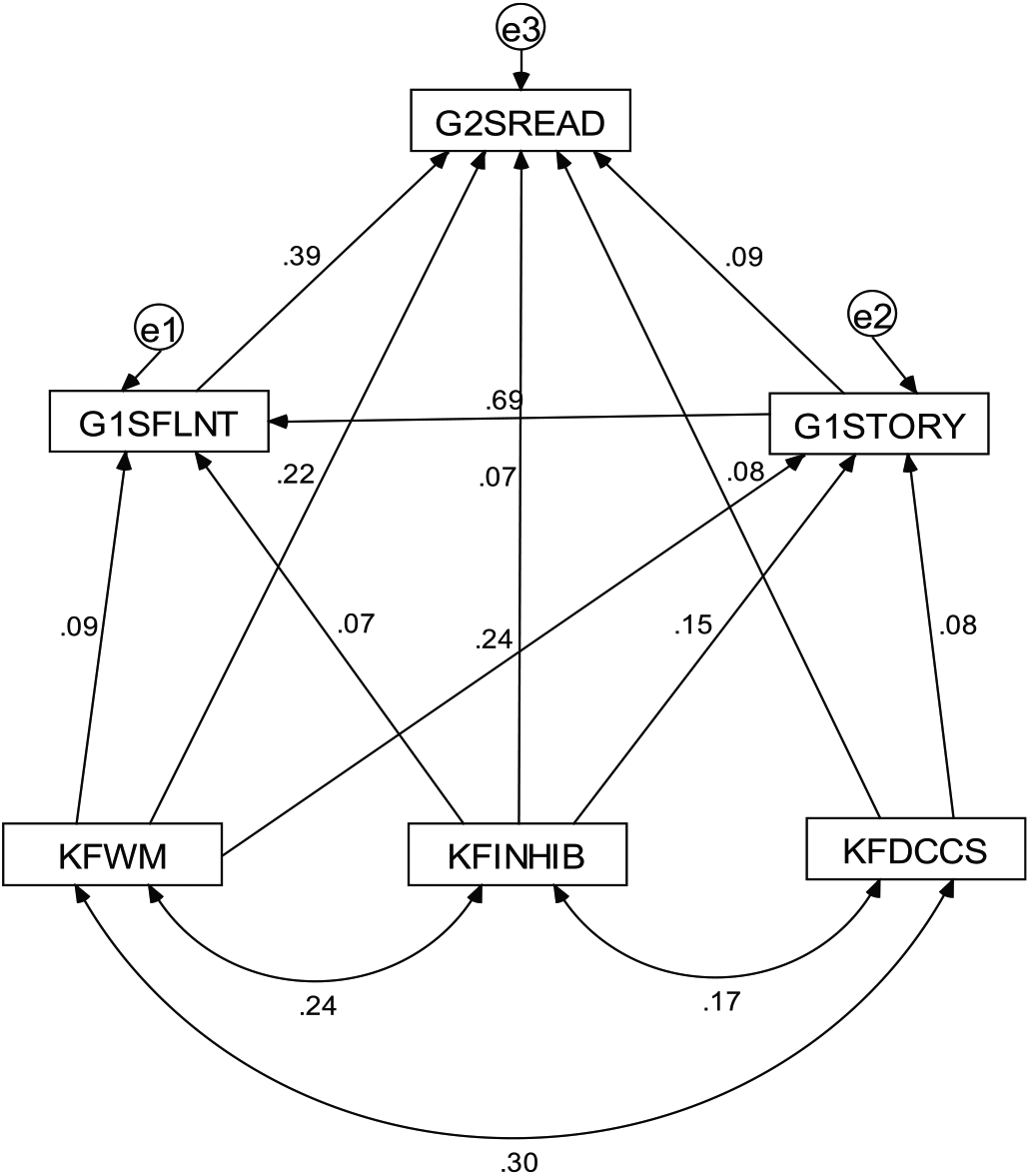
Final model depicting mediation effects of children’s first-grade reading skills between their executive function in kindergarten and second-grade reading achievement.
Standardized direct, indirect, and total effect effects.
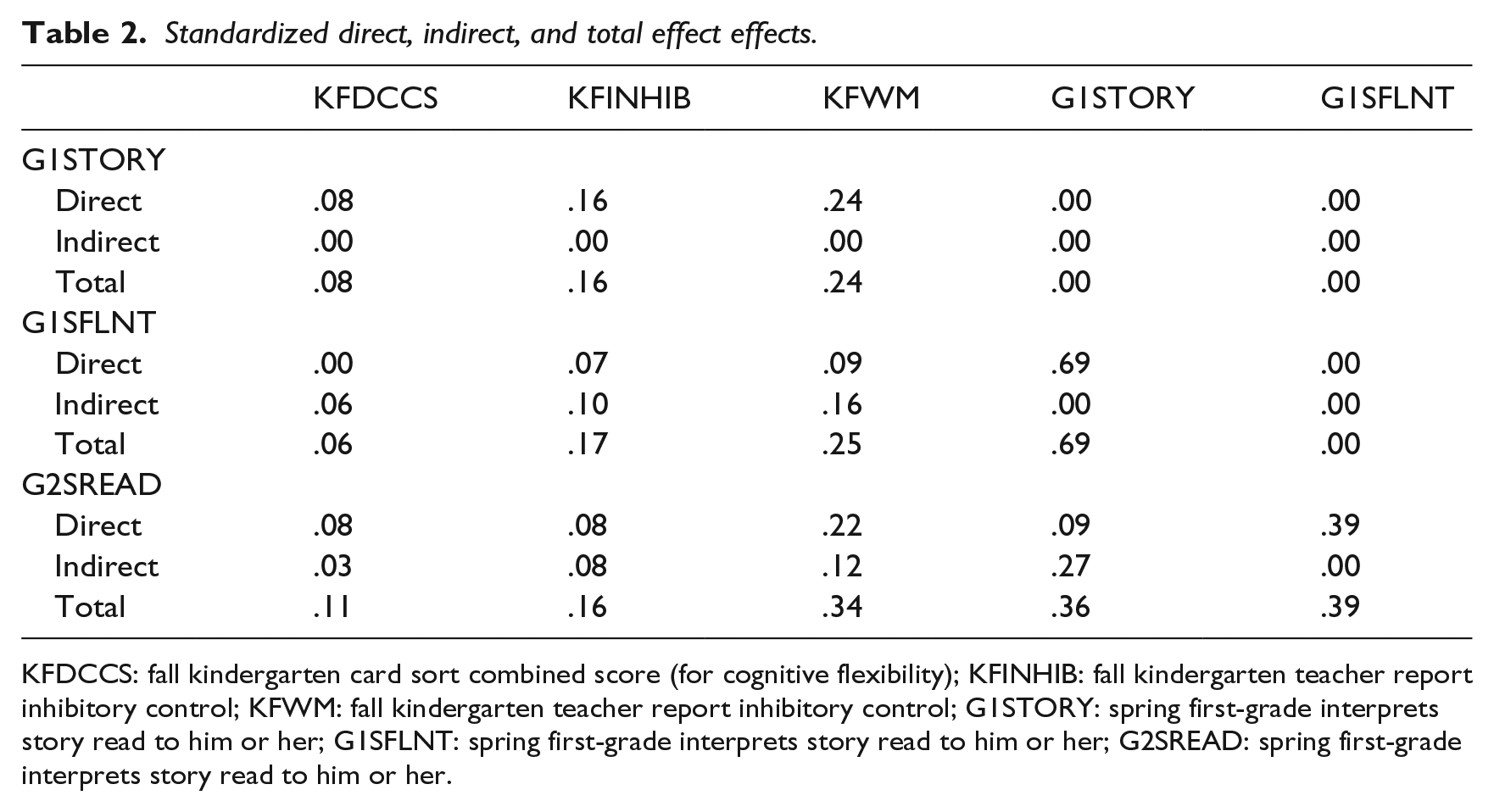
KFDCCS: fall kindergarten card sort combined score (for cognitive flexibility); KFINHIB: fall kindergarten teacher report inhibitory control; KFWM: fall kindergarten teacher report inhibitory control; G1STORY: spring first-grade interprets story read to him or her; G1SFLNT: spring first-grade interprets story read to him or her; G2SREAD: spring first-grade interprets story read to him or her.
Mediation (indirect) effects on second-grade reading achievement
Children’s first-grade language comprehension transmitted significant indirect effect from all three EF elements to their fluency (γs = .06, .11, and .16, respectively). Namely, the effect of children’s working memory measured in kindergarten on their first-grade reading fluency was transmitted through their language comprehension (γ = .16). The relation between a child’s inhibitory control and first-grade reading fluency was mediated by the child’s language comprehension skills (γ = .14). Furthermore, children’s first-grade reading fluency mediated all three core elements of EF on their second-grade reading achievement (γs = .03, .08, and .12, respectively).
In sum, all three core elements of EF measured in kindergarten contributed direct and indirect effects on their second-grade reading comprehension through their first-grade reading skill. While children’s first-grade reading fluency contributed the highest direct effect (γ = .39) to their second-grade reading comprehension, their language comprehension added the most indirect effects (γ = .27) to their second-grade reading comprehension to a total effect of .36. The standardized total effects of children’s cognitive flexibility, inhibitory control, and working memory on their second-grade reading achievement were γs = .11, .16, and .34, respectively. Children’s working memory accounted for the unique variance in their second-grade reading achievement. Also note that all three core components of EF were significantly correlated with each other, consistent with findings from Miyake and Friedman (2012) and Anderson (2002). Taken together, the inclusion of the mediation variables added approximately 23 percent to the explained variance in second-grade reading achievement. Overall, all variables included in the final model accounted for about 54 percent of the variance in children’s second-grade reading IRT scale score.
Discussion
The results from this study suggest that many factors are significant in accounting for variations in children’s reading comprehension scores. When looking into the influences on individual differences in reading comprehension, the results of this study are consistent with the prior literature suggesting that all three components of EF made unique contributions in explaining reading comprehension (Best et al., 2011). Correlations of four points of data collection on EF were significant (all significant at p < .001 level), indicating developmental stability, in line with Miyake and Friedman (2012). Consistent with the prior literature, working memory had the highest direct effect among those three elements of EF (Gerst et al., 2017; Swanson, 2000). Furthermore, this study found that working memory had the strongest total effects on reading comprehension among the EFs through two first-grade reading skills (i.e. mediation variables).
It is noteworthy that this study extends the prior work by exploring both direct and indirect effects of EF on reading comprehension and demonstrated that mediators, such as children’s language comprehension skill and fluency, are crucial contributors of the indirect effects of the EF to reading comprehension. Children’s language comprehension (e.g. being able to deduce the author’s intent behind the message and to consider the context) and reading fluency (e.g. constructing meaning and responding critically) were vital skills in transmitting EF to their reading comprehension. The results support the panel’s (2000) recommendation to use repeated reading procedures instead of promoting wide independent reading as a method to promoting fluency.
Roughly 54 percent of the variance in reading comprehension was accounted for in this study. While this is remarkable, it also suggests that other factors not examined in this study are likely essential for explaining variation in reading comprehension. Examining the direct and indirect effects and discovering dynamic mediators that can help transmit the EF effects to increase the total effects of EF on academic achievement is a valuable extension of existing work. Future work is needed to better examine the influence of additional factors in accounting for individual differences in reading and examining how these factors account for shared or unique variance in reading achievement. Findings from research tested on the ECLS-K: 2011 could inform parents, educators, policymakers, and the general public about children’s learning, social skills, and the priorities and ideologies of our society in the 2010s.
Teachers and parents can help to improve children’s listening comprehension by reading at a slower speed and asking children to explain what they think will happen next to see how well they have been listening. Listening comprehension, first developed in infancy before other skills (e.g. speaking, and reading), is one of the fundamental skills in language learning.
A fluent reader can identify words automatically, and therefore has the working memory space necessary to make inferences and comprehend the identified word(s) in their proper context. Inside classroom practice, teachers can give instruction on how to recognize words at the accuracy level and can allocate sufficient time and the encouragement so that children will practice these word recognition skills until they become automatic. While the teacher is giving directed reading instruction to one group of students, other students can be practicing repeated reading either on their own or with the assistance of others (e.g. volunteers). In addition, parents can help with repeated reading with their children at home.
The results of this study show that working memory strongly influences young children’s reading achievement. This may be because reading material in the primary grades often requires children to store information. In contrast, other types of EF (e.g. cognitive flexibility) may not be as critical during the primary grades. That might explain why cognitive flexibility did not have as strong effect as working memory in this study. Future studies could use quadratic growth curve modeling to examine the influence of working memory and cognitive flexibility on reading over time (longer than the current kindergarten through second-grade data).
Existing studies have shown that inhibitory control is a strong contributor to, or inseparable from, working memory in children aged between 4 and 9.5 years. In order to stay focused on tasks, individuals have to inhibit internal (e.g. mind-wandering) and external distractions (e.g. looking outside the windows) when the teacher is explaining a concept in class. The ECLS-K: 2011 collected working memory and cognitive flexibility scores through individual direct cognitive assessment, whereas the inhibitory control data were from teachers’ ratings, which might have been one of the major limitations of this study. The ECLS-K: 2011 could have collected inhibitory control data through a performance test, such as the Flanker inhibitory control and attention test, a measure of inhibition and visual attention by the National Institutes of Health Toolbox Cognitive Battery (NIH-TCB).
In sum, this study demonstrated the three aspects of EF measured in kindergarten, together with children’s language comprehension and reading fluency in first grade, which influenced their second-grade reading comprehension. Examining both direct and indirect effects of each variable on reading comprehension and how they work in collaboration provides a better understanding of children’s reading development. Future work is needed to explore other prospective mediation variables to expand our knowledge of how the combination of these factors with teacher’s instruction and parental involvement can influence subsequent reading comprehension success.
Footnotes
Declaration of conflicting interests
The author declared no potential conflicts of interest with respect to the research, authorship, and/or publication of this article.
Funding
The author received no financial support for the research, authorship, and/or publication of this article.